


Introduction
Atmospheric dust plays a very important role in the Earth’s climate system. It affects both the solar and terrestrial radiation by scattering and absorption, modifies cloud properties and the hydrological cycle, and influences tropospheric photochemistry (Reference AndreaeAndreae, 1996; Reference Ramanathan, Crutzen, Kiehl and RosenfeldRamanathan and others, 2001; Reference Kaufman, Tanré and BoucherKaufman and others, 2002; Reference Prospero and LambProspero and Lamb, 2003). Dust supplies to the ocean could have fertilized the biota and driven atmospheric CO2 lower (Reference MartinMartin and others, 1994; Reference Watson, Bakker, Ridgwell, Boyd and LawWatson and others, 2000; Reference RidgwellRidgwell, 2002). Thus, atmospheric dust is considered to be a significant climate-forcing factor. Atmospheric dust loading is related to terrestrial dust emissions. Dust storm frequency is a surrogate for dust emissions, and is very high in desert/deflated regions (Reference Engelstaedter, Kohfeld, Tegen and HarrisonEngelstaedter and others, 2003). The world’s major dust sources include North Africa, the Arabian Peninsula, central Asia and Australia. Reconstructions of the histories of dust storm frequencies in different regions, especially in the major dust source areas, can help us to understand the past variations in atmospheric dust loading and dust–climate interactions. Visible dust layers are usually formed on glaciers close to the source areas during the seasons in which dust events (including dust storms, blowing sand and floating dust) are most frequent. Ice cores from central Asia provide a unique way to reconstruct dust event frequencies (DEFs) in this region. In this paper, we will report the results of the reconstruction of DEF, and investigate the correlation between DEF and temperature, based on the record of the Malan ice core from the northern Tibetan Plateau.
Measurement Methodology
The Malan ice cap (35˚50’ N, 90˚40’ E), with an area of 195 km2 and a summit elevation of 6056 m, is located in the Kunlun Shan on the northern Tibetan Plateau (Fig. 1). Its lowest elevations are ∼5000 m on the north side, where the snowline varies between 5340 and 5440ma.s.l., and 5120 m on the south side, where the snowline varies between 5500 and 5540ma.s.l. In 1999, a 102 m ice core was drilled at 5680ma.s.l., where the 10 m borehole temperature was about −6.5˚C. The core was returned frozen to the Key Laboratory of Cryosphere and Environment of the Chinese Academy of Sciences, where δ18O was measured by gas stable-isotope-ratio mass spectrometry (MAT-252). The timescale was established using seasonal variations in δ18O for the upper part of this core (N. Reference Wang, Thompson, Davis, Mosley-Thompson, Yao and PuWang and others, 2003a, b) and a Nye model for the lower part (Wang and others, in press). A nearly 900year record of climatic and environmental changes can be reconstructed based on the Malan ice core (Wang and others, in press).
Location of the Malan ice-core site and distributions of deserts in central Asia. Spot elevations and contours in the right panel in m a.s.l. (contour interval 100 m). LIA: Little Ice Age.

Most studies have shown that southern Xinjiang, where the Taklimakan desert is located, is an area that experiences frequent dust events (Reference ZhouZhou, 2001; S. Reference Wang, Wang, Zhou, Shang, Yang and ZhaoWang and others, 2003). Considering that both southern Xingjiang and the northern Tibetan Plateau are dominated by westerlies, the Malan ice core is situated on the leeward side of this area of frequent dust-movement activity (see Fig. 1). This implies that the Malan ice core could preserve the information of past dust events. It is apparent that there is an abundance of visible yellow layers in the core, the thicknesses of which were measured for this study. To better understand the dust events recorded in the ice core, we collected data on such activity from meteorological stations in southern Xinjiang (Reference He, Yang and LiHe and others, 2003; S. Reference Wang, Wang, Zhou, Shang, Yang and ZhaoWang and others, 2003), and compared them with the ice-core record. With the time series of δ18O and dust events in the core, we can use statistical methods to construct the correlation between them.
Dust Ratio and Dust Event Frequency
Glacial dust layers can be formed by dust events and/or by the processes by which wind blows aerosols and/or debris from exposed hills surrounding a glacier onto its surface. For mountain glaciers with surfaces that are lower than the surrounding exposed hills, both processes can be relevant. However, for those glaciers with surfaces that are higher than the surrounding land, dust events are probably a more important factor for the formation of dust layers, especially those that are visible. The Malan ice-core drilling site is far from, and much higher than, the margins of the ice cap (see Fig. 1), so the formation of the visible yellow dust layers in the core should be attributed to dust events.
The positions of the dust layers with respect to the seasonal variations in δ18O (Fig. 2) indicate that most of the former appear in the spring. This suggests that dust events occur mainly during spring, which is consistent with observations for north China, including southern Xinjiang (Reference ZhouZhou, 2001; S. Reference Wang, Wang, Zhou, Shang, Yang and ZhaoWang and others, 2003). We can infer that dust layers in the Malan core are related to dust events, so we can use the former to reconstruct the record of the latter. The thicknesses of these layers vary at depth (Fig. 2), possibly because of variations in the DEF, accumulation rate and ice-layer thinning. Just as concentrations of melt layers in polar ice cores are indicators of past summer climate (Reference Herron, Herron and LangwayHerron and others, 1981; Reference Koerner and FisherKoerner and Fisher, 1990), the concentrations of the dust layers in the Malan ice core have the potential to characterize past DEF. Hence, we suggest that the ratio of the dust layer thickness to the ice thickness, i.e. the dust ratio, in a given time period can be used as a proxy for DEF.
The positions of the yellow dust layers (black bars) and the seasonal variations in δ18O (solid curves) at different depths in the Malan ice core. High values of δ18O represent summer, and low values represent winter. The years of ice at different depths are also displayed.

Figure 3 illustrates the variations in dust ratio in the Malan ice core and the frequency of dust events that occur in the spring in southern Xinjiang during the past 50 years (Reference He, Yang and LiHe and others, 2003). Their variations are obviously similar, and both display the same decreasing trend, which implies that the dust ratio can significantly reflect the DEF.
Comparison between the variations in dust ratio (5 year mean) in the Malan ice core (a) and frequency of dust events (including dust storms, blowing sand and floating dust) that occurred in spring in southern Xinjiang (b) in the past 50 years (Reference He, Yang and LiHe and others, 2003).

Based on the timescale of the Malan ice core, we reconstructed the variations in dust ratio since the 1130s (Fig. 4). Over this time, the ratio varies from a maximum of 69.3% (during periods of active dust events) to a minimum of 0% (during calm periods), with the average ratio being 29.5%. The longest active period lasted over one century, from the 1770s through the 1880s, and the longest calm period lasted 80 years, from the 1630s through the 1700s. From Figure 4, it can be seen that the general trend in the dust ratio has decreased during the most recent two centuries, implying that the DEF trend has also decreased.
Variations in dust ratio in the Malan ice core since the 1130s. The histogram represents the decadal averages of the time series, and the horizontal line is the average value (29.5%) over the entire period.

Correlation Between Dust Event Frequency and Air Temperature
A strong positive correlation was found between contemporaneous measurements of δ18O in precipitation samples and air temperatures from an array of meteorological stations over the northern Tibetan Plateau (Reference Yao, Thompson, Mosley-Thompson, Yang, Zhang and LinYao and others, 1996). This indicates that δ18O in ice cores from this region, such as those from the Malan ice cap, can be used as reasonable proxies for air temperature. Thus, we can investigate the correlation between DEF and air temperature based on the datasets of dust ratio and δ18O in this core.
Figure 5 shows the variations in decadal averages of dust ratios and δ18O. The correlation coefficient between them is –0.410, with a confidence level of 99.9%. In order to investigate their relationships on different timescales, we calculated the correlation coefficients based on different running averages of the 10 year means of the two parameters, i.e. the three-point running averages comprise the 30 year timescales, the five-point running averages comprise the 50 year timescales, etc. Figure 6 indicates that the correlation between the dust ratio and the δ18O becomes more significant at lower-frequency timescales. At centennial-scale resolutions, the correlation coefficient reaches –0.797, with a confidence level of 99%.
Variations in δ18O (a) and dust ratio (b) in the Malan ice core since the 1130s. The curves with symbols represent the decadal averages, and the smooth curves are their sixth-order regressions. The insert illustrates the correlation between dust ratio and δ18O.

Correlations between dust ratio and δ18O in the Malan ice core for different running averages.

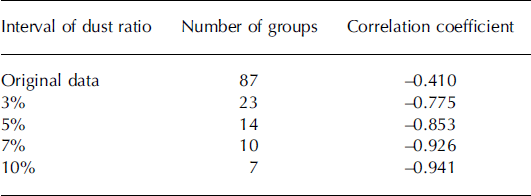
To better understand the frequency of dust events under different climatic conditions, we first divided the dust ratio and δ18O into groups based on the different intervals of dust ratio, then calculated the means of the dust ratio and δ18O in each group and finally computed their correlation coefficients. These were found to be strongly negative (Table 1), implying that dust events occur more frequently in cold periods than in warm periods.
Correlation coefficients between dust ratio and δ18O in the Malan ice core when the original data were divided into groups on the basis of the different intervals of the dust ratio. Interval of dust ratio in the first column is an equal interval by which the range of the dust ratio record, 0–69.3%, was divided into parts. In each part, there are a number of data of dust ratio and their corresponding data of δ18O, which form a group. Procedure for calculating correlation coefficients is given in the text. The confidence levels of all the correlation coefficients are 99.5%
Discussion
The correlation between dust events and climate revealed by the Malan ice-core record is consistent with results derived from other records. A study of Chinese historical documents illustrates that the ‘dust rain’ in eastern China occurred more frequently in cold weather (Reference ZhangZhang, 1982). Chinese loess studies also show that, in northern China, dust events have occurred more frequently and intensively in cold periods than in warm periods (Reference LiuLiu, 1985; Reference Lu and SunLu and Sun, 2000). However, it is also noted that ice-core records and historical documents describe these relationships at high resolutions of 101–102 years, while records from Chinese loess profiles are of much lower resolutions of 103–104 years.
At present, the causes of dust storms that occur in northern China are not clear. Some studies have pointed out that natural factors have been largely responsible for their occurrence (Reference YeYe and others, 2000; Reference Li, Wang and ZhongLi and others, 2004), but others have considered human factors (Reference SongSong, 2004; Reference Wei and ZhangWei and Zhang, 2004). All these conclusions were reached based on short-term observations. The Malan ice-core record provides long-term datasets, and indicates that there has been a strong negative correlation between the DEF and air temperature over the past nine centuries. This supports the hypothesis that natural forces might be the main control on the occurrence of dust events.
Recently, a study pointed out that dust cools the climate system (Reference Kaufman, Tanré, Dubovik, Karnieli and RemerKaufman and others, 2001). Our local results cannot be used as evidence that tropospheric dust loading forces climate cooling, even though we have demonstrated a significant negative correlation between the DEF and air temperature. However, the results presented here may suggest that dust loading could be a factor in a feedback mechanism that influences climate change, i.e. high dust loading in cold periods may reinforce climate cooling that is already underway.
Conclusions
Because dust events, i.e. dust storms, blowing sand and floating dust, influence not only climates but also inhabited environment, much attention has recently been paid to the study of these phenomena. In this paper, we extended the time series of dust ratios (a proxy for DEF) in the Malan ice core back to the early 12th century, and found that during this period dust events occurred most frequently in the 19th century. The Malan ice-core record also shows that there is a strong negative correlation between the DEF and air temperature over the past nine centuries, which suggests that climatic factors may be linked with the occurrence of dust events. This strong negative correlation could be explained by the following scenario: when climate cools, the westerlies are enhanced, which increases the frequency and magnitude of dust events, and sets up a feedback (Reference WangWang, 2005). Moreover, our results raise a question which should be studied in the future: has the atmospheric dust loading been decreasing as demonstrated for the Malan core site during the past two centuries? If so, temperature change resulting from the atmospheric dust burden must be estimated, so that the greenhouse temperature signal can be detected with greater confidence.
Acknowledgements
This research work is supported by the Centurial Program (2004401) and the Innovation Research Project (KZCX3-SW-339-3) of the Chinese Academy of Sciences, the Chinese National Science Foundation (40525001, 40121101) and the National Basic Research Program of China (2005CB422003). We thank two anonymous reviewers for their helpful suggestions and comments which greatly improved this paper.



