





Policy Significance Statement
As the United Kingdom (UK) prepares for the 2031 Census, the need for inclusive and conceptually robust gender data is increasingly urgent. High-quality sex-disaggregated statistics are essential for tracking gender equality and informing fair and effective policymaking. Yet, this paper shows that current systems often fail to capture the realities of women’s lives, particularly in areas such as unpaid care, income, and occupational segregation. Drawing on co-produced research with 170 participants across the UK four nations, we propose four practical recommendations spanning census reform and the wider reimagining of UK data systems: expanding the scope of the census to capture unpaid care and income; co-designing data with affected communities; mainstreaming gender across all statistical outputs; and developing a national gender data strategy rooted in feminist economics. Without such reforms, gendered inequalities will remain hidden in official data, limiting the UK’s ability to design equitable policies, meet its international gender equality commitments, and reflect the realities of women's lives in national statistics.
1. Introduction
Gender data gaps—the paucity of data designed and collected to capture gender inequalities and the social and cultural factors producing them—impair our capacity to identify and address systemic inequalities. They undermine global commitments including the United Nations (UN) Beijing Platform for Action and the Sustainable Development Goals (UN Women, 2018; Fischer et al., Reference Fischer, Cameron, Tilus, Espey and Badiee2025), with the UN estimating that less than half of the data needed to monitor SDG 5 Gender Equality are currently available (UN Women, 2022). Data are not neutral: they actively shape the social world by determining what is rendered visible, actionable, and amenable to policy intervention. Beyond reflecting inequalities, the absence of gender-sensitive data tends to reproduce them (UN Women, 2018; Criado Perez, Reference Criado Perez2019; Ahn et al., Reference Ahn, Choi and Seo2024). In the United Kingdom (UK), the Equality Act 2010 has catalysed improvements in collecting data disaggregated by protected characteristics, yet significant gaps remain (Schmid et al., Reference Schmid, Cook and Jones2023; Schmid et al., Reference Schmid, Onah, Humbert, Sojo and Cowper-Coles2025).
The national census, conducted once every 10 years by the Office for National Statistics (ONS) in England and Wales, the National Records of Scotland (NRS), and the Northern Ireland Statistics and Research Agency (NISRA), is among the most comprehensive sources of demographic data available, covering approximately 97% of households in England and Wales (ONS, 2022a), 88% in Scotland (Scotland’s Census, 2022), and 97% in Northern Ireland (NISRA, 2022). It provides the most detailed picture of a nation, counting and describing an entire population at a single moment in time.
With its near-universal coverage and capacity for disaggregated multivariate analysis, the census is a potentially powerful tool for feminist analysis (UN Women, 2018; Thackray et al., Reference Thackray, Hind and Schmid2023). Yet that potential remains underutilised: as we show in this paper, the census fails to collect income data, does not capture unpaid childcare, and aggregates women-dominated industries in ways that obscure consequential differences in pay, conditions, and career progression. The gaps limit the visibility of gendered inequalities and constrain gender budgeting strategies—public finance approaches that ensure resource allocation responds to diverse population needs—on which equitable policymaking depends (Elson, Reference Elson1998; Budlender and Hewitt, Reference Budlender and Hewitt2003).
This paper critically investigates the role of the UK census in capturing economic gender inequalities and examines how participatory methodologies, particularly co-production, can show user needs, reveal data blind spots, and contribute to the development of statistical systems that more accurately reflect the realities of women and marginalised groups. The analysis is guided by three research questions:
-
1. What are the strengths and limitations of UK census data for feminist analysis?
-
2. What new insights into gendered inequalities can emerge through feminist engagement with UK census data?
-
3. How can co-produced feminist approaches help reshape official data systems to better reflect the lived experiences of women and marginalised groups?
To address these questions, we conducted 12 participatory workshops across the UK, involving over 170 participants from local government, women’s organisations, grassroots groups, academia, and civil society. The workshops combined training on census tools with collaborative analysis and critical reflection on the capacities and constraints of national data systems.
This paper makes three contributions. First, it demonstrates that census data hold considerable potential for feminist analysis, realisable only through deliberate reshaping of data systems and practices. Second, it identifies entrenched measurement gaps, particularly around unpaid care, income, and occupational granularity, that hinder analysis of gendered economic inequalities and limit gender-responsive policymaking. Third, it shows that positioning people with lived experience as co-analysts produces statistical critiques that do not emerge from academic or policy organisations alone, putting the tools of statistical critique in the hands of those whose lives the data is meant to describe.
Underpinning these contributions is a central argument: that gender data gaps in the UK census are not technical oversights but structural and political choices reflecting deeper assumptions about whose labour, lives, and experiences are deemed worth measuring. The census is a site of political negotiation about what counts and what does not. We employ feminist participatory methods to make these choices visible and contestable and derive recommendations for reorienting official statistics towards greater accountability, inclusivity, and gender equality.
2. Background: Feminist epistemic critiques, gender statistics, and the need for participatory data
This section establishes the conceptual foundations of our analysis. We outline feminist critiques of data systems and introduce the concept of epistemic injustice (Fricker Reference Fricker2007) as the theoretical framework through which current gaps can be understood and examine the gender statistics frameworks that emerged in response. We then turn to the UK census as the specific instrument through which these demands might be met, assessing both its potential and structural limits, before considering how feminist participatory methods offer a means of addressing limitations in practice.
2.1. Feminist epistemology, data, and the politics of knowledge
Data systems are active participants in the reproduction of social structure rather than passive recorders of it. The categories they employ, the variables they include, and the populations they render visible or invisible reproduce or potentially challenge existing hierarchies of power (Criado Perez, Reference Criado Perez2019; D’Ignazio and Klein, Reference D’Ignazio and Klein2020). Feminist critiques of quantification challenge the notions of objectivity and neutrality embedded in traditional statistical methods, arguing that the power relations embedded in data design and generation have too often excluded women’s experiences from the knowledge systems that shape policy (Oakley, Reference Oakley1998; Walby, Reference Walby2001, Reference Walby2005). As Davis et al. (Reference Davis, Kingsbury and Merry2012) argue, data determine which phenomena are surfaced, whose experiences are prioritised, and which forms of knowledge are legitimised in public policy.
This is what Fricker (Reference Fricker2007) terms “epistemic injustice”: the systematic exclusion of certain speakers from credible participation in the production of knowledge. Fricker identifies two forms applicable to data systems. “Testimonial injustice” occurs when a speaker is assigned a credibility deficit based on their social identity. For example, when the testimony of carers, disabled people, or women in poverty is treated as atypical and anecdotal rather than analytical, while the views of credentialled experts are taken as authoritative with excess credibility. “Hermeneutical injustice” occurs when gaps in collective understanding and interpretive resources prevent people from rendering their experiences intelligible within dominant frameworks.
The UN System of National Accounts, for example, provides international guidance to national statistical offices on which data to collect and serves as the basis for determining Gross Domestic Product (GDP) measurement, yet it excludes unpaid caregiving, domestic labour, and volunteer work from its “production boundary.” This reflects a systematic privileging of market-based activity in policy discourse and data systems over the reproductive labour disproportionately performed by women (Benería, Reference Benería1999; Kabeer, Reference Kabeer2026; Waring, Reference Waring1989). Those who perform this labour cannot make its extent or consequences legible to the institutions that shape policy because the categories required to do so are systematically marginalised.
These dynamics are not confined to traditional statistical systems. As Faissner et al. (Reference Faissner, Lenk and Müller2025) argue, AI systems risk automating and scaling epistemic injustice, encoding androcentric assumptions about whose data and experiences matter into algorithmic processes that operate at speed and scale beyond conventional oversight. As AI and administrative data play an increasing role in the production of official statistics, the epistemological stakes of participatory data design are heightened.
These failures are compounded by the institutional conditions in which national statistics are produced. The UK ONS is currently facing a serious crisis that illustrates how epistemic injustice can become structurally embedded. A 2025 government-commissioned Devereux Review identified deep failures in budgeting, governance, and accountability. Key data sources relevant to understanding and addressing gender inequalities had their reliability questioned, including employment figures (Thwaites et al., Reference Thwaites, Cominetti and Slaughter2025), wealth estimates (Adam et al., Reference Adam, Delestre, Emmerson and Sturrock2025), and the gender pay gap (Forth et al., Reference Forth, Bryson, Phan, Ritchie, Singleton, Stokes and Whittard2026). In response, the ONS (2025a) has announced a refocusing on “core economic” statistics (including those measuring inflation, labour market participation, and GDP), while scaling back well-being statistics, reducing health surveys, and redirecting analytical resource from social policy to economic measurement. This move risks reinforcing precisely the market-oriented and androcentric vision of value that feminist critics have long challenged (Waring, Reference Waring1989).
2.2. Gender, sex, and gender statistics
Gender statistics emerged as a response to the androcentric bias in data and policy systems that renders invisible differences in lived experiences and material conditions shaped by gender and sex (United Nations, 1995; Mecatti et al., Reference Mecatti, Crippa and Farina2012). We understand sex to refer to biological characteristics, commonly categorised as female and male. Gender, by contrast, is a social and cultural construction of feminine and masculine roles that describes, prescribes, and proscribes norms, attitudes, and behaviours. As a structure, it organises social institutions, distributes resources, and shapes life chances at individual, interactional, and institutional levels (Connell, Reference Connell1987). As there is often, but not necessarily, an alignment between sex and gender, the binary categories of “women” and “men” are commonly relied upon in data collection, though gender identities and biological sex characteristics are often more varied than this implies (Guenther et al., Reference Guenther, Humbert and Kelan2018; Guyan, Reference Guyan2022).
While sex-disaggregated data are essential, gender statistics go further: their design, production, and use are grounded in concepts, definitions, and methodologies that explicitly aim to capture and explain gender roles, power relations, and evolving patterns of inequality (EIGE, 2025; Mecatti et al., Reference Mecatti, Crippa and Farina2012; UN DESA, 2016).
Gender statistics also aim to capture how gender intersects with other axes of structural disadvantage. Intersectionality, a concept rooted in Black feminist scholarship, foregrounds how these multiple axes combine to produce distinct and compounded forms of inequality that cannot be understood by examining any single dimension alone (Hill Collins and Bilge, Reference Hill Collins and Bilge2016; Yuval-Davis, Reference Yuval-Davis2006). In the UK, access to disaggregated, multivariate data is important given the legal duty of public bodies to assess how policies affect people across the nine protected characteristics under the Equality Act 2010: age, disability, gender reassignment, marriage and civil partnership, pregnancy and maternity, race, religion or belief, sex, and sexual orientation.
The latest UK census, apart from that in Northern Ireland, collected data on both sex and gender identity, though the guidance for how respondents should answer the sex question differed between England/Wales and Scotland. Additionally, voluntary questions on gender identity were introduced, allowing responses such as non-binary without requiring sex reassignment status, though this question, too, varied in formulation between nations (Guyan, Reference Guyan2022; ONS 2023a). The inclusion and formulation of these questions became the subject of considerable debate, centring on two key tensions: whether the sex question should capture biological sex or legal gender, and the extent to which self-identification provides a reliable basis for population-level data (see Fugard, Reference Fugard2020; Hines, Reference Hines2020; Sullivan, Reference Sullivan2020a, Reference Sullivan2020b; Collier and Cowan, Reference Collier and Cowan2022).
Ultimately, inconsistencies in question design led to the downgrading of gender identity statistics from “accredited official statistics” to “official statistics in development” (ONS, 2025b). In response, the Government Statistical Service (2024) is working to establish harmonised standards for the collection of both sex and gender identity data. This is an essential step towards the inclusive, intersectional data that gender statistics require, though only if the communities being surveyed are meaningfully involved in the co-production of questions rather than having categories imposed upon them (Collier and Cowan, Reference Collier and Cowan2022).
The downgrading of gender identity statistics reflected genuine methodological challenges in producing reliable population-level data for small populations, yet its consequences move beyond technicalities in determining which populations are counted, and therefore actionable, in public policy (Guyan, Reference Guyan2022). Survey design is a site of politics as much as methodology, and in this case reproduced the very hierarchies of knowledge that feminist epistemology seeks to challenge. Stevens and Doğan (Reference Stevens and Doğan2025) develop this argument through the concept of trans data epistemologies, foregrounding how transgender communities generate distinctive ways of knowing with and through data that challenge the binary frameworks dominant in official statistics. Their work reinforces the broader principle that data design reflects epistemological choices about whose frameworks of understanding are treated as authoritative and whose are rendered illegible.
Realising the potential of gender statistics to make marginalised populations visible, therefore, depends not only on better question design but on the quality and coverage of the instruments through which data are collected, of which the census remains one of the most powerful sources available.
2.3. The potential of UK census data
Population censuses are a foundational tool for country-level analysis, offering near-universal coverage that is especially valuable for examining marginalised groups (UN Women, 2018). Census data often serve as the sole source for disaggregated indicators by migration status, carer status, disability, race, ethnicity, and local area. Unlike sample surveys, which prohibit intersectional analyses and may exclude marginalised populations, the census’s near-universal coverage includes smaller and harder-to-reach groups, even if full inclusion is not guaranteed (Abbott and Compton, Reference Abbott, Compton, Tourangeau, Edwards, Johnson, Wolter and Bates2014).
The census provides a comprehensive snapshot of people and households across the UK, used by local authorities, government, businesses, voluntary organisations, and researchers to plan and fund public services, develop policy, and allocate resources. Tools such as the Gender Equality Index UK (Schmid et al., Reference Schmid, Onah, Humbert, Sojo and Cowper-Coles2025) demonstrate the value of applying census data to monitor subnational disparities in gender outcomes and inform place-based policy interventions, which is particularly important in the UK given high levels of geographic inequality (Davenport and Zaranko, Reference Davenport and Zaranko2020; McCann, Reference McCann2020). Other examples include Carers UK using census data to estimate the monetary contribution of unpaid carers to the economy and develop policy solutions (Petrillo et al., Reference Petrillo, Zhang and Bennett2024).
The 2021/2022 censuses also introduced flexible table builders, allowing users to define and construct their own datasets, enabling the kind of disaggregated multivariate analysis that headline statistics often foreclose and widening access to data beyond specialist researchers. Despite recent debates about replacing the census with linked administrative data (Royal Statistical Society, 2023), the UK government has commissioned a further census survey for 2031 (ONS, 2025c).
This is a welcome decision given that although administrative data are not without risk, even if it may offer cost and timeliness benefits. As Hand (Reference Hand2018) cautions, such data are not inherently representative or statistically sound, typically drawn from systems designed for operational rather than analytical purposes (e.g., tax records, benefits data, police logs) that reflect the design and exclusions of the services they stem from. This underscores the importance of retaining but improving the census through the participatory methods described below.
2.4. Participatory methods to redress epistemic injustices
Involving equality advocates, grassroots organisations, and individuals with lived experience of gender and intersecting inequalities can ensure that statistics more closely align with the priorities and needs of those the data are meant to serve (Kim, Reference Kim1997; Reid and Frisby, Reference Reid, Frisby, Reason and Bradbury2008; UN Women, 2018). There is growing international recognition of this potential. The UK Statistics Authority (2025) has highlighted user engagement as a key strategy for improving the value of statistics, and frameworks such as the UN Statistics Copenhagen Framework (2025) draw attention to co-produced “citizen data” as a means of addressing critical data gaps while embedding the perspectives of marginalised groups (Emandi et al., Reference Emandi, Chen, Encarnacion and Suchodolska2025).
This argument is also part of an emerging literature applying epistemic injustice theory to data systems. Haarman (Reference Haarman2021) contends that treating data as neutral and self-evident conceal the power relations embedded in its production and that intentional participation offers a means of contesting this. Stevens and Doğan (Reference Stevens and Doğan2025) extend this to trans communities, showing how participatory engagement can generate epistemological frameworks that official systems exclude. This paper contributes to this literature empirically, grounding theoretical claims about epistemic injustice in the concrete analytical work of those affected by data gaps.
Yet the persistence of exclusionary data practices despite this recognition is itself an expression of epistemic injustice: those whose knowledge is discounted are also least positioned to challenge the terms of their exclusion within institutional processes designed by and for credentialled experts. Participatory methods intervene at this point, generating the concepts, categories, and critiques that official systems are structurally unlikely to produce from within. This underpins the rationale for this research project and the delivery of census data workshops across the UK, through which participants identified data gaps, co-produced solutions, and built capacity for inclusive data use, as described in the following.
3. Methods: Evaluation of the census from a feminist perspective
To evaluate the census, we utilised a feminist participatory action research (FPAR) approach. Drawing on Reid and Frisby (Reference Reid, Frisby, Reason and Bradbury2008), this method integrates three critical strands of inquiry: feminist research, for its emphasis on critical theory and epistemological reflexivity; action research, for its focus on transformative social change; and participatory action research, for its recognition of the lived experiences.
3.1. Workshop design, delivery, and data analysis
We delivered 12 in-person, interactive data training workshops across England (Birmingham, Brighton, Bristol, Cambridge, London, Manchester, and Newcastle), Wales (Cardiff ), Scotland (Aberdeen and Glasgow), and Northern Ireland (Belfast and Derry). We engaged 170 participants with varying degrees of statistical knowledge, including representatives from local government, women’s and non-profit organisations, grassroots groups, academia, the private sector, and unaffiliated individuals. Sessions were designed as full-day events capped at 15 participants, enabling hands-on practical assistance with census tools and meaningful group discussion. Expenses covered travel, childcare, and other costs of attending.
Participants were recruited through the research team’s mailing lists and social media channels and through trusted institutional partners in each region whose existing relationships with local networks helped ensure participation from groups that might otherwise be excluded from academic or policy-facing research. The self-selecting nature of recruitment meant that participants came with an existing interest in gender equality and data, consistent with FPAR’s emphasis on engaging those with a stake in the issues under investigation.
In each session, participants received training on the Problem, Plan, Data, Analysis, Conclusion (PPDAC) cycle (Spiegelhalter, Reference Spiegelhalter2019), which emphasises that statistics begins and ends with the problem to be solved rather than the data itself. Participants first worked through the Problem and Plan stages, identifying their research questions and ideal data requirements, before being trained on using the census flexible table builders and creating basic data visualisations. Participants recorded their findings on a structured data collection form documenting their research questions, analytical steps, notable statistics, data gaps identified, and potential uses for their work. This form constituted the primary source of qualitative and quantitative data analysed in this paper.
Data from the structured collection forms were analysed using content analysis in NVivo, with coding conducted iteratively by one researcher through repeated engagement with the data and refined through feedback from colleagues. Themes were derived inductively from participant language rather than imposed through a pre-existing framework, allowing the categories and priorities that emerged to reflect participants’ own analytical vocabulary. This process generated both the gap taxonomy presented in Table 1, which preserves participants’ own formulations wherever possible, and the basis for selecting the three illustrative examples in Section 4.1, chosen to represent the themes that recurred with greatest frequency and consistency across workshops and nations.
Data gaps identified by workshop participants
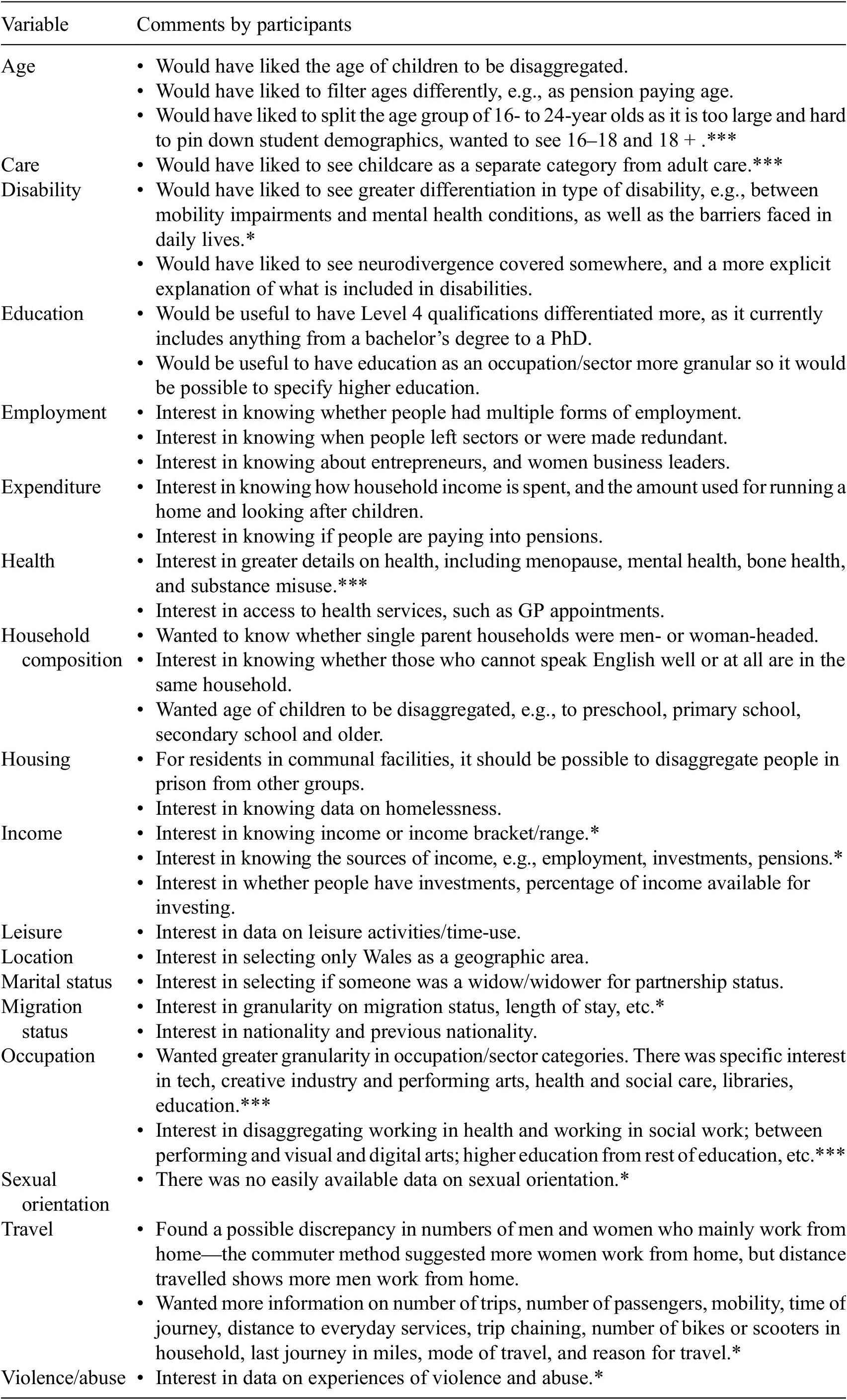
Table 1. Long description
Beginning at the top row, the left column lists variables and the right column details participant comments. Age: requests for disaggregated child ages, filtering by pension age, and splitting 16–24-year-olds. Care: desire to separate childcare from adult care. Disability: calls for differentiation between mobility and mental health, inclusion of neurodivergence, and clarification of disability types. Education: suggestions to distinguish Level 4 qualifications and specify higher education as a sector. Employment: interest in multiple jobs, sector exits, entrepreneurs, and women leaders. Expenditure: questions on household spending, child care costs, and pension contributions. Health: requests for more detail on menopause, mental health, bone health, substance misuse, and access to G P appointments. Household composition: interest in single parent gender, English proficiency within households, and child age breakdowns. Housing: desire to separate prison residents from other communal facilities and data on homelessness. Income: interest in income brackets, sources, investments, and investment percentages. Leisure: requests for leisure activity and time-use data. Location: interest in selecting Wales as a geographic area. Marital status: desire to identify widow/widower status. Migration status: requests for granularity, length of stay, nationality, and previous nationality. Occupation: calls for more detailed sector categories, especially tech, creative, health, libraries, education, and distinctions between performing/visual/digital arts and health/social work. Sexual orientation: noted lack of available data. Travel: discrepancy in work-from-home data by gender, requests for trip numbers, passengers, mobility, journey details, bikes/scooters, last journey, travel mode, and reasons. Violence/abuse: interest in data on experiences. Asterisks indicate points raised by multiple participants.
Note: *Asterisks represent points raised by multiple participants.
Follow-up surveys administered immediately after workshops and 6 months later were used primarily to track participants’ subsequent use of census data and self-reported confidence. The analysis was conducted by the research team; while participants functioned as co-analysts throughout the workshops, defining research questions, conducting census analyses, and identifying data gaps in their own terms, the subsequent thematic synthesis was researcher-led, drawing inductively on participant language and priorities.
3.2. Building trust, enabling participation
A foundational aim of this project was to redress the forms of epistemic injustice identified in Section 2.1, repositioning those whose knowledge is often discounted in official data processes as legitimate producers of statistical critique. The infrastructure needed to enable this kind of engagement remains underdeveloped for structural reasons. Statistical producers operate under significant resource and time constraints and are mandated to maintain objectivity across a wide and competing range of user needs; sustained engagement with communities of lived experience requires both institutional capacity and familiarity with the issues those communities face, neither of which can be assumed. Advocacy organisations rarely have the resources to participate in consultation processes that are lengthy, technically demanding, and jargon laden. Co-production offers one route through this impasse by creating bounded, supported conditions in which collective lived-experience knowledge can be translated into forms that statistical producers can engage with.
The workshops were co-designed and delivered by the Global Institute for Women’s Leadership (GIWL) at King’s College London and the Women’s Budget Group (WBG). Both institutions occupy positions within the same hierarchies of knowledge that this project sought to challenge; a reflection of the dynamics Fricker (Reference Fricker2007) describes, in which institutional credibility shapes whose knowledge counts in policy processes. Crucially, WBG’s sustained relationships with grassroots and women’s organisations across the UK, built through years of community-facing policy work, created the trust infrastructure through which many participants were reached. Academic credibility and community trust together produced conditions of engagement that neither institution could have generated alone.
The method, therefore, functioned as both a mode of inquiry and a direct response to the forms of epistemic injustice this project sought to redress. The co-produced data gap mapping challenges testimonial injustice by treating grassroots advocates and individuals with lived experience as credible producers of statistical critique. By generating new categories (for overlapping care responsibilities, income insecurity, and occupational invisibility, as discussed below), the workshops begin to address the hermeneutical gaps that official systems have not recognised as such, showing how feminist participatory approaches can shape both what is made visible in statistics and who gets to shape public knowledge.
3.3. Operationalising feminist participatory action research
The workshops were explicitly structured around the six dimensions of FPAR proposed by Reid and Frisby (Reference Reid, Frisby, Reason and Bradbury2008), with each informing both the design and delivery of sessions as outlined below. This participatory logic was reflected from the outset: rather than assigning research questions, the team invited participants to deliberate and determine the direction of their own analysis, identifying what they wanted to investigate, why it mattered to their work, and how they would approach it using the census tools.
The research team’s role was facilitative rather than directive throughout. At the close of each session, participants shared what they had found, and the challenges encountered including, critically, what the census could not show them. It was through this process that the data gaps documented in Section 4.2 emerged as the product of participants’ own analytical encounters with the limits of official data.
3.3.1. Centring gender and women’s diverse experiences
Participants’ lived experiences shaped both group discussions and the selection of key issues and census data for analysis, actively challenging assumptions about whose experiences, needs, and interests matter in data production and use.
3.3.2. Accounting for intersectionality
Training in the flexible table builder was explicitly oriented towards enabling intersectional analysis, moving beyond a singular notion of gender equality to engage with how gendered experiences are shaped by race, class, sexuality, disability, religion, and age. Participants co-identified, for instance, how statistical agencies’ groupings of LGBTQ+ people, combined with disclosure controls, limits the potential for evidence-based advocacy in this domain.
3.3.3. Honouring voice and difference
Workshops were promoted as suitable for all levels of statistical experience, with bursaries covering travel, accommodation, and childcare, recognising that financial barriers to participation are themselves a form of epistemic exclusion. Participants were contacted in advance to identify access needs. Within sessions, small group work was prioritised to make space for a wider range of voices, with groups sharing findings back to the plenary in lay terms to ensure accessibility across differing levels of data literacy.
3.3.4. Exploring new forms of representation
Participants contributed to the selection and analysis of data and were encouraged to communicate findings in formats meaningful to their networks. Each participant retained final agency over their own representation, with the option to share findings in anonymised, partially identifiable, or fully identifiable form.
3.3.5. Reflexivity
As two London-based institutions, we were acutely aware that concentrating the project in the capital would reproduce the epistemic bias we sought to challenge. We, therefore, designed the workshop programme to reach beyond London, targeting less well-served regions and ensuring coverage across all four UK nations. Bursaries addressed the financial barriers that would otherwise have excluded participants from more distant or under-resourced communities, shaping both who contributed to the findings and what gaps were identified.
3.3.6. Honouring diverse forms of action
The workshops were designed to reduce barriers caused by maths anxiety, introducing user-friendly frameworks like the PPDAC cycle and creating an inclusive environment in which participants felt confident engaging with statistics. By focusing on capacity building, the workshops empowered participants to deploy census data in whatever format best suited their own advocacy, campaigning, or policy work.
4. Results
The findings presented in this section draw on the insights gathered through the workshops and follow-up surveys. In keeping with the FPAR framework, participants occupied a dual role: as practitioners and advocates with lived knowledge and as co-analysts of census data who identified both its possibilities and its limits. Section 4.1 presents participant-led analyses illustrating how census data can surface gendered inequalities while simultaneously exposing the limits of existing statistical categories. Section 4.2 examines the structural silences participants identified most consistently, situating these within feminist economic critiques of what official data systems count, and how.
4.1. Participant analyses: What the census can show
Participants were invited to identify themes within the census most relevant to their work and conduct analyses in relation to those themes. This had a dual purpose: to demonstrate the analytical value of census data for feminist inquiry and to make visible, through the process of analysis itself, what the data cannot capture. These two functions are inseparable: it is only by working closely with census data that its structural omissions become legible.
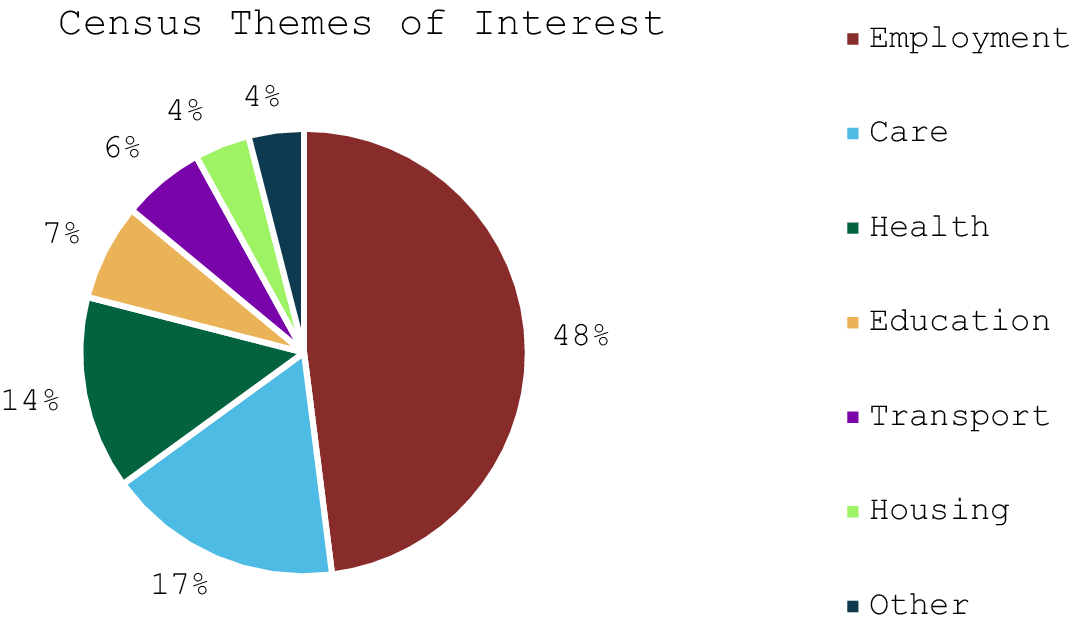
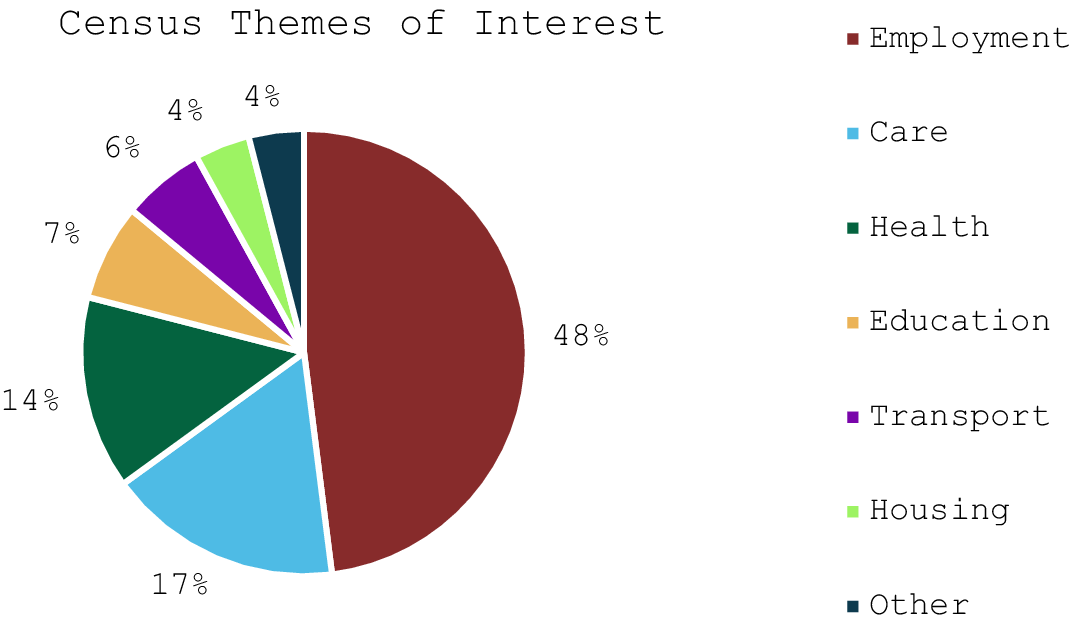
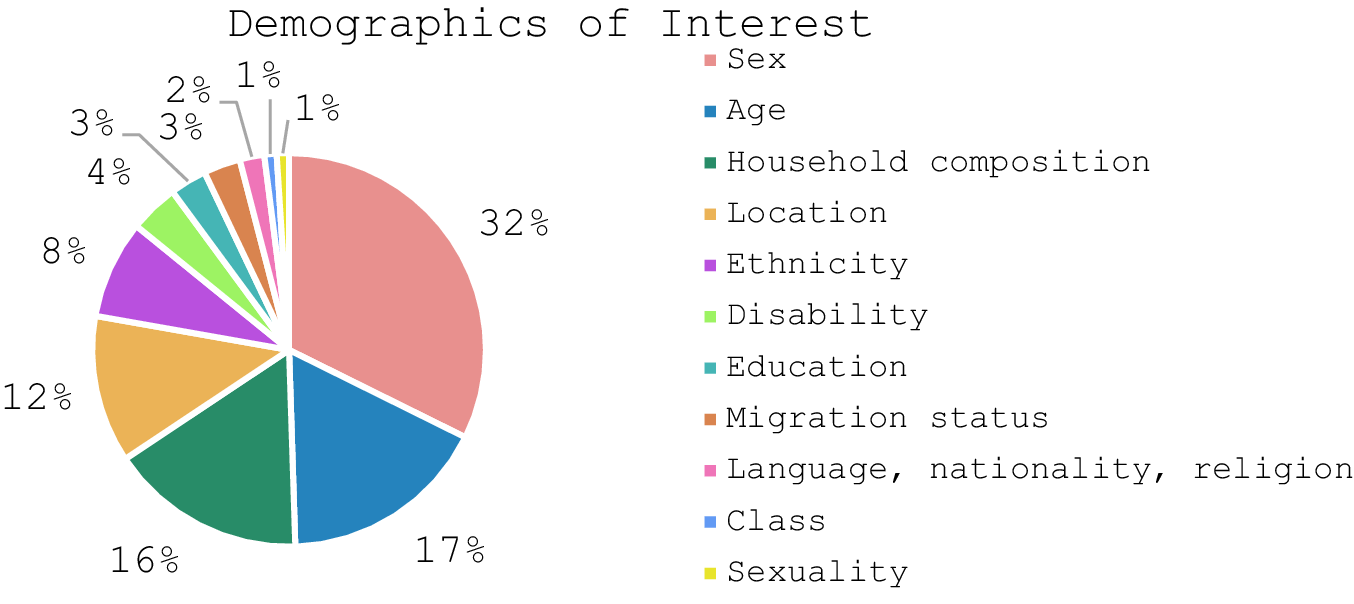
Participants’ priorities reflected long-standing feminist concerns with paid and unpaid work: employment (48%), care (17%), and health (14%) emerged as central themes (see Figure 1). Participants also emphasised intersecting characteristics including age (17%), family structure (16%), geography (12%), and ethnicity (8%) (see Figure 2), aligning with intersectional feminist frameworks that foreground the multiplicity and context-specificity of lived experience.
Participant-identified priority themes addressed through census-based analysis. Themes reflect only areas for which relevant census variables were available.
The demographic attributes of interest to workshop participants. Data from workshop feedback form.
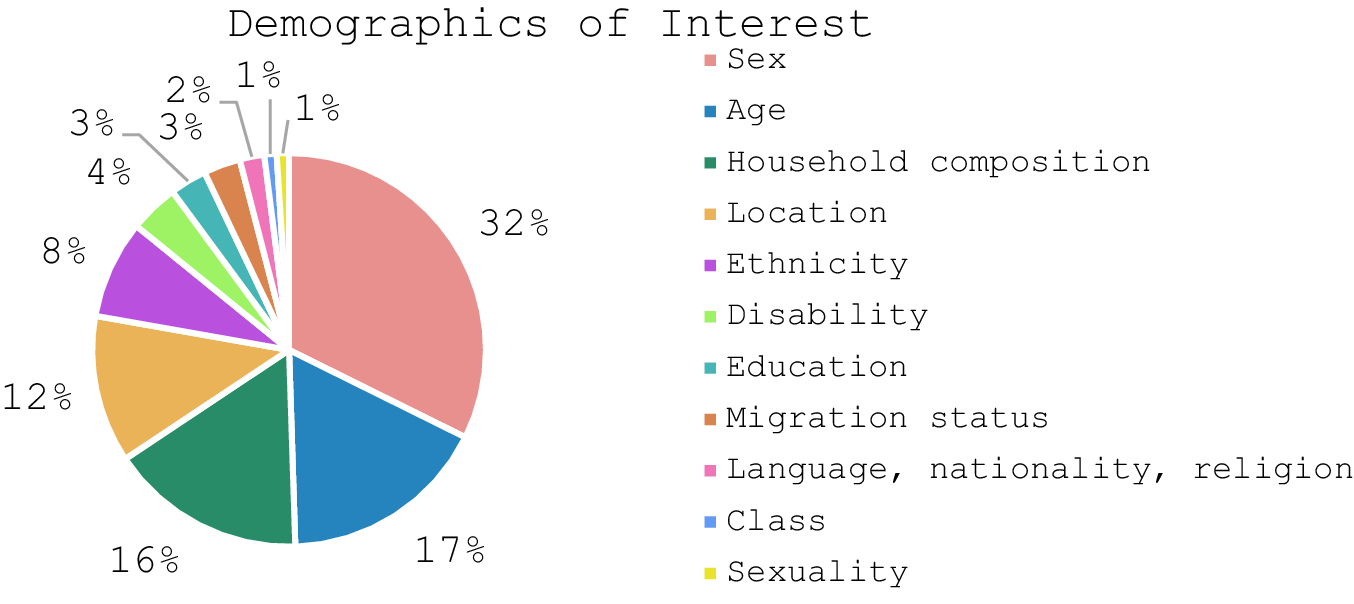
Figure 2. Long description
Starting at the top right and moving clockwise, the pie chart segments are as follows: sex 32 percent in pink, age 17 percent in blue, household composition 16 percent in green, location 12 percent in yellow-orange, ethnicity 8 percent in purple, disability 4 percent in light green, education 3 percent in light blue, migration status 3 percent in orange, language nationality religion 2 percent in brown, class 1 percent in gray, and sexuality 1 percent in light pink. Each segment is color-coded and corresponds to the legend on the right.
The themes in Figures 1 and 2 reflect only areas where participants could meaningfully engage with existing census variables; several additional priorities, particularly unpaid childcare intensity, overlapping care roles, and income security, could not be analysed using census data, examined in Section 4.2.
Next, we present three examples drawn from participant analyses, selected to demonstrate both how census data can reveal gendered patterns overlooked in headline statistics and where aggregations or conceptual omissions constrain these.
4.1.1. Example 1: The gendered burden of unpaid adult care
Participant analysis shows that women account for 59.2% of all carers in England and Wales. While this proportion declines in later life to 53.7% among carers aged 65 and over, women remain carers at every age, suggesting that any redistribution of care responsibilities with age is partial rather than substantive. Participants highlighted that this pattern raises important but currently unanswerable questions about overlapping care roles, particularly sandwich care, where individuals provide care for both children and adults simultaneously. The absence of census data on unpaid childcare and supervisory care prevents meaningful exploration of these dynamics, revealing a critical blind spot in how overlapping and intergenerational care roles are rendered invisible in official data.
4.1.2. Example 2: Economic invisibility of care at the local level
A local authority analysis in Nottingham illustrates how census classifications reproduce the economic invisibility of care. In this local authority alone, 3266 women who provide more than 50 hours of unpaid adult care per week are classified as economically inactive. Participants identified this as a clear example of how unpaid care is systematically excluded from economic definitions, reinforcing a policy narrative in which care is treated as non-work rather than essential social reproduction. The absence of complementary data on unpaid childcare further compounds this misrecognition, limiting the ability to assess how care responsibilities shape women’s labour market exclusion and economic insecurity (Sikirić, Reference Sikirić2021).
4.1.3. Example 3: How occupational classification conceals gender inequality
Participant analyses highlighted how gender inequality is produced through data categorisation itself. Over 900,000 people are employed in the census category of teaching and other educational professionals, of whom 69.1% are women; however, this classification spans from early years teachers to university lecturers, masking critical distinctions in qualification requirements and working conditions. Conversely, metal working machine operatives, plant and machine operatives, and construction operatives together employ approximately 290,000 people (93.0% men), yet they are afforded three distinct categories. That a workforce less than a third the size of the education sector receives greater occupational granularity reflects a systematic marginalisation of women-dominated sectors in national statistics.
These examples illustrate how participatory engagement with census data generates insights into gendered patterns of work, care, and economic activity while exposing the limits of existing statistical categories. In the following section, we examine the broader structural dimensions of these constraints.
4.2. Structural silences: What the census cannot show
Table 1 documents the full range of data gaps identified by participants across the 12 workshops. The scope of these requests, spanning income, care, occupation, health, migration status, and experiences of violence, maps what participants collectively understood a feminist-informed data system to require. Many gaps reflect not simply the absence of variables but a demand for greater granularity within existing categories: the ability to distinguish childcare from adult care, performing arts from visual arts, or higher education from the broader education sector.
Three themes recurred with particular frequency across workshops: the absence of income data, the aggregation of occupational classifications in feminised sectors, and the omission of unpaid childcare. These gaps resonate with long-standing feminist critiques of national accounting systems that have historically prioritised monetised, market-based activities while marginalising unpaid, reproductive, and care work.
4.2.1. Income invisibility and the politics of economic autonomy
Income data are central to understanding economic inequality yet are excluded from the 2021 UK census due to concerns about response rates and measurement accuracy (HM Government, 2018; Valet et al., Reference Valet, Adriaans and Liebig2019). Participants identified three distinct concerns. First, the complete absence of income data prevents analysis of gendered economic inequality at the local level. Without income measures, it is not possible to assess financial precarity or distributional inequality in relation to characteristics such as age, disability, ethnicity, or family structure. Second, the inability to distinguish between earnings, pensions, benefits, and investment income limits understanding of cumulative disadvantage, particularly for women whose lifetime earnings and pension entitlements are shaped by unpaid care and labour market interruptions (Women’s Budget Group, 2023, 2025). Third, without income linked to sex and other protected characteristics, it is difficult to examine compounded forms of economic inequality or design targeted interventions.
A related limitation affects many alternative income datasets: income is frequently measured at the household rather than individual level, obscuring intra-household inequalities by assuming equal access to shared resources; assumptions that mask gendered disparities in control over assets and financial decision-making (De Henau and Himmelweit, Reference De Henau and Himmelweit2013; Vijaya et al., Reference Vijaya, Lahoti and Swaminathan2014; Doss et al., Reference Doss, Kieran and Kilic2020). The ONS has begun developing experimental individual-level income estimates from administrative data (ONS 2022b), but these remain difficult to access. The Royal Statistical Society’s (2026) Poverty Data Gaps Explorer further underscores persistent limitations in UK income and wealth data and the need for approaches that recognise the gendered dimensions of poverty.
4.2.2. Industry and occupation aggregation and gendered distortions
Female-dominated sectors such as health, education, and care are grouped into broad categories under the UK Standard Industrial Classification, masking substantial variation in job roles, qualifications, pay levels, and working conditions. Historically male-dominated industries continue to be represented with greater occupational granularity despite their reduced economic prominence—an asymmetry feminist scholars argue reflects biases in which market-oriented and male-dominated sectors are treated as more analytically significant than feminised forms of labour (Bakker, Reference Bakker2007; Waring, Reference Waring1989). Broad categories obscure differences in job security, career progression, and exposure to precarity, particularly in public service and care sectors shaped by austerity and post-pandemic restructuring, flattening gendered patterns of disadvantage in exactly the evidence base policymakers rely on.
4.2.3. Unpaid work and the erasure of childcare
The most profound structural silence identified by participants is the census’s failure to measure unpaid childcare. While unpaid adult care is captured, the omission of childcare renders invisible a substantial sphere of social reproduction: the unpaid labour underpinning both the paid economy and the welfare state (Bakker, Reference Bakker2007; Hoskyns and Rai, Reference Hoskyns and Rai2007; Bhattacharya, Reference Bhattacharya2017; Women’s Budget Group, 2020). The ONS (2025d) estimates the combined value of unpaid child and adult care at 18% of GDP in 2023.
Participants also identified the census’s failure to distinguish active care from “supervisory care”: the responsibility of being on call to provide support, which incurs significant temporal and cognitive constraints even when not actively performed (Folbre and Yoon, Reference Folbre and Yoon2007; Folbre Reference Folbre2008, Reference Folbre2009). The absence of data on sandwich carers compounds this further: national estimates suggest around 2% of adults simultaneously care for children and older adults (McMunn et al., Reference McMunn, Xue, Di Gessa and Lacey2024), with women providing more hours of care over longer periods and being more likely to reduce working hours or exit the labour market entirely (McMunn et al. Reference McMunn, Bird, Webb and Sacker2019, Reference McMunn, Lacey and Webb2020).
The data gaps identified by participants reveal structural silences that systematically misrepresent gendered patterns of disadvantage in exactly the evidence base that policymakers use to design interventions and conduct Equality Impact Assessments. As Table 1 makes clear, participants’ vision of a feminist-informed data system extended well beyond the three themes examined here, spanning health, housing, migration status, and experiences of violence and abuse, among others. While not all of these are appropriately collected through a census instrument, their consistent appearance across workshops signals the scale of what current official data fails to capture about women’s lives.
Together, these silences obscure central aspects of women’s economic and social lives: the care they provide without pay, income inequalities that official systems fail to measure, and sectors in which their work is rendered analytically invisible. Each represents a form of hermeneutical injustice: those most affected lack statistical representation to make their experiences legible to the institutions that shape policy because the categories required to do so have been systematically withheld.
5. Discussion: Implications and recommendations for gender data reform
The findings presented in Section 4 reflect a pattern consistent with the feminist critique of quantification: that data systems organised around mainstream economic assumptions systematically render invisible the unpaid labour, income insecurity, and occupational precarity that characterise women’s economic lives. The absence of income data, the aggregation of feminised sectors, and the omission of childcare from the census are interconnected expressions of the same underlying logic that this paper’s participatory methodology has helped to surface, name, and begin to challenge. In what follows, we evaluate the implications of these findings for gender budgeting and SDG reporting, reflect on what the participatory methodology produced, and set out four recommendations for more equitable and inclusive gender data systems.
5.1. From data gaps to policy blind spots
The absence of income data, disaggregated occupational classifications, and comprehensive measures of unpaid care in the UK census reflects structural choices that constrain the visibility of gendered inequalities, undermining the ability of policymakers, researchers, and civil society to pursue gender budgeting and reform the labour market and welfare state towards greater gender equality.
Without reliable data on unpaid care, individual income, and occupational segregation, governments cannot accurately assess how policies affect different groups or design interventions that address entrenched structural inequalities. These gaps also weaken the UK’s capacity to meet its international obligations under UN SDG 5, particularly targets 5.4 on recognising and valuing unpaid care work and 5.c on adopting gender-responsive policies, and contribute to the UK’s comparatively weak performance on family policy indicators relative to peer nations (Gromada and Richardson, Reference Gromada and Richardson2021). These are the result of data infrastructures that fail to capture the realities of gendered lives, leaving gaps in the evidentiary base on which inclusive policy rests.
5.2. What participatory methods produced
By positioning grassroots advocates, local government practitioners, and individuals with lived experience as co-analysts rather than consultation subjects, the methodology surfaced gendered patterns that headline statistics conceal, generated a taxonomy of data gaps in participants’ own vocabulary, and produced proposals for reform grounded in the priorities of those the data is meant to serve.
The trust built through WBG’s sustained community relationships was essential: it enabled participation from groups that academic or policy institutions alone could not have reached and created conditions in which critique could be generated across differences of expertise, geography, and institutional power. What emerged was more than a list of missing variables and rather a collectively produced account of epistemic injustice in action, showing how the census’s structural silences are experienced, named, and contested by those who encounter them in their advocacy, work, and lives.
5.3. Recommendations for inclusive gender data systems
These four recommendations emerge directly from participant-identified gaps, grounded in feminist economic theory and timed for a critical moment, with the 2031 Census consultation already underway. The first two focus on census reform; the second two address the wider changes necessary to strengthen UK data systems to address intersecting gender inequalities.
5.3.1. Expand the scope of the census to capture gendered economic life
The census currently fails to measure several dimensions of women’s economic lives that participants identified as essential. Expanding its scope, within the constraints of a resource-intensive instrument requiring questions to be adequately tested and comparable across census cycles, is both necessary and achievable through the 2031 consultation process.
This should include capturing unpaid childcare and supervisory care as distinct from adult care and identifying sandwich carers, as well as including income data using broad bands (Donnelly and Pop-Eleches, Reference Donnelly and Pop-Eleches2018) or privacy-protected linkage to HMRC/DWP administrative records. It also requires a gender-sensitive review of employment data and improved occupational granularity in feminised sectors where broad categories obscure distinctions in role, responsibility, and pay.
5.3.2. Co-design data to rebuild trust and improve accessibility
Changing census questions is a lengthy, politically complex process, but meaningful participatory input is achievable through incremental steps: embedding civil society and grassroots voices into question development and consultation processes; co-producing accessible user guidance in multiple formats; and establishing permanent participatory mechanisms for interpreting and communicating census outputs. Embedding participatory practices enhances usability and rebuilds trust in official data (Daniore et al., Reference Daniore, Hurndall, Zavattaro, Leis and Gille2025)—an essential condition for the legitimacy of gender-responsive policymaking. As AI and administrative data play an increasing role in statistical production, the risks of automating and scaling epistemic injustice grow correspondingly (Faissner et al., Reference Faissner, Lenk and Müller2025). Establishing participatory methodologies as a counterweight is more urgent than ever.
5.3.3. Gender mainstreaming across statistical data products
Gender mainstreaming requires statistical agencies to embed a gender lens in analysis and presentation as well as data collection. The flexible table builders introduced in the 2021/2022 censuses marked an important step towards user-driven multivariate analysis, and this functionality should be extended across tools and outputs. All ONS, NISRA, and NRS data products should consistently include sex-disaggregated data, with multivariate analysis enabled as standard. The ONS’s (2023b) commitment to quarterly sex breakdowns should be applied systematically across all topic areas where disparities are plausible, including personal well-being, health, and personal finance.
5.3.4. Develop a national gender-sensitive data strategy
The cumulative gaps identified in this research cannot be addressed through piecemeal reform alone. A coordinated, cross-sector national gender data strategy is needed, outlining what multivariate data should be collected, how frequently, by whom, and for what purpose. Delivering it requires adequately resourced, credible statistical institutions: rebuilding the ONS’s capacity and mandate following the Devereux Review is a precondition rather than a separate ask.
The strategy should be grounded in feminist economics centring unpaid care, material inequality, and well-being with clear commitments to collect, disaggregate, and publish data by sex, gender identity, and intersecting protected characteristics. Developed in partnership with women’s organisations, gender researchers, and statistical agencies, it would provide a coherent framework for addressing gender data gaps across all areas of public policy, from employment and income to unpaid care and gender-based violence, ensuring it meets the UK’s legal and international obligations on gender equality and inclusive data governance.
Together, these recommendations can form the basis of a feminist reimagining of national data infrastructure, one that better reflects what people do, what sustains their lives, and how these are shaped by structural conditions of inequality.
6. Conclusion: Reimagining UK gender data
Gender data gaps reflect choices embedded in the design of data systems, shaping whose labour counts, whose experiences warrant measurement, and whose knowledge is treated as authoritative. This paper has examined those choices through the lens of the UK census, drawing on feminist economics, epistemic injustice theory, and participatory action research with over 170 participants across the UK's four nations to show both the potential and the limits of census data for making gender inequalities visible.
Three core insights emerge. First, the census’ potential for feminist analysis would be significantly strengthened through deliberate reshaping of its design and scope. Second, the gaps in measurement particularly around unpaid reproductive labour, income, and occupational granularity are interconnected expressions of an androcentric logic rather than isolated technical deficiencies. Third, embedding participation and reflexivity into statistical systems is necessary and demonstrably achievable: the findings of this study could not have been generated without the knowledge and analytical contributions of those whose lives the data are meant to describe.
In response, we propose four recommendations spanning census reform and the wider reimagining of UK data systems from expanding the scope of the census to capture unpaid care and income, to co-designing data, mainstreaming gender across all statistical outputs, and developing a national gender data strategy rooted in feminist economics.
Ultimately, the census is more than a statistical exercise. It is the most detailed picture a society draws of itself and in choosing what to count and what to omit it reflects national priorities, political imagination, and the lives and dimensions deemed worthy of seeing. Achieving a gender-equal data future requires more than technical reform, demanding instead a transformation in how we understand, govern, and democratise knowledge itself.
Data availability statement
The data that support the findings of this study are openly available from the Office for National Statistics (2022c), the Northern Ireland Statistics and Research Agency (2022), and Scotland’s Census (2024). The materials shared with participants, including census explainer and practical handouts used in the workshops, are publicly available on the WBG website.
Acknowledgements
We thank the 170 participants from across England, Wales, Scotland, and Northern Ireland who joined our workshop series, making this research possible. Further, we are grateful to our colleagues at the UK Data Service for their feedback on our proposed recommendations.
We wish to disclose that an earlier version of this work was published as a publicly accessible, non-peer-reviewed report via King’s Global Institute for Women’s Leadership on 25 September 2025 (Schmid et al., Reference Schmid, Cowper-Coles, Hamilton and Hind2025b). This short report summarised our project and findings from a non-academic perspective and was not subject to peer-review. The work was funded by the UKRI ESRC (ES/Z502753/1).
A Generative AI tool, namely Claude Sonnet 4.6, was used solely for the purpose of language editing and not for any data analysis or interpretation of findings.
Author contribution
Conceptualization-Lead: C.S.; Conceptualization-Supporting: L.H., M.C-C.; Data Curation-Lead: L.H.; Data Curation-Supporting: C.S., S.H., M.C-C.; Formal Analysis-Equal: S.H., L.H., M.C-C.; Formal Analysis-Lead: C.S.; Funding Acquisition-Lead: C.S.; Funding Acquisition-Supporting: M.C-C.; Investigation-Lead: C.S.; Investigation-Equal: S.H., L.H., M.C-C.; Methodology-Equal: L.H., M.C-C.; Methodology-Lead: C.S.; Methodology-Supporting: S.H.; Project Administration-Lead: S.H.; Project Administration-Supporting: C.S.; Resources-Equal: L.H.; Software-Lead: M.C-C.; Supervision-Equal: M.C-C.; Validation-Equal: C.S., S.H., L.H., M.C-C.; Visualization-Equal: C.S., S.H.; Writing – Original Draft-Lead: C.S.; Writing – Original Draft-Supporting: S.H., L.H., M.C-C.; Writing – Review & Editing-Equal: S.H., L.H., M.C-C.; Writing – Review & Editing-Lead: C.S.
Funding statement
This work was supported by the UKRI Economic and Social Research Council (ES/Z502753/1). The funder had no role in study design, data collection, analysis, decision to publish, or preparation of the manuscript.
Competing interests
The authors declare no competing interests.

 Open access


Comments
No Comments have been published for this article.