

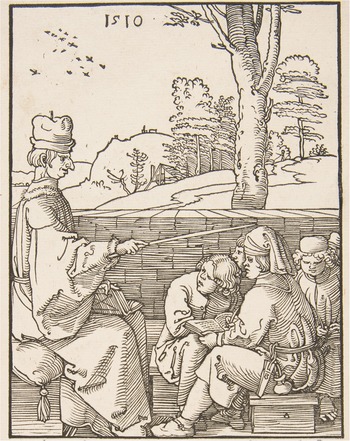
If we were to accept the iconography of the classroom at face value, we might think that the position of schoolmaster in medieval England was one of security and confidence. The dominant image of the teacher in the period, reproduced in seals, illuminations, and printed schoolbooks alike, is one of supreme self-assurance: it invariably depicts a figure unchallenged in his authority, a miniature sovereign ensconced in a throne-like cathedra, surrounded by deferential pupils, and wielding a rod or birch as a scepter (see Figure 1).Footnote 1 To some extent, this view is merited, since the growth of elementary and grammar education in the late Middle Ages is one of the period’s success stories. Nicholas Orme has documented the impressive spread of teaching between the twelfth and sixteenth centuries, finding evidence of at least four hundred venues across England, and Jo Ann Hoeppner Moran and Sylvia Thrupp suggest that in some areas of the country literacy levels might have been as high as 40 percent or even 50 percent by 1530.Footnote 2
Woodcut showing the schoolmaster as absolute ruler of his classroom, from Albrecht Dürer, “Wer recht bescheyden wol werden” (1510). Object number 21.64.1, Metropolitan Museum of Art, New York.

However, it does not take much probing to disturb this rosy picture. This is also a period in which the wages of teachers were demonstrably low, opportunities for social advancement few, and in which Thomas Elyot could state with little exaggeration that education might be improved “if the name of a schole maister were nat so moche had in contempte, and also if theyr labours with abundant salaries mought be requited.”Footnote 3 An especially powerful corrective is provided by fifteenth- and sixteenth-century legal discourse. When teachers appear in pleas and criminal prosecutions in the Middle Ages and early modern period, their voices are typically marked by frustration, anxiety, and failure, and not only shatter the assured image projected by visual culture but show how schoolmasters were subject to multiple intersecting forces. The central aim of this paper is to recover something of this alternative history. Following the leads of Sylvette Guilbert and Paul Grendler, who have used similar material to analyze teaching conditions in thirteenth-century Champagne and quattrocento Italy, it examines a series of suits and cases from late medieval and Tudor England, and originating from a range of courts and jurisdictions, in order to pinpoint the cultural and economic imperatives that governed masters and their conduct.Footnote 4 It tracks these factors across four main fronts, looking at masters in dispute with their communities, with the expectations of their profession, with their own social group, and finally with the larger political order. The essay makes no pretense to comprehensiveness in its treatment of legal documents mentioning schoolmasters; on the contrary, it offers a series of snapshots that show masters confronting significant checks on their authority or taking unorthodox measures to circumvent them. By examining the experiences of these deviant and occasionally desperate figures, it will bring into focus the hard economic realities of teaching in the period, whether they stemmed from material conditions or from the social ties teachers had to negotiate. As a whole, therefore, this inquiry intends to overturn the image of the medieval teacher as sovereign power, effectively toppling him from his cathedra.
Bad reputations: teachers and communities
Some of these forces can be glimpsed in vivid form in the representative case of John Legh, a master at Cromer, Norfolk, in the first half of the sixteenth century. Legh was one of the early teachers at the town’s free school, which had been founded in 1505 by Bartholomew Rede, goldsmith, former mayor of London, and master of the mint from 1492 to 1498.Footnote 5 Legh’s story comes to light in a bill of complaint he submitted to the court of chancery in the 1530s. Since it addresses Sir Thomas Audley as Lord Chancellor, but does not mention his later title Baron of Walden, it can plausibly be dated to somewhere between 1533 and 1538.Footnote 6 The document, which was likely composed by Legh himself, claims that he has been “openlye and sklanderously defamyd” throughout Cromer in a smear campaign orchestrated by one Stephen Sheppard.Footnote 7 At the core of these “fals, malycyent and evell” rumors is the allegation that Legh had been living “incontinently” with Margaret Robens, Sheppard’s wife, “in so muche that oon of the Children of the seyd Stephen shulde be like in symylitaid to your seid orator.” These whispers apparently began when Robens was forced to take refuge at her father’s house, where Legh himself was lodging, owing to the “stryff, debate and variaunce” between the couple; however, Legh also implies that she may have been sent with the express purpose of defaming him, by “the mayntenaunce, ayde, consorte and procurement” of Sheppard. At any rate, he is convinced that the gossip is designed to unseat him at Cromer by turning the court of public opinion against him. The rumors have been broadcast, he says, “to the entent by suche sklanderous report your seide orator shulde be enforsid to forsake his seid lyuynge and promocoyn”; worse still, Robens and Sheppard have already tried to secure the elevation of “some ffreynd of thers to the same lyuyng.” In fact, their plot seems to have borne some fruit already: Legh records that he has been “arrestid of felony and imprysoned … to appeare before the kynges justice at the nexte gaole delyure to be holdeyn at Thetford,” and frets that Sheppard’s “slaunderous Reports and wrongfull vexacoyn” will end in his “utter undoyng and impoverisseing.”Footnote 8 The plea ends with a request that the accused parties be brought before the court of chancery under subpoena.
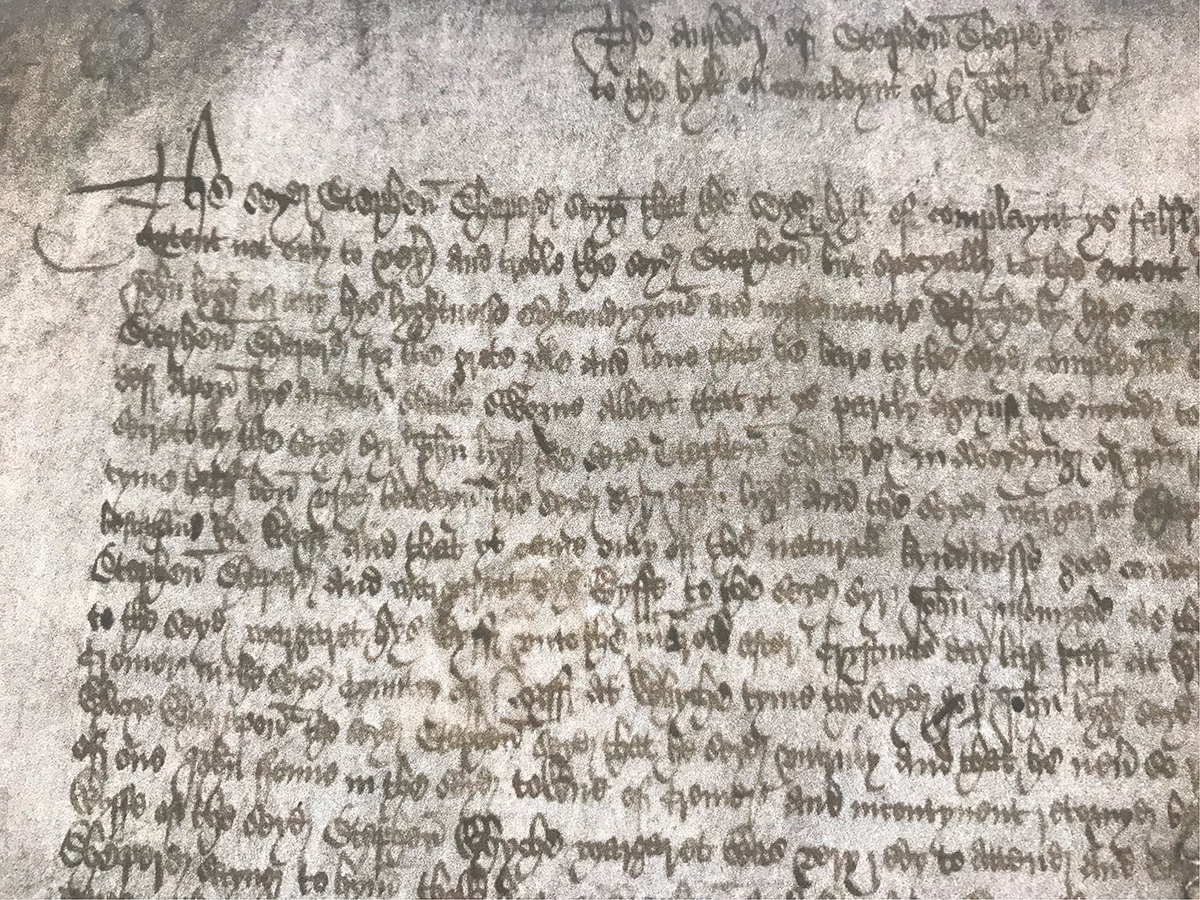
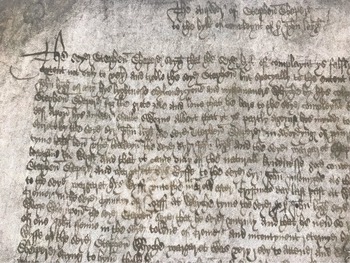
The court evidently took these allegations seriously enough to pursue them, since Sheppard’s official response to the plea also survives (Figure 2). Unsurprisingly, Sheppard denies being the ringleader of any plot against Legh and tries to turn the teacher’s accusations back against him. He argues that the bill is itself a vexatious suit, “sumyttyd of malice … to dryve the seyde Stephen to grete extremite”: indeed, he claims that Legh issued verbal threats against him to this effect, calling him “thow knaue, Stephen, and wreche” and threatening, “I wyll not leve the wyth a penny.” If there are rumors against Legh, he states, he played no part in disseminating them, only having learned of their existence from Legh himself. In another snippet of reported speech, he alleges that the teacher accosted him on “the morow after crystmas day last past” and angrily declared: “Thow wreched knaue and vylleyn, thy wife tellyth me that thou seyst that thy wyfe ys my whore.”Footnote 9 In short, although he confirms both the existence and substance of the rumors against Legh, he denies initiating them.
“Answer of Stephen Sheperd to the byll of complaynt of Sir John Leygh,” accusing Legh of “entent … to vex and troble the seyd Stephen.” C 1/845/39, National Archives. (Author’s photo).
The exchange is not only notable for its circumstantial color, but for the detail it brings to light about the general climate of teaching at the turn of the sixteenth century. A number of provocative inferences can be drawn from the complaint and its response. Foremost is the tantalizing possibility it raises of female involvement in formal education alongside and in support of male instructors: although there is some evidence of women teaching girls both in England and on the Continent, the fact that Sheppard describes Robens as “assistant … to the seyd Syr John” hints at her acting as something like a submaster in Cromer’s school.Footnote 10 There is even an odd indication of popular hostility toward teachers and the specialized knowledge they embodied: at one point Sheppard inveighs against Legh’s “colpable polycy, lernyng, and crafty conseyance,” conjuring an image of Legh exploiting his professional skills to entrap him. But over and above these points, what is particularly conspicuous about Legh’s case is the obvious precariousness of his authority as teacher. In particular, there is a sense of his reliance on moral reputation in order to exercise that authority. Whether or not the charges against him had any basis in reality, the simple fact of their acceptance and circulation in Cromer was apparently capable of jeopardizing his “provision,” leading not only to a crisis in his credibility as master, but also to the material penalties of arrest and potential loss of stipend. Legh appears, in effect, dependent on the judgment of the community in which he was operating in order to function as a teacher; once this turned against him, whether owing to deliberate malice or actual misconduct, his legitimacy was compromised, leaving him with little recourse beyond the last-ditch appeal to chancery. Even his attachment to the powerful company of goldsmiths was apparently unable to protect him against these conditions.
The Legh case therefore exposes an immediate site of pressure on the medieval master, making clear the importance of his personal standing in the community, and showing how suspicions of delinquency might compromise him. The same level of reliance is equally visible in later examples, although sometimes plays out in different ways. A comparable witness is the case of Francis Wiggington, “scolemaster of the free grammer schole of Blisworth,” Northamptonshire, who was investigated by the Star Chamber for his alleged “misdemeanors, insufficiencie and euill conuersacione” in November 1593, following the withdrawal of several students to the nearby village of Courteenhall.Footnote 11 After collecting thirteen depositions from concerned residents of the village, the Chamber, headed by the MP for Coventry Sir Bartholomew Tate, felt that the accusations merited further inquiry and drew up a list of eleven “interrogationes to be mynystered to certain witnesses.” Although the central nub of their investigation is Wiggington’s ability to run his school effectively, and whether “he useth littel diligence” in his post, it is striking how few of these “interrogationes” relate directly to his competency as master. Alongside such questions as “what number of Schollers dothe he teache,” and whether parents had been “constrayned to send their children to other schools out of their towne” owing to his “neclegence or misusage,” most concern his behavior within Blisworth at large: witnesses were asked whether they had heard of him frequenting “marketts” to “buy and sell cattle, corne and grasse,” whether he “hathe kepte a ferret” for hunting “connies” (rabbits), whether he “is a common haunter of Alehouses,” whether he has stolen “poles, Roddes or stickes” from private woodland, or “hathe cutt … divers trees” belonging to his neighbors, or sold “seates” from the schoolhouse, or “converted the same to his owne use to the greate defacing of the said scholehouse.”Footnote 12 It is only toward the end of this list that his conduct as a teacher resurfaces, when the Chamber inquires “whether do you know that the said Wiggington hathe been or is ignorant of his Schollers exceedinge in learning, as that when he was demanded by the father of one of his Schollers what booke his sonne lerned he could not telle him.”
The main point to emerge from these questions, therefore, is the impression that Wiggington was a social nuisance first and an incompetent teacher second, in line with the pedagogic theory of the period.Footnote 13 The bulk of the charges against him suggest that the chief issue was his inability to comport himself properly outside the schoolroom: his interference with his neighbors’ property, his spreading gossip, and his tendency to get “dronke” in public too frequently are the chief bones of contention. Again, there is some possibility that these charges were fabrications. In the first round of depositions one William Payne hints that personal animosity might have driven the initial complaints, pointing out that Thomas Andrewe, the lead deponent, “did fall out” with the teacher before any accusations were raised, and even “did beate and drawe bloud of the said Wiggington”; likewise, Wiggington’s own counter-questions show that he suspected willful sabotage, asking each witness whether he had any personal relationship with William Wake, schoolmaster at Courteenhall.Footnote 14 Yet what is beyond dispute is that Wiggington’s school was hemorrhaging boys, regardless of whether his “conversacion … hathe during alle the time afforsaid beene good.” As a result, the groundlessness or not of the charges is almost beside the point: his suspect behavior was apparently sufficient for parents to abandon him in favor of another master, despite the “greate charge and hinderaunce” this incurred.Footnote 15 Precisely like John Legh at Cromer, Wiggington’s case emphasizes the dependence of early modern teachers on their reputation within their communities. Rumor itself might draw sanction, either in the official form of inquests or arrest, or in the informal shape of parental boycotts.
Nonetheless, at points the flipside of these conditions comes into view. A different dimension can be seen in the dramatic case of another Elizabethan master, Thomas Ballard of Benenden, Kent. Ballard first appears at the Kent quarter sessions for August 1597, where he is mentioned in a series of three recognizances, or bonds for good behavior. These expressly identify him as “ludimagister” (schoolmaster), and record him exchanging oaths with Henry Williard and William Fagge, a yeoman and husbandman of the village, respectively, and swearing “that he would not himself cause, nor procure another to inflict, through himself or through others, any loss or injury to the aforementioned people … to their bodies through ambush, attack or any other means, so harming or disturbing the Queen’s peace.”Footnote 16 The recognizances do not disclose exactly what made such pledges necessary in the first place, and are generally conventional in language, although they do suggest that Ballard was the responsible party: the surety he stood to forfeit for breaking his bond was £66, compared with the £10 sureties imposed on Williard and Fagge. Whatever underlay them, these promises evidently did not curb Ballard’s behavior: five months later in January 1598 a warrant was issued for his arrest. The warrant accuses him of being “a disturber of hir majeste peace,” “a loose lyvere,” a “vexser of honestmen with ruinous suites” and “the like unlawfull misdemeannours,” before empowering the “constables and Borsholders in the county of Kent” to bring him to court.Footnote 17
The matter did not end there. In June 1598 an indictment was filed by Richard Glover, a parish constable who had tried to apprehend Ballard, complaining that Ballard had violently resisted arrest. The master had in fact attacked Glover with “a sword or a rapier” (“uno gladio sive a rapier”), slashing him “on the left part of his body” (“sinistra parte corporis”) and causing significant injury.Footnote 18 However, more interesting are two further indictments Glover filed on the same date, giving the names of several residents of Benenden and nearby villages. Those accused either actively impeded Glover or failed to assist him: he further complains that some of them even went so far as to “violently beat and unworthily manhandle” him as he attempted to discharge his duty.Footnote 19 More significantly, the names on the list do not appear to be the “loose lyuers” in whose company the warrant places Ballard, but a broad cross section of the village and its surrounding area. The figures Glover cites range from Edward Maplesten, “gent,” and Abraham Peckham, “yoman,” to Thomas Tolhurst, “blacksmyth,” and Abraham Peckham, “laborer.”Footnote 20 Similarly, those that actively assisted Ballard included Maplesten’s wife, Thomasina; Anne Sharpe, “Spynster”; Henricus Boden, “de Haveley in Essex laborer”; and Giliana Deene, wife of William Deene, “gent. of Rolvenden.”Footnote 21 There were apparently others present whose identities Glover did not know, since he refers to sundry “other offenders” (“aliis malefactoribus”).Footnote 22 It is therefore clear that Ballard was not acting alone but could rely on his neighbors to support him, even against an authorized officer of the law.
Ballard’s case therefore places the teacher in a different, less antagonistic relationship with his community, and shows how it might work to reinforce his position rather than jeopardize it. We cannot know what exactly motivated his neighbors to come to his aid. There is some faint indication that he might have been prized as an educator; the fact that women comprised over half of his defenders is suggestive, since it can be assumed that they had special interest in the welfare of the children at Benenden, likely being mothers and household managers themselves. Other allegiances are nonetheless possible, particularly because Ballard did not command unilateral loyalty from the village: it is worth recalling that his accusers came from the same group as his supporters, since his arrest warrant clearly stipulates that unnamed “pareshyoners … of Benenden” lodged the original complaints against him.Footnote 23 But what remains clear is that Ballard’s credibility was high enough to inspire a range of residents to assist him against arrest, even at the risk of their own prosecution. As a result, the Ballard affair emphasizes much the same point as Wiggington’s inquest and Legh’s suit, showing once again the reliance of the teacher on the perception of those among whom he lived. Although Ballard’s cachet was sufficiently high to turn his reputation to his advantage, the same dependencies and vulnerabilities are nonetheless apparent in his conflict with the authorities.
In sum, what unites all three of these cases is the sense that schoolmasters were much like the practitioners of any mid-ranking craft in the sixteenth century. There is little evidence that they enjoyed any exceptional security or dispensation on account of their profession or specialist knowledge. Individual masters were subject to many of the same imperatives Sylvia Thrupp and Barbara Hanawalt recognize as cornerstones of mercantile identity: they were reliant on their standing within their community in order to function effectively within it, susceptible to the pernicious influence of rumor, and largely powerless if the mood of their neighbors turned against them.Footnote 24 Even Thomas Ballard’s resistance to prosecution highlights this dependence, arising more from attitudes toward him in Benenden than any authority integral to his position. Much as Sarah Lynch and Mark Lewis Tizzoni observe, one of the chief determinants of a teacher’s status was evidently “the value their own community and culture placed” on their presence.Footnote 25 But alongside this point, the records also underscore the level of competition surrounding education in the period. Not only were teachers defensive of their prerogatives and territories, but teaching posts were clearly subject to powerful rivalries. At least, this is the readiest explanation Wiggington and Legh could find for the accusations against them, assuming that plots were being hatched by competitors intending to deprive them of their “provision” or pupils. Teaching was, in effect, situated in a free market economy, with several prospective masters contending for students or positions, in much the same way that artisans might compete for clients or contracts.
Badly beaten: discipline in the school
Social factors do not only affect a master’s ability to remain in his position, but at times penetrate the schoolroom itself. There is a small group of pleas that show similar forces directing aspects of teaching, and actively impressing themselves on its methodologies. In particular, the question of school discipline appears as a central concern across several records, where the master’s right to punish pupils as he saw fit proves a marked flash point. Sometimes the authorities simply sided with the master and confirmed his traditional power to beat students according to his judgment and his own sense of proportion.Footnote 26 One instance is a complaint lodged in 1390 at the Common Bench, in which Robert Eliot of Harnhill accused Robert Dryg of “assault and wounding” to damages of £20: in this case, Dryg simply pleaded that he was “the master of Robert … to teach him to sing and to read, and he had struck him with a rod for purposes of correction and learning,” an explanation which proved satisfactory to the court.Footnote 27
Other petitions, however, show more complex deliberations at work. The records of chancery preserve two appeals that place teachers in a far shakier position with regards to corporal punishment: that of John Roberdson, dating from Bishop Stillington’s tenure as chancellor between 1467 and 1473, and that of Thomas Fosse, “Scholemaister at Bristoll,” dating from 1485.Footnote 28 The two cases are remarkably similar in their basic outlines. Both are financial at root, both show a teacher in conflict with a wealthy and influential citizen, and both had been submitted to chancery after the appellant had been prosecuted in another jurisdiction. While Roberdson claims to have loaned “a certayn somme of money” to “oon William Skivmet of London, Goldsmyth,” father to one of his pupils, Fosse was seeking recompense for an unpaid fee from “John Peers of Bristoll, Marchaunt”; or, as Fosse puts it himself, “competente rewarde for hys dilygent labour” in teaching John’s son Thomas “his gramere till suche tyme as he has his perfecte congruete.” In each case, however, the debtor had deferred payment by using underhanded methods, at least in the eyes of the petitioner. Both Fosse and Roberdson had apparently been accused of beating their pupils to excess, and the fathers had used these charges to bring proceedings against them. Skivmet had “arand of trespas” against Roberdson “before the Sherife of London,” “suomyttyng that he shuld sore bete and smote a childe of his which he put unto your seid Orator to be lerned more than two yere agoo”: despite Roberdson pleading that he “neid hurt ne bete the seid childe, but as a childe aughte to be chastised for his lernyng,” he had not only been “arrested and kept … in pryson by the space of xii dayes” but had been placed under an alderman’s commandment, “by force of which he can not be taken to bayle.”Footnote 29 While Fosse had not reached the same legal and economic straits, he was convinced that his arrest and financial ruin were imminent. He complains that John Peers “of his very subtyle and untrue delyng” had also submitted an “action of trespass” against him, claiming that he “unressenable shuld bete and intrete his seid sone, to the hurte and damage of the seid John Peers of xl li [£40]”; since Peers was a prominent citizen of Bristol, if not “on of the cheif rewelerz of the seid towne,” Fosse was concerned that Peers might leverage his “power and substance” against him. He ends with a conventional entreaty for the chancellor to exercise his authority against Bristol’s “maire, Sheriff, and baillifez” in order to shield Fosse against impending prosecution.Footnote 30
These sources are subject to the usual problems attendant on depositions: much as Merridee Bailey notes, the facts are difficult to sift from the heightened emotional rhetoric that tends to pervade appeals of this kind.Footnote 31 Nevertheless, they signal that masters did not exercise undisputed power in matters of discipline, but were ruled by wider social influences and expectations.Footnote 32 In the first place, the records make clear that masters were required to act within recognized limits when inflicting punishment.Footnote 33 Central to the defenses of both Roberdson and Fosse is the claim that their correction respected established parameters: the former argues that he beat his pupil only as a child “aughte to be chastised,” and the latter asserts that his actions were guided by “ressen.” In either case, the teacher assumes the existence of broad norms regarding beating and seeks to place his practice firmly within those bounds. But these cases also make clear that teachers were usually not the arbiters of these limits and could not themselves define where the thresholds of acceptability might lie. The prosecution of the two masters emphasizes that fathers and wider communities might be chief dictators of appropriate and inappropriate punishment: the fact that Roberdson and Fosse had been or expected to be arrested for exceeding moderation, despite their protests to the contrary, highlights precisely who had the power to reach such judgments. Even if the masters were indeed the aggrieved party, as both claimed, it remains true that their use of corporal punishment was a vulnerability that parents might leverage against them, and that the right to characterize discipline as immoderate was not theirs. This point is borne out by the careers of subsequent masters: in 1587, for instance, John Depupp of Nottingham Free School was fined and dismissed from his post on the grounds “that he hathe abussed his skollers with suche unressonable correccion” after the city’s alderman sided against him and with the parents of his pupils.Footnote 34 Ultimately, the proper exercise of physical correction is another external demand with which teachers had to comply, and another hard limit on their authority.
Bad company: teachers as a social group
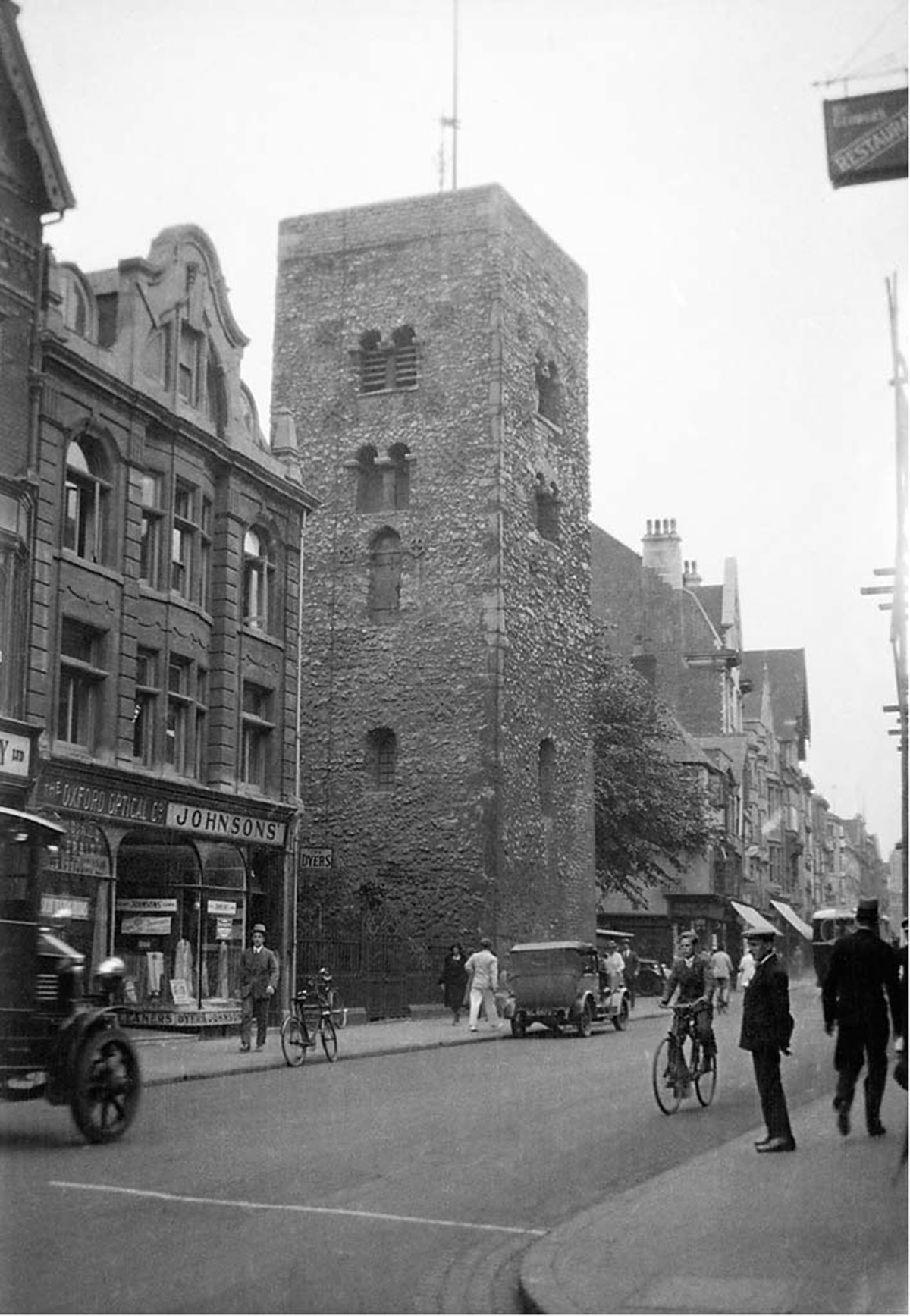
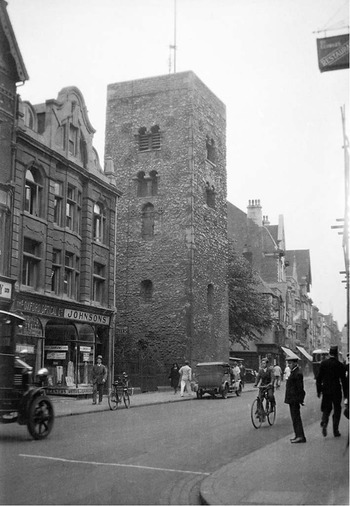
While we have so far seen teachers in conflict with their immediate neighbors, and with parents and their expectations, a third point of friction is the discord between teachers and figures of comparable social rank. One of the most suggestive of these cases is that of John Martyn, outlined in a memorandum from August 1450 in the register of Gilbert Kymer, chancellor of Oxford. Kymer’s entry for Sunday, August 9, states that Martyn, a “teacher of the parish of St Michael at the north gate of Oxford,” “seditiously gathered together a multitude of scholars [‘scolarii’], at the time that high mass was being said in the parish church of St. Michael” (see Figure 3). Although it is possible that “scolarii” might describe Martyn’s own pupils, a later note of 1453 accusing him of housebreaking and assault makes this unlikely, and suggests that his accomplices were fellow students or clerks at Oxford: Martyn is described here as “instructor of the very young [‘parvuli’] in the parish of St Michael at the north gate,” which would probably place his charges below the age of seven, when formal training in grammar theoretically began; his accomplices this time are also explicitly named as “Thomas Wolley priest” and “Richard Wrixham, canon of the church of St George.”Footnote 35 At any rate, with this band of supporters, Martyn entered the church and demanded that its priest William Street, then in the middle of mass, “strike out” a sentence of excommunication he had earlier placed against Martyn: if he refused to comply, Martyn swore that “he himself or else some of the others would drag him outside by their own hands or haul him out of his pulpit.” Things progressed no further, however, owing to the intervention of John Beek, general agent of the chancellor, who personally committed Martyn to prison. This intercession did little to defuse the situation: the memorandum continues, “On account of their youth the scholars, wickedly remaining in an abundant rabble, at the onset of night, marched on the prison of our lord the king,” apparently intent on freeing Martyn by force. Fortunately, this “insurrection” was “by the divine will peacefully put to rest,” and “certain principal agitators, perpetrators, and supporters of the same rebellion were imprisoned.” However much the registrar saw the hand of God at work here, it seems that Martyn himself was responsible for cooling down his followers. He agreed to be bound over to keep the “peace of the university” to the sum of 100 shillings and was duly released.Footnote 36
St. Michael at the North Gate, Oxford, scene of the confrontation between John Martyn and William Street. Photographed by Berit Wallenberg (1929). Swedish National Heritage Board.
Martyn is not the only example of a teacher committing violent crime. His attack on Street bears comparison to a later case from the 1532 quarter sessions at Nottingham. Here an indictment was issued for George Somers, “late of Notingham, scolemastar,” who had apparently attacked one “John Langton, chaplain” on June 17 “with club and daggers of malice aforethought,” and succeeded in “feloniously and wilfully murder[ing] him”: the document ends with the stark verdict, “We indyte the Skolle Mayster of welfulle murdar.”Footnote 37 An analogue (albeit less terminal) occurred in London in June 1494, when William Baker, “Scolemaister of the Abbey of Westminster,” was brought before the city aldermen on charges of “insult and affray upon Thomas Kyrkeham, drawing blood.” Baker was fined 3 shillings 4 pence for this assault, although Kyrkeham does not seem to have been a passive victim: he was also fined 12 pence in the same session for having “made assault upon the foresaid William Baker,” presumably either in self-defense or in retaliation for the initial “insult.”Footnote 38
Although we are told little about the circumstances leading to Langton’s murder, Kyrkeham’s injury, or the threats against Street, the same pattern is observable across all three cases. It is not only the identity of the aggressor that is consistent across them, but that of the victim as well, since each represents a teacher undertaking a violent assault on a priest. Street and Langton are of course explicitly identified as clerics, and it seems that Kyrkeham occupied a similar position. At least, a man by the same name appears in the records of London’s ecclesiastical court two years earlier, where he is identified as “vicar of Tottenham”; he may well have been unbeneficed at the time of his altercation with Baker, however, since the earlier record charges him with inciting a bribe to resign his parish to another man, having allegedly told his mark, “I am owte of Rayment: yf ye wyll lend me sum money to by me sum bettur gere, y wyll resyngn to yowr kynnysman.”Footnote 39 As a result, when read collectively, these cases seem to indicate some larger friction between masters and the lower ranks of the clergy, one that might readily boil over into verbal or physical aggression.
To make sense of this hostility, it is probably best to read it against the status of teachers themselves. Taken as a whole, schoolmasters appear to belong to an indeterminate group rather than comprising a firm and recognizable classification in their own right.Footnote 40 Sometimes this indeterminacy manifests itself in the confused vocabulary used to refer to them, which often drifts between social categories: while John Roberdson could call himself “Chapelyn” and “Prest” in his bill of complaint, for instance, one “Richard le Scolemaister,” who was injured by a gang of poachers in 1355, is merely described as a household “servant” to the Earl of Dunster.Footnote 41 More usually, however, the records and even teachers themselves describe their standing in noncommittal language, frequently using the term clerk to summarize their positions. Hence Legh calls himself “John Legh Clarke” while John Oxeford, the village schoolmaster who was caught up in an East Anglian pocket of the 1381 Rising, is listed as “clerk undermaster of the school at Clare” (“clericus hostiarius scole de Clare”) in the indictment that names him.Footnote 42 John Newsham, the Oxford master who apparently drowned himself in the river Charwell in 1301, was also described as “clerk and instructor of boys” (“clericus et doctor puerorum”) at the coroner’s inquest into his death.Footnote 43 As George Shuffleton in particular has noted, by the late Middle Ages clerk had grown into an expansive, even nebulous label: while it might apply to a member of the lower clergy, it could also conceivably denote “men who took minor orders … but whose marriages disqualified them from performing the sacraments,” “laymen who did jobs traditionally performed by clerics,” or “men who attended a university without obtaining a degree or taking up a position in the Church.”Footnote 44 Its recurrence across the records therefore positions teachers in a gray area on the outermost fringes of the clergy, where its lower ranks and functions shade into the laity.
The fact that teachers were identified—and identified themselves—with this marginal category goes some way toward explaining their conflict with fully-fledged members of the clergy. In the first place, it speaks to a certain expectation of advancement on the part of schoolmasters: as Patricia Coulstock has noted, many medieval teachers, especially unmarried ones, seem to have approached their trade not merely as an intermediate but a transitory one, considering it “a temporary and short-term expediency while waiting for a benefice.”Footnote 45 Some records allow this aspiration to be seen in action. One example is the case of Robert Goldsmyth at Westminster, who made the jump from “Servant and Submaster” to “presthode” in the 1450s without looking back; shortly after his promotion, his old master George Mortymer pleaded to chancery that he had lost contact with Goldsmyth and, more alarmingly, with the “certayn godes to the value of xx li [£20]” entrusted into his care.Footnote 46 At the same time, however, the fact that teaching was associated with the term “clerk” also points to a further reality. It reminds us that members of the secular clergy, or clerks in the traditional sense, could also serve as teachers, whether working on an informal basis or explicitly required to do so, like Jacob Affleck in the 1530s and the “honest secular prest … lerned in gramer and playn song” appointed at Blackburn in the 1510s.Footnote 47 In other words, just as ambitious teachers might be seeking, even expecting, elevation into the priesthood, so secular clerics operating at the lower levels of their profession might supplement their incomes by taking on pupils. As a result, the liminal position of schoolmasters goes some way toward explaining their clashes with secular priests. It is probably best to interpret these episodes as the result of internal tension within the same broad social group, rather than rivalry between two distinct factions: Somers, Baker, and Martyn were likely attacking men who were their direct competitors, obstructing their advancement on the one hand and vying with them for a limited clientele of students on the other. In sum, it is not too much of a stretch to see some form of professional rivalry animating these outbreaks of violence, something that would have been all the more acute in densely populated urban centers such as London, Oxford, and Nottingham.
Bad deal: teachers, pupils, and crime
In all that we have seen so far, it is clear that teachers in the late Middle Ages and early modern period were caught up in a complex nexus of relations like any other member of society, and that their position did not exempt them from the usual obligations, dependencies, transactions, conflicts, and jealousies governing practitioners of other mid-ranking crafts; reputation, communal norms, and territorialism are unifying factors across the records. Nevertheless, there are a handful of more eccentric cases that are harder to resolve into any broader pattern. One example of this order of crime is also one of the severest charges leveled against a teacher, Francis Philipp’s trial for treason against Henry VIII, an act “sprung from the malice and devilish provocation which gives duty little heed,” as the trial record states.Footnote 48 The case was heard by the commission of oyer and terminer in February 1524, before Chief Justice Sir John Fineux and a number of the leading lights of early modern jurisprudence, including John Fitzjames, Anthony Fitzherbert, and John More, father of Thomas. The case was in fact sufficiently notorious to be recalled several decades after its occurrence, as it is outlined in the chronicles of Edward Hall and Raphael Holinshed in the 1540s and 1580s.Footnote 49 In the trial documents Philipp is identified as “Scolemaister” of Greenwich, although he actually seems to have been master of the “hengestmanni” (henchmen), a group of boys in the royal household who served as pages on ceremonial occasions until the office was abolished under Elizabeth I.Footnote 50 Philipp appears to have been in Henry’s service in some capacity since at least 1517: he is, for instance, listed among the servants at a banquet held at Greenwich Palace in that year.Footnote 51 He might also be the unnamed “master” for whom “nine ells of linen for three shirts” were purchased at Richmond in 1510, although this might equally be a predecessor.Footnote 52 Regardless, in September 1522 his career in the royal service ground to a decisive halt when he masterminded a plot against Henry that involved three other members of the king’s household. The trial record names his accomplices as John Pykeryng, clerk of the larder, Anthony Maynvyle, “de London, Gent,” and Simon Dygby, one of Philipp’s own pupils and possibly a junior member of the Rutland family that fought against Richard III at Bosworth.Footnote 53
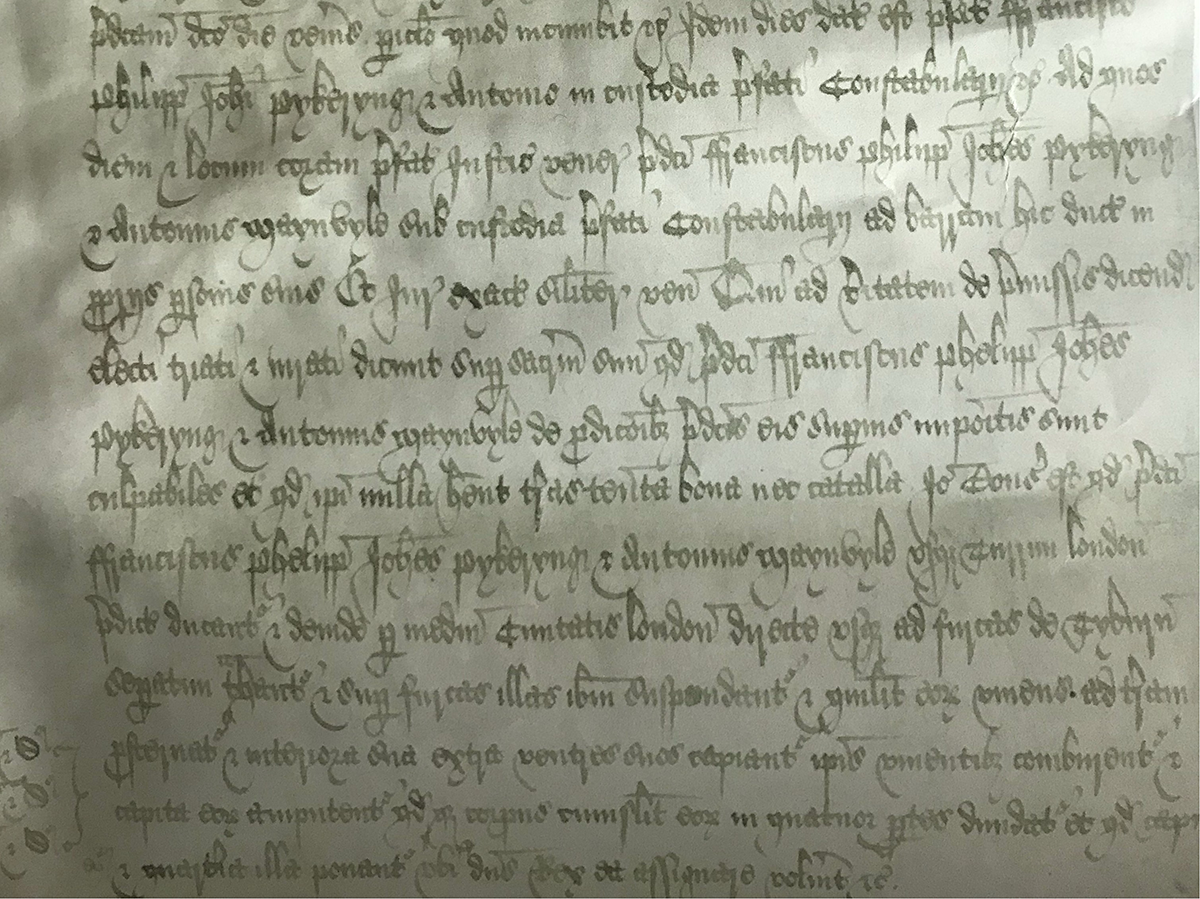
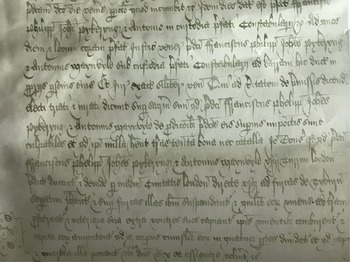
Since Philipp is named first throughout the proceedings, it is fair to assume that he was considered the driving force behind the plot. According to Hall’s account, Philipp and his co-conspirators planned to ambush one of the king’s officers and seize “the kynges treasure of his subsidie as the Collectors of the same came towarde London.” The group would then head for Coventry, where their theft would turn into full-scale insurrection: Philipp intended “to have araised men and taken the castle of Kylingworth, and then to have made battaile against the kyng.”Footnote 54 He was however apprehended at Coventry, suggesting that things progressed no further than robbery. Although Hall misrepresents a few minor details, the trial record largely bears out his version of events: while it concentrates chiefly on the seizure of “coins, goods and chattels” from “a faithful subject” (“depredandi et spoliandi fideles subditos … de denariis bonis et catallis suis”), its language signals how the court chose to interpret the affair. Philipp’s crimes are handled as a full-scale uprising against the king (“contra … regem”), committed by a gang of “rebels and destroyers” (“rebelles et perditores”) who were inspired by “evil intention and devilish instigation” (“malicia procogitata ac instigatos diabolica”) to “contempt of law and misprision” (“contemptu legis et misprisionis”). The final penalty paid by Philipp only reinforces this point (see Figure 4). He and the other conspirators were to be “dragged separately through the center of the city of London directly to the gibbets at Tyburn and there be hanged on those gibbets, and each of them laid on the ground alive, and their entrails drawn from their stomachs and burned beside their stomachs, and their heads cut off, and the body of each man divided into four parts, and the heads and quarters placed and displayed where the king chooses to set them.”Footnote 55 The only member of the group to escape this treatment was Dygby, the pupil Philipp had implicated in his plan, who fled overseas and was later pardoned.
Francis Philipp and his co-conspirators are sentenced to death “on the gibbets at Tyburn.” KB 9/492/2, f.2v., National Archives. (Author’s photo).
In many ways, it is difficult to treat this episode as a witness to the wider realities of late medieval teaching, given its unusual circumstances and the severity of the charges and penalties. Not only was Philipp exploiting an opportunity unavailable to most teachers, but he was operating in a relatively privileged context distinct from the more precarious positions occupied by his contemporaries. It is also difficult to speculate in any informed way about his motives, tempting though it might be to assign his actions to the same penury and lack of prospects that seem to have moved other teachers to criminal activity; the fact that he had remained in the same post for at least five years by the time of the robbery might imply some degree of exasperation or stagnancy. But for all this, Philipp’s crimes do contain some points of note. One of the most telling details is the ease with which he managed to insinuate Dygby into his plans, along with other junior members of the king’s household. It seems from these circumstances that Philipp’s chief relationships were with young men at Greenwich Palace. This feature serves as a salutary reminder of a point that hovers over many of the documents: that medieval teachers were likely to have been comparatively young themselves. Since they were often by definition at the start of an academic or ecclesiastical career, most would have been separated from their pupils only by a few years. Indeed, other records point to a similar level of youthfulness on the part of teachers: the same circumstance might also explain why the 1558 statutes of Witton Free Grammar School felt it necessary to mandate that no master should be “dissolute in manners, a drunkard, a whoremonger, or intangled with other occupation repugnant to his vocation, a dicer, or a common gamester.”Footnote 56 Philipp therefore gives us a further glimpse behind the iconography of the classroom, calling into question the paternalistic image of the teacher, much as the other sources cast doubt on the reach of his power.
Bad ending: conclusions
While the schoolmasters considered here are by necessity abnormal and isolated figures, their experiences lay bare a number of important points about the profession at the close of the Middle Ages and beyond. Most importantly, they offer an antidote to the picture that emerges in pedagogic discourse itself, of a figure ruling his classroom in serene and total authority. While one fifteenth-century master at Magdalen made his students state in their exercises, “I laboure and enforce as moche as I can to please the maister … for ther is no mann to whom I am more beholde to,” this view is clearly a fantasy with little resemblance to reality, much as some contemporary commentators admit.Footnote 57 The often pathetic figures discussed here were not all-powerful but subject to a dense network of forces, emanating from several centers: from their community and its sense of their reputation and moral character; from the fathers of their pupils and the expectations of proper conduct in the classroom, especially relating to the exercise of punishment; from their larger social group, whose activities might interfere with or obstruct their own ambitions; and from their own marginal and insecure social standing. Ultimately, what these cases offer is a picture of teaching as a commercial rather than high-minded venture, in which the master is more or less equivalent to any artisan or craftsman and compelled to stake out his claim in a crowded and fickle marketplace. In this respect, they also place another stereotype under strain, challenging the venerable idea that Renaissance humanism brought about a “spread of education” and new respect for the “revival of learning.”Footnote 58 On the contrary, the fifteenth- and sixteenth-century masters we have encountered here seem to be disempowered and vulnerable figures whose trade commanded no automatic prestige.
Disclosure Statement
The author has reported no competing interests.
Ben Parsons is Associate Professor at the University of Leicester. He has published widely on medieval and Renaissance culture, including the books Punishment and Medieval Education (2018), Two Middle English Prayer Cycles (2023) and Introducing Medieval Animal Names (2025). He would like to thank the Arts and Humanities Research Council (UK) for funding the research underpinning this paper, and HEQ’s reviewers for their invaluable recommendations.

 Open access

