

The artistry of the Middle Woodland period Hopewell culture rivals any in the North American archaeological record. A considerable quantity of Middle Woodland scholarship focuses on the extraordinary quantity and quality of material objects associated with this artistic tradition (e.g., Emerson et al. Reference Emerson, Hughes, Farnsworth, Wisseman and Hynes2005; Hill et al. Reference Hill, Seeman, Nolan and Dussubieux2018; Seeman Reference Seeman, Nassaney and Sassaman1995, Reference Seeman and Townsend2004; Squier and Davis Reference Squier and Davis1848:186–288; Struever and Houart Reference Struever, Houart and Wilmsen1972; as well as chapters in Carr Reference Carr2021; Carr and Case Reference Carr and Case2005). These durable material goods are often labeled as Hopewell items or Hopewell Interaction Sphere objects, but in the broader anthropological lexicon, they are craft products that “materialize ideology; construct social relationships; communicate status, affiliation and power; and mark differences between individuals” (Costin Reference Costin, Feinman and Price2001:274–275). Previous studies of these crafts have yielded numerous insights into Middle Woodland iconography and ideology (e.g., chapters in Carr Reference Carr2021; Carr and Case Reference Carr and Case2005; Reference Carr, Novotny, Hargrave, Schermer, Hedman and Lillie2015; Carr and Novoty Reference Carr, Novotny, Hargrave, Schermer, Hedman and Lillie2015; Giles Reference Giles2013). Yet, any attempt at a full understanding of these crafts must also include an understanding of their production (see Miller Reference Miller2015; Spielmann Reference Spielmann, Wells and McAnany2008, Reference Spielmann and Lynott2009; Wright and Loveland Reference Wright and Loveland2015). Numerous scholars emphasize the location and context of production as important parameters for understanding social, political, and ideological aspects of craft production more generally (Costin Reference Costin1991:11–13, Reference Costin and Wailes1996:212; Mehta et al. Reference Mehta, Abbott and Pevny2016:472). Craft production loci are identified by the presence of manufacturing tools and debris or the associated “permanent features,” such as kilns or workbenches (Costin Reference Costin, Feinman and Price2001:293–294). Identification of production loci can then inform the “relative dispersal or aggregation” of craft production commonly referred to as the “concentration of production” (Costin Reference Costin, Feinman and Price2001:295).
Our focus in this article is on one class of craft products—the modified animal and human teeth, jaws, and other bones that have been recovered from dozens of Middle Woodland sites across the Eastern Woodlands of North America (Baby Reference Baby1961a; Cobb Reference Cobb, Hargrave, Schermer, Hedman and Lillie2015; Farnsworth and Atwell Reference Farnsworth and Atwell2015; Farnsworth et al. Reference Farnsworth, Martin and Perri2015; Giles Reference Giles2013; Hoard Reference Hoard2021; Johnston Reference Johnston, Hargrave, Schermer, Hedman and Lillie2015; Kimball et al. Reference Kimball, Whyte and Crites2010; Mills Reference Mills1916; Nawrocki and Emanovsky Reference Nawrocki, Emanovsky, Hargrave, Schermer, Hedman and Lillie2015; Seeman Reference Seeman1988, Reference Seeman, Chacon and Dye2007; Shetrone Reference Shetrone1930). These modified bone objects are often found in association with human burials or caches/deposits at mounds and enclosures, especially in Ohio (Farnsworth et al. Reference Farnsworth, Martin and Perri2015; Seeman Reference Seeman, Chacon and Dye2007). These deposits reflect the important role of modified bone in burial ceremonialism, among many other ritual practices, but unequivocal evidence for their manufacturing loci has been difficult to discern. In this article, we present protein residue, lithic use-wear, and faunal evidence for the modification of bear—as well as possibly canid and human—bone at the Moorehead Circle timber post enclosure within the Fort Ancient Earthworks. In addition to adding to our understanding of the life history of these modified bone objects, pinpointing their place of manufacture adds to an understanding of the materiality of craft production in the Middle Woodland and small-scale societies more generally.
The Setting: Fort Ancient and the Moorehead Circle
Archaeological sites from the Middle Woodland period (ca. 50 BC–AD 400) in what is now southern Ohio contain the material remains of elaborate burial ceremonialism, monuments of soil and timber, and objects associated with extensive exchange networks associated with what many archaeologists refer to as Hopewell (Abrams Reference Abrams2009; Carr and Case Reference Carr and Case2005; Case and Carr Reference Case and Carr2008; Seeman Reference Seeman and Townsend2004, Reference Seeman, Redmond, Ruby and Burks2020). The largest Middle Woodland sites are earthen enclosures that were the center of periodic ceremonies and gatherings for dispersed populations. Fort Ancient (33WA2) is a hilltop earthwork enclosure of unparalleled monumentality, occupying some 40 ha of an upland peninsular landform situated along—and over 70 m above—the Little Miami River Valley.
Fort Ancient was one of the first earthworks to be recognized by Euro-American settlers during their eighteenth-century push into the Ohio Valley, and because of its setting and manner of construction, it was assumed for more than a century to have been a fortress. The US War Department undertook a measured survey of it in 1807, and the first published account of the site, complete with a plan, was an article in The Portfolio out of Philadelphia in 1809 (Sunderhaus Reference Sunderhaus, Connolly and Lepper2004). The awe-inspiring immensity of its construction ensured that it was featured in, and further publicized by, early published compilations of the antiquities of the new American West (e.g., Atwater Reference Atwater1820, Reference Atwater1833; Squier and Davis Reference Squier and Davis1848). By the late nineteenth century, it had been archaeologically investigated by Warren K. Moorehead (Reference Moorehead1890). Fort Ancient's embankments total more than 5.6 km (3.5 mi.) in total length, with heights ranging from about 1 m to more than 7 m (3 ft. to >23 ft.). Moorehead's excavations, and the book that he wrote about them (Reference Moorehead1890), were instrumental in convincing members of the Ohio state legislature to support the acquisition of the site between 1892 and 1908 as the first state park (Otto Reference Otto, Connolly and Lepper2004). After that, archaeological excavations were conducted sporadically in the twentieth century by William C. Mills (1900s), Richard Morgan and Holmes Ellis (1939–1940), Patricia Essenpreis (1980s), and Robert Connolly (1990s). A geophysical survey performed by Jarrod Burks in 2005 (Burks Reference Burks2006) was occasioned by the need to correct erosional problems in several of the embankments, which would involve trucking in tons of granite rock; the survey was meant to ensure that corrective efforts would not inadvertently impact previously undetected archaeological features. It was Burks's magnetic gradient survey that discovered the existence of the Moorehead Circle, which led to the Ohio History Connection's invitation to Riordan to undertake its archaeological investigation.
The Moorehead Circle is the name given to a circular complex approximately 60 m in diameter, on the perimeter of which once stood multiple rings of wooden posts (Figure 1). Timber post circles, sometimes called “woodhenges,” are known to have been located in—or externally affiliated with—several Hopewell enclosures, including Hopewell (Ruby Reference Ruby, Redmond, Burks and Ruby2019), Stubbs (Cowan and Genheimer Reference Cowan and Genheimer2010; Cowan and Sunderhaus Reference Cowan and Sunderhaus2002), Fort Hill (Sassaman Reference Sassaman1953), and possibly Seip (Spielmann and Burks Reference Spielmann and Burks2011).
Moorehead Circle plan map with excavation units and general location of ring of wooden posts (dashed line) indicated. Star on inset map shows location within Fort Ancient. Moorehead Circle plan map adapted from an image prepared by Jarrod Burks. Fort Ancient inset map based on 2007 GPS survey by Jarrod Burks and William Romain.
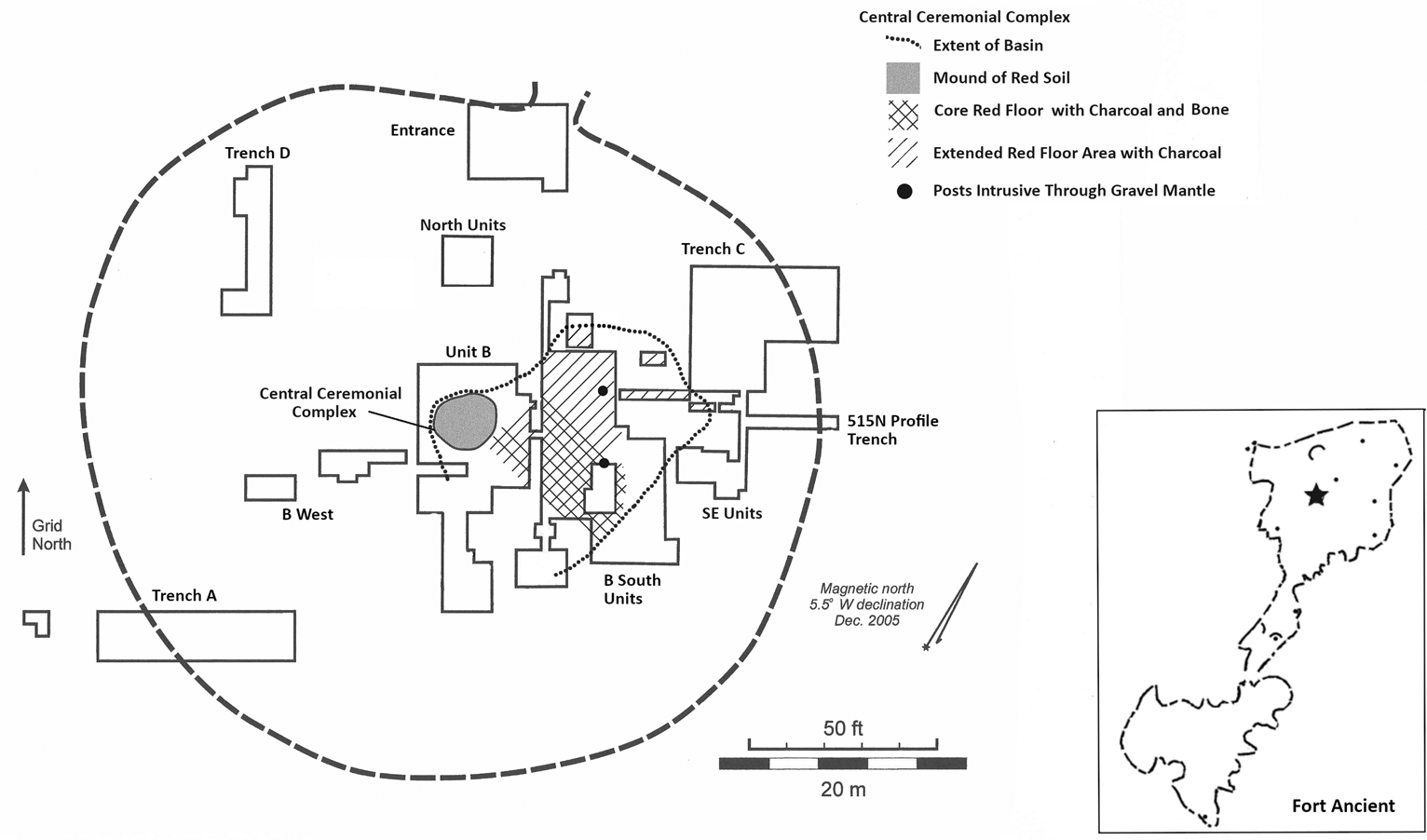
The investigation of the Moorehead Circle has determined that a portion of its landform was first modified with deposits of fill soil that were used to create a level platform, upon which the post rings were erected and a formal, paved entranceway was created. A large shallow basin was then dug in its interior to contain a ceremonial complex of features, including what is believed to have been a cremation facility (the “red floor”) connected to a 4 m diameter low mound of baked red soil (Figure 1, central ceremonial complex). In a future volume on the site, these features will be implicated with observances of the summer solstice sunrise. Over time, the basin was filled with thin strata of sandy and gravelly soils and lenses of charcoal, after which a new group of posts of undetermined purpose was erected on its surface. Sometime later, the entrance and the entire central ceremonial complex was covered by a substantial (10–20 cm thick) mantle of gravel. The gravel mantle therefore becomes a horizon marker in the stratigraphy of the site. Some post features were later dug through the gravel mantle, many of which are believed to be of Middle Woodland age. Two of them (Figure 1, posts intrusive through gravel mantle) were both large and deeply set (ca. 1.3–1.6 m deep), and they are thought to have likely been involved in a renewed use of the site for solstice observations before it was finally abandoned by the Hopewell (Riordan Reference Riordan, Redmond and Genheimer2015, Reference Riordan, Redmond, Burks and Rubyp2019).
The artifacts and ecofacts recovered from the Moorehead Circle include ceramics, chert flakes, cores, and tools (primarily bladelets but also scrapers, projectile points, and knives), mica fragments, some historic materials, animal bones, and plant remains from floated soil samples. Riordan (Reference Riordan, Redmond, Burks and Rubyp2019:41) did recover small bits of potential human remains on the red floor, arguing that they were residue from human bone bundles brought to Fort Ancient for cremation, but DNA analysis was inconclusive as to whether or not they are human. These elements were not included in the faunal analysis discussed herein. The type of stone tool most frequently recovered from Moorehead Circle archaeological contexts was the bladelet, including both whole specimens and fragmented pieces. Bladelets are markers for Middle Woodland Ohio Hopewell sites, and they are distinctive from core and blade traditions found during other time periods in the eastern Woodlands (Greber et al. Reference Greber, Davis and DuFresne1981; Miller Reference Miller2018a).
Although the total number of excavated bladelets from the Moorehead Circle is over 400, the subgroup of particular interest here was recovered during the final field season at the site in 2016 (Figure 1). The areas under excavation in 2016 included (1) units of the central ceremonial complex, (2) a group of excavation units to the southeast of the central complex (“southeastern units”), and (3) four contiguous 2 × 2 m units located a few meters north of the central complex (“north units”). In the following analysis, the distinction between the site's pre- and postgravel mantle periods is an important chronological consideration. The gravel mantle was present in all three of the above areas excavated in 2016.
Previous Studies of Bladelet Use at the Moorehead Circle
Previously published use-wear studies of bladelets from the Moorehead Circle indicate a high rate of bladelet utilization with a focus on soft tissue/meat (30%) and dry hide processing (25%), especially perforation, although many bladelets were also used on bone/antler (17%) and wood (17%; Miller Reference Miller2014, Reference Miller2015). Bladelets were handheld tools, given that none displayed evidence of hafting, and only 3% were used on more than one material (e.g., wood and hide; Miller Reference Miller2014). Bladelets can best be described as expedient tools because they typically display singular uses and were not hafted; many bladelets could be manufactured from a single core, and high rates of breakage would occur with their use on hard materials. Yet, the high proportion of bladelets used to perforate dry hide led Miller (Reference Miller2015) to argue that leather working was a central focus of craft production at the Moorehead Circle. However, Miller's studies were conducted while excavation of the Moorehead Circle was still ongoing (compare Miller Reference Miller2014:Figure 2 with this article's Figure 1), and several developments illustrate the impetus behind the present study. For one, subsequent excavations revealed the full extent of the complex stratigraphy in the central ceremonial complex and surrounding units (Riordan Reference Riordan, Redmond, Burks and Rubyp2019).
Additionally, in 2014, soil samples were systematically collected across the Moorehead Circle and some adjoining acreage for phosphate testing as part of Joshua Donaldson's (Reference Donaldson2016) master's thesis at Ball State University, under the direction of Kevin Nolan. Donaldson found concentrations of phosphates at several locations within the bounds of the Moorehead Circle, which caused Riordan to speculate about the relevance of similar types of analysis to further understand activities at the site. Specifically, he wondered whether one reason for the high frequency of bladelet fragments might have been their use in sacrificial bloodletting as a part of rituals conducted there (for evidence of bloodletters in central America, see Stemp et al. Reference Stemp, Peuramaki-Brown and Awe2019; Walton Reference Walton2021). This train of thought inspired the 2016 decision to collect bladelets in a manner that would leave open the possibility of testing them for blood protein residues. Prior to that year's work, the decision was made to not subject any recognized bladelet fragments to the usual process of being scrubbed clean in water prior to being cataloged. This was done specifically in hopes of preserving any residues of blood proteins that might have adhered to the tools during use. The total number of specimens preserved under this protocol was 35. Even though the following analysis of the bladelets did not directly support the human bloodletting possibility, it did serve to identify other species with which they had a functional connection.
Protein Residue Analysis
Available funding allowed for 35 bladelets and bladelet fragments from the 2016 excavations to be submitted to Archaeological Investigations Northwest Inc. (AINW) for protein residue analysis (Figure 2). Protein residues were identified via crossover immunoelectrophoresis (CIEP) by personnel at AINW. The CIEP process involves removing residues from artifacts and testing these against antisera from known animals, with those extracts (antigens) that react to antisera indicating the presence of proteins from relevant species. For quality control purposes, AINW tests for false positives from contaminants or extraneous proteins, and none of the samples in this analysis reacted with their control samples. Similarly, positive results were confirmed by repeat analysis of the CIEP procedures. The samples submitted to AINW were tested against deer, dog, bear, and human antisera. These particular antisera were originally selected to test the hypothesis of human bloodletting against an alternative hypothesis that bladelets would have been used on the most common species in the faunal assemblage—white-tailed deer. Dog and bear were selected due to the prevalence of these modified remains at the Moorehead Circle and Middle Woodland sites more generally. Finally, on a practical note, testing four antisera on 35 bladelets was all that the project budget allowed.
Bladelets submitted for protein residue analysis. Artifact numbers are given for those with positive reactions to the antisera. (Color online)
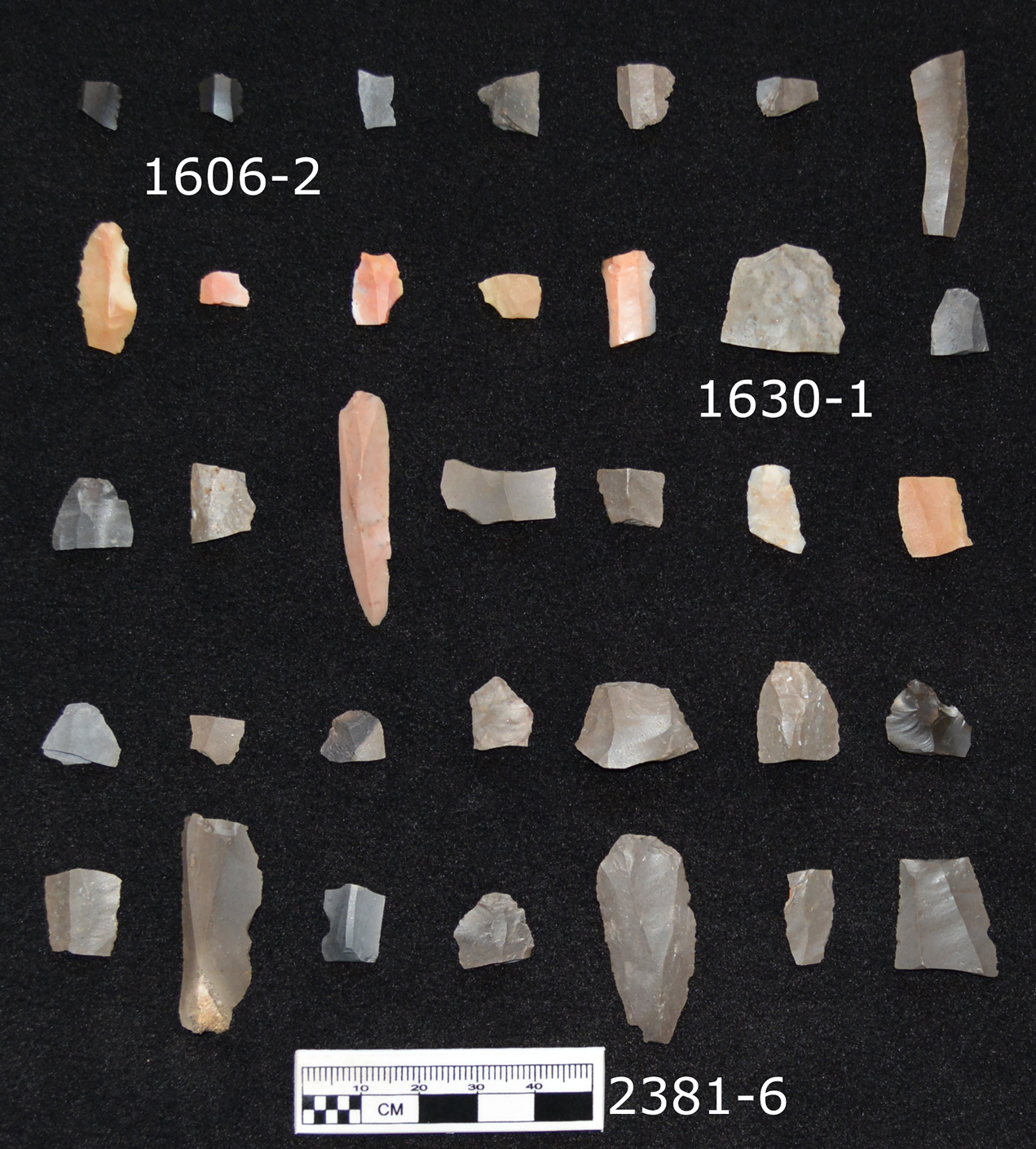
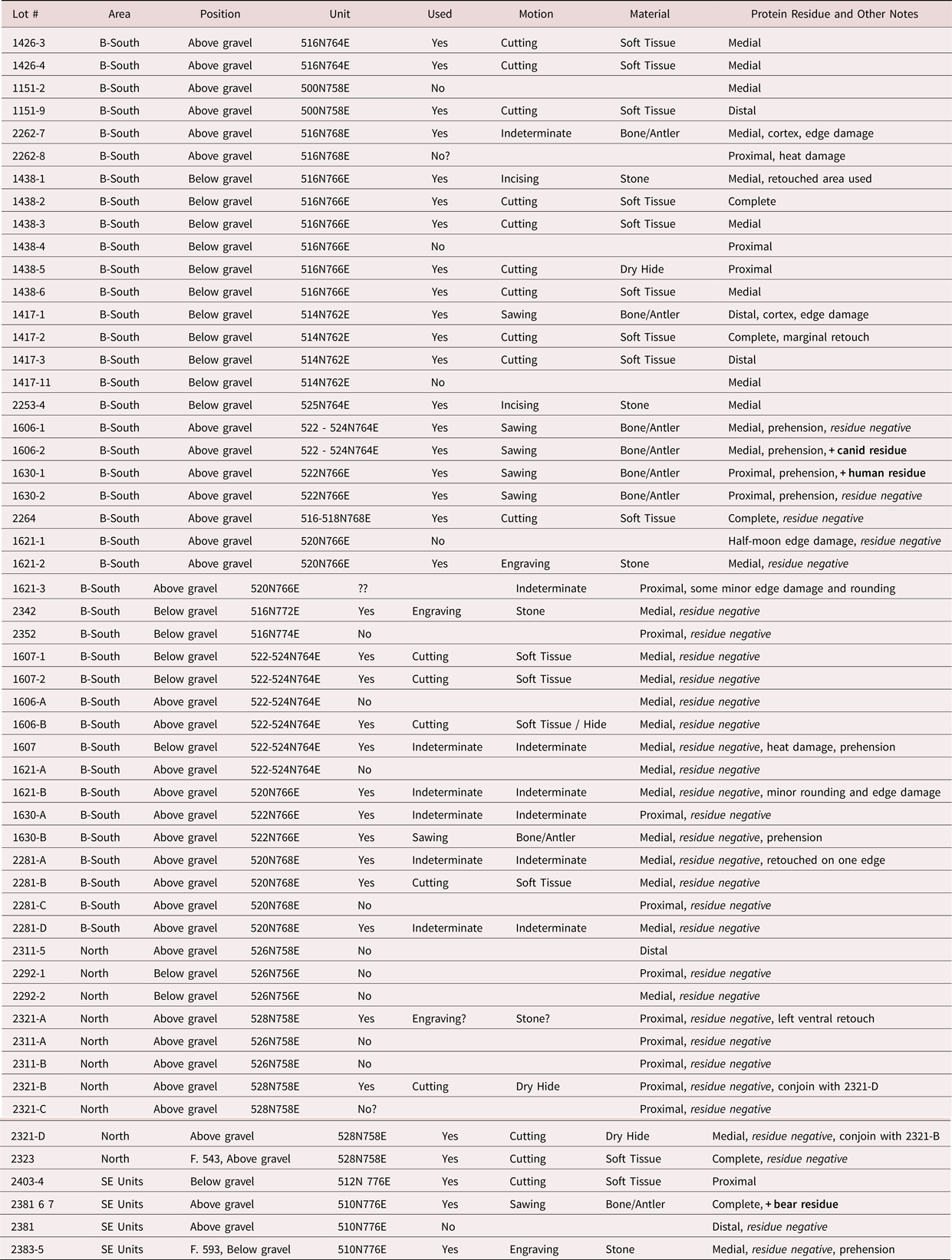
Three of 35 bladelets produced positive reactions against the antisera (Table 1). Artifact #1606-2 reacted with dog antiserum, which includes members of the Canidae family (domestic dog, coyote, wolf, and fox). Artifact #1630-1 tested positive for human antiserum, indicating the presence of proteins from the Primate order (humans, apes, and monkeys). Artifact #2381-6 tested positive for bear antiserum, indicating the presence of proteins from the Ursidae family (black, brown, and grizzly bears). Negative results could indicate that (1) the bladelets were not used, (2) they were used on other materials that do not contain protein residues (stone, wood, plant, etc.), (3) they were used on animal species not tested with the antisera, or (4) protein residues did not preserve. The results from our use-wear and faunal analysis help us to further evaluate some of these possibilities.
Results of Use-Wear and Protein-Residue Analysis of Bladelets Recovered from the 2016 Excavations at the Moorehead Circle.
Use-Wear Analysis
Following the residue analysis by AINW, Miller conducted use-wear analysis on all 35 bladelets from the protein residue sample, plus 19 others that had been washed and processed (Table 1). These bladelets were manufactured from Wyandotte (38.9%), Upper Mercer (22.2%), Flint Ridge (18.5%), Knox (14.8%), and Paoli (5.6%) cherts, which are common materials for blade manufacture at Fort Ancient (Miller Reference Miller2014; Vickery and Sunderhaus Reference Vickery, Sunderhaus, Connolly and Lepper2004). Use-wear analysis employed the same methods that Miller (Reference Miller2014, Reference Miller2015) utilized in previous studies of Moorehead Circle bladelets. Briefly, this method is based on Keeley's (Reference Keeley1980) foundational study tying the formation of distinctive polishes, as well as striations and edge modifications, to motions of use and materials upon which stone tools were used in light of comparison with experimentally replicated use-wear patterns. In preparation for use-wear analysis, bladelets were washed for 10 minutes in liquid soap, followed by 10 minutes in clean tap water, using an ultrasonic cleaner. Microscopic analysis was conducted with a binocular microscope and an Olympus BX51M incident light metallurgical microscope. The following first covers use-wear results of the bladelets from the protein residue sample, with particular focus on the three that tested positive for residues. Then, the results of the 19 additional bladelets are presented before discussing the use-wear results of these 54 bladelets by excavation context in terms of below and above the gravel layer.
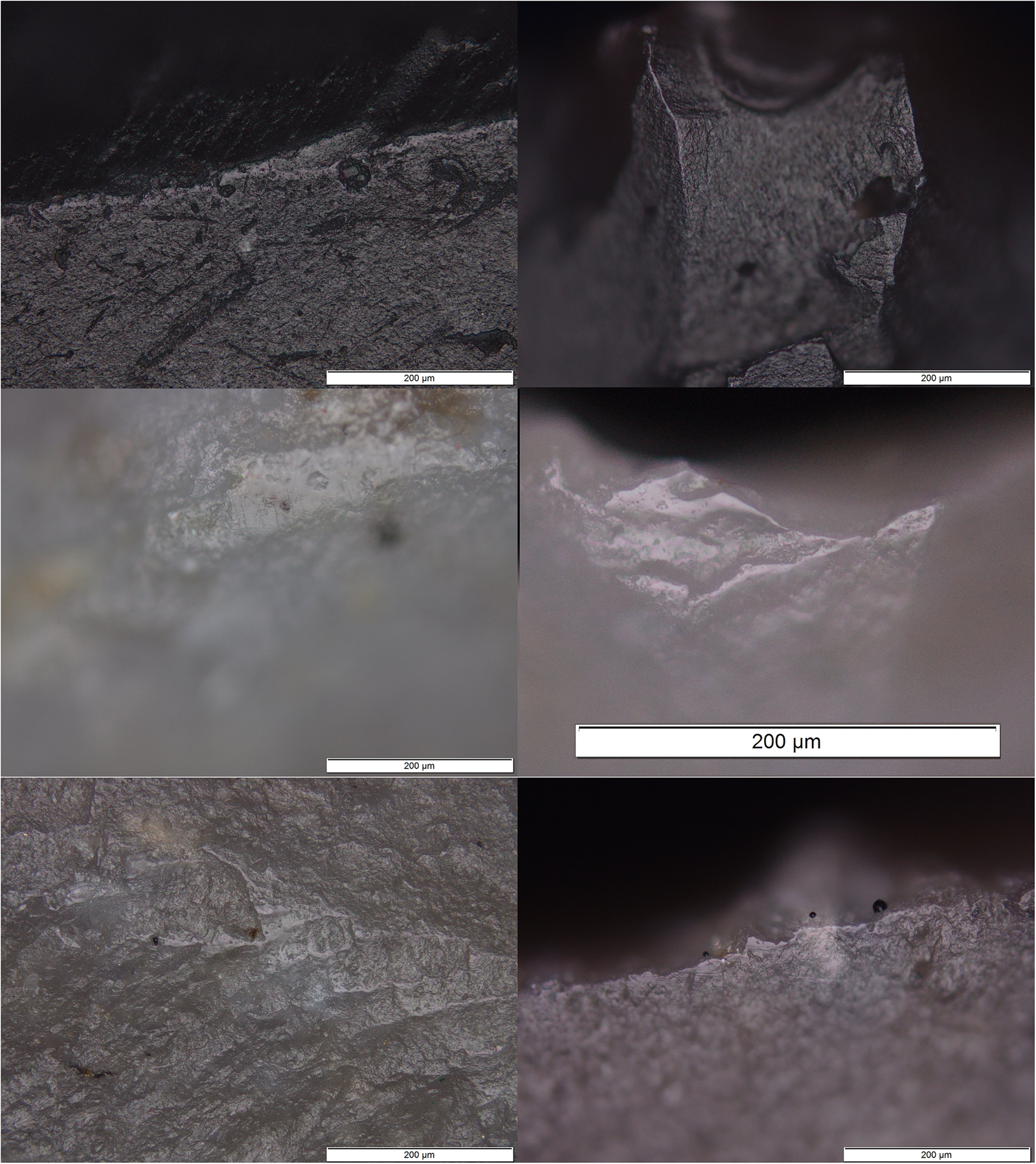
Use-wear analysis indicates that all three artifacts that tested positive for protein residues were used on bone/tooth/antler (hereafter, “bone” for simplicity). Use on bone is inferred from extensive edge damage and the presence of “bone” polish, which is a noninvasive (i.e., only forms on the tool edge), bright polish with a texture characterized by small micro pits (Keeley Reference Keeley1980; Van Gijn Reference Van Gijn1990; Vaughan Reference Vaughan1985). The bladelet that tested positive for canid residue (#1606-2) is a medial fragment with heavy edge damage associated with bone polish and striations parallel to the working edge on both sides, indicating use in a sawing motion (Figure 3, top row). The bladelet that tested positive for human blood residue (#1630-1) is a proximal bladelet fragment with bone polish (Figure 3, middle row) that formed on the corners of the snapped edge, suggesting use in an engraving motion and that it may have been intentionally broken for this purpose (see Kay and Mainfort Reference Kay and Mainfort2014). The bladelet that tested positive for bear residue (#2381-6) is a nearly complete bladelet, of which the very tip was broken in a use event that caused edge damage and the formation of bone polish (Figure 3, bottom row). All three bladelets also showed evidence of prehension polish, which forms when dust from the worked material—in this case, bone—becomes trapped under the fingers when using a handheld tool (Rots Reference Rots2010).
Use wear on the three bladelets with positive protein residue reactions. Top row: 1606-2 (canid +); left photo shows bright, micropitted polish on a dorsal ridge, indicating bone polish as a result of prehension at 200× magnification; right photo shows bright micropitted bone polish associated with edge damage at 200× magnification. Middle row: 1630-1 (primate +); left photo shows bright, micropitted polish on a dorsal ridge, indicating bone polish as a result of prehension at 200× magnification; right photo shows bright micropitted bone polish associated with edge damage at 200× magnification. Bottom row: 2381-6 (bear +); left photo shows bright, micropitted polish on a dorsal ridge, indicating bone polish as a result of prehension at 200× magnification; right photo shows bright micropitted bone polish associated with a step edge from continuous microflake removals at 200× magnification.
Use-wear analysis of the 32 bladelets that tested negative for protein residue indicated that 10 of these displayed no evidence of use, whereas 22 did (Table 1). One of the utilized bladelets was used to saw bone, whereas three (and possibly a fourth—2321-A) contained bright, flat polish indicative of engraving soft stone (Figure 4). Dull, greasy, invasive polish associated with little edge damage and minor edge rounding consistent with butchering soft tissue was documented on six additional bladelets, and the presence of edge rounding associated with a dull, pitted polish demonstrated dry hide cutting on two conjoined bladelet fragments (Figure 4). Finally, five bladelets displayed evidence of use on indeterminate materials because polish was not sufficiently developed. These results are informative for the bladelets with negative protein residue results because the 10 unutilized bladelets or the four bladelets used on stone would not produce positive residue reactions. The protein residue positivity rate for those bladelets that may be expected to have preserved residues (3 of 21, 14.3%) is in line with other studies from eastern North America (e.g., Moore et al. Reference Moore, Brooks, Kimball, Newman and Kooyman2016:136; Sterner and Jeske Reference Sterner and Jeske2017:69).
Further examples of use wear on bladelets. Top left: bright, micropitted bone polish and edge damage on a medial bladelet fragment with a negative protein reaction (1606-1); magnification is 200×. Top right: bright, micropitted bone polish and edge damage on a proximal bladelet fragment with a negative protein reaction (1630-2); magnification is 200×. Middle left: dull, greasy, invasive soft-tissue polish on a complete bladelet with marginal retouch (1417-2); magnification is 100×. Middle right: dull, greasy, invasive soft-tissue polish on a medial bladelet fragment (1426-3); magnification is 100×. Bottom left: edge rounding and dull, matte dry hide polish on a proximal bladelet fragment (1438-5); magnification is 200×. Bottom right: bright, flat stone polish on a medial bladelet fragment with marginal retouch (1438-1); magnification is 100×.
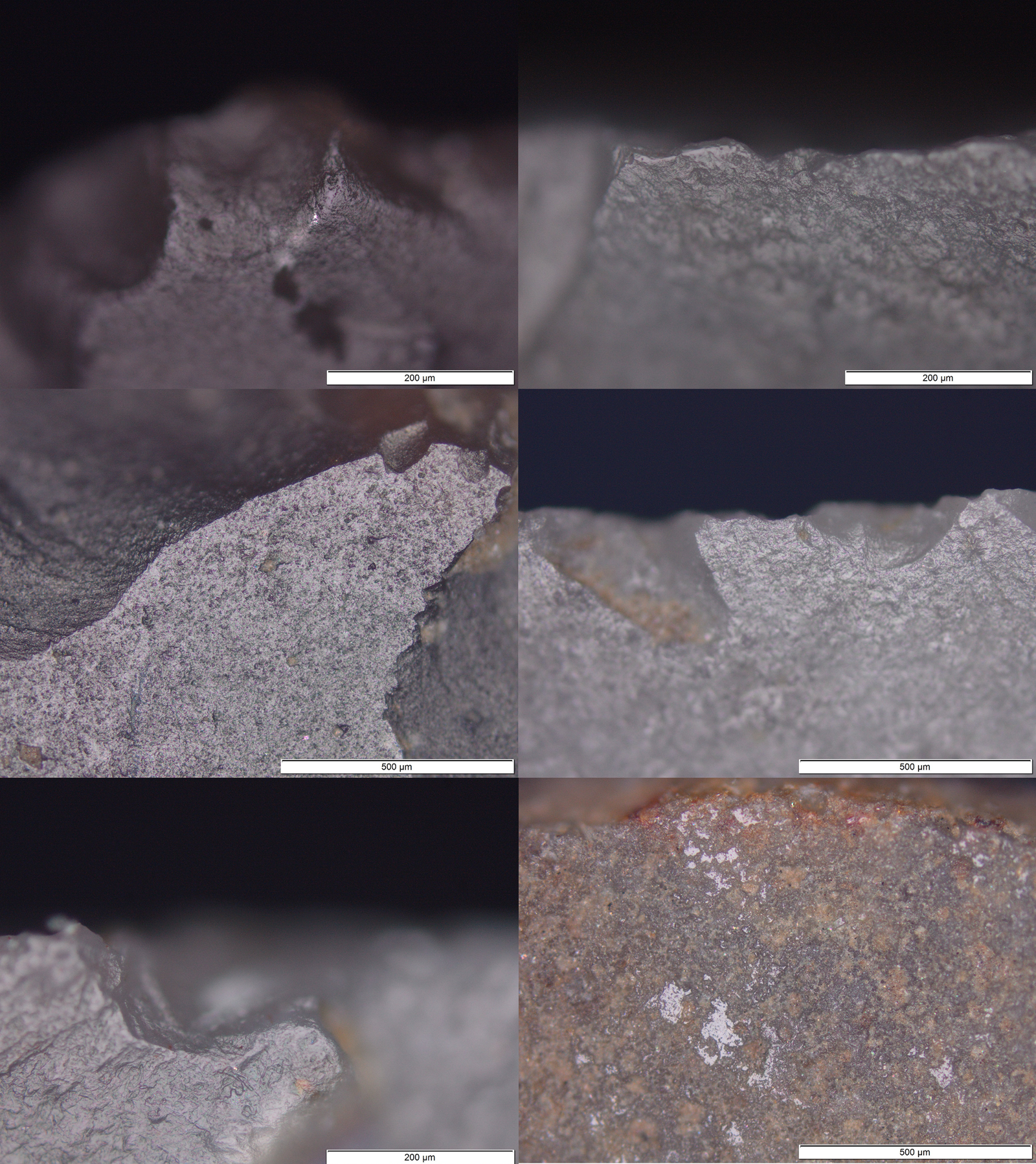
The use-wear analysis sample also included 19 bladelets that were not tested for protein residues (because they were washed and handled upon recovery) but that were recovered in 2016 from contexts spatially associated with the 35 bladelets that were tested for residues. Fourteen of these bladelets displayed evidence of utilization (Table 1). Of these 14 utilized bladelets, nine were used on soft tissue/meat, two for processing bone, two for engraving stone, and one for cutting dry hide (Table 1; Figure 4).
It is important to remember that there was a major change in this area of the Moorehead Circle with the addition of the gravel mantle covering many of the previous features sometime toward the end of the Middle Woodland use of the complex (Riordan Reference Riordan, Redmond, Burks and Rubyp2019). This mantle is interpreted as having been part of a termination ritual that ended the initial use of the Moorehead Circle (Riordan Reference Riordan, Redmond and Genheimer2015). It was subsequently restored to a more limited ceremonial role, when bladelets continued to play an important role in activities conducted there. Consequently, we examine the use-wear results in terms of a combined sample of bladelets (i.e., both those tested for protein residue and those only subjected to use-wear analysis) from below-gravel and above-gravel contexts here. Among the 20 bladelets recovered from below-gravel contexts, the largest proportion were used on soft tissue (n = 8), with multiple bladelets also used to engrave stone (n = 4), and one each used on bone and dry hide (Table 1). One was utilized for an indeterminate function, whereas five displayed no evidence of utilization. Among the 34 bladelets recovered from above-gravel contexts, use on bone (n = 7) and soft tissue (n = 7) was most common. Additionally, two bladelets (and possibly a third: 2321-A) were used to engrave stone, two conjoined segments were used to cut dry hide, and five were used on an indeterminate material (Table 1). Ten bladelets displayed no evidence of use. In summary, the larger proportion of bladelets used to process bone recovered from above the gravel mantle—including the three protein-positive bladelets—signals a temporal trend toward more emphasis on bone working through time.
Elsewhere at Fort Ancient, as well as other Middle Woodland sites in Ohio, use-wear analysis indicates that bladelets were not specialized. Instead, they were tools used for a wide range of tasks in a similar pattern to that observed at the Moorehead Circle. Most often, this included use on soft tissue, as was also the case with the current Moorehead Circle sample (Miller Reference Miller2014, Reference Miller2015, Reference Miller2018b; Yerkes Reference Yerkes1994, Reference Yerkes2009). A relatively large proportion of bladelets from the Museum Expansion Area, to the east of the Moorehead Circle in the North Fort of Fort Ancient, were used to work soft stone, whereas many bladelets from just outside the northeast walls of Fort Ancient near the Twin Mounds were used to process soft plant material (Miller Reference Miller2015:130–132). Both stone working and plant processing may well represent other craft production activities involving the use of bladelets at Fort Ancient (Miller Reference Miller2015:128–129). Nearly half of bladelets examined from two sites near the Stubbs earthworks several kilometers downstream from Fort Ancient were used on bone (Miller Reference Miller2018b). However, the use of these bladelets was largely focused on engraving bone, and no strong evidence for the manufacture of modified teeth or jaws occurs at the sites.
Faunal Analysis
Abigail Stone analyzed the complete faunal assemblage recovered from the 2006–2016 excavations at Moorehead Circle between January 2021 and May 2022. All specimens were identified as precisely as possible to skeletal element and taxon using the Illinois State University Zooarchaeology Laboratory's comparative collection. Identifications of select elements, including all Carnivora specimens, were confirmed using the much larger faunal reference collection at the Illinois State Museum in Springfield. Considering the protein residue analysis findings, particular care was taken with the carnivore remains, and all bear and canid identifications were informally corroborated by Dr. Terrance Martin, emeritus curator of anthropology and zooarchaeology at the Illinois State Museum. Stone also examined all elements for taphonomic and cultural modifications, including signs of burning or weathering, cut or gnaw marks, and polish or striations indicative of more extensive working or use as a tool. When more specific taxonomic identification was not possible due to small size, absence of diagnostic markers, or poor preservation, specimens were placed in broad mammal or bird size classes whenever these determinations could be made.
The collection included 1,452 bone and shell fragments weighing 2,004.0 g. Of this total, 1,247 pieces weighing 1,974.6 g (85.9% by count and 98.5% by mass) were identified to at least taxonomic class (referred to henceforth as the “identified assemblage”). Well over half of the identified assemblage evinced definitive signs of burning (n = 720, 57.7%). This includes 453 completely or partially calcined elements (36.3%; white or white/gray/black) and 267 charred elements (21.4%; black). An additional 366 specimens (29.4%) evinced nascent charring (dark brown coloration), bringing the total of probable heat-modified bone to 1,086 elements (87.1%). This is a markedly higher proportion of burned bone than was recovered from other Fort Ancient contexts, where 46% of the bones exhibited evidence of heating (Yokell Reference Yokell, Connolly and Lepper2004). A significant portion of the Moorehead Circle assemblage (n = 222, 17.8%) also displayed weathering, although this varied considerably between excavation lots. Weathering was particularly prevalent in certain contexts, including specific lots from units in B South, Trench C, and the Entrance (see Supplemental Tables 1 and 2 for context-specific information on cultural and taphonomic modifications). This suggests that many artifacts from these areas remained exposed to the elements for an extended period before deposition, potentially introducing contextually divergent degrees of preservation bias into the assemblage. The prevalence of burning and, in particular, weathering differs from patterns seen at other areas at Fort Ancient (Yokell Reference Yokell, Connolly and Lepper2004), perhaps stemming from different forms or intensities of site use. In a future publication, we hope to use the burning and weathering patterns to help tease apart aspects of Moorehead Circle's use and its complex internal stratigraphy.
Taphonomic factors including burning, weathering, and high fragmentation reduced the identifiability of the assemblage and probably augmented an identification bias favoring larger species. Of the 1,247 identified specimens, only 223 were identified to at least taxonomic family (17.88% by count, 61.36% by mass), with a further 15 elements identified to taxonomic order. An additional 907 less diagnostic mammal specimens and 18 bird specimens were grouped into various size classes, but they could not be reliably identified to more specific taxa. A small number of more recent elements were present in the uppermost levels of the assemblage: two partial box-turtle carapaces with preserved scutes, part of a bovine tooth, a horse carpal, and a fragment of medium/large mammal long bone with clear saw marks. Largely, however, we believe the assemblage reflects primary deposits made during the various phases of site use.
Table 2 shows the breakdown of identified and unidentified faunal remains at Moorehead Circle. Odocoileus virginianus (white-tailed deer) makes up 13.15% of the identified assemblage by NISP (n = 164) and 52.29% by mass, with an MNI of 5. A further 64.23% of the assemblage by NISP (n = 801) was identified as large or medium/large mammal. These small, less-diagnostic fragments are almost certainly O. virginianus as well, although elk and bear are also possibilities. This preponderance of deer is consistent with findings from previous excavations within Fort Ancient (Yokell Reference Yokell, Connolly and Lepper2004) and other Ohio Hopewell sites (e.g., Pacheco et al. Reference Pacheco, Burks, Wymer, Redmond, Ruby and Burks2020; Parmalee Reference Parmalee and Prufer1965). Other nonintrusive, identified species include elk (n = 6), raccoon (n = 7), American black bear (n = 4), canids (n = 1), squirrels (n = 3), beaver (n = 1), eastern cottontail (n = 7), turkey (n = 20), and loon (n = 1). Small fragments of turtle carapace/plastron (n = 4) and freshwater mussel shell (n = 10) were also identified but could not be classified below the level of order (see Supplemental Table 2 for a context-specific breakdown of taxa found across Moorehead Circle.). No fish remains were found.
Identified and Unidentified Faunal Specimens at Moorehead Circle.
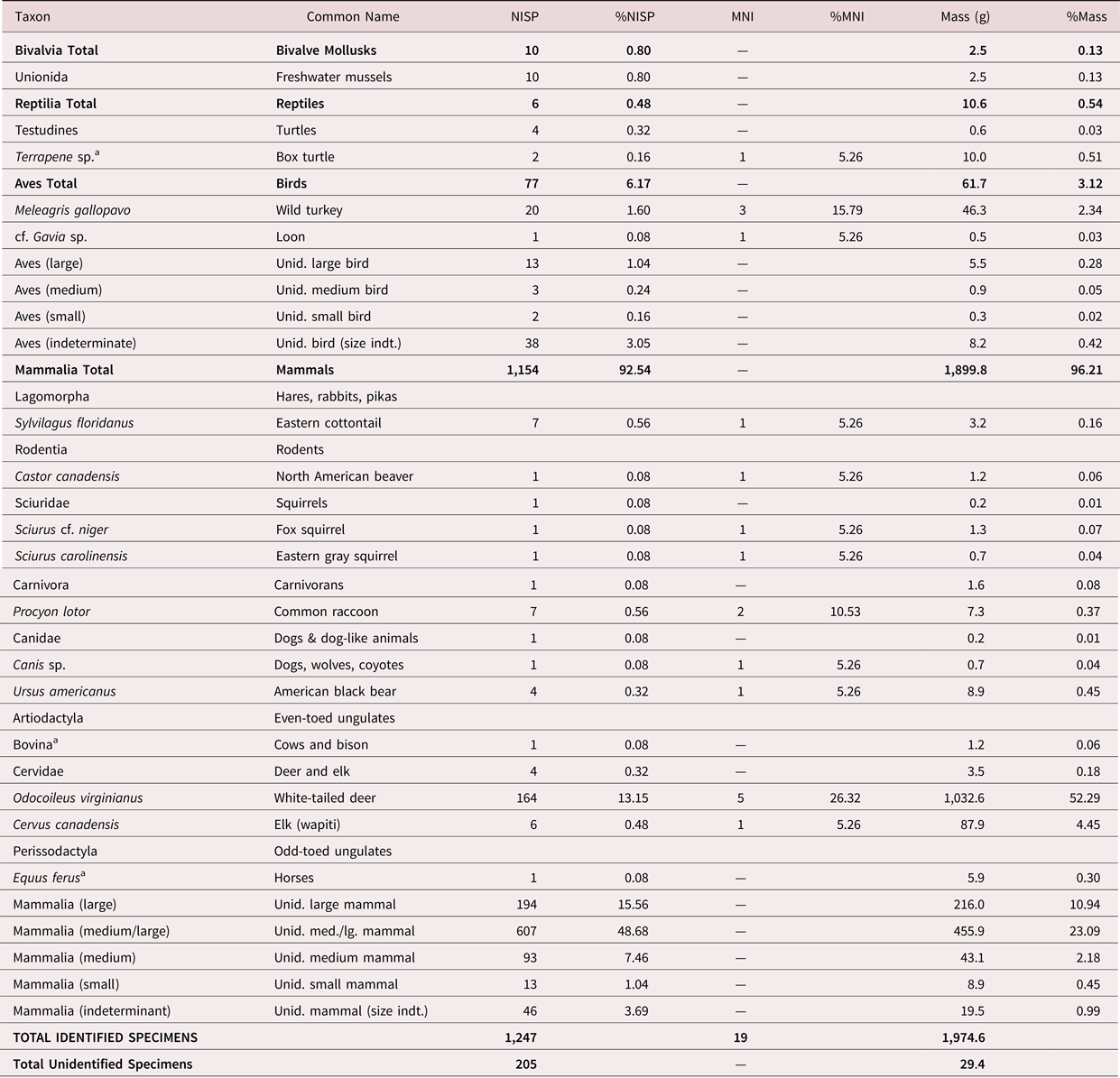
a These elements were likely intrusive into the assemblage from more recent periods.
Surprisingly few published faunal assemblages of Ohio Hopewell ceremonial complexes are available for comparison. Exceptions include a broader study of fauna from other Fort Ancient contexts (Yokell Reference Yokell, Connolly and Lepper2004), a short report on the fauna from the 1976–1977 excavations at the Edwin Harness burial mound (Shane Reference Shane and Greber1983), and a more recent reexamination of fauna from the 1971–1977 excavations of the Seip Earthworks Complex (Lee Reference Lee2009). The disparate sizes of these faunal assemblages, as well as different methods of collection and analysis, limit the utility and meaning of direct comparisons. However, the relative importance of the species identified here is in line with the findings from these sites. As at more residential sites, these assemblages are dominated by important food species such as white-tailed deer and—to a lesser degree—wild turkey, with smaller numbers of species such as cottontail rabbits, raccoons, and elk. Bear and canids are present primarily in the form of worked teeth. There is little compelling evidence for feasting deposits at these sites aside from the embankment wall deposits at Fort Ancient, which contained a single immature deer; at least five fish; and goose, turkey, and swan bones (Yokell Reference Yokell, Connolly and Lepper2004:197–199). None of the Moorehead Circle features have particularly large or unique faunal assemblages that can readily be interpreted as detritus from large-scale feasting events. Moreover, the assemblage as a whole is small, suggesting that the area was certainly not the site of long-term, large-scale occupation. The majority of faunal remains recovered from Moorehead Circle are more likely the food refuse of individuals using the site for a limited time and/or for specific, nondomestic functions.
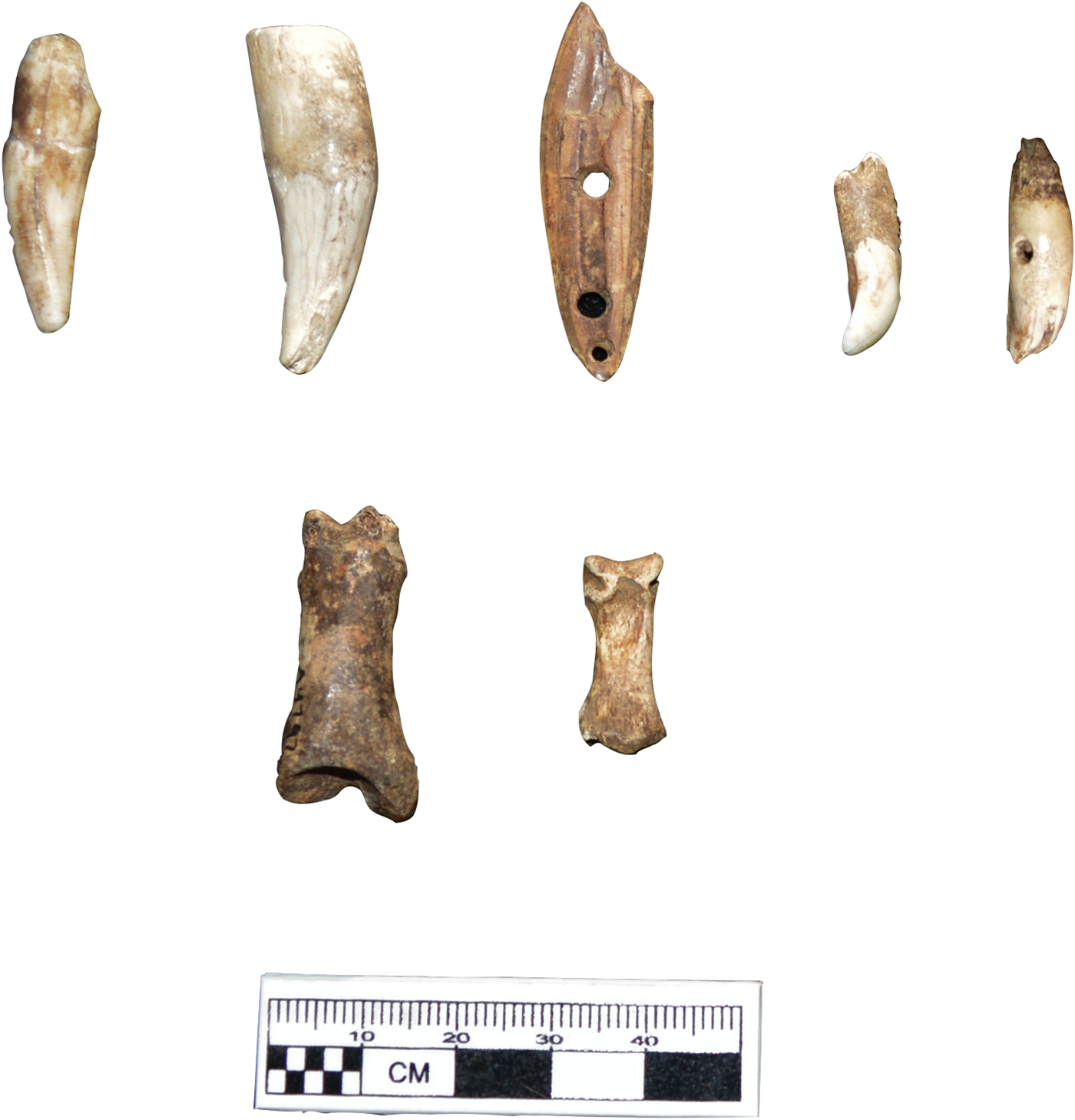
Within the Moorehead Circle assemblage, worked bone was of particular interest given the protein residue results. In total, 43 specimens had polish, striations, or other indications of use beyond butchery. Most of these elements were large mammal long-bone shaft fragments with polish, indicating use as expedient bone tools of indeterminant function. Where species was identifiable for these artifacts, almost all came from deer, although one was part of a distal elk tibia, and another came from a bird carpometacarpus (cf. Gavia sp.). In contrast to these expedient tools, several carnivore elements have shine, drilling, and/or grinding relating to the use of the elements for ornamentation. These include all the bear and large carnivore elements and several smaller carnivore specimens. Table 3 describes all large and modified carnivore remains. All modified carnivore elements were recovered from below the gravel layer, or contexts presumed to predate the gravel layer, except for the two bear canines (Lots 701 and 751), which were recovered in the first 30 cm of excavation in their respective units. Further discussion of the context in which these modified carnivore remains were recovered is provided in Supplemental Text 1.
Large and Modified Carnivore Remains from Moorehead Circle.
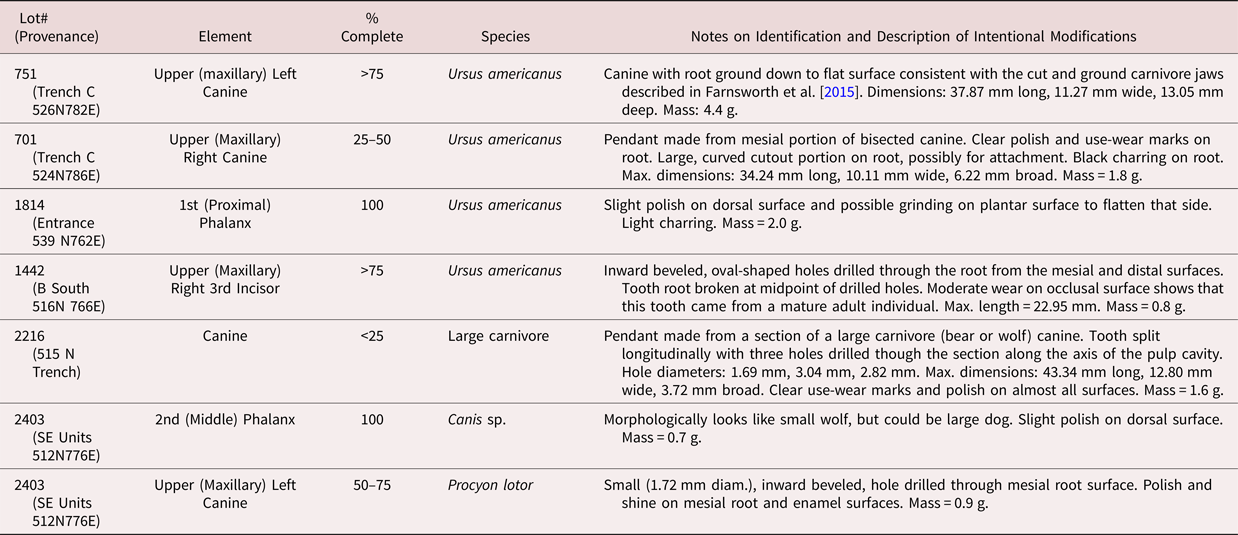
Note : See Supplemental Text 1 for additional contextual information.
Modified carnivore teeth are relatively common in Hopewell burial sites throughout the Midwest (Farnsworth et al. Reference Farnsworth, Martin and Perri2015; Seeman Reference Seeman1979) and are used to suggest interaction with Hopewell networks at sites farther afield (e.g., Hoard Reference Hoard2021). However, no assemblages have so far produced conclusive faunal evidence for modified carnivore jaw manufacture on location at the site. Although earlier analyses of structures within the Seip Earthworks hypothesized that these functioned as specialized craft production workshops (Baby and Langlois Reference Baby, Langlois, Brose and Greber1979), Lee (Reference Lee2009) found no evidence for shell bead manufacture or other bone artifact production in her reanalysis of the faunal assemblage. At the Edwin Harness Mound, at least 241 partial or complete perforated carnivore (raccoon, Canis sp., gray fox, and bobcat) canines were identified in the faunal assemblage (Shane Reference Shane and Greber1983). This could be seen as evidence for large-scale manufacture, but given that the site was a burial mound with significant numbers of human bones mixed in with the faunal assemblage, it is most likely that these canines were interred originally with subsequently disturbed burials rather than being manufactured at the site itself. The broader Fort Ancient faunal assemblage included five bear specimens and 32 Canidae specimens. Given that Yokell (Reference Yokell, Connolly and Lepper2004) does not discuss if any were modified, there is no indication that she believed any of the excavated areas were production zones.
The Moorehead Circle faunal assemblage does not, in itself, contain definitive proof of carnivore tooth modification at the site. However, unlike shell bead manufacture, which often includes characteristic shell blanks, production of carnivore tooth ornaments would be less likely to produce identifiable debris. Certainly, individual drilled teeth would not produce any kind of identifiable faunal remains beyond the teeth themselves. Even the production of ground carnivore jaws would be unlikely to produce extensive, identifiable detritus given that much of the removed portion would be highly fragmentary. However, when asking the question of whether the Moorehead Circle was the locus of manufacture of modified bear elements, the relative importance of bear remains within the Moorehead Circle assemblage compared to Fort Ancient as a whole is worth noting. For reference, Yokell (Reference Yokell, Connolly and Lepper2004) identified 1,245 faunal elements from seven areas across Fort Ancient to at least the level of Family. This compares to 223 faunal elements in the Moorehead Circle assemblage identified to the Family level. Only five bear elements were identified across all contexts Yokell analyzed, whereas four were identified within the much smaller Moorehead Circle assemblage. This higher proportion of bear remains at the Moorehead Circle, combined with evidence of both intentional modification on three of the four identified bear elements and indistinct shine on the dorsal surface of the bear phalanx (see Table 3), suggests a greater emphasis on bear remains in the Moorehead Circle. Additionally, the only bear and canine elements recovered from Moorehead Circle were teeth and phalanges (finger/toe bones; Figure 5). This pattern of bear remains comprising solely teeth and toes/claws was also observed by Parmalee at the McGraw site, where he attributed it to the use of these specific elements for ceremonial purposes (Parmalee Reference Parmalee and Prufer1965:115–116). Similarly, according to Berres and colleagues (Reference Berres, Stothers and Mather2004:24), “The post-cranial remains [of bears] were often hung in a tree, thrown in a river or lake, burned, or buried, while the skull and paws were saved for religious veneration” by Indigenous peoples across the Eastern Woodlands, and therefore it is not surprising that skull and paw bones would be discovered in the absence of other postcranial remains. Consequently, the faunal assemblage is entirely consistent with the protein-residue and lithic use-wear analysis, as discussed in more detail below.
Modified teeth and other carnivore remains from the Moorehead Circle. Top row, from left: 701, 751, 2216, 1442, 2403. Bottom row, from left: 814, 2403. See Table 3 for faunal ID for each specimen. (Color online)
Summary of Multiple Lines of Evidence
Protein residue analysis indicates that the presence of canid, bear, and human blood residues on three bladelets. Use-wear analysis indicates that these bladelets were used to process bone. Bear and canid remains have been recovered from the Moorehead Circle. Two bear canines (701-1 and 751-1) and one incisor (1442-1), as well as one large carnivore canine (1216), show direct evidence of human modification in the form of cutting, grinding, polishing, and/or drilling. Taken together, we see these three datasets as evidence that at least some bladelets were used to produce modified bear jaw objects at Moorehead Circle. Given the protein residue results indicating canid blood on one bladelet, the presence of the modified large carnivore canine, and the number of modified canid jaws recovered from Middle Woodland contexts (Farnsworth et al. Reference Farnsworth, Martin and Perri2015; Nawrocki and Emanovsky Reference Nawrocki, Emanovsky, Hargrave, Schermer, Hedman and Lillie2015; Seeman Reference Seeman1988), it is possible that modified canid teeth or jaws were produced here as well, although we recognize that the only identifiable canid remains recovered are an unmodified second phalanx (Table 3). The recovery of a drilled raccoon canine may indicate that this practice extended beyond large carnivores, but no raccoon antisera were used in the protein residue study. The evidence for human bone modification is only supported by the detection of human blood residue on a bladelet used to engrave bone (1630-1). It is possible that this bladelet was used to engrave human bone (i.e., Baby Reference Baby1961a; Cobb Reference Cobb, Hargrave, Schermer, Hedman and Lillie2015; Johnston Reference Johnston, Hargrave, Schermer, Hedman and Lillie2015; Seeman Reference Seeman1988; Shetrone Reference Shetrone1930:137), but given that no modified human bone was recovered from the Moorehead Circle, we must also consider the possibility that human blood residue was an incidental inclusion (i.e., a self-inflicted cut by the bladelet user) on a bladelet used to engrave bone from some other species.
Unlike the bladelet with human blood residue (1630-1), incidental inclusion of protein residues from bear or canid species seems unlikely because we presume humans were users of the bladelets and would not accidently cut the flesh of these creatures. Yet, a tool used only to process dry, defleshed bone would not return a positive protein residue result.
To reconcile the use-wear evidence for bone processing with the residue analysis for blood or soft-tissue contact, we argue that the bone must have been relatively fresh, with at least some amount of hydrated soft tissue or bodily fluids still present. In the CIEP process, AINW uses immunoglobulin proteins, which are present primarily in bodily fluids and hydrated tissues, with their highest concentration in blood plasma. It is unlikely that these proteins would be present from contact with dry bone. If the flesh covering the bones was relatively thin—as is the case with soft tissue covering the jaws/mouth—and the main contact material was bone, then we would not expect to see extensive development of soft-tissue polish on these tools.
This is also in line with independent arguments indicating that modified jaws were processed while still in the flesh (Nawrocki and Emanovsky Reference Nawrocki, Emanovsky, Hargrave, Schermer, Hedman and Lillie2015). Some jaws were modified by removing bone from the inferior margin to the point where tooth sockets were exposed and roots of teeth were removed, likely through grinding, yet the teeth remained in place in the jaw (Farnsworth et al. Reference Farnsworth, Martin and Perri2015; Nawrocki and Emanovsky Reference Nawrocki, Emanovsky, Hargrave, Schermer, Hedman and Lillie2015). Nawrocki and Emanovsky (Reference Nawrocki, Emanovsky, Hargrave, Schermer, Hedman and Lillie2015:25) use multiple lines of evidence to demonstrate that modified jaws with ground tooth roots must have been produced when the jaws were still fresh in order to keep the teeth in place. Notably, “single rooted anterior teeth [canines and incisors] frequently fall from the alveoli long before the skin, tendons, major ligaments, and cartilage are destroyed,” and therefore the processing and preservation of the ligaments must have occurred very soon after procurement of the animal (Nawrocki and Emanovsky Reference Nawrocki, Emanovsky, Hargrave, Schermer, Hedman and Lillie2015:26). Furthermore, according to Nawrocki and Emanovsky (Reference Nawrocki, Emanovsky, Hargrave, Schermer, Hedman and Lillie2015:25), “The ground apices of the tooth roots sometimes project below the inferior surface of the mandibular body. The best explanation for this phenomenon is that the specimen was still fresh enough to preserve the periodontal ligaments and other soft tissues surrounding the tooth roots while it was being ground.” This provides independent support for our protein residue and use-wear analysis, which indicate that some soft tissue or blood must have still been associated with the bone/teeth that were being processed with bladelets. We suspect that this accounts for the modified bear canines and modified bear incisor, which could have come from cut and ground maxillae. Certainly, the split and drilled large carnivore canine was removed from the jaw, and the raccoon canine may have been removed prior to drilling as well.
Middle Woodland Modified Teeth and Jaws
Across the American Midwest, examples of modified teeth and jaws from predators such as canids and bears span over 4,000 years from the Archaic through Mississippian periods (Baby Reference Baby1961b; Berres et al. Reference Berres, Stothers and Mather2004; Griffin Reference Griffin1952:Figure 138). These are particularly numerous during the Middle Woodland Hopewell period (Struever and Houart Reference Struever, Houart and Wilmsen1972). Bear canines that were drilled, cut, split, and/or inset with pearls are especially common. For example, Seeman (Reference Seeman1979:371–373) estimates that more than 1,000 such bear canines have been recovered from Middle Woodland sites, with 500 recovered from Ohio Hopewell mortuary sites alone. Specifically for Fort Ancient, Moorehead (Reference Moorehead1890:94) reports 12 ground and drilled black bear canines interred with an individual buried in a mound outside of the enclosure.
Modified predator jaws (mandibles or maxillae with in situ teeth) have been found at dozens of Middle Woodland sites, largely in what are today Illinois and Ohio (Farnsworth et al. Reference Farnsworth, Martin and Perri2015; Nawrocki and Emanovsky Reference Nawrocki, Emanovsky, Hargrave, Schermer, Hedman and Lillie2015; Seeman Reference Seeman1988). In Ohio, a large cache of over 100 drilled, incised, and ground human, cougar, bobcat, canid, and bear jaws was recovered from the Tremper Mound (Mills Reference Mills1916; Nawrocki and Emanovsky Reference Nawrocki, Emanovsky, Hargrave, Schermer, Hedman and Lillie2015; Seeman Reference Seeman, Chacon and Dye2007). Seeman (Reference Seeman, Chacon and Dye2007:Figure 7.4) notes that modified predator jaws have also been recovered from mounds and caches at the Harness, Hopewell, Manring, Seip, and Turner sites. Farnsworth and colleagues (Reference Farnsworth, Martin and Perri2015) describe 34 examples of modified jaws of wolves, bears, coyotes, and cougars from mounds in the Illinois River Valley, and five modified canid jaws from nonmound habitation sites in the Illinois River Valley. Those found in burials were often recovered near the head, waist, and wrists of the interred, perhaps providing clues as to how they were worn (Farnsworth et al. Reference Farnsworth, Martin and Perri2015; Nawrocki and Emanovsky Reference Nawrocki, Emanovsky, Hargrave, Schermer, Hedman and Lillie2015).
Many examples of modified human remains are known from the Middle Woodland archaeological record as well. The majority of these are cranial elements, including jaws. For example, Seeman (Reference Seeman1988) reports cut, drilled, and otherwise modified human jaws from burials or ceremonial caches at the Harness, Hopewell, and Tremper sites in Ohio. Modified human mandibles have also been recovered from the GE Mound in Posey County, Indiana, as well as numerous sites in the central and lower Illinois River Valley (Cobb Reference Cobb, Hargrave, Schermer, Hedman and Lillie2015; Johnston Reference Johnston, Hargrave, Schermer, Hedman and Lillie2015).
Perforation is the most common modification of human jaws that may have involved chipped stone tools, but some examples of incising or engraving are known as well. For example, burial 41 at Hopewell Mound 25 includes a set of drilled and notched human jaws, and there is also a drilled and notched mandible from the Edwin Harness Mound (Johnston Reference Johnston, Hargrave, Schermer, Hedman and Lillie2015:63). Outside of Ohio, human jaws with incised mandibular rami have been recovered from the Liverpool Mound group in the central Illinois River Valley (Johnston Reference Johnston, Hargrave, Schermer, Hedman and Lillie2015).
Additionally, a few examples of modified human postcranial skeletal elements have been recovered from sites in Ohio. For example, Shetrone (Reference Shetrone1930:137) recovered an engraved human arm bone from the Cincinnati Earthworks in Hamilton County. An engraved whistle fashioned from a right radius was recovered from the Bourneville Mound in Ross County (Baby Reference Baby1961a). A fragment of a human long bone in the form of a tube incised with a human-like form was recovered from the Turner site (Seeman Reference Seeman, Chacon and Dye2007:181). Finally, several examples of carved human long bones were excavated from Hopewell Mound Group Mound 25 (Giles Reference Giles2013; Greber and Ruhl Reference Greber and Ruhl1989:240–253). Due to the lack of modified human bone at the Moorehead Circle and Fort Ancient more generally, it is difficult to hypothesize whether bladelet #1630-1 was used to modify cranial or postcranial elements if it was used on human bone. Consistent with our residue results, and in line with Nawrocki and Emanovsky's (Reference Nawrocki, Emanovsky, Hargrave, Schermer, Hedman and Lillie2015) findings for animal jaws, there is evidence that human remains were processed in the flesh during Middle Woodland mortuary rituals. For example, Hopewell cremations from Ater, Edwin Harness, Seip, and Mound City were burned in the flesh (Baby Reference Baby1954; Konigsberg Reference Konigsberg1985).
Finding Meaning in Middle Woodland Modified Bone
Modified predator jaws and teeth were certainly valued ceremonial items, potentially worn during mortuary ceremonies and used to usher the deceased through the afterlife. Scholars have put forth many arguments to explain the meaning associated with modified animal jaws. For example, Thomas and colleagues (Reference Thomas, Carr, Keller, Carr and Case2005) view bear and wolf teeth and modified jaws as symbols of clan membership. Farnsworth and colleagues (Reference Farnsworth, Martin and Perri2015:55) agree that these could be symbols of clan membership while noting they may have been used by shamans. Others (i.e., Cobb Reference Cobb, Hargrave, Schermer, Hedman and Lillie2015; Johnston Reference Johnston, Hargrave, Schermer, Hedman and Lillie2015) suggest that these were meant to honor the animal spirit, or they were attempts at capturing the power of the predator as represented by the most dangerous part of the anatomy—their jaws.
Indigenous ontologies indicate that bears and canids were viewed as other-than-human persons. Berres and colleagues (Reference Berres, Stothers and Mather2004) note how many Eastern Woodlands peoples recognize the power and agency of bears, viewing them as other-than-human persons who are dangerous predators with many human-like traits. Additionally, bears may be viewed as “kin, healers, food providers, and supernatural guides capable of connecting the human and spirit worlds” (Kassabaum and Peles Reference Kassabaum, Peles, Carmody and Barrier2019:108). Similarly, wolves are often viewed as other-than-human persons who—among the Ojibwe, for example—are kin or companions with humans and who share similar social structure and subsistence practices (Benton-Banai Reference Benton-Banai1979).
Archaeologists have also noted a correlation between the treatment and distribution of jaws from human and other-than-human predators such as bears. Seeman (Reference Seeman, Chacon and Dye2007) suggests that human jaws were modified in similar ways to the jaws of predatory animals and that there is a similar geographic distribution in finds of human and predator jaws in the Middle Woodland. Seeman views this as evidence for a connection between predator jaws and human jaws that draws on similarities between hunting styles and interpersonal conflict. Farnsworth and Atwell (Reference Farnsworth, Martin and Perri2015:76) list a number of nonmutually exclusive hypotheses that both human and animal jaws may represent ancestor veneration, trophies, links between humans and powerful predators, reminders of the inevitability of mortality, symbols of power of predator mouth and human voice, or a way of honoring the animal spirit. The presence of the bladelets used on bear—as well as potentially canid and human—bone at the Moorehead Circle suggests a similar connection between humans and other-than-human predators here too.
Materiality of Middle Woodland Craft Production at the Moorehead Circle
Nearly all modified bear, canid, and human bones from the Middle Woodland contexts in Ohio are finished objects recovered from mounds or ceremonial caches at earthen enclosures or mound centers (Farnsworth et al. Reference Farnsworth, Martin and Perri2015; Seeman Reference Seeman, Chacon and Dye2007; Struever and Houart Reference Struever, Houart and Wilmsen1972). This leaves few clues as to where these objects were manufactured, although some evidence indicates that Middle Woodland craft production often occurred at—or very near to—enclosures or mound groups (Everhart and Ruby Reference Everhart and Ruby2020; Miller Reference Miller2015, Reference Miller2018b; Spielmann Reference Spielmann, Wells and McAnany2008, Reference Spielmann and Lynott2009; Struever and Houart Reference Struever, Houart and Wilmsen1972; Wright and Loveland Reference Wright and Loveland2015). But prior to this study, scholars had uncovered little direct evidence for the places where bone objects were crafted, even at earthworks and mound centers. We argue that the Moorehead Circle was just such a context, based on the convergence of protein residue, lithic use wear, and faunal evidence.Footnote 1 Data show that bladelets were used to modify bear and possibly canid bone within the Moorehead Circle as indicated by the residue-positive bladelets recovered from above a gravel layer that capped many of the early features. Use-wear analysis of additional bladelets from these contexts demonstrate that there was a shift toward a greater proportion of bladelets used in bone processing after the addition of the gravel mantle. The evidence does not indicate that bladelets were used solely on bone, indicating that other activities occurred here at this important complex within the Fort Ancient earthwork. Similarly, the Moorehead Circle faunal assemblage contains the modified remains of carnivores, and these occur in larger proportions than at other areas of Fort Ancient.
Given that craft products can “materialize ideology” (Costin Reference Costin, Feinman and Price2001:274), we conclude by further exploring the materiality of modifying bear—as well as potentially canid and human—bone at the Moorehead Circle to connect with larger themes in the study of craft production (Hendon Reference Hendon2015; Van Dyke Reference Van Dyke and Dyke2015). Although people make objects, the “materiality turn” emphasizes the active role that objects have in human experiences via their “mutually constitutive relationships” (Van Dyke Reference Van Dyke and Dyke2015:21). From a materiality perspective, the artisans who crafted the modified bear objects were working with powerful and potentially dangerous beings that were still in the flesh (Benton-Banai Reference Benton-Banai1979; Berres et al. Reference Berres, Stothers and Mather2004; Kassabaum and Peles Reference Kassabaum, Peles, Carmody and Barrier2019:108). In addition to the technical knowledge and skills required to manufacture these objects, this also likely required special knowledge of how to properly interact with these other-than-human persons (Berres et al. Reference Berres, Stothers and Mather2004; Benton-Banai Reference Benton-Banai1979).
The Moorehead Circle was a place reserved for ceremonies, spatially separate from residential areas where most of Middle Woodland daily experience occurred. In a review of ethnographic examples of craft production in small-scale societies, Spielmann (Reference Spielmann, Wells and McAnany2008:66–67) notes that craft production occurs at “ceremonial precincts” when the crafted items are used by ritual practitioners, when there are rules about who can view an item, or when the craft product is so large that it must be manufactured at the place of use. These are not mutually exclusive categories, and the first two seem especially relevant to the Moorehead Circle case. More specifically, crafting did not just occur at the “ceremonial precinct” of Fort Ancient but in a particular place with elements aligned to important celestial events (Riordan Reference Riordan, Redmond, Burks and Rubyp2019). Given that all three protein residue–positive results came on tools recovered from above the gravel mantle, the manufacture of these items certainly occurred at a time when the most prominent aboveground wooden elements of the Moorehead Circle were two large posts situated 6 m apart that framed the rising summer sun on the solstice (Riordan Reference Riordan, Redmond, Burks and Rubyp2019). Because there is no evidence for a roofed structure, hearths, or other cold-weather features, we can further speculate that the activities occurred during the warm season, possibly in conjunction with the summer solstice event materialized by the two posts. The increased proportion of bladelets used for bone processing from contexts above the gravel mantle suggests that these activities became more common through time, even as other elements of the Moorehead Circle were removed and covered up. Evidence for earlier crafting activity comes from bladelets used on bone recovered below the gravel layer, in addition to the fact that many of the modified carnivore remains were recovered below the gravel or in excavations at the entrance, which was a pregravel construction. Crafting ritual objects from animal bone, in what was then the memorialized—and still highly sacred—space within Fort Ancient during the post gravel mantle era, may represent the continuation of a practice that had earlier occurred within the space demarcated by the circle of timber posts in pregravel mantle times. In either case, these artisans worked at their craft among the bundle of soil, stone, fire, water, and wood that formed the Moorehead Circle, parts of which referenced the larger Fort Ancient enclosure and important events like the movement of celestial bodies. Consequently, in many ways, this all occurred “at the heart of Fort Ancient” (Riordan Reference Riordan, Redmond, Burks and Rubyp2019:26), indicating that the crafters were involved in making meaningful things through particularly strong connections to the people, activities, and materials associated with the Moorehead Circle.
Acknowledgments
Dr. Terry Martin lent his expertise to assist with some of the faunal identifications. The Dayton Society of Natural History provided resources for the 2016 fieldwork at the Moorehead Circle. Four anonymous reviewers provided comments to help improve the content and clarity of the manuscript. Thanks to Liv Stone for providing the Spanish abstract.
Funding Statement
Funding for the protein residue analysis was provided by the Register of Professional Archaeologists, the Ohio Archaeological Council, as well as the Department of Sociology and Anthropology and the College of Arts and Sciences at Illinois State University.
Data Availability Statement
All data is presented in the manuscript or supplemental materials.
Competing Interests
The authors declare none.
Supplemental Material
To view supplemental material for this article, please visit https://doi.org/10.1017/aaq.2023.21.
Supplemental Text 1. Context of Carnivore Elements Recovered from the Moorehead Circle.
Supplemental Table 1. Faunal Specimen Identifications by Unit.
Supplemental Table 2. Faunal Modifications by Unit.


 Open access

