


Introduction
Canada is regarded as an early adopter of democratic innovations (DIs). The citizens’ assemblies on electoral reform held in the Province of British Columbia in 2002-4 and the Province of Ontario in 2006-7 framed much of the literature and practice for subsequent DIs (Fournier et al., Reference Fournier, van der Kolk, Kenneth Carty, Blais and Rose2011; Warren and Pearse, Reference Warren and Pearse2008). Since then, there have been notable increases in the adoption of DIs around the world (OECD, 2020). Is the lack of recent high-profile cases a sign that Canada is falling behind its international peers? Before a comparative project can be undertaken to answer this question, we must first understand how DIs are currently used in Canadian democratic structures. To assess whether Canada remains a leader or has fallen behind relative to other countries, we first need to understand the trajectory of democratic innovations in Canada, both in terms of breadth (how many) and depth (how effective).
We begin by reviewing the purpose of adopting democratic innovations into democratic institutions. We find that existing theories are effective at capturing the nuances between successful cases of democratic innovation adoption but fail to provide a framework to assess a broad range of cases. To address this, we look at Canadian democratic innovations through both breadth and depth. Breadth is studied by examining trends in case-level adoption over time across Canada by province and by type of democratic innovation. Because understanding the breadth of DI adoption alone is not sufficient to assess whether democratic innovations are incorporated into decision-making processes by governments, our analysis also examines the depth of adoption according to the dimensions of influence and temporality. We build a two-by-three framework that describes the extent to which a democratic innovation is influential (low or high) and the temporality of the innovation (episodic, periodic or standing). Using crowdsourced data from Participedia and the OECD as well as our own research, we build a dataset of over a hundred cases of democratic innovations—such as citizen assemblies, deliberative polls and participatory budgeting processes—in Canada. We apply the two-by-three framework to our data to understand the extent to which DIs in Canada have been adopted writ large, and whether there are notable trends over time. We find that while there is an increase in the total number of democratic innovations over time, few exhibit high influence and permanence; instead, most DIs in Canada tend to be low-influence, episodic processes. Although the quantity of democratic innovations increases over time, this upward tick is inconsistent year on year.
We argue that while Canada demonstrated early adoption of institutionally led and high-profile citizens' assemblies, the introduction of DIs by governments has stagnated. Furthermore, while we see an increase in the total number of DIs, this is not accompanied by an increase in the level of depth of adoption; we see more, but not necessarily more influential or more recurring, DIs. Those processes that are adopted are due to the process design inherent to the type of DI. This is the case for Indigenous self-governance, which points to the decolonial struggle toward empowered Indigenous self-governance as a key characteristic of Canada's trajectory of democratic innovation adoption. We conclude that further analysis is needed to understand why certain processes were (or were not) adopted and whether there is a uniquely Canadian approach to democratic innovations.
Democratic Innovations
Amid increasing polarization and decreasing trust in traditional democratic institutions, governments are seeking to improve the citizen-state relationship by employing DIs (Smith, Reference Smith2009). The term covers a range of mechanisms that expand citizen engagement in political decision making. More specifically, they are “processes or institutions that are new to a policy issue, policy role, or level of governance, and developed to reimagine and deepen the role of citizens in governance processes by increasing opportunities for participation, deliberation and influence” (Elstub and Escobar, Reference Elstub and Escobar2019: 14). This definition includes, but is not limited to, deliberative polls, participatory budgeting and deliberative mini-publics (DMPs) (Elstub and Escobar, Reference Elstub and Escobar2019; Geissel and Newton, Reference Geissel, Newton, Geissel and Newton2012; Smith, Reference Smith2009).
These processes are innovations in that they are new, either to an issue, role or level of governance. However, many of these processes are considered “new” only in the context of Western political structures; many Indigenous peoples and communities have embedded practices and institutions of deliberation, which are actively repressed by colonialism. Thus, we consider them new in comparison to the top-down governance chain rooted in colonial models of government (Hébert, Reference Hébert, Bächtiger, Dryzek, Mansbridge and Warren2018), and in contrast to long-standing forms of representative democracy, such as voting. Furthermore, DIs have been an active pursuit for decades, rendering the term “innovations” to be somewhat misapplied in some contexts. Nonetheless, we choose to use innovation to designate processes underutilized in a majority of jurisdictions since our results demonstrate that uptake is low and uneven across jurisdictions.
Precisely how democratic innovations aspire to reimagine and deepen the role of citizens, and what participation, deliberation and influence look like, has led to the development of a number of typologies of DIs. For example, Michels classifies DIs in a quadrant structure, with one dimension for individual vs. collective and a second for outcome/decision making vs. process/opinion forming. In these categories, Michels lists referenda (individual, outcome), participatory policy making (collective, outcome), deliberative surveys (individual, process) and deliberative forums (collective, process) (Michels, Reference Michels2011: 279-80). Meanwhile, Geissel (Reference Geissel, Newton and Geissel2012) identifies three types of DIs: direct democracy, co-governance and consultative-discursive procedures. Elstub and Escobar (Reference Elstub and Escobar2019) identify the spectrums on which these processes may be measured: participant selection (most to least exclusive), mode of participation and mode of decision making (both most to least intense) and extent of power (most to least influence). They also draw attention to three further contextual factors: policy area, level of governance and stage of policy process. Their relation to institutional structures here offers an opportunity to explore the final word of Elstub and Escobar's definition: influence. That is, these processes should have some relationship—whether formal or informal—to structures of power to be meaningful.
Democratic innovations are a broad familial group of activities (Elstub and Escobar, Reference Elstub and Escobar2019). It can include citizens' assemblies, citizen panels, collaborative governance structures, consultations, deliberative polls, Indigenous self-governance, referenda and participatory budgeting. Citizens' assemblies and citizen panels both fall under the definition of “mini-publics,” in that they use a process of recruitment called sortition, and they prioritize deliberation (Smith, Reference Smith2009; Elstub and Escobar, Reference Elstub and Escobar2019). It is however difficult to discern between a citizen reference panel and a citizens' assembly, particularly because some assemblies mirror the structure of a citizen reference panel in all but name. We interpret the differentiation to be on the basis of size, with citizens' assemblies typically being larger (around 100 participants) and longer (around 18 days), compared to citizen panels which are smaller (around 36 participants) and shorter (around 5 days) (OECD, 2020). Deliberative polls are similar to citizens' assemblies, although involve a pre- and post-deliberation poll, and are trademarked by Fishkin's Deliberative Democracy Lab (Fishkin and Luskin, Reference Fishkin and Luskin2005; Smith, Reference Smith2009; OECD, 2020). Indigenous self-governance incorporates processes that distribute autonomy away from the colonial Canadian government back to Indigenous nations. Finally, participatory budgeting involves a dedicated amount of money—for example, a certain percentage of a city's annual budget—for which residents can suggest investment priorities, and then vote on the priorities they believe should receive said funding (de Sousa Santos, Reference De Sousa Santos1998; Smith, Reference Smith2009; Elstub and Escobar, Reference Elstub and Escobar2019).
Democratic innovations in Canada
Looking to Canada specifically, case studies have been a popular approach to deriving insights from the practice of deliberative democracy. This includes Beauvais and Warren's (Reference Beauvais and Warren2019) study of the Grandview-Woodland Citizens’ Assembly, Abelson's (Reference Abelson2001) study of deliberative participatory forums in healthcare at a local level, and studies of the British Columbia Citizens’ Assembly by Lang (Reference Lang2007) and Warren and Pearse (Reference Warren and Pearse2008). Comparative analyses of cases have also been undertaken to derive insight about the practice of DIs in Canada, most notably by Fuji Johnson (Reference Fuji Johnson2009, Reference Fuji Johnson2015). In Democratic Illusions, Fuji Johnson investigates a range of policy areas (housing, power, nuclear waste) across three Canadian regions (Toronto, Nova Scotia, Nunavut) where deliberative democracy has been part of the policy process. Fuji Johnson finds that though procedures may appear robust, what happens after a forum ends can fail to satisfy participants and scholars on two fronts. First, in the short-term procedures and outputs of the engagement process: implementations may be curtailed, or policies may be filtered through an organization's preferences. And second, in the long-term outcomes of the policy process: short-term participant empowerment can fade to disempowerment via “outcomes that did not significantly challenge the status-quo approach to formulating and implementing policy” (2015: 5). Another recent example of a study across cases is Sokolon's (Reference Sokolon, McGrane and Hibbert2019) study of Canadian experiences with deliberative democracy which finds that despite claims that deliberative democracy is posited as an alternative to elite and aggregate democracies, this is not demonstrated in the Canadian context; indeed, in most cases, elites were “crucial to the success” of deliberative processes (Reference Sokolon, McGrane and Hibbert2019: 234). Most recently, in a study of two cases of deliberative civic engagement in Canada, Massie (Reference Massie2023) finds the use of DIs is less because of the democratic merit of these processes and more a result of situational factors from the policy-making agent.
These examples show that while there is a hub of literature about deliberation in Canada, it has primarily focused on in-depth analyses of individual cases, or a handful of comparative cases with limited work analyzing cases at an aggregate level to derive broad insight about the state of DIs in Canada. In addition to the above gap in the literature, we also observe that handbooks taking stock of progress on adoption of DIs include few references to Canadian cases of DIs. Karpowitz and Raphael's (Reference Karpowitz, Raphael, Escobar and Elstub2019) chapter in the Handbook of Democratic Innovation and Governance on DIs in North America focuses on the USA and on direct democracy and referenda. In their section on mini-publics—for which Canada has held a reputation—Canadian examples are only mentioned once. We thus seek to better understand the breadth of DIs in the Canadian context.
Adopting democratic innovations in institutions
To explore the depth of adoption of DIs, we draw on the literature around DIs and their relationship to institutions. This literature describes DIs as layered onto democratic institutions and considers the extent to which DIs are adopted (Offe, Reference Offe2011; OECD, 2021; Courant, Reference Courant2022). Three principal arguments are used to emphasize the contribution of DIs to the democratic system.
The first argument for adopting DIs into institutions is built on the premise that democracy itself is a “dynamic process of governance” (Downs, Reference Downs1957: 146) that can “never be a settled political order” (Dryzek, Reference Dryzek1996: 5, citing Connolly, Reference Connolly1991: 476-8). This draws from Dryzek's (Reference Dryzek1996) argument to expand the depth and forms of democracy: that democracy can deepen or backslide, but it does not remain stable over time. Furthermore, Dryzek identifies that some political forces seek to avoid further depth of democracy beyond what exists, leaving us to inhabit “minimally authentic liberal democracies” (Reference Dryzek1996: 9) which fail to innovate institutionally. While capitalism and democracy have historically evolved together, the neoliberal form of capitalism that has taken hold creates obstacles for further democratization and undermines existing democratic institutions and attitudes via the supplanting of civic values by neoliberal rationality (Dryzek, Reference Dryzek1996; Brown, Reference Brown2015). Democracy is subject to erosion, and status-quo democratic institutions and practices are not sufficient to prevent this erosion. Supporters of DIs further assert that these tools can deepen democracy outside of existing democratic forums (such as regular elections) (Smith, Reference Smith2009). While existing democratic structures may be locked in, it is possible to layer new models into existing models such that the institution becomes more effective.
Second, some argue that adopting DIs in a manner that ensures their ongoing usage supports the process of naturalizing DIs as a normal component of democratic decision making in the minds of citizens. Courant (Reference Courant2022) argues that DI institutionalization helps ensure these innovations meet their normative purpose, embedding their deliberative values as an ordinary part of political life, similar to how citizens regard more established formats of democratic participation, such as elections.
Finally, attention to the influence and permanence of DIs may mitigate the risk of their misuse (see Courant, Reference Courant2022; Buchstein, Reference Buchstein2010). In this sense, we characterize misuse as usage of a democratic innovation that deviates from the normative ideals of deliberative and participatory democracy. Writing on mini-publics specifically, Goodin and Dryzek (Reference Goodin and Dryzek2006) argue that there are numerous ways in which actors in the macropolitical system can abuse this deliberative forum to undermine the democratic or deliberative benefits they can offer. Broadly, misuse can take the shape of politicians using DIs in an arbitrary fashion (Courant, Reference Courant2022), which institutionalization would mitigate through the adoption of guidelines specifying when, how and for what reason a participatory forum ought to be undertaken. An example of such abuse and arbitrary use of DIs could be a situation in which a government undertakes a participatory exercise to craft an illusion of citizen control over a policy outcome, but without the intention or a plan to incorporate citizen input into policy. This scenario is a type of “democratic illusion” as described by Fuji Johnson (Reference Fuji Johnson2015), who warns that the democratic potential of DIs is hindered when elites opt not to empower the forum.
Naturally, not all DIs can be influential—consultations, for example, seek to gather opinions and ought not to guarantee adoption of these opinions—but influence remains a vital dimension of analysis in a study of varieties of DIs since Arnstein's (Reference Arnstein1969) influential ranking of participation formats by level of citizen empowerment. Incorporating DIs into decision making in a way that circumvents elite input may not be possible (nor is it normatively desirable in many circumstances). However, there are other approaches available to incorporate citizen empowerment beyond direct citizen control over policy making. For example, the Parliament of the German-speaking Community of Belgium has established a permanent two-tier deliberative citizens’ assembly, in which recommendations are submitted to a joint committee between the citizens’ assembly, the elected representatives and the minister, and any rejected recommendations must be justified (OECD, 2021; Niessen and Reuchamps, Reference Niessen and Reuchamps2022). Transparency and accountability mechanisms can be a valuable step toward building citizen empowerment through DIs without resorting to referenda for every decision. Indeed, Skogstad (Reference Skogstad2003) refers to the opportunity of participatory democracy to enhance the input legitimacy of representative democracy. We ought not to think about influence as citizen control or bust.
Analytical Framework
Our analysis begins from the question: to what extent are DIs adopted in Canada? As evidenced by our literature review, there is a need for analysis of democratic innovation in Canada that contains both breadth and depth. Breadth, in this context, is defined as pure quantity—the number of DIs that occur in Canada. Finding that breadth alone is insufficient to understand the extent to which DIs operate in Canada, we also look to the depth: whether these processes are incorporated into the policy-making process. We propose a framework (Table 1) with two dimensions: level of influence and temporality.
Framework for Evaluating DI Adoption

The first dimension is the level of influence. In their model, Bherer and Breux (Reference Bherer and Breux2012) draw on the literature of Fung (Reference Fung2003, Reference Fung2006) to present a five-stage model of empowerment, from personal benefits to direct authority. Rather than conceptualizing a linear process of low to high engagement, Courant (Reference Courant2022) instead describes the combinations of power that constitute different types of deliberative mini-publics, including who has the agenda-setting power, how decisions are ratified and by what process decisions are legitimated. Like Courant, Laroque's (Reference Larocque2012) study of direct participation of citizens experiencing poverty incorporates authenticity, or the stage of the decision process in which participation is occurring and whether the results of the participation are used in the decision process. Geissel (Reference Geissel, Reuchamps, Vrydagh and Welp2023: 62) suggests evaluating cases based on the “connection” to decision making, whether by policy makers or by citizens, but also acknowledges that the majority of decisions are made by policy makers. We measure influence as whether the democratic innovation merely advises decision makers (low) or whether it is an influential forum that either has decision-making power or a guarantee of response from decision makers (high).
The second dimension is the temporality of the democratic innovation. For Courant, frequency is important due to the relationship between task, rhythm and duration, and a DMP's institutionalization, and is measured on a scale from exceptional to permanent. On the other hand, Bherer and Breux (Reference Bherer and Breux2012) measure frequency as categorical, either regular, limited or with an institutional guarantee to repeat the forum. Likewise, Laroque (Reference Larocque2012) asks whether discussions are held on a regular, ongoing basis or not. Vermeule (Reference Vermeule2011) similarly distinguishes between standing and intermittent institutions; however, intermittent institutions are further subdivided into periodic versus episodic institutions. Periodic institutions are scheduled in a manner set in advance, while the episodic types are unpredictable and called as required. We measure temporality as whether the DI is conducted with regularity that suggests it has been embedded into an institution driving a decision-making process, or is conducted for experimental or event-based purposes and rarely (if ever) repeated. We use Vermeule's categories of institutional design to describe the temporality of DIs; the three categories of institutions (intermittent: episodic, intermittent: periodic, and standing) capture the nuance between ad hoc versus more permanent innovative institutions.
The framework provides us with categories to better understand the depth of adoption—with the ultimate goal of understanding trends in adoption—of DIs in a Canadian context. DIs are often undertaken in response to a democratic problem, and so we expect many cases to simply be conducted once for an isolated reason (and thus be episodic) and/or to merely collect citizen views on policy that ought to leave ultimate decision-making power to elected representatives under the advice of subject matter experts (and thus be low influence). The presence of such low-influence and episodic cases does not necessarily indicate a government's underperformance in its adoption of DIs, of course; some democratic problems only call for an episodic and/or low-influence DI. Rather, underperformance would be better measured on the basis of the goodness of fit between a democratic problem and depth of the DI used to address it. For example, underuse of higher-influence and more periodic DIs to address democratic problems that call for this additional depth might constitute government underperformance on the uptake of DIs.
We do not incorporate legislative frameworks from provincial or federal governments into our study. While there are cases of engagement being legislated within Canada, we are interested in understanding what is actively happening, rather than what legislation indicates should happen. We suggest that the relationship between policy and adoption is an area for productive future research.
Method
We began by compiling to the best of our ability all cases of democratic innovation in Canada. First, we accessed cases of democratic innovation in Canada through ParticipediaFootnote 1 by performing a filtered search that specified “Canada” in the Countries field. We also downloaded OECD (2020) data of DIs undertaken in Canada, which we merged with the Participedia dataset. We supplemented this database with desk research of high-profile DIs and cases involving prominent practitioner organizations MASS LBP and the Morris J. Wosk Centre for Dialogue to ensure a comprehensive if not complete inventory of DIs between 2000 and 2020. Data was cleaned by verifying whether each individual case was actually conducted in Canada and removing misclassified cases or cases that spanned international borders. For fields provided by the Participedia data model (for example, the type of jurisdiction in which the case was conducted), we filled in missing data for all cases where this information could be found and verified existing data. For fields required for the analysis but not provided in the Participedia data model (for example, the type of democratic innovation), the authors created categories to enable the sorting of cases, manually populated this field by reading each case and assigned a category in the earlier section on Democratic Innovations. Although definitions of some DIs are not uniformly applied, leading to potential overlap on some dimensions, we believe these terms are sufficiently accurate to allow us to identify basic trends. Finally, we exclude referenda from the analysis, as although they are often considered DIs (for example, Smith, Reference Smith2009, Elstub and Escobar, Reference Elstub and Escobar2019), they do not meet our criteria for inclusion as “new,” nor do they substantively change the relationship between citizen and state.
Only cases that began in the years 2000 to 2020 were included. There is limited information or evidence about cases prior to this date.Footnote 2 There is similarly limited information about more recent cases (post-2020); this is unsurprising, given the effects of COVID-19 on engagement activities and the fact that they may not yet be included in crowdsourced databases. The total number of cases was 171.
We classified cases by level of influence (low or high) and temporality (periodic, episodic or standing). All data was coded independently by both researchers for an inter-coder reliability of 95 per cent. The discrepancies which arose between researchers were resolved through discussion.
Where a case was deemed to have no influence—for example, it existed outside a government policy process or was funded exclusively by research grants—this was coded as Not Applicable (N/A). Similarly, N/A was applied where there was a lack of accessible evidence to accurately code the case. We removed all N/A cases from the analysis. Though forums not connected to a government policy process have the opportunity for an indirect effect on policy, this is not a proven linkage, and the causal pathway is too loose at present to merit inclusion in this article. In addition to this, not all participation in one's community or society is necessarily participatory democracy, and not all deliberation is deliberative democracy. For example: you can deliberate with your neighbour over what to do about the leaves from their tree that have fallen into your yard, but this does not connect to democratic state power. After removing N/As, the total number of cases was 106.
As most case summaries were written after the democratic innovation concluded, there are some instances where the DIs were not designed from the outset to be either high influence or periodic, but later evolved to be so. In these instances, we took an inclusive position and considered them based on whether they were held again or whether there was a commitment to follow-up from the policy maker, rather than if they were designed in this way. In many cases, it would be difficult to understand the prior intentions of policy makers after the fact. An example of the criteria and evidence used to support each classification is laid out in Table 2 below.
Criteria and Examples of Supporting Evidence
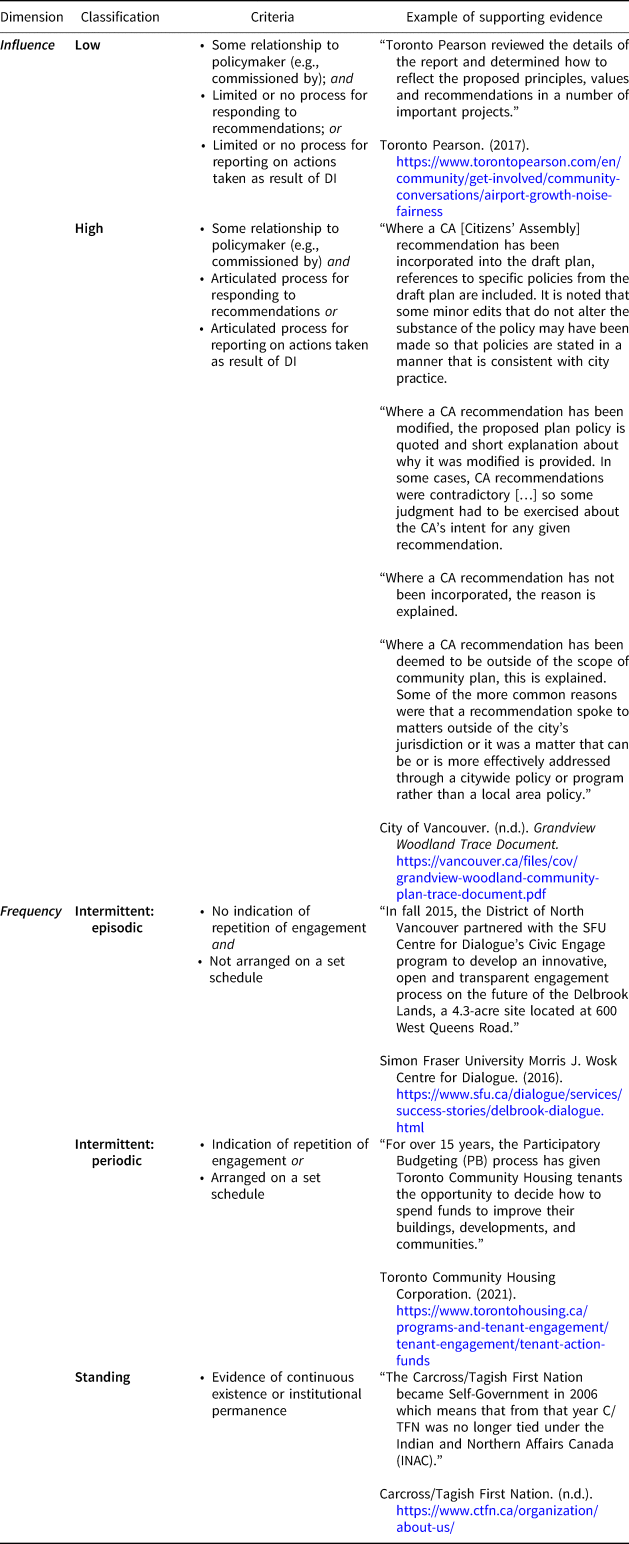
The noted British Columbia Citizens’ Assembly on Electoral Reform is an example of a high-influence, episodic case; the recommendation was from the outset designed to be put to referendum, but the case itself was a one-off. On the other hand, the Grandview-Woodland Citizens’ Assembly is also considered high influence (and episodic) as the Council provided a line-by-line response to the recommendations of the panel.
The data collection process outlined is consistent with similar analyses of DIs (for example, Fung and Warren, Reference Fung and Warren2011; Smith et al., Reference Smith, Richards and Gastil2015). While reasonable effort was taken to ensure that the data captures all cases of DIs in Canada, we recognize that the data collection process is dependent on limited datasets and that some instances of DIs may not be reflected in the data. Yet, in keeping with analyses from other countries that follow similar models (for example, Vrydagh, Reference Vrydagh2023), we are confident that the data gathered is both rigorous and substantive enough to highlight trends.
With adoption as our main outcome of interest, we explored several lines of inquiry: (1) overall breadth of democratic innovation adoption in Canada by year, geography and type; (2) depth of adoption over time through the lens of our framework; and finally, (3) depth of adoption in the context of jurisdictional level and type of DI. We gathered the cases in Excel and conducted all analyses in R.
Findings: Democratic Innovations in Canada
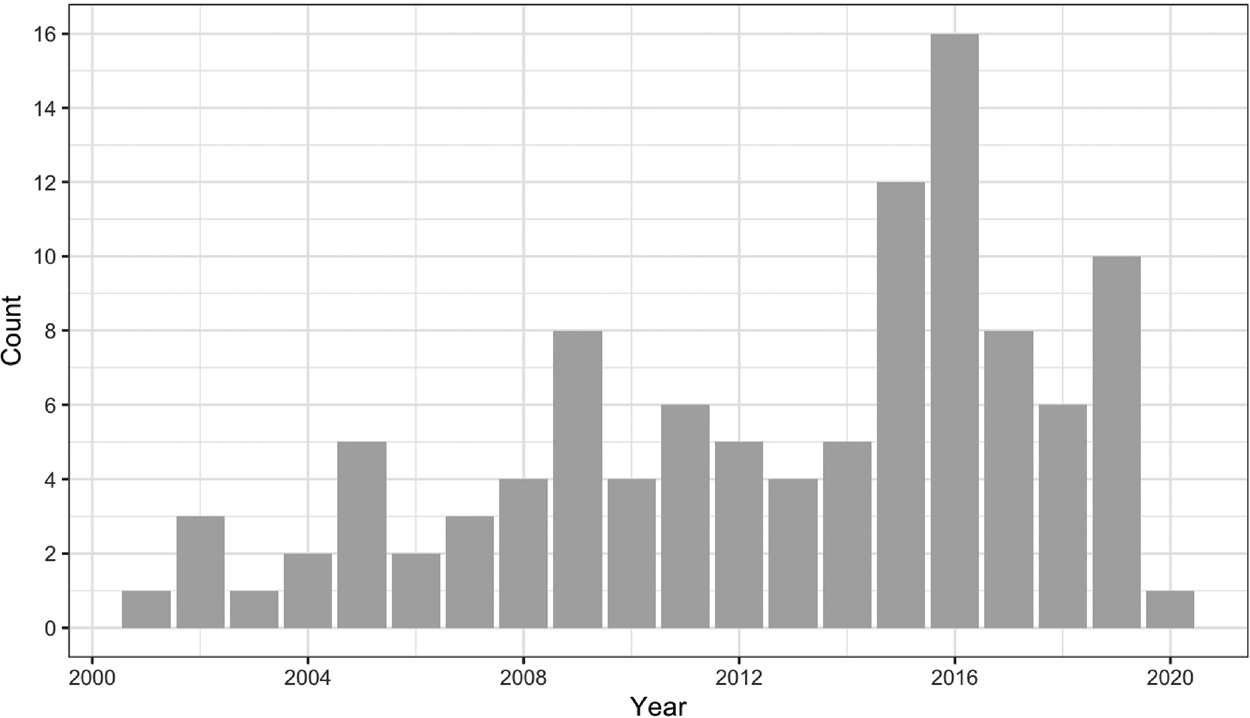
We find that while there has been an upward trend in the number of DIs, this is a result of peaks and troughs rather than consistent growth over time (Figure 1). However, there has been an increase in the total number of DIs in the years 2010-2020 compared to the prior 10 years. The year 2016 has the highest number of processes at 16, although this high has not been maintained in subsequent years. Unsurprisingly, given the global health crisis, DIs of all types drop off in 2020.
Frequency Plot of Democratic Innovations in Canada, 2000-2020.
The majority of DIs were in Ontario and British Columbia—indeed, DIs in these provinces comprised nearly 60 per cent of all processes, while populations in these provinces comprise 52 per cent of the Canadian population (Statistics Canada, 2021). Notably, Quebec's low share of DIs in Canada relative to their population share may exhibit a methodological limitation of the study: though evidence of innovative participatory tools in Quebec exists (Bherer and Breux, Reference Bherer and Breux2012), documentation of these French-language processes may not be captured in the Participedia database. The majority of processes were held at the level of municipal or regional (for example, provincial) jurisdictions (Table 3); naturally, this may simply be a function of the quantity of municipalities/regions in Canada being much greater than the quantity of federal governments in Canada. The most popular primary topic areas were health care and planning (Table 3).
Trends in Canadian DIs

Next, we examine the two dimensions of DI adoption. We are encouraged to see that a third of all cases (33%) are high influence; in comparison, 66 per cent are low influence (Figure 2). 2016 saw a spike in total number of cases, although these were primarily low influence.
DIs in Canada by Level of Influence, 2000-2020.

Examining temporality, the vast majority (90.6%) of cases are episodic—compared to 8.5 per cent that are held periodically and 0.9 per cent that are standing. Regular, ongoing cases are the minority every year except for 2003, where there are no episodic engagements and only one periodic engagement. As in Figure 3, we see that 2016 saw the highest number of engagements, although these were all episodic in nature.
DIs in Canada by Temporality, 2000-2020.

Considering these two dimensions together, we see a picture of DIs in Canada that is characterized by low-influence, episodic processes. As noted in Figure 1, there is an upward trend in the number of DIs from 2010 onwards, which culminates in a spike in 2016. However, this does not correlate with a similar trend in the number of high-influence cases, nor in periodic or standing cases. We see that only 5.7 per cent of all cases (6 of 106) in the dataset can be classified as high influence and periodic, and only one is standing.
When we focus on the depth of adoption of DIs for each type of jurisdiction (Table 4), we observe that all cases of institutionalized DIs were undertaken by municipalities or Indigenous governments (categorized here as “regional”). This can be explained in large part by considering the type of process (Table 5). By far, the most common type of process was consultation, followed by citizen panels. Seventy-eight per cent of all cases fell into these two categories alone. Yet, no cases were found to be high influence nor periodic or standing for either type of process; all cases were instead low influence and episodic. The only two types of engagement for which high-influence and periodic cases were observed were participatory budgeting and Indigenous self-governance—both of which fell into the jurisdictions of municipal and Indigenous governments (“regional”). Furthermore, the only process that fell into the category of a standing institution was a case of Indigenous self-governance.
Adoption by Jurisdiction

Adoption by Type of Process

Discussion
Despite our broad definition of what constitutes a high-influence and periodic democratic innovation, we do not find many processes in Canada that fit into this category. The low level of adoption of such processes may not be a cause for concern—in fact, it may suggest a typically Canadian approach to DIs. The British Columbia Citizens’ Assembly, commonly held as the benchmark in DIs in Canada, was not by this definition high influence and periodic; while it was influential (in that the recommendations of the Citizens’ Assembly were put to referendum), it was a single episodic activity. While attempts have been made to embed DIs (for example, the Toronto Planning Review Panel), they have failed to come to fruition.
The number of processes that are both high influence and periodic is low, at only six out of 106 total processes; and only one case was both standing and high influence. Only two types of process demonstrate this level of depth: participatory budgeting and Indigenous self-governance. We propose there are structural reasons for this.
Participatory budgeting is by design influential, as it is the very act of allocating and distributing funding according to the priorities of the stakeholders. It is the structure of this democratic innovation that enables the influence of its participants: the guarantee of action is enabled through pre-allocated funds. This DI is somewhat inverted relative to other formats of citizen engagement; for example, most formats involve decision makers listening to ideas from the public, then deciding whether or not to act upon them and then allocating funds toward the action. This is true of many consultations, town halls, and even citizen panels and assemblies. Thus, the upfront guarantee of action and allocation of funds is what sets participatory budgeting apart from other DIs. Whether or not this tool is adopted as periodic rather than episodic, however, appears to still be at the discretion of the government.
Indigenous self-governance is the only other process of democratic innovation to be designated high influence and periodic—in fact, the only process to be designated as both high influence and standing in our analysis is Indigenous self-governance.Footnote 3 In this example of a standing institution, power was returned to the Carcross/Tagish First Nation through the 2005 Land Grant Agreement reached with the Government of Canada and the Government of the Yukon Territory. This has allowed for the development of a governance system consistent with the nation's history, traditions and people (Participedia, 2019). Because it is a standing institution, continuity of the innovative governance structure is ensured. The cases of Indigenous self-governance classified as high influence and periodic also exhibit promising gains for self-determination: the collaborative land-use planning used in Haida Gwaii's Community Planning Forum was a step toward self-government (Participedia, 2018), and the Mohawk Council of Kahnawake's Community Decision Making Process constituted a refusal of colonial governance norms and a step toward self-governance (Participedia, 2021).
Although Indigenous self-governance is not “new” in a temporal sense, we view their inclusion as forms of DIs as vital to presenting a complete picture of the way in which citizens reimagine their role in contemporary governance processes through participation, deliberation and influence. This is all the more relevant given that Canadian institutions were designed to inherently exclude Indigenous forms of governance (Wilson et al., Reference Wilson, Alcantara and Rodon2020). Based on both the level of influence and the permanence of the structures—a combination not found in other types of democratic innovation in our dataset—our findings suggest that Indigenous self-governance is a promising type of democratic innovation in Canada.
As we have emphasized throughout this article, we need not expect nor demand the utmost influence and infinite repetition of democratic innovation in order for it to be a helpful addition to a democratic system. Consultations—often low influence and episodic in nature—constituted a major category of DIs in our dataset. While consultation lacks depth according to our framework and is rightfully criticized by Arnstein (Reference Arnstein1969) as lacking the muscle required to secure follow-through, a closer look at individual cases reveals a variety of techniques which can be (though are often not) employed to boost the democratic contribution of a consultation process. For instance, a consultation can incorporate a dialogical approach: the federal government's Consultation on National Security included an online consultation, email submissions, public town halls, constituency-level events and digital engagement, including a Twitter chat and online town hall (Public Safety Canada, 2017). This approach elevates a consultation from a forum with uni-directional information flow toward a more discursive format, introducing elements of deliberative democracy into a participatory space, which bolsters the empowerment of citizen participants by distributing power in the room that would otherwise be held solely by the facilitators (Farkas, Reference Farkas2013a, Reference Farkas2013b). Several consultations even included an iterative format to connect with citizens at several steps of the policy-making process. For example, the City of Vancouver's Vancouver Plan 2020 incorporated multiple points of engagement, including a launch event, workshops, online surveys, outreach activities, and both online and in-person design charrettes. Their process included four distinct phases: (1) to listen and learn about what matters most to residents, (2) to develop emerging directions, (3) to propose policy and land-use ideas and (4) to revise and finalize the plan (City of Vancouver, 2020). This iterative approach both benefits participants and still fits the definition of a consultation. We therefore argue that though their ability to influence policy is limited, there are opportunities to structure the design of consultations to a) enhance their contribution to democratic decision making and b) bolster citizen empowerment vis-à-vis the consultation.
It is worth noting that there is also variation in the level of influence within these methods. Though most citizen reference panels are low influence, some are high influence; likewise, while many citizen assemblies are high influence, some are not. Furthermore, sometimes an ostensibly high-influence citizen assembly is limited by the legal framework in which it operates. For example, the BC Citizens’ Assembly on Electoral Reform was influential insofar as the outcomes of the Assembly would be taken to public referendum; however, the BC government mandated a 60 per cent referendum approval rate for it to be adopted, which was not met (Fournier et al., Reference Fournier, van der Kolk, Kenneth Carty, Blais and Rose2011). This experience highlights the importance of research linking output and outcome, especially as it relates to DIs and their role in shaping public opinion. While outside the scope of this article, future research could explore the relationship between legal frameworks and DIs in more depth to further understand the ways in which DIs in Canada are helped or hindered by policies, such as mandatory public engagement.
We also note that many of the cases that we categorize as consultations were called “engagements” rather than “consultations.” We suspect that this shift—away from consulting the community toward engaging the community—may be an effort to dodge the use of the word “consultation,” which has come to be associated with low influence over a policy process. However, more research would be required to understand the reasoning and implications of this shift.
The data suggest that the municipal government is a more fruitful environment for DIs in Canada relative to other jurisdictional levels. There were more DIs at the municipal level than in any jurisdiction. We identify several reasons that could explain the prominence of DIs at the municipal level.
First, municipalities may foster DIs as they are lower-stakes environments for experimentation. Provinces have been described as laboratories of democracy (Volden, Reference Volden2006; Bednar, Reference Bednar2011) in which new approaches can be trialled prior to implementation at federal level. Similarly, we can conceptualize municipalities as lower-stakes, higher-freedom innovation labs in which an “ideas carrier,” an individual who implements new ideas in the political system (Berman, Reference Berman1998), can initiate a democratic innovation with relative ease. Innovations at the municipal level may simply be easier to initiate compared to the machinations of the federal or provincial government approvals process. There may be more institutional inflexibility, risk-aversion and concerns for public scrutiny at higher orders of government which create obstacles to the uptake of DIs (see Font et al., Reference Font, Smith, Galais and Alarcon2018).
Second, we suspect that municipalities are more friendly to democratic innovation than higher levels of government because of their legislated responsibility to consult the public (for example, through public hearings). This has a) familiarized municipal actors with citizen engagement as a practice and b) generated great disgruntlement with the procedures of legislated engagement requirements, fostering fertile ground for ideas of alternative practices (that is, the first stages of innovation). For instance, municipal disgruntlement with public hearings as the standard format of consultation for land use has led to pilots of innovative participatory projects in several BC municipalities. These pilots aim to test out alternative structures to better engage the public on matters of community planning. For example, the Burnaby Community Assembly was launched to feed community ideas into the city's upcoming Official Community Plan process (Burnaby Community Assembly, 2024); and in New Westminster, a standing community advisory assembly with participant balance between renters and homeowners has been established to advise council and staff from all departments on projects that will impact residents (New Westminster, 2024). We note that other levels of government are also bound to consult the public on certain regulatory changes, but possess some flexibility in the manner in which it is conducted (Woolley, Reference Woolley2008).
Third, we argue that local governments may be more open to DIs because they do not bear economic constraints quite so heavily as higher orders of government. This follows Dryzek's (Reference Dryzek1996) theory that state governments are more encumbered with economic constraints—for example, maintaining market confidence—which often wins out over the pursuit of increased democratic control. But local governments are a zone in which democratization may be undertaken, so long as local governments are less subjected to market punishment compared to provinces or states.
We also note that the high number of DIs happening at the municipal level may explain—at least in part—the lack of recent literature on Canadian DIs. Local innovations are less likely to receive media attention compared to federal—or even provincial—DIs. Where there have been relatively high-profile cases (for example, the BC Citizens’ Assembly), this has largely been a result of controversy surrounding the project. While we hope that the lack of media coverage would not necessarily indicate a similar lack of academic literature, it is harder to track the multiple smaller examples of DIs happening across the multitude of towns and cities in Canada, compared with the limited number of provinces.
The finding that the majority of DIs happen at a local level raises important questions about their adoption. Theoretically, local governments may have greater capacity to introduce such processes. Our findings support this hypothesis: aside from cases of Indigenous self-governance, the only processes that were high-frequency and periodic in our framework were at the municipal and regional (but sub-provincial) level. However, as previously discussed, these processes were categorized as such as a result of their process design. If the Government of Canada decided to run a recurring participatory budgeting process, it too would be a high-impact, periodic innovation; there are no conditions of adoption inherent in the local level of government that cannot be created elsewhere. Future research may want to explore why the federal government has not pursued such models of DIs. Furthermore, despite the fact that all high influence, standing DIs occurred at the municipal level, these are still few and far between. We suggest that future research should explore why high-influence, standing methods of democratic innovation observed in other localities, such as the Ostbelgien Citizens’ Assembly, have not seen similar adoption in the Canadian context.
Finally, we consider the extent to which the framework developed in this analysis allowed us to achieve our research aims. In addition to assessing the breadth of adoption by process type and geography, the application of our framework provided understanding into the depth of adoption of DIs according to both their influence and temporality. First, we find that the majority of DIs in the Canadian context were low influence and episodic. Those processes that were high influence and periodic were a result of the DI process used, rather than any exogenous or policy factors. We were also able to see that all DIs that were high influence and periodic were initiated by municipal, regional or Indigenous governments.
These findings would not have been achieved had we used the conventional frameworks outlined in our literature review. While our findings may lack depth in narrative exploration that the frameworks that Courant, Bherer and Breux and Larocque provide, our framework permits analytical applications into the depth of DI adoption, which enables comparison of cases and identification of trends and prompts areas for future analysis. Furthermore, our framework is not limited by governmental structure or geographical boundaries, meaning that it can be applied in both an in-country analysis and a cross-country analysis.
Conclusion
Despite Canada's initial trailblazing, we see little in the literature on the adoption of DIs in Canada. Is this because DIs are being overlooked in the literature or because they are not happening in practice? To address the dearth in literature, we sought to clarify the extent to which DIs in Canada are adopted. Building on and simplifying frameworks identified elsewhere, we developed a framework that could be readily applied to DIs in Canada and internationally. We then charted the uptake of DIs against this framework.
The two-by-three adoption framework allowed us to measure both the level of influence (low or high) and its temporality (whether it was standing or intermittent, and if intermittent, whether it was periodic or episodic). We used the framework to interrogate over a hundred cases of DIs in Canada gathered from open-access sources, including Participedia and the OECD. Our findings suggest that overall uptake of DIs has risen gradually but inconsistently since 2000. Most DIs occur at the municipal level, which may explain why we see a lack of writing about Canadian DIs: local forums are often only covered in local media, if at all. However, despite the quantity of DIs exhibiting a small upward trend over time, trends in our two dimensions do not exhibit similar upward trends. Rather than seeing DIs reaching a greater depth of adoption in Canada, we see a greater number of low-influence, episodic processes. As we have articulated, this finding on its own is not necessarily a cause for concern; however, it does raise important questions about the gap between rhetoric and practice, and Canada's progress relative to that seen elsewhere.
Only a handful of DIs in Canada are high influence and periodic, and only one is high influence and standing; in both cases, this was connected to the type of democratic innovation undertaken. More attention should be paid to the importance of Indigenous self-governance as a democratic innovation, particularly in the context of ongoing attempts at decolonization.
While there are benefits to adopting DIs and embedding them as periodic or standing institutions, careful consideration should be given to the potentially exclusionary dynamics of some types of DIs before their adoption into Canadian institutional structures. Future research should interrogate the relationship between DIs and the institutional frameworks in which they operate. Future research would also benefit from identifying whether the trends identified in this analysis are a uniquely Canadian experience or whether they mirror the trajectory of DIs in other countries. Finally, we hope that the framework developed for this analysis will be a useful contribution to a more robust and comparative analysis of DIs that allows for greater identification of trends in theory and practice.
Acknowledgements
An earlier version of this article was presented at the Canadian Political Science Association 2023 Annual Conference and the 2024 Bell Chair Graduate Student Conference in Canadian Politics. The authors are grateful for feedback provided by Simon Lambek, Bill Cross, Edana Beauvais, members of McMaster's Digital Society Lab and the two anonymous reviewers.
Competing interests
The authors declare none.


 Open access

