





Highlights
-
1. Emotion word type and valence modulated L2 emotion word processing in late bilinguals.
-
2. Negative emotion-laden words produced slower responses, and positive emotion-label words elicited larger LPC amplitudes exclusively within the task where the emotional dimension of the stimuli was task-relevant.
-
3. The universality of emotion word type and valence effects should be evaluated in light of task demands and language context.
1. Introduction
Emotion permeates the way in which human beings produce and process language (Hinojosa et al., Reference Hinojosa, Herbert and Kissler2023). Within the field of emotion word research, the two-dimensional model (Russell et al., Reference Russell, Clement, Jiwani, Ridgeway and Schroeder1980) has been the predominant framework for delineating the affective properties inherent in linguistic stimuli. According to this model, emotions vary continuously along two orthogonal dimensions: valence and arousal. Valence denotes the inherent pleasantness or unpleasantness of a stimulus, ranging from negative to positive, while arousal reflects the degree of automatic activation a stimulus provokes, ranging from calming to exciting. Within this framework, emotion words are typically categorized as either positive or negative, with varying levels of arousal. Studies have shown that emotionally valenced words are processed differently from neutral words, as evidenced by faster reaction times and stronger neural responses (see Aguilar et al., Reference Aguilar, Ferré and Hinojosa2024, for a review), highlighting the crucial role of emotional content in language processing. However, because a second language (L2) is often learned in formal, relatively low-emotion settings, an important question arises: is the effect of emotionality on language processing universal, influencing L2 in a way comparable to first/native language (L1)?
This question has sparked growing research on how emotionally charged words are represented in bilingual populations. To date, it is increasingly acknowledged that bilinguals’ processing of emotion-denoting words is modulated by multiple factors (e.g., language proficiency, age of acquisition, language immersion; Sharif & Mahmood, Reference Sharif and Mahmood2023; Tang & Ding, Reference Tang and Ding2023; Velez-Uribe & Rosselli, Reference Velez-Uribe and Rosselli2021). Nevertheless, it is commonly found that the emotion effect persists in L2, albeit with diminished intensity. For instance, it was found that emotionally valenced words are recognized more quickly than neutral words in lexical decision tasks (LDT), irrespective of participants’ L1, age of L2 acquisition, or the frequency and context of L2 use (Ponari et al., Reference Ponari, Rodríguez-Cuadrado, Vinson, Fox, Costa and Vigliocco2015). At the same time, the emotional resonance in L2 appears to be attenuated or delayed. Bilingual speakers, for example, exhibit reduced skin conductance responses (Harris et al., Reference Harris, Ayçiçeǧi and Gleason2003), report weaker affective intensity (Ferré et al., Reference Ferré, Guasch, Stadthagen-Gonzalez and Comesaña2022), and show delayed early posterior negativity in electroencephalography (EEG) studies (e.g., Opitz & Degner, Reference Opitz and Degner2012) when processing emotionally charged stimuli in L2 compared to L1.
These findings point to a systematic asymmetry in how emotional content impacts L1 and L2. To account for such asymmetries, theories of bilingual lexical processing generally assume that representations from both languages are automatically and in parallel activated whenever one of a bilingual’s languages is used. Within this view, the Bilingual Interactive Activation plus (BIA+) model (Dijkstra & Van Heuven, Reference Dijkstra and Van Heuven2002) posits an integrated lexical system in which words from both languages are represented in a shared system and co-activated, and constrained by language nodes and higher-level context. Because L2 is often learned in more formal, decontextualized settings, L2 emotion words are likely to develop weaker connections not only to conceptual representations but also to affective and contextual information than their L1 counterparts, thereby naturally yielding attenuated emotion effects in L2. Complementarily, the dual coding theory (Paivio, Reference Paivio1991) posits partially separable but interconnected verbal and imaginal systems. L1 words are typically grounded in both abstract verbal codes and rich imagery-based, experiential codes built up through affective encounters, whereas L2, whose acquisition is usually less emotionally grounded, tends to rely more heavily on verbal codes. Thus, the attenuated emotion effects in L2 can be understood not merely as a quantitative difference in activation strength but also as a qualitative difference in the representational format, namely a relative lack of dense, sensory-rich non-verbal coding that characterizes L1 and rapidly potentiates affective responses. Together, these frameworks offer a straightforward explanation for why emotion effects are generally preserved but attenuated in L2 compared to L1.
Despite these established findings, a critical yet often overlooked issue in this line of research is the heterogeneity of emotion words. While much of the existing literature treats emotion words as a monolithic category, recent research has proposed that emotion words comprise two subtypes: emotion-label words, which directly denote emotional states (e.g., “happy” or “angry”), and emotion-laden words, which evoke emotions indirectly through their connotations (e.g., “wealthy” or “poor”) (Pavlenko, Reference Pavlenko2008; Wu et al., Reference Wu, Zhang and Meng2025; Zhang et al., Reference Zhang, Wu, Meng and Yuan2017). Obviously, the two-dimensional model cannot distinguish between emotion-label words and emotion-laden words (Betancourt et al., Reference Betancourt, Guasch and Ferré2024). So far, employing a variety of experimental paradigms, a number of behavioral studies have elucidated the division between responses to emotion-label words and emotion-laden words in either L1 (Betancourt et al., Reference Betancourt, Guasch and Ferré2023; Kazanas & Altarriba, Reference Kazanas and Altarriba2015, Reference Kazanas and Altarriba2016b; Knickerbocker & Altarriba, Reference Knickerbocker and Altarriba2013), L2 (El-Dakhs & Altarriba, Reference El-Dakhs and Altarriba2019), or both (Altarriba & Basnight-Brown, Reference Altarriba and Basnight-Brown2011; Bromberek-Dyzman et al., Reference Bromberek-Dyzman, Jończyk, Vasileanu, Niculescu-Gorpin and Bąk2021; Ferré et al., Reference Ferré, Guasch, Stadthagen-Gonzalez and Comesaña2022; Kazanas & Altarriba, Reference Kazanas and Altarriba2016a; Tang et al., Reference Tang, Fu, Wang, Liu, Zang and Kärkkäinen2023). This phenomenon has been referred to as the emotion word type effect (Tang et al., Reference Tang, Li, Fu, Wang, Li, Parviainen and Kärkkäinen2024; Zhang et al., Reference Zhang, Wu, Meng and Yuan2024). For example, in a masked LDT, emotion-label words elicited faster reaction times than emotion-laden words in both L1 and L2, with this distinction being more pronounced in bilinguals’ dominant language (Kazanas & Altarriba, Reference Kazanas and Altarriba2016a). In a similar vein, Tang et al. (Reference Tang, Fu, Wang, Liu, Zang and Kärkkäinen2023) conducted an emotional categorization task (ECT) in which late Chinese-English bilinguals were explicitly tasked with classifying words as positive, neutral, or negative. They found a processing facilitation for emotion-label words over emotion-laden words in both L1 and L2, marked by decreased response times.
Electrophysiologically, the event-related potentials (ERP) technique, by virtue of its high temporal resolution, has been utilized to uncover the temporal dynamics of brain activities involved in processing emotion-label words and emotion-laden words. For instance, in an LDT where Chinese-speaking participants were required to decide whether a given stimulus is a word, two key ERP components were identified (Zhang et al., Reference Zhang, Wu, Meng and Yuan2017, Reference Zhang, Wu, Yuan and Meng2020). The N170, an early ERP component reflecting differentiation between emotional and non-emotional connotations over the parietal region, and the late positive complex (LPC), which is sensitive to valence effects and reflects elaborate processing of emotional information over the central-parietal sites, were found to be modulated by emotion word type in L1. Comparable observations have been noted in the context of L2 processing (Zhang et al., Reference Zhang, Wu, Yuan and Meng2020). In addition, research indicates that the emotion word type modulates emotion conflict in L1 (Zhang et al., Reference Zhang, Wu, Yuan and Meng2019) and cognitive conflict in L2 (Wu & Zhang, Reference Wu and Zhang2019; Zhang et al., Reference Zhang, Teo and Wu2019). These findings suggest that distinct neural mechanisms underpin the decoding of emotion-label and emotion-laden words during both early and late processing stages, across both L1 and L2.
Currently, theories about lexical processing in bilinguals generally acknowledge that information concerning both languages are automatically active in parallel during processing either of a bilingual’s languages. From the perspective of the Bilingual Interactive Activation plus (BIA+) model (Dijkstra & Van Heuven, Reference Dijkstra and Van Heuven2002), there is an integrated lexical network in which words from both languages are represented in a shared system and co-activated, with language nodes and higher-level contextual constraints modulating the extent to which particular representations influence performance. Within such an architecture, emotion-label and emotion-laden words in L2 can be assumed to vary in the strength of their links not only to conceptual representations but also to affective and contextual information, with top-down task demands shaping how strongly these links are engaged. Complementarily, the dual coding theory (Paivio, Reference Paivio1991) posits partially separable but interconnected verbal and imaginal systems. Emotion-label words are thought to rely predominantly on abstract verbal–conceptual codes, whereas emotion-laden words are more tightly tied to experiential, imagery-based codes.
Yet despite the recent surge in behavioral and ERP studies on the emotion word type, findings remain inconsistent (Martin & Altarriba, Reference Martin and Altarriba2017; Vinson et al., Reference Vinson, Ponari and Vigliocco2014), raising questions about stimulus control, task sensitivity, and experimental design. Specifically, we assume that two main points of concern warrant further attention. The first revolves around the selection and control of experimental stimuli. Many existing studies rely heavily on researchers’ subjective judgments when classifying words as either emotion-label or emotion-laden, raising valid concerns about the objectivity and consistency of such classifications (see Aguilar et al., Reference Aguilar, Ferré and Hinojosa2024; Hinojosa et al., Reference Hinojosa, Moreno and Ferré2020, for reviews). Only recently have normative databases been established to address this gap, providing standardized classifications based on emotional prototypicality across languages, including Spanish (Pérez-Sánchez et al., Reference Pérez-Sánchez, Stadthagen-Gonzalez, Guasch, Hinojosa, Fraga, Marín and Ferré2021), Chinese (Zheng et al., Reference Zheng, Zhang, Guo, Guasch and Ferré2023), and English as an L2 among Chinese-English bilinguals (Wu et al., Reference Wu, Zhang and Meng2025). Notably, these databases involve emotion words across different grammatical categories. In addition, concreteness, which refers to the extent to which conceptual information is associated with real-world referents, was not controlled in ERP studies mentioned that focus on emotion word type. Prior research suggests that emotion plays a more vital role in processing abstract words in comparison to concrete ones (Moseley et al., Reference Moseley, Carota, Hauk, Mohr and Pulvermüller2012), as emotional terms typically lack grounding in sensory modalities other than affective experience. Consequently, some of the observed differences between these two types of emotion words may potentially stem from uncontrolled variation in concreteness (Kissler, Reference Kissler2020). Concerning the subjective way of stimuli selection and insufficient control on their concreteness, Wang et al. (Reference Wang, Shangguan and Lu2019) extended the work of Zhang et al. (Reference Zhang, Wu, Meng and Yuan2017) by more rigorously controlling for their L1 stimuli and revealed distinct ERP effects. Specifically, the effect of emotion word type emerged predominantly at early word processing stages, as indexed by P2 amplitude differences between positive emotion-laden words and neutral words – a component linked to early attention resource allocation. Nevertheless, these issues remain largely unexplored in L2 research.
The second concern pertains to the potential impact of task heterogeneity on the discrepancies observed in studies focusing on emotion word type. Attention to emotionally charged words can be particularly compelling and often occurs in an obligatory fashion (Algom et al., Reference Algom, Chajut and Lev2004), yet the extent to which such words modulate behavioral or electrophysiological responses may vary depending on the nature of the task (Eilola & Havelka, Reference Eilola and Havelka2011; Fischler & Bradley, Reference Fischler and Bradley2006; Frühholz et al., Reference Frühholz, Jellinghaus and Herrmann2011). Previous emotion word research has employed paradigms that differ in whether the emotional dimension of the stimuli is central or not to the required decision (González-Villar et al., Reference González-Villar, Triñanes, Zurrón and Carrillo-De-La-Peña2014; Hinojosa et al., Reference Hinojosa, Albert, López-Martín and Carretié2014; Schacht & Sommer, Reference Schacht and Sommer2009). For instance, Hinojosa et al. (Reference Hinojosa, Albert, López-Martín and Carretié2014) reported that negative words elicited larger LPC amplitudes when participants explicitly evaluated word valence (direct task) than when they evaluated word touchability (indirect task), suggesting that greater attentional resources were allocated to emotional information in the former condition. This finding is consistent with the view that the LPC is highly sensitive to task difficulty and attentional demands. With respect to emotion word type research, El-Dakhs and Altarriba (Reference El-Dakhs and Altarriba2019) further revealed that the task type might lead to divergent processing of emotional content: the emotion word type effect was present in free recall and rating tasks – both requiring in-depth semantic evaluation – but absent in a discrete word association task, which involves more automatic processing. Viewed in this way, the distinction between emotion-label and emotion-laden words may not be universal but rather strongly task-dependent.
Indeed, prior research on emotion word type has employed experimental paradigms with varying task demands. In some tasks, the emotional dimension of the stimuli is task-relevant and requires deeper processing of the emotional value of words (e.g., emotionality-rating task, the ECT), whereas in others, the emotional dimension is task-irrelevant and only incidental to performance (e.g., the priming paradigms, the LDT). These paradigms differ in the extent to which attention is allocated to the affective properties of emotion words. For clarity, in what follows we describe these as “affectively task-relevant” versus “affectively task-irrelevant” tasks. Concretely, the former tends to engage more top-down attentional resources for emotion processing, which may potentially enhance emotion perception compared to the latter (Liao & Ni, Reference Liao and Ni2021). It is worth noting that prior research has shown that emotions conveyed by L1 emotion words can still be decoded even when attention is not explicitly directed to emotional content (Frühholz et al., Reference Frühholz, Jellinghaus and Herrmann2011), indicating that affective processing can occur under task-irrelevant conditions as well. Importantly, although both emotion-label words and emotion-laden words are connected to emotions, they may differ in how directly and automatically they activate affective representations, and these differences are likely to interact with task demands. In line with this, Liu, Fan, Tian, et al. (Reference Liu, Fan, Tian, Li and Feng2022) compared L1 emotion-label and emotion-laden word processing in an ECT (affectively task-relevant) with an emotional Stroop task (EST; affectively task-irrelevant, requiring participants to name the ink color of emotional words while ignoring their emotional content). They observed that task demands modulated the late-stage processing of these two types of emotion words, as indexed by LPC amplitudes. Their findings underscore the necessity of jointly considering emotion word type and task demands in research on emotion word processing. Nevertheless, whether similar task-dependent patterns arise in the L2 has yet to be explored.
To address these gaps, the present study employed a 2 (emotion word type: label versus laden) × 2 (valence: positive versus negative) × 2 (task demands: affectively task-relevant versus affectively task-irrelevant) within-subject design to investigate whether the emotion word type effect generalizes to L2 and how these two types of emotion words with different valence are processed under different task demands within the L2 context. We used an ECT in which the affective information was task-relevant and an EST in which the affective information was task-irrelevant. All words were normed for valence, arousal, concreteness, familiarity, and frequency, and carefully balanced across conditions. Both behavioral and electrophysiological data were collected. Based on previous research (Ferré et al., Reference Ferré, Sánchez-Carmona, Haro, Calvillo-Torres, Albert and Hinojosa2025; Frühholz et al., Reference Frühholz, Jellinghaus and Herrmann2011; Liu, Fan, Tian, et al., Reference Liu, Fan, Tian, Li and Feng2022), we hypothesize that emotion-laden words and negative words would show a behavioral processing disadvantage relative to emotion-label words and positive words, as reflected in longer response times (RTs) or higher accuracy rates (ACCs) across both tasks. This effect, however, would be attenuated under the EST relative to the ECT. For ERP correlates of emotion word processing, our primary focus lies on the LPC, which is expected to be larger in the ECT than in the EST. In addition, the existing literature presents conflicting results regarding the sensitivity of LPC to emotional valence. Some studies suggested that pleasant stimuli elicited more positive LPC amplitudes than unpleasant information (e.g., Herbert et al., Reference Herbert, Junghofer and Kissler2008), while others reported the opposite pattern (Hofmann et al., Reference Hofmann, Kuchinke, Tamm, Võ and Jacobs2009; Kanske & Kotz, Reference Kanske and Kotz2007). In the present study, we expect LPC amplitudes to be larger in response to emotion-label words compared to emotion-laden words, especially those with positive valence.
2. Methods
2.1. Participants
Thirty late Chinese-English bilinguals (9 males and 21 females; age range: 25–36 years), with Chinese as their L1 and English as their L2, were recruited for this study. All participants were right-handed (evaluated by the Edinburgh Handedness Inventory, Oldfield, Reference Oldfield1971), had normal or corrected-to-normal vision and color vision (self-reported), and none reported any neurological disorders. Informed consent was obtained from each participant prior to their participation. All of them were monetarily compensated for taking part in the experiment. ERP data from one participant were excluded due to excessive EEG noise, resulting in a sample of 29 participants (9 males and 20 females; M age = 29.45, SD age = 2.61). Before the EEG measurements, all participants were required to complete the LexTALE, an objective measurement for speakers of English as L2, to assess their L2 proficiency, particularly their vocabulary knowledge. The result (M LexTALE = 66.94%, SD LexTALE = 10.27%) showed that they were at an upper-intermediate level of L2 proficiency (60%–80%) (Lemhöfer & Broersma, Reference Lemhöfer and Broersma2012). In addition to that, they were asked to answer three questions adapted from the Language History Questionnaire (Li et al., Reference Li, Zhang, Yu and Zhao2020). The results showed that their age of English acquisition ranged from 6 to 12 years, with a mean age of 9.07 years (SD = 1.85), thus meeting the criterion for late bilingualism (Lai et al., Reference Lai, Rodriguez and Narasimhan2014), and that they had an average of 20.38 years (SD = 2.44) of English-learning experience, primarily through classroom instruction. Finally, participants self-reported their L2 proficiency across four skills (reading, listening, writing, speaking) using a seven-point Likert scale (1 = very poor, 7 = very excellent). The mean raw score was 4.68 (SD = 0.51), representing 66.87% (SD = 7.33%) of the maximum possible score. The experimental design and procedure were approved by the Ethics Committee of University of Jyväskylä. The authors assert that all procedures contributing to this work comply with the ethical standards of the relevant national and institutional committees on human experimentation and with the Helsinki Declaration of 1975, as revised in 2008.
2.2. Stimuli
A total of 120 English adjective words were included in this study, comprising 30 positive emotion-label words, 30 positive emotion-laden words, 30 negative emotion-label words and 30 negative emotion-laden words (the full set of stimuli is provided in Table S1 in the Supplementary Material). To enhance control over stimulus concreteness, and because adjectives are more closely related to emotional states (Bromberek-Dyzman et al., Reference Bromberek-Dyzman, Jończyk, Vasileanu, Niculescu-Gorpin and Bąk2021), a word pool of 295 emotion-related English adjective words was drawn from an English emotional norm database (Warriner et al., Reference Warriner, Kuperman and Brysbaert2013). These words were then categorized into emotion-label words and emotion-laden words using a voting method (Liu, Fan, Jiang, et al., Reference Liu, Fan, Jiang, Li, Tian, Zhang and Feng2022; Liu, Fan, Tian, et al., Reference Liu, Fan, Tian, Li and Feng2022; Tang et al., Reference Tang, Fu, Wang, Liu, Zang and Kärkkäinen2023; Wang et al., Reference Wang, Shangguan and Lu2019). Specifically, a group of 20 participants, who were not involved in the EEG measurements, classified the words based on their definitions. Words marked as unfamiliar by any participant were excluded from the next step. Only words reaching at least about 80% agreement among participants for the identical emotion word group were included. With this criterion, 165 emotion-label and emotion-laden words were obtained. Subsequently, four groups of 20 participants who did not take part in the EEG measurements were recruited to assess the valence, arousal, concreteness, and familiarity of the selected words using a seven-point scale (7 = very pleasant, very excited, very abstract, and very familiar, respectively).
The stimuli utilized in this EEG experiment were matched on arousal (p > .42), frequency (p > .72) (Brysbaert & New, Reference Brysbaert and New2009), concreteness (p > .74), familiarity (p > .08), and length (p > .98). In terms of valence ratings, positive words were rated with significant higher score over negative words (p < .001). Paired t-tests revealed no differences either between positive emotion-label and positive emotion-laden words (t = −1.67, p = .11), or between negative emotion-label and negative emotion-laden words (t = 0.75, p = .46). More recently, emotional prototypicality has been proposed as a reliable and objective measure of the degree to which a word refers to an emotion, providing a way to distinguish between emotion-label words and emotion-laden words (e.g., Wu et al., Reference Wu, Zhang and Meng2025). To ensure the objectivity of the stimuli used in our study, we recruited a group of 28 participants (who were not involved in the EEG measurements) to rate how strongly a word signified an emotion on a five-point scale (5 = this word clearly refers to an emotion). The results showed that the emotion-label words (M = 4.44, SD = 0.90, SE = 0.02) were rated more prototypical in emotion than emotion-laden words (M = 3.04, SD = 1.33, SE = 0.32) (t = 7.35, df = 36.725, p < .001). Attributes of the experimental stimuli employed in this study are shown in Table 1.
Means (M) and standard deviation (SD) of the properties of emotion-label and emotion-laden words in English (L2)

2.3. Procedure
Participants were directed to sit comfortably in front of an LCD monitor with a resolution of 1920 × 1080 and a refresh rate of 60 Hz, positioned at a distance of 75 cm. All stimuli (font: Times New Roman; size: 36) were presented in blue or green color against a gray background employing the psychological software E-prime 2.0 (Psychology Software Tools, Pittsburgh, PA, USA).
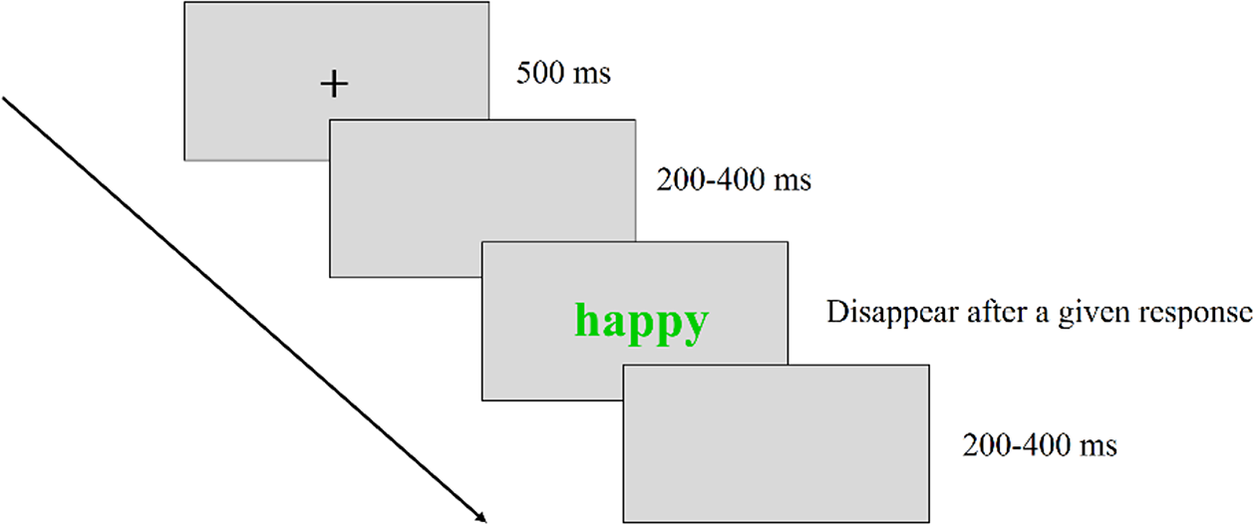
This study consisted of two tasks: the ECT (affectively task-relevant) and the EST (affectively task-irrelevant). Each task comprised four blocks, with each block containing 60 trials. Within each of the first two blocks, there were 15 positive emotion-label words, 15 negative emotion-label words, 15 positive emotion-laden words, and 15 negative emotion-laden words, evenly distributed in a random order. Subsequently, these two blocks were presented again, resulting in a total of four blocks with 240 trials. The stimuli were presented randomly either in blue or green color within each task. Both the ECT and EST shared the same procedure, as illustrated in Figure 1. Concretely, each trial began with a black fixation cross at the center of the screen for 500 ms, followed by a blank lasting randomly from 300 to 500 ms, and then replaced by an English word. Participants were instructed to respond to the word as quickly and accurately as possible. Of note, the word disappeared upon giving a response. In the ECT, participants were required to explicitly determine the word valence (positive or negative), whereas in the EST, they were required to ignore word meaning and identify their ink color (blue or green) by pressing the corresponding keys. The task order, word colors, and responsive keys were counterbalanced across all participants. The entire experimental session lasted about 30 minutes.
Schematic view of the experimental procedure for one trial.

2.4. EEG recording and data preprocessing
Continuous EEG was recorded by a 128-channel HydroCel Geodesic Sensor Net (Electrical Geodesic Inc., USA), coupled with a high-impedance amplifier – the Net Amps 400 amplifier (Electrical Geodesic Inc., USA), and Net Station 4.5.7 (Electrical Geodesic Inc., USA). Electrode impedances were maintained below 50 kΩ during recording. Data were recorded at a sampling rate of 1,000 Hz, filtered online from 0.1 to 250 Hz, and referenced to the vertex electrode (Cz).
EEG data were preprocessed and analyzed with MNE-Python (Gramfort et al., Reference Gramfort, Luessi, Larson, Engemann, Strohmeier, Brodbeck, Goj, Jas, Brooks, Parkkonen and Hämäläinen2013; MNE version: 0.21.2; Python: 3.10.9) analysis package following the workflow outlined below: EEG data were band-pass filtered from 0.1 to 30 Hz. The lower transition bandwidth was set to 0.10 Hz (−6 dB cutoff frequency: 0.05 Hz), and the upper transition bandwidth was set to 7.50 Hz (−6 dB cutoff frequency: 33.75 Hz). The filter length was 33001 samples (33.001 s). A notch filter at 50 Hz was applied to mitigate power line interference. Bad channels with excessive noise were identified and interpolated using the spherical spline method, and the EEG data were re-referenced offline to an average over all channels. Then, epochs were extracted time-locked to the onset of the stimulus, spanning from −100–800 ms. Blinks and saccade artifacts were detected and removed through independent component analysis. Visual inspection of the data was conducted to reject certain trials after epoching due to the presence of residual artifacts. Finally, baseline correction was applied to each epoch using the 100 ms prestimulus interval, and epochs for each condition were grand averaged across participants for visualization. Notably, only data corresponding to correct responses were included for preprocessing. For statistical analysis, the average effective number of trials per condition for each participant was 52 out of 60 trials (SD = 2.88, range: 44–59) in both the ECT and EST. For additional details, please refer to Table S2 in the Supplementary Material.
2.5. Statistical analysis
2.5.1. Exploratory data analysis
We conducted cluster-based permutation tests to identify the time windows and scalp regions showing reliable condition-related differences. This data-driven approach allowed for objective window selection by identifying temporally and spatially contiguous clusters of significant effects without requiring a priori assumptions about their onset or duration (Luck & Gaspelin, Reference Luck and Gaspelin2017). The epoched EEG data underwent a cluster-based permutation test on spatiotemporal data points (129 channels × 900 samples) derived from the grand-average ERP of subjects. Within-subjects factors were Emotion word type (emotion-label versus emotion-laden), Valence (positive versus negative) in the ECT (affectively task-relevant) and EST (affectively task-irrelevant), respectively. The F-threshold was chosen automatically that corresponds to a p-value of .05 for the given number of observations using 10,000 permutations (Bricker, Reference Bricker2020). Then non-parametric cluster-level paired t-test for spatiotemporal data was used, and threshold on both sides of the distribution was employed to further investigate any significant interactions related to the effect of emotion word type and valence in ANOVAs. This test allows an objective measure of whether there are differences in ERP components, during the specified time window that reflect neural modulations of the effects of valence and emotion word type on L2 emotion word processing within each task. The test revealed modulations of valence, emotion word type, and their interaction on word processing in the ECT (shown in Figure 2). Specifically, the valence effect was observed at 372–600 ms over the central-parietal sites (p = .0009); the emotion word type effect was observed at 396–600 ms over the central-parietal sites (p = .0009); the interaction between valence and emotion word type was observed at 350–595 ms over the central-parietal sites (p = .007). In the EST, no such effects were found (ps > .3619). Average EEG data across pre-selected channels and time window were further submitted to Bayesian multilevel regression with full structure of population terms in order to explore interactive effects.
The grand-average ERP waveforms (right panel) display the main effects of valence (A), emotion word type (B), and their interaction (C) over central-parietal sites in the ECT, with shadows indicating the time windows with significance. The F-map (left panel) illustrates the F-values with significance in given time windows, and the white dots reflect the channels in the significant cluster (Note: “P” means “Positive,” “N” means “Negative,” “Label” means “emotion-label words,” and “Laden” means “emotion-laden words”).

2.5.2. Statistical modeling
Statistical analyses for RTs (in ms) and EEG (μV) data were carried out using Bayesian multilevel regression fitted in Stan (Stan Development Team, 2018) via the library brms (Bürkner, Reference Bürkner2017) in R environment (R Core Team, 2022). The model predicted all outcome variables for the population effects of emotion word type (emotion-label versus emotion-laden), valence (positive versus negative), task type (ECT versus EST), and their interactions. The hypr package 0.1.7 (Rabe et al., Reference Rabe, Vasishth, Hohenstein, Kliegl and Schad2020) was called to design sequential difference contrasts for categorical variables (2-level predictors: 1/2, −1/2). Thus, the intercept represented the grand average across fixed terms, and hence the resulting estimates can be interpreted as simple main effects. The likelihood of the model fitted to the response latency data was assumed to be distributed as lognormal. Given that averages of EEG data are roughly normally distributed, we fitted this model using a normal distribution to estimate the posteriors as the product of the default Gaussian family.
The above models fitted to response latency included regularizing, weakly informative priors (Gelman et al., Reference Gelman, Simpson and Betancourt2017) to estimate plausible posterior values. In terms of the EEG model, our prior for α followed a normal distribution of N (2, 5), and the prior for β was assumed to be a Cauchy distribution centered at zero with a standard deviation of 5 μV. The choice was based on prior domain knowledge that 5 microvolts are roughly 30% of 15, which is the upper bound of the expected standard deviation of the EEG signal. Thus, the prior indicated that the mass probability of predicting time-locked signals falls between ±10 μV with 95% probability. For all models, Markov Chain Monte Carlo sampling was implemented with four chains distributed between four processing cores to draw samples from the posterior probability distribution. To assess our prior hypotheses, a region of practical equivalence (ROPE) around a point null value of 0 (Kruschke, Reference Kruschke2018) was established by using the following formula:
 $$ \mathrm{ROPE}=\frac{\mu_1-{\mu}_2}{\sqrt{\frac{\sigma_1^2+{\sigma}_2^2}{2}}}. $$
In general, we reported four statistics to describe the posterior distribution for each parameter of interest, including (1) median posterior point estimates, (2) the 95% highest density interval (HDI), (3) the proportion of the HDI contained within the ROPE, and (4) the maximum probability of effect (MPE). For statistical inferences, a posterior distribution for a parameter β in which 95% of the HDI does not contain 0 and falls outside the ROPE as well as a high MPE (i.e., values close to 1) is considered compelling evidence for a given effect.
3. Results
3.1. Behavioral results
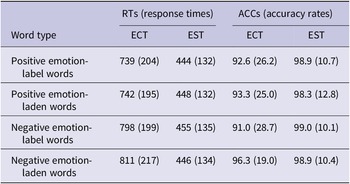
The response times (RTs) and accuracy rates (ACCs) across all conditions of words in the ECT (affectively task-relevant) and EST (affectively task-irrelevant) are shown in Table 2. The ACCs were excluded from analysis due to a ceiling effect, with accuracy rates for emotion words across conditions exceeding 91%.
Mean RTs (ms) with standard deviations (SDs) in parentheses for the four groups of emotion words in the ECT and EST

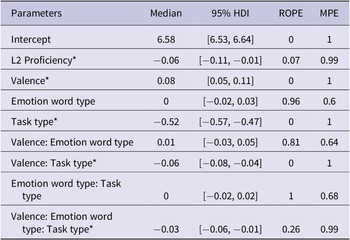
In the analysis of RTs, data points with standardized residuals exceeding ±2.5 were excluded from the following analysis (n = 43, 0.6% of the data). A two-way interaction between valence and task type emerged, which was further modulated by a three-way interaction between valence, emotion word type, and task type. Subsequent analysis revealed that positive words were responded faster than negative words only in the ECT, where valence judgments were required. While negative emotion-label words were responded more rapidly than negative emotion-laden words in the ECT, no significant difference was found in the positive condition. Additionally, the analysis did not reveal any significant effects of valence, emotion word type or their interaction in the EST, where ink color judgments were required. Statistical analysis of RTs could be found in Table 3.
Summary of the posterior distribution modeling for the modulation of each parameter of interest on RTs

Note: The table includes posterior medians, the 95% HDI, the percentage of the HDI within the ROPE, and the maximum probability of effect (MPE). Hereafter “*” means effect with significance.
3.2. Electrophysiological results
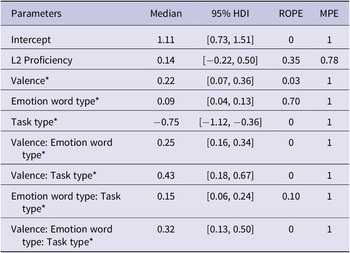
Dissimilar patterns in neural modulations spanning 350–595 ms with a centro-parietal scalp distribution in the ECT condition were observed. Figure 3 illustrates the mean grand average of the ERP waveforms and topographic maps over the time window of interest (350–595 ms) for each word condition in the ECT and EST, respectively. Specifically, main effects of valence and emotion word type were evident in the ECT condition, suggesting that positive words elicited higher amplitudes than negative words, and emotion-label words elicited higher amplitudes relative to emotion-laden words. Additionally, interactions between valence and task type, as well as between emotion word type and task type emerged, revealing that positive words elicited enhanced amplitudes compared to negative words exclusively in the ECT, and emotion-label words elicited higher amplitudes than emotion-laden words in the ECT only. Finally, a three-way interaction involving valence, emotion word type, and task type manifested demonstrates that positive emotion-label words elicited larger amplitudes than positive emotion-laden words, and both elicited larger amplitudes than their negative counterparts in the ECT. No difference was observed between negative emotion-label words and negative emotion-laden words in the ECT. We found no evidence of effects of valence, emotion word type, or their interactions in the EST. Statistical analysis of ERP amplitudes is reported in Table 4.
The grand-average ERP waveforms (left panel) and topographic maps (right panel) over the time window of interest (350–595 ms) for each stimulus condition in the ECT (A) and EST (B) over central-parietal sites. The shadows in the two waveforms indicate the time window (350–595 ms) applied in the analysis.

Summary of the posterior distribution modeling for the modulation of each parameter of interest on the amplitudes of LPC

Note: The table includes posterior medians, the 95% HDI, the percentage of the HDI within the ROPE, and the maximum probability of effect (MPE). Hereafter “*” means effect with significance.
3.3. Effect of L2 proficiency on word processing
The modulation of L2 proficiency was observed only in RTs (Median = −0.06, 95% HDI [−0.11, −0.01], ROPE = 0.07, MPE = 0.99). Specifically, individuals with higher levels of L2 proficiency tended to respond more slowly to emotion words. No modulation of L2 proficiency was observed in the grand-average ERP responses over the time window of interest (350–595 ms) for each stimulus condition (Median = 0.14, 95% HDI [−0.22, 0.50], ROPE = 0.35, MPE = 0.78).
4. Discussion
To unravel how task demands modulate the processing of emotion-label and emotion-laden adjective words with different valences in L2, we collected both behavioral and electrophysiological data from a group of late Chinese-English bilinguals with upper-intermediate L2 proficiency. Participants performed two tasks that differed in whether emotional information was task-relevant (ECT) or task-irrelevant (EST). Specifically, in the ECT, they explicitly evaluated the emotional valence of each word, making the emotional dimension task-relevant, whereas in the EST, they named the ink color while ignoring word meaning, rendering the affective attributes of the stimuli task-irrelevant. The findings confirm our hypothesis by revealing distinct neural processing patterns for the two types of emotion words as a function of task demands, indicating that the emotion word type and valence effects in L2 may be task-dependent rather than uniform across paradigms.
4.1. Modulation of L2 emotion word type and valence under affectively task-relevant condition
Behaviorally, the analysis of response times revealed that in L2, negative words were associated with slower processing speed relative to positive words, but this valence effect was observed exclusively within the ECT. The observed processing advantage for positive words corroborates the behavioral results from studies focusing on emotion word type (Kazanas & Altarriba, Reference Kazanas and Altarriba2016a, Reference Kazanas and Altarriba2016b; Liu Fan, Tian, et al., Reference Liu, Fan, Tian, Li and Feng2022; Martin & Altarriba, Reference Martin and Altarriba2017; Tang et al., Reference Tang, Fu, Wang, Liu, Zang and Kärkkäinen2023). For example, D. Tang et al. (Reference Tang, Fu, Wang, Liu, Zang and Kärkkäinen2023) found that late bilinguals exhibited faster responses to pleasant words than to unpleasant words in both their L1 and L2 during the ECT. This phenomenon could be explained by the density hypothesis, which proposes that positively valenced words are more elaborated and interconnected in memory relative to words with negative contents, thus leading to a processing advantage (Unkelbach et al., Reference Unkelbach, Fiedler, Bayer, Stegmüller and Danner2008). An alternative explanation is that from a survival perspective, stimuli imbued with negative connotations, especially those perceived as threatening, may induce a cognitive and temporal “freezing” of ongoing processing, resulting in delayed responses. For these reasons, positive words were preferentially processed compared to their negative counterparts.
In addition, the interaction between emotion word type and valence was observed in the ECT only. Specifically, in the ECT where valence judgments were required, the emotion-related positive words, regardless of emotion word type, did not influence reaction times. On the contrary, negative emotion words with direct expression of emotional states (emotion-label words) exhibited faster response than negative words with indirect association to emotions (emotion-laden words). The lack of differentiation for positive emotion words is consistent with prior results (e.g., Zhang et al., Reference Zhang, Wu, Yuan and Meng2019), which may be ascribed to the predominance of the positive valence effect, exerting a substantial influence on processing speed relative to emotion word type effect. The observed disparity between negative emotion-label words and emotion-laden words plausibly arises from the higher emotional prototypicality of emotion-label words (Wu et al., Reference Wu, Zhang and Yuan2021, Reference Wu, Wu and Gao2024, Reference Wu, Zhang and Meng2025; Zhang et al., Reference Zhang, Wu, Meng and Yuan2017). Emotion-label words can be conceived as having direct links to both conceptual representation and affective information, and thus as being deeply embedded in both verbal and experiential-affective codes. In contrast, the affective connotations of emotion-laden words are accessed through mediated conceptual events (Altarriba & Basnight-Brown, Reference Altarriba and Basnight-Brown2011), requiring additional cognitive effort to connect lexical forms with emotional meaning. As a result, negative emotion-laden words may prompt slower categorization of valence relative to negative emotion-label words.
Electrophysiological data revealed that brain activation differences, occurring within the 350–595 ms time window and localized in the central-parietal region, align with the LPC component identified in earlier studies (see Citron, Reference Citron2012; Hinojosa et al., Reference Hinojosa, Moreno and Ferré2020, for reviews). In our study, this effect was evident only in the ECT, where positive words that directly label emotions elicited larger LPC amplitudes compared to words that indirectly evoke emotions. Both types of positive words elicited larger LPC amplitudes than negative emotion words. Interestingly, negative words, regardless of emotion word type, elicited similar LPC amplitudes. Prior research has consistently shown that the LPC is sensitive to the emotional content of stimuli, particularly to the dimension of valence (see Citron, Reference Citron2012 for a review). In this sense, our findings indicate a positive bias, supporting the view that stimuli with positive connotations attract more attention, and undergo deeper, more elaborate encoding than negative ones (Herbert et al., Reference Herbert, Junghofer and Kissler2008). This contrasts with prior research on emotion word type in L1, where the opposite pattern was observed in cognitive tasks like LDT (Zhang et al., Reference Zhang, Wu, Meng and Yuan2017) and ECT (Liu, Fan, Tian, et al., Reference Liu, Fan, Tian, Li and Feng2022). However, our ERP results, coupled with the observed faster categorization speed in our behavioral data, suggest a positive bias in late Chinese-English bilinguals’ L2 word processing when their affective information is task-relevant.
Additionally, our ERP findings in the categorization task indicate that, at a later processing stage, the difference in processing between emotion-label and emotion-laden words may be more pronounced for L2 words with positive valence. The larger LPC amplitudes observed for positive emotion-label words relative to positive emotion-laden words imply that L2 emotion-label words may capture more attention. This assumption is supported by Liu, Fan, Tian, et al. (Reference Liu, Fan, Tian, Li and Feng2022), who reported more elaborate processing of emotion-label words than emotion-laden words at the later processing stages. A plausible rationale is that the affective content of emotion-laden words stems primarily from their indirect associations with affective events or states, so that they accumulate relatively fewer imagery-based experiential codes through affective encounters and instead rely more heavily on verbal codes. Emotion-label words, in contrast, are more deeply emotionally grounded, facilitating the development of robust referential connections between their verbal codes and non-verbal affective imagery systems. In addition, it is argued that they are embedded in broader semantic association networks, as reflected in their larger number of synonyms and antonyms (Altarriba & Bauer, Reference Altarriba and Bauer2004; Zhang et al., Reference Zhang, Wu, Meng and Yuan2024). For example, “happiness” is closely related to other positive words that directly describe or express emotions, such as “joy,” “delight,” and “pleasure.” As a result, the affective content of emotion-label words remains relatively stable, forming the core meaning embedded within the mental lexicon (Betancourt et al., Reference Betancourt, Guasch and Ferré2023). This representational difference translates into differential activation dynamics: the stronger conceptual-affective grounding of emotion-label words provides a more resilient source of activation that can survive cross-language competition and partial task relevance, whereas the more verbally dependent emotion-laden words are more susceptible to attenuation when processing is skewed toward the L2’s typically weaker links. This could explain why L2 positive emotion-label words elicited enhanced LPC amplitudes. Furthermore, this processing bias for L2-positive emotion-label words aligns with our previous finding (D. Tang et al., Reference Tang, Li, Fu, Wang, Li, Parviainen and Kärkkäinen2024), where larger LPC amplitudes were associated with these and neutral words, compared to the other emotion word groups in an LDT. So, we speculate that positive emotion-label words in L2 bear heightened emotional salience.
4.2. Task-dependent effects of L2 emotion word type and valence under affectively task-irrelevant condition
The dissociations between the processing of emotion-label words and emotion-laden words in L2 as a function of whether affective information is task-relevant or task-irrelevant are of the greatest relevance for the purpose of the present study. In the EST, our behavioral results were consistent across word conditions, with participants exhibiting equivalent response times for the ink color identification of all L2 word conditions. This indicates that in the L2 context, neither emotion word type nor valence influenced response times when the emotional connotation of words was not explicitly attended to. This finding is consistent with previous research using the EST, which also found no modulation of valence on processing speed for emotion words in either L1 (e.g., Crossfield & Damian, Reference Crossfield and Damian2021) or L2 (e.g., Liao & Ni, Reference Liao and Ni2021; Winskel, Reference Winskel2013). Our study extends the prior research by demonstrating that the effect of emotion word type was similarly absent in the EST. Viewed from the BIA+ framework (Dijkstra & Van Heuven, Reference Dijkstra and Van Heuven2002), in the absence of explicit attention to emotional content in the EST, L2 emotion words rely more on automatic form-based activation than on stronger affective and conceptual connections. Their weaker connections to the affective-imaginal representations mean that, without top-down attention from the task or context to boost or guide emotional processing, the affective activation remains subdued or fails to reach a threshold for behavioral influence. Thus, the relatively weaker links between L2 emotion words and emotional or conceptual nodes result in attenuated or vanished emotion activation under affectively task-irrelevant condition. Consequently, no effects of emotion word type, valence, or their interactions were observed on response times.
This finding is further supported by ERP results from the EST, which revealed that the effects of valence and emotion word type did not manifest in L2 word processing, as words across all categories elicited similarly modest LPC amplitudes. Prior research has also shown that the LPC is modulated by the nature of task, reflecting the varying demands and complexities of different experimental paradigms (Citron, Reference Citron2012; Fischler & Bradley, Reference Fischler and Bradley2006; Schacht & Sommer, Reference Schacht and Sommer2009). For instance, the LPC may robustly reflect emotionality in tasks necessitating deep cognitive processing engagement, such as semantic and valence categorization tasks, but its sensitivity can be diminished or even vanished in tasks involving shallow processing (Schacht & Sommer, Reference Schacht and Sommer2009). This is precisely what we observed in our study. During the EST, participants disengaged from the emotional attributes of stimuli, resulting in less extensive and deep activation of affective associations. As a result, the ERP results, along with the behavioral findings from the EST, jointly suggest that the effects of emotion word type and valence may be specific to tasks that involve lexical access or semantic processing.
It is worth noting that Liu, Fan, Tian, et al. (Reference Liu, Fan, Tian, Li and Feng2022) reported a positive bias (faster response times) at the behavioral level and a negative bias (larger N170 amplitudes) during the early word processing stage at the neurophysiological level, in both the ECT and EST during L1 word processing. However, these findings were not replicated in our study. One potential methodological explanation for this inconsistency could be the different presentation fashion of the stimuli. Unlike our study, where stimuli were presented in a randomized and intermixed manner, Liu, Fan, Tian, et al. (Reference Liu, Fan, Tian, Li and Feng2022) used a blocked presentation based on valence. This methodological variation might have diminished the effect of valence on L2 word processing in our study, resulting in null differences in response times in the EST. Alternatively, it is more likely that late bilinguals may fail to activate strong emotions in L2 as they do in L1. According to the dual coding theory (Paivio, Reference Paivio1991), L2 may rely more heavily on verbal codes as it is typically acquired in formal settings characterized by fewer accompanying emotionally relevant experiences (Pavlenko, Reference Pavlenko2012). As such, emotional experiences may be dulled for bilinguals in the L2 settings (Champoux-Larsson & Nook, Reference Champoux-Larsson and Nook2024), leading to more blunted and less resonant emotional sensitivity. This phenomenon would be particularly evident in the EST, in which fewer top-down attentional resources are allocated to the affective meanings of words (Liao & Ni, Reference Liao and Ni2021), thereby hindering the automatic access to the lexical forms of stimuli and subsequent access to their semantic meaning. However, it is worth underscoring that because our data come exclusively from L2 processing, the present findings characterize emotion-label and emotion-laden word processing in L2 but do not, in themselves, demonstrate that these patterns are qualitatively different from those that would be observed in L1.
The lack of discernible differences in processing between L2 emotion-label words and emotion-laden words, as evidenced by both behavioral and ERP results in the indirect EST, is intriguing. This finding supplements the existing evidence by suggesting that, despite the established distinction between these two kinds of emotion words in several paradigms – such as the affective Simon task (Altarriba & Basnight-Brown, Reference Altarriba and Basnight-Brown2011), the rapid serial visual presentation paradigm (Knickerbocker & Altarriba, Reference Knickerbocker and Altarriba2013), the LDT (Zhang et al., Reference Zhang, Wu, Meng and Yuan2017, Reference Zhang, Wu, Yuan and Meng2020), and the valence decision task (Bromberek-Dyzman et al., Reference Bromberek-Dyzman, Jończyk, Vasileanu, Niculescu-Gorpin and Bąk2021) – the effect of emotion word type does not manifest in the indirect task where late bilinguals direct their attention away from affective attributes of stimuli. However, the assertion that participants in our study did not register the emotional meaning of presented emotion-evocative words in a non-native language, irrespective of whether those words directly or indirectly evoke emotions, should be approached with caution. This caution emanates from the argument that the emotional properties of words are unlikely to be completely ignored even though they are task-irrelevant, as they are processed unconsciously without explicit attention (Crossfield & Damian, Reference Crossfield and Damian2021; Frings & Wühr, Reference Frings and Wühr2012). More importantly, it arises from the exclusion of neutral words or nonwords as a comparison or baseline in our study. Therefore, we can only safely conclude that, in the L2 context, bilinguals attend to or ignore the emotionality of emotion-label words and emotion-laden words to a similar extent when the affective information is task-irrelevant (Algom et al., Reference Algom, Chajut and Lev2004).
In terms of the effect of L2 linguistic competence on word processing, prior research has suggested that the extent to which emotional resonance is dampened may be moderated by L2 proficiency levels (e.g., Caldwell-Harris, Reference Caldwell-Harris2014). Our result indicates that L2 proficiency only affects response times, with higher levels of L2 proficiency associated with slower processing speed to emotion words. This modulation is compatible with the possibility that higher L2 proficiency allows for richer access to the affective meaning of L2 words, which may in turn lead to slower responses when participants must explicitly evaluate emotional content.
4.3. Limitations
The present study entails several limitations. First, although our results contribute to the understanding of how emotion-label and emotion-laden words are processed under different task demands in an L2 context, the absence of a direct L1 condition or an L1 control group limits the within-study comparison between L1 and L2. Without L1 data collected within the same experimental design and participant sample, we cannot determine whether the task-dependent pattern observed here is specific to L2, shared across L1 and L2, or perhaps even stronger in L1. Throughout the paper, we therefore interpret our findings as characterizing L2 emotion word processing rather than as demonstrating that the underlying mechanisms are qualitatively different from those in L1. Addressing this limitation will require future studies that incorporate within-subject L1–L2 comparisons and, ideally, directly matched stimulus sets across languages. Second, the emotional Stroop effect typically involves differences in color-naming performance between emotion words and neutral words (Algom et al., Reference Algom, Chajut and Lev2004). The exclusion of neutral words in our study precludes an exploration of enhanced or reduced processing of emotional stimuli relative to non-emotional (neutral) words (the emotion Stroop effect) in L2. Future research should address this limitation by incorporating neutral word conditions to enable more definitive conclusions about the nature and magnitude of emotion word type effects in L2 processing. Third, although we measured L2 proficiency and examined its relationship with behavioral and ERP indices, our sample included only upper-intermediate L2 users and did not systematically manipulate proficiency. Future work should therefore prioritize designs that treat L2 proficiency as a continuous predictor to expand the generalizability of our findings across the broader bilingual population. Finally, other neuroimaging methods, such as fMRI and MEG could be employed to provide insights into the spatial dynamics underlying the processing of these two types of emotion words.
5. Conclusion
The current study provides evidence that task demands – specifically, whether affective information is task-relevant or task-irrelevant-modulate the processing of L2 emotion-label words and emotion-laden words with different valences, both behaviorally and electrophysiologically. In the ECT, behavioral results implied that L2-negative emotion-laden words evoked weaker emotional activation compared to negative emotion-label words. In addition, ERP results revealed larger LPC amplitudes for emotion-label words, especially for positive emotion-label words, indicating more elaborate processing for this word category. However, in the EST, there was no observed modulation of emotion word type or valence, nor any interaction effects, in either behavioral or electrophysiological measures. Taken together, our study indicates that the emotion word type effect is present in the L2 context, highlighting the importance in the construction of experimental stimuli for emotion research. However, this effect, along with the valence effect on L2 processing, may be more robust when late bilinguals direct their attention toward the lexical access or semantic meanings of emotion words. Therefore, our results suggest that the emotion word type effect in L2 processing may be more task-specific than previously assumed. Crucially, because the present design did not include L1 stimuli, these conclusions are restricted to L2 processing. Determining whether the observed task-dependence is shared with L1 or differs in magnitude across languages awaits future work employing direct L1–L2 comparisons.
Supplementary material
The supplementary material for this article can be found at http://doi.org/10.1017/S1366728926101394.
Data availability statement
The data that support the findings of this study are available upon request to the authors.
Acknowledgements
The authors would like to thank Yalin Sun and Reetta Joukainen for their assistance in data collection.
Funding statement
This work was supported by China Scholarship Council (Grant No. 201906060171) and the municipal research project of Hangzhou Collaborative Innovation Institute of Language Services (Grant No. 25JD104).
Competing interests
The authors declare that they have no known competing financial interests or personal relationships that could have appeared to influence the work reported in this paper.





 Open access

