


In the nineteenth century, students at Bowdoin College regularly burned and buried their mathematics textbooks. These events involved more than just standing around a bonfire: they featured parades, puns, arcane incantations, and mock orations. Both before and after the Civil War, these practices marked an academic milestone, and students consistently communicated what they considered distinctive in their educations. Despite these similarities, the Civil War changed how students buried their books. Before the war, Bowdoin students observed a complex “Burial of Calculus,” interring a weather-beaten mathematics book after parading it up and down the streets of Brunswick, Maine.Footnote 1 During the war, this practice stopped. Then, in the 1870s, a new generation of Bowdoin students began again, personifying their books as women: a “sister” or “old lady” whom they knew. In their “Burial of Anna Lytics,” these young men gathered together and placed a stone marked “Anna” on their textbooks’ grave.Footnote 2 The funeral, though explicitly parodic, encouraged reflection about the Civil War, including the ways that national practices and attitudes changed in response to the immense scale of wartime death. Still indicating academic achievement and intellectual superiority, the “Anna” gravestones were also postbellum memorials that participated in and responded to the national projects of remembering the war dead.
In their “Anna burials,” Bowdoin students participated in a phenomenon that had become increasingly widespread on college campuses nationally. Starting at Yale in the first half of the nineteenth century, this student observance spread to at least fifteen American colleges by the 1890s.Footnote 3 Though scholarship about these burials exists, references to them tend to be brief and they often emphasize local contexts, such as the role of fraternities or changes in mathematics requirements at individual campuses.Footnote 4 The most synthetic work on the subject is a 2010 blog post from Bowdoin historian John Cross, where he notes the presence of strikingly similar student traditions at seven campuses in New England and New York.Footnote 5 Such earlier references have tended to view this tradition as indicating a distinctive student culture at each individual institution, and they did not try to analyze the phenomenon's broader significance nor fit their stories into the tradition's broader chronology. In the antebellum era, Bowdoin students followed the example of Yale's “Burial of Euclid,” as did students at Williams, Trinity, and Hamilton.Footnote 6 That said, the major growth in the adoption of textbook burials occurred postbellum, when short reports about institutional rivals started to appear in nascent college newspapers. Only at this time did students claim the tradition at the University of California, Worcester Polytechnic, Dartmouth, Purdue, Amherst, Bates, Rutgers, Syracuse, Cornell, and Vassar.Footnote 7 This paper draws upon and adds to these accounts in an effort to understand the significance of these rituals in the context of national trends, albeit instantiated in a single college. Though all of these practices shared elements of academic achievement and class solidarity, they also emphasized particular mathematics curricula. Moreover, Bowdoin's unusually strong connections to the Civil War set its students’ textbook burials apart.
In focusing on the ways that a war fought in the South influenced a student tradition in Maine, this article contributes to the large body of scholarship about how the Civil War transformed innumerable aspects of American life, including education. Recently, Drew Gilpin Faust has analyzed how the war changed experiences of death at both local and national levels, and this work builds on the developing focus on memories of the war.Footnote 8 Such historiographical projects have shifted the focus of Civil War studies to include civilians, which has opened the field to social and cultural histories of the time.Footnote 9 Inspired by such calls, educational historians have begun to address the effects of the Civil War on American education. Some have pursued national demographic shifts in schooling, looking at the ways postbellum colleges, institutes, academies, seminaries, and other types of schools indicated expanded opportunities for women and African Americans.Footnote 10 Others have pursued regional case studies and argued for enhanced scholarly conversation between Civil War studies and the history of education.Footnote 11 This article builds on the research above by analyzing a feature of student life at Bowdoin College.Footnote 12 By emphasizing Bowdoin's textbook burials, this article asserts the importance of incorporating student perspectives in histories of education, especially when considering the changing student cultures of Civil War America.
Methodologically, this article builds not only on Civil War scholarship but also on studies of educational cultures. Helen Lefkowitz Horowitz's Campus Life argued for the importance of studying the history of American “undergraduate cultures,” not as a totalizing whole but rather as partitioned into groups that could be found on any campus circa 1900: “college men” (and “college women”), “outsiders,” and “rebels.”Footnote 13 This focus inspired a range of studies that engaged in cultural histories of education, some of which have argued for the historiographical expansion of “higher education” to “higher schooling” in order to better represent the experiences of women.Footnote 14 With an eye to such analyses, anthropologists have also begun to work on similar topics. Laurie Wilkie's study of the Zeta Psi fraternity analyzes competing and emerging cultures of masculinity at the University of California and beyond, and the nascent “Archaeology of Academia” group has engaged in anthropological studies of various campuses throughout the country.Footnote 15 For this article, paying attention to specific college cultures avoids repeating a previous claim that they showed American students’ general hatred of mathematics.Footnote 16 This methodological focus instead reveals how institutional rituals served as an outlet for students’ complex feelings about their curricula, colleges, and the broader landscape of American education.
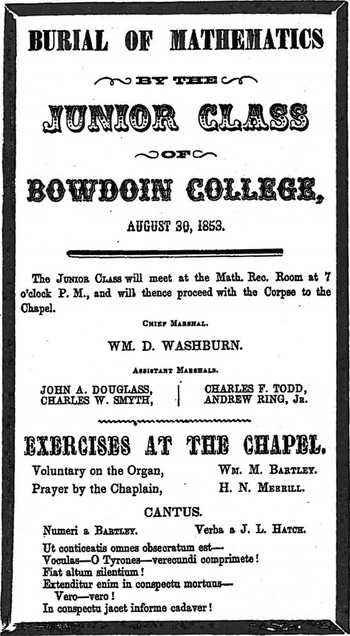
These interpretive approaches are necessary because of the sources involved. Though it might seem that textbook burials would result in the destruction of materials, they also produced college paraphernalia, particularly in the form of printed programs. Figure 1 shows the first page from the first of these rituals at Bowdoin, and it outlines the name of the ceremony, the students’ chosen way of displaying their collective identity, and the beginnings of the “Exercises” for burying the book. A close look at this program reveals the reasons why such sources are not straightforward. The student names, slightly modified, correspond to mock roles; the actual college chaplain did not lead the funeral rites for a textbook. The traditions at Bowdoin (and elsewhere) were parodic, borrowing features of recognized ceremonies for the stated aim of student fun. So, the printed programs necessarily include a high degree of ambiguity and duplicity. Such sources, now housed in individual college archives, provide the foundation for this paper, and Bowdoin College emerges as the central case study because of its extensive records.Footnote 17 Analyses of these texts, as well as the Anna Lytics “gravesites,” reveal the varied meanings associated with student textbook rituals before and after the Civil War.
Burial of Mathematics program, 1853, by the Bowdoin College Class of 1854. (Courtesy of the George J. Mitchell Department of Special Collections & Archives, Bowdoin College Library, Brunswick, Maine.)
A focus on textbook burials at only one institution allows this paper to highlight significant changes in the ritual over time. Bowdoin's textbook burials developed distinctive characteristics in the antebellum era, in part because of the leadership of the college's mathematics professor and textbook author, William Smyth. Therefore, this paper begins with a discussion of Smyth's calculus and the ways that the sciences motivated its study. These pedagogical frameworks had important implications for the antebellum textbook burials as well. When marking the academic milestone of passing Smyth's class, Bowdoin students communicated their intellectual superiority to both younger students and the larger community, and they represented their distinctive Bowdoin education through interconnections of scientific, mathematical, and classical knowledge. While these components remained relatively constant from the 1850s to the 1870s, and Smyth's textbooks did not change much, the postbellum student rituals metamorphosed in response to the death practices and attitudes of that era. In order to illustrate this change, the last section of this paper focuses on the funereal aspects of Bowdoin's Burials of Anna Lytics, contrasting them with the earlier Burials of Calculus. With this last development, the paper argues that postbellum Bowdoin students burned and buried their mathematics textbooks not only to communicate their feelings about their curriculum but also to create postbellum memorials.
The Dreaded Calculus of William Smyth
On August 30, 1853, Bowdoin juniors started the tradition of the Burial of Calculus. Having acquired a “Programme of Exercises” from Yale's November 1851 Burial of Euclid, they followed the general outline of activities: saying mock prayers over the textbook, singing songs with lyrics composed for the occasion, parading the book through town, and burying it in a secluded spot near campus.Footnote 18 But, because Bowdoin's curriculum at the time was more scientific than Yale's, there was a change in focus. While Yale students made fun of an elderly British translation of Euclid's Elements, saying that John “Play-fair” was “misnamed,” Bowdoin juniors defaced a publication in the process of being printed, and from their local mathematics professor: Smyth's Elements of the Differential and Integral Calculus.Footnote 19 In their new textbook burial, the juniors combined calculus, which appeared sporadically in antebellum college curricula, with Latin references, more common at other institutions. In these hybrid mathematical-classical allusions, the Bowdoin students seemed to revel in the distinctive features of their college educations. Their textual references, seemingly unintelligible to outsiders, communicated that the juniors felt they were intellectually superior to town residents and underclassmen, who were also present as an audience. Though the songs and mock prayers explicitly noted the students’ hatred of Smyth's new mathematics, they also implicitly emphasized the distinctive scientific impulse of their collegiate educations generally and mathematical educations in particular.
Bowdoin College, in the 1850s, included advanced mathematics because of the college's broader focus on scientific and medical topics. Bowdoin joined the ranks of New England Congregationalist colleges when Governor Samuel Adams of Massachusetts chartered it in 1794, and it quickly incorporated scientific topics. When Maine became an independent state as a result of the 1820 Missouri Compromise, the new state legislature voted that the Medical School of Maine be established under the direction of Bowdoin trustees, overseers, and faculty. In its first year, the Congregationalist connections allowed partnerships with the Yale Medical School, and Bowdoin chemistry professors additionally provided curricular support.Footnote 20 By 1850, Bowdoin claimed thirteen professors and lecturers, seven of whom served the sciences and medicine: chemistry/mineralogy and mathematics (both combined with natural philosophy), as well as physic, materia medica, anatomy/surgery, obstetrics, and medical jurisprudence.Footnote 21 Even subjects considered peripheral to medical training, such as mathematics, received curricular support through the sciences.
As contrasted with Yale's Burial of Euclid or the traditions at Williams, Trinity, and Hamilton that followed Yale's example, Bowdoin students had a place in their textbook ritual for the mathematics professor, Smyth.Footnote 22 Smyth had previously developed a reputation for his scientifically oriented mathematics, though his approach developed within the context of a liberal education. Born in 1797, he passed a difficult childhood in Wiscasset, and had to enlist in the army during the War of 1812 to support his mother and siblings. Immediately after the war, he dreamed of becoming a schoolteacher, studied mathematics by the light of the kitchen fire, and learned basic astronomy through peering at the night sky. As a young man, he started a small private school in the deserted counting room of a business ruined by the war, and he soon became an assistant at the Academy at Gorham, where the principal taught him the subjects preparatory to college: elementary mathematics and ancient languages. In 1820, the year the Medical School of Maine opened, Smyth entered Bowdoin College as a student, where he followed the traditional liberal education track. After graduation, he taught briefly at a local Brunswick academy and then attended Andover Seminary for further Greek study. His penchant for Greek led to his initial appointment at Bowdoin, but his talent for the sciences led to his position as Tutor in Mathematics and Natural Philosophy in 1825.Footnote 23
Smyth owed his continued presence at Bowdoin College to his enthusiasm for new pedagogical technologies in mathematics teaching. Though he told faculty friends that Greek was his true academic passion, his students thought otherwise. His lifelong friend Alpheus Spring Packard later remembered, “His success, as a Tutor of Algebra” was “quite unexampled with us.”Footnote 24 Packard specifically remembered a semester when some students, already having fulfilled their algebra requirement, decided to attend Smyth's algebra because of his use of that novel pedagogical tool, the blackboard. The blackboard had its roots in the education of French military officers, as historian Christopher Phillips has recently investigated, and Smyth's use of it was the first at Bowdoin, probably the first in the state of Maine.Footnote 25 “Quite an enthusiasm was excited for a study not apt to be popular,” Packard remarked dryly, and this enthusiasm “was reported of by students wherever they went, and thus was made known the eminently fit person to relieve Prof. Cleaveland [Professor of Mathematics, Natural Philosophy, Chemistry, and Mineralogy].”Footnote 26 In 1828, Smyth became Professor of Mathematics and Natural Philosophy, in part because of the excitement generated when he used this new French scientific teaching tool.
Smyth's reliance on French and scientific traditions influenced his mathematics textbooks as well. His first, Elements of Plane Trigonometry (1829), worked from the example of Étienne Bézout and Sylvestre-François Lacroix, and it contained applications in measuring objects of different shapes. His second, Elements of Algebra (1830), stemmed from the works of Sylvestre-François Lacroix and Pierre L.M. Bourdon, and it ended with problems about interest and annuities.Footnote 27 He continued to expand the series between the 1840s and the 1860s with further editions of these central texts, as well as Elementary Algebra (1850) and Elements of the Differential and Integral Calculus (1854). These works, particularly in calculus, relied on French predecessors but additionally aimed to reconcile British and French mathematical methods in order to motivate applications, participating in a contemporaneous trend noticed by historians Peggy Aldrich Kidwell, Amy Ackerberg-Hastings, and David Lindsay Roberts.Footnote 28 Smyth's calculus, for instance, contained numerous examples in the physical sciences: solving equations for motion in mechanics, calculating equilibriums and centers of gravity in hydrodynamics, and illustrating celestial mechanics in astronomy. In an unusual move, Smyth even began his calculus textbook with a physics problem: “Find the space through which a body, acted upon by gravity, will descend in a determinate time.” After working through an algebraic derivation for the differential equation describing an answer to this question, Smyth noted that the object was all along “to indicate the circumstances which gave rise to the new branch of Mathematics we are about to consider.”Footnote 29 In doing so, he used a scientific problem to inspire the entire study of calculus. Smyth's reliance on mathematical applications gained wide appeal, leading to their adoption at Harvard and elsewhere in New England.Footnote 30
Student Cultures of Textbook Burials at Antebellum Bowdoin
While Smyth's reputation grew, a new textbook burial ritual emerged at Bowdoin that made fun of the assumed connections between mathematics, the sciences, and other work (i.e., interests and annuities). Some Brunswick resident acquired the Programme of Exercises from Yale's November 1851 Burial of Euclid (now in Bowdoin's archives), and the students held their first “Burial of Mathematics” on August 30, 1853. The celebration began, according to their pamphlet, at the Mathematical Recitation Room at 7 o'clock in the evening, and the students then processed to the Chapel with the textbook “corpse.” William D. Washburn acted as the chief marshal, with the assistance of John A. Douglass, Charles F. Todd, Charles W. Smyth, and Andrew Ring Jr. The “Exercises at the Chapel” began with a voluntary performed by William M. Bartley and a prayer from the (mock) “chaplain,” H. N. Merrill. Bartley then led the class in a song he composed, with words from J. L. Hatch. Singing “O Tyrones … vero! vero,” they used its Latin words as a joking plea for truth to be visited on the underclassmen, the “Tyros,” and these themes reappeared in F. A. Wilson's eulogy and J. L. Hatch's elegy.Footnote 31 In including their names aside roles as “chief marshal” or “assistants,” these Bowdoin juniors implied some importance for their jobs at this mock funeral, and, in doing so, they ridiculed the argument that this scientific version of mathematics could serve as preparation for other positions elsewhere.
In laughing at authority figures, the Bowdoin students also incorporated a place for their professor and textbook author, William Smyth. In the “torch light procession” from the Chapel to the grave, Smyth was supposed to march in the second row, just behind the student marshals and flanked by (mock) police.Footnote 32 He never did participate, but, as the students jokingly remarked, they always found a volunteer to act his part. In this parade, the juniors performed a (dubious) desire that he would join them, that his presence would communicate community and institutional support for their actions, as Smyth was a leader in both town and gown. But the stand-in's antics in fact showed their irreverence, the ways that they considered themselves better than all around them. In this ceremonial display, they did not try to hide their purpose. A few rows behind the “professor,” pallbearers held a coffin aloft, and their dirge imagined a future grave for Smyth's notable subject. Not just Smyth but also a personified Calculus had a place of honor in their procession, and the juniors’ specific spots (i.e., in front of everything else) made fun of curricular rationales: that leadership was supposed to emerge from mathematics.Footnote 33
The inclusion of Bowdoin student names resulted in the whole printed document appearing significantly different from earlier ones. Their inspiration, Yale's Programme of Exercises from its November 1851 Burial of Euclid, had served as a record of the changed lyrics to common songs. Every page was filled with student doggerel: a Latin version of the Scottish “Bruce's Address” on page 1, a version of the nineteenth-century minstrel song “Susanna” on pages 2 and 3, and a rewritten “Auld Lang Syne” on page 4. This format identified the source for the tune of each song without any indication of the lyrics’ authors. The only names that appeared were clearly parodic: “Ghorr Rheigh” (“gory”) gave the initial oration, and “Strong-in-the-Faith Redfield” (a character they constructed) delivered the funeral sermon. Yale's name itself appeared nowhere. In fact, Bowdoin's archives mistakenly labeled Yale's program as one of theirs, though the lyrics contained in it appeared in a Yale songbook and were attributed to Yale sophomores.Footnote 34
Bowdoin's Burial of Mathematics, by contrast, read as a litany of student names, and it continued to conflate students’ management of the procession with collegiate leadership. Eight distinct names of members of the junior class appeared on the first page, identifying them as marshals, organist, chaplain, and lyricist. Between songs and prayers, the second page contained the names of the eulogist, elegist, and another lyricist. The order of the procession identified nine participants, and a final lyricist appeared on the fourth page. In sum, the program included the names of nineteen separate students, more than half of the total class of thirty-seven. Their names joined the announcement of collegiate pride that took up nearly half of the front page. There, a Modern type proclaimed the “BURIAL OF MATHEMATICS.” Below, decorative type most often found on contemporary posters, displays, and advertisements identified the participants and institution: “By the JUNIOR CLASS of BOWDOIN COLLEGE.”Footnote 35 In loudly declaring their institutional affiliation, the Bowdoin students claimed that their roles in this student production approached the managerial task of running their college. Though literary societies held a similar place in allowing students to take charge of their curriculum and social rules, as historians James McLachlan, Thomas S. Harding, and Roger L. Geiger have shown, the textbook burials did not have the official endorsement of Bowdoin's Athenian Society or Peucinian Society.Footnote 36 Rather, as the program's boldface “JUNIOR CLASS” made clear, these events ostensibly represented the whole class or cohort. It allowed them to assert that their collective body, not calculus or the mathematics professor, really ran the show.
More specifically, the Bowdoin students commented on the ways that their educations distinctively reconciled scientific and humanistic ideas through their singing in a hybrid language of Latin and calculus. After carrying the book from the mathematics recitation room to the Chapel, the juniors sang songs in Latin with words and music composed specifically for the occasion. The first burial, in August 1853, led up to the Latin words of mourning, “Eheu—Eheu!”Footnote 37 The second, in August 1854, borrowed these words and combined them with the declensions of the word calculus, “Amisimus Calculum! … Fuit Calculus! … calculo hic dies notandus est” (roughly meaning: We lost Calculus! … Calculus has been! … For calculus this day is marked).Footnote 38 Cycling through the grammar learned in their Latin classes, the juniors displayed not only their knowledge of the name Calculus, rarely discussed in lower level mathematics, but also their command of Latin. Later classes noted the presence of an audience for these songs. In July 1859, the class of 1860 addressed the sophomores and sang, “Calculus offendet vos” (Calculus offends [hits] you).Footnote 39 In this song, as well as other ritual actions, they established their audience as separate from and lesser than themselves as they performed their mastery of the terminology of mathematics and ancient cultures. This situation anticipated the interpersonal dynamics of college sports, as Ronald Flowers has explored, and it participated in the broader trends of college singing recently outlined by J. Lloyd Winstead.Footnote 40 Class pride and school pride intermingled just as the classical and mathematical allusions did.
The songs in English similarly argued that the burial celebrants’ knowledge of calculus made them special: superior to the underclassmen and townspeople who acted as spectators. In 1853, the juniors began by singing a version of the popular New England hymn “Windham.” With a melody in a minor key, the usual lyrics concerned the sorrow of walking “the road that leads to death” but also the joy that comes from being a Christian.Footnote 41 The class of 1854′s new version claimed that the singers were exemplary, not because they were Christians, but because they were the mourners of Calculus.Footnote 42 Later, before a group of underclassmen and townspeople, they reiterated this message through a version of the hymn “Carnes,” originally popularized in New England singing schools.Footnote 43 Performing a somber mood, the juniors sang new lyrics that called the deceased their (male) “friend departed.” Despite the seriousness of this contrafactum, the juniors again implicitly noted their special status as the mourners of Calculus. The original words of “Carnes” lamented the fate of “heathen nations … who do not love Him,” and the student version set an implicit comparison between themselves and their audience, who had not known and therefore could not “love” the personified Calculus.Footnote 44 Through these modifications, both songs emphasized the distinction of mathematical knowledge.
The songs of subsequent antebellum textbook burials noted not only the significance of knowing Calculus but also the power that came from making fun of it. In August 1854, the juniors prefaced their “torch light procession” with a version of “Auld Lang Syne” modified for the occasion. Originally a Scottish song associated with Robert Burns, by the 1850s it had started appearing in American Protestant hymnals.Footnote 45 The students borrowed the tune but made a list of calculus terminology out of it: “His functions true transcend all praise. / His forms fill every space. / His curves, in spiral wreaths, / Are elements of grace.”Footnote 46 Singing not only these terms but also “gravity … time … constancy … Volume … winding curve … rolled … spiral … point … parabolic,” the juniors chose relatively common words with specialized, mathematical meaning.Footnote 47 Later, after the procession, they sang a version of the hymn “China,” also known as “Jesus Loves Me, This I Know,” and their contrafactum encouraged a contrast between their love of Jesus and hatred of Calculus.Footnote 48 They made the difficulties of the class clear through their irreverent second and third verses:
Old Calculus has screwed us hard,
Has screwed us hard and sore,
I would he had a worthy bard,
To sing his praises more.
He took the strongest of the class,
And brought them to their knees,
And then we found too late, alas!
Prof. Smyth was hard to please.Footnote 49
Singing their displeasure before a town-gown audience, they noted how the (exaggerated) collective experiences of their class brought them together into a community. Moreover, through expressing their irreverence toward their college, the juniors proclaimed their assumed superiority.
The Bowdoin students named in the 1853 Burial of Mathematics did not necessarily hate mathematics, as indicated by their future careers. While some of the nineteen became lawyers, members of the clergy, or, in one case, a music dealer, nearly a third pursued decidedly scientific careers. The chief marshal, an assistant marshal, and a member of the arrangements committee all fulfilled the contemporaneous vision of industrial employment and became managers of factories in New England and the Midwest. Another assistant marshal and a textbook pallbearer became physicians, settling in Massachusetts and California before joining the war effort in the 1860s. While the third assistant marshal died before graduating, the fourth became a mathematics professor at Catawba College in North Carolina.Footnote 50 The future professions of all the students, but especially that of the professor-to-be, demonstrated how participation in the burial ceremony provided an opportunity to celebrate mathematics and the possibilities that it introduced.
Such traditions reinforced the distinction of the knowledge gained in a Bowdoin education. The entire burial ceremony was one large allusion to ancient practices, with orations, processional, funeral pyre, and Latin words of mourning.Footnote 51 The characteristic features of a Bowdoin education, particularly compared to Yale's, emerged through the references to scientific terminology, the local mathematics professor, and, in particular, calculus. Rarely taught on so wide a scale, calculus did confer unusual knowledge, and Smyth's version emphasized scientific applications only occasionally mentioned in other mathematics classes of the period.Footnote 52 At a time when a small minority of the American population attended college, the juniors displayed their distinctive knowledge in this public performance.Footnote 53
Burying Anna at Postbellum Bowdoin
These textbook ceremonies stopped during the Civil War, both at Bowdoin and at Yale. New England colleges, unlike those in the South, generally remained open during the war years, and faculty and students often wrote about feeling isolated from the fighting. Nevertheless, the justification and structure of American higher education changed drastically during these years, as historian Michael David Cohen has recently explored.Footnote 54 The absence of textbook burials could be explained institutionally, following Cohen, by noting how college student populations decreased even in the North, and new requirements (including military drill) occupied time that might otherwise have been used for the continuation of antebellum rituals. In fact, the students at Yale did not have the interest or time to construct elaborate textbook burials after the war.Footnote 55 This break exposes student opinions of this time, so difficult to access through historical records. Amid widespread devastation of families and communities, they did not destroy college material so overtly. In a time of national strife, the students observed a moment of silence.
When textbook burials emerged again at Bowdoin College after the Civil War, the figure of the textbook gained a new metaphorical body, that of Anna Lytics. The personified Calculus was routinely male, following the inspiration of Yale's Euclid, and the female “corpse” marked a departure from tradition. In the postbellum ritual, the students, entirely male, gathered to bury a female “body.” They meanwhile sang new mathematical lyrics to popular songs, favoring Civil War tunes to the Protestant hymns of the antebellum celebrations. Though they joked that their struggles with mathematics mirrored the recent war, with mathematical ideas as the new Confederacy, they also noted that Anna Lytics was a Union supporter.Footnote 56 Furthermore, at a time when the stuff of death received unprecedented attention, Bowdoin students modified the earlier ceremonies by increasingly including funeral objects: a coffin, a winding sheet, a cart and horse, and a headstone, marked simply “Anna” with the class year.Footnote 57 In these objects, songs, and the book's gender, the movement from burying Calculus to burying Anna reflected the changes in understandings of death and memory in postbellum years. In burying Anna, Bowdoin students of the 1870s created their own postbellum memorials.
Bowdoin's town of Brunswick, Maine, although far north of the fighting, had unusually strong connections to the war. Local residents maintain that “the Civil War both began and ended” there, referring to the actions of two prominent wartime figures associated with the town: Harriet Beecher Stowe and Joshua Chamberlain.Footnote 58 Harriet Beecher Stowe and her family moved to Brunswick in 1850, though local abolitionist William Smyth forgot to bring them from the train station. On campus, Stowe wrote the immensely popular and provoking Uncle Tom's Cabin, while her husband lectured about theology.Footnote 59 Perhaps because of the town's strong abolitionist community, many residents and members of the college left to serve in the war. Of the nineteen participants listed in the first textbook burial held at Bowdoin College in August 1853, three served and another two died in the South during wartime years.Footnote 60 Languages professor Joshua Chamberlain (class of 1852) famously led a Maine regiment in the Battles of Fredericksburg and Gettysburg and, after being promoted to the rank of Major General of the Army of the Potomac, he accepted the surrender of the Confederate forces at Appomattox Court House.Footnote 61 In recognition of this connection, Smyth raised tens of thousands of dollars for the construction of a new campus building that would serve as a memorial for the war dead.Footnote 62 Standing unfinished from 1867 to 1882, it reminded students that the establishment of stone memorials was still an ongoing process in the 1870s, years after the Confederate surrender.
Though Bowdoin students of the 1870s did not know Smyth or Stowe, since Smyth died in 1868 and Stowe left in 1853, the recent war remained present in many aspects of their educations. After the Confederate surrender and after service as governor of Maine, Joshua Chamberlain returned to his alma mater, becoming its president in 1871. Following national trends, he instituted mandatory military drill for all students, an important development that Michael David Cohen has argued not only changed the curriculum but also how students were permitted to dress and behave.Footnote 63 Some students, finding such policies constraining, unsuccessfully petitioned the Governing Boards to abolish these new curricular and social reforms. The resulting “rebellion,” when three-quarters of the student body refused to participate, resulted in a near closure of the college for a week and, according to Kanisorn Wongsrichanalai's scholarship, influenced national debates about the role of the military in peacetime.Footnote 64 Chamberlain expected students to keep alive the memory of the recent war and, though they did not comply in their drills, they did in their textbook burials.
When Bowdoin students began to bury their textbooks again, they did so in ways that invoked the recent war. While marching through town or constructing a bonfire, the classes of 1874 and 1877 sang “We're halfway through” to the tune of “I'm Going Home,” which music historian Christian McWhirter identifies as the unofficial anthem of the Confederacy.Footnote 65 Though they explicitly “bid … a glad adieu” to their time as underclassmen, their use of this melody also allowed them to observe the passing away of the Confederate States of America.Footnote 66 In doing so, they cast their underclassmen requirements, especially in mathematics, as enemies of the nation, and they claimed victory over both. The class of 1877 further reinforced this message through their adaptation of “Cheer, Boys, Cheer,” a Confederate battle anthem.Footnote 67 Instead of singing about the approaching battle between Confederate and Union forces, the Bowdoin students sang about their recent triumph over “Conics,” “Sections,” and “Ellipse.”Footnote 68 Asserting the disappearance and death of mathematical subjects, Bowdoin students implicitly noted the similar fate of the Confederacy through adopting and adapting their music for parodic purposes. Moreover, framing their collegiate requirements as a Civil War battle poked fun at the martial mentality of their president, especially one so fond of requiring drill.
Presenting the primary figure in these textbook burials as a Union woman named Anna Lytics further reinforced the Civil War associations. Explicitly, the name emerged merely from the pun with “analytics,” and there had been students portraying Anna Lytics as a mourner of Euclid in some earlier burials at Yale.Footnote 69 In Bowdoin's specific case, the applications-oriented curriculum became especially tied to analytical methods in mathematics, and students chose to parody the extensive rationales concerning the importance of this approach.Footnote 70 As different groups of students observed textbook burials in the postbellum years, Anna matured from a vague, mathematical personification to a character with her own history, invariably tied with the Union cause. When the class of 1881 walked in procession with her coffin and funeral cart, for instance, they sang mathematical lyrics to “John Brown's Body,” a tune popularized as the “Battle Hymn of the Republic” during the years of the war:
As true and loyal mourners, now we gather round to gaze
Upon this silent “corpus” which so “fresh”ly earned our praise,
And for whose “roots” rejected we now “soph”ly tune these lays,
Since dear (?) old Anna's gone.Footnote 71
Proclaiming their mathematical and collegiate terminology, these students asserted their educational superiority, as earlier generations had. This knowledge, they sang, came from their struggles with Anna Lytics, who was not as much their enemy as she seemed at first. In the conceit of this song, in lyrics and especially the tune, Anna emerged as a Union supporter, one who frustrated the students but who deserved “mourning” nonetheless.Footnote 72
In giving the textbook a name independent from the author of the text and the name of the work, the postbellum students reified their mathematical personification, adding elements of actual funeral practices, first in word and then in deed. As antebellum classes had joked about the “corpse” of Calculus, the class of 1874 adopted a slogan about the interment of “her bones” and the classes of 1876 and 1877 sang about Anna's “coffin, pall, and winding sheet.”Footnote 73 When the classes of 1876 and 1877 started referring to Anna as a “sister,” they began adding physical objects to the ceremony too.Footnote 74 The coffin, occasionally a feature of the antebellum burials, gained a horse and cart (to transport it), a pyre (to burn it), and a small, simple headstone (to indicate its final resting place). That marker, labeled “Anna” with the class year, designated a place where alumni could and did gather to remember student days.Footnote 75
In establishing a stone memorial, the students engaged in a practice that was, at the time, central to the lives of many Americans. The nation had experienced death on an unprecedented scale during the Civil War. Historians still have a difficult time estimating the total number of dead—Union and Confederate soldiers, civilians and slaves—and each recalculation is higher than the last.Footnote 76 In such a conflict, it was not unusual for families throughout the country to lose a son, father, or brother, and the sight of a train car carrying remains became common even before Abraham Lincoln's 1865 funeral train. As historian Drew Gilpin Faust has shown, the massive scale of death meant the establishment of practices, organizations, and institutions that dealt with the reality of death away from home, among strangers who did not know one's name.Footnote 77 The Civil War and postbellum period saw the emergence of national cemeteries, federal relief organizations, ambulance corps, and federal hospitals; and provisions for burials, identifying bodies, notifying next of kin, and providing aid to families of the deceased. Because newspaper lists of the dead were often inaccurate, naming and marking gravesites became a national project, provoking soldiers’ new practices of pinning notes to their own dying bodies and inspiring volunteer initiatives that ultimately involved such diverse people as nurse Clara Barton, poet Walt Whitman, Quartermaster General Montgomery Meigs, and the congregation of the African Colored Church near Bowling Green, Kentucky.Footnote 78 Through providing a name for a metaphorical “gravesite,” the students of Bowdoin College mimicked an influential postbellum movement.
Moreover, with the Anna stones, students personalized the national frenzy for memorialization. On the one hand, Bowdoin's building campaign, similar to Yale's Battell Chapel, Wesleyan's Memorial Chapel, and Colby's Memorial Hall, constructed a structure to remember the unnamed. Though a Bowdoin donor eventually added bronze memorial plaques listing the alumni who served in the war, the building's first twenty-two years encouraged students to remember the Civil War through plain granite walls and Collegiate Gothic windows.Footnote 79 The connection to the men of the US Army became clearer in 1871, when Joshua Chamberlain decided to hold the dreaded drills in the unfinished structure.Footnote 80 On the other hand, the “Anna” stones, instead of recognizing the masculine might of the anonymous many, memorialized a named young “sister” who “led a temperate life / Through all her mad career” or “old” lady who was to them variously “dear (?).”Footnote 81 Students built gravesites for an individual, though metaphorical, woman, despite the presence of Memorial Hall. In doing so, Bowdoin students adopted and adapted the postbellum memorialization movement.
The gender dynamics implicit in this textbook burial did not fit neatly into postbellum conversations about war or college life, however, because the students continuously noted that the whole occasion was a farce. American memorials routinely favored male honorees to female, as Kirk Savage has observed, and this trend partially followed from the drastic gender disparity in mortality rates at the time.Footnote 82 In this context, students did not continue the antebellum jokes about the death of their (male) “friend” Calculus or “his” mourners. Choosing a female “corpse” for their textbook marked their celebration as different from the actual funerals that occurred during the war and continued to occur through postbellum initiatives to identify and mark overlooked gravesites.Footnote 83 Appeals to humor in the situation allowed students to avoid reflecting on the meaning of this association, for instance, whether they joked about burying a woman because they wished to deflect from imagined experiences of male death or because they wished to express some anger or resentment at women in particular.
In this latter association, the misogyny of Bowdoin students’ jokes reflected emerging worries about the feminization of American education, especially at the college level. According to Cohen's work, curricula at existing colleges changed not only through the incorporation of military drills but also through a push toward “university” status, which often came with questions about coeducation. In this institutional environment, many aspirational universities at least considered opening their doors to women, and some in fact did.Footnote 84 After a few years of coeducation, administrators at some of these institutions, such as the University of California and Middlebury College, established quotas so that the population of women did not threaten to overpower the population of men.Footnote 85 These gender anxieties also found outlets at high schools of the late century, as many historians of education have explored. Particularly as women excelled in mathematics at competitive high schools, their teachers and state boards discouraged their advancement.Footnote 86 In this context, the regendering of the central textbook in this student ritual served to exclude women's participation, just as Bowdoin remained a men's college. It warned educated women that their mathematical knowledge could lead to their burning, at least in a metaphorical sense. Though the college has saved some reminiscences of students who participated in these burials and later distinguished themselves in local or national causes, such as the Arctic explorer Robert Peary, Bowdoin librarian George Little, and generous alumnus Curtis A. Perry, they did not write about their reasons for calling their textbook Anna.Footnote 87 As the whole affair remained a joke, the Bowdoin students were able to avoid reflecting on the meaning behind such associations.
When students did write about their experiences, they did not note their Civil War songs or their thoughts about their textbook's (metaphorical) femininity; rather, they reflected on how the figure of Anna inspired collective memory. Her funeral drew more attention to those around her rather than her “self,” following the ideals of the Good Death popularized through the Second Great Awakening. The Good Death, according to the ars moriendi of the nineteenth century, invoked a calm passing at home, where loved ones could hear the last words, usually religious proclamations. By the 1860s, the presence of this crowd had become so important that Civil War soldiers on both sides carried small photographs with them so that they could create simulacra of deathbed scenes on the battlefield or in army camps.Footnote 88 The Bowdoin students of the 1870s similarly spent much of their mock religious rites not in contemplation of their textbook's personification but in calling attention to their own class, the “mourners” of Anna Lytics. The gravestones, though centrally marked “Anna,” also indicated class years, and the printed programs emphasized that the students’ collective identity was at least as important as the name they gave their textbook. For instance, Figure 2 shows how the 1874 juniors, still using Latin in the title of the ritual, magnified their class year so that it became the largest text on the program's first page. In this case and others, the Burials of Anna Lytics served to reinforce communal bonds, the ways that common experiences linked students. Truly central was not the textbook or its personification but rather the collective experience of the difficulty of the analytical methods of their mathematics classes. Through the textbook and its destruction, students did not remember an individual woman or a group of anonymous men but rather memorialized themselves. In other words, the name Anna was not important for its connections to a singular female figure; rather, it invoked the collective.
Humatio Annae Lyticae Program, 1874, by the Bowdoin College Class of 1876. (Courtesy of the George J. Mitchell Department of Special Collections & Archives, Bowdoin College Library, Brunswick, Maine.)

Alumni's later practices and recollections noted the importance of this textbook ritual in building their college community. When construction crews unearthed the Anna stones in the 1930s while excavating for a new building, college officials moved them to the site of the mathematics recitation room. George Tillson, an engineer who had participated in the class of 1877's burial, wrote to the alumni secretary, Philip Wilder, explaining the importance of the stones. Though he joked that the ceremony emerged from the way that “some students … did not enjoy that particular branch,” i.e., mathematics, he also emphasized the “formal” qualities of the affair: “a regular programme printed in black type and with a heavy black border,” the lists of the participants’ names “given in a peculiar classic Latin,” and the “literary exercises” of processions and speeches. In its final lines, his letter indicated not only the ways that this “interment,” as he called it, linked members of his class but also how it could connect the Bowdoin students of “56 years ago” to those of the “present generation.”Footnote 89 According to Tillson, the presence of the stones encouraged alumni to remember their student days and prompted current students to imagine life at their college long before they were born. Like other features of campus architecture, the Anna stones were sites of reflection and affection. Though he and his classmates did not reflect on the Civil War features of the ritual, such as the songs or funeral paraphernalia, they noted how their Anna stones promoted group memory.
Conclusion
From 1853 to 1880, the transformation of Bowdoin's Burials of Calculus to Burials of Anna Lytics contained striking differences within structurally similar activities. In parades, bonfires, mock religious services, and burials, students expressed their feelings about their college educations and where they fit within them. Their ostensible topic—the hatred of mathematics—masked motivations having to do with the ways that their textbooks and professors rationalized mathematics requirements and, by extension, how they justified the importance of college, more generally. Recent scholars have remarked that the 1870s burial of time capsules was “a ceremony of self-affirmation intended to reinforce group identity and solidarity.”Footnote 90 The same could be said of textual burials, not only at Bowdoin but at other campuses that witnessed versions of the ritual, particularly as the practice became widespread in the 1880s and 1890s. Both before and after the Civil War, in Brunswick and elsewhere, the bonds of class solidarity and school pride were forged in the fires of burning mathematics books. Even in participating in this larger phenomenon, Bowdoin students consistently argued for the distinction of their collegiate education both before and after the war. In their reckoning, their classes in calculus and the scientific mathematics of William Smyth set them apart.
These similarities make the postbellum changes all the more surprising. Where antebellum students joked about their friendship with a personified, male Calculus, the postbellum students constructed elaborate funerals for a named, female figure. At a time of changing conceptions of death and memory, the Bowdoin juniors added actual funeral objects to their mathematics textbook burial and sang both Confederate and Union songs. The identities of Anna, class, and college merged as the postbellum students imagined what they might wish for their own deaths. The Burials of Anna Lytics, after all, ended with the placing of a gravestone explicitly for Anna Lytics and implicitly for themselves: marked “Anna” with their own class year.
In doing so, the Bowdoin students participated in the national movement of Civil War memorialization. They chose to keep the memory of the war alive not through mandatory military drills but through singing Union and Confederate songs with mathematical lyrics. In doing so, they cast their personal academic struggles as battles with hostile, geometrical rebels, and they joked that a certain version of heroism, bravery, and sacrifice emerged through classroom anxieties as well as military service. The central figure of Anna Lytics, however, was a Union woman, deserving of their mock mourning even though they did not like her. Still, placing Anna's gravestone created a place to remember not the Civil War but their student days. Though both antebellum and postbellum students destroyed college material, the 1870s juniors used this destruction to create new campus structures that communicated their class identity. Still on Bowdoin's land 140 years later, the Anna stones were not part of architectural planning or fundraising campaigns. Rather, they make visible how students leave behind traces of their presence in their college campuses, and they encourage us to consider how college students choose to be remembered.



