




Non-technical Summary
Parasites are rarely found in the fossil record, making any discovery of such organisms incredibly valuable for understanding ancient ecosystems. Trilobites, an ancient group of arthropods, are particularly useful in studying parasitism in deep time. In this study, we look at a fossil of Illaenus, a genus of trilobite, which shows thirteen small, round depressions on its rear section (called the pygidium). These depressions likely formed while the trilobite was still alive and suggest the presence of a parasite that may have lived within the soft tissue of the trilobite. The parasite could have caused changes in the mineralization of the trilobite’s skeleton or, possibly even eaten or absorbed nutrients from the trilobite’s body. This discovery provides new evidence that parasitic relationships existed hundreds of millions of years ago.
Introduction
Trilobites are a highly diverse group of Paleozoic arthropods, first appearing in the early Cambrian (Fortey and Owens, Reference Fortey, Owens and Kaesler1997; Jell, Reference Jell2003; Geyer, Reference Geyer2019). In northern Estonia, the trilobite fauna was diverse throughout the Middle and Upper Ordovician, with approximately 100 genera or subgenera (Rõõmusoks, Reference Rõõmusoks, Raukas and Teedumäe1997). Biogeographically, the Estonian Ordovician benthic fauna is part of the Baltoscandian Province (see Jaanusson, Reference Jaanusson and Moore1979). Fossils of illaenids are very common in the Middle Ordovician carbonate facies of northern Estonia; usually represented as pygidia and cranidia (Rõõmusoks, Reference Rõõmusoks, Raukas and Teedumäe1997). They inhabited a shallow temperate sea with normal salinity.
Malformations in trilobites have been extensively documented. Most records reflect injuries and developmental issues (Owen, Reference Owen1985; Babcock, Reference Babcock, Kelley, Kowalewski and Hansen2003, Reference Babcock and Landing2007; Zong, Reference Zong2021a, Reference Zongb; Bicknell and Smith, Reference Bicknell, Smith, Bruthansová and Holland2022, Reference Bicknell and Smith2023; Bicknell et al., Reference Bicknell and Smith2021, Reference Bicknell, Holmes, García-Bellido and Paterson2023a,Reference Bicknell, Smith and Patersonb). There has been less examination of structures linked to disease or parasitism, which are considered (paleo)pathologies (Babcock, Reference Babcock and Landing2007; De Baets et al., Reference De Baets, Hoffmann, Mironenko, De Baets and Huntley2021b). Parasitism in trilobites is thought to be recorded in swellings, pits and lesions, and certain types of borings (Conway-Morris, Reference Conway-Morris1981; Owen, Reference Owen1985; Geyer, Reference Geyer1990; Babcock, Reference Babcock and Landing2007; De Baets et al., Reference Zong2021a; Montagna and Ruggiero, Reference Montagna and Ruggiero2023; Bicknell et al., Reference Bicknell, Holmes, García-Bellido and Paterson2023a, Reference Bicknell, Smith and Hopkins2024). As trilobites have been extinct since the Paleozoic, the best way to understand their pathologies is to compare specimens to similar phenomena in modern marine arthropods, such as decapods and horseshoe crabs (De Baets et al., Reference De Baets, Hoffmann, Mironenko, De Baets and Huntley2021b).
Shell boring within the exoskeleton may reflect parasites (Babcock and Peng, Reference Babcock, Peng, Peng, Babcock and Zhu2001) and are known from live individuals and carcasses (Babcock, Reference Babcock and Landing2007). Borings produced while the trilobite was alive coincided with a cellular response and present insight into responses to drilling (Babcock, Reference Babcock and Landing2007). The most compelling evidence of drilling parasitism in the Paleozoic comes from agnostoids, which show signs of tissue growth and deformation of the exoskeleton around small pits (Babcock, Reference Babcock and Landing2007). Babcock (Reference Babcock1993) and Babcock and Peng (Reference Babcock, Peng, Peng, Babcock and Zhu2001) illustrated a boring that was internally sealed by a pearl-like protrusion and morphologically similar to borings made by nematodes in foraminiferans (Sliter, Reference Sliter1971; Lipps, Reference Lipps, Tevesz and McCall1983, p. 357; Babcock, Reference Babcock and Landing2007).
In this study, symbiosis is considered any long-term, close biological interaction between two or more different organisms, whether parasitic, commensalistic, or mutualistic. Modern ecology and biology textbooks typically use the “de Bary” definition, which applies symbiosis to all long-term interspecific interactions, moving away from the narrower definition that restricted symbiosis to mutualism (de Bary, Reference De Bary1878; Martin and Schwab, Reference Martin and Schwab2013). Parasitism is defined here as a relationship in which one organism benefits at the expense of another, negatively impacting the host (i.e., Conway-Morris, Reference Conway Morris, Briggs and Crowther1990; Tapanila, Reference Tapanila2008; Robin, Reference Robin, De Baets and Huntley2021). Here we expand the fossil record of parasitism by describing domical to crater-like structures in a mold of Illaenus sp. pygidium, discuss the origin of these morphologies, and explore the paleoecology of the association.
Geological background
During the Ordovician, Baltica drifted from the temperate into a subtropical climatic zone (Cocks and Torsvik, Reference Cocks and Torsvik2005; Torsvik et al., Reference Torsvik, Cocks and Harper2013). In the Darriwilian, the region of modern Estonia was submerged under a shallow epicontinental sea that had minimal bathymetric variation and an extremely low sedimentation rate (Nestor and Einasto, Reference Nestor, Einasto, Raukas and Teedumäe1997). A sequence of grey argillaceous and calcareous sediments accumulated along the shelf, with bioclasts (mostly echinoderms and brachiopods) decreasing and clay content increasing away from shore (Nestor and Einasto, Reference Nestor, Einasto, Raukas and Teedumäe1997).
In northern Estonia, limestones are predominantly exposed, having formed in the shallow part of a normal marine basin (Nestor and Einasto, Reference Nestor, Einasto, Raukas and Teedumäe1997; Meidla et al., 2024). The Middle Ordovician limestones are temperate water carbonates (Meidla et al., 2024). They are usually light grey in color due to clay minerals and pyrite content when fresh, and often reddish when weathered. The shelly fossils are usually well preserved. In northeast Estonia, the Middle Ordovician limestones are often dolomitized (Meidla et al., 2024).
Material and methods
Collections with Ordovician trilobites from Estonia were examined. These are in the Natural History Museum, University of Tartu (n=2,000) and the Department of Geology at Tallinn University of Technology (GIT) (n≥650). A total of 54 pygidia of Illaenus were checked. An isolated Illaenus sp. pygidium GIT 437-107 from the Darriwilian of northern Estonia was identified with abnormal structures. Due to a lack of meta-data, the exact locality of the specimen is unknown. This specimen was photographed using a Leica Z16 APO system, and measurements of the specimen were obtained from photographs using computer software. Additional photographs were taken after covering the fossil with sublimate ammonium chloride.
Repository and institutional abbreviation
Studied specimen is deposited at the Department of Geology, Tallinn University of Technology (GIT).
Results
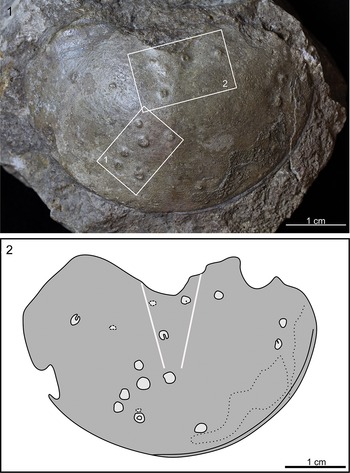
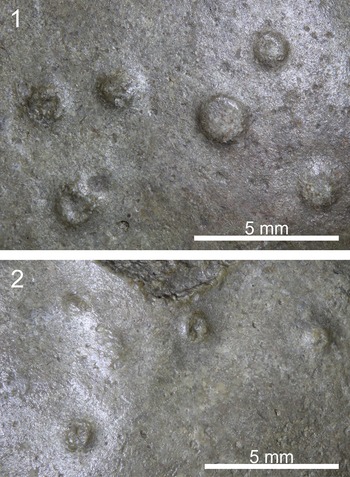
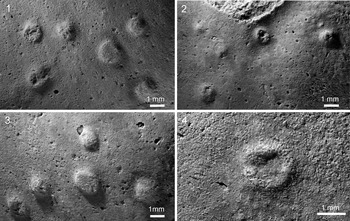
The examined specimen is an internal mold of an Illaenus sp. pygidium that is 33 mm long and 47 mm wide. The surface of the mold shows thirteen smooth bumps on its surface with height of 0.4 to0.7 mm (Figs. 1–3); otherwise the surface is smooth with only a weak impression of the axial lobe. Five bumps have a small depression in the center and are located about the pygidial median axis. Two bumps are located on the right pleural field and one on the left pleural field. The bumps never touch each other. The structures range between 0.9–1.8 mm (x̄=1.3 mm, σ=0.25 mm) and central depression range between 0.3–0.6 mm (n=7, x̄=0.5 mm, σ=0.12 mm). The outer slopes of the simple bumps are steep and their external contours are rather sharp. The inner slopes in crater-shaped bumps are similarly steep and the contours of the central depression are sharp.

Internal mold of Illaenus sp. pygidium with traces of parasitic infestation from the Darriwilian of northern Estonia (GIT 437-107); (1) Detail view of traces; showing two simple bumps and four crater-like structures, (2) Detail views of traces; showing two simple bumps and two crater-like structures.

Internal mold of Illaenus sp. pygidium with traces of parasitic infestation from the Darriwilian of northern Estonia (GIT 437-107); (1–4) Detail view of traces; showing simple bumps and crater-like structures.

Discussion
The asymmetrical distribution of structures, the irregular spacing, and overall smoothness of this Illaenus pygidium illustrate that these structures are not a standard pygidial morphology. Despite being damaged, exoskeletal remains are visible along the specimen edge. The circular structures must therefore have been depressions in the pygidial inner surface. They may have coincided with exoskeletal thinning and the preserved exoskeleton indicates that the depressions would have almost punctured the pygidium in these areas. Due to the variety of possible explanations for these structures, we present all possibilities below, and attempt to systematically exclude options that are unlikely.
Drilling
The morphology of the depressions is not indicative of predatory drillings or shell disease (De Baets et al., Reference De Baets, Budil, Fatka and Geyer2021). While the shape of depressions somewhat resembles Oichnus drillings, the depression orientations are 180o opposite the expected orientation for drill holes originating at the external exoskeletal surface. The pits have variable diameters, suggesting multiple mistaken attacks by predators of different sizes. This seems very unlikely, as it requires an array of distinct drilling predators. Even if these pits were mistakenly created by the trace maker (i.e., a drilling predator) of Oichnus parabolloides, at least some holes should have penetrated the entire skeleton (Wisshak et al., Reference Wisshak, Kroh, Bertling, Knaust, Nielsen, Jagt, Neumann and Nielsen2015). We can therefore exclude drilling predators as an option here.
Epizoans
Some pits in trilobite exoskeletons are superficially reminiscent of attachment sites of epizoans (Babcock, Reference Babcock and Landing2007). However, these would have been encrusted on the external surface and would result in different morphologies, excluding this option.
Microbially induced disease
Bacteria may cause shell diseases that result in external cuticular damage or perforations that can impact soft tissues in the final stages (Sindermann and Rosenfield, Reference Sindermann and Rosenfield1967; Noga et al., Reference Noga, Smolowitz and Khoo2000; Shields et al., Reference Shields, Williams, Boyko, Castro, Davie, Guinot, Schram and Vaupel Klein2015; Klompmaker et al., Reference Klompmaker, Chistoserdov and Felder2016; Newton and Smolowitz, Reference Newton, Smolowitz, Terio, McAloose and St. Leger2018; De Baets et al., Reference De Baets, Budil, Fatka and Geyer2021). Microbes typically cannot penetrate the exoskeleton and usually rely on external injuries, which are not present in our specimen. More importantly, shell disease typically starts on the external exoskeleton and results in pits with different morphologies. Also, unicellular algae or fungi have been implicated in shell disease of marine arthropods, but the resulting morphologies are inconsistent with morphologies observed here (De Baets et al., Reference De Baets, Budil, Fatka and Geyer2021).
Post-mortem bioerosion
The depressions are too shallow to be domiciles of boring organisms but could record attachment scars of a bioeroding encruster. However, no bioerosional attachment structures with these semi-circular morphologies are known. These structures are therefore not post-mortem bioerosional traces.
Tremichnus
This is a trace fossil that records the embedment of an animal within a crinoid. The structures do resemble Tremichnus in crinoids (Brett Reference Brett1978, Reference Brett1985). However, the depressions are located on the internal surface of the pygidium, not externally as in crinoids. Moreover, Tremichnus occurs in accretionary skeletons as a modification of a living mesoderm, as opposed to a mineralized cuticular skeleton of trilobites.
Tumors
The structures are morphologically comparable to tumors within modern arthropods. However, the confident identification of tumor-like growth, particularly those related to cancer, is very rare and isolated in modern marine arthropods like decapods or horseshoe crabs (Sparks, Reference Sparks1985; Vogt, Reference Vogt2008; Miroliubov et al., Reference Miroliubov, Lianguzova, Krupenko, Kremnev and Enshina2023). True neoplasia are seldom produced by cancer in arthropods (Chong, Reference Chong2022) and usually other organisms are implicated in their formation (De Baets et al., Reference Duneau and Ebert2012). As such, we conservatively exclude this option here.
Symbiotic interactions
Conway Morris (Reference Conway-Morris1981), Babcock (Reference Babcock and Landing2007), and De Baets et al. (Reference De Baets, Budil, Fatka and Geyer2021) provide summaries of parasitism in trilobites. Parasitic infestations commonly consist of gall-like or tumor-like growths known as neoplasms of the exoskeleton (e.g., Snajdr, Reference Snajdr1978a, Reference Snajdrb, Reference Snajdr1981; Conway Morris, Reference Conway-Morris1981; Owen, Reference Owen1985; Babcock, Reference Babcock1993, 2003, Reference Babcock and Landing2007).If the structures in Illaenus were formed syn vivo, the trace maker would have been located within the trilobite’s soft tissues. The trace maker may therefore have lodged or attached itself within the soft-tissue and inhibited pygidial biomineralization around the foreign organism. The ‘infestation’ may have occurred during a moulting event, resulting in scars underneath the exoskeleton. It is also possible that parasites maintained their position in the following molt. Alternatively, the symbiont excavated these depressions by dissolving the trilobite exoskeleton. In either case, the symbiotic organism could have affected the exoskeleton and mechanically weakened the pygidium and likely used the trilobite tissues and other nutrients to grow. We found an endobiotic parasite to be the most likely explanation for the structures in Illaenus because the other explanations explored above can either easily be rejected or they seem considerably less likely.
Šnajdr (Reference Snajdr1978a) traced the ontogenetic development of galls in the various molt stages of the trilobite, and this approach makes it possible to distinguish two main types of neoplasms: those formed by parasites that lived beneath the exoskeleton and survived one or more molting events, and those formed by organisms located at or near the exoskeletal surface and thus were lost during molting (De Baets et al., Reference De Baets, Budil, Fatka and Geyer2021). The downwards broadening morphology of depression in the inner surface of the Illaenus pygidium is more consistent with a parasite that lived beneath the exoskeleton. Neither teratology, however, shows strong site selectivity—an indicator of ectoparasites—consistent with parasites common occurrence in the protective hollows of pleural furrows (Jell, Reference Jell1989). The depressions in the inner surface of the Illaenus pygidium do not correspond to protective hollows of pleural furrows, thus supporting the endoparasite nature of the infesting organism. However, Jell (Reference Jell1989) figured five bulges in Moatunia distincta and four bulges in a specimen of Eymekops hermias associated with the caecal system, suggesting that endoparasites might have been lodged in the digestion and absorption system and had bulged the exoskeleton around them. While this is interesting, we lack evidence to suggest this also occurred here.
Circular pits with slightly irregular edges that partially penetrate the exoskeletons are called “borings” (Whiteley et al., Reference Whiteley, Kloc and Brett2002, fig. 2.15D-F), and usually the pit-makers did not significantly harm the hosts (Brandt, Reference Brandt1996). The same would be expected for the pits in the Illaenus sp. pygidium if those pits were made on the external surface of the pygidium. However, the trace maker was likely within the trilobite’s soft tissues, suggesting markedly more significant harm to the individual and more ability to respond by changing growth patterns. Furthermore, processes in arthropods would markedly differ from those in other biomineralized groups, as molting would effectively remove symbionts (Duneau and Ebert, Reference Duneau and Ebert2012; De Baets et al., Reference De Baets, Budil, Fatka and Geyer2021). The most similar cases from modern marine arthropods are internal cyst-like or small tumor-like masses from spore-forming Microsporidia (Sokolova et al., Reference Sokolova, Pelin, Hawke and Corradi2015).
A rare exception that could lead to superficially similar indented pathologies was observed in modern decapods (mud crabs) inflicted by “rust spot” shell disease (Andersen et al., Reference Andersen, Norton and Levy2000). These authors found no evidence for an infectious or parasitic culprit involved in this modern mud crab disease during histopathological investigations, and the main histological features in the decapod Scylla included endocuticular indentation below cavities in the upper endocuticle, among various other phenomena in soft-tissues which would be difficult to preserve in fossil arthropods. The development of indentations of rust spot shell disease is less regular in morphology, size and spacing than the structures observed in the trilobite. Given these differences, the observed morphologies are unrelated to bacteria or unicellular organisms. Various eukaryotic organisms, including helminths, could also produce cyst-like or tumor-like structures in invertebrates, although no structures with these characteristics have yet been reported from marine arthropods (Vogt, Reference Vogt2008; De Baets et al., Reference De Baets, Hoffmann, Mironenko, De Baets and Huntley2021b). Regardless of the precise identification of the culprits, infestation during life by parasitic organisms or a pathological response by the trilobite is the mostly likely explanation for the structures observed here.
Acknowledgments
O.V. was financially supported by the Institute of Ecology and Earth Sciences, University of Tartu and the Estonian Research Council grant PRG2591. R.D.C.B. was funded by an MAT Program Postdoctoral Fellowship. K.D.B. was supported by the I.3.4 Action of the Excellence Initiative - Research University Programme at the University of Warsaw (Project: PARADIVE). We are grateful to B. Pratt and C. Brett for the constructive reviews of the manuscript.
Competing interests
The authors declare none.

 Open access

