



Depression and posttraumatic stress disorder (PTSD) are significant risks for suicide and other adverse outcomes among US military personnel. 1 While shipboard personnel receive a standard medical evaluation prior to deployment, unlike their land-based counterparts, they do not complete the Pre-Deployment Health Assessment (Pre-DHA). The Pre-DHA includes standardized screening tools for PTSD and depression and is difficult to administer in the shipboard environment. The beginning of a shipboard deployment is associated with multiple significant stressors, yet little is known about depression and PTSD prevalence during this period when existing conditions may be worsened. We report on the prevalence of shipboard personnel who screened positive for PTSD and/or depression at the onset of deployment, and those who reported a diagnosis by a physician or other healthcare professional (HCP) in the year prior to that deployment. A significant number of personnel were screen-positive for PTSD or depression, yet few had received an HCP-diagnosis for these concerns.
Method
US Navy and Marine Corps active-duty personnel completed a self-reported anonymous pre-deployment paper survey within approximately 2 weeks of deployment (described in detail elsewhere).Reference Harbertson, Scott, Moore, Wolf, Morris and Thrasher 2 Briefly, data were collected from 11 ships as part of a longitudinal study assessing risks for sexually transmitted infections. Convenience sampling was used and coordinated through all available department heads based on personnel availability to represent a broad spectrum of shipboard personnel. PTSD and depression were assessed using the PTSD Checklist–Civilian Version (PCL-C)Reference Weathers, Litz, Herman, Huska and Keane 3 and Center for Epidemiologic Studies Depression Scale (CES-D), respectively.Reference Radloff 4
Screening positive for PTSD was defined as a PCL-C score of ≥50 and endorsement of a moderate level of ≥1 intrusion symptoms, ≥3 avoidance symptoms, and ≥2 hyperarousal symptoms,Reference Hoge, Castro, Messer, McGurk, Cotting and Koffman 5 – Reference Terhakopian, Sinaii, Engel, Schnurr and Hoge 8 consistent with DSM-IV criteria. Being at risk for major depressive disorder (MDD) was defined as a CES-D score of ≥22. Participants who reported a diagnosis of depression and/or PTSD by a doctor or HCP in the past 12 months were considered to have had a clinical diagnosis (HCP-diagnosis).
Data were analysed using SAS software version 9.3 (SAS Institute, Inc., Cary, NC). Participants with ≤1 missing questions on the assessment and PTSD and/or depression diagnosis survey question(s) were included in the denominator of the mental health diagnosis analysis. Pearson's chi-squared or Fisher's exact tests were used to determine statistical significance of categorical variables. All independent variables were included in the multivariable regression model. No collinearity was observed using a tolerance ≤0.10. All P-values were based on two-tailed tests of significance, defined as P≤0.05.
Results
A total of 2543 participants met the inclusion criteria.Reference Harbertson, Scott, Moore, Wolf, Morris and Thrasher 2 Those who did not complete the PTSD or depression assessment were excluded; final sample sizes were 2076 and 2078 for PTSD and depression, respectively.
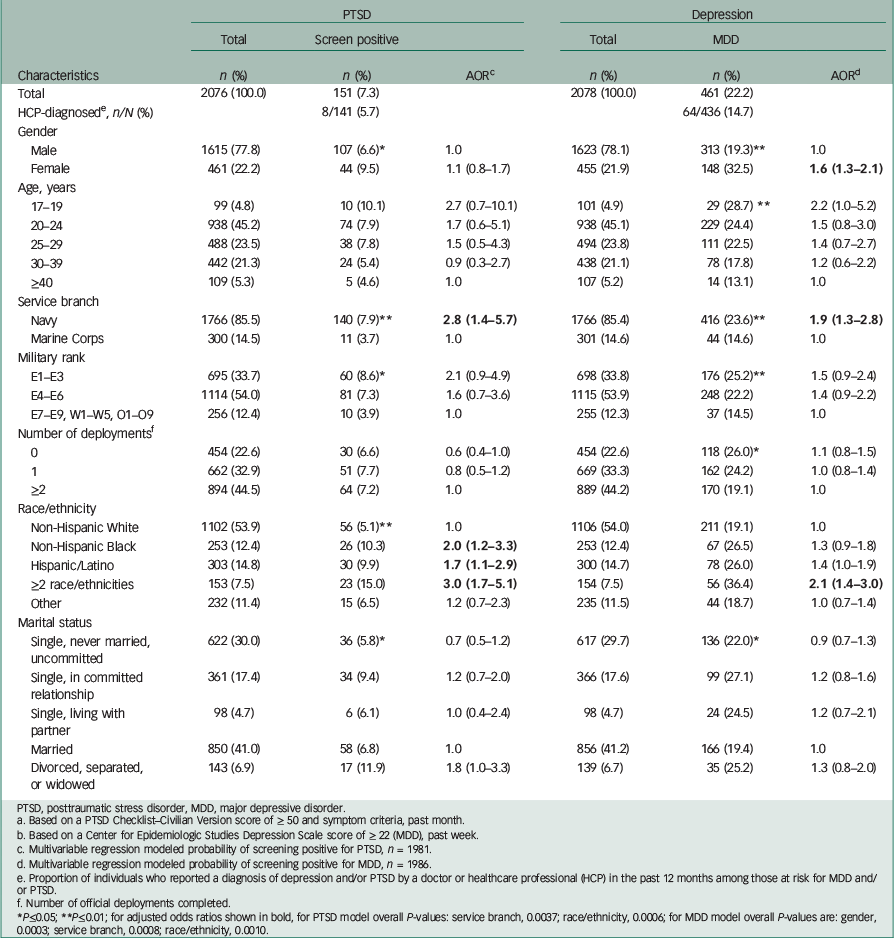
In total, 7.3% (n=151/2076) screened positive for PTSD, and 22.2% (n=461/2078) for MDD. Among those who screened positive for PTSD, 87.7% (n=128/146) were at risk for MDD.
Not all participants who completed the PTSD and/or depression assessment reported whether a physician had diagnosed them with PTSD and/or depression (HCP-diagnosis), so the denominator differs. Overall, only 5.7% (n=8/141) of those who screened positive for PTSD and 14.7% (n=64/436) of those who are at risk for MDD had an HCP-diagnosis.
Among personnel at risk for depression, a significantly larger proportion of women with MDD (20.3%, n=29/143) had an HCP-diagnosis than men (12%, n=35/293, P=0.02). No statistically significant differences by gender were observed for PTSD diagnosis among those who screened positive for PTSD (women: 7%, n=3/43, men: 5.1%, n=5/98). There were few individuals who screened negative for MDD or PTSD (2%, n=32/1571 and 1%, n=21/1863, respectively) but reported an HCP-diagnosis.
After adjusting for all demographics, the odds of screening positive for PTSD were significantly higher among those reporting Navy service branch than Marine Corps and non-Hispanic Black, Hispanic/Latino or two or more race/ethnicities compared with non-Hispanic White race/ethnicity (see Table 1). The odds of being at risk for MDD were significantly higher among females, Navy service branch, and those reporting two or more race/ethnicities after adjusting for all other demographics.
| Characteristics | PTSD | Depression | ||||
|---|---|---|---|---|---|---|
| Total | Screen positive | Total | MDD | |||
| n (%) | n (%) | AOR c | n (%) | n (%) | AOR d | |
| Total | 2076 (100.0) | 151 (7.3) | 2078 (100.0) | 461 (22.2) | ||
| HCP-diagnosed e , n/N (%) | 8/141 (5.7) | 64/436 (14.7) | ||||
| Gender | ||||||
| Male | 1615 (77.8) | 107 (6.6)* | 1.0 | 1623 (78.1) | 313 (19.3)** | 1.0 |
| Female | 461 (22.2) | 44 (9.5) | 1.1 (0.8–1.7) | 455 (21.9) | 148 (32.5) | 1.6 (1.3–2.1) |
| Age, years | ||||||
| 17–19 | 99 (4.8) | 10 (10.1) | 2.7 (0.7–10.1) | 101 (4.9) | 29 (28.7) ** | 2.2 (1.0–5.2) |
| 20–24 | 938 (45.2) | 74 (7.9) | 1.7 (0.6–5.1) | 938 (45.1) | 229 (24.4) | 1.5 (0.8–3.0) |
| 25–29 | 488 (23.5) | 38 (7.8) | 1.5 (0.5–4.3) | 494 (23.8) | 111 (22.5) | 1.4 (0.7–2.7) |
| 30–39 | 442 (21.3) | 24 (5.4) | 0.9 (0.3–2.7) | 438 (21.1) | 78 (17.8) | 1.2 (0.6–2.2) |
| ≥40 | 109 (5.3) | 5 (4.6) | 1.0 | 107 (5.2) | 14 (13.1) | 1.0 |
| Service branch | ||||||
| Navy | 1766 (85.5) | 140 (7.9)** | 2.8 (1.4–5.7) | 1766 (85.4) | 416 (23.6)** | 1.9 (1.3–2.8) |
| Marine Corps | 300 (14.5) | 11 (3.7) | 1.0 | 301 (14.6) | 44 (14.6) | 1.0 |
| Military rank | ||||||
| E1–E3 | 695 (33.7) | 60 (8.6)* | 2.1 (0.9–4.9) | 698 (33.8) | 176 (25.2)** | 1.5 (0.9–2.4) |
| E4–E6 | 1114 (54.0) | 81 (7.3) | 1.6 (0.7–3.6) | 1115 (53.9) | 248 (22.2) | 1.4 (0.9–2.2) |
| E7–E9, W1–W5, O1–O9 | 256 (12.4) | 10 (3.9) | 1.0 | 255 (12.3) | 37 (14.5) | 1.0 |
| Number of deployments f | ||||||
| 0 | 454 (22.6) | 30 (6.6) | 0.6 (0.4–1.0) | 454 (22.6) | 118 (26.0)* | 1.1 (0.8–1.5) |
| 1 | 662 (32.9) | 51 (7.7) | 0.8 (0.5–1.2) | 669 (33.3) | 162 (24.2) | 1.0 (0.8–1.4) |
| ≥2 | 894 (44.5) | 64 (7.2) | 1.0 | 889 (44.2) | 170 (19.1) | 1.0 |
| Race/ethnicity | ||||||
| Non-Hispanic White | 1102 (53.9) | 56 (5.1)** | 1.0 | 1106 (54.0) | 211 (19.1) | 1.0 |
| Non-Hispanic Black | 253 (12.4) | 26 (10.3) | 2.0 (1.2–3.3) | 253 (12.4) | 67 (26.5) | 1.3 (0.9–1.8) |
| Hispanic/Latino | 303 (14.8) | 30 (9.9) | 1.7 (1.1–2.9) | 300 (14.7) | 78 (26.0) | 1.4 (1.0–1.9) |
| ≥2 race/ethnicities | 153 (7.5) | 23 (15.0) | 3.0 (1.7–5.1) | 154 (7.5) | 56 (36.4) | 2.1 (1.4–3.0) |
| Other | 232 (11.4) | 15 (6.5) | 1.2 (0.7–2.3) | 235 (11.5) | 44 (18.7) | 1.0 (0.7–1.4) |
| Marital status | ||||||
| Single, never married, uncommitted | 622 (30.0) | 36 (5.8)* | 0.7 (0.5–1.2) | 617 (29.7) | 136 (22.0)* | 0.9 (0.7–1.3) |
| Single, in committed relationship | 361 (17.4) | 34 (9.4) | 1.2 (0.7–2.0) | 366 (17.6) | 99 (27.1) | 1.2 (0.8–1.6) |
| Single, living with partner | 98 (4.7) | 6 (6.1) | 1.0 (0.4–2.4) | 98 (4.7) | 24 (24.5) | 1.2 (0.7–2.1) |
| Married | 850 (41.0) | 58 (6.8) | 1.0 | 856 (41.2) | 166 (19.4) | 1.0 |
| Divorced, separated, or widowed | 143 (6.9) | 17 (11.9) | 1.8 (1.0–3.3) | 139 (6.7) | 35 (25.2) | 1.3 (0.8–2.0) |
PTSD, posttraumatic stress disorder, MDD, major depressive disorder.
a Based on a PTSD Checklist–Civilian Version score of ≥ 50 and symptom criteria, past month.
b Based on a Center for Epidemiologic Studies Depression Scale score of ≥ 22 (MDD), past week.
c Multivariable regression modeled probability of screening positive for PTSD, n = 1981.
d Multivariable regression modeled probability of screening positive for MDD, n = 1986.
e Proportion of individuals who reported a diagnosis of depression and/or PTSD by a doctor or healthcare professional (HCP) in the past 12 months among those at risk for MDD and/or PTSD.
f Number of official deployments completed.
* P≤0.05;
** P≤0.01; for adjusted odds ratios shown in bold, for PTSD model overall P-values: service branch, 0.0037; race/ethnicity, 0.0006; for MDD model overall P-values are: gender, 0.0003; service branch, 0.0008; race/ethnicity, 0.0010.
Discussion
Among shipboard US Navy and Marine Corps personnel who screened positive for PTSD and/or depression at deployment onset (predominantly Navy, female, non-White race/ethnicities, Table 1), very few self-reported PTSD and/or depression diagnosis in the past year, revealing a potentially large unmet need for mental healthcare. Missed opportunities for mental healthcare among screen-positive personnel, previously reported within the US military,Reference Hoge, Castro, Messer, McGurk, Cotting and Koffman 5 reduces the benefits associated with early identification and linkage to care. 1 Evidence shows improved methods of mental health screening that focus on deployment disqualifying mental health criteria prior to land-based deployment linked to in-theatre care substantially reduces the number of in-theatre personnel seeking clinical care for psychiatric disorders or suicidal ideation, and operational restrictions or evacuation for mental health conditions.Reference Warner, Appenzeller, Parker, Warner and Hoge 9 Few soldiers deploying to Iraq (7.7%, n = 819/10 678) required further mental health evaluation and only 6% (n=48) of those were not deployable. Integrated screening and monitoring among shipboard personnel may present similar benefits, particularly if the pre-deployment screening period allowed sufficient time for proper evaluation and implementation of measures to ensure sustained access to appropriate medication and/or other treatment before an extended shipboard deployment.
Individuals who have elevated PTSD and depression scores, or comorbid PTSD/depressionReference Panagioti, Gooding and Tarrier 10 on the Pre-DHA, could be targeted for specialised mental health evaluations; personnel with modestly elevated depression and PTSD scores could receive evidence-based non-medical interventions shown to reduce symptoms,Reference Penedo and Dahn 11 – Reference Golden, Gaynes, Ekstrom, Hamer, Jacobsen and Suppes 15 although additional research is needed to confirm benefits to the shipboard population. Females, those reporting Navy service branch and non-Hispanic Black, Hispanic/Latino and two or more race/ethnicities were significantly more likely to screen positive for either PTSD or depression, and additional studies could validate whether these individuals are at highest risk using clinical diagnostic interviews to inform interventions that target individuals at highest risk.
The current study PTSD and MDD prevalence is slightly higherReference Riddle, Smith, Smith, Corbeil, Engel and Wells 6 , Reference Hoge, McGurk, Thomas, Cox, Engel and Castro 16 , Reference Marshall, Prescott, Liberzon, Tamburrino, Calabrese and Galea 17 or lowerReference Marshall, Prescott, Liberzon, Tamburrino, Calabrese and Galea 17 , Reference Dursa, Reinhard, Barth and Schneiderman 18 compared with other military populations, but study design differences (e.g. scoring criteria and survey–deployment temporal relationship) make comparisons difficult. Adjusted analyses showed that those reporting Navy service branch had higher odds of PTSD and depression than Marine Corps. Previous data among the US military show higher mental health disorder prevalence among Marine Corps than Navy, 19 , Reference Barlas, Higgins, Pflieger and Diecker 20 but these studies reported unadjusted data, used different assessment tools, and were not timed around a deployment. It is possible that Marine Corps personnel assigned to a shipboard deployment may differ from land-assigned Marine Corps, but this would need to be examined further.
There are several possible explanations for the observed high depression and PTSD screen-positive prevalence in the current study, including limitations inherent to screening tools applied to a general population, such as increased false-positivity; increased reporting on anonymous surveys; and the possibility that mental health symptoms increase immediately prior to deployment. Also, it is possible that individuals previously diagnosed and successfully treated may screen negative on the mental health assessment tools. These study findings should be clinically validated with additional research.
There are no conclusive US military data that document that Pre-DHA mental health screening provides a mental health benefit to service members. Additionally, there are concerns that mental health diagnoses may result in adverse career impact or separation from the military. Regardless, the Pre-DHA is already conducted in all other deploying Department of Defense personnel except shipboard personnel, under the logical premise that addressing mental health issues prior to deployment, even imperfectly, is preferable to not doing so. In addition, current reports documenting mental health in deploying US military are based on Pre-DHA data and are therefore incomplete due to the absence of shipboard deployment data.
US shipboard personnel with mental health conditions need improved screening and treatment in conjunction with career security for those without disqualifying conditions. This survey identified that a significant proportion of shipboard personnel are screen-positive for PTSD and/or MDD, and were not diagnosed with a mental health condition within the past year. If individuals with mental health conditions are identified and linked to care, both the individual and deploying unit will likely benefit. In addition, those with severe mental health issues may be identified prior to experiencing dysfunction in a stressful environment, which may place themselves or shipmates at risk.
Funding
This work was supported by a cooperative agreement (W81XWH-07-2-0067) between the Henry M. Jackson Foundation for the Advancement of Military Medicine, Inc., and the US Department of Defense, under Work Unit No. 60546.
Acknowledgements
The views expressed in this research are those of the authors and do not necessarily reflect the official policy or position of the Department of the Navy, Department of the Army, Department of the Air Force, Department of Veterans Affairs, Department of Defense, or the US Government. Human subjects participated in this study after giving their free and informed consent. This research has been conducted in compliance with all applicable federal regulations governing the protection of human subjects in research.


 Open access


eLetters
No eLetters have been published for this article.