


Highlights
-
• Five anti-seizure medications (ASM) showed a positive association with the ketogenic diet’s (KD) efficacy.
-
• No specific anti-seizure medications were negatively associated with KD.
-
• ASM choice should be based on a child’s phenotype and tolerance with the KD.
Introduction
The ketogenic diet (KD) is a well-established therapeutic option for children with non-surgical drug-resistant epilepsy. The KD is often tried when children have failed two or more anti-seizure medications (ASM). At the time of KD initiation, most children are already on anti-seizure medications, which are continued, and later adjusted as per the seizure control on the KD. The KD has unique mechanisms of action, Reference Murugan and Boison1 which differ from ASM, but synergistic use with some ASMs may be possible.
There are limited data on how concurrent ASM influence KD efficacy. In a retrospective study on the effect of concurrent ASM on the efficacy of KD in 115 children, Morrison et al. found that children receiving phenobarbital in combination with the KD were significantly less likely to have a >50% seizure reduction. Reference Morrison, Pyzik, Hamdy, Hartman and Kossoff2 Conversely, those receiving zonisamide in combination with the KD at onset were more likely to have a >50% reduction. This study, which was published in 2009, analyzed 6 drugs: lamotrigine, levetiracetam, zonisamide, phenobarbital, topiramate, and valproic acid. However, in the last decade, many other drugs have been used in combination with the KD, including vigabatrin, clobazam, rufinamide, brivaracetam, lacosamide, perampanel, and cannabinoids. There is a paucity of data on the efficacy of the combined use of KD with these ASM. Therefore, in the current retrospective study, we evaluated the effect of concurrent anti-seizure medications on the seizure control in children with drug-resistant epilepsy started on the KD. The goal of this study is to help clinicians to rationalize the concurrent ASM along with the KD.
Methods
This was a retrospective chart review of children with drug-resistant epilepsy initiating a KD and followed in the Ketogenic Diet Clinic of the Hospital for Sick Children from Jan 2011 to Feb 2022. This study was approved by the Hospital for Sick Children Research Ethics Board. Children aged 1 month to 18 years who started on ketogenic diet treatment for drug-resistant epilepsy, and with concurrent use of one or more ASM, without dose modification for a period of at least 3 months, were eligible for the study.
The following data were recorded: types of seizures, epilepsy etiology, co-morbidities, age at diet start and diet type (classic, medium chain triglycerides (MCT), or modified Atkins diet), as well as the details of the concurrent ASM at the time of KD initiation. Seizure control was noted at time points of 3–6 months, depending on the period of continuous, unchanged anti-seizure medication, and data availability. Percentage seizure reduction was calculated from the baseline and classified as seizure-free, ≥50% reduction in seizures, and <50% reduction in seizures. Children with ≥50% reduction in seizures from their baseline were classified as responders. Seizure rates were reported by parents or caregivers at 3-month increments up to 12 months.
Data were presented as means (SD) and proportions. We analyzed the relationship between anti-seizure medications and the efficacy of the KD, defined as the number of responders, using logistic regression analysis. Two models were built. The first model included all anti-seizure medications used by a minimum of 10 participants, as well as clinical and demographic variables, such as types of seizures, epilepsy etiology, comorbidities, age at start of diet, and type of diet started. To reduce dimensionality, seizure types were categorized by a pediatric epileptologist as focal, generalized, or unclassified. The second model included only ASMs used by a minimum of 10 participants as predictors. Model outputs are reported as odds ratios and 95% confidence intervals. A p-value of <0.05 was considered significant.
Models were fit using the logit function with Broyden-Fletcher-Goldfarb-Shanno (BFGS) maximum-likelihood optimization in the statsmodels package of Python. Reference Seabold and Josef3,Reference Van Rossum and Fred4 Due to data limitations, no internal validation was conducted; rather, log-likelihood ratios were used to compare blocks of predictor variables between the full model and the ASM-only model. Code is available upon request.
Results
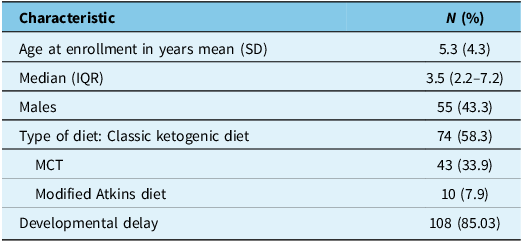
During the study period, a total of 223 children were initiated on the ketogenic diet. Out of these, 127 children (55 boys, 43%) met the enrollment criteria. Baseline demographic and clinical variables are described in Table 1. The mean age at diet start was 5.3 years (SD 3.5 years). Comorbid developmental delay was present in 108 children (85%). The classic KD was the most prominent diet type (58.3%), followed by MCT (33.9%), while few children were started on the modified Atkins diet (7.9%).
Baseline clinical and demographic characteristics (Total N = 127)

Table 1. Long description
The table presents baseline clinical and demographic characteristics of 127 children who were initiated on the ketogenic diet. It includes two columns: Characteristic and N (percentage). The characteristics listed are age at enrollment in years mean (standard deviation), median (interquartile range), gender distribution, type of diet, and developmental delay. The mean age at diet start is 5.3 years with a standard deviation of 3.5 years. The median age is 3.5 years with an interquartile range of 2.2 to 7.2 years. There are 55 males, which constitutes 43.3 percent of the sample. The types of diets include the classic ketogenic diet, MCT, and the modified Atkins diet, with 74 children (58.3 percent) on the classic ketogenic diet, 43 children (33.9 percent) on MCT, and 10 children (7.9 percent) on the modified Atkins diet. Developmental delay is present in 108 children, which is 85.03 percent of the sample.
IQR = Inter Quartile Range; MCT = medium chain triglycerides.
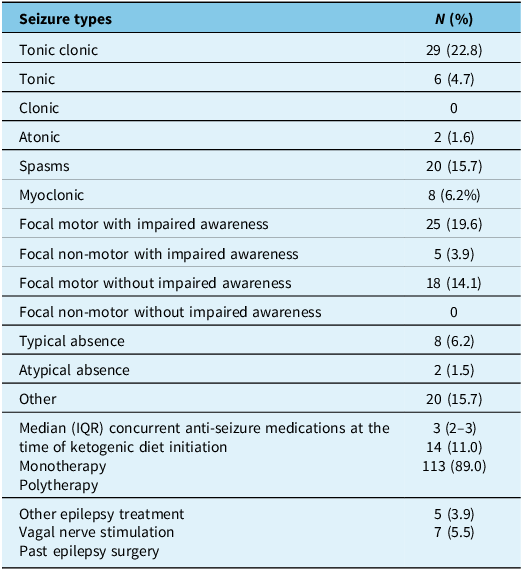
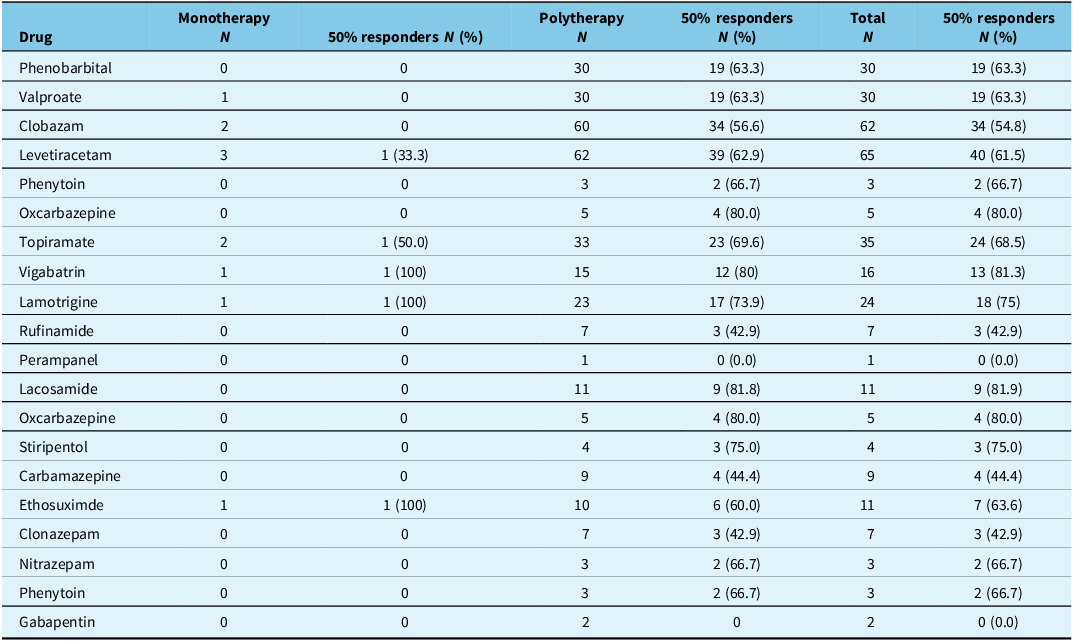
The most common seizure types included bilateral tonic-clonic (22.8%), focal motor with impaired consciousness (19.7%), and epileptic spasms (15.7%) (Table 2). Genetic causes represented the most common etiology (47%). The enrolled children were on a median of 3 concurrent anti-seizure medications at the time of diet initiation. Fourteen children (11.0%) were on monotherapy while 113 children (89.0%) were on polytherapy (44 on 2 ASM, 45 on 3 ASM, 20 on 4 ASM, and 2 on 5 ASM). The most common drugs used, either on monotherapy or in combinations, included levetiracetam, clobazam, valproate, phenobarbital, oxcarbazepine, vigabatrin, and lamotrigine (Table 3). The >50% reduction in seizure responder rate was the highest for vigabatrin (81.3%), followed by lamotrigine (75%), topiramate (68.5%), phenobarbital (63.3%), valproate (63.3%), levetiracetam (61.5%), and clobazam (54.8%).
Baseline epilepsy characteristics (Total N = 127)

Table 2. Long description
The table presents baseline epilepsy characteristics for a total of 127 patients. It includes various seizure types such as tonic clonic, tonic, clonic, atonic, spasms, myoclonic, focal motor with impaired awareness, focal non-motor with impaired awareness, focal motor without impaired awareness, focal non-motor without impaired awareness, typical absence, atypical absence, and other. The table also lists the number and percentage of patients experiencing each seizure type. Additionally, it provides data on the median number of concurrent anti-seizure medications at the time of ketogenic diet initiation, with a distinction between monotherapy and polytherapy. Other epilepsy treatments such as vagal nerve stimulation and past epilepsy surgery are also included.
IQR = Inter Quartile Range.
Seizure reduction (≥50% reduction from baseline) at 3–6 months on the diet and concurrent anti-seizure medications

Table 3. Long description
The table presents data on seizure reduction rates for different anti-seizure medications, comparing monotherapy and polytherapy. It includes columns for the drug name, number of patients, and percentage of responders achieving at least a 50% reduction in seizures. The table has 19 rows and 8 columns, with headers such as Drug, Monotherapy N, 50% responders N (percentage), Polytherapy N, 50% responders N (percentage), Total N, and 50% responders N (percentage). Notable trends include vigabatrin having the highest responder rate at 81.3%, followed by lamotrigine at 75%. Levetiracetam, clobazam, valproate, phenobarbital, and oxcarbazepine also show significant responder rates. The data highlights the effectiveness of various medications in reducing seizures, with polytherapy generally showing higher responder rates compared to monotherapy.
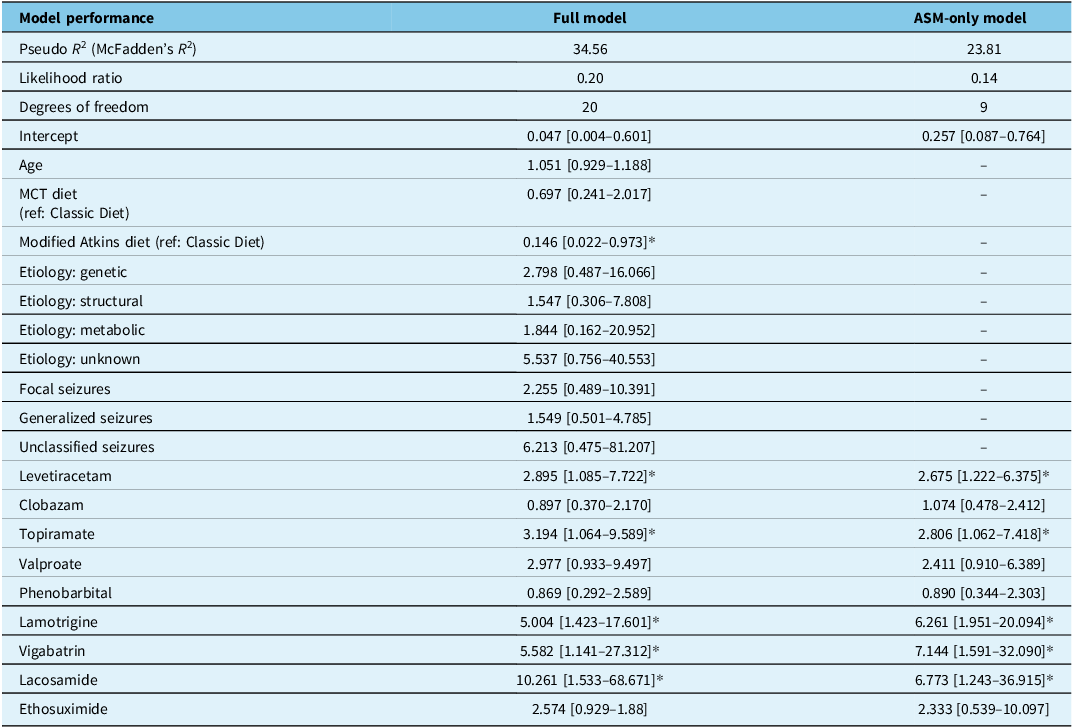
Due to the limited number of individuals on monotherapy, a direct analysis of how each drug affected KD efficacy was not feasible. To account for the many combinations of ASM polytherapy, regression analysis was used to quantify each ASM effect. Two regression models were built (Table 4). First, a full model was constructed that included all ASMs with at least 10+ study participants, as well as auxiliary variables age, seizure type, epilepsy etiology, and diet type. The full model was compared to a second model using only ASM predictors.
Logistic regression analysis

Table 4. Long description
The table presents a comparison of two regression models used to analyze the efficacy of anti-seizure medications (ASMs) in treating epilepsy. The first model, labeled as the full model, includes all ASMs with at least 10 study participants, along with auxiliary variables such as age, seizure type, epilepsy etiology, and diet type. The second model, labeled as the ASM-only model, uses only ASM predictors. Key metrics compared include pseudo R squared values, likelihood ratios, degrees of freedom, and intercepts. The full model has a pseudo R squared value of 34.56, a likelihood ratio of 0.20, and 20 degrees of freedom, while the ASM-only model has a pseudo R squared value of 23.81, a likelihood ratio of 0.14, and 9 degrees of freedom. The table also lists the effects of various predictors such as age, different diets, seizure types, and specific ASMs like Levetiracetam, Clobazam, Topiramate, and others, with their respective confidence intervals.
MCT = medium chain triglycerides.
OR > 1 indicates more likely to be a responder.
* Significant at p < 0.05.
In the full model, five of nine ASM had a statistically significant positive association with the efficacy of the ketogenic diet – lacosamide (OR 10.261 [95% CI: 1.533–68.671]), vigabatrin (5.582 [1.141–27.312]), lamotrigine (5.004 [1.423–17.601]), topiramate (3.194 [1.064–9.589]), and levetiracetam (2.895 [1.085–7.722]). Other than these ASM, the only variable statistically significantly associated with responder rate was the modified Atkins diet. In relation to its reference, the Classic diet, the modified Atkins diet was associated with a reduced likelihood of >50% seizure reduction (0.146 [0.022–0.973]). The pseudo-r 2 of the full model was 34.56, indicating an improvement in the model’s ability to explain the data relative to a null (intercept-only) model.
In the ASM-only model, the same five ASMs were found to have statistically significant associations with no qualitative difference in their result (Table 4). No ASMs were negatively associated with seizure responder rate in either model. The pseudo-r 2 of the ASM-only model was 23.81, indicating it had better predictive likelihood than a null model but less than the full model.
Discussion
This study examined the relationship between concurrent ASM and the seizure reduction efficacy of the KD in children with drug-resistant epilepsy. Five anti-seizure medications, vigabatrin, lacosamide, lamotrigine, topiramate, and levetiracetam, had a positive association with the seizure reduction efficacy of the diet. These ASM demonstrated statistically significant odds ratios in logistic regression models, both with and without auxiliary clinical parameters such as age, etiology, seizure type, and diet type. We did not find a negative association of efficacy with any ASM used. The only non-ASM predictor with significant odds ratio was the modified Atkins diet which was associated with worse seizure reduction efficacy of KD compared to the Classic diet.
Although several ASMs appeared positively associated with KD response, the heterogeneity of their mechanisms of action argues against a biologically coherent pharmacodynamic synergy with the KD. These agents act through distinct pathways, including enhancement of γ-aminobutyric acid (GABA) signaling (vigabatrin, topiramate), modulation of voltage-gated sodium channels (lacosamide, lamotrigine), and regulation of synaptic vesicle neurotransmitter release (levetiracetam). Reference Rogawski, Löscher and Rho5 Given this mechanistic diversity, the observed associations are more plausibly explained by confounding factors – such as epilepsy syndrome, age at treatment initiation, and treatment selection bias – rather than true synergistic effects. However, the ketogenic diet may act synergistically with anti-seizure medications by converging on shared molecular pathways that regulate neuronal excitability. For example, both vigabatrin and the ketogenic diet have been shown to influence the mTOR signaling pathway, potentially amplifying effects on epileptogenesis and seizure control. Reference Zhang, McDaniel, Rensing and Wong6,Reference McDaniel, Rensing, Thio, Yamada and Wong7
The anti-convulsant mechanism of the KD is not well understood. The KD causes a shift in the energy dynamics of the body towards the utilization of ketone bodies as the main source of fuel. The ketone bodies acetone, aceto-acetate, and beta-hydroxy butyrate have anti-convulsant properties in vitro. Reference Simeone, Simeone, Stafstrom and Rho8 KD has been shown to modulate mitochondrial metabolism, reactive oxygen species production, enhanced synthesis and release of the inhibitory modulator adenosine, opening of K(ATP) channels, and promotion of GABAergic inhibition through GABAβ receptors. Reference Murakami and Tognini9 The ketone bodies β-OHB and acetoacetate act as signaling molecules and epigenetic modifiers with action on histone acetylation, hence promoting transcriptional activation. Reference Shimazu, Hirschey and Newman10 The KD has been associated with increased polyunsaturated fatty acid levels, which have been shown to cause activation of peroxisome proliferator-activated receptors (PPARs), and hyperpolarization of neurons, leading to anti-convulsant effect. Reference Abdallah11 Effect of the KD on the gut microbiome has also been postulated as a potential anticonvulsant mechanisms of the KD. Reference Olson, Vuong, Yano, Liang, Nusbaum and Hsiao12
Pharmacokinetic interactions between KD and ASM may include the effect of KD on the absorption, distribution, metabolism, and excretion of ASM, affecting serum ASM concentrations. Reference Tayutivutikul, Wanleenuwat, Panapongvasin, Klajing and Iwanowski13,Reference Pedersen, Kverneland and Rudi14 Decrease in serum levels of ASM has been noted in patients on ketogenic diet therapies Reference Pedersen, Kverneland and Rudi14–Reference Kverneland, Taubøll, Selmer, Iversen and Nakken16 In addition, cytochrome p450 enzymes may be upregulated as a consequence of high fat intake, leading to reduced serum concentrations of ASMs metabolized by these enzymes. Reference Tayutivutikul, Wanleenuwat, Panapongvasin, Klajing and Iwanowski13
In a previous retrospective study, children receiving phenobarbital in combination with the KD were significantly less likely to have a >50% seizure reduction. Reference Morrison, Pyzik, Hamdy, Hartman and Kossoff2 Conversely, those receiving zonisamide in combination with the KD at onset were more likely to have a >50% reduction. Since this study, physicians are potentially cautious about prescribing phenobarbital with the KD. We did not find a negative association of concurrent phenobarbital with KD. The rationale for reduced KD efficacy with phenobarbital is not clear. A possible mechanism is that phenobarbital is a potent inducer of hepatic cytochrome P450 enzymes. This enzyme induction may alter systemic energy metabolism by enhancing gluconeogenesis and carbohydrate utilization, thereby making it more difficult to achieve or maintain a state of therapeutic ketosis. We could not assess the effect of concurrent zonisamide, as zonisamide is not easily available in Canada. Concomitant lamotrigine was found to reduce the anti-seizure efficacy of the diet in a retrospective study of 71 children with refractory epilepsy started on KD. Reference van der Louw, Desadien, Vehmeijer, van der Sijs, Catsman-Berrevoets and Neuteboom17 The likely mechanisms postulated were reduced level of ketosis when on lamotrigine, or sub-therapeutic lamotrigine levels as a result of KD-induced UGT1A6 enzymatic activity, which increases the glucuronidation of lamotrigine to inactive metabolites. Reference Armeno and Kossoff18
There are many clinical confounders, both known and unknown, which may influence seizure control on KD. Details of etiology and electroclinical syndrome characterization were not consistently available in our cohort and thus not a variable of analysis, but may contribute to outcomes on KD. For example, vigabatrin appears to have a positive effect on KD efficacy. However, vigabatrin is mostly started in children with infantile spasms, a condition which is well known to respond to the KD. Reference Prezioso, Carlone, Zaccara and Verrotti19 A similar positive association may also be observed in other developmental and epileptic encephalopathies, such as Dravet syndrome and Lennox–Gastaut syndrome, in which both selected anti-seizure medications (e.g., topiramate, levetiracetam) and the ketogenic diet are known to reduce seizures. This raises the issue of targeted, non-random ASM selection in children with developmental and epileptic encephalopathies – a major cause of pediatric drug-resistant epilepsy – which may confound observed associations. Reference Samanta, Bhalla and Bhatia20,Reference Xu, Lin, Perry and Nascimento21 Furthermore, regression analyses may not fully account for heterogeneity in epilepsy syndromes and underlying disease severity.
We could not study the effect of several novel ASMs such as cenobamate, cannabidiol, and fenfluaramine, as these have only recently become available for clinical use in Canada. However, our study does expand the total number of ASM that have been investigated on this topic from six to ten. Additionally, our data may include outcome measurement bias. Seizure outcomes were caregiver-reported, dietary adherence and degree of ketosis were not consistently quantified, and clinical decision-making influencing ASM selection could not be fully accounted for. Other limitations include lack of data on ketone levels, diet adherence, and ASM dosage and levels; important determinants of diet and ASM efficacy. A possible selection bias also exist as we only selected children with no ASM dose change for at least 3 months, likely selecting more stable patients, and possibly better responders.
Lastly, while regression analyses are useful in medical research, a more appropriate analysis to determine the impact of individual ASM on KD efficacy would be bivariate analysis (e.g., Fisher’s exact test) of monotherapy. A previous retrospective study on the effect of concurrent ASM on the efficacy of KD in 115 children attempted such an analysis. Reference Morrison, Pyzik, Hamdy, Hartman and Kossoff2 Unfortunately, in both our study and the previous study, relatively few drug-resistant epilepsy patients were on monotherapy; performing such a statistical test on individuals using polytherapy violates the independence and mutual exclusivity assumptions of bivariate analyses, thus, we believe a regression model was the most appropriate option available. The modest sample size and number of treatment responders raise the possibility of model overfitting, particularly in the full regression model and for ASM that were near our sampling size minimum of 10 patients. Model estimates are imprecise and may reflect model instability. Although regularization techniques were applied, external validation was not possible. With this in mind, we reported the full models, which often have better reproducibility. Reference Steyerberg22
Conclusion
In this retrospective cohort, five anti-seizure medications – vigabatrin, lacosamide, lamotrigine, topiramate, and levetiracetam – were positively associated with seizure reduction in children treated with the ketogenic diet. However, given the heterogeneity of mechanisms of action among these agents and the observational nature of the study, these associations should not be interpreted as evidence of pharmacodynamic synergy with the ketogenic diet. Rather, they are likely influenced by clinical confounders such as epilepsy phenotype, treatment selection, and patient characteristics. Further investigation is needed to understand the contribution of these factors. Importantly, no concurrent anti-seizure medication was negatively associated with ketogenic diet efficacy. These findings suggest that the choice of concomitant anti-seizure medication may be guided primarily by the child’s electro-clinical profile and tolerability, rather than concern for effect on ketogenic diet efficacy.
Author contributions
SS conceived and designed the study, oversaw data collection, contributed to data interpretation, and drafted and critically revised the manuscript. AA performed the statistical analysis and modeling and contributed to data interpretation and critical manuscript review. NK contributed to data acquisition and curation, participated in interpretation of the results, and reviewed the manuscript for accuracy and intellectual content. ED contributed to study conception and design, data interpretation, and critical revision of the manuscript. All authors met ICMJE criteria for authorship and approved the final manuscript.
Funding statement
This work was supported by Grant funding by the Ontario Brain Institute.
Competing interests
EJD received grant funding from the Ontario Brain Institute for this work. EJD has also received consulting fees from UCB, Jazz Pharma, and Pendopharm; speaker honoraria from Jazz Pharma; and participated in advisory board for Pendopharm.

 Open access


Target article
Effect of Concurrent Anti-Seizure Medications on the Efficacy of the Ketogenic Diet in Children with Epilepsy
Related commentaries (1)
Reviewer Comment on Sharma et al. “Effect of Concurrent Anti-Seizure Medications on the Efficacy of the Ketogenic Diet in Children with Epilepsy”