


Introduction
Sustainable use is key to maintaining healthy ecosystems and the livelihoods of the people who depend on them (Nasi et al., Reference Nasi, Taber and Vliet2011), but unsustainable and/or illegal resource use can threaten the social-ecological systems concerned. For millennia, people have harvested marine turtles and benefitted from their use (Frazier, Reference Frazier2005). However, overexploitation and shifts from subsistence to commercial use, motivated by nutritional values, perceived health benefits, valued material properties (e.g. of the carapace and its scutes) or revenue from trade (Frazier, Reference Frazier2005; Barrios-Garrido et al., Reference Barrios-Garrido, Espinoza-Rodríguez, Rojas-Cañizales, Palmar, Wilderman, Montiel-Villalobos and Hamann2017) threaten the conservation of marine turtles (Donlan et al., Reference Donlan, Wingfield, Crowder and Wilcox2010; Williams et al., Reference Williams, Pierce, Hamann and Fuentes2019) by depleting their populations. For example, international market demands during the 1950s–1970s caused the collapse of all marine turtle populations in Mexico (Mancini & Koch, Reference Mancini and Koch2009, and references therein).
Impacts such as these have triggered international, national and local conservation efforts. By 1981, all marine turtle species were listed in Appendix I of CITES (2019) and thus international commercial trade became generally prohibited. Similar provisions also followed under other intergovernmental instruments, such as the Convention on the Conservation of Migratory Species of Wild Animals, in which, by 1986, all species except Natator depressus were listed in Appendix I, generally prohibiting take, and the Inter-American Convention for the Protection and Conservation of Sea Turtles, signed in 2001, which also generally prohibits domestic trade and intentional capture, retention or killing. In addition to governments ratifying such international instruments and becoming bound to their provisions, many NGOs have also been trying to conserve marine turtle populations, at least since the 1950s (Mazaris et al., Reference Mazaris, Schofield, Gkazinou, Almpanidou and Hays2017).
Despite global conservation efforts and some decline in local trade and consumption (Boura et al., Reference Boura, Abdullah and Nada2016; Hancock et al., Reference Hancock, Furtado, Merino, Godley and Nuno2017; Harrison et al., Reference Harrison, Weller, Nahill, Urteaga, Dunbar and Azanza2017; Quiñones et al., Reference Quiñones, Quispe and Galindo2017), marine turtle take remains a key threat in the North Atlantic, Caribbean, South-west Atlantic, Middle East, South-east Asia and East Pacific regions (Donlan et al., Reference Donlan, Wingfield, Crowder and Wilcox2010; Marcovaldi et al., Reference Marcovaldi, Thomé and Fallabrino2019; Nalovic et al., Reference Nalovic, Cuevas and Godfrey2019; Phillott & Rees, Reference Phillott and Rees2019; Rguez-Baron et al., Reference Rguez-Baron, Kelez, Liles, Zavala-Norzagaray, Torres-Suárez and Amorocho2019). Reports continue to highlight the prevalence of illegal supply of turtle meat, eggs and other marine turtle specimens (hereafter, specimens refers to marine turtles, live or dead, or any parts or derivatives thereof) in local, regional and international markets (Mancini & Koch, Reference Mancini and Koch2009; Mancini et al., Reference Mancini, Senko, Borquez-Reyes, Póo, Seminoff and Koch2011; IOSEA Marine Turtles MOU, 2014; Boura et al., Reference Boura, Abdullah and Nada2016; Hancock et al., Reference Hancock, Furtado, Merino, Godley and Nuno2017; CITES, 2019), and there is growing international concern over online trade in these species (CITES, 2019). Given the extensive efforts for marine turtle conservation globally, there is potential for reassessing and refining measures to curb their illegal harvest, use and trade (hereafter also referred to as illegal activities, for simplicity). Understanding the complexity of the underlying socio-economic and cultural contexts of wildlife trade and analysing lessons from previous interventions will allow the formulation of evidence-based strategies and conservation priorities (Travers et al., Reference Travers, Archer, Mwedde, Roe, Baker and Plumptre2019).
The extent to which interventions are effective in reducing or preventing illegal wildlife trade is often unclear because information on these activities is difficult to obtain (Gavin et al., Reference Gavin, Solomon and Blank2009). However, the scarcity of data from empirical research should not prevent the development and implementation of conservation strategies (Donlan et al., Reference Donlan, Wingfield, Crowder and Wilcox2010). Alternative ways of collecting data, such as expert elicitation, are therefore necessary. Expert knowledge refers to substantive information on a topic that is not widely known but that may be obtained from training, research, skills or personal experience (Martin et al., Reference Martin, Burgman, Fidler, Kuhnert, Low-Choy, Mcbride and Mengersen2011). Expert elicitation has been used to aid conservation decision-making by offering an expedient and cost-effective way of gauging knowledge on intricate and poorly understood issues such as wildlife harvest, trade and consumption (Swan et al., Reference Swan, Barlow and Parry2017; Ribeiro et al., Reference Ribeiro, Reino, Schindler, Strubbe, Vall-Llosera and Araújo2019).
Using expert elicitation, we implemented a global survey to examine how conservation efforts can better safeguard marine turtles in the context of illegal harvest, use and trade. We explored (1) perceived drivers, occurrence and trends of illegal activities globally; (2) the perceived urgency in addressing illegal activities, the adequacy of current conservation efforts, and conservation priorities; (3) challenges to curbing illegal activities and recommendations to overcome those challenges; and (4) lessons from conservation experiences. We aimed to identify global priorities for marine turtle conservation interventions that seek to curb illegal activities.
Methods
Survey approach
Literature authorship and chain-referral are common approaches for identifying participants for expert elicitation studies on marine turtles (e.g. Donlan et al., Reference Donlan, Wingfield, Crowder and Wilcox2010; Wildermann et al., Reference Wildermann, Gredzens, Avens, Barrios-Garrido, Bell and Blumenthal2018). We identified 327 potential participants through their authorship in the primary and secondary literature on conservation of marine turtles and their harvest, use and/or trade. This literature search was conducted on Web of Science (Clarivate, Philadelphia, USA) and Google Scholar (Google, Mountain View, USA), employing the search query: (‘marine turtle*’) AND (‘trade’ OR ‘illegal’ OR ‘use’ OR ‘take’) AND (period =2000–2018). We read the abstract of each paper retrieved to verify its relevance. The last literature search was undertaken on 11 April 2018. We also identified potential participants through organizations and other groups working on marine turtle conservation (including the IUCN Species Survival Commission Marine Turtle Specialist Group). These bodies were identified using the search terms (‘marine turtle organisation’) OR (‘marine turtle conservation’) and the marine turtle repository platform SEATURTLE.ORG (2018). This resulted in 137 additional contacts being obtained. Wherever available, individual rather than general e-mail addresses were used.
Knowledge of marine turtle trade and conservation is a specialized field of expertise, and therefore we used snowball sampling during survey implementation to identify further individuals and attenuate any biases of convenience sampling (Heckathorn, Reference Heckathorn2011). We requested all those directly contacted to recommend up to three peers who may have relevant expert knowledge and experience; this approach, widely used for accessing populations that are hard to reach (Heckathorn, Reference Heckathorn2011), resulted in the identification of 66 additional participants. In total, 530 e-mails were sent to potential participant individuals or organizations; 67 (13%) of these were not delivered.
Survey tool and implementation
We used an online survey, in English, developed with GetFeedback (2018), to collect participants' perceptions on the status and scope of the global illegal harvest, use and trade of marine turtles and on priority conservation measures for addressing these illegal activities. The survey comprised five parts: (1) professional experience and country of expertise (i.e. the country with which participants felt most familiar regarding marine turtle harvest, use and trade and/or conservation; questions in parts 2–4 then referred to this country); (2) perceptions of the characteristics of and trends in illegal activities (threats to turtles were considered here, identified from Donlan et al., Reference Donlan, Wingfield, Crowder and Wilcox2010, and Humber et al., Reference Humber, Godley and Broderick2014); (3) priorities for addressing illegal activities; (4) adequacy of measures for addressing illegal activities (measures were compiled through a literature survey and summarized using an inductive approach through direct examination of data; Elo & Kyngäs, Reference Elo and Kyngäs2008); (5) conservation and management challenges and lessons from past conservation projects. The survey included both closed and open-ended questions. A temporal qualifier of 5 years was used for some of the questions, to ensure that participants focused on current rather than historical trends, a common approach in expert elicitation studies (e.g. Swan et al., Reference Swan, Barlow and Parry2017).
The survey instrument was pretested with a pilot group of nine individuals who have a scientific background and familiarity with conservation research on marine turtles (this group was excluded from the actual survey). Following the pilot survey, we refined the instrument based on suggestions for rewording and restructuring. The survey (Supplementary Material 1) was deployed via e-mail and responses were collected during 12 April–20 May 2018; one e-mail reminder was sent during this period. We informed participants of the general aims of the project, that participation was voluntary and anonymous, individual details would not be disclosed or identifiable, information collected would be used for research purposes only, they could withdraw at any time, and they could skip questions they did not wish to answer. Clicking on an initiation button on the first page of the survey was taken as consent for participation. Participants were requested to complete the survey only once, although we could not control compliance with this.
Data analysis
Responses to closed questions were analysed as frequencies. Some response categories had limited counts and were grouped for more robust distinctions. We used ordered logistic regression to explore potential differences in perceived trade trends, threat ranking, adequacy of current efforts, and priority future efforts required, according to region. For example, we explored differences in perceptions of the trend in trade among regions as an ordered response (somewhat/definitely increased, remained the same, somewhat/definitely decreased) without making assumptions about the distance between ordered categories or their distribution. Statistical analyses were conducted with R 3.4.4 (R Core Team, Reference Core Team2018).
Responses to open questions (i.e. perceived challenges to curbing illegal activities, how to address them, and lessons learnt) were categorized using an inductive approach in which summary themes were created by examining the data (Elo & Kyngäs, Reference Elo and Kyngäs2008), and then analysed as frequencies. Responses were often categorized into more than one theme, to retain as many differences as possible in expert judgment (an important aspect for communicating findings to decision-makers; Martin et al., Reference Martin, Burgman, Fidler, Kuhnert, Low-Choy, Mcbride and Mengersen2011).
Results
Survey participants
The survey was completed by 103 participants (a response rate of 22%), the majority of whom worked for environmental NGOs and universities/research institutes, mainly playing a role in scientific research or programme coordination at national and international levels (Table 1). The majority of participants had considerable experience in marine turtle conservation, research and/or trade: 76% of the group had > 5 years of experience in this field, 19 of which (18% of all participants) had > 20 years experience. Of the 103 participants, 72% had been directly involved in a conservation project addressing illegal harvest, use or trade of marine turtles in the previous 10 years.
Characterization of the 103 survey participants.

1 Per cents are rounded and hence may not sum exactly to 100.
2 One invalid answer, representing 1%, is not displayed.
Nine participants did not indicate a single country of expertise, hence only 94 responses were considered for some of the questions (sample sizes for questions are indicated throughout). In total, participants contributed information on 49 countries. Most participants contributed information on countries in the Eastern Pacific and Western Atlantic; followed by the Eastern Indian Ocean and Central and South-western Pacific; Central Eastern and South-eastern Atlantic; Mediterranean; and lastly, Western Indian Ocean (Fig. 1). Supplementary Figs 1–5 detail the number of participants per country.
Geographical distribution of the countries of expertise of the 94 participants, grouped by region. Numbers indicate the number of participants, and per cent of the total, in each region.

Characteristics of harvest, use and trade
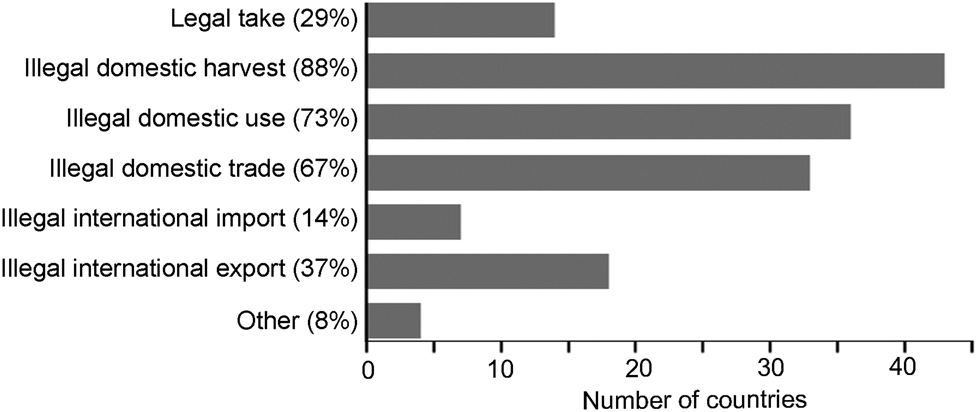
Of 94 participants, 68% reported the occurrence of illegal harvest of marine turtles in their countries of expertise, 86% reported illegal use and 61% illegal domestic trade. Legal trade, unsurprisingly, was less reported. Here, our inquiry about these activities was intended to examine occurrence rather than magnitude. Participants referred to illegal activities most frequently at the national level; illegal international import or export were not as highly reported. For example, 86% of participants reported illegal use (consumption or other uses) but only 10% reported international import. Illegal use was reported by 40% of the participants with expertise on Mediterranean countries and 86–100% of participants with expertise in the other four regions (in ascending order: Eastern Indian Ocean and Central and South-western Pacific; Eastern Pacific and Western Atlantic; Central Eastern and South-eastern Atlantic; and Western Indian Ocean). Of the 49 countries of expertise, illegal harvest was perceived as present in 43 (88% of countries), illegal use in 36 (73%) and illegal domestic trade in 33 (67%) (Fig. 2).
Perceived occurrence of activities involving marine turtles in the 49 countries of expertise of the 94 participants (Fig. 1), as number and per cent of countries for which participants reported each activity. ‘Other’ indicates incidental catch, incidental nest destruction or intentional killing.
Among the 64 participants reporting illegal harvest, 88% perceived local people to be those mainly involved in turtle and egg take. Compared to other potential drivers (e.g. killing or harassment of turtles for pleasure or entertainment, protection of self or property, or protest), household consumption and commercial gain were considered the main motivations driving take (86% and 77% of participants, respectively). However, participants mostly considered that such consumption and income benefits were supplementary rather than vital (85% of 55 participants and 71% of 49, respectively). Supplementary Figs 6–8 present these answers by category.
Of 94 participants, 25 (27%) indicated that legal harvest of marine turtle specimens occurred in their country of expertise (Fig. 2). As expected, these reports referred largely to the Eastern Pacific and Western Atlantic (14 responses) and to the Eastern Indian Ocean and Central and South-western Pacific (8), where some legal take is permitted. Most participants (64% of the 25) considered that legal harvest is likely/extremely likely to be masking illegal activities (20% considered this unlikely/extremely unlikely).
When questioned about illegal trade trends over the previous 5 years, 41% of 94 participants perceived a decrease, 15% perceived an increase, and the remainder believed it had remained the same or did not know. We did not find significant differences in perceived trade trends between regions (all P > 0.1). Regarding online trade, 33% of 94 participants across regions perceived this type of trade to be non-existent in their countries of expertise over the previous 5 years, and 53% reported not knowing whether it existed or not.
Urgency in addressing activities, and conservation priorities
When participants were asked to rank the relative importance of various threats to marine turtles in their countries of expertise, the impacts of fisheries (including bycatch), and illegal harvest, use and trade were perceived as the greatest and most urgent threats that need to be addressed across the regions studied (Fig. 3). Legal harvest, use and trade were considered the lesser and least urgent threats. Illegal activities were significantly more likely to be perceived as a threat of high importance and urgency in the Mediterranean (t =−2.21, P = 0.03) and less so in the Central Eastern and South-eastern Atlantic (t = 2.22, P = 0.03). Addressing illegal activities in participants' countries of expertise was perceived to be of high priority for marine turtle conservation across the regions considered: of 94 participants, 46% perceived this as essential/high priority, 29% as medium priority, and 23% as low/no priority. Current efforts to address these issues were generally perceived as insufficient/very insufficient considering what is needed (56% of 94 participants), 28% perceived them as somewhat sufficient, and 16% as sufficient/outstanding. There were no significant differences in perceived adequacy of efforts among the different regions studied (all P > 0.1), but participants working in the Central Eastern and South-eastern Atlantic were more likely to perceive this issue as a high priority (t = 2.25, P < 0.02).
Perceived mean relative importance of threats to marine turtle conservation amongst 94 participants, with 95% confidence intervals. Scoring: 1, lesser and least urgent threat; 6, greatest and most urgent threat.

According to participants, the top three types of measures that should be prioritized to curb illegal activities involving marine turtles (Fig. 4) were those relating to improving law enforcement (77% of 88 participants), improving management, conservation interventions and monitoring (64%), and raising environmental literacy, awareness and participation at levels of governance from communities to governments (59%).
Measures perceived as priorities to curb illegal harvest, use and trade for the countries of expertise of 88 participants, as number and per cent of response count. Participants could select several measures, and were free to skip the question if they did not wish to answer it.

Challenges and recommended actions
With respect to the most important challenges to curb illegal activities in their countries of expertise, participants (91) mostly referred to the three following areas: fisheries management (mentioned by 23%), enforcement (26%) and legislation (20%; Fig. 5). Challenges commonly reported concerning enforcement and legislation included poor monitoring and market surveillance, weak penalizing systems that fail to discourage unlawful practices, little political interest or involvement by authorities, and limited local capacity (human and financial) hindering conservation efforts.
Perceived challenges to addressing illegal harvest, use and trade of marine turtles, and the actions recommended for addressing such challenges, from 91 participants. Participants reported the challenges in response to an open-ended question, and summary themes were attributed to their responses. The three most common themes identified were fisheries management, enforcement and legislation. Participants' suggestions for how to address the challenges relating to fisheries management and to enforcement and legislation are displayed below each figure part. EIAs, environmental impact assessments; IUU, illegal, unreported and unregulated.

With respect to fisheries management, bycatch was commonly indicated as a great challenge, which, together with the incursion of foreign nationals, including illegal, unreported and unregulated fishing by foreign vessels, was reported as having the potential to create/support markets for marine turtle specimens. Other challenges reported included unclear legal frameworks, poor understanding of legal harvest quotas, poverty and lack of employment opportunities, outdated fishing gear and techniques in small-scale fisheries, poorly managed hatchery programmes, and poorly educated communities.
Solutions indicated for these challenges included (in no particular order): revising legal frameworks; improving land/maritime surveillance, including at landing and border points; locating illegal, undeclared stockpiles that are sold to foreign vessels; appropriately disposing of bycaught or stranded turtle carcasses that may enter illegal markets; improving knowledge of marine turtle reproductive biology and habitat use; improving the understanding and monitoring of human–turtle interactions, including harvest/trade levels; banning commercial egg trade; developing incentives for compliance with legislation and regulations; improving transparency in monitoring and enforcement processes; implementing good fisheries management practices; and encouraging leadership from government and communities.
Lessons learnt from conservation experiences
Of the total 103 participants, 72% had been directly involved within the last 10 years in a marine turtle conservation project addressing illegal activities. When considering this experience and asked about strategic management options for the success of similar projects in the future, the most common needs mentioned related to planning processes, site monitoring, and background research (Table 2). Several participants (61% of 72) emphasized the importance of collaborative management and planning with affected local stakeholders; 17% referred to the importance of ensuring continuous monitoring presence at sites where turtles are typically harvested; and 11% noted the importance of adequate preliminary research on local socio-economic, cultural and ecological contexts to inform project design.
A total of 72 survey participants had been directly involved in marine turtle conservation projects aiming to curb illegal harvest, use and trade during the previous 10 years. Of those, 64 suggested key management and strategic options for the success of any future projects, summarized here. Frequency refers to the number of individual participant responses that identified the need for a given key management or strategic option, and per cent is calculated in relation to the total of 72 participants.

Discussion
Using participants' perceptions to explore illegal harvest, use and trade, its challenges, lessons learnt and solutions, we identified global priorities for marine turtle conservation interventions. Obtaining reliable information on illegal activities is challenging, and the opinions of experts evolve over time (Martin et al., Reference Martin, Burgman, Fidler, Kuhnert, Low-Choy, Mcbride and Mengersen2011). The perceptions we have reported may have been subject to biases, including from field experiences, areas of expertise, and the degree of both of these (Donlan et al., Reference Donlan, Wingfield, Crowder and Wilcox2010; Williams et al., Reference Williams, Pierce, Hamann and Fuentes2019). Expert knowledge is likely to be influenced by a range of factors that are unique to the individual experts, making it difficult to achieve impartiality. Further work should therefore seek to validate our findings through empirical research, and try to better understand how individual experience, perspectives and goals influence experts’ opinions on wildlife conservation trends, needs and priorities. Moreover, although we attempted to attenuate any biases of convenience sampling with snowball sampling, we did not achieve equitable coverage of experience levels and geographical distribution, which limits the generalization of our findings. For example, we recruited fewer participants for the Western Indian Ocean and Mediterranean regions than for the other three regions.
Our findings suggest that illegal harvest, use and trade continue to occur in a number of countries, with specimens being harvested largely by local people. Although these conclusions result from the views of a relatively limited number of experts, they align with evidence from recent studies reporting illegal activities (Egypt, Boura et al., Reference Boura, Abdullah and Nada2016; Cape Verde, Hancock et al., Reference Hancock, Furtado, Merino, Godley and Nuno2017; Costa Rica, Harrison et al., Reference Harrison, Weller, Nahill, Urteaga, Dunbar and Azanza2017; Peru, Quiñones et al., Reference Quiñones, Quispe and Galindo2017; Colombia, Indonesia, Madagascar, Malaysia, Mozambique, Nicaragua and Panama, CITES, 2019). The frequent of illegal trade at the national level compared to that reported at international level may reflect the limited capacity of international regulatory frameworks, such as CITES, to counter illegal wildlife trade at the national level. However, overall, many participants considered trade to have decreased in the previous 5 years, supporting the findings of other research (e.g. Boura et al., Reference Boura, Abdullah and Nada2016; Hancock et al., Reference Hancock, Furtado, Merino, Godley and Nuno2017; Harrison et al., Reference Harrison, Weller, Nahill, Urteaga, Dunbar and Azanza2017; CITES, 2019). Notwithstanding, shifts from traditional to online trade in marine turtles have been reported for some regions (CITES, 2019). Online marine turtle trade has been reported in Central American and South-east Asian countries (Harrison et al., Reference Harrison, Weller, Nahill, Urteaga, Dunbar and Azanza2017; CITES, 2019). However, participants were generally unfamiliar with this type of trade in these countries. This could be explained by the relatively novel, emerging nature of online wildlife crime and the difficulty of tracking and quantifying this type of trade (May, Reference May2017).
Although participants considered addressing illegal activities a priority for marine turtle conservation, current efforts to address these were believed to be insufficient by many participants. Illegal harvest, use and trade were considered serious threats that need to be addressed for marine turtles across the regions studied, and particularly in the Mediterranean. This is unexpected, considering that illegal activities are of little concern in the Mediterranean compared to other regions (Boura et al., Reference Boura, Abdullah and Nada2016; Casale et al., Reference Casale, Broderick, Caminas, Cardona, Carreras and Demetropoulos2018). Perhaps there are inflated perceptions about the severity of the threat in this region because it has been historically less dependent on marine turtle exploitation compared to other regions. That illegal activities were considered a less important and less urgent threat in the Central Eastern and South-eastern Atlantic could reflect relatively scarcer data and research on marine turtles and their trade in this region.
Participants also reported concerns about legal take contributing to illegal activities. This has been reported previously (CITES, 2019), but participants did not consider legal exploitation a great and urgent threat. This is probably a result of the limited extent of legal take and its lower relative impact compared to threats such as bycatch and illegal take (Humber et al., Reference Humber, Godley and Broderick2014).
The challenges identified by participants concerning illegal activities related simultaneously to fisheries management, enforcement and/or legislation matters (Fig. 5), emphasizing the importance of multi-dimensional conservation approaches. Action on any one of these areas alone is unlikely to be effective. For example, even though prohibitive legislation may be in place, community members will still harvest marine turtle specimens if the risk of being caught is low (CITES, 2019), and bycaught turtles will still be retained if maritime surveillance is poor (Boura et al., Reference Boura, Abdullah and Nada2016; Quiñones et al., Reference Quiñones, Quispe and Galindo2017). Over half of the survey participants considered raising environmental literacy, awareness and participation of stakeholders a top priority to eliminate illegal activities. Participants also considered improving law enforcement, management, conservation interventions and monitoring to be priorities. These findings are supported by studies demonstrating that community education and awareness of marine turtle conservation, combined with better legislation and enforcement, lead to decreases in illegal harvest (Boura et al., Reference Boura, Abdullah and Nada2016; Hancock et al., Reference Hancock, Furtado, Merino, Godley and Nuno2017).
Conservation priorities for marine turtles appear to be consistent over time, as the main measures that participants considered suitable for curbing illegal activities echo recommendations from the literature (e.g. Nada & Casale, Reference Nada and Casale2011; Lam et al., Reference Lam, Ling, Takahashi and Burgess2012; Marco et al., Reference Marco, Abella, Liria-Loza, Martins, López and Jiménez-Bordón2012; Campbell, Reference Campbell2014; IOSEA Marine Turtles MOU, 2014; Antonio & Matillano, Reference Antonio and Matillano2016; Boura et al., Reference Boura, Abdullah and Nada2016; Hancock et al., Reference Hancock, Furtado, Merino, Godley and Nuno2017; Harrison et al., Reference Harrison, Weller, Nahill, Urteaga, Dunbar and Azanza2017). It is great the presentation of issues through survey questions may have triggered participant accessibility bias, in which judgement is disproportionally influenced by information that comes more easily to mind (Martin et al., Reference Martin, Burgman, Fidler, Kuhnert, Low-Choy, Mcbride and Mengersen2011). However, our findings reveal the need to seek novel ways of doing conservation. For example, government–NGO cooperation can help overcome government resource constraints, which were noted by some participants (e.g. WWF has helped build Colombia's capacity for the identification of traded turtle specimens, WWF, 2016; Sea Shepherd Conservation Society has helped Mexico patrol marine areas for poachers, Sea Shepherd Conservation Society, Reference Sea Shepherd Conservation Society2019). Our findings mirror calls for more inclusive marine turtle conservation interventions incorporating alternative views and sustainable use (Delisle et al., Reference Delisle, Kim, Stoeckl, Lui and Marsh2018; Sardeshpande & MacMillan, Reference Sardeshpande and MacMillan2019).
Although we have found that some progress has been achieved, our findings demonstrate the need for stronger efforts to address continuing illegal harvest, use and trade. Based on perceived challenges to curbing illegal activities, how to address them, and lessons learnt, we recommend that future marine turtle conservation interventions prioritize the following eight matters to curb illegal harvest, use and trade: (1) undertake dialogue, collaborative management and planning with primary resource users; (2) ensure that project leaders thoroughly understand local socio-economic and ecological contexts; (3) adopt multi-dimensional approaches addressing fisheries management, enforcement and legislation; (4) tackle illegal harvest, use and trade at national level; (5) implement sustainable and locally-adapted alternatives to illegal activities; (6) establish coordinated mechanisms to prevent wildlife cybercrime; (7) further knowledge of marine turtle reproductive biology, habitat use, threats from fisheries and illegal activities, and the relationship between the latter two; (8) implement disincentives for unlawful practices.
By looking at illegal harvest, use and trade through the lens of researchers and practitioners, we have identified global priorities for marine turtle conservation. Notwithstanding that our findings require empirical validation, we believe they will contribute to the planning of successful conservation interventions that aim to curb illegal activities both locally and globally.
Acknowledgements
We thank all participants for sharing their knowledge, survey pre-testers and colleagues for their advice, and the University of Bayreuth and the Elite Network of Bavaria for covering software costs. Our research received no specific grant from any funding agency, or commercial or not-for-profit sectors.
Author contributions
Study design: all authors; data collection: LLL; data analysis: LLL, AN; writing, revision, editing: all authors.
Conflicts of interest
None.
Ethical standards
This research did not require ethical approval from the University of Bayreuth (where LLL was based), but nevertheless followed the guidelines of the British Sociological Association (2017) and otherwise abided by the Oryx guidelines on ethical standards.


 Open access

