


Epidemiological studies have shown that fruit and vegetable intake is beneficial to health, being associated with decreased risk of a range of chronic diseases including cardiovascular diseaseReference Ness and Powles1, strokeReference Gillman, Cupples, Gagnon, Posner, Ellison and Castelli2 and a number of cancersReference Steinmetz and Potter3. As a consequence, dietary guidelines developed by health authorities in many Western countries recommend the consumption of fruits and vegetables. Population surveys suggest, however, that most adults consume low and possibly inadequate amounts of fruits and vegetables. The Australian Guide to Healthy Eating promotes the consumption of two or more servings of fruit each day and five or more servings of vegetablesReference Smith, Kellett and Schmerlaib4. One recent survey showed that 78% of Australian adults consumed less than five daily servings of vegetables and 45% consumed less than two daily servings of fruit5. Similar findings have been reported for other developed countries including the USAReference Serdula, Gillespie, Kettel-khan, Farris, Seymour and Denny6 and the UKReference Lang, Thane, Bolton-Smith and Jebb7. As a consequence, health authorities have invested in public health programmes, such as the ‘5 A Day for Better Health Program’ in the USAReference Stables, Subar, Patterson, Dodd, Heimendinger and Van Duyn8, aimed at increasing intakes of fruits and vegetables.
To inform efforts to promote increased fruit and vegetable intakes, a large body of research has been conducted in an effort to understand the determinants of fruit and vegetable consumption. The majority of that research has focused upon understanding the psychosocial and sociodemographic correlates of fruit and vegetable intake, such as knowledge, perceived benefits and barriers, self-efficacy, sex and social statusReference Krebs-Smith, Heimendinger, Patterson, Subar, Kessler and Pivonka9–Reference Friel, Newell and Kelleher18. A limited number of studies have examined lifestyle correlates, such as the relationships between fruit and vegetable intake and smoking or physical activityReference Johansson, Thelle, Solvoll, Bjorneboe and Drevon13, Reference Friel, Newell and Kelleher18, Reference Billson, Pryer and Nichols19. While there has been a substantial amount of research into the determinants of fruit and vegetable intake, little research has investigated the food-related behaviours associated with healthier intakes of fruits and vegetables. That research showed that eating home-grown produce is associated with higher vegetable intakeReference Billson, Pryer and Nichols19; eating vegetables at lunch and dinnerReference Satia, Kristal, Patterson, Neuhouser and Trudeau20; eating salads is associated with higher vegetable intakeReference Satia, Kristal, Patterson, Neuhouser and Trudeau20; eating at fast-food restaurants is associated with lower vegetable intakesReference Satia, Galanko and Siega-Riz21; and breakfast consumption is associated with stage of change for fruit intake among womenReference Horacek, White, Betts, Hoerr, Georgiou and Nitzke22. As well as being limited in number, studies of the food-related correlates of fruit and vegetable consumption have assessed only a limited number of behavioural variables.
To date, nutrition interventions aimed at promoting increased fruit and vegetable consumption have met with modest success at bestReference Wilcox, Parra-Medina, Thompson-Robinson and Will23–Reference Sorensen, Linnan and Hunt25. This may be due, in part, to a poor understanding of the specific antecedent behaviours, including food purchasing, preparation and cooking behaviours, as well as eating/meal behaviours, that are precursors to healthy fruit and vegetable consumption. In terms of efforts to promote increased consumption, a more thorough understanding of the behavioural correlates of fruit and vegetable intake is likely to be of practical significance, since it can be used to guide intervention programmes. The aim of the present paper is to examine associations between food-related behaviours and fruit and vegetable intake among women. A focus on women is important since women remain largely responsible for domestic duties in households, including food purchasing and meal choice and preparationReference Bittman26.
Methods
Participants
The findings presented in this paper are based on data derived from a sample of women who were recruited from 45 MelbourneFootnote * suburbs of different socio-economic status (SES) within 30 km of the central business district. The suburbs were selected using a stratified random sampling procedure. Each suburb within the 30 km radius was ranked according to its SEIFA score (Socio-Economic Index for Areas) based on relative disadvantage (which considers the proportion of residents with low income, low educational attainment and unskilled occupations)27. The suburbs were grouped into septiles from low to high socio-economic disadvantage and 15 suburbs were drawn at random from each of the lowest, middle and highest septiles to ensure that women from a range of SES backgrounds were included.
A random sample of women aged 18–65 years in each of the 45 suburbs was selected from the electoral roll.Footnote † Given that previous studies have achieved lower response rates amongst women of lower SES, we over-sampled from the low- and mid-SES suburbs relative to the high-SES suburbs. A total of 2400 surveys were distributed: 645 to women in high-SES suburbs, 780 to women in mid-SES suburbs and 975 to women in low-SES suburbs. A second independent sample (n = 2400) was drawn in the same manner for a separate physical activity survey and participants completing that survey were asked if they were also willing to complete the dietary survey.
Procedures
According to the methods described by DillmanReference Dillman28, the women were initially mailed a letter advising them they had been selected to take part in a study of women's health behaviours and that they would shortly receive a survey. One week later a self-completion dietary questionnaire was posted out to 2400 women and a physical activity questionnaire was sent to a separate sample of 2400 women. A small incentive was included in the initial survey package. All non-respondents received a postcard reminder within three weeks and a second reminder with replacement survey package after a further three weeks.
Measures
Sociodemographic details
The questionnaire sought details of the women's age, country of birth, marital status, presence of children in the household, educational qualifications and occupational status.
Fruit and vegetable intakes
Fruit and vegetable intakes were assessed via two questions that asked ‘How many servings of [fruit/vegetables] do you usually eat each day?’ (a serving of fruit was defined as 1 medium piece or 2 small pieces of fruit, or 1 cup of diced pieces; a serving of vegetables was defined as 1/2 cup of cooked vegetables or 1 cup of salad vegetables). Response options were: none; 1 serving; 2 servings; 3–4 servings; or 5 servings or more. These questions were adapted from the Australian National Nutrition Survey (NNS)29. In methodological work based on the NNS (n = 10 851), responses to questions regarding the number of servings of fruit and vegetables were compared with more detailed data gathered via 24-hour recall regarding the number of grams of fruit and vegetables consumed. That work showed that the two brief questions adequately discriminated between groups with different fruit and vegetable intakesReference Rutishauser, Webb, Abraham and Allsopp30. The test–retest reliability (intra-class correlation) of these measures, assessed in a sub-study of 30 women from across the age spectrum and with a variety of educational backgrounds who completed the survey on two occasions three days apart, was very high (0.85 for fruit and 0.85 for vegetables).
Shopping behaviours
Nine items were included that asked women about various aspects of their shopping behaviours (e.g. how often they write a shopping list, how often they go shopping by themselves, etc.). A complete listing of the items is included in Table 1. The women were asked to indicate how often they engaged in each of the behaviours on a 4-point response scale: ‘never/rarely’; ‘sometimes’; ‘most of the time’; always'.
Women's shopping, food preparation, meal and eating behaviours

N/A – not applicable.
* Including breakfast, lunch and dinner.
Food preparation behaviours
Ten items were included that asked women about various aspects of their food preparation behaviours (e.g. how often they prepare or cook dishes ahead of time, how often they find shopping a real chore, etc.). A complete listing of the items is included in Table 1. The women were asked to indicate how often they engaged in each of the behaviours on a 4-point response scale: ‘never/rarely’; ‘sometimes’; ‘most of the time’; always'.
Meal behaviours
Ten items were included that asked women about various aspects of their meal behaviours (e.g. how often they eat meals that are from fast-food restaurants, how often they eat meals that are from cafeterias, etc.). A complete listing of the items is included in Table 1. The women were asked to indicate how often they engaged in each of the behaviours on the following response scale: ‘never’; ‘less than 1 meal/week’; ‘about 1 meal/week’; 2–3 meals/week'; 4–5 meals/week'; 6–7 meals/week or more'; ‘not applicable’. Due to their skewed distribution, some of these categories were collapsed prior to analysis (see Tables 2 and 3 for details).
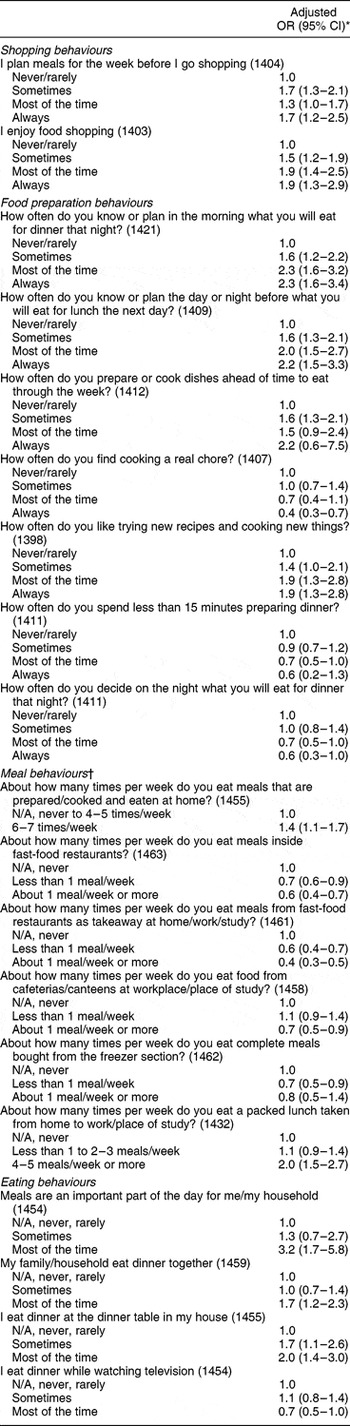
Adjusted OR (95% CI) for the likelihood of consuming two or more servings of fruit per day
OR – odds ratio; CI – confidence interval; N/A – not applicable.
* Logistic regressions controlling for women's age, educational status, marital status, presence of children and SEIFA score (Socio-Economic Index for Areas).
† Including breakfast, lunch and dinner.
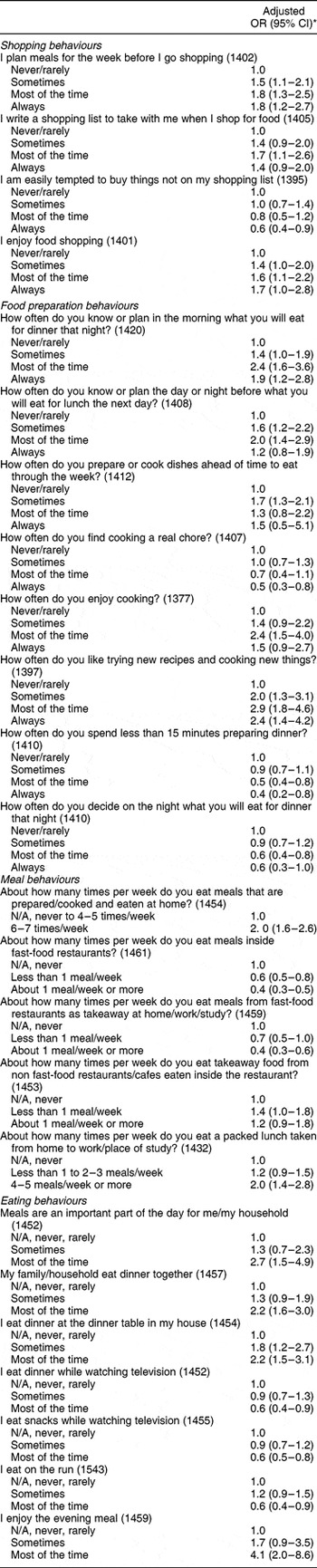
Adjusted OR (95% CI) for the likelihood of consuming two or more servings of vegetables per day
OR – odds ratio; CI – confidence interval; N/A – not applicable.
* Logistic regressions controlling for women's age, educational status, marital status, presence of children and SEIFA score (Socio-Economic Index for Areas).
Eating behaviours
Ten items were included that asked women about various aspects of their eating behaviours (e.g. how often they eat dinner at the dinner table, how often they eat on the run, etc.). A complete listing of the items is included in Table 1. The women were asked to indicate how often they engaged in each of the behaviours on a 5-point response scale: ‘never/rarely’; ‘sometimes’; ‘most of the time’; always'; ‘not applicable’. For the purpose of analysis, ‘never/rarely’ and ‘not applicable’ were combined.
Statistical analyses
Descriptive statistics were used to describe the sociodemographic profile of survey participants, their fruit and vegetable intakes, and the women's shopping, food preparation, meal and eating behaviours. Fruit intake was categorised into two categories: one or less servings per day and two or more servings per day. This is consistent with existing recommendations to the public regarding fruit intakeReference Smith, Kellett and Schmerlaib4. Similarly, vegetable intake was categorised as: one or less servings per day and two or more servings per day. This categorisation was based on the distribution of the data. Initially, cross-tabulations and the chi-square statistic were used to examine associations between the behavioural variables and fruit and vegetable intakes. For those variables that were found to be significantly associated with fruit or vegetable consumption, bivariate logistic regression analyses were performed to examine the likelihood of consuming two or more daily servings of fruit and two or more daily servings of vegetables. To account for potential confounding, these analyses were controlled for area-level SES, women's age, educational status (a measure of personal SES), marital status and the presence of children.
Results
Profile of participants
The initial dietary survey achieved a response rate of 50% (n = 1136), excluding from the denominator 127 women who had moved with no forwarding address or who were ineligible. The second phase of the study resulted in an additional 444 dietary surveys (42% of those completing the original physical activity surveys). The final sample comprised 1580 women (n = 511 from high-, 588 from mid- and 481 from low-SES neighbourhoods). Non-respondents to both surveys were more likely to live in low-SES neighbourhoods than mid- or high-SES neighbourhoods. One respondent in five was aged between 18 and 29 years, 27% were aged 30–39 years, 25% were aged 40–49 years and 28% were aged 50–65 years. Slightly less than 68% of the women were married, 12% were separated/divorced/widowed and 20% had never been married. In terms of their educational qualifications, 23% had up to 10 years of education, 40% had a trade qualification/certificate/completed 12 years of education and 37% were university-educated. The age distribution of the sample compares very favourably with census data31, while women who had not completed secondary school education tended to be under-represented (23% in the sample compared with 39% in the population)32.
Fruit and vegetable intakes
Few women (6%) reported they usually ate no servings of fruit each day, 24% ate one serving, 35% ate two servings, 23% ate three or four servings and 3% reported eating five or more servings per day. In terms of their vegetable consumption, 2% of the women reported they usually ate no servings each day, 29% ate one serving, 35% ate two servings, 29% ate three or four servings and 5% reported eating five or more servings per day.
Food-related behaviours and fruit and vegetable intakes
The women's responses to the questions regarding their shopping, food preparation, meal and eating behaviours are presented in Table 1. Those behavioural variables associated with fruit intake and with vegetable intake are presented in Tables 2 and 3, respectively.
Table 2 shows that, compared with women who never or rarely participated in each of the following behaviours, the likelihood of consuming two or more daily servings of fruit was higher for women who always planned meals for the week prior to shopping (odds ratio (OR) = 1.7), enjoyed food shopping (OR = 1.9), planned the evening meal in the morning (OR = 2.3), planned what they would eat for lunch on the following day (OR = 2.2), cooked dishes ahead of time (OR = 2.2) and liked trying new recipes (OR = 1.9) (Table 2). Compared with women who ate meals prepared at home at most four or five times a week, the likelihood of consuming two or more servings of fruit per day was 1.4 times higher among women who ate meals prepared at home six or seven times a week. Compared with women who never or rarely participated in each of the following behaviours, the likelihood of consuming two or more daily fruit servings was higher among women who always ate a packed lunch taken from home (OR = 2.0), considered meals an important part of their day for their family or household (OR = 3.2), ate dinner together as a family/household (OR = 1.7) and who always ate dinner at the dinner table (OR = 2.0).
Compared with women who never or rarely reported the following activity, the likelihood of eating two or more daily servings of fruit was lower in women who reported they always found cooking a chore (OR = 0.4), spent less than 15 minutes preparing dinner (OR = 0.6) and who decided on the night what they will eat for dinner (OR = 0.6). Compared with women who did not eat meals inside a fast-food restaurant, those who ate meals in a fast-food restaurant at least once per week were less likely (OR = 0.6) to consume two or more servings of fruit per day. Similarly, compared with women who did not participate in the following activity, the likelihood of meeting the fruit intake recommendations was lower in women who ate takeaway meals from a fast-food restaurant (OR = 0.4), ate foods from a cafeteria/canteen (OR = 0.7), ate complete meals bought from the freezer section of the supermarket (OR = 0.8) and who watched television while eating dinner (OR = 0.7).
Table 3 shows that, compared with women who never or rarely carried out the following activities, the likelihood of consuming two or more daily servings of vegetables was higher among women who more frequently planned meals before they went shopping (OR ranging from 1.5 to 1.8), wrote a shopping list (OR = 1.4–1.7), enjoyed food shopping (OR = 1.4–1.7), planned in the morning what they will eat for dinner that night (OR = 1.4–2.4), planned what they will eat for lunch (OR = 1.2–2.0), reported they enjoy cooking (OR = 1.4–2.4), liked trying new recipes (OR = 2.0–2.9) and who reported they sometimes prepare dishes ahead of time (OR = 1.3–1.7). Compared with women who ate meals prepared at home at most four or five times a week, the likelihood of consuming two or more servings of vegetables per day was two times higher among women who ate meals prepared at home six or seven times a week. Women who ate at a non fast-food restaurant (OR = 1.4), ate a packed lunch taken from home (OR = 2.0), saw meals as an important part of the day (OR = 2.7), saw eating dinner together as a household as important (OR = 2.7), ate at the dinner table (OR = 2.2) and who enjoyed the evening meal (OR = 4.1) were also more likely to eat two or more daily servings of vegetables compared with women who never or rarely participated in the activities.
Compared with women who never or rarely reported these activities, the likelihood of eating two or more servings of vegetables per day was lower in women who frequently were tempted to buy things not on their shopping list (OR = 0.6), found cooking to be a chore (OR = 0.5), spent less than 15 minutes preparing dinner (OR = 0.4), who decided on the night what they will eat for dinner (OR = 0.6), ate in a fast-food restaurant (OR 0.4), ate takeaway meals from a fast-food restaurant (OR = 0.4), ate dinner and snacks while watching television (OR = 0.6) and who ate on the run (OR = 0.6).
Discussion
This study aimed to examine relationships between food-related behaviours and fruit and vegetable intake among women. As other population studies have shown5–Reference Lang, Thane, Bolton-Smith and Jebb7, substantial proportions of those surveyed did not meet current dietary recommendations. About 40% of women ate less than two servings of fruit daily, and 95% ate less than the recommended minimum of five servings of vegetables daily. Given the known health benefits associated with regular consumption of fruits and vegetables, these findings attest to the need for nutritional programmes to promote intakes. Knowledge of the specific shopping, meal preparation, cooking and meal behaviours that are associated with higher intakes of fruit and vegetables may inform the development of practical health promotion strategies aimed at encouraging increased fruit and vegetable consumption.
The food-related behavioural predictors of both fruit and vegetable intakes observed in the present study are consistent with the limited literature in the areaReference Satia, Kristal, Patterson, Neuhouser and Trudeau20–Reference Horacek, White, Betts, Hoerr, Georgiou and Nitzke22. Our findings seem to reflect two key factors: greater attention paid to forward-planning and organising of food/meals (e.g. planning/making a list of food purchases before shopping; planning, cooking and packing meals ahead of time); and enjoyment of and high value placed on meal purchasing, preparation and eating (including eating together as a family, at the dinner table; choosing food prepared at home rather than outside the home). This study suggests there are some very practical strategies that could be encouraged in attempts to promote greater intakes of fruits and vegetables among women. Given these findings and the modest success of previous programmes aimed at promoting fruit and vegetable intakeReference Wilcox, Parra-Medina, Thompson-Robinson and Will23–Reference Sorensen, Linnan and Hunt25, the inclusion of food-related behavioural strategies would seem worthy of consideration.
A number of the food-related behaviours examined in this study were not widely practised among women. For instance, only around a third of the women in this sample reported that they always took a shopping list when grocery shopping, and only one in 10 always planned their weekly meals before shopping. Similarly, less than a third of the women took a packed lunch to their work or place of study most days, and only 6% mostly or always prepared dishes ahead of time to eat through the week. In terms of behaviours reflecting enjoyment and valuing of food preparation and meal times, only a third of the sample reported that their family/household always ate dinner together; only 11% reported enjoying trying new recipes and cooking new things; and only a quarter reported that they never or rarely found cooking to be a chore. Given the low prevalence of these food-related behaviours and values, and their associations with both fruit and vegetable intakes, nutrition interventions may benefit from promoting increased forward-planning and strategies for increasing enjoyment and perceived value in regards to meal choices, food shopping and meal preparation, cooking and eating.
The behavioural predictors of fruit intake and vegetable intake in this study were remarkably similar. This is a little surprising given that, in general, fruit does not require the same amount of preparation as vegetables, and is more often consumed as a snack than as part of a main course. The finding that many preparatory/meal-related behaviours were predictive of fruit intake, as well as vegetable intake, may suggest that these behaviours are a ‘marker’ for a broader characteristic that is associated with healthier eating generally. The robustness of the associations observed even after adjusting for education rules indicates that SES is unlikely to be an explanatory factor. Other possibilities are that the behavioural predictors in this study are markers of health consciousness generally, or of a greater perceived value of healthy eating. Future research could test these possibilities with inclusion of such measures and investigations of pathways by which such characteristics influence food-related behaviours and in turn dietary outcomes.
The cross-sectional design of this study limits conclusions about the temporal or causal nature of the findings. In addition, women's food-related behaviours and their associations with fruit and vegetable consumption may be different from those among men. However, the study used a large and diverse sample of women from a range of socio-economic backgrounds, and the power to adjust statistically for key potential confounders is a further strength. This study provides novel insights into specific food-related behaviours associated with two key indicators of a healthy diet – fruit and vegetable consumption. Findings suggest the importance of food-related behaviours reflecting organisation and forward-planning, as well as enjoyment and high perceived value, with regard to meal shopping, preparation and cooking and consumption. Practical behavioural strategies based on these general characteristics could be trialled in future intervention studies aimed at promoting fruit and vegetable consumption among women.
Acknowledgements
D.C. and K.B. are supported by Career Development Awards from the National Health and Medical Research Council/National Heart Foundation. J.S. and A.T. are supported by Public Health Research Fellowships from the Victorian Health Promotion Foundation. This study was supported by a grant from the National Heart Foundation. We would like to thank Anna Sztendur for expert technical assistance with data analysis and the preparation of this manuscript.



