


Over the last several decades, researchers have observed that Mexican Americans have paradoxically good health outcomes relative to their low socio-economic positions( Reference Markides and Coreil 1 ). This health advantage, which has been observed for all-cause mortality, cancer, CVD and several other chronic conditions, is strongest in the foreign-born and deteriorates as immigrants spend increased time in the USA( Reference Markides and Coreil 1 – Reference Sundquist and Winkleby 5 ). A common explanation is that acculturation, or exposure to and adoption of US culture, may have a negative effect on the health behaviours of immigrants and their offspring( Reference Palloni and Arias 4 , Reference Abraido-Lanza, Armbrister and Florez 6 , Reference Abraído-Lanza, Chao and Flórez 7 ).
The relationship between acculturation and diet has received particular attention, perhaps because obesity rates are even higher among Mexican Americans than the general US population( Reference Satia-Abouta 8 ). US-born and more-acculturated Mexican Americans consume fewer ‘traditionally Mexican’ food items (beans, tortillas, tortas, etc.) than their foreign-born and less-acculturated counterparts( Reference Batis, Hernandez-Barrera and Barquera 9 , Reference Winham and Florian 10 ). Studies have documented both healthy and unhealthy differences in diet, but the general consensus is that acculturation is associated with an overall decline in dietary quality( Reference Batis, Hernandez-Barrera and Barquera 9 , Reference Ayala, Baquero and Klinger 11 – Reference Perez-Escamilla and Putnik 16 ). For example, using bi-national data from the USA and Mexico, Batis et al. found that populations with greater exposure to the USA demonstrate decreased consumption of fruits and vegetables but increased consumption of several unhealthy foods and nutrients, including saturated fat, sugar, dessert and salty snacks, pizza and French fries( Reference Batis, Hernandez-Barrera and Barquera 9 ).
Several questions remain regarding how and why exposure to US culture affects Mexican Americans’ food behaviours. An important but understudied topic is whether food purchasing and preparation behaviours vary based on nativity, language use or other measures of exposure and adoption of US culture( Reference Satia-Abouta 8 , Reference Ayala, Mueller and Lopez-Madurga 17 , Reference Akresh 18 ). The few studies conducted in this area have focused primarily on consumption of fast foods and sugar-sweetened beverages, both of which increase with acculturation( Reference Ayala, Mueller and Lopez-Madurga 17 , Reference Kasirye, Walsh and Romano 19 , Reference Sharkey, Johnson and Dean 20 ). We agree with previous conceptualizations of the dietary acculturation process, which posit that acculturation can act through a number of psychosocial, structural and economic pathways that affect where people shop for food, what types of food they purchase and how their food is prepared( Reference Satia-Abouta 8 , Reference Ayala, Mueller and Lopez-Madurga 17 ). For example, recent immigrants may retain patterns of food behaviour established in their countries of origin, shop at different food outlets than their native-born counterparts, make different food choices in food stores and restaurants, or use more or less healthful preparation techniques. Language proficiency may also be an important determinant of food purchasing and preparation, because Spanish speakers might feel uncomfortable shopping at food outlets where English is dominant, have lower comprehension of food advertising, food packaging and nutrition labels, and have reduced exposure to other elements of US food culture. Understanding the relationship between acculturation and food purchasing and preparation is important because it may help explain variation in diet within the Mexican-American population as well as why obesity rates tend to increase within and across immigrant generations.
In the present study, we use data from Mexican-American adults who participated in the 2005–2010 National Health and Nutrition Examination Survey (NHANES) to assess the relationship between language use, nativity and food behaviours among Mexican-origin populations. Rather than focus exclusively on diet, we examine a broad range of food purchasing, preparation and consumption behaviours. We also examine whether any observed relationship between language use, nativity and food behaviours is explained by variation in educational attainment, socio-economic status and other sociodemographic characteristics. To understand psychosocial pathways through which exposure to US culture might affect the food behaviours of Mexican-origin populations, we examine reasons why participants prefer fast food to home meal preparation, as well as values that affect food choices in the supermarket.
Methods
Data source
Data for the current study are from public use data files of the 2005–2010 NHANES. Briefly, NHANES is a continuous series of annual studies that has been conducted since 1999 and is designed to assess the health and nutritional status of adults and children in the USA. NHANES uses a complex, multistage sampling design to obtain a sample representative of the non-institutionalized US population of all ages. Oversampling is used to produce sub-samples representative of national populations of children and adolescents, people living in low-income households and racial/ethnic minorities, including Mexican Americans.
NHANES includes both an in-person interview and a physical examination component. The interview contains demographic, dietary and health-related questions, while the examination includes medical, dental and physiological measurements taken by highly trained personnel. Participants also undergo two 24 h dietary recalls. In 2007, a Flexible Consumer Behavior Survey module was added to collect information on people's knowledge, attitudes and beliefs towards nutrition and food choices. Further details regarding the NHANES sampling strategy, study design and questionnaires are available elsewhere( 21 ).
Analytic sub-sample
In the present study we restrict our analyses to a sub-sample of 2792 Mexican-American adult participants in the 2005–2010 NHANES aged 20 years or older, including 1353 males and 1439 females. Of the 31 034 total participants in these years of the survey, we exclude 13 902 (45 %) because they were less than 20 years old and an additional 13 956 (45 %) because they did not self-identify as Mexican American. Of the remaining 3176 Mexican-American adults, we exclude 384 who lacked data regarding their marital status (n 2), education (n 8), income (n 369) or language use (n 5).
Measurements
Language use
We use participants’ language use as a proxy for adoption of US culture, based on a question that asks, ‘What language do you usually speak at home?’ Response options include: ‘only Spanish’, ‘more Spanish than English’, ‘both equally’, ‘more English than Spanish’ and ‘only English’.
Food purchasing, preparation and consumption
NHANES participants are asked about a wide range of food purchasing, preparation and consumption behaviours. In the present study, we examine the relationship between language use and the following food behaviours: (i) participants’ daily total energy intake, measured in kJ/d based on two 24 h dietary recalls; (ii) participants’ daily total energy intake from fast-food restaurants; (iii) the number of non-homemade and fast-food/pizza meals participants consumed in the previous week; (iv) the number of ready-to-eat (i.e. supermarket deli or pre-packaged) and frozen meals participants consumed in the previous 30 d; (v) the number of days that participants or another household member prepared dinner in the previous week; (vi) the number of minutes per day that participants or other household members spent to cook dinner and clean up; (vii) family spending on food in stores and restaurants in the previous 30 d (measured in $US); and (viii) values related to preference of fast food v. home meal preparation and food choices in supermarkets. To assess fast food values, participants are asked whether or not they prefer fast food v. cooking at home because it is cheaper, more nutritious, tastes better, is more convenient or allows them to socialize. To assess values related to food choice in supermarkets, participants are asked about the importance of the following characteristics when they choose between foods at the supermarket: price, nutrition, taste, ease of preparation and how well the food keeps. Response options include: ‘very important’, ‘somewhat important’, ‘not too important’ and ‘not at all important’.
Statistical analyses
We present the means and standard deviations of all continuous variables and percentage distributions of categorical variables. We use conditional means and cross-tabulation to assess whether food behaviour outcomes vary across language-use strata. We use t tests to assess the statistical significance of these relationships( 22 ). We use multivariate logistic regression to examine whether any observed relationship between language use and food behaviour outcomes is explained by differences in sociodemographic characteristics between English- and Spanish-speaking participants. We examine the following three outcomes using multivariate logistic regression: (i) whether participants ate any food from a fast-food or sit-down restaurant during either of two days assessed via two 24 h dietary recalls; (ii) whether participants and their family members prepare dinner seven days per week as opposed to six days per week or less; and (iii) whether participants consumed two or more meals prepared outside the home in the previous week. We dichotomize the latter two outcomes (i.e. dinner preparation and prepared meal consumption) because they are each highly skewed and violate the normality assumption of linear regression. In particular, 60 % of participants in our sample reported preparing dinners seven days per week and one-quarter reported consuming zero prepared meals in the previous week. The distribution was such that standard transformations (i.e. the square or square root, log transformation, etc.) did not result in normality.
We use multivariate linear regression to examine the following three outcomes: (i) the square root of restaurant dietary intake, measured in kJ/d, among participants who ate at a fast-food or sit-down restaurant during at least one of the two days measured via 24 h dietary recalls; (ii) the square root of expenditures on food in all stores during the previous month ($US); and (iii) the square root of expenditures on restaurant food in the previous month ($US). These outcomes are each right tailed and clearly violate the normality assumptions of linear regression; we use the square root to achieve a more normal distribution. For each outcome, we include an unadjusted model and a model adjusted for nativity, gender, age, marital status, educational attainment, family income and family size. For all analyses, we use sample weights included in the NHANES public use files that account for non-response, the complex design of the study and post-stratification( 23 ).
Results
In Table 1, we provide sociodemographic information regarding the 2792 Mexican-American adult participants in the 2005–2010 NHANES. Four in ten speak only Spanish in the home, 15 % speak more Spanish than English, 13 % speak both languages equally, 14 % speak more English than Spanish and 16 % speak only English. The sample is 47 % female and 53 % male, with a greater proportion of males in the Spanish-speaking strata (P = 0·013). Mean age is 40 years, with a relatively equal age distribution across language-use strata. Family size and the proportion of participants who are married each decrease with English language use, while educational attainment and family income increase (P < 0·001 for all outcomes).
Sociodemographic characteristics by language use among Mexican-origin adults in the 2005–2010 National Health and Nutrition Examination Survey (n 2792)

P values are based on χ 2 tests for categorical variables and F tests for continuous variables.
In Table 2, we present food purchasing, preparation and consumption behaviours by language use. Participants consume a mean of 8771 kJ/d from all sources, with 1146 kJ/d from fast-food restaurants and an additional 739 kJ/d from sit-down restaurants. Total energy consumption is higher among participants who speak mostly Spanish (P = 0·001) and mostly English (P < 0·001) than Spanish-only speakers. Spanish-only speakers consume an average of 779 kJ/d from fast food, compared with 1629 kJ/d among those who speak both languages (P < 0·001), 1749 kJ/d among mostly-English speakers (P < 0·001) and 1311 kJ/d among English-only speakers (P < 0·001). Similarly, Spanish-only speakers consume 461 kJ/d from other restaurants while every other group consumes over 800 kJ/d from these sources (P < 0·05 for all groups).
Food purchasing, preparation and consumption behaviours by language use among Mexican-origin adults in the National Health and Nutrition Examination Survey (NHANES)
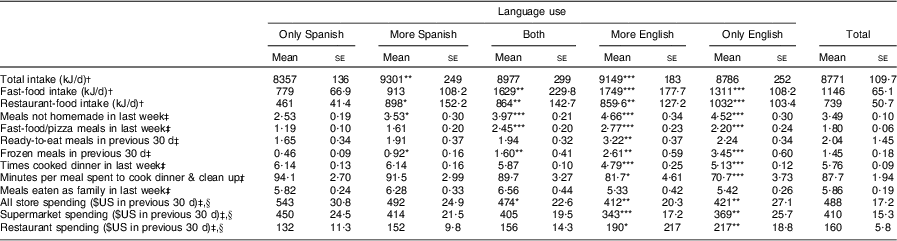
*P < 0·05; **P < 0·01; ***P < 0·001. Statistical significance is based on a t test and refers to the difference from the reference group, ‘Spanish only’ speakers.
†Mean daily intake is based on two 24 h dietary recalls. These data are from the 2005–2010 NHANES.
‡These data are from the 2007–2010 NHANES.
§‘All store spending’ includes spending at supermarkets, small grocery stores and other stores that sell food. ‘Restaurant spending’ includes dine-in and take-out food.
Data in Table 2 suggest that consumption of non-homemade meals, fast-food meals, ready-to-eat meals and frozen meals each increase with English language use. For example, Spanish-only participants consume a mean of 2·5 non-homemade meals in the previous week, compared with 4·7 among mostly-English speakers (P < 0·001) and 4·5 among English-only speakers (P < 0·001). Similarly, Spanish-only participants consume 1·2 fast-food and pizza meals in the previous week, compared with 2·8 and 2·2 among the mostly English and English only, respectively (P < 0·001 for both groups). Consumption of frozen meals, in particular, seems to increase with language use: Spanish-only participants consumed a mean of 0·5 frozen meals in the previous 30 d, compared with 2·6 among mostly-English speakers (P = 0·001) and 3·5 among English-only speakers (P < 0·001).
Frequency of dinner preparation and time spent to cook dinner and clean up both decrease with English language use. Participants who speak only Spanish cook dinner 6·1 times/week and spend 94 min/dinner cooking and cleaning up, compared with 5·1 dinners/week and 71 min/dinner among those who speak only English (P < 0·001 for both outcomes). There is no clear relationship between language use and the weekly number of meals families eat together. In the 30 d prior to the study, Spanish-only speakers spent more money than English-only speakers at all food stores ($US 543 v. $US 421; P = 0·001) and supermarkets ($US 450 v. $US 369; P = 0·004), but less at restaurants ($US 132 v. $US 217; P = 0·001).
Figure 1 includes a series of bar charts indicating reasons participants might prefer eating at fast-food restaurants v. cooking at home (top panel) and the perceived importance of food characteristics when choosing between items at the supermarket (bottom panel). The data do not reveal a clear relationship between language use and perceived importance of taste, nutrition or price as reasons participants prefer fast food to cooking at home. In contrast, 63 % of Spanish-only participants said that the ability to socialize was a very important reason they might prefer fast food over home cooked meals, compared with 45–47 % of participants who speak both languages, mostly English or only English. Furthermore, the data suggest a clear relationship between language use and the perceived importance of the convenience of fast food: half of Spanish-only participants cited convenience as a very important reason to prefer fast food, compared with 86 % of participants who speak mostly English or English only.
(colour online) Values related to fast-food purchasing (top panel) and food choices in supermarkets (bottom panel) by language use among Mexican-American adult participants in the 2007–2010 National Health and Nutrition Examination Survey. Values are percentages with their 95 % confidence intervals represented by vertical bars
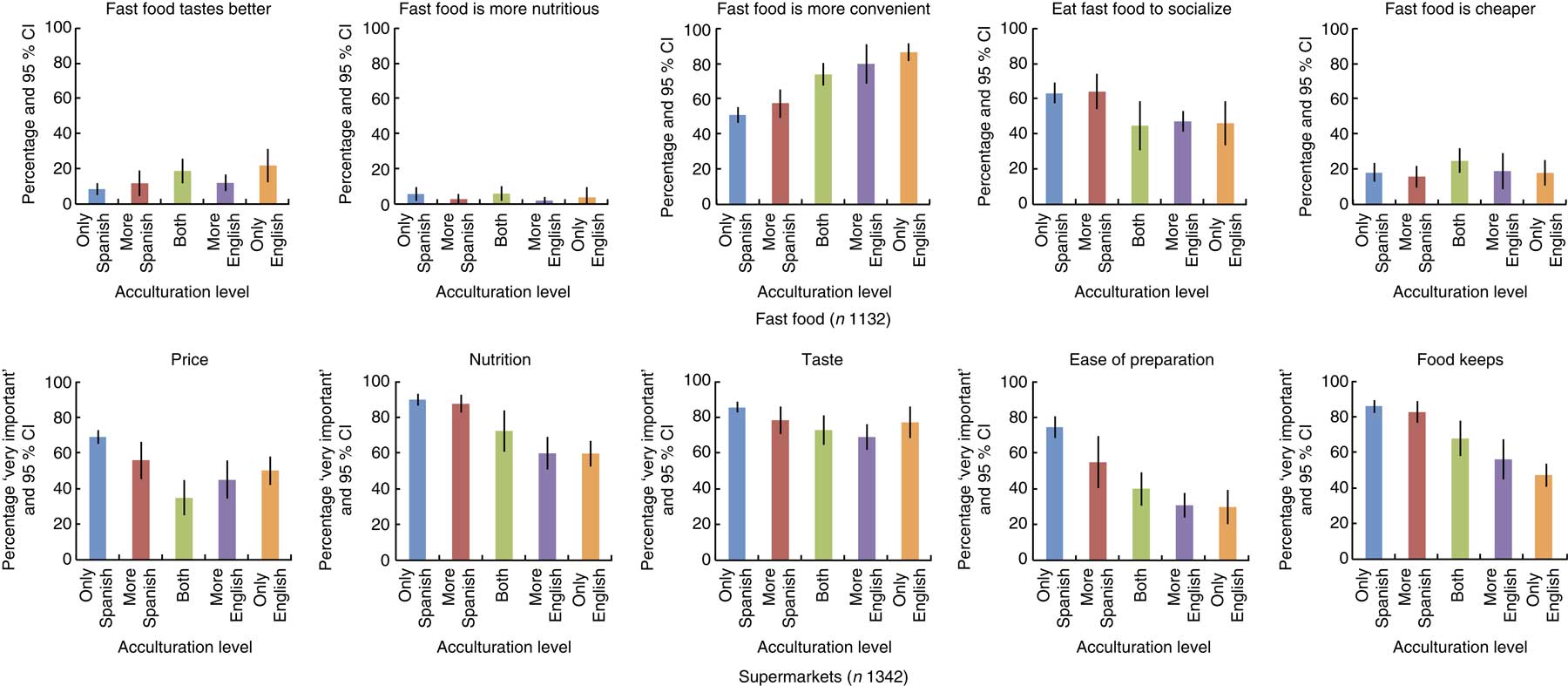
The data suggest that participants perceive taste to be very important when choosing between food items at the supermarket, regardless of language use. Spanish-speaking participants perceive every other perceived value to be more important than their more-acculturated counterparts. For example, about seven in ten participants who speak only Spanish perceive price as very important, compared with 45 % and 50 % of those who speak mostly English or only English, respectively. Nine in ten participants who speak mostly Spanish or only Spanish perceive nutrition as very important, compared with two-thirds of those who speak only English. Three in four Spanish-only participants perceive preparation ease as very important, compared with 30 % of those who speak mostly English or only English.
Table 3 displays the results of logistic regression models predicting the following: (i) whether participants ate any food from a fast-food or sit-down restaurant during either of two days assessed via two 24 h dietary recalls; (ii) whether participants and their family members prepare dinner seven days per week as opposed to six days per week or less; and (iii) whether participants consumed two or more meals prepared outside the home in the previous week. Unadjusted for other factors, English-only speakers had nearly three times the odds of eating at a restaurant as Spanish-only speakers. Adjustment for sociodemographic factors attenuates this relationship somewhat, but there are still large and significant differences across language-use strata. The adjusted model suggests that few other sociodemographic factors are associated with restaurant consumption among Mexican Americans, with the primary exception being a negative association with age (P < 0·001). Unadjusted for other factors, the odds of frequent dinner preparation are lower among English speakers. This relationship is attenuated by adjustment for sociodemographic factors, but Spanish-only participants still have significantly greater odds of being ‘frequent’ dinner preparers relative to their mostly-English (P < 0·01) and only-English (P < 0·05) counterparts. The foreign-born also have greater odds of being frequent dinner preparers (adjusted OR = 1·4; P < 0·05), which is important since most Spanish-speaking participants are also foreign-born. Our regression models predicting frequent consumption of prepared meals reveal a similar pattern relative to the two previous food behaviour outcomes: unadjusted for other factors, English-speaking participants are significantly more likely to frequently consume prepared foods. This relationship is somewhat attenuated by adjustment for sociodemographic factors, but significant differences remain between English speakers and Spanish speakers.
Unadjusted and adjusted logistic regression models predicting food behaviours among Mexican-origin adults in the National Health and Nutrition Examination Survey (NHANES)
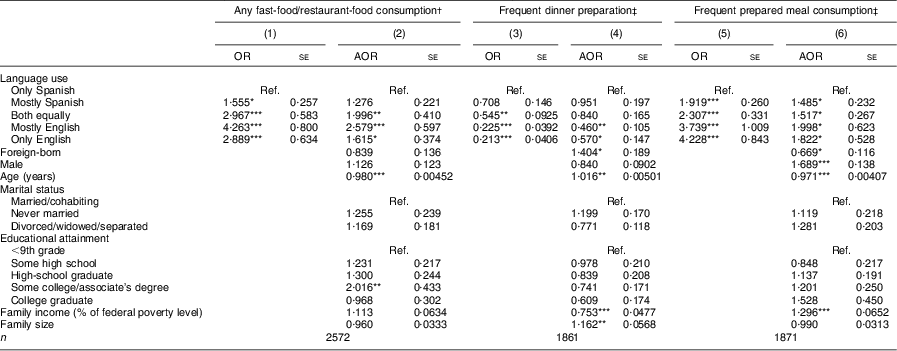
AOR, adjusted odds ratio; Ref., reference category.
‘Any fast-food/restaurant-food consumption’ defined as any food item during either of two days measured via 24 h dietary recalls. ‘Frequent dinner preparation’ defined as having prepared seven dinners in the previous week. ‘Frequent prepared meal consumption’ defined as two or more meals prepared outside the home in the previous week.
*P < 0·05, **P < 0·01, ***P < 0·001.
†These data are from the 2005–2010 NHANES.
‡These data are from the 2007–2010 NHANES.
In Table 4, we present three sets of linear regression models. The first set of models predicts the square root of energy intake from restaurants (kJ/d) among participants who ate at a fast-food or sit-down restaurant during at least one of the two days measured via 24 h dietary recalls. Unadjusted for other factors, participants who speak Spanish and English equally, mostly English or only English consume more energy at restaurants than participants who speak Spanish only (P < 0·05 in all cases). This relationship is greatly reduced and all point estimates become insignificant after adjustment for sociodemographic factors. The adjusted model suggests that the foreign-born consume less energy at restaurants than the US-born (P < 0·01). The second set of models in Table 4 indicates that, unadjusted for other factors, food expenditures at supermarkets and other stores are negatively associated with English language use. This relationship is attenuated by adjustment for sociodemographic factors, but spending is still significantly greater among participants who speak English and Spanish equally (P < 0·01) and mostly English (P < 0·01) relative to those who speak Spanish only. The foreign-born have significantly greater food expenditures (P < 0·05), which amplifies the difference between Spanish speakers, who are predominantly foreign-born, and English speakers, who are predominantly US-born. The final set of models suggests that, without adjustment for other factors, English speakers spend more money at restaurants than Spanish speakers. This relationship is explained by sociodemographic differences between language-use strata. Younger age, greater family income and larger family size are positively associated with restaurant expenditures.
Unadjusted and adjusted linear regression models predicting food behaviours among Mexican-origin adults in the National Health and Nutrition Examination Survey (NHANES)
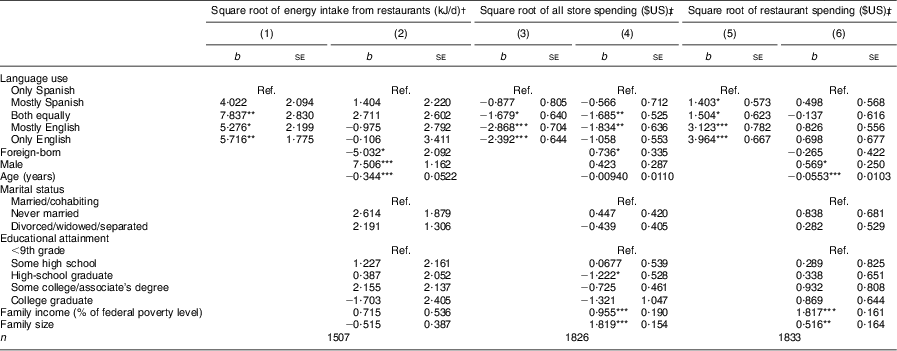
Ref., reference category.
‘Energy intake from restaurants’ includes only participants who reported eating at a fast-food or sit-down restaurant during either of two days measured via 24 h dietary recalls. ‘All store spending’ includes spending at supermarkets, small grocery stores and other stores that sell food in the previous 30 d. ‘Restaurant spending’ includes dine-in and take-out food in the previous 30 d.
*P < 0·05, **P < 0·01, ***P < 0·001.
†These data are from the 2005–2010 NHANES.
‡These data are from the 2007–2010 NHANES.
Discussion
We believe that the present study has provided new insight into the relationship between language use and food behaviours among the Mexican-origin population in the USA. Previous research has documented differences between more- and less-acculturated Latinos in consumption of specific foods and nutrients, as well as found increased purchasing and consumption of fast food among the more acculturated( Reference Batis, Hernandez-Barrera and Barquera 9 , Reference Ayala, Baquero and Klinger 11 – Reference Ayala, Mueller and Lopez-Madurga 17 , Reference Kasirye, Walsh and Romano 19 ). Consistent with this research, we found that purchasing and consumption of fast food and other restaurant food increased with English language use( Reference Ayala, Mueller and Lopez-Madurga 17 , Reference Kasirye, Walsh and Romano 19 ). We also found that increased reliance on restaurant food is part of a larger pattern characterized by less frequent home meal preparation and increased reliance on convenience foods among English speakers. English speakers spend more money at restaurants, less money at grocery stores and supermarkets, and consume more non-homemade meals of all types, including fast-food and pizza meals, frozen meals and ready-to-eat meals. These findings are troubling from a public health perspective because a wide body of research has documented that homemade meals tend to be more healthful than prepared foods( Reference Guthrie, Lin and Frazao 24 – Reference Lin, Guthrie and Frazao 27 ).
Our data also suggest that food values vary based on participants’ language use. In particular, English speakers were much more likely than Spanish speakers to report that convenience is a very important reason why they prefer fast food to cooking at home. This suggests that the relationship between language use and diet might be caused by differences not only in tastes and preferences, but also in motivation, time, ability or commitment to preparing meals at home. Furthermore, Spanish-speaking participants placed greater importance on price, nutrition, ease of preparation and how well foods keep when choosing between items at the grocery store or supermarket. This may suggest that, relative to their more-acculturated counterparts, Spanish speakers are more deliberate about what foods they purchase in order to stretch their food budgets, provide good nutrition to themselves and their families, and reduce the burden of home meal preparation. The relatively higher importance placed on food price, in particular, likely reflects the fact that native-born and English-speaking Latinos tend to have high incomes and presumably can spend more money on food( Reference Bowman and Vinyard 26 ).
Importantly, we also found that at least some of the differences in food behaviours between English speakers and Spanish speakers are explained by differences in sociodemographic characteristics. In particular, large and significant differences across language-use strata in energy intake from restaurants and restaurant food expenditures were completely explained by sociodemographics. Differences between English- and Spanish speakers in the other food behaviours were attenuated by adjustment for sociodemographics, although significant differences persisted. Relative to English-speaking Mexican Americans and most other US sub-populations, Spanish speakers are more likely to be foreign-born, male, have larger families and have lower levels of income and education. Many of these characteristics affect food behaviours and other health outcomes, and can be thought of as the underlying cause of much of the difference between English- and Spanish speakers. Still, the fact that many differences in food behaviours were unexplained by sociodemographic factors suggests that immigrants and their offspring may be able to adapt to the US context while still maintaining some of the healthier food behaviours practised in Mexico.
We feel it is important to note that our study is based on the Mexican-American adult population in the USA during a specific time period, between 2005 and 2010, and that duration since migration is relatively high among immigrants in the sample (i.e. over 60 % report time in the USA of ≥10 years). Obesity and other diet-related chronic diseases have increased dramatically in Mexico, especially over the last decade, representing an enormous health and economic burden on the country( Reference Zallman, Himmelstein and Woolhandler 28 ). Many of our participants migrated prior to these secular increases and, like the majority of Mexican immigrants, originated from rural contexts and low socio-economic strata where obesity rates were low compared with the rest of the country( Reference Olaiz-Fernández, Rivera-Dommarco and Shamah-Levy 29 , Reference Riosmena and Massey 30 ). As Mexico continues to undergo economic development and urbanization, unhealthy food behaviours and diet-related chronic diseases may continue to increase. As a result of these trends, the ‘health advantage’ of Mexican immigrants may be less pronounced in recent and future waves of immigrants than among the longer-tenured immigrants we observed in our study. As a result, the relationships we observed may change as immigrants arrive to the USA with less healthy behaviours.
The present study has a number of important limitations and strengths. NHANES data are cross-sectional, making it impossible to determine causality in the relationship between language use and food behaviours. Self-selection among Mexican Americans who chose to participate in NHANES also represents a potentially serious limitation of our study. In particular, undocumented immigrants are difficult to reach in survey research and have high refusal rates. Since undocumented immigrants represent a relatively large proportion of the foreign-born Mexican-American population, self-selection based on legal status could be a serious source of bias in our results. We posit that refusal rates among undocumented immigrants are likely similar between NHANES and other household surveys, since legal status is not among the inclusion criteria of the study. NHANES does not collect data regarding the legal status of participants, making the potential for this type of selection bias difficult to assess.
We used measures of language use and nativity to assess whether exposure to and adoption of US culture affects food behaviours, but these measures may be flawed. Previous research has established that acculturation is both a multidimensional and multidirectional process, whereby immigrants and their offspring can adopt the cultural patterns, practices and beliefs of their host country, retain cultural elements from their country of origin, or become multicultural( Reference Marin and Gamba 31 ). Furthermore, immigrants and their offspring can undergo changes in one dimension of the acculturative process (e.g. language use) but remain unchanged with regard to other dimensions (e.g. cultural beliefs). We believe it is possible and likely that dimensions of the acculturative process other than language use could affect the food behaviours of Mexican-origin populations, but this is impossible to assess given the limitations of the NHANES data. Of note, NHANES also includes the time participants spent in the USA, which could be considered a good proxy for immigrants’ exposure to US culture. As a sensitivity analysis, we used multivariate regression analyses (similar to those in Tables 3 and 4) to examine whether immigrants with varying time in the USA differed with regard to food behaviour outcomes. We found that the ‘nativity effect’ was generally the same regardless of time spent in the USA and did not explain the relationship between language use and food behaviours. For the sake of parsimony and to more clearly communicate the difference between US- and foreign-born participants, we chose not to include time spent in the USA in our final models. Similarly, the acculturation construct may be better measured with a multidimensional scale assessing friendship ties, media use, ethnic self-identification, and ethno-cultural attitudes, beliefs and practices, but this type of multidimensional scale is unavailable in NHANES( Reference Marin and Gamba 31 , Reference Cuellar, Arnold and Maldonado 32 ).
These limitations notwithstanding, we believe our study has important strengths and makes significant contributions to the existing literature in this field. Rather than focusing narrowly on the relationship between acculturation and diet, we have examined a broad set of food behaviours that ultimately determine what people eat. We believe this approach is a strength of our study, because behaviours such as where people shop for food, what they purchase, and if and how they prepare it are modifiable behaviours that can be targeted with interventions. This broad approach was greatly facilitated by our use of the NHANES data set, which contains a wealth of information regarding food purchasing, preparation and consumption. The NHANES data allowed us to examine novel aspects of Mexican Americans’ food behaviours, particularly those related to food purchasing and preparation as well as food-related values. Another important strength is that NHANES oversamples among minority populations, which allowed us to study a large, representative sub-sample of the Mexican-American population.
Conclusion
In conclusion, the main finding of the present study is that the previously observed relationship between exposure to US culture and diet may be indicative of a larger pattern characterized by decreased home meal preparation in more-acculturated populations and increased reliance on convenience foods( Reference Batis, Hernandez-Barrera and Barquera 9 , Reference Ayala, Baquero and Klinger 11 , Reference Ayala, Mueller and Lopez-Madurga 17 ). Our findings suggest that interventionists should concentrate on promoting home meal preparation or improving the nutritional quality of prepared, packaged and other convenience foods purchased by Mexican Americans. The latter strategy might include increasing the breadth, depth, quality, taste, prices and advertising of prepared healthy foods available in food outlets where Mexican Americans shop. This might be particularly effective because it would avoid the need to reduce consumption of convenience foods, but still allow for a range of healthy choices.
Acknowledgements
Sources of funding: This study was funded by the National Heart, Lung, and Blood Institute (grant numbers P50HL105188 and F31HL116109). The National Heart, Lung, and Blood Institute had no role in the design, analysis or writing of this article. Conflict of interest: None. Authors’ contributions: B.A.L. conceptualized the study, conducted the statistical analysis and wrote the manuscript. R.B. assisted with the conceptualization and analyses and provided revisions for the manuscript. M.C.W. and D.G. assisted with the conceptualization and provided revisions for the manuscript. Ethics statement: The current study does not meet the definition of human subjects research, since our analyses were based on previously collected data without personally identifying information. Acknowledgements: The authors thank Anne Pebley and Jennie Brand for their substantial contributions to the conceptualization of this manuscript.



