


Introduction
The construction sector has been known for its inferior labour standards, despite its contribution to economic development and employment. Accompanied by the rise of neoliberal globalisation, the industry’s employment regime has been restructured, leading to deteriorating wage levels, working hours, social security coverage, vocational training opportunities and occupational health and safety (OHS) (ILO 2001, 2015; Toner Reference Toner2006). The subcontractor system’s dissemination, dominated by small-scale companies (Lew et al Reference Lew, Lai, Toh, Tan, Felicia and Yow2020; Bryan et al Reference Bryan, Rafferty, Toner and Wright2017), contributed to the spread of temporary and unregistered work and the rise in fatality rates (ILO 2001, 2005a).
Working standards in the construction industry have been shaped by two alternative paths: high-road (high skill-high wage) and low-road (low skill-low wage) (Bosch and Philips Reference Bosch and Philips2003). In high-road countries (e.g., the Netherlands, Canada, Germany and Denmark), the sector exhibits a capital-intensive characteristic; employees have education and career opportunities; workers and firms must comply with specific quality standards; and a stable workforce committed to the industry is ensured. In contrast, in low-road countries (e.g., in South Korea, the United Kingdom, the United States, Australia and Spain), the industry is encouraged by price and wage competition and with a labour-intensive characteristic, it has difficulties in internalising new technologies and developing modern forms of organisation, endangering long-term progress based on quality, productivity and innovation (Bosch and Philips Reference Bosch and Philips2003). The low-road path coincides with a segmented labour market in construction, where lower work standards are often applied to secondary jobs that are mainly associated with temporary job contracts, informal employment and targeting of workers from distinct groups based, for example, on immigration status, ethnicity, gender or the subcontractor role (ILO n.d.).
While the construction industry has played a big role in socio-economic development and job creation in Türkiye (Ercan and Gültekin-Karakaş Reference Ercan and Gültekin-Karakaş2015; Günlük-Şenesen et al Reference Günlük-Şenesen, Kaya and Şenesen2013; Uzunkaya, Reference Uzunkaya2013), it has been following a low-road path. The sector has been subject to intense criticism due to difficult working conditions and widespread work accidents, while quality, safety and planning parameters are ignored within the subcontractor system (Gürcanlı and Müngen Reference Gürcanlı and Müngen2013; Sümer Reference Sümer2014; Turkish Ministry of Development 2014; Yılmaz Reference Yılmaz2015; Yıldırım et al 2022). The sector occupies first place (38%) in total work-place-related fatalities (TurkStat 2018).
Competition based on cheap labour, characterised by the prevalence of temporary employment, economic hardships, work accidents and a lack of vocational training, forms an obstacle to improving quality and value added (Ercan Reference Ercan2010; Uzunkaya Reference Uzunkaya2013). Poor construction quality caused thousands of deaths during the many earthquakes that Türkiye has experienced over the past two decades. In February 2023, two devastating earthquakes affected 11 provinces (covering 16% of Türkiye’s population), resulting in significant loss of life and property. Researchers attributed the damage in these earthquakes to the use of substandard material and low workmanship quality, deficient detailing, insufficient inspection processes, non-compliance with building codes and inadequate seismic reinforcement (Caglar et al Reference Caglar, Vural, Kirtel, Saribiyik and Sumer2023; Yakut et al Reference Yakut, Sucuoğlu and Binici2022), pointed to an urgent need for vigilant supervision by structural engineers and the employment of well-trained personnel during construction (Caglar et al Reference Caglar, Vural, Kirtel, Saribiyik and Sumer2023).
This study evaluates the state of labour standards in Türkiye’s construction sector through the lens of segmentation theory. We examine whether the labour market is segmented into sub-markets by following a multidimensional approach, where we provide a comparative analysis of wages and working conditions for worker groups based on characteristics of age, education level, occupation, gender, immigration status and workplace size. For this purpose, we use the Turkish Statistical Institute’s (TurkStat) Household Labour Force Survey (HLFS) data for the years 2002–2020 and apply statistical and regression analyses.
The study makes a significant contribution to the literature by providing a multi-dimensional empirical examination of labour market segmentation in the Turkish construction sector, highlighting the nuances of experiences among various worker demographics and unique factors specific to a developing country context. A deeper understanding of industry-specific dynamics is crucial to effectively addressing labour market inequalities as segmentation manifests differently across various sectors (Eurofound 2019). Hence, this study’s specific focus on the construction sector reveals unique insights for developing customised policies to enhance labour standards in the Turkish construction industry. Our findings will inform policymakers not only in Türkiye but also in countries with similar labour market practices about the development of targeted policies to establish adequate working standards. By providing empirical evidence and policy recommendations, this study adds a valuable perspective to the discussions on how to tackle labour market challenges in economies characterised by significant segmentation.
A review of working conditions for construction employees
The nature of construction production paves the way for inferior labour standards, especially in the absence of preventative legal and institutional frameworks or an effective enforcement of these. In project-based construction, the constant relocation of workers, materials and equipment makes work coordination difficult, hence temporary employment is common (Debrah and Ofori Reference Debrah and Ofori2001; Lingard Reference Lingard2013). In addition to work site dangers, construction is a highly volatile and risky activity because of the turbulence in demand due to business cycles. Multi-layered subcontracting has become prevalent to share and shift the risks in a system in which specialty small firms are integrated with general contractors and project owners in finishing a project (Bosch and Philips Reference Bosch and Philips2003). The widespread implementation of the subcontracting system normalises the employment of non-unionised, insecure, low-paid workers who are deprived of vocational training and, hence, high-skilled job opportunities (Byrne et al Reference Byrne, Clarke and Van Der Meer2005). The industry is placed at the top in occupational accident rankings and labour rights violations due to the lack of a clear understanding of which employer (main or sub-contractor) will provide OHS and the intense working pressure on subcontractors in the payment-by-result system (Azari-Rad et al Reference Azari-Rad, Philips and Thompson-Dawson2003; Mayhew and Quinlan Reference Mayhew and Quinlan1997; Mustchin Reference Mustchin2014; Valluru et al Reference Valluru, Dekker and Rae2017; Wong and So Reference Wong and So2002). Inadequate site inspections and lax enforcement of regulations compel construction workers to endure unsafe working conditions (ILO 2001, 2015); legal minimum wage, working time, overtime wage, paid vacation leave and social security rights are violated (ILO 2005b). Discrimination against immigrants, minorities, and women increases job and social insecurity, and OHS negligence (Buckley et al Reference Buckley, Zendel, Biggar, Frederiksen and Wells2016; Debrah and Ofori Reference Debrah and Ofori2001; Pattanaik Reference Pattanaik2009; Tutt et al Reference Tutt, Pink, Dainty and Gibb2013; Underhill and Quinlan Reference Underhill and Quinlan2011; Wells Reference Wells1996; Yea Reference Yea2015).
Construction is characterised by segmented labour markets where some workers are forced to work in secondary jobs, with undesirable conditions. Based on the premise that labour market segmentation is not only due to differences in worker productivity but also linked to contractual arrangements and institutional features (Eurofound 2019), segmentation theory provides insights into inter-employer wage differences and employment patterns (Dickens and Lang Reference Dickens and Lang1992). Doeringer and Piore’s dual labour market theory (Reference Doeringer and Piore1971) distinguishes between a primary market, characterised by high wages, favourable working conditions, job stability, advancement opportunities, equity and fair work rules; and a secondary market, which typically features low wages, limited benefits, poor working conditions, high labour turnover, minimal chances of advancement and arbitrary supervision. Segmentation is observed in the construction labour markets by reliance on migrant workers in India (Singh Reference Singh2016), immigrant workers in Malaysia (Abdul-Aziz Reference Abdul-Aziz2001), informal employment in Indonesia (Pribadi and Chan Reference Pribadi, Chan, Pribadi and Chan2022) and both union and non-union contractors in the United States (Philips Reference Philips, Bosch and Philips2003).
The Turkish construction labour market is notable for it segmented structure, which exhibits a dual characteristic between large and small firms, local and immigrant workers, as well as low-educated/unskilled and highly educated/qualified workers (Karaalp-Orhan and Aksoylu Reference Karaalp-Orhan and Aksoylu2018; Şenel Reference Şenel2019; Temel and Topateş Reference Temel and Topateş2023). In the Turkish construction industry, subcontracting is dominant, resulting in extensive unregistered, insecure, and non-unionised employment. This practice is associated with insufficient on-site facilities and temporary positions that lack overtime pay, vacation and leave benefits, particularly in smaller firms (Karaalp-Orhan and Aksoylu Reference Karaalp-Orhan and Aksoylu2018). Micro- and small-scale enterprises (<49 employees), which represented 97% of construction employment in 2017 (Güllüoğlu and Güllüoğlu Reference Güllüoğlu and Güllüoğlu2019), contribute to the high accident probability and low building quality (Bilim and Çelik Reference Bilim and Çelik2018) within the subcontractor system (Yılmaz Reference Yılmaz2016). Cost-driven competition between subcontractors for large companies leads to a ‘race to the bottom’ in wages and OHS issues.
The unionisation rate in the sector is the lowest in the economy: as of January 2024, it is 3.4% (3.1% of it is in the public sector), corresponding to around 56,000 workers (Aydın and Baştürk Reference Aydın and Baştürk2024). Non-unionisation is mainly due to the extensive unregistered employment (Erikli Reference Erikli2018) of seasonal, immigrant, and self-employed workers under temporary conditions. In the private construction sector, labour is more transient and diverse, with migrant and temporary employees unaware of unions, not viewing construction as a career job, or lacking the resources to join a union. Additionally, private construction firms often oppose unionisation to minimise labour costs and avoid disruptions from strikes.
Furthermore, Türkiye hosts the highest number of refugees globally (3.47 million in 2023 (UNHCR 2024)). The rising use of immigrant employment in many sectors, including construction, further worsens labour standards and limits local job opportunities (Çınar Reference Çınar2018; Kara and Kurtulmuş Reference Kara and Kurtulmuş2015; Şahin Reference Şahin2014; Şenel Reference Şenel2019). Field studies showed that Syrian and Afghan construction workers often face challenges, including informal employment, low wages, long hours, job insecurity, discrimination, isolated living, and exclusion (Temel and Topateş Reference Temel and Topateş2023; Yıldırım et al Reference Yıldırım, Altunoğlu and Geyik Yıldırım2023).
Besides, individuals with lower education and skills often find themselves exposed to non-standard work arrangements, concentrating on hazardous jobs while facing financial and communication challenges. These factors limit their ability to organise for self-protection. Immigrant workers, illiterate individuals and part-time workers are more likely to engage in informal construction work, resulting in lower income (Şenel Reference Şenel2019).
This study sheds light on labour market inequalities in the construction industry, which is susceptible to precarious employment due to the temporary and project-based work structure. The Turkish construction sector presents a complex landscape of labour standards issues that necessitates a comprehensive approach to address them effectively. Existing research on the segmented structure of the Turkish construction labour market has predominantly focused on limited dimensions and sample sizes, and has mainly used qualitative methods, such as interviewing with immigrant workers in Manisa (Temel and Topateş Reference Temel and Topateş2023), workers of large firms and subcontractor firms in Ankara (Karaalp-Orhan and Aksoylu Reference Karaalp-Orhan and Aksoylu2018), and workers and employers regarding unregistered work in Denizli province (Şenel Reference Şenel2019). This study aims to delve into the interconnected labour standards challenges faced by construction workers at various levels with a comprehensive empirical analysis, covering the whole country. Drawing from the literature, we examine the trends in work conditions and wage levels among distinct sub-categories of construction workers to shed light on the labour market segmentation. Accordingly, our research questions are listed below:
-
1. Is there labour segmentation in the Turkish construction sector?
-
2. How does labour segmentation manifest itself regarding work conditions and wages?
Data and methodology
Based on the study’s research questions, we formulate and test the following research hypotheses:
H1 There is labour segmentation in the construction sector.
H2 Segmentation in the construction labour market disadvantages sub-groups of workers in terms of payment.
H3 Segmentation in the construction labour market disadvantages sub-groups of workers in terms of work standards.
While payment is measured by real net monthly wages, we measure work standards by job type and conditions (i.e. permanent versus temporary employment) and social security status. We use TurkStat’s HLFS data for the years 2002–2020, the most recent available period at the time of writing. Our sample is limited to working age individuals (i.e., aged 15–64).
Our conclusions are derived from applying the following empirical approaches, each complementing the results of the other: (1) through descriptive statistical analysis, we explore segmentation among construction workers based on age, education level, occupation, workplace size and immigration status, with a focus on work standards and wages; (2) we reveal the trends on the roles of selected key indicators in wage determination in the construction sector through estimation of Ordinary Least Squares (OLS) regressions; (3) we estimate construction workers’ allocation to permanent and temporary employment by estimation of logit regressions for each year; (4) we estimate the likelihood of having social security by logit regressions estimated for each year. While the statistical analyses presented under the first approach aid us in exploring H1, wage regression results supported by descriptive statistics are used to test H2. Logit regressions for job type and social security, again supported by descriptive statistics, are used for H3.
Results on the labour segmentation of the construction sector
A portrait of construction workers in Türkiye
This section provides a portrait of construction workers in Türkiye.
-
In 2020, 76% of construction workers were between 20 and 49 years old. The average age has risen since 2009, driven by declining interest among younger individuals (with an increasing share of those aged 40+ from 37% to 47%).
-
The share of labour born abroad (as a proxy for immigrant construction workers) rose from 0.85% when the Syrian war started in 2011 to 2.08% in 2020.
-
Despite a declining share of primary school graduates (36% in 2020), the majority (68%) of construction workers still have less education than high school graduates.
-
The bulk of construction workers (53% of 1.5 million employees in 2020) are in crafts, followed by those in jobs not requiring qualifications (elementary occupations, 22%).
-
The proportion of regular employees increased (51% in 2020) in contrast to casual employees (33%). However, casual working is substantially more pervasive in construction than in other sectors (33% versus 4% in 2020), with a lower rate of regular employees (51% versus 63%). 43% of all construction workers lack regular income.
-
The construction workforce is predominantly male, with women comprising only 4%. In 2020, 48% of female construction workers had college-level or higher education, followed by primary school education or lower (21%). Educated women mostly held managerial/professional roles (66%) and clerical and sales positions (34%). Women worked fewer hours per week than men (43.4 vis-à-vis 45.9 hours), yet earned a higher monthly net real wage (₺1,105 vis-à-vis ₺711 in 2010 prices). A substantial majority of female workers (93%) held registered employment, surpassing the sector average (64%). Moreover, women demonstrated higher job stability (95%), a notable contrast to the sector’s average (47%). The findings highlight that, despite being a minority in the construction industry, women exhibited favourable conditions concerning wages and employment stability compared to men. That is probably because female construction employees are highly educated and predominantly occupy better-paid managerial, professional and office positions.
In what follows, we analyse the segmentation within the construction labour market, considering factors of age, education, occupation, firm size and immigrant status.
Segmentation based on wages
The payment of construction workers over the period corroborates the segmented labour market hypothesis. In 2020, the minimum nominal net wage was ₺2324 in Türkiye (the average Turkish Lira (TRY) to US Dollar exchange rate was 1 TRY (₺) = 0.1438 USD). At that year, the lowest nominal net wages were observed for the youngest (15–19 age: ₺1192; 20–24 age: ₺1676) and oldest construction workers (50–54 age: ₺1770; 55–59 age: ₺1612; 60–64 age: ₺1694). Wages for regular or casual workers were at their lowest for individuals with no degree (₺1272), followed by those with a primary school education or less (₺1542) and those with a secondary school education or less (₺1577). Workers with tertiary education received the highest wage (₺3697). Wages were the lowest for elementary (₺1249) and craft (₺1614) workers and the highest for managers (₺4346). The earnings for immigrants (considering only regular and casual employees) were less (₺1373) compared to those for individuals born in Türkiye (₺1885). Additionally, wages were consistently the lowest in workplaces with fewer than ten employees (₺1345) compared to ₺2433 and ₺3103 earned by workers in workplaces with 11–49 and 50+ employees, respectively.
To observe the changes over time, we estimate yearly wage regressions for construction workers in the effect of human capital and demographic characteristics. The dependent variable is chosen to be the logarithm of the monthly net wage because of the issues in calculating hourly wages due to high seasonality and irregular work patterns in the construction industry. The regression estimations include only wage earners aged 15–64, excluding employers, self-employed and unpaid family workers from the sample. In the HLFS data, rural–urban residence information is available for 2002–2013 and unavailable for 2014–2017. Again, the region of residence and permanent or temporary employment data are available between 2004 and 2017. Therefore, regressions were first estimated using common variables in the 2002–2020 period. These regressions included the following explanatory variables: gender, age, education level, marital status, occupation, social security status and average weekly working hours. All variables (apart from weekly hours) are included as dummies. The second set of estimations expands this model by adding the following dummy variables for years where the information is available: job type (permanent or temporary), rural-urban residence, and 26 regional dummies based on the European Union’s Nomenclature of Territorial Units for Statistics at level two (NUTS-2). This latter set was estimated for the 2004–2020 period. In this article, we present and discuss the extended second set, as it allows us to control for more variables in the wage estimations. We found no notable difference between the two sets with respect to the estimates for common explanatory variables (see online Appendix 1 for the second set of wage estimations; the results for the first set are available upon request).
The estimation results confirm that the wage gap increases as the education level rises. College and higher education graduates have the largest wage gap (earning 34% higher than illiterates in 2020).Footnote 1 We find that women earn lower wages than men after controlling for human capital and other demographic characteristics. The estimated gender wage gap during the 2004–2019 period ranges from 9% to 21%, with a median value of 12.9% in the last 10 years. While the wage gap is found to be statistically insignificant in 2020, the persistent pattern in the prior years implies the existence of gender inequality in payment. Updated data is needed for further comprehensive analysis.
Lower wages were observed in all occupations compared to legislators, senior managers, and managers (the base category). Unqualified (elementary) construction workers face the highest disadvantage, with 53% lower wages in 2020. Additionally, workers in all other categories (except professionals and associate professionals) earn approximately half of the wages earned by the base category, placing them in a similar position to those in elementary occupations.
Construction workers without social security earn, on average, less than those with social security coverage, with the gap being -21.6% in 2020 (Figure 1).
Wage gap due to not having social security.

Temporary workers also experienced lower wages in 2004 and 2005, and after 2018 (Figure 2). In 2020, the wage gap between temporary and permanent workers was 12.4%. Surprisingly, during the 2010–2014 period, temporary employment resulted in about 4% higher monthly wages than permanent employment when controlling for other variables. This may be related to the growth that the sector experienced between 2010 and 2017, which may have caused an increase in demand for temporary workers, leading to a positive wage gap for a certain period.
Wage gap due to temporary working.

Segmentation based on job type
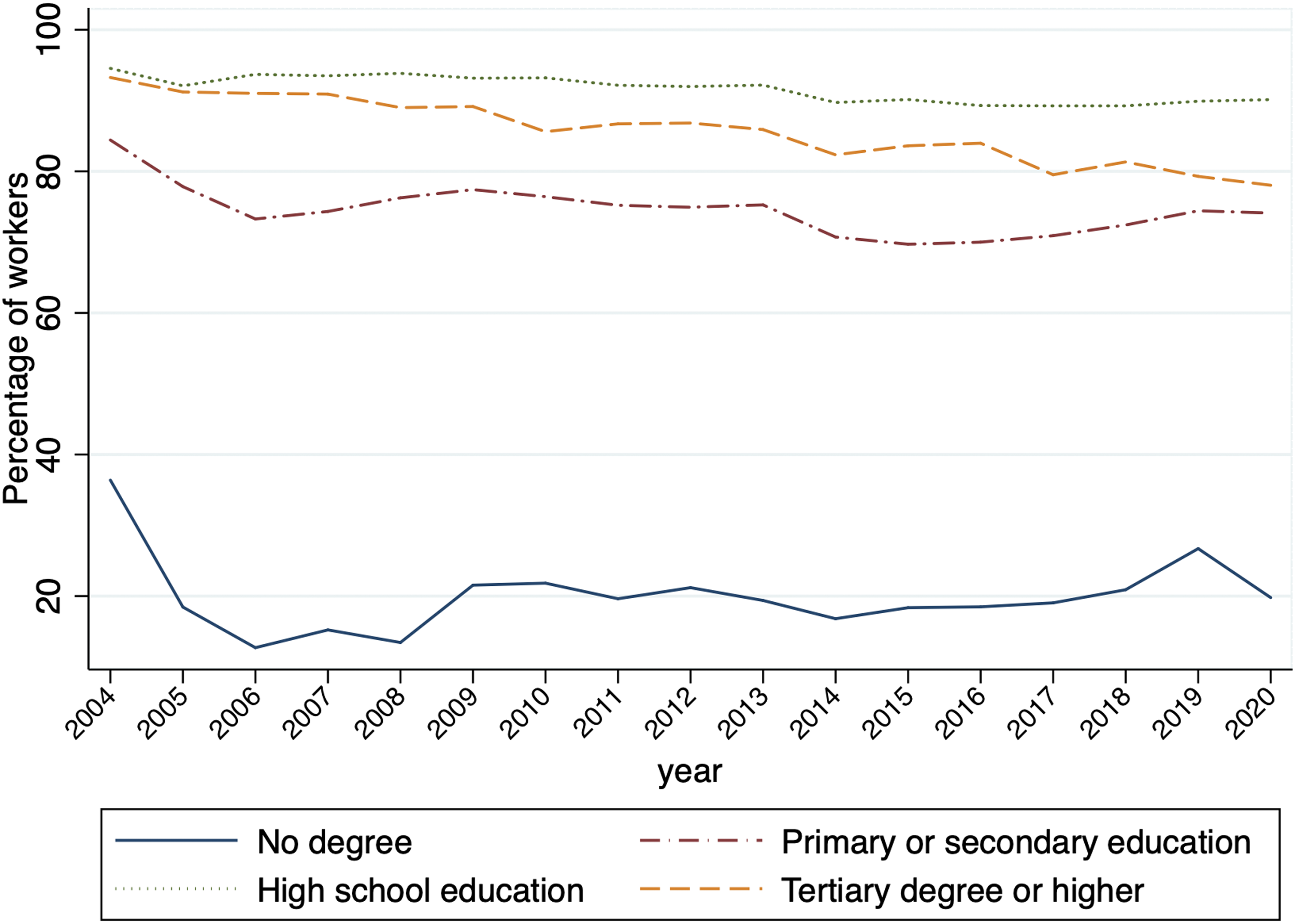
Despite improvements after 2006, temporary construction jobs still represented a larger share (53% in 2020) than permanent positions, with job insecurity much surpassing the manufacturing (6%) and services sectors (7%). Precarious contract types were especially prevalent in the 15–24 and 55–59 age groups (more than 60%). Permanent employment was the lowest for those with no educational degree (20%) and with primary/secondary education (26%) (Figure 3). Less qualified workers (elementary occupations) were more prone to temporary employment (75%), followed by crafts (64%) (Figure 4). Moreover, immigrant workers face disadvantages, with a 62% prevalence of temporary employment compared to 55% for Türkiye-born workers. Temporary working was more frequent (67%) in micro workplaces (less than ten employees). The rates were 37% and 34% in the workplaces with 11–49 and 50+ employees, respectively.Footnote 2
Percentage of construction workers in permanent employment by education. Data Source: TurkStat HLFS.
Percentage of construction workers in permanent jobs by occupation. Data Source: TurkStat HLFS.

We ran logit regressions to explore the role of gender, education level, occupation, age, workplace size, marital status and immigrant status on the likelihood of having a permanent position as opposed to a temporary one among construction workers. We also included dummies for NUTS-2 regions as controls (online Appendix 2). The sample is restricted to the years 2009–2020 to ensure the use of a common set of independent variables across all years.
Broadly, since 2015, the age of the worker does not appear to have created an important effect on the likelihood of finding a permanent position, while more years of schooling start making a notable effect at the high school level and higher.
Estimations for each year also indicate that, in comparison to those working in large companies, construction workers employed in small workplaces are 17–38 percentage points less likely to have a permanent job (Figure 5). The gap in the propensity to hold a permanent position appears to have narrowed since 2013, although we still observe a large difference (21 percentage points in 2020). The negative impact of working in a medium-sized workplace, in comparison to a large one, has gotten smaller over the years, dropping from 11 percentage points in 2009 to 3 percentage points in 2016. We observe a statistically insignificant difference between 2017 and 2020.
Marginal effects of working in small workplace on the likelihood of having a permanent position.

As for those who have migrated to Türkiye, we observe a statistically significant difference in the likelihood of holding a permanent position only for the years 2015 and 2016. In these years, migrants were 8 and 11 percentage points less likely to be in a permanent position (Figure 6).
Marginal effects of being born abroad on the likelihood of having a permanent position.

Segmentation based on social security coverage
Despite improvements in social security coverage over the last decade, the construction sector still lags behind manufacturing and services (94%) across all age groups (64% in 2020) (Table 1). Working without social security was a more pressing problem for the youngest (aged 15–19) and oldest (50+) construction workers, as well as for the workers without a degree (50%). The incidence of unregistered work decreases with higher education levels (Figure 7). Elementary (51%) and craft workers (42%) appear to be the most vulnerable segments regarding social insecurity (Figure 8). 75% of immigrant workers lacked social security, while only 36% of Türkiye-born counterparts did. Besides, unregistered employment hits mostly the construction workers in workplaces with less than ten employees: 50% work unregistered, while the rate decreases to 12% and 5% in workplaces with 11–49 and 50+ employees, respectively.
Comparison of social security coverage by age across sectors (%), 2020

Data source: TurkStat HLFS.
Percentage of construction workers with social security by education. Data source: TurkStat HLFS.

Percentage of construction workers with social security by occupation. Data Source: TurkStat HLFS.

We ran logit regressions to explore the role of gender, education level, occupation, age, workplace size, job type and migrant status on the likelihood of having social security among construction workers for the 2009–2020 period. We also included dummies for NUTS-2 regions as controls (online Appendix 3). Estimations performed for each year reveal a consistent effect of our main variables of interest over time.
In terms of the impact of age, workers in the youngest (15–19) and oldest (55–59; 60–64) age groups are the least likely to have social security. The changes in having social security are higher in middle-aged groups. In most years, we observe a statistically insignificant effect for education at levels lower than a high school degree. The logit estimation results suggest that, in terms of propensity for access to social security, education starts paying off at the high school level. In 2020, workers with a high school degree or higher were around 7–8 percentage points more likely to have social security in comparison to illiterates.
Estimations for each year indicate that, in comparison to those working in large companies, construction workers employed in small workplaces are 33–46 percentage points less likely to have social security (Figure 9), while those working in medium workplaces are 6–15 percentage points less likely to have social security (Figure 10).
Marginal effects of working in small workplace on the likelihood of having social security.

Marginal effects of working in medium workplace on the likelihood of having social security.

Construction workers who migrated to Türkiye are less likely to have social security. The effect, in absolute terms, has increased after 2014, where we observe migrants being 31–37 percentage points less likely to have social security (Figure 11).
Marginal effects of being born abroad on the likelihood of of having social security.

Discussion
Despite rising regular employment and job and social security coverage during the 2000s, the majority of Turkish construction workers still experience inferior labour standards. At the lower end of the workforce, workers bear a greater burden of adverse conditions, highlighting the segmentation in the labour landscape. This study’s in-depth empirical analysis of the construction sector extends the outdated conversation on labour segmentation and informal employment in Türkiye (Aydın et al Reference Aydın, Hisarcıklılar and İlkkaracan2010; Acar and Tansel Reference Acar and Tansel2016; Başlevent and Acar Reference Başlevent and Acar2015; Doğrul Reference Doğrul2012; Salem and Bensidoun Reference Salem and Bensidoun2012) with respect to firm size (Kumaş et al Reference Kumaş, Çağlar and Karaalp2014) and wage differentials (Kahyalar et al Reference Kahyalar, Fethi, Katircioglu and Ouattara2018). Particularly, this study focuses on labour standards in Türkiye’s construction sector, differentiating itself from Kumaş et al.’s (Reference Kumaş, Çağlar and Karaalp2014) broader market analysis. It highlights the construction sector’s particular problems, such as widespread unregistered employment and job insecurity, as well as presenting a detailed view of persistent wage gaps influenced by age, education, occupation, gender, workplace size, immigration and job status. As labour market segmentation manifests differently across sectors, in-depth, sector-specific analyses can uncover unique dynamics, paving the way for tailored policies that could enhance labour standards in the construction industry. The paper also sheds light on other non-institutional factors that are linked to labour market segmentation, such as the refugee influx and earthquake-linked business cycles which make Türkiye a unique developing country case.
We found that registered work has progressed in the Turkish construction sector (64% in 2020). This progress in social security coverage could be attributed to the Turkish Government’s efforts to decrease informality in the economy through action plans in 2009, 2011 and 2014. A series of social security contribution subsidies targeting firms in socioeconomically disadvantaged regions have increased formal employment sizably in small firms that are more prone to informal employment (Aşık et al Reference Aşık, Bossavie, Kluve, Nas, Selin, Nebiler and Oviedo Silva2022). Also, it became mandatory to pay wages and other benefits to workers through bank accounts, reducing unregistered payments. However, the rising influx of refugees has contributed to labour informality (Acar Erdoğan and Del Carpio Reference Acar Erdoğan and Del Carpio2019; Oğuz et al Reference Oğuz, Göksal, Oğuz and Şahin2020). In terms of registered employment rates, the construction sector lags behind both manufacturing (84%) and services (81%). As a result, despite improvements, the findings underscore the persistent precariousness of employment conditions in the construction industry, aligning with previous research (Koçak Reference Koçak2013; Bayrak Reference Bayrak2018; Şenel Reference Şenel2019; Gültekin-Karakaş et al Reference Gültekin-Karakaş, Yusufi and Hisarcıklılar2021; Yıldırım et al 2022).
The current Labour Law, enacted in 2003, introduced formal forms of temporary employment while also reducing informality. Legal changes in 2016 also permitted employers to expand the use of temporary and part-time contracts as a means to circumvent dismissal measures. The precariousness of construction jobs becomes evident concerning the higher rate of temporary work (53%) than manufacturing (6%) and services sectors (7%). The study also found other persisting challenges, including a lack of regular income guarantees (43%) and a higher prevalence of casual employment (33% compared to 4% in other sectors). The reliance on the casual construction workforce, who experience poorer working conditions in Türkiye, is parallel with other developing economies such as Indonesia (Pribadi and Chan Reference Pribadi, Chan, Pribadi and Chan2022).
Raw comparisons of real monthly wages using HLFS data indicate that, on average, female construction workers have a higher net income than male workers. However, after controlling for characteristics and occupations, it becomes evident that women consistently earn lower wages. Despite this wage disparity, female construction employees benefit from relatively high levels of social and job security (around 95% in 2020). Thus, the study also highlights the unique position of female construction workers, adding to the discourse on gender dynamics within segmented labour markets. Contrasting with the findings of Byrne et al (Reference Byrne, Clarke and Van Der Meer2005) and Singh (Reference Singh2016), women in the Turkish construction industry are employed under better conditions unexpectedly due to their higher levels of education and occupational characteristics.
This study examined stratification by age, education, occupation, workplace size and immigrant status and shed light on the labour standards experienced by the most vulnerable groups. The analyses revealed that the workforce is segmented in many respects, exposing inferior work conditions especially to the youngest and oldest, low-educated, low-qualified, immigrants and those employed by micro workplaces.
The presence of a high percentage (43%) of young (15–29) and aged (50+) workers in the sector is associated with widespread informal employment that also leads to increased fatalities, as Duman and Hamzaoğlu (Reference Duman and Hamzaoğlu2011) noted. Unregistered work is particularly pressing for workers aged 15–19 and 50+. The lower rate of registered employment among workers aged 55+ might be attributed to retirees seeking additional income through construction work. According to the Health and Labour Watch of Türkiye (ISIG) (Sendika. Org 2014), the construction industry frequently employs retired individuals or those nearing retirement age. Similarly, descriptive analysis shows that temporary employment especially hits the 15–24 and 55–59 age groups, while logit estimations indicate that, after controlling for other factors that influence workers’ job types, the age of the worker does not appear to have created an important effect on the likelihood of finding a permanent position since 2015. This is with the exception of workers aged 55 and older. For these older age groups, we find statistically significant negative effects on the likelihood of getting a permanent position in some years.
Monthly wages are the lowest for the 15–24 and 50+ age groups. These adverse work conditions have led to a diminution of interest among young individuals in construction work in Türkiye, similar to the Malaysian case (Abdul-Aziz Reference Abdul-Aziz2001).
Aligning with Karaalp-Orhan and Aksoylu (Reference Karaalp-Orhan and Aksoylu2018) and contrasting with the earlier work of Winch (Reference Winch1986), the findings empirically showed that workers in micro workplaces are more likely to work without job security and social security, while their real wages tend to be consistently lower compared to their counterparts in larger workplaces. These findings highlight the unique challenges and economic dynamics within micro workplaces.
The study found that the construction labour market is also segmented according to the immigration status of workers, in parallel to the work of Temel and Topateş (Reference Temel and Topateş2023). Descriptive analysis shows that immigrant construction workers in Türkiye encounter higher rates of temporary employment, lower social security coverage and comparatively lower mean wages when compared to their Türkiye-born counterparts. However, logit estimates indicate that, after controlling for other factors that influence job type, only in 2015 and 2016, were immigrants less likely to be in a permanent position. Our data set does not permit us to differentiate the country of origin of the migrants, but these two years coincide with the sharp increases in the flow of migrants from Syria to Türkiye. The results are suggestive of them being employed in temporary positions, with the effect disappearing once the influx of migrants stabilises in 2017 and after. This period also coincides with the years leading up to their eligibility to apply for a work permit in Türkiye. These findings underscore the difficulties faced by immigrant workers in the construction sector. Differing from the Malaysian case (Abdul-Aziz Reference Abdul-Aziz2001), the inclusion of immigrant workers in Türkiye’s construction workforce was the result of the eruption of war rather than abundant job opportunities or higher wages. The refugees were more likely to find informal employment (Del Carpio and Wagner Reference Del Carpio and Wagner2015).
The labour market is also stratified in terms of education and skill levels. Low-educated and unskilled (elementary) workers in the construction industry face a greater risk of non-standard working arrangements and often gravitate towards hazardous jobs. Their limited ability to advocate for their rights, with a very low unionisation rate), further exacerbates their vulnerability, aligning with Pattanaik (Reference Pattanaik2009), Debrah and Ofori (Reference Debrah and Ofori2001) and Byrne et al (Reference Byrne, Clarke and Van Der Meer2005). 80% of those with no educational degree work temporarily, while more years of schooling increase the likelihood of finding a permanent position. Moreover, unregistered employment tends to be more prevalent among construction workers lacking a degree (50%) and those with primary or secondary education (40%). Construction workers with no degree also had the lowest average wage, followed by primary and secondary school graduates. The findings reveal a concerning pattern for less qualified workers, particularly those in elementary occupations (the second-largest category), and crafts. These individuals face heightened levels of both job and social insecurity. The economic difficulties faced by elementary and craft workers are further shown by the constantly lower average pay for these workers over the defined period.
Low education and qualifications among construction workers pave the way to informal employment and neglect of OHS standards (Gürcanlı and Müngen Reference Gürcanlı and Müngen2013). Under cost concerns, construction sites often lack a sufficient number of qualified personnel, which ultimately leads to higher costs for employers (Sümer Reference Sümer2014). The low percentage of vocational-technical high school graduates (10%) confirms the shortage of trained intermediate staff, as claimed by Sezici et al (Reference Sezici, Yılmaz and Yılmaz2009) and Eren, the President of the Turkish Contractors Association (TMB) (Sarı Reference Sarı2023). Efforts have been made to address labour force training deficiencies by establishing the Vocational Qualifications Authority in 2006 (Turkish Ministry of Development 2014), which requires new workers in high-risk occupations to undergo mandatory vocational training. However, there are challenges in implementing the certification process, particularly for workers who are financially constrained or illiterate (Bayrak Reference Bayrak2018).
We argue that education and skill development programs might contribute to addressing multiple labour standards problems at once. Such programs will enhance the employability of workers and prevent them from being forced to accept indecent work conditions and wages. They will also facilitate the transition from temporary or informal employment to more stable and formal employment, providing support for career progression. Strict state control is needed to mandate certification for professional qualifications for workers through subcontractors and main contractors. In-company training and the allocation of resources from the unemployment insurance fund can further enhance vocational training. Public and professional chambers should support training in vocational qualifications and OHS.
Conclusion
The Turkish construction industry has embraced a strategy marked by low-road practices, resulting in diminished productivity and unfavourable working conditions. The industry needs to follow a dynamic development path based on high productivity and quality production (Turkish Ministry of Development 2013, 2014; Uzunkaya 2013), where labour standards are institutionalised, and the quality of the workforce is increased with educational opportunities in a secure and safe working environment. Advancement in labour standards is required to conform to the United Nations (UN) Sustainable Development Goal (SDG) no. 8 ‘Decent Work and Sustainable Growth’, which aims to promote inclusive economic growth, full and productive employment, and decent work (ILO 2013; UN n.d.).
The analyses in this article have shown that despite the increase in regular, permanent and registered work in the 2000s, the Turkish construction industry continues to utilise precarious employment. The examination also revealed segmentation in the construction labour market, with the existence of secondary jobs characterised by poorer work standards. Young and old workers, those with low education and qualification levels, and immigrants are more exposed to temporary and unregistered work. Additionally, those employed by micro workplaces face higher precarity than workers of large companies, which offer better pay, job security and social security.
Addressing segmentation in labour markets requires comprehensive measures to promote equality and inclusiveness. To reduce wage disparities, minimum wage regulations should be enforced for all workers, irrespective of their age, education, job, immigrant status, and workplace size. Moreover, considering the subcontracting-based production structure and the resulting fragile employment regime within the sector, all construction workers must be encompassed by comprehensive social safety nets. This should include provisions for retirement plans and unemployment benefits. Such measures become particularly critical given the construction industry’s susceptibility to business cycles. Institutionalisation, delineation of clear responsibilities for all stakeholders, and effective supervision in the sector (Yıldırım et al 2022) will help eliminate the hierarchical workforce structure, ensuring that all employees enjoy the rights established by law. Besides, to integrate refugees into the labour market without worsening segmentation, policies should focus on skills certification, language and vocational training, incentives for standard-compliant recruiting and active job matching programs.
Segmentation in the construction labour market has an impact on both construction quality and working life. The high death toll from the two major earthquakes in February 2023 in Türkiye underscores the urgent need for decent work conditions. The country is located in the most active earthquake zones with the shortest return period (Caglar et al Reference Caglar, Vural, Kirtel, Saribiyik and Sumer2023). As Türkiye continues to grapple with the aftermath of the earthquakes, improving work conditions will contribute to ensuring a high-quality building stock that upholds the right to a fulfilling and secure life. The challenges of securing a skilled labour force have intensified, particularly in the context of reconstruction efforts initiated in the earthquake-stricken zone (TCA 2023). The increasing reconstruction activities in earthquake-prone zones and the growing demand for urban transformation, especially in high earthquake-risk cities, emphasise the urgent need to establish favourable working conditions within the sector and extend them comprehensively. Ensuring decent working conditions and providing vocational education and career development opportunities for all workers is essential for elevating the status of construction jobs and addressing the shortage of skilled labour in the sector.
A cultural shift in the sector towards higher labour standards, driven by more training, certification, and safety nets, will enhance both worker quality of life and construction quality. It will also respond to the rise in quality expectations of consumers as incomes rise, rapid urbanisation continues and the risks associated with high-magnitude earthquakes accumulate. This approach is more effective than rebuilding cities post-disaster. The Turkish construction sector is still immature (Yıldırım et al 2022), with minimal barriers to becoming a contractor, leading to 450,000 contractors compared to Germany’s 3,000 (Balbay Reference Balbay2020). Contractors often prioritise quick returns over safety and quality. Transitioning to focus on labour standards and quality rather than rapid accumulation will foster long-term profitability through commitment, training and innovation. This transformation will benefit the sector’s development, employment and industrial growth in Türkiye.
The results offer governmental and non-governmental organisations and the business community some tactical points and areas for development in Türkiye. The study’s conclusions can be applied by trade unions, academic institutions, industry associations and labour standards specialists in their efforts to strengthen regulations and the execution of labour standards-related policies. The study’s comparative, multi-level and multi-dimensional analytical framework also provides ground for international policy-making. It could be replicated for other national contexts that follow the low-road path in their construction industries, such as South Korea, the United Kingdom, the United States, Australia and Spain (Bosch and Philips Reference Bosch and Philips2003) to develop policy suggestions that address the challenging systemic failures regarding labour standards (Gurmu Reference Gurmu2019; Lozano-Díez et al Reference Lozano-Díez, López-Zaldívar, Herrero Del Cura and Verdú-Vázquez2019; Kang et al Reference Kang, Min, Won, Kang and Kim2021; Oswald et al Reference Oswald, Sherratt and Smith2018; Ringen et al Reference Ringen, Dong, Goldenhar and Cain2018; Woolley et al Reference Woolley, Goode, Salmon and Read2020).
Limitations and further research: The data problem is an important constraint in analysing labour standards in the construction industry. The widespread informality and seasonal employment in the sector make it difficult to access data and reveal reality in all dimensions. The study evaluated the working conditions in the sector with a comprehensive, multi-level analysis with secondary data published from the most recent period from 2002 to the present. Considering that the labour standards problems in Türkiye are caused by the lack of implementation rather than the lack of legislation (Yıldırım et al Reference Yıldırım, Gultekin, Tilkici and Ay2022), determining the level of performance with more comprehensive field studies based on construction sub-activity branches, enterprise sizes and regions will enable the development of more effective policies. Besides, it was impossible to estimate the immigrant worker ratios exactly as they were not captured by official data, and field studies are needed on this subject.
Supplementary material
To view supplementary material for this article, please visit https://doi.org/10.1017/elr.2024.35
Acknowledgements
This paper is based on a research study funded by the Istanbul Technical University Scientific Research Projects Unit (grant no. 41022) entitled ‘Multi-Level Analysis of Labor Standards in the Turkish Construction Industry’.
We thank the reviewers for their constructive feedback, which has greatly improved the clarity and coherence of our paper. Their insights have been invaluable in refining our work. We also extend our gratitude to the editor for her support throughout this process.
Funding statement
The author(s) disclosed receipt of the following financial support for the research, authorship and/or publication of this article: This work was supported by the Scientific Research Projects Coordination Unit of Istanbul Technical University [grant number 41022].
Competing interests
The author(s) declared no potential conflicts of interest with respect to the research, authorship and publication of this article.
Derya Gultekin is an Associate Professor of Economics at Istanbul Technical University in Türkiye. She obtained her PhD from the University of Sydney. Derya’s research primarily focuses on tobacco control, regional inequality, social policy, labour policy and financial markets and development issues.
Mehtap Hisarciklilar is an Associate Professor of Economics at the Centre for Financial and Corporate Integrity, Coventry University in the UK. She obtained her PhD in Economics from the University of Nottingham. Mehtap’s research addresses issues within the areas of social inequalities, gender mainstreaming, international trade, foreign direct investment, and firm innovation through application of quantitative methods.
Ferimah Yusufi is an Associate Professor of Economics at Tekirdağ Namık Kemal University in Türkiye. She obtained her PhD from Marmara University. Ferimah’s research focuses on economic crisis, health and energy policies, and public finance, including government investment incentives and tobacco taxation.


 Open access

