




Introduction
Central America is home to Indigenous Maya populations speaking a variety of related languages. Despite the Spanish conquest of the sixteenth century AD, these populations have persisted, maintaining many traditions and their sense of cultural identity. Today, the total Maya population is estimated at approximately eight million, most of whom (around 6.2 million) live in Guatemala.
One of the Maya groups of south-central Guatemala are the Ixils. Today, the three largest Ixil cities are San Gaspar Chajul, Santa Maria Nebaj and San Juan Cotzal (further referred to as Chajul, Nebaj and Cotzal, respectively). Renovation of one of the local houses in Chajul (described here as house 3) in 2003 revealed wall paintings, possibly from the Colonial period (AD 1524–1821) (Źrałka & Radnicka Reference ŹraŁka and Radnicka2015). These paintings represent a unique local mural tradition combining both pre-Columbian and European elements. Although Colonial books or codices are known to combine pre-Columbian and imported European motifs and concepts (e.g. Olko Reference Olko2005; Leibsohn Reference Leibsohn2009; Boone Reference Boone, Boone and Urton2011), Mesoamerican Colonial wall paintings predominantly concentrate on religious subjects related to Christianity, appearing in churches and convents. Instead, Chajul house 3 provides evidence that murals appearing in private, domestic contexts constitute the fusion of local Maya and imported Spanish traditions and beliefs. This blending of elements and motifs from two different cultures and traditions can be compared to Old World examples, such as the fusion of Egyptian elements with new Greek, and later Roman, components in Ptolemaic Egypt (e.g. David Reference David2002; Venit Reference Venit2015), or to the mixture of Greek and Scythian art on the steppes of the Black Sea (e.g. Jacobson Reference Jacobson1995).
This article presents the history of the discovery of the murals in house 3 at Chajul and the subsequent work of Polish conservators in 2015. Beginning with a brief outline of the pre-Columbian and early Colonial history of the Ixil region, we then present the architectural context of the house 3 murals. This is followed by a description of the iconography and the results of physical and chemical analyses of the pigments. Finally, we examine the chronological context of the murals and seek to interpret their iconography and significance.
The Ixil region and Chajul
The Ixil region extends throughout the northern part of El Quiche Department, Guatemala (Figure 1), and is dotted with archaeological sites, most of which have never been investigated. German scholar Franz Termer, as well as researchers from the University of Pennsylvania, conducted some of the earliest archaeological investigations of the region during the 1920s and 1930s (Termer Reference Termer1957: 8; Becquelin et al. Reference Becquelin, Breton and Gervais2001: 1; Weeks et al. Reference Weeks, Hill, Golden, Weeks, Hill and Golden2005: 5). Between 1946 and 1949, the Carnegie Institution of Washington undertook excavations in the region's largest centre, Nebaj (known to the Ixil Maya as Xe’ Vak) (Smith & Kidder Reference Smith and Kidder1951). In 1965, American archaeologist Richard Adams carried out an archaeological survey in the Cotzal region (Adams Reference Adams2005: 337), while in 1964 and 1965, French scholars from the Centre National de la Recherche Scientifique surveyed the upper basin of the Xacbal River, revisiting sites previously described by anthropologist Jackson S. Lincoln (Reference Lincoln1945), and documenting and excavating new sites (Becquelin et al. Reference Becquelin, Breton and Gervais2001: 3 & 179–81).
Map of the Ixil area featuring three municipalities (Nebaj, Chajul and Cotzal, all marked with different colours) and archaeological sites (map by J.L. Velásquez Izaguirre).

No archaeological research was conducted in the region for four decades until 2008, when rescue excavations were initiated in the site of Xacbal, known locally as B'ayal I’ or Xe’ Kuxhab’ (see Banach Reference Banach2017), following damage to the site during the construction of a power station. The project comprised restoration works on the site's major structures, along with archaeological excavation (Velásquez Reference Velásquez, Arroyo, Paiz and Mejía2012). Most recently, Guatemalan archaeologist Adriana Linares-Palma has established an ongoing community-based participatory mapping project to locate Postclassic archaeological and sacred sites in the municipality of Cotzal (A. Linares-Palma pers. comm.).
Prior to the Spanish conquest, the lands of the Ixil Maya were under the political influence of their powerful neighbours, the K'iche’ Maya. In 1530, the K'iche’ Maya from Uspantan and the Ixils were finally conquered by the Spaniards with the support of native allies from central Mexico (Lovell Reference Lovell2005: 65–66). In the aftermath, the Dominicans began to evangelise the indigenous population, although the presence of priests in this region, and particularly in Chajul, was very limited during the Colonial era (Colby & van den Berghe Reference Colby and van den Berghe1969). At the same time, pursuant to the ordinance of Leyes de las Indias, laws regulating life in the new empire, issued by the Spanish Crown in the sixteenth century (Fosman y Medina Reference Fosman Y Medina1681: 198–202), the indigenous populations from many smaller settlements were re-settled into three large cities, Nebaj, Chajul and Cotzal, where they could be more easily controlled by the new authorities. These demographic movements resulted in the abandonment of many pre-Columbian settlements. Indigenous authorities, however, were preserved in the new Spanish order, with some of the local Ixil Maya leaders recruited to the so-called cofradías—religious brotherhoods set up by the Spaniards. These organisations were responsible for the care of the cult images of saints and other operations associated with the Catholic Church (Colby & van den Berghe Reference Colby and van den Berghe1969: 54).
Prior to the conquest, today's Chajul was already one of the largest pre-Columbian centres in the region. In 1549, by the order of Pedro Ramírez de Quiñones, an important Spanish official, the inhabitants of Huyl, Boob, Yllon, Honcab, Chaxa, Aguaçaq, Huyz and four other communities were moved from their native lands to Chaul [Chajul], which itself was a separate native community at the time (de Remesal Reference de Remesal1619: 509).
In the 1960s, Pierre Becquelin and colleagues (Becquelin et al. Reference Becquelin, Breton and Gervais2001: 281–83) documented an archaeological site, which they named ‘Chajul’, located to the north-west of the modern city. The site comprised five structures, most of which delimit a ballcourt (Becquelin et al. Reference Becquelin, Breton and Gervais2001: 282–83 & fig. 15). Based on the authors’ own experience, however, we believe that it is highly probable that the core of pre-Columbian Chajul lies beneath the centre of the modern city. The importance of pre-Columbian Chajul is suggested by a polychrome vessel (no. K558) representing the so-called Nebaj style, which is now stored in the Museum of Fine Arts in Boston. Hieroglyphic text on the vessel names the owner of the vase, who is described as a guardian or master of the Chajul king (Ch'aju[l] ajaw) (van Akkeren Reference van Akkeren2005: 52; D. Beliaev pers. comm.). This text clearly demonstrates that during the Late Classic period (AD 600–800), to which the vase dates, Chajul seems to be an important political entity, with its own dynasty of kings (D. Beliaev pers. comm.).
Chajul is also briefly mentioned in the Rabinal Achí—an important text deriving from the Classic-period tradition of court dramas, and considered to illustrate early fifteenth-century events. The first scripts of this orally transmitted story come from the mid nineteenth century AD; they were first written down in 1850 by Bartolo Sis of Rabinal (the copy of this version had been lost), and in 1862 by French priest Brasseur de Bourbourg (Brasser de Bourbourg Reference Brasseur de Bourbourg1862; Tedlock Reference Tedlock2003: 1–2, 6). Today the Rabinal Achí (or ‘Dance of the Trumpets’) is performed in Guatemala in the form of a dance, and addresses the conflict between the K'iche Maya and the inhabitants of the Rabinal region (Achi Maya) in Highland Guatemala. It mentions a K'iche’ prince Cawek who names himself “the man of the lord of foreign Chajul, foreign Cunen” (Tedlock Reference Tedlock2003: 35 & 251). Located to the south of Chajul, Cunen is currently a K'iche’ town that may once have been inhabited by Ixil-speaking populations (Tedlock Reference Tedlock2003: 181). The second town mentioned in Rabinal Achí is Chajul, referring to a pre-Columbian centre that probably extended beneath the modern town of the same name (Becquelin et al. Reference Becquelin, Breton and Gervais2001: 13). The drama narrates how Cawek attacked the city of Kajyub’ in the Rabinal region but was captured and presented to the local lord; his destiny was to be sacrificed by his enemies (Tedlock Reference Tedlock2003). The drama suggests that before the conquest, Chajul and other Ixil Maya lands were politically subjugated to their powerful neighbours, the K'iche’, the major political power at the time of the Spanish conquest of the Maya highlands in the 1520s (Lovell Reference Lovell2005: 58–66).
Previous research on Chajul murals
The best-preserved paintings discovered at Chajul thus far are those from a house belonging to the Asicona family (which still serves as their domicile), located approximately 100m north-east of the Catholic church of San Gaspar (Figure 2). German scholar Lars Frühsorge, who visited Chajul in 2007, designated the Asicona house as house 3 (Frühsorge Reference Frühsorge2008), which we follow in this publication. Built of adobe bricks bound with mortar mixed with pine needles, the house comprises three rooms. Facing towards the church, the front side of the house has a porch supported by seven columns (carved in their upper sections)—a typical architectural feature in this region; the shorter side of the house faces the street. Recently, the façade has been nearly completely blocked by another building and can now be accessed only by a narrow passageway. The first paintings in house 3 were uncovered in the early 1990s, albeit only a small part of them. While replacing the damaged roof in 2003, one of the owners, Lucas Asicona Ramírez, decided to remove the outer layers of plaster and uncover the paintings. Information concerning the murals was communicated to the Guatemalan authorities (Institute of Anthropology and History of Guatemala—IDAEH) by both Asicona Ramírez and ethnohistorian Ruud van Akkeren. Consequently, an IDAEH representative, Salvador López, was sent to Chajul to document the paintings. Lars Frühsorge visited Chajul in 2007 and published preliminary information on the paintings from house 3 and several other houses in the town of Chajul with surviving murals (Frühsorge Reference Frühsorge2008). Around the same time, wall paintings from several Chajul houses were also being documented by Juan Luis Velásquez. In 2011, members of the Nakum Archaeological Project carried out a preliminary photographic documentation of almost all of the house murals from Chajul city, including those in house 3 (Źrałka & Radnicka Reference ŹraŁka and Radnicka2015). In 2015, Polish scholars Katarzyna Radnicka and Tomasz Skrzypiec undertook conservation work on the murals in house 3 (Figure 3).
Reconstruction of Chajul house 3 based on 3D scanning; note the three rooms of the house, with the central one featuring wall paintings (reconstruction by A. Kaseja; 3D scanning by B. Pilarski).

Conservation works carried out in house 3 in 2015 (photograph by R. Słaboński).

Previously published nineteenth- and twentieth-century ethnographic and archaeological research in the Ixil region makes little mention of wall paintings. Colby and van den Berghe (Reference Colby and van den Berghe1969: 70–71) recorded fragments of paintings during their research in the Ixil region, stating that the last artist to create such paintings had died shortly before they conducted their fieldwork in the 1960s. Colby and Colby (Reference Colby and Colby1981: 31–32) make a later reference to wall paintings, although it is only a brief mention that reveals little information about the exact locations or iconography of the murals.
The iconography of the house 3 murals
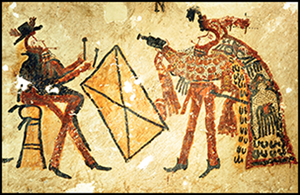
The paintings at house 3 decorate the north, east and west walls of the main, central room. They probably also once covered the south wall, but this has been demolished and rebuilt. Conservation work has revealed the presence of at least five layers of later paintings, most of which had been scraped off by the current owners of the house when uncovering the mural (if not earlier). In places, some fragments have survived that are large enough to suggest that the subsequent layers repeated the themes of the original mural, which was intermittently repainted. One of the best-preserved and most interesting scenes is on the western wall (panel 1 on Figure 4). Exceeding 2m in length, the panel features a possible dwarf with a long stick (individual 1) striding behind the backs of two musicians wearing Spanish costumes (individuals 2 and 3), and approached by a man in Indian-Spanish attire (individual 4). The first musician (individual 2) is shown playing a short wind instrument, probably a flute (xhuli aj) or a chirimía—instruments still popular in traditional music of the Ixil Maya. The chirimía is a form of a double-reed woodwind instrument (resembling an oboe), which was introduced by the Spaniards. The second musician plays a large drum, beating it with sticks with rounded heads. The same set of instruments (large drum and flute/chirimía) is used today to accompany different feasts and ritual ceremonies. Individuals 1–3 wear typical European costume, comprising a short mantle worn over one shoulder; a kaftan with puffed sleeves and ruff; a broad belt with its loose end dangling to the front, long slim trousers (or perhaps short trousers and stockings); and heeled shoes with long, pointed toes. The individuals wear hats with broad brims adorned with a feather or brush made from animal hair. The only legible fragment of inscription, located above the drummer's head, reads ‘…CADORES’, which probably refers to the word ‘tocadores’, or ‘musicians’.
View of the wall paintings on the western wall of house 3 (panel 1) (photograph by R. Słaboński).

A figure, possibly a dancer (individual 4), is shown striding towards the musicians, holding a green object resembling a bottle in his extended hand. His costume comprises both European and Indian elements, including trousers and heeled shoes; a short, tasselled mantle of feathers; a shirt with long sleeve strings dangling loosely; a long cloak with the representation of a white bird; and a decorative headdress. The costume is predominantly orange, with black details. In his other hand, he holds a short, black stick, similar to the vara staff used by the local authorities both nowadays and in the past. It is notable that the U-shaped marks on individual 4's costume, as well as on the attires of most figures described below on the northern wall, may represent a late occurrence of a pre-Columbian iconographic symbol that marked cotton clothes (see Stuart & Houston Reference Stuart and Houston2018). As such, this may represent an iconographic motif that signals the type of material from which costumes were made.
Panel 2 on the northern wall (Figure 5) seems to be a continuation of the scenes depicted on the western wall. The mural is 4.3m long and features 10 human figures (individuals 5–14). Individuals 5–8 and 10 are represented in a very similar manner, wearing mixed European-Indian costumes (Figure 6). Some of the figures (individuals 6–8 & 10) are shown facing each other. They wear cloaks/mantles similar to those described above and decorated with what may be a bird, trousers, heeled shoes and triangular headdresses adorned with bunches of feathers and other ornaments. In their upraised hands, each figure holds an enigmatic red object, which exhibits an elongated, curved element protruding from it. These may be jícara, a traditional carved vessel typically made of calabash. Scarf-like elements dangle from the area of the wrists of almost all of the figures. Similar dress is used by Indigenous people practising dance today. A stooping man (individual 9, possibly a dwarf) with a long stick is visible between individuals 8 and 10, and is depicted in European costume very similar to that worn by the musicians. In his left hand, he carries a curved object resembling a tobacco pipe, rendered in black paint.
General view of the paintings on the northern wall of house 3 (panel 2) (photograph by R. Słaboński).
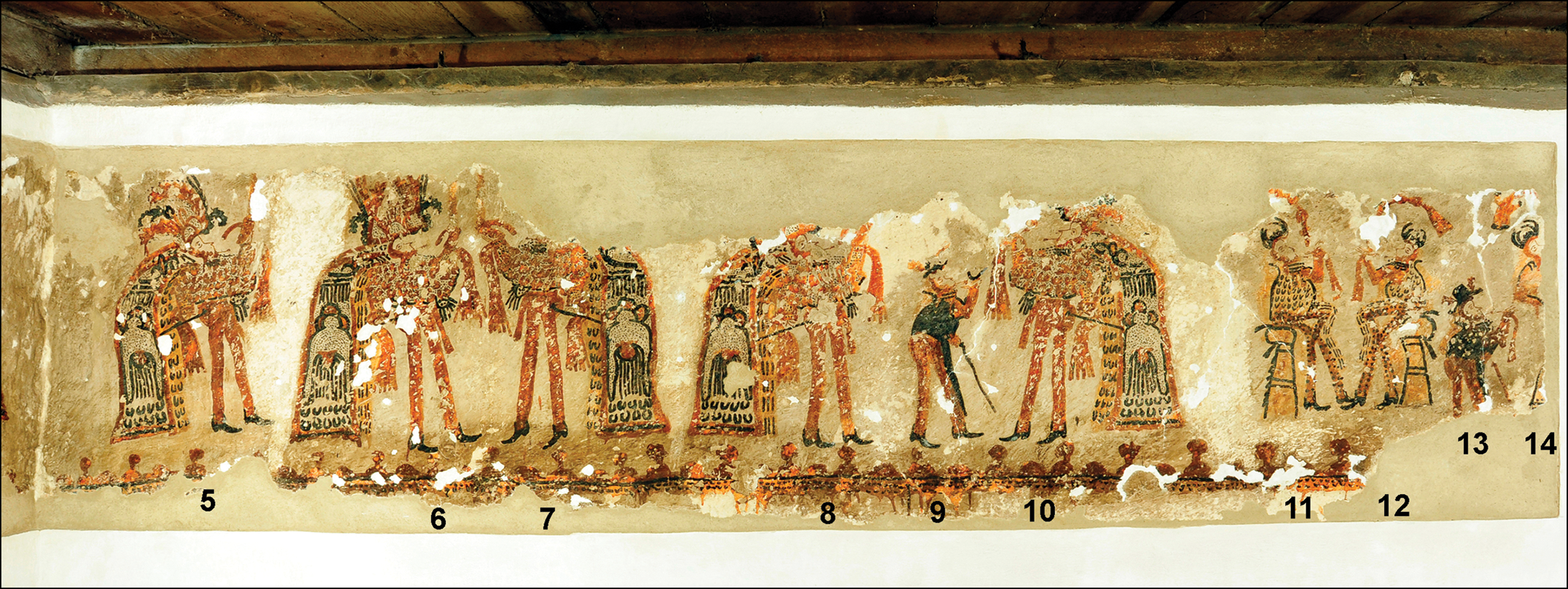
Details of the wall paintings of house 3, panel 2: a) individuals 5–6; b) individuals 8–10 (photographs by R. Słaboński).

The figures farther to the right are of a slightly different nature. Two individuals (11–12) sit on high stools opposite each other, carrying large curved objects in their raised hands (Figure 7). These may also be instruments—horns or trumpets made from gourds—although this interpretation is uncertain, as the figures are not playing the instruments. The costumes worn by individuals 11–12 are slightly different from those described above. Both wear simple headdresses, adorned with horns or antlers. The costumes resemble those worn by other European-dressed musicians, although both the kaftan/mantle and trousers are orange and covered with black spots. This creates an overall impression of a jaguar skin. To the right, individual 13, also apparently a dwarf, wears European costume, with a long stick in one hand and the other hand raised. It is uncertain whether or not he is carrying something in this hand. Perhaps the dwarf depicted three times is actually the same person shown in three different moments of the ritual or dance. Farther to the right is the partially surviving representation of individual 14, who is dressed in a costume similar to those worn by individuals 11–12. A fragment of another high stool also survives, which suggests that there may originally have been two people facing each other, similar to individuals 11–12 and the musicians featured on the western wall.
House 3, panel 2: individuals 11–14 (photograph by Robert Słaboński).

The eastern wall is adorned with two ‘panels’ (panels 3–4), one at either end. If there were any paintings between these two panels, they have not survived. The decorations on panels 3–4 are of a completely different style to the paintings presented above. Each panel features two nearly identical vases (flacons) with seven multi-petalled flowers, with long, twining stems and tiny leaves (Figure 8). We initially believed these to be symbolic representations of incense burners, but, in 2015, Lucas Asicona said that his grandmother owned a similar flower vase placed close to this wall. Notably, the conservation works has revealed the remains of only one later layer of painting over these murals, and has identified a slightly different painting technique (and probably a different paint as well), suggesting that panels 3–4 may date to a more recent period than the paintings on the western and northern walls.
Panels 3 (a) and 4 (b) from the eastern wall of house 3, featuring flowers in small vases (flacons) (photographs by K. Radnicka).

Radiocarbon dating and chemical analysis of pigments
Radiocarbon dating of three samples from house 3 provide preliminary information about its date and murals. Two samples (pine needles) were taken from wall mortar immediately above panel 2. The third sample (a small piece of charcoal) was taken from the layer of lime mortar underlying paintings from panel 1. All three dates are very similar and—with the support of ethnographic and historical data—indicate that the house and the paintings can be tentatively dated to the late seventeenth or early eighteenth century AD (Figure 9).
Dating of radiocarbon samples from Chajul house 3 (figure from Poznań Radiocarbon Laboratory; Bronk Ramsey Reference Bronk Ramsey2013; Reimer et al. Reference Reimer2013).

Sixteen pigment samples from house 3 have been subjected to visual examination, as well as physical and chemical analyses (SEM-EDX, FTIR and GC-MS) conducted at the University of Valencia, under the supervision of María Luisa Vázquez de Ágredos-Pascual (see the online supplementary material (OSM)). These analyses indicate that the materials and techniques applied in the preparation of the house 3 murals have remained almost unchanged since pre-Columbian times. Physical and chemical analyses (FTIR and SEM-EDX) have identified a palette of colours typical of pre-Columbian Maya mural paintings: white lime (CaCO3), carbon black, hematite (Fe2O3), ochre and red earth (possibly of local origin; see the OSM), as well as the so-called ‘Maya blue’. Such pigments were first used in the Maya area during the Middle Preclassic period (first millennium BC) (Vázquez de Ágredos-Pascual Reference Vázquez de Ágredos-Pascual2010). The ‘Maya blue’ pigment was identified on the lime mortar directly below the plaster with paintings of panel 1. The most notable result was the presence of lead in one of the samples of red pigment, which may suggest the use of minium or red tetroxide (Pb3O4) of European origin (see the OSM). These results suggest that in the northern part of El Quiche Department, Maya mural painting materials and techniques continued to be used after the Spanish conquest. Only rarely were materials introduced, as shown by the possible use of minium in the house 3 mural paintings. Our analyses also suggest that the artists responsible for the mural paintings were most likely indigenous Maya, who employed traditional methods and materials in pigment preparation.
Discussion
Our research to date, including interviews with Chajul inhabitants about local history and tradition, suggests that houses with murals were originally owned by important members of the local community—possibly members of the cofradías. These individuals were involved in the organisation of religious events, both those connected with Catholicism and those linked with costumbre (or Maya spirituality, related to the cult of the Maya pre-Columbian calendar and to agrarian rituals). Prior to the recent civil war in Guatemala (c. 1960–1996), there were approximately 10 cofradías in Chajul, although their number has decreased in recent years. The rooms with paintings probably served as places for important cofradía meetings and dances (cf. Howell Reference Howell2004: 35).
Although the murals are currently located in domestic spaces, it is possible that in the past, painted rooms (or whole houses) might have played a different role. According to Lucas Asicona, the three rooms of house 3 had different functions in the early twentieth century. The northernmost room served as a space for receiving visitors; the central room, with the murals (at that time completely covered by later stucco), served as a place for special events, such as meetings, ceremonies and dances for the cofradía. Finally, the southernmost room was a kitchen and living room. A large patio in front of the house provided another space for dances. This division seems to reflect the original seventeenth-/eighteenth-century layout and function of the house. It should be noted that some other Chajul city houses with wall paintings have been—or still are—used as meeting places for cofradía members. Thus, it is very plausible that most, if not all, of the houses with murals belonged to cofradía members and served as important places for meeting and dance. As such, the paintings from these locations may commemorate special events, particularly dances, practised by these important religious and social organisations.
Mark Howell (Reference Howell, Cecil and Pugh2009: 279)—an American ethnomusicologist who studied highland Maya dances—mentions that as in the Colonial period, dances are now performed in such spaces as the central church, places associated with Calvary, and in cofradía houses during festivals in honour of saints. Edith Hoyt (Reference Hoyt1963: 69), a painter who visited the town of Chajul in the 1940s, also witnessed dances (particularly the Baile de las Canastas or Dance of the Baskets) being performed in the church and on the patio of one of the “white houses with a red tiled roof”.
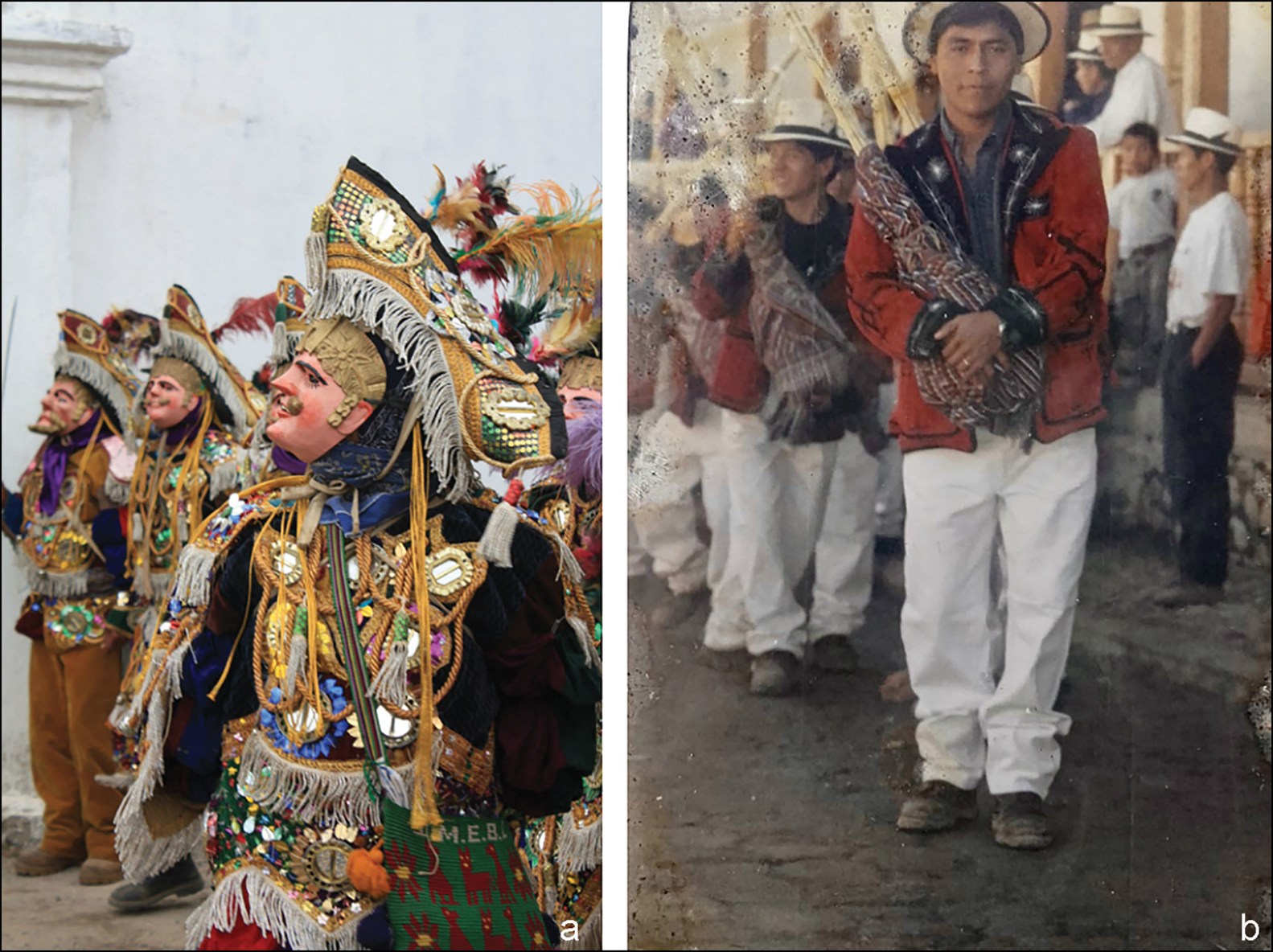
According to local inhabitants of Chajul city, the wall paintings from house 3 and other locations represent scenes from either the Baile de la Conquista (Dance of the Conquest), or the Baile de los Moros y Cristianos (Dance of the Moors and Christians). Such dances were—and remain—very popular in many parts of Mesoamerica (Bode Reference Bode1961; Howell Reference Howell2004; Matos Moctezuma Reference Matos Moctezuma2008; Cohodas Reference Cohodasn.d.). They recall and recreate important episodes related to the conquest of the Maya highlands, when the Spaniards and their native allies battled against local Maya kingdoms—particularly against the K'iche’, as in the case of the Dance of the Conquest. This is one of the oldest dance-plays still performed today in various Maya communities (Howell Reference Howell, Cecil and Pugh2009: 279), including the Ixil, among whom it is usually conducted during the annual celebrations of their patron saints (Figure 10a). Briefly, it tells the story of the invasion of present-day Guatemala by the Spanish and their allies in February 1524, culminating in the defeat of the K'iche’ Maya (Lovell Reference Lovell2005).
Photographs featuring modern dances practised in the Ixil Region: a) Danza de la Conquista at Salquil Grande (photograph by M. Banach); b) Baile de Bolero at Chajul (photograph from the archives of L. Asicona Ramírez).
The original author of the narrative of the Dance of the Conquest was a Franciscan missionary based near what is today the city of Quetzaltenango (Cohodas Reference Cohodasn.d.: 4–12). His aim was educational, both to promote conversion to Christianity and submission to the Spaniards. The narrative is probably based on two historical sources: the letter of Pedro de Alvarado to Hernán Cortés written in 1524 (de Alvarado Reference de Alvarado1913); and Título del Ajpop Huitzitzil Tzunun, a document written in 1567 in the K'iche’ language, probably by local caciques (leaders) (Gall Reference Gall1963). Both documents narrate the defeat of the K'iche’ army; the original objectives of these narratives—evangelisation and the legitimisation of the conquest—evolved, however, to become more associated with K'iche’ history, identity and the ubiquitous forms of repression. Thus, with time, the Dance of the Conquest adopted an ambivalent character manifested in reinterpretations of the ‘official’ narrative using different dramatisation techniques (Cohodas, Reference Cohodasn.d.: 5). In contrast, the Dance of the Moors and Christians describes the re-conquest of the Moorish-controlled Iberian Peninsula by Spanish forces, narrating a story obviously foreign to this region, and introduced by the Spaniards after the conquest (c.f. Matos Moctezuma Reference Matos Moctezuma2008).
The murals may, however, represent some other dances that were—or still are—performed in the Ixil region (see, for example, van Akkeren Reference van Akkeren2005: 111–13). In the case of Chajul city, dances such as the Baile de los Boleros (Dance of the Boleros) and the Dance of the Baskets should be noted. The former is performed annually during Epiphany (5–6 January), in honour of San Gaspar, the patron saint of Chajul (Figure 10b). The latter is possibly of pre-Columbian origin. Although interrupted—probably during the civil war in Guatemala—it has been proposed for revival, but has been mostly preserved in the oral tradition (Yurchenco Reference Yurchenco1978; Looper Reference Looper2011: 110).
As previously mentioned, the Rabinal Achí is another popular dance. Although the dance narrative performed today relates to the conflict between the Achi and K'iche’ Maya and does not mention the Ixils, the references to Chajul and Cunen in the text should not be ignored, nor should the fact that it is one of very few pre-Columbian drama-dances still being practised. Indeed, in his reference to the Dance of the Baskets, Lincoln (Reference Lincoln1945: 43–44) suggests that it and the Rabinal Achí may have shared some characteristics, or even that they were effectively synonymous in Chajul. It is also possible that the paintings in house 3 and other residences represent a dance, ritual or other important events that have not survived in any form to the present day. This stems to some degree from the government-enforced prohibition on the performance of many indigenous dances in this and other regions of the Guatemala in the nineteenth and twentieth centuries (see Lincoln Reference Lincoln1945: 43–44).
Conclusions
The murals from Chajul represent remarkable examples of Colonial art from Latin America. Their importance lies in their presence in private houses, rather than in public buildings, such as the churches and convents that are more typically embellished with wall paintings. Furthermore, they extend beyond the canon of Colonial art, which predominantly focuses on religious themes (e.g. Scott Reference Scott1999). Our analyses indicate that the paintings were probably made by indigenous artists using traditional colours and painting techniques. They also commemorate scenes strictly related to local ritual activities, although these are characterised by European influences. The discovery of a Chajul wall painting tradition adds significant new information to the history of Colonial-period Mesoamerican art, and contributes to our understanding of local, indigenous expressions of art and ritual in the context of foreign influences. The themes, the characteristic style of representing people (slender, schematic figures with long legs) and the Indo-Spanish costumes clearly stand out against the background of contemporaneous Colonial wall paintings known from Mesoamerica. Pre-Columbian elements were, of course, included in Christian murals at churches and convents, but usually on a limited scale (e.g. Reyes-Valerio Reference Reyes-Valerio2000; Duverger Reference Duverger2002). One example may be provided by murals at the Franciscan former convent in Tecamachalco in Puebla, Mexico. Here, among Old and New Testament scenes we also find a double circle of feathers surrounding the Franciscan emblem, which refers to chimalli, or the shield of Aztec warriors (Chico et al. Reference Chico, Siller, Huslz, González and Zavala1982). The colours used in the Tecamachalco murals also represent a typical pre-Columbian palette. In addition, they were painted on native amate paper to be later placed on the ceiling of the church. Another notable example are sixteenth-century murals from the church at Santa María Xoxoteco in Hidalgo, Mexico, created for didactic and conversion purposes. These feature many different scenes, including Christian paradise, as well as Christian hell featuring tortured people, painted with the use of many local, indigenous motifs and concepts of pre-Columbian origin (Artigas Reference Artigas1979; J. Nielsen & M. Clemmensen pers. comm.).
Our research raises the important question as to why wall paintings appeared at Chajul during the latter part of the Colonial period. There are other houses that have murals awaiting conservation and analysis, and these may provide more information on dating and may show that, in some contexts, paintings appear earlier than in house 3. Nevertheless, if most, or perhaps all of the Chajul murals appear to date to the seventeenth and eighteenth centuries, they may be connected to a contemporaneous pattern observed in New World Spanish colonies, characterised by a strengthening and even revival of local cofradías and a loss of control by Spanish authorities in some regions (Colby & van den Berghe Reference Colby and van den Berghe1969: 62–65; E.A. Bautista Quijano pers. comm.).
The state of preservation of other murals in Chajul houses is very poor. There are, however, buildings with murals that are still covered by several layers of stucco, and there is a high chance that they may turn out to be fairly well preserved once the stucco is removed during conservation work. We hope that our ongoing research will involve the documentation and conservation of other house murals. Such work may further illuminate this poorly known tradition of Maya art, and will provide a better understanding of these unique wall paintings that undoubtedly constitute one of the most important examples of cultural patrimony in Latin America.
Acknowledgements
We are very grateful to all the owners of the Chajul houses who granted us access to their private properties. Our thanks are also due to Felipe Rivera Caba, a cofradía member, for his important comments concerning the history of Chajul. Moreover, we would like to express our gratitude to two anonymous reviewers, to Dmitri Beliaev, and to Jesper Nielsen and Mikkel Bøg Clemmensen for their valuable remarks. Conservation of the murals in the Asicona house in 2015 was possible thanks to private funds from Helene Zaleski, the Jagiellonian University and the ‘Helping the Past’ (Pomóc przeszłości) foundation. Pigment analysis and radiocarbon dating of samples from house 3, and the preparation of this article, were possible thanks to the grant from the National Science Centre of Republic of Poland (under the agreement UMO-2017/27/B/HS3/00847). We are also very grateful to the Guatemalan authorities (Institute of Anthropology and History) and to the Asicona family for their permission to conduct conservation and documentation works at house 3.
Supplementary material
To view supplementary material for this article, please visit https://doi.org/10.15184/aqy.2020.87


 Open access

