

Introduction
Can monuments to victims of authoritarian regimes promote more tolerant societies? Existing literature has focused on understanding the effect of historical heritage that celebrates individuals and ideologies that are mnemonically tied to conflict and human rights violations. Such research has shown that the existence of these objects may impact societies negatively, reducing trust among citizens and in the government, as well as perceived support for racial equality (Ruipérez Núñez Reference Ruipérez Núñez2025). Thus, removing them may reduce racial resentment and even hate crimes (Rahnama Reference Rahnama2025). On the other hand, removal of contested memorial objects may mobilize voters who somewhat sympathize with the ideals that those objects represent (Rozenas and Vlasenko Reference Rozenas and Vlasenko2022; Villamil and Balcells Reference Villamil and Balcells2021), and it can also increase negative emotions of subsets of the population (Wright and Esses Reference Wright and Esses2017).
Although results are mixed, previous research is indicative of the importance of monuments and memorials and the potential impact on the societies in which they exist. However, their findings are limited to the effect of existing historical memorials that commemorate divisive individuals and periods.
In contrast, much less is known about the effect of new commemorative practices, particularly those that are victim-centered. The few studies that have looked into such memorial objects have found that they might reduce far-right voting (Pereira and Hager Reference Pereira and Hager2023; Turkoglu et al. Reference Turkoglu, Ditlmann and Firestone2023). However, they do not look into how they can affect attitudes that underlie positive social outcomes like empathy, democratic support, and tolerance. Previous work has suggested that places of memory, such as museums, can affect outcomes like support for reconciliation processes, support for democratic institutions, and victim compensation policies (Balcells et al. Reference Balcells, Palanza and Voytas2022).Footnote 1 Building on these insights, our study seeks to understand whether memorial objects that commemorate victims can have similar effects.
To explore this, we conduct a pre-registered survey experiment examining the impact of daily-life commemoration. Specifically, we focus on Stolpersteine [stumbling stones], memorials placed where Nazi regime victims lived. Stolpersteine are small, square stones that are typically placed on sidewalks, in front of the victim’s last self-selected residence, or occasionally in front of the building where the victim worked or engaged in some other type of activity (Kavčič et al. Reference Kavčič, Schaarschmidt, Warda and Zündorf2021). The stone visibly lists the victim’s name, date of birth, and date of death or deportation, as well as how they died. Marking where Holocaust victims lived before deportation, they serve as reminders of community ties and may foster positive attitudes toward refugees by prompting empathy and perspective-taking.
Stolpersteine are now common in many European cities. More than 100,000 Stolpersteine in 26 European countries commemorate Nazi victims, making it Europe’s largest decentralized monument (K. Demnig and G. Demnig Reference Demnig and Demnig2023). Despite their broad acceptance, these collective memories, like those in other countries (Ruipérez Núñez and Dinas Reference Ruipérez Núñez and Dinas2023), have become politicized and controversial. In Germany, cities like Munich banned the stones on public grounds, as their placement allows passersby to “step on the victims,” which can be seen as disrespectful. Right-wing groups in Germany have increasingly vandalized Stolpersteine, with attacks involving paint, acid, and tar. By 2020, around 420 stones had been stolen and 1,400 vandalized (Kavčič et al. Reference Kavčič, Schaarschmidt, Warda and Zündorf2021).
The Stolpersteine have inspired similar grassroots commemorative projects worldwide. For instance, in the United States, the Witness Stones ProjectFootnote 2 and the Stopping Stones ProjectFootnote 3 commemorate victims of slavery. Given their widespread adoption, it is crucial to investigate the impact of these personal monuments on individuals and communities.
Unlike museums or concentration camps, which are visited intentionally, people encounter these stones during routine city walks. Participants in our survey encounter these stones unexpectedly, akin to stumbling upon them while walking. We evaluate whether exposure to Stolpersteine influences emotions, attitudes toward refugees, and tolerance toward minority groups. We anticipate that Stolpersteine will prompt reflection on past intolerance and foster overall tolerance, even toward groups not targeted by the Nazi regime.
We find that exposure to such monuments evokes strong emotional reactions but does not significantly alter overall attitudes. However, exploratory analyses suggest increased tolerance in groups with initially low baseline attitudes (e.g., toward Jehovah’s Witnesses). Looking into heterogeneity in the effects, we find that some effects on emotions are stronger for left-leaning respondents. Right-leaning individuals, on the other hand, show increased negative attitudes toward refugees.
How can memorials foster tolerance?
We argue that, by highlighting past injustices, exposure to memorials can trigger a cognitive process that operates on two levels: emotional and attitudinal. Emotions affect a number of crucial political outcomes, such as partisan polarization (Webster and Albertson Reference Webster and Albertson2022), public opinion (Lerner et al. Reference Lerner, Gonzalez, Small and Fischhoff2003), and political attitudes (Elster Reference Elster1999), and are used strategically by political actors (Widmann Reference Widmann2021).
Emotions also affect the views of minority groups and support for different policies related to them. On the one hand, negative emotions like anger can increase support for vindictive policies and decrease support for conciliatory ones (Lerner et al. Reference Lerner, Gonzalez, Small and Fischhoff2003), and drive people toward populist leaders and parties as they seek retaliation for perceived wrongs (Elster Reference Elster1999; Frijda Reference Frijda1986).
However, emotions can also lead to positive outcomes, such as motivating social justice and democratic engagement (Nussbaum Reference Nussbaum2013, Reference Nussbaum2016). Expressing anger about past injustices can aid reconciliation, foster a more inclusive society, and strengthen commitment to justice and democracy (Halperin Reference Halperin2011; Lepoutre Reference Lepoutre2018; Muldoon Reference Muldoon2008). Attitudes toward migrants and refugees are influenced by sociotropic psychological mechanisms and individual emotions, shaped by national identity, norms, and language (Hainmueller and Hopkins Reference Hainmueller and Hopkins2014). Experiences of victimization and their memory can increase tolerance toward other minority groups (Vollhardt et al. Reference Vollhardt, Nair and Tropp2016). Refugees are viewed more favorably when depicted as community contributors (Adida et al. Reference Adida, Lo, Prather and Williamson2022), and empathy with their perspective increases support for them (Adida et al. Reference Adida, Lo and Platas2018; Williamson et al. Reference Williamson, Adida, Lo, Platas, Prather and Werfel2021). Following Balcells et al. (Reference Balcells, Palanza and Voytas2022), our goal is to understand if symbolic policies such as exposure to memorials can effectively promote tolerance.
The expectation that commemorations can affect attitudes is also in line with previous research. For example, individuals involved in or exposed to transitional justice projects often become more tolerant and pro-democratic (Balcells et al. Reference Balcells, Palanza and Voytas2022; David and Choi Reference David and Choi2009). Promoting shared collective memory can foster acceptance, tolerance, and reconciliation (Gibson Reference Gibson2004). Celebration of past atrocities can increase ingroup sentiments (Ariely Reference Ariely2019).
At the same time, monuments can expose individuals to the perspective of atrocity victims, which can improve attitudes toward them (Adida et al. Reference Adida, Lo and Platas2018; Williamson et al. Reference Williamson, Adida, Lo, Platas, Prather and Werfel2021). Moreover, reminders of historical atrocities can influence attitudes toward various out-groups (Sodaro Reference Sodaro2018; Staub Reference Staub1989). For these reasons, the removal of contested symbolic objects such as Confederate symbols in the United States can have important attitudinal effects (Rahnama Reference Rahnama2025).
We hypothesize that Stolpersteine will highlight the horrors of the past, leading the treatment group to report more negative and fewer positive emotions compared to the control group. We expect this to promote tolerance, with the treatment group showing more positive attitudes toward refugees, greater comfort working with minorities, increased support for democracy, and decreased support for the radical right compared to the control group.
Research design
We test the effect of the Stolpersteine using a pre-registered survey experiment.Footnote 4 The unit of analysis is individuals, and the treatment is administered via the display of a photo. The sample consisted of 738 individuals of German nationality, recruited via the online platform Prolific. In choosing Germany as a case to research the effect of Holocaust memorials, we follow Seawright and Gerring (Reference Seawright and Gerring2008, p. 302), who stipulate that an extreme case can be used to explore a novel subject or mechanism. The survey is run in German. Respondents were randomly assigned to one of two groups: treatment and control. Assignment to treatment was block randomized on gender (male, female)Footnote 5 and age (four categories).Footnote 6
After being asked a set of sociodemographic questions, respondents in the treatment group saw the image of a set of Stolpersteine. The control group was not exposed to any image. This was designed to mimic the absence of any input when the stones are not installed.Footnote 7 Afterward, we asked a set of post-treatment outcome questions to both the control and treatment groups. We guided the design of our survey on previously used questions in the literature. The overview of all survey questions can be found in the online Appendix.
As noted in the previous section, we have two main sets of expectations. At the level of emotions, we expect them to generate more negative and fewer positive emotions. At the level of attitudes, we expect them to improve views of refugees and increase willingness to work with minority groups. We also anticipate increased support for democracy and decreased support for the radical right among those exposed to the stones. For robustness, we follow Hangartner et al. (Reference Hangartner, Dinas, Marbach, Matakos and Xefteris2019) and include a quasi-behavioral outcome. Hangartner et al. (Reference Hangartner, Dinas, Marbach, Matakos and Xefteris2019) expected higher willingness to donate to the UN Refugee Agency in the treatment group. We also include outcomes about groups that are not directly mentioned in the treatment (e.g., refugees)Footnote 8 , which allows us to check whether the treatment effects go beyond the specific groups mentioned in the stones.
Figure B.1 in the online Appendix reports balance statistics across the two experimental groups. As shown in the table, only three of the 45 variables, related to race and ethnicity and having a PhD degree, are imbalanced at the 95% confidence interval. This is very close to what would be expected by chance. Still, Figure D.2 in the online Appendix replicates the main analyses, adding covariate adjustment. The results remain substantively identical, although the two refugee variables that were statistically significant at the 90% interval fail to cross that significance threshold. As per registration, we regress the attention check on the treatment, and we find no evidence that respondents in the treatment groups are less attentive (Table 1 in the Appendix).
Figure 1 shows the picture that we used as the experimental treatment. We used a picture of a typical set of Stolpersteine. We started by restricting the universe of stones to the subset of those that were laid in Berlin. Berlin is not only the largest city in Germany but it also has the most Stolpersteine so far. As such, stones displayed in Berlin are closer to the modal Stolpersteine that German individuals (the population from which our sample is taken) are likely to encounter.
Picture of the Stolpersteine [stumbling stones] used as an experimental treatment.

We wanted a picture of stones whose inscription was as typical as possible among the stones laid in Berlin. While many stones remember the killings of other marginalized and persecuted groups during Nazism, the deportation of Jews still makes up the vast majority of stones. As such, we focused on stones that commemorate this group (Kavčič et al. Reference Kavčič, Schaarschmidt, Warda and Zündorf2021, p. 37).
We selected stones that served as a memorial for a Jewish family that was deported to Auschwitz. The stones, if known, indicate the location of the deportations. We chose a stone that specifically indicates the deportation destination because the majority of stones contain this information. The largest deportation camp was Auschwitz. While we do not know how many stones specifically indicate Auschwitz as the deportation site, we can assume that a large portion do. We used a picture that shows more than one stone. Again, this choice tries to mimic the most likely exposure to stones in reality. Often, an entire family would be deported together.
Results
As per pre-registration, we assess the effect of the Stolpersteine by regressing each of our outcomes on a dummy coded 1 for treated individuals and 0 for individuals in the control group. The results are shown in Figure 2. The figure reports all outcomes we measured. These are grouped in four facets: items measuring emotions, items measuring attitudes toward refugees, items measuring tolerance toward minorities, and items measuring attitudes toward democracy and a quasi-behavioral outcome. These outcomes were measured using different scales. To make results comparable, all variables are standardized.
Effect of exposure to Stolpersteine on emotions, attitudes, and donations.

As the figure shows, exposure to the Stolpersteine clearly affects emotions. Treated individuals report feeling more negative emotions (anger, disgust, sadness, hostility, and fear) and less positive emotions (pride and joy). All effects are significant at the 95% level and their magnitude is sizeable. The effect sizes range from 0.17 standard deviations in the case of fear to −0.91 standard deviations in the case of joy.
While our results show that memorials evoke strong emotions, focusing solely on emotions does not fully reveal the stones’ potential to increase tolerance. If the effect is limited to increasing negative emotions, the stones cannot be said to promote tolerance, despite their moral value. However, negative emotions might indicate an impact that could improve attitudes and behaviors.
For instance, anger is an aggressive emotion linked to moral condemnation and action against injustice (Banks et al. Reference Banks, White and McKenzie2019), while disgust prompts avoidance based on appearance (McGinn Reference McGinn2011). Our study finds an overall increase in negative emotions. While we are unable to disentangle how the multiple negative emotions may be operating, previous research on removing Confederate statues shows that rising negative emotions can increase willingness to engage in activism (Wright et al. Reference Wright, Cheung and Esses2019).
In contrast to the emotional impact, we find less clear effects on other outcomes. Only two items are statistically significant at the 90% confidence interval – granting asylum and residence rights, and the belief that refugees are more to blame for crime inverted. It is worth noting that all measures move in the same direction. The fact that only two items are statistically significant at the 0.1 threshold could be due to random noise.
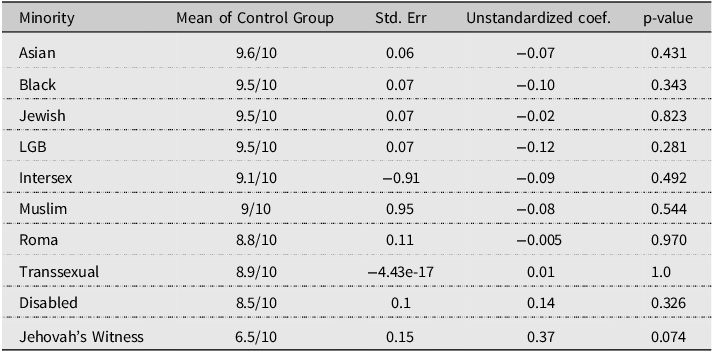
We find mostly null effects on tolerance toward minorities, with the only significant effect (p = 0.07) being on tolerance toward Jehovah’s Witnesses.
This might be due to ceiling effects. As shown in Table 1, tolerance measures for minorities are extremely high in the control group, with all variables having baseline values of at least 9 on a scale from 0 to 10. This indicates that the sample is already very positive toward minorities before treatment, leaving little room for change.Footnote 9 Interestingly, the one significant effect found is on tolerance toward Jehovah’s Witnesses, the least tolerated outgroup at baseline.Footnote 10 This suggests that monuments like Stolpersteine might be particularly effective in changing attitudes toward minority groups facing low tolerance or in contexts with low overall tolerance for minority groups.Footnote 11
Null effects on tolerance toward minorities may be driven by ceiling effects

A potential concern is the increased likelihood of type I errors due to the large number of outcomes tested. To address this, Table 2 in the Appendix presents the p-values from the models in Figure 2 with Bonferroni-adjusted significance levels. Coefficients on emotions remain significant, with the exception of fear. However, comfort with Jehovah’s Witnesses as coworkers, and the beliefs about granting asylum to refugees and that refugees are more to blame for crime (inverted), are no longer statistically significant.
However, Bonferroni adjustments are often criticized for being overly conservative, especially with a high number of outcomes (Liu and Shiraito Reference Liu and Shiraito2023). Robustness checks and additional analyses are in the online Appendix. Figure B.1 in the online Appendix shows that results remain similar after covariate adjustment for emotions and for comfort with working with Jehovah’s Witnesses.
Heterogeneous treatment effects
We conduct exploratory analyses to see if the effect of Stolpersteine is moderated by pre-treatment covariates.Footnote 12 We find greater variation with political covariates, such as interest in politics and left-right positioning.
We measured political interest with a dummy variable: 0 for “Very interested” or “Fairly interested” in politics, and 1 for “Not very interested” or “Not at all interested.” The effect on emotions is higher for those with greater political interest (Figure 3).
Heterogeneous treatment effects by political interest. Note: The reference category is high political interest (fairly interested, very interested).

We analyzed heterogeneous treatment effects by ideology using a dummy variable: 1 for respondents above 5 on an 11-point scale and 0 for those below 5. The arithmetical and psychological center (5) was coded as missing. Results in Figure 4 show that while the treatment increases negative emotions (anger, sadness, disgust, and hostility) for both left and right individuals, the effect is smaller for right-wing individuals.
Heterogeneous treatment effects by ideology. Note: The reference category is left.

Attitudes toward refugees become more negative for those on the right after exposure, although only the belief that refugees increase terrorism is statistically significant (p = 0.023).
We examined whether effects vary by age (Figures E.3 to E.6), gender (Figure E.7), education level (Figure E.8), or religiosity (Figure E.9). No evidence of heterogeneity was found other than suggestive evidence that the effect on emotions is stronger for individuals with college education. Results are in the online appendix.
Discussion and conclusion
Tolerance of minority groups is a central democratic value, and many countries honor victims of intolerance to foster it. Our experiment showed that small-scale memorials for Holocaust victims in Germany generated strong emotional responses, though the effect on attitudes was less clear.
The null effects on many attitudinal measures likely result from high baseline tolerance in our sample. The few significant effects were among Jehovah’s Witnesses, who face lower tolerance, suggesting that such memorials may improve tolerance for highly discriminated groups. However, analyses based on ideology show that right-leaning individuals expressed more negative attitudes toward refugees. While this result may indicate backlash to the treatment, it should be interpreted with caution, as only one coefficient reaches statistical significance.
The high baseline tolerance in our sample suggests our results may represent a lower-bound effect. In contexts with higher discrimination, such interventions might have a stronger impact.
An alternative explanation for the differing effects on emotions and attitudes could be their nature: attitudes are more stable and harder to change than emotions. Future studies should replicate these analyses with samples showing lower baseline tolerance to clarify which explanation drives the difference in results.
One concern that might be raised is whether a survey experiment is the most suitable means to measure the effect of the Stolpersteine, as they have been designed to impact their surrounding environment. Isolated from contextual factors, a survey experiment cannot fully capture their real-life effect as these memorials remind people that Holocaust atrocities occurred in the vicinity they experience everyday, potentially enhancing their emotional impact.
Turkoglu et al.’s (Reference Turkoglu, Ditlmann and Firestone2023) and Pereira and Hager’s (2023) studies provide compelling evidence of Stolpersteine reducing AfD vote shares, highlighting their potential to influence broader societal outcomes. While our survey experiment focuses on individual-level emotions and attitudes, it is possible that the emotional responses we examine play a role in mediating such electoral effects. However, our sample and methodology are not suited to establish this link directly. Future research, possibly through large-scale survey experiments, could explore whether emotional mechanisms like empathy and tolerance drive these observed electoral changes. By integrating insights from our study with studies based on observational data, we can better understand the pathways through which Stolpersteine impact society.
The experiment may be underestimating the real-life effect of the Stolpersteine. By having participants read information on their computers or phones, we may have enhanced the experimental treatment’s effect. This design might not fully represent real-life scenarios where such information could be overlooked. However, while some may choose to ignore specific stones, their dense distribution in German cities ensures most people notice them. This unavoidable presence has provoked strong reactions, such as the AfD’s criticism as a “dictatorship of remembering” (Lucht Reference Lucht2018). Thus, the emotional impact might be stronger in real life, as people see where victims lived and how many neighbors were affected. Future research can expand on this issue by employing complementary designs, such as surveying individuals who have been exposed to these memorials.
While our sample is young and skews liberal, we believe that readers can still learn from the results of our study. The perspectives of younger, more liberal individuals are essential in understanding current and future societal trends regarding Holocaust remembrance and education. At the same time, we believe that a younger sample provides an interesting case. The younger generation is the first to lack direct contact with Holocaust survivors or perpetrators, resulting in a less immediate historical connection compared to previous generations.
The impact of Stolpersteine may vary based on whether individuals belong to a majority or a minority group. For minorities, the effect might be weaker due to familiarity with similar narratives and a higher baseline tolerance, or stronger due to greater empathy with other minority groups. While we remain agnostic about the direction of this effect, our sample size precludes further investigation. Future research could provide clearer insights.
Overall, our results suggest that citizens are not indifferent to small daily-life monuments, and that monuments and memorials can prompt strong emotional reactions. Further research should investigate if specific emotions are linked to different attitudinal and behavioral effects in public commemorations.
Supplementary material
The supplementary material for this article can be found at https://doi.org/10.1017/XPS.2025.10022
Data availability
The data, code, and any additional materials required to replicate all analyses in this article are available at the Journal of Experimental Political Science Dataverse (Ruipérez Núñez and Sauter Reference Ruipérez Núñez and Sauter2025) within the Harvard Dataverse Network, at: https://doi.org/10.7910/DVN/UKZAEX.
Competing interests
The authors declare no competing interests.
Ethics Statement
The survey and research design have been approved by an independent ethics board of the European University Institute in 2022. Further information on consent and debriefing participants can be found in the Reporting section of the appendix.




 Open access

