


Impact statement
Some Cambridge Journals (such as our Prisms journals) require an Impact Statement section. Comment out this section if it is not required. A short summary on the wider beneficial use of the research presented in your article. This statement should give a broader perspective on the contribution this research is making to the field. The reported impact can be local, regional or international in its reach. Impact statements should not exceed 300 words and be comprehensible to a broad, potentially non-academic audience.
Introduction
The Australian funeral industry is facing an increasing environmental and cultural crisis. What was once an intimate, family and community-led practice (Kelly Reference Kelly2012) has been transformed by a Death Industrial Complex (DIC) that prioritises profit while perpetuating ecologically harmful, unsustainable systems. The concept of the DIC is central to understanding these issues. This term refers to the extensive network of commercial funeral service providers and associated businesses that now dominate the funeral industry. More recently calls for ‘sustainable’ alternatives are increasingly subject to greenwashing the misleading marketing of products as environmentally responsible (Kelly Reference Kelly2012; Krupar Reference Krupar2017). While public demand is growing for meaningful change, most mainstream alternatives still focus on reducing harm, rather than providing genuine ecological benefits. Woodthorpe et al. (Reference Woodthorpe, Olson, Robins, Robinson, McClymont and Cox2026) categories this as individual consumer choice versus a collective ecological imperative, this framing limits the attention that this topic receives from a policy or an industry innovation perspective.
Alkaline hydrolysis, also referred to as ‘water cremation’, has emerged as a technological innovation with the potential to provide active environmental restoration (Scarre Reference Scarre2024). This process employs heated, alkaline water to accelerate natural decomposition, resulting in nutrient-rich liquid effluent and bone ash (Arnold et al. Reference Arnold, Kohn, Nansen and Allison2023; Robinson Reference Robinson2025). Currently, these outputs are often managed as waste (Robinson Reference Robinson2021; Scarre Reference Scarre2024). There is a critical need for a design framework that extends circular and regenerative principles to reintroduce human matter into natural cycles, thereby closing ecological loops and supporting ecosystem restoration.
Within the DIC, there needs to be a shift to embrace a regenerative paradigm, transforming the way we view human matter from disposable waste to a resource for ecological renewal that restores cycles aligned with nature (Rumble et al. Reference Rumble, Troyer, Walter and Woodthorpe2014; Becher Reference Becher2021), reconnecting death with natural systems rather than continuing to separate them. We need to be designing with ecological temporalities and embedding – not perceived obsolescence – but regenerative obsolescence and decay (the process by which designed objects intentionally break down and provide ecological benefit) into the nature of our designs from their inception. Creating objects and systems in this manner produces value in two clearly identifiable ways: their physical materiality (what they are made of) and their temporal status (they are here only for a short time). This project contributes to the methodological framework for designing regenerative death rituals that provide people with more disposition options that reflect natural cycles and embrace the ‘…celebration of presence and ephemerality. (Harper Reference Harper2021)’.
This paper makes a contribution towards a theoretical foundation for distinguishing regenerative from sustainable approaches within death care, framing current practices as both environmental and cultural issues. The structure proceeds in several stages: first, it introduces three core paradigms of death care, extractive, sustainable and regenerative, to provide a conceptual overview of the industry. Building on this framework, the paper advocates for situating death within restorative ecological cycles. It then presents alkaline hydrolysis biomaterials as a case study, demonstrating how post-mortem materials can facilitate ecological restoration while addressing human needs for grief, ritual and memorialisation. The research proposes a design methodology that recognises more-than-human entities as active participants in the design process, moving beyond an anthropocentric focus. The biomaterials exemplify this post-anthropocentric orientation by integrating ecosystem requirements and ecological function as primary design guidelines. This work is situated within the field of biodesign: a transdisciplinary practice bridging design and biological science to harness living organisms and biological processes for material and systemic innovation (Pollini and Rognoli Reference Pollini and Rognoli2024) and specifically engages with the living artefacts framework for regenerative ecologies (Karana et al. Reference Karana, McQuillan, Rognoli and Giaccardi2023) which proposes that biodesigned artefacts can function as part of mutualistic, coevolutionary systems versus discreet objects. The following section systematically examines the conceptual and theoretical foundations that inform regenerative design in the context of death care.
Theoretical foundations: regenerative vs. sustainable design
Death care practices fall into three catagories: extractive (resource-intensive, polluting and anthropocentric – focused on human needs above all else); sustainable (minimising harm but not changing the disposal mindset); and regenerative (turning death into an opportunity for renewal and ecosystem health). These three categories exist on a spectrum and are not discrete paradigms, the boundaries between sustainable and regenerative are continually contested and shifting. This project does not claim to have invented regenerative death care; many of the precedents, NOR, conservational burial, LOOP Biotech Living Coffin, all participate in contributing positively to ecology and regenerative landscapes. Regenerative Remains contributes a methodological extension of this trajectory, by designing ritualised artefacts from the specific material outputs of alkaline hydrolysis – effluent and bone ash – making the transformation of human matter into landscape tangible and participatory for bereaved communities.
Within the DIC, an underlying extractive narrative permeates all aspects of traditional burial and cremation and is highly resistant to change (Beard and Burger Reference Beard and Burger2017). It positions death as a disposal problem, adopting an ‘out-of-sight’ approach that doesn’t eliminate matter, but instead relocates or transforms it into toxins and gas emissions (Hetherington Reference Hetherington2004; Rumble et al. Reference Rumble, Troyer, Walter and Woodthorpe2014; Slominski Reference Slominski2023). Traditional burial and cremation contribute significantly to CO2 emissions (Tasmania’s funeral industry generates approximately 761,000 kg of CO2 annually (Australian Bureau of Statistics 2025) – equivalent to more than 4,600 Sydney–Melbourne return flights (‘ICAO Carbon Emissions Calculator’ n.d., authors’ calculation) and contaminate the environment through embalming chemicals (Keijzer Reference Keijzer2017; Slominski Reference Slominski2023) and deforestation from hardwood casket production (Coutts et al. Reference Coutts, Basmajian, Sehee, Kelty and Williams2018; MacMurray and Futrell Reference MacMurray and Futrell2019). This extractive approach not only depletes and damages natural resources but also spreads misinformation and encourages death illiteracy, often exploiting bereaved families by promoting preservation technologies (Canning and Szmigin Reference Canning and Szmigin2010; Gunders Reference Gunders2024) rather than natural, nutrient-cycling options (Manning Reference Manning2023). It pollutes soils and waterways with embalming chemicals (Keijzer Reference Keijzer2017; Slominski Reference Slominski2023) and generates permanent waste with the construction of concrete vaults and metal caskets (Coutts et al. Reference Coutts, Basmajian, Sehee, Kelty and Williams2018; MacMurray and Futrell Reference MacMurray and Futrell2019) which are all intended for preservation; breaking away from natural cycles of decomposition and the recycling of matter (Canning and Szmigin Reference Canning and Szmigin2010; Becher Reference Becher2021; Westendorp and Gould Reference Westendorp and Gould2021; Oster Reference Oster2022). There has been a surge in biodegradable caskets made from materials such as cardboard, wool and even invasive vines (Ross Reference Ross2025) for use in natural burials, and efforts have been made to reduce cremation emissions to an acceptable level (Rumble et al. Reference Rumble, Troyer, Walter and Woodthorpe2014). This is still operating within a disposal paradigm, limited in its response by asking how we ‘die with less impact’ and not ‘how can death heal ecosystems’ (Becher Reference Becher2021).
Sustainable death care emerged to address the problems created by this extractive system, though at its essence, it’s promoting less harm rather than proactively trying to effect change. A critical assessment reveals that the sustainable paradigm still operates within the DIC framework by reducing negative impacts while maintaining current systems (Krupar Reference Krupar2017). Krupar argues that the green death discourse often repackages post-mortem disposition as ‘environmental’, without fundamentally changing the current market system. However, green burials account for only 5% of dispositions in the US and 10% in the UK (Woodthorpe et al. Reference Woodthorpe, Olson, Robins, Robinson, McClymont and Cox2026), these low numbers suggest that individual choice within a market system is not sufficient to trigger systemic change.
A number of emerging regenerative burial approaches are already in existence: Natural Organic Reduction (NOR): human composting which places the body in organic material to aid the microbial breakdown of the body into a nutrient-rich soil (Urban Death Project n.d), and conservation burials in which the body is placed in a designated bushland with the aim of regenerating natural landscapes (Croker Reference Croker2025). This project builds on that trajectory, extending it through the specific material affordances of alkaline hydrolysis outputs and a designed ritual process that actively involves the bereaved in the visible transformation of an ecosystem.
Regenerative death care shifts the way we view human matter from waste to be disposed of to a resource for ecological renewal. A methodological framework for regenerative death can provide both rituals and disposition options that integrate death into natural cycles (Rumble et al. Reference Rumble, Troyer, Walter and Woodthorpe2014; Becher Reference Becher2021; Slominski Reference Slominski2023). Our success should not be measured by human comfort alone, but by tangible benefits to soil, plants and broader ecosystems. This means designing materials and rituals that support both human grief needs and ecological healing. Regenerative death care has the potential to address both inner and outer sustainability (Pollini and Rognoli Reference Pollini and Rognoli2024). Applied here, this means transitioning internal grief to external care, supporting a shift from anthropocentric (human-centred) to life-centred (inclusive of non-human life) worldview and multi-species flourishing, categorised by multiplicity (diversity of species in the interaction), connectivity (extent and degree of interactions) and reciprocity (mutualistic care between human and non-human organisms) (Groutars et al. Reference Groutars, Kim and Karana2024). Furthermore, when implementing regenerative frameworks, we may introduce unforeseen ecological or sociocultural consequences, especially in contexts with varied religious or cultural expectations regarding death and body disposition (Manning Reference Manning2023; Miller and Beaman Reference Miller and Beaman2024). In recognising the importance of non-human stakeholders, we balance respect for human diversity and autonomy in mourning practices. Therefore, transitioning towards a regenerative paradigm should be accompanied by a context-sensitive ethical reflection and practical assessment.
Traditionally, the methods of preservation and memorialisation cater to grief, emotion and sociocultural expectations, and the selection of materials for these practices has been based on human aesthetic and cultural comfort, without consideration for the effects these actions have on ecosystems or our relationship with death (Canning and Szmigin Reference Canning and Szmigin2010; Rothstein Reference Rothstein2018; Slominski Reference Slominski2023). Becher relays a concept found in Alice Munro’s short story, Heirs of the Living Body, about nature and the transformation of matter. Munro opens with the question, ‘What is a person?’, answering that it is the body’s chemical makeup, which, in the right combination, makes a human, though it can be unmade and transformed into something else. She says humans know this as ‘death’, but from a post-anthropocentric perspective, we could see it as nature recycling matter into a new form – ‘even flowers’ – pointing to the ‘shared materiality of humans and non-humans’ (Becher Reference Becher2021). Using this approach, we shift our measure of success from human satisfaction to encompass soil ecosystems, mycorrhizal networks and plant communities as legitimate stakeholders. We can acknowledge that the objects we design for death carry cultural weight, making visible our society’s beliefs about mortality and the body (Arnold et al. Reference Arnold, Kohn, Nansen and Allison2023). Rather than prioritising human cultural comfort over ecological function, regenerative biomaterials need to serve both: honouring grief rituals while actively nourishing soil and supporting new life. Post-anthropocentric death methodologies allow us to recognise human matter as having agency in ecological cycles, creating space for regenerative design interventions that draw value from non-human flourishing.
Nature operates through processes of continuous matter cycling. Death is an essential aspect of these regenerative cycles, embracing the idea that through decomposition we might give back to something bigger than ourselves and ‘live on’ in a transformed state (Miller and Beaman Reference Miller and Beaman2024; Gould and Halafoff Reference Gould and Halafoff2025). Manning’s Reference Manning2023 study of non-religious elders and their views on the afterlife revealed a growing understanding of how our bodies’ nutrients are valuable to nature and that the cycle of death continues to support life. Industrial death care interrupts these cycles by denying our mortality through preservation and attempting to destroy evidence of it through cremation (Westendorp and Gould Reference Westendorp and Gould2021). There is an emerging culture shift away from the DIC, changing the finality of death-as-ending to death-as-transformation, inevitably affecting our relationship to death and the environment (Rumble et al. Reference Rumble, Troyer, Walter and Woodthorpe2014). This project explores how we might design rituals that embody matter-recycling principles through regenerative biomaterials that begin to blur the lines between what is human and what is non-human. This project situates its biomaterial artefacts within the emerging biodesign literature on regenerative ecologies, developed by Karana et al. (Reference Karana, McQuillan, Rognoli and Giaccardi2023). The principles of regenerative ecologies are delineated as mutualism, coevolution and cohabitation, in which the boundaries between human and nature are interwoven, reciprocal, transforming and evolving shared habitats. Karana et al. outline five pillars to guide this practice, of which this work engages most directly with Pillar 1 and Pillar 5. Pillar 1 calls for a temporal alignment of artefact and material cycles into living systems. The 24-month decomposition timeline is deliberately calibrated to both plant establishment cycles and the grief visitation patterns of bereaved communities. This project may be understood as transmuting the materials from our own human life cycle nourishing ecological landscapes and expanding regenerative capacity. The ritualistic dimension of this project supports Pillar 5, which addresses healing the longstanding cognitive separation of humans from nature, through the potential for cultural change and the shifting of worldviews through a transference of care from human to landscape. This project invites participants into an ongoing, visible and tangible encounter with ecological transformation. Where Karana et al. focus on living organisms (fungi, algae, bacteria) we propose using a biological material to activate living ecological process in soil and tree after burial. In this sense this work does not apply the living artefacts framework directly, but a variation in which resource recovery as part of a biodesign practice supporting ecological and human regeneration.
Cultural context: existing death rituals and their limitations
Existing rituals include ash scattering ceremonies, and more recently, becoming a tree through the patented ash treatment process at Mornington Green Legacy Gardens (Mornington Green Legacy Gardens 2026). The literature reveals a growing trend towards alternative options that promise to transform post-mortem matter by returning it to nature (Rumble et al. Reference Rumble, Troyer, Walter and Woodthorpe2014; Becher Reference Becher2021; Manning Reference Manning2023; Croker Reference Croker2025; Urban Death Project n.d.). Alternatives have emerged to satisfy the desire for this eco-death disposition, from the aforementioned Mornington Green Legacy Gardens, NOR (Urban Death Project n.d.) and conservation burials (Croker Reference Croker2025), to custom death shrouds for natural burial (Interlandi 2013), biodegradable burial pods (Figure 1) (Kostur Reference Kostur2022) and speculative trans-species trees (Fukuhara and Tremmel 2003). Eco-death consumerism and greenwashing are becoming a barrier to genuine change within the industry, as avenues to meet the public demand to leave behind a green legacy evolve into ‘just another consumer choice (Kelly Reference Kelly2012)’, rather than addressing the actual environmental impacts. While NOR and conservation burial demonstrate that regenerative disposition is achievable, neither engages the specific material outputs of alkaline hydrolysis – effluent and bone ash – as designed artefact inputs, nor do they propose ritualised experience in which the bereaved bear witness to the design material and landscape transformation over time. The project aimed to design a regenerative ritual that returns human matter to living systems, primarily through matter recycling, using biomaterial artefacts as ritual enablers.
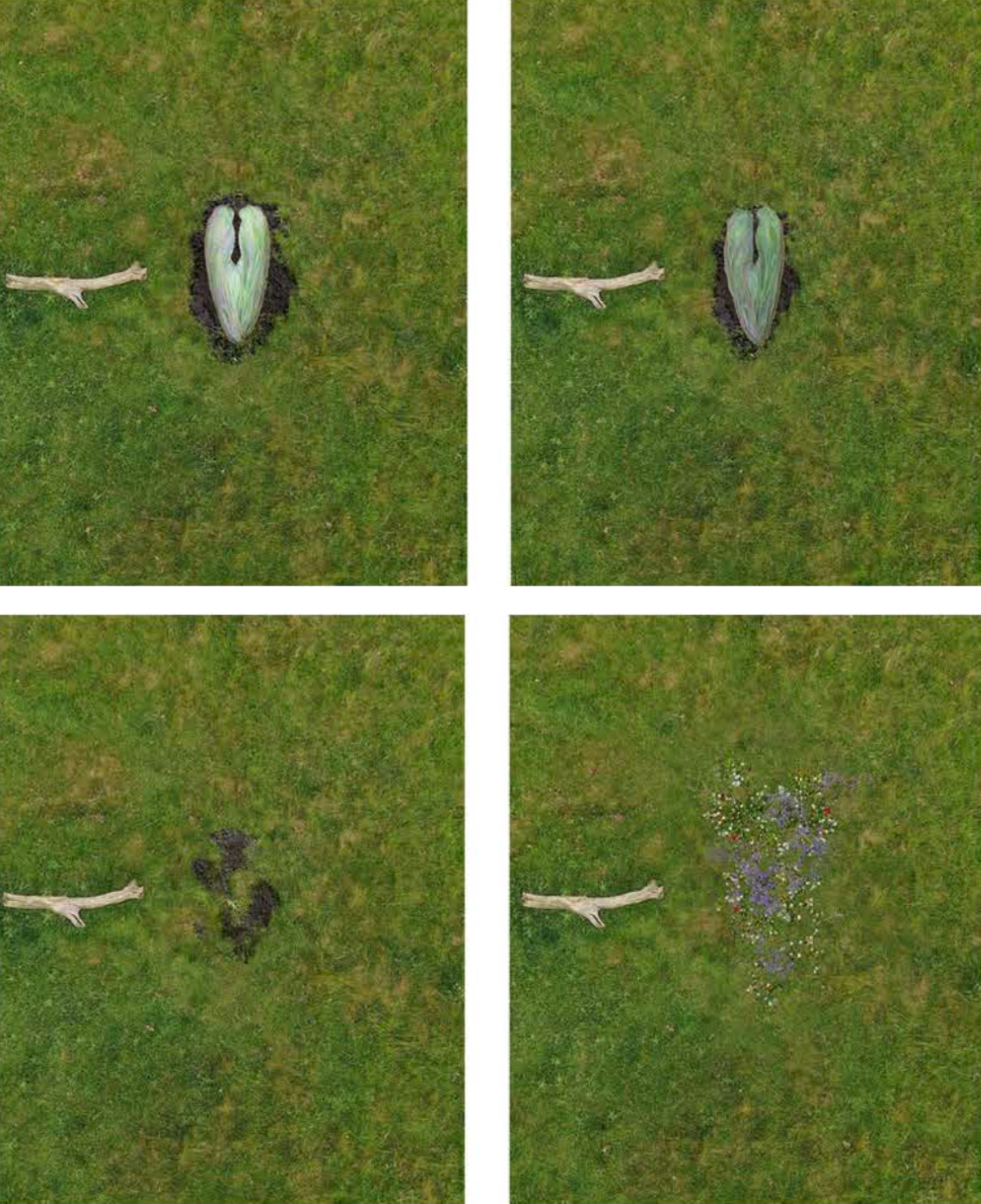
Continuum: The lifecycle of the cocoon burial pod (Kostur Reference Kostur2022).
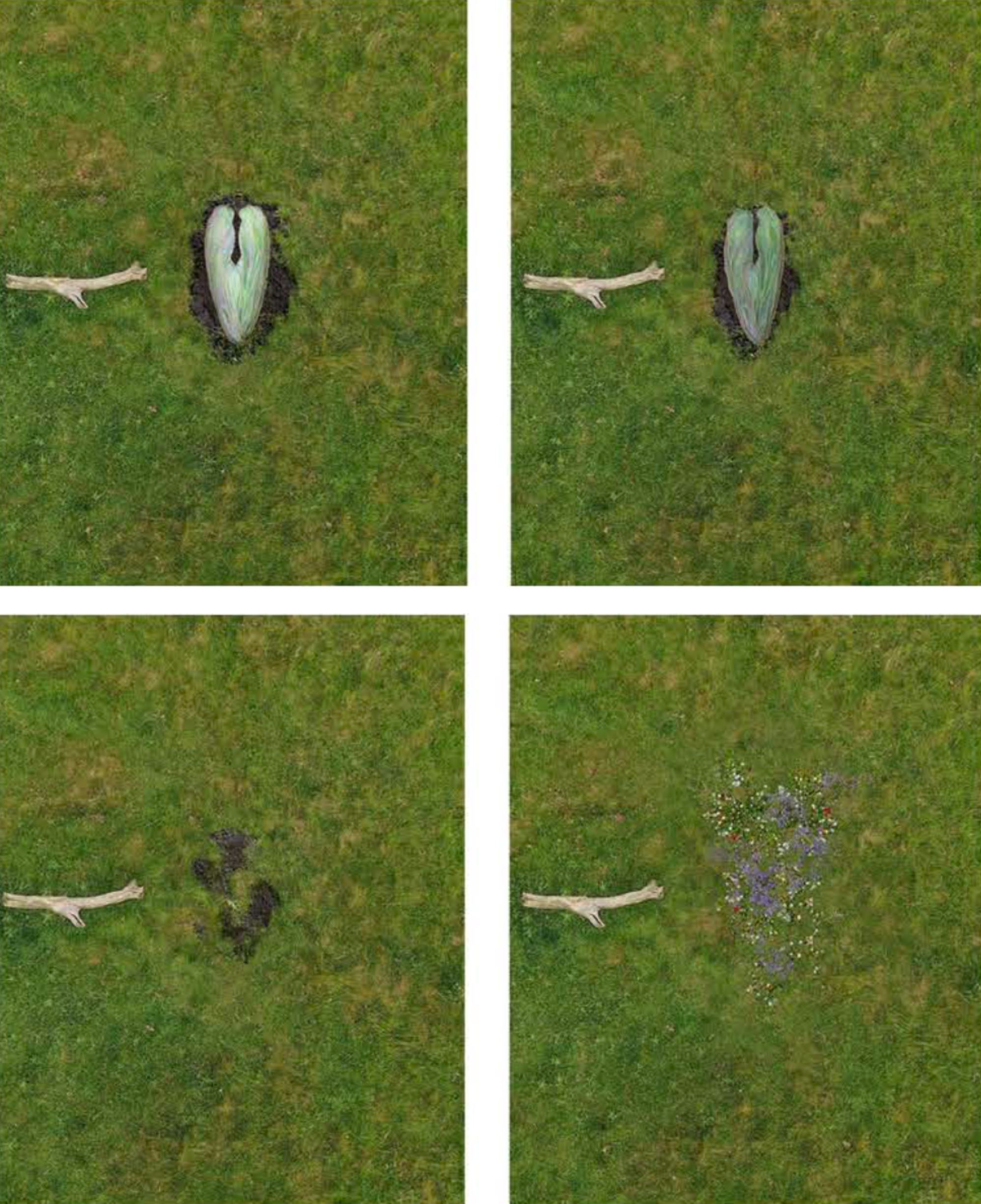
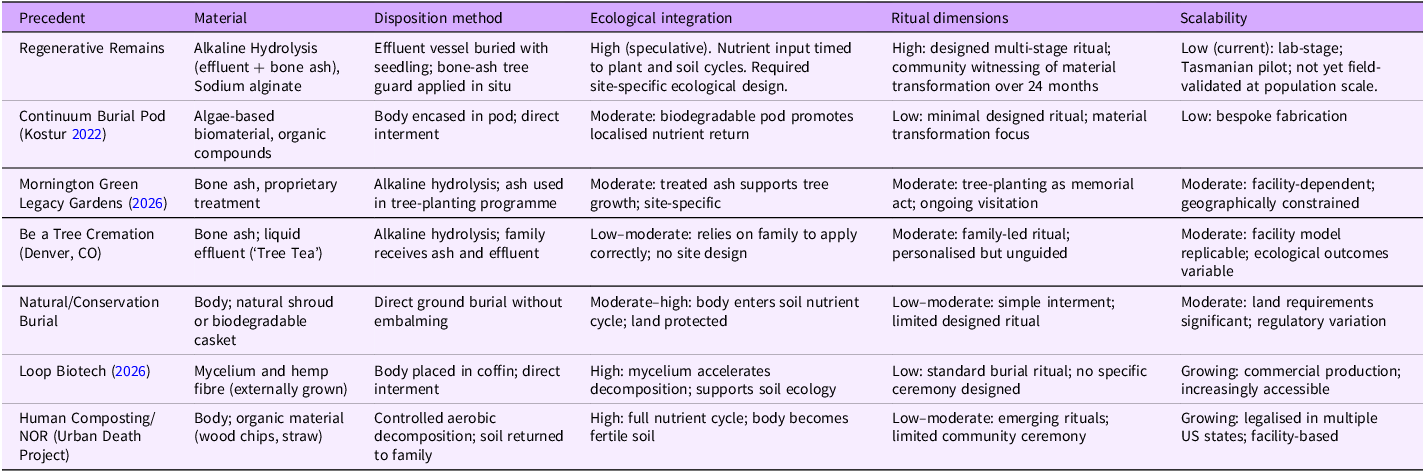
Precedents like Leksi Kostur’s Continuum project (Kostur Reference Kostur2022) exemplify the beauty and transformation of death within these natural cycles, facilitating regeneration through a biomaterial-led narrative of transition from an individual existence to a restored ecosystem. Designing an object made from a bone-ash-based biomaterial meant considering how the form could embody the material’s properties, allowing it to emerge through the gentle visualisation of skeletal remains protecting new life. When the dance with time concludes and the tree guard has broken down, a material memory remains; the bone ash presence continues in the soil and the tree, a living legacy that can be visited for generations. Table 1 maps the precedents across five dimensions, revealing that ecological integration is well served and scalability is increasing.
Precedent comparison table across 5 dimensions
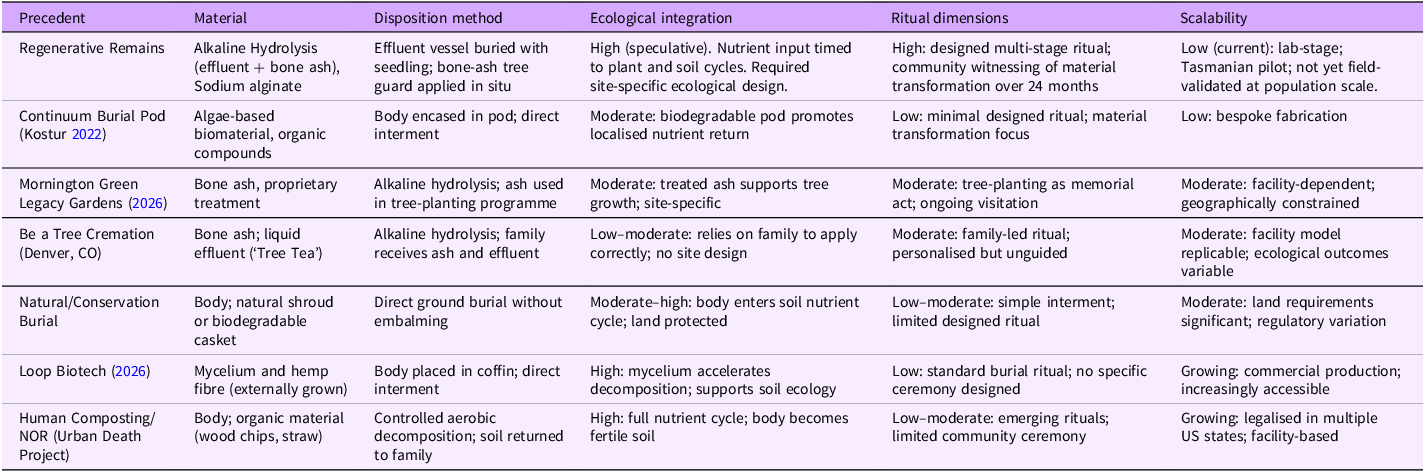
Table 1 Long description
The table compares various precedents across five dimensions: Material, Disposition method, Ecological integration, Ritual dimensions, and Scalability. It has 8 rows and 6 columns. The columns are labeled Precedent, Material, Disposition method, Ecological integration, Ritual dimensions, and Scalability. Row 1: Precedent, Regenerative Remains; Material, Alkaline Hydrolysis (effluent + bone ash), Sodium alginate; Disposition method, Effluent vessel buried with seedling; bone-ash tree guard applied in situ; Ecological integration, High (speculative). Nutrient input timed to plant and soil cycles. Required site-specific ecological design.; Ritual dimensions, High designed multi-stage ritual; community input witnessing of material transformation over 24 months; Scalability, Low (current): lab-stage; Tasmanian pilot; not yet field-validated at population scale. Row 2: Precedent, Continuum Burial Pod (Kostur 2022); Material, Algae-based biomaterial, organic compounds; Disposition method, Body encased in pod; direct interment; Ecological integration, Moderate: biodegradable pod promotes localised nutrient return; Ritual dimensions, Low: minimal designed ritual; material transformation focus; Scalability, Low: bespoke fabrication. Row 3: Precedent, Mornington Green Legacy Gardens (2026); Material, Bone ash, proprietary treatment; Disposition method, Alkaline hydrolysis; ash used in tree-planting programme; Ecological integration, Moderate: treated ash supports tree growth; site-specific; Ritual dimensions, Moderate: tree-planting as memorial act; ongoing visitation; Scalability, Moderate: facility-dependent; geographically constrained. Row 4: Precedent, Be a Tree Cremation (Denver, CO); Material, Bone ash; liquid effluent (Tree Tea); Disposition method, Alkaline hydrolysis; family receives ash and effluent; Ecological integration, Low-moderate: relies on family to apply correctly; no site design; Ritual dimensions, Moderate: family-led ritual; personalised but unguided; Scalability, Moderate: facility model replicable; ecological outcomes variable. Row 5: Precedent, Natural/Conservation Burial; Material, Body, natural shroud or biodegradable casket; Disposition method, Direct ground burial without embalming; Ecological integration, Moderate-high: body enters soil nutrient cycle; land protected; Ritual dimensions, Low-moderate: simple interment; limited designed ritual; Scalability, Moderate: land requirements significant; regulatory variation. Row 6: Precedent, Loop Biotech (2026); Material, Mycelium and hemp fibre (externally grown); Disposition method, Body placed in coffin; direct interment; Ecological integration, High: mycelium accelerates decomposition; supports soil ecology; Ritual dimensions, Low: standard burial ritual; no specific ceremony designed; Scalability, Growing: commercial production; increasingly accessible. Row 7: Precedent, Human Composting/NOR (Urban Death Project); Material, Body; organic material (wood chips, straw); Disposition method, Controlled aerobic decomposition; soil returned to family; Ecological integration, High: full nutrient cycle; body becomes fertile soil; Ritual dimensions, Low-moderate: emerging rituals; limited community ceremony; Scalability, Growing: legalised in multiple US states; facility-based.
Alkaline hydrolysis: regenerative resource recovery
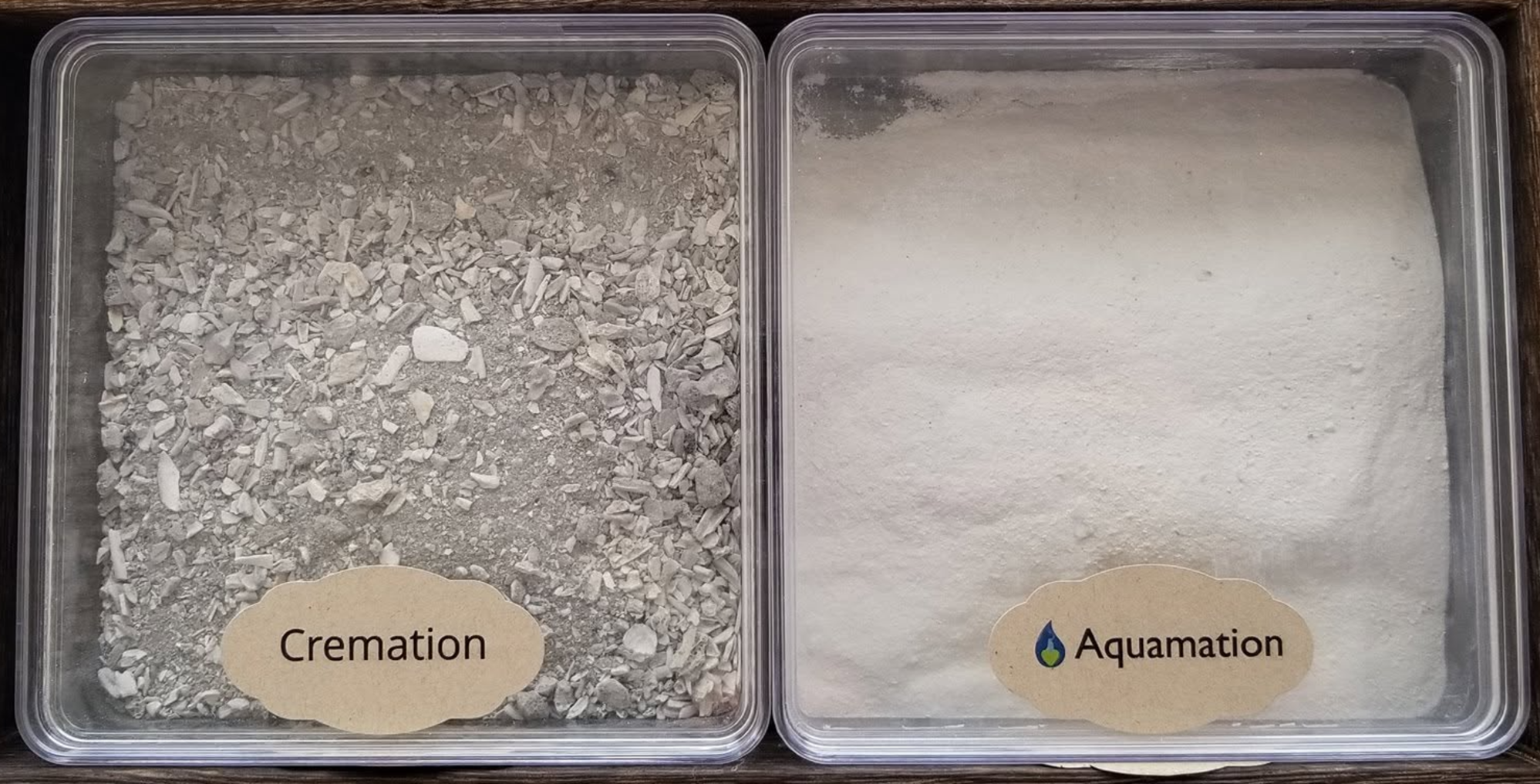
Human bodies are made of a complex chemical composition that can be broken down through the gentle, sustainable process of alkaline hydrolysis (water cremation) (Kelly Reference Kelly2012). As briefly mentioned above, this process uses heat, pressure, water and an alkali (5%), usually potassium hydroxide, to break down tissue and preserve nutrients through accelerated natural decomposition, taking around 8–12 hours. What remains after this time are two outputs: a nutrient-rich liquid effluent (a by-product that retains much of a body’s nutritional value, but notably no identifiable DNA or RNA (Arnold et al. Reference Arnold, Kohn, Nansen and Allison2023) and bone fragments (which make up about 5% of the original mass), which can be turned into ashes (Robinson Reference Robinson2025) (see Figure 2). Water cremation ensures nutrients remain available, unlike traditional cremation, which destroys them or burial, which sequesters them. Compared with conventional fire cremation, it uses, on average, 1/4 the energy and produces no additional emissions, making it a viable, sustainable alternative (Robinson Reference Robinson2021; Arnold et al. Reference Arnold, Kohn, Nansen and Allison2023).
Ashes from fire cremation vs water cremation.
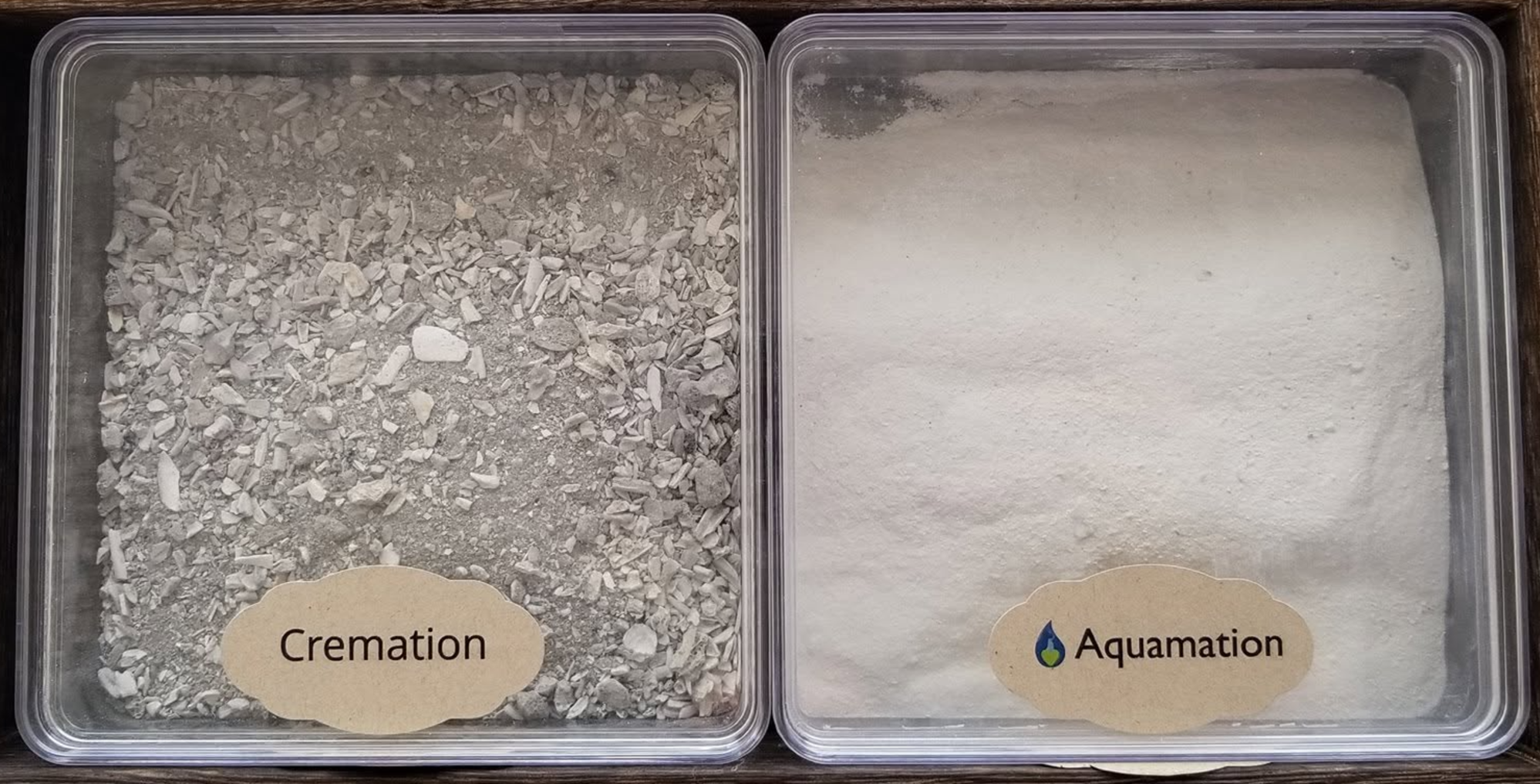
There is significant potential to shift from disposal technology to resource recovery through alkaline hydrolysis, aligning with the emerging environmental discourse that points out that disposal of any kind is never final, and can be transformed to align with natural cycles (Hetherington Reference Hetherington2004; Rumble et al. Reference Rumble, Troyer, Walter and Woodthorpe2014; Becher Reference Becher2021).
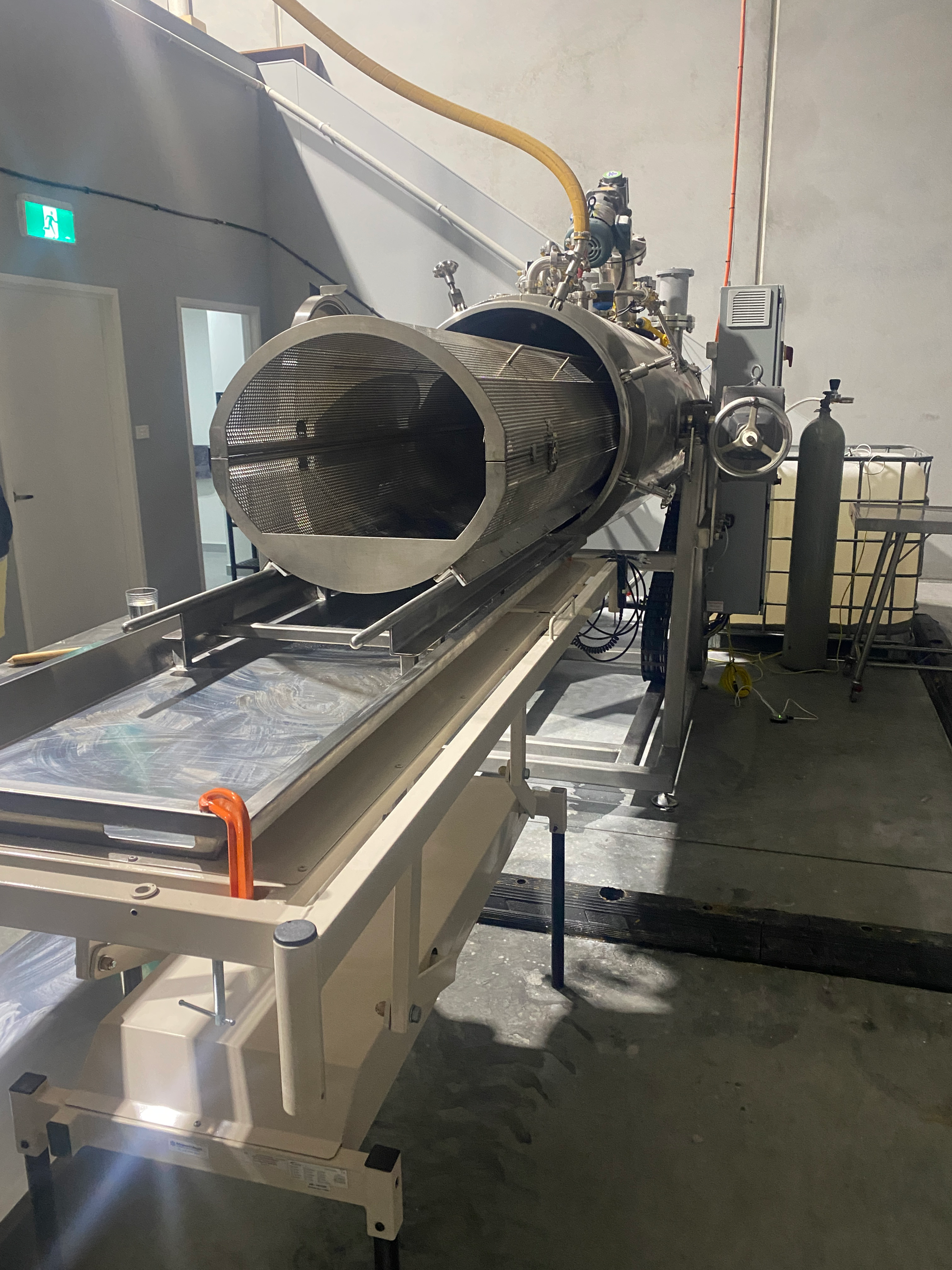
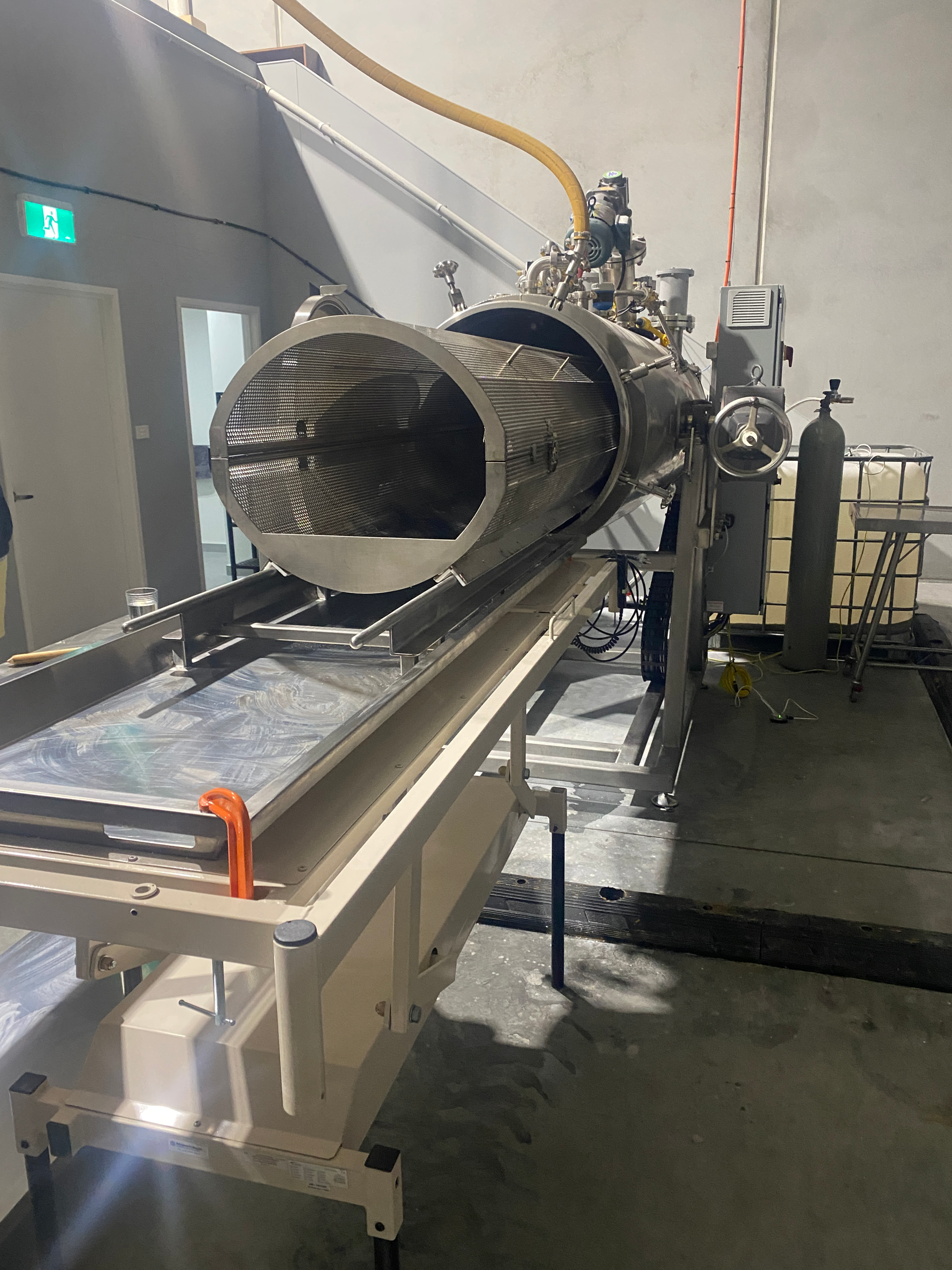
The main output from the alkaline hydrolysis process is effluent. This liquid fertility comprises potassium, nitrogen, amino acids, phosphorus and other nutrients with proven regenerative potential. These bioavailable nutrients can support plant and microbial growth at multiple scales (Mornington Green Legacy Gardens 2026); however, the degree of ecological benefit depends on application rate and timing, soil type and existing nutrient loads – conditions that vary significantly across sites. The liquid form enables targeted application and is sterile due to processes that destroy any pathogens, resulting in a neutral pH (Arnold et al. Reference Arnold, Kohn, Nansen and Allison2023). Current practices for disposing of effluent vary. It was commonly sent to wastewater or water reclamation, a practice that raised public concerns, as opponents of the emerging technology claimed people’s loved ones were being poured ‘down the drain’ (Robinson Reference Robinson2021; Scarre Reference Scarre2024). In a Tasmanian context, Alluvium Water Cremations is paving the way for alternative solutions. Located a few hundred metres from an industrial composting facility servicing areas near Hobart, Tasmania, Alluvium is passionate about creating sustainable solutions to ‘redefine the future of cremation while preserving the beauty of our planet for generations to come’ (Alluvium Water Cremations 2026) (See Figure 3). They send the effluent from their cremations for composting, preserving the nutrients and honouring the legacy of the dead through positive environmental action.
Alkaline Hydrolysis at Alluvium Water Cremations.
The second output from the water cremation process is bone. These physical remains are sometimes complete and sometimes fragmented, but the process leaves them in a porous state, which is then dried and ground to a fine powder. As with traditional cremation, this is usually returned to families as ‘ashes’ or ‘cremains’. The bone ash from a water cremation is much lighter in colour than that from a fire cremation, and there is a much larger amount, as less is broken down during the cremation process. These bright, white ashes are a vital mineral resource, composed chiefly of calcium phosphate (85 – 90%), and if treated correctly, can be used to improve soil structure. They are commonly returned to families and often scattered as a memorial ritual at a place of significance to the deceased or around a plant. However, the presumption that trees and plants will absorb these ashes often overlooks significant environmental risks that are rarely scrutinised in public discourse or industry guidelines. With a pH level usually between 9 and 12 (similar to bleach) and a high sodium content, applying large, untreated amounts to a developing tree would not be favourable for its survival (Slominski Reference Slominski2023). These effects threaten seedling establishment, soil microbial balance and long-term vegetative health, potentially counteracting any intended regenerative benefit. Whether these risks materialise depends on site-specific conditions: application rate, existing soil nutrient loads, soil type and the buffering capacity of the surrounding substrate all mediate outcomes. Ecological benefit cannot be assumed from material composition alone. Sustainable or regenerative frameworks need to account for these vulnerabilities by ensuring bone ash is modified or diluted before application. On a small scale, Be a Tree Cremation (Denver, CO, USA) returns both ashes and ‘fertiliser’ to kin, who can opt in to receive a small bottle of effluent for ritual use (Figure 4). Robinson (Reference Robinson2021) describes how people’s desire to ‘return to nature’ inspired Be a Tree’s ‘Tree Tea’. For many, the conceptualised notion of ‘becoming a tree’, ‘nourishing’ the plants and soil and ‘nurturing’ the environment offered the option to ‘live’ on after death. While symbolically powerful, these practices must rely on evidence-based practices to avoid inadvertent environmental harm and genuinely contribute to ecosystem restoration.
‘Tree Tea’ by Be a Tree Cremation (Water Cremation 2025).

‘Today’s wastes are tomorrow’s raw materials’ (Franklin and Till 2018, as cited in Rognoli et al. Reference Rognoli, Alessandrini, Pollini, Earley and Hornbuckle2023), are at the heart of the bioeconomy and the emerging field of byproduct or waste streams used for biomaterial design. Within biodesign, there is an increasing breadth of material-led approaches to biological waste and by-product streams, many of these are organism grown materials, including mycelium composites, algae-based biopolymers and bacterial cellulose (Karana et al. Reference Karana, Blauwhoff, Hultink and Camere2018). Projects such as Loop Biotech’s Living Cocoon made from Mycelium and hemp fibres (Loop Biotech 2026) and Continuum’s algae-based burial pod components (Kostur Reference Kostur2022), use living materials to integrate human remains into the landscape through ecologically beneficial materials (Karana et al. Reference Karana, McQuillan, Rognoli and Giaccardi2023). Both Loop Biotech’s Living Coffin and Continuum’s burial pod utilise externally grown organisms specifically cultivated for the purpose as their primary design materials. Regenerative Remains takes a different position it contributes methodologically to a material driven design approach where the properties of the material by-product have guided the design process. Rather than growing an organism as material, this project works with post-mortem outputs, effluent and bone ash – recovered from an existing process – whose nutrient profiles are determined by the body and the ecosystem it is introduced into. Drawing on Pollini and Rognoli’s (Reference Pollini and Rognoli2024) concept of bioreceptive design, the bone-ash tree guard can be understood not as a surface that attracts life, but as a material that releases bioreceptivity into the surrounding soil during decomposition – nourishing the landscape rather than hosting organisms on its surface. Working with the body’s own biocompounds makes this circular not only ecologically but conceptually: the material is the person, transformed. It has been shown that having these physical objects, a memorial marker of a human resting place, is of importance to create a lasting place of significance that can be visited. This is where the transformation offered through Regenerative Remains differs from that of NOR, which, though it meets the criteria many are seeking for greener death alternatives, is yet to be able to tangibly demarcate human remains, even when used in a forest or regenerative setting. Cirigliano (Reference Cirigliano2023) has been rather critical of NOR for this (and other) reasons, and there are similarities in the way that both NOR and Regenerative Remains are transformed into nutrient-rich soil, but one leaves no trace, and the other leaves a tree, actively participating in landscape regeneration both above and below ground. Unlike the compost output from NOR, the ritual biomaterial artefacts also support families and communities through their grief – becoming a visual tool in the transformation both within and without, a narrative object that observers can form a bond with as they witness its return to the Earth over a 24-month timeline.
Recycling human matter through regenerative ritual
This project proposes two biomaterial artefacts designed to integrate alkaline hydrolysis outputs into land restoration rituals: an effluent vessel and a bone-ash tree guard, moving beyond traditional, individual-focused memorialisation. Families can participate in site-based ceremonies in which the biomaterial artefacts are buried with a seedling at a regeneration site. A bone-ash tree guard protects the seedling, and both artefacts are designed to biodegrade over two years as the tree becomes established. This visible transformation links grief, memory and environmental healing, encouraging ongoing community engagement with the regeneration site.
The research highlights the importance of a return to natural cycles through death as an active participant in ecosystem renewal. Transformation is an essential aspect of the regenerative ritual’s development from the outset. We can observe undisturbed evolutions of death, decay and growth in the environment (Gould and Halafoff Reference Gould and Halafoff2025), which transform matter through decomposition assisted by the soil microbiome and mycorrhizal networks. As a manifestation of these processes – both technical (alkaline hydrolysis) and natural – material transformation need to be part of the ceremony. To synthesise the research into ritual, strengthening the connection through visual analogy, as the biomaterial artefact breaks down and the tree grows, the community can bear witness to the physical transformation from death to life.
This is a place-specific ritual proposal; at a site of regeneration, a seedling is selected by the family or the deceased before death. The seedling is planted on top of the effluent vessel and protected by the bone-ash tree guard. The family and community can participate in planting, and as they periodically visit the site, they witness the material transformation and the establishment of the trees, providing comfort through grief and a connection to place. The tree guard is designed with a 24-month decomposition timeline, aligning material breakdown with tree maturation. The significance of the ritual lies in the opportunity for the deceased to nurture ecosystems and actively contribute to environmental healing. The visible transformation of the artefacts creates an ongoing connection to the site, allowing grieving families and communities to engage over an extended timeframe. Here, temporal materialities align with natural cycles instead of resisting them. Mitima-Verloop et al.’s (Reference Mitima-Verloop, Mooren, Kritikou and Boelen2022) research on ritual disruption during the COVID-19 pandemic demonstrated the importance of ritual agency in supporting the grieving process, highlighting how constrained or disrupted funeral rituals affected people’s capacity to grieve.’ This project identifies the intersection between personal grief and ecological grief (Pihkala Reference Pihkala2024; Walter Reference Walter2023), Walter describes an ‘emergent death mentality’ in which grief over the individual shifts to a collective grief for the biodiversity and ecological loss.
We need opportunities to weave together ritual that elevates the physical remains of a person beyond traditional methods of interment and integrates them into the earth to heal the landscape while also facilitating a novel way to move through grief. (Mitima-Verloop et al. Reference Mitima-Verloop, Mooren, Kritikou and Boelen2022).
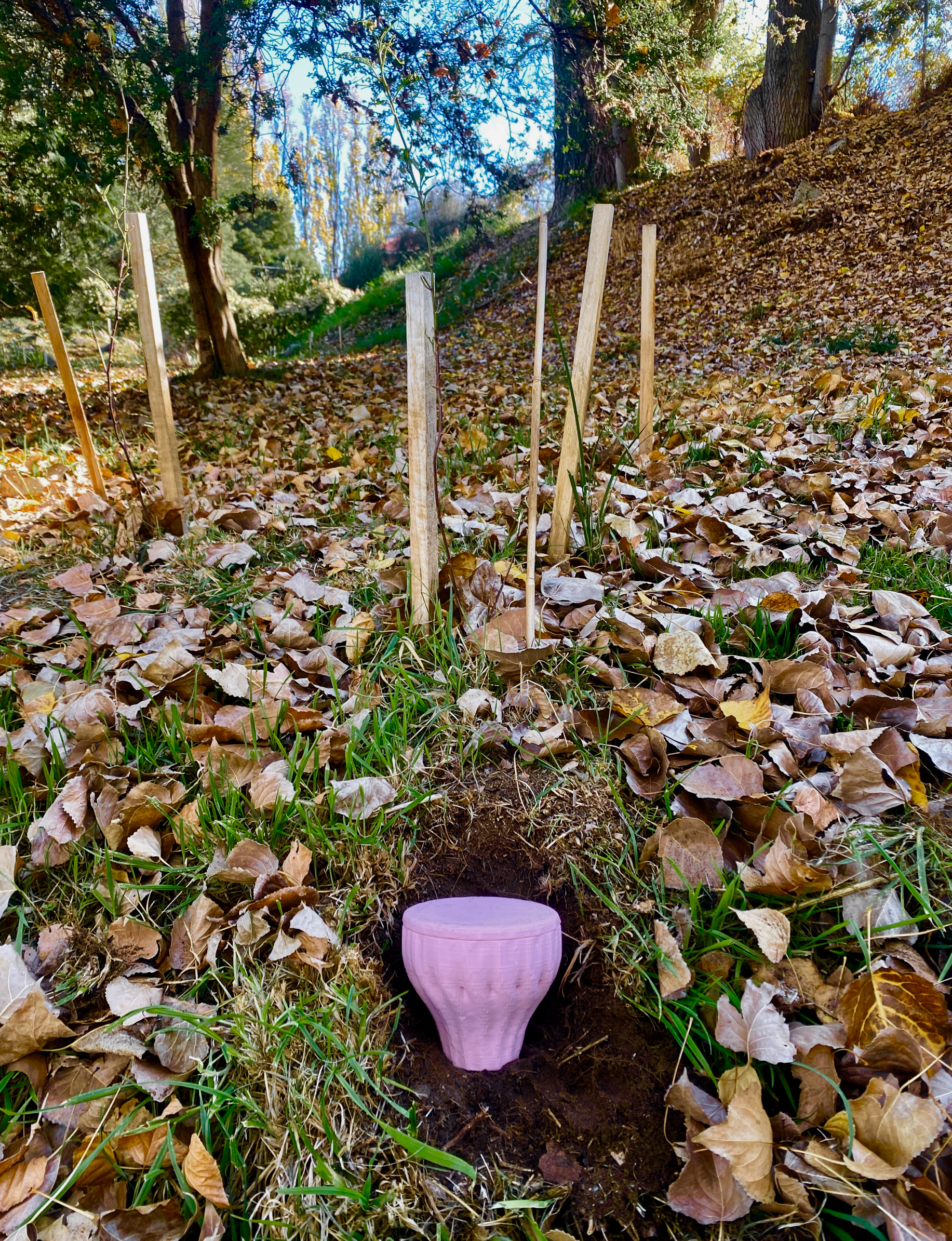
The effluent vessel (Figure 5) has been designed to meet both functional and aesthetic requirements for use in the ritual. To safely hold the effluent liquid during the ceremony and, once buried in the soil, break down gradually, releasing nutrients and nurturing the plant. It is critical to ensure the material was suitable for the local climate – wet winters and dry summers – and that all materials used were biodegradable and could be beneficial to the soil. The vessel needs to be beautiful enough to be culturally acceptable, while also able to create intrigue, inviting people to pause and consider what its’ material and purpose. The tree guard is made from bone ash which breaks down in the soil over time, gradually releasing calcium, phosphorus and other essential life-enabling nutrients to the growing plant. The effluent vessel is made from a sodium alginate biomaterial used to contain the liquid remains. This artefact aims to evoke the ‘re-enchantment of death’ (Rumble et al. Reference Rumble, Troyer, Walter and Woodthorpe2014) and refrains from a purely utilitarian aesthetic, to avoid exposure to scrutiny or to be accused of lacking ethical respect (Scarre Reference Scarre2024). Sodium Alginate is a well-established biodesign material often used as a biopolymer and gelling agent, with a predictable degradation rate, Regenerative Remains utilises the known quantities of this compound for an ecological rather than biomedical context (Adamiak and Sionkowska Reference Adamiak and Sionkowska2023) as a binding and flow agent in the 3D printing process.
3D printed effluent vessel in landscape. Authors own photo.
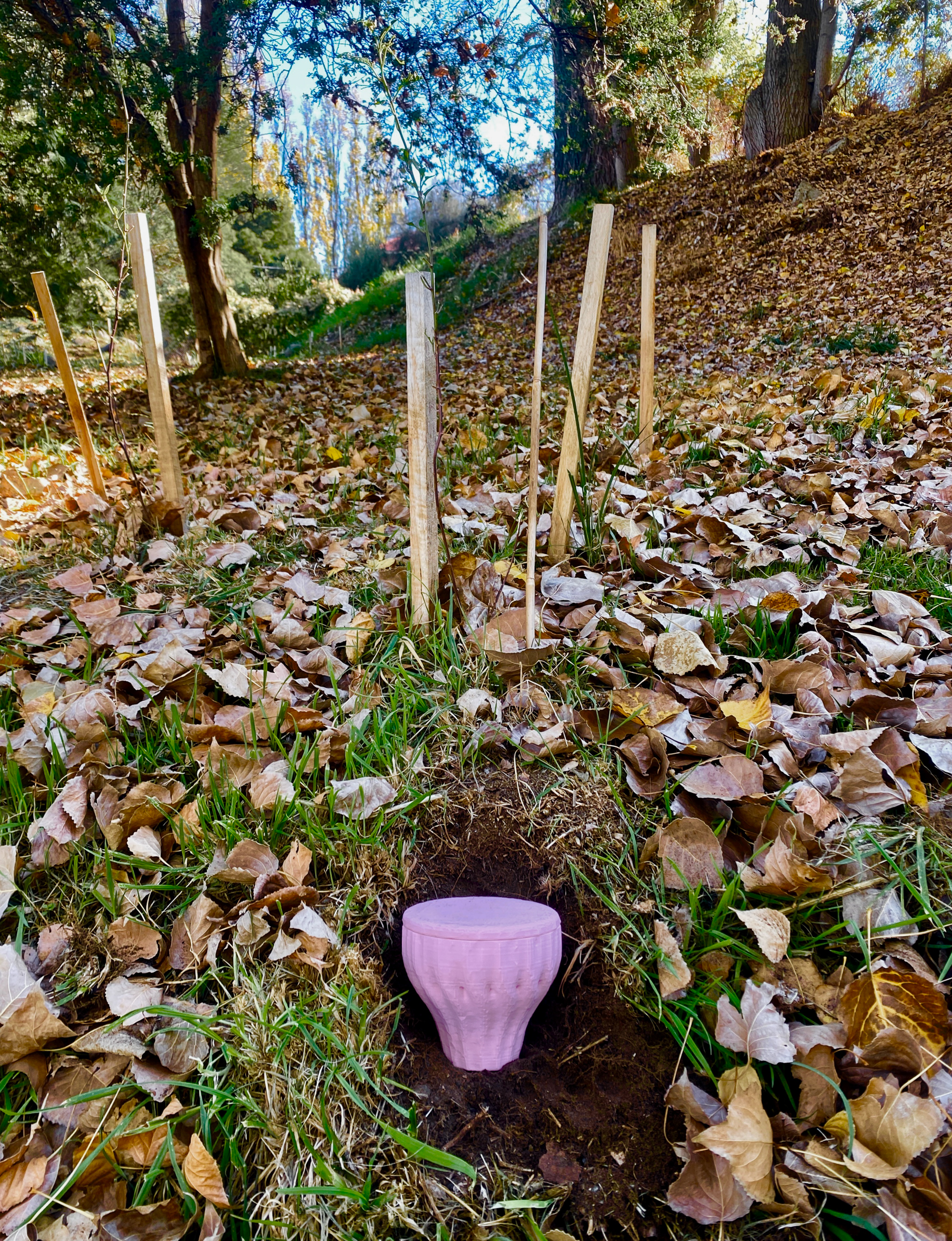
The use of bone ash as the primary material was not purely functional but a deliberate act of visual and conceptual relevance. The vessel is made from bone remains, and these are visually evident in the object’s surface, colour and texture. The aesthetic emerged from the material and its application, its form language referencing the internal architecture of bone with porous channels and cavities, visible in cross section. Also visually evident is the reflection of the branching networks of mycelium and root systems underground, to which the object will return to and become part of. The vessel carries death (effluent, bone ash) and nurtures life (releasing nutrients to plant roots), and the surface of the form was designed to evoke this liminal state and represent the transition embedded within nature’s cycles. The design of the vessel was not developed as an object for display but designed to make sense in the hand during a ceremony and then to disappear into the earth. This intentional impermanence resists the funeral industry’s tendency towards preservation and permanence (Slominski Reference Slominski2023; Gould and Hallafoff Reference Gould and Halafoff2025). The binder material (sodium alginate, derived from seaweed) contributes a softness to the vessel’s surface that contrasts with the mineral hardness of bone ash. This material combination allows a gradual release of the liquid as the alginate softens and breaks down first, allowing the bone and liquid to enter the surrounding soil. The form needed to be recognisable enough to be accepted within a grief ritual while being different enough to signal change. The vessel’s rounded form echoes ancient burial vessels, and the bone-ash surface reveals the material transformation at the heart of the project.
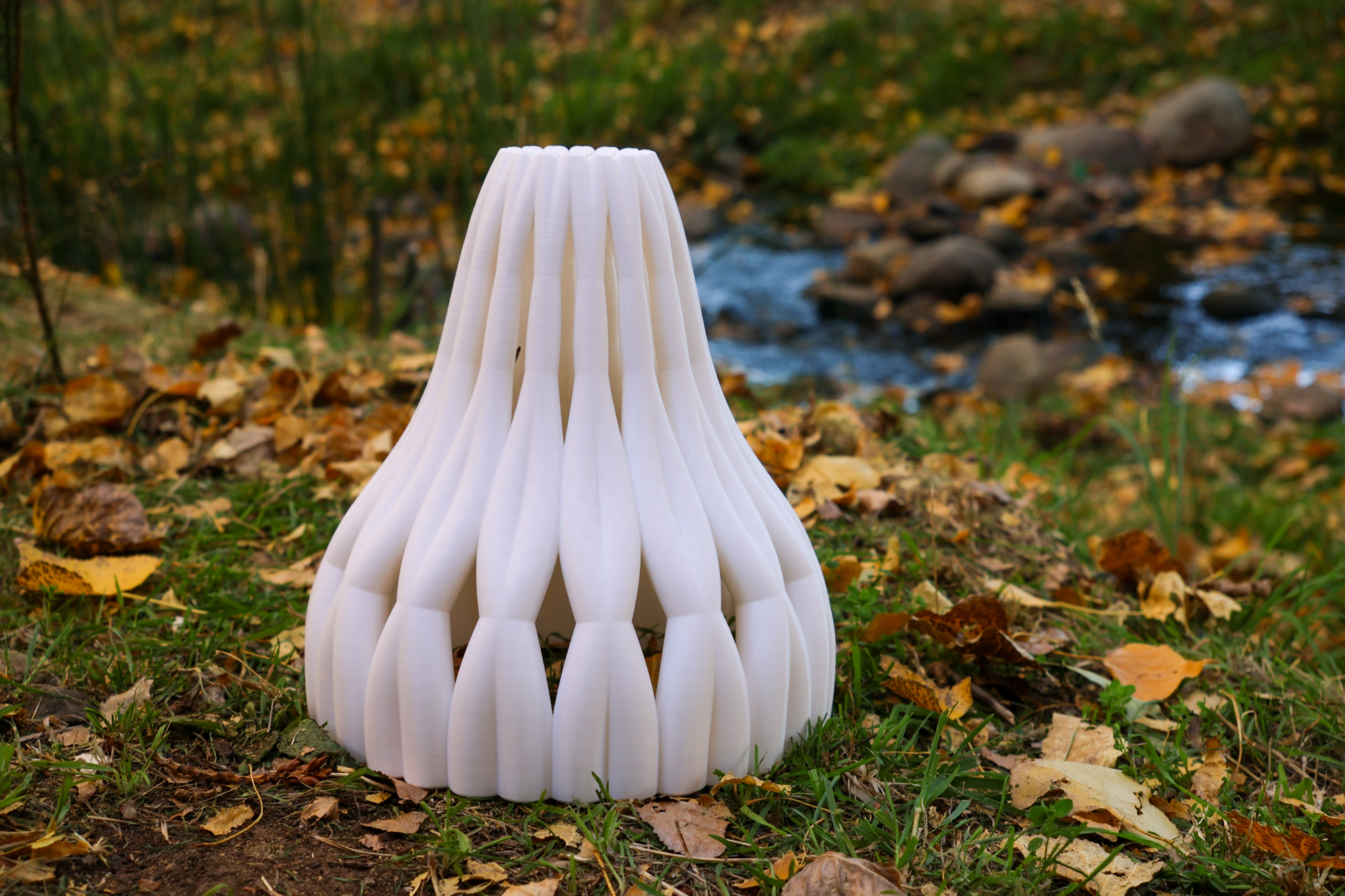
The concept of a tree guard made from bone ash emerged from a synthesis of research, precedent studies, the outputs of alkaline hydrolysis and a desire for more critical dialogue about the cultural paradigm of death and funerals. Most people are familiar with tree guards, as they’re not uncommon sights in urban areas, especially with an increase in government- and council-led efforts to plant more trees throughout cities as part of climate resilience programmes (City of Hobart: Increasing the tree canopy, n.d.). There are basic functional requirements to consider in the design, such as physical protection for the young plant from herbivores, dimensions to accommodate growth, structural integrity and weather resistance to wind and rain, while still ensuring enough light reaches the plant. This tree guard (Figure 6) aims to transcend a purely functional object; but instead create a visual narrative of decomposition and choreographed decay. In designing for decay, the 24-month period allows for plant to become established, while providing for the anecdotal evidence that the bereaved visit the grave site or site of remembrance most frequently within the first two years. The design for decay plans for the gradual transformation of the object, such that it reflects the passing of time and celebrates the beauty of decay rather than the aesthetics of preservation. In her book, Aesthetic Sustainability (Harper Reference Harper2017, 72), Kristine Harper proposes that ‘decay is renewal’ and that building temporality into objects ‘charges’ them with greater emotional value, making them more than ‘just a thing’. Time leaves behind traces of the tree guard, just as we leave traces on the earth, a story of renewal and regeneration emerging, realigning death with ecological cycles.
3D printed bone-ash tree guard in landscape.
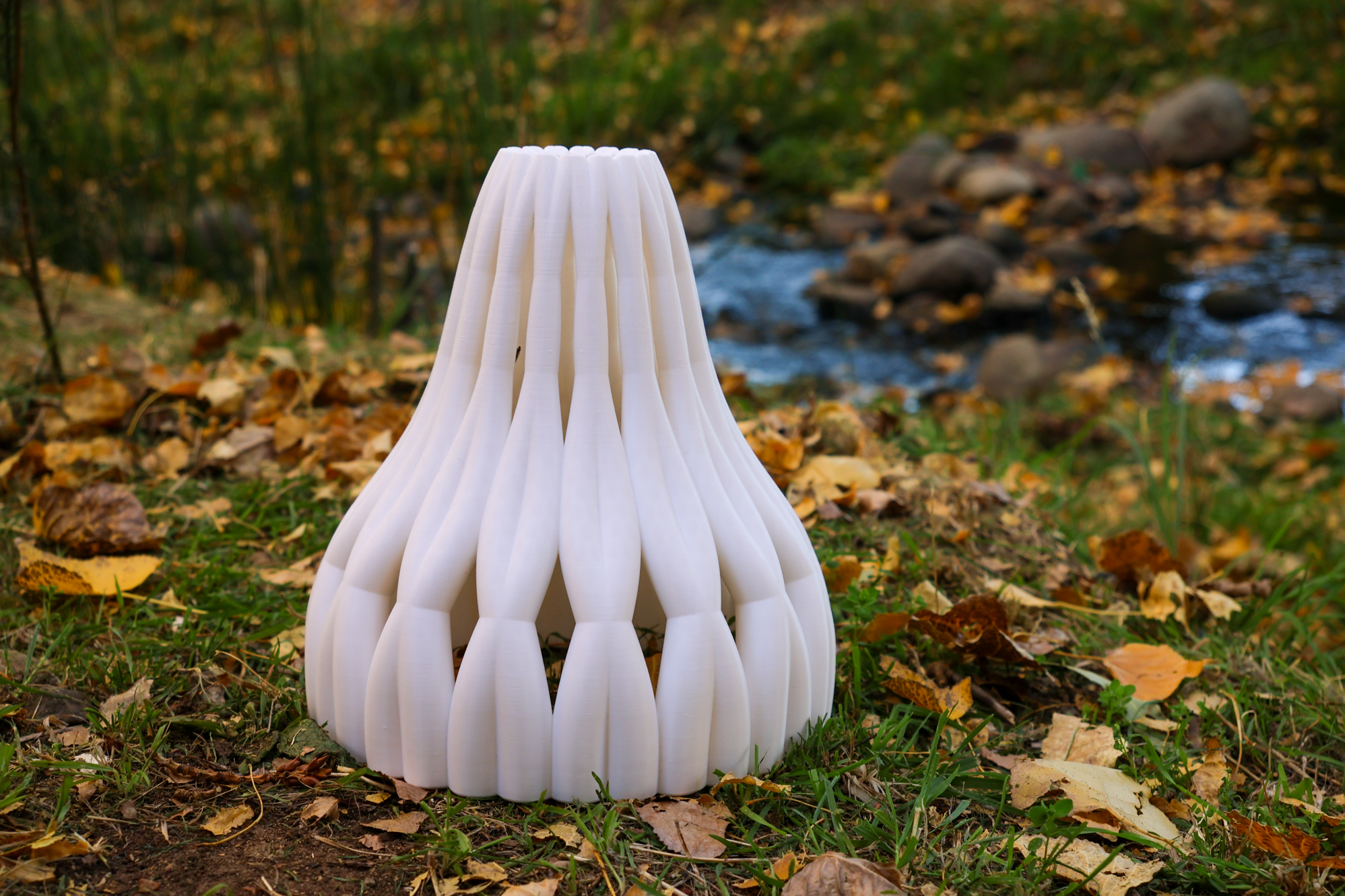
The aesthetic considerations of the design emerged from the structural qualities of porous, mineral bone ash, which is resistant to compression but susceptible to moisture over time. The tree guard’s geometry was developed to work with this behaviour. Its form allows water to begin gradual breakdown from the outside while maintaining structural integrity long enough to protect the seedling. In this sense, the aesthetic of the guard is an expression of how the material wants to fail. The skeletal remains standing guard around emerging growth is central to the visual story. Bone, in death, still has structure, and the guard’s ribbed form is informed by this. The form deliberately evokes this without being literal or morbid, gesturing towards the skeleton without illustrating it. The guard was not designed to look the same throughout its 24-month life. It was intended to visibly weather, soften at edges and gradually return to the earth. This temporal dimension is part of the design. Visitors over many seasons will see a different object as it gives itself back to the earth. The beauty of the object is inseparable from its willingness to disappear. Most memorialisation objects are designed to resist time, but the tree guard deliberately confronts this notion. Its surface quality and lack of protective coating are all aesthetic decisions that signal a different relationship to time and to death. The material truth is that this object is already on its way back. When the guard is fully broken down, the bone ash remains in the soil around the tree as an invisible but present legacy. This final state was considered as part of the aesthetic narrative, as the object ends not in landfill but in the tree itself. The form, surface and material were all chosen to make this path feel intentional and meaningful, not incidental.
Stemming from the shift away from tradition in the DIC to embody regenerative principles in death was the challenge to create culturally acceptable rituals. Central to the ritual innovation presented is the transformation of visual material. Being able to bear witness to the decomposition of the tree guard and the regeneration of the land as the plant grows creates an ongoing connection to place. It invites the community’s active participation in ecological processes (Westendorp and Gould Reference Westendorp and Gould2021; Castle and Phillips Reference Castle and Phillips2003). Allowing kin to be involved in selecting the tree adds a personal touch by providing choice and agency in the process, deepening and exposing the connection to natural cycles. In the ritual, the biomaterial artefacts serve as a meaning-making device, helping co-create a narrative of the relationship between human and non-human.
This aligns with broader social trends like ‘girl mossing’, which embraces the analogy of decay as a way to critique current systems with a fast-paced culture, encouraging humans to submit to ‘grander temporal cycles that fundamentally include decomposition and death’ (Gould and Halafoff Reference Gould and Halafoff2025). Design considerations had to be made to ensure the artefact forms suggested notions of protection and spoke to the element of bone embedded within the material, doing so in a gentle way that afforded a gradual introduction of decomposition concepts. The timing of the transformation had to balance ecological cycles with ceremonial appropriateness and grief processing, ensuring respect for diverse cultural and religious perspectives while creating something new.
Methodological contributions: designing for matter recycling
This is a design research proposal for a regenerative approach to human disposition, with methodological and conceptual contributions. This project can be understood in the context of habitabilities principle (Karana et al. Reference Karana, Barati and Giaccardi2020), reframing the first habitat, as the primary human life. The second habitat is post disposition in which human remains are used to nurture and feed a new organism. In this instance the designer sets the parameters for the design, however the eventual outcomes evolve beyond the designers’ control (Karana et al. Reference Karana, Barati and Giaccardi2020). This speculative project illustrates the careful crafting of cohabitation, evolving relations across multi-species and multigenerational scales, from the decomposing human remains, through soil microbiota and mycorrhizal networks, to the establishing plant, while simultaneously connecting human generations as kin return to the site over time. These cohabitations between human, regenerative remains and landscape ecosystems are grounded in theoretical knowledge of material properties and ecological cycles. Embodying a post-anthropocentric design approach, this design case study focuses on regenerative matter recycling, begins to develop a theoretical framework to recognise non-human agencies. This helps to inform how material behaviours become active participants rather than passive subjects in the design process, highlighting ecological needs as binding design constraints (Groutars et al. Reference Groutars, Kim and Karana2024). The effluent nutrient profile informed decomposition timing – if absorbed too soon, it was speculated the concentration could harm or kill the plant. This timeline also needed to pair with the plant’s development, ensuring it was established enough to thrive without protection, leaving behind a living impression and entangling the enduring stories of the dead with the unfolding tales of the renewed landscape (Becher Reference Becher2021). This design case study necessitates a broader shift within design processes to a regenerative paradigm, focusing on comprehensive ecological requirements in the post-anthropocene and the environmental integration of materials (Rumble et al. Reference Rumble, Troyer, Walter and Woodthorpe2014; Westendorp and Gould Reference Westendorp and Gould2021; Gould and Halafoff Reference Gould and Halafoff2025), before pursuing human aesthetic preferences and convenience.
By advancing beyond extractive and conventional sustainable practices, this research highlights the transformative potential of regenerative design in death care through the intentional development of biomaterial artefacts and novel ritual frameworks. The study addresses both the expressed need and the emerging demand for alternative post-mortem options that integrate human remains into ecological cycles (Rothstein Reference Rothstein2018) and presents speculative possibilities grounded in material science and environmental theory (Hayama and Harb Reference Hayama and Harb2025). While these proposals need practical field validation, their conceptual foundations establish a critical lens for examining the cultural and ecological implications of current death industry practices. The use of narrative inquiry serves as an analytical tool to challenge the DIC and question societal norms that perpetuate the separation of death from ecological processes. Notably, this research contributes to discourse on sustainable urbanisation and climate adaptation by suggesting pathways for reimagining human remains as active agents of landscape renewal in the face of population growth and environmental constraints (Canning and Szmigin Reference Canning and Szmigin2010; Arnold et al. Reference Arnold, Kohn, Nansen and Allison2023). Given the well-established nutrient profiles of alkaline hydrolysis by-products and the extensive literature on plant-soil interactions (Robinson Reference Robinson2025), the practical implications of these regenerative artefacts deserve further ecological investigation. There are four key design principles that have emerged from this project, they are transferrable methodology for designers working within post-mortem or biological waste streams in regenerative contexts: 1. Align decomposition timing with ecological and grief cycles: material breakdown should be calibrated to the biological rhythms of the ecosystem it enters and the human communities it serves. 2. Connect loss with growth, ritualise and bear witness to change: by making visible a circular systems perspective, we could shift from a linear mindset in which death is a final end point, to observing the transformation of matter, energy and life into other lifeforms and ecosystems. 3. Position non-human entities as equal design stakeholders: by recontextualising our life and death as connected to the soil microbiomes, mycorrhizal networks, plant communities as stakeholders, we can deliberately consider and design for multi-species entanglements. 4. Close material and resource loops to regenerate specific localities: utilising the nutrient-rich waste streams from alkaline hydrolysis keeps biological resources cycling within specific localities, supporting restoration and regeneration.
These principles offer strategies to guide the DIC towards gradual, context-sensitive and ‘pluralistic’ eco-funeral practices (Slominski Reference Slominski2023). The study’s findings highlight not only the theoretical viability but also the practical necessity of transitioning from speculative interventions to field-validated, community-informed models. Collectively, these contributions demonstrate the potential for shifting funeral practice paradigms, positioning regenerative design as an opportunity to align grief rituals with ecological restoration and foster greater resilience in human–environment relationships.
Challenges and limitations: honest assessment
Within this project, several challenges and limitations emerged, affecting the outcome. Time constraints meant the current state of the project includes material prototypes developed and tested in a lab, alongside a theoretical framework for a novel regenerative funeral ritual. Environmental benefits are speculative, based on theory and material properties, and the necessary next step would be field validation to provide measured soil health improvements, long-term ecological performance, and demonstrated regenerative outcomes.
There are barriers to implementing and scaling the project. Some practical challenges to overcome include coordinating between the funeral industry and land management, as there will likely be long-term monitoring requirements and maintenance needs. Consideration would need to be given to who would be responsible for the care of these sites. The industry is resistant to change (Beard and Burger Reference Beard and Burger2017; Arnold et al. Reference Arnold, Kohn, Nansen and Allison2023), benefiting from maintaining the fear of the unknown surrounding death, making it difficult to challenge regulations designed around disposal rather than regeneration. There are currently limited alkaline hydrolysis facilities in Australia, creating a geographical barrier to accessing the technology, furthered by industry resistance. However, Tasmania is an exception, with fewer barriers due to access through Alluvium Water Cremations, flexible local regulations around disposition (Burial and Cremation Act 2019) and growing cultural acceptance.
This design project introduces new artefacts and frames them within new rituals, centring individual and family choice. It works within the existing market rather than dismantling the DIC’s underlying structures, offering bereaved families a regenerative alternative where previously there was none. As Slominski (Reference Slominski2023) outlines through the eco-funeral normalisation feedback loop, grassroots shifts in practice gradually accumulate into broader structural change – and the Tasmanian context, with its accessible regulatory environment and cultural receptivity, represents a plausible starting condition for that transition. Scale and place present additional limitations of this project.
Working within regenerative design principles, this project has been designed for a local Tasmanian context, a small-scale, locally situated pilot. At this scale, the nutrient inputs from alkaline hydrolysis and its by-products are modest in relation to the existing soil profiles and ecological load. However this paper does not address the impact on soil profiles and ecological load if this project were adopted at a population scale. Nutrient loading from effluent application, from deaths at a regional level has not been studied, to understand if these nutrients shift from regenerative to harmful. Significant changing of nutrient cycles are plausible at a larger scale, and understanding this ecological impact is necessary for this approach to be proposed at a broader scale. This proposal should be understood not as a scalable systemic model, but a proof-of-concept approach for a specific landscape context. This is consistent with Woodthorpe et al.’s (Reference Woodthorpe, Olson, Robins, Robinson, McClymont and Cox2026) perspective that the environmental consequences of body disposal at scale remain poorly understood, this is a gap that future research must address.
A remaining ethical limitation in this project is the use of animal-derived bone ash as a substitute for human remains during the prototype development. This substitution was made to comply with research ethics protocols; however it is not ethically neutral within the post-anthropocentric positioning of this paper. This is a tension that is unresolved, given our commitment to recognise more-than-human rights and agency. Future work should pursue ethics approval pathways that enable direct engagement with human derived biomaterials, for alignment of material and methodological framework.
Advancing design refinement also requires systematic investigation into the aesthetic acceptability of artefacts within diverse cultural contexts and the identification of effective strategies for community engagement. To ensure sound methodology and build public trust, future research must emphasise the transparency of limitations and clearly distinguish substantiated benefits from speculative claims. This transparency is essential to mitigate the risk of greenwashing, whether perceived or otherwise. Immediate next steps should involve interdisciplinary collaboration with ecologists and soil scientists, the implementation of field studies to assess ecological outcomes, and participatory design processes to ensure the artefact’s suitability across diverse communities.
Data availability statement
No new data were created or analysed in this study. Data sharing is not applicable to this article.
Acknowledgements
I want to acknowledge that Claude AI was used to generate an outline for the paper. Animal-derived bone ash was used for prototype development to comply with research ethics requirements regarding human remains; the authors acknowledge that this substitution is not ethically neutral within a post-anthropocentric framework, this limitation is discussed further in the Challenges and Limitations section.
Author contributions
Conceptualisation: R. Ramsay. Methodology: R. Ramsay, V. Ward. Writing – original draft: R. Ramsay. Writing – review & editing: R. Ramsay, V. Ward. Visualisation: R. Ramsay. Supervision: V. Ward. All authors approved the final submitted draft.
Financial support
This research received no specific grant from any funding agency, commercial or public sector.
Competing interests
The authors declare no conflicts of interest.
Ethics statement
This research did not involve human subjects and did not require formal ethical approval. Animal-derived bone ash was used for prototype development in compliance with institutional research ethics requirements regarding human remains.


 Open access

