



Diet, obesity and other chronic non-communicable diseases are of a serious public health concern due to their high prevalence and adverse effects on psychosocial and physical health(Reference Haines and Neumark-Sztainer1–Reference Leme, Haines and Tang3). Latin American countries are not impervious to this public health crisis(Reference Popkin and Reardon4). Unfortunately, efforts to address poor diets and curb other unhealthy-related practices have shown limited success in these countries(Reference Tseng, Zhang and Shogbesan5,Reference van Baak and Mariman6) . Therefore, attention is being paid to health policies and behavioural change interventions that aim to foster healthy eating, including altering the food supply and environment(Reference Stok, Renner and Allan7,Reference Stok, Hoffmann and Volkert8) . In Latin American and Caribbean countries, the division of Nutrition from the FAO released a report for all the food guidelines from the Latin American and Caribbean countries in 2014, with the aims to (i) gain knowledge of the current status of the food guidelines from the Latin American and Caribbean countries and (ii) identify what is needed in terms of public health policies for the population to improve diet(9). The focus of this report is on the improvement of the population diet quality, which includes policies on the reduction of fat, added sugars and Na content, that is, nutrient-to-limit food sources(9). Moreover, the report provides an update of the dietary guidelines in the Latin American Countries and improves information about foods and beverages. This can be helpful for the nutrition facts table revisions and the implementation of mandatory front-of-package labelling for foods high in nutrients-to-limit(10).
Understanding current food sources of energy intake and nutrients-to-limit, that is, SFA, added sugars and Na(Reference Committee11) among adolescents and adults in Latin American countries can provide insights into targets for healthy food policies and behavioural change interventions to support healthy food supplies, environment and eating patterns(9,Reference Committee11) . Although detailed energy and nutrient food sources among Latin Americans have been published(Reference Kovalskys, Rigotti and Koletzko12,Reference Kovalskys, Fisberg and Gomez13) , there is a gap on studies that use a standardised classification system to examine food sources. While standardised classification for certain aspects of dietary intake exists within single disciplines (e.g. nutrition/dietetics or epidemiology), no consistent classification system that is shared across disciplines is currently available. Therefore, one system can be used to represent different things across disciplines and researchers and might overlap food sources within different classification systems(Reference Stok, Renner and Allan7). For example, some researchers have classified items based on specific food groups, such as sugar-sweetened beverages, fruits, vegetables and unhealthy snacks, while others have used the nutrient composition (e.g. vitamins and minerals) or total energy content of an individual diet(Reference Stok, Renner and Allan7,Reference Stok, Hoffmann and Volkert8) . Studies that used different approaches to classify dietary intake make it difficult to compare adherence to dietary guideline recommendations(Reference Leme, Fisberg and Thompson14). Thus, consistency and a standardised classification system may be needed for Latin American countries(Reference Leme, Fisberg and Thompson14).
The National Health and Nutrition Examination Survey (NHANES) has drawn a unique classification system to categorise all foods consumed for the US population based on major food groups, subgroups and categories(Reference Rhodes, Adler and Clemens15). This system, named ‘What We Eat in America (WWEIA)’ provides a way to examine eating patterns and their impact on energy and nutrient intakes(Reference Rhodes, Adler and Clemens15). Food groupings are based on foods as they are consumed compared to the included components of disaggregated items, which provides a different view of the populations’ foods and nutrients consumed. This categorisation system estimates the nutrient contribution from mixed dishes and foods consumed alone but does not evaluate the overall nutrient contribution from foods. Other food classification systems(Reference Barco Leme Ana and Philippi Sonia16) disaggregate foods using recipes for mixtures to provide an estimate of the total nutrient contribution from the food sources.
Previous analyses of Latin American countries have identified only major food groups of energy intake and a few nutrients-to-limit sources in adult populations(Reference Kovalskys, Rigotti and Koletzko12,Reference Kovalskys, Fisberg and Gomez13) . There is a lack of studies that identify more specific groups and/or categories of foods in population-based studies. The availability of a multi-centre cross-sectional survey data from the 2015 ‘Latin American Study of Nutrition and Health (ELANS)’ provided the opportunity to examine the top food categories of energy, gram amount consumed and nutrients of public health concern in a Latin America representative urban sample, using a disaggregated approach to classify food sources. The objective of this study was to verify the consumption and sources of energy, total gram amount, SFA, added sugars, and Na in adolescents and adults from eight Latin American countries: Argentina, Brazil, Chile, Colombia, Costa Rica, Ecuador, Peru and Venezuela.
Methods
The Latin American Study of Nutrition and Health (Estudio Latino Americano de Nutrición y Salud; ELANS) is a cross-sectional survey with a multistage probability sample, stratified by geographical location (only urban cities), sex, age and socio-economic status; of non-institutionalised individuals of eight Latin American countries: Argentina, Brazil, Chile, Colombia, Costa Rica, Ecuador, Peru and Venezuela. Urban areas were included rather than rural areas to provide a population homogeneity and because most of the included countries have up to 90 % of individuals living in these areas. Briefly, ELANS aimed at identifying the weight status and lifestyle behaviours of Latin Americans. The survey examined approximately 9000 persons from September 2014 to June 2015. Trained interviewers collected the data via reported questionnaires (e.g. dietary and physical activity recalls) and objective measurements (e.g. weight and height) according to standardised procedures(Reference Fisberg, Kovalskys and Gomez17). The ELANS was approved by the Western Institutional Review Board (#20140605). All participants provided written informed consent/assent form to participate in this survey.
Study sample
One participant within the selected household was randomly selected based on the ‘last’(Reference Lavrakas18) and ‘next-birthday’(Reference Salmon and Nichols19) methods from each selected household. These methods are considered to be not intrusive and rely on the lack of correlation in the population between birth month and the eligible person characteristics of interest as a source of randomness. Thus, participants from the ELANS sample were selected based on 50 % of the cases using the ‘next-birthday’, and the other 50 % the ‘last-birthday’ methods, controlling quotas for sex, age and socio-economic status in order to obtain a representative sample. The representativeness of the sample size was established with a confidence level of 95 % and a maximum error of 3·49 %. Sample weighting was applied at each country level. SES was evaluated by a self-report questionnaire using a country-dependent format and based on the legislative requirements or established local standards layouts. The ELANS used protocols and procedures that ensured confidentiality and protect individual participants from identification. More details of this study can be found in a previous publication(Reference Fisberg, Kovalskys and Gomez17).
Dietary data
Dietary intake data were obtained from two non-consecutive 24-h dietary recalls per person through an interview using a standardised multiple-pass method(Reference Blanton, Moshfegh and Baer20). The foods and beverages intake recorded were transformed into energy, macronutrients and micronutrients values using the software Nutrition Data System for Research version 2013 (NDS-R, University of Minnesota, USA). The local foods reported by the participants from each country used a standardised procedure to match the equivalence of energy and nutrients from the NDS-R database, using local food composition tables, nutrition labels and/or the nutrition facts panel. A concordance rate of at least 80–120 % for energy and macronutrient content was required to establish an equivalence of local foods to foods available in NDS-R. Added sugars were previously defined(9,Reference Committee11) as all sugars used as ingredients in processed and prepared foods such as breads, cakes, soft drinks, jams, chocolates and ice cream, or eaten separately or added to foods at the table (according to the Latin American Dietary Guidelines). Energy, added sugars, saturated fat and Na were determined using the Multiple Source Method(Reference Harttig, Haubrock and Knüppel21) (https://msm.dife.de/) for estimating usual dietary intakes of population and individuals. The multiple source method (MSM) is used to convert individual intakes derived from the two 24-h recalls to usual intake distributions(Reference Harttig, Haubrock and Knüppel21). The prevalence of overconsumption for added sugar, saturated fat and Na was determined using the WHO nutrients recommendations. Na intake should be below 2000 mg/d(22) and was adjusted for energy. Added sugar(23) and saturated fat(24) should be below 10 % of total energy intake. Energy intake was compared to the Institute of Medicine (IOM) recommendations based on participants’ sex(25). Trained interviewers collected the recall data in Portuguese (in the case of Brazil) or in Spanish (for the other Latin American countries). Participants were asked to report all the foods and beverages eaten on the previous day. The detailed description of the dietary interview methods can be found elsewhere(Reference Fisberg, Kovalskys and Gomez17,Reference Kovalskys, Fisberg and Gomez26) .
WWEIA food classification
To investigate the food sources of energy, total grams consumed and nutrients-to-limit, the ‘What We Eat In America food Classification System (WWEIA)’(27) was adapted and used to classify all foods consumed by the Latin Americans. The WWEIA was designed by the NHANES/United States Department of Agriculture to calculate the contribution of energy and nutrients from the food categories(27). Thus, a database was developed to provide the energy and nutrients of all the foods and beverages consumed by the US population. This database contains approximately 8600 food items, that is, unique food codes. Under the WWEIA food category classification system, each food code is assigned to one of the 153 WWEIA food categories (e.g. ‘milk, whole’; ‘beef, excludes ground’; ‘pasta dishes, excludes macaroni and cheese’), which are organised within subgroups (n 46, e.g.’ milk’; ‘meats’; ‘mixed dishes – grain-based’) and major categories (n 15, e.g. ‘Milk and Dairy’, ‘Protein Foods’, ‘mixed dishes’). The NHANES population targeted individuals starting with 2 years of age, hence why, three major food groups are included: (i) baby foods; (ii) baby beverages and (iii) human milk.
Cross-cultural adaptation
Previous consent was given to adapt the WWEIA food classification system to the Latin America context. To adapt the WWEIA food classification system to the Latin American context, we verified all the foods consumed by each of the eight countries and these were added to the relevant WWEIA food groups, and when necessary, we create additional food groups to report local foods consumed in Latin America (most of them were Mixed Dishes – Latin American, beans-based items). A specialist panel comprising of six experts in the area of nutrition, dietary intake, methods and/or cultural adaption reviewed all the databases and the classification of all the items consumed into the correct groups. Fruitful conversations between the experts were made until consensus was reached (see online supplementary material, Supplemental Figure 1). In order to retain its international comparability, the original WWEIA foods were kept in each of the groups even though they were not necessarily most frequently consumed or are not available in the Latin American countries (e.g. egg/breakfast sandwich, diet sports/energy drinks and different types of milk according to fat content – usually in these countries there are only three types of milk: whole (3 %), reduced-fat (0·6–2·9 %) and non-fat milk (≤0·5 %)). Furthermore, there is a wide variety of fruits in the Latin American country, and each country can differ in terms of fruits. We opted not to create a specific group for these fruits. Fruits widely consumed in the Latin American countries were kept in the category ‘other fruits/fruit salads’. One major food group was excluded because they were not commonly consumed in this target population – older than 15 years: baby foods/beverages. From these 14 main groups with 42 subgroups (e.g. ‘bread, rolls, tortillas’; ‘100 % juices’; and ‘fruits’), 109 categories (e.g. ‘yeast breads’, ‘citrus juice’, and ‘peaches and nectarines’) were included to determine the rank order of relative proportions to total energy, total grams consumed and nutrient-to-limits (added sugars, saturated fat and Na) of foods/beverages consumed. The maintained and modified food main groups, subgroups and categories, according to the experts’ opinion, can be seen in Supplemental Table 1.
Sociodemographic variables
Participants were grouped into three age categories (15–19 years, 20–59 years and ≥ 60 years), with stratification by sex (male and female). Socio-economic status was evaluated by questionnaire using a country-dependent format and based on the legislative requirements or established local standard layouts. This was evaluated by creating a categorical (low-, middle- and high-income) variable on the basis of the low-income measure, which compares the equivalised per-person income of each country/household with established thresholds for Latin Americans, drawn from national indexes used in each country(Reference Fisberg, Kovalskys and Gomez17).
Statistical analyses
Analyses were conducted using SAS Studio 3.8 (SAS Institute Inc., 2012–2018). Energy, added sugars, saturated fats and Na means (standard errors) were calculated and compared to the dietary recommendations(22–24). Descriptive statistics of usual intake on a population level as estimated by the MSM(Reference Harttig, Haubrock and Knüppel21) based on the two 24-h dietary recalls (means and percentages, with their standard error) for food sources on a population level were determined for energy, Na, SFA, added sugars and total grams consumed reported. Mean per capita energy, total grams consumed, Na, saturated fat and added sugar consumed from each food group were expressed as percentage of the total to allow relativity across sex and age groups.
Results
ELANS sample
A total of 10 134 participants initially participated in the first day of the interview. At the second interview, the study sample included 9680, being that 4·5 % were not present or refused to participate at this point of the data collection. Of the 9680 individuals, 462 (9·0 %) were excluded from data analysis due to inconsistencies or partial missing data. Thus, the final analytical sample consisted of 9218 adolescents and adults.
The mean age (standard error) of the sample used for analyses was 35·8 (se 0·1) years, with 52·2 % of respondents being female and 84·6 % pertaining to a middle-low-income SES. The majority of the participants (60·1 %) reported having completed at least some high-school degree, 29·3 % reported having some college/university degree and only 1·1 % reported not having any educational background. Over one-third (37·2 %) of Latin American adults were classified as normal weight, 34·4 % overweight and 25·1 % obese.
Energy and nutrients-to-limit intakes of the participants
The average intake and nutrients-to-limit of the participants are presented in online supplementary material, Supplemental Figure 1. The average energy intake for the overall ELANS sample was 8334·11 (95 % CI 1979·2, 2004·6) kJ/d. Among the countries, Ecuador presented the highest energy intake 9257·31 (95 % CI 2170·7, 2254·5) kJ/d and Chile the lowest (M = 1732·7, 95 % CI 1696·4, 7401·49 kJ/d).
The percentage for total energy intake (% TEI) of added sugar for the overall ELANS sample was 13·2 %. Comparing the eight countries, Argentina presented the highest values for added sugars (16·8 %), while Ecuador the lowest value (10·2 %). In relative terms of TEI for SFA, the average intake for the ELANS sample was 9·7 % of total energy consumed. Argentina presented the highest (11·6 %), while Peru (6·4 %) the lowest intake. For Na, Ecuador (4900·1 mg/d) showed almost two times more than the average intake for the entire ELANS sample (2612·8 mg/d) and Peru had the lowest intake (1006·0 mg/d).
Energy, total grams consumed and nutrients-to-limit food sources
Energy intake
Table 1 shows the dietary sources of energy consumed from the WWEIA food categories adapted to the Latin America reality. The five highest ranked categories contributed to 35·0 % of total energy intake for the participants in the ELANS, including: 10·3 % rice, 6·9 % yeast breads, 6·8 % turnovers and other grain-based (e.g. empanadas), 5·7 % soups (e.g. sancocho de gallina – ‘Chicken soup with vegetables/corn’) and 5·3 % rice mixed dishes (e.g. arroz chaufa de chancho/carne – ‘fried rice with beef/vegetables’). The percentage of contribution of the five highest ranked food categories contributing to total energy was the highest for Peru and Ecuador, with, 42·2 % and 39·3 %, respectively. Peru food sources were rice (16·5 %), sugars and honey (7·1 %), yeast breads (6·5 %), rice mixed dishes (6·2 %) (e.g. aeropuerto – ‘Peruvian fried rice with noodles, beef and vegetables’), and chicken, whole pieces (5·9 %). Ecuador food sources were rice (17·3 %), soups (8·1 %) (e.g. locro de cuero - ‘Ecuadorian soup made with pig skin’), rolls and buns (5·3 %), meat mixed dishes (4·7 %) (e.g. papas con cuero – ‘Ecuadorian dish made with pork skin and potatoes’), and bananas (3·9 %). On the other hand, the percentage of contribution to the five highest ranked food categories contributing to total energy intake were lowest for Colombia with 28·0 % of total energy intake and included rice (9·6 %), yeast breads (5·0 %), meat mixed dishes (4·7 %) (e.g. pastel de carne – ‘Hispanic meat pie with ground beef and seasonings’), bananas (4·4 %) and beef, excludes ground (4·3 %).
Food sources* of energy (kcal))†, mean contribution and as percentage of energy intake among Latin Americans adults and older adults aged 15 to 65 years (n 9090), Latin American Study of Health and Nutrition

Cons, number of times foods have been consumed by the entire population; PCT, percentage of contribution; M/P/S, meat/poultry/seafood.
* The five highest ranked food categories according to percentage of contribution to total energy intake.
† To convert to kJ, multiply kcal values by 4·184.
Total grams consumed
The five first food/beverages sources on relative proportions had 42·8 % of total grams consumed in the ELANS sample. Sweetened beverages contributed 9·6 % being fruit drinks the most consumed category. The other four highest ranked sources were 9·3 % from 100 % other juices, 8·3 % rice, 8·1 % beer and 7·5 % soups (e.g. hervido de res, ‘Hispanic soup with beef, vegetables and corn’). Argentina (68·0 %) and Ecuador (55·5 %) had the highest proportions for total grams consumed. In Argentina, the five beverage sources were 22·5 % tap water, 22·3 % tea, 10·8 % fruit drinks, 9·8 % soft drinks and 2·6 % beer. In Ecuador, there were both food and beverages sources: tap water (29·4 %), soups (9·2 %, e.g. menestra de frejol canário – ‘minestrone with mung beans’), rice (8·0 %), soft drinks (5·2 %) and meat mixed dishes (3·7 %) (e.g. estofado de res con grasa – ‘beef stew with fat’). Alternatively, Colombia (38·3 %) and Chile (40·1 %) showed a lowest percentage of contribution of the five ranked food categories contributing to total grams consumed. Colombia sources were 8·6 % fruit drinks (sweetened beverages), 8·2 % for soups (e.g. sopa de Pasta – ‘spaghetti soup with tomato paste and chicken/meat broth’), 7·6 % rice, 7·1 % coffee and 6·8 % soft drinks. Chile sources were 14·5 % soft drinks, 9·6 % fruit drinks (sweetened beverages), 7·1 % yeast breads, 5·4 % beer, and 3·5 % rolls and buns. Results are presented in Table 2.
Food sources* of total grams amount consumed, mean contribution and percentage of total grams amount consumed among Latin Americans adults aged 15–65 years (n 9090), Latin American Study of Health and Nutrition (ELANS)
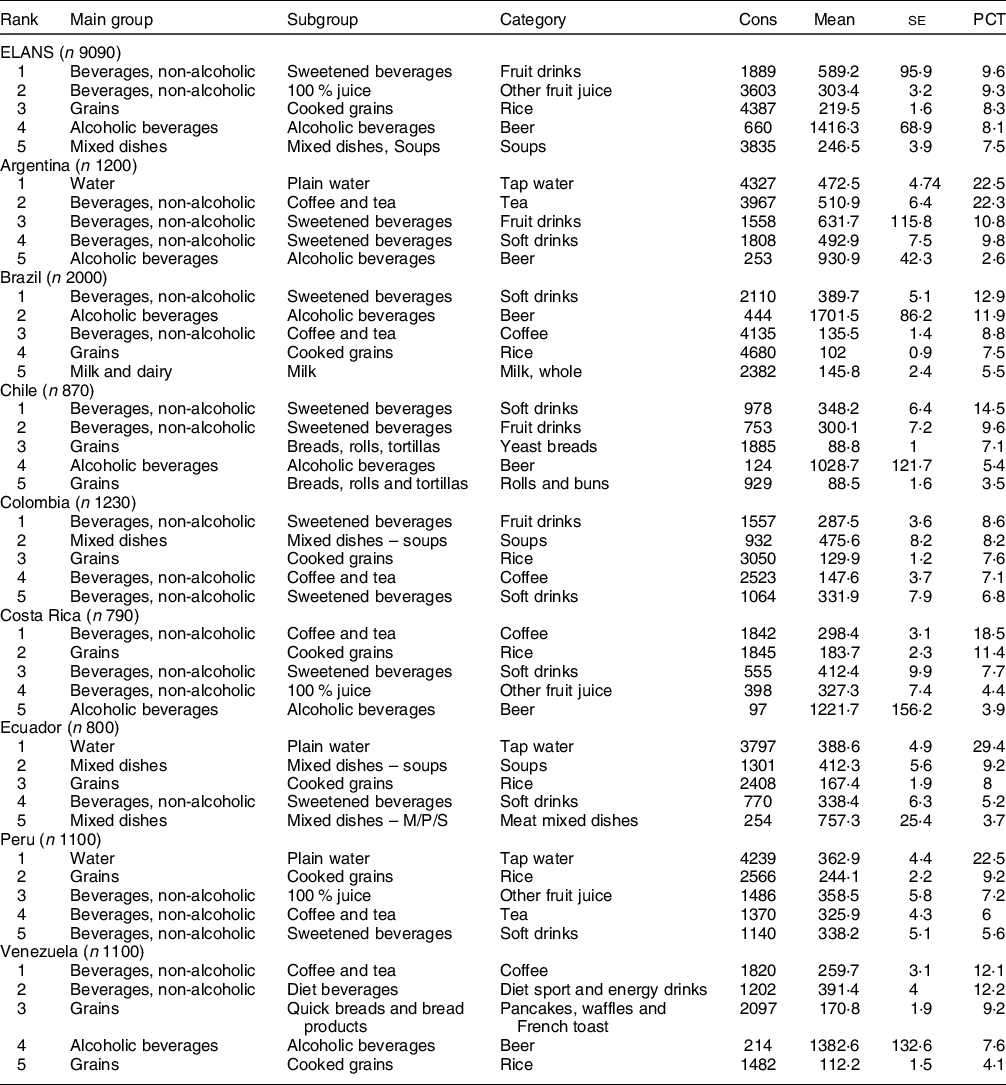
Cons, number of times foods have been consumed by the entire population; PCT, percentage of contribution; M/P/S, meat/poultry/seafood.
* The five highest ranked food categories according to percentage of contribution to total grams consumed.
Added sugars intake
The added sugar food categories are presented in Table 3. The top five categories accounted for a total of 64·5 % of added sugar intake for the overall ELANS participants. The top sources were 24·1 % other fruit (100 %) juice, 16·5 % fruit drinks (sweetened beverages), 12·4 % sugars and honey, 6·2 % cakes and pies, and 5·3 % doughnuts, sweet rolls, pastries. The percentage of contribution of the five highest ranked food categories contributing to added sugar was the highest for Peru and Argentina, 85·1 % and 83·3 %, respectively. The food sources in Peru were sugars and honey (56·1 %), soft drinks (19·1 %), cakes and pies (4·2 %), fruit drinks (3·4 %, sweetened beverages), and yogurt, whole (2·3 %). The sources in Argentina were soft drinks (34·3 %), sugars and honey (27·7 %), fruit drinks (12·7 %), cookies and brownies (5·4 %), and cakes and pies (3·2 %). Alternatively, Costa Rica had the lowest percentage of contribution (65 %) and included sugars and honey (21·5 %), soft drinks (17·9 %), other 100 % juices (12·4 %), fruit drinks (7·8 %) and tea (6·9 %).
Food sources* of added sugar (grams), mean contribution and as a percentage of total added sugar intake, among Latin American adults and older adults aged 15–65 years (n 9090), Latin American Health and Nutrition Study (ELANS)
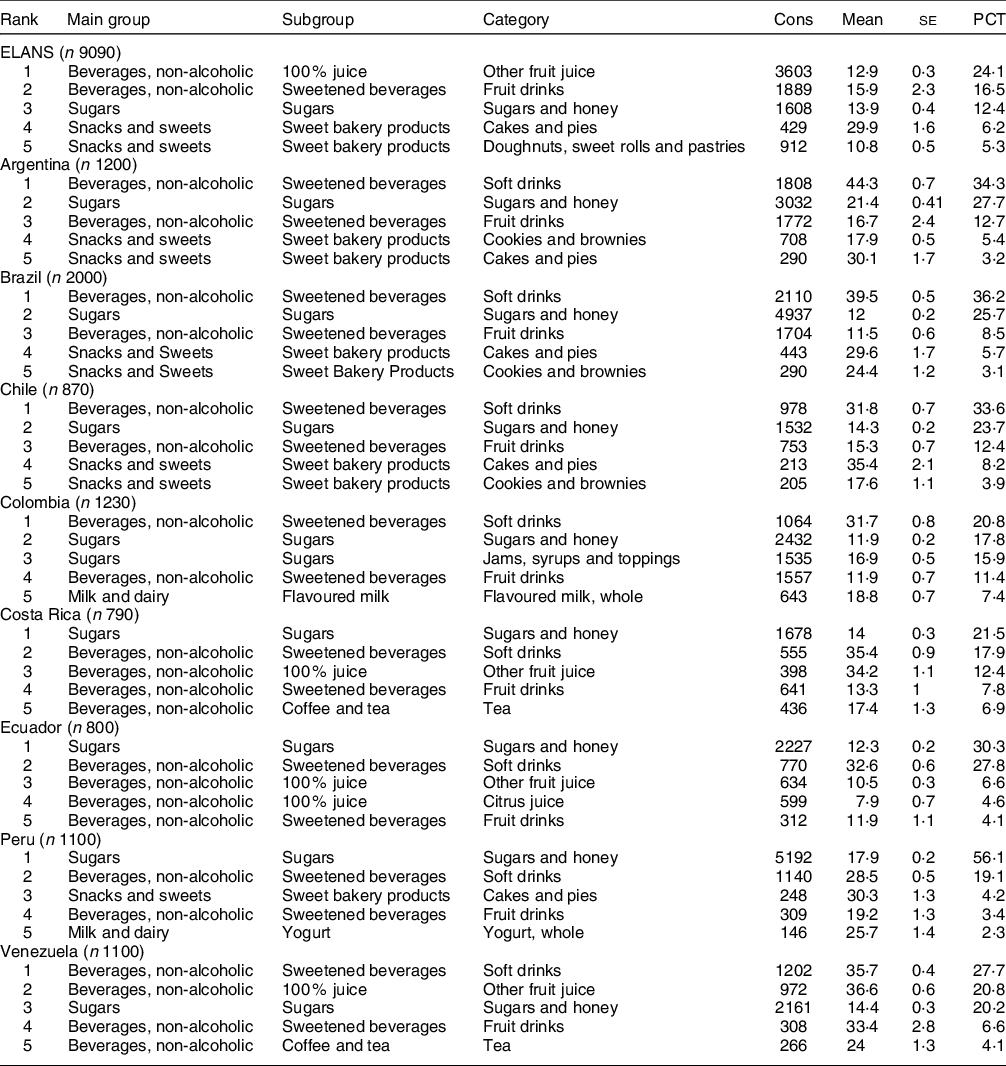
Cons, number of times foods have been consumed by the entire population; PCT, percentage of contribution; M/P/F, meat/poultry/fish.
* The five highest ranked food categories according to percentage of contribution to total added sugar intake.
SFA intake
The food categories of total SFA intake are presented in Table 4. The five highest food sources showed 46·8 % of SFA consumed by the ELANS participants and included 12·6 % turnovers and other grain-based items (e.g. empanadas – ‘Hispanic meat/vegetable/cheese baked pastry’), 11·9 % cheese, 10·3 % pizza, 7·5 % beef, excludes ground, and 4·5 % meat mixed dishes (e.g. mondongo – ‘stew tripe with vegetables’). Venezuela (52·9 %) and Argentina (48·7 %) have the highest percentage of contribution of the five highest ranked food categories contributing to SFA intake. Venezuela food sources were cheese (24·6 %), turnovers and other grain-based items (11·2 %, tequeños ‘Venezuelan fried bread cheese sticks’, beef, excludes ground (6·7 %), meat mixed dishes (5·8 %, e.g. carne guisada – ‘Hispanic stew beef’) and chicken, whole pieces (4·6 %). Argentina food sources were pizza (13·4 %), beef, excludes ground (12·6 %), turnover and other grain-based items (9·5 %, e.g. tarta de jamón y queso (2 tapas) – ‘ham and cheese pie’), cheese (8·7 %), and doughnuts, sweet rolls and pastries (4·5 %, e.g. churros). Alternatively, Costa Rica had the lowest percentage of contribution of five ranked food sources with 30·2 % of total SFA and included sausages (7·9 %), cheese (5·9 %), beef, excludes ground (5·8 %), chicken, whole pieces (5·3 %), and eggs and omelets (5·3 %).
Food sources* of SFA (grams), mean contribution and as percentage of total SFA intake, among Latin American adults and older adults aged 15–65 years (n 9090), Latin American Study of Health and Nutrition (ELANS)

Cons, number of times foods have been consumed by the entire population; PCT, percentage of contribution; M/P/S, meat/poultry/seafood.
* The five highest ranked food categories according to percentage of contribution to total SFA intake.
Sodium intake
Table 5 presents the food categories on relative proportions for total Na consumed. The five highest ranked food categories consumed by the overall ELANS population accounted for 43·1 % and included 13·9 % rice, 9·1 % soup (e.g. sopa de carne seca – ‘jerk beef soup’), 7·3 % rice mixed dishes (e.g. arroz con camaron – rice with prawn), 6·9 % yeast breads, and 5·9 % beans, peas, and legumes. The percentage of contribution of the five highest ranked food categories contributing to Na was the highest for Peru (73·0 %) and included rice (42·0 %), rice mixed dishes (15·0 %, e.g. arroz chaufa con pollo y hot dog – ‘Peruvian fried rice with chicken and frankfurter’), yeast breads (10·4 %), chicken, whole pieces (2·5 %), and, rolls and buns (2·4 %). On the other hand, Ecuador (38·3 %) and Argentina (39·3 %) showed the lowest percentage of contribution of the ranked food categories contributing to Na intake. Ecuador major food sources included 10·4 % cheese, 7·8 % beef, excludes ground, 7·2 % meat mixed dishes (e.g. estofa de cerdo con grasa – ‘pork stew with fat’), 6·6 % soups (e.g. sopa/colada de haba – ‘broad bean soup’) and 6·4 % whole milk. Argentina food sources were 13·4 % yeast breads, 9·5 % pizza, 7·5 % turnovers and other grain-based items (e.g. empanada de carne frita – Hispanic fried beef baked pastry), 4·6 % beef, excludes ground, and 4·3 % chicken, whole pieces.
Food sources* of sodium (micrograms), mean contribution and as percentage of total sodium intake, among Latin American adults and older adults aged 15–65 years (n 9090), Latin American Study of Health and Nutrition (ELANS)

Cons, number of times foods have been consumed by the entire population; PCT, percentage of contribution; M/P/S, meat/poultry/seafood.
* The five highest ranked food categories according to percentage of contribution to total sodium intake.
Discussion
This study was conducted to provide an overview of the food sources of energy, nutrients-to-limit (i.e. added sugars, Na and SFA) and total grams consumed among Latino Americanos from eight countries. The top food sources on energy and dietary components demonstrated the importance in efforts to support healthy eating, such as healthy food policies and behavioural change strategies. In addition, it was observed that food sources were overlapped among dietary components. For example, mixed dishes containing meat or rice were among the five highest ranked categories of energy, Na and SFA in the current study, but the rank order for these sources differs were changed between countries and dietary components(Reference Kirkpatrick, Raffoul and Lee28). The ELANS and each country population were exceeding the WHO dietary recommendations for added sugars(23), SFA(24) and Na(22) intake, the only exception was Peru that was consuming Na within the recommendations.
Attention should be called to the WHO reference for sugars, which is for ‘free sugar’ and not for ‘added sugar’. The term ‘free sugars’ may be used interchangeably with ‘added sugars’, implying all sugars that are added during manufacturing and preparation as well as sugars that are naturally occurring in honey, syrups, 100 % juice and other fruit concentrates(Reference Chatelan, Gaillard and Kruseman29). Added sugars are defined as all sugars that are added during processing and preparation (e.g. white and brown sugar/sucrose, glucose, high-fructose corn syrup, dextrose, fructose, honey, invert sugar, and lactose)(Reference Bowman30). Added sugars do not include lactose from dairy products and from sugars naturally occurring in fruit juices and concentrates, and unprocessed foods, such as fruit, vegetables, legumes, potatoes, fish, meat, poultry and eggs. Therefore, total energy intake for added sugars should be limited towards the lower boundary for free sugars recommendations.
The ELANS population have shown an increased intake for SFA within the recommendations, and their major sources are ‘protein foods’, ‘milk and dairy’ and ‘mixed dishes (mainly from meat sources)’. Other population-based evidence has also found comparable intakes of SFA with the dietary recommendations. For example, a study using the NHANES(Reference Huth, Fulgoni and Keast31) with over 16 000 US children, adolescent and adult populations showed similar trends with a mean of 11·4 % of energy coming from SFA. The Canadian Community Health Survey (CCHS) with a representative sample with adults (M = 45·0 ± 0·3 years old)(Reference Harrison, Brassard and Lemieux32) found that mean intake of SFA was 10·4 %. Age differences between samples should be considered when interpreting these results. Furthermore, differences in food sources consumed by country were corroborating with the Canadian sample(Reference Harrison, Brassard and Lemieux32) – Canadians from the thirteen provinces were differing in their SFA food rankings. Thus, participants’ country and/or administrative divisions may be taken into account when developing public health strategies, considering their sociocultural aspects.
A high consumption of dietary Na was observed with the Latin American individuals, but lower than the world average intake (4000 mg/d)(Reference Mozaffarian, Fahimi and Singh33). Some gaps comparing to WHO recommendations might exist(Reference Fang, He and Fang34). Discrepancies between high-income and low- and middle-income countries (i.e. Latin America countries) may be because of different ways to plan, prepare and consume foods. In Latin America, for example, a higher amount for table salt may be added to home-based preparations, along with sources deriving from industrialised items (i.e. ready-to-eat meals). Food sources with ‘added sodium’ may be defined as all Na added during preparation and processing. Sources may include savory snacks, sweetened beverages and other ready-to-eat meals (e.g. canned and frozen items), in addition to the salt added to the home-based preparation. Therefore, measurements to limit and monitor salt and Na intake are needed(Reference Fang, He and Fang34). Also, family-based strategies are needed to promote healthy eating and reduce intake of Na and other nutrients-to-limit in Latin America(Reference Wieland, Hanza and Weis35,Reference McInvale Trejo and Shaw-Ridley36) .
The identification of percentage of contribution of the top ranked food categories of energy, total grams consumed and nutrient-to-limit sources using a standardised food classification system (adapted to the Latin American reality) might provide important implications for the Latin America governments to provide efforts to mandate regulatory changes, including the food labels. The government can provide resources to develop the evidence base for nutrition fact panel more likely to cope with better food choices(Reference Pomeranz, Wilde and Mozaffarian37). From all the Latin American countries evaluated in the ELANS study, Chile is the pioneer in the region on the development of the Food Labeling system. This is an innovative policy that implemented a nutritional profile to reduce the intake of energy, total sugars, saturated fat and Na through the incorporation of a front-of-package ‘high in’ warning label. The Chilean Food Labeling had an impact in the market and in the nutritional content of packaged foods. A greater percentage of foods ‘high in’ nutrients-to-limit and energy were withdrawn from the market. A substantial number of products were reformulated, especially in the dairy, solid fats, sugary drinks and flour-based food groups(Reference Quintiliano Scarpelli, Pinheiro Fernandes and Rodriguez Osiac38). Given the Chilean case, for other Latin American countries, it is necessary to make efforts and continue developing public health policies to support and promote healthy food environments.
In the past years, the adaption of existing evidence-based tools to different realities have received greater attention(Reference Indig, Grunseit and Greig39,Reference O’Connor, Perez and Beltran40) . When the ELANS started, an expertise panel provided guidance to evaluate diet and other lifestyle behaviours for policy-making. These priorities in the ELANS aimed to understand the critical role of the context to develop, adapt and deliver strategies that are appropriate, implementable, effective and sustainable for Latin America countries. Adapting the ‘What We Eat in America’ food classification system should address the dietary intake and behaviours to the reality of the Latin America countries. These may help to maintain the population sociocultural identities and provide a sustainable approach for healthy eating, for example, maintaining their eating traditions – that have their roots on Spanish or Portuguese cultures(Reference Kenny, Hu and Kuhnlein41).
Strengths of the present study are the use of a large, national representative database to examine food sources of selected nutrients. The total urban population was employed to define main regions proportionally in each country first and then to select cities representing each region, that is, main cities and other representatives of the region, mixing a random method and sampling criteria, and trying to fulfil urban population coverage to the maximum possible(Reference Fisberg, Kovalskys and Gomez17). The limitations included the use of reported measurements that may over- or under-report dietary intake(Reference Naska, Lagiou and Lagiou42). Results need to be interpreted with caution because adolescents and adults might be over-reporting their intakes of healthier foods and under-reporting their intakes of food sources of nutrients-to-limit in the diet, particularly when using 24-h recall(Reference Collins, Watson and Burrows43). Moreover, under-reporting is higher in overweight or obese individuals(Reference Avelino, Previdelli and Castro44,Reference Murakami, Miyake and Sasaki45) . To reduce the impact of misreporting, data were expressed as percentage of contributions of food and beverage sources to energy, nutrient-to-limit and total grams consumed(Reference Leme, Baranowski and Thompson46). Although participants’ age and sex were not taken into account when considering the analysis, majority of population were on the adult age range, which may affect the estimation of population mean of dietary intake(Reference Naska, Lagiou and Lagiou42,Reference Leme, Baranowski and Thompson46) . Finally, the study used cross-sectional data from which casual relationships cannot be drawn.
Conclusion
Evidence from Latin America countries has shown an increased intake on nutrients-to-limit and in the prevalence of obesity and other non-communicable diseases; thus, understanding dietary food sources in these populations is important(Reference Pinto, de Souza and Pereira47,Reference Rivera, Pedraza and Aburto48) . The present study provides detailed information on the food sources contributing to total energy, total grams consumed, Na, SFA and added sugars consumed by a representative sample of Latin American adolescents and adults aged 15–65 years from eight countries. A large proportion of total energy consumed was from energy-dense food groups (e.g. sugar-sweetened beverages and salty pastries) but also came from some food sources contributing to important vitamins and minerals (e.g. home-based preparations – soups and meat mixed dishes, milk, and beef)(Reference Leme, Baranowski and Thompson46). Awareness of food sources may be useful to create or refine dietary strategies within public health initiatives to improve the diets of individuals living in the Latin America countries.
Acknowledgements
Acknowledgements: The authors would like to thank the staff and participants from each of the participating countries who made substantial contributions to ELANS. The following are members of ELANS study group: Chairs: Mauro Fisberg and Irina Kovalskys; Co-chair: Geogina Gómez; Core Group members: Attílio Rigotti, Lilia Yadira Cortés Sanabria, Martha Cecilia Yépez García, Rossina Gabriella Pareja Torres and Marianella Herrera-Cuenca; External Advisory Board: Berthold Koletzko, Luis A. Moreno, Regina Mara Fisberg and Michael Pratt; Project Managers: Viviana Guajardo and Ioná Zaclman Zimberg. Financial support: The ELANS study was partially supported by a scientific grant from the Coca-Cola Company and by different grants and support from the Feeding Difficulties Center/Sabara Children’s Hospital, International Life Science Institute of Argentina, Universidad de Costa Rica, Pontificia Universidad Católica de Chile, Pontifícia Universidad Javeriana, Universidad Central de Venezuela (CENDESUCV)/Fundacíon Bengoa, Universidad San Francisco de Quito and Instituto de Investigación Nutricional de Perú. The funders had no role in study design, data collection and analysis, the decision to publish, or the preparation of this manuscript. Conflict of interest: There are no conflicts of interest. Authorship: RMF, GG, IK, MH-C, LYCS, MCY, RGPT, AR and MF, senior researchers of the ELANS study, participated on the study concept and design, acquisition of data, administrative, technical and material support, and study supervision. RMF and ACBL participated on the study research questions and hypothesis. AMA and CHS organised data and classified the foods into the groups. AVM and ACL helped classifying the foods into the groups and conducted the statistical analyses. ACL wrote the first draft with contributions of RMF, GG and MF. All authors reviewed and commented on subsequent drafts of the manuscript. Ethics of human subject participation: This study was conducted according to the guidelines laid down in the Declaration of Helsinki, and all procedures involving research study participants were approved by the Western Institutional Review Board (#20140605). Written informed consent was obtained from all subjects/patients.
Supplementary material
For supplementary material accompanying this paper, visit https://doi.org/10.1017/S136898002100152X



