



INTRODUCTION
In 1855 (amidst industrial strife),Footnote 1 the Customs Administrator of Barcelona commented on the “Guild or Union” of Maritime Porters (Faquines de Capçana):
The association in its essence subsists as it was founded in the years of 1500 or much before, and as much for its antiquity as for its originality deserves to be observed in all its aspects, as it is a monument that the sixteenth century has left us for the study of the grave questions that today are agitated around in the organization of labour.Footnote 2
What was this “originality” to which the Customs Administrator referred at this relatively late date, when the guild was transitioning directly into a union? What was it about this “monument” that “deserves to be observed in all its aspects”, and what could it teach “the study of the grave questions” amidst labour agitation? While the “antiquity” of European guilds is a well-studied matter, only occasionally has one or another guild been highlighted for its “originality” – its ability to challenge the hegemonic paradigm of guild studies – even as the existence of a typological normal is increasingly re-assessed by recent scholarship.Footnote 3 While the Administrator referred to the Guild of Maritime Porters, there had been seven guilds in the sub-sector, and each of them “deserves to be observed”.
This study aims to contribute to the expanding appreciation of guilds by focusing on legally recognized European guilds in the service sector. As such, I look at port labour in Barcelona towards the end of the pre-casual, generally monopolistic artisan period, when the sub-sector was comprised of seven trades organized in six, then seven guilds with monopolistic privileges enshrined in official ordinances (charters). Three harbour-based guilds worked on the water with identical means of transport (mariners, fishermen, and unloaders); the four land-based guilds each with different means (maritime porters, maritime horsecart operators, maritime teamsters, and mule rentors).
Barcelona reflected the infrastructural characteristics of the first – pre-industrial – phase of the three-stage theoretical framework outlining the relationship between the port and the city through life and work.Footnote 4 As a pre-industrial port, all handling was undertaken with very rudimentary tools and vehicles, without any form of mechanization. This allows us to focus on socio-economic, cultural, and political considerations.Footnote 5 It encompasses the early rise of economic liberalism, when the traditional model was under scrutiny and attack by merchants and politicians.
The historically dominant labour historiography [discussed below] generally ignored or dismissed both the services and guilds; therefore, guilds in the service sector deserve particular attention. As such, the research is guided by a number of questions. What were the specific functions of these service-sector guilds? How were these guilds organized to meet their occupational and organizational needs and preferences? What were their internal and external struggles? How did these differ from those of guilds in general, and those of cargo-handling guilds in other European ports? How did their experiences and strategies guide their trajectories during the rise of capitalism, the existential crisis of abolition, and the establishment of other forms of organization?
I argue that to understand the development paths of these guilds and their responses to liberalization, we should look at the occupational and organizational cultures that framed and informed their decisions. To contextualize, I first look generally at guilds in the service sector, and how they differed in important ways from craft guilds. (I refer to secondary-sector guilds as “craft guilds” for ease of reading: in technical terms, all of the guilds here practiced a craft, or trade.) I outline the port facilities and the flow of goods in the port of Barcelona to establish the setting of activities, the resultant occupational necessities, and the organizational models for providing privileged services. Thereafter, I examine forms of human and social capital and the determination of different types of qualification as exemplified by the seven guilds. With this understanding of the case of Barcelona, I make comparisons to other European ports. Then, I examine in detail the processes of liberal abolition in Spain, and the responses of the guilds. The article closes with an eye to informing further research of guilds in the service sector and the responses of organized labour in the face of liberal reforms and prohibitions.
Over centuries, each guild maintained its own archive, determining which papers to preserve: records of daily operations are scarce, while normative and legal documents are numerous – this could create an impression of litigiousness (which I believe is correct given the importance of protecting privileges). If a guild disappeared, these records could be adopted by one of a number of authorities, or could be orphaned or otherwise generally lost to history. Surviving records are dispersed because the guilds were under various local and central authorities, civil and military (but not ecclesiastic).Footnote 6 The Municipal Historic Archive of Barcelona houses numerous collections for individual guilds, government offices, and civic bodies. A special maritime notary recorded the minutes of general and extraordinary meetings of the three harbour-based guilds under the Navy for decades; in other cases, meeting notes were kept by each guild, and few remain.Footnote 7 The collection of the Guild of Mariners was lost to arson during the upheavals of 1835 [detailed below].Footnote 8 Owing to the richness of the Guild of Maritime Porters archive, it enjoys a detailed treatment here, and a considerable amount of the information about the other guilds is based on that archive.
GUILDS IN THE SERVICE SECTOR
The historiography of labour history (and, therefore, of guilds) appears to echo the economic, political, and organizational questions of the times.Footnote 9 This has created a twofold problem. On one hand, the role of the service sector was not yet appreciated when the foundations of modern economic thought were laid. On the other, the guilds were dismissed as reactionary hold-outs from the dying artisan world – opposed to free markets, technological change, and a less-hierarchical organization of labour.
The service sector has never been easy to quantifiably appreciate. Conceptually, the intangible, transitory, non-transferrable, and difficult-to-value characteristics of service outputs, and the diversity of the sector create complications in understanding and attributing productive qualities to their labours. Adam Smith called them “unproductive” and noted, “[i]n the same class must be ranked, some both of the gravest and most important, and some of the most frivolous professions: churchmen, lawyers, physicians, men of letters of all kinds; players, buffoons, musicians, opera-singers, opera-dancers, etc”.Footnote 10 While the diversity remains, their economic contribution has grown tremendously. Services now account for the greatest share of the global economy in employment and of GDP (estimated at about half of global employment and sixty-five per cent of global GDP).Footnote 11 Specifically for this study, recent historians attribute productivity to transportation, as the labours create value, especially at a “necessary moment” in exchange.Footnote 12
In the second half of the nineteenth century, the models of organization and unionism were broadly contested across the political spectrum with differing appreciations of the guild legacy. While some scholars have noted in the early writings of Marx and Engels a view towards guild-to-union transition based on the struggles of journeymen in the first quarter of the nineteenth century,Footnote 13 in the opening lines of the Manifesto Marx and Engels placed the guilds in a dying era within the materialist conception of progressing history.Footnote 14 However, they did not explicitly detail the transition from feudalism to capitalism, leaving the matter open to some debate.Footnote 15 Some contemporary authors emphasized the lineage from guilds to unions, based on their readings of a treasure trove of original guild documents from the fourteenth and fifteenth centuries.Footnote 16 Still others, while accepting guild demise, maintained a favorable, nostalgic appreciation of guilds for their benefits to workers, preserving social order, and instilling values of cooperation, religiosity, and solidarity.Footnote 17 Fundamental to the historiography, the seminal work of the Webbs carried the classical Marxist position into the twentieth century, contributing to a hegemony that lasted almost a century with few challenges.Footnote 18 The relative dominance of Marxian thought in labour history was significant, and the historiographic distillation of Marxism swept the guilds into the ash heap – or dustbin, if you prefer – of history.
While certainly not the first in the trend, The Return of the Guilds collection has come to symbolize the guild-studies debates over the past four decades, when the traditional, negative view of the guilds has been challenged.Footnote 19 The aim was twofold: to analyse the role of guilds in economic and social development (especially through human capital and technological innovation); and, to expand the conceptualization of guilds to include the Global South. The condicio sine quo non of a guild (or “guild-like institution”) is a shared occupation, from which arise autonomous or independent social networks capable of ordering and regulating the supply of labor, overseeing labour relations, and providing sociability and mutual aid. However, service providers (besides merchants) are scarce in the collection (and literature on guilds in general), with passing mentions in some geographic studies; the occupational studies are of crafts. Recently, at least passing references are made to primary- and tertiary-sector organizations, even as these are subsumed into wide-reaching analyses of European guilds as institutions; the need for closer investigation remains to round out our understanding of the debates.Footnote 20
The focus on craft guilds (especially regarding the development of capitalism) has contributed to a general conceptualization of guilds as largely individualistic, hierarchical structures that instructed and regulated the development of skilled labour over a life-cycle: from apprentice, to journeyman, to master craftsman. The vision of the workshop as a paragon of paternalistic harmony has given way to an understanding of pre-industrial labor conflict within the guild system.Footnote 21 Yet, the basic composition of craft (especially workshop) labour as individual or comprised of subcontracting networks of individual operators has remained dominant, obfuscating the variety of guild structures and operations.Footnote 22 This is not to downplay the importance of the secondary sector (especially as regards technological and systemic economic changes); that said, a greater understanding of guilds in the tertiary sector is beneficial, and echoes the growing appreciation for the quantitative and qualitative role of services in economic development.Footnote 23 After two centuries of liberal economics, the basic questions of guilds vis-à-vis the development of capitalism and labour remain topical, and deserve to be applied to the services.Footnote 24
In studies of services, the guild era tends to be ignored or used as a mere introduction. Two decades ago, the most important collection on dock work was published. One of the editors noted, critically, that, “[t]he studies collected in this volume are mainly focused on dock work in the casual configuration”.Footnote 25 Even so, in the subsequent twenty years, just over five per cent of port labour articles in European world/imperial languages dealt in some capacity with the artisan phase.Footnote 26 In the chapter on “Trade, Transport, and Services” of a new labour-history handbook, the authors posited that, “[a]n investigation of dock labour also points to additional categories of transport labourers, whose work is often obscured by a focus on industrialized and mechanized labour in the 19th and 20th centuries”.Footnote 27
Perhaps owing to this persistent vacancy, a recent collection focused on transport demonstrated an appreciation of guild diversity.Footnote 28 The editors noted the paucity of attention to transport in the labor historiography: “Although historiographic interest in the history of transport labour is growing, scientific knowledge on the subject is still very limited.”Footnote 29 The contributions aimed to, “reinforce an important trend in labour history over the past two decades, a trend that shifts the focus away from factory labour […] to the study of varieties of the forms of labour”.Footnote 30
An investigation of the totality of guilds within a sub-sector permits the discernment of broad similarities and specific differences within the sector and compared with craft guilds. The corporations studied here were not merely work gangs: they were guilds by contemporary legal definition and by the functional roles they filled in the economic, judicial, and socio-cultural spheres over many centuries. Just like other guilds, they were legally responsible for key activities common among guilds across the economy, including: the exclusive determination of membership; the organization of labour; the assurance of work quality; the transmission of values, traditions, knowledge, and skills; the organization of socio-cultural functions; the protection of the intangible inheritance of membership and benefits; and, the maintenance of judicial personhood for the defence of corporate privileges in exchange for various obligations to governing authorities. Some of them also managed cofradías (confraternities or brotherhoods) that provided mutual aid with funds from the guild and coordinated religious activities. That is, they carried out “corporate collective action”.Footnote 31 Importantly, the judicial defence of monopolies was considerable.Footnote 32 At times, this included very significant fines and even contemplated imprisonment for violators.Footnote 33 Extra-judicial (but still legal) direct actions were also used when necessary, exemplified by some one hundred seizures of goods from violators by the maritime porters over twenty-five years.Footnote 34
While the guilds filled the same functional roles as craft guilds, their organizational strategies were very different. Unlike most craft guilds, the corporations studied here were all formally organized horizontally: they were comprised solely of masters. This was not only true of the guilds; there were no apprentices or journeymen in the respective trades. This horizontality did not necessarily result in egalitarian practices: the cooperative functioning of some sharply counterpoised the individualistic maritime-cargo handling guilds (and craft guilds).
The workers were conscious of what modern scholarship considers the service-providing nature of their labours. This formed the basis of an argument made in 1815, by which the maritime porters defended their guild from an economy-wide, abolition-promoting resolution put forward by the Board of Commerce in Barcelona:
[A]s the motivating cause of that resolution and others which have followed, has not been any other than that of fomenting commerce and the advancement of the trades, factory or manufactory, and as it is for some time well known, that the guild of maritime porters manufactures nothing, nor produces any artifact, in natural consequence of this, that a corporation, that is not dedicated to any manufacturing industry, and that has no other elements save the employment of physical labour, honour and the legality of each individual is not susceptible to advancement in the productions of the art, as there are none and there can be none.Footnote 35
All of the guilds were threatened by the advance of liberal economic policy despite the fact that they were not all subject to technological transformation or noteworthy accumulation and concentration of capital. The liberal reforms designed to unfetter restraints on capital, technology, and labour-market participation for industrialization were to be applied to all economic activities.
THE FLOW OF GOODS AND DETERMINATION OF PRIVILEGES
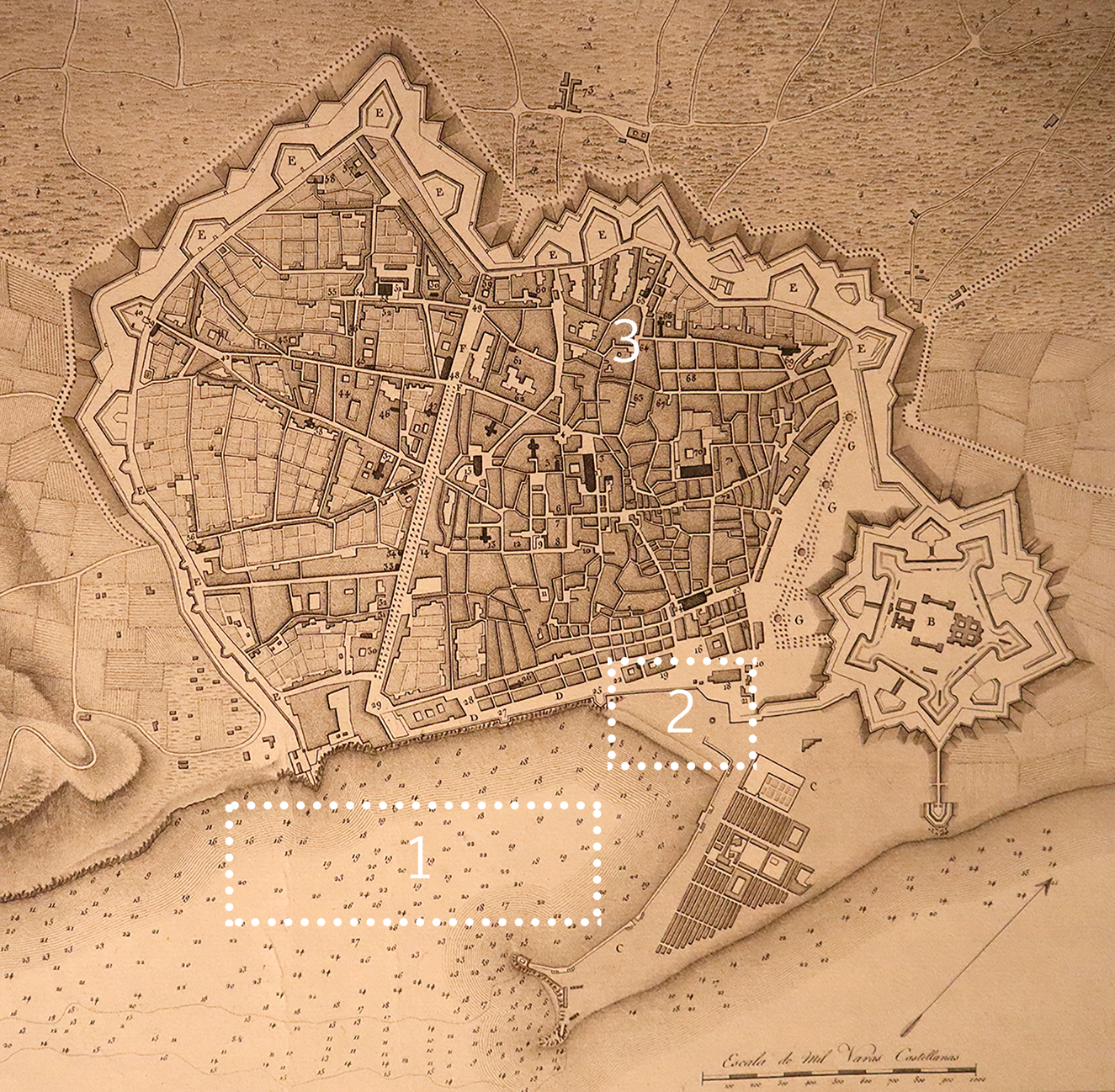
Barcelona has been a port city for the better part of two millennia, such that, “[t]he commercial structure of Barcelona comes down to us as determined, basically, by the existence of the port”.Footnote 36 What began as a mere beach was transformed into a meagre harbour during the mid-fifteenth century; by the mid-eighteenth century, it had achieved the general characteristics that would remain with scant modification through the late-nineteenth century. From time to time, the build-up of sand in the harbour mouth hampered or even prevented entry to the port, requiring costly maintenance. During the timeframe studied, this occurred in 1773, 1802, 1814–1816, 1820, and 1827–1829 (when storms sank some fifty ships and accumulated sands returned); each period was followed by dredging or modifications of the jetty.Footnote 37 Even in good conditions, boats anchored in the often-congested harbour area, awaiting boatmen who hauled goods to and from the beach.
Map of Barcelona (c.1800). The three handling zones are: (1) the harbour area; (2) between the beach and the Customs House (top-right of (2)), and (3) beyond the Customs House.
Author's modification of Jacques Moulinier et al. “Plan of the City and Port of Barcelona”, in Alexandre de Laborde, Voyage pittoresque et historique de l'Espagne (Paris, [1806], 1811). Author's Collection.
Export goods included bulk and processed agricultural products (especially wine and aguardiente), general merchandise, and stamped textiles (the product par excellence of proto-industrialization and industrialization in Catalonia).Footnote 38 The variety of imported goods was immense, differing with each arrival: lumber; metal bars; foodstuffs including fish, sugar, cocoa, coffee, and grains; raw cotton and silk for transformation; and diverse goods represented the majority at the turn of the nineteenth century.Footnote 39 Transshipment and importation for subsequent exportation constituted other shares.Footnote 40
The highly regulated labour market was based on guilds privileged to handle certain goods in specific areas.Footnote 41 On the water, three guilds handled cargo: mareantes (mariners); pescadores (fishermen); and, descargadores (loaders/unloaders) – all organized under the Matrícula de Mar (Matriculate of the Sea, a naval draft-registration system).Footnote 42 They used harbour lighters to haul or float goods to the shore, charging the same official prices for goods (there were no goods-specific privileges among these guilds).
These harbour guilds initially divided opportunities on a chaotic, inter-guild competitive, first-come practice. This prompted, in May 1767:
[A]n order from the King to negotiate the union of the three Guilds of Loaders and Unloaders, Fishermen, and Mariners, in only one Guild for the traffic and utility that are produced by loading and unloading […] and these be divided in a way that there is no difference or distinction between them.Footnote 43
Over the next six years, these guilds each met formally once, in early January 1770, to elect officers. Significant numbers of the Guild of Unloaders were also members of the Guild of Fishermen (at times even all of their directors) – a point of great contention for the mariners. Around this time, the Navy opted to review centuries of ordinances for the formation of a three-guild General Guild. By 1773, the situation had worsened to the degree that a Naval Inspector intervened, dividing the beach – where contracting, work, and lately, fights occurred – into areas of operation for each guild.Footnote 44 In 1778, the mariners proposed to protect their numerical superiority and formalize the existing fifty-fifty split for opportunities with the “Guild of Fishermen and Unloaders” (although these were two guilds, not one) in exchange for the mariners sharing half of their traditional right-of-anchorage fees charged to importing vessels. The proposal was signed the next day.Footnote 45
Official prices based on types and quantities of goods were the same for all three guilds; at times, new schedules were emitted to adjust de jure prices with de facto ones.Footnote 46 Merchants could use their own lighters and crew, but were required to pay one-quarter or half the normal handling rates to the guilds. It was not uncommon for sea-going mariners to be contractually required to handle goods, especially if the distant port had no designated, privileged unloaders.Footnote 47
On the beach, the responsible guild was selected based on the type of cargo and the means of handling it: faquines de capçana (maritime porters, also called bastaixos) who suspended goods from poles (a palanquin) resting on pillows, carried by pairs in groups of up to eight men (called manuellas); carreteros de mar (maritime horsecart operators); and tragineros de mar (maritime teamsters). These last two were differentiated by the size of the cart used and the number of horses needed: the carreta was a small, single-axle cart pulled by one beast, whereas the teamsters used a larger, two-axle carretón that required a team of horses. These guilds transported goods throughout the city, yet often just a few hundred metres to the Customs House.
Maritime porters. Author's photograph of an altar piece in the Basilica of Santa María de Mar, Barcelona (2019).
Author's collection.

Three of the four land-based guilds enjoyed specific privileges over scores of certain types of goods in specific locations, based on: the value of the merchandise; the objective, technical requirements for handling; and, location-based rules. The maritime porters handled breakable, imported, and higher-valued goods (for example, steel bars but not iron ones); the maritime horsecart operators handled less-fragile items and those of lesser value.Footnote 48 The maritime teamsters transported some bulk goods, but not others. The alquiladores de mulas (literally “mule rentors” or, mule handlers) did not operate on the beach; instead, they served points from the Customs House to through the city and beyond using mid-sized, mule-drawn carts or placing goods directly on the backs of mules. The mule rentors enjoyed no privileges over goods, but benefitted from their ability to economically transport non-privileged goods.
Within the Customs House and the adjacent King's Scales, only the maritime porters were allowed to handle goods – a privilege they defended fiercely – in exchange for not charging for the designated gang's service (which was covered from common funds). This service to commerce and the crown was based on the trustworthiness and guarantees of the guild, and was often cited as a justification for their higher prices. From the Customs House, these three guilds maintained their privileges in the city, but goods leaving the city could also be handled by the mule rentors. Allowances for the movement of goods by the owner (personally, and with his own means) at different parts of this trajectory were limited, but eventually increased as part of the liberalization of the labour market, as did the free choice from among the four land-based guilds.Footnote 49
There were no guilds dedicated to single products or in service to a specific craft or merchant guild. The variety of privileged goods had expanded over centuries, and new goods were brought into the privilege-based system or purposefully left out. The guild system was sufficiently flexible to respond to the developing needs of commerce while guaranteeing the best practices and security.
GUILD CULTURES, HUMAN CAPITAL, AND QUALIFICATION
Occupational and organizational cultures are entwined with human and social capital, and the means for establishing trade and guild entry qualifications. Occupational cultures were comprised principally of the means of transporting goods, which largely determined the productive forces (tools, harbour lighters, different carts, and beasts of burden), labour requirements (individual or collective, whether contracted or cooperative), and the methods for deploying these. These established the capital outlay and informed the possibility of employment relationships and the social relations of service provision, which informed the individual or cooperative model of service provision in each guild. Inasmuch as each trade had an occupational culture based on work-related activities, each guild had an organizational culture, which combined the occupational culture with the intangible processes and products of guild life and sociability. These were evinced in the decisions to maintain or modify the social relations in the face of internal and external changes.
The individualistic trades (horsecart operators, teamsters, and mule rentors) were based on the work of a single member, using private means for private gain; their guilds oversaw monopoly prices, but not payments. In all four cooperative guilds (maritime porters, mariners, fishermen, and unloaders), the means were collective property, the method was collective, and the model was cooperative and controlled by the guilds. The four guilds that worked cooperatively operated in gangs, working and distributing income on largely equal terms (gang leaders and others alike) based on who worked during different shifts or specific tasks.
To level opportunity, some of the guilds used a scheduled turn system or practiced a random, daily assignment with the same aim. The harbour guilds kept a daily lottery system. The maritime porters used a fixed, rotational turn enforced with discipline. The Guild of Maritime Horsecart Operators – who separated from the Guild of Maritime Porters and Maritime Horsecart Operators in 1796 – used the traditional, fixed rotational turn until separation, when they opted for a first-in, first out system based on arrivals each morning (until 1832), like that long used by the Guild of Maritime Teamsters. None of these allowed for direct or internal employment.
There is no specific information regarding a turn system (if any) for the Guild of Mule Rentors. However, employment mechanisms were entrenched: tax filings for 1760, show that almost sixty percent of the seventy-nine masters were employed as “mancebos” (a term generally reserved for journeymen) by their guild brothers – in a guild that did not have journeymen.Footnote 50 The maritime teamsters and horsecart operators specifically prohibited the employment of non-members or guild brothers.
All of the guilds had entrance fees, which loosely correlated to the costs of the means of provision. Importantly, fees were generally one-half for the sons of existing masters (an important form of hereditary capital). Where the means of service was individual, ownership was another requirement. In individualist guilds, organizational income was generated primarily through entrance fees and fines; in collective guilds, the coffers were additionally engrossed by leftover monies from group work and anchorage rights.
Some expenses were similar between the individualistic and cooperative guilds: religious and social activities; mutual aid and the upkeep of sick, injured, or otherwise unfit members; and stipends for guild positions were common to craft and all these service guilds. Both individual and collective guilds used traditional officers for administrative roles (directors, seekers, scribes, and treasurers). The porters also had a paid síndico (a sort of manager), although his specific roles are unclear. Collective work also required the functional role to gang leader, although these were not permanent positions and they received no extra payments. Officers were paid a set amount in cash in the individualist guilds (as in craft guilds); in the cooperative guilds they received shares of income, which also covered the upkeep of the means of service provision.
While it could be argued that the payment of greater shares to guild officers created a less-egalitarian system, the payments to officers seems to have been in response to their additional guild responsibilities. Directorship lasted one year, with no re-election. The directors and gang leaders acted as coordinators of labour, not employers. The hiring schemes of fixed, rotational turns or daily lotteries prevented favoritism among gangs by the directors, and among labourers by gang leaders. The gangs were formed daily and leaders were selected by the guildsmen on the basis of experience.Footnote 51 Importantly, because of collective ownership of the means, and prohibitions of employment, additional income could not be used as capital in the occupation. This contrasts with the teamsters, which saw the rise of owners of warehouses, who sought to end the turn system (detailed below). Likewise, membership in other occupations or guilds was apparently not uncommon, so the opportunity for external income or capitalization was not restricted.Footnote 52
The Guild of Mariners demonstrates the complexity of payment schemes. The person financing the daily payment of wages until the end-of-month payments were made by the merchants was well compensated in shares. The guild's confraternity also received income (which was a common practice among guilds). For mariners, this included shares and a large annual deposit to pay ransom for brothers captured and enslaved at sea. After these set payments were made, the income was shared equally among all who worked that day and the widows, sick, and injured.Footnote 53
The result of the above practices in the case of all these guilds was a horizontal structure, comprised solely of masters with common prices. In the cooperative ones, these were highly egalitarian. Combined, these practices contributed to a culture of work based on solidarity, cooperation, levelled opportunities, and mutual aid; they also prevented freeloading. The fixed turn of the porters also inculcated and enforced discipline. While there was some inter-guild competition and intrusion from non-guild members, apparently no notable internal conflicts surfaced in the cooperative guilds. The individualistic guilds behaved more like craft guilds, in which weak or inexistent levelling systems allowed for competition and more- and less-successful masters.
Occupational and organizational cultures required and created human and social capital; the latter is understood as “the stocks of shared norms, information, sanctions, and collective action that accumulate inside closely knit groups”.Footnote 54 It is important to highlight technical and non-technical forms of these capitals, and the formal and informal transmission mechanisms. The collective character of social capital is further highlighted by the processes of determining, inculcating, and enforcing a balance between individual and collective values, beliefs, and economic interests. Its quality as a form of capital is based on the ability to increase productivity and lower internal costs within the labour force, and to grow as such through collective experiences and the transmission of learned lessons.
This definition of human capital goes beyond the technical know-how of operations usually applied to craft guilds. Individual technical skill was almost non-existent: brute force and the ability to handle beasts of burden were important, but certainly not uncommon in the population.Footnote 55 Collective technical skill amounted to the ability to coordinate the handling of a load among a group. For positions that required relatively greater skill, the determination was not formally established by the guild: the ability of the gang-leader was informally established. The individual responsible for stowage (notxer) was subjectively and informally determined by the merchant and not by the guild. The non-technical forms of human capital revolved around the daily mechanisms for managing opportunities and expectations, enforcing labour discipline and trustworthiness, and mitigating or resolving intra-group changes or conflicts. As such, there was no informational asymmetry between the guildsmen and plausible competition or their customers. The service sector guilds highlight the relative importance of non-technical forms of human capital over technical ones, and the importance of collective human capital vis-à-vis individual human capital. Certainly, the degree of collective human capital was greatest in those tasks that required coordinated labour and the constant enforcement and advancement of group interests.
Guild scholarship has debated the importance of the development and transmission of human capital. S.R. Epstein noted, “[n]ot least, [the guilds] sustained systems for the transmission of skills and technical innovation”.Footnote 56 In craft guilds, skill development was accomplished in two ways: direct transmission during apprenticeship and tacit transmission during journeymanship, when workers were exposed to other practices; in both cases, this was largely individualistic in scope and transmission. Sheilagh Ogilvie countered this, arguing that the actual impact of guilds as institutions on human capital was minimal or negligible across Europe.Footnote 57 Whatever the relative importance, in the horizontal service-sector guilds (which all lacked apprenticeship and journeymanship), skills were informally, tacitly transmitted during the collaborative work process and in activities of sociability.Footnote 58 The socio-cultural skills related to the democratic functioning of the corporations and those soft skills for disciplined teamwork were transmitted informally and regulated formally through fines and detention (house arrest).
While qualification (the formal or informal determination of sufficiency) for entrance, advancement, and skill development are often inter-related, there are important differences between, and complexities within, them. In guilds in general, qualification was a combination of technical demonstration, social characteristics, and the economic capacity to pay entrance fees, purchase the means of production, and cover the costs of creating a masterpiece or other examination. Unlike the craft guilds, the service-sector guilds maintained no monopolies over protected, “mysterious” practices or technology-based know-how beyond the ability to handle beasts of burden or to demonstrate brute strength. Or, as the maritime porters noted in 1815, their labour, “has no other elements save the employment of physical labor, honor and the legality of each individual”. Socio-cultural considerations were paramount: the upstanding and honourable reputation and family relationships of the applicant were fundamental, and were determined by the testimony of existing members.
The socio-cultural requirements were not particular to the service-sector guilds; its importance vis-à-vis that of technical qualification is noteworthy.Footnote 59 As the guilds were responsible for damages, losses, or theft, this qualification was particularly important at the individual and social levels.Footnote 60 There are no mentions of pilfering or theft in the records consulted, which mention damaged goods. The individual determination of trust was difficult to challenge: this granted the guilds flexibility in controlling the supply of labour, even after such practices were normatively liberalized. Membership was homogenous as regards nationality and there were migrations of maritime porters to Barcelona from other parts of Catalonia – including non-maritime areas.Footnote 61 Kinship was historically a quota of entries; however, it became increasingly important in the face of liberal abolition. Beginning in the first quarter of the nineteenth century, the Guild of Maritime Porters began to only permit the entry of sons and sons-in-law of existing masters, based on the requirement that existing members vouch for an applicant.
Maritime porters: new masters, 1760–1850.
Author's work, based on AGMMB “Matrícula”, 29 October 1692–13 December 1902, Caja 9, carpeta 5 (2304). NB: “Sons” includes sons-in-law. [The entries continue to the first years of the twentieth century.]

Membership rose from seventy-eight porters and horsecart operators in the mid-1770s to about one-hundred fifty porters by 1828 (the horsecart operators had left the guild at the turn of the century).Footnote 62 The chart shows the periods of internal guild conflict and division (c.1796–1800), of French occupation and [likely] de-monopolization under the French-imposed Constitution of Bayonne (1808), and of early attempts at liberalization under the Cádiz Constitution (1813–1814) and the Liberal Triennium (1820–1823). Each no-enrolment, liberal period is followed by one of “returnees” and significant labour-force replacement. The continued and increased membership during industrialization and after the supposedly definitive abolition of 1836 is important.
OTHER EUROPEAN PORT LABOUR EXPERIENCES
It is worthwhile to look briefly at the experiences of port labour in other European cities (based on existing literature), to remove any inclinations of causality, and to further our understanding of the great variety of port types, port facilities, product needs, and the multi-organizational schemes for assuring service provision. The first consideration should be geographic and hydrographic. Three typologies are evident: fluvial/estuary, natural (rock) harbours, and beaches (which could be transformed to mimic a natural harbour). The basic differences impacted the infrastructural costs, the flow of goods and labour, and the dimensions for expanding facilities or monopolized areas.
Other ports in Spain provide comparisons under the same political framework. Cádiz enjoyed a natural, rocky port at the Atlantic mouth of a key river-way to Sevilla, to which direct access had become less feasible due to changes in depth and increases in ship size. As a historic port for colonial trade, Cádiz enjoyed significant traffic in a great variety of import and export goods. There were tiers of porters corresponding to the lifecycle of the workers (mostly drawn from distant mountainous areas). The justification for using foreign (but not alien) workers is not explained in the literature, but migration patterns and family connections were important for gaining entry into the guilds, which depended on a system of socio-cultural qualification based on trust and collective responsibility. Interestingly, individual responsibility was also guaranteed by the guilds, as in cases of debt or abandoned wives who appeared to claim their husband's wages.Footnote 63
Valencia was served by a meagre beach (called el Grau) on the outskirts of the city. The shallow approach meant that the normally land-based workers waded cargo ashore or hauled lighters to the beach using horses. Goods were then taken into the city by either horsecart operators or porters. Unlike the cosmopolitan traffic of Cádiz, Valencia handled a smaller amount and variety of goods. This likely conditioned the relatively simple guild system. Membership in Valencia was largely family-based and of local origin.Footnote 64
Whereas in some locations labour was reserved for and defended by residents (in Barcelona this seems de facto), some Italian port cities preferred outsiders from specific areas, creating schemes of goods-differentiation or competition between groups. Otherwise, the labour configurations of Mediterranean Italian ports appear quite similar to Barcelona, but apparently less segmented.Footnote 65
The fluvial port of London developed a highly complicated porterage universe.Footnote 66 “Porters were the least skilled of labourers” and, as such, were not allowed to form guilds, only “mere fellowships” under the direct control of municipal authorities with the power to determine membership and allow for the employment of non-fellows in times of high demand.Footnote 67 Among these, de jure goods-based differentiation was the norm, with guild-specific porters and four types of more-general porters: Aliens’; Tacklehouse; Ticket; and Billingsgate (or Fellowship): “no two were organized in identical manner”.Footnote 68 There were numerous hierarchies and employment or sub-contracting schemes within and between the groups and sub-groups, which developed over many centuries. In the early-seventeenth century, the Tacklehouse and Ticket Porters were unified in a Society based on the employment of the latter by the former. The Fellowship Porters were privileged with specific high-traffic goods (including grain, corn, malt, potatoes, salt, seafood, and coal) and had very complex operational rules. From the 1790s, the geographic and infrastructural expansion of wharfs and docks challenged the traditional jurisdictions. The end of alien exclusions in the mid-1840s brought cheaper Irishmen into the mix. The response of the different porters to these changes was legalistic, and they continued to lose out to capitalist liberalism. Despite the low income and lowly character of Fellowship Porters, their high-membership organization lasted to the very end of the nineteenth century.
The 250-odd Dutch weigh-porters guild was divided into halves of “free men” and vemen (cooperatives), permanent gangs of three to ten men sharing “an equal share of the common income”. Specialized porterage guilds handled grain, salt, beer, wine, and peat. Younger members of the vemen were to obey their elders or gang leaders. There is no indication of a formal hierarchy with differentiated income or of employment – it clearly seems to have been a model of organizing labour and transmitting human capital. In Antwerp (and somewhat in Amsterdam), porterage by structurally varied naties (literally, nations) was more closely related to a high degree of goods specialization (through berths), sometimes serving a particular guild, as in London; however, the relative horizontality and lack of employment schemes varies greatly with porterage along the Thames, and the model survived long past the end of municipal regulations in the early nineteenth century.Footnote 69
Permissiveness regarding de facto employment and a trend towards casualization (even within the guild system) may reflect a French path in the Atlantic and Mediterranean. In Marseille, the cargo guilds were normatively egalitarian; however, intra-employment hierarchies arose within the portefaix (porters's) guild.Footnote 70 While sub-contracting within the guild was well-demonstrated, the issue of out-sourcing – hiring non-guild members – is less well-documented, and Sewell treats it as a hypothesis in the case of common porters (called crocheteurs or robeirols in Provence). In Barcelona, an analogous group of common porters (camàlichs also called mossos de corda) was generally prevented from forming a guild and specifically from working in maritime-cargo handling; they represented occasional, intrusive competition during at least three centuries.Footnote 71 In Le Havre (between 1790 and 1840), “registered trades composed of permanent masters who hired casual but faithful helpers continued to dominate the work force” for moving goods to and from the ships; likewise for barrowmen. The trades were based on the labour of a master who “was helped by one or two boys (garçons) and an occasional day-labourer (journalier) as necessitated by the size of the job”. The occupational origin of these day-labourers is difficult to ascertain but was quite varied.Footnote 72 Some of the porterage tasks that had historically been divided (under the auspices of the Marine) into regulated trades or formal corporations by the types of goods and means of transportation were later under the jurisdiction of the dockers.
A look at Istanbul during the late Ottoman Empire highlights other characteristics, trajectories, and strategies. The guilds of boatmen and porters were the only corporations able to control operations along the vast fluvial access provided by “three towns joined by water” (Istanbul, Pera, and Üsküdar).Footnote 73 There were almost two thousand porters in the 1822 census (although this may include those entirely devoted to land-based trade). The operational role of boatmen, or “sea porters”, echoes that of other port cities. A key difference was the individual nature of the gedik, a state-granted licence required to operate and, by extension, it is assumed, to join the guild.Footnote 74 The gedik was designed to limit membership but could be used anywhere. It could be inherited, used as debt collateral, or sold (even to non-practitioners). It is not clear if the exclusionary licence was for operational porters and boatmen or for licence-holders to hire others as workers; it appears to have been the case for both.Footnote 75 The centuries-old gedik system was undermined by the 1880 state-sanctioned intromission of foreign porterage corporations with the capital to invest in barges and mechanization. This resulted in the proletarianization of the guild members through employment by these foreign companies, a process that, between 1890 and 1910, “spread to almost every port in the empire, from Istanbul to Thessaloniki, Zonguldak to Beirut, and Izmir to Samsun”.Footnote 76
The above survey highlights some of the challenges of location, and strategies for service provision and resistance or adaptation to the development of capitalism. The existence of hierarchical practices in other ports eliminates a deterministic relationship between the means and methods of service provision, and the occupational and organizational cultures; in turn, it highlights the importance of social relations, and political and socio-cultural considerations.
LIBERAL ADVANCE: PRIVILEGES, REFORM, AND ABOLITION
We will now look in detail at the advance of liberalism in the local context, and not from a theoretical-ideological perspective. The period studied began with the progress of liberal economic thought within the absolutist monarchy; economic and political liberalism were not yet united under a political program of radical reforms in the mid- to late-eighteenth century.Footnote 77 In response to economic stagnation, the reformist thinking of the Borbón régimes – and especially that of Carlos III, “the brilliant torch” of the Ilustración (enlightenment) who was raised to the Spanish throne from that of Naples and Sicily in 1759 (amidst the Seven Years’ War, which Spain entered in 1761) – was based on the expansion of economic freedom and institutional modifications.Footnote 78
One of the earliest and most important reforms was the end of Cádiz's long-privileged monopoly over colonial trade. A Royal Decree in 1765 extended Cádiz's Caribbean trade privileges to nine cities, including Barcelona. This allowed the direct participation of Catalan merchants in the lucrative colonial trade.Footnote 79 Arguably, the liberalization of colonial commerce facilitated proto-industrialization and the creation of the industrial bourgeoisie of Barcelona.Footnote 80 This was followed, in 1774, by a liberalization of trade between Spain's American colonial ports, and the overshadowing 12 October 1778 decree, which further expanded the trade-enabled ports in Spain.Footnote 81
In 1775, a regenerative movement was created through a national network of local discussion circles to debate and address economic issues (reaching eighty-three such bodies by 1788). The Sociedades Económicas de Amigos del País (Economic Societies of Friends of the Country) – based on academic-scientific circles – echoed contemporary experiences throughout Europe. In Spain, the Societies were comprised of “the ‘most enlightened nobility’, ‘gentlemen, clergy, wealthy people’, members of the administration and local authorities’”, but not merchants or industrialists.Footnote 82 This effort was led by an early ideologue of economic liberalism and resolute critic of guild monopolies, Pedro de Campomanes, Fiscal (or highest fiscal agent) of the Council of Castile, which directly advised the king. The educational and charity-based approaches of the Societies were essentially gradual, paternalistic, and ideated within the existing socio-political hierarchy. Structurally, the effort achieved little and more radical approaches arguably gained strength from the insufficiency.
Having attempted a plethora of social and economic measures (in agriculture, land ownership, taxation, colonial trade, etc.), reformers examined the guilds. Three approaches were considered by royal advisors during the last decades of the eighteenth century: abolition in favour of laissez faire; replacing guild regulations with legislation; and, limiting the monopolistic character of guild privileges and expanding membership.Footnote 83 While these positions were concomitant, there was an apparent generational preference by which younger ideologues tended towards more radical approaches, including outright abolition. The crown consistently opted for reducing the monopolistic character of guild privileges while preserving the traditional configuration of labour.
The question of membership – which coincided with the shift from charity towards incorporation of the poor in the labour market (especially in textiles) – would prove important: one of the major reforms was to transition from exclusive membership into inclusive membership, by which all practitioners were to be guild members, but the guild could not prevent a qualified individual from joining. Faced with this, the traditional guild prerogative of defining and determining qualification would remain a fundamental point of contention. This was market-sensitive: each guild tried to balance market demands while maintaining sufficient opportunities and income.
The degree of monopoly contained in the ordinances (or that attained in actual practice) was a matter of debate during the period examined (and remains one today): in the case of the privileges of the maritime-cargo handling guilds of Barcelona, it was significant.Footnote 84 The term “monopoly” was used often by merchants and government officials during the period studied: technically speaking, these privilegios (privileges) were exclusionary privativos, monopolistic prohibitions for non-members. They were established in the ordinances conferred on each officially recognized guild and were steadfastly defended in the streets and the courts.
The treatment of work opportunities was a challenge within each guild. As noted, there were established turns, daily turns, lotteries, and free selection systems (with some guilds transitioning to free selection during liberalization). The 1770 ordinance of the Guild of Maritime Porters and Maritime Horsecart Operators was a response to pressure from commerce and competition from the maritime teamsters. It referenced the rationale of the turn system:
[T]o prevent confusion, and emulations, that could occur between the members of the Guild if the election among Faquines were free, it is found to be convenient, that the practice of the turn be continued, as among the Faquines de Capsana, as among the Carreteros de Mar.Footnote 85
The merchants sought to end the turn and employ the relatively less-expensive maritime horsecart operators (or, better still, the maritime teamsters), even if it would have meant a lower-quality treatment of their merchandise (off-set by guild repayment for damaged goods). However, because of the monopoly-based system, the merchants were unable to select among the guilds or which guild members. With the aim of promoting “the liberty and greater utility of Commerce”, they called for the abolition of the two-trade Guild of Maritime Porters and Maritime Horsecart Operators in 1778:
[S]uch communes, or colleges are detrimental to the public good, for the idea of monopolies which they contain; it seems that they can only justify the immeasurable ambition of the individuals of the Guild of Maritime Porters and Maritime Horsecart Operators.Footnote 86
Their supplication was unsuccessful: it would be only one of many attempts. It clearly shows the application of liberal, anti-monopolistic economic thought to the maritime-cargo handling trades.
Napoleon's invasion and occupation of large areas of Spain – including Barcelona, from 1808–1814 – was politically enshrined in the French-imposed Statute (or Constitution) of Bayonne (1808), of which Article 118 eliminated corporate privileges.Footnote 87 However, the extent or efficiency of its implementation regarding guild monopolies remains in question. The invasion also created a political opportunity seized by the constitutionalist legislature (the Cortes de Cádiz), which passed a Constitution in 1812 (“La Pepa”), which removed guild privileges in Article 13, and then promulgated the abolition of the guilds in favour of the free exercise of any trade on 8 June 1813.Footnote 88 The defeat of the Grande Armée brought the return of the absolutist Fernando VII to the Spanish throne in 1814. He rescinded constitutionalist measures and re-instated the guilds. This was balanced by efforts at restricting the monopolistic character of guild privileges: outlined by Royal Order on 30 November 1814; clarified in 1817; and effectuated by Royal Order on 1 February 1819.Footnote 89 This resulted in two decades of re-positioning by the guilds throughout the process of reforms.
The reforms were interrupted by the 1820 Revolution, which initiated a period of governance known as the Trienio Liberal (1820–1823) defined by liberal political and economic reforms.Footnote 90 On 16 May 1820, the government reinstated the 1813 abolition, without distinction of trade or any relationship with the military.Footnote 91 During the Liberal Triennial, the generally individualistic, informally organized camàlichs (common porters) competed openly with the maritime porters.Footnote 92
In 1823, the military might of the monarchy and its European allies crushed the constitutionalist government, returning the absolutists and forcing liberals to flee, especially to France (as had occurred in 1814).Footnote 93 Re-legitimized in 1824, the guilds quickly re-established their monopoly powers, some charging a re-entry fee to those that had left the guild during the period of abolition. The government sought to encourage wider participation in the guild system (based on the 1819 resolutions): the changes regulated apprenticeship and mastership entries and entry fees, eliminated some membership expenses, and sought to regularize guild ordinances along more uniform lines. The guilds were required to propose new, non-monopolistic ordinances. Curiously, this effort was suspended from 1825 to 1828 while the government sought a common basis for ordinances for guilds in general throughout the kingdom.Footnote 94 This was an interesting approximation of a national labour policy during the pre-industrial period and represents a redux of Jovellano's proposal during the ancien régime debates.Footnote 95
The strategy of the maritime porters, horsecart operators, and maritime teamsters was to take advantage of the contradictory declarations and procrastinate for years in submitting proposals for new ordinances. This led, in 1827 – when the ordinance-revision process was supposedly suspended by Royal Order – to an attempt by the local authorities in Barcelona to abolish the respective monopolies over handling goods along the beach. The Board of Commerce justified this decision “for the liberty of commerce from the mistreatment of which it has complained for so many years”.Footnote 96
Faced with this existential threat, the guilds drafted new ordinances in a negotiation process that would come to fruition in July 1832, when these three guilds were brought under a single, unified ordinance.Footnote 97 The maritime porters were able to defend their use of a turn; the maritime teamsters and horsecart operators both saw an end to the practice.Footnote 98 The leadership of the teamsters had attempted this in 1801 and 1827, but the guild's Assembly reversed the decision. Central to the issue was the warehousing of coal by some masters: the hauling of coal was liberalized in 1828, and hoarding was prohibited.Footnote 99 Importantly, the 1832 ordinance – which was intended to widen membership – still allowed the guilds to determine the entrance of applicants based on aptness and honour. This ordinance established the liberty of the owners of the cargo to select among the three guilds to transport goods from the beach to the Customs House (while maintaining the guild-based control of the respective trades). The owner could select the person – guildsman or otherwise – and the means of transporting merchandise from the Customs House and King's Scale; operations within remained privileged to the maritime porters. This was especially significant for the maritime porters and horsecart operators, who had depended on privileges to handle goods at higher set prices than those of the teamsters. The maritime porters prepared a request that the Crown modify the 1832 ordinances and return to the previous system, but there is no record of its official submission or any reply.Footnote 100 In any case, common porters continued to intrude on the maritime porters's market.Footnote 101
In January 1834 (shortly after the arrival to power of moderate liberals in a constitutional monarchy), all guilds were required by Royal Order to propose new ordinances without monopoly privileges.Footnote 102 The maritime horsecart operators did so on 18 July 1834. They attempted to reinstate the turn and prohibit a master from owning more than one horsecart or hire others (a long-standing conflict).Footnote 103 This proposal was never approved: one year later, the guild again requested a return to pre-1832 operations. In April 1835, the privileges of the Guild of Maritime Porters were re-confirmed, contributing to market limitations for the horsecart operators.Footnote 104 The directors of the horsecart operators noted that their guild was in a sad state, “as it has no apprentices or journeymen”, with “some widows who can but suffer under the heavy load every day”.Footnote 105 The municipal government responded: “At a more opportune occasion the reorganization of the guild that said Prohombres solicit at this time [will be proceeded to].”Footnote 106
Political tensions erupted in late July 1835, amidst the First Carlist War (1833–1840) pitting insurrectionary absolutist Carlists against reigning constitutional monarchists over royal succession.Footnote 107 When word reached Barcelona of the killing in a nearby city of workers aligned with constitutional monarchists at the hands of Church-supported absolutists on 19 July, riots ensued (known locally as the Bullangas).Footnote 108 A contemporary account alleged that priests had called for the crucifixion and mutilation of constitutionalists. In response, religious buildings were sacked, clergy were murdered, and five convents were torched on 25 July. While the liberal press applauded the anti-clerical violence, their opinion soured a week later, when popular rage turned against industry and the state.Footnote 109 On the night of 5–6 August, the Military Governor of Barcelona charged with suppressing the uprising was lynched while the local (liberal) militia stood by. That night, the first steam-powered factory in Spain, the “el Vapor” complex – partly owned by Barcelona's eminent, liberal Bonaplata family – was attacked and destroyed despite the armed resistance of the owners (a Bonaplata headed the city's militia).
Hours later, tax-collection booths in the port area and boats used to combat contraband were burned. The Customs House was assaulted, but the attackers were repelled. Curiously, the storage facilities of the Guild of Fishermen – where fishermen paid catch-based tithes to two religious orders – were destroyed, as were the storage facilities and lighters of the Guild of Mariners.Footnote 110 The participation of sailors in the riots was noted, and one was executed as a ringleader.
A few months later, the directors of the maritime porters conveyed a message to local authorities that the general membership demanded the removal of the guild's síndico (manager) and were threatening a “sort of riot” the next morning; however, there is no indication that this threat came to pass.Footnote 111
In mid-1836, more-radical liberals rose to key positions in the constitutional monarchy. On 2 December 1836, the guilds were formally abolished across Spain by a Royal Order that reinstated the 8 June 1813 measure.Footnote 112 Abolition was not effectuated immediately, or comprehensively: in January 1840, the Guild of Maritime Porters was able to convince the municipal authorities that this abolition was actually just another call for reforming ordinances.Footnote 113 They continued to control entry qualification and to defend their privileges over goods and areas of operations. The Guild of Maritime Porters became a trade union in 1873 and maintained largely traditional operations (albeit, gradually reduced to the Customs House) and a non-negotiable price schedule until the early twentieth century.Footnote 114
Having abandoned and failed to re-establish their turn system in 1832 and 1834, respectively, the maritime horsecart operators saw the eventual rise of the “‘Brotherhood of Owners’ of the Guild of Maritime Horsecart Operators” by the end of the nineteenth century.Footnote 115 The tradesmen later operated a mutual aid society, “with the aim of harmonizing the interests of capital and labour”.Footnote 116 One owner presented a price schedule to the authorities in 1887, indicating that the guild had lost the monopolistic control of the labor supply or pricing.Footnote 117 The mule rentors and maritime teamsters already operated through free selection by 1836: their post-abolition trajectories remain unknown.Footnote 118
Under the aegis of the navy's Matriculate of the Sea system, the harbour-based guilds had remained beyond the control of the local authorities, and their privileges were not effectively challenged. Although they had been formally abolished from 1813–1814, and again from 1820–1823, they recovered quickly.Footnote 119 The military necessities of the navy justified the exclusion of the matriculated corporations from the 1834 and 1836 measures. Over the decades, the Guild of Unloaders appears to have disappeared (likely folding into the Guild of Fishermen), and the Mariners increasingly monopolized unloading.Footnote 120 The Matriculate system was repeatedly challenged and modified to reduce guild power and monopolies, finally suffering abolition in the third quarter of the nineteenth century.Footnote 121 Ever-more-permanent work gangs of younger mariners operated in gang-leader controlled companies with private ownership of unloading vessels, undercutting their former brothers who remained in the guild.Footnote 122
The colegios of so-called liberal professions were never abolished – many of them maintain monopolies over significant sub-sectors of the economy, showing the class limits of labour flexibilization.Footnote 123
CONCLUSIONS
Scholars of labour will find in the maritime-cargo handling trades of Barcelona during the artisan phase a rich source for comparisons with contemporary and subsequent labour organizations. Just as the productive craft guilds receive considerable attention in historiography, each of the guilds in the service sector “deserves to be observed in all its aspects” (in the words of the Customs Administrator) for a richer, more complete understanding of pre-industrial labour and the development of capitalism.
The examples of internal harmony through discipline and solidarity, and the protection of labour monopolies are certainly among the lessons to be learned from the more egalitarian, horizontal guilds. These unskilled labourers fiercely defended their monopolistic privileges, ignored and challenged government pronouncements, survived abolition, and at least one transitioned directly from guild to union, a rarity in labour studies.
The absence of technical skills and qualifications meant that, for centuries, these guilds relied on socio-cultural determinations to control the labour supply and prevent intrusive competition through direct actions and legal cases. Members inculcated and enforced traditional values and norms while developing and transmitting skills. These norms varied significantly among the guilds, as shown by their cooperative or individualistic operations, the defence or rejection of a turn system, internal employment practices, and modalities of payment.
By the same token, collective operations alone were not sufficient for maintaining unity – the organizational culture was fundamental: with the end of the Matriculate system and the liberalization of harbour-based handling, the transition from lottery systems to permanent, private work gangs created opportunities for fracturing in the Guild of Mariners.
While the technological means of providing unloading and porterage services was basically the same across the continent, very different occupational and organizational cultures developed in view of goods differentiation, employment, levelling, and capital accumulation. This counters a direct causality, and underscores the need for additional considerations: geography and port typology; market specializations; dominant social orders, including the relative importance of other craft and commercial guilds and the rise of private corporations; and political and even religious frameworks.
The internal conflicts arising from capital accumulation could undermine organizational harmony and contributed to the breakdown of guilds into owners and workers (with or without associations or combinations), especially where leadership was held by the wealthier members. This was seen in the individualistic guilds (mirroring craft guilds), but not in the cooperative ones, which all defended their more-egalitarian structures prior to, during, and decades after abolition.
The main external challenge faced was not technological nor the need to remove guild obstacles to sectoral growth (the common cases in manufacturing): it was the ideological and political shift towards anti-monopoly liberalism. Justified by the economic imperative to remove guild-imposed obstacles and hindrances to manufacturing, reformist and abolitionist measures were to be applied to all guilds. However, the monarchy (whether absolutist or constitutional) generally maintained the guilds in the face of bourgeois pressure. It was only after the violence of 1835 and the inclusion of radicals in the government that the Crown's position moved solidly to abolition as a means of repression and control. The perseverance of the “liberal professions” highlights the class dimensions of liberalism and its growing concern over organized workers. The repressive aspects of liberalization and abolition deserve further inquiry throughout Europe.



