


Maternal and child malnutrition in middle-income countries such as Ecuador has traditionally been the focus of nutrition agendas and encompasses both undernutrition and a growing and mostly unrecognized problem of overweight and obesity.
The prevalence of stunting in children <5 years of age has declined from 40·2 % in 1986 to 25·3 % in 2012, but remains high in some regions and sub-populations(Reference Freire, Ramírez-Luzuriaga and Belmont1,Reference Freire, Dirren and Mora2) . While undernutrition in the form of stunting and micronutrient deficiencies have been observed in Ecuador for at least two decades(Reference Freire, Dirren and Mora2), the emerging phenomenon of excess weight is still not widely recognized. In 1986, the combined prevalence of overweight and obesity in children <5 years was 4·2 %, and by 2013 this proportion had doubled to 8·6 %(Reference Freire, Ramírez-Luzuriaga and Belmont1). Among women, overweight and obesity rates increase sharply from puberty to adult age, affecting 29·2 % of adolescent and 63·8 % of adult women(Reference Freire, Ramírez-Luzuriaga and Belmont1). Furthermore, undernutrition coexists with overweight and obesity(Reference Freire, Silva-Jaramillo and Ramirez-Luzuriaga3). This double burden of nutrition has been associated with rapid urbanization, economic growth and greater penetration of the retail food industry, which have resulted in diets based on energy-dense and nutrient-poor foods(Reference Corvalán, Garmendia and Jones‐Smith4). In countries like Ecuador, the double burden of malnutrition exacerbates as undernutrition problems have not been adequately addressed.
According to the World Bank, Ecuador is classified as an upper-middle-income country. The population living below the poverty line decreased from 64·4 % in 2000 to 22·5 % in 2014(5). While rapid social and economic development has made modest inroads in the face of persistent poverty and inequality, the country remains highly unequal, which has disproportionately affected the nutritional status of the population(6,Reference Malik7) .
Given Ecuador’s socio-economic disparities, the extent to which the distribution of various forms of malnutrition varies in different segments of the population has not been adequately explored. The aim of the present study was to assess the main nutrition problems affecting children and women of reproductive age in Ecuador stratified by wealth, level of education and ethnicity.
Methods
The present study is part of a supplement assessing malnutrition inequalities in ten countries in Latin America (Argentina, Bolivia, Brazil, Colombia, Chile, Ecuador, Guatemala, Mexico, Peru and Uruguay). A standard set of criteria was applied to allow between-country comparability. At a minimum, the population for analysis was required to be representative at the national level and include anthropometric and socio-economic measures in children aged <5 years, adolescent women aged 11–19 years and adult women aged 20–49 years. Nutritional measures were defined according to WHO standards, and the operationalization of education level was the same in all countries. Definitions for wealth and ethnicity varied in each country, depending on data availability and demographic characteristics.
In the present analysis, we followed the criteria previously described. We used nationally representative data from the 2012 Ecuadorian National Health and Nutrition Survey (ENSANUT-ECU). The sample is representative at the national and sub-regional levels: urban and rural Sierra (highland), urban and rural Coast, Amazon, Galápagos, and the cities of Quito and Guayaquil. The sample included a total of 57 727 individuals and 19 803 households(Reference Freire, Belmont and Lopez-Cevallos8). Detailed information about the sampling methodology has been published elsewhere(Reference Freire, Ramírez-Luzuriaga and Belmont1,Reference Freire, Belmont and Lopez-Cevallos8) .
Trained field workers collected information on sociodemographic characteristics and performed anthropometric measurements for all participants in the selected households using standardized procedures, protocols and equipment(Reference de Onis and Habicht9). Age was confirmed by observing each individual’s national identity card. Height was measured in participants >2 years old using portable stadiometers and length was measured in children aged <2 years using infantometers, to the nearest 0·1 cm. Electronic scales were used to estimate weight in children and adults to the nearest 0·1 kg. Anthropometric data were collected twice for each parameter to ensure reliability with an interval of 5 to 10 min. Additionally, supervisors remeasured participants in every tenth household and interviewers were retrained after 11 d of fieldwork.
From a sub-sample of participants, trained phlebotomists drew venous blood samples after an 8 h fast, using standard methods, into trace-element-free vials. The blood was centrifuged in situ at 3500 rpm for 10 min, aliquoted and refrigerated. Serum was stored in cryotubes covered with aluminium foil to preserve them from light and kept in liquid nitrogen to be transported to the ENSANUT-ECU reference laboratory at Quito, Ecuador. Hb was measured using sodium lauryl sulfate spectrophotometry(Reference Oshiro, Takenaka and Maeda10).
Study participants
We included children aged <5 years and women of reproductive age (adolescents aged 11–19 years and adults aged 20–49 years). It is well established that these segments of the population are at higher risk of malnutrition due to social and biological factors. The final sample included 8580 children <5 years, 4043 adolescent women (11–19 years) and 15 203 adult women (20–49 years) with complete anthropometric data. For biochemical assessments, the final sample included 2046 children <5 years, 2084 adolescent women (11–19 years) and 7396 adult women (20–49 years) with complete Hb data. We excluded from the analysis pregnant women and individuals with missing socio-economic, anthropometric, demographic and Hb information.
Malnutrition assessment
To assess nutritional status in children of pre-school age and adolescent women, we calculated Z-scores using the WHO growth reference standards(11,Reference de Onis, Onyango and Borghi12) . Stunting in children <5 years and adolescent women (11–19 years) was classified as length- or height-for-age Z-score (HAZ) < –2. For adult women (20–49 years), short stature was used as a proxy of stunting, classified as height < 1·49 m(Reference Kozuki, Katz and Lee13).
For children <5 years, wasting was defined as weight-for-height Z-score (WHZ) < –2. For adolescent women (11–19 years) underweight was defined as BMI-for-age Z-score (BMIZ) < –2. For adult women (20–49 years) underweight was defined as BMI < 18·5 kg/m2(14).
Anaemia was defined using WHO cut-off points(15). Hb values were adjusted for altitude using the method proposed by Nestel and adjusted by the Centers for Disease Control and Prevention’s Pediatric Nutrition Surveillance System(Reference Nestel16).
For children <5 years, overweight was defined as BMIZ between >2 and ≤+3, and obesity as BMIZ > +3. For adolescent women (11–19 years), overweight was determined by BMIZ between >+1 and ≤ +2, and obesity as BMIZ > +2. In adult women (20–49 years), excess weight was defined according to WHO standards using the BMI cut-off points of ≥25 and <30 kg/m2 for overweight and ≥30 kg/m2 for obesity(14). Weight and height outliers for individuals aged <19 years were defined using the WHO sd boundaries; for adults, outliers were set at 5 sd above or below the reference mean. Outliers were identified and excluded from the analyses.
Wealth, education and ethnicity measures
We used the global Multidimensional Poverty Index (MPI) to assess poverty at the individual level using ten indicators to identify deprivations across three dimensions: health, education and standard of living(Reference Alkire, Conconi and Seth17,Reference Alkire and Santos18) . Poverty was defined if a person is deprived in at least one-third of the ten weighted indicators. Within each domain, every indicator was weighted equally. We divided the MPI into tertiles and used this measure as a proxy of wealth.
For children <5 years and adolescent women (11–19 years), level of education was defined by the mother’s years of schooling and categorized as low (0–6 years; primary school or less), medium (7–12 years; high school) or high (more than 12 years; more than high school). For adult women (20–49 years), level of education was defined by the women’s years of schooling using the same categories previously described.
We defined ethnicity as a social construct, based on shared social, cultural and historical experiences, using categories included in the most recent (2010) census(6,Reference Smedley and Smedley19) . The three groups analysed were indigenous, Afro-Ecuadorian and mestizo.
Statistical analyses
Means and percentages with 95 % CI were estimated for sociodemographic and nutritional measures in children <5 years, adolescent women (11–19 years) and adult women (20–49 years) stratified by tertiles of wealth, education level and ethnicity. Differences in means and proportions between subgroup categories were tested using the test for linear combinations (lincom command in the statistical software package Stata version 12.0). A P value of <0·05 was used to assess statistical significance. All statistical procedures were performed with Stata version 12.0 considering the complex design of the survey sample (SVY module).
Results
Among adult women, low level of education ranged from 16·5 % in the high wealth tertile to more than half (57·3 %) in the low wealth tertile. Households in the medium and high wealth tertiles had greater access to public services such as a sanitary sewer system and public water networks. Access to electricity was universal with no differences observed across wealth tertiles (Table 1).
Sample characteristics, overall and by tertile of wealth, in Ecuador (data are from the Ecuadorian National Health and Nutrition Survey 2012)

Education level is based on years of education and is based on mother’s education level for children aged <5 years and adolescent women aged 11–19 years.
Children aged <5 years
Only stunting and anaemia differed significantly by sociodemographic characteristics. Rates of stunting and anaemia were significantly higher in the low tertile, relative to the medium and high wealth tertiles. Additionally, stunting and anaemia disproportionately affected indigenous children, relative to Afro-Ecuadorian and mestizo (Table 2 and Fig. 1).
Prevalence of malnutrition by wealth, education level and ethnicity among demographic subgroups in Ecuador (data are from the Ecuadorian National Health and Nutrition Survey 2012)

BMIZ, BMI-for-age Z-score; WHZ, weight-for-height Z-score; HAZ, height-for-age Z-score.
* P < 0·05 v. low tertile/low education/indigenous.
† P < 0·05 v. medium tertile/medium education/Afro-Ecuadorian.
‡ Overweight: BMIZ > +2 and ≤ +3 for children aged <5 years; BMIZ > +1 and ≤ +2 for adolescent women aged 11–19 years; and BMI ≥ 25 and <30 kg/m2 for adult women aged 20–49 years.
§ Obesity: BMIZ > +3 for children aged <5 years; BMIZ > +2 for adolescent women aged 11–19 years; and BMI ≥ 30 kg/m2 for adult women aged 20–49 years.
║ Overweight/obesity: BMIZ > +2 for children aged <5 years; BMIZ > +1 for adolescent women aged 11–19 years; and BMI ≥ 25 kg/m2 for adult women aged 20–49 years.
¶ Wasting: WHZ < –2 for children aged <5 years. Underweight: BMIZ < –2 for adolescent women aged 11–19 years; and BMI < 18·5 kg/m2 for adult women aged 20–49 years.
‡‡ Stunting: HAZ < –2 for children aged <5 years; HAZ < –2 for adolescent women aged 11–19 years. Short stature: height < 1·49 m for adult women aged 20–49 years.
§§ Anaemia: Hb, adjusted using the Centers for Disease Control and Prevention’s equation, of <110 g/l for children aged <5 years and <120 g/l for women aged 11–49 years. The sample size for anaemia was 2020 for children aged <5 years, 1791 for adolescent women aged 11–19 years and 6551 for adult women aged 20–49 years.
Prevalence of overweight and obesity and of stunting or short stature by (a) wealth ( , low tertile;
  , medium tertile;
  , high tertile), (b) education level (
 , low;
  , medium;
  , high) and (c) race or ethnicity (
 , indigenous;
  , Afro-Ecuadorian;
  , mestizo) among children aged <5 years (n 8580), adolescent women aged 11–19 years (n 4043) and adult women aged 20–49 years (n 15 203) in Ecuador. Education level is based on years of education and is based on mother’s education level for children aged <5 years and adolescent women aged 11–19 years. *P < 0·05 v. low tertile/low education/indigenous; †P < 0·05 v. medium tertile/medium education/Afro-Ecuadorian. (Data are from the Ecuadorian National Health and Nutrition Survey 2012)
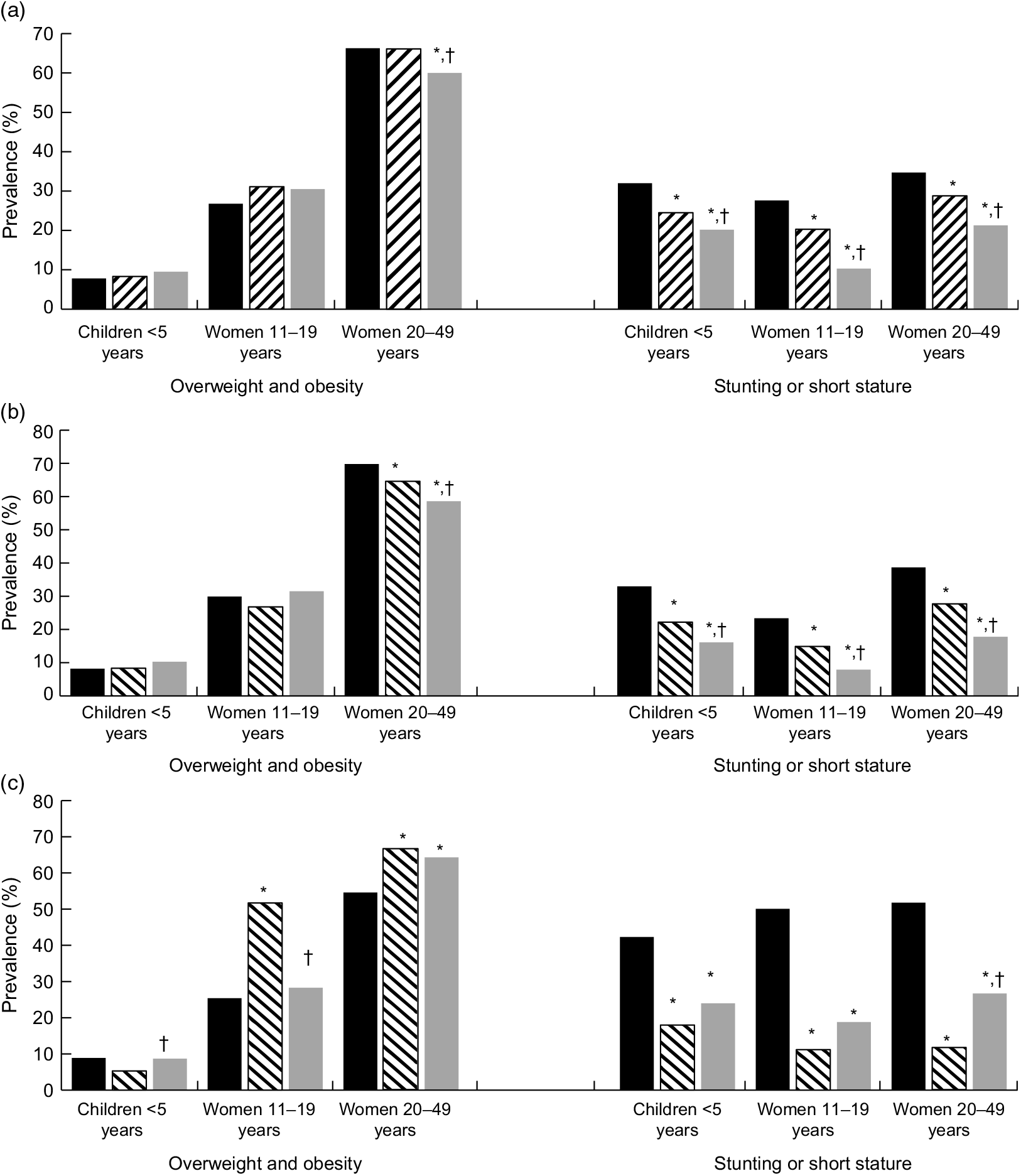
No significant differences in overweight and obesity prevalences were observed across sociodemographic characteristics for children aged <5 years.
Adolescent women aged 11–19 years
Regarding undernutrition, 20·6 % of adolescent women were stunted, 9·3 % had anaemia and 1·0 % suffered from wasting. The prevalence of stunting was significantly higher among adolescent women in the low education and wealth tertiles relative to adolescent women in the medium and high education and wealth tertiles (Table 2). Regarding ethnicity, half of indigenous adolescent women were stunted (50·1 %); this proportion was significantly higher than that of Afro-Ecuadorian (11·2 %) and mestizo (18·8 %) adolescent women.
Regarding excess weight, Afro-Ecuadorian adolescent women were more affected by overweight and obesity relative to indigenous and mestizo women. No significant differences in rates of overweight and obesity among adolescent women were observed across tertiles of wealth and education.
Adult women aged 20–49 years
Undernutrition in the form of anaemia and short stature were prevalent, while the proportion of thinness was very small. Regarding ethnicity, the prevalence of short stature disproportionately affected indigenous women (51·8 %) compared with their Afro-Ecuadorian (11·8 %) and mestizo (26·7 %) counterparts.
The prevalence of overweight and obesity was significantly lower in women in the high wealth tertile (60·0 %) than in women in the medium and low tertiles (66·1 and 66·3 %, respectively). Furthermore, women with low level of education had a higher combined prevalence of overweight and obesity (69·8 %) compared with women with high level of education (58·6 %). Significant ethnic differences in rates of overweight and obesity were observed among adult women. Indigenous women had a higher proportion of overweight (41·3 %) than mestizo (38·9 %) and Afro-Ecuadorian women (31·8 %). However, the rate of obesity among Afro-Ecuadorian women was substantially higher (34·9 %) than that among mestizo (25·4 %) and indigenous women (13·3 %; Table 2).
Discussion
In the present study we document important social inequalities regarding malnutrition indicators among children of pre-school age and women of reproductive age. Undernutrition in the form of stunting and anaemia disproportionately affects socially disadvantaged groups (low wealth, low education and indigenous). Differences in excess weight are smaller and vary by age group. For instance, among children aged <5 years the gaps are very small, whereas among adolescent and adult women, the most significant differences are observed in ethnic minorities (Afro-Ecuadorian) and the low education group.
Many factors help explain the overweight and obesity epidemic in the Ecuadorian context. On an individual level, excess weight results from an imbalance between energy consumed and energy expended. At the collective level, energy imbalances are related in part to improvements in socio-economic conditions, changes in occupational structure, rapid urbanization, and changes in the food supply and food environment. The food environment is characterized by an abundance of widely advertised, relatively inexpensive and highly palatable energy-dense foods. These trends, in turn, influence dietary preferences and have been accelerating in low- and middle-income countries like Ecuador(Reference Corvalán, Garmendia and Jones‐Smith4,Reference Popkin, Adair and Ng20) . The term ‘obesogenic’ is often used to describe a permissive environment that promotes food intake at levels well beyond the control of the individual resulting in excess body weight. Furthermore, physical activity levels have decreased as traditional lifestyles based on strenuous labour have changed dramatically in favour of more sedentary occupations and leisure activities(Reference Delisle, Ntandou-Bouzitou and Agueh21–Reference Waters23). Results from ENSANUT-ECU show that 21 % of children and 26 % of adolescents in urban areas spend ≥2 h on screen time per day, and this trend increases with socio-economic status. Among the adult population in urban areas (>18 years), 64 % is sedentary and this proportion is higher in women (74·4 %) relative to men (52·7 %)(Reference Freire, Ramírez-Luzuriaga and Belmont1).
It has been documented that improvements in socio-economic status in low- and middle-income countries like Ecuador initially increase rates of excess weight (particularly overweight) and decrease rates of undernutrition(Reference Tzioumis and Adair24). As rapid economic growth occurs, undernutrition remains high among the poor, whereas overweight develops initially among the wealthy. In the Ecuadorian context, we observe higher rates of overweight and obesity among children and women of low wealth groups, suggesting that the country is in a relatively advanced stage of the nutrition transition(Reference Popkin25).
Various social, cultural and economic factors may be related to the distribution of malnutrition observed in Ecuador. During the past decade, significant economic and social transformations have occurred which can help contextualize these study findings(Reference Larrea Maldonado and Camacho26). Between 2006 and 2014 growth in gross domestic product in Ecuador averaged 4·3 %, which enabled increased social spending. During that period, poverty declined from 38·3 to 25·8 % and extreme poverty dropped from 12·9 to 5·7 %. The Gini coefficient decreased from 0·54 to 0·47, reflective of greater income growth among the poorest segments of the population(27).
Moreover, between 2007 and 2013 the country adopted education policies tripling the budget assigned to undergraduate public education, from $US 1094·6 million in 2006 to $US 2908·4 million in 2012(Reference Estarellas and Bramwell28). A 10-year Education Plan, between 2006 and 2015, aimed to universalize early and primary education for children and increase upper secondary education enrolment to reach at least 75 % of the population aged 16–18 years. These policies help explain the relatively high proportion of education observed among low wealth groups(Reference Estarellas and Bramwell28).
In 2014 the Ecuadorian Government set a precedent by implementing mandatory front-of-pack labelling for regulating the sale of packaged foods and drinks. The traffic light labels display the levels of sugar, fats and salt with colour codes: red, yellow and green for high, medium and low content of these macronutrients, respectively. A qualitative evaluation of the initiative revealed that the traffic light labels helped raise consumers’ awareness and understanding of the content of processed products(Reference Freire, Waters and Rivas-Mariño29).
The implementation of this initiative is an essential step for raising awareness among consumers. However, the traffic light food labelling by itself cannot influence a reduction in overweight and obesity. Rather, integrated policies of promotion and prevention must be implemented to address the problem of overweight and obesity in the context of the double burden of malnutrition.
The WHO has proposed a set of actions that have the potential to impact both sides of the double burden. These include the promotion of exclusive breast-feeding during the first 6 months, adequate early nutrition feeding practices (after 6 months), promotion of maternal nutrition, regulation of the food environment in schools and the implementation of marketing regulations(30).
Furthermore, current interventions designed to address undernutrition must not inadvertently increase the risk of excess weight. For instance, initiatives to address micronutrient deficiencies through the fortification of staple foods that have the potential to produce further overweight and obesity should be discouraged.
Our study has some strengths and limitations. The strengths include the use of a nationally representative sample of Ecuadorian children of pre-school age and women of reproductive age. We included a comprehensive assessment of the main malnutrition problems affecting the Ecuadorian population, stratified by social indicators. Use of the MPI is an innovative approach to assess social inequalities. This index is aligned with the UN Sustainable Development Goals and allows to identify more precisely target groups for interventions and policy design. The main limitation of our study is the limited capacity to infer causality between socio-economic disparities and malnutrition indicators based on the cross-sectional nature of the data and the type of analysis conducted.
Acknowledgements
Acknowledgements: The authors would like to thank Emory University, Nutrition and Health Science Program, and Universidad San Francisco de Quito for supporting the authors with the time and resources to conduct this research, and the Latin American Nutrition Leadership Program (Programa LILANUT) for its coordination and support in the preparation of this manuscript. Financial support: M.J.R.-L. received PhD funding from the Laney Graduate School, Emory University and CONACYT Mexican Government. DSM Nutritional Products provided funds for the publication of this manuscript. DSM Nutritional Products had no role in the design, analysis or writing of this article. Conflict of interest: None of the authors declare a conflict of interest regarding this manuscript. Authorship: M.J.R.-L. conceived the research question and analysis plan, carried out the statistical analysis and wrote the manuscript. P.B. contributed to the statistical analysis. W.F.W. reviewed and contributed to writing the manuscript and interpreting the results. W.B.F. designed and supervised data collection and contributed to the development of the overall research and writing the manuscript. All of the authors read and approved the final manuscript. Ethics of human subject participation: This study was conducted according to the guidelines laid down in the Declaration of Helsinki and all procedures involving human subjects were approved by the Ethics Committee of Universidad San Francisco de Quito. Written informed consent was obtained from all subjects.



