


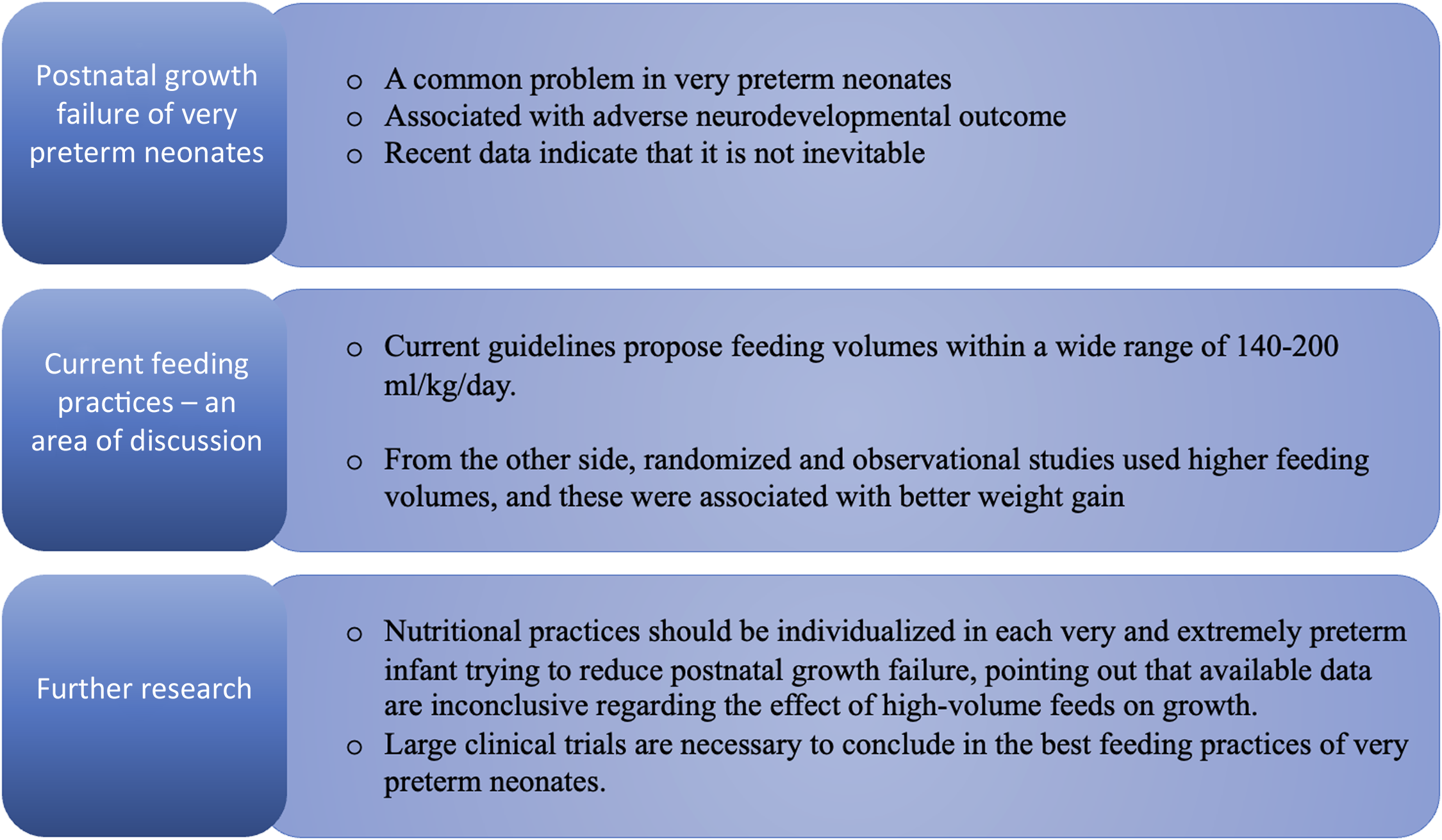



Despite advances in neonatal care and nutritional practices, postnatal growth failure remains common among very preterm neonates(Reference Kumar, Perino and Bowers1,Reference Tran, Le and Skinner2) . In a multicentre study(Reference Martin, Brown and Ehrenkranz3) of 1187 infants born at 23–27 weeks of gestation at fourteen neonatal intensive care units in the USA, postnatal growth failure was found in 75 % of these infants at 28 d of life even though the growth velocity rate was above 15 g/kg per d, which is considered an adequate growth velocity for preterm infants(Reference Ehrenkranz, Dusick and Vohr4–Reference Fenton, Anderson and Groh-Wargo6). For many years, the goals of nutritional care are set to approximate the growth and body composition of a healthy fetus although it is recognised that optimal proportions of fat and lean mass accretion will differ(Reference Cordova and Belfort7,Reference Embleton, Moltu and Lapillonne8) .
Postnatal growth failure is of great concern since there is evidence that it is associated with poor neurodevelopmental outcomes(Reference Ehrenkranz, Dusick and Vohr4,Reference Latal-Hajnal, von Siebenthal and Kovari9) . A multicentre cohort study that evaluated 495 infants with 501 to 1000 g birth weight found that the growth velocity had a significant and possibly independent effect on neurodevelopmental and growth outcomes at 18–22 months corrected age(Reference Ehrenkranz, Dusick and Vohr4). Similarly, a study of 219 very low birth weight infants showed that children with postnatal weight gain below the 10th percentile at the age of 2 years were at the highest risk for mental retardation, motor delay, and cerebral palsy, and their developmental outcome was even worse than that of children who were small for gestational age and had insufficient catch-up growth. Therefore, this study concluded that the postnatal growth pattern was the most important factor associated with adverse neurodevelopmental outcomes at the age of 2 years(Reference Latal-Hajnal, von Siebenthal and Kovari9). However, the association of postnatal weight gain and head growth with later neurocognitive outcomes was reported mainly in observational studies but not in interventional studies(Reference Ong, Kennedy and Castañeda-Gutiérrez10).
For the last 20 years, there is a discussion regarding the prevention of postnatal growth failure especially in very preterm infants with major morbidities(Reference Gounaris, Sokou and Gounari11). Population-based studies initially proposed that postnatal growth failure was inevitable(Reference Cole, Statnikov and Santhakumaran12,Reference Horbar, Ehrenkranz and Badger13) . In 2018, Andrews et al analysed data from 396 preterm very low birth weight newborns in a tertiary neonatal unit after the implementation of new nutritional practices. They found that most infants had growth approximating their birth centile, indicating that adequate postnatal growth was not inevitable(Reference Andrews, Ashton and Pearson14). Several reasons avert very preterm neonates to achieve optimal growth. Embleton et al in 2001 stated in their review that preterm infants had a significant and irreplaceable nutrient deficit in the first few weeks of life that led to postnatal growth failure. This deficit was due to nutritional practices that were based on nutrient maintenance and normal growth but not on catch-up growth(Reference Embleton, Pang and Cooke15). The problem seems to be more severe in very preterm neonates with co-morbidities such as bronchopulmonary dysplasia (BPD). Very preterm neonates with morbidities had further reduction in growth during hospitalisation,(Reference Greenbury, Angelini and Ougham16) and this might be due to lower energy administration than that recommended by current feeding practices leading to a further increase in energy deficit(Reference Gounaris, Sokou and Gounari11,Reference Milanesi, Lima and Villela17) . The observations above indicate that a energy deficit is accumulated, which should be taken into consideration in nutritional practices during hospitalisation. This practice is also emphasised in a recent statement by ESPGHAN who recommended increasing nutrient intakes above estimated target needs during the recovery phase(Reference Moltu, Bronsky and Embleton18).
Target feeding volumes and energy supply
Strategies for the prevention of malnutrition and the resulting insufficient growth have been studied including the volume of the feeds. The range of feeding volumes that is discussed in the widely implemented clinical practice 2010 ESPGHAN guidelines lies within 150–180 ml/kg per d (aiming to 110–135 kcal/kg per d energy) with lower and upper limits of 135–200 ml/kg per /d(Reference Agostoni, Buonocore and Carnielli19). Studies from 127 tertiary neonatal intensive care units reported feeding a wide range of feeding volumes of 140–200 ml/kg per d(Reference Klingenberg, Embleton and Jacobs20). The very recent update of ESPGHAN guidelines(Reference Embleton, Moltu and Lapillonne8) recommends a higher energy supply (115–140 kcal/kg per d v.110–135 kcal/kg per d the older guidelines) with a considerably higher upper limit of 160 kcal/kg per d. The feeding volume corresponding to this energy supply is not higher than 200 ml/kg in most cases. Moreover, in the same report, emphasis is given to balance among the several nutrients (energy fractions) for optimal nutrition to promote optimal growth and long-term outcomes(Reference Embleton, Moltu and Lapillonne8). Of note, these proposed volumes refer to fortified human milk, which is the best practice or alternatively special formula for very preterm neonates. All but one studies discussed below refer to respective volumes of the above-mentioned type of feeding.
As ESPGHAN Committee on Nutrition and invited experts in a recent position paper emphasise, these recommendations do not consider changes in energy needs related to acute illness or chronic disease states(Reference Embleton, Moltu and Lapillonne8). These conditions are very common in this population. They do not also consider additional nutrient losses or demands of very preterm neonates(Reference Embleton, Moltu and Lapillonne8). They also conclude that in individual preterm infants, enteral intakes up to 200 ml/kg per d (or higher) may be appropriate and safe depending on current health status, such as the presence of a significant patent ductus arteriosus or BPD(Reference Embleton, Moltu and Lapillonne8). They also discuss the relevance in specific contexts of the administration of volumes above 200 ml/kg per d, namely in low-middle income countries where access to human milk fortifiers is limited or in infants that do not tolerate full-strength fortification.
In a randomised clinical trial of 224 infants born very preterm weighing 1001–2500 g at birth, volume feedings of 180–200 ml/kg per d of fortified human milk increased growth velocity, weight, head circumference, length and mid-arm circumference compared with usual-volume feedings of 140–160 ml/kg per d of fortified human milk(Reference Travers, Wang and Salas21). The average growth velocity of infants in the higher-volume group was 20 g/kg per d,(Reference Travers, Wang and Salas21) higher than the 15 g/kg per d that is considered adequate for catch-up growth(Reference Ehrenkranz, Younes and Lemons5,Reference Fenton, Anderson and Groh-Wargo6) . Andrews et al analysed data from 396 preterm neonates and found that optimal nutritional practices led to infants’ growth approximating their birth centiles(Reference Andrews, Ashton and Pearson14). Another smaller randomised study of sixty-four preterm infants with birth weight < 1500 g found that infants fed on a high volume of expressed breast milk (300 ml/kg per d) had significantly higher daily weight gain compared with infants fed on a maximum of 200 ml/kg per d(Reference Thomas, Cherian and Santhanam22). However, this study did not provide any data on the length and head circumference increase between the two groups(Reference Thomas, Cherian and Santhanam22). Similarly, in a trial of fifty-four infants born at 24–29 weeks of gestation, volume feedings of 200 ml/kg per d of fortified human milk or preterm formula increased growth velocity, weight gain and arm fat area of infants, compared with those fed at volumes of 150 ml/kg per d(Reference Kuschel, Evans and Askie23). However, head circumference and length did not differ significantly(Reference Kuschel, Evans and Askie23). An older study of fifty-nine preterm infants born 1–2 kg birth weight also reported weight gain at the intra-uterine rate with feeding volumes of 250 ml/kg per d of breast milk or standard formula(Reference Lewis and Smith24). The available data indicate that higher feeding volumes led to higher weight gain and optimal growth velocity for catch-up growth. A recent Cochrane review of two randomised controlled trials comparing high v. standard enteral feeds for preterm or low birth weight infants concluded that high-volume feeds probably improve weight gain during the hospital stay, yet available data are inconclusive on the effect of high-volume feeds on growth and clinical outcome(Reference Abiramalatha, Thomas and Thanigainathan25).
On the other hand, fear of high-volume-related complications, mainly patent ductus arteriosus and BPD(Reference Agostoni, Buonocore and Carnielli19), leads to hesitation in the advancement of feeding volumes. Available studies find no adverse effects in the higher volume groups regarding fluid retention, haemodynamically significant patent ductus arteriosus, tachypnoea, rate of BPD, duration of respiratory support, necrotising enterocolitis, feeding intolerance and length of stay(Reference Travers, Wang and Salas21–Reference Lewis and Smith24,Reference Gounaris, Sokou and Theodoraki26) . In a recent study of very preterm infants, gradually advancing milk feedings up to 260 ml/kg per d were generally well tolerated and without side effects(Reference Gounaris, Sokou and Theodoraki26). Neonates with BPD did not have a significant difference in their respiratory function at 8 years of age compared with very preterm neonates without BPD and term controls when fed with increased milk volumes(Reference Panagiotounakou, Sokou and Gounari27).
Another possible clinicians’ concern is that higher feeding volumes may cause emesis or reflux or even just worsen reflux with a subsequent impact on respiratory status. Current studies assessing higher feeding volumes evaluated preterm infants for signs of feeding intolerance, such as episodes of vomiting and increased aspirates. In the study of Thomas et al, more infants in the high-volume group had feeding intolerance; however, this observation was not statistically significant(Reference Thomas, Cherian and Santhanam22). No difference in feeding intolerance between higher and standard feeding volumes was also noted in two other studies(Reference Kuschel, Evans and Askie23,Reference Zecca, Costa and Barone28) . A meta-analysis also found that there is little or no difference in feeding intolerance between shorter feeding intervals (smaller milk volumes) and longer intervals (higher milk volumes) in very preterm infants(Reference Ibrahim, Van Rostenberghe and Ho29). A recent randomised controlled trial of 2804 very preterm or very-low-birth-weight infants found that daily milk increments of 30 ml/kg v. 18 ml/kg did not make a difference in survival without moderate or severe neurodevelopmental disability, late-onset sepsis or necrotising enterocolitis(Reference Dorling, Abbott and Berrington30). A Cochrane review of six trials concluded that data are insufficient to determine how progressive introduction of enteral feeds affects the risk of necrotising enterocolitis (NEC)(Reference Walsh, Brown and Copperthwaite31). Another recent Cochrane review of fourteen trials involving 4033 infants showed that slow advancement of enteral feed volumes probably has little or no effect on the risk of NEC and overall-cause mortality(Reference Oddie, Young and McGuire32). In this review, meta-analyses suggested that slow advancement may slightly increase feed intolerance and the risk of invasive infection; however, this evidence was of low certainty(Reference Oddie, Young and McGuire32).
Another study using a similar intensive feeding policy did not find to affect the BMI and obesity rates at the ages of 2 and 8 years(Reference Gounaris, Sokou and Theodoraki26). Moreover, rapid weight gain up to term-corrected age in preterm infants had no impact on later metabolic status, while rapid weight gain in later childhood seemed to affect the cardiometabolic status(Reference Embleton, Korada and Wood33). Body composition is not routinely estimated in neonatal units, whereas all three anthropometrics namely head circumference, body weight and body length, as a proxy for lean mass accretion, should be taken into consideration. Optimally, growth in the preterm neonates should not lead to excessive fat deposition, and this is addressed in the last ESPGHAN guidelines also(Reference Embleton, Moltu and Lapillonne8). Low energy intake in the first week of life may be a predisposing factor for complications. A large Swedish retrospective study of 498 infants less than 28 weeks gestation showed that a low energy intake of 102 kcal/kg per d during the first 4 weeks of life was an independent risk factor for the development of severe retinopathy of prematurity, while an increase in energy intake of 10 kcal/kg per d was associated with a 24 % decrease in severe retinopathy of prematurity(Reference Stoltz Sjöström, Lundgren and Öhlund34).
Discussion and conclusion
Very preterm neonates vary in many aspects such as gestational age, birth weight, sex, perinatal complications, type of feeding (fortified human milk which is the best practice or alternatively special formula or combination), heritability (parental BMI and obesity) and epigenetic factors. Studies in young adults (although reluctance exists when extrapolating adult data to neonates) emphasised the crucial role of heritability and other factors such as gut microbiota in weight gain(Reference Silventoinen, Magnusson and Tynelius35,Reference Wardle, Carnell and Haworth36) . Based on the above parameters, it seems unlikely that a standard amount of energy fits the needs of each preterm infant to achieve a standard growth pattern and that the amount of feeding should be individualised. Factors such as appetite and satiety regulation which seem to play a crucial role in delineating the true physiological needs to maintain a healthy, normal weight have not so far been studied in preterm neonates(Reference Ramirez-Silva, Pérez Ferrer and Ariza37). There are also no studies assessing the association of nutrition and constitutional factors in the growth of preterm infants. An early study of Kuschel et al demonstrated that almost half of the infants required higher milk intakes to maintain weight gain and the other half required a reduction of milk intake due to feed intolerance. This observation further supports the need for individualisation of feeding(Reference Kuschel, Evans and Askie23). In corroboration of our notions in the recent ESPGHAN statement, the authors highlight that growth in the ex utero environment will never be the same as in utero, that optimal proportions of fat and lean mass accretion will differ, and that optimal nutrient intakes and growth trajectory for an individual infant are impossible to determine(Reference Embleton, Moltu and Lapillonne8).
Currently available guidelines propose feeding the preterm newborn to provide an energy supply of 115–140 kcal/kg per d (maximum 160 kcal/kg per d) which typically represents a feeding volume of 140–180 ml/kg per d (maximum 200 ml/kg per d)(Reference Embleton, Moltu and Lapillonne8). In the previous and largely adopted 2010 ESPGHAN statement, whereas slightly smaller volumes have been proposed, the authors state that these feeding volumes may be inadequate for several substrates and have accepted that the nutrient intake above this specified range is not discouraged if justified for a good reason(Reference Agostoni, Buonocore and Carnielli19). Similar concerns are expressed in the current report also, whereas authors acknowledge that neonatal nutrition research is extremely active, and it is likely that alternative approaches and recommendations may be preferable as our knowledge expands. Special preterm formula has a standard concentration with increased protein content; thus, in case of inadequate weight gain, the quantity should be increased since the energy and protein ratio needs to be stable, a necessary issue for protein utilisation. We have observed that very preterm neonates often need higher feeding volumes of fortified human milk or special preterm formula or combination to maintain minimum weight gain. Moreover, we have observed in three tertiary neonatal care units (unpublished observations) that many very preterm infants, immediately after the transition from tube feeding to bottle feeding, consume ad libitum milk volumes of 250–300 ml/kg per d or even higher. Recent studies conducted by our research group showed that these higher feeding volumes are usually well tolerated and have not adversely affected BMI at school age, and moreover, very preterm neonates treated with a more intense feeding policy had a good respiratory prognosis at school age(Reference Gounaris, Sokou and Theodoraki26,Reference Panagiotounakou, Sokou and Gounari27) . Furthermore, healthy bottle-fed full-term neonates and young infants followed up in our outpatient clinic usually consume variable milk volumes ranging between 150 and 250 ml/kg, but their weight gain is also variable and, on several occasions, unrelated to the consumed milk volumes. These observations have also been made by other researchers(Reference Thomas, Cherian and Santhanam22,Reference Lewis and Smith24,Reference Valman, Heath and Brown38,Reference Lucas, Bishop and King39) . In a few studies, volumes up to 300 ml/kg per d have been administered earlier but also recently(Reference Thomas, Cherian and Santhanam22,Reference Lewis and Smith24,Reference Gounaris, Sokou and Theodoraki26,Reference Valman, Heath and Brown38,Reference Lucas, Bishop and King39) . One could speculate that reluctance in milk administration exists among many neonatologists in tube-fed premature babies and that many physicians rely on unproven risks to prescribe milk with caution. The interplay between growth factors, genes, epigenetics and nutrient supply, on an individual basis, may affect the early postnatal growth in the preterm infant(Reference Menon, Davidson and Drake40). Nutrient supply is the parameter that we can easily modulate to achieve optimal short-term and long-term outcomes.
In conclusion, nutritional practices should be individualised in each very preterm infant for ideal growth. Available data are inconclusive regarding the effect of high-volume feeds on growth and later outcomes. There is a need for larger randomised studies that compare higher target feeding volumes in very preterm infants to universally conclude in the optimal feeding practices.
Acknowledgements
None.
This research received no specific grant from any funding agency, commercial or not-for-profit sectors
C. K. performed the literature search and drafted the manuscript. E. S., D. R. and A. M. contributed to the literature search and drafting of the work. R. S. and M. B. critically revised the manuscript. V. G. proposed the writing of the article, supervised and critically revised the work. A. G. and R. S. contributed to the idea of the article, contributed to literature search and critically revised the manuscript. All authors approved the final version to be published and agreed to be accountable for all aspects of the work.
There are no conflicts of interest.

 Open access

