



Family and home environments have a large influence over children health. Members of the same family have been found to share risk factors associated with overweight (OW) and obesity (OB)(Reference Nielsen, Nielsen and Holm1). These factors include parental childrearing practices, preferences for certain foods with high fat and sugar and physical inactivity patterns(Reference Budd and Hayman2).
Parental practices are considered to be educational styles that determine a family’s actions and mediate the ways in which parents and children interact(Reference Ventura, Gromis and Lohse3,Reference Stang and Loth4) . A significant association has been found between these practices and the body weight of children(Reference Shloim, Edelson and Martin5).
According to the WHO, the first years of life are crucial for establishing eating preferences and good nutritional habits(6). Therefore, the relationship that children establish with food can be mediated by the beliefs and preferences that their parents and caregivers have towards food(Reference Couch, Glanz and Zhou7,Reference Vaughn, Barrio and Fisher8) .
Unhealthy weight gain in children and many eating behaviours that are established early in life will likely continue into adulthood. This situation poses some risk and raises concerns about the increase in OW and OB among children under 5 years of age, which exceeded 31 million worldwide in 1990 and 41 million in 2015(6).
Previous studies have found that certain parental styles can affect children’s weight and BMI and may even be related to a high prevalence of OB(Reference Larios, Ayala and Arredondo9–Reference Saelens, Sallis and Frank11). Nonetheless, the consequences of these type of childrearing styles and how they relate with OW and OB are still debatable.
Furthermore, the interaction between parents and child should be the subject of more investigations that contribute to a deeper understanding of this phenomenon, in order to develop effective interventions to solve childhood weight problems. Therefore, the aim of this study was to evaluate the relationship between parental feeding practices and excess weight in preschool children in Bucaramanga, Colombia, using artificial intelligence as an analytical approximation.
To conclude this section, we would like to note a methodological aspect that is important because it represents a novel approach for studies on the association of nutrition variables. We have used artificial intelligence, namely, a selection of variables that are commonly used in machine learning (the branch of artificial intelligence that addresses these topics). This was aimed at contributing additional evidence for the conclusions that we obtained with the traditional statistical techniques used in this field. A second objective was to propose an alternative methodology that could be used in the future, since with artificial intelligence techniques, there is no need to be limited to predictive linear models (such as logistic regression).
Methods
Study sample
A cross-sectional analytical study was performed. The study population included children under 6 years of age who attended a government programme run by the Colombian Institute for Family Wellbeing (Instituto Colombiano de Bienestar Familiar (ICBF, Spanish acronym)), named Children’s Homes (Hogares Infantiles in Spanish), in the Bucaramanga metropolitan area, Colombia.
A sample size of 384 children who and their respective parents was analysed, considering a two-sided 95 % CI (1-α), α error of 5 %, power of 80 %, prevalence of excess weight among exposed children of 30 %, prevalence of excess weight in non-exposed children of 20 %, prevalence of changes in excess weight among non-exposed children of 10 %, effect size of 1 and expected OR of 2·0 (OpenEpi, version 3).
For every child of the analytic sample, the survey was applied exclusively to one parent through a direct interview. The selection of the Children’s Homes (n 18) was based on a simple random sample, with a sampling framework composed of all institutions of that type (n 37) located throughout the city and metropolitan area. Within each institution, a computerised random number generator was used to select the participants.
Preschool-age children who attended the Children’s Homes in Bucaramanga and its metropolitan area were included. In addition, we included their parents or primary caregivers who were randomly selected. Parents/caregivers were excluded from the study if they did not necessarily have mental and physical conditions to answer the survey.
We excluded caregivers or parents who did not know how to read or write. The data were collected between September and December 2017. This process was carried out in the HI facilities by nutritionists who were previously trained in the direct interview method and in taking anthropometric measurements using standardised techniques. This study was conducted according to the guidelines laid down in the Declaration of Helsinki, and all procedures involving human subjects were approved by the Ethics Committee of the University Industrial of Santander (Act Nª 6, 7 April 2017). Informed consent was obtained from mothers on behalf of their children at each stage of data collection.
Measures
Outcome variable: excess of weight
OW or OB was defined as BMI for age (BMI/A) ≥+2·0 z-score sd for children under 5 years of age, and BMI/A ≥ 1·0 sd for children 5 years of age and older(12).
Children’s nutritional status was classified according to growth and development established by the WHO(12) using as indicators the z values of the BMI/A.
Explanatory variable: parents’ practices related to feeding their children
This variable was determined by administering a Parental Feeding Practices Survey.
The Parental Feeding Practices Survey contains four domains: (a) positive involvement in children’s feeding, (b) pressure to eat, (c) use of food for behaviour control and (d) restriction of the amount of food items that reflect both the use of parental control over children’s feeding and child-centred feeding practices. In addition, a previous study that evaluated the validity of this instrument found good initial validity and reproducibility(Reference Tschann, Gregorich and Penilla13).
Covariates
The children’s variables included in the analyses were sex, age, socio-economic level and eating habits. In addition, their food consumption over the past month was measured by a FFQ that was developed and administered as part of the National Nutritional Situation Survey (ENSIN, 2015)(14). The mothers and fathers participating in the study reported the information regarding their children’s food consumption. Physical activity was evaluated with the Measurement of Physical Activity and Sedentary Behavior Survey (CMAFYCS in Spanish), which contains questions related to the number of min/week that the children spent: walking, dancing, participating in an organised sport, riding a bike, skating, jumping rope and swimming. This has been validated for the Colombian preschool population(Reference Camargo, Santisteban and Paredes15). This information was also reported by the mother or father of each child. Waist circumference was measured with the technique described by Lohman et al.(Reference Callaway, Chumlea, Bouchard, Lohman, Roche and Martorell16), with each child standing, their abdomen relaxed, arms at their sides and feet together. A measuring tape was placed horizontally at the level of the natural waist, that is, at the narrowest point of the circumference of the torso. The measurement was obtained without compressing the skin and after completing a normal breath. Weight:height ratios were also calculated.
The variables related to parents and caregivers were the following: sex, age, socio-economic level, education, occupation, marital status, head of family, family composition (number of members in the family, number of children, number of children under 7 years old), person responsible for decisions related to food and its preparation, weight, height and waist circumference.
The direct interview method was used to collect the sociodemographic variables related to the parents and caregivers. This procedure was carried out by nutritionists previously trained in this technique.
Procedures
The nutritionists responsible for collecting data were trained in administering the survey through a direct interview and in taking anthropometric measurements according to techniques standardised by the International Society for the Advancement of Kinanthropometry(17). Measurements were taken in duplicate by two independent nutritionists, with children wearing light clothing and without shoes. Reproducibility was obtained with two measurements of weight, size and waist circumference, using intraclass correlation coefficients (intraclass correlation coefficient 0·95, 95 % CI 0·88, 0·97; intraclass correlation coefficient 0·97, 95 % CI 0·90, 0·98 and intraclass correlation coefficient 0·91, 95 % CI 0·89, 0·95, respectively).
Body height (scale 0·1 cm) was measured without shoes using a portable stadiometer (SECA® 213). Body weight was measured using electronic scales, with an accuracy of 0·1 kg (SECA®, reference 803). Waist circumference measurements were made at the narrowest point, the midpoint between the last costal edge and the iliac crest, using a flexible steel anthropometric tape (Lufkin) measure with a precision of 0·1 mm.
Statistical analysis
Data analysis was conducted between June and October 2018. This initially included the distribution of categorical (proportions) and continuous variables (means and standard deviation, or median and interquartile range), according to distribution. Shapiro–Wilk W test was used to verify the normality of the data. To assess the differences among continuous variables, the Student’s t test was used for normal distributions; otherwise, the Mann–Whitney U test was used. To determine whether differences existed among categorical variables, χ 2 and Fisher exact tests were used. The calculation of the prevalence of excess weight excluded two children (0·5 % of the total sample) who lacked complete anthropometric data.
Two alternative methods were used to determine the parental practices that most affected OW in the children. First, the results obtained with Artificial Intelligence techniques are presented, namely, techniques for selecting subsets of variables (feature subset selection) with machine learning tasks. This technique used programmes implemented in Python with scikit-learn library. For the second technique, logistic regression models were generated using Stata 14.0 software (Stata Corporation).
In both cases, BMI/A was determined with WHO Anthro and Anthro Plus.
Analysis with machine learning
The data set was treated as a binary classification task. The classes corresponded to excess weight of children according to the BMI/A cut-off points indicated previously.
Variables were divided into three groups: (G1) sociodemographic (eating habits, sex, age, socio-economic level, education, occupation, marital status, head of family, family composition, person responsible for decisions related to food and its preparation); (G2) frequency of consumption of certain food groups (food consumption over the past month was measured by an FFQ) and physical activity performed by children (specifically, the number of min/week that the children spent walking, dancing, participating in an organised sport, riding a bike, skating, jumping rope and swimming) and (G3) parental feeding practices. Regarding the variables for G3 (corresponding to the questions from the survey about parental feeding practices used in this study), these were grouped into four dimensions in order to measure different aspects related to parental practices(Reference Tschann, Gregorich and Penilla13). These dimensions were: positive involvement in children’s eating (D1), pressure to eat (D2), use of food to control behaviour (D3) and restricting the amount of food (D4). Additionally, questions related to these dimensions, a group of general questions (G) was created. Each group contained sub-components. The online Supplementary material in this article includes a list of all the G3 variables.
Logistic regression (LR) was used to determine the degree to which the variables in groups G1, G2 and G3 could predict excess weight in the children. The LR was implemented in Python using the scikit-learn library.
Since the classes in the data set were poorly balanced (thirty-five cases with excess weight v. 347 without this outcome), an LR was used with the parameter ‘class_weight = balanced’. Regarding the C of the LR, the experiments used C = 1. Since the values of all the variables were numeric, ‘missing’ values were imputed using the mean. The variables were standardised to obtain uniform ranges.
In addition, given the unbalanced nature of the data mentioned above, the AUC was used to measure the performance of the LR. As is known, the AUC measures the proportion of case pairs (one from each class) that are correctly classified. A value of 0·5 corresponds to random and 1 corresponds to the performance of a perfect classifier.
Furthermore, since the main interest of this study was to determine which parental behaviours more greatly influenced excess weight in children, a variable selection algorithm was used and the five variables that were most relevant to predicting excess weight were sought. In this case, Recursive Feature Elimination(Reference Darst, Malecki and Engelman18) was used, which was the most standard one for this context. This selection method began with all the available variables and gradually discarded those that were less important to determining the probability of presenting excess weight. With the implementation used, one variable was eliminated at a time until arriving at the five most relevant variables. In order to separate the training process from the test, results were obtained using cross validation. It is important to mention that this method, which is used in machine learning for linear classifications (such as in LR), requires a significant programming load. Therefore, a programming environment such as Python with the scikit-learn library was used.
Results
A total of 384 children under 6 years of age were analysed, along with their respective father or mother. The average age of the parents was 33 (sd 11·1) years. No statistically differences in the general characteristics of interest were found between girls and boys (Table 1).
General characteristics of preschool children in Bucaramanga, Colombia, according to sex
(Numbers and percentages; median values and interquartile ranges (IQR))

BMI/A, BMI for age; CLMMW, Current Legal Minimum Monthly Wages.
* P value determined with the Mann–Whitney U test.
† P value determined with the χ 2 test.
‡ $737·717 Colombian pesos in 2017, which on an average equalled $245·90 USD on the date of the survey ($1 USD = $3000 Colombian pesos).
§ n for caregivers is 355 for information about CLMMW.
|| Physical activity: number of min/week the children spent: walking, dancing, participating in an organised sport, riding a bike, skating, jumping rope and swimming.
¶ P value determined with Fisher’s exact test.
Regarding parents, 51·29 % were heads of family; on average, between Monday and Friday, the parents spent 4 (sd 2.62) h with their child eating, playing, reading, talking or doing homework. On the weekend, they spent 9.5 (sd 6.27) h performing these activities with their children. Regarding the anthropometric status of the parents, their average weight was 65·41 (sd 12·82) kg for mothers and 77·08 (sd 14·52) kg for fathers, height was 156·85 (sd 7·07) cm for mothers and 168·14 (sd 9·46) cm for fathers and waist circumference was 82·05 (sd 12·01) cm for mothers and 83·63 (sd 12·32) cm for fathers, with a prevalence of excess weight of 55·31 % for mothers and 65·71 % for fathers.
The prevalence of excess weight (OW or OB) in the children was 9·2 (95 % CI 6·9, 12) %. The table in the online Supplementary material shows the parents’ practices related to feeding their children. There were no significant differences between fathers and mothers (P = 0·657) in terms of the use of food to control the behaviour of their children or restricting their children’s food consumption (P = 0·294). Meanwhile, statistically significant differences were found between restricting food consumption for children with and without excess weight (P = 0·044), with a greater frequency for children without excess weight.
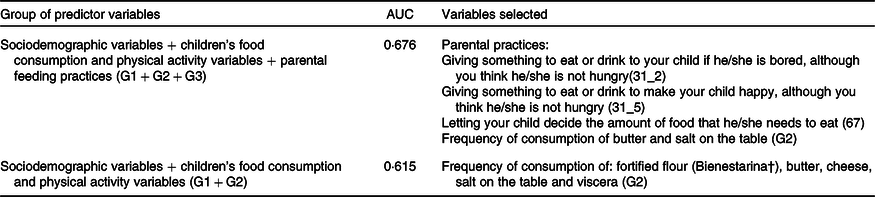
Table 2 presents the results from the selection of variables using Recursive Feature Elimination, the artificial intelligence method described previously. This was based on two sets of variables and used the selection method. The first group includes the variables from all three groups, represented by G1 + G2 + G3. The selection that was obtained is limited to three variables: 31_2, 31_5 and 67. An AUC of 0·676 was obtained only with these variables. Note that the variables 31_2 and 31_5 correspond to the group of questions inquiring about whether food or drinks were used to control the children’s behaviour.
Results from the Recursive Feature Elimination (RFE) variable selection method based on different groups to obtain the five most relevant variables*
* The classification algorithm was logistic regression and the performance used the AUC estimated by means of a cross-validation.
† Bienestarina® is a flour enriched with vitamins and minerals and is a food supplement of high nutritional value, which consists of a mixture of flours and/or cereal starches (wheat and maize), soya flour and whole milk powder, with vitamins and minerals. Bienestarina is provided by the government (not for sale) for Colombian Institute for Family Wellbeing programmes in order to improve the nutrition of children attending that institution (some of whom are malnourished).
In order to determine whether the G3 group needs to be present for obtaining an acceptable classification, the G3 variables were eliminated from the baseline group of variables. That is, we searched for the most relevant variables based on G1 + G2. This in fact resulted in an AUC of 0·615, indicating that the G3 group is necessary for obtaining a good classification.
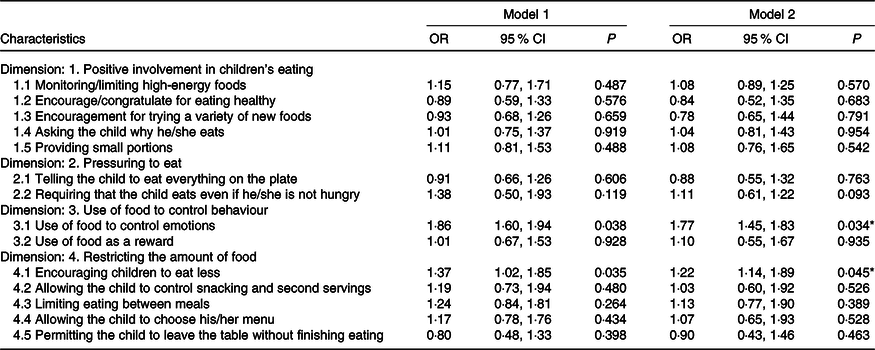
As we have mentioned, we also used a conventional method to identify parental feeding practices associated with excess weight. Table 3 shows the results obtained. When adjusting by the sex, age, socio-economic level and physical activity of the children, the presence of excess weight in children was found to have a statistically significant association only with the use of food to control emotions (OR 1·77; 95 % CI 1·45, 1·83, P = 0·034) and encouraging children to eat less (OR 1·22; 95 % CI 1·14, 1·89; P = 0·045).
Associations between parental feeding behaviours and excess weight in Colombian preschoolers†
(Odds ratios and 95 % confidence intervals)
* P < 0·05.
† Model 1, raw model; model 2, adjusted model (age, sex, socio-economic level and physical activity).
In addition to the above, when exploring the results according to the nutritional status of the parents, a statistically significant association was found only between the presence of excess weight in some parents and the practice of encouraging children to eat less (OR 1·33; 95 % CI 1·01, 1·07; P = 0·041), after adjusting by the sex, age and socio-economic level of the children.
Discussion
The role of parents in modelling eating practices and physical activity for their children has been widely explored(Reference van der Maaten and Hinton19,Reference Nazzaro, Lerro and Marotta20) . Some authors suggest that children’s preferences for certain foods and the physical activity patterns that they choose reflect their parents’ preferences, which assumes positive effects on children’s body weight only when parents make correct choices. Nevertheless, the results of the present study indicate that, regardless of socio-economic level, the children’s food consumption, or level of physical activity, certain parental practices were more greatly related to excess body weight in the children.
Actually, the results from the artificial intelligence approach described in this paper agreed with findings obtained by traditional methods and also showed additional evidences.
Thus, this study found that parental feeding practices are an important associated variable of excess weight in children. One practice that stands out is the use of food by parents or caregivers to control behaviour, particularly to manage the emotional state of children (boredom, frustration or anger) regardless of satiety, which some authors call feeding to soothe or emotional eating(Reference Huxtable, Millar and Love21–Reference Braden, Rhee and Peterson24). This aspect was also reported by a study of children under 18 months old that indicated harmful effects from the use of food to control the emotional state of children(Reference Stifter and Moding25). These types of practices can inhibit the children’s ability to self-regulate, even at early ages, as well as, affect the health of children as a result of excess weight or malnutrition(Reference Sleddens, Kremers and Stafleu26). Furthermore, unhealthy relationships with food are established when it becomes an emotional regulator for children.
Regarding parental practice of restricting food, a study of a population like ours found differences in that practice between fathers and mothers. The father’s restrictive practice was related to the eating behaviour of the children, while the mothers’ practice was related to the children’s temperament(Reference Haycraft and Blissett27). Nevertheless, our study did not find differences in this type of practice between fathers and mothers.
Furthermore, to this childrearing style, findings by our study as well as others show that practices that restrict certain types of food and control the amount that is consumed are also related to the weight of children. A study with non-Hispanic preschool girls reported that mothers who restricted their daughter’s food, regardless of whether they were hungry, generated poor self-regulation processes in their daughters, triggering an increase in energy consumption and thereby increasing weight for size. In turn, this modified the mothers’ perception of their daughters’ bodies, which increased the restriction of food(Reference Francis and Birch28). The characteristics of these findings may be like our study, which indicates that these restrictive practices are more common among parents of children without excess weight. This fact rules out inverse causality in the association between this type of practice and excess weight in children, since those practices were not more common among parents whose children had excess weight. It is worth mentioning that the practice of restriction is a parental strategy that is characteristic of Hispanic families(Reference Lindsay, Sussner and Greaney29).
The main finding of the present study was the role of parental practices to control food in order to manage the emotional responses of children and its relationship to excess weight. This is a relatively new issue that warrants more documentation. As other authors have noted, this suggests the importance of continuing to develop research to study not only children’s eating behaviour but also the way in which parents and caregivers provide food(Reference Wood, Blissett and Brunstrom30), particularly the mother. Our results suggest that the types of childrearing styles that parents or caregivers use when feeding children at early ages can determine the way in which the children relate to food in the future.
Some of the strengths of this study include the sample size and the random selection of the children’s homes and of the participating population. In addition, the quality of the process to collect the data contributed to the internal validity of the study. Another strength that is worth noting is the methodological approach that was applied using artificial intelligence techniques to evaluate the association of interest to this study. This application, which is new in the field of nutrition, improves the robustness of the evidence that is generated, thereby contributing to the internal validity of the findings.
A limitation of this study includes the self-reporting to obtain the data corresponding to the main explanatory variable, that is, the practices that parents used to feed their children. Therefore, memory bias on the part of the parents cannot be ruled out. Further, the study design does not enable establishing a causal relationship between parental feeding practices and the development of excess weight in children.
Conclusions
Parents who more frequently rely on practices that use food to control their children’s behaviour and who restrict the amount of food that their children consume have children with more excess weight than parents who do not commonly use those practices. The findings of this study undoubtedly offer a window of opportunity to provide educational strategies for parents and caregivers, regardless of socio-economic level, in order to not only provide knowledge about how these types of practices can affect the eating habits of children but also to help to develop skills that contribute to adopting childrearing styles that more positively impact the health of children.
Acknowledgements
The authors would like to thank the participants from Children’s Homes, and the parents, caregivers and children for their valuable contributions. Thank you to the Colombian Institute for Family Wellbeing (Instituto Colombiano de Bienestar Familiar) for their administrative and collaborative efforts in the development of this study.
This study was financed through a 2016–2017 internal call for research projects by the Vicerrectoría de Investigación y Extensión, of the Universidad Industrial de Santander, project code 2310. The Vicerrectoría de Investigación y Extensión had no role in the design, analysis or writing of this article.
Conceptualisation: E. M. G. D.; design of the study: E. M. G. D., A. B. and C. I. A C.; carrying it out study: E. M. G. D. and C. I. A. C.; formal analyses: E. M. G. D. and A. B.; writing – review and editing: E. M. G. D., A. B. and C. I. A. C.
None of the authors reports any conflicts of interest.
Supplementary material
For supplementary material/s referred to in this article, please visit https://doi.org/10.1017/S0007114520003797



