

Introduction
The provision of person-centred long-term care (LTC) and support is one of the action areas of the United Nations Decade of Healthy Ageing (2021–2030) (World Health Organization (WHO) 2020). Person-centredness is a widely used term, but its exact meaning is unclear. An oft-cited definition in dementia care is that of Kitwood, who advocates for a humanistic approach, emphasizing the relational and psychological dimensions of people living with dementia over the medical model of dementia care (Kitwood Reference Kitwood1997). The more recent Lancet commission on person-centred LTC uses the WHO’s healthy ageing model as an underlying principle to aim for person-centred LTC for older persons to enhance their functional ability: ‘Maintaining functional ability enables a full enjoyment of life and upholds the basic rights, fundamental freedoms, and human dignity of older people’ (Pot, Rabheru, et al. Reference Pot, Rabheru and Chew2023, p. 1754). The aim of person-centred LTC and support is then to optimize people’s functional ability when they are confronted with significant ongoing loss in their mental and physical capacity (World Health Organization [WHO] 2020). This requires care and support that is flexible, sensitized to and takes account of individual needs and priorities (Dahlberg et al. Reference Dahlberg, Todres and Galvin2009; Cesari et al. Reference Cesari, Sumi, Han, Perracini, Jang, Briggs, Thiyagarajan, Sadana and Banerjee2022). For people with declining capacities like people with dementia, this brings a number of challenges.
First, the needs of people with dementia change throughout the progression of the condition and extend across different service provision sectors, which are often disconnected and lack interprofessional collaboration (King et al. Reference King, Peckham, Marani, Roerig, Yung, McGrail, Young, Shaw and Marchildon2023). Second, in the provision of LTC and support for people with dementia, social and psychological needs are commonly not addressed (Miranda-Castillo et al. Reference Miranda-Castillo, Woods, Galboda, Oomman, Olojugba and Orrell2010). Third, people with dementia are frequently not heard or taken seriously, as cognitive decline may limit their ability to articulate coherent narratives or express their needs, and prevailing pessimistic sociocultural views of dementia further stigmatize these capacities (van Wijngaarden et al. Reference van Wijngaarden, Alma and The2019; Villar et al. Reference Villar, Serrat and Bravo-Segal2019).
Regulators assessing service providers are influential change agents for the quality of care and support they provide (van de Bovenkamp et al. Reference van de Bovenkamp, Stoopendaal, van Bochove and Bal2020; Leistikow et al. Reference Leistikow, Pot and Bal2022). Regulatory norms and frameworks often provide a common conception of what is considered ‘good care’, which is used in regulatory assessments as well as internal audits by care organizations (Grit Reference Grit2017; Weenink et al. Reference Weenink, Wallenburg, Leistikow and Bal2021). Current regulatory frameworks on the quality of person-centred LTC and support, however, are built on fixed standards used in fields such as medication safety, whereas the assessment of person-centred care and support requires greater flexibility (van de Bovenkamp et al. Reference van de Bovenkamp, Stoopendaal, van Bochove and Bal2020; Kok Reference Kok2021; Pot Reference Pot2022). It is therefore questionable if current regulatory assessments of the quality of person-centred LTC and support actually contribute to its quality.
Research on regulatory assessments of person-centred LTC and support is scarce and rarely focuses on service provision in home settings (Pot et al. Reference Pot, Kok, Schoonmade and Bal2023). However, given population ageing, more care and support will need to take place at home in the future (European Commission. Directorate General for Economic and Financial Affairs. and Economic Policy Committee of the European Communities 2015; Pot et al. Reference Pot, Kok, Schoonmade and Bal2023). This qualitative study draws on the experiences of people with dementia living at home, to critically reflect on how and what is assessed in regulatory practices. In other words, we aim to identify potential discrepancies between what is deemed important by people with dementia and how regulatory practices assess the quality of person-centred LTC and support for people with dementia living in the community. This study addresses the following research question: How do the experiences of people with dementia living in the community relate to the way in which the health-care regulator assesses the quality of person-centred LTC and support?
Phenomenology of person-centred LTC and support
Historically, the narratives of people experiencing cognitive impairments have been disregarded (Villar et al. Reference Villar, Serrat and Bravo-Segal2019). This not only is due to the decline in their cognitive capacity but also results from social contexts and stigmatization, as their opportunities to express themselves are regularly reduced significantly by people around them (Villar et al. Reference Villar, Serrat and Bravo-Segal2019, p. 5). However, attention to the narratives of people with dementia can provide valuable information on their lived experiences, personal challenges and the role that health care and support services have in their existential context (van Wijngaarden et al. Reference van Wijngaarden, Alma and The2019; Roberts et al. Reference Roberts, Windle, Story, Brotherhood, Camic, Crutch, Stott, Sullivan and Grillo2023; Smith et al. Reference Smith, Chesher, Fredriksen-Goldsen, Ward, Phillipson, Newman and Delhomme2024). Active listening can amplify under-represented voices and reveal nuances in experiences, which are crucial for person-centred LTC and support (Wang and Geale Reference Wang and Geale2015).
Using the lived experiences as an epistemically valuable source of information is in line with the phenomenological philosophy often applied in research on dementia care (Dahlberg et al. Reference Dahlberg, Todres and Galvin2009; Fetherstonhaugh et al. Reference Fetherstonhaugh, Tarzia and Nay2013; Huizenga et al. Reference Huizenga, Scheffelaar, Bleijenberg, Wilken, Keady and Van Regenmortel2023; Samsi and Manthorpe Reference Samsi and Manthorpe2013; van Wijngaarden et al. Reference van Wijngaarden, Alma and The2019). Although the interpretation and use of phenomenology differ across these studies, they share a common focus on using the experiences and views of people with dementia regarding specific phenomena to understand the meanings these phenomena hold for them. Phenomenological research is meaning-oriented: ‘as researchers, we do not refer to “what” people say (content analysis or opinion research); rather we attempt to refer to how they interpret what is meaningful in their lives’ (van Wijngaarden et al. Reference van Wijngaarden, van der Meide and Dahlberg2017, p. 1742). As van Wijngaarden et al. (Reference van Wijngaarden, van der Meide and Dahlberg2017) argue, phenomenology differs because the dominant conception of what is considered to be evidence in health care has historically been based on positivism.
In phenomenological studies, people with dementia share that they face an uncertain future and root themselves in a familiar past to maintain a sense of agency, all while the present continuously confronts them with cognitive impairments (Huizenga et al. Reference Huizenga, Scheffelaar, Bleijenberg, Wilken, Keady and Van Regenmortel2023). The ongoing loss of mental capacity changes their relationships with themselves, others and their surrounding world (van Wijngaarden et al. Reference van Wijngaarden, Alma and The2019). People with dementia are inclined to withdraw socially, wanting to avoid interactions with people lacking in understanding about their cognitive decline and hold stigmatizing views of dementia (Van Gennip et al. Reference Van Gennip, Pasman, Oosterveld-Vlug, Willems and Onwuteaka-Philipsen2016; van Wijngaarden et al. Reference van Wijngaarden, Alma and The2019; Huizenga et al. Reference Huizenga, Scheffelaar, Fruijtier, Wilken, Bleijenberg and Van Regenmortel2022).
Accepting support from care-givers can help people with dementia in maintaining activities and relations that they consider important. But receiving support also entails a degree of dependency and requires placing trust in the hands of others (Bolt et al. Reference Bolt, van der Steen, Khemai, Schols, Zwakhalen and Meijers2022). It is crucial for people with dementia to be listened to, have their preferences respected and be taken seriously. In other words, a sense of reciprocity and agency empowers people with dementia, helping them accept and navigate their increasing dependency with the necessary support (Boyle Reference Boyle2014; Van Gennip et al. Reference Van Gennip, Pasman, Oosterveld-Vlug, Willems and Onwuteaka-Philipsen2016; van der Byl Williams and Zeilig Reference van der Byl Williams and Zeilig2023).
There is evidence that interactions between care-givers and people with dementia often occur in relation to designated professional tasks, with professionals structuring questions in ways that elicit specific answers, which can result in people with dementia feeling marginalized or excluded when their role in decision-making is reduced (Fetherstonhaugh et al. Reference Fetherstonhaugh, Tarzia and Nay2013; Villar et al. Reference Villar, Serrat and Bravo-Segal2019). As a consequence, perceived disparity in the care relationship can cause emotionally distressing experiences for people with dementia (Van Gennip et al. Reference Van Gennip, Pasman, Oosterveld-Vlug, Willems and Onwuteaka-Philipsen2016). The desire to be taken seriously, the tendency to withdraw from the social world and the desire to be heard are, as articulated by van Wijngaarden et al. (Reference van Wijngaarden, Alma and The2019), related to insensitive practices:
More often people [with dementia] seemed to feel scrutinized by an inquisitive and disapproving view. This objectifying gaze had a severe impact on daily life, as in several cases it provoked a sense of being patronized. … this sense of marginalization and alienation is evoked, not so much by harsh, explicit words, but mainly as a result of tacit, insensitive practices and/or actions. (p. 18)
Person-centred LTC and support should therefore not only promote agency but also be sensitized to the innate vulnerability of people when confronted with declining cognitive capacities (Dahlberg et al. Reference Dahlberg, Todres and Galvin2009).
Regulating health care
Regulation means different things to different people, but it can broadly be understood as a tool used by states to oversee, control and alter the actions of public and private institutions, with the aim of ensuring that these activities serve the public good (de Kam Reference de Kam2020). The primary objective of regulation reflects a societal value, in this case ensuring good-quality person-centred LTC and support. As described in the previous section, person-centredness is an important value in providing care and support for people with dementia and is embedded in Dutch law in the definition of good care (Wet kwaliteit, klachten en geschillen zorg [Healthcare Quality, Complaints and Disputes Act] Stb 2015). Regulators assessing care and support are therefore tasked with safeguarding its quality (Beard et al. Reference Beard, Officer, De Carvalho, Sadana, Pot, Michel, Lloyd-Sherlock, Epping-Jordan, Peeters, Mahanani, Thiyagarajan and Chatterji2016; Pot et al. Reference Pot, Kok, Schoonmade and Bal2023)
The assessment by regulators involves translating the complex realities they evaluate and rendering them into concrete – often measurable – standards (Dahler-Larsen Reference Dahler-Larsen and Dahler-Larsen2019). Because high-quality person-centred LTC remains broadly defined, the regulator translates this abstractly formulated societal value into specific aspects of care that can be monitored through standards (de Kam Reference de Kam2020; Leistikow et al. Reference Leistikow, Pot and Bal2022). Standards are used to provide a common conception of what is considered good and what is unacceptable (Grit Reference Grit2017), and to create certainty in assessing organizations fairly in relation to others (Rutz et al. Reference Rutz, van de Bovenkamp, Buitendijk, Robben and de Bont2018; Kok et al. Reference Kok, Leistikow and Bal2019).
In an effort to allow multiple interpretations of how good-quality person-centredness can be practised, the Dutch Health and Youth Care Inspectorate (hereafter: Inspectorate), the focus of this study, introduced more open standards. In practice, however, inspectors reverted to assessing fixed and specific aspects of care as they sought to restore certainty and uniformity in their evaluations (Kalisvaart et al. Reference Kalisvaart, Oldenhof, Bal and Pot2025). In setting a standard, regulators act as a directive force to steer human action in a particular direction, thus influencing the social reality of service providers (Dahler-Larsen Reference Dahler-Larsen and Dahler-Larsen2019; de Kam Reference de Kam2020; Kok Reference Kok2021). Furthermore, the instruments used to assess a standard can have a performative effect, referring to the expected and unexpected ways in which regulatory instruments influence the behaviour of addressees. To ensure that regulatory policies are still contributing to the desired societal value, continuous regulatory reflexivity on practices and outcomes is necessary (Leistikow et al. Reference Leistikow, Pot and Bal2022).
The Inspectorate has conducted multiple pilots to explore ways to adapt its current practices in order to include the distinct perspectives of clients or citizens on quality of care (Rutz et al. Reference Rutz, van de Bovenkamp, Buitendijk, Robben and de Bont2018). Findings from experts-by-experience or mystery guests were, however, often considered as non-factual, as they do not align with current regulatory practices or dominant values such as objectivity (Adams et al. Reference Adams, Paul, Ketelaars and Robben2015; Rutz et al. Reference Rutz, van de Bovenkamp, Buitendijk, Robben and de Bont2018; de Graaff et al. Reference de Graaff, Stoopendaal and Leistikow2019). In the construction of inspectable standards for person-centred LTC and support, a risk arises when factual, measurable information outweighs the experiences of clients. Currently, health-care regulation is often attuned to the most significant risks, potentially excluding the emotional and relational components required for person-centredness (Carr and Biggs Reference Carr and Biggs2020).
Whereas some degree of reduction is inevitable when using standards to assess person-centred LTC and support, as one cannot remain entirely abstract, these reductions should still be informed by the lived experiences of clients. Monitoring a field with a standardized and measurable approach is a tempting call, but can result in a misguided feeling of control and risk management. The regulation of person-centred LTC and support may therefore benefit from a different – more bottom-up and flexible – approach that involves greater and meaningful client participation (Pot et al. Reference Pot, Kok, Schoonmade and Bal2023; Kok et al. Reference Kok, van de Bovenkamp and Pot2025b).
Methodology and methods
Methodology
This explorative qualitative study adopted a phenomenological methodological approach by focusing on the meanings attached to certain practices. It also foregrounds the everyday experiences in which these are embedded (van Manen Reference van Manen1997).
Study design
We used a qualitative research design consisting of interviews with people with dementia, family carers and inspectors of the Inspectorate, focus groups and document analysis. By combining the experiences of people with dementia with regulatory practices, we aim to identify potential discrepancies between the regulatory assessment of and the lived experience of person-centred LTC and support.
Recruitment of participants
The recruitment process for respondents with dementia and their family carers for in-depth interviews and focus groups involved a collaborative effort with a local community service organization and two day-care centres for people with dementia. Professionals from these organizations, who work directly with people with dementia and their family carers, approached potential participants to gauge their initial interest in participating in the study by sharing their experiences with dementia. They asked potential participants who, in their view, would feel comfortable participating and be willing to share their experiences. When individuals expressed interest, professionals asked if they could share their contact information with the first author, who then contacted them by phone to restate the research purpose and arrange an appointment if they still remained interested. Some family members first wanted to call or meet with the first author before they gave permission for their relative to be approached to participate.
Building trust and situational sensitivity are key to promoting a safe environment for people with dementia. To support this, we held informal conversations with the care professionals and family care-givers beforehand about the respondents’ situation and mood. Furthermore, to prioritize relational engagement and low-threshold participation, we refrained from discussing any details of their diagnosis (e.g. specific type of dementia) or demographic details (e.g. age), as this may be distressing (Heggestad et al. Reference Heggestad, Nortvedt and Slettebø2013; Novek and Wilkinson Reference Novek and Wilkinson2019; Thoft et al., Reference Thoft, Ward and Youell2021).
Interviews at the day-care centre were organized by employees who asked people with dementia a few days before the first author’s visit if they would like to participate in an interview, and again on the day itself. Interviews and focus groups at the day-care facilities started with lunch or coffee for people with dementia to informally get acquainted with the new situation and the unfamiliar faces of the researchers (first and second author). Potential contextual factors that may have influenced the lived experience of the participants in this study include that all participants lived in their own home, and all had been assigned a case manager who helps people with dementia and family carers in organizing care and support. Lastly, we interviewed one participant who lived alone; the rest lived with their partner.
The inspectors interviewed for this study were recruited using purposive sampling (Palinkas et al. Reference Palinkas, Horwitz, Green, Wisdom, Duan and Hoagwood2015). This research is part of a larger research consortium on including the perspectives of people with lived experience in regulation, and the role of their experiences in regulatory practices. Contact persons from different regulatory parties involved in this consortium supported us in identifying and connecting us to inspectors who work on designing regulatory frameworks and/or incorporating the perspectives of people with lived experience in their regulatory work.
Interviews and focus groups with people with dementia and family carers
The aim of interviewing people with dementia was to offer a glimpse into their lived experiences, from their own perspectives. The intent was not to create a representative image of the experiences or needs of people with dementia but to grasp ‘a general structure of meaning’ (van Wijngaarden et al. Reference van Wijngaarden, van der Meide and Dahlberg2017, p. 1742). To foreground the experiences of people with dementia, listen to their experiences and understand what they consider important, we used the emotional touchpoint method. Originally designed as part of experience-based co-design (EBCD) by Bate and Robert (Reference Bate and Robert2006) and adapted by Kuis and Goossensen (Reference Kuis and Goossensen2017), the emotional touchpoint method uses key moments as selected and described from the inner perspective of the respondents in their unique situation.
The respondents’ experiences are captured using criteria based on values established by respondents themselves; no external frames or categories were imposed (Kuis and Goossensen Reference Kuis and Goossensen2017). The emotional touchpoint method highlights important moments or phases that shape the respondents’ experiences of the condition’s progression, from the diagnosis of dementia onwards. The interviewees were asked to share important moments related to living with dementia. To help interviewees articulate the emotions or feelings involved and, if needed, extend their emotional vocabulary, ‘emotion mats’, cards representing various emotions and feelings (e.g. powerless, relieved, misunderstood), were used (Kuis and Goossensen Reference Kuis and Goossensen2017). We interviewed six people with dementia and four family carers. Interviews ranged in duration from 25 to 70 minutes.
For the three focus groups, the emotional touchpoint method was extended using advice from experts of Alzheimer Netherlands (AN), the Dutch patient organization for people with dementia. Key moments shared in the interviews that represented recurring structures in the narratives were translated into short stories as input for the focus group. The goal of the focus groups was to gain a more elaborate, nuanced understanding of the experiences of people with dementia and the underlying structure of what exactly is at stake in these situations. Because dementia can affect cognition in several ways, the stories were read out loud and presented on a handout with high contrasting colours. Pictures representing the story were also provided. As a result, attendees had the option to engage with the stories by listening, reading or looking at the pictures. The focus groups with people with dementia took place at two different adult day-care centres. For every focus group, two researchers and at least one day-care employee were present. The same approach was applied in the focus group with family care-givers. Two focus groups included people with dementia (six and eight participants) and one focus group included family care-givers (eight participants).
Interviews with inspectors and analysis of regulatory documents
We also interviewed inspectors and analysed their regulatory instrument and inspection reports. Interviews with a variety of inspectors from different departments and inspectorates helped to gain a broad understanding of their general practices and participative procedures (N = 15). Inspectors were interviewed using a topic list focusing on the involvement of clients in their practices from designing a regulatory framework with which they assess organizations, the practice of an inspection visit, to drawing conclusions. Specifically, the interviews with inspectors of the department assessing LTC and support (N = 4) were used to provide context for our document analysis and the practice of inspection visits. The interviews with inspectors provided contextual insights into regulatory practices and indicated that the regulatory reports provide information on the actual information used to assess and justify norms by inspectors. This informed our decision to analyse regulatory reports.
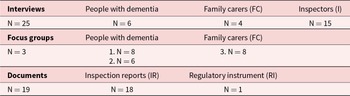
Via document analysis we aimed to provide insight into the current regulatory process of assessing person-centred LTC and support. After every inspection visit an assessment report is written and published on the website of the Inspectorate (https://toezichtdocumenten.igj.nl). These reports contain the Inspectorate’s justifications for their assessment, which helps us in understanding which information inspectors consider to be of importance when assessing person-centred LTC and support. We selected and assessed 19 of the most recent reports that assess community nursing organizations, in which person-centred LTC and support is a central theme. An overview of the collected data is provided in Table 1.
Overview data

Table 1 Long description
Long_Description: The table summarizes three data sources used in the study: interviews, focus groups, and documents, with counts by participant or document type. Interviews total 25, including 6 people with dementia, 4 family carers, and 15 inspectors, making inspectors the largest interview group. Focus groups total 3, with participant counts listed as 8 and 6 for people with dementia across two groups and 8 for family carers across one group; no inspector focus group count is provided. Documents total 19, consisting of 18 inspection reports and 1 regulatory instrument. Overall, interviews are dominated by inspectors, while the document set is almost entirely inspection reports. The focus group section appears to combine multiple groups under the people-with-dementia column, so those counts should be interpreted as group-specific rather than a single consolidated total.
Data analysis
All interviews were audiotaped and transcribed verbatim. For the interviews with people with dementia and family carers, the discussed important experiences were analysed following the three-step care ethical model (Kuis and Goossensen Reference Kuis and Goossensen2017). Step 1 identifies what is at stake for the participant in terms of emotions or values. Respondents themselves had shared which emotions they felt in these experiences. Step 2 involves the response to this experience by a care-giver or other person. The responses were coded using Atlas.ti software. Step 3 analyses the response of the participant. For the focus groups, experiences that represented recurring structures in the narratives, like not being taken seriously or longing for a sense of agency, were translated into short stories of four to five sentences maximum. Each story represented an experience and emotion or value at stake.
In the focus groups, people with dementia recognized this experience and shared comparable stories. Because vignettes ‘are useful for grounding discussion in concrete cases rather than abstract views’ (Green and Thorogood Reference Green and Thorogood2009, p. 99), we used three vignettes based on real-life experiences shared by respondents. The selected vignettes represent shared underlying mechanisms in the collected data, resonated most with focus group participants and closely reflect the real-life experiences of people with dementia. Identifiable details were anonymized and the names used in the vignettes are pseudonyms.
Data analysis proceeded iteratively, combining contextual insights from interviews with a systematic document analysis of regulatory reports (Srivastava and Hopwood Reference Srivastava and Hopwood2009). The regulatory reports were thematically analysed to gather the justifications in assessments of person-centred LTC and support (Braun and Clarke Reference Braun and Clarke2006; Bowen Reference Bowen2009). This helped identify the information used by inspectors to evaluate person-centredness during an inspection visit. We coded every justification to assess this theme inductively in a first phase. The documents and codes were then revisited in a second phase, forming descriptive categories of recurring accounts. Throughout the analysis, emerging findings were regularly discussed in the research team in order to refine our analysis and attain consensus on our interpretation of the data. The four interviews with inspectors responsible for assessing LTC and support were used to triangulate and contextualize the findings from the document analysis.
Ethical considerations and informed consent
This research is approved by the ESHPM Research Ethics Review Committee, reference number ETH2122-0419. For the interviews with people with dementia, a simplified/adapted informed consent form was developed. A summary of the consent form was given to the respondents after every interview, featuring a picture and contact details of the first author to answer potential questions or concerns from respondents or their families afterwards. All inspectors signed an informed consent form prior to the interview. Some inspectors requested not to be quoted verbatim; this was taken into account in the reported findings.
Findings
We present the findings starting with the vignettes illustrating experiences of people with dementia. We elaborate on what the experiences depicted in the vignettes entail, how care-givers responded and what can be learnt from them in relation to regulatory assessments of person-centred LTC and support. We then present how and what the Inspectorate evaluates in assessing person-centred LTC and support.
Vignette 1
Wim has just finished his weekly grocery shopping, a mundane task he’s been doing for years and years on Friday afternoons. His stroll back home through his neighbourhood is a beloved routine. Despite his dementia diagnosis – which has a significant impact on his life – he has retained this routine, symbolizing the freedom he still has.
While on his walk, Wim runs into Marcia, the community nurse. Marcia has a strange look on her face, she has been his nurse for months but instead of their usual greeting, Marcia looked concerned. She approached Wim and said: ‘Wim, do you know your way home? Come on, come with me, I’ll bring you’.
Wim was baffled. ‘I know where I live!’ he thought, but he also knows that Marcia doesn’t know any better and means well. So, Wim pretends that he doesn’t know his way home.
This vignette shows the tension between a sense of agency and vulnerability experienced by people with dementia. No matter how mundane the task of weekly groceries may be, it is something that Wim can still do on his own, contributing to his sense of agency. This sense of agency is disrupted when Marcia assumes that Wim doesn’t know his way home, pushing him into a position of vulnerability and dependency. Although Marcia seems to ask, there is no opportunity given to Wim to formulate an answer. We do not know the history of Wim and Marcia; it could very well be that on a recent other occasion Wim was lost, and Wim is currently not aware. But, as Wim is clear-minded now, the assumption that he cannot find his way home feels belittling to the extent that he considers it to be one of the most important and memorable moments regarding his dementia. In the context of person-centredness, the interaction with Marcia highlights the significance of professionals being aware of the importance of being treated with respect and having a sense of agency for people with dementia, and of adopting a social and respectful manner in conversing with them. For example, it is important to avoid elderspeak and to provide possibilities for people with dementia to express themselves.
Vignette 2
Margaret and her partner recently were assigned a case manager. They remember his first visit vividly. In their first conversation the case manager asked if they had set up a will. When they said they hadn’t, he urged them to do it.
Margaret was recently diagnosed with Lewy body dementia but feels perfectly fine most of the time. She had not given her future much thought and found it difficult to be confronted with it by having to make decisions about it.
After following the case manager’s stern and confrontational suggestion to set up a will, a sense of ease of mind has been created. Amid the uncertainty of her future, she finds peace in knowing that her will is set and that arrangements are made for her children and grandchildren to all receive what she wants them to have.
There is an uncertainty in what the future holds when having dementia. Many people with dementia will be aware that they will forget, and will not be aware of things in the future. Setting up a will gives people with dementia a sense of agency, as they can control their future themselves. Margaret experienced a great deal of peace in having made decisions about the future, by controlling the narrative. This peace of mind is not limited to the people with dementia; partners also experience relief. People with dementia and family carers experience arranging a will as an important emotional experience. Although the conversations can appear confrontational, professionals can play a significant role in offering peace of mind by warning people with dementia and their loved ones about possible future scenarios. This holds true even if clients were previously unaware of the risks of not making these directives earlier.
Vignette 3
The alarm rings, and Jos awakes unexpectedly refreshed. The past couple of nights were restless; he slept far worse than usual. Today he’s going to the daycare centre, something he truly enjoys. There, he’s surrounded by likeminded people who understand him like nobody else.
As the minutes pass, he grows agitated. A bus is scheduled to arrive and bring him to the daycare centre at 9:30. On most days, he appreciates the rides after a restless night, but now his increased energy has made him impatient and annoyed. He longs to experience the freedom of riding his bike there himself. It’s only 15 minutes and the weather is great.
He can’t cancel the bus ride, though; he knows it’s there to help him, his son arranged it for him and, even if he wanted to, he has no idea who to call to cancel it.
Most respondents living at home still have families who support them. For example, their family support network helps in organizing care and support services or with administrative tasks. Navigating the network of care services and the associated bureaucracy can be difficult for people with dementia, making it demanding for them to oversee. When care services are set, they are not rescheduled easily, or at least people with dementia may not know how to do this. In practice, however, the needs of people with dementia change daily. Our findings demonstrate that it is important for people with dementia that the service provision is flexible and responsive to their changing needs. When people with dementia, like Jos, feel refreshed, they may not want to be restricted by having to adhere to and being pushed into a pre-planned care and support schedule. While on other days it can be a relief that professional support is organized, Jos has an emotionally distressing experience when the services are not in line with how he feels, and he is not seen or heard in his needs.
In sum, the vignettes collectively depict the tension between wanting to hold on to a sense of agency and accepting support. Maintaining a sense of agency is of great importance for people with dementia. At the same time, people with dementia must relate to their increasing need for support. People with dementia move fluidly within these shifting tensions, and when services fail to align with their emotional or cognitive state, it can lead to distressing experiences.
Regulating person-centred LTC and support
In this section we first elaborate on the realization of the regulatory framework, starting from broad terms depicted in laws to specific assessment criteria which are used for assessments during inspection visits. We then look at the considerations made in this process and show which specific aspects of care are used by inspectors to justify their assessments of person-centred LTC and support.
The Inspectorate assesses organizations using a compliance-based approach. Organizations are visited by inspectors to assess whether they are compliant with laws and regulations as well as quality standards set by professional and client organizations. On these visits, inspectors use a regulatory instrument to assess every organization based on the same set of norms. When constructing a regulatory instrument, inspectors select which norms will be assessed:
If you have these 100 norms, we [inspectors] choose, say, 14 or 18, where we specifically focus on during an inspection visit. We ourselves decide when such an organization complies by indicating a number of weighting aspects of each norm based on what we think is sufficient. (I2)
The instrument thus gives inspectors 14 to 18 norms to assess during a visit, which belong to different themes. The central theme in the regulatory instrument used by inspectors to assess the quality of LTC and support at home is called ‘Client is central’. The theme ‘Client is central’ is firstly translated into three norms, see Table 2.
Norms used in evaluating ‘client is central’

Table 2 Long description
The table lists three evaluation norms for whether home care is client-centred. Norm 1.1 focuses on the client receiving care that fits their current care needs. Norm 1.2 states that care should contribute to the client’s quality of life. Norm 1.3 emphasizes that the client keeps as much control as possible over their home care, and that community nursing adapts to the client’s needs. The norms move from meeting immediate needs, to broader wellbeing, to autonomy and responsive service delivery. No scores or performance results are provided, so the table defines criteria rather than reporting outcomes or comparisons.
Using these three norms, the Inspectorate determines what they expect from organizations for the client to be central. For each of these norms the Inspectorate formulates several assessment criteria to decide whether an organization complies or not: the second translation (see Table 3). This is an informal process. As an inspector stated:
A number of inspectors work together to identify a number of assessment criteria based on a quality framework, and that’s what we were going to work with. (I2)
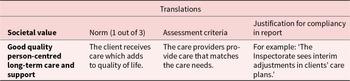
Examples of translations in operationalizing person-centred long-term care and support
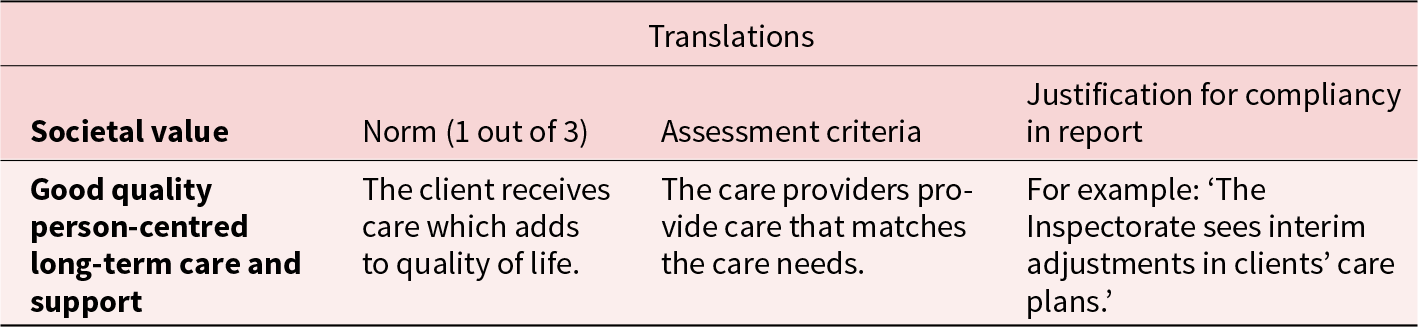
Table 3 Long description
The table links a societal value to a specific norm, assessment criteria, and an example justification used in a report. It focuses on good quality person-centred long-term care and support. The norm states that the client receives care that contributes to quality of life. Compliance is assessed by whether care providers deliver care that matches the client’s care needs. The report justification example notes that an inspectorate observed interim adjustments in clients’ care plans. Only one translation entry is provided, so no comparisons or trends across multiple values are shown.
A team of inspectors decide how norms will be evaluated and at what point an organization complies. Norms are scored on a four-point scale from ‘not compliant’ with the norm to ‘fully compliant’.
Inspectability
Inspectability is a term used by inspectors to describe the operationalization process of translating a norm into specific, assessable criteria. By making norms inspectable, inspectors are equipped with a standardized tool that minimizes interpretive variation and ensures that all organizations are assessed using the same observable and verifiable information. An inspector explained that when a norm is experienced to be difficult to assess or is interpreted differently by inspectors – for example when it is too vague in the eyes of inspectors – the norm and the coinciding assessment criteria are re-evaluated and refined in team meetings.
To arrive at a shared understanding of the information required to assess the extent to which care organizations comply with a norm, inspectors identify common interpretations of that norm. To do this, inspectors translate abstract terms like ‘good-quality’ into more specific, observable aspects of care during a visit. When assessment criteria are interpretated differently by inspectors they search for other depictions, in order to increase uniformity. In this process the broader norms often remain untouched, but inspectors instead agree on a specific piece of information on which (non-)compliance can be justified.
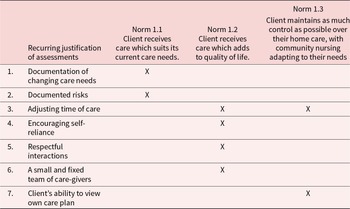
In Table 3 we identified the translations made by inspectors from the abstract societal value to an observable aspect of care in their inspection reports. By looking at adjustments in the care plan, the inspectors justify that care professionals provide care that matches clients’ needs. This justification in turn is an attempt to produce a uniform depiction of good-quality person-centred LTC and support. In analysing the inspection reports published by the Inspectorate, we found seven recurring justifications that the Inspectorate gave in order to come to their conclusion in their assessment of ‘the client is central’, see Table 4. We now examine the information used to make each justification. In all analysed reports the Inspectorate considered the organizations to be largely compliant (3/4) with the theme ‘Client is central’ or fully compliant (4/4).
1. Documentation of changing care needs in care plan
Justifications of theme ‘client is central’

Table 4 Long description
The table links seven recurring assessment justifications to three client-centred norms. Norm 1.1 is marked only for documentation of changing care needs and documented risks. Norm 1.2 is marked for adjusting time of care, encouraging self-reliance, respectful interactions, and having a small fixed team of caregivers. Norm 1.3 is marked for adjusting time of care and for the client’s ability to view their own care plan. Adjusting time of care is the only justification connected to more than one norm, appearing under both Norm 1.2 and Norm 1.3. Overall, the justifications cluster most strongly under Norm 1.2, with Norm 1.1 and Norm 1.3 covering fewer, more specific areas.
Using the inspection reports, we identified that inspectors often draw conclusions on norm 1.1 by going through personal care plans (documentation of clients on the agreed upon services and updates and logs on provided services), and search for documented changes in the needs of clients:
The Inspectorate sees interim adjustments in clients’ care plans. For example, the Inspectorate sees that a care plan has recently been changed, because a client and care-givers noticed that a different method of showering was less stressful for the client. The Inspectorate sees this change reflected in the care plan. [IR-6]
In order to grasp whether a client receives care that suits their needs, inspectors identify regularly updated care plans as an indicator that the needs of clients are met and up to date. Inspectors also use documentation to verify what professionals tell them by looking to see if it is also written down in care plans:
The community nurse adjusts the care plan when she notices that there is a change in care needs. … In the report, the Inspectorate reads, for example, that health-care professionals report reduced judgement and disorientation. The Inspectorate then reads that one of the actions is that the client uses a medicine dispenser. The care professionals no longer consider it responsible for her to manage her own medication. [IR-1]
Using different sources in the inspection visit is part of the triangulation of information:
Triangulation is important, and only when we have three sources and all three are congruent with each other will we write it down as a positive finding. [I2]
Inspectors are thus required to search for information that can be verified with multiple sources before it can be incorporated into their formal assessment reports.
2. Documented risks
Another justification found for norm 1.1 ‘Receiving care which suits the client’s current needs’ is derived from care plans as well, but draws on whether risks have been identified in care plans. For example, a justification from a regulatory report of an organization complying with this norm reads:
The Inspectorate reads about a client’s risk of falling. For another client, the Inspectorate reads that there is a risk of a skin defect. [IR-16]
Inspectors use documented risks to clients as an indicator that their current care needs are met. In and of itself this does not demonstrate that clients’ care needs are met; rather, the Inspectorate’s reliance on documented risk as a criterion reveals a regulatory logic in which identification of clients’ risk is central to their assessments of care quality. In almost every inspection visit, inspectors also talk to clients, but the focus on risks during the inspection visits devaluates their epistemic contribution in assessing if care suits their current needs. An inspector justified this approach by stating that they cannot solely accept client satisfaction, as clients are often not aware of all the risks present. Inspectors struggle with incorporating client experiences into the inspection because they experience a responsibility in identifying risks which clients do not perceive. Inspectors’ own assessment criteria thus prevail regarding the contribution of clients. This is exemplified by an inspector’s account of a conversation with a client in relation to risk identification:
Then we [inspectors] talk briefly with the client about how they experience the care, and that’s something general. In the meantime, we keep a close eye on how the situation at that client’s home is, as we see it represented in the client’s file later. Is there attention for the risks and the living environment and are things in order regarding medication? [I2]
During the conversation with clients, inspectors reported scanning the room to search for possible risks and to verify if these risks are documented in care plans. Documentation regarding changing care needs and the identification of risks thus have a big role in the inspectors’ assessments regarding norm 1.1. What should be noted is that inspectors must assess all themes and norms in one visit in which another theme like ‘Safe care at home’ is assessed at the same time. This may mean that themes regarding risks are prioritized in inspection visits over other themes, like ‘Client is central’.
3. Adjusting time of care
The most used justification by inspectors when assessing whether the ‘client is central’ in the organizations they visit is whether the time of providing care is coordinated with the client and is responsive to a client’s wishes. This is used to assess if care adds to quality of life (1.2) and if the client is given the help and opportunity to have as much control as possible over their life (1.3). As an example, the justification from a report reads:
The community nurse coordinates the times of the care moments with the client during the inventory of care needs. A client says that she drinks coffee at the playground every week. This is important for her social contacts. In the care plan, the Inspectorate reads that she will receive her care early on that day. [IR-1]
This example shows an organization that establishes a fixed weekly schedule, wherein community nurses consider the client’s own schedule. We also identified other types of examples of when an organization complied with these norms:
The client says she then puts a note on the door, asking care-givers not to wake her up for care. According to the client, the care-givers then call her later in the morning to arrange a new time for care. [IR-2]
This example shows how care was not organized to a fixed schedule but a system that the client and care-giver agreed upon, for the client to communicate with her care-givers when to (not) receive services and how care-givers are attuned to this.
4. Encouraging self-reliance
A fourth justification we identified is that inspectors refer to examples of how care professionals encourage clients to be self-reliant:
Care professionals tell the Inspectorate that they stimulate the self-reliance of each client. … For example, a client tells the Inspectorate that a care provider helps her with showering and dressing. The care provider only helps with actions that the client cannot do herself. Previously, the care provider helped with more actions, the inspection heard. [IR-11]
The encouragement of self-reliance is used as justification for norm 1.2, which concerns receiving care that contributes to quality of life. Inspectors verify care professionals’ accounts on this topic through multiple sources. First, inspectors verify these accounts through interactions with clients, assessing whether clients experience encouragement of self-reliance in their daily care. Second, inspectors assess this during inspection visits by observing perceivable practices. For example, inspectors may note the presence of assistive tools in clients’ homes that enable them to put on compression stockings independently. Third, inspectors examine care plans and other documentation to determine whether self-reliance is actively promoted. As one inspection report states:
In various files, the Inspectorate notes that care providers encourage self-reliance as much as possible. For example, the Inspectorate notes that care providers support clients to take their medication independently for as long as possible. [IR-18]
The reliance on triangulation of information determines which information is rendered useful in regulatory assessments, a mechanism we also identified in the following theme.
5. Respectful interactions
In the assessment of the same norm 1.2, inspectors also use observable respectful interaction with clients in their justifications. For instance, speaking at eye level, engaging in small conversations or using the client’s own dialect are all examples of aspects included. The justification for this assessment is based on observations during the inspection visits often accompanied by examples of stories from clients.
The Inspectorate sees that health-care professionals treat clients respectfully. For example, the Inspectorate sees that a care provider is calmly waiting for a client who has difficulty getting up. [IR-1]
An inspector explained that they observe and take into account how clients are approached and treated during the inspection visit. What person-centred care and support entails is formed by the methodology of inspectors in their assessment of care organizations.
Clients also report that care providers are warm and treat them with respect. The care providers are patient and make time for a (short) chat. The Inspectorate also observes this during the care route. [IR-12]
Because inspectors rely on observable and triangulated aspects of care, person-centred care and support is operationalized through what can be observed during their visits.
6. A small and fixed team of care-givers
We identified that a small and consistent team of care-givers is often used in the justification of compliance to norm 1.2:
From all respondents, the Inspectorate hears that a fixed and manageable team provides the care. Care providers state that clients see a maximum of five or six different care providers per week. The Inspectorate confirmed this statement when reviewing care plans. [IR-18]
In the justifications of norm 1.2 overall, we identified a greater use of examples given by clients. An inspector explains that within the theme ‘Client is central’, client experiences are not used on their own, as they need to be triangulated, but are used to provide examples of what is found in a document or said by a care provider.
Clients tell us that they usually see the same care provider and that a number of other regular care professionals also come. Clients say that all health-care professionals know them well and know what care is needed. The Inspectorate sees in physical care plans that a team of three or four care professionals visits each client. [IR-11]
Conversations with clients during inspections are thus used to exemplify other findings, but have a limited epistemic weight in the assessments on their own.
7. Clients’ ability to view own care plan
Lastly, inspectors most often assess norm 1.3 by inspecting whether clients are able to view their own care plan.
The Inspectorate hears that clients can view their own ECD [electronic care plan]. The care professionals say that not all clients do this. Sometimes informal care-givers or children of clients look at the ECD, care professionals say. [IR-9]
The Inspectorate focuses on the ability of clients to view their care plan online or on paper. If the care plan is physically in their home, inspectors check if this is an actual version of the care plan.
Clients have the option to log in to their ECD digitally. The Inspectorate sees an information leaflet about this at clients’ homes. Most clients state that they do not feel the need to view their file. [IR-7]
An inspector explained that not all clients feel the need to understand their own care plans, but as this is an aspect which is included in their norms, they must assess it. The ability of clients to view their own care plans here is at odds with their own findings, indicating that this is not necessarily a priority of clients. While inspectors may have a more encompassing understanding of care organizations as a whole, experiential knowledge of clients may inadvertently be marginalized in the methodology used by inspectors. Even though there is continuous reflection on the norms and their inspectability by inspectors, the question remains whether the Inspectorate takes the client into account in weighing their assessment of person-centred care.
Discussion
In this article we addressed the following research question: How do the experiences of people with dementia living in the community relate to the way in which the health-care regulator assesses the quality of person-centred LTC and support? Our findings indicate that the most significant experiences shared by people with dementia were underpinned by a desire to be involved in decisions, thereby fostering a sense of agency, an observation also reported by Fetherstonhaugh et al. (Reference Fetherstonhaugh, Tarzia and Nay2013). People with dementia are confronted with declines in capacity while continuing to seek agency in how they live their lives. In order to promote people’s functional ability and sense of agency, person-centred LTC and support should prioritize listening before taking action to understand the perspectives of people with dementia, create an environment that fosters their functional ability and sense of agency, and remain responsive to ongoing or future declines in capacity (Miranda-Castillo et al. Reference Miranda-Castillo, Woods, Galboda, Oomman, Olojugba and Orrell2010; Van Gennip et al. Reference Van Gennip, Pasman, Oosterveld-Vlug, Willems and Onwuteaka-Philipsen2016; Villar et al. Reference Villar, Serrat and Bravo-Segal2019; Pot, Rabheru, et al. Reference Pot, Rabheru and Chew2023). These aspects should be meaningfully incorporated in the way quality of person-centred LTC and support is assessed. In practice, our analysis shows that this is a difficult endeavour.
The Inspectorate seeks to assess the norms it derived from laws, legal frameworks and input from professional and client organizations. Person-centred LTC is one of these norms (de Kam Reference de Kam2020; Leistikow et al. Reference Leistikow, Pot and Bal2022). We identified that the Inspectorate focuses on aspects of person-centred LTC and support (e.g. flexibility, respectful interactions) which are, in the context of maintaining functional ability and a sense of agency, considered important to people with dementia as well. In analysing the process of operationalizing these norms, we found that what is deemed to be valid information by inspectors is based on a largely positivistic logic. Inspectors agree upon specific observable aspects of care during site visits and documentation that in their eyes depict that the ‘Client is central’. These specific aspects thus should portray the broader conceptualization of good-quality person-centred LTC. This approach, however, raises a validity concern regarding whether it encapsulates what person-centredness means in the experience of people living with dementia. For example, even if an organization meets assessment criteria for person-centredness (e.g. documentation of risks and changing care needs), it is questionable if this assesses or promotes a sense of reciprocation and agency for people with dementia in their relationship with care-givers (Boyle Reference Boyle2014; Van Gennip et al. Reference Van Gennip, Pasman, Oosterveld-Vlug, Willems and Onwuteaka-Philipsen2016; van der Byl Williams and Zeilig Reference van der Byl Williams and Zeilig2023).
Regulators in various countries experiment with the involvement of patients and family members in various steps of the regulatory process, but face similar challenges (de Graaff et al. Reference de Graaff, Stoopendaal and Leistikow2019; Wiig et al. Reference Wiig, Rutz, Boyd, Churruca, Kleefstra, Haraldseid-Driftland, Braithwaite, O’Hara and van de Bovenkamp2020). Established regulatory practices and frameworks often take precedence over clients’ experiences, particularly when these accounts challenge standing practices. Our findings align with previous research showing that experiences of clients are considered less valuable sources of information, thereby risking epistemic injustice (Wiig et al. Reference Wiig, Rutz, Boyd, Churruca, Kleefstra, Haraldseid-Driftland, Braithwaite, O’Hara and van de Bovenkamp2020; de Graaff et al. Reference de Graaff, Rutz, Stoopendaal and van de Bovenkamp2024; Kok et al. Reference Kok, Palimetaki, Akrouh, Schoonmade, van de Bovenkamp and Pot2025a). In other words, regulators struggle to incorporate and value phenomenological accounts of users of the services they assess, in their practices of creating regulatory instruments and in their assessments using these instruments. Furthermore, the standardization of the specific depictions of person-centred LTC can have an undesired performative effect in steering the focus of care organizations, as it stimulates not interactions with clients but, for example, documentation because this is tangible and verifiable (Dahler-Larsen Reference Dahler-Larsen and Dahler-Larsen2019; de Kam Reference de Kam2020; Kok Reference Kok2021; Kalisvaart et al. Reference Kalisvaart, Oldenhof, Bal and Pot2025).
This struggle is linked to a second aspect of regulatory practices that greatly determines what the Inspectorate focuses on in its assessments, namely risk mitigation. Aspects of care that are person and context-dependent, and that require flexibility and discretion from inspectors, like person-centred LTC and support, are considered low-risk activities, as Carr and Biggs (Reference Carr and Biggs2020) show, which in turn become less regulated values. While in the broader context of regulation a strong focus on risk mitigation is important, in, for example, a hospital setting, this focus is at odds with practices of person-centred LTC and support. A tension arises between the established practices of regulators based on the use of standards, risk mitigation and objectivity on the one hand and the provision of person-centred LTC embedded in subjectivity, relationships and phenomenology on the other. Regulation focused on risks leaves little room to stimulate thinking and responsiveness to the experiences of people with dementia depicted in the vignettes, whether this is in utilizing the experiences of clients in the regulatory process or in stimulating the regulated care providers to do so. The point we would like to make is that other, more flexible ways of regulatory work are necessary in order to assess – and further – person-centred LTC and support.
Recommendations for practice
As an important change agent, regulators can have a large impact on the quality of care. Traditionally, this is done by the assessment of predetermined standards. However, as this study shows, the assessment of person-centred LTC and support is less suited to this type of compliance-based regulation. Further research may focus on experimenting with more reflexive ways of regulation. In reflexive regulation the regulator steps away from assessing compliance to predetermined standards, but actively engages with all parties involved, to foster an environment of learning, collaboration and evaluation with the aim of critically examining underlying systemic factors and assumptions (Kok et al. Reference Kok, van de Bovenkamp and Pot2025b) . This will also require different skills and expertise from inspectors to be developed. Regulatory assessments based on predefined standards risk failing to do justice to person-centred care viewed from the perspective of people living with dementia themselves.
Strengths and limitations
A possible limitation of this study may be document bias, due to our reliance on reports of the Inspectorate. We aimed to overcome document bias and validate our interpretations of the document analysis by triangulating and comparing our findings with findings from interviews with inspectors, which supported in contextualizing and nuancing our findings. A strength in this study is the use of the emotional touchpoint method, as it helped in giving people with dementia the room to share and elaborate on experiences that were important to them. However, starting with an open question about the most important emotional experiences also proved too difficult for some respondents in more severe stages of dementia. In these cases, looking at the emotion mats helped in triggering positive and negative experiences they had. In other cases, family carers reminded the respondents of experiences they previously shared. Another strength is our use of both experiences of people with dementia and regulators, which gave us the opportunity to provide a comprehensive view into the complexities of receiving and assessing person-centred LTC and support.
Conclusion
In our analysis of interviews and focus groups with people with dementia and their family care-givers, we identified that their most important experiences, either positive or negative, are related to maintaining a sense of agency, despite their decline in capacity. Health-care regulators are tasked with assessing the quality of LTC and support, including person-centred care, as one of the standards to be assessed. But, in the Inspectorate’s positivistic operationalization, these aspects of care are assessed through documentation, observable interactions and a prioritized focus of risk mitigation. Our analysis identifies that assessing person-centred LTC and support requires different, more flexible regulatory practices than current positivistic methods using fixed standards.
With this article, we highlight the often overlooked – yet influential – role of regulatory practice to the field of social gerontology. If regulatory assessments do not evolve in step with developments in social gerontology and its recognition of the importance of person-centred care and support (WHO 2020), organizations that may wish to change to adopt more person-centred approaches will remain constrained by standards that not only fail to support but may even hinder such practices. The performative effect of regulatory practice means that the priorities and methods of the regulator cascade down to providers of care and support. It is therefore important that regulatory practices are designed to incentivize person-centred care and support, which calls for a different, more flexible and reflexive approach.
Financial support
This research is part of the RUN (Reflexive regulation Using Narrative approaches) consortium, which is funded by the NWA (Dutch Research Agenda) programme Innovation of Supervision, NWA.1334.19.010. The RUN project has the ambition to restructure the policies around the regulation of care and services by making users the touchstone of quality. Open access funding provided by Erasmus University Rotterdam.
Ethical standards
The research is approved by the ESHPM Research Ethics Review Committee, reference number ETH2122-04 19.


 Open access

