





1. Introduction
In discussing stress and accent patterns in natural language, default patterns are a useful point of reference. Default patterns rely only on the most basic considerations of constituency and directionality to determine how prominences are distributed. They are unaffected, for example, by differences in syllable weight, the placement of morphological boundaries, or the locations of inherent prominences. In other words, they are the patterns that emerge in morphologically simple forms containing only light syllables without underlying accents.
In this article, we focus on the default pattern of Sentani (Elenbaas Reference Elenbaas1999), a Papuan language spoken in the Indonesian province of Irian Jaya. (A distinct dialect of Sentani, with a different pattern, is described in Cowan Reference Cowan1965. This article focuses exclusively on the dialect described by Elenbaas.) Sentani’s default pattern is similar to many of the other attested binary default patterns in that it exhibits limited departures from perfect binary alternation. However, where departures in other attested binary default patterns might constitute either clash configurations (adjacent prominent positions) or lapse configurations (adjacent non-prominent positions), Sentani is unique in deploying both clash and lapse and in deploying them in very similar circumstances.
Sentani places primary stress on the penult. In forms with four or fewer syllables, as in (1a)–(1c), Sentani places secondary stresses on every even-numbered syllable from the left preceding the penult. The result in four-syllable forms, as in (1c), is a clash involving the stresses on the penultimate and antepenultimate syllables. In forms with more than four syllables, as in (1d)–(1f), Sentani places secondary stress on every even-numbered syllable from the left preceding the penult except the antepenult. The result in six-syllable forms, as in (1e), is a lapse involving the stressless antepenultimate and preantepenultimate syllables.Footnote 1

The default Sentani pattern can be perturbed by a requirement that stress avoid schwa, and by an interesting weight sensitivity that seems to be limited to initial and final syllables.
In the Weak Bracketing framework for metrical stress (Hyde Reference Hyde2002, Reference Hyde2016a), clash and lapse are only introduced into binary default patterns to accommodate stress on initial constituents, stresslessness for final constituents, or both. While this has been demonstrated previously for the other attested binary patterns, it has yet to be demonstrated for Sentani. Our purpose in this article is to fix the place of the Sentani pattern in the typology of binary default patterns and to demonstrate that its clashes and lapses arise for the same reasons as in other default patterns. In particular, in presenting a Weak Bracketing analysis of Sentani, we will demonstrate that clashes and lapses arise to accommodate stress on an initial constituent and stresslessness for a final constituent. In particular, clash and lapse arise to accommodate stress on initial feet and stresslessness for final syllables.Footnote 2
The family of constraints promoting stresslessness for final constituents is the Nonfinality family (Prince & Smolensky [Reference Prince and Smolensky1993] Reference Prince and Smolensky2004). The general formulation for Nonfinality is given in (2). BCat is the element banned from final position, FCat is the relevant final constituent and DCat is the relevant prosodic domain. Nonfinality constraints prohibit BCat from occurring on the final FCat of DCat.

A Nonfinality constraint might ban a foot-level grid entry from coinciding with the final syllable of a prosodic word, for example, or it might ban a prosodic word-level grid entry from coinciding with the final foot of a prosodic word.
The family of constraints promoting stress on initial constituents is the Initial Prominence family. The general formulation for Initial Prominence constraints is given in (3). RCat is the category of the element required in initial position, ICat is the category of the relevant initial constituent and DCat is the category of the relevant prosodic domain. Initial Prominence constraints require RCat to occur on the initial ICat of DCat.

An Initial Prominence constraint might require a foot-level grid entry to appear on the initial syllable of a prosodic word, for example, or on the initial foot.
Though both families are well motivated (Hyde Reference Hyde2009), only the constraints made available by the Nonfinality formulation have actually been deployed in a variety large enough to warrant the ‘family’ designation. The Nonfinality formulation has been demonstrated to apply to domain-final moras, syllables and feet, and they have been shown to apply at the syllable, foot and prosodic word levels (Hyde Reference Hyde2007), but Initial Prominence constraints have only been demonstrated to apply to initial syllables at the prosodic word level. While this is not necessarily concerning – there is no a priori reason that Nonfinality and Initial Prominence should have symmetrical ranges of application – seeing additional applications of Initial Prominence would further support its inclusion in the theory. In applying Initial Prominence to initial feet, the analysis of Sentani provides this additional support.
The version of the Weak Bracketing framework that we use in the analysis of Sentani is the one presented in Hyde (Reference Hyde2016a). The only significant difference between this version and the one in Hyde (Reference Hyde2002) is that Generalised Alignment (McCarthy & Prince Reference McCarthy, Prince, Booij and Marle1993) constraints have been replaced by Relation-Specific Alignment (Hyde Reference Hyde2012a) constraints. Relation-Specific Alignment allows the theory to avoid a set of pathological predictions – the midpoint pathology (Hyde Reference Hyde2012a, Reference Hyde2016a,Reference Hydeb) – that arise under Generalised Alignment, and it allows the theory to provide a uniform account of stress windows of various sizes and types (Hyde Reference Hyde2012a, Reference Hyde2016a). The particular version of alignment used, however, does not make a difference for the issues examined here, but see Hyde (Reference Hyde2012a) for discussion of the differences between Generalised Alignment and Relation-Specific Alignment. More recent innovations in the Weak Bracketing framework (Hyde Reference Hyde2025) also play no role in the issues examined here.
The article proceeds as follows: §2 situates Sentani in the typology of iambic patterns and briefly examines those that are most similar to Sentani. §3 presents the constraints of the Weak Bracketing framework and illustrates how they have been deployed to analyse similar iambic patterns in previous work. §4 and §5 discuss the additional constraints required in the analysis of Sentani in particular and work through the account. §6 examines the possibility that Sentani might be analysed as a ternary pattern. §7 contains a summary and concluding remarks.
2. Default patterns
Among the possible default patterns that a language might exhibit, there are only four with a perfect binary alternation. In other words, there are only four default patterns where prominence is located on every other position so that a form contains neither clashes nor lapses. These four perfect alternation patterns can be divided into two pairs, each pair consisting of one trochaic pattern and one iambic pattern. The first pair, the minimal alternation patterns, have the fewest prominences possible without a lapse. The minimal alternation patterns are illustrated in (4) with the structures they would be assigned in the Weak Bracketing framework. In (4) and throughout this article, entries on the metrical grid are positioned above the syllable string, and foot structure is indicated by association lines below it. The head syllables of feet are indicated by vertical association lines.

The second pair, the maximal alternation patterns, have the most prominences possible without a clash. The maximal alternation patterns are illustrated in (5).

Under the Weak Bracketing approach, default patterns with clash or lapse emerge as variations on the perfect alternation patterns, and are due either to a requirement that a prominence occur in initial position or to a requirement that a prominence avoid final position.
The portion of the typology that concerns us here is the group of iambic default patterns that emerge as variations on the iambic minimal alternation pattern in (4b). This group emerges under a requirement that prominence avoid final syllables. Two members of the group have been discussed previously in the context of the Weak Bracketing analysis. The first is the variation where a lapse occurs at the right edge in even-parity forms. The pattern in (6a) is just like the iambic minimal alternation pattern in (4b), except that the final prominence of even-parity forms is absent, resulting in a lapse. We will refer to this variation as the final lapse variation. The second variation is one where a clash configuration occurs near the right edge in even-parity forms. The pattern in (6b) is just like the iambic minimal alternation pattern in (4b) except that the final prominence in even-parity forms shifts one position to the left, resulting in a clash. This variation is often referred to as iambic reversal, since the final foot in even-parity forms switches from iambic to trochaic.

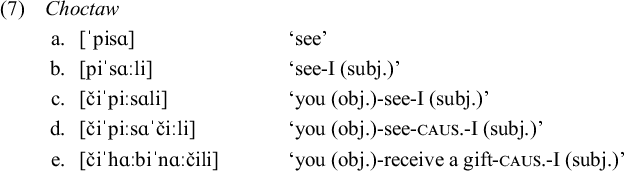
The final lapse variation can be seen in Choctaw (Nicklas Reference Nicklas1972, Reference Nicklas and Crawford1975), Hixkaryana (Derbyshire Reference Derbyshire1985) and Central Alaskan Yupik (Miyaoka Reference Miyaoka1985; Woodbury Reference Woodbury1987).Footnote 3 Examples from Choctaw are given in (7). In longer Choctaw forms, syllables with long vowels are stressed. Every even-numbered syllable from the left, except the final syllable, has a long vowel.
The iambic reversal variation can be seen in De’kwana (Hall Reference Hall1988), Aguaruna (Payne Reference Payne and Payne1990; Hung Reference Hung1994), Southern Paiute (Sapir Reference Sapir1930) and Axininca Campa (Payne Reference Payne1981). Examples from De’kwana are given in (8).

The Sentani default pattern constitutes a third variation on iambic minimal alternation. As (9) illustrates, the Sentani variation combines aspects of the previous two. As in the two previous variations, odd-parity forms are identical to the odd-parity forms of iambic minimal alternation from (4b). In even-parity forms, the final prominence shifts one position to the left as in the iambic reversal variation in (6b), but it does not always result in iambic reversal’s clash. It results in a clash in forms where the initial and final foot are adjacent (i.e., forms with four syllables), as in (9a), but not in forms where they are not (i.e., forms with more than four syllables), as in (9c). In forms where the initial and final foot are not adjacent, the prominence expected on the antepenult is removed, resulting in a lapse. Even-parity forms with more than four syllables, then, have a lapse like the final lapse variation, though the lapse arises in a different location.

Below, we demonstrate how the Sentani variation emerges under circumstances similar to those that produce the final lapse and iambic reversal variations. Like the other variations, the Sentani variation emerges under a requirement that prominence avoid final position. Unlike the other variations, however, the Sentani variation requires a constraint restricting the position of primary stress. It can only emerge when primary stress is restricted to the final foot. The Sentani variation also requires a constraint insisting that the initial foot, in particular, be stressed (in addition to a constraint insisting that feet generally be stressed). Both of the additional requirements are available from constraint families – alignment (McCarthy & Prince Reference McCarthy, Prince, Booij and Marle1993; McCarthy Reference McCarthy2003; Hyde Reference Hyde2012a) and initial prominence (Hyde Reference Hyde2002, Reference Hyde2016a) – that have previously been established as fundamental to the Weak Bracketing analysis.
3. The Weak Bracketing analysis
Before presenting the Weak Bracketing analysis of Sentani, we briefly examine the Weak Bracketing analysis of iambic minimal alternation, iambic final lapse and iambic reversal. (For a more thorough discussion, see Hyde Reference Hyde2016a.) The five constraints most immediately responsible for iambic minimal alternation and its variations are discussed below, beginning with two alignment constraints.
We employ the Relation-Specific Alignment formulation of Hyde (Reference Hyde2012a, Reference Hyde2016a; see also McCarthy Reference McCarthy2003 and Hyde & Paramore Reference Hyde, Paramore, Hansson, Farris-Trimble, McMullin and Pulleyblank2016). For those unfamiliar with the formulation, the general schemas for Relation-Specific Alignment constraints are given in (10). Each schema has two components separated by a slash. The component to the right of the slash is the prohibited configuration of misalignment, and the component to the left of the slash defines a locus of violation. The prohibited configuration is constructed from three categories. ACat1 and ACat2 are the two categories whose edges are being aligned, and SCat is the ‘separator category’, whose intervention between the relevant edges of ACat1 and ACat2 constitutes misalignment. The locus of violation can consist of either two categories or three. It can consist of the two aligned categories, ACat1 and ACat2, or it can consist of the two aligned categories plus the separator category, SCat.

Note that the separator category is only optionally included in the locus of violation. When the separator category is included, the constraint is distance-sensitive: the number of violations it assesses increases as the degree of misalignment increases. When the separator category is omitted, the constraint is distance-insensitive: it assesses a single violation for each pair of misaligned categories regardless of the degree of misalignment.
The alignment constraints most relevant to producing iambic minimal alternation and its variants are AllRight(σHd) and AllLeft(σHd), given in (11). AllRight(σHd) draws the head syllables of feet towards the right edge of the prosodic word, and AllLeft(σHd) draws the head syllables of feet towards the left edge.

Since the separator category ‘σ’ is included in the loci of violation, the constraints are distance-sensitive. They register degrees of misalignment rather then the simple fact of misalignment. AllRight(σHd) assesses a number of violations that is equal the number of syllables intervening between each foot and the right edge of the prosodic word in which it occurs. Similarly, AllLeft(σHd), assesses a number of violations that is equal the number of syllables intervening between each foot and the left edge of the prosodic word in which it occurs.
Constraints that map prosodic categories to entries on the metrical grid play a key role in the Weak Bracketing framework. The general formulation for Map constraints (Hyde Reference Hyde2002) is given in (12), where κ is the prosodic category to be mapped to the grid and xκ is a κ-level grid entry.

The Map constraint that is key at this point in the discussion is Map(f), given in (13). Map(f) requires that each foot have a foot-level grid entry within its domain.

Though foot-level grid entries must coincide with head syllables (indicated with vertical association lines), it is not case that all head syllables will coincide with grid entries. We will encounter an additional Map constraint, Map(ω), in §4. Map(ω) requires prosodic words to map to prosodic-word level grid entries.
The next constraint key to producing iambic minimal alternation and its variants is *Clash (Liberman & Prince Reference Liberman and Prince1977; Prince Reference Prince1983). *Clash requires that any two adjacent entries on one level of the metrical grid have an intervening entry on the next level lower. This prevents grid entries from occurring too close together.

The final key constraint is a Nonfinality constraint. NonFin(xf), given in (15), prohibits foot-level grid entries from occurring on prosodic word-final syllables.

Iambic minimal alternation and its variations all share the same pattern for their odd-parity forms. This lack of distinction arises because all four of the active constraints required to differentiate the three patterns – AllRight(σHd), Map(f), *Clash and NonFin(xf) – can be maximally satisfied in words with an odd number of syllables, which means that their ranking in relation to one another does not alter the optimal candidate for such forms. As long as AllRight(σHd) dominates AllLeft(σHd), as the tableau in (16) illustrates, a right-aligned iambic pattern emerges regardless of the rankings between AllRight(σHd), Map(f), *Clash and NonFin(xf). In the optimal candidate, a pair of overlapping feet at the right edge of the prosodic word share a grid entry, allowing both to satisfy Map(f) while avoiding NonFin(xf) and *Clash violations.

Iambic minimal alternation and its variations, then, differ only in their even-parity forms. Which of the even-parity patterns emerges depends on the ranking of AllRight(σHd), Map(f), *Clash and NonFin(xf). We examine the rankings that produce the different even-parity patterns below.
3.1. Iambic minimal alternation
The key feature distinguishing the iambic minimal alternation pattern from its variations is that iambic minimal alternation has a prominence on the prosodic word-final syllable of even-parity forms. Where iambic minimal alternation has a prominence on its final syllable, iambic final lapse and iambic reversal both avoid final prominence. The key feature of the ranking that results in iambic minimal alternation, then, is that NonFin(xf) is ranked low.
As the tableau in (17) illustrates, iambic minimal alternation emerges when AllRight(σHd) and Map(f) both dominate NonFin(xf). The thoroughly trochaic candidate (17c) and the iambic reversal candidate (17b) both avoid the final prominence of iambic minimal alternation by grouping their final two syllables into a trochaic foot. Since trochaic footing results in worse rightward head syllable alignment than iambic footing, AllRight(σHd) excludes candidates (17c) and (17b). The iambic final lapse candidate (17a) avoids the final prominence of iambic minimal alternation by leaving its final iamb stressless. Since the stressless final foot is an unmapped foot, Map(f) excludes candidate (17a). The iambic minimal alternation candidate (17w) emerges as optimal. (The ranking of *Clash is not actually crucial in the iambic minimal alternation ranking, but we include it in the tableau to facilitate comparison with the rankings where it is crucial.)

A Hasse diagram summarising the crucial rankings for iambic minimal alternation is given in (18).

3.2. Iambic final lapse
The key feature distinguishing the iambic final lapse pattern is that it has a stressless final iamb in even-parity forms. Where iambic final lapse lacks a prominence within its final foot in even-parity forms, iambic minimal alternation has a stressed final iamb, and iambic reversal has a stressed final trochee. The key feature of the ranking that results in the stressless final foot of iambic final lapse is the low ranking of Map(f).
The tableau in (19) illustrates how iambic final lapse emerges when AllRight(σHd) and NonFin(xf) both dominate Map(f). The thoroughly trochaic candidate (19c) and the iambic reversal candidate (19b) both avoid the unmapped final foot of the final lapse pattern by mapping their final trochaic feet. Since trochaic footing results in worse rightward head syllable alignment than iambic footing, however, AllRight(σHd) excludes candidates (19c) and (19b). The iambic minimal alternation candidate (19a) avoids the final unmapped foot of the final lapse pattern by mapping its final iambic foot. Since the stressed final iamb positions prominence on the final syllable, NonFin(xf) excludes candidate (19a). The iambic final lapse candidate (19w) emerges as optimal. (The ranking of *Clash is not crucial here.)

A Hasse diagram summarising the crucial rankings for iambic minimal alternation is given in (20).

3.3. Iambic reversal
The key distinguishing feature of iambic reversal is the final trochaic foot in otherwise iambic even-parity forms. Where iambic reversal has a final trochaic foot, iambic minimal alternation and iambic final lapse both have thoroughly iambic footing. The key feature of the ranking that results in the final trochee of iambic reversal is the low ranking of AllRight(σHd) and *Clash.
As the tableau in (21) demonstrates, iambic reversal is optimal when NonFin(xf) and Map(f) both dominate AllRight(σHd), and AllRight(σHd) dominates *Clash. The thoroughly iambic footing of the minimal alternation and final lapse patterns allows them to have the best rightward alignment and to avoid clash. NonFin(xf) excludes the final prominence of the minimal alternation candidate (21c), however, and Map(f) excludes the unmapped final iamb of the final lapse candidate (21b). The thoroughly trochaic candidate (21a) avoids clash, but its multiple trochaic feet yield the worst rightward alignment. AllRight(σHd) excludes (21a), and the iambic reversal candidate (21w) emerges as optimal.

The Hasse diagram in (22) summarises the crucial rankings for the iambic reversal pattern.

4. The Sentani variation: six-syllable forms
Where the iambic reversal variation employs clash in even-parity forms to avoid final prominence, and the iambic final lapse variation employs lapse, the Sentani variation employs both. In forms with four-syllables – forms where the initial and final feet are adjacent – Sentani uses clash to avoid prominence on the final syllable. In six-syllable and longer even-parity forms – forms where the initial and final feet are not adjacent – Sentani uses lapse to avoid prominence on the final syllable. We consider six-syllable and longer even-parity forms in this section and four-syllable forms in §5.
The Sentani variation cannot emerge under the set of constraints discussed thus far because the pattern found in six-syllable and longer even-parity forms is harmonically bounded by the iambic final lapse pattern with respect to these constraints.Footnote 4 As the tableau in (23) demonstrates, the two patterns perform equally well on NonFin(xf), Map(f) and *Clash, but iambic final lapse performs better on AllRight(σHd). The result is that the Sentani pattern cannot be optimal under any ranking of this set of constraints.

The reason that the six-syllable Sentani pattern is harmonically bounded by iambic final lapse with this set of constraints is that leaving the penultimate foot unmapped does not offer all of the same advantages as leaving the final foot unmapped. While the six-syllable Sentani pattern avoids final prominence and clash, it does not avoid the final trochaic foot that results in an additional AllRight(σHd) violation.
Despite not offering the advantage of avoiding a final trochee, lapse arises in the Sentani variation for essentially the same reasons as in the iambic final lapse pattern: it arises to avoid final stress and clash. The lapse arises in a different position in Sentani because the position of lapse in the final lapse pattern is simply unavailable in Sentani. As discussed above, primary stress always occurs within the final foot of a Sentani form. This has two consequences. The first is that the foot hosting primary stress – the final foot – has to be trochaic in order to avoid final stress. The second is that the final two syllables – the syllables that constitute the final foot – are unavailable for hosting a lapse. To avoid the clash that would otherwise result from a final trochaic foot, the penultimate foot is left unmapped, resulting in a lapse preceding the primary stress.
The first consideration in producing the Sentani pattern, then, is to locate primary stress within the final foot. The two constraints most directly responsible for locating primary stress in Sentani are Map(ω), given in (24), and AllRight(fHd), given with its counterpart, AllLeft(fHd), in (25). Map(ω), requires that each prosodic word have a prosodic word-level grid entry within its domain. The prosodic word-level grid entry must fall within a head foot.

AllRight(fHd) draws the head foot of the prosodic word toward the prosodic word’s right edge; AllLeft(fHd) draws the head foot of the prosodic word toward the prosodic word’s left edge. Because the primary prominence must always fall within the head foot, restricting the position of the head foot also restricts the position of the primary prominence.

As the tableau in (26) illustrates, the combined effect of AllRight(fHd) and Map(ω) is to enforce mapping of the final foot in particular. AllRight(fHd) and Map(ω) can be satisfied simultaneously only when the final foot is mapped. When the prosodic word maps to a prosodic word-level grid entry that is over a head foot in final position, as in candidate (26w), both constraints are satisfied. The mapping status of the penultimate foot is of no concern. AllRight(fHd) is only violated if the head foot is not the final foot, as in candidate (26b), and Map(ω) is only violated if the prosodic word does not map to a prosodic word-level entry, as in candidate (26a). In contrast, the effect of Map(f) is more general. Map(f) requires every foot to map to the metrical grid. If either the final foot is left unmapped, as in candidates (26a) and (26b), or the penultimate foot is left unmapped, as in candidate (26w), Map(f) is violated.

To streamline the discussion, we will assume from this point on that Map(ω) is undominated, and we will not consider candidates without a primary prominence. Given this situation, a high-ranking AllRight(fHd) can be used to ensure that the obligatory primary prominence occupies the final foot and that the final foot cannot be unmapped.
As the tableau in (27) demonstrates, the six-syllable pattern of the Sentani variation emerges under two key ranking conditions. The first condition is that NonFin(xf) and AllRight(fHd) both dominate AllRight(σHd). Ranking NonFin(xf) above AllRight(σHd) excludes the option of a stressed final iamb, as in candidate (27d), and ranking AllRight(fHd) above AllRight(σHd) excludes the option of shifting the primary stress off of a final iamb so that the final iamb can remain stressless, as in candidate (27c). The second key ranking condition is that AllRight(σHd) and *Clash both dominate Map(f). Ranking AllRight(σHd) above Map(f) excludes the option of a thoroughly trochaic pattern, as in candidate (27b), and ranking *Clash above Map(f) excludes the option of tolerating a clash configuration, as in candidate (27a). In the optimal candidate (27w) a stressless iamb precedes a stressed final trochee. This allows (27w) to maintain mostly iambic footing and primary stress on the final foot while avoiding clash and stress on the final syllable.

While the ranking conditions demonstrated in (27) produce the correct result for six-syllable and longer forms, they are unable to produce the correct result for four-syllable forms. The ranking conditions would leave the penultimate foot stressless in four-syllable forms as they do in longer even-parity ones. Since the penultimate foot is initial in four-syllable forms and non-initial in six-syllable and longer forms, however, we can obtain the correct result with a constraint that requires initial feet to be stressed.
5. The Sentani variation: four-syllable forms
The constraint family that can require stress on initial elements is the Initial Prominence family. InProm(xf, f), given in (28), is the Initial Prominence constraint requiring stress on prosodic word-initial feet. InProm(xf, f) insists that some foot-level grid entry coincide with the initial foot of every prosodic word.

Adding InProm(xf, f) to the constraint ranking in (26), ranked above *Clash, is sufficient to produce the correct results for four-syllable forms.
The tableau in (29) demonstrates the result of ranking both AllRight(σHd) and InProm(xf, f) above *Clash for a four-syllable form. Note that the tableau does not consider output candidates that fail to maintain primary stress on a final trochaic foot, as required by the ranking NonFin(xf), AllRight(fHd) ≫AllRight(σHd). Ranking AllRight(σHd) above *Clash excludes the option of a thoroughly trochaic pattern, as in candidate (29b). Ranking InProm(xf, f) above *Clash excludes the option of a stressless initial/penultimate foot, as in candidate (29a). The optimal candidate (29w) tolerates a clash to ensure that the initial foot is iambic and stressed while also ensuring that the final foot contains a primary stress that avoids the final syllable. (The low-ranked Map(f) is included in the tableau to highlight the fact that it plays no role in this context.)

A Hasse diagram of the constraint ranking responsible for the Sentani variation is given in (30):

6. Binary vs. ternary
A reviewer states that the default pattern of Sentani is consistent with a ternary pattern (with nonfinality), and that it provides support for internally layered ternary (ILT) feet (Martínez-Paricio & Kager Reference Martínez-Paricio and Kager2015). While we agree that the available data for the default pattern is consistent with a ternary pattern with nonfinality, the ILT approach is not actually capable of producing this pattern or similar key patterns.
As the reviewer states, the available data for the Sentani default pattern could be analysed in terms of amphibrachs – ILT feet with left-aligned internal iambs. Forms that do not divide evenly into ternary feet would use binary feet to exhaustively parse leftover syllables. One iamb would be employed at the left edge in $3n+2$
forms, and two in
$3n+2$
forms, and two in $3n+1$
forms. In four-syllable forms a final iamb would be replaced by a final trochee to avoid final stress. The structures in (31) illustrate the ternary foot analysis for forms of up to seven syllables – the longest in available data. The proposed binary Weak Bracketing structures are repeated alongside them for comparison.
$3n+1$
forms. In four-syllable forms a final iamb would be replaced by a final trochee to avoid final stress. The structures in (31) illustrate the ternary foot analysis for forms of up to seven syllables – the longest in available data. The proposed binary Weak Bracketing structures are repeated alongside them for comparison.

The predictions of the binary and ternary analyses would start to diverge beginning with nine-syllable forms. The binary pattern described by Elenbaas is given in (32) with the proposed Weak Bracketing structures.

The ternary pattern described by the reviewer is given in (33) with ILT structures. Note that the predicted stress patterns differ in forms with nine syllables (compare (32b) with (33b)), and in all forms with eleven or more syllables (compare (32d)–(32f) with (33d)–(33f)).

Martínez-Paricio & Kager (Reference Martínez-Paricio and Kager2015: Supplementary Material, p. 10) identify a version of the ternary pattern in (31) and (33) without nonfinality (a version where four-syllable forms have two iambs) as one of the predictions of their ILT account, and they indicate that it is unattested. The pattern is entirely plausible. It is similar to the ternary default pattern of Chugach (Leer Reference Leer1985a,Reference Leerb,Reference Leerc), where the iambs would occur to the right of the amphibrachs rather than to the left (Martínez-Paricio & Kager Reference Martínez-Paricio and Kager2015: 483 and Supplementary Material, p. 10; Martínez-Paricio & Kager Reference Martínez-Paricio and Kager2016).
This may seem like good news for the ILT framework. It is not. In considering forms long enough to see the difference between the binary pattern described by Elenbaas and the potential ternary alternative, it becomes clear that ILT cannot actually produce the ternary alternative. The distance-insensitive alignment constraints that ILT uses to produce directionality effects simply break down at longer lengths.
One of the advantages claimed for layered feet is that they can replace unparsed medial syllables in patterns that would require them in standard Weak Layering accounts. In standard Weak Layering accounts (Itô & Mester [Reference Itô and Mester1992] Reference Itô and Mester2003), it is necessary to directly influence the position of medial feet relative to medial unparsed syllables in order to distinguish between the trochaic patterns in (34a) and (34b), for example. Influencing the position of medial feet directly requires distance-sensitive alignment constraints (see Alber Reference Alber2005 and Hyde Reference Hyde2012a for discussion).

Internally layered feet are claimed to eliminate the need for medial unparsed syllables. The pattern in (34a) is recreated in (35a) with a dactyl at the left edge of the form, and the pattern in (34b) is recreated in (35b) with an amphibrach at the right edge. There is no need to position medial feet directly. All that is needed is to position a peripheral ternary foot of the right type.

Since ternary feet are thought to eliminate the need for unparsed medial syllables, then, ternary feet are also thought to eliminate the need to influence the position of medial feet directly and, therefore, the need for distance-sensitive alignment constraints.Footnote 5 The possibility of eliminating distance-sensitive alignment is supposed by some to be quite desirable, because the violations for distance-sensitive constraints can increase quadratically as the length of the form increases (though it has yet to be demonstrated that this actually has any practical empirical consequences).
The two constraints that are most directly responsible for locating feet in the ILT framework are given in (36) in the Relation-Specific Alignment formulation (see §3). In (36), fT is a ternary foot, fB a binary foot and f a foot of any size.Footnote 6

Since they omit the separator category in the definition of the locus of violation, both constraints are distance-insensitive: they assess violations for the simple fact of misalignment rather than measuring degrees of misalignment. Ternary-R assesses a single violation for each ternary foot that has a foot (of any size) to its right. Binary-L assesses a single violation for each binary foot that has a foot (of any size) to its left.
As indicated in (37) and (38), Ternary-R and Binary-L correctly locate the three feet needed to parse seven-syllable and eight-syllable forms. The two constraints are best satisfied when a ternary foot occurs at the right edge and a binary foot at the left edge. It is not necessary to influence the position of the medial foot directly. In the seven-syllable form in (37), there is one ternary foot and two binary feet. In the desired winner, the two binary feet precede the ternary foot. Ternary-R is the key constraint in this case. It locates the single ternary foot at the right edge, forcing the two binary feet to the left. Binary-L is also satisfied as well as possible given this particular collection of feet.

In the eight-syllable form in (38), there are two ternary feet and one binary foot. In the desired winner, the binary foot precedes the two ternary feet. Binary-L is the key constraint in this case. It locates the single binary foot at the left edge, forcing the two ternary feet to the right. Ternary-R is also satisfied as well as possible given this particular collection of feet.

In general, the approach works as long as there is no more than one type of medial foot. In other words, it works as long as the form contains no more than one ternary foot or no more than one binary foot. Whenever there is more than one of both types, however, both types must occur medially, and Ternary-R and Binary-L are unable to fix the position of the medial feet.
The effect is apparent in $3n+1$
forms that have at least ten syllables. To produce the correct pattern in a ten-syllable form, for example, two binary feet would need to precede two ternary feet. Since they cannot influence the position of medial feet, however, Ternary-R and Binary-L cannot actually locate them in the correct positions. As the tableau in (39) demonstrates, the candidate where the medial trochaic foot precedes the medial binary foot ties with the desired winner, in which the medial trochaic foot follows the medial binary foot. Note that we would not be able to distinguish between the candidates by considering additional constraints. The two candidates perform identically on every constraint in the ILT constraint set.
$3n+1$
forms that have at least ten syllables. To produce the correct pattern in a ten-syllable form, for example, two binary feet would need to precede two ternary feet. Since they cannot influence the position of medial feet, however, Ternary-R and Binary-L cannot actually locate them in the correct positions. As the tableau in (39) demonstrates, the candidate where the medial trochaic foot precedes the medial binary foot ties with the desired winner, in which the medial trochaic foot follows the medial binary foot. Note that we would not be able to distinguish between the candidates by considering additional constraints. The two candidates perform identically on every constraint in the ILT constraint set.

The problem arises in every $3n+1$
form with ten syllables or more. ILT will be unable to choose between two options for ten-syllable forms, among three options for 13-syllable forms, among four options for 16-syllable forms, and so on.
$3n+1$
form with ten syllables or more. ILT will be unable to choose between two options for ten-syllable forms, among three options for 13-syllable forms, among four options for 16-syllable forms, and so on.

Some might be tempted to say that this circumstance has little practical consequence, since the longest Sentani forms available have just seven syllables. It should be kept in mind, however, that this circumstance also prevents ILT from producing the Chugach pattern, and Chugach does have forms of the relevant lengths.
ILT’s distance-insensitive constraints, then, are inadequate for implementing the potential ternary analysis of Sentani and similar patterns. While ILT could simply adopt distance-sensitive constraints, doing so would mean abandoning one of the most significant motivations for positing internally layered feet in the first place. ILT’s proponents have pointed to other virtues, of course, but these virtues are typically not unique. Much of the supporting evidence presented for internally layered feet is based on segmental processes that have been acknowledged to be captured by overlapping binary feet as well (Martínez-Paricio Reference Martínez-Paricio2013; Martínez-Paricio & Kager Reference Martínez-Paricio and Kager2016). In many cases, the relevant processes were first discussed in the context of overlapping binary feet (Hyde Reference Hyde2002). It is also possible to point to additional deficiencies of ILT. ILT is generally even less restrictive than standard Weak Layering, and it suffers from the same types of pathological predications (Hyde Reference Hyde2016b, Reference Hyde2025).
While ILT is unable to execute the potential ternary analysis of Sentani, there is ample evidence that Elenbaas’s description of Sentani as a binary pattern is correct in any case. The Sentani default pattern can be perturbed by the avoidance of stress on schwa in open syllables and by a limited weight sensitivity. Neither phenomenon is straightforward, and the interaction between them is even less so. Trying to provide an analysis would take us far beyond the scope of this squib, but it is worth noting that the perturbations nearly always result in forms that unambiguously exhibit a binary pattern. Occasionally, the results are ambiguous, but they are never unambiguously ternary. What follows provides several examples in which perturbations reveal the binary pattern of Sentani stress placement.
In Sentani, secondary stress tends to avoid occurring on a schwa in an open syllable. In forms with four or more syllables, for example, a secondary stress occurs on the peninitial syllable in the default pattern. To avoid stress on schwa in an open syllable, however, the default penintial stress can shift to an initial syllable without a schwa, as in (41).

If both the first and second syllables are open with schwa, then the shift fails to occur, as in (42). Crucially, the stress does not shift to the third syllable even when doing so would avoid schwa without producing a clash, as in the six-syllable (42b). To parse a six-syllable form, the binary analysis would employ three binary feet, but the ternary analysis would employ two ternary feet. The explanation for the failure to shift is straightforward if the stress is always confined to a binary foot at the left edge, as the binary analysis of six-syllable forms assumes. The explanation must be more subtle, however, if the stress occurs in a ternary foot at the left edge, as the ternary analysis of six-syllable forms assumes.

When stress is able to shift from second to first syllable in six-syllable forms, the results further support binary footing. As (43) illustrates, a secondary stress that would occur on the second syllable in the default pattern shifts to the initial syllable to avoid schwa. In addition to the stress that is shifted, however, an entirely new stress missing from the default pattern appears on the third syllable. The result is straightforwardly consistent with binary footing and straightforwardly inconsistent with ternary footing.

Unlike secondary stress, primary stress seems never to shift to avoid schwa. In the forms in (44), the primary stress remains on the penult despite the possibility of avoiding schwa by shifting to either the right or the left. On first thought, this is unexpected. If secondary stress is incompatible with schwa, then primary stress should be even more so. Under both the binary analysis and the ternary analysis, the effect of Nonfinality, discussed above, straightforwardly explains the inability of primary stress to shift from the penult to the ultima. Under the binary analysis, confining primary stress to a final binary foot also straightforwardly explains its inability to shift from the penult to the antepenult. Under the ternary analysis, however, if the primary stress is confined to a final ternary foot, as it would be in the examples in (44), there would have to be a more subtle reason for its inability to shift from the penult to the antepenult.

Finally, we turn briefly to Sentani’s limited weight sensitivity. Final heavy syllables always receive the primary stress, and initial heavy syllables always receive at least a secondary stress. While providing an analysis of Sentani’s weight sensitivity would take us well beyond the scope of this squib, it is worth noting that the perturbations due to syllable weight always result in patterns that are consistent with binary feet. In three-syllable forms, for example, whether the final syllable or the initial syllable is heavy, the result always has two stresses, indicating two binary feet, rather than the single stress we would expect with a ternary foot.

While the data we have for the Sentani default pattern are consistent with either a binary or a ternary analysis, then, forms where the default pattern has been perturbed suggest that a binary analysis is correct. Of course, it may be possible for an especially clever ternary approach to supply binary feet for the necessary cases in Sentani. (ILT is ruled out as a candidate analysis by its inability to produce the default pattern.) However, the prima facie case for the binary analysis is a strong one.
7. Conclusion
Like the other two variations of iambic minimal alternation previously discussed in the literature – iambic final lapse and iambic reversal – the Sentani variation emerges from a requirement that stress avoid the word-final syllable. The iambic final lapse pattern accommodates final stresslessness by omitting the final stress in even-parity forms, resulting in a lapse. The iambic reversal pattern accommodates final stresslessness by shifting the final stress in even-parity forms one syllable to the left, resulting in a clash with the preceding stress. The Sentani pattern is something of a hybrid. It always shifts the final stress one syllable to the left in an even-parity form, but it only tolerates clash in four-syllable forms. In longer even-parity forms, it omits the stress on the antepenult, resulting in a lapse preceding the penult.
The Sentani variation emerges in the Weak Bracketing framework as a result of constraints that restrict primary stress to the final foot and a constraint that insists that initial feet, in particular, map to grid. A clash surfaces in Sentani when the initial and final feet are adjacent to one another (i.e., in four-syllable forms). The constraints positioning primary stress and the constraint insisting the initial foot map to the grid prevent stress from being omitted from either foot. However, a lapse surfaces when the initial foot and the final foot are not adjacent (i.e., in even-parity forms with more than four syllables). Omitting stress from a medial foot in longer forms allows them to avoid clash while maintaining stress on initial and final feet.
Competing interests
The authors declare no competing interests.

 Open access

