




Introduction
Agroecology reinstates the value of agrobiodiversity in livestock farming systems (Dumont et al., Reference Dumont, Groot and Tichit2018). By increasing on-farm animal and plant diversity, farms can reduce their sensitivity to environmental disturbances and strengthen their adaptive capacity (Darnhofer et al., Reference Darnhofer, Bellon, Dedieu and Milestad2010; Magne et al., Reference Magne, Nozières-Petit, Cournut, Ollion, Puillet, Renaudeau and Fortun-Lamothe2019; Dumont et al., Reference Dumont, Puillet, Martin, Savietto, Aubin, Ingrand, Niderkorn, Steinmetz and Thomas2020). Farms with two animal species take advantage of possible synergies and complementarities between species due to differences in their behavior, feed requirements, susceptibility to disease and parasites, seasonality and duration of production cycles and products (Tichit et al., Reference Tichit, Hubert, Doyen and Genin2004; Martin et al., Reference Martin, Barth, Benoit, Brock, Destruel, Dumont, Grillot, Hübner, Magne, Moerman, Mosnier, Parsons, Ronchi, Schanz, Steinmetz, Werne, Winckler and Primi2020). The literature highlights advantages of combining cattle and sheep on the same farm, such as improving grassland use (quantity, quality and floristic diversity), increasing lamb growth (d'Alexis et al., Reference d'Alexis, Sauvant and Boval2014; Fraser et al., Reference Fraser, Moorby, Vale and Evans2014; Jerrentrup et al., Reference Jerrentrup, Komainda, Seither, Cuchillo-Hilario, Wrage-Mönnig and Isselstein2020), reducing parasitism (Marley et al., Reference Marley, Fraser, Davies, Rees, Vale and Forbes2006; d'Alexis et al., Reference d'Alexis, Sauvant and Boval2014) and reducing farm inputs. This farm diversification is known as a way to reduce economic risk (Sanderson et al., Reference Sanderson, Archer, Hendrickson, Kronberg, Liebig, Nichols, Schmer, Tanaka and Aguilar2013; De Roest et al., Reference De Roest, Ferrari and Knickel2018; Diakité et al., Reference Diakité, Corson, Brunschwig, Baumont and Mosnier2019; Dardonville et al., Reference Dardonville, Urruty, Bockstaller and Therond2020). However, these mixed-species livestock farming systems (MSLF) require specific work organization, which is often highlighted as being complex and difficult (Dumont et al., Reference Dumont, Groot and Tichit2018; Martin et al., Reference Martin, Barth, Benoit, Brock, Destruel, Dumont, Grillot, Hübner, Magne, Moerman, Mosnier, Parsons, Ronchi, Schanz, Steinmetz, Werne, Winckler and Primi2020), but without being investigated completely. Previous studies have focused on one element of MSLF (e.g., parasite or grazing management), but comprehensive and systemic analysis of the functioning of these systems that considers how farmers organize temporal and spatial interactions among different farm components is lacking (Hendrickson et al., Reference Hendrickson, Hanson, Tanaka and Sassenrath2008; Martin et al., Reference Martin, Barth, Benoit, Brock, Destruel, Dumont, Grillot, Hübner, Magne, Moerman, Mosnier, Parsons, Ronchi, Schanz, Steinmetz, Werne, Winckler and Primi2020). To fill this gap, the objectives of this study were to understand why and how farmers combine cattle and sheep on their farms, and how they use this combination to cope with different kinds of uncertainties. To this end, farmers who raised both cattle and sheep were surveyed. To cover the range of ways in which the two species can be combined, we investigated two types of MSLF: ‘beef cattle–meat sheep’ (BM) and ‘dairy cattle–meat sheep’ (DM).
Methodology
Analytical framework
Our analytical framework was based on that of the livestock farming system (Landais et al., Reference Landais, Deffontaines and Benoit1988; Gomes et al., Reference Gomes, Pailleux, Dedieu, Claudete and Cournut2014) and considered the system's functioning as a combination of configuration practices (dimensioning the area and herd/flock), herd/flock and land management, product marketing and work organization practices. To analyze how MSLF function, we focused on the practices related to the mixing of the two species, trying to qualify the degree of spatial and temporal coordination between them (Moraine et al., Reference Moraine, Duru and Therond2016), and associated these practices with the justifications given by the farmers. For configuration practices, we considered how farmers managed the balance between cattle and sheep numbers. For other practices, we considered, following the literature, that mixing species could improve resource management, product development and resilience in the face of diverse hazards, and influence work organization. We therefore examined how species were combined on pastures; the organization of breeding, especially the organization of calving and lambing periods that influences work distribution over the year; the division of work among workers; the diversity of products and marketing representatives; and how mixing species were used during destabilizing events (i.e., climatic, economic and workforce-related hazards).
Sampling and survey design
The study was performed in central France, in the Massif Central, which is a grassland-dominated region where mixed cattle–sheep farming systems remain widespread (Rapey et al., Reference Rapey, Gendron, Healy, Hiriart-Durruty, Veny, Miquel, Bonestebe and Dumont2018). Two types of cattle–sheep MSLF were studied in two contrasting areas: the BM MSLF in the ‘Bocage Bourbonnais’ region (north-western Massif Central), characterized by a lowland area (mean elevation 200 m) dominated mainly by permanent pastures, and the DM MSLF in the ‘La Planèze de Saint-Flour/Margeride’ region (southern Massif Central), a humid foothills region (elevation 700–1000 m).
Agricultural advisors working in the two regions provided a list and description of mixed cattle–sheep farms. We selected 20 BM and 17 DM farms from this list that best covered a variety of ewe/cow ratios and workforce compositions. According to the advisors, these two criteria strongly influence how the two herds/flocks are managed.
Two sets of semi-structured interviews (2–3 h each, recorded) were performed from 2016 to 2019. The first focused on why and how farmers combine cattle and sheep on their farms. We collected information about the reasons (advantages and disadvantages) for the combination chosen and about the functioning of this system according to our analytical framework. For work organization, we used the Work Assessment Method (Cournut et al., Reference Cournut, Chauvat, Correa, Dos Santos Filho, Diéguez, Hostiou, Pham, Servière, Sraïri, Turlot and Dedieu2018) to quantify routine work required for animals (e.g., feeding, care, milking) by distinguishing workers in a basic group (BG) (i.e., composed of several partners or a single farmer) from workers outside the BG (i.e., paid workers and volunteers). The second set of interviews (the same farms, except for five who declined to be interviewed again) focused on the evolution in farm trajectories from the year the interviewed farmer had established the farm to the end of 2017. The semi-structured interviews dealt with the farm's trajectory through the farmer's explanation of the co-evolution of land area, herd/flock sizes, buildings, equipment, animal and land management, marketing practices and work organization (Madelrieux et al., Reference Madelrieux, Terrier, Borg and Dobremez2020). The justifications for each change made it possible to relate these changes to possible destabilizing events such as climate variation (e.g., drought, rainy spring), economic fluctuation (e.g., decreasing product prices, increasing input costs) or workforce problems (e.g., departure or illness of a worker, work overload). These destabilizing events were called ‘climatic’, ‘economic’ and ‘workforce-related’ hazards, respectively.
Data analysis
Thematic analysis of farmers' answers about why they chose to combine cattle and sheep on their farms made it possible to identify advantages and disadvantages of MSLF. The number of farmers who mentioned each type of advantage and disadvantage was counted to assess their importance in the sample and in each type of MSLF.
To characterize the types of species mixing on pasture, we built three variables to describe the spatial and temporal interactions between species (Mugnier and Cournut, Reference Mugnier and Cournut2018): how fields are allocated (are any areas grazed by both species or not), how the species are combined on shared plots (sequential or co-grazing) and the frequency of these combinations [frequent (practices used yearly) or occasional (practices used if grass in plots is refused)].
To analyze work, we calculated indicators of the Work Assessment Method for working times (Cournut et al., Reference Cournut, Chauvat, Correa, Dos Santos Filho, Diéguez, Hostiou, Pham, Servière, Sraïri, Turlot and Dedieu2018): autonomy of the BG (i.e., the percentage of total routine work it performs), the work remaining in charge of each person of the BG (WRBG) and the efficiency of the routine work [i.e., the number of hours per total livestock unit (LU)].
The method also characterizes the distribution of routine work over the year. The combination of the two species from the viewpoint of work was characterized in two ways: (i) how tasks required for each species are assigned among the members of the BG (a member is versatile when dealing with both species and specialized in other cases) and (ii) temporal organization of the work required to manage each species over the year. For this, the temporal organization of breeding, especially the articulation of calving and lambing periods, plays a key role.
For each type of hazard (climatic, economic or workforce-related), we calculated the percentage of farms affected by it out of all the farms in our sample and the percentage of farms that changed species-mixing practices out of all farms impacted by the hazard. We listed the practices modified to cope with the hazards and recorded the number of times that farmers used each practice. We calculated the percentage of each change out of the total number of changes in species-mixing practices. These latter were (i) management of the ratio of ewe/cow numbers; (ii) allocation of resources between the two species; (iii) grazing management; (iv) breeding periods, leading to different combinations of the timing of calving and lambing; and (v) the assignment of tasks required for each species among BG members.
Results
Description of the sample
In the sample, the BG was composed of one to four people depending on the farm, with 50% of BM farms having a BG composed of a single farmer (Table 1). On DM farms, a BG of two people was more frequent due to the constraints of milking. Volunteer workers were widespread (80% of BM farms and 50% of DM farms), while salaried employees were used on 30% of the BM and DM farms.
Mean (± standard deviation) of farm structure data of the beef cattle–meat sheep (BM) and dairy cattle–meat sheep (DM) farms surveyed

Livestock units are calculated based on 1 dairy cow = 1 LU, 1 beef cow = 0.85 LU, 1 ewe = 0.15 LU.
All systems were mainly grass-based, as grassland covered a mean of 86% of the utilized agricultural area (Table 1). The remainder of farmland was cultivated with crops (cereals + silage maize) for on-farm consumption. BM farms had more area of temporary pasture, while DM farms had slightly more silage maize and had rangelands. Cattle and sheep grazed from April to November in both regions, but on most BM farms, sheep also grazed during winter. Moreover, 12 BM and 10 DM farms had a grouped field pattern.
The ewe/cow ratio varied greatly on BM and DM farms, and BM farms tended to have more cows and less ewes than DM farms (Table 1). The total number of products (i.e., all types of beef from dairy or beef cattle farms, milk from dairy cattle farms and all types of sheep meat) ranged from 4 to 9 among the farms, and 73% of the farmers marketed more than five. The number of sales and marketing representatives for these products ranged from 2 to 6 per farm, and 50% of the farmers had more than four.
Over 75% of the farmers marketed products of one or both species under a quality label. On BM farms, 95% of the farmers sold sheep meat and beef to cooperatives (one established by local farmers) or producer associations. On DM farms, 54% of farmers sold sheep meat to private traders or consumers. Over 75% of DM farmers sold milk to cooperatives, 84% of which for the production of cheese with a protected designation of origin label. The remaining farms sold standard milk to large industrial dairies.
Advantages and disadvantages of combining cattle and sheep according to the farmers
Farmers in both types of MSLF mentioned the same advantages and disadvantages (Fig. 1). The economic advantage was mentioned by 86% of the farmers (Fig. 1a). Mixing species secures income (‘When one product is not doing so well, the other is generally doing better.’) and distributes it throughout the year due to the nature of the products and their seasonality. It also provides access to Common Agricultural Policy funding for cattle and sheep. The second most common advantage identified (84% of all farmers) was the increased use of on-farm forage and grass resources. Due to the species' complementary feed requirements and behavior, farmers can better (i) use the diversity of resources available on their land (‘Sheep can get something out of the worst fields.’); (ii) manage grazing and maintain grassland (‘Cattle leave a little grass because they don't bite down to the bottom of the stalks, so we let the sheep in to avoid wasting biomass.’); and (iii) use dried fodder by decreasing waste (‘With fodder, for example, you can give low-quality fodder to sheep that would be hard to give to dairy cows.’). The third most common advantage identified (35% of all farmers) was work organization and satisfaction. Farmers argued that the different durations of breeding cycles of the two species enabled them to distribute the workload over the year by planning the timing of calving and lambing periods (‘Work does not peak for both species at the same time.’). In addition, they explained that mixing species makes it possible to diversify the work, which helps to enjoy it (‘juggling the two helps break the monotony’; ‘I like both species, I like raising two different species’).
Percentage of surveyed farmers on beef cattle–meat sheep (BM) and dairy cattle–meat sheep (DM) farms who mentioned each type of (a) advantage and (b) disadvantage of combining cattle and sheep.

BM and DM farmers mentioned similar disadvantages of combining cattle and sheep, with the same ranking (Fig. 1b). First, farmers claimed that managing two species generates a high workload (‘We have more work and constraints with two types of production.’) and fewer quiet periods (‘There is work all year round. When you have finished the cows and the crops, you have to start the sheep.’). Second, they explained that managing two different species requires technical knowledge about both (‘It is difficult to be technically good in both species.’). Last, they mentioned that the two species needed different equipment and buildings, which increased investment costs.
However, BM farmers mentioned the first two disadvantages much less than DM farmers did (Fig. 1b). Only 60% of the BM farmers mentioned the workload, but all of the DM farmers did so. In dairy farming, routine milking work represents most of the workload, and the accumulation of two types of production aggravates negative feelings towards this workload.
The difficulty in developing the double skill set necessary to manage both species in a satisfactory manner was mentioned by only 40% of the BM farmers but by 88% of the DM farmers. This reflects similarity in the skills needed to manage ruminants for meat production, but more differences in those needed to manage ruminants for dairy production.
Four types of grazing management in mixed cattle and sheep farming systems
We observed grazing practices on all farms that allowed farmers to use the diversity of animal batches with different feed requirements and behaviors to make the most of the diversity of fields and maintain open spaces (i.e., grazing summer pastures or small or steep plots with sheep) (‘Sheep can be used to add value to small pieces of land (1.5 ha) or plots of land too small to be used for cattle’; ‘ewes can be used to make the most of sloping land that cannot be used by cattle’).
Analysis of the mixed-species grazing practices identified four combinations of cattle and sheep grazing that expressed a gradient in the degree of interaction between the two species (Fig. 2).
Four combinations of cattle and sheep on pasture on dairy or beef cattle–sheep farms.
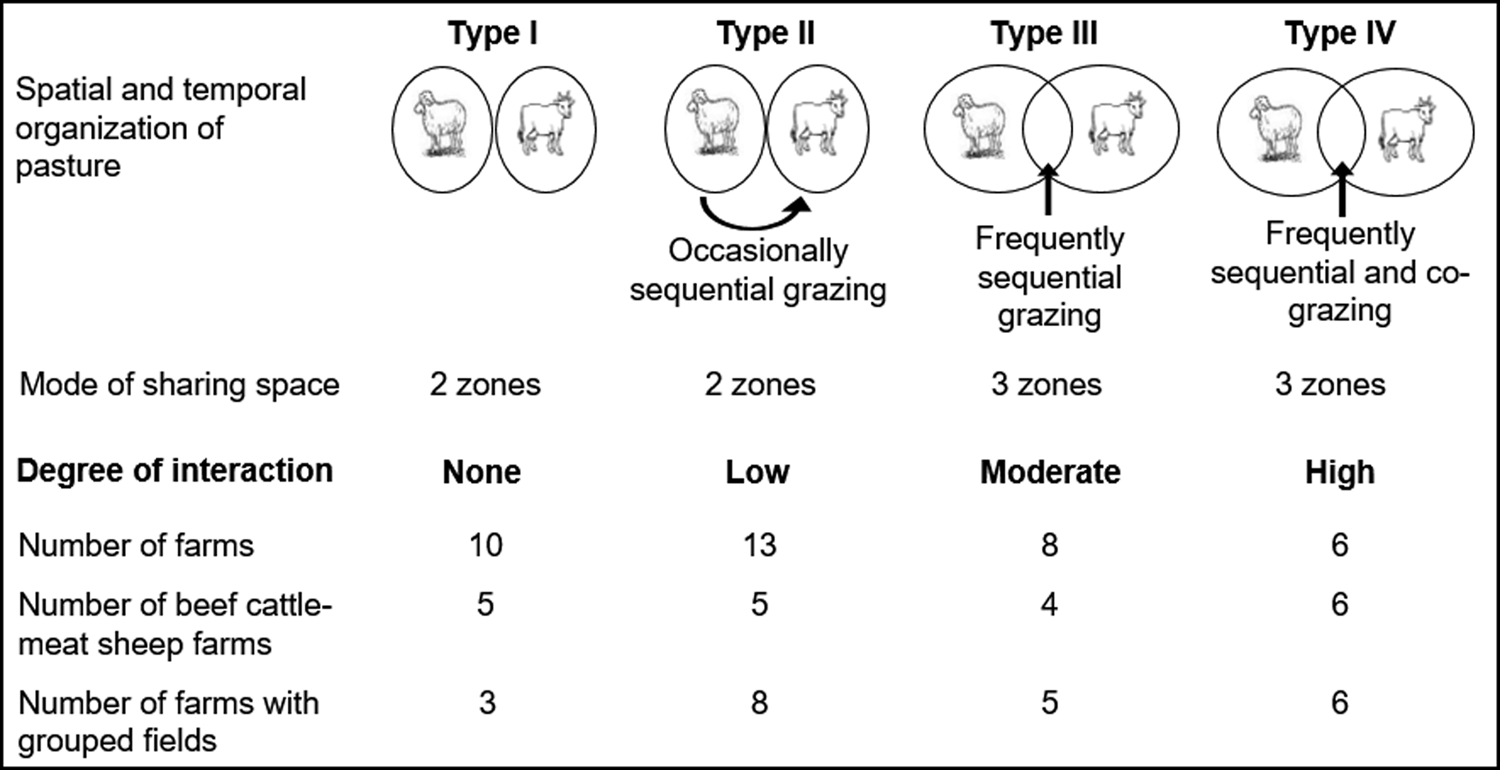
Type I, found on ten farms, had no interaction between species: each species had its own grazing zone. The farmers explained that they did not use mixed-species grazing because of the complexity of managing it, the need to have two sets of fences instead of one and the risk of disease transmission (e.g., viral, bacterial) between the species. Farmers also mentioned field configuration (e.g., scattered fields, variable plot sizes, type of soil, herbage quality), cattle and sheep buildings in different locations and the need to adapt plots to the animals' requirements (i.e., feeding and monitoring).
In type II (13 farms; low interaction), famers also split the space into two zones due to location of fences and/or buildings and the diversity of plots, but occasionally used sequential grazing to remove grass refused by cattle.
In type III (8 farms; moderate interaction), farmers split the space into three zones: one separate zone for each species and one common zone always grazed by both species (sequential grazing).
In type IV (6 farms; high interaction), farmers also had three zones and frequently used sequential grazing for the same reasons as in type III but also used co-grazing. They argued that co-grazing uses the available grass better (‘If a plot is too big for a batch of sheep, a batch of cows with calves is inserted in this batch for 8–10 days to avoid waste’; ‘two-year-old heifers are also used with the ram batch to be able to rotate pastures without having to delineate and re-fence the plots so that they have an adequate size’).
In each type, we observed variability in herd sizes and area but noted that type IV farms (high interaction) had grouped fields and concerned only BM farms (Fig. 2).
Work organization to manage two species
The study of work organization revealed great diversity in routine work times (Table 2). The duration of daily milking of dairy cows explained the larger amount of work per person in the BG on DM farms than BM farms (WRBG: 6.5 vs 4.5 h day−1, respectively) and lower work efficiency (47 vs 20 h LU−1, respectively). The overall autonomy of the BG is 85%, but higher on BM farms than DM farms, which indicates that the latter delegate more routine work to volunteers or employees (18 vs 12%, respectively) (Table 2). Several configurations of the BG were used to manage the two species: (i) all members of the BG were versatile, (ii) one member was versatile while the others were specialized in one species or (iii) all members were specialized. The all-versatile configuration dominated on BM farms (85%) but was rare on DM farms, on which specialized workers dominated: only 47% of DM farms had a versatile BG member (Table 2). On two DM farms, the BG took care of only the dairy cows, while a volunteer (the retired father) managed the sheep.
Mean (± standard deviation) of main work organization characteristics of the beef cattle–meat sheep (BM) and dairy cattle–meat sheep (DM) farms surveyed

WRBG = Work remaining in charge of each person of the basic group; Livestock units are calculated based on 1 dairy cow = 1 LU, 1 beef cow = 0.85 LU, 1 ewe = 0.15 LU.
Routine work was distributed unequally over the year. Organization of calving and lambing varied among the farms given adjustments during the year between the (i) available workforce and upcoming work, (ii) grass resources and animal requirements and (iii) products and market demand. We identified three modes of temporal organization of the work required for each species at the annual scale (two on BM farms and one on DM farms) (Fig. 3).
Distribution of routine work (hours per day) over the agricultural year (Dec–Nov): (a) no overlaps between birthing periods or even between birthing periods and harvests, (b) grouping of calving and lambing, with some overlap, and (c) distribution of calving and lambing over the year.

In the first mode (Fig. 3a; 12/37 farmers), farmers sought to avoid overlaps between birthing periods and even between birthing periods and harvests. Calving was grouped in late autumn/early winter, followed by lambing in late winter/early spring. This mode caused work to peak from December to March but left time to perform other tasks (e.g., cropping, haymaking, harvesting) when the animals were on pasture. It was widespread on the BM farms (60%), to which an off-season ewe flock was sometimes added to meet demand in the sector and was fit in between harvests and the start of calving.
The second mode (Fig. 3b, 8/37), observed on 40% of the BM farms, corresponded to grouping of calving and lambing, often in winter/early spring, which led to some overlap. The aim was to make the best use of grass and to relax after the busy birthing period, which can require the assistance of additional workers, often volunteer, or a large BG.
In the third mode (Fig. 3c, 17/37), farmers sought to distribute calving and lambing throughout the year to avoid work peaks and to distribute the workload over the year. This arrangement was specific to DM farms, on which calving was distributed over time to satisfy the demand for regular production of milk for the dairy to process into cheese, but also because daily milking is labor-intensive.
Changes in species-mixing practices to cope with climatic, economic and workforce-related hazards
Changes that farmers made to species-mixing practices were analyzed for 32 farms (17/20 BM and 15/17 DM). All 32 farmers said that they had to cope with a climatic hazard and 80% of them each with a workforce-related or economic hazard. BM farms had to cope with more hazards than DM farms (Table 3). Of the farmers impacted by climatic, workforce-related and economic hazards, 47–25%, 81–90% and 56–77%, respectively, had modified species-mixing practices (Table 3). Workforce-related hazards had triggered 50% of the changes in species-mixing practices, while the other two types of hazard shared the other 50%.
Change in practices related to species mixing used to cope with climatic, workforce-related and economic hazards for 17 beef cattle–meat sheep (BM) and 15 dairy cattle–meat sheep (DM) farms

a A farmer could make several changes in practices related to species mixing to cope with a climatic or workforce-related hazard during the trajectory (e.g., breeding periods and allocation of resources to cope with a climatic hazard).
The most frequent change concerned the ewe/cow ratio (47% of all changes in species-mixing practices), often by changing the number of ewes, as farmers claimed that their short production cycle facilitated rapid changes. The second most frequent change concerned breeding organization (22% of the total), by staggering calving and lambing periods to better match sales periods or resource availability or to organize the work better. BM farmers had made this change more often than DM farmers because it is easier to modify calving periods of beef cattle than those of dairy cattle. Modifying resource allocation between the two species concerned 18% of the changes, and had been used only to cope with climatic hazards. To cope with a scarcity of grass resources, farmers had prioritized one species over another, and the ranking of cattle and sheep depended on whether the cattle were dairy or beef. Sheep were considered more demanding and sensitive to a change in diet than beef cattle on BM farms (‘Beef cattle are less demanding in terms of fodder quantity. It is thus possible take risks with the herd by restricting them in case of strong climatic hazards to save more fodder for the sheep.’) but more flexible and less demanding than dairy cattle on DM farms (‘In a drought year, sheep will be able to graze longer in winter than dairy cows, and thus they will not consume the fodder stocks, because for dairy cows, if there is a shortage, more fodder has to be bought. The sheep act a little like chameleons.’). To cope with workforce-related hazards, 70% of DM farmers impacted by them had modified the assignment of tasks required for each species among workforce members, usually by transitioning them to versatility. Lastly, modification of grazing management concerned only two BM farmers (13% of BM farmers impacted by workforce-related hazards), who changed to separate grazing (from type IV to type I; from type II to type I).
To cope with climatic hazards, the change made most often concerned the allocation of resources between the two species. To cope with workload-related hazards, the changes made most often concerned modifying the ewe/cow ratio (often by decreasing sheep numbers, and sometimes increasing cattle numbers on BM farms) and modifying the breeding periods. Finally, only one type of change had been made in the face of economic hazards: modifying the ewe/cow ratio, often by decreasing sheep numbers and increasing cattle numbers in response to an unfavorable economic context for sheep (Table 3).
Discussion
Our study provides empirical evidence of the functioning of MSLF by focusing on the practices involved in combining cattle and sheep and how they are changed in response to economic, climatic or workforce-related hazards, and by considering the farmers' viewpoints. It sheds comprehensive and systemic light on these promising systems that can cope with uncertainties and produce in an agro-ecological manner (Dumont et al., Reference Dumont, Puillet, Martin, Savietto, Aubin, Ingrand, Niderkorn, Steinmetz and Thomas2020), although their operation remains poorly documented (Martin et al., Reference Martin, Barth, Benoit, Brock, Destruel, Dumont, Grillot, Hübner, Magne, Moerman, Mosnier, Parsons, Ronchi, Schanz, Steinmetz, Werne, Winckler and Primi2020).
Advantages and disadvantages of mixing species
The advantages of combining two species that farmers mentioned are partly in line with the benefits found in the literature. For economic advantages, diversified farms such as MSLF are known to mitigate risk and stabilize farm income (Chavas, Reference Chavas2008; Bowman and Zilberman, Reference Bowman and Zilberman2013; Dardonville et al., Reference Dardonville, Urruty, Bockstaller and Therond2020). The larger number of products and the ability to market them in multiple sales channels and throughout the year improves economic viability (De Roest et al., Reference De Roest, Ferrari and Knickel2018) and the system's ability to adapt to changes in the context (Martin et al., Reference Martin, Barth, Benoit, Brock, Destruel, Dumont, Grillot, Hübner, Magne, Moerman, Mosnier, Parsons, Ronchi, Schanz, Steinmetz, Werne, Winckler and Primi2020).
Advantages due to increasing the overall use of forage resources and improving their management are confirmed by many authors, who highlighted the utility of combining livestock species with complementary ecological niches (Dumont et al., Reference Dumont, Puillet, Martin, Savietto, Aubin, Ingrand, Niderkorn, Steinmetz and Thomas2020; Martin et al., Reference Martin, Barth, Benoit, Brock, Destruel, Dumont, Grillot, Hübner, Magne, Moerman, Mosnier, Parsons, Ronchi, Schanz, Steinmetz, Werne, Winckler and Primi2020). In contrast, the benefits of mixed-species grazing for managing nematode infection shown by several authors (Marley et al., Reference Marley, Fraser, Davies, Rees, Vale and Forbes2006; d'Alexis et al., Reference d'Alexis, Sauvant and Boval2014; Forteau et al., Reference Forteau, Dumont, Sallé, Bigot and Fleurance2020), were not mentioned by the farmers surveyed, who instead feared disease transmission or a surplus of work and investment in fences.
Work was the third most common benefit mentioned by farmers, due to the diversity of tasks, the pleasure of managing a complex system (Navarrete et al., Reference Navarrete, Dupré and Lamine2015) and the ability to organize the work better and make it more flexible, all of which come from managing two species (Darnhofer et al., Reference Darnhofer, Bellon, Dedieu and Milestad2010). However, farmers usually mentioned work as disadvantages of mixing species, in line with much of the literature on farm diversification (Dumont et al., Reference Dumont, Groot and Tichit2018; Ferguson and Lovell, Reference Ferguson and Lovell2019). Diversifying production increases the number of activities and thus the number of tasks on a farm, and authors discuss workload, management complexity and multiplication of skills (Kingwell, Reference Kingwell2011; De Roest et al., Reference De Roest, Ferrari and Knickel2018).
The ranking of advantages and disadvantages from the farmers' viewpoints helps to understand what matters to farmers and to identify possible gaps between conclusions of scientific studies and what farmers actually perceive. It can provide some indications about how to support farmers, such as raising their awareness about managing parasitism using mixed-species grazing or helping them to think about an organization of their system that reduces work constraints (Bendahan et al., Reference Bendahan, Poccard-Chapuis, de Medeiros, de Lucena Costa and Tourrand2018). As highlighted by De Roest et al. (Reference De Roest, Ferrari and Knickel2018), farmers need more access to information and training about the implications of, and options for, farm diversification.
Different ways to mix species
The four combinations of cattle and sheep grazing we identified were influenced by field configuration (grouped or scattered) and type of cattle production (dairy or beef), but we observed no difference in the stocking rate or ewe/cow ratio among them (Mugnier and Cournut, Reference Mugnier and Cournut2018). Some authors identified these two factors as influencing the value of mixed-species grazing (d'Alexis et al., Reference d'Alexis, Sauvant and Boval2014; Modernel et al., Reference Modernel, Picasso, Do Carmo, Rossing, Corbeels, Soca, Dogliotti and Tittonel2019).
The working times observed on mixed farms show that the workload of the BG is higher and the efficiency of routine work lower on DM farms than on the BM farms, which is consistent with differences observed between the beef cattle and dairy cattle sectors (Cournut et al., Reference Cournut, Chauvat, Correa, Dos Santos Filho, Diéguez, Hostiou, Pham, Servière, Sraïri, Turlot and Dedieu2018).
The high diversity in routine work times in our sample prevented us from identifying an effect of size factors or modes of functioning (Hostiou et al., Reference Hostiou, Khanh, Duteurtre, Binh and Dedieu2012), as the BM and DM farms differed too much. We identified three modes of temporal organization of the work required for each species, which corresponded to different strategies for organizing animal-production cycles, the availability of labor and the willingness to use resources (Cournut et al., Reference Cournut, Chauvat, Correa, Dos Santos Filho, Diéguez, Hostiou, Pham, Servière, Sraïri, Turlot and Dedieu2018).
To adapt their farm to economic, climatic and workforce-related hazards, farmers use mechanisms related to the combination of the two species: modifying the ewe/cow ratio, breeding periods, the versatility of workers, grazing management and resource allocation between species. Modifying the ewe/cow ratio is used the most, particularly for economic hazards (Nozières et al., Reference Nozières, Moulin and Dedieu2011). Managing breeding periods clearly seems to be a specific mechanism for BM farms, whose calvings are easier to adjust and group together. Modifying workers' versatility, however, concerns only those DM farms that have a specific size and configuration of the BG. DM farms are also those that most often prioritize one species (here, dairy cattle) over the other for feeding to cope with climatic hazards.
We thus highlighted resilience mechanisms related to diversity, but our approach did not allow us to identify buffer capacities of these diversified systems (Darnhofer, Reference Darnhofer2014), whose configuration and rules for mixing species can allow them to cope with hazards without implementing adjustment or transformation mechanisms. Other methods should be explored to qualify these different ways to manage diversity for resilience (Dumont et al., Reference Dumont, Puillet, Martin, Savietto, Aubin, Ingrand, Niderkorn, Steinmetz and Thomas2020).
Disparity between species marks the way they can be mixed
Among the farms in the sample, we found a wide variety of ways to combine the two species in terms of work, animal and pasture management, product marketing and risk management. However, we observed marked differences between the BM and DM farms. DM farms graze the two species less closely than BM farms, have work schedules that are marked by daily milking of cows throughout the year and are managed by a BG with specialized members with a heavier workload. DM farmers mention work (workload and no quiet periods) and the multiplication of skills more often as a disadvantage of mixing species, which seems to be consistent with the characteristics of work organization on DM farms. Furthermore, DM farms use mechanisms related to the combination of the two species differently to cope with economic, climatic and workforce-related hazards.
This difference between types of system (BM or DM) reflects the influence of the disparity between cattle and sheep which depends on whether the cattle are beef or dairy. Disparity is a component of diversity that expresses how different the species are from one another (Biggs et al., Reference Biggs, Schlüter, Biggs, Bohensky, BurnSilver, Cundill, Dakos, Daw, Evans, Kotschy, Leitch, Meek, Quinlan, Raudsepp-Hearne, Robards, Schoon, Schultz and West2012). Meat and dairy enterprises have different production processes that influence the technical management and thus the work organization (Cournut et al., Reference Cournut, Chauvat, Correa, Dos Santos Filho, Diéguez, Hostiou, Pham, Servière, Sraïri, Turlot and Dedieu2018), workers' skills and representatives of the sector. The daily milking and high feed requirements of dairy cows often leads to reserving the best pastures near the milking parlor for them (Marie et al., Reference Marie, Bensaid and Delahaye2009; Garcia-Launay et al., Reference Garcia-Launay, Sibra, Molenat, Agabriel and Brunschwig2012), thus influencing how the two species are combined in space and, in case of climatic hazards, prioritized for feeding.
In contrast, when the two species are bred for meat, they have close management, similar fodder, and feeding which represents most of the routine work, can be done in the same work sequence by the same person. Thus, economies of scope for resources and work are possible (De Roest et al., Reference De Roest, Ferrari and Knickel2018; Martin et al., Reference Martin, Barth, Benoit, Brock, Destruel, Dumont, Grillot, Hübner, Magne, Moerman, Mosnier, Parsons, Ronchi, Schanz, Steinmetz, Werne, Winckler and Primi2020). We observed this influence of disparity between cattle and sheep on grazing management, work organization, workers' skills, marketing and hazard management. Disparity is thus a component of animal diversity to consider in depth when studying species mixing, in addition to the balance (Biggs et al., Reference Biggs, Schlüter, Biggs, Bohensky, BurnSilver, Cundill, Dakos, Daw, Evans, Kotschy, Leitch, Meek, Quinlan, Raudsepp-Hearne, Robards, Schoon, Schultz and West2012) (number of animals of each species), which corresponds to the ewe/cow ratio. This effect of the type of cattle and thus of the disparity between the two species has concealed effects of other factors and made it difficult to formalize operating modes, even though there are many differences in management within the two types of system. Analyzing a larger sample would make it possible to overcome this obstacle and describe interactions between dimensions of the system better, as well as to formalize necessary trade-offs between the objectives of grass resource use, production, work organization and resilience in the MSLF (Magne et al., Reference Magne, Nozières-Petit, Cournut, Ollion, Puillet, Renaudeau and Fortun-Lamothe2019).
Work: an essential dimension to consider
Although farmers usually mentioned workload as a disadvantage of mixing species, the facts are not so clear, and mixing species also benefits work. The connections highlighted between management choices and work organization, as well as the influence of workforce-related hazards on changes in species-mixing practices, confirm that work must be considered as part of the system to be configured, managed and adjusted with the other parts and not simply as a set of constraints. All of this argues for adding a work component to MLSF analysis frameworks (Martin et al., Reference Martin, Barth, Benoit, Brock, Destruel, Dumont, Grillot, Hübner, Magne, Moerman, Mosnier, Parsons, Ronchi, Schanz, Steinmetz, Werne, Winckler and Primi2020) and for further studies on this subject.
Conclusion
Based on animal agrobiodiversity, MSLF are recognized as promising systems that can cope with uncertainties and produce in an agro-ecological manner. Previous studies showed benefits of mixed-species grazing on animal health and pasture use, but few examined how farmers manage the two species on their farms and why. It is thus the originality of our study to provide empirical evidence of why and how farmers manage cattle and sheep on their farms, in an integrative view that included dimensions largely ignored in the literature, such as work organization and adaptive capacity, but also in a comprehensive way, as we included farmers' viewpoints. This systemic and comprehensive approach to the MSLF advances our understanding of them and helps formalize them.
We identified why and how farmers combined cattle and sheep on their farms and showed that disparity between species influences the modes of combination. The results provide ideas for accompanying farmers toward more sustainable systems and for developing new research on co-designing MLSF systems in which the combination of species would be described by integrating all dimensions of the system, especially work.
Acknowledgments
The authors thank INRAE and Region Auvergne (Programme PSDR Auvergne 205-2019/NewDeal) and the French government IDEX-ISITE initiative 16-IDEX-0001 (CAP 20–25) for their financial support.
The authors thank the farmers interviewed and the interns who conducted the interviews (C. Orus, L. Boucher, E. Toque and E. Zapata).


 Open access

