


INTRODUCTION
Few ancient Greek words are as evocative as ‘akropolis’. Even to the non-scholar, it evokes vistas of lofty heights and gleaming marble, and the word is commonly used to conjure up the very essence of Hellenism. It is consequently surprising that virtually no research has been conducted on the topic of akropoleis and their characteristics, from neither a historical nor an archaeological perspective (Hölscher Reference Hölscher1998, 54, n. 62; Tuplin Reference Tuplin, Summerer, Ivantchik and von Kienlin2011, 82, n. 82). The reason for this scholarly disinterest is probably the fame of the Athenian Akropolis, and the assumption that the topic is already well-researched or requires no closer study due to universal scholarly consensus. This is not the case: several encyclopaedias on the ancient world even lack entries for ‘akropolis’,Footnote 1 or simply refer to the Athenian Akropolis (KlPauly, s.v. ‘Akropolis’). Not even works on this particularly famous example contain any discussion on the phenomenon of akropoleis in general (Beulé Reference Beulé1862; Boetticher Reference Boetticher1888; Schede Reference Schede1922; Walter Reference Walter1929; Rodenwaldt Reference Rodenwaldt1930; Brouscaris Reference Brouscaris1978; Brommer Reference Brommer1985; Rhodes Reference Rhodes1995; Hurwit Reference Hurwit1999; Greco Reference Greco2010), and the word is remarkably rare in the plural in any form of printed text. This does not mean that it is not applied to features of ancient Greece; any fortified hill near an ancient settlement will inevitably receive the epithet ‘the akropolis’ by excavators and historians alike. What this means or implies, however, is seldom discussed or outlined. Akropoleis thus form undefined and unformulated yet important topoi in the scholarly mind, being – similarly to agorai, nekropoleis, and temples – an essential element in our perception of the ‘standard’ ancient Greek city.
In traditional scholarship, akropoleis have either been regarded as the oldest part of the urban settlement from which the rest of the city then expanded, as important sanctuary areas of the tutelary deities, or as refuges for the urban population during sieges and invasions. In this article, I will deconstruct and challenge these notions through a closer scrutiny of the textual source material. It is not my aim, however, to present a new, all-encompassing model for the emergence and development of the akropolis phenomenon. This will be the subject for a future, considerable research project rooted in my previous extensive study of the materiality of akropoleis on the central Greek mainland (Rönnlund Reference Rönnlund2018). Instead, here I will argue that the concrete and symbolic function of akropoleis in the Greek world should be understood as the outcome of a complex combination of settlement history, military strategy, and local myth, all requiring directed future research to be better comprehended.
All locations referred to as akropoleis in ancient textual sources are collected as a catalogue in Appendix A (published as online-only Supplementary Material), together with brief descriptions of each site. A discussion on akropolis toponyms – proper names of akropolis locations – is given in Appendix B.
A BRIEF HISTORIOGRAPHY OF AKROPOLEIS
Because of the lack of any specialised research literature on akropoleis in general, it is difficult to present a unified outline of the developments within akropolis research. Interpretations regarding the general meanings of the word are highly dispersed and often anecdotal in nature. However, this does not imply that akropoleis are missing in the historiography of the study of ancient Greece. Due to the scholarly interest in the Athenian, Pergamene and Lindian akropoleis, there are several works in which akropoleis play an important role in the historical models and reconstructions of societal and settlement developments of ancient Greece.
In the scholarship of the last few decades, there are very few studies that address or even mention akropoleis on a more general level. To my knowledge, the only scholar to discuss the general meaning of ‘akropolis’ in antiquity is Christopher Tuplin (Reference Tuplin, Summerer, Ivantchik and von Kienlin2011, 82–4), who does so in an analysis of the topography of ancient Kelainai/Apamea.Footnote 2 Overall, the word ‘akropolis’ is more common in older research literature – mainly in the ‘grand narratives’ of the twentieth century – than in more recent studies.Footnote 3 Despite their essentially unformulated role, it is clear that akropoleis in these older works are regarded as the legacy of prehistory in Classical Greek society, forming part of a historical narrative explaining the development of Greek democratic society (i.e. Athens). The narrative essentially states that the akropoleis were the fortified hilltop dwellings of prehistoric kings (Busolt Reference Busolt1920, 153; Schede Reference Schede1922, 11; von Gerkan Reference Gerkan1924, 8–9; Ehrenberg Reference Ehrenberg1969, 8; Snodgrass Reference Snodgrass1977, 23; Brouscaris Reference Brouscaris1978, 17–18; Fine Reference Fine1983, 48–9; Welwei Reference Welwei1998, 9), which after the decline of ‘Homeric’ society were abandoned in favour of increasingly democratic settlements at the foot of the hill (Busolt Reference Busolt1920, 154; Schede Reference Schede1922, 11; von Gerkan Reference Gerkan1924, 10; Tritsch Reference Tritsch1929, 72; Ehrenberg Reference Ehrenberg1937, 156; Kirsten Reference Kirsten1956, 45; Adcock Reference Adcock1957, 57; Winter Reference Winter1971, 30; Brouscaris Reference Brouscaris1978, 19; LSJ9, s.v. ἀκρόπολις). The deserted akropoleis were after this either used as refuges in times of peril (Beloch Reference Beloch1912, 118; Tritsch Reference Tritsch1929, 72; Lehmann Reference Lehmann1937, 74; Kriesis Reference Kriesis1965, 94; Winter Reference Winter1971, 16, 31; Lawrence Reference Lawrence1979, 126) or as sanctuaries for the tutelary deities (Tritsch Reference Tritsch1929, 72; Snodgrass Reference Snodgrass1977, 23; Brouscaris Reference Brouscaris1978, 19; Zuiderhoek Reference Zuiderhoek2017, 30). This narrative is prevalent in popular perception, and is still conveyed by the official guides at the Athenian Akropolis. However, there is no archaeological or textual evidence supporting it, either in its whole or in its parts, and it poorly fits the present-day understanding of the development of ancient Greek society from prehistory to the Hellenistic period (cf. Wokalek Reference Wokalek1973; Lawrence Reference Lawrence1979, 131; Lang Reference Lang1996, 25). The origin of the narrative is not immediately obvious – especially as it does not fit the evidence – but it is probable that much of its basic outline can be traced to scholarly readings of a passage in Aristotle’s Politics (1330b77):
When it comes to selecting suitable strong places [τόπων ἐρυμνῶν], there is no single scheme which suits all forms of government alike. An akropolis is suitable to oligarchies and monarchies; a level place [ὁμαλότης] is better for the character of a democracy; neither suits an aristocracy, for which several fortified places [ἰσχυροὶ τόποι πλείους] are preferable.
This passage is often cited as explanatory to various models of the development of urban settlements (Martin Reference Martin1956, 23; Winter Reference Winter1971, 3–4; Lévystone Reference Lévystone2019, 749–50; Kaye Reference Kaye2023, 308–9), and has clearly been regarded – implicitly if not explicitly – as reflecting a historical development, and not as a theoretical outline of ideal fortified locations for certain forms of government (cf. Lang Reference Lang1996, 22; Neils Reference Neils and Beck2013, 419), as Aristotle intended.Footnote 4 The reasons behind the apparent chronological narrativisation of the cited passage can probably be found in a twentieth-century Athenocentric understanding of ancient Greek society. As in this view there were no monarchies in the essentially democratic ancient Greece (i.e. Periclean Athens), and the (i.e. Athenian) aristocracy had already in the Archaic period been supressed by the Solonian reforms, the Aristotelian modes of government must have appeared intriguing. To some past scholars, the rule of kings and aristocrats could consequently only refer to periods before the Classical, as these characters figure in the Homeric epics, and the Aristotelean modes must therefore – by inference – represent different historical stages. Readings of the Homeric epics led to a common understanding that the prehistoric kings (basilēes) resided in hilltop palaces, and the re-discovered magnificent ‘palaces’ in Mycenae, Tiryns and Knossos thus appeared to support this reading. The akropolis par excellence, the Athenian Akropolis, was consequently interpreted as the seat of the early Athenian kings, despite extremely few remains resembling any Mycenaean palatial structure having been found on the hill.Footnote 5 Some scholars consequently imagined a historical development in which power ‘slid’ downhill from the lofty heights of the royal akropolis towards the level ground (von Gerkan Reference Gerkan1924, 7–9; Kirsten Reference Kirsten1956, 53). The agora was in this view regarded as the centre of democratic rule in the Greek state (i.e. Classical Athens), and because it was located on more level ground, the scheme seemed to fit the actual physical appearance of the polis. Aristotle’s theoretical reasoning of the ideal locations for a fortified position was thus turned into a loose historical narrative explaining the gradual evolution of the Greek city. Beginning in the 1920s, this narrative continued to be influential throughout the twentieth century, and – despite occasional criticism and contradictory evidence – it still remains influential.
THE ETYMOLOGY OF ‘AKROPOLIS’
The word ‘akropolis’ is, naturally, strongly associated with the poleis, the city-states of Greek antiquity, and there is reason to believe that akropoleis did play a role in the development of the poleis as settlements, albeit not in the way imagined by previous scholarship as summarised above. Comparative etymology has suggested that the original meaning of the word ‘polis’ – in its earliest form ‘ptolis’ – was probably ‘stronghold’, with similar words in Vedic (pūr) and Baltic languages (pilìs, pils) (Frisk Reference Frisk1934, 283; Benveniste Reference Benveniste1969, 367; Sakellariou Reference Sakellariou1989, 155; Hansen Reference Hansen and Hansen1996, 10, 34; Reference Hansen and Hansen2000, 145; Cole Reference Cole2004, 17; Hall Reference Hall and Shapiro2007, 41). It is sometimes argued that the word was in use already in the Late Bronze Age (Ehrenberg Reference Ehrenberg1969, 8; van Effenterre Reference Effenterre1985, 29), with the first attestation on a Linear B tablet found at Knossos (KN As 1517,12). However, the word rendered po-to-ri-jo more probably represents a masculine name than the genitive ‘ptoleōs’ (Hansen Reference Hansen and Hansen1993, 9; Reference Hansen and Hansen1996, 34). ‘Polis’ and ‘akropolis’ are consequently attested from approximately the same point – in the Homeric epics – yet the latter is, naturally, clearly derivative of the former. It was a well-established fact in antiquity that ‘polis’ had originally meant what was then more commonly known as ‘akropolis’, at least to scholars, and ‘polis’ was still retained in toponymic form to denote the Athenian Akropolis – the Polis – until at least the Classical period (Hansen Reference Hansen and Hansen1996, 34–6). Whether this was also the case elsewhere is difficult to say, but it is to be noted that Pausanias states that a hill known as Ptolis near Arcadian Mantineia contained the ruins of ‘old Mantineia’ (Pausanias 8.12.7), indicating a similar situation here.Footnote 6
Strictly speaking, and contrary to common assumption, ‘akropolis’ does not denote ‘the higher city’, but more ‘the farthest polis’ or ‘the polis on the edge’. The word is a determinative compound of ‘akros’ and ‘polis’ and possibly substituted an earlier form ‘hē akrē polis’. It has been suggested that this construction – which is unusual for the early Greek period – was influenced by the similar word akropolos (meaning ‘lofty’; see Iliad 5.523; Odyssey 19.205), which was used to describe mountaintops (Risch Reference Risch1944, 20). It has further been suggested that the appearance of this compound construction reflects the need to distinguish between two different yet related phenomena, both of which were originally referred to as poleis: a hilltop stronghold and a settlement (Frisk Reference Frisk1934, 283). This need would ultimately have led to the emergence of an independent word, as ‘polis’ began to exclusively denote something other than it originally did (Frisk Reference Frisk1934, 283). ‘Akropolis’, hence, did not imply an urban settlement located on a hilltop generally, but rather the kind of polis that is distinguishable by being located on a height, in contrast to the kind of polis found on a slope or plain, i.e. a settlement proper (also known as asty) (von Gerkan Reference Gerkan1924, 10). The term in its compound form was apparently established at the time of the composition of the Odyssey, where it occurs for the first time, or at least at the time of the final compilation of this work.Footnote 7
There are no ancient definitions of the meaning of ‘akropolis’, nor any elaborations as to its meaning or function. The only exception is in the very late Hesychius (fl. fifth or sixth century AD; Hesychius, s.v. ἀκρόπολις), who simply states that an akropolis is ‘the top [ἄκρον] of the polis’. Modern dictionaries of ancient Greek contain similar definitions, such as the ‘upper or higher city; hence, citadel, castle’ (LSJ9, s.v. ἀκρόπολις), ‘(t)he highest part of a city, the citadel’ (Cunliffe Reference Cunliffe2011, s.v. ἀκρόπολις), and ‘high city, stronghold, citadel’ (Montanari et al. Reference Montanari, Goh, Schroeder, Nagy and Muellner2015, s.v. ἀκρόπολις). It is often assumed that the ‘-polis’ of the compound refers to polis in the urban sense (‘city’),Footnote 8 but, as I argue in this study, there is relatively little reason to suppose that this is correct.
AKROPOLEIS IN TEXTUAL SOURCES
Akropoleis occur in several different contexts in ancient texts, as physical and metaphysical locations, as well as figures of speech. The use of ‘akropolis’ is thus informative not only of the physical aspects of akropoleis, but also of their symbolic meaning and significance in myth and the construction of the experienced lived landscape. The textual akropoleis, as known from literary and epigraphical sources, can roughly be organised into five groups: akropolis as a place in myth, akropolis as a fortified location, akropolis as a cultic area, akropolis as an abstraction, and Akropolis as a proper name.
The word ‘akropolis’ occurs for the first time in the Odyssey (8.494, 504), referring to the events surrounding the sack of the city of Troy. The Trojan akropolis appears as a separate area within the city of Troy, and is also known as the Pergamos in the Homeric epics, which is possibly a pre-Greek word for such hilltop fortifications (Iliad 5.446, 460).Footnote 9 The word ‘akropolis’ is not used in the Iliad, where only the forms akrē polis or polis akrē figure as the location of the houses of Hector and Priam and the temple of Athena (Iliad 6.297, 317). Outside the epics, we encounter the word ‘akropolis’ in Stesichoros’ The Sack of Troy (S. 88), again in connection with the story of the ruse with the wooden horse, and in Theognis’ Elegies (2.1231). The word continued to relate to the Pergamos of Troy throughout antiquity, probably due to the cultural prominence of the Homeric epics (Greek Anthology IX epigr. 700; Diodorus Siculus 4.32.5; Dionysius of Halicarnassus, Roman Anthology 1.46.1; Strabo 13.1.35; Plutarch, On the Failure of Oracles 436b; Pausanias 10.27.5).
When ‘akropolis’ appears in mythical circumstances other than the Trojan War, it is mainly in connection with the foundation myths of a number of mainland poleis. The stories which include the mention of the local akropolis all appear to be similar – like variations on a common theme. The general scheme is that a foreigner arrives in a particular polis, slays a monster, becomes king (basileus), enacts a synoikismos of a scattered population (thus he becomes the oikistēs), and fortifies what the textual source refers to as the akropolis. Examples of this story can be found relating to several poleis, including Boeotian Thebes, Argive Argos, Megara, and Athens.Footnote 10 The motifs of this tale, as observed by Francis Vian (Reference Vian1963, 76–82), indicate that it probably originates from the Archaic or Classical periods rather than the Late Bronze or Early Iron Age, being similar to the foundation myths of the Greek age of colonisation. The common occurrence of alternative – seemingly conflicting – foundation myths to this one have led to the interpretation that the tale of the oikistēs reflects a later (post-Archaic) understanding of the foundation of cities (Berman Reference Berman2004, 18–19). Especially interesting is the conflict between the focus on autochthony in many of the supposedly older myths and the apparent alienness of the oikistēs of the later. This was resolved by later mythographers by arranging the two myths chronologically, making one of the foundations a re-foundation, such as in the case of Thebes (Berman Reference Berman2004, 18–19).
Accounts of besieged and captured akropoleis appear early in texts, already in the late sixth century. From the Classical period and onwards, akropoleis apparently played a strong role in urban fortifications,Footnote 11 but not necessarily in relation to the defence of the local population. Instead, the akropoleis served as the headquarters of the foreign (often Spartan or Athenian, later mainly Macedonian) occupying garrison. Cases in which the civic population is said to have taken refuge in the akropolis are exceedingly few and occur only at the very end of the Hellenistic period, as will be outlined below.
In 66 passages in ancient literature, a tyrant is said to have had his seat on an akropolis.Footnote 12 Most of these passages are in either Diodorus or Plutarch and speak of the tyrants of Syracuse, but there are 19 tyrants mentioned as dwelling on 10 other akropoleis. Compared with all the known tyrants in Greek antiquity – more than 200 – this is not an impressive number.Footnote 13 However, these passages are still indicative for some connection between ‘tyrant’ and ‘akropolis’. This association is attested in several examples from the late Hellenistic and Roman periods, which due to their similitude suggests that they refer to some popular saying or aphorism, such as Plutarch (Life of Cato the Younger 33.6) reporting that Cato cautioned the Romans not to establish Caesar as ‘tyrant in the akropolis’ (εἰς ἀκρόπολιν τὸν τύραννον). This association could also be linked to the literary trope of the tyrant and the tyrannicide, with the akropolis being ‘the first emblem of tyrannical power’ – one of the tyrant’s foremost attributes (Tomassi Reference Tomassi, Amato, Citti and Huelsenbeck2015, 252). Akropoleis in this form appear as backdrops in rhetoric, and this long after tyrants had ceased to be common, imposing upon the location an essence of oppression. It is never specified why the tyrant would dwell at the akropolis, but it certainly offered an easily defended space from which the walled city could be controlled, and access to extramural areas was often provided by a separate exit.Footnote 14 However, this does not imply that the akropoleis contained the actual houses of the tyrants; it is only Polycrates of Samos who is said to have actually withdrawn into the Astypalaia, the akropolis of Samos (Polyaenus, Stratagems 1.23.2). Even if the origins of the literary tyrant can probably be traced to the Peisistratids of the Archaic period, it is Klearchos of Pontic Herakleia who most closely follows the stereotype (Chion, Letters). The Ortygia in Syracuse is the most well-attested tyrannical akropolis, but far from the norm in other senses. Being a small island or peninsula in the harbour of the city, it was not our typical akropolis,Footnote 15 but it is referred to as such in several ancient sources (e.g., Polyaenus, Stratagems 5.2.4; Diodorus Siculus 14, 16). The island’s position in the harbour meant that Dionysios I and Dionysios II were able to use it as a base for their mercenaries, thus fully dominating the city. In the Bosporan Kingdom, the Spartokid archonts/tyrants/kings had, during the fifth and fourth centuries BC, turned the akropolis of the capital Pantikapaion at modern Kerch into a fortified monumental complex, complete with palace (basileia) and sanctuary to Apollo (Tolstikov Reference Tolstikov, Grammenos and Petropoulos2003). This mirrors the development at Pergamon, where the Attalid kings made the akropolis a monumental showcase rivalling Athens. There are no further known cases of a tyrant’s palace on any akropolis, contrary to what is sometimes asserted.Footnote 16
The small size of most akropoleis identified in the archaeological record indicates that they were not built or suitable as refuges for a non-combatant population (cf. Lawrence Reference Lawrence1979, 126–7). This harmonises well with the literary sources, in which akropoleis seldom figure as such, but instead house the foreign garrison (phrouros) of the city. The reasons why one would pick this topographical position for a garrison headquarters were probably the same as for the tyrants outlined above. In many ways, a passage in Polybius (7.12.1–6) summarises the function of the akropolis as a base for troops controlling the local population, as exemplified by a dialogue between Aratos of Sikyon and Philip V of Macedon regarding the Ithome of Messene. Also, the lofty location made it suitable as a lookout, for both light signals from allies and approaching enemies. To physically separate the occupying force from the local population in the settlement below was further desirable, as it mitigated the presumably constant tensions between the two groups (Lawrence Reference Lawrence1979, 130; Chaniotis Reference Chaniotis, Chaniotis and Ducrey2002). Often consisting of mercenaries, the garrison could be the source of disorder and distrust, especially when installed by an oppressive major power (Chaniotis Reference Chaniotis2005, 92). To revolt against the great power would also be extremely difficult if there was an occupying force in the akropolis (Lawrence Reference Lawrence1979, 129). However, garrisons could also be installed with the goodwill of the citizens, providing security and help to the polis. Generally, however, it appears that garrisons in akropoleis were not desired by the poleis. Even if foreign garrisons were not uncommon at the time of the Persian Wars – at least among the cities of Ionia – it is only with the polarisation of power between Sparta and Athens that we encounter the first garrisoned akropoleis, which became a standard way of asserting power in conquered cities in the Hellenistic period. In this period, Macedon appears to have been the great power to invest most effort in installing garrisons in foreign cities. From the 322 BC war, Macedonian forces occupied cities in central and southern Greece continually until the second-century BC Roman conquest (Chaniotis Reference Chaniotis2005, 88). Employing the example of Thessaly, Isocrates and Demosthenes comment on how cities and whole regions could be kept in submission by the Macedonians through garrisoned akropoleis (Isocrates, On the Peace 118; Demosthenes, On the False Embassy 260). This must have saturated the idea of an akropolis with associations of oppression, even to a stronger degree than the tyrannical association. As with all garrisons, the stationed forces appear to have been supervised by an akrophulax,Footnote 17 or more frequently a phrourarchos,Footnote 18 both officers responsible for both the fortifications and the men stationed within. This officer acted as the link between the occupying force and the polis, and could sometimes become well-esteemed by the citizens, as is attested in some inscriptions (cf. Chaniotis Reference Chaniotis2005, 89). The existence of such inscriptions, however, is indicative that this was seldom the case, and the garrisons were often considered a burden for the polis. The accounts in Livy of the capture of various Greek cities during the Macedonian Wars (214–148 BC) show that the garrisoned akropolis (Livy uses the Latin arx) was often the final position in the city to surrender. However, the lack of fresh water and supplies made these locations ill-suited for prolonged occupation, and in most cases the besieged either surrendered, were overtaken, or attempted to break out within a day or two (Livy 36.24; cf. Lawrence Reference Lawrence1979, 129).
This relates to a common scholarly understanding of the function of Greek akropoleis as places of refuge in times of imminent danger (Kriesis Reference Kriesis1965, 94; Winter Reference Winter1971, 16; Wokalek Reference Wokalek1973, 17–18; Lawrence Reference Lawrence1979, 126; Fine Reference Fine1983, 48–9). However, the literary sources indicate that this was very rarely the case. The Greek-language sources contain but one clear example – that of the Lycians defending themselves in the akropolis of Xanthos (Herodotus 1.176.5) – interestingly not relating to a Greek population. Livy, writing in Latin, contains more examples, but – as mentioned above – the failures to resist the sieges indicate that the akropoleis (arces) were ill-equipped for this purpose.Footnote 19 When an attack was imminent, most members of the poleis instead sought refuge in the walled urban settlement itself or fled to remote places in the countryside (cf. Hanson Reference Hanson1998, 112–16). This is attested throughout antiquity, while the examples of non-combatants taking flight to the akropolis are limited to Livy’s accounts of the extraordinary events of the Macedonian Wars of the early second century BC. There are some few examples, however, of akropoleis serving as the last resort for political leaders, such as the family of Mithridates VI Eupator taking refuge in the akropolis of Phanagoreia in the Bosporan Kingdom in the final phase of the Mithridatic War (Appian, The Mithridatic Wars 16.108).
There is comparatively little literary evidence supporting the idea that akropoleis contained important sanctuaries in the pre-Roman era. There are remains of sanctuaries on many locations identifiable as akropoleis in the archaeological record, but the vast majority of these are not excavated or are poorly studied, providing us with very little information as to their function or attribution. The great exception is naturally Athens, whose Akropolis appears to be highly atypical in most regards. From literary sources, and excluding Athens, 49 cults can be identified at akropoleis, mentioned at 54 loci and belonging to 25 poleis (Rönnlund Reference Rönnlund2018, 60, table 3.4). The majority of the cases, however, are known from the second-century AD Pausanias,Footnote 20 and were we to exclude these, only 12 would remain, some of which are dubious.Footnote 21 Athena clearly dominates the picture: 23 akropoleis apparently housed sanctuaries of the goddess. Her epithets are many, but, except for at Athens, there are no examples in the literary sources of the cult of Athena Polias, the epithet most commonly associated with akropoleis in scholarly literature (e.g., Kruse Reference Kruse1952a; Reference Kruse1952b; Mili Reference Mili2015, 104). There are, however, several examples of dedications (indicating cultic activities) to this deity found on archaeologically attested akropoleis. Little is known about other deities who have the epithet ‘Polias/Polieus’, but it is assumed that the reference is not to the polis as ‘the city’, but rather to the original sense of ‘stronghold’ (Hansen Reference Hansen and Hansen1996, 36). An association between Athena and akropoleis can be discerned already in sixth-century BC texts, for instance in Pindar (Olympian Odes 7.47–9), who recounts how the mythical Heliadai created the first Rhodian sanctuary of Athena on the akropolis of Lindos/Ialysos.
The Athenian Akropolis contained the treasury of the Delian League after it had been transferred from Delos in 454 BC by Pericles (Thucydides 1.96). The only known mention of a similar arrangement is on the akropolis of Thessalian Pharsalos. In 375 BC, the Pharsalians entrusted the treasury and the akropolis to the local aristocrat Polydamas, to pay for the religious and administrative expenses of the polis (Xenophon, Hellenica 6.1.2). Whether this treasury was placed within a sanctuary is not known. It is to be noted, however, that there is no archaeological evidence for a sanctuary on the akropolis of Pharsalos (Rönnlund Reference Rönnlund2023a, 85–8).
Epigraphic evidence indicates that some akropoleis were important locations of display for the polis. Almost all inscriptions referring to or containing the word ‘akropolis’ inform us that sculpture and other objects were to be displayed on the akropolis (ἐν ἀκροπόλει). This practice does not differ from that of putting up similar honorific decrees and statues in agorai, gymnasia, or sanctuaries; the formulas are often identical. However, it seems that the practice of erecting inscriptions on the akropolis was more common in certain poleis than in others. The vast majority of these akropolis inscriptions were set up in Athens or by the Athenians referring to the Athenian Akropolis. Several of the decrees of the Delian League were put on display on the Athenian Akropolis with copies distributed to the various League members to be put up where suitable (e.g., ID 88). In some cases, these inscriptions were set up on the akropolis of the respective polis. Variations of the same phrase are used repeatedly: the decision of the boulē was to be inscribed on a stele and put up on the akropolis. An Attic inscription also informs us that an identical decree was to be put up on the Erythraian akropolis (in Ionia), which was at the time governed by an Athenian phrourarchos (IG I3 15). This suggests that the decision makers at least assumed that the Erythraian akropolis was a suitable location for the decree. A similar practice of using the akropolis for public decrees can be found in Thessaly. At Gonnoi, several inscriptions mention that they were put up in the sanctuary of Athena on the akropolis (Helly, Gonnoi II 40, 41, 64, 69–73, 80, 82, 85). The sanctuary of Athena on the akropolis at nearby Larisa was apparently also used for this purpose (IG IX,2 517), and another, albeit fragmentary, inscription from Krannon can tentatively be reconstructed as referring to the installation of the decree on the akropolis (Béquignon Reference Béquignon1935, 37). Several inscriptions have been found at Tauric Chersonesos in the Crimea showing a similar use of the akropolis as a location for public display. Especially interesting in this case is the c. 107 BC Diophantos decree (IOSPE I2 352), which informs us of the existence of altars to Parthenos and Chersonasos on the akropolis of Chersonesos, next to which a bronze statue of the said Diophantos was to be erected.
From the fifth century BC, akropoleis were often symbols of independence for their polis, and their destruction a symbol of defeat. This appears to have been a general connotation of the word until the Hellenistic period. A short third-century funerary inscription found at Opous in East Locris illustrates this well (IG IX 12 5): Ἀρχία υἱὸς ὅδ’ ἔστ’ Ἀλκαίνετος, ὃς δορὶ σώζ[ων] | πατρίδος ἀκρόπολιν τέρμ’ ἔλαβεν βιότου.Footnote 22 It is possible that the wording of this inscription was influenced by the famous Spartan monument of Lysander in Delphi, which was put up after Aigospotamoi in 405 BC (FdD III1 51,50 = Hansen, CEG 819 III 9–13):
When he destroyed with his swift ships the might of the Kekropidai [e.g., the Athenians], Lysander dedicated an image of himself on occasion of this victory, having crowned his spacious fatherland, the akropolis of Hellas, the never-ravaged Lakedaimon. Ion, coming from Samos surrounded by the sea, fashioned elegiac lines. (trans. Cingano Reference Cingano, Fantuzzi, Morales and Whitmarsh2021, 82, spellings modified by author)
This Delphic inscription arguably must have been well known, as it was placed at a conspicuous spot at the street leading through the sanctuary. The idea of a certain polis being ‘the akropolis of Greece’ was, however, not new; it occurs already in the first half of the fifth century BC in a short epigram by Simonides (fl. c. 556–468 BC). This was allegedly inscribed on the left side of the temple of Aphrodite on the Akrokorinthos (Simonides 14; Scholia on Pindar, Olympian Odes 13.32b): ‘These women stand making an inspired prayer to Kypris for the Greeks and their close-fighting fellow countrymen; for the goddess Aphrodite was unwilling to hand over to the bowmen Medes the akropolis of the Greeks’ (trans. Campbell Reference Campbell1991). A fragment by Amyntas (second century BC), describing the vision of a Sparta in decline, shows that the idea of Lakedaimon as the akropolis of Greece continued to hold force (Amyntas fr. 44): ‘The birds look on the smoking ruins and mourn, and the oxen go not upon her plain. And seeing the smoke leap up beside Eurotas where men bathe, Greece mourns her akropolis’ (trans. Page Reference Page1941). The Peloponnese is referred to as the akropolis of the whole of Greece in Strabo (8.1.3),Footnote 23 and similar expressions of places acting as or being the akropolis of whole regions are also known. Delphi is once described as the ‘akroptolis of Phocis’ (Euripides, Orestes 1094), Thebes as ‘the akropolis of Boeotia’ (Diodorus Siculus 15.20.1), Thermon as that of Aetolia (Polybius 5.8.7), Enna as that of Sicily (Diodorus Siculus 34/35.2.24b), the Alps as the akropoleis of Italy (Polybius 3.54.2), and the Hieron Oros as that of the Hellespontine region (Eudoxus fr. 348.2; Strabo 7a.1.56). Plutarch claims that Alexander wished his soldiers to think of the world as their patris, and of his camp as their akropolis (Plutarch, On the Fortunes of Alexander p. 343), but this could possibly be seen as a later tradition, as we do not know Plutarch’s sources. Aelius Arestides (Orations 13.15) uses a similar language when describing the position of the Athenian Akropolis within its city as mirroring Athens’ central position in Attica and Attica’s central position in Greece.
This use of ‘akropolis’ became more common in philosophical explanatory models in the Classical period. Plato discusses the relationship between the heart and the head in the governance of the body, calling the head the bodily akropolis, as commands are issued from it (Plato, Timaeus 70a6). Similarly, he calls the head the ‘akropolis of the soul’ (Plato, Republic 560b), which in this particular case is devoid of phulakes, that is, virtues. Aristotle also compares bodily organs with akropoleis (albeit not the head) because they need to be protected from harm (Aristotle, Parts of Animals 670a). Similar thoughts are expressed by Diocles of Karystos (fl. fourth century BC), who states that ‘the mind is placed in the brain, like a sacred statue on the akropolis of the body’ (Diocles fr. 72), and Anaximenes of Lampsakos (fl. fourth century BC) similarly wrote of reason as ‘the akropolis of salvation’ (Anaximenes 9.5). These examples indicate how functions and practices relating to akropoleis could be used metaphorically. However, these positive connotations were to change. From the Hellenistic period and onwards, the akropolis appears sometimes to have become a symbol of harsh rule, often by garrisons or a stereotypical tyrant. The reason behind this, as mentioned above, was probably the experiences of garrison rule and some kind of common expression or aphorism. As an example, Epictetus says (according to Arrian, Discourses of Epictetus 4.85–9):
How, then, is an akropolis to be destroyed [καταλύεται]? Not by iron, nor by fire, but by principles. For if we capture [καθέλωμεν] [the akropolis] in the city, have we also [captured] that of fever? Have we also [captured] that of pretty women – in short, the akropolis within us – and have we ejected [ἀποβεβλήκαμεν] the tyrants within us, to whom we are subjected all the time and every day; sometimes the same tyrants, and sometimes others? But here is where we must begin; and from here we must raze [καθελεῖν] the akropolis and cast out [ἐκβάλλειν] the tyrants; we must let go [ἀφεῖναι] of the body, its members, the faculties, property, reputation, offices, honours, children, brothers, friends; regard all these things as foreign [ἀλλότρια]. And if the tyrants are to be thrown out [ἐκβληθῶσιν] from the place, why should I continue for my own sake to dismantle [ἀποτειχίζω]Footnote 24 the akropolis? How does it harm me by standing? Why should I proceed to throw out the bodyguard of the tyrant? How do they affect me? Their rods, their spears, and their swords are pointing against others.
Philo Judaeus similarly connects akropoleis with oppression when explaining Jewish religion to a Hellenic audience, comparing the Tower of Babel with a ‘tower in the city as an akropolis for the tyrant Vice’,Footnote 25 and he uses the closely related term akra to describe the house of a domestic tyrant (Philo Judaeus, Special Laws 3.25). Examples of positive connotations relating to akropoleis appear to have become increasingly scarce by the Roman period, but whether this reflects a reality or the nature of our preserved sources is difficult to say.Footnote 26
The passage by Epictetus above is vivid in its employment of the language of siege-craft; the vocabulary is reminiscent of that of the poliorcetic treatises of Philo of Byzantium and Aeneas Tacticus. Interestingly, the latter do not contain much information regarding the use of akropoleis in the urban defences, but instead focus on the fortified settlement as a whole. The Stratagems of Polyaenus, however, is rich in references to akropoleis involved in siege events (Polyaenus, Stratagems 1.23.2, 2.30.1, 5.1.1, 5.2.4, 5.5.1, 5.19.1, 5.44.3, 7.6.3, 8.21.1, 8.59.1). This is interesting, as Polyaenus’ stories are collected from narratives of events often contemporaneous with Philo and Aeneas. As pointed out to me by a reviewer, however, Polyaenus drew from a wider range of narratives of warfare and sieges, whereas Philo and Aeneas were ‘hands-on’ manuals instructing the urban defenders in how to deal with practical situations.
‘Akropolis’ appears as a proper female name in seven inscriptions distributed over most of the Greek world. The oldest was found at Phalanna in Thessalian Perrhaibia, and has been dated to the third century BC (SEG LI 731), while the others are probably from the Roman period. A Latin inscription (ILGR 201), found at Macedonian Pella, records the epitaph of one Gaius Fictorio Heracleon, put up by his wife Fulv[ia] Acropolis. This represents one of few – if not the only – ancient renderings of the word in Latin script.
THE MEANINGS OF ‘AKROPOLIS’ IN ANTIQUITY
As this outline shows, the word ‘akropolis’ in antiquity, despite its relative rarity, conveyed a relatively wide array of meanings, ranging from topographical sites to abstract qualities in people and objects. It appears as if the main connotations – a place of origins, a symbol of liberty, a symbol of oppression – can be linked to the changing functions of physical akropoleis. This change can also be discerned in the symbolic use of ‘akropolis’: the early positive sense of ‘the akropolis of Greece’ sharply contrasts with the ‘akropolis of the tyrant’ in later sources.
It is consequently difficult to provide an exact meaning of the word in its more absolute sense that is relevant to all periods – or even to any period – as examples of use are derived from a broad spectrum of sources. However, I argue that it is possible to extract some general information from the textual sources summarised above that can be seen as diachronically applicable. There are certainly less ‘universal’ traits and aspects relating to akropoleis, too, but they appear to be more period- and time-specific and cannot be employed to describe the phenomenon across the span of antiquity.
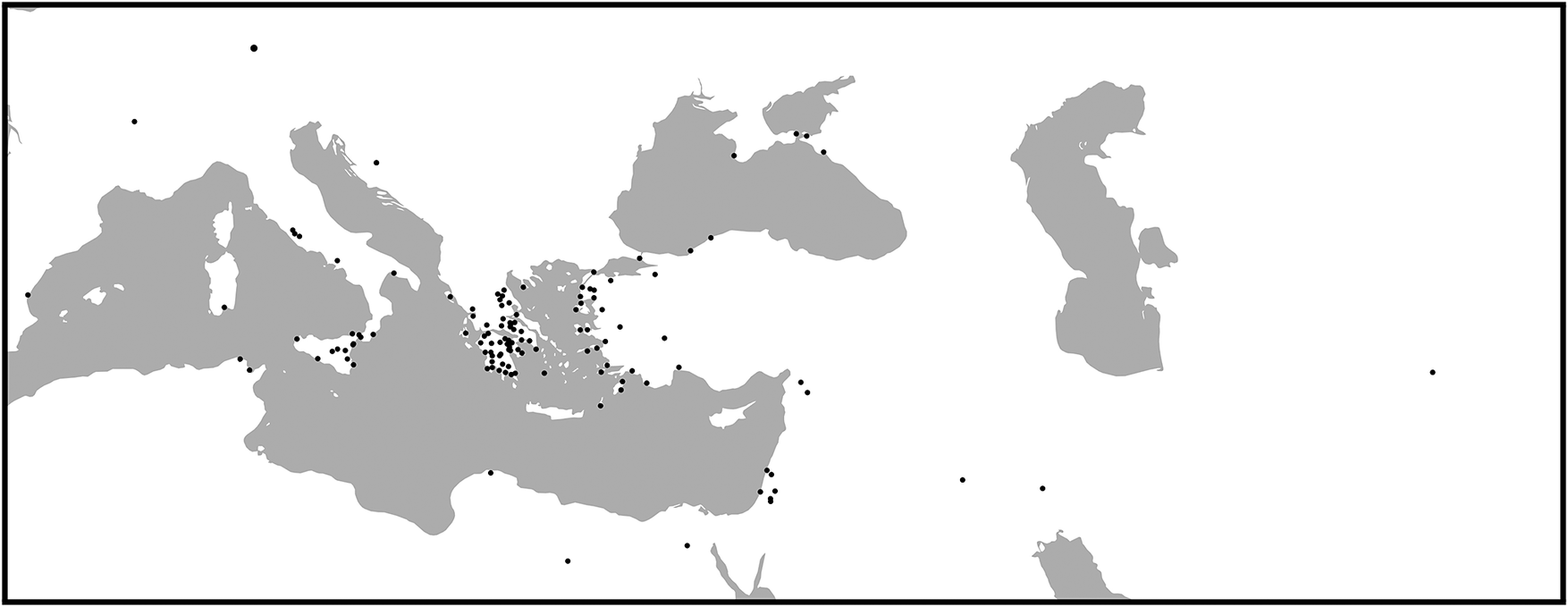
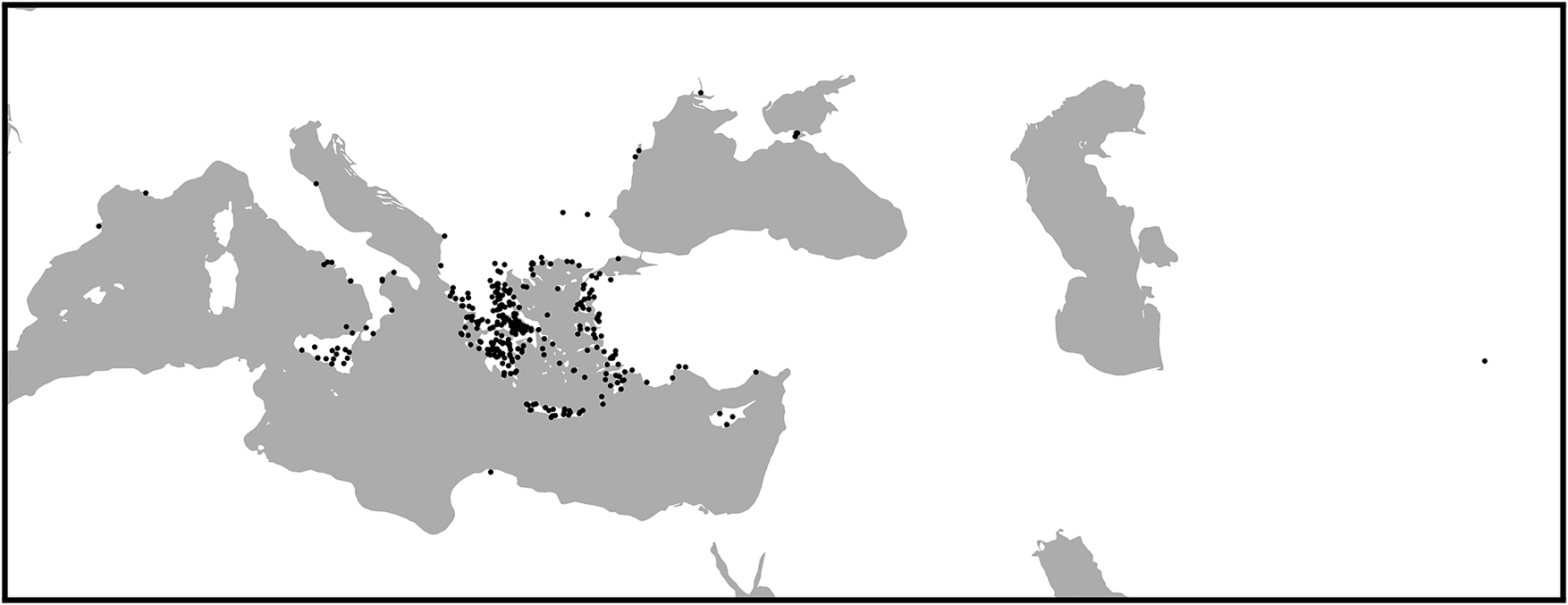
To arrive at some general understanding of what was reasonably regarded as an akropolis in antiquity, I argue for a focus on the physical examples of the feature. The extant ancient textual sources from Homer to the second century AD contain references to 133 individual akropoleis (listed in Appendix A: Supplementary Material). Their spatial distribution (Fig. 1) overall corresponds to that of the akropoleis identified archaeologically by the Copenhagen Polis Centre (Fig. 2) in An Inventory of Archaic and Classical Poleis (Hansen and Nielsen Reference Hansen and Nielsen2004).Footnote 27 Out of the 133 akropoleis, 22 are more-or-less clear cases of interpretatio graeca (including Babylon, Carthage and Rome), 11 can be regarded as figurative (such as the Alps), four are referring to mythical/fictional locations, four should probably be regarded as fortresses (φρούρια), and eight are too imprecise or the texts too fragmentary to be securely identified.
Distribution of akropoleis known from ancient literary and epigraphical sources. Map by author.

Distribution of archaeologically identified akropoleis in Hansen and Nielsen Reference Hansen and Nielsen2004. Map by author.

Consequently, out of the 133 locations, I only regard 84 as representing akropoleis in a Greek cultural sense, all of which associated with a respective polis. This does not imply that the cases left out were not understood by the ancient Greeks to be akropoleis. It is clear that the word conveyed such strong connotations that meanings and understandings related to it were easily projected upon other (sometimes similar) features of other cultures and areas.
Even if there is ample variation as to size, position, and layout, it can be said that an akropolis in ancient textual sources is essentially a walled space, most often described as located on an elevated position. It is also, almost exclusively, referred to as belonging to a polis settlement, as to be expected from the literal meaning of the word. It was, however, seemingly not a part of the settlement per se and was sometimes contrasted with this in descriptions of the urban topography. Akropoleis thus belonged to the immediate environment of the polis settlement, and cannot simply be equated with a fortress, a part of a fortress or any fortified position. ‘Akropolis’ further denoted only the actual walled area and not the hill itself, with the fortification wall probably acting as the boundary. With the exception of garrisons, akropoleis appear not to have been inhabited, and few buildings are mentioned at these locations apart from sanctuaries, which were sometimes located within the walls. The akropolis was generally situated above the polis, but the type or height of the elevated position does not seem to have been important.
This loose definition is in no way meant to be excluding but instead focuses on being strictly descriptive. There was probably no drive of standardisation to construct features of this nature according to the stated characteristics, so variation is very much to be expected: akropoleis could be of a palimpsest nature, being the result of hundreds of years of settlement and fortification developments,Footnote 28 but could also be deliberately constructed units in cities established ex novo, possibly as the archetypal city was expected to contain an akropolis.Footnote 29 I therefore suggest that we should be carefully permissive when applying the word to ancient topography. However, there are certainly several sites referred to in especially archaeological scholarship as akropoleis that poorly fit the description above, which – in my view – should probably prompt some afterthought as to the relevancy of the application of the word.
Overall, the great symbolic significance of the akropoleis for their respective poleis is clear from the textual sources. These were locations which were important, which meant something to people beholding them. The exact qualities of the sets of meanings projected by the akropoleis appear, however, to have been in flux throughout antiquity, much depending on cultural memory but also the political situation. In Classical poetry they represent shining beacons of freedom, and their destruction symbolised a state of servitude and neglect. This is much the opposite of how they appear in Roman-period literature. Fascinatingly, as most akropoleis in the Greek cultural sphere were abandoned as fortifications over the course of the Roman period, they continued to figure in literature as important topoi in the politico-philosophical landscape. At the time of Epictetus, many akropoleis had been desolate and abandoned hilltops for hundreds of years, yet in his Discourses (as quoted above) they remain powerful symbols of power and oppression.
CONCLUDING REMARKS
As this brief survey of the written and epigraphic texts shows, much of the old scholarly understanding and perception of the ancient Greek akropoleis rely on insufficient data or reflect outdated historical models. Akropoleis were indeed important places for the ancient Greeks, but in a more complex and changeable way than previously assumed. In a way, this might appear obvious – we should naturally assume that most widespread cultural phenomena are non-heterogeneous in nature – but this has not barred traditional scholarship from imagining a unified development. Over the thousand years during which the word was in common use, ‘akropolis’ came to signify and signal many things, not always as direct reflexes of historical developments, but also through the workings of philosophical and literary discourse. This study will hopefully provide archaeologists (but, hopefully, also historians) with a set of ‘tools of recognition’ when studying ancient topography, hinting at what to qualitatively expect from an akropolis at a settlement of Greek antiquity. Hopefully, the study will also prompt interest in what the ancient texts no longer tell us; the fragmentary state of the sources, as well as the loss of some central ancient works – perhaps most notably the two identically named On the Athenian Akropolis by Heliodorus of Athens (FGrHist 373 F 4) and Polemon of Ilion (FHG III 108–48) – leaves many gaps in our understanding of these features in ancient society. However, as there are many archaeological sites corresponding to the descriptive definition extracted from literary sources, much additional information regarding the history, use and meaning of Greek akropoleis could be extracted from epigraphy, excavation and survey results. A thorough inventory of archaeologically attested akropoleis throughout the Greek world, including all aspects of their material remains, would be a major undertaking, but would certainly generate crucial and revealing information regarding this ancient phenomenon.
SUPPLEMENTARY MATERIAL
Appendix A is published as online-only Supplementary Material at http://doi.org/10.1017/S0068245425100336.
APPENDIX B: THE PROPER NAMES OF AKROPOLEIS
Some ancient sources refer to akropoleis not simply as ‘the akropolis’ of a given polis, but by proper toponyms – names that distinguished them as places in their own right. These toponyms were typically distinct from those of the polis itself and often evoked local myth, history, or cultural memory. While the best-known references appear in relatively late authors such as Strabo and Pausanias – writing at a time when many akropoleis were desolate locations – earlier naming traditions are also preserved in Livy (who uses the Latin arx for ‘akropolis’, drawing upon his Greek source material).
Though no single explanatory model can account for all these toponyms, certain patterns certainly emerge. These can be grouped, for analytical purposes, into five broad categories: names derived from (but distinct from) the name of the polis, pre- or non-Greek substrate names, names with mythico-historical connotations, and purely descriptive names. The aim of this appendix is not to establish a rigid typology, however, but to explore how these toponyms may reflect local perceptions of history and identity in antiquity, and what they reveal about the cultural significance of akropoleis within the landscape of the Greek polis.
The toponyms
Toponyms for akropoleis are relatively rare in ancient literature, yet they are well established in modern scholarly discourse – for instance, in references to the Akrokorinthos of Corinth or the Kadmeia of Boeotian Thebes. In total, I have identified at least 21 akropolis toponyms from ancient textual sources (see Table 1). These examples span a wide temporal and geographic range, with attestations from Homer to Pausanias, and include cases from both within and beyond the Greek cultural sphere. While many other hilltops and mountains bore proper names, this study focuses specifically on examples where the ancient evidence either explicitly provides a name for an akropolis or allows for a strong inference that a given toponym referred to one.
Toponymic names of akropoleis

In some rare cases, the toponym was a direct derivation from the name of the local community. The best-known example is the Akrokorinthos of Corinth, one of the strategic ‘fetters of Greece’ (Polybius 18.11.6). The prefix akro- parallels that of the determinative compound ‘akro-polis’ (Risch Reference Risch1944, 20), both conveying a sense of extremity – here referring to the uppermost part of the Corinthian polis or the surrounding region of Corinthia. Due to its size and distant position in relation with the city of Corinth itself, the Akrokorinthos presents a rather unusual if not atypical akropolis.Footnote 30 However, the Akrokorinthos is never unambiguously identified as the Corinthian akropolis in the literary sources. Instead, ancient authors (Polybius 30.10.3 [fr.]; Diodorus Siculus 14.92.1; Pausanias 7.7.6) refer more generally to an unnamed ‘akropolis of Corinth’ and describe the Akrokorinthos as ‘a mountain peak above the city’ (Pausanias 2.4.6). Plutarch, despite focusing on the site in his Life of Aratus (16.4), also refrains from calling it an akropolis.Footnote 31 A parallel case is the Akrolissos of Illyrian Lissos, which appears as a fortified location in both Polybius (8.13) and Strabo (7.5.8), though again not explicitly termed an akropolis.
In rare instances, an akropolis may have inherited its name from one of the pre-synoecised communities that formed the later polis. Amastris in Paphlagonia was founded in the early fourth century BC through the union of Tios, Kromna, Kytoros and Sesamos; the last became the nucleus of the new polis and lent its name to the akropolis (Strabo 12.3.10). Whether similar naming patterns existed in other synoecised cities remains uncertain but plausible.
Several akropolis toponyms appear to derive from pre- or non-Greek linguistic strata. One frequently cited example is the Larissa of Argive Argos (Plutarch, Life of Cleomenes 21.3). The name Larissa is found in various locations – including Thessaly and Asia MinorFootnote 32 – and is often conjectured to be of ‘Pelasgian’ origin, possibly meaning ‘fortress’.Footnote 33 While the suffix -issa is suggestive of a pre-Greek etymology, conclusive linguistic evidence is lacking. Similarly, Pergamos – the akropolis of Troy (Iliad 5.446, 5.460), but also locations near Amphipolis (Herodotus 7.112) and most famously in Mysia – has been proposed as a non-Greek toponym,Footnote 34 associated with fortified heights.Footnote 35 Again, etymological certainty remains elusive.
Toponyms also served to anchor akropoleis within local myth and identity. The Kadmeia of Thebes is perhaps the clearest example, named after the Phoenician Kadmos, who was miraculously led to the site of his settlement by a cow (Apollodorus 3.4.1; Pausanias 9.5.2). Pausanias’ description of the Megarid (Pausanias 1.40.6, 1.41.1, 1.42.1–6) reveals a profusion of mythic founders associated with its akropoleis. The Alkathoa was named after Alkathoös, son of Pelops; the Karia after Kar, son of Phoroneus; and the Nisaia (in the eponymous harbour settlement) after King Nisos (Pausanias 1.44.3).Footnote 36 Similarly, the Psophis, the akropolis of Zakynthos, was named in honour after Arcadian Psophis, the home of the Zakynthian oikistēs Zakynthos (Pausanias 8.24.3). These narratives share recurring elements – often featuring a non-local founder or re-founder – mirroring broader mythic patterns of polis origins. Comparable traditions appear outside the Greek world, as in the myths of Trojan Aeneas at Rome or Troezean Theseus at Athens.
That an akropolis was sometimes regarded as the original settlement site of the community can be further construed from a small number of examples where the local toponym appears to have been simply ‘the Polis’. The most well-known example is of course the akropolis of Athens, which according to both literary and epigraphic sources was referred to as ‘the Polis’ (Hansen Reference Hansen and Hansen1996, 34–6).Footnote 37 That this was done in a toponymical sense is evident in Thucydides (2.15.6) as well as in epigraphy, including a fragmentary Athenian inscription (SEG LXIV 30b = IG I3 15d, ll. 42–4), which states that the decree was to be put up on the akropolis of Erythrai in Ionia but also on the Polis (= Akropolis) of Athens – if the reconstructed text is correct. A similar, if not direct, parallel, is the hill of Ptolis in Arcadia,Footnote 38 which Pausanias names as the original settlement location of nearby Mantineia.Footnote 39 On Rhodes, the akropolis of Ialysos was apparently known as the Achaïa Polis (Diodorus Siculus 5.57.6), a name also attested in Rhodian epigraphy from the Hellenistic and Roman periods.Footnote 40 Achaïa Polis was the mythical original settlement of the Rhodians prior to the division of the island into three poleis (Badoud Reference Badoud2024, 13), again reflecting the same narrative of polis origins.
The reason behind this naming is most probably that the original meaning of ‘polis’/‘ptolis’ was not ‘city’, as is sometimes asserted (e.g., Ma Reference Ma2024, 13), but ‘fortification’ or ‘hilltop fortification’ (Frisk Reference Frisk1934, 283; Benveniste Reference Benveniste1969, 367; Sakellariou Reference Sakellariou1989, 155; Hansen Reference Hansen and Hansen1996, 10, 34; Reference Hansen and Hansen2000, 145; Hall Reference Hall and Shapiro2007, 41), as is also supported by comparative etymology.Footnote 41 A hilltop fortification could consequently have retained this meaning of the word as a toponym. As discussed in the main article, the original meaning of ‘polis’ was known to at least some scholars of antiquity,Footnote 42 and I find this a more reasonable explanation of the toponymic use of ‘Polis’ for certain akropoleis than Thucydides’ (2.15.6) claim that the Athenian Akropolis was originally named the Polis because of the urban settlement originally having been located on the hilltop.
The idea of polis settlement origins on akropoleis appears elsewhere in ancient literature, sometimes possibly not reflecting a local tradition but rather a will to harmonise the mythical topography with the physical. Strabo employed this scheme when trying to locate the toponym Orthe, which appears in the Thessalian section of the Catalogue of Ships (Iliad 2.739). He seems to have been unaware of the polis and city of this name in south-western Thessaly,Footnote 43 as he claims that ‘some call Orthe the akropolis of the Phalannaians’ (Strabo 9.5.19). The urban settlement of the polis of Phalannaians (Phalanna) is not conclusively identified, but the most probable candidate is probably the large magoula or tell at Kastri, some 2.5 km south-east of modern Tyrnavos, where decrees of the Phalannaians have been found.Footnote 44 Whether this flattish and low mound, located several kilometres from the nearest larger hill, qualifies as ‘an akropolis’ is questionable. Somewhere, over 50 km to the south-west of Kastri, near the actual ancient settlement of Orthe at modern Kedros, was Thessalian Ithome, also known from The Catalogue of Ships (Iliad 2.729) and described by Strabo (9.5.17) as ‘a strong and rocky location’.Footnote 45 This hilltop community, which is yet to be conclusively identified (Stählin Reference Stählin1916; Rönnlund Reference Rönnlund2023a, 34), shared its name with the akropolis of ancient Messene in Messenia (Strabo 8.4.8), which is not in the Catalogue, but might have been a settlement precursor to Classical Messene (Fimmen Reference Fimmen1916). Strabo (13.4.5) further states that οἱ δὲ τὰς Σάρδεις Ὕδην ὀνομάζουσιν, οἱ δὲ τὴν ἀκρόπολιν αὐτῆς (‘Some call Sardeis Hyde, while others call its akropolis Hyde’), which has prompted the theory that Hyde was the precursor of later Sardis (Buresch Reference Buresch1898, 98).
A more direct such example is the akropolis Ake of Phoenician Ptolemaïs, which most probably reflects the original Canaanite name of the settlement (Harpocrates s.v. Ἄκη). The toponym Astypalaia, which appears to have been the akropolis of Samos (Polyaenus, Stratagems 1.23.2), possibly reflects a more local understanding of the akropolis as the location of the ‘older asty’, that is, the old settlement location. However, we may again have here encountered the remnants of a myth of an Easterner oikistēs as outlined above, as Astypalaia, according to Asios of Samos, was also a Phoenician princess (Pausanias 7.4.1).
A few akropolis toponyms fall outside the Greek world yet reflect similar mythical processes. The Byrsa of Carthage, possibly derived from either Punic root brt (‘citadel’) (Aubet Reference Aubet1993, 189; Hoyos Reference Hoyos2020, 2) or b’rt (‘well’) (Neue Pauly, s.v. ‘Byrsa’),Footnote 46 was reimagined by Greek and Roman authors through a homophonic pun with βύρσα (oxhide), anchoring it in the legend of Queen Dido and the tale of her ingenious land acquisition (Virgil, Aeneid 1.297).Footnote 47 Whether this story also reflects a Semitic root prs (‘to divide, cut, allot’) is uncertain, but the interpretive transformation is revealing. A similar application of Greek ideas of akropoleis and their role in the mythical landscape of cities outside the Greek world is found in Strabo (15.3.2), who calls the akropolis of Persian Susa the Memnonium, after Memnon, the son of the city founder Tithonos.
Finally, some akropolis toponyms are purely descriptive. The Ortygia of Syracuse, an islet in the city’s harbour, may derive its name from ὄρτυξ (‘quail’), possibly referring to its bird-like shape. Mythologically, it was said to be the birthplace of Artemis (Homeric Hymns 3.15–16), and in later tradition (Apollodorus, The Library 1.21; Hyginus, Fabulae 53), it was also associated with the titaness Asteria’s transformation into a quail, albeit in confusion with Delos, which according to these authors was previously known as Ortygia. The name of the smaller akropolis of Same on Cephalonia presents a challenge, as the manuscript tradition of Livy (38.29.10) reflects a corrupted section of text in the relevant passage. As outlined by Georgios Antzoulatos (Reference Antzoulatos2021), the name variously rendered Kyneatis/Kyatis/Thyatis/etc. probably refers to its topographical setting, as Livy has the qualifying sentence nam urbs in mare devexa in occidentem vergit (‘as the city slopes towards the sea and faces westward’).Footnote 48 What the original name was is impossible to say. Livy also names the akropolis of Ambrakia Perranthes (38.4.1), perhaps a corruption of Perianthēs (‘surrounded by flowers’). Contrasting with other sources (see above), Strabo (14.2.12) calls the akropolis of Ialysos the Ochyroma, meaning simply ‘fortification’, an unusual name among akropoleis despite their function as fortifications.
Concluding remarks
The examples discussed above reveal discernible patterns in how akropoleis were named and contextualised within ancient literary and cultural frameworks. Most notably, the recurrent association with mythical foreign founders – apparent in at least nine of the 21 identified cases – suggests that akropoleis frequently occupied a central role in the articulation of local origin myths. While a more systematic investigation of polis foundation narratives might yield additional examples, such an inquiry lies beyond the scope of the present study.
Crucially, the evidence suggests that these toponyms were not incidental or purely functional. Rather, they operated as narrative anchors, embedding the akropolis within the mythico-historical consciousness of the community. Whether evoking a legendary founder, preserving an old settlement name, or describing a conspicuous topographical feature, these names reflected a broader cultural understanding of the akropolis not merely as a strategic stronghold, but as a storied locus of identity, autonomy, and cultural memory. As such, akropoleis emerge not just as elevated fortifications, but as elevated symbols – charged with meaning, history, and local pride within the landscape of the Greek polis.
ACKNOWLEDGEMENTS
This article draws on my doctoral thesis, completed in 2018 at the Department of Historical Studies, University of Gothenburg. I am deeply indebted to my first supervisor, Prof. Helene Whittaker, for her unwavering support and belief in this research topic, and to the Department as a whole – including its former head, Prof. Göran Malmstedt – for providing my first true scholarly home.
A five-month scholarship at the Swedish Institute at Athens in 2015 was crucial to the development of this work, and I extend my sincere thanks to its staff, as well as to the staff of the Nordic Library at Athens, for their invaluable assistance in locating obscure local periodicals and conference proceedings. My stay at Lincoln College, University of Oxford, during Trinity Term 2017, likewise enabled me to complete my thesis on time; I am most grateful to Prof. Maria Stamatopoulou for so generously hosting me. I also would like to thank Prof. Peter Liddel of the University of Manchester for pushing me to re-approach this topic after several years of neglect.
As the article dedication indicates, this work would never have been possible without the support, encouragement and friendship of my second supervisor, Rune Frederiksen. His untimely death in 2023 remains difficult to comprehend. Rune, you are deeply missed, there are so many things I would like to talk to you about; thank you for everything.


 Open access

