


If the histories of d’Auberteuil and of Longchamps…can be published in the face of the world, and can be read and believed by those who are contemporary with the events they pretend to relate, how may we expect that future ages shall be better informed? Will those rise from their graves to bear witness to the truth, who would not, while living, lift their voices against falsehood? If contemporary histories are thus false, what will future compilations be?
Thomas Jefferson, 1787
My aim has been to see the period as it was, rather than in terms of what happened after it; to consider policies and personalities in terms of what was possible in their time, rather than to impose on them the standards which are accepted in our own.
Hugh Seton-Watson, 1967
In response to Russia’s full-scale invasion of Ukraine in 2022, scholars representing diverse disciplines within Slavic, East European, and Eurasian studies began calling not only for the “decolonization” of the field, but also for the decolonization of Russia itself. Consider, for example, the 2023 ASEEES call for papers for its decolonization-themed annual convention: “Russia’s full-scale invasion of Ukraine has led to widespread calls for the reassessment and transformation of Russo-centric relationships of power and hierarchy both in the region and in how we study it.”Footnote 1 In both kinds of calls, Anglophone historians of Russian and Soviet empire have played leading roles.
This being an academic forum, as opposed to a town hall—a distinction worth emphasizing—the present essay sets aside academics’ calls to decolonize Russia in order to attend to hasty generalizations and unsubstantiated claims concerning knowledge production and the state of the field of Russian history prior to 2022.Footnote 2 In these discussions, historians have emphasized the “coloniality of power” and “hegemony” of western and Russian “colonial knowledge systems,” which their interventions aim to expose and remedy.Footnote 3 They have emphasized the field’s posited “Russo-centrism” and “methodological nationalism”; “marginalization” of non-Russian histories and cultures and tendency to “ignore,” “dismiss,” and “overlook” Russian colonialism, corruption, imperialism, and violence; “persistent imperialist outlook”; “Ukrainian blind spot” and refusal to grant “full historiographical legitimacy to Ukraine;” complicity in “the legitimation of Russian imperial claims,” “the political rehabilitation of the Soviet regime”; the “predetermin[ation of] the war with Ukraine;” and “academic enabling of Russian crimes,” including Russia’s war on Ukraine.Footnote 4 It has even been suggested that “if the field continues to demand that grad students go to Russia after the end of the war,” it would require “a silence that would be personally shameful as well as collectively complicit in genocide.”Footnote 5 These and similar claims have been used to explain “why Russian studies in the West failed to provide a clue about Russia and Ukraine.”Footnote 6 They make historians of Russia appear to be not only professionally incompetent but also complicit in Russian imperialism today. But are they accurate?
Such claims about the pre-2022 state of the field now constitute part of its history, and for this reason, and arguably this reason alone, they demand historians’ attention. This article seeks to answer two basic questions: To what extent, if any, do these claims accurately represent the historical development of the field? Have historians in the west tended to overlook Russian imperialism and to marginalize the histories and cultures of non-Russian peoples within the tsarist and Soviet polities? The purpose of this article is to answer these questions, not to judge the quality of the work discussed below with the benefit of hindsight. I argue that some of the most prominent and influential Anglophone historians of Russia have been focused on the imperial and national(ist) dimensions of Russian history for almost a century. Because historians of Russia should understand that since the 1990s the field has never been more alert to these dimensions, I focus here on the preceding half century of Anglophone historiography of Russia as a multinational empire. I devote considerable space to discussing two periods in particular: first, the period of the field’s founding in North America in the 1940s and 50s when Michael Karpovich (1888–1959) and his students explicitly set out to decenter Russian historiography by questioning the scheme of Russian history presented by Vasilii O. Kliuchevskii (1841–1911) and attending to the history of the empire’s non-Russian peoples and its borderlands, all before a comprehensive English-language study of Russian imperialism or the fields of colonial, postcolonial, settler colonial, and Indigenous studies existed; and second, the explicit rethinking of Russian history that commenced in the 1990s and launched what the editors of Kritika would later dub the “imperial turn” in Russian historiography.Footnote 7 I argue that far from overlooking the imperial and colonial dimensions of Russia’s past, Anglophone historians have been documenting and explaining them for almost a century. I argue further that in some ways the imperial turn in Russian historiography marked a return to research agendas established decades earlier.
As early as the 1940s and 50s, Anglophone historians emphasized the need to pay greater attention to the history of Russian imperial expansion and colonization, Russia’s borderlands and non-Russian peoples. Because this period in the field’s development appears to have been forgotten by some historians, and misrepresented by others, it receives here relatively more attention than later periods. Thereafter, the multinational character of Russian and Soviet empire never fell out of Anglophone historians’ focus; on the contrary, what scholars at the time called the “nationality question” and the “nationality problem”—that is, the question of non-Russian nationalisms within the USSR and the perceived problem they posed for its future prospects—had by the 1980s, if not earlier, moved to the center of the field’s attention. It was in opposition to the dominance of the national paradigm in Russian historiography, and in recognition of its limitations, that historians in the 1990s began calling, and not for the first time, for greater attention to be paid to the imperial and colonial aspects of Russian history. The main difference between historians working prior to the 1990s from those since then is that the field’s founders were pioneering the Anglophone history of Russia as a multinational empire and, as a rule, lacked access to the archives and libraries of the USSR. They therefore had to rely on published, mostly Russian-language sources available in western repositories, the richness of which varied from country to country,Footnote 8 while historians working in the aftermath of the collapse of the USSR had far greater access to former Soviet archives and libraries, as well as more opportunities to study the non-Russian languages of its peoples, thereby enabling them to advance the cause of decentering and decolonizing the historiography of Russian empire. Commenting on the challenge of studying Russia as a multiethnic empire in the 1960s, British historian and political scientist Hugh Seton-Watson (1916–84) observed: “When scholars from this country are admitted to work in Russian archives in the same conditions in which foreign scholars are admitted to archives in Britain, it will be possible to write better books than I, or indeed my generation, can hope to write.”Footnote 9 In striking contrast, in the 1990s and 2000s it was possible for a graduate student preparing a doctoral dissertation on, say, the history of Russian empire-building in the Caucasus to use Foreign Language and Area Studies (FLAS) fellowships to study Turkish, Uzbek, Persian, Ottoman, Church Slavonic, Chaghatay, and Georgian at a single institution, and to use this training to conduct research in the former Soviet archives of multiple countries. This kind of opportunity was simply not available to those who founded the field of Russian historical studies in the US, nor does it appear that FLAS fellowships supported the study of all these languages in the 1960s or 1970s.Footnote 10 It remains for future students of Russian historiography to judge whether the Anglophone historians who enjoyed relatively open access to the former Soviet archives, at least for a time, managed to produce better books on Russian empire than those published by the field’s pioneers.
The Karpovich School of Russian Imperial Studies
In response to Russia’s invasion of Ukraine, one historian of Russian empire attempted to explain “how the field [of Russian history in the United States] was colonized” by tracing the origins of the posited problem to Harvard University’s Tbilisi-born Russian émigré historian Michael Karpovich. Karpovich, the argument goes, “transplanted” to the US his teacher Vasilii Kliuchevskii’s idea of Russian history, in which “only the ‘Great Russian’ people had agency, not the Ukrainian people,” and then used it “to shape the first generation of American scholarship on Russia.” In making this case, which first appeared on H-Russia and was later republished in the journal Russian History, the author points to Karpovich’s 1932 “textbook,” Imperial Russia, 1801–1917, his 1943 article on Kliuchevskii and Russian historiography, his 1947 lecture on Russian historiography, and his influence on students whose published work “helped to create the field—one in which Ukraine was an object, not a subject.”Footnote 11
There are problems, however, with each of these claims, which, taken together, misrepresent Karpovich’s understanding of Kliuchevskii’s legacy, Karpovich’s own contributions to the study of Russian imperialism and colonialism, his influence on students, and their contributions to the study of tsarist Russia and the USSR as multinational empires. While it is true that Karpovich attended Kliuchevskii’s “remarkable lectures” at Moscow University, as he explained in a letter to the “Ukrainophile” American academic Philip Mosley (a former student who went on to publish an early English-language discussion of Russian imperialism and direct Columbia University’s Russian Institute, where he contributed to the early development of Ukrainian studies), “I cannot say that he taught me” because “he did not teach his students the methodology of history.”Footnote 12 As David Engerman has observed, Karpovich “learned from others how to become a historian” and believed that the importance of his former teacher’s lectures “inhered less in Kliuchevskii’s arguments than in his artistry.” Thus, Kliuchevskii “may have been [Karpovich’s] teacher but he was not his guiding light.” Indeed, Karpovich’s approach to Russian history was in some ways “antithetical” to that of Kliuchevskii, as both Karpovich’s published work and that of his students demonstrate.Footnote 13
Karpovich was among the first historians in North American to frame the study of Russian history in terms of empire. His Imperial Russia, 1801–1917, published in 1932, however, explicitly made “no pretense” to being an original contribution to “historical literature in the scholarly sense.” It was designed to be not a textbook but rather “a week’s reading” for college courses in “general European history,” as is clearly stated in its preface. Thus Karpovich’s treatment of Russian history was extremely cursory by design. Concerning Russian expansion in the nineteenth century, when, according to the author, “the Empire became an accomplished and firmly established fact,” Karpovich claimed Russia had pursued “an aggressive near-Eastern policy” as well as “a series of colonial wars” aimed at the conquest of the Caucasus and Central Asia. As a result of its imperial expansion, Russia’s “territorial and ethnographic composition was highly complex.” Karpovich both distinguished among Russians, Ukrainians, and Belarusians, and also treated them as a single “people.” For him, “the Russian people” comprised three branches: Great Russian, Little Russian (Ukrainian), and White Russian (Belarusian). He also acknowledged the existence of Ukrainian and Belarusian national movements. In other words, Karpovich treated Russia as a multinational empire more than half a century before the publication of Andreas Kappeler’s Rußland als Vielvölkerreich. Unlike Kappeler, however, Karpovich plotted Russia’s peoples on a civilizational spectrum, with the Russians placed between the inhabitants of the country’s so-called “backward border provinces”—he gave the Caucasus and Central Asia as examples—on one hand, and the inhabitants of the western territories who were “in many respects on a higher level of civilization than the Russians,” on the other.Footnote 14 In this highly circumscribed way, Karpovich drew attention to both the multinational character of the Russian empire and the “aggressive” and “colonial” dimensions of its policies and practices, at least toward the Near East, the Caucasus, and Central Asia. Here it is worth noting that Karpovich’s view of the relationship among Great Russians, Ukrainians, and Belarusians reflected the state of the fields of ethnography and philology in the west at the time and was shared by other historians.Footnote 15
In 1943, Karpovich published an essay that addresses Kliuchevskii’s legacy in the context of recent trends in Russian historiography. The purpose of the essay was to identify “deviations from” and “deficiencies in” what Karpovich called “the Klyuchevski scheme” of Russian history. Karpovich criticized both Kliuchevskii’s “Moscow-centric” and Mykhailo Hrushevsʹkyi’s Ukraine-centric approach not because he judged them to be illegitimate or fruitless, but because of the tendency of nationalist historiography—Great Russian and Ukrainian alike—to obscure the non-national dimensions of a country’s past. He listed as first among “the unfulfilled tasks of Russian historiography” the need to attend to the imperial and colonial dimensions of Russia’s past. “What is sadly missing in [Kliuchevskii’s] Course of Russian History,” he boldly asserted, “is the history of the Russian Empire.” For Karpovich, Kliuchevskii failed to give “due recognition” to the history of colonization during the empire’s formative period. Nor did he address “the development of the border regions” or “the problems of imperial administration.” Karpovich found in Kliuchevskii’s scheme “practically complete neglect” of the “Asiatic aspects of Russian history” and a failure to appreciate “the importance of Asia in Russian history.” In questioning Kliuchevskii’s Moscow-centric approach to Russian history and calling on historians to attend to its imperial and colonial dimensions, Karpovich had anticipated the imperial turn in Russian historiography by half a century. In his day, though, “Russian historiography [was] still waiting for its Turners and Seeleys,” a reference to Frederick Jackson Turner (1861–1932) and Sir John Robert Seeley (1834–95), pioneers in the study of frontiers and imperial expansion. Karpovich concluded his thoroughgoing critique of Kliuchevskii’s scheme of Russian history by stating that it needed “a thorough renovation, if not total replacement.”Footnote 16 Toward the end of the 1940s, Karpovich suggested the outlines of its replacement in a lecture that listed “regional histories and histories of national minorities,” “history of expansion and colonization,” and “history of imperial administration and the imperial policies” first among the “principal gaps” in Russian historiography.Footnote 17 Thus, far from having transplanted Kliuchevskii’s idea of Russian history to the US, Karpovich had proposed an alternative approach that foregrounded the multinational character of Russian empire.Footnote 18 He also worked to ensure that articles published in the Russian Review (est. 1941) would be “strictly objective” and devoid of “any attempt of propaganda whatsoever in favor of Russia.”Footnote 19
Karpovich did not have to wait long for the field of Russian history in the US to find its Turners and Seeleys. Indeed, Karpovich himself trained some of them. Within a decade of calling for historians to pay greater attention to the imperial and colonial dimensions of Russian history, his former Harvard students began publishing pioneering works that documented and explained the history of tsarist Russia and the USSR as multiethnic empires.
The Iranian-Russian émigré historian Firuz Kazemzadeh (1924–2017), for example, was among the first of Karpovich’s students to attempt to fill the lacunae in Russian historiography that his teacher had identified. In introducing Kazemzadeh’s The Struggle for Transcaucasia (1917–1921), published in 1951, Karpovich again drew attention to historians’ relative neglect of Russia’s borderlands, explaining that historians of Russian empire tended to focus “on the centre of power, on the words and deeds of the leaders,” and at the same time tended to overlook “the all-important fact that the Soviet Union is a multinational state.” Karpovich praised Kazemzadeh for having made a “valuable and interesting contribution” to a “somewhat neglected field of study,” and for displaying “that degree of detachment which one is entitled to expect from a historian.” (Here it is worth noting the absence of such scholarly detachment in some of the recent calls to decolonize the field.) Writing at a time when “the histories of the non-Russian inhabitants of the former Russian Empire are practically unknown in the West,” a fact “especially true of Transcaucasia,” Kazemzadeh thanked his “mentor” for guiding him in his attempt “to fill the gap” in the study of “the Revolution in the border areas of Russia.” In the study, Kazemzadeh took Russian imperialism for granted, which is not to say that he in any way “normalized” it. He was alert to the history of Russian colonization in the region, a project that ultimately “failed” not only in the northern Caucasus where the Russian settler population was relatively small and had “little contact with the native masses,” but also in the southern Caucasus where “beneath the thin crust of Russianization … were the masses, as un-Russian as ever, speaking their own languages and disliking the intruders from the North.” Only once did he refer to Georgia as “a colony of Russia” before observing that in the early 1920s “Georgians proved to be as imperialistic as the Russians.”Footnote 20 Kazemzadeh would continue to publish and teach about Russian imperialism throughout his career at Yale University.Footnote 21
Like Kazemzadeh, the Ukrainian-American scholar John S. Reshetar, Jr. (1924–2015), studied under Karpovich in the second half of the 1940s. In the preface to his The Ukrainian Revolution, 1917–1920: A Study in Nationalism, published in 1952, Reshetar thanked Karpovich for preparing him to write the doctoral dissertation on which the book is based. In the book, Reshetar continued the decentering approach to Russian history that his mentor had proposed a decade earlier. He noted, for example, that Anglophone scholars had done much to describe and analyze “events which occurred in Moscow and Petrograd, but there have been no comparable efforts to study the peripheries of the Russian Empire.” Having first acknowledged that the “distinctiveness of the Ukrainians is now generally recognized,” the author proceeded to place Ukrainians in the foreground of the study, which opens with passages from Mykola Kostomarov’s The Book of Genesis of the Ukrainian People (1846) and Mykola Mikhnovsky’s Independent Ukraine (1900). He then documented and explained the myriad ways that Ukrainians had shaped their own history and that of the Soviet Union. The men who led the Ukrainian movement between 1917 and 1920 may have failed to create a lasting independent state, but they nonetheless compelled Russia’s communist rulers to acknowledge the existence of the Ukrainian nation, “no mean achievement.”Footnote 22 Reshetar’s achievement is all the more remarkable for the fact that, though lacking access to Soviet archives and libraries and writing at a time when nationalities studies was in its infancy, he managed to use Ukrainian, Russian, and other sources to excellent effect. Columbia University’s Russian Institute Director Philip Mosley—as noted, a former Karpovich student and an early, strong supporter of Ukrainian studies—correctly characterized Reshetar’s book as “a truly pioneer work,” while one reviewer considered it “the first study in the West [focused] on the contemporary history of Ukraine.”Footnote 23 (Today, however, it appears that the work has been forgotten even by some scholars specializing in modern Ukrainian history.Footnote 24 ) Reshetar later joined forces with Omeljan Pritsak, the founding director of the Harvard Ukrainian Research Institute, to demolish the myths of the “‘All-Russian’ nation” and the so-called “eternal oneness” of the Russian and Ukrainian peoples; to popularize Hrushevsʹkyi’s critique of the “traditional scheme of ‘Russian’ history”; and to help others understand that “Kievan Rusʹ is not identical with Russia.”Footnote 25 Thanks to the work of the Ukrainian Academy of Arts and Sciences in the US, which began publishing its Annals in 1951, the 1950s saw a dramatic increase in the number of English-language scholarly works in the nascent field of Ukrainian studies in the US.
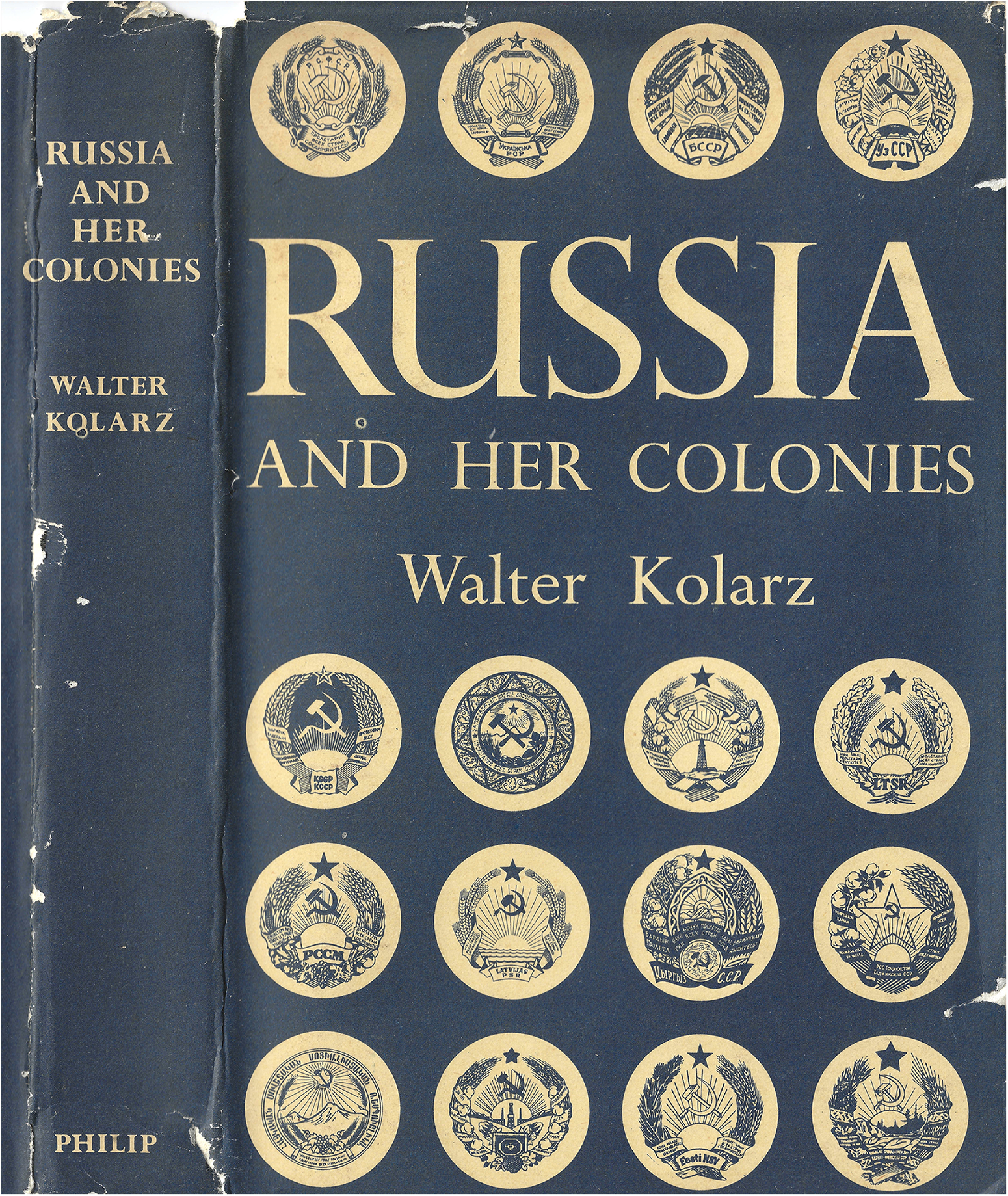
In the same year that Reshetar published his pioneering work on Ukrainian history, the Sudeten-born Austrian journalist Walter Kolarz (1912–62) published a study titled Russia and Her Colonies. According to Kolarz, Russia since 1552 had been a “multi-national empire,” and its history of colonization did not end in 1917 but was rather given “a new impetus” by a revolution that was “Russian” because it had taken place in Russia and was “carried out by people who were Russian in the ethnical or cultural sense.” Kolarz focused on “the question of the extent to which the government of the U.S.S.R. has assisted or hampered the legitimate national aspirations of the peoples of the Soviet Empire.” That “no [contemporary] Soviet writer would speak of ‘colonies’ or of ‘colonial policy’ when describing the relationship between Moscow and the non-Russian peoples of the U.S.S.R.” did not deter Kolzarz from doing so. He defined “colonies” in territorial terms and used the term “nationalities” to refer to ethnic groups. Specifically, he defined Russian colonies as “territories which enjoy either legally or factually special status within Soviet Russia,” and explained that what made these territories “colonies” was their “enforced dependence on the Moscow government.” And as the book’s dust jacket was designed, one suspects, to suggest, Kolarz considered all of the non-Russian Soviet republics to be “Russian colonies” (Figure 1). In the book’s concluding chapter, Kolarz argued that the Soviet government could not and did not solve the country’s nationalities “problem,” and that far from destroying Russian imperialism, as its early Marxist theorists had claimed, Soviet nationalities policy had “in reality tried to preserve and to consolidate it.”Footnote 26
Dust jacket for Kolarz’s Russia and Her Colonies (1952).

The book made a strong impression on historians in the US. For the Duke historian John Shelton Curtiss, Kolarz’s book was “unique in its detailed treatment of some phases of Soviet nationality policy,” and he acknowledged that Kolarz had built “a strong argument” that the Soviet government had “consistently discouraged” the national aspirations of the country’s non-Russian nationalities.Footnote 27 Romeo Cherot, an early student of Soviet “nativization” policy in Kazakhstan, believed that Kolarz had demonstrated “the complete economic and political domination” of the then fifteen non-Russian Soviet union republics by the central government and its “the ruthless suppression of any tendencies toward national deviation or independence.” The book led Cherot to conclude that “Tsarist colonization has merely continued as Soviet colonization.”Footnote 28 Then one of the leading scholars of Ukrainian history in the US, Reshetar himself considered the book to be both an “indispensable” general survey of early Soviet history and an “indictment” of Soviet policy toward non-Russian peoples of the USSR. Kolarz had both “exploded the myth of Soviet federalism” and documented how Soviet “centralism” had “ruthlessly subordinated local national interests to those of the Russian-dominated center.” Like Cherot, Reshetar saw in Iosif Stalin’s centralism a continuation of traditional Russian governance (specifically, he pointed to the examples of Ivan the Terrible and Peter I). Thus, far from overlooking the violence of Russian imperialism in the first decades of Soviet rule, Kolarz and his readers emphasized the ruthlessness and “tragic” results of both tsarist and Soviet imperialism.Footnote 29 Thanks to the much later work of Yuri Slezkine and others, we now know that Kolzar was partially correct; in addition to placing strict limits on the nationalist aspirations of ethnic groups in the USSR, the Soviet central government also facilitated the development of new and stronger national identities among them in the process of creating “the first state in history to be formed of territorial units defined as ethnic political entities.”Footnote 30
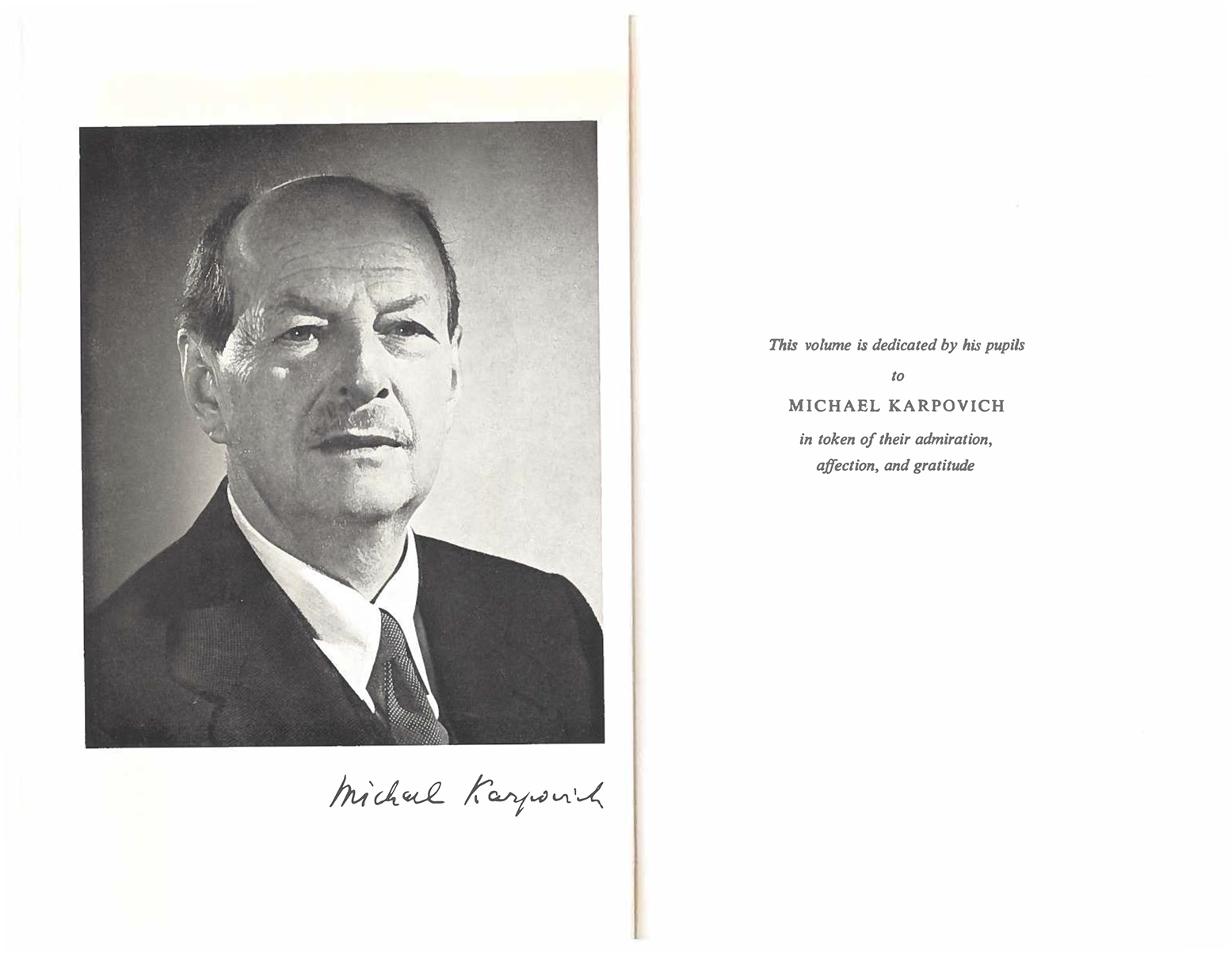
Kazemzadeh and Reshetar were hardly the only Karpovich students to make important contributions to the historical study of Russian and Soviet imperialism. Consider the careers of Richard Pipes (1923–2018) and Marc Raeff (1923–2008), who remained close long after being mentored by “Karpy,” as former students affectionately referred to their beloved teacher (Figure 2). Early in their careers, both scholars, as Jonathan Daly has observed, “focused on the multinational character of the Russian Empire and Soviet state” decades before it would become “a central scholarly focus in the field.”Footnote 31 Pipes did this in the final chapter of his Harvard dissertation, which Karpovich had encouraged him to expand into his first book, The Formation of the Soviet Union: Communism and Nationalism 1917–1923, which, when published in 1955, became an instant classic that has since been reissued multiple times and translated into multiple languages. Building on the work of Kazemzadeh and Reshetar on the southern Caucasus and Ukraine, respectively, Pipes produced a “clear, scholarly, and dispassionate account,” according to one reviewer, of the “cold-blooded ruthlessness and calculated deceit” of early Soviet nationality policy that laid to rest the idea that the Bolsheviks deserved credit for having liberated the non-Russian peoples from tsarist oppression and discrimination, and showed the “dictatorship of the proletariat” to be “synonymous with the establishment of Great Russian hegemony.” Here for the first time in English, according to Kazemzadeh, Pipes told “the story of the Tatars, Bashkirs, Uzbeks, Turkomans, Kazakhs, and Tajiks” in which “the revolution and civil war in Turkestan assumed the character of a struggle of the Russians against the native population.” Pipes did not overlook the destructive and violent nature of this struggle. On the contrary, he showed, for example, that when the native population sought to establish an autonomous government in Kokand, the Tashkent Soviet sent Russian forces to crush the movement, resulting in the widespread destruction of property and a massacre of the local population. “After three days of stealing and slaughter,” wrote Pipes, “the soldiers poured gasoline on the houses in the Old City and set them on fire. The Moslem Quarter was almost entirely destroyed.”Footnote 32 “Kokand is not a dead city,” observed a Russian reporting from the scene, “it resembles a mortuary, from which emanate odors of mud and carrion.”Footnote 33 Pipes believed that “by granting the [Soviet] minorities extensive linguistic autonomy and by placing the national-territorial principle at the base of the state’s political administration … this purely formal feature of the Soviet Constitution may well prove to have been historically one of the most consequential aspects of the formation of the Soviet Union,” a view affirmed by scholars in the aftermath of the Soviet collapse.Footnote 34
From Hugh Mclean, Martin E. Malia, and George Fisher, eds. Russian Thought and Politics (1957).

For his part, Marc Raeff continued the work of decentering Russian history first by attending to the history of Siberia. Writing to Pipes in 1952 from Seattle, Washington, where Donald Treadgold (1922–94), another Karpovich student, was applying Turner’s “frontier thesis” to the history of Siberia, Raeff explained that among the main themes covered in his own planned study of Siberia would be “the nationality issue from the point of view of centralism vs. federalism vs. colonialism,” a subject that was “still extremely hazy in my mind and may not get anywhere.”Footnote 35 Raeff continued to study the imperial and colonial dimensions of Russian history “at a time when few scholars stressed the multinational character of the Russian Empire.” Thus colleagues later characterized him, with good reason, as “the universally recognized doyen of Imperial Russian history” and “one of the most influential and prolific historians of Imperial Russia in the world.”Footnote 36 Not only were Pipes and Raeff among the earliest Anglophone pioneers in the study of Russia as a multiethnic empire, they continued to study the history of Russian imperialism throughout their long and productive careers. That these outstanding Karpovich students were often asked to contribute articles and book reviews on this topic, including work on the history of the Baltics, the Caucasus, Central Asia, and Ukraine, powerfully demonstrates their prominence in the field of Russian studies broadly conceived to include its non-Russian aspects.Footnote 37 As Nadieszda Kizenko has observed, “the importance of both men to the field of Russian history in the US goes without saying,” and through their publications and teaching, “they left an indelible impression on those fortunate to have encountered them.”Footnote 38 Their example is worth remembering today for another reason: “Regardless of how much Pipes and Raeff disliked the Soviet system,” as historian Elise Wirtschafter has observed, “as scholars, professionals, and teachers, they maintained relationships with Russian colleagues … and facilitated their students’ ability to do likewise.”Footnote 39 Documenting and analyzing the imperial and colonial dimensions of Russian history and training students to develop professional relationships with Soviet scholars did not make Pipes and Raeff complicit in Soviet imperialism.
Here it is worth pausing to consider factors that may have led some readers of the work discussed above to conclude that Karpovich and his students had uncritically adopted and perpetuated Kliuchevskii’s Russo-centrism or treated non-Russians merely as objects, and not subjects, of imperial Russian and Soviet history. In making the case that the field’s “Ukrainian blind spot” and other posited deficiencies can be traced to Karpovich and his students, historians have tended to focus on the figure of Nicholas V. Riasanovsky (1923–2011), who briefly studied under Karpovich at Harvard before receiving a Rhodes scholarship to Oxford University, where he defended a doctoral dissertation supervised by B. H. Sumner and Isaiah Berlin, and to emphasize the outsized influence of his A History of Russia, first published in 1963, on generations of students of Russian history. But one might ask: Was Riasanovsky’s perspective on Russian history typical of that of Karpovich and his students? While Jonathan Daly had good reason to include Riasanovsky among the five scholars who founded Russian historical studies in the US, even Daly himself had originally “never considered Riasanovsky one of them”; the other four scholars either had no relationship with him at all or thought little of him as a scholar; and Riasanovsky himself, who focused on topics “uncongenial to [Karpovich],” “insisted that Karpovich had not inspired his scholarly evolution.”Footnote 40 Unlike Kazemzadeh, Pipes, Raeff, Reshetar, and Treadgold, Riasanovsky never particularly concerned himself with the history of Russia’s borderlands and non-Russian peoples. He had graduated from Harvard before Karpovich delivered his pioneering 1947 lecture on the major gaps in Russian historiography.
It is small wonder, then, that the first edition of Riasanovsky’s A History of Russia, with its approving quotations from Kliuchevskii, was viewed at the time (and still today) as belonging to what Hrushevsʹkyi called “the traditional scheme of ‘Russian’ history.” In his review of the work, Michael T. Florinsky (1894–1981), for example, noted the author’s tendency “to favor the more conservative interpretations and [to lean] on the writings of the historians of the traditional school,” and even to “endors[e] some of the extreme claims of Russian nationalism.”Footnote 41 One way to explain this tendency, as Riasanovsky himself did, “is to emphasize that my father was linked to the main traditions of prerevolutionary Russian historiography and that I managed to adapt that historiography … to the American and Western scene.”Footnote 42 This, together with his training in intellectual history at Oxford under Berlin, and the experience of researching and writing his first two monographs, which focused on the teachings of the Slavophiles and the “official nationality” of Nicholas I, go far toward explaining his perspective on Russian history. These were the circumstances that conditioned the writing of his History. Perhaps it makes more sense, therefore, to connect Riasanovsky to the tradition of other Russian émigré historians like Florinsky and George Vernadsky (1887–1973), in whose English-language Russian history textbooks of the 1940s and 50s—a time when the field of Russian historical studies in North America had “a very low academic status”—one finds “at bottom old-fashioned imperial history,” where “the prehistory and early history of the Eastern Slavs, and well as the history of Kiev Rusʹ, are but the first chapters in the history of the Russian state and people,” a vision of Russia “at once nationalist and imperialist,” which Riasanovsky’s History helped to perpetuate long after the 1960s.Footnote 43 In fact, Vernadsky’s own legacy is more complex than this characterization suggests. As historian Oleksandr Avramchuk has recently observed, Karpovich “played a pivotal role” in softening Vernadsky’s “anti-Western tone” and, one suspects, in facilitating the development of Vernadsky’s Ukrainophilism.Footnote 44
From Nationalities Studies to the Imperial Turn
In the second half of the 1950s and early 1960s, it became increasingly common for Anglophone historians to treat Soviet nationality policy in terms of colonialism, imperialism, and Russification. In a lecture delivered in Russian to scholars in Germany in 1954 and then published as an article in one the field’s leading journals, Hugh Seton-Watson (1916–84) first pointed to the contradiction between Vladimir Lenin’s opportunistic endorsement of the right to national self-determination and preference for international working-class solidarity over “bourgeois” solidarity of individual nations, before suggesting that in the NEP years some nationalities (in Ukraine and the southern Caucasus) enjoyed “a real measure of self-government,” while others (in Central Asia) were more directly ruled by the local Russian minority. In the 1930s, he argued, “ruthless collectivization in the economic field was not compatible with self-government for the nationalities,” and caused famine to spread across the Pontic-Caspian steppe from Ukraine to Kazakhstan, while “Russification” and the purges “hit the nationalities with special severity.” During World War II, the Soviet regime committed “genocide” against Chechens, Crimean Tatars, Kalmyks, Karachais, and Volga Germans, and in the post-war period pursued “the suppression of the national epics of the Moslem peoples,” “the systematic falsification of the history of the [non-Russian] nationalities,” as well as the “massive colonization” of certain border areas by Russians, whom the Soviet government used as its “instruments” for the “suppression of the nationalities.” Soviet policy, Seton-Watson concluded, amounted to “a war of extermination against the principle of nationality. It can also fairly be described as imperialism,” which understandably appeared to the state’s non-Russian populations as “a policy of Russification.”Footnote 45 By the time he published a monograph on Soviet imperialism in 1962, reviewers “already familiar with the facts mentioned by Professor Seton-Watson” nonetheless found much of value in it. No reviewer of the monograph called into question the author’s characterization of the USSR as imperialist with regard to its non-Russian peoples, its satellite states, and international politics. In his review, Kolarz praised the author’s judicious comparison of Russian and western imperial and colonial situations, observing that “the repressive and paternalist but also the benevolent feature of Soviet and Communist colonialism cannot be seen in proper perspective unless they are related to the history of imperialism and colonialism in other parts of the world.” The difference between European and Russian imperialism, according to Kolarz, was that “the major European colonial Powers have boldly embarked on decolonization while the Soviet Union has kept all its colonial conquests.”Footnote 46 And with the publication of The Russian Empire, 1801–1917, which emphasized that “Russia was a multi-national empire, more than half of whose subjects were not Russians,” Seton-Watson had corrected, according to Taras Hunczak, the “basic misconception” that Russian expansion was largely a “process of unification and consolidation,” which had led “many students of history to deal with the Russian empire as a national rather than a multinational state.”Footnote 47
Nor was Seton-Watson alone in emphasizing the colonial, repressive, and violent qualities of Soviet imperialism.Footnote 48 In a number of pioneering studies beginning in 1960 with the publication of The Soviet Deportation of Nationalities, Robert Conquest (1917–2015), whom Pipes considered a friend, emphasized the brutal and even genocidal quality of Soviet policy toward certain non-Russian peoples within the USSR. Pipes himself praised the author for having written “the first full account” of the subject and “an indignant protest against the brutality of the Soviet regime and the indifference of the Western world to it.”Footnote 49 Conquest’s approach remained influential. As David Shearer correctly observed in the late 1990s, Conquest’s accounts of Soviet nationality policy, collectivization, man-made famine, and the purges under Stalin “helped popularize the view that terror constituted the modus operandi of the Soviet political system.”Footnote 50 Writing at the end of the decade in an issue of the Journal of Contemporary History dedicated to the theme of “colonialism and decolonization,” Alexandre Bennigsen (1913–88) invoked the term “decolonization” in the context of the “problem” of relations between the Soviet central government and the country’s Muslim intelligentsia, only to conclude that it would be “absurd to claim that [the latter’s] demands constitute a nationalist opposition or that they reflect ‘decolonization’ aims.” Although Bennigsen did not interpret Soviet Muslims’ resentment of Russians’ privileged position within the country, which he acknowledged, as reflecting an attitude of “colonials,” he at the same time somewhat contradictorily acknowledged that in “exceptional” cases their demands were “rather similar to the demands made by colonized peoples to their colonizers.”Footnote 51 Clearly, the question of Soviet colonialism was far from being settled in the 1960s. Indeed, Anglophone historians have continued to debate the question of tsarist and Soviet “colonialism,” including in these pages.Footnote 52
Prior to the 1960s, as we have seen, what scholars had identified as the “nationality problem” in the USSR, understood as early as the 1950s as “one of the most important and significant facets of the modern Soviet state,”Footnote 53 had purchase on the attention of some of the founders of the field of Russian history in the US. Thereafter, non-Russian émigré scholars in North America, and others like Edward Allworth (1920–2016), played leading roles in emphasizing the multinational character of the tsarist and Soviet empires and moving the study of its non-Russian “captive” nations to the center of the field’s attention.Footnote 54 The First Conference on Baltic Studies was convened at the University of Maryland on December 1, 1968, the Association for the Advancement of Baltic Studies was established in 1969, and the Bulletin of Baltic Studies (later Journal of Baltic Studies) published its first issue in 1970.Footnote 55 At Harvard, Professor Omeljan Pritsak (1919–2006), inspired by the “sudden explosion of Ukrainian literary talents” and the “imperial Soviet reaction” to it, and by the earlier efforts of the Federation of Ukrainian Student Organizations of America to establish a chair in Ukrainian studies at an American university, launched a fundraising campaign to endow three chairs in Ukrainian studies and create a Ukrainian research center at the university. Thanks to the leadership of Stephan Chemych (1928–2001) and the support of the Ukrainian diaspora, both goals were realized by 1973, and Harvard’s Ukrainian Research Institute would soon oversee the publication of Harvard Ukrainian Studies (est. 1977), the Harvard Series in Ukrainian Studies, and the Harvard Library of Early Ukrainian Literature.Footnote 56 At the same time, other émigré Ukrainian scholars, under the leadership of Stephan Horak (1920–86) and with the financial support of the Shevchenko Scientific Society of New York, established the Association for the Study of Nationalities and its flagship journal, Nationalities Papers (est. 1972), while similarly motivated efforts in Canada led to the creation, at the University of Alberta in 1976, of the Canadian Institute for Ukrainian Studies and the founding of its flagship Journal of Ukrainian Studies (1976–2012).Footnote 57 As a result, the 1980s and 1990s witnessed a significant increase in the number of conferences and publications dedicated to Ukrainian studies.Footnote 58
Meantime at Columbia University, Edward Allworth, who had been running a seminar on Soviet nationalities in the 1960s, became, in 1970, the founding director of Columbia’s Program on Soviet Nationality Problems (and, in 1984, the founding director of its Center for the Study of Central Asia), and the following year published Soviet Nationality Problems, featuring essays by, among others, Alexandre Bennigsen and Marc Raeff.Footnote 59 Allworth considered “the satisfaction of the many nationality-group needs and desires” to be “one of the most important keys to Soviet developments and stability in the coming years”; he explained that his program would focus on “the broad Soviet nationality question and developments among the component nationalities of the USSR,” and called on specialists to share data concerning academic institutions, courses (excluding Russian language courses), and students focused on Soviet nationality studies.Footnote 60 Thus, by the early 1970s, Anglophone (and other) historians were moving the nationality question from the margins to the center of Russian historical studies while simultaneously contributing to the development of related fields of study—first Baltic and Ukrainian, later Caucasus and Central Asian studies—fields that were now “peripheral” only to Russianists and others not following developments in them.
These developments and other Russia-related nationalities studies of the 1960s and 70s, one suspects, convinced Wayne Vucinich (1913–2005), who at the time was directing the Center for Russian and Eastern European Studies at Stanford University and in 1981–82 would serve as the president of the Association for the Advancement of Slavic Studies, to launch the Hoover Institution Press Studies of Nationalities in the USSR series.Footnote 61 In the forward to the first volume in the series, Vucinich noted that “in most surveys of the history of Russia and the Soviet Union, the more than one hundred non-Russian peoples received far less attention than their histories and cultures merit,” and promised that future volumes would address such important topics as “the Russian conquest of foreign nationalities and lands, the development and administration of ethnic minorities under Tsarist and Soviet rule, Russia’s role in transmitting both Russian and West-European ideas and institutions to their own Asian and non-Slavic groups, and Russia’s character as a melting pot of different peoples and cultures.”Footnote 62 While this suggests that the series itself was conceived in Russo-centric ways, the authors who published in it used sources in multiple languages in an attempt to foreground non-Russian perspectives, with varying degrees of success.
In these works, Anglophone historians tried their hands at writing national histories for some of the non-Russian peoples of the USSR and eastern Europe from their perspectives. For example, having already made an important contribution to the study of Russia’s annexation of Crimea in the eighteenth century, Alan Fisher in his contribution to the nationalities series emphasized Crimean Tatars’ history of statehood, efforts by Russian tsars “to eliminate Tatar culture and identity,” and Crimean Tatars’ Soviet period experience of “one calamity after another: collectivization and its related famines, the elimination of their political and cultural elites between 1928 and 1939, the ravages of war and occupation from 1941 to 1944, and finally, their wholesale deportation to remote areas of the USSR,” as well as their “accomplishment[s] in the face of adversity.” Like other series authors, Fisher was far from overlooking the destruction and violence that attended Russian empire-building in all periods. It is worth noting here that Fisher credited one of his “mentors,” Marc Raeff, for training him in the “historical methodology” needed to write about the subject responsibly.Footnote 63 In reviewing the book, Chantal Lemercier-Quelquejay praised the author for, among other things, using Turkic-language sources effectively; destroying “myths surrounding Crimean history”; rescuing Crimea from a Russian-language historiography that treats it as a “nest of robbers,” a “Turkish fief,” and a home to “mere hirelings of the Germans”; and documenting Crimean Tatars’ fight for their “cultural and spiritual independence” against tsar and commissar alike.Footnote 64 Fisher concluded his study by suggesting ironically that “an anti-Soviet propagandist might find grounds on which to suggest, on the basis of current Soviet policy toward the Tatars, that maybe Russian chauvinism actually did account for the deportation in 1944.”Footnote 65
All of the series authors used Russian- and non-Russian-language sources in an attempt to foreground non-Russian perspectives on the historical development of the ethnic group at the center of their studies. In a review of Azade-Ayşe Rorlich’s The Volga Tatars, for example, Firuz Kazemzadeh cited “access to Tatar sources” as “the difference between Rorlich’s book and the writings of others, including Soviet historians who seldom learn the languages of the non-Slavic peoples of the USSR,” and noted the author’s “sympathy for the Tatars,” while Paul Buell took another author to task for having written a book about the Kazakhs “not from a Kazakh point of view but from the Russian.”Footnote 66 Some authors were praised for being “even-handed and fair” in discussing relations between Russian and non-Russian groups, while at least one author was criticized for being too “partisan” and producing “a lachrymose account of successive Russian barbarities and perfidies which have victimized the Azerbaijanis,” and where “individual Azerbaijani Turks played an unattractive part, they are treated as tools of the center.”Footnote 67 Research conducted by one of the authors in the series yielded an insight concerning Russian imperialism that was at the time “inadequately explored in both Western and Soviet scholarship,” but that has since become a cornerstone of Russian empire studies: “The peculiarities of Russian imperialism … had a highly differentiated influence on the development of nationalities within the empire…. The largest contiguous land empire in the world, Russia was content for much of its history to rule its inorodtsy and inozemtsy … in a mixed, contradictory system that involved indirect rule in some places, direct military government through local elites assimilated into the Russian administrative system in others, and various forms of constitutionalism (in the Grand Duchy of Finland and the Kingdom of Poland).” This, combined with Russians’ “belief that the mode of exploitation in the USSR ran from center to periphery, rather than from colony to metropole as in more traditional empires,” helps to explain why it is perilous to generalize about Russian empire, whether in colonial or other terms.Footnote 68 In any case, whatever else can be said about the volumes in the series, it cannot be said that they overlooked either Russian imperialism, sometimes discussed in colonial terms, or the sometimes cruel and brutal nature of tsarist and Soviet rule in relation to non-Russian peoples. As readers explained at the time, including in these pages, these and similar studies demarginalized the experiences of non-Russians within the tsarist and Soviet empires by highlighting the Russo-centric bias of tsarist and Soviet historiography concerning the development of non-Russian peoples, taking seriously the histories and cultures of nonstate peoples, and, albeit to varying degrees, placing the study of empire- and nation-building in comparative regional and international perspective.Footnote 69
Bennigsen, who taught at the University of Chicago in the 1970s and 80s, served as a bridge between historians who, in the 1940s and 50s, pioneered the study of Russia as a multinational empire in the US, on one hand, and those who, in the 1990s, self-consciously set out to “revise,” “rethink,” and “reconceptualize” Russian imperial history, on the other.Footnote 70 In 1997, Daniel Brower (1936–2007) and Edward Lazzerini published Russia’s Orient: Imperial Borderlands and Peoples, 1700–1917, which they dedicated to Bennigsen’s memory. They credited Bennigsen and his “Centre Russe” in Paris for decentering Russian history by attending to Russia’s regional periodical press, which “unlocked previously unheard voices and unexamined insights from among indigenous peoples”; using Turkish and Iranian archival sources; drawing attention “away from the center of the Russian/Soviet empires” and toward their southern and eastern borderlands; and emphasizing the importance of using local languages to study the history of Russia’s non-Russian peoples. Writing explicitly in opposition to modernization theory, which made “colonial domination an apparently necessary stage along the path to the modern,” Brower and Lazzerini placed the “interdependent concepts of empire and colony” at the center of their project. Echoing Kolarz and others before them, they explained: “Implicit in our approach to the Russian Empire is the idea that the relations between eastern and southern regions and the state were those of colonial lands and empire. The peoples were dominated politically and militarily by an imperial center and were considered backward as gauged by the customary eighteenth- and nineteenth-century Russian (Western) measures of civilization.” Leaving aside the fact that the same could arguably be said of relations between the imperial government and the Russian peasantry, and that their approach left little room for native agency in building and maintaining the tsarist and Soviet empires, it nonetheless provided a framework for making sense of cross-cultural encounters in Russia’s orient, which, they argued, were best understood as “encounters between empire and colony, between colonizers and colonized.” They believed the Russian Empire had “evolved in ways that are comparable to those of other Western empires.” Footnote 71
While this approach informed much subsequent work, as exemplified in Michael Khodarkovsky’s seminal Russia’s Steppe Frontier: The Making of a Colonial Empire, it was not universally accepted at the time or later. John LeDonne, for example, took issue with Khodarkovsky’s claim that Russia’s empire was no less colonial than any other European colonial power. LeDonne was unusually well-positioned to discuss the imperial dimensions of Russian history, as the study of Russia’s regions, borderlands, and non-Russian peoples has been central to his scholarship for over half a century.Footnote 72 LeDonne observed that it had become “very fashionable to force the experience of various countries into a single mold presumably valid the world over.” Given the differences among “colonial” situations, LeDonne noted, “one wonders if one can find a common denominator.” He proceeded to observe that unlike the Dutch or Spaniards in relation to the East Indian and Amerindian worlds, Russia had once been a tributary state of the Mongol empire until it itself became powerful enough to demand tribute from the peoples of that former empire. He also noted that unlike in England, France, or Spain, the native peoples over whom Europeans claimed dominion never became part of the imperial elite as was the case in Muscovy and the Russian Empire. And there were “many other specific features of the Russian imperial experience that did not fit into the straight colonial mold.” Was the relationship between the Russian government and the peoples over whom it claimed dominion “colonial” everywhere—from Finland, the Baltics, Poland, and Ukraine in the west, to the Pontic-Caspian steppe and Central Asia in the south and east, to the Taymyr, Chukotka, and Kamchatka peninsulas in the north? “Was the Mongol empire also a colonial one? … [O]nce stretched to encompass the whole world, the concept becomes meaningless.”Footnote 73 In any case, both works—Russia’s Orient and Russia’s Steppe Frontier—left unanswered the question of what specifically distinguishes “colonial” from “imperial” encounters, and “colonial” from “imperial” domination.
In contrast to Brower and Lazzerini’s Borderlands Research Group, Jane Burbank, David Ransel, and others spearheading the Imperial Russian History Initiative took a different approach to crafting new narratives of Russian empire. Their Imperial Russia: New Histories for the Empire, published a year after Russia’s Orient, sought to avoid “fitting the activities of ‘society’ into a dialectic with the ‘state,’” preferring instead to treat society as “composed of distinct groups and individuals acting on their own behalf and not necessarily working for or against the state.” Burbank and Ransel “deliberately rejected the strategy of isolating subjects associated with the colonial aspects of the empire in a special section, a practice that tends to exoticize non-Russians as ‘others’ and normalize Russianness.” The essays in the volume shifted focus away from central government ministries and toward institutions “at the intersection of state and society,” while others moved away from the “generalizing” idea of “society” to that of “the public” and “the family,” which had the effect of “dislocating power from its unitary position in the autocracy.” Burbank and Ransel believed that the essays collectively avoided the then- (and still-) fashionable topic of identity and emphasized “the intersection, rather than the conflict, of state and society institutions.” While it is clear from their notes that they intended their approach to be an alternative to that proposed in Russia’s Orient, which it was, they also tended to treat Russia “as a variety of European empire.”Footnote 74
Here is not the place to discuss the fruits of Russian empire-related research conducted in the 1990s and published subsequently. The present article has focused on the preceding half century of Anglophone historiography concerning Russia’s empires and non-Russian peoples because this period in the field’s development appears to have been forgotten by some historians and misinterpreted by others. How far did the field progress in that time? Thanks to the first two waves of Anglophone Russian empire studies—the first being the work carried out by the field’s pioneers in the 1950s and 60s, and the second drawing from the closely related fields of nationalism and ethnicity studies in the 1970s and 80s—by the early 1990s it was possible to claim credibly, as Andreas Kappeler did in his magnum opus, that “the history of the various ethnic groups and regions has received much greater coverage than that of the Russian multi-ethnic empire as a whole.” Writing at roughly the same time, Geoffrey Hosking took this idea one step further, arguing it was “time to redress the balance in favor of the Russians,” a project he subsequently continued.Footnote 75 The third wave, launched in the 1990s and arguably today embodied in the journals Ab Imperio: Studies of New Imperial History and Nationalism in the Post-Soviet Space and Kritika: Explorations in Russian and Eurasian History, both founded in 2000, had by that year already witnessed the publication of “cascades of archival materials and archive-based monographs,” “an explosion of scholarly interest and work on the theoretical, historical, and current policy aspects of national identity, nation-formation, and nationalism,” and “appreciably more international and interdisciplinary cross-fertilization in the scholarship on Russia and the former Soviet Union.”Footnote 76 But as we have seen, this work was not without precedent; indeed, the journals themselves were preceded by Kritika (Cambridge, Mass, 1964–84) and Nationalities Papers (1972-), which fact takes nothing away from their value.
As this article has attempted to show, Anglophone historians of the Russian empire and the USSR have treated them as multinational empires for almost a century. Far from uncritically transplanting Kliuchevskii’s idea of Russian history to the US and overlooking the imperial and colonial dimensions of Russia’s past, Michael Karpovich was highly critical of his former teacher’s Moscow-centrism and neglect of many topics, including Russian imperial expansion and colonization. Having already in the 1930s pointed to the aggressive and colonial nature of Russia’s southward and eastward expansion, Karpovich then suggested an alternative approach to Russian history focused on addressing the motivations and consequences of Russia’s imperial expansion and colonization in its borderlands and on its non-Russian peoples. As we have seen, some of Karpovich’s students embraced this agenda and ascended to positions of prominence in the field, where they produced work of high quality and enduring value. In attending to the imperial and colonial dimensions of Russian history, they did not overlook but rather documented and explained the opportunistic, ruthless, and sometimes violent policies and practices of tsarist and Soviet officials; nor did they treat the state’s non-Russian peoples as mere objects of history. On the contrary, they took the ideas and actions of these peoples seriously, often foregrounding, where appropriate, the nationalist quality of their aspirations. As one reviewer of Reshetar’s history of the Ukrainian Revolution observed, “many authors have meticulously described day-to-day events in Petrograd and Moscow—in the Russian ethnic area—but they have left events among the non-Russian peoples virtually untouched.” Not so Karpovich’s students. They showed that “the various peoples of the former Russian Empire were affected in a great variety of ways by the fall of the czarist autocratic regime.”Footnote 77 By the time Theodore Von Laue published his review of the Festschrift in honor of Michael Karpovich in 1958, Karpovich’s students had come to “almost monopolize the teaching of modern Russian history at American universities and colleges.”Footnote 78 Given the prominence of the positions that they and their students came to occupy, as well as the impact of their published work on the field, it is difficult to argue that the study of the multinational character of the Russian and Soviet empires was marginal to the study of Russian history in the US in any period. As noted, some of Karpovich’s students continued to make important contributions to the study of Russian imperialism throughout their careers. Collectively, these Anglophone historians pioneered the decentering of Russian history and anticipated the imperial turn in Russian historiography by half a century. It is worth emphasizing that they did this, as a rule, without having access to the kinds of archival resources that historians enjoyed in the 1990s.
The emphasis on the multinational character of Russian empire and on the need to attend to the histories of the USSR’s non-Russian peoples, as well as the problem that non-Russian nationalisms posed to Soviet statehood, made the writing of the national histories of these peoples appear to be a matter of some urgency. Between the 1960s and early 1990s, non-Russian émigré scholars, Ukrainians in the first instance, and others like Edward Allworth and Wayne Vucinich, adopted a national paradigm in writing about the histories of the non-Russian peoples of the USSR and eastern Europe, while never losing sight of the fundamentally imperial, if not always and everywhere colonial, quality of tsarist and Soviet rule. The collapse of the USSR served to strengthen Anglophone historians’ determination to make sense of Russia’s past and that of its non-Russian peoples in terms of empire. Having access to the archives and libraries of the former tsarist and Soviet states, as well as to the local scholars who knew them best, and to training in the non-Russian languages of the peoples of these states, made it possible for Anglophone (and other) historians in the 1990s and later to discover new sources, recover other silenced voices, and tell new stories that have enriched our understanding of Russian imperialism and colonialism, and to produce synthetic accounts that cannot be said to suffer from “methodological” or any other kind of nationalism.Footnote 79 And all this makes it possible to view the imperial turn not as “a decade-long fad that had lost much of its popularity by 2010” and produced historical accounts of Russian empire that are “conceptually indistinguishable from traditionalist national histories,”Footnote 80 but rather as a productive continuation of research agendas set decades earlier. Whether the imperial turn has resulted in the production of better work about Russian empire than that of Seton-Watson and his generation, however, remains to be determined.
Sean Pollock is Professor of History at Wright State University. His most recent publication is “Extractivist, Exclusionary, and Exploitative? Toward a History of International Scholarly Cooperation in Slavic, East European, and Eurasian Studies before the Annus Horribilis” (https://www.oeaw.ac.at/sice/sice-blog/extractivist-exclusionary-and-exploitative), and others appear in Russian History, The Russian Review, Kritika: Explorations in Russian and Eurasian History, Canadian-American Slavic Studies, and a forthcoming Festschrift honoring Daniel Clarke Waugh.

 Open access

