

Introduction
Hemiaulus is a common diatom genus that includes marine plankton species (H. hauckii, H. indicus, H. membranaceus, H. sinensis) in warm water regions to temperate zones (Hasle and Syvertsen, Reference Hasle, Syvertsen and Tomas1997) and in warm oligotrophic seas (Guillard and Kilham, Reference Guillard, Kilham and Werner1977). Richelia intracellularis Schmidt is a nitrogen-fixing cyanobacterium, cells are shorter than they are wide, 6–8 µm broad and heterocysts develop successively at both ends of trichomes (Guiry and Guiry, Reference Guiry and Guiry2020). Many studies over the last decades have demonstrated N-fixation and transfer in diatom–cyanobacterial symbiosis (Foster et al., Reference Foster, Kuypers, Vagner, Paerl, Musat and Zehr2011; Inomura et al., Reference Inomura, Follett, Masuda, Eichner, Prášil and Deutsch2020; Sundstrom, Reference Sundstrom1984; Venrick, Reference Venrick1974; Villareal, Reference Villareal1991; Zeev et al., Reference Zeev, Yogev, Man-Aharonovich, Kress, Herut, Béjà and Berman-Frank2008). Nitrogen-fixing organisms (diazotrophs) play a crucial role as an important nitrogen source to phytoplankton nutrient budgets in N-limited marine environments (Pyle et al., Reference Pyle, Johnson and Villareal2020). A symbiotic relationship is known between some diatoms and a filamentous cyanobacterium Richelia intracellularis (Villareal, Reference Villareal1991; Zeev et al., Reference Zeev, Yogev, Man-Aharonovich, Kress, Herut, Béjà and Berman-Frank2008). Richelia intracellularis is usually found as an endosymbiont within diatoms such as Rhizosolenia spp. and Hemiaulus spp. (Koray, Reference Koray1988; Pyle et al., Reference Pyle, Johnson and Villareal2020; Sundstrom, Reference Sundstrom1984; Venrick, Reference Venrick1974; Zeev et al., Reference Zeev, Yogev, Man-Aharonovich, Kress, Herut, Béjà and Berman-Frank2008). The presence of a heterocyst indicates that N2-fixation is likely possible in this symbiosis (Kimor et al., Reference Kimor, Reid and Jordan1978). Diatom–diazotroph associations containing R. intracellularis were traditionally considered the dominant nitrogen-fixing plankton in marine tropical oceans (Zeev et al., Reference Zeev, Yogev, Man-Aharonovich, Kress, Herut, Béjà and Berman-Frank2008). Inomura et al. (Reference Inomura, Follett, Masuda, Eichner, Prášil and Deutsch2020) suggested that carbon transfer from the host diatom enables faster growth and N2 fixation rates by trichomes. Richelia intracellularis was also found as an epiphytic cyanobacterium on the diatom Chaetoceros compressus Lauder, 1864 (Gomez et al., Reference Gomez, Furuya and Takeda2005).
The Sea of Marmara (SoM) is a small, semi-enclosed basin with an area of 11,350 km2 and a maximum depth 1,273 m, connected to the Black Sea and the Aegean Sea through the Strait of Istanbul (Bosphorus) and Canakkale (Dardanelles). The SoM has two-layered water masses that the upper layer (0–25 m) is brackish (∼22 salinity) originating from the Black Sea, and the lower layer is saline (∼38 salinity) originating from the Mediterranean Sea. These two stratified water masses are distinctly separated by an interface layer (Besiktepe et al., Reference Besiktepe, Sur, Ozsoy, Latif, Oguz and Unluata1994; Unluata et al., Reference Unluata, Oguz, Latif, Ozsoy and Pratt1990). The hydrography of the upper layer is strongly associated with the Black Sea (Polat and Tuğrul, Reference Polat and Tuğrul1995). Nutrient concentrations in the upper euphotic zone are relatively low, with seasonal variations depending on the photosynthetic activity (Baştürk et al., Reference Baştürk, Tugrul, Yilmaz and Saydam1990). Primary production is always higher in the upper layer, while the lower layer has nutrient-rich waters due to the limitation of the euphotic zone by the intermediate layer (Polat et al., Reference Polat, Tuğrul, Coban, Basturk and Salihoglu1998). Also, nitrogen is the limiting nutrient (Balkis, Reference Balkis2003; Balkis and Toklu-Alicli, Reference Balkis and Toklu-Alicli2014; Tüfekçi et al., Reference Tüfekçi, Balkis, Beken, Ediger and Mantıkçı2010). Previous studies have indicated that Hemiaulus species were a significant component of the SoM. Hemiaulus hauckii was identified by Balkis (Reference Balkis2004) with densities ranging from 3900 cells L−1 in September 1998 to 80 cells L−1 in November 1998, and by Tas et al. (Reference Tas, Kus and Yilmaz2020) in the northeastern SoM in 2004 and 2006 (presence only). Balkis and Toklu-Alicli (Reference Balkis and Toklu-Alicli2014) reported this species in the Gulf of Bandırma in November 2007 (360 cells L−1) and August 2008 (960 cells L−1), while Balkis-Ozdelice et al. (Reference Balkis-Ozdelice, Durmus, Toklu-Alicli and Balci2020) found it in the Gulf of Erdek in February 2007 (280 cells L−1), November 2007 (120 cells L−1), and August 2008 (100 cells L−1). Kayadelen et al. (Reference Kayadelen, Balkis-Ozdelice and Durmus2022) reported H. hauckii in the coastal waters of Burgazada in November 2013, and Ergul et al. (Reference Ergul, Balkis-Ozdelice, Koral, Aksan, Durmus, Kaya, Kaya, Ekmekci and Canli2021) noted its presence in the Gulf of İzmit and the coastal waters of Fatih (Istanbul) in September 2020 (1400 cells L−1). Additionally, Demir and Turkoglu (Reference Demir and Turkoglu2022) recorded an abundance of H. hauckii in the Çanakkale Strait (Dardanelles) at 5.4 × 10⁵ cells L−1 in October 2018, constituting 42.86% of the total phytoplankton abundance. Hemiaulus membranaceus was reported by Ergul et al. (Reference Ergul, Balkis-Ozdelice, Koral, Aksan, Durmus, Kaya, Kaya, Ekmekci and Canli2021) in the Gulf of İzmit (100 cells L−1), Biga (120 cells L−1), and Fatih (180 cells L−1) coastal waters in September 2020, and by Tas et al. (Reference Tas, Kus and Yilmaz2020) in the northeastern SoM. Hemiaulus sinensis was recorded by Ergul et al. (Reference Ergul, Balkis-Ozdelice, Koral, Aksan, Durmus, Kaya, Kaya, Ekmekci and Canli2021) in the Gulf of İzmit (240 cells L−1), Biga (160 cells L−1), and Fatih (2100 cells L−1) coastal waters in September 2020. However, none of these studies mentioned the Hemiaulus–Richelia symbiosis, nor was Richelia reported.
The present study aimed to reveal the first evidence of the endosymbiotic association between the diatom genus Hemiaulus and the diazotrophic cyanobacterium Richelia associated with the environmental drivers in the SoM.
Materials and methods
The physicochemical data in the SoM in summer 2021 (July/August) were collected via the TÜBİTAK Marmara Research Vessel as part of “the Integrated Marine Pollution Monitoring 2020–2022 Programme” which was implemented by the Ministry of Environment and Urbanization-CEDIDGM/Laboratory, Measurement and Monitoring Department under the coordination of TÜBİTAK-MAM CTUE. A SeaBird SBE 25Plus/ SBE 27 CTD device was used for temperature and salinity measurements. Inorganic nutrients (NOx–N, NH4–N, PO4–P, and SiO2) were analysed using an Autoanalyser (QuAAtro) available on-board. Dissolved oxygen (DO) concentration was measured using an automatic titrator with the method of the Iodometric Winkler Test. Chlorophyll-a concentration was measured according to the acetone extraction method using a spectrophotometer (Parsons et al., Reference Parsons, Maita and Lalli1984), employing a filter with a mesh size of 0.45 µm and a path length of 5 cm, with 1 L of seawater used for filtration.
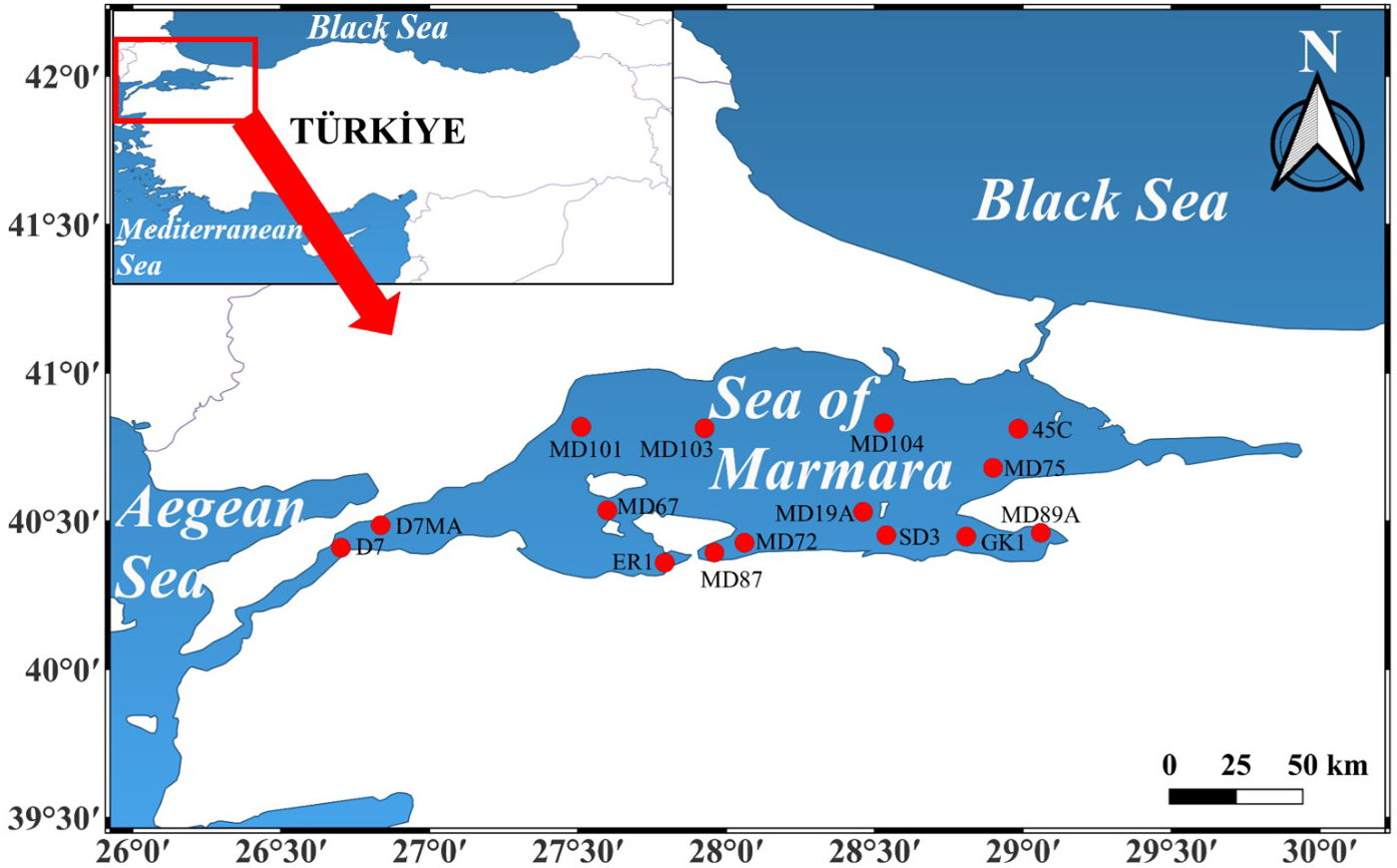
The seawater samples for phytoplankton analysis were collected from the surface of 15 sampling stations (Figure 1) using Niskin bottles and transferred into 1-L polyethylene dark containers and immediately fixed with acidic Lugol’s iodine solution (Throndsen, Reference Throndsen and Sournia1978). In the laboratory, samples were left to settle for at least a week, and then the samples were concentrated to 10 mL (Sukhanova, Reference Sukhanova and Sournia1978). The phytoplankton cells were counted on a Sedgewick–Rafter counting cell with 1 mL volume under an “Olympus CK2” model phase-contrast inverted microscope (Semina, Reference Semina and Sournia1978).
Study area and locations of sampling stations.
Prior to epifluorescence microscopy, glutaraldehyde was added to the samples at a final concentration of 2% to preserve cellular structures. The preserved samples were then examined using an Olympus BX51 epifluorescence microscope equipped with a U-MWB2 filter set (blue excitation: excitation filter 460–490 nm, dichroic mirror 500 nm, and emission filter 520 nm). Observations were conducted at magnifications of 200×, 400×, and 1000×, with immersion oil used where applicable. Cells of Hemiaulus spp. and their diazotrophic endosymbiont R. intracellularis were identified based on their natural autofluorescence. Structural features such as trichomes were distinguished by their linear morphology and characteristic fluorescence signal under blue excitation. No fluorescent dyes or staining procedures were applied during sample preparation or microscopy. For the identification of Hemiaulus species, Lebour (Reference Lebour1930), Cupp (Reference Cupp1943), Hendey (Reference Hendey1964), and Hasle and Syvertsen (Reference Hasle, Syvertsen and Tomas1997) were used, and R. intracellularis was identified according to Foster et al. (Reference Foster, Kuypers, Vagner, Paerl, Musat and Zehr2011), Sournia (Reference Sournia1986), and Zeev et al. (Reference Zeev, Yogev, Man-Aharonovich, Kress, Herut, Béjà and Berman-Frank2008).
Results
Physicochemical parameters
The values of some physicochemical parameters were measured simultaneously with the water samples taken. The water temperature ranged from a minimum of 23.2°C at station 45C to a maximum of 28.48°C at station MD67, with an average of 26.29°C. Salinity values varied from a minimum of 21.35 at station SD3 to a maximum of 32.52 at station GK1, averaging 22.56. The DO levels were recorded with a minimum of 6.22 mg L−1 at station D7MA, a maximum of 7.63 mg L−1 at station SD3, and an average of 7.15 mg L−1. Chlorophyll-a concentrations ranged from a minimum of 0.28 µg L−1 at station D7MA to a maximum of 6.77 µg L−1 at station MD89A, with an average of 1.24 µg L−1.
The concentrations of NO₃ + NO₂–N ranged from 0.05 µM, observed at all stations except MD89A, to 0.18 µM at MD89A. NH₄–N levels varied between 0.04 µM, detected at most stations, and 0.24 µM, which was measured at MD89A. PO₄–P concentrations ranged from 0.02 µM, measured at several stations, to a maximum of 0.39 µM at MD67. SiO₂–Si values spanned from 0.18 µM at MD101 to 1.42 µM at station 45C. The N:P molar ratio ranged between 0.23 at MD67 and 6.29 at MD89A.
An overview to phytoplankton composition
Within the phytoplankton composition observed during the summer period, when Hemiaulus species were present, a total of 95 taxa including nano- and microphytoplankton size group were identified (Supplementary Table S1). Thirty-nine taxa of these (41.1%) were diatoms, 39 taxa (41.1%) were dinoflagellates, and 17 taxa (17.8%) belonged to other groups. Also, R. intracellularis from Cyanophyceae, Dactyliosolen fragilissimus and H. hauckii from Bacillariophyceae, and Gonyaulax fragilis, Prorocentrum compressum, Prorocentrum micans, and Tripos furca from Dinophyceae were the most frequently encountered species in this period.
Identification and characterisation of the diatom genus Hemiaulus and endosymbiotic cyanobacterium Richelia intracellularis
Three species of the diatom genus Hemiaulus – H. hauckii, H. membranaceus, and H. sinensis – were morphologically identified during the light microscopy examination. The genus Hemiaulus dominated the phytoplankton community in some sampling stations during this study period.
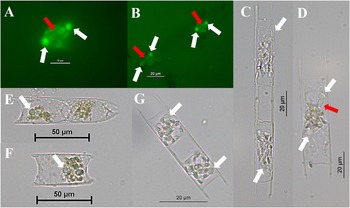
The presence of the cyanobacterium Richelia intracellularis was first detected inside the diatom Hemiaulus cells as an endosymbiont using an epifluorescent microscope (Figure 2). This symbiotic association was observed at the stations D7, D7MA, ER1, MD19A, MD67, MD75, MD87, MD89A, and SD3, whereas it was sporadically found at the other stations. Some of the Hemiaulus cells contained one trichome of R. intracellularis. The trichome of R. intracellularis consisted of two to three vegetative cells and two heterocysts at both ends of each trichome observed in each Hemiaulus species (Figure 2).
The diatom genus Hemiaulus and cyanobacterium R. intracellularis symbiosis. (A, B) Epifluorescence microscopy at the two different dimensions of the same cell. (C−G): bright-field microscopy: (C, D) Hemiaulus hauckii; (E, F) Hemiaulus membranaceus; (G) Hemiaulus sinensis. The red arrows indicate the trichomes, while the white arrows point to the terminal heterocysts of R. intracellularis.

Hemiaulus hauckii had a large diameter (apical axis) averaged 40–60 µm and a small diameter (transapical axis) averaged 12–22 µm, and their chains could be as long as 180 µm. Hemiaulus hauckii was found either as a solitary cell or characterised by chains composed of 2–3 cells. The H-shaped cells had broad girdle view, straight margins, horns long, apertures large and rectangular (Figure 2C, D).
Hemiaulus membranaceus had a large diameter (apical axis) averaging 50–95 µm and a small diameter (transapical axis) averaging 25–35 µm, and it was rarely found as a solitary cell. Its chains were twisted, with short horns and elliptical valves. The Richelia intracellularis trichome was found inside the H. membranaceus cells (Figure 2E, F).
Hemiaulus sinensis had a large diameter (apical axis) averaging 12–14 µm and a small diameter (transapical axis) averaging 10–12 µm. Its chains were straight and composed of two to three cells, with horns having flattened tips and rectangular valves. The cells were significantly smaller than the other two species. The trichome of R. intracellularis inside the H. sinensis cells consisted of two to three vegetative cells and two heterocysts at both ends of each trichome (Figure 2G).
Hemiaulus species were clearly distinguished morphologically from each other under a bright-field light microscope (Figure 2C–G). The symbiotic association between Hemiaulus and Richelia was observed more distinctly under an epifluorescent microscope (Figure 2A, B). However, this symbiosis was also occasionally noticed under a bright-field light microscope (Figure 2D–G). The average diameter of R. intracellularis inside Hemiaulus species was approximately 17–18 µm. Two circular heterocysts appeared clearly at both terminal of the vegetative cell (Figure 2A, B).
Abundance of the diatom Hemiaulus and cyanobacterium Richelia
The diatom Hemiaulus species were commonly observed in the study area except for some sampling stations as seen in Figure 3A. Hemiaulus hauckii was more abundant than H. sinensis and H. membranaceus. The highest abundance reached up to 166 × 103 cells L−1 at the station MD75, comprising H. hauckii (128 × 103 cells L−1, 77%) and H. sinensis (38 × 103 cells L−1, 23%). The other sampling stations with a high abundance of Hemiaulus species were the station D7 (90 × 103 cells L−1) and the station MD67 (71 × 103 cells L−1). Hemiaulus membranaceus was found in only one station (MD19A) at the low cell density (1 × 10³ cells L−1) (Figure 3A). The diatom Hemiaulus and endosymbiotic cyanobacterium Richelia intracellularis associations were mostly observed in the stations MD75 and D7. The endosymbiont R. intracellularis was often detected in the H. hauckii host. No Richelia trichomes or Hemiaulus species were detected at station MD104 (Figure 3A).
(A) Abundance of Hemiaulus species in the study area during summer 2021, (B) The relative abundance of the diatom Hemiaulus spp. in the total phytoplankton.

The stations with more than 50% of the relative proportion of Hemiaulus species in total phytoplankton were D7MA (96.9%), D7 (95.4%), MD87 (92.2%), MD67 (88%), ER1 (82.6%), GK1 (65.8%), MD101 (55.8%), and MD75 (54.1%) (Figure 3B).
Discussion
Nitrogen has previously been reported to be limited in the SoM (Balkis et al., Reference Balkis, Atabay, Turetgen, Albayrak, Balkıs and Tüfekçi2011, Reference Balkis, Sivri, Linda-Fraim, Balci, Durmus and Sukatar2013; Toklu-Alicli et al., Reference Toklu-Alicli, Polat and Balkis-Ozdelice2020; Tüfekçi et al., Reference Tüfekçi, Balkis, Beken, Ediger and Mantıkçı2010). The diatom–diazotrophy associations between H. hauckii and R. intracellularis have also been reported in other seas around the world (Foster et al., Reference Foster, Subramaniam, Mahaffey, Carpenter, Capone and Zehr2007; Zeev et al., Reference Zeev, Yogev, Man-Aharonovich, Kress, Herut, Béjà and Berman-Frank2008). It was detected that there were two terminal heterocysts at each trichome of the R. intracellularis.
The symbiotic associations between the diatom genus Hemiaulus and the cyanobacterium Richelia (diazotrophy), which are nitrogen-fixing organisms via their heterocysts, have a crucial role in N-limited environments. Considering the N-limitation in the SoM, this symbiotic association might have special significance for the functioning of the ecosystem. It is known that after seasonal stratification, Hemiaulus can become dominant in the Aegean Sea (Ignatiades, Reference Ignatiades1969).
Villareal (Reference Villareal1991) suggested that Hemiaulus obtains fixed-N from the symbionts that serves to sustain the host diatom in oligotrophic environments. This means that new nitrogen inputs via symbiotic N-fixation may increase the host Hemiaulus cell abundance in the N-limited environments, as reported by Pyle et al. (Reference Pyle, Johnson and Villareal2020). The role of Richelia as a diazotroph (nitrogen-fixing organism) is particularly crucial in such nitrogen-limited settings. Gomes et al. (Reference Gomes, Mendes, Cartaxana and Brotas2018) and Cieza et al. (Reference Cieza, Stanley, Marrec, Fontaine, Crockford, McGillicuddy, Mehta, Menden-Deuer, Peacock, Rynearson, Sandwith, Zhang and Sosik2024) have demonstrated that N-fixing organisms proliferate more under increased temperatures, significantly impacting nutrient dynamics. Additionally, Mikaelyan et al. (Reference Mikaelyan, Mosharov, Kubryakov, Pautova, Fedorov and Chasovnikov2020) found that decreased silicate levels could limit the photosynthetic capacity of phytoplankton, thereby hindering the growth of Hemiaulus species. Zeev et al. (Reference Zeev, Yogev, Man-Aharonovich, Kress, Herut, Béjà and Berman-Frank2008) highlighted that nitrogen-fixing symbiotic relationships become more pronounced under silicate deficiency. These observations indicate that increases in temperature and decreases in silicate levels contribute to the proliferation of the Hemiaulus–Richelia symbiosis.
This study revealed the Hemiaulus–Richelia symbiosis and significant seasonal and abundance changes in the abundance of Hemiaulus in the SoM. The highest abundances of H. hauckii and H. sinensis were observed in summer (July–August 2021), reaching 128 × 103 cells L−1 and 38 × 103 cells L−1, respectively, while H. membranaceus was rarely observed. This notable increase in distribution and abundance during the summer, coupled with the symbiotic relationship with Richelia demonstrated in our study, highlights a significant shift in the ecosystem dynamics of the SoM. Additionally, Demir and Turkoglu (Reference Demir and Turkoglu2022) reported high abundances of H. hauckii in the Çanakkale Strait; however, their study did not provide any data on symbiosis. Additionally, R. intracellularis has previously been reported as an endosymbiont within Rhizosolenia styliformis in the Aegean Sea (Koray, Reference Koray1988). In that study, Koray (Reference Koray1988) identified 15 distinct symbiotic pairings, including the association between Rhizosolenia styliformis + R. intracellularis, which was recorded at a density of 1500 cells L−1 in October. Koray (Reference Koray1988) also reported that these taxa were sensitive to changes in salinity, temperature, and oxygen levels, supporting their potential use as indicators of environmental stress, as previously suggested by Kimor (Reference Kimor1985). This study demonstrates for the first time that R. intracellularis forms a symbiotic relationship with Hemiaulus species in the SoM and Turkish coastal waters.
In conclusion, the identification of the Hemiaulus−Richelia symbiosis in the SoM, which is the first reported occurrence of the symbiosis between the diatom Hemiaulus and cyanobacterium Richelia in Turkish seas, adds a significant piece to the marine nutrient dynamics, particularly in nitrogen-limited environments. This symbiotic relationship not only enhances nitrogen availability for Hemiaulus but also supports the broader marine ecosystem by contributing to primary production and nutrient cycling. Further research should aim to elucidate the mechanisms behind these associations and their responses to environmental changes, providing valuable insights into marine ecology and the management of coastal ecosystems.
Supplementary material
The supplementary material for this article can be found at https://doi.org/10.1017/S0025315425100295.
Acknowledgements
This work was supported by the TÜBİTAK 1001–121G116 project and the “Integrated Marine Pollution Monitoring 2020–2022 Programme” carried out by Ministry of Environment and Urbanisation/General Directorate of EIA, Permit and Inspection/Department of Laboratory, Measurement, and coordinated by TÜBİTAK-MRC ECPI.
Author contributions
Balkis-Ozdelice, N.: Conceptualisation, methodology, identification of species, data curation, writing-original draft. Tas, S.: Conceptualisation, methodology, identification of species, and writing-original draft. Durmus, T.: Conceptualisation, data curation, writing-original draft. Bayram-Partal, F.: Data curation, sampling, and writing-original draft. Balci, M.: Identification of species, data curation, and writing-original draft. Additionally, all the authors read and approved the final manuscript.
Funding
This study was supported by the Scientific and Technological Research Council of Türkiye (TÜBİTAK) under grant number 121G116.
Competing interests
The authors report there are no competing interests to declare.



 Open access

