


En 1963, la bibliothèque de la Sorbonne fait l’acquisition auprès de Jean-Paul Bloch, l’un des fils de Marc Bloch, d’une partie de la bibliothèque dont il avait hérité de son père. Cet ensemble est immédiatement versé à la bibliothèque Halphen, alors en cours de constitution, à la demande expresse d’Édouard Perroy, le doyen de la sous-section d’histoire du Moyen Âge à l’université de ParisFootnote 1. Un second versement a lieu en 2006, lorsqu’Étienne Bloch, un autre des fils de Marc Bloch, fait don directement à la bibliothèque de la part d’ouvrages de son père qui lui étaient échus en partage. Au total, la bibliothèque Halphen a donc reçu, en deux fois, 1 879 volumes dont 1 426 monographiesFootnote 2. Je reviendrai plus loin sur ces nombres.
L’ensemble considéré ici n’est qu’une fraction de la bibliothèque de Bloch, spoliée en 1942 et emportée en AllemagneFootnote 3. Il est en effet plus que vraisemblable que les restitutions n’ont pas concerné la totalité de l’ensemble patrimonial confisqué, les troupes soviétiques ayant mis la main sur les archives de l’historien. La Russie les restitua à la fin des années 1990 ; l’on ne peut savoir si ce fonds comportait ou non des livresFootnote 4. On ne sait pas non plus où les livres furent entreposés ni qui, ou quelles institutions, y ont eu accès et ont pu en obtenir la cession ou simplement s’en emparer. Il est probable que des volumes ont été prélevés dans une proportion qu’en l’absence d’inventaire de la bibliothèque au moment de la spoliation en février 1942, il est impossible de connaître. Quoi qu’il en soit, la vente de J.-P. Bloch en 1963 et la donation d’É. Bloch représentent la très grande majorité des volumes revenus d’Allemagne et restitués entre 1948 et 1950 aux héritiers de l’historienFootnote 5. La bibliothèque avait été partiellement récupérée par les Alliés à la fin de la guerre et remise à la famille à partir de 1948 : 1 508 volumes à ses héritiers représentés par l’aînée de ses enfants, Alice Bloch, 131 autres volumes en 1949 et 34, enfin, en 1950, soit un total de 1 673 monographies, accompagnées de 463 fascicules pas mieux identifiés, restitués en 1950, et dont on peut supposer qu’il s’agit d’une partie de la collection des tirés à partFootnote 6. Cette restitution pose tout de même un certain nombre de problèmes.
Je me propose, dans cette note, de présenter ce que nous savons de ce fragment, d’en analyser sommairement le contenu et d’examiner ce que ces livres nous disent de Marc Bloch, de ses méthodes de travail et de ses relations avec le monde académique.
Marc Bloch et ses livres
Depuis la fin du xixe siècle, l’université de Paris mettait sur pied des bibliothèques d’institut pour les besoins spécifiques des enseignants qui y travaillaient et y effectuaient leurs recherches. L’objectif était de constituer, pour chaque institut, des outils de travail analogues à ceux que détenaient les chaires allemandes. La bibliothèque Halphen, créée dans le courant des années 1960, était destinée à répondre aux besoins des médiévistes, insuffisamment couverts par la bibliothèque de l’université en matière d’ouvrages d’érudition spécialisés et d’édition de sources. L’acquisition d’une partie des volumes ayant appartenu à Bloch constitua, pour les médiévistes, un atout majeur tant par l’ampleur du fonds concerné que par la qualité des livres qui le composent. Les professeurs chargés de la bibliothèque, notamment Édouard Perroy, avaient parfaitement conscience de la valeur de cet ensemble. Tous connaissaient le nombre stupéfiant de comptes rendus écrits par Bloch entre 1920 et 1941 (environ 1 700), ainsi que la veille permanente que celui-ci avait effectuée sur les parutions allemandes de la périodeFootnote 7. Cela faisait de cette bibliothèque privée un outil de travail dont l’intégration au fonds en cours de constitution était d’un intérêt évident. Les ouvrages ne firent pas alors l’objet d’un inventaire spécifique, mais, dûment catalogués, furent intégrés au fonds : cette situation induit une difficulté et fait courir le risque de confusions mineures mais réelles dans l’identification de l’origine de certains ouvrages.
La transmission des livres de Bloch a connu les traverses et les difficultés propres aux biens des intellectuels et des artistes de renom spoliés par les nazis durant l’OccupationFootnote 8. Lorsqu’il quitta Paris en 1939, Bloch laissa la bibliothèque à son domicile du 17 rue de Sèvres sans prendre aucune mesure pour la sauvegarder : pourquoi l’aurait-il fait, d’ailleurs, avant juin 1940 ? Sa correspondance aborde à diverses reprises le sort de ses livres et de ses notesFootnote 9. Elle témoigne du souci constant de Bloch à son égard. Si l’on en croit les Mémoires de Jérôme Carcopino, Bloch aurait, dès 1940, avec Louis Halphen et Jacques Ancel, effectué une démarche auprès de lui, alors directeur de l’École normale supérieure (ci-après ENS), afin de placer leurs bibliothèques à l’abri, sous la protection de l’État. Carcopino refusa, mais leur proposa de faire don de leurs bibliothèques à la faculté des lettres de Paris pour leur assurer la protection demandée. Bloch comme Halphen refusèrentFootnote 10. Nous sommes manifestement ici en présence d’un épisode de reconstitution historique destiné à rendre plus présentable la position de Carcopino durant la guerre : cette proposition a effectivement été présentée à Bloch, mais en février 1942 seulementFootnote 11.
En septembre 1940, Bloch chargea Lucien Febvre, auquel il avait confié les clefs de son appartement, d’aller chercher ses notes afin de les mettre à l’abriFootnote 12. I l en profita pour lui faire don de quelques ouvrages, au vrai un peu encombrants, tels le Polytptyque de l’abbé Irminon et ses volumineux Prolégomènes ou son exemplaire du glossaire de Du Cange, et pour jauger sa bibliothèqueFootnote 13 : « Pour les livres, il n’y a, je le crains, pas grand-chose à faire. Ce n’est pas une bibliothèque de bibliophile que l’on pourrait classer par rareté. C’est une bonne bibliothèque de travail, où beaucoup d’outils se valentFootnote 14. » Des menaces très précises pesaient alors sur les bibliothèques privées d’une certaine importance, que les Allemands entreprenaient de placer sous séquestre et de déménager.
Un échange épistolaire suivi, entre Bloch et Carcopino, ministre de l’Instruction publique de 1941 à 1942, éclaire à la fois les démarches entreprises par l’historien et les problèmes qu’il rencontra, à l’image de beaucoup d’intellectuels français. Il s’agissait d’abord de régler sa situation personnelle, ce pour quoi Carcopino fut effectivement d’une aide précieuse et efficace. Dans une lettre qu’il adressa au ministre le 5 janvier 1942, c’est un tout autre sujet qui l’occupe : il cherche à sauver sa bibliothèque en la faisant venir à Montpellier. Elle est alors placée sous séquestre et menacée d’être saisie par les Allemands afin d’être transférée en Allemagne, ce qui advint effectivement au mois d’avril de cette même annéeFootnote 15. Bloch développe un argumentaire tout à fait saisissant. Sa bibliothèque est, pour lui, un bien patrimonial qui a une valeur à la fois économique – il a bien fallu en acheter des éléments – et affective, et qu’il entend léguer à ses enfants ou à une institution d’enseignement supérieur comme son père, Gustave Bloch, professeur d’histoire romaine à la Sorbonne, avait eu l’intention de le faire. Le fonds est constitué par des achats dont on ne peut mesurer l’importance mais qui furent peut-être conséquents. Il comportait aussi les très nombreux ouvrages dont Marc Bloch avait fait le compte rendu pour la Revue historique, la Revue de synthèse ou les Annales d’histoire économique et sociale. La partie de sa bibliothèque parvenue à la bibliothèque Halphen contient aussi quelques ouvrages ayant appartenu à son père. Bloch, dans cette lettre, affirme être très gêné dans la poursuite de ses travaux scientifiques en raison du manque d’accès à ses livres, aucune bibliothèque universitaire française, ni celle de Clermont-Ferrand où il vit jusqu’à la fin 1941, ni celle de Montpellier où il se trouve alors, ne pouvant se substituer à l’outil qu’il s’était construit grâce à un travail acharné. Il reprend et précise les termes de la lettre adressée à Febvre en septembre 1940 :
Ce n’est pas une bibliothèque de bibliophile. Mais c’est un bel instrument de travail. Grâce à quelques achats, à une grosse besogne de comptes rendus, à des envois amicaux, qui ne me venaient pas seulement de France, j’avais pu me constituer quelques séries assez complètes et, par là même, assez exceptionnelles : sur les sources de l’histoire médiévale, par exemple, sur l’histoire d’Allemagne, sur l’histoire économique et, plus particulièrement, l’histoire rurale. Ajoutez une assez importante suite de brochures et, naturellement, le fonds de culture générale, que mes enfants regrettent chaque jour davantageFootnote 16.
Sa bibliothèque, si difficilement constituée et devenue un outil précieux à tous points de vue, est, à la fin de 1941, un objet de contentieux aussi violent que peut l’être un litige à l’intérieur du monde académique. Celui-ci met aux prises Bloch, Augustin Fliche et Carcopino. Bloch désire récupérer ses livres pour pouvoir simplement continuer à travaillerFootnote 17. Il demande par conséquent à Carcopino d’activer les leviers administratifs nécessaires pour parvenir à ce résultat avant que les Allemands ne s’en emparent : au tout début 1942, la bibliothèque est toujours à Paris et un transfert physique est possible. La réponse du ministre est très prudente et assez « vichyssoise » dans son approche, ce qui fait sortir Bloch de ses gonds. Carcopino, réitérant sa proposition supposée de 1940, suggère que Bloch cède sa bibliothèque à l’université de Montpellier, auquel cas son déménagement de Paris à Montpellier pourrait s’opérer sans problème. Il demande ni plus ni moins à son collègue de consentir à sa propre spoliation au profit d’une institution où sa venue est, de surcroît, jugée inopportune. De fait, Fliche, doyen de la faculté des lettres de Montpellier et qui avait tenté de s’opposer à la nomination de Bloch, était à la manœuvre. Le refus indigné, mais courtois, de Bloch a pour conséquence l’abandon du dossier par Carcopino. Les livres furent emportés en Allemagne.
La constitution d’une bibliothèque : les réseaux scientifiques et amicaux de Bloch
Les itinéraires de livres ne sont ni linéaires ni faciles à comprendre, et les procédures d’acquisition sont parfois très indirectes, reflétant autant les amitiés, les rencontres et les hasards qu’une politique d’accumulation. Les dédicaces permettent ainsi de trouver des éléments témoignant des différents réseaux. Par exemple, un exemplaire de la thèse de doctorat de William Mendel Newman, publiée en 1928, avait été offert par celui-ci à la bibliothèque de l’École des Chartes ainsi que l’établit la dédicace. Il figure dans l’ensemble parvenu à la bibliothèque Halphen. Il est impossible de dire comment il a pu se retrouver en possession de Bloch : peut-être s’agit-il d’un doublon qui lui avait été donné par le bibliothécaire de l’École des Chartes, ce qui impliquerait une relation suivie avec celui-ciFootnote 18 ? Dans d’autres cas, la circulation des ouvrages ou des tirés à part indique le fonctionnement concret des amitiés ou simplement des relations. Le tiré à part d’un article de 1924 d’Émile Lesne, intitulé « Les diverses acceptions du terme ‘beneficium’ du viiie au xie siècle », est dédicacé à Christian Pfister, mais se trouve dans la bibliothèque de BlochFootnote 19. On imagine une rencontre scientifique, amicale ou pédagogique entre les deux historiens, et le don du tiré à part de ce dernier à BlochFootnote 20. Dans d’autres circonstances, ce type de circulation est inenvisageable : le livre de Louis Halphen, Le Comté d’Anjou au xie siècle, paru en 1906, porte une dédicace à Henri d’Arbois de Jubainville, décédé en 1910. Il ne peut s’agir que d’un achat à la succession ou chez un libraire. Les relations entre Bloch et Halphen n’étaient par ailleurs pas excellentes ; rien d’étonnant, par conséquent, à ce que ce titre soit le seul du titulaire de la chaire d’histoire du Moyen Âge de la Sorbonne dans la bibliothèque de Bloch. À l’évidence, des livres continuèrent d’arriver après l’armistice de 1940, envoyés sans doute directement à Fougères, résidence de la famille Bloch après son départ de Paris. Le géographe Louis Papy envoie ainsi sa thèse de Bordeaux en juillet 1941 et Bloch mentionne son arrivée dans une lettre à Febvre en aoûtFootnote 21.
Quant aux conséquences matérielles de la mise sous séquestre de la bibliothèque, de son transfert en Allemagne et des conditions de sa restitution à la famille Bloch entre 1948 et 1950, plusieurs incertitudes subsistent. Il est certain que des volumes ont été, à un moment ou à un autre, distraits de l’ensemble en un nombre non négligeable mais impossible à estimer. Il paraît difficile, dans l’état actuel de l’enquête, de dire à quel moment ces pertes se sont produites : durant le séquestre à Paris ? durant le transfert en Allemagne ? lors du retour ? Quoi qu’il en soit, elles sont substantielles. Quelques livres ont pu être envoyés vers des universités allemandes où leur traçage s’avérera difficile, s’il est entrepris. Quant à ceux qui ont pu être récupérés par les troupes soviétiques et se trouveraient encore en Russie, leur repérage semble devoir être considéré comme une cause perdueFootnote 22.
Les itinéraires sont toujours imprévisibles et parfois étonnants. La bibliothèque de l’École normale supérieure (ENS) détient par exemple 136 ouvrages ayant appartenu à BlochFootnote 23. Celui-ci a certainement pu en offrir quelques-uns à l’institution avant 1939 : le catalogue les annonce effectivement comme donnés par lui, ce qui fait sens en cas de doublon ou en cas d’acquisition superflue : le Frédéric II de Pierre Gaxotte a pu ainsi faire l’objet d’un désherbage. Quelques volumes portent des indications sur leur iter administratif et sont mentionnés comme ayant été mis sous séquestre. On ne sait pas, à ce stade, à quelle date ni par quels cheminements ces livres se sont retrouvés à l’ENS, qui n’est pas la seule institution à connaître cette situation. L’acquisition a pu en être faite par achat après-guerre, les Domaines ayant mis en vente, au début des années 1950, des biens spoliés dont on ne retrouvait pas les propriétaires. Ainsi, l’actuelle bibliothèque de l’Institut national d’Histoire de l’art (INHA) a possédé un livre ayant appartenu à Bloch, acheté aux Domaines en 1951 avec un lot de plus de 700 autres ouvrages spoliésFootnote 24. On ne connaît ni les circonstances dans lesquelles ce volume a été soustrait à l’ensemble auquel il appartenait, ni si d’autres l’ont été. En tout état de cause la majeure partie des livres détenus par les institutions de l’État a été restituée à la famille Bloch. Un certain nombre a pu s’égarer ou être déclassé durant les transferts entre la France et l’Allemagne, et durant l’entreposage avant la restitution. Les pertes effectives sont cependant impossibles à estimer.
Le processus de sédimentation
On l’a dit, l’ensemble actuellement détenu par la bibliothèque Halphen compte 1 879 titres, dont 488 tirés à part qui sont réunis en 36 volumes reliés. Ces tirés à part constituent environ 26 % du total et forment un élément particulièrement intéressant du point de vue scientifique, parce qu’ils font état d’une partie du vaste réseau amical et professionnel de Bloch et ouvrent une lucarne, du fait de leur classement, sur ses catégories de travail. Par ailleurs, il y a 1 426 monographiesFootnote 25. Or, on sait que 1 673 monographies ont été restituées à la famille. En d’autres termes, la bibliothèque Halphen possède environ 85 % de ces volumes et la totalité des tirés à part récupérés. Il est fort probable que la bibliothèque de Bloch a été beaucoup plus importante. À titre de comparaison, Louis Halphen, dont la bibliothèque fut, elle aussi, saisie, détenait 12 000 volumes, à côté desquels les quelque 1 800 livres de Bloch semblent bien peuFootnote 26. Halphen ne récupéra que 860 de ses livres. Henri Hauser, le prédécesseur de Bloch à la chaire d’histoire économique de la Sorbonne, possédait une bibliothèque de plusieurs milliers d’ouvrages, dont seuls 830 lui furent rendus. Au demeurant, Bloch avait écrit au moins 1 700 comptes rendus : tous les livres auxquels ils correspondent ne sont donc pas présents dans la bibliothèque Halphen ! En regard, le nombre de livres revenus d’Allemagne est exceptionnellement élevé. C’est sans doute même le fonds le plus important qui ait été récupéré si l’on en croit les relevés de Martine Poulain.
Les plus anciens titres de ce fonds datent de la fin du xixe siècle et même, pour certains, du xviiie siècle. Pour ces derniers, ils avaient probablement été achetés dans le cadre de la préparation de cours ou d’ouvrages : par exemple, tout ce qui concerne les monnaies, comme le traité de François Abot de Bazinghen, daté de 1764, semble destiné à la préparation du cours dont procède l’Esquisse d’une histoire monétaire de l’EuropeFootnote 27.
Les monographies acquises en 1963 auprès de Jean-Paul Bloch ont été intégrées au fonds général sans indication particulière de provenance. Elles n’ont fait l’objet d’une recherche et d’une identification qu’au début des années 2000, à la suite de la donation par Étienne Bloch d’une seconde partie de la bibliothèque qui comportait la collection des tirés à part. Après l’identification des monographies, une base de données décrivant tous les éléments de la bibliothèque a été élaborée sous format Excel. Malgré l’absence de catalogue au moment de la donation, l’identification des volumes fut toutefois relativement aisée, Marc Bloch ayant signé de son nom beaucoup de ses livres ou inséré un ex-libris portant une devise (Veritas vinum vitae). Cependant, 149 portent la signature du seul Étienne Bloch, ce qui crée des difficultés d’attribution. On ne sait pas s’il s’agit d’acquisitions postérieures à la disparition de son père en 1944 ou de marques d’appropriation de livres faisant partie de la bibliothèque mais demeurés sans ex-libris ou signature.
La date de départ des tirés à part est 1888. Il est évidemment exclu que ceux qui ont été reçus avant 1919 aient été envoyés à Marc Bloch. Celui-ci avait en effet gardé des travaux envoyés à son père par d’anciens élèves. Ainsi, Ernest-Charles Babut, promotion 1896 de l’ENS et élève de Gustave Bloch, avait envoyé un exemplaire de son article intitulé : « Recherches sur la garde impériale et sur les corps d’officiers de l’armée romaine aux ive et ve siècles », paru dans la Revue historique en 1914. Il est dédicacé : « À mon cher Maître », ce qui ne saurait évidemment désigner que Gustave Bloch. On a d’autres cas de cette intégration des travaux des élèves de Gustave Bloch à la bibliothèque de son fils, tels cette étude sur Syagrius par Alfred Coville, alors professeur au lycée Henri IV, ou un papier d’Ernest Labroue sur l’école de Périgueux au ve siècleFootnote 28. Les envois de Mgr Louis Duchesne (« Le concile d’Elvire et les flamines chrétiens », 1886) ou de Camille Jullian (« Routes romaines et routes de France », 1900) sont dans le même cas, et l’on doit considérer qu’ils sont passés dans la bibliothèque de Marc Bloch après le décès de son père, en 1923Footnote 29. Il y a donc effectivement un élément patrimonial dans cet ensemble qui apparaît comme un véritable bien de famille, constitué sur deux générations et qui, au bout du compte, a été partagé entre les ayants droit avant d’être partiellement rassemblé de nouveau dans une bibliothèque d’érudition relevant de la Sorbonne.
Pratiques érudites
Les livres, comme Bloch le soulignait dans une lettre adressée à Carcopino en novembre 1941, avaient été pour certains achetés, mais pour beaucoup reçus à des fins de recension. Bloch reçoit ainsi en 1933, de la part de son éditeur scientifique, Paul Harsin, un ouvrage dont la dédicace ne laisse aucun douteFootnote 30. Bloch fait mention de ces livres dans sa correspondance. Ces envois se croisent avec les acquisitions personnelles pour donner un fonds d’une exceptionnelle richesse, provenant de toute l’Europe et d’une envergure qui témoigne d’une insatiable curiosité.
Certains livres, 67, pour être précis, sont des hommages des auteurs et sont dédicacés, comme le sont la plupart des tirés à part. Il n’y a pas autrement d’indications du mode d’acquisition des livres. Toutefois, la prodigieuse activité de recension de Bloch a constitué le moyen le plus fréquent d’acquérir des monographies. Par exemple, Bloch a écrit un bref compte rendu, au demeurant très sévère, du Frédéric II d’Ernst Kantorowicz, intégré dans le « Bulletin historique » de la Revue historique consacré à l’histoire de l’Allemagne au Moyen Âge en 1928, le livre datant de 1927Footnote 31. L’ouvrage est introuvable dans le fonds conservé à la bibliothèque Halphen : il peut avoir été dérobé ou se trouver dans une autre bibliothèque, universitaire ou non, ou être resté en Allemagne. En revanche, le second volume consacré par Kantorowicz aux sources de son travail et à des dissertations annexes se trouve à la bibliothèque HalphenFootnote 32. Il date de 1931 et a simplement été mentionné dans la Revue historique en 1932, sans recension.
En l’absence d’un catalogue de cette bibliothèque, qui aurait permis d’en saisir le cadre de classement, les tirés à part fournissent des indications sur le laboratoire de l’historien et sur les catégories qui comptaient pour lui, tout en gardant à l’esprit la nature mondaine de certains échanges, c’est-à-dire l’effectuation de purs gestes sociaux sans signification scientifique. Le très bel ensemble de tirés à part possédés par Bloch, reliés par ses soins, nous offre par conséquent une vision partielle mais passionnante de l’étoile des relations de Bloch. Elle est internationale et transdisciplinaire, avec une orientation vers les secteurs les plus ouverts de l’économie et vers des champs nouveaux, telle l’histoire des techniques. Nous ne savons pas à quel moment exact ces tirés à part ont été rassemblés, classés et intégrés à des reliures. Cela dit, le fascicule le plus récent date de 1937. On peut par conséquent penser que la collection a été constituée cette année-là. Chaque volume bénéficie d’un inventaire écrit par une main qui n’est pas celle de Marc Bloch sur un feuillet collé à l’intérieur de la couverture. Il comporte la référence bibliographique exacte de l’envoi – ce qui rend l’ensemble utilisable rapidement. Le classement est thématique et, à l’intérieur, alphabétique. Ne faisons pas de Bloch un saint : certains tirés à part arrivaient non massicotés ; il arrive que toutes les pages n’en soient pas coupées. Soyons juste aussi : il n’est pas évident que la lecture de certains textes écrits par des érudits locaux s’imposât comme une urgence, malgré tout l’intérêt (et il était grand) qu’il pouvait attacher à ce type de littératureFootnote 33.
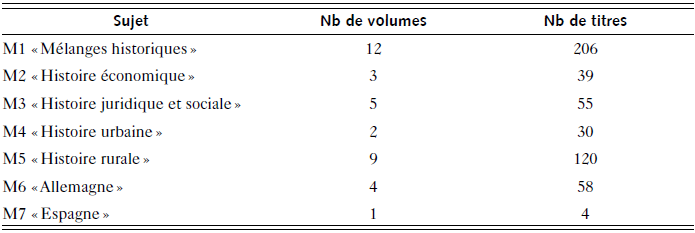
Les tirés à part se trouvent dans 36 volumes qui sont classés thématiquement et numérotés dans le catalogue de M1 à M7, le M. étant pour Mélanges. L’ordre ainsi proposé est, à lui seul, un programme.
– Les tirés à part reçus par Marc Bloch présents à la bibliothèque Halphen

Un manque saute immédiatement aux yeux : pas de catégorie « Angleterre », ni « Italie » d’ailleurs. Cette donnée recoupe le constat du nombre très peu élevé de tirés à part en anglais (17), même si on ne peut exclure qu’un ou plusieurs volumes aient disparu au cours des déplacements de la bibliothèque.
Le volume « Mélanges historiques » comprend le tout-venant, ce qu’il n’est pas possible de placer dans les catégories suivantes. Il contient les tirés à part ayant sûrement appartenu à Gustave Bloch. On trouve là les articles concernant les sujets les plus divers. Le reste du classement met en valeur la constitution d’outils de travail dans des champs bien particuliers : l’histoire économique, l’histoire juridique et sociale, l’histoire urbaine et l’histoire rurale, qui sont de ce fait individualisées, alors que cela ne va pas de soi. La question de l’autonomie de l’histoire économique est l’une de celles qui se posent dès les années 1920 et que la revue des Annales aborde depuis ses origines.
Ce classement est une prise de parti. L’histoire sociale est traitée avec l’histoire institutionnelle et non l’histoire économique comme on pourrait plutôt l’attendre. L’économie est, quant à elle, placée à part. Les quatre thèmes mis en valeur sont évidemment cruciaux pour Bloch et il était, pour lui, matériellement intéressant d’avoir effectué ces regroupements qui rendent le maniement du fonds plus pratique, plus opérationnel pourrait-on direFootnote 34. Bloch propose ici une catégorisation nouvelle de la science historique, difficile à admettre pour le monde académique qui lui était contemporain, mais qui est celle qui organise les Annales dès les premiers numéros. Notons l’absence totale de catégories propres pour le politique et pour le religieux : ce qui intéresse Bloch, ce sont les mouvements de fond qui rendent intelligibles les sociétés et dont les événements singuliers dépendent. Ici, le rapport entre sociologie et histoire, et les désaccords de méthode entre Bloch et Febvre, peuvent aussi se lire ou du moins s’entrapercevoir. Le religieux comme le politique sont renvoyés à ce que j’ai appelé le tout-venant, c’est-à-dire aux 12 volumes dits de « Mélanges historiques ». Ils ne sont en tout cas aucunement prioritaires pour lui dans son travail des années 1920 et 1930 une fois paru Les rois thaumaturges.
L’intérêt essentiel se trouve, en revanche, dans la constitution d’un ensemble d’histoire rurale quantitativement important. Bloch crée véritablement ce champ en l’individualisant, ainsi que relevé par Febvre dans le compte rendu des Caractères originaux de l’histoire rurale française (1931) qu’il rédigea pour la Revue historiqueFootnote 35. Les thèmes retenus, d’autre part, recoupent évidemment les préoccupations des Annales. La géographie, pour sa part, n’a pas été individualisée mais intégrée à l’histoire rurale. Ces catégories peuvent être utilisées pour tenter de décrire le réseau amical et scientifique français de Bloch, ses principales préoccupations, la perception que ses contemporains et ses collègues ont eue de lui.
Économie
Bloch fut, à l’université de Paris, le successeur d’Henri Hauser à la chaire d’histoire économique, et son enseignement, entre 1936 et 1939, porta effectivement sur des sujets d’histoire économique dépassant largement le seul Moyen Âge, comme l’atteste son cours d’histoire monétaire publié dans le courant des années 1950 dans la collection des « Cahiers des Annales »Footnote 36. La faiblesse de l’historiographie française en matière d’histoire économique l’avait toujours frappé et sa mise à niveau peut passer pour l’une de ses préoccupations. Les orientations des Annales, dès les premières années, visaient en tout cas à une meilleure intégration de l’économie à l’histoire. La bibliothèque comme la collection de tirés à part de Bloch le reflètent en partie. On y trouve des titres très techniques, à l’image d’un essai de l’économiste suédois Eli F. Heckscher intitulé « Quantitative Measurement in Economic History » (1939)Footnote 37. Des manuels et des cours d’économie politique de haut niveau y sont très présents avec les cinq volumes des Principes d’économie politique de l’économiste allemand Gustav SchmollerFootnote 38 ainsi qu’avec l’ensemble des travaux de François Simiand, à la limite de l’économie et de la sociologie. On connaît les relations très fortes entretenues avec Simiand et les échanges permanents entre eux sur la question des rapports entre économie et histoire et, notamment, sur la place et l’importance de la statistique en histoire économique autant qu’en économie : une trace de cette amitié intellectuelle exigeante se trouve encore dans une dédicace, celle du livre de Simiand, Inflation et stabilisation alternées, paru en 1934, et qui prend la forme d’une demande pour continuer la discussionFootnote 39.
L’histoire financière et l’histoire monétaire sont particulièrement bien représentées. Il en va de même de l’histoire du travail et de la question du salaire : on sait que Bloch ne participa pas à l’entreprise de William Beveridge, pour laquelle Hauser fut désigné, et qu’il avait de fortes réticences à l’égard d’une étude des salaires qui n’aurait pas comme préalable une compréhension fine de la question monétaire et de la métrologieFootnote 40. Des essais plus classiques ou plus attendus sont présents, comme ceux d’Édouard Sayous ou de Robert S. Lopez.
La présence de certaines figures surprend, comme celle de Charles Parain. Il envoya, en 1934, un essai sur l’agriculture dans l’Égypte ancienne, dont la dédicace exprime une « vraie admiration » pour Bloch. Ce personnage, Parain, joua un rôle certain dans l’apparition de l’histoire des techniques en France ainsi que dans celle de l’ethnologie comme discipline. Il participa, en 1935, à un numéro thématique des Annales intitulé « Réflexions sur l’histoire des techniques » avec un article sur l’origine des plantes cultivéesFootnote 41 et, à la demande de Bloch, fut intégré à l’équipe de la Cambridge Economic History où il écrivit un article fondamental sur l’histoire des techniquesFootnote 42, sujet pour lequel Bloch avait une grande sensibilité comme le montrent aussi ses rapports très cordiaux avec le jeune Georges HaudricourtFootnote 43. Bloch lui-même participa à l’ouvrage avec un substantiel article sur les dépendances paysannes et les institutions seigneurialesFootnote 44. Ils furent donc, malgré la différence d’âge (sept ans), assez proches intellectuellement. Parain, normalien de la promotion 1913, appartient au même groupe d’intellectuels qu’Haudricourt qui contribua puissamment à la naissance de l’ethnographie françaiseFootnote 45. Il fait aussi partie des intellectuels antifascistes dont Febvre et Bloch furent un temps proches tout en critiquant assez férocement leurs prises de position, assez faibles, selon eux, du point de vue théorique. La proximité avec Parain fut cela dit bien réelle et est marquée par la collaboration de celui-ci, voulue par Bloch, à la Cambridge Economic History.
Bloch s’intéressait aux aspects les plus concrets et les plus matériels de l’histoire économique : le travail, la monnaie, les techniques, qu’il sortit de la théorie économique et de l’histoire des sciences pour en faire ses objets d’étude dans une perspective d’histoire globale. Il ne négligeait pas pour autant les approches plus traditionnelles comme celle de Georges Espinas qui fut un proche, du moins intellectuellement. Celui-ci envoya à Bloch 14 textes concernant l’économie et le droit, qu’il dédicaça. Espinas était, on le sait, une figure très notable de l’entre-deux-guerres. Il servit de lien entre Henri Pirenne et son entourage, et le groupe rassemblé autour des Annales. Spécialiste des archives urbaines du Nord et fin connaisseur des réalités sociales des Flandres, il joua un rôle important, en éditant et en commentant des textes devenus fameux, comme, par exemple, le rouleau de la « réparation testamentaire » de Jehan Boinebroke ou les documents relatifs au conflit ayant opposé Douai à Lille en 1284Footnote 46. Il demeura un peu à l’écart cependant du cercle de Bloch, ce dont témoigne le ton des dédicaces : c’est un ami, mais pas un ami procheFootnote 47.
Enfin, on ne peut pas dire grand-chose des rapports intellectuels entre Bloch et Maurice Halbwachs dont la carrière a suivi des cours parallèles, de Strasbourg à la Sorbonne, où le second est élu en 1935 avant de l’être au Collège de France en 1938. Il est présent dans la bibliothèque des tirés à part pour deux articles, l’un de 1923 portant sur les statistiques, l’autre de 1932 sur le salaire, tous deux dédicacés. Les thématiques développées par Halbwachs, en particulier sur la mémoire sociale et l’usage des statistiques, sont de celles qui ont fortement intéressé Bloch. On peut penser que d’autres ouvrages d’Halbwachs ont pu se trouver dans sa bibliothèque. Il est impossible d’aller plus loin.
Cette analyse sommaire des lectures de Bloch en matière d’économie, d’histoire et de sociologie économique montre un souci évident de couvrir l’ensemble du champ, en construisant et en approfondissant un cadre théorique et conceptuel : l’intérêt porté aux travaux de Schmoller est à cet égard intéressant, parce qu’il s’agit d’un choix méthodologique entre deux écoles de pensée, en l’occurrence l’école allemande qui met l’accent sur la contextualisation, au détriment de l’école autrichienne davantage formaliste. Une partie de la bibliothèque est orientée vers la préparation du cours sur la monnaie et l’intérêt que porta Bloch à l’entreprise de John Law vaut d’être rappelé, de même que ses lectures sur le crédit et les institutions financières.
L’histoire rurale
Ernest Labrousse, en 1933, envoyait son travail sur les prix « [à] l’auteur des Caractères originaux de l’histoire rurale française »Footnote 48. Il n’est pas inutile de rappeler que l’histoire rurale est l’une des rubriques importantes des Annales, suivie avec attention aussi bien par Bloch que par Febvre et que les revues étaient peu nombreuses, alors, à suivre l’actualité de la recherche dans cette spécialité.
L’histoire s’intéresse désormais aux paysages, aux conditions concrètes de la production et du travail, aux outils et à leur emploi. En ce sens, Bloch a annoncé et préparé l’archéologie médiévale des années 1960, et anticipé sur la réflexion menée sur la culture matérielle du monde ruralFootnote 49. Cette préoccupation ruraliste le rapproche, quoiqu’avec plus que des nuances, de personnes comme Charles-Edmond Perrin, son presque contemporain et ami (normalien, il entre à l’ENS en 1908, quatre ans après Bloch) mais à la carrière beaucoup plus lente, puisqu’il n’accéda aux fonctions et au grade de Professeur que dans les années 1930. En 1935, il lui dédicaçait sa thèse, soutenue cette année-làFootnote 50. Perrin est dans une veine beaucoup plus juridique qu’économique et sociale. Son livre est fondamental pour la compréhension de la seigneurie et de son évolution entre les ixe et xie siècles. L’ouvrage porte des marques d’usage et est annoté de la main de Bloch. Perrin prit l’année suivante la succession de Bloch à Strasbourg, occupant la chaire d’histoire du Moyen Âge. Il quitta toutefois rapidement la capitale alsacienne pour la Sorbonne où il devint professeur en 1937. Il co-signe avec Bloch, en 1938, la rubrique « Histoire d’Allemagne. Moyen Âge »Footnote 51.
Un autre ruraliste, Georges Lefebvre, spécialiste de la Révolution française, était arrivé comme professeur à Strasbourg en 1928, avant d’être nommé à la Sorbonne en 1935. Dès son installation à Strasbourg, il dédicaça ses livres à Bloch. Son Napoléon est dans la bibliothèque, de même que Les Thermidoriens ou Questions agraires au temps de la Terreur. Pour ce dernier titre, la dédicace passe du traditionnel « Amicalement » au plus chaleureux « Affectueusement ».
On devine, autour des hasards des carrières qui se construisent, des amitiés chaleureuses et une vivacité des échanges qui font, parfois, l’intérêt et le plaisir de la vie universitaire et furent à Strasbourg, dans les années 1920, particulièrement intenses et favorables au développement du champ nouveau de l’histoire ruraleFootnote 52. Lefebvre reconnaissait avoir une dette particulière envers Bloch.
Géographie
Depuis ses études, Bloch entretenait avec la géographie une affinité particulière. L’histoire rurale le rapprocha encore du milieu des géographes. Il cultivait, avec certains de ses membres, les meilleures relations possibles, ce dont témoignent quelques envois et leurs dédicaces. La thèse de Papy, citée plus haut, en est un exemple. Un autre se trouve avec une étude sur le Livradois de Lucien Gachon qui se réclame, dans sa dédicace, d’Henri BauligFootnote 53, professeur à Strasbourg depuis 1919. Baulig était un géomorphologue, directeur de l’Institut de Géographie. Quant à Gachon, c’est un personnageFootnote 54 : il entreprend des études de géographie, alors qu’il est âgé d’une quarantaine d’années et qu’il est déjà notoire pour son œuvre d’écrivain régionaliste dans la lignée d’Henri Pourrat, dont le cadre est le Livradois.
Les géographes d’une part, les plus économistes des historiens français de l’autre ont apprécié les Caractères originaux où Bloch reprenait des thèmes d’analyse des paysages en leur donnant une profondeur historique à laquelle, jusqu’à lui, peu en France étaient sensiblesFootnote 55. De façon tout à fait attendue, on trouve dans sa bibliothèque la Nouvelle géographie universelle d’Élisée Reclus. L’on sait, enfin, l’attention particulière accordée aux progrès dans la carrière universitaire de géographes repérés à la fois par Bloch et par Febvre, qui apprécient leurs travaux dans leur correspondance : Pierre George et Pierre Gourou furent ainsi particulièrement suivisFootnote 56.
Amis et collègues
On ne sera pas surpris de trouver parmi les auteurs de dédicaces des collègues des universités de Strasbourg et de Paris, comme Pfister ou Perrin, amis très proches, comme Febvre, au ton souvent ironique ou distancié (« À Marc Bloch, ce chef d’œuvre revu par Toledano, bien affectueusementFootnote 57 », « Amicalement, mais sans orgueil excessifFootnote 58 »). Les dédicaces chaleureuses ou familières sont rares dans ce corpus où les mentions indiquent une sympathie dans les relations entre collègues, pouvant aller jusqu’à l’affirmation d’une amitié, mais très rarement jusqu’à celle d’une affection.
On trouve des noms attendus : Robert Folz, Roger Dion, Pirenne, Perrin, François Louis Ganshof, Roger Aubenas. En ce qui concerne Ganshof, il envoya 19 articles entre 1924 et 1935. Bloch et Ganshof s’étaient connus au début des années 1920 lors du séjour d’un an et demi effectué par le second à Strasbourg afin de suivre les enseignements de Pfister, mais les envois ne laissent pas apparaître, à travers les dédicaces, autre chose qu’une courtoise sympathie et du respectFootnote 59. Nulle familiarité ici.
En revanche, les 28 envois de Pirenne, dont 10 sont dédicacés, font entrevoir la chaleur d’une amitié dont Bloch lui-même témoigna à plusieurs reprises, par exemple en rapportant, dans Apologie pour l’histoire, le contenu d’une conversation tenue à Oslo sur les rapports du présent au passéFootnote 60. Après la disparition de Pirenne en 1935, sa veuve et son fils envoyèrent à Bloch les ouvrages posthumes dont ils dirigeaient l’édition, tel Mahomet et Charlemagne (1937)Footnote 61. Mais les envois ne se limitaient évidemment pas aux médiévistes.
Le ralentissement des acquisitions, livres ou tirés à part, est notable dans la seconde moitié des années 1930. Il faut peut-être y voir un effet de source, cette partie de la bibliothèque ayant pu avoir subi des pertes et des vols. Ce ralentissement peut aussi être vu comme la conséquence du climat intellectuel de ces années-là. L’explication, en l’état actuel des choses, ne va pas de soi. Quoi qu’il en soit, la bibliothèque de Bloch était une bibliothèque d’actualité dont le propriétaire, intéressé par les nouveautés, était en contact avec des figures majeures de la vie intellectuelle européenne, de façon parfois assez formelle, toutefois.
Les relations extérieures
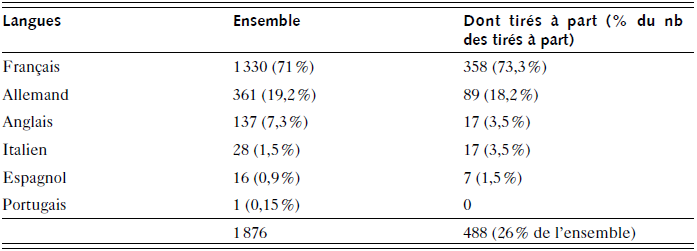
Quelques constats peuvent être faits en s’intéressant aux langues dans lesquelles ont été écrits les livres et les tirés à part reçus. Le comptage de l’ensemble donne les résultats suivants (tabl. 2). Il permet de rendre compte du rapport que Bloch a entretenu avec les autres pays européens et, d’abord, de façon privilégiée, avec l’Allemagne.
– Langues employées dans les livres et tirés à part
Allemagne
Le nombre important de livres et de tirés à part en allemand est frappant. Ils sont pour beaucoup liés à la rubrique « Bulletin historique » que Bloch tenait pour la Revue historique entre les années 1920 et 1932, et dans laquelle il montra un très sérieux effort d’information factuelle et d’analyse critique sur la production germaniqueFootnote 62. Ce bulletin historique prend la forme de recensions systématiques des publications en langue allemande, classées analytiquement : ce sont plusieurs dizaines de monographies, d’éditions de texte, d’outils de travail, de gros articles qui sont ainsi présentés au public français. Cet énorme travail aboutit à des articles importants à tous points de vue. Le bulletin rédigé par Bloch en 1932 fut ainsi jugé par lui-même suffisamment intéressant pour qu’il en envoyât un tiré à part, à SimiandFootnote 63.
Dans l’ensemble des bulletins historiques qu’il rédigea, il se montra particulièrement sensible aux manifestations incongrues du nationalisme dans les écrits historiques ou encore aux apories que des méthodologies trop exigeantes et faussement rigoureuses créaient. On pense en particulier à la Stilkritik qui visait à identifier les auteurs de texte, y compris dans la diplomatique, grâce à leur lexique et leurs tournures stylistiques. Les chercheurs arrivaient à des résultats que Bloch jugeait absurdesFootnote 64. La question vaudrait d’être reprise avec, comme toile de fond, les progrès que la textométrie et les statistiques construites sur des corpus étendus permettent d’effectuer en ce sens.
Bloch publia les derniers bulletins historiques en 1937 et 1938 en collaboration avec Charles-Edmond Perrin qui l’avait rejoint à la Sorbonne. Ce sont deux publications très substantielles (55 et 34 pages en corps 10 et simple interligne) : elles montrent que l’érudition française continuait de s’intéresser aux publications allemandes et que celles-ci étaient abondantes. Le ton des recensions est neutre et les auteurs s’attachent à analyser des contenus et à critiquer des méthodes : on est loin d’une quelconque surenchère nationaliste ou d’un boycott intellectuel de l’Allemagne à laquelle, malgré tout, les deux grands patriotes que furent Bloch et Perrin étaient attachés.
Bloch poursuivit la chronique jusqu’en 1938. Sa dernière collaboration fut publiée cette année-là. L’article avait été rédigé avec Perrin et traite les années 1932-1938Footnote 65 : il couvre donc partiellement la période du nazisme, sujet qui n’est pas abordé. En effet, si une certaine hostilité à l’égard des absurdités et des mauvaises méthodes ou de quelques présupposés idéologiques repoussants se ressent, la science avance en privilégiant la discussion et le débat malgré tout.
En dehors de la préparation et de la rédaction des bulletins historiques, Bloch entretenait des relations amicales avec tout un réseau de savants allemands que la prise du pouvoir par les Nazis entama sans pour autant les briser totalement. De 1926 à 1939, chaque année, des ouvrages allemands entrèrent en grand nombre dans sa bibliothèque, avec des pointes : 26 titres en 1930, 24 en 1934, 20 en 1937.
Jusqu’en 1933 Bloch reçut des envois d’Alfons Dopsch, avec lequel les relations semblent avoir été très amicales : trois dédicaces indiquent une relation chaleureuse et proche, Dopsch adressant à l’occasion de l’envoi de tirés à part, en 1930 et en 1933, des vœux de Nouvel An. C’est un paradoxe étant donné les options politiques de Dopsch. En décembre 1933, Bloch reçoit encore le tiré à part d’un bref article (cinq pages) dont le titre, « Verlassung und Wirtschaft im frühen Mittelalter » (Affranchissement et économie durant le haut Moyen Âge), est un rappel de l’une des thématiques principales de l’œuvre de BlochFootnote 66. Les œuvres majeures de Dopsch se trouvent, dédicacées ou non, dans la bibliothèque de Bloch, dont Herrschaft und Bauer in der deutschen Kaiserzeit sorti en 1939. Celui-ci ne paraît pas avoir été envoyé par l’auteur ou son éditeur, ce qui pourrait être un signe du relâchement de leurs relationsFootnote 67.
Le monde anglophone
Les contacts fréquents et importants de Bloch avec l’Angleterre se retrouvent dans la présence de 137 livres en langue anglaiseFootnote 68. Si ce nombre est important, celui des tirés à part l’est moins (17). François-Olivier Touati a montré les difficultés éprouvées par Bloch pour pénétrer le monde académique anglais, au vrai, fort peu curieux, à l’époque, des travaux français.
On trouve sans surprise la présence de celui qui fut le principal contact de Bloch en Angleterre, George Gordon Coulton, avec 4 titres, soit 4 livres, non dédicacés mais munis de la signature de BlochFootnote 69. On remarque aussi la présence d’auteurs importants comme Frederic William Maitland, historien du droit, éditeur et critique du Domesday Book, dont les livres ont forcément été achetés, Maitland étant mort en 1906.
On est surpris cependant de ne trouver, parmi l’œuvre de Michael Moissey Postan, que sa leçon inaugurale à Cambridge, éditée en 1939 (« The Historical Method in Social Science ») et aucun titre d’Eileen Power, remarquable historienne de l’économie du Moyen Âge, co-directrice de l’un des volumes de la Cambridge Economic History et professeure à la London School of EconomyFootnote 70 : l’un et l’autre avaient pourtant déjà à leur actif, à cette date, une importante bibliographie et entretenaient des relations scientifiques avec Bloch. La participation de ce dernier à la Cambridge Economic History, alors dirigée par Power, souligne ce lien. La convergence des intérêts scientifiques du couple Postan-Power avec ceux de Bloch aurait pu laisser attendre une relation plus suivie. Elle sera investie, dans les années 1950-1960, par Georges Duby.
En revanche, la présence de Earl J. Hamilton ne surprend pas. Cet Américain travaillait en Europe dans les années 1930. Spécialiste de l’Espagne, il fut associé, pour ce pays et la France méridionale à l’enquête lancée par Beveridge en 1929, à savoir une étude générale des prix et des salaires en EuropeFootnote 71.
C’est peut-être en piochant dans la bibliographie en langue anglaise, enfin, que Bloch a pu s’informer sur l’histoire du Japon dont on sait l’importance qu’elle revêtait à ses yeux de comparatiste : on trouve plusieurs titres de Kan’ichi Asakawa, portant sur des sujets d’histoire ruraleFootnote 72. À chaque fois, il s’agit de tirés à part, obtenus on ne sait dans quelles circonstances : rencontres dans des colloques ou envois spontanés de la part des auteurs. Le dépouillement systématique, par Bloch, des grandes revues, comme The Economic History Review, lui avait peut-être permis de repérer des auteurs.
Italie et Espagne
La présence de l’Italie est limitée, sans être anecdotique. On retrouve dans le fonds quelques-uns des grands noms du monde académique italien de l’entre-deux-guerres : Enrico Besta, Gian Piero Bognetti, Pier Silverio Leicht, Nicola Ottokar, Roberto Sabatino Lopez, Pietro Vaccari. Les quatre premiers ont une occurrence chacun, Vaccari trois. Il est vrai que c’est du travail de Vaccari, spécialiste du monde carolingien, fortement intéressé par les questions du servage et de l’organisation territoriale de la seigneurie, que Bloch était sans doute le plus proche. En ce qui concerne Leicht, Bloch en connaissait bien le travail pour avoir, en 1929, chroniqué son Gasindii e Vassalli dans le premier numéro des Annales. Les papiers de ces auteurs ne sont pas dédicacés, sauf dans le cas de Bognetti qui se fend d’un sobre et peu compromettant « Omaggio »Footnote 73. Enfin, Lopez est représenté par deux modestes tirés à part.
Les relations entre Bloch et l’Italie ou l’historiographie italienne ne se limitaient cependant pas à ces quelques titres et elles furent en réalité assez compliquées, ainsi que l’a montré Francesco Mores, pour des raisons liées au régime fascisteFootnote 74. Des relations suivies avec l’étranger n’étaient en effet pas sans risques pour les universitaires italiens qui pouvaient, en cas de conflit avec le régime, perdre leur poste, voire pire.
Côté espagnol, enfin, on note peu de noms, mais l’un au moins est remarquable, celui de Claudio Sánchez-Albornoz, avec trois tirés à part envoyés en 1929 et 1930. L’historien était alors au début de prises de position politiques qui le conduisirent en Argentine et à la présidence du gouvernement républicain espagnol en exil.
Le réseau des correspondances et des amitiés de Bloch est clairement international. Centré sur l’Europe, comme il est normal dans les années 1930, il ne néglige pas les États-Unis alors émergents (Hamilton) ni l’Europe latine, dans la mesure de son accessibilité. L’Italie fasciste n’est pas un terrain commode pour un historien ayant les intérêts et la liberté d’esprit de Bloch. L’Espagne est, elle aussi, difficile, surtout évidemment après 1936. La mention de Sánchez-Albornoz n’en est que plus intéressante et importante. Il n’en demeure pas moins que le fondement des lectures de Bloch est français, avec 70 % des titres en français parmi ceux qui nous sont parvenus.
Ce fonds est désormais conservé à part, dans une réserve de la bibliothèque Halphen, comme un ensemble particulier et précieux. Il constitue un objet à la fois étrange et émouvant. Pour des médiévistes, se servir des livres mêmes qu’utilisa Bloch dans diverses circonstances de son existence, est une expérience singulière. L’aura de respect qui entoure sa personnalité scientifique et citoyenne fait que l’on a l’impression à la fois de manier des reliques ou de circuler à l’intérieur d’un véritable musée et de poursuivre modestement son travail en utilisant les mêmes références que lui. Le fait qu’il ait reçu à peu près tout ce qui se publiait en matière d’éditions de sources explique en partie cela. Il faut cependant reconnaître que la diversité des ouvrages est surprenante : on y trouve même deux livres du stratège anglais le général Edward Spears, l’un de 1932 et l’autre de 1939, signe de l’intérêt discret mais très réel porté par Bloch à la chose militaireFootnote 75. Il semblerait aussi qu’il ait possédé l’Histoire de l’armée allemande de Jacques Benoist-Méchin, mais à Fougères, pas à ParisFootnote 76. Cette appétence, qui est celle d’un citoyen, se retrouve tout au long des pages de L’étrange défaite. Le nombre de ses comptes rendus montre qu’il prenait le temps de tout lire, de tout ficher, de tout mémoriser ou, pour le moins, de tout parcourir attentivement : les ouvrages dont les pages ne sont que partiellement découpées montrent qu’il savait garder une certaine mesure dans son immense labeur. L’émotion cède rapidement la place à l’effarement devant sa puissance de travail, sa prodigieuse mémoire, et à l’admiration sans cesse renouvelée face à sa capacité à analyser et à synthétiser les informations les plus diverses.
Il n’y a pas que cela, toutefois. Avec cette bibliothèque, on se trouve au cœur même de la vie intellectuelle et sociale de Bloch, et de l’outil de constitution de son savoir. Bloch, on le sait, comparait la bibliothèque de l’érudit au laboratoire du scientifique. De fait, avoir à portée de main non pas simplement la liste de ce que Bloch a lu, mais les volumes mêmes qu’il a utilisés est d’un intérêt prodigieux, à la fois pour la compréhension de son travail, mais aussi à cause des recoupements qui naissent de la fréquentation de ces ouvrages et des questions qui ne manquent pas de se poser.
Certains de ces livres portent des marques de lecture, crochets ou flèches au crayon indiquant les passages les plus importants. Lorsqu’il s’agit d’une note, l’écriture en est pressée, parfois presque illisible. Elle consiste en quelques mots, exprimant pour certains des réactions spontanées. Lisant, par exemple, une charte éditée par Roger Aubenas et portant mention d’un intérêt vraiment élevé, il s’indigne : « un intérêt scandaleux ». Ou encore, une note rapide en marge d’un diplôme carolingien lu très vite. Des commentaires figurent quelquefois sur son exemplaire personnel. Il en va par exemple ainsi d’une page du livre de Karl Bücher, Die Entstehung der Volkswirtschaft (Les origines de l’économie), paru en 1908, où Bloch s’étonne de ce que le thème de la religion soit sous-estimé. Il relève également « [u]ne certaine confusion du fait politique et économique dans la classification bucherienne, assez générale dans l’école allemande (p. 85) ».
Il arrive que Bloch ait laissé ses notes sur feuilles volantes dans l’ouvrage qu’il venait de lire, soit que celles-ci aient été oubliées soit qu’il ait trouvé pratique de procéder de la sorte. C’est le cas pour le livre de William Alfred Morris portant sur les sheriffs du xive siècle en Angleterre qui avait suscité chez lui un vif intérêt. Bloch rédigea trois feuillets de remarques. Il y qualifie le travail de « solide » et compare la charge de bailli avec celle de sheriffFootnote 77.
Certains de ces livres sont, quant à eux, directement annotés. Ainsi, un manuel allemand intitulé Das Mittelalter, comporte de nombreuses annotations bibliographiques de livres ou d’articles non cités par les auteursFootnote 78. Parfois, des passages sont discrètement soulignés, mais c’est rare : Bloch avait évidemment du respect pour les objets que sont les livres et évitait sans doute d’autant plus de les marquer qu’il connaissait leur valeur économique et les considérait comme faisant partie de son patrimoine.
Être en prise avec la vie de relations de Bloch, dans toute sa complexité, suscite également de l’émotion. Envois de livres et de tirés à part, dédicaces, les hommages portent témoignage du respect que les Annales et Bloch avaient pour l’érudition locale et à ceux qui la faisaient et, inversement, de la reconnaissance dont la revue et ses directeurs jouissaient auprès de ce monde qu’ils estimaient et appréciaient. Cette attention, rare, classe le groupe d’historiens qui participaient alors à la revue, dont Bloch, à part dans le monde universitaire.
On trouve aussi des dossiers singuliers. Outre les notes oubliées, peut-être dans les années 1960, par un étudiant qui avait lu un article d’histoire romaine (un papier de Babut) dans le volume des « Mélanges historiques » des tirés à part, on a parfois des surprises intéressantes. L’abbé A. Pissier avait envoyé une plaquette, accompagnée d’une lettre que Bloch laissa dans l’ouvrage, volontairement ou non. La relation de confiance et d’estime qui unissait cet ecclésiastique, curé de campagne, au professeur de Strasbourg mérite d’être soulignéeFootnote 79. Les curés étaient souvent des érudits locaux et, en tant que tels, des interlocuteurs scientifiques, voire des informateurs, importants pour certaines questions extrêmement pointues qu’ils étaient seuls à maîtriser, comme la micro-toponymie ou la connaissance fine de tel ou tel dossier documentaire concernant un territoire. La vie même des sociétés savantes reposait aussi sur l’implication de membres du clergé qui utilisaient leurs compétences et leur curiosité dans des activités intellectuelles dont il y avait toujours quelque chose à retirer.
Une étude globale de ce fonds et, plus généralement, la reconstitution de la bibliothèque de Bloch en localisant les livres encore dispersés est naturellement une entreprise à encourager. Les instruments mis au point durant l’année 2026 ainsi qu’une meilleure compréhension des processus ayant entraîné sa dispersion partielle devraient permettre d’avancer dans le travail de reconstitution de cette bibliothèque. La base de données élaborée par Jean-Damien Généro en s’appuyant sur le travail de Klementyna Glinska est intitulée, par son auteur, « Reconstruire la bibliothèque de Marc Bloch ». Elle offre un m oyen de commencer cette tâche en fournissant la réponse à des interrogations minimales mais essentielles : elle indique les références bibliographiques, donne les cotes de la bibliothèque Halphen, propose la transcription des annotations marginales ou les signale et permet, enfin, d’effectuer des comptages simples.
L’exploitation du fonds devra aller de pair, cependant, avec l’exploration d’autres bibliothèques susceptibles de contenir des ouvrages possédés par Bloch comme celle de l’ENS où le travail est déjà bien entamé. C’est là, que l’on trouve le plus aisément trace de ses lectures, comme l’a montré F.-O. Touati en publiant le tableau des emprunts de Bloch à la bibliothèque du temps qu’il y était élèveFootnote 80. Il serait évidemment, du point de vue scientifique, du plus haut intérêt de pouvoir reconstituer l’intégralité du catalogue. Encore une fois, nous avons bien conscience de ne détenir qu’un fragment, certes substantiel, mais incomplet d’une bibliothèque dont on subodore l’importance en nombre de volumes sans avoir les moyens de la mesurer. L’ampleur des pertes subies par les grandes bibliothèques d’érudits, comme celle d’Halphen, laisse supposer que celle de Bloch contenait beaucoup plus de volumes que les 1 800 parvenus à la Sorbonne.
Pour conclure, ce rapide et bref examen du fonds donne d’abord à voir le comportement familier d’un érudit avec son outil de travail, encore perceptible dans ce qui nous est parvenu de sa bibliothèque. On note aussi l’usage du livre comme moyen de communication sociale, instrument de constitution et de maintien des liens sociaux, ainsi que comme moyen, évidemment, de construction de la science. Le livre est ce qui a lié Bloch aux travailleurs intellectuels de son temps, parce que les échanges sont constitutifs de la vie scientifique, comme en témoignent ceux auxquels il procédait avec ses amis, ses pairs, ses disciples. Pour ces raisons, la valeur de ce fonds est inestimable dans le cadre d’une histoire des sciences ou d’une histoire de l’histoire et ne relève évidemment pas de la seule curiosité ou de l’anecdote. Il est, en lui-même, un objet d’histoire.

 Open access

