

The US government’s testing of nuclear weapons in the desert southwest beginning in 1945 led to widespread radiation exposure, creating dire long-term health consequences for many surrounding communities. We examined the impact on voter turnout almost a half-century later as the US government attempted to respond monetarily by compensating those who fell ill. By combining data on county-level turnout with government reports to examine the effects of compensation on voting, our natural experiment analyzed whether counties that experienced fallout but were not included in the initial compensation differed in voter behavior in the two subsequent presidential elections. Utilizing Difference-in-Difference (DiD) modeling, we tested whether uncompensated counties voted at rates comparable to neighboring counties that were compensated. Our findings show that aggregate voter turnout was significantly higher in these swing states with implications for nuclear weapons policy and international relations (IR) deterrence debates.
Our findings show that aggregate turnout was significantly higher in these swing states with implications for nuclear weapons policy and international relations deterrence debates.
Nuclear weapons testing affected the lives and health of voters around the desert southwest. In 1990, the Radiation Exposure Compensation Act (RECA) was enacted to compensate those residents of Arizona, Utah, and Nevada who fell ill with specific medical conditions and simultaneously met stringent residency requirements. However, eligibility was limited geographically. Counties that were located outside of the mapped fallout area—as mistakenly understood by scientific studies at the time—were excluded from compensation in 1990; however, some were compensated in 2000 as the US government expanded the geographic coverage (Boutté Reference Boutté2002). Our study attempted to understand the potential impact of the 1990 RECA implementation on voter turnout. Utilizing county-level data, we examined voter behavior in the subsequent presidential elections that were potentially affected.
We argue that the voters affected by the 1990 RECA implementation influenced nuclear policy and related debates, if indirectly (figure 1). We do not know the extent to which high voter engagement in deterrence-adjacent policy contributed to changes in deterrence or nuclear weapons policies. However, nuclear weapons testing affected voters. They responded, and their response likely contributed to the government’s response. Moreover, once the government responded, the deterrence landscape shifted. Therefore, in this adaptation of Downs’s (Reference Downs1957) pocketbook-voting hypothesis, nuclear weapons policy can change due to voter pressures even in adjacent policy areas. Other factors contributed to the cessation of testing in 1992, including improvements in computation and the end of the Cold War. However, this article shows how voters played a part.

Figure 1 Sequence of Events in Nuclear Weapons Policies and Debates
Note: Voter response was one of many factors that led to deterrence change.
Literature on the impact of catastrophic events underscores their complex correlation with voter engagement. In national security, the focus has been largely on the effects of terrorist attacks (Davis and Silver Reference Davis and Silver2004; Hersh Reference Hersh2013; Huddy et al. Reference Huddy, Feldman, Taber and Lahav2005). Hersh (Reference Hersh2013) found that the victims of 9/11 and their neighbors had an increase in voter turnout. A broader set of findings outlines the importance of national-security issues to voters via “rallying-around-the-flag” effects (Baker and Oneal Reference Baker and Oneal2001; Edwards Reference Edwards1997; Hetherington and Nelson Reference Hetherington and Nelson2003; Mueller Reference Mueller1973; Norrander and Wilcox Reference Norrander and Wilcox1993). A large body of research evaluates the impact of other factors, such as mass shootings and natural disasters (Atkeson and Maestas Reference Atkeson and Maestas2012; Barnes et al. Reference Barnes, Hanson, Len, Meacham, McIntyre and Erickson2008; Fowler and Hall Reference Fowler and Hall2018; Gasper and Reeves Reference Gasper and Reeves2011; Hassell, Holbein, and Baldwin Reference Hassell, Holbein and Baldwin2020; Healy and Malhotra Reference Healy and Malhotra2009). However, many of these events can depress voter turnout.
According to Zelin and Smith (Reference Zelin and Smith2023), aligned with Downs’s hypothesis (1957), the cost of voting increases for those affected by natural disasters. Poor health can make it more difficult to vote (Lyon Reference Lyon2021; Ojeda and Pacheco Reference Ojeda and Pacheco2019; Pacheco and Ojeda Reference Pacheco and Ojeda2020). Traumatic events can induce a mass stress response, depressing voter turnout (Marsh Reference Marsh2023). Although our focus is RECA, the fallout may meet some of Marsh’s (Reference Marsh2023) criteria for traumatic events. Marsh (Reference Marsh2023) also pointed out that the trauma is experienced more often and more severely by Black people, women, individuals with lower socioeconomic status, and others. In summary, catastrophic events have an impact on democratic engagement that is negative, unequal, and increasingly common.
The government’s response to catastrophic events may be important in preserving democratic health. Zelin and Smith (Reference Zelin and Smith2023) used a natural experiment to argue that whereas authorities may offset the impact of such events, expanding voting by mail had limited effect during Hurricane Michael. Marsh (Reference Marsh2023) suggested only that future research identify the role of government in promoting posttraumatic growth and resilience in political engagement. There is still little research on the government’s response to catastrophic events; however, studies have explored extensively the effect of government support on voter turnout.
The idea that monetary support from the government can improve democratic engagement has mixed support. Researchers who evaluated Downs’s (Reference Downs1957) pocketbook-voting have been skeptical of his hypothesis, arguing that partisanship may obfuscate the economic benefit and prevent voters from properly attributing the policies (Achen and Bartels Reference Achen and Bartels2016; Green, Palmquist, and Schickler Reference Green, Palmquist and Schickler2004). According to Rendleman and Yoder (Reference Rendleman and Yoder2024), the response of voters who benefit from the Earned Income Tax Credit programs in the United States is consistent with their economic interests—although this response is small and diminishes with time. Voters may quickly lose track of the government source of their benefits (Mettler Reference Mettler2011; Shanks-Booth and Mettler Reference Shanks-Booth and Mettler2019). The literature cautions against expecting an increase in voter turnout among compensated groups.
This expectation might discourage the idea that the government’s response matters for voter turnout. Nevertheless, by examining the outcome of a natural experiment, Loeffler (Reference Loeffler2023) showed that Universal Basic Income (UBI) may be turnout-enhancing according to her DiD analysis of the introduction of an unconditional cash payment in Alaska. After Alaskan voters received monetary compensation independent of their employment status, age, or indigence, Loeffler (Reference Loeffler2023) found a positive and lasting response on voter engagement. The unconditional nature of the policy suggests that universal eligibility was an important albeit untested component of the increased voter engagement. Conversely, compensation levels may not have as important a role, at least in some cases. In their natural experiment, Jares and Malhotra (Reference Jares and Malhotra2024) found a null result comparing farmers who were harmed by President Trump’s 2018 trade war and were compensated more or less fairly, and they found a negligible impact on midterm turnout.
If being compensated fairly does not motivate voters but unconditional eligibility may, we expect that how the eligibility is determined is important in voter response. That is, uncompensated groups are more likely to mobilize. We expect that voters are more likely to respond if they are not compensated but others who are similarly situated are compensated.
H1: Engagement is likely to increase among uncompensated voters in counties affected by nuclear weapons testing.
The concept of linked fate (Dawson Reference Dawson1994; Tate Reference Tate1994) suggests that many voters may be motivated to see their well-being as tied to the well-being of their group. This literature typically defines the group along different racial and ethnic lines (Alexander Reference Alexander2010; Berry, Ebner, and Cornelius Reference Berry, Ebner and Cornelius2021; Escaleras, Kim, and Wagner Reference Escaleras, Kim and Wagner2019); however, in our case, county residents may have been linked together. Even if a voter was not individually eligible for compensation, witnessing others who fell ill likely would motivate greater political engagement in that county. Therefore, we expect that voters become mobilized among uncompensated counties even when they are not personally affected by the fallout.
H2: Engagement is likely to increase among uncompensated voters in counties affected by nuclear weapons testing even beyond individual self-interest
To test these hypotheses, we examined how the 1990 RECA affected voter behavior. Because some counties were compensated during the initial RECA implementation and other similarly situated counties were not covered, this allowed us to study the compensation as a natural experiment. The “natural” assignment of counties into experimental and control groups arises from the then-misunderstood geographic extent of the fallout. In Utah, residents in Beaver, Garfield, Iron, Kane, Millard, Piute, Sevier, and Washington counties were offered compensation in 1990 (RECA 1990). Other Utah counties considered for compensation (Szymendera Reference Szymendera2022) were excluded in 1990 (i.e., Carbon, Duchesne, Emery, Grand, Juab, San Pete, Uintah, Washington, Wayne, and San Juan counties). In Nevada, the compensated counties were Eureka, Landler, Lincoln, Nye, White Pine, and portions of Clark County. However, in Arizona, only parts of Mohave and Coconino counties were covered in the 1990 compensation, and the remaining Apache, Gila, Navajo, and Yavapai counties were uncompensated until the subsequent RECA Amendments in 2000 (Szymendera Reference Szymendera2022). Whereas the residents in all of the analyzed counties experienced the deleterious effects of the fallout from nuclear weapons testing, the residents in excluded counties differed in that they were not eligible for government compensation in the 1990 RECA.
We compiled data from government reports on RECA eligibility in 1990 (Williams, Whiles, and Pavri Reference Williams, Whiles and Pavri2025). We combined this dataset with data from Marsh (Reference Marsh2023), which provides voter-turnout figures for each presidential election between 1976 and 2016, by county. Marsh (Reference Marsh2022) compiled time-series cross-sectional data at the county level because the smallest geographic unit with consistently accurate turnout estimates is at that level. Using county-level data also was how RECA eligibility was determined; therefore, it provided a corresponding level of analysis. The focus of Marsh’s (Reference Marsh2023) data was disasters and trauma affecting turnout. However, having only one datapoint (i.e., flood) limited us from controlling for these traumatic events in our geographically and temporally constrained sample. There also were some missing observations in the Marsh (Reference Marsh2023) data, including Washington County data in 1988 and data from San Juan and White Pine counties.
There are potential methodological concerns with relying on aggregate voter-turnout statistics. Even at the smallest level, aggregate statistics can mask individual patterns of behavior that may differ significantly. A salient concern with relying on the county-level data in the geographically constrained study is the sample size. A small sample can cause us to underestimate the studied effects or to find a lack of stability across models. We estimated multiple models with different temporal and geographic samples, resulting in similar and significant effects. However, future research should explore individual-level voter data to corroborate our findings. Small sample size and reliance on county-level aggregate statistics are weaknesses of our study, which limited our conclusions.
We combined the data from Marsh (Reference Marsh2023) with the RECA county designations (RECA 1990) and government reports (Szymendera Reference Szymendera2022) to identify the status of each county. In one set of models, we focused only on Utah to minimize methodological concerns with cross-state comparisons (Keele and Titiunik Reference Keele and Titiunik2016). In Utah, several similarly situated counties were uncompensated and several were covered by RECA. We expanded our analysis to the other affected states of Arizona and Nevada. These models included a larger sample size of counties from across the three states. These data included some counties that were partially compensated. We tested the stability of our results by specifying different classifications of these counties without any significant impact on our findings. Our expanded models, which analyzed Arizona, Nevada, and Utah, utilized increased sample size but also allowed us to study the total population of counties affected by the fallout and RECA.
We used standard DiD regression models to estimate the effect of compensation on turnout in the presidential elections of 1992 and 1996 that followed RECA 1990 enactment. The effect of compensation is captured as an interaction term between the “treated” or not compensated counties and the “post” or the presidential elections of 1992 and 1996. We relied on the R fixest package to estimate our results (Bergé Reference Bergé2018). Similar to Marsh (Reference Marsh2022), we accounted for important within-state differences not captured by fixed effects by including the percentage of the county population that represented Black, Indigenous, and People of Color (BIPOC) voters; total population; and median household income. We also included a measure to capture the partisanship as a ratio of Republican to Democrat voters.
The DiD analysis provides leverage to make causal claims; however, this relies on meeting a set of assumptions. To assess model assumptions, we tested turnout before the passage of RECA (1980–1988) by visually analyzing pre-RECA trends and reanalyzing the models with county–year interaction terms pre-RECA, without finding significance (Angrist and Pischke Reference Angrist and Pischke2009). Details about our assumption testing and different model specifications are in our replication data documentation (Williams, Whiles, and Pavri Reference Williams, Whiles and Pavri2025). Meeting these assumptions still may not be sufficient, although our small sample size did not allow for matching (Imai and Kim Reference Imai and Kim2021; Imai, Kim, and Wang Reference Imai, Kim and Wang2021). One possibility is that residents self-selected into the compensated and uncompensated areas (Keele and Titiunik Reference Keele and Titiunik2016). It is important to note that RECA eligibility was based on county residency several decades earlier, in the 1950s and 1960s. Therefore, voters would not have been able to self-select based on—unknown to them at that time—the potential for eligibility decades later. Furthermore, some locations closer to the Nevada Test Site than the designated RECA areas nevertheless were uncompensated (Szymendera Reference Szymendera2022). Our consideration of the assumptions did not invalidate the choice of DiD modeling; however, we proceeded with caution, hedging our results.
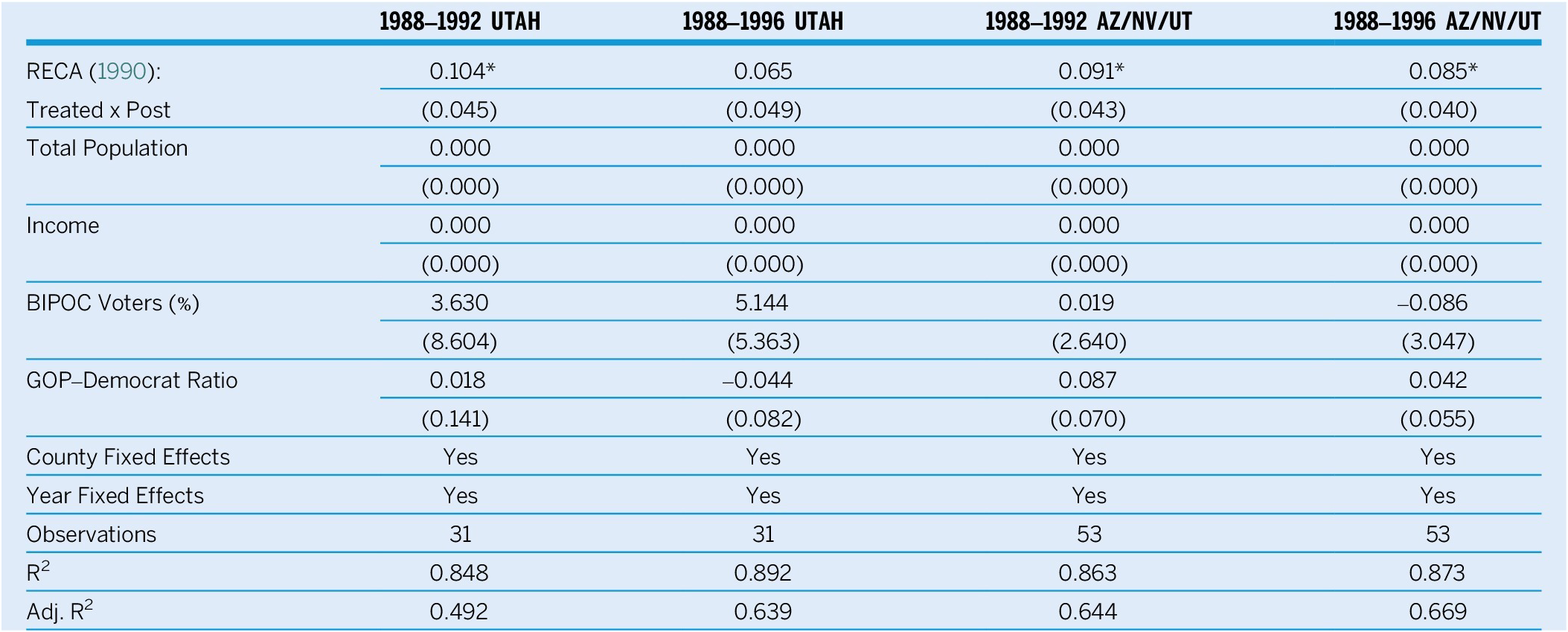
Our model estimates show that counties ineligible for compensation in 1990 had a surprisingly large positive and significant rise in voter turnout in the subsequent presidential elections across almost all of the different model specifications (table 1). In Utah alone, the excluded counties had a 10% higher and significant turnout in 1992 and a 6% higher (but not significant) turnout in 1996. Across Arizona, Nevada, and Utah, the uncompensated counties had a 9% higher and significant turnout in both 1992 and 1996. The turnout increased consistently and was significant in all of the model specifications in the 1992 presidential election. The trend continued and voter-turnout increases persisted in the 1996 election, showing significance across almost all models. The remaining controls did not show significance. In small-N studies such as this one, it can be difficult to establish statistical significance. The significance of the results and their stability across different model specifications, however, assuage some of the concerns about drawing conclusions from our small-N analysis.
Table 1 Effect of the 1990 RECA Compensation, Two-Way Fixed Effects (County-Year) Regression Results

Notes: County-clustered standard errors are in parentheses; p < 0.1, *p < 0.05.
Our results indicate that not being compensated had a significant and strongly positive effect on voter turnout in two presidential elections following passage of the 1990 RECA, which supports Hypothesis H1.
In addition, the effect sizes can inform our understanding of who may have voted. The increase in voter turnout among the three states (i.e., Arizona, Nevada, and Utah) translated into as many as 100,000 voters who otherwise would not have cast a ballot. That number far exceeds the total number of RECA claims in this category, which totals approximately 30,000 (Szymendera Reference Szymendera2022). The turnout increase in the 1992 election alone was larger than the number of the claims filed, including those that were rejected, since the inception of RECA. Only those voters who experienced a specific list of conditions and had met detailed residency requirements in the 1950s and 1960s were eligible for RECA compensation. The number of claimants, therefore, was substantially smaller than the number of voters who were motivated by their county’s lack of compensation.
This finding supports Hypothesis H2, which states that voter engagement increased even among voters who were not eligible for RECA compensation (i.e., due to lack of a covered illness or they did not meet the strict temporal residency requirements).
Overall, there was an aggregate impact on voter turnout in the desert southwest. This may inform not only nuclear weapons research but also literature on natural-disaster response and even discussions about the “universal” part of the UBI. Although we must be cautious in drawing conclusions from this small-N analysis, the turnout increases were large and significant statistically in terms of the number of voters (i.e., approximately 100,000). Furthermore, the increases were politically salient: Utah was not a swing state, Nevada and Arizona were.
Following the 1996 presidential election, discussions of expanding RECA county eligibility led to the passage of the RECA Amendments. Put in place in 2000, they extended RECA coverage to many of the uncompensated counties. Voters responded, as did the government, by expanding the geographic coverage of RECA. These results suggest the efficacy of the voters in bringing about policy change.
Because compensation for testing became politically salient, the government may have inferred from the voter engagement that nuclear weapons testing would be politically and financially costly. Indeed, the 1990s saw significant shifts in nuclear weapons testing policy. The last nuclear weapons detonation in the desert southwest took place in 1992 and, shortly afterwards, the US Congress imposed a moratorium on testing (Fehner and Gosling Reference Fehner and Gosling2000). The 1996 international negotiations, led by the United States, produced the unratified Comprehensive Test Ban Treaty. These policy shifts were intended to limit global testing.
The shift away from testing also corresponded with changes in the US deterrence posture, as well as changes in IR debates about deterrence. It is impossible to estimate how much of the nuclear weapons testing in the desert southwest was intended only to assess US capability or to serve as a deterrent by showcasing US capability, or both. However, IR debates about nuclear deterrence during the Cold War described credibility through the lens of capability—stable mutual deterrence stressed survivable second-strike capability, no matter how devastating the first attack (Jervis Reference Jervis1989; Krieger and Roth Reference Krieger and Roth2007; Mearsheimer Reference Mearsheimer2001; Schelling Reference Schelling1960; Waltz Reference Waltz1990). The United States was capable of detonating many nuclear weapons and therefore was credible. The cessation of testing occurred as the Cold War ended and improvements in computational power made simulated testing feasible. Nevertheless, after testing ceased, “capability” was no longer the focus of IR debates. Deterrence debates shifted away from discussions of credibility by means of capability alone.
Subsequent deterrence research highlighted the significance of resolve, showcased in part by electoral costs that leaders potentially would incur for bluffing (Fearon Reference Fearon1997; Guisinger and Smith Reference Guisinger and Smith2002; Levendusky and Horowitz Reference Levendusky and Horowitz2012; McManus Reference McManus2018; Snyder and Borghard Reference Snyder and Borghard2011; Trager and Vavreck Reference Trager and Vavreck2011). It was no longer enough for a country to be capable of carrying out a threat; the question was whether a leader would be willing to do so. To make the threats credible, leaders could utilize domestic-audience costs: if leaders were caught making an empty threat, such a bluff would lead to a loss of office (Fearon Reference Fearon1997). It is difficult to know if, when, or how the theorized domestic-audience costs would be sufficiently engaged to affect a credible deterrent in nuclear-policy space. The absence of historical instances of nuclear deterrence failures or called bluffs makes it a challenge to test domestic-signaling arguments in the context of nuclear policy empirically. However, this theoretical argument also may miss the role of voters in nuclear politics.
Empirically, voters may have played an active role in shaping deterrence. The domestic costs of nuclear weapons testing and RECA compensation led to a significant increase in voter turnout in the politically salient swing states of the desert southwest. The cessation of testing followed, as well as a change in how credibility was debated and theorized.
The evolution of IR deterrence debates from capability to resolve raises an important question about how we define what makes nuclear weapons a credible deterrent. Our results show that voters could be mobilized by policies tangentially related to nuclear deterrence. Deterrence policy may have shifted in part because of the electoral pushback to RECA, a deterrence-adjacent policy (see figure 1). The work of activists and other (not analyzed) aspects of voter engagement triggered by testing also may have played a role. As the voter-behavior literature discussed herein suggests, voter participation is complex. Voter motivations may not necessarily align with those of leaders attempting to project credibility. Voters may demonstrate independent preferences rather than punish leaders for failing to follow on empty threats that they did not approve of in the first place. These preferences would make them a political resource for leaders rather than a challenge to overcome.
Nuclear weapons policies that are responsive to voter preferences may be less prone to political pressures and the risk of being overturned or changed, thereby enhancing leaders’ credibility. The potential for electoral pushback through increased voter turnout or political activism can provide credibility in its absence; the lack of pushback can translate into less-contested nuclear weapons policies, signaling the likelihood that they remain unchanged. Lack of pushback from voters (even in deterrence-adjacent policies) may be an important feature of deterrence stability.
Nuclear weapons debates rarely extend to questions of democratic behavior. Although we do not know how they voted, voters can meaningfully exercise their influence through increased turnout and a referendum of sorts is enabled. Of course, we are not suggesting that only the negative effects motivate voters to influence public policy. It also could be the case that governments ignore the increased voter turnout, without making responsive changes. In the long run, elected officials may be just as likely to capitalize on the heightened awareness of voters and preserve them as sustained future voters for their political parties as they are to ignore the issues motivating disgruntled but highly engaged voters. Because testing is becoming a renewed part of our national discourse (O’Brien Reference O’Brien2024), studies must evaluate nuclear weapons debates through the lens of the broadest impact on democratic behavior.
ACKNOWLEDGMENTS
We gratefully acknowledge research grant support for this article from the Carnegie Corporation of New York (Grant No. G-23-60433). We also thank the Atlanta University Center Data Science Initiative for providing research support for a portion of this article.
DATA AVAILABILITY STATEMENT
Research documentation and data that support the findings of this study are openly available at the PS: Political Science & Politics Harvard Dataverse at https://doi.org/doi:10.7910/DVN/YX4LSZ.
CONFLICTS OF INTEREST
The authors declare that there are no ethical issues or conflicts of interest in this research.