





Introduction
Herbicides with soil-residual activity provide an extended period of weed control by persisting in the soil and suppressing weeds as they emerge. Residual herbicides are commonly used as a part of a preemergence application, whereas some can be applied postemergence (Steckel et al. Reference Steckel, Sprague and Hager2002). Use of herbicides with soil-residual activity is increasing as a strategy to diversify chemical weed control programs, thus delaying resistance to commonly used postemergence herbicides (Heap Reference Heap2021; Norsworthy et al. Reference Norsworthy, Ward, Shaw, Llewellyn, Nichols, Webster, Bradley, Frisvold, Powles, Burgos, Witt and Barrett2012; Young Reference Young2006).
Herbicide concentration and degradation rate in the soil are dependent on individual herbicide properties and the various biotic and abiotic factors encountered after herbicide application. Factors in the soil that influence herbicide degradation include microorganism activity, soil pH, soil moisture, and soil organic matter (Curran Reference Curran2016; Shaner Reference Shaner2014). When residual herbicide degradation is delayed due to environmental conditions, herbicide carryover into a subsequent sensitive crop can occur, causing plant injury and, potentially, yield loss (Riddle et al. Reference Riddle, O’Sullivan, Swanton and Acker2013). Circumstances that can delay residual herbicide degradation include postemergence applications made later in the growing season to control late-emerging weeds and reduced precipitation following application (Hartzler and Anderson Reference Hartzler and Anderson2018).
Soil management practices are known to alter the soil environment. Soil management with tillage mixes the soil and breaks up aggregates, which can reduce water infiltration and soil organic matter, but also incorporates surface plant residue, which increases exposure of the soil surface to solar radiation and increases the rate of soil warming in the spring (Abid and Lal Reference Abid and Lal2008; Johnson and Lowery Reference Johnson and Lowery1985). Soil management practices such as no-till and cover cropping have been shown to increase soil organic matter, maintain warmer winter soil temperatures, increase water storage, and improve water infiltration (Basche et al. Reference Basche, Kaspar, Archontoulis, Jaynes, Sauer, Parkin and Miguez2016; Basche and DeLonge Reference Basche and DeLonge2019; Blanco-Canqui et al. Reference Blanco-Canqui, Holman, Schlegel, Tatarko and Shaver2013; He et al. Reference He, Li, Kuhn, Wang, Zhang, He, Li, Kuhn, Wang and Zhang2010; Zuber et al. Reference Zuber, Behnke, Nafziger and Villamil2015). Cover cropping has been shown to increase the abundance, diversity, and activity of soil bacteria compared with bare soil (fallow), but the effects are dependent on management and the environment (Kim et al. Reference Kim, Zabaloy, Guan and Villamil2020).
The effects of soil management practices on the soil environment could influence herbicide degradation. For example, imazethapyr and imazaquin degradation has been shown to vary between soil management with tillage and no-till depending on annual temperature and rainfall (Mills and Witt Reference Mills and Witt1991). Previous research comparing tillage and no-till has observed varying effects on herbicide degradation depending on the herbicide used and environmental conditions (Alletto et al. Reference Alletto, Coquet, Benoit, Heddadj and Barriuso2010). Limited research has examined soil management effects on degradation of clopyralid, fomesafen, and mesotrione. Furthermore, extensive research has not been conducted to examine the effect of soil management with a cereal rye cover crop on herbicide degradation in soil.
In the U.S. Midwest, fomesafen and imazethapyr are residual herbicides commonly used in soybean that can carry over into corn. Similarly, mesotrione and clopyralid are commonly used in corn and can carry over into soybean (Hartzler and Anderson Reference Hartzler and Anderson2018; Hartzler Reference Hartzler2014; Owen Reference Owen2004; Rabaey and Harvey Reference Rabaey and Harvey1997; Thorsness and Messersmith Reference Thorsness and Messersmith1991). Typical soil half-life of fomesafen, imazethapyr, clopyralid, and mesotrione is 100, 60 to 90, 40, and 5 to 15 d, respectively (Shaner Reference Shaner2014). Field research was conducted in 2019 and 2020 to determine the influence of soil management practices on herbicide carryover (i.e., clopyralid, fomesafen, imazethapyr, mesotrione) in corn–soybean cropping systems. This research addresses an important knowledge gap about the impact of soil management in corn–soybean systems, including the adoption of a cereal rye cover crop, on carryover of fomesafen, imazethapyr, clopyralid, and mesotrione.
Material and Methods
Field Procedures
Experiments were conducted during the 2019 and 2020 growing seasons at three sites; University of Wisconsin–Madison Arlington Agricultural Research Station (hereafter referred to as “Arlington”; 43.3091°N, 89.3473°W) on till plains with Plano silt loam soil (fine-silty, mixed, superactive, mesic, Typic Argiudolls), University of Wisconsin–Madison Lancaster Agricultural Research Station (“Lancaster”; 42.8283°N, 90.7908°W) on an upland with a Fayette silt loam soil (fine-silty, mixed, superactive, mesic, Typic Hapludalfs), and University of Nebraska–Lincoln Havelock Farm (“Lincoln”; 40.8553°N, 96.6158°W) on a terrace with a Aksarben silty clay loam soil (fine, smectitic, mesic, Typic Argiudoll). Separate corn and soybean experiments were conducted at all sites both years (Table 1). Fields with no use of residual herbicide products in the previous growing season were selected for each experiment. Fields at Lancaster and Lincoln had a history of being managed in a corn–soybean rotation, and experiments for each crop were established to align accordingly with the cropping sequence. The fields at Arlington were also managed in a corn–soybean rotation; however, the experiments for both crops were established following the soybean cycle in both years due to land availability. Experiments for each crop were established as a two-way factorial in a randomized complete block design with four replications. There were five herbicide treatments (25% and 50% labeled rates for two herbicide products and a nontreated control) and three soil management treatments (conventional tillage, no-till, and a fall-seeded cereal rye cover crop terminated before crop planting). Experimental units (plots) were 3-m wide by 9.1-m long. Soil-residual herbicides used before corn included imazethapyr (25% rate [IM25] = 17.5 and 50% rate [IM50] = 35 g ae ha−1; Pursuit®, BASF, Research Triangle Park, NC) and fomesafen (25% rate [FO25] = 65.9 and 50% rate [FO50] = 131.8 g ai ha-1; Reflex®, Syngenta, Greensboro, NC). Herbicides used before soybean included clopyralid (25% rate [CL25] = 35.75 and 50% rate [CL50] = 71.5 g ae ha-1; Stinger®, Corteva Agriscience, Indianapolis, IN) and mesotrione (25% rate [ME25] = 26.3 and 50% rate [ME50] = 52.6 g ai ha-1; Callisto®, Syngenta, Greensboro, NC). Herbicide treatments were applied the previous fall at reduced rates to simulate herbicide that had partially degraded from a spring application in the previous crop (Table 1). All herbicide applications were made using a CO2-pressurized backpack sprayer and 3-m-long boom with six TTI110015 nozzles (Spraying Systems, Wheaton, IL) calibrated at 140 L ha−1. Soil management practices were implemented within 3 d following residual herbicide application in the fall.
Timing of field operations and herbicide applications. a
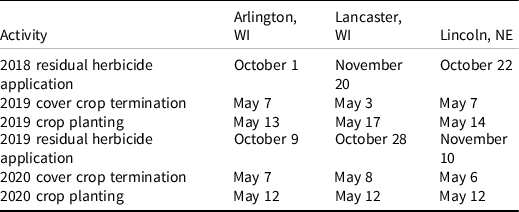
a Soil management practices were implemented within 3 d following residual herbicide application in the fall. Clay content of soil was 26%, 32%, and 18%, soil organic matter was 3.1%, 3.0%, and 2.5%, and soil pH was 6.0, 6.8, and 5.2 at the Arlington, Lancaster, and Lincoln sites, respectively.
Tillage treatments at Arlington and Lancaster included chisel plow in the fall following residual herbicide application and field cultivation in the spring immediately before crop planting; at Lincoln, an offset disk was used in the fall only. The cereal rye cover crop variety ‘Guardian Winter Rye’ (La Crosse Seed, La Crosse, WI) was used at Arlington and Lancaster, and ‘Elbon Cereal Rye’ (Green Cover Seed, Bladen, NE) was used at Lincoln. The cereal rye was drilled at 67 kg ha−1 with 19-cm row spacing at 3.2-cm seeding depth in the fall following the harvest of the previous crop and residual herbicide application. Cereal rye was terminated with glyphosate (1.26 kg ae ha−1; Roundup PowerMax®, Bayer Crop Science, St Louis, MO) plus ammonium sulfate (1% v/v) 4 to 7 d before crop planting. Crops were planted using a row-crop planter with 76-cm row spacing and 3.8-cm seeding depth. The corn hybrid ‘P0339AM’ (Pioneer, Johnston, IA) was planted at 80,300 seeds ha−1 at Arlington and Lancaster and 79,000 seeds ha−1 at Lincoln. This hybrid was selected for its sensitivity to the acetolactate synthase–inhibiting herbicide, imazethapyr (Corteva Agriscience 2020). The soybean variety ‘P22T1R2’ (Pioneer, Johnston, IA) was planted at 345,900 seeds ha−1 at Arlington and Lancaster and 370,000 seeds ha−1 at Lincoln. Soil fertility was managed in each experiment according to recommendations from the University of Wisconsin–Madison (Arlington and Lancaster) and the University of Nebraska–Lincoln (Lincoln) for optimum nitrogen, phosphorus, and potassium availability (Laboski and Peters Reference Laboski and Peters2012; Shaver 2014). Glyphosate plus ammonium sulfate (1% v/v) was applied postemergence as needed to maintain weed-free conditions.
Data Collection
Average monthly temperature and accumulated precipitation during the growing season were collected with onsite weather stations and are summarized in Table 2.
Monthly average air temperature and accumulated precipitation during the 2019 growing season, 2020 growing season, and 30-yr normal (1988–2018) at Arlington, WI, Lancaster, WI, and Lincoln, NE. a

a The 2019 and 2020 growing season temperatures were collected with on-site weather stations. The 30-yr monthly normal weather was estimated in R software using historic daily weather data (Correndo et al. Reference Correndo, Moro Rosso and Ciampitti2021).
Growth of the cereal rye cover crop was assessed at the time of termination by taking photos to assess canopy cover, after which aboveground biomass was harvested. A 0.09-m2 quadrat was used to delineate the area used for canopy assessment. Photos of three random locations in each cover crop plot were collected with a smartphone camera and analyzed with Canopeo Software (Oklahoma State University, Division of Agricultural Sciences and Natural Resources Soil Physics program, Stillwater, OK; https://canopeoapp.com) to determine percent green canopy cover from each subsample (0% to 100%, with no green canopy at 0% and complete canopy cover at 100%) using default settings (red/green: 0.95; blue/green; 0.95, noise reduction: 100) (Arsenijevic et al. Reference Arsenijevic, Avellar, Butts, Arneson and Werle2021; Patrignani and Ochsner Reference Patrignani and Ochsner2015; Potratz et al. Reference Potratz, Mourtzinis, Gaska, Lauer, Arriaga and Conley2020; Ribeiro et al. Reference Ribeiro, Oliveira, Smith, Santos and Werle2021). The percentage of canopy cover used for analysis was determined for each plot by calculating the average percent canopy cover from the three photos. Aboveground biomass subsamples were collected from three random locations in each cover crop plot using a 0.09-m2 quadrat. Biomass subsamples were combined and dried at 50 C until constant mass. Sample mass was converted to kilograms of biomass per hectare.
Residual herbicide carryover treatment effects on corn and soybean were assessed using visual ratings of crop injury, early-season stand counts, crop canopy photos, and crop grain yield. Visual ratings of injury (0% = no injury, 100% = dead), crop canopy photos, and stand counts were collected in each plot at the V3 to V4 crop stage in both corn and soybean. Canopy photos were collected at four random locations in each plot using a 76-cm2 quadrat to delineate the photo area (Arsenijevic et al. Reference Arsenijevic, Avellar, Butts, Arneson and Werle2021). Photos were processed and prepared for analysis following the methodology used for cover crop canopy photos. Stand counts were collected using two 1.5-m of row subsamples from each plot. Subsample counts were pooled and converted to plants per hectare. Grain mass from crop yield was machine harvested at crop physiological maturity and standardized to 15.5% moisture for corn and 13% moisture for soybean before being converted to kilograms per hectare.
Statistical Analyses
All analyses were performed in R Software for statistical computing v. 3.6.2 (R Foundation for Statistical Computing 2014). A linear mixed model (LMM) (lme4 package) with normal distribution was fit to data for cover crop biomass, stand counts, and grain yield. A generalized linear mixed model (GLMM) with Template Model Builder with a beta distribution and logit link (glmmTMB package) was fit to data for cover crop canopy and crop canopy. The LMM assumptions for normal distribution and homogeneity of variance of residuals were assessed before analysis. The LMMs were analyzed with ANOVA (anova function, car package). All response variables were analyzed with separate models for each crop. Data were not collected for the 2020 Arlington corn experiment due to establishment error. Canopy photos were compromised for the Arlington 2019 corn and soybean experiments; therefore, these data were not included in the analyses.
Models for cover crop canopy, cover crop biomass, crop stand counts, and crop canopy tested for differences across site-years, because data varied greatly within and among sites. In LMMs for cover crop biomass, site-year and herbicide treatment were included as fixed effects, while blocks nested within site-year were included as a random effect. Cover crop biomass data were square-root transformed before analysis to better meet LMM assumptions of normal distribution of residuals and homogeneity of variance. In the LMMs for stand counts and GLMMs for canopy cover, site-year, soil management treatment, and herbicide treatment were included as fixed effects, while blocks nested within site-year were included as a random effect. When interactions or fixed effects were significant in ANOVA (P ≤ 0.05), means were separated using Fisher’s LSD (emmeans package).
Models for crop yield were analyzed separately for each site (Arlington, Lancaster, and Lincoln) with data pooled between years, because results varied among sites. In LMMs for grain yield, soil management treatment and herbicide treatment were included as fixed effects, while blocks nested within year were included as a random effect. When interactions or fixed effects were significant in ANOVA (P ≤ 0.05), means were separated using Fisher’s LSD.
Results and Discussion
Weather
Seasonal average temperature for the growing season was comparable to the 30-yr normal at all three locations, although temperatures in April and May were colder than normal at Arlington 2019, Arlington 2020, Lancaster 2019, Lancaster 2020, and Lincoln 2020 (Table 2). Seasonal precipitation was higher than normal at Arlington and Lancaster in 2019 and 2020, whereas precipitation was below normal at Lincoln in 2020 (Table 2).
Cover Crop Biomass and Canopy Cover
Corn Experiments
Herbicide treatments did not affect cereal rye biomass and canopy cover in corn (biomass P = 0.50; canopy cover P = 0.09). The site-year fixed effect was significant for cover crop biomass (P < 0.001) and canopy cover (P < 0.001). Biomass ranged from 135 to 888 kg ha−1 across site-years for the cereal rye planted preceding corn (Table 3). Cover crop canopy cover ranged from 7% to 45% cover across site-years.
Cereal rye cover crop biomass, percent canopy cover, and crop stands across site-years for corn and soybean experiments conducted in 2019 and 2020 in Arlington, WI, Lancaster, WI, and Lincoln, NE. a

a Means separated using Fisher’s LSD and site-year values within a column that are followed by similar letters are not significantly different from each other at α = 0.05. A dash (—) denotes no data.
b Significance at: *P < 0.05; **P < 0.01; ***P < 0.001.
Previous research on herbicide carryover into cover crops reported cereal rye injury from imazethapyr 3 wk after planting but no reduction in biomass, but no injury from fomesafen was observed (Rector et al. Reference Rector, Pittman, Beam, Bamber, Cahoon, Frame and Flessner2019). In a herbicide bioassay in which soil was treated with imazethapyr, cereal rye had similar biomass compared with the nontreated control (Ribeiro et al. Reference Ribeiro, Oliveira, Smith, Santos and Werle2021). Findings from these studies indicate that the likelihood of observing cereal rye cover crop biomass or canopy reduction from carryover of fomesafen or imazethapyr is low.
Soybean Experiments
Herbicide treatments did not affect cereal rye biomass or canopy cover in soybean experiments (biomass P = 0.70; canopy cover P = 0.84). The site-year fixed effect was significant for cover crop biomass (P < 0.001) and canopy cover (P < 0.001). Biomass ranged from 131 to 763 kg ha−1 across site-years for the cereal rye planted preceding soybean (Table 3). Canopy cover ranged from 8% to 38% cover across site-years for cereal rye planted preceding soybean.
Previous research on herbicide carryover into cover crops observed injury to cereal rye from clopyralid 3 wk after planting with no reduction in biomass, but no injury was observed for mesotrione (Rector et al. Reference Rector, Pittman, Beam, Bamber, Cahoon, Frame and Flessner2019). Research conducted in Missouri observed no reduction in cereal rye stand or biomass from mesotrione or clopyralid (Cornelius and Bradley Reference Cornelius and Bradley2017). Similarly, no effects were observed from mesotrione carryover on cereal rye cover crop biomass or stand from research conducted in Arkansas (Palhano et al. Reference Palhano, Norsworthy and Barber2018). Findings from these studies indicate that the likelihood of observing cereal rye cover crop biomass or canopy reduction from carryover of clopyralid or mesotrione is low.
Early-Season Crop Stand Count
Corn Experiments
Herbicide treatment or soil management did not influence early-season corn stand counts (herbicide treatment P = 0.51; soil management P = 0.90). The site-year fixed effect was significant in the stand count model for corn (P < 0.001). Corn stand counts ranged from 79,000 to 90,000 plants ha−1 across site-years (Table 3). Similarly, previous research with rotational crops observed no stand loss in corn from carryover of soybean herbicides despite injury being observed (Walsh et al. Reference Walsh, Defelice and Sims1993). Although there were no observed effects of soil management on crop stand in this study, previous research has observed a reduction in corn stand from use of a cereal rye cover crop when seed to soil contact was reduced was reduced by rye residue in the seed furrow (Eckert Reference Eckert1988).
Soybean Experiments
Herbicide treatment or soil management did not affect early-season stand counts in soybean (herbicide treatment P = 0.70; soil management P = 0.14). The site-year fixed effect was significant in the stand count model for soybean (P < 0.001). Soybean stand counts ranged from 261,000 to 296,000 plant ha−1 across site-years (Table 3).
Crop Canopy Cover
Corn Experiments
The herbicide treatment (P = 0.02) fixed effect and site-year by soil management interaction (P < 0.001) were significant. Canopy cover was lower for the IM50 (11.5%) herbicide treatment compared with the FO50 (12.3%) treatment, but not different from the CTRL (12.1%), FO25 (12.1%), and IM25 (12.3%) treatments (Figure 1). At Arlington 2019, canopy cover was lower for the no-till (4.3%) and cover crop (4.2%) soil management treatments compared with the tillage (5.2%) treatment (Figure 1). At Lancaster 2019, canopy cover was lower in the cover crop (6.2%) treatment compared with the tillage (7.7%) treatment, while canopy cover for the no-till (7.0%) treatment was similar to that of the tillage and cover crop treatments. At Lancaster 2020, canopy cover in the cover crop (26.8%) treatment was lower than in the tillage (30.0%) and no-till (30.5%) treatments. At Lincoln 2019, canopy cover was lower for the no-till (9.0%) treatment compared with tillage (10.9%) and cover crop (10.6%) treatments. At Lincoln 2020, canopy cover was similar among the tillage (16.5%), no-till (15.6%), and cover crop (16.1%) treatments.
Influence of herbicide carryover (left) and soil management (right) on early-season percent canopy cover in corn. Herbicide treatments include nontreated control (CTRL), 25% fomesafen rate (FO25), 50% fomesafen rate (FO50), 25% imazethapyr rate (IM25), and 50% imazethapyr rate (IM50) applied in the previous fall. Soil management separated between cropping season (2019 and 2020) and the research sites Arlington, WI, Lancaster, WI, and Lincoln, NE. Jittered points represent actual data, centered solid points represent the means, and error bars represent 95% confidence intervals. Means were separated using Fisher’s LSD, and treatments with the same letters are not different at α = 0.05.
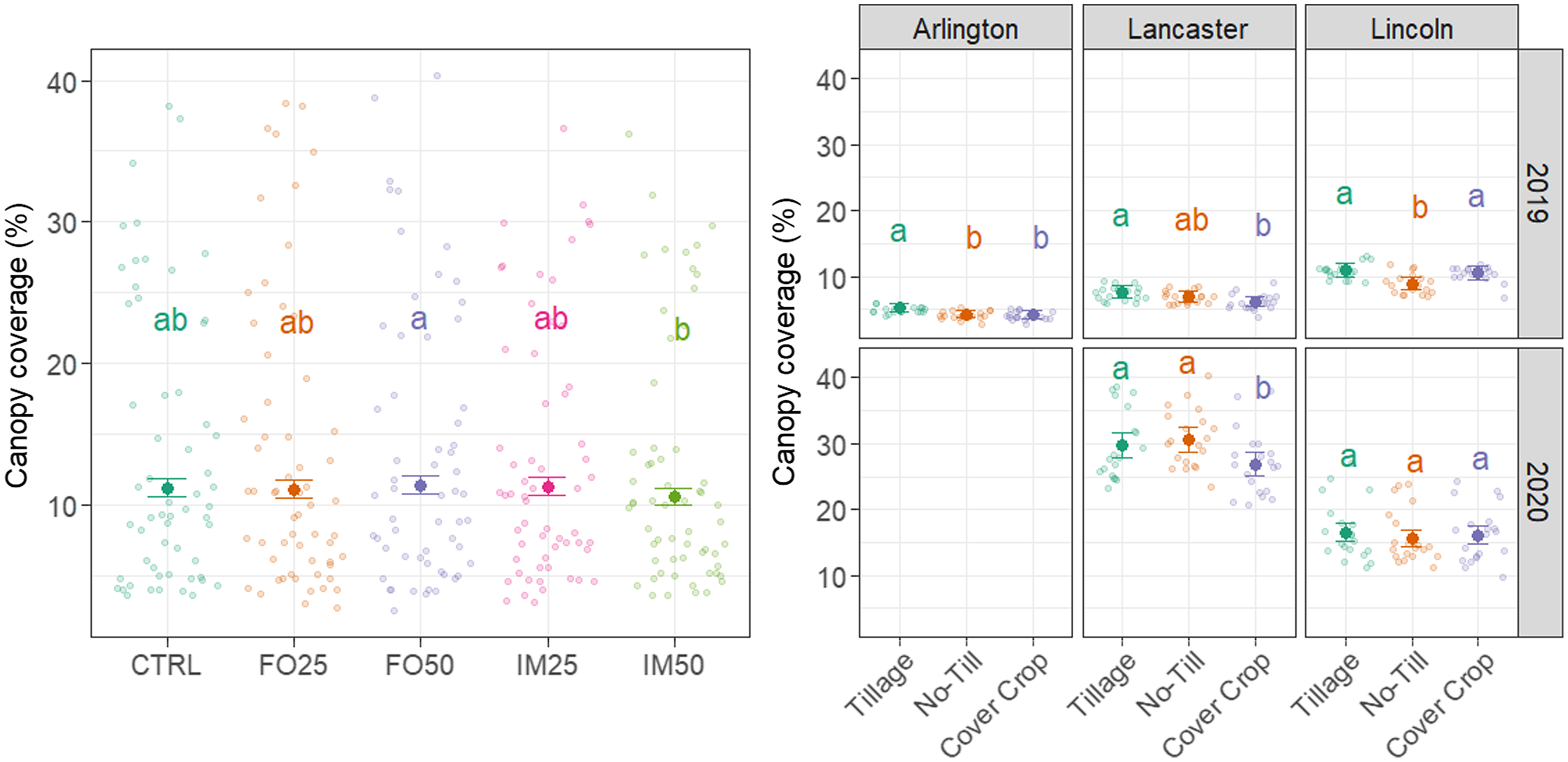
Corn canopy cover did not differ between any of the herbicide treatments and the nontreated control. Canopy assessments in this study varied greatly across site-years when using the crop growth stage for assessment. Collecting crop canopy samples at a predetermined time in relation to crop planting (Arsenijevic et al. Reference Arsenijevic, Avellar, Butts, Arneson and Werle2021) or tracking differences in canopy cover until reaching a target percent canopy cover (Potratz et al. Reference Potratz, Mourtzinis, Gaska, Lauer, Arriaga and Conley2020) could be a better indicator of treatment differences in canopy development. Visible crop injury was absent or too inconsistent to be used for analysis in all experiments, so data are not shown. Expected injury symptomology from fomesafen carryover was striped leaves from chlorotic/necrotic leaf veins, especially down the midrib.
Soybean Experiments
The herbicide treatment (P = 0.03) fixed effect and the site-year by soil management interaction (P < 0.001) were significant. Canopy cover was lower in the ME50 (13.3%) herbicide treatment compared with the CTRL (13.9%), CL25 (14.3%), and ME25 (14.2%) treatments (Figure 2). Canopy cover for the CL50 (13.8%) treatment was similar to that of all other treatments. At Arlington 2019, canopy cover was lower for the no-till (11.0%) and cover crop (9.1%) soil management treatments compared with the tillage treatment (14.5%) (Figure 2). At Lancaster 2019, canopy cover differed among the tillage (13.7%), no-till (10.3%), and cover crop treatments (9.1%) (Figure 2). At Lincoln 2019, canopy cover was lower for the no-till (8.4%) and cover crop (9.1%) soil management treatments compared with the tillage treatment (11.1%) (Figure 2). At Lincoln 2020, canopy cover was lower for the no-till (7.3%) and cover crop (7.3%) soil management treatments compared with the tillage treatment (8.5%). Canopy cover was similar among treatments at Arlington 2020 and Lancaster 2020.
Influence of herbicide carryover (left) and soil management (right) on early-season percent canopy cover in soybean. Herbicide treatments include nontreated control (CTRL), 25% clopyralid rate (CL25), 50% clopyralid rate (CL50), 25% mesotrione rate (ME25), and 50% mesotrione rate (ME50) applied in the fall. Soil management separated between cropping season (2019 and 2020) and the research sites Arlington, WI, Lancaster, WI, and Lincoln, NE. Jittered points represent actual data, centered solid points represent the means, and error bars represent 95% confidence intervals. Means were separated using Fisher’s LSD, and treatments with the same letters are not different at α = 0.05.

Soybean canopy cover was minimally influenced by herbicide carryover and soil management for soybean, with less than 1% lower cover based on herbicide treatment and less than 6% lower cover based on soil management (Figure 2). Previous research with similar methodology for assessing crop canopy cover observed 1.5% lower canopy cover in soybean at the V2 growth stage from sulfentrazone applied preemergence (Arsenijevic et al. Reference Arsenijevic, Avellar, Butts, Arneson and Werle2021). Similar methodology for canopy assessment observed variation in time to reach 50% soybean canopy cover between strip-till and no-till depending on year (Potratz et al. Reference Potratz, Mourtzinis, Gaska, Lauer, Arriaga and Conley2020). Early-season soybean canopy cover was greatest in soil management with tillage for most site-years in this study. Visible crop injury was absent or too inconsistent to be used for analysis in all experiments, so data are not shown.
Crop Yield
Corn Experiments
Herbicide treatment did not affect corn yield, as the interaction with soil management and the herbicide treatment fixed effect were not significant for Arlington (P = 0.88), Lancaster (P = 0.95), or Lincoln (P = 0.90). The soil management fixed effect was significant for Arlington (P = 0.04), Lincoln (P < 0.001), and Lancaster (P < 0.001). At Arlington, grain yield was lower for the cover crop (11,200 kg ha−1) soil management treatment compared with the tillage (12,300 kg ha−1) and no-till (12,100 kg ha−1; Figure 3). At Lincoln, grain yield was lower for the for the no-till (10,300 kg ha−1) and cover crop (10,400 kg ha−1) soil management treatments compared with tillage (11,200 kg ha−1). At Lancaster, grain yield was lower for the cover crop (10,300 kg ha−1) and no-till (10,000 kg ha−1) soil management treatments compared with the tillage (13,100 kg ha−1) treatment.
Influence of soil management on corn yield. Jittered points represent actual data, centered solid points represent the means, and error bars represent 95% confidence intervals. Means were separated using Fisher’s LSD, and treatments with the same letters are not different at α = 0.05.

These findings indicate that when half the label rate of fomesafen or imazethapyr is present in the soil following soybean harvest, the risk for injury or yield loss in the subsequent corn crop is low under the environmental and soil conditions encountered in this research. Also, the differences in corn canopy cover from herbicide treatment did not affect corn yield (Figure 1). Previous field research observed reduced leaf chlorophyll content and root volume from fomesafen carryover in 10-d-old corn plants when planted 65 d after application (Cobucci et al. Reference Cobucci, Silva João and Prates1997). Fomesafen carryover injury in sweet corn was dependent on varietal tolerance, while risk of carryover injury was suggested to be low and avoidable with proper hybrid selection (Rauch et al. Reference Rauch, Bellinder, Brainard, Lane and Thies2007). Imazethapyr has been shown to reduce corn shoot and root growth in greenhouse experiments (Renner et al. Reference Renner, Meggitt and Penner1988), with roots being more sensitive than shoots (Loux et al. Reference Loux, Liebl and Slife1989). Field studies found no observed reduction of corn yield when nonlethal herbicide carryover injury from fomesafen or imazethapyr occurred (Cobucci et al. Reference Cobucci, Silva João and Prates1997; Loux et al. Reference Loux, Liebl and Slife1989; Walsh et al. Reference Walsh, Defelice and Sims1993). Regarding soil management practices, previous research in Wisconsin found that corn grain yield was similar between tillage and no-till systems in a corn–soybean rotation (Mourtzinis et al. Reference Mourtzinis, Marburger, Gaska, Diallo, Lauer and Conley2017; Pedersen and Lauer Reference Pedersen and Lauer2003), contradicting findings from Lancaster in this study. In Nebraska, tillage was shown to increase corn grain yield compared with no-till in years with cooler springs (Wilhelm and Wortmann Reference Wilhelm and Wortmann2004). Lower corn grain yield in the soil management with a cover crop compared with no-till at Arlington in this study corroborates previous research conducted in Iowa that also observed lower corn grain yield for a cover crop terminated before planting compared with no-till (Pantoja et al. Reference Pantoja, Woli, Sawyer and Barker2015).
Soybean Experiments
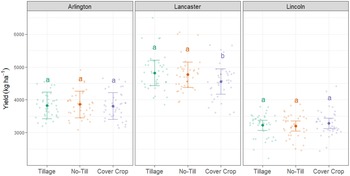
Herbicide treatment did not influence soybean yield, as the herbicide treatment interactions or fixed effects were not significant at Arlington (P = 0.09), Lancaster (P = 0.61), or Lincoln (P = 0.68). Soil management influenced soybean yield at Lancaster (P = 0.01), but not at Arlington (P = 0.59) or Lincoln (P = 0.57). At Lancaster, soybean yield was lower in the cover crop (4,600 kg ha−1) soil management treatment compared with tillage (4,800 kg ha−1) and no-till (4,800 kg ha−1) (Figure 4).
Influence of soil management on soybean yield. Jittered points represent actual data, centered solid points represent the means, and error bars represent 95% confidence intervals. Means were separated using Fisher’s LSD, and treatments with the same letters are not different at α = 0.05.
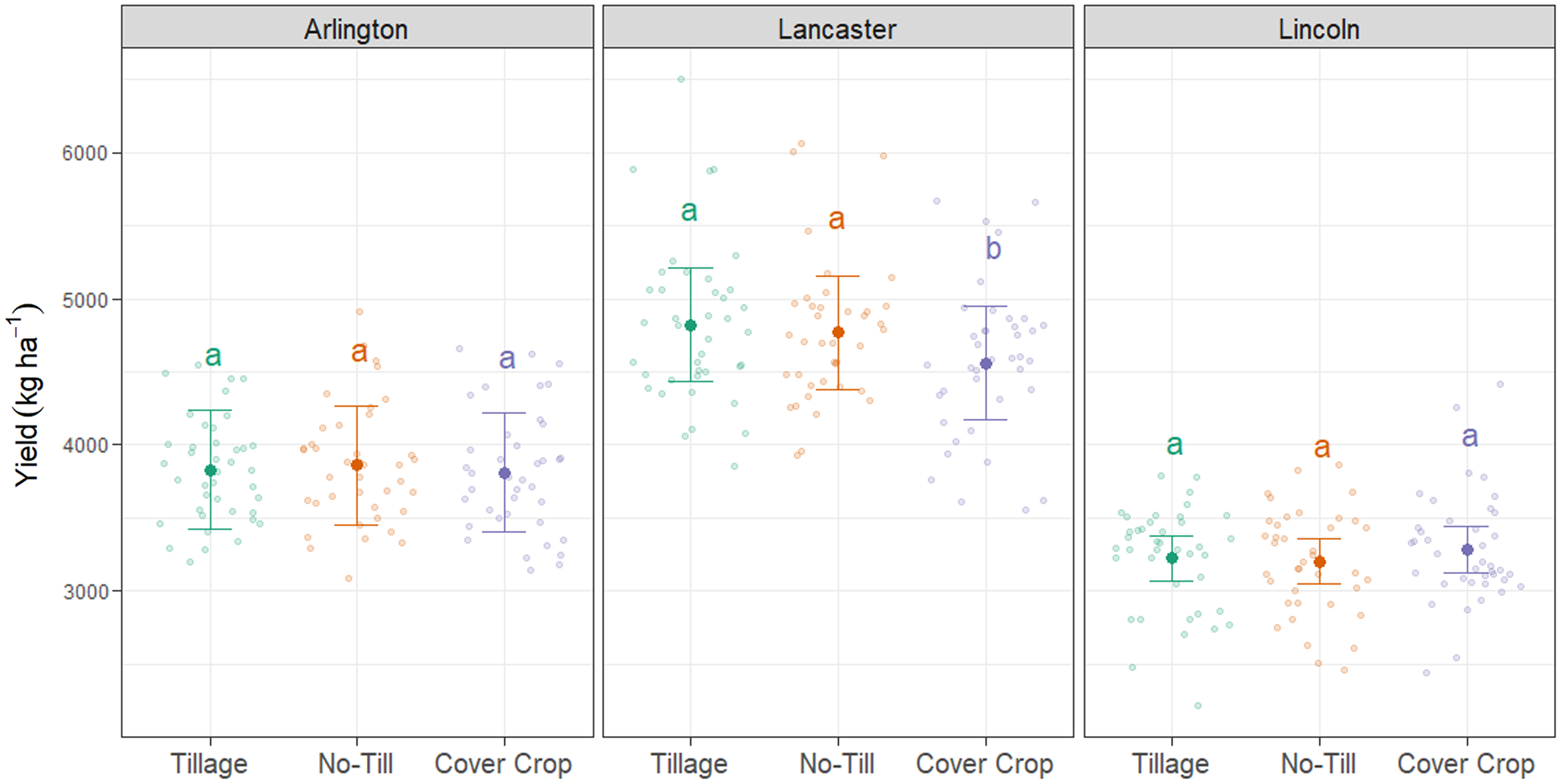
These findings indicate that when half the label rate of clopyralid or mesotrione are present in the soil following crop harvest, the risk for injury or yield loss in the subsequent soybean crop is low under the environmental and soil conditions encountered in this research. Also, the differences in early-season soybean crop canopy cover from herbicide treatment did not affect soybean yield (Figure 2). Field research in soybean following wheat (Triticum aestivum L.) observed a reduction in soybean height from clopyralid carryover (Thorsness and Messersmith Reference Thorsness and Messersmith1991). Field trials simulating mesotrione carryover 1 yr after applications of 144 to 576 g ai ha−1 did not observe injury in soybean; however, injury was observed in field pea (Pisum sativum L.; Pintar et al. Reference Pintar, Stipicevic, Svecnjak, Baric, Lakic, Sraka, Pintar, Stipicevic, Svecnjak, Baric, Lakic and Sraka2020). In contrast, soybean injury occurred in another study simulating mesotrione carryover 1 yr after application when rates exceeded 280 g ai. ha−1, although injury did not affect crop yield (Riddle et al. Reference Riddle, O’Sullivan, Swanton and Acker2013). Regarding soil management practices, previous research in Wisconsin has observed cases of lower (Pedersen and Lauer Reference Pedersen and Lauer2003), higher (Pedersen and Lauer Reference Pedersen and Lauer2002), and no difference in soybean yield (Mourtzinis et al. Reference Mourtzinis, Marburger, Gaska, Diallo, Lauer and Conley2017) from management with tillage compared with no-till. In Nebraska, similar soybean yield has been observed between soil management with no-till and tillage (Wilhelm and Wortmann Reference Wilhelm and Wortmann2004). Similar soybean yield between soil management with no-till compared with a cereal rye cover crop at Arlington and Lincoln in this study is consistent with findings from previous research (Pantoja et al. Reference Pantoja, Woli, Sawyer and Barker2015; Reddy et al. Reference Reddy, Zablotowicz, Locke and Koger2003).
In conclusion, there was no evidence that herbicide carryover on the soil types in this study affected crop development and yield. The highest herbicide rates used in this study and the timing of application represent a field scenario in which the herbicides used had undergone one half-life at the time of crop harvest, which is longer than the estimated half-life time for all herbicides evaluated. These results indicate that carryover of fomesafen and imazethapyr in corn and clopyralid and mesotrione in soybean, when applied at labeled rates, is unlikely to affect cereal rye, corn, and soybean growth and productivity across a range of diverse soil management practices when used in silt loam and silty clay loam soils in the U.S. Midwest region.
Acknowledgments
Partial funding to support this research was provided by the NCR-SARE’s Graduate Student Grant Program, Wisconsin Soybean Marketing Board, and Wisconsin Corn Promotion Board. We would like to thank the staff at the University of Wisconsin–Madison Arlington Agricultural Research Station, University of Wisconsin–Madison Lancaster Agricultural Research Station, and University of Nebraska Havelock Farm. We would also like to thank the personnel of the University of Wisconsin Cropping Systems Weed Science and University of Nebraska Extension Weed Science Labs for their technical assistance with this research. No conflicts of interest have been declared.




 Open access

