

1. Introduction
The United Nations Secretary General’s Panel on Critical Energy Transition Minerals recently affirmed that ‘rules-based and non-discriminatory international investments and trade agreements, frameworks and initiatives should … promote structural transformation through value addition and economic diversification’.Footnote 1 In practice, however, the access objectives of import-dependent, resource-hungry countries often contend with the industrialization objectives of exporting, resource-rich countries.Footnote 2 While the former develop trade tools to protect them from geopolitically motivated supply chain weaponization and secure critical mineral (CM) supplies, the latter seek to capture resource rents, advance industrial policies, and develop downstream industries using their CMs through trade policy.Footnote 3
Recent efforts to secure differing sets of objectives have led to a proliferation of narrow and largely non-binding international instruments on trade and investment in CMs. This paradigm shift in the form of global trade integration and cooperation is reflective of the diminishing power of binding rules, substituted or complemented by facilitative and cooperative mechanisms built upon legally non-binding frameworks. While the rise in non-binding international agreements has been generally noted,Footnote 4 their effects and potential consequences on the larger body of existing international economic law and relations remain largely unexplored. As a result, international instruments, such as critical minerals-related trade instruments (CMTIs), remain under analysed, whether as individual policy tools of international collaboration or as a collective reflection of emerging international rulemaking.
Therefore, by shedding light on and raising critical questions about the global economic governance of CM trade, which is evolving through narrow, bilateral, and non-binding instruments, this article seeks to bridge this gap in the literature and highlight emerging trends. It finds that CMTIs bear several systemic and institutional implications for rulemaking and governance in international trade. They are primarily investment-identifying and investment-facilitating instruments. They may shift agency away from resource-rich states, lead to the concentration of norm entrepreneurship amongst a few ‘repeat players’, and result in selective de-judicialization (resulting from the selective non-bindingness of developmental commitments juxtaposed against the bindingness of trade liberalizing rules). As such, they are also likely to exacerbate opacity in international relations, inter alia.
The article concludes by urging a re-examination of the emerging global governance framework on trade in CMs, towards cooperative governance and better balance between sovereign interests. In doing so, the article seeks to complement the existing rich literature on the legality of resource-oriented trade policies through a study of evolving trade cooperation tools.
2. Setting the Context
2.1 A Break with the Past: From Commodity Agreements to Mineral ‘Partnerships’
Natural resources form the bedrock of the ‘material world’.Footnote 5 Yet, commodity trade has been traditionally mired in challenges to balance scarcity and supply considerations with price stability, resource sovereignty, and their necessity for global economic development, manufacturing-based economies, and subsequent economic security. Moreover, resource wealth does not automatically translate into economic development, as the ‘resource curse’Footnote 6 theory highlighting poor socio-economic performance of resource-dependent economies has shown. This dichotomy underlies the existence of two factions whose interests are in constant tension: the resource rich and the resource hungry. The resource-rich countries rely upon commodity-driven economic growth policies, whereas the resource hungry require raw materials sourced from abroad to service their economies. Therefore, the ability to access resources, and to capture and maximize resource rents, have been fundamental drivers of resource policy design.
As a result, deliberate domestic and international policies have been intended to maximize benefits and ensure equitable distribution of the gains from resource wealth, while facilitating access to those countries lacking resource wealth. The body of international law has been traditionally deployed to secure a variety of these aims,Footnote 7 beginning from the reference to the need to ensure ‘access, on equal terms, to the trade and to the raw materials of the world which are needed for their economic prosperity’.Footnote 8 International trade and investment laws have since secured access to resources by liberalizing trade and investment, and introducing prohibitions on the use of trade restrictions to support downstream industrialization using raw materials. Of note, rules relating to export restrictions and trade-related investment measures are relevant to trade liberalization and can be found in the WTO Legal Texts and FTAs.Footnote 9 Simultaneously, as the substance of international rules was evolving, post-colonial movements, such as the New International Economic Order and the principle of permanent sovereignty over natural resources (PSNR), attempted to secure the rights of resource-rich countries over their resource wealth.Footnote 10 Historically, international commodity agreements (ICAs) regarding ‘non-critical’ products,Footnote 11 such as tin, copper, aluminium, and silver, and agricultural products, such as cocoa, coffee, tea, rubber, and timber, have been forged as means to stabilize supply and price, and have been unsuccessful in most instances due to a variety of reasons.Footnote 12 In contrast, the oil industry, given its concentration in production and its significance to financial markets, has been operating through a global cartel. Legally, both ICAs and oil have been shielded from disputes, via a specific exception under Article XX(h) of the General Agreement on Tariffs and Trade (GATT) and a ‘gentlemen’s agreement’ allegedly keeping energy-related issues outside the scope of multilateral trade rules.Footnote 13
Could the same models apply to today’s CMs? The non-critical goods, while being crucial for economic development and enjoying diversified supply sources, may not necessarily be scarce and sparse or serve as strategic inputs to defence sectors. They may instead pose other global economic problems, such as ‘overcapacity’ issues arising from heavy industrial subsidization.Footnote 14 In contrast, today’s debates on critical minerals arise from their limited global distribution both in their raw formats and processing stages of value chains, and strategic significance of these minerals in their application in security and futuristic technologies.Footnote 15 These minerals display high concentration of supply chainsFootnote 16 and are mainly applied in highly specialized energyFootnote 17 and defence technologies,Footnote 18 making their ownership economically and strategically desirable while shaping a global competition to gain control over their supply chains. Meanwhile, some countries, such as China, have foreseen and identified the strategic benefits that accompany early control over such supply chains and have deployed state intervention mechanisms to strengthen their stronghold over global CM supply chains at both upstream and downstream levels.Footnote 19 The Belt and Road Initiative has been instrumental to China’s foreign infrastructure investment model of accessing foreign CMs, including in Africa.Footnote 20 Resultantly, Chinese share of global processing is between 60–70% for lithium and cobalt, and around 90% for rare earths.Footnote 21 Only recently have other countries realized the risks such near-monopoly control poses, starting with the Chinese weaponization of CM supply chains during the China–Japan standoff over the South China Sea in 2010, and the more recent episodes of Chinese export restrictions on a range of CMs such as gallium and germanium.Footnote 22 However, the nature of the risk posed by Chinese dominance of CM supply chains has been questioned. Some find that China did not weaponize rare earth supply chains against any one specific country in 2010,Footnote 23 while others highlight those Chinese policies on CMs are less sadistic or hostile and more strategically imperative for domestic development.Footnote 24
Thus, although such contentions persist, the perception of risk, arising from Chinese domination amid fragile geopolitical relations between the West and China, has led to growing global economic security concerns and the rise of economic statecraft. Reducing supply chain vulnerabilities in CMs while strengthening domestic industries to retain economic competitiveness have become key strategic and industrial objectives of resource-hungry countries. This group, including the United States, the EU, Japan, Korea, and the United Kingdom, also coincides with what is known as ‘the West’. Resource-hungry countries are exploring the role of trade policy, outward industrial policy,Footnote 25 and international collaboration in pursuing ‘resource diplomacy’, i.e., carefully designed foreign policy for access to and management of resources, with non-China economies, as part of their national CM strategies. At the same time, resource-rich economies in Africa, South America, and South-East Asia have their own set of legitimate developmental objectives, such as economic diversification, CM-led industrialization, and protection of vulnerable communities from the adverse outcomes of increased extraction.Footnote 26 The resulting proliferation of Western CMTIs seeks to counter supply chain vulnerabilities and excessive Chinese control, through a number of bilateral partnerships to stabilize trade and investment relations, facilitate economic exchange, re-emphasize best practices, and promote the adoption of high sustainability standards.
This article does not aim to provide a comprehensive reasoning of this divergence in approaches between past ICAs and current use of mineral diplomacy – rather, it merely notes the key differences between the historical and contemporary contexts underlying minerals trade, which may correlate with the different policy responses to the current issue. First, the rush for CMs to service the green transition is popularly perceived as presenting renewed opportunities to overcome structural barriers and secure higher levels of economic developmentFootnote 27 by correcting colonial extractivist legacies. Therefore, while security considerations, urgency of the energy transition, and goals of strategic competitiveness make contemporary trade and investment patterns in CMs different from the past, the dichotomy between the respective objectives of the resource rich and resource hungry continues to exist. Acknowledging these continued differences, albeit in a different geopolitical context, therefore becomes essential to applying a critical lens to assess implications of evolving international trade instruments.
Second, despite the continued divergence in interests, the recent bilateral approach to governing international trade and investment in minerals contrasts with the traditional mechanisms reflected in commodity agreements. A key reason could be that price stability is neither the sole nor primary concern anymore,Footnote 28 even if it is still important to maintain a conducive environment for industry; rather, the geopolitics underlying supply chain resilience and diversification of trading partners while maintaining and promoting viable global value chains with trusted partners take frontal policy concerns of developed, resource-hungry economies. Yet, for resource-rich countries, commodity agreements and cartel-like behaviour to secure high commodity prices may appear lucrative. However, lessons from the past, incoherent policy preferences amongst the resource rich, and a desire to derive long-term economic benefits may overcome the temptation of immediate higher prices. As a result, preliminary discussions on producer cartels on CMs have not yet formalized, while CM partnerships are being considered as critical to driving trade and investment cooperation and facilitation.
Accordingly, the focus of this article remains the various partnerships or critical minerals related trade instruments (CMTIs) that resource-hungry countries have entered in order to overcome Chinese control of CM supply chains. The process of identification is explained next.
2.2 Methodology for Selection of Countries and Relevant Instruments
Due to the absence of a centralized body monitoring the number of CMTIs signed globally, this article relies extensively upon the International Energy Agency (IEA) database of ‘international collaboration’ on CMs. The IEA database indicates that the countries with the maximum CMTIs are the EU, the United States, and Japan, alongside Australia and Canada. These governments are not only the most active in signing CMTIs; they also constitute the biggest demanders of CMs as well as large suppliers, and they are all coincidentally economically developed. Therefore, the analysis here focuses on CMTIs predominantly signed by and amongst these countries. Moreover, this focus on developed resource-hungry and resource-rich countries allows this article to trace the features of CMTIs dominated by these actors, and identify the potential implications for their partner resource-rich countries that are typically lesser developed. As a result, although international partnerships are increasingly a feature of commodity-dependent developing countries’ minerals strategies as evidenced by the African Green Minerals Strategy,Footnote 29 this article remains focused on the wide network of CMTIs by and amongst developed resource-hungry countries and the implications of the evolving landscape of trade cooperation and power dynamics at their behest.
It should be noted that a number of CMTIs were missing from the IEA database (such as the Canada–UK CMTI, at the time of writing); the author has also identified additional CMTIs noted on each government’s websites or through press releases on CMs. This hybrid approach highlights the challenges associated with such delocalized and decentralized models of cooperation as opposed to conventional treaties.
Thus far, the EU has signed Memoranda of Understanding (MoU)Footnote 30 with Canada, Ukraine, Namibia, Kazakhstan, Argentina, Chile, the Democratic Republic of the Congo (DRC), Zambia, Greenland, Rwanda, Uzbekistan, Australia, and Serbia as part of its outward looking trade strategy,Footnote 31 in addition to being a member of the Minerals Security Partnership (MSP). The United States has recently signed a number of MoUs with countries including Mongolia,Footnote 32 Norway,Footnote 33 Peru,Footnote 34 Argentina,Footnote 35 India,Footnote 36 Uzbekistan,Footnote 37 Saudi Arabia,Footnote 38 Thailand,Footnote 39 and Malaysia.Footnote 40 It also has a trilateral MoUFootnote 41 with the DRC and Zambia, a compact with Australia,Footnote 42 an ‘overview of political understandings’ with Korea,Footnote 43 and a deal with Ukraine in the context of post-war reconstruction assistance based on resource diplomacy.Footnote 44 More recently, the United States has signed ‘framework agreements’ with AustraliaFootnote 45 and Japan,Footnote 46 with whom it also has an earlier ‘Critical Minerals Agreement’.Footnote 47 Additionally, the US Geological Survey has also entered MoUs with its counterparts in the Dominican RepublicFootnote 48 and both Australia and Canada to coordinate their mapping and research efforts.Footnote 49 Japan has signed CMTIs with resource-rich countries, such as Australia,Footnote 50 Canada,Footnote 51 and Peru,Footnote 52 and with resource-hungry countries, such as the UK,Footnote 53 in addition to signing the critical minerals agreement with the United States. This article also examines Australia’s CMTIs with Japan, Germany,Footnote 54 France,Footnote 55 Korea,Footnote 56 the UK,Footnote 57 the United States,Footnote 58 the EU, India,Footnote 59 and Canada, as well as Canada’s CMTIs with the United States,Footnote 60 the EU, Japan, Germany,Footnote 61 the UK,Footnote 62 South Korea,Footnote 63 Australia, Italy,Footnote 64 Chile,Footnote 65 and Indonesia.Footnote 66
2.3 International Cooperation Embedded in National Strategies on Critical Minerals
Each of the countries studied here has published either dedicated CM strategies or other sovereign positions that reflect their approaches to securing CM supply chains through international collaboration. Thus, the signing of international partnerships is widely understood as a key step towards CM diplomacy. For example, the EU has couched its strategy to sign such CMTIs within a new legislation, the Critical Raw Materials Act (CRMA),Footnote 67 making it the most sophisticated legal articulation of the role of CMTIs in a national legislation. The CM strategies of Japan, Canada, and Australia too highlight the role of CMTIs in collaborating with trade partners to facilitate economic objectives of barrier-free trade and investment and pursue non-economic objectives of establishing social and environmental standards. CMTIs also serve strategic goals, such as to friendshore global supply chains for the United StatesFootnote 68 when understood in the context of its earlier Inflation Reduction Act (IRA).
For the EU, partnerships, such as those under the Global Gateway,Footnote 69 are critical to ensuring a secure and sustainable supply of CMs. The CRMA leverages the presence of a bilateral ‘Strategic Partnership Agreement’ on CMs (SPA) or a free trade agreement (FTA) as a yardstick to assess the viability of investments in ‘strategic projects’ in foreign markets. Such strategic projects, whether within or outside the EU, benefit from support by the EU in the form of easier access to financing, and also easier and quicker permitting procedures for projects within the EU. For those projects outside the EU and in less developed regions, the EU seeks to leverage the Global Gateway for infrastructural investments. The EU has also recently announced its plans to stockpile CMs, to complement its sourcing efforts.Footnote 70
In contrast, the United States lacks a dedicated legislative framework governing CM trade; rather, the Biden Administration integrated CMs into its national defence and climate strategies, the IRA, and initiatives to rebuild a strategic stockpile,Footnote 71 facilitated by vast industrial subsidies.Footnote 72 However, the current administration under President Trump has paused IRA funding, ramped up domestic minerals production opportunities, and is exploring CM deals in exchange for defence support. At the time of writing, as the Trump Administration is still shaping its formal approach to securing foreign CM supplies, this article draws insights from the Biden Administration’s approach to securing 50 CMsFootnote 73 by reshaping global CM supply and value chains to increase its own economic resilience, and to insulate the United States from adversarial trade measures. However, it is worth noting that the Trump Administration has actively signed a minerals deal with Ukraine in the first few months of his second term, and with Australia, Japan, Malaysia, and Thailand as the administration’s approach to critical minerals has gained maturity.Footnote 74
Japan has had a relatively multifaceted approach to resource diplomacyFootnote 75 with its international partners,Footnote 76 by focusing on securing a diverse range of foreign resources through investments in upstream and downstream segments of CM value chains using state funding mechanisms,Footnote 77 engaging with allies at international fora, and also pursuing a stockpiling strategy. The new Resource Green Transformation (GX) Diplomacy GuidelineFootnote 78 outlines a differentiated foreign policy approach towards comprehensive partnership countries, stable supplier partners, those that are economically emerging, or those needing improved investment climates.Footnote 79 Additionally, Japan has long practiced the strategic intertwining of overseas development assistance with joint exploration activities and long-term supply commitments.Footnote 80 Other regions such as the EU are only now turning to developmental assistance when negotiating CM deals with resource-rich countries.
Similarly, resource-rich countries Canada and Australia display an appetite for increased investments and onshore developmental opportunities. As large, economically developed and technologically advanced nations, they leverage their structural advantages and fiscal strengths by providing grants and subsidies to spur development of CM projects and necessary infrastructure.Footnote 81 Both countries have funds dedicated to international partnerships, whereby Australia’s Critical Minerals International Partnerships Program provides grants for co-investments between Australia and other governments,Footnote 82 and Canada has allocated C$70 million ‘for global partnerships to promote Canadian mining leadership’.Footnote 83
3. Proliferation of Narrow Trade Instruments on Critical Minerals
Evidently, the exercise of trade policy through international cooperation is an essential component of national CM strategies, whether to secure access or investments. Resource diplomacy has come to attain strategic importance globally and is practised by countries through different forms of state–state CMTIs, which may be binding or non-binding, and fall short of being traditional comprehensive FTAs under Article XXIV of the GATT.Footnote 84 This section conducts a factual investigation into the key elements and characteristics of different countries’ CMTIs, followed by a critical analysis of their cross-cutting trends in Section 4.
The CMTIs listed above take any of the following forms: ‘critical minerals agreement’, ‘memorandum of understanding’ (MoU), ‘strategic partnership agreement’, ‘joint action plan’ or ‘joint statement of intent’. While CM agreements, MoUs, and strategic partnership agreements usually bear the signatures of authorized representatives of each sovereign, the ‘joint action plans’ or ‘joint statement of intent’ are typically published on government websites as a result of bilateral ministerial meets, signalling a shared vision and constituting a political announcement of their intent to cooperate on CMs.Footnote 85 Such CMTIs are increasingly populating the international landscape, influencing diplomatic relationships between countries and, as argued in this article, are capable of generating non-legal and normative effects amid various implications for global trade cooperation.
3.1 Methodological Challenges in Evaluating Non-Binding International Instruments
Before beginning the analysis, a few disclaimers and methodological challenges, which arose during the research process, must be noted as attributable to the inherent nature of CMTIs. The large majority are non-binding. Such CMTIs explicitly state that they neither create legal rights and obligations nor are they enforceable, meaning they are non-binding, reflect only political commitments, and do not amount to ‘treaties’ under international law.Footnote 86
However, a few instruments analysed below cannot be definitively characterized as non-binding. The first such exception is the US–Japan Critical Minerals Agreement (CMA) of 2023, which can be interpreted as a binding agreement, even though its specific commitments appear non-enforceable. Its characterization as a binding executive agreement can be considered a matter of US political interplay between its trade strategy to leverage such CM agreements to meet the IRA incentives, US constitutional law, and the division of trade policymaking powers in the United States.Footnote 87 The US–Ukraine Mineral Resources Agreement is similarly another recent binding agreement that secures minerals in exchange for military support,Footnote 88 while negotiations on similar CM agreements with the EU and the UK are ongoing.Footnote 89
Further, the contents and characteristics of several CMTIs,Footnote 90 such as the EU’s Administrative Arrangement on Cooperation in Critical Raw Materials Supply Chains with Japan and the Canada–Indonesia MoU,Footnote 91 remain unknown owing to transparency concerns that render it impossible to verify their legal status or binding value. The texts of several other publicly available CMTIs also remain silent as to their legal binding value. It is conventionally known that the bindingness of instruments must be assessed on the basis of the signatories’ intention, circumstances of their conclusion, subsequent behaviour, and signatories’ explanations.Footnote 92 However, making an instrument-by-instrument assessment of bindingness is outside the scope of this article. Instead, for the purposes of this article, it suffices to note (a) whether a CMTI specifies its bindingness and (b) where unspecified draw credible inferences about its status from context.
Finally, a practical challenge to legal analysis posed by the functional quality of non-bindingness arises from the imprecision of such CMTIs. Imprecision, a well-known characteristic of soft legal or non-binding instruments,Footnote 93 is a strategic malaise of instruments conveying political commitments or ideas, in contrast to the textual meaning of words in legally binding instruments. The proliferation of the EU’s CMTIs stands in stark contrast with its struggles to successfully conclude FTA negotiations, highlighting the corresponding absence of complexities in signing non-binding instruments and the avoidance of legal risks associated with non-compliance. While such flexibility lends to their emergent attractiveness, it also fosters imprecision and indeterminacy in texts. For instance, comparing two sentences from the EU’s Strategic Partnership Agreements with Namibia and Chile respectively, it is difficult to ascribe any meaningful difference to the phrases ‘aims to support Namibia to develop an internationally competitive and sustainable industry’ versus ‘aims to support developing an internationally competitive and sustainable industry [in Chile]’. Yet, the active voice text in the first set of parentheses would imply the EU as explicitly providing support to Namibia, whereas the latter indicates a sentiment of general supportiveness. Further, and perhaps deflating any significance of this difference even further, the phrase “aims to support” in and of itself lacks depth of obligation. Therefore, in this instance, the non-bindingness of the instrument reveals two fundamental issues. First, verbosity without imparting meaning is prevalent, as Klabbers has pointed out as a danger of soft law.Footnote 94 Second, the comparison of texts in two different non-binding agreements indicates a similarity in both the phrases, which contrasts with their implications that a binding context might have yielded. As a result, a provision-by-provision comparative analysis, which often features in literature on FTAs, is rendered near meaningless here. Instead, the following section identifies only those differences that relate to stark additions or omissions with perceptible consequences for power dynamics in bilateral relations. The analysis avoids highlighting instances of minor language differences where the overall meaning of the commitment would likely remain unaffected given the non-binding nature of the CMTIs.
3.2 Understanding the Critical Minerals Related Trade Instruments (CMTIs)
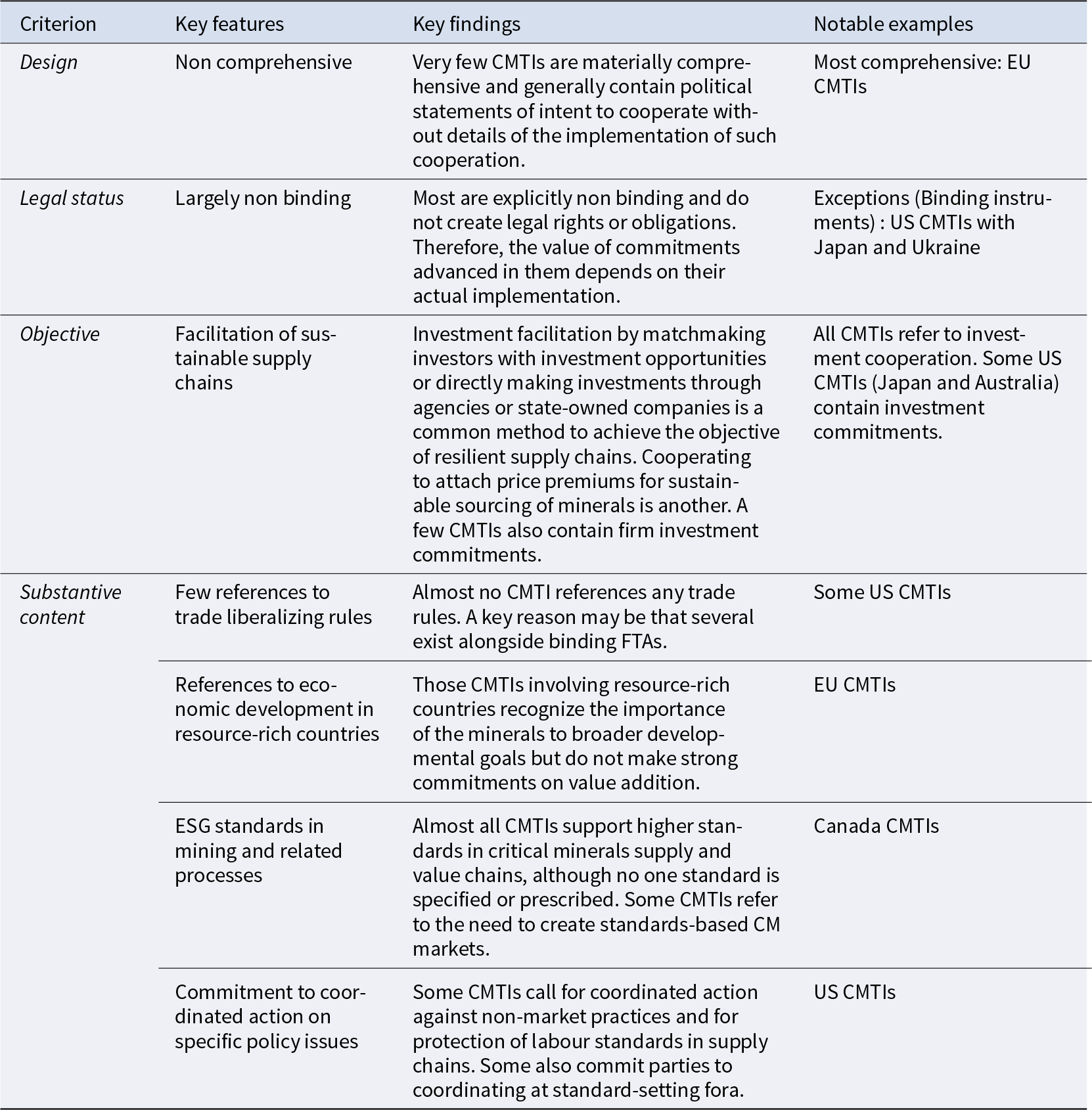
As legal imprecision renders a provision-by-provision comparison of the CMTIs largely futile, they are analysed through the lens of four criteria: design, legal status, objective, and substantive content. Using these criteria, the article identifies key features that were reflected across several CMTIs. These features include how different CMTIs approach different commitments, such as levels of comprehensiveness, the need for standards in CM value chains, downstream development in resource-rich countries, bindingness, investment facilitation, inter-governmental cooperation, and coordinated action to achieve non-economic objectives. Such differences may arise from different policy approaches to CMTIs; their ability to meet each country’s overarching strategic objectives; priorities of countries at different levels of development and other points of comparative advantage; and a patchwork of observable trends that globally define trade relationships between the resource rich and resource hungry. Table 1 above provides an overview of the key findings.
A summary of key cross-cutting trends of CMTIs
3.2.1 Design, Structure, and Content of CMTIs
Typically, CMTIs focus on some or all of the following objectives: developing open, fair, and competitive markets for CMs; commitment to ESG standards; mobilization of funding; capacity building; cooperation on research and innovation on mineral knowledge, circularity; and integration and joint development of CM value chains. EU SPAs are typically the most comprehensive, with the exception of the EU–Canada SPA, and contain a preamble, a statement of objectives, its administrative aspects, and legal implications of the instrument. The US–Japan CMA is also comprehensive in coverage and specific in its provisions, as is the recent US–Ukraine Mineral Resources Agreement. Other CMTIs are far less comprehensive in language, with lesser obligation and precision, although reflecting similar objectives of investment facilitation, value–chain integration, and advancing sustainably sourced CM supplies.
Meanwhile, ambition, as a measure of tangibility, may also be revealed by the design and content of such CMTIs, which is typically low or ambiguous due to their vague terms. However, a notable difference can be observed in the newly signed US framework agreements with Australia and Japan. These contain investment commitments, such that both Australia and the United States committed to take measures within six months ‘to provide at least $1 billion in financing to projects located in each of the United States and Australia’, while with Japan, there is commitment of ‘financial support to selected projects to generate end product for delivery to buyers in the United States and Japan and, as appropriate, like-minded countries’. These agreements also envisage close cooperation in supporting geological mapping, co-identifying critical minerals projects, leveraging stockpiling systems, and even coordinating trade measures.
3.2.2 Binding Value of CMTIs
The CMTIs by the EU, Canada, Australia, and Japan typically state that ‘This [instrument] is not intended to create rights or obligations under international or domestic law’ or that ‘This [instrument] is not legally binding’. Therefore, these legally non-binding CMTIs are generally understood to reflect political commitments. Further, their existence alongside binding trade rules and FTAs renders their legal purpose unclear. Yet, they remain an important part of the external commercial policy on CMs, as evidenced by various national CM strategies emphasizing the role of international partnerships in strengthening critical supply chains, thereby highlighting their potential to create a variety of effects, such as facilitation of investments.
In contrast, the United States has a unique hybrid approach whereby in addition to its non-binding arrangements with Australia, Korea, the DRC and Zambia, Thailand, Malaysia, and Japan, it also has binding agreements with Japan (2023) and Ukraine (2025). The US–Japan CMA is a bilateral partnership between two major resource-hungry countries, with a view to encourage adoption of measures to address non-market practices in producing countries, increase circularity of CMs, and maintain labour standards in value chains. Crucially, it does not adopt the EU approach that it is ‘not intended to create rights or obligations under domestic or international law’. Rather, it says that ‘[n]othing in this Agreement modifies any international obligation of either Party, including any obligation under the WTO Agreement.’ (emphasis added). A textual interpretation could mean that creation of any new legal rights and obligations under the CMA must be without prejudice to existing international obligations. Despite the binding value of the CMA, most of its provisions are couched in language that signifies cooperation, confirms intention, or affirms existing obligations. Notably, it also includes a diplomatic form of dispute settlement, through state-to-state consultations, foreseeing potential abrogation of stated rights and obligations.
3.2.3 Investment Facilitation as an Economic Objective
Meeting net-zero targets is expected to require a three-to-four fold increase in demand for CMs, accompanied by billionsFootnote 95 and trillions of dollars of investments.Footnote 96 Accordingly, investment facilitation appears to be a primary motivation of all CMTIs, which they seek to achieve by encouraging ‘integrated, value-added investments in the upstream, midstream, and downstream sectors’, pursuing information sharing on infrastructure projects, and exploring joint investment opportunities. For example, the Japan–Canada CMTI seeks to encourage investments in Canada by Japanese battery-related companies by marshalling public funds and private sector engagement. Similarly, Australia and Germany’s joint ‘Declaration of Intent’ commits them to undertaking a feasibility study to explore investment opportunities in Australia. Governments would undertake the role of a matchmaker, track projects and firms in each country that could participate in CM value chains, and jointly fund relevant future projects.
However, relying alone on private investments is likely insufficient to achieve the level of investments needed to catch up with China’s control over CM supply chains. As a result, CM strategies and CMTIs are increasingly reflecting the role of public financing, leadership by state agencies, and cross-border cooperation amongst such agencies in achieving CM security through cooperation on R&D, exploration activities, and developing investment opportunities. For example, the Japanese CM strategy has highlighted the role of state agencies JOGMEC and the Japan Bank for International Cooperation (JBIC) – in securing CMs. These institutions have entered into MoUs with their foreign counterparts, national governments, and mining ministries, such as JOGMEC with Australia’s Northern Territory, and with Zambia, Namibia, and the DRC, all of which signal cooperation on research and analysis, and developing exploration and exploitation operations by Japanese companies.Footnote 97 On similar lines, JOGMEC has also signed an administrative arrangement with the European Commission to cooperate on joint investments and infrastructural aid in third countries, beyond supply chain risk management, innovation, and mining circularity.Footnote 98
When such state-owned agencies enter into agreements with private or government-owned companies, they might lead to commitments that are more specific and accompanied by direct economic benefits. For example, the JBIC has signed an MoU with Chile’s Corporación Nacional del Cobre de Chile (CODELCO), which recently led to a loan agreement between JBIC and CODELCO for the import of Chilean copper by Japanese manufacturers.Footnote 99 Further, the recent transaction support by Japan–Australia Rare Earths (jointly owned by state-run JOGMEC and private firm Sojitz Corporation) to Lynas (an Australian mining company and the world’s biggest producer of rare earth metals outside China) has secured Japan priority supply rights,Footnote 100 highlighting that state-owned enterprises have an increasingly strategic role in making or securing investments. Similarly, the arrangement between Australia’s Critical Mineral Office and India’s state-owned Khanij Bidesh India Ltd (KABIL) committed an initial investment of 6 million USD to undertake ‘joint due diligence of select Greenfield and Brownfield projects to identify Lithium and Cobalt mineral assets for final joint investment decisions and acquisition of the assets in Australia catering to the critical & strategic ecosystem of both the countries’.Footnote 101 Recent US CMTIs with Japan and Australia, at a state–state level, also include investment commitments.
Finally, investment facilitation in a resource-rich country may not necessarily be limited to improving mining or downstream capacity at location. Instead, partners may cooperate to strengthen value-added supply chains in the resource-hungry country, a situation that contrasts starkly with calls for domestic value addition by developing resource-rich countries. A prominent example is the MoU between the Australian Strategic Metals (ASM) and the Korean government agency responsible for national resource security that has established a downstream plant by the ASM in Korea, to be supported by minerals mined from the Australian Dubbo projectFootnote 102 and meant to diversify supply of CMs for Korea. Notably, the ASM’s Dubbo Project was awarded grants worth millions under Australian Government’s Critical Minerals Development Program, the NSW Government’s Critical Minerals and High-Tech Metals Activation Fund,Footnote 103 and has been offered a debt-funding package of up to $600 million by the US Export–Import Bank, highlighting the cross-border flow of funds to trusted allies as a means of securing supply chain resilience.Footnote 104
3.2.4 References to Trade Rules and Market Liberalization
CMTIs in general do not incorporate trade rules, references to trade rules, or commitments to liberalize and not protect industries. A notable exception is the US–Japan CMA that alludes to various trade rules, such as mutually reaffirming their commitments against the imposition of trade restrictions and export taxes. As two resource-hungry countries, their agreement can be presumably guided by similar objectives, as is made clear by their joint commitment to cooperate on identifying and addressing market distortions in third countries affecting trade in CMs. However, similar commitments to act jointly are now visible in US deals with supplier countries such as Australia, Malaysia, and Thailand.
Despite the absence of explicit references to trade rules, several CMTIs may still reflect an implicit commitment to free trade principles. For instance, they may allude to the prevalence of ‘fair market practices’ in global CM supply chains, as seen in Canadian CMTIs with Australia and the UK. Similarly, the Japan–Canada CMTI contains ‘a commitment to oppose market-distorting measures and monopolistic policies on critical minerals for batteries’.
Additionally, several CMTIs may exist alongside FTAs, such that parties are automatically bound by the legal commitments, such as on export restrictions, included therein. For example, a large number of EU SPA partners coincide with membership in EU FTAs. Most SPAs do not contain any commitments prohibiting the use of export restrictions, performance requirements, or dual pricing policies. However, the disciplines to ensure prevalence of such free market principles are already included either in WTO rules, or in FTAs with corresponding SPA partners, such as in FTAs with Canada, Kazakhstan, Argentina, Chile, and the Southern African Development Community including Namibia.Footnote 105 Some SPAs (e.g., those with Argentina and Ukraine) also make it clear that the SPAs will be implemented in full accordance with pre-existing FTA provisions. In contrast, the earlier EU–Kazakhstan MoU, which exists in parallel with an FTA, explicitly reaffirms non-discrimination, transparency, predictability, openness of trade and investment channels for CMs and the non-trade-distorting nature of rules. Notably, the EU–Chile SPA also ‘reaffirms’ the commitment to market principles as the best way to create an investment-friendly environment across all stages of the value chain, despite an important value-addition carve-out in the updated EU–Chile FTA.
3.2.5 References to Economic Development Goals
CM-led industrialization through domestic value addition is of key interest to resource-rich countries;Footnote 106 however, since few CMTIs involve resource-rich countries, few include such considerations. Further, the issue is approached differently by different countries, revealing variations in CMTIs signed by the same country with different partners. For instance, references to value addition are mainly included in the CMTIs concerning Australia, Canada, and the EU: naturally, Australia and Canada as resource-rich countries would benefit from local value addition, whereas for the EU, value addition is an apparent objective of its CRMA in the context of its engagements with developing resource-rich countries. Accordingly, the statement of intent between Australia and the UK aims to support the development of sovereign capabilities in downstream processing and manufacturing in both nations, promote and build new CM industries, as similarly professed in the Canada–Japan CMTI. Similarly, the Australia–Germany CMTI seeks to identify strategic projects in Australia that could strengthen and establish new Australia–Germany value chains.
Meanwhile, the EU’s references to value addition are varied. In contrast to its SPAs with Canada or Australia that do not allude to economic development, industrialization, or value addition, the SPAs with Zambia, Kazakhstan, Ukraine, Chile, Argentina, and Namibia refer explicitly to local value addition or beneficiation. For example, one of the stated objectives of the Argentina SPA is to develop Argentinian CM value chains ‘as a lever for a sustainable and inclusive economic growth, the creation of local added value, quality employment, the development of local industrialization and domestic revenue mobilisation, thereby increasing the competitiveness of the Argentine economy’. The Zambia SPA includes objectives relating to promotion of and investment in circular economy value chains through technology transfers, and integration of sustainable value chains through joint ventures and new business models. In contrast, the SPAs with Canada and Australia focus on value chain integration broadly and not value addition specifically.
3.2.6 Sustainability Standards in CM Value Chains
ESG standards have been identified as important tools to ensure environmental and social sustainability of CM value chains, and are therefore typically found across all CMTIs. The focus areas include the implementation of the highest ESG standards in CM supply chains, ensuring their consistency and harmonization across the global trading system, and the setting of standards through bilateral or multilateral cooperation. The CMTIs do not refer to any one specific standard, such as the Initiative for Responsible Mining Assurance (IRMA). Rather, they may allude to multilateral fora engaging in standard setting (for example, the reference to the International Standards Association in the Canada–Australia CMTI and to the Minerals Security Partnership and Sustainable Critical Minerals Alliance in the Canada–Japan CMTI). CMTIs between the United States and Japan and between Canada and Australia also confirm their bilateral intention to cooperate in standard-setting efforts.Footnote 107 These trends are explained through examples.
First, CMTIs enable developed resource-rich countries to be proactive in encouraging market adoption of green premiums for sustainably sourced minerals. The Canadian strategy recognizes the role of Canada in avoiding a ‘race to the bottom for lowest cost output’Footnote 108 and highlights the need for Canada to act as a standard setter in relation to sustainability practices and ESG standards in mining supply chains. As a result, Canada’s bilateral partnerships with the EU, Japan, and the UK include a strong focus on leading international efforts on advancing high ESG standards in CM supply chains. Recent US CMTIs also state explicitly that the parties will coordinate to establish high standard marketplaces and appropriate pricing frameworks that include floor prices or similar measures.
Further, Canada and Australia, two developed, resource-rich countries that compete to supply the global needs for CMs on market principles, have also signed a cooperation agreement on CMs,Footnote 109 reflecting a ‘united we stand, divided we fall’ approach to engaging in strategic cooperation. The agreement seeks to advocate for ‘robust ESG credentials built into global critical minerals supply chains through close collaboration in multilateral fora, including International Standards Association’; and ‘development of supply chain transparency and traceability to monetise the value proposition for responsibly sourced minerals’, amongst others. By cooperating and not competing on crucial issues such as ESG standardization, Canada and Australia can emerge as powerful drivers of responsible mining as CM suppliers. However, their sustained competitiveness depends on investors’ cost preferences and the ability and appetite to navigate regulations, as well as consumer preferences reflected in downstream products. Thus, while both countries can present lucrative investment opportunities, their value proposition is subject to non-derogation of sustainability standards in their own territories as well as other resource-rich countries. It is therefore in Australia and Canada’s strategic economic interests to influence market adoption of higher prices for higher standards.
Second, CMTIs often mirror prevailing trends in global standard-setting efforts. For example, the EU SPAs reveal an implicit intention of the EU to treat countries differently, distinguishing between standard setters and standard takers. On one hand, the EU-Australia SPA seeks to leverage cooperation on ESG standards at international fora to ‘align international mineral pricing with high ESG standards’. In other words, this indicates an objective to influence markets to accept and set higher prices for higher standard minerals. Similarly, the SPA with Canada, as echoed in other Canadian CMTIs reviewed here, seeks to lead international efforts on higher sustainable mining standards incorporating ESG criteria. On the other hand, the EU SPAs with Zambia, Namibia, Chile, Argentina, Kazakhstan, and Ukraine approach any references to such standards from a compliance perspective, i.e., the need to ‘align with internationally agreed principles and ESG standards’ (emphasis added). Therefore, a second trend is the difference of treatment of resource–supplier countries, based on their levels of development and reflective of existing disparities in contributions to standard-setting processes.
3.2.7 Coordinated Action on Labour Issues, Market Distortions and Standards in Supply Chains
CMTIs signed between resource-rich and resource-hungry countries typically represent a give-and-take relationship, underlined by a transactional motivation of access and investments. However, a large number of CMTIs are signed amongst resource-hungry countries, which are developed, economically powerful, and typically exhibit high levels of legal sophistication and regulatory ambition in their trade instruments. Such CMTIs may be found to encourage coordinated action to achieve both economic and non-economic objectives.
As observed in the preceding pages, economic objectives include making joint investments in resource–supplier countries or integrating their value chains to secure supply chain resilience, in addition to advancing the adoption of green premiums for sustainably sourced CMs. The US–Japan CMA also commits the parties to confer on addressing CM-related non-market measures of non-parties as well as sharing information on CM-related foreign investments in each other’s territories to aid national security determinations. The negotiating objectives of the EUFootnote 110 regarding a prospective EU–US CMA also include an intention to address cooperatively the trade distortions in CM value chains.
Additionally, CMTIs also encourage coordinated approaches to addressing non-market policies of third countries, as seen in Canada’s CMTIs with the UK, Japan, and Australia. US partnerships with Norway, Australia, Malaysia, Thailand, and Japan not only commit them to cooperate on identifying and responding to market distortions and non-market policies in third countries but also to advance high labour and environmental standards in global CM supply chains. Some CMTIs also encourage coordinated action on labour issues in CM supply chains – through a coordinated discouragement of imports of CMs that do not meet certain labour laws or standardsFootnote 111 – and cooperation to assist supplier markets to implement high labour standards. Thus, CMTIs provide an avenue for cooperating on the achievement of various non-economic objectives.
3.3 Co-existence with Regional or Small-Group Strategic Alliances
In addition to the several bilateral CMTIs examined above, these countries have also engaged in different forms of regional or multilateral cooperation. A transatlantic cooperation led by the United States and the EU, called the Minerals Security Partnership (MSP comprising Australia, Canada, Estonia, Finland, France, Germany, India, Italy, Japan, Norway, the Republic of Korea, Sweden, the UK, the United States, and the EU), seeks to advance and accelerate individual projects and promote policies that contribute to resilient value chains and bring local value.Footnote 112 While there is no MoU laying down the terms and conditions of the collaboration, the MSP is a ‘collaboration of 14 countries and the EU to catalyze public and private investment in responsible critical minerals supply chains globally’. The MSP partners have also developed a set of principles to guide their support for projects, which may be financial, diplomatic, or otherwise.Footnote 113 In 2024, the MSP expanded to form the MSP Forum to facilitate investments by the resource hungry in the resource rich countries; the Forum remains open to members committed to global supply chain diversification and high ESG standards. The MSP Forum members include the MSP partners and Argentina, Ecuador, the DRC, the Dominican Republic, Greenland, Kazakhstan, Mexico, Namibia, Peru, the Philippines, Serbia, Turkey, Ukraine, Uzbekistan, and Zambia.Footnote 114 The MSP Forum has also recently established a MSP Finance Network involving the MSP partners and their development finance institutions and export credit agencies. Another similar effort includes the Quad Investors Network (QUIN) launched by the Quad – Australia, India, Japan and the United States – to connect investors, academia, and government to facilitate investments in CMs.Footnote 115 In late 2025, a parallel G7 initiative led by Canada called the ‘Critical Minerals Production Alliance’ was also launched to leverage sovereign tools, including financial support, to operationalize projects globally that strengthen Western access to CMs.Footnote 116
Further, the national CM strategies of various countries recommends engaging in multilateral cooperation efforts at the following organizations: Organization for Economic cooperation and Development (OECD), the G7/G20, the IEA, the World Bank, the International Renewable Energy Agency (IRENA), the Intergovernmental Forum on Mining, Minerals, Metals and Sustainable Development (IGF), the Extractive Industries Transparency Initiative (EITI), the Energy Resource Governance Initiative (ERGI), the Indo-Pacific Economic Framework (IPEF), the Sustainable Critical Minerals Alliance,Footnote 117 the Conference on Critical Materials and Minerals,Footnote 118 and the Critical Minerals Mapping Initiative.Footnote 119 Some CMTIs also refer to the Sustainable Critical Minerals Alliance and the International Standards Association in the context of sustainable mining standards. However, it is striking that WTO members have not sought to put trade in CMs, which has recently suffered from a five-fold increase in export restrictions globally,Footnote 120 on the WTO agenda.
In contrast, an increasing number of FTAs contain ‘energy and raw materials’ chapters linked to prohibitions of trade restrictions and increased cooperation on CMs. Therefore, the utilization of binding trade and investment instruments to regulate free trade of responsibly mined CMs is not uncommon; yet, the role of the WTO as an appropriate or relevant forum for streamlining liberalization and regulation of CM trade has not yet been seriously considered.
In sum, CM strategies and CMTIs play a mutually supportive role for both resource-rich and resource-hungry countries, with CMTIs externalizing the respective strategies. In terms of coverage, most of the CMTIs are signed by and between developed, resource-hungry countries, or with developed, resource-rich countries. There is some participation of select African and South American countries in partnerships involving the United States and EU. Notably, Australia and Canada as suppliers do not typically have CMTIs with fellow suppliers in these regions, while they do between themselves. Substantively, there are limited differences between most of the CMTIs: they collectively emphasize the importance of high ESG standards in CM value chains, availability of public funding, and investment facilitation through multi-stakeholder engagements. However, differing strategic objectives evidently bear upon the number of CMTIs signed, the choice of partners, and the terms of the CMTI. For example, the EU has the most CMTIs, whereas the United States and Japan have fewer, as of the time of writing. Other differences include the approaches to developmental concerns and standard setting. For example, while the EU attempts to incorporate development considerations in its SPAs with developing resource-rich countries, the United States appears more focused on ensuring enforcement of market principles in CM trade, building geopolitical ties and managing risks to national security.Footnote 121 As a result, the United States has traditionally sought binding CMAs or FTAs with countries which it can rely upon for its friend-shoring objectives. However, this trend may be changing with the second Trump Administration. As a result, several countries in Africa or Asia remain subject to non-binding US CMTIs, which do not contain investment commitments of the nature noted in the recent Japan and Australia deals.
Finally, with the US preference for binding CMAs now being replaced by its rapid engagement in non-binding deals, there appears an emerging global consensus on the use of non-binding international instruments for the purpose of CM cooperation. While a binding agreement with high precision but low obligation contrasts with a non-binding instrument of low precision, obligation, and delegation, the preference for or against non-binding or executive agreements is also a function of the domestic political economy. The binding US–Japan CMA, for example, can be understood against the background of the US IRA, which relies on leveraging FTAs to friendshore supply chains and incentivize partnering with allies. Yet, the list of recognized FTAs based on which IRA credits could be claimed is short, leading the United States to negotiate similar CMAs with the EU and the UK.Footnote 122 At the time, the EU preferred the legal, institutional, and political flexibility that accompanied soft law formats while the United States sought a binding agreement that would satisfy Congress, but which delayed its conclusion. Now, with the new Trump administration embracing the non-binding approach to international agreements, the status of these negotiations is currently unknown. However, the evolving US approach to CMTIs does show that the legal status and the contents of such instruments are as much functions of domestic politics as external strategy, highlighting the vast powers of a government (and the risks therein) to sign them and to shift policy directions without proportionate domestic accountability.
4. Potential Implications of Critical Minerals Related Trade Instruments
Having traced the rise of CMTIs as an instrumentation of trade policy in key mineral-related jurisdictions, the article turns to highlighting a set of anticipated effects of such non-binding CMTIs on global governance and international economic relations, beginning with an explanation of why it is an important question to ask, from an international law perspective.
4.1 Why Bother? Non-Legal Effects of Non-Binding Instruments
Overall, the CMTIs analyzed in this article are non-binding in nature. Debates have long persisted over the definition and limits of soft law, and whether non-binding instruments can even be considered as law.Footnote 123 However, here, the focus is on the CMTIs’ potential effects – comprising changes in state conduct regardless of compliance – that reveal their functional value.
Non-binding instruments play a role in the global governance of the subject matter they seek to regulate. First, they may generate indirect legal effects,Footnote 124 which may include acting as interpretive elements for legally binding instruments, or as a precondition for another international or domestic instrument to produce legal effects, or they may contribute to the development of customary international lawFootnote 125 through reflection of state practice. Second, non-binding instruments that are perceived as legal and legitimate can also influence state conduct.Footnote 126 Indeed, Prosper Weil recognized that soft law norms ‘do create expectations and exert on the conduct of states an influence that in certain cases may be greater than that of rules of treaty or customary law’.Footnote 127 This influence can result from the expectations of compliance with such non-binding instruments, as a result of reputational concerns, moral persuasion, prior consent, perceived legitimacy of the norms etc.Footnote 128 Such legitimacy – a function of the negotiators’ identity, the process, and the objective of the non-binding instrument itself – can thus help establish informal international law with which states may want to comply.Footnote 129
Much prior analysis relates to whether non-binding instruments signed multilaterally are producing effects as intended, including in the realm of international humanitarian law,Footnote 130 the Kimberley Scheme on conflict diamonds, the Wassenaar Arrangement on export controls of conventional arms, and the Proliferation Security Initiative. In these contexts, the greatest concern seems to have been ensuring the compliance of parties with such instruments and the success of the instruments in inducing appropriate state conduct.Footnote 131 While compliance with CMTIs is also critical for upholding their stated objectives, this article argues that non-binding CMTIs could produce consequential and far-reaching indirect and non-legal effects that go beyond their non-enforceability. For instance, as Pauwelyn et al. note, the ‘core challenge for new forms of cooperation’ is ensuring their inclusivity amid other emanating effects, such as potentially harmful impacts on unsuspecting non-members.Footnote 132
Thus, this article seeks to offer a timely critique of CMTIs by identifying their potential trends and effects on governance of CM trade and investments, beyond the known enforceability and opacity issues of CMTIs. The bilateral, scattered, and non-enforceable nature of instruments; their different, even competing objectives (between economic development and access to responsible and reliable supply chains); and their interaction with established trade and investment rules deepen the need for a closer scrutiny of the CMTIs. Thus, while the examination of each individual CMTI is enlightening, it is especially useful to compare the horizontal and vertical analyses of the different CMTIs and different countries’ approaches to them. Comparing such variations in turn helps inform the following trends in CMTIs, such as the evolving power dynamics in international rulemaking through non-binding instruments, as explored next.
4.2 Norm Entrepreneurship through Non-Binding Instruments
4.2.1 ‘Serial Bilateralism’ and Concentration of Norm Creation
The CMTIs analysed above remain concentrated amongst wealthy, developed resource-rich and resource-hungry countries.Footnote 133 As highlighted earlier, the textual analysis revealed that they echo similar views, on objectives relating to integration of value chains, condemnation of trade and investment restrictions, and adoption of higher ESG standards, with minor and non-substantial variations between them. This phenomenon can be said to be akin to the Brussels Effect, i.e., the EU’s manner of exercising norm-setting power,Footnote 134 which in this scenario is being exercised by a small set of major resource-hungry nations. A justification for such regulatory imperialism, in the words of Bradford, is the benevolence of such norm-setting behaviour, especially when foreign trading partners may not have strong regulatory bodies to participate in regulatory activities.
However, in the context of CMTIs, the issue extends beyond the content of the norms. The EU has over time consistently incorporated similar language across its CMTIs with a variety of resource-rich countries. Similarly, the CMTIs signed by the EU, Japan, Australia, and Canada reflect no major differences. As a result, the extent to which less-developed, resource-rich countries are able to influence the terms of the CMTIs and by extension, the evolution of the trade governance mechanisms on CMs, remains unknown or limited. This phenomenon of signing ‘a large number of narrowly focused or bilateral agreements’ has been previously studied and termed by Benvenisti and Downs as ‘serial bilateralism’,Footnote 135 a means used ‘by powerful states to shape the evolution of norms’. Although this hypothesis was made in relation to binding instruments when ‘multilateral negotiations threaten to get out of control’, it can be comfortably extended to CMTIs, as there are no multilateral negotiations in the first place, leaving a fresh slate for norm-creation. Further, there are very limited differences between CMTIs of different resource-hungry countries. Accordingly, since the majority of the CMTIs remain concentrated amongst a small group of countries involving the United States, the EU, Japan, Australia, and Canada, repetition of the norms amongst the first movers, i.e., the norm-setters, highlights the concentration of global norm-creation in a handful of countries.
Moreover, norm-creation and the conversion of certain rules into acceptable standards depend upon the bargaining powers of the negotiating countries. For example, the CMTIs dominated by resource-hungry countries reflect non-divergent attitudes towards accessing resources, standard-setting, and investment facilitation. However, resource-rich countries may be unable to achieve the same. For example, the text of the updated EU–Chile FTA contained an exception from dual-pricing obligations for value-addition purposes in its raw materials chapter.Footnote 136 But it remains to be seen if other EU FTAs with resource-rich countries adopt a similar approach and if they include any variations of the flexibility. In the case of CMTIs, strengthened value addition commitments yet remain elusive. Thus, their dissemination remains aspirational.
4.2.2 Imbalanced Participation in Norm Diffusion
Linked to norm creation, is the ability of countries to disseminate the norms, as observed through the provisions on standard setting in CMTIs. Higher ESG standards in mining are key to ensuring sustainable development of the communities most impacted by increased extractive activities. While the aim of ensuring uptake of ESG standards, in and of itself, is not in question, the processes whereby such higher standards are sought to be dissipated lend themselves to concerns of regulatory imperialism. Therefore, the objective is far from attack here; rather, it is the manner used in achieving the objective that needs greater scrutiny.
For instance, CMTIs that seek to instil higher ESG standards in CM value chains remain silent on how such standards may be achieved. The EU’s SPAs with less-developed countries ‘promote alignment with standards’, whereas its SPA with Australia states that the parties will cooperate to ‘promote high ESG criteria and improved policy alignment, driven by high regard for worker conditions and worker safety, and the importance of sustainable and secure production of critical minerals’, and ‘align international mineral pricing with high ESG standards; and … promote market recognition for high ESG standards’. Two observations arise. First, however subtle, the nuance in the phrasing of the CMTIs reflects inherent biases and entrenches differences between standard setters and standard takers, relegating a large group of resource-rich countries to ‘aligning’ themselves with international standards, whereas some resource-rich countries (primarily the developed ones) are to play a role in promoting high standards.Footnote 137 The absence of developing, resource-rich countries in standard-setting efforts may lead to the creation of standards that do not adequately address their concerns. Second, while a CMTI may not have direct or indirect legal effects, the global economic effects that are sought to be generated hold relevance for third countries. For instance, a CMTI between a prominent CM buyer (EU) and a developed country CM supplier (Australia) seeks to influence market adoption of higher prices for higher standards. The ‘higher standard, higher price’ linkage stands to benefit developed CM-supplier countries, such as Canada and Australia,Footnote 138 that already reflect a strong focus on setting international standards in their domestic CM strategies and CMTIs. However, small companies based in poorer resource-rich countries, which may remain unable to comply with higher standards, risk earning lower rents for their resources. They may also remain ill-equipped to comply with unilateral standards that are now emerging through due diligence regulations. To better support development aims associated with CMTIs, EU SPAs (and others) could encourage and assist in the participation of resource-rich countries in international standard-setting processes, instead of only aligning with standards. Assisting with building capacity to comply with higher standards, would be the next step.
4.3 Imbalances between Resource-Hungry and Resource-Rich Countries
4.3.1 Stripping Resource-Rich States of Agency and Selective De-legalization
As vocalized by the statute establishing the African Minerals Development Centre, African countries have been long concerned that the ‘increasing competition and demand for Africa’s raw mineral resources and the imposition of trade conditionalities likely reduce the continent’s policy space to pursue local beneficiation, value addition and resource-based industrialisation’.Footnote 139 Non-binding CMTIs may function in a way that strips resource-rich states of their ability to decide how to pursue CM-led industrialization, against the spirit of PSNR. The following explains why this may happen.
First, the interplay of certain WTO rules and the network of CMTIs legally constrainsFootnote 140 the ability of resource-rich states to impose trade measures in pursuit of CM-led industrialization. WTO rules on subsidies and trade-related investment measures prohibit most export restrictions, local content policies, and some investment-related performance requirements, which are common trade policy tools used to pursue value-addition of natural resources.Footnote 141Simultaneously, they also allow members to impose export taxes and performance requirements such as those requiring investors to invest in joint venture formats or to hire local talent, inter alia. However, several FTAs have ‘WTO+’ disciplinesFootnote 142 on the same topics, further constricting the ability of resource-rich countries to use export taxes or dual pricing mechanisms or a wider variety of performance requirements. Thus, theoretically, existing trade rules under the international trade system confine the ability of states to impose measures in furtherance of industrialization interests. In practice, Indonesia’s export restrictions on nickel that were introduced with a view to pursue downstreaming were outlawed by a WTO panel,Footnote 143 a ruling that was appealed into the void.
The imbalance arises thus: accepting that existing trade rules form the default applicable law, the CMTIs, multilateral CM arrangements, and domestic CM strategies operate within the legal framework already set by these rules. However, non-binding CMTIs do not create international legal rights and obligations, and, therefore, do not provide or constitute explicit exceptions from binding law. As a result, any guarantees of industrialization, value-addition, and technology transfers cannot be interpreted as absolving resource-rich countries of their obligations to not impose trade restrictions undertaken under the WTO or FTAs. This phenomenon of ‘selective de-legalization’ is concerning, since restrictive trade measures in pursuit of industrialization risk legal challenges under existing WTO and FTA rules, whereas value addition commitments under non-binding CMTIs cannot be enforced as they operate as “obligations of means” and not “obligations of ends”.Footnote 144 Thus, the proliferation of non-binding CMTIs highlights the turn to cooperative, ad hoc mechanisms with no enforceable and credible guarantees supporting developmental goals of resource-rich countries.
FTAs containing dedicated chapters on trade in raw materials exhibit a similar trend by including enforceable obligations based on free market principles, while developmental and environmental considerations are couched in non-enforceable language.Footnote 145 Further, co-existence of such comprehensive FTAs and non-binding CMTIs would result in resource-rich countries being bound by the more restrictive provisions of the FTA. Value addition commitments in a CMTI, in spirit, contradict prohibitions on the use of various trade policies in FTAs, such as the use of performance requirements, which could be used to pursue developmental objectives. Admittedly, while the CMTIs do not term them as value-addition commitments, they signal political guarantees of conditionality-free access to CMs supported by value-addition, technology transfers, and in some cases, legal establishment through joint ventures. However, FTAs commonly censure the requirement of performance of these supportive elements encouraged by CMTIs.Footnote 146 Thus, a resource-rich country, while providing access to its CMs, is significantly constrained from pursuing trade policies on downstreaming or other development-related conditionalities and must rely upon the good faith of the trading partner for the fulfillment of various commitments made under the CMTI.
Second, CMTIs and CM arrangements, while committing to the development of resource-rich states, may shift the poles of power away from them. For example, small group CM arrangements (such as the MSP Forum) include conditions for funding projects in resource-rich countries,Footnote 147 whereby powers reside with resource-hungry countries to decide which resource-rich countries and projects benefit from investments. Yet, although the principles guiding the selection of MSP projects include ‘economic benefits for local communities’, they neither specify kinds of benefits that an investment must guarantee, nor acknowledge the ability of a recipient government to define development-related conditions and goals. Instead, the MSP privileges a donor’s interests in selecting an appropriate investment opportunity, while maintaining insufficient guarantees and safeguards for resource-rich countries’ developmental prerogatives.
Additionally, the review of CMTIs undertaken in Section 3 suggested that government partnerships or CMTIs are to be given effect through firm-to-firm engagements (with the governments acting as matchmakers of feasible projects, under the Germany-Australia partnership) or through direct partnerships with foreign firms, including other state-owned enterprises (such as state-owned enterprise Indian firm KABIL’s MoUs with Argentinian state-run companies).Footnote 148 While such an approach can ensure efficiency associated with targeted support and lower transaction costs, it can lead to foreign governments ‘picking winners’, thereby hindering the ability of less capable firms in resource-rich developing countries to develop. However, if resource-rich countries were to introduce policies restricting exports or imposing development-related conditionalities on inward FDI, they would risk being outlawed under WTO law and FTAs. Yet, the CMTIs do not provide adequate guarantees for the attainment of the same objectives, and may even bypass interactions with states by promoting direct contracts with firms, thereby highlighting the imbalance caused by the interaction of CMTIs with existing treaties.
4.3.2 The Consequence: A Tilted Playing Field
De-legalization, in international power dynamics
It is a strategic move on the part of ‘states that are becoming more powerful over time’ to ‘defer international [binding] agreements unless they are given the opportunity to renegotiate in the future when they can extract better terms’.Footnote 149 Meyer argues, ‘when power is shifting in a state’s favour, the state may be unwilling to accept terms that reflect its present bargaining power if accepting that agreement today means forgoing the opportunity to negotiate better terms tomorrow’.Footnote 150 In the context of CMs, developed resource-hungry countries (several with hegemonic or colonial legacies) are reliant upon the CMs of the resource-rich countries and, therefore, hold less bargaining power in terms of access. However, given the need for foreign investments, high standards and the push for green premiums, the long-term market power can be expected to lie with the resource-hungry as a result of their technological and economic prowess and their consequent ability to shape global norms and supply chains. As a result, signing non-binding CMTIs in the presence of the safety net of binding WTO rules allows resource-hungry states to engage in norm entrepreneurship and loss-avoidance tactics, while enjoying reputational gains of being benevolent partners through unenforceable developmental commitments.
However, it is worth noting that the demand side of the equation has struggled to influence CM policy. For example, the heavy interdependence of the EU on Chinese investments in the EV sector makes immediate de-coupling infeasible, thereby inspiring the EU to undertake contingent protection measures without following the more aggressive footsteps of the United States.Footnote 151 Yet, market power creates suitable conditions for strategic regulatory action. For example, the EU also introduced due diligence requirements in the form of the Batteries Regulation to improve the sustainability footprint of batteries sold in the EU market.Footnote 152 Further, policies, such as the US IRA, have sought to leverage the US market power in incentivizing investments in allied countries. Strategies of Canada and Australia evidence the emphasis on market adoption of green premiums as a presumable strategy to differentiate their responsible mining practices from supply chains involving Chinese activity. While such policies are currently in preliminary stagesFootnote 153 and require proactive implementation to achieve stated objectives, there appears to be significant political will amongst the largest demanders of CMs to collaborate. Most recently, the 2025 G7 Action Plan on CMs makes the establishment of ‘standards-based markets’ as one of three key focus areas,Footnote 154 where standards extend beyond environmental sustainability, pollution, and land degradation, to include labour standards, local consultation, anti-bribery and corruption measures. Thus, utilizing markets and market power to shape the nature of CM supply chains is of strategic significance to several resource-hungry and some resource-rich countries.
Assuming the establishment of such market power over time, power imbalances between the resource-rich and the resource-hungry qualify the interaction of binding rules and non-binding CMTIs. When powerful countries agree (i.e., resource-hungry developed countries), non-binding instruments are considered complementary to binding rules.Footnote 155 Indeed, in some cases, such as the EU SPAs, the EU ensures that the FTA rules prevail. The fact that few CMTIs involve less-developed resource-hungry countries also hinders their participation in the global norm-making process. However, Shaffer and Pollack also hypothesize that when powerful and less powerful countries disagree due to the distributive conflicts in international law, the latter can resort to a combination of hard and soft law to attain their objectives. This hypothesis runs into two issues. First, it does not account for a situation where existing binding rules contain drawbacks – amending such rules is very difficult – and evolving non-binding instruments may contain some benefits if complied with but lack enforceability amid several other power imbalances. Second, as Benvenisti and Downs note, in practice, less-powerful developing countries are not able to use soft law effectively to countervail the drawbacks of binding rules.Footnote 156
Finally, power dynamics have been at the fore in recent discourse on CMs with the United States leveraging military support in ongoing conflicts to gain access to minerals in Ukraine and the DRC. The final deal between the United States and Ukraine over a period of several weeks salvaged some of the unequal and inequitable elements of the initial US proposal, even though it does not provide Ukraine with enforceable guarantees of military support. However, once again, it serves as an example of the norm-entrepreneurship abilities that accompany power of economically and militarily advanced countries.
‘Forced Errors’: Constraints in Trade Policy Choices
The imbalance resulting from reduced legal agency and increased risks of exposure to judicial action, is further exacerbated by the inability of several fiscally constrained resource-rich countries to provide state support to create favourable investment conditions. Instead, such countries turn to trade-restrictive measures that could achieve equivalent effects as less trade-restrictive measures but which would risk legal sanctions.
This practice is evident from the Global Trade Alert’s New Industrial Policy Observatory (NIPO) database,Footnote 157 which usefully tracks different kinds of industrial policy trade measures in CMs. By filtering for ‘critical minerals’ policies and ‘subsidies’, the results indicate that the main subsidizers are Australia, Austria, Canada, China, Czechia, EU, France, Germany, Greece, Italy, Netherlands, Poland, Korea, Russia, Saudi Arabia, Slovenia, Spain, Turkey, UK, and the United States. Main users of export subsidies in the CM sector are Argentina, Australia, Japan, Italy, Korea, India, and the United States. However, CM-related export policies are used by Argentina, China, Indonesia, Pakistan, and South Africa. Users of FDI-related CM policies are Mexico and Chile. Despite the limitations of the NIPO database, such as its coverage of measures implemented in 2023, the data show certain trends. Overwhelmingly, subsidies (financial grants, state aid and loans, tax relief, loan guarantees, interest subsidies, capital injection, and equity stakes) are provided by developed countries, resource rich or resource hungry alike, whereas users of export policies (export bans, licensing requirements, export taxes) are typically resource-rich developing countries.
At the same time, resource-hungry governments signing CMTIs and advocating against trade distortive practices of resource-rich countries often employ industrial policies on CMs that cause trade discrimination, such as the IRA; are imperialistic, such as recent US policies on Greenland; rely on heavy government intervention to support investments in the CM sector, as evidenced by national CM strategies; or are simply protectionist of their own industries. Thus, there is an implicit inconsistency between the proclaimed commitment towards non-distorting trade practices to be exhibited by third countries and the simultaneous implementation of policies by themselves that are not only legally dubious but also trade distorting.
Potential ‘Own Goals’ by the Resource Hungry
Although the CMTIs pursue a broader aim of supply chain diversification, their concentration amongst limited countries, which are typically resource-hungry developed nations, fail to rationalize the demand and supply sides of the equation. As this article has argued, the network effects of these instruments appear to adopt a ‘govern from the top’ approach to CM cooperation, but in a manner that is disconnected from the on-ground realities in resource-rich nations. In this regard, the EU can be said to have still diversified its partnerships with several resource-rich countries. However, key resource suppliers from Africa, South America, and South-East Asia remain outside the majority of these arrangements, raising the question of effectiveness of the CMTIs in attaining their ultimate goal of secure, resilient, and diversified CM supply chains.
Consider a scenario where investments in CMs by resource-hungry country X do not contain adequate social benefits and environmental considerations for a resource-rich country Y, even if there are certain tangible economic benefits. Simultaneously, other resource-hungry countries do not engage with country Y through partnerships that offer desirable or preferred economic benefits. What options remain for country Y, other than to entrench dependencies on country X, or to pursue their national economic goals through unilateral measures?
Thus, a top–down approach reflected in CMTIs between resource-hungry countries fundamentally differs from a bottom-up approach that includes resource-rich countries. It denies the latter the opportunities to attain their national strategic goals through cooperation, thereby deepening the power asymmetries described above, and consequently exposes the resource hungry to the risk of loss of allies. In the absence of direct cooperation with resource-rich countries that is considerate of their economic ambitions in addition to their social and environmental contexts, Western resource-hungry countries may be left assessing the risks of unilateral economic statecraft measures, restrictive practices of the resource-rich, and coordination amongst those excluded, such as members of the Regional Comprehensive Economic Partnership or some variation of the BRICS (Brazil, Russia, India, China, and South Africa) group. Thus, the CMTIs may well help devise top–down regulations that raise prices of CMs and standardize sustainable mining practices, but their current exclusionary nature and lack of strength in commitments do not guarantee the fruits of cooperation and, indeed, engender strategic pushback.
4.4 Systemic and Institutional Implications of Critical Minerals Related Trade Instruments
4.4.1 Advantageous Practicality of CMTIs to Overcome Hurdles of Multilateralism
Despite their concerning implications, there are practical motivations to sign CMTIs, and especially non-binding ones in the current global political economy. Their implementation promotes state–state cooperation by helping to avoid the costs of signing binding rules.Footnote 158 Non-binding CMTIs allow countries the flexibility to negotiate bilaterally or regionally, and leverage their collective potential without the pitfalls of unresolvable divergences plaguing multilateral or FTA negotiations.Footnote 159 For example, negotiating sustainability-related commitments in trade agreements is typically fraught with north–south tensions, but narrowly tailored non-binding CMTIs with environmental and social conditions, backed by private-sector involvement and diplomatic capital, can help leverage a carrot-and-stick approach with partners. Further, individual countries can identify their areas of interest (such as green hydrogen by Namibia, or market adoption of green premiums by Australia) in accordance with their national priorities and make them the central foci of CMTIs. From a domestic political economy standpoint, non-binding CMTIs typically enable governments to bypass tedious legislative mechanisms that are necessary when signing or ratifying binding treaties, thereby accelerating their proliferation.Footnote 160
In contrast, any multilateral discussions for binding rules on CMs must necessarily begin with definitional or ‘scope’ questions, over what are CMs (in a list-based approach) or how should ‘criticality’ be defined (in a subjective approach).Footnote 161 Considering past experiences of WTO negotiations, it might be impossible to agree upon the meaning of ‘criticality’. Indeed, ‘criticality’ assessments are unable to deliver unanimous answers, since it necessarily is a dynamic and subjective concept.Footnote 162 Mirroring the WTO Environmental Goods Agreement negotiations and the challenges in arriving at a list of environmental goods, the membership could face a similar conundrum when attempting to define criticality. However, if countries were left to justify the criticality of the minerals for their respective measures, there would be a risk of status quo for two reasons. First, even if criticality were to be established using objective conditions, establishing any new WTO rules on CMs containing such conditions would require consensus, which is elusive. Second, if criticality were related to national security (for e.g., the US defence strategies on CMs) and if certain countries believe in ‘self-judging’ criticality, their appetite for any objective assessment of criticality would be presumably diminished. Given these complexities, the mode of modern trade governance may be undergoing a paradigm change, from binding, comprehensive instruments negotiated multilaterally or bilaterally, to bilateral ‘mini deals’Footnote 163 and other non-binding instrumentsFootnote 164 that reflect narrow, unilateral, or regional preferences.
4.4.2 Costs of Non-Cooperation
In the recent power-based orientation of the trade governance landscape as opposed to a three-decade long prevalence of a rules-based system, non-binding, politically driven, and targeted approaches may offer pragmatic and quick fixes. However, these approaches are not without costs. In addition to the ‘potential own goals’ highlighted above, prevalence of ‘repeat players’ across CMTIs risk a vast majority of the global trading community being left outside discussions on CMs and CM goods that are necessary for the global energy transition or advanced manufacturing. While potentially beneficial to the two that are party to a CMTI, its terms and conditions may also be detrimental to third countries that are either part of relevant global value chains or are consumers. Non-transparent CMTIs could also allow space for issue-linkage or barter of concessions on different policies, such as access to CMs or exemption from export restrictions in exchange for a different regulatory relaxation or military support. These issues further endanger the already stressed international trade law fabric by creating a patchwork application of different rules.
Additionally, a major geopolitical risk posed by the proliferation of CMTIs relates to China’s absence from these arrangements. While the very purpose of the CMTIs is to escape from the Chinese stronghold over CM value chains and the related perception of risk, some analysis has already questioned the common narrative of deliberate Chinese weaponization of CMs.Footnote 165 Understanding the ultimate goals and objectives of China through a careful examination and analysis of its policies is necessary to inform Western policymaking. CMTIs in conjunction with domestic CM strategies often aim to strengthen CM supply chain resilience through not only friend-shoring and on-shoring strategies but also by removing China from the supply chains. These strategies do not grasp fully that in the absence of cooperation, retaliatory tactics and hostilities will only increase. For instance, China has responded to Western trade measures by imposing export restrictions on gallium, germanium,Footnote 166 and antimony,Footnote 167 on the grounds of national security. Recent Chinese export controls on rare earths have led to depletion of inventories and disruptions to production facilities in the EU, reflecting the long-term costs of policy shocks.Footnote 168 Moreover, competition between the West and China is not only with respect to the significant CM reserves and supply chains that China controls, but also their respective investments in resource-rich third countries.Footnote 169 The recently announced China-led ‘International Economic and Trade Cooperation Initiative on Green Mining and Minerals’ adds to such global fragmentation.
Accordingly, a strategy to enhance cooperation with China is necessary, both as a self-preservation strategy, and to ensure that standard-development pursued by the West is not undermined by the lack of similar ESG compliance requirements in other countries. Although recent research has shown convergence between Western and Chinese approaches to ESG standards in extractive processes,Footnote 170 cooperation on adopting a principled approach to investments in third countries could provide certainty, guarantee minimum standards, and avoid the erosion of basic principles protecting their sustainable development interests. Thus, a broader cooperative mechanism, instead of continued trade hostilities, could avoid information asymmetries, and improve predictability of trading conditions.
4.4.3 Lack of Transparency
Lack of transparency surrounding non-binding CMTIs signed by different countries creates a wide gulf of knowledge between different national and international actors, i.e., nations, firms, affected communities, civil society, and others.Footnote 171 CMTIs continue to be concealed without accountability towards the public (a domestic administration issue) and towards other trading nations (an international governance issue) in several instances, undermining a core principle of transparency that underpins traditional forms of trade integration. Domestically, as CMTIs do not amount to ‘treaties’ or even binding agreements, they generally avoid the congressional direction and oversight that countries impose as part of treaty-making processes, including publication obligations.Footnote 172 As a result, non-binding instruments often remain unpublished although their publication is desirable, as the EU has previously noted in a separate context.Footnote 173 It has been argued that such lack of transparency need not translate into a lack of accountability domestically, as non-binding instruments may be subject to ex-post accountability mechanisms.Footnote 174 However, there may be critical implications of the lack of transparency for the rest of the world.
Internationally, the lack of a centralized organization on CM governance translates to absence of transparency obligations regarding CMTIs, binding or not, leading to limited knowledge of all globally existing CMTIs. Since these arrangements do not involve trade liberalization per se and do not amount to conventional FTAs provided for in Article XXIV of the GATT absent substantial trade coverage, they do not attract the same level of scrutiny and transparency obligations at the WTO.
The opacity manifests itself through lack of publicly available CMTIs – a research-related methodological challenge highlighted in Section 3. On various occasions, it is not clear whether a government’s announcement of its intention to sign a CMTI with another country has materialized. For instance, while reports state that the UK planned to sign an MoU with Zambia,Footnote 175 it is not clear whether such an MoU has been actually signed and if so, what are its details. Such lack of transparency highlights a key weakness of a fragmented and decentralized system.
The IEA database on CMs aims to fill this gap. However, due to the lack of transparency at source, several CMTIs remain unpublished by governments and, therefore, unrecorded by the IEA. These include the UK’s partnerships (or plans to partner) with South Africa,Footnote 176 KazakhstanFootnote 177 and Saudi Arabia;Footnote 178 and the EU’s Administrative Arrangement on Cooperation in Critical Raw Materials Supply ChainsFootnote 179 with Japan. In the absence of globally applicable transparency frameworks, emergent forms of strategic cooperation also go unnoticed, such as Saudi Arabia’s MoUs with the DRC, Egypt, Morocco, and Russia;Footnote 180 and the Critical Minerals Dialogue under the Indo-Pacific Economic Framework.
As a first step, publication of CMTIs would improve transparency and global awareness for international actors and domestic constituencies. Even then, ensuring long-term distribution of benefits resulting from CMTIs would require subsequent transparency of the steps taken to implement them. For example, although the EU publishes its SPAs consistently, it does not publish the Strategic Roadmaps that follow the SPAs, which arguably contain crucial information regarding the implementation of the SPA commitments. In particular, as CMTIs foresee the role of state machinery in making foreign investments, it is critical to understand the specifics of the allocation of funds, and whether there are cross-border subsidies for outward FDI at play.Footnote 181 The recent announcement of strategic projects outside the EU has also been criticized for not being transparent in its selection process.Footnote 182 Thus, government-government or government-firm interactions, financial investments and technical transfers, the creation of local added value etc., all require continued monitoring to assess risks, successes, and failures.
Finally, the role of transparency stretches beyond bilateral interests, and extends to securing a collective goal in the global economic governance of scarce and strategic resources. The strategic value of CMs may make transparency appear counterintuitive; however, the very proliferation of CMTIs acknowledges the need for strong global and multi-stakeholder cooperation. The interdependencies between countries for CMs require them to map the global supply and reserves of CMs, discuss investment opportunities and the developmental goals of resource-rich countries, cooperate on necessary trade liberalization, regulation for sustainability and economic security, collaborate on developing cutting-edge and mining-efficient technologies, and maintain peaceful economic relations. The knowledge of the terms on which governments agree to facilitate trade and investment in CMs between each other, would reduce transaction costs and information asymmetries, reinforce countries’ trust in each other, and deepen cooperation.Footnote 183
5. Toward Global Cooperative Governance on Critical Minerals
CMTIs represent one method of international economic collaboration on CMs, which have, amongst other reasons, understandably proliferated due to challenges posed by multilateral negotiating processes and the urgency with which investments in CMs must be undertaken. However, as has been demonstrated in this article, CMTIs due to their non-binding nature do not ex ante guarantee the achievement of contrasting objectives; their success is inextricably linked to their implementation. In addition, they may create several externalities that include distributional consequences, entrenchment of power asymmetries, and catalyzing systemic transformations away from multilateral cooperation.
To address the complexity of trading in CMs amid contrasting interests, both CM consuming and producing countries have proposed resorting to cartelization. Aiming to capture resource rents, a producer cartel of resource-rich countries resembling the OPEC would, to an extent and for so long as their demand inelasticity is high, attract higher prices for CMs.Footnote 184 However, such cartels are generally undesirable from a consumer perspective, if cartel members seek to leverage their stronghold over CMs and pursue extortionist pricing.Footnote 185 A successful producer cartel would also need to have political consensus internally, which might be difficult to achieve given the heterogeneity amongst resource-rich countries with Australia and Canada on the one hand, and other Asian, African, and Latin American countries on the other.Footnote 186 For instance, Indonesia’s proposal for a nickel cartel has not been successful thus far.Footnote 187
In contrast, the erstwhile Critical Raw Materials Club proposed by the EU, which has now morphed into the MSP Forum,Footnote 188 can be considered akin to a buyer’s club.Footnote 189 The Canada-led G7 Critical Minerals Production Alliance is another similar endeavour to coalesce Western efforts to strengthen supply chains by skirting Chinese involvement. Indeed, the result of the CMTIs is collective strategizing amongst a few handful countries to set higher standards, and drive markets to adopt green premiums, without proportionate focus on engaging with industrialization goals of resource-rich supplier countries. The 2025 G7 CM Action Plan on creating a standards-based market for CMs could also be said to be a culmination of the forces of serial bilateralism and norm entrepreneurship. Collectively, neither the bilateral CMTIs nor the MSP Forum amount to a buyer’s club per se, but their combined effect on other resource-rich countries is similar. Such arrangements consequently ‘provide additional justification for more resource nationalist approaches in mineral-exporting countries.’Footnote 190 The recent news of a China-led ‘green minerals’ alliance confirms the risks of bloc-based behaviour that hinder the chances of global cooperation. An overlooked consequence is that resource-rich supplier countries may face uncomfortable choices between strategic alliances (driven by sparring nations) and their own development.
Thus, cartelization by either side of the demand-supply equation could risk long-term trouble. A producer cartel risks exploitative pricing or trade strategies, whereas a buyer’s cartel without credible funding commitments or inclusive decision-making processes would risk attracting the non-cooperation of resource-rich nations and accelerating their resort to ‘resource nationalism’. That a semi buyer’s club has already been established by the interaction of globally existing CMTIs highlights the current unlevel playing field between the resource-rich and resource-hungry. Commentators focused on the economic security aspects of accessing CMs have also proposed strategic cooperation on funding end-to-end supply chain development.Footnote 191 Funding alongside guaranteed off-take agreements, a model followed by Japan, would minimize the risks of outflow of minerals to China. However, these models do not clarify how, and whether, such investments facilitated through contracts and protected by trade and investment agreements, deliver economic benefits beyond the price of unprocessed minerals to the producing country. As such, contract negotiations have historically often produced inequitable outcomes for producer countries.Footnote 192
Thus, a system that harmonizes competing demands of countries regarding CMs, will offer the most sustainable solution. One recent proposal involves the creation of a global minerals trust amongst few key producer and supplier economies, which requires further consideration and analysis.Footnote 193 Another under-discussed platform is the multilateral trading system. Multilateral trading principles and the institutional framework of the WTO offer significant governance benefits, including rules that promote transparency and openness, supported by complementary institutional mechanisms. The inherent interdependence among WTO members with respect to CMs necessitates collective efforts to map global reserves and supply chains, engage in dialogue regarding the developmental priorities of resource-rich countries, and pursue coordinated trade liberalization and regulatory measures to advance both sustainability and economic security. To achieve these objectives, the WTO can play a pivotal role in facilitating transparency and information sharing among members, in addition to discussing reforms to allow limited space for green industrial policy such as that proposed by the African Group.Footnote 194 Further, dedicated work programmes on CMs may be developed. The ‘Trade in Critical Minerals’ Database cocreated by the WTO and the Asian Development Bank is a positive step in this direction. As governing CM trade in consideration of various contentious topics as discussed in this article straddles several lines (export restrictions, subsidies, environmental necessity, sustainability, industrial policy, regional agreements), proposing that any one specific committee be the platform to discuss the topic undermines the complexity of the issue. Instead, a dedicated ‘Fast-Tracked Work Programme on Critical Minerals’ supported by staff working on trade in goods, development, trade agreements, and environment could be useful. Similarly, plurilateral initiatives within the WTO framework could provide suitable platforms for establishing best practices or even new rules as discussions gain maturity.
However, as the future of the WTO now appears frail, it would be naïve to expect or even recommend that action be limited to the WTO and other multilateral spaces. The UNCTAD, OECD, World Bank, and other conventional international organizations may continue to convene discussions on principled approaches to CMs through multi-stakeholder engagements. However, the implementation of resulting policies will be likely reflected in future CMTIs or trade deals. Thus, the more pragmatic expectations should include application of lessons learnt, to future negotiations of trading arrangements, whether inside or outside the WTO. In particular, making CMTIs and other arrangements reflexive and critical of their effects seems crucial, a condition presumably facilitated by soft law formats but complicated by the power dynamics of involved parties. However, although a gradual shift towards soft or informal law can be noted in international economic cooperation, towards an ‘international economic soft law’, it is too early to prescribe one form over another (i.e., hard law). Given that the co-existence of existing hard rules and evolving soft rules is fast becoming mainstream practice, it would be necessary to align their stated normative objectives and consequences to establish legitimacy and credibility, and to overcome the concerns arising out of selective de-legalization. Therefore, as a start, CMTIs could include safeguard mechanisms to protect the interests of resource-rich countries, allowing for periodic reviews of the effects of the instruments, results of which could allow them the flexibility to pursue restrictive trade policies if benefits from the CMTI are found to be limited, absent, or disproportionate. Such a provision could be accompanied by guarantees against the initiation of disputes, in order to overcome the structural asymmetry arising from selective de-legalization.
Moreover, a fundamental problem of increased extraction is the impact on society at large. Detrimental impacts on communities and the environment as a result of mining activities are well noted. Those rightly advocating higher standards for mining activities and CM supply chains, such as the G7 and particularly Canada and Australia, hold great potential in disseminating necessary technologies to ‘green’ mining activities. For example, the summary of the CMTI between Canada and Indonesia suggests cooperation on green solutions for mining and downstream sectors, as well as sharing of knowledge and best practices for the uptake of higher standards. Such technical assistance and even technology sharing for cleaner extraction and processing in developing countries could be formalized in future international discussions.
Finally, delivering on the aims of the CMTIs also relies on the inescapable nexus between trade and finance, and particularly on rethinking concessional financing terms to promote equitable development and prevent resource-rich developing countries from becoming ensnared in unsustainable debt cycles. While reform initiatives in the global financial architecture are underway, the World Bank is also administering an Extractives Global Programmatic Support Multi-Donor Trust Fund, and the Resilient and Inclusive Supply-Chain Enhancement (RISE) Partnership. The RISE Partnership analyses country conditions to create country roadmaps, evaluate regional and national potential to engage in CM supply chains, provide technical assistance to develop strategies and open trade and investment policies, and facilitate private and public investment for midstream and downstream CM processing in developing resource-rich countries.Footnote 195 While similar to the MSP Forum, the key differences are that a holistic approach to systemic developmental challenges and inclusive participation of mineral-rich developing countries drive this initiative; and it benefits from the institutional fulcrum of the World Bank. Thus, its use has gained support in the 2025 G7 CM Action Plan, and indeed, should be leveraged.
6. Conclusion
This article set out on a mission to analyse the evolving CM-related trade governance landscape amidst the recent global scramble for CMs, pitting the resource rich and the resource hungry against one another. The conflicting interests exhibited by resource-rich countries, resource-hungry countries, affected communities, and the environment, all operating amid other geopolitical tensions, lead to conflicting trade policies. The resource-rich aim to pursue CM-led industrialization using trade-restrictive policies while the resource-hungry use FTAs and other non-conventional modes of international cooperation to secure market access and prohibit the use of trade-restrictive measures.
Now, as this article has shown, international cooperation is evolving from binding treaty obligations to the non-binding international instruments. Governance of trade and investment in CMs has particularly witnessed a proliferation of such non-binding CMTIs. However, CMTIs remain primarily concentrated amongst a few countries. They lie outside the multilateral trade law framework, are not legally binding, and exhibit the following trends: they contain hortatory language on assisting resource-rich countries to pursue domestic value-addition; they serve as engines of norm-creation and diffusion; and they enable resource-hungry governments to identify and subsidise projects in third countries, while rejecting recipient countries’ efforts to impose horizontal investment conditionalities for development. In consequence, development-related trade policies remain relatively constrained while the effectiveness of political commitments on value-addition depend on them being effectively performed. At a minimum, there is a need for greater information on these arrangements, closer scrutiny, and continued reviews of their contribution to their stated goals.
Substantively, the exclusion of commitments that are important for resource-rich nations from CMTIs, and non-implementation of such commitments when made, can create fertile grounds for the risks of resource nationalism, cartelization, and increased trade restrictions. Therefore, it would be pragmatic and futuristically sustainable to draw compromises between both resource-rich and resource-hungry countries, such that a collaborative process is pursued to attain different objectives. First, trade and investment frameworks must ensure development of environmentally and socially sustainable supply chains (using demand-side measures but simultaneously addressing supply-side concerns), and integration of value chains with an equitable allocation of benefits arising from those resources. Second, developing resource-rich countries must not only utilize this generational opportunity to embark on sustainable industrialization, but also to improve their governance and investment climates. International trade and investment frameworks consisting of both binding law and non-binding tools must be leveraged accordingly to support such efforts.
Through the analysis, the article has in effect questioned the largely unquestioned acceptance of the CMTIs as tools that deliver balanced outcomes for the resource rich and the resource hungry. While further, micro-level research is needed to study the actual effects of these instruments, the concerns articulated here may act as guard rails to critically examine emerging practices and establish sustainable foundations for global economic collaboration on CMs that can weather geopolitical turbulence. However, even beyond the contents of these instruments, the article has sought to identify broader concerns that may arise with shifting modes of trade cooperation. In this time of flux, identifying an optimal trade cooperation instrument is challenging, as demonstrated by a shift toward international economic soft law observed in the areas of CMs, digital trade, and the green economy, and by the rise of narrow, binding and non-binding trade ‘mini-deals’. By expanding its scope of analysis from individual CMTIs signed between unequal powers to the potential effects caused by their interactive network, this article sheds light on distributive and systemic concerns that may progressively arise from the proliferation of such instruments, and suggests some ways to address them.
Acknowledgements
The author is indebted to Emily Lydgate for her constant support and feedback on this project. Achyuth Anil, Abhijit Das, Michael Gasiorek, Fiona Smith, and Petros Mavroidis are gratefully acknowledged for discussions and reviews, as well as the handling editor and two anonymous peer reviewers at the World Trade Review who have helped improve this paper vastly. This paper has benefitted from comments received at the ASIL International Economic Law Group Conference at the University of Michigan, 2025.


 Open access

