





1. Introduction
1.1. The demonstrator as communicating artefact
Interdisciplinary and transdisciplinary research has been increasingly recognised as a key mechanism for addressing today’s highly complex and multifaceted challenges (Shrivastava et al. Reference Shrivastava, Stafford Smith, O’Brien and Zsolnai2020). However, in reality, conducting research by including scientists from different disciplines and between actors from science and society is difficult (Rhoten Reference Rhoten2004; Campbell Reference Campbell2005) and it requires new forms of communication and interaction between them (Hadorn et al. Reference Hadorn, Biber-Klemm, Grossenbacher-Mansuy, Hoffmann-Riem, Joye, Pohl, Wiesmann and Zemp2008; Daedlow et al. Reference Daedlow, Podhora, Winkelmann, Kopfmüller, Walz and Helming2016). One important approach for promoting constructive interaction between stakeholders with different practices and knowledge backgrounds is boundary objects (Vilsmaier et al. Reference Vilsmaier, Engbers, Luthardt, Maas-Deipenbrock, Wunderlich and Scholz2015; Feldhoff et al. Reference Feldhoff, Stockmann, Fanderl, Gahle, Graf, Leger and Sonnberger2019). The concept, rooted in the field of science and technology studies, provides a lens to better understand why certain artefacts facilitate the cooperation of actors from different social worlds without consensus (Koehrsen Reference Koehrsen2017). Boundary objects are considered to be both robust enough to carry meaning across different social worlds and plastic enough to adapt to individual interests (Star & Griesemer Reference Star and Griesemer1989). This results in enabling the coordination of interests and the generation of knowledge despite heterogeneous constellations.
This study specifically explores the demonstrator as a boundary object in the scientific process. The demonstrator (or demonstration – the act of presenting the demonstrator) is an established tool in technology research and development (Bradshaw Reference Bradshaw2010; Mahmoud-Jouini et al. Reference Mahmoud-Jouini, Modler, Cruz and Gaudron2013; Moultrie Reference Moultrie2015). In academia, it describes an artefact which is created during the scientific process to support science itself, but also the dissemination and communication of it (Moultrie Reference Moultrie2015). This becomes tangible at technology-related conferences hosting ‘demonstration sessions’ for presenting demonstrators (e.g., International Solid-State Circuits Conference or Human–Robot Interaction Conference). However – and surprisingly – very little research can be found, that reflects upon the demonstrator on a meta-perspective, such as its objectives, types or designs. Moultrie (Reference Moultrie2015) presents one of the few studies that explores the role of the demonstrator in scientific research. He gives insights into the different types of demonstrators that assists the process from basic research until commercialisation. He found evidence that the individual demonstrator can fulfil multiple purposes simultaneously and highlights their important role in science as ‘translator objects’, communicating between several stakeholders, such as scientists, potential investors and the public. The following example illustrates the possible multitude of purposes and target groups one single demonstrator might serve: to evaluate technology, to present at a scientific conference to support the core scientific messages, to present on public science nights to translate scientific language into a more easily understandable experience, to run scientific experiments with, to present to potential investors during a pitch and to show colleagues from different disciplines during a lab tour. Eventually, the demonstrator serves as a communication tool, potentially resulting in scientific visibility, improved inter- and transdisciplinary research processes, tangible science communication to the public or successful technology transfer to the market (Steen, Buijs & Williams Reference Steen, Buijs and Williams2014; Moultrie Reference Moultrie2015; Lüneburg, Papp & Krzywinski Reference Lüneburg, Papp and Krzywinski2020; Bobbe et al. Reference Bobbe, Winger, Podlubne, Wieczorek, Lüneburg, Kharabet, Wagner and Pertuz2022).
However, it remains open how demonstrators can be purposefully designed to serve as boundary objects and therefore to fulfil their highly communicative purpose. Typically, trained design expertise (in the form of communication, industrial or human–computer interaction design) is rarely involved in scientific processes. Yet, there is evidence of various benefits when engaging designers into the scientific process, not only when technology development is directed towards producing new products for commercialization, but at any stage of research. Such benefits include the quick and iterative creation of visualisations and tangible artefacts (prototypes and demonstrators) which serve to support communication, build understanding and enable the testing of ideas (Design Council 2011; Driver, Peralta & Moultrie Reference Driver, Peralta and Moultrie2011; Niedderer Reference Niedderer2013).
The importance to provide scientists with explicit design knowledge in order to enable them to create effective technology demonstrators becomes clear. This research aims to understand the design principles of technology demonstrators from academia by thematically analysing the design of 28 demonstrators. With this study, we aim to advance theoretical knowledge about communicating artefacts in technology development and gain readily implemented design knowledge for designing demonstrators. We first introduce and discuss related artefacts (demonstrator, prototype, science exhibit) and continue with a detailed description of our methodology. We then present the resulting typology and discuss how our work is related to the literature. Finally, we conclude by discussing the limitations of our study and proposing future research.
1.2. Review of related artefacts
Demonstrators are crucial artefacts in technology research and development. When we broaden our view and look at artefacts with similar objectives and contexts as the demonstrator, we find the prototype to show substantial similarities. In our view, there is a gap in the literature which results in the absence of a precise demarcation between the concepts prototype and demonstrator. In the following section, we aim to fill this gap by reviewing and contrasting the literature on the prototype and the demonstrator. Eventually, this results in the proposal of a demonstrator definition. Lastly, a third artefact, the science exhibit will be introduced and discussed. Distinguishing the roles of the three artefacts supports the theoretical knowledge development assists to interpret the findings of the study.
Prototype
Similar to demonstrators, prototypes represent artefacts that are created during research and development processes. Unlike demonstrators, however, there is a large body of knowledge about prototyping, especially in design-related fields of practice and research. Prototypes are physical or digital embodiments of critical elements in the design (Lauff, Kotys-Schwartz & Rentschler Reference Lauff, Kotys-Schwartz and Rentschler2018). They are used to explore and develop an idea, a technology or specific attributes of a product. The main goal of prototyping is to inform the design process and design decisions (Buchenau & Suri Reference Buchenau and Suri2000; Hare et al. Reference Hare, Gill, Loudon, Ramduny-Ellis and Dix2009). It has been argued that prototypes are also used for communication aims because they often represent the earliest embodiment of an idea or a hypothesis (Schrage Reference Schrage1996; Virzi, Sokolov & Karis Reference Virzi, Sokolov and Karis1996; Ulrich & Eppinger Reference Ulrich and Eppinger2003), however, communication is often limited to clients, potential users and colleagues (Camburn et al. Reference Camburn, Viswanathan, Linsey, Anderson, Jensen, Crawford, Otto and Wood2017). Blomkvist & Holmlid (Reference Blomkvist and Holmlid2011) identified the following consensus concerning the prototype in literature: Prototypes are (a) an embodiment or representation, (b) a hypothesis about the future and (c) that can be evaluated and acted upon.
Demonstrator
Moultrie (Reference Moultrie2015) mentions the demonstrator as a physical artefact that emerges during technology research and development. He detects different types of demonstrators: They embody science or technology to demonstrate scientific principles, the technical feasibility of potential/specific future applications, commercial feasibility of a specific application or up-scaling in regard to commercialisation. Lastly, demonstrators communicate to convince potential funders or investors and support communication within and outside of the scientific community. Moultrie concludes the paper with mentioning the often-overlooked communicative potential of the demonstrator. However, in his case studies, designers and scientists produced demonstrators and prototypes as tangible artefacts and a clear distinction is missing. Mahmoud-Jouini et al. (Reference Mahmoud-Jouini, Modler, Cruz and Gaudron2013) also describe the demonstrator to be a physical artefact in the design process in industry. They found evidence that the demonstrator supports concept evaluation and describes the demonstrator to be an “incomplete and continuously evolving” (p. 15) boundary object, that enables interactions between different stakeholders. Bradshaw (Reference Bradshaw2010) investigated the demonstration activity within industrial product development and identified the demonstration to be a powerful mechanism to engage internal stakeholder and is used as a platform for dialogue and engagement within companies to support the internal innovation process. He considered demonstrators to “provide evidence of product benefits and hence have a primary use as a communication tool” (p. 61). He further describes demonstrators as a platform for evaluation.
We notice a strong overlap of prototypes and demonstrators. However, from the literature mentioned above, we derive that in both settings, science and industry, demonstrators mainly communicate and do not necessarily evaluate an idea about the future, while prototypes do the opposite: they mainly evaluate and not necessarily communicate an idea about the future. In Figure 1, we summarised this crucial differentiation. However, in our view, there is a continuum between the two artefacts without clear delimitation.
The continuum between the prototype and the demonstrator with different ratios of evaluation and communication purpose.

To conclude, in the context of our research, we refer to technology demonstrators as (a) an embodiment or representation, (b) of a hypothesis about the future and (c) that is communicated to a specific audience.
Science exhibit
If we approach the demonstrator as communicating artefact from yet another perspective, we find the promising field of museum research, to draw insights from. Interactive science exhibits in informal learning environments share the central purpose with demonstrators: communication of science and technology. We refer to highly interactive science exhibits with the ultimate goal of providing an attractive, engaging and effective learning experience (Dancstep, Gutwill & Sindorf Reference Dancstep (Née Dancu), Gutwill and Sindorf2015). The literature suggests that visitor engagement with such science exhibits leads to rich learning experiences (Borun & Dritsas Reference Borun and Dritsas1997; National Research Council 2009; Barriault Reference Barriault2016). Visitor engagement can be defined as the intellectual, physical, social or emotional engagement of visitors (Perry Reference Perry2012), and enhancing visitor engagement with interactive exhibits has become the primary tool for developing and evaluating exhibits (Ansbacher Reference Ansbacher2002; Bobbe & Fischer Reference Bobbe and Fischer2022). An engaging exhibit must attract the attention of visitors, have a clear entry point of engagement and encourage prolonged interaction (Hein Reference Hein and Macdonald2006; Gutwill and Dancstep (Née Dancu) Reference Gutwill and Dancstep (Née Dancu)2017). This engagement cycle (attraction, initial engagement, deep engagement) (see Figure 2) will be used throughout the study for thematic data analysis.
Visitor Engagement Cycle (after Hein Reference Hein and Macdonald2006; after Humphrey & Gutwill & Dancstep Reference Gutwill and Dancstep (Née Dancu)2017).

2. Method
This study describes a thematic data analysis of 28 demonstrator cases to identify the design principles of technology demonstrators in scientific research. Five participants (including the first author) analysed the demonstrator cases, which have been collected through an online survey.
2.1. Collection of demonstrator design cases
To gather first-hand information from demonstrator designers and developers of a large number of demonstrator designs, we created an online survey. To collect as many demonstrator cases as possible in the first place, we did not provide a demonstrator definition, but only stated the context of demonstrators in technology research and development in the introduction of the survey. To understand design approaches of the researchers (intentionally or unintentionally) applied to the demonstrator, but also consider that most researchers are nondesigners, the survey has been built and formulated in a way that no prior design knowledge is required. Thus, questions about the design are divided into subquestions. The final survey contained questions regarding general information concerning the demonstrator (name, institution, duration of development, effort of development), objectives of the demonstrator (primary goals and intentions, secondary goals and intentions, respective target groups and contexts of use), design of the demonstrator (concept, final design) and evaluation of the demonstrator (retrospective evaluation). Respondents could further upload a picture of the demonstrator and leave a website link for further information and their email addresses in the event of questions. The full survey can be found in the Appendix.
The online survey was set up with Lime Survey of the Technische Universität Dresden (https://bildungsportal.sachsen.de/umfragen/limesurvey/). It was open for 8 weeks during 3 September 2021 to 29 October 2021. Invitations to the survey were spread via mail internally (TU Dresden, Cluster of Excellence CeTI) and externally to research institutions, which are known for developing demonstrators during their research process (TU München, DLR, TU Delft, Cambridge, TNO Netherlands, ARS Electronica, Swinburne University of Technology, Barkhausen Institut Dresden, Fraunhofer Institutes). Ninety-one surveys were started, however, only 34 provided comprehensive data. In the following, we applied three exclusion criteria. (a) To align all demonstrators with our proposed definition from above, we applied the communication criteria, which results in the exclusion of cases, which were (so far) used for evaluation purposes only. (b) We further excluded demonstrators, which ‘failed’ in meeting their communication objectives, according to the originators own statements. We added this criterion to ensure a resulting typology with constructive design principles. (c) Lastly, we excluded demonstrators, which were still under development and therefore have not yet been evaluated regarding their communication purposes.
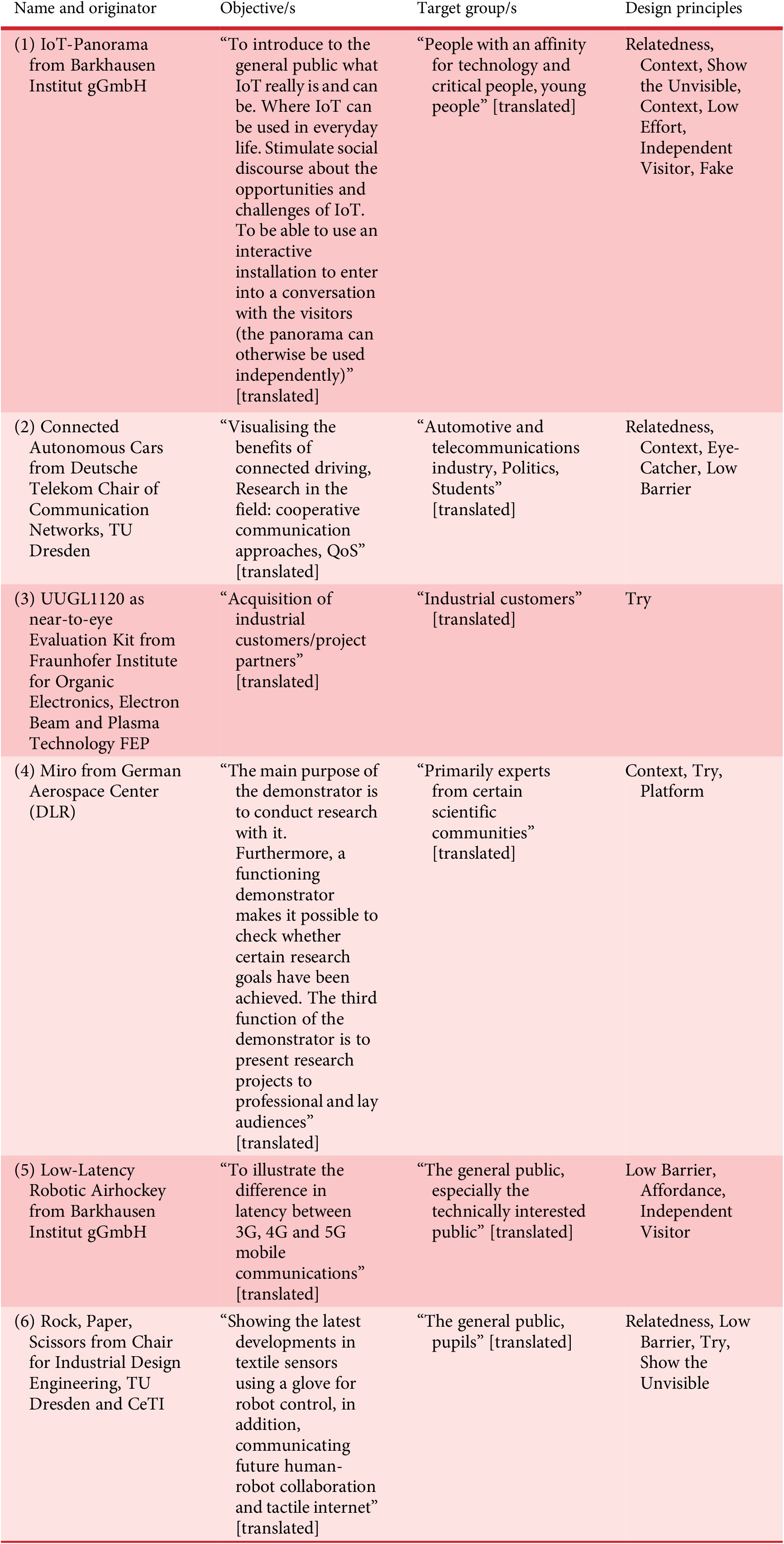
As a result, the final sample consisted of 28 demonstrator cases. All demonstrator cases derive from technology research and development in the areas of Internet of Things and Robotics. Additionally, two-thirds of demonstrator cases derive from one research institution (TU Dresden), but eight different chairs. Nonetheless, this has an effect on the generalisation of the outcome. A condensed overview of all demonstrator cases (including name, originator, objective/s, target group/s and identified design principles) can be found in the Appendix (Tables A1–A4).
2.2. Thematic analysis
We used a thematic analysis to find a comprehensive demonstrator ontology regarding how demonstrators are designed to demonstrate science and technology. It comprises of two parts: (i) Code Generation and (ii) Code Analysis.
-
(i) Part one consists of a workshop with five participants for initial code generation. All five participants have experience and interest in the design of demonstrators, but derive from different perspectives. With the choice of participants, we included perspectives for two demonstrator purposes, related to communication (Moultrie Reference Moultrie2015): communication within the scientific community and communication outside the scientific community (general public, potential funders, industry). Two participants (P2 and P3) are coresearchers.
-
(P1) Demonstrator design for communication to the general public and scientific community in the field connected robotics, background in electrical engineering, codeveloped two demonstrator cases,
-
(P2) demonstrator design for communication to potential funders in the field smart wearables, background in industrial design engineering, codeveloped two demonstrator cases,
-
(P3) demonstrator design for communication to industry in the fields human–machine interface and agriculture, background in industrial design engineering, codeveloped one demonstrator case,
-
(P4) demonstrator design for communication to potential funders and the general public in the field robotics, background in industrial design engineering, codeveloped one demonstrator case,
-
(P5) and demonstrator design for communication to the general public in the field tactile internet, background in industrial design engineering, codeveloped two demonstrator cases.
-
During the 4-hour workshop, we provided a collaborative environment where we negotiated meaning and explicated knowledge (Öberg & Hernwall Reference Öberg and Hernwall2016; Ørngreen & Levinsen Reference Ørngreen and Levinsen2017). More specifically, we facilitated a group discussion for initial code generation, following a thematic analysis (Braun & Clarke Reference Braun and Clarke2006). Every participant screened the data before the workshop. First, the first author introduced literature-based knowledge about the field of demonstrators. Second, we discussed each demonstrator in the following way. For ensuring a comprehensive understanding of the demonstrator, we reviewed demonstrator purpose and functionality and finally discussed the applied design principles. Thereby, all participants inductively generated the initial code set. For supporting the discussion and for documenting purposes, we used the visual collaboration platform ‘miro’ (https://miro.com/). Here, all demonstrator cases were presented and participants could add sticky notes with design principles. Additionally, we recorded the audio of the workshop and transcribed it afterwards.
-
(ii) After the workshop, we conducted part two of the data analysis. The visual results on the collaboration platform, as well as the transcript of the workshop, served as a basis. The first author collated all initial codes into potential themes, reviewed the themes, defined, named and grouped themes and finally produced the analysis report with theme descriptions, examples and quotes. To ensure inter-subjectivity, the report has been discussed with one workshop participant in detail. The themes were iteratively restructured and renamed until arriving at consensus. The final report has been sent to all workshop participants. Minor changes were applied until arriving at consensus.
3. Results
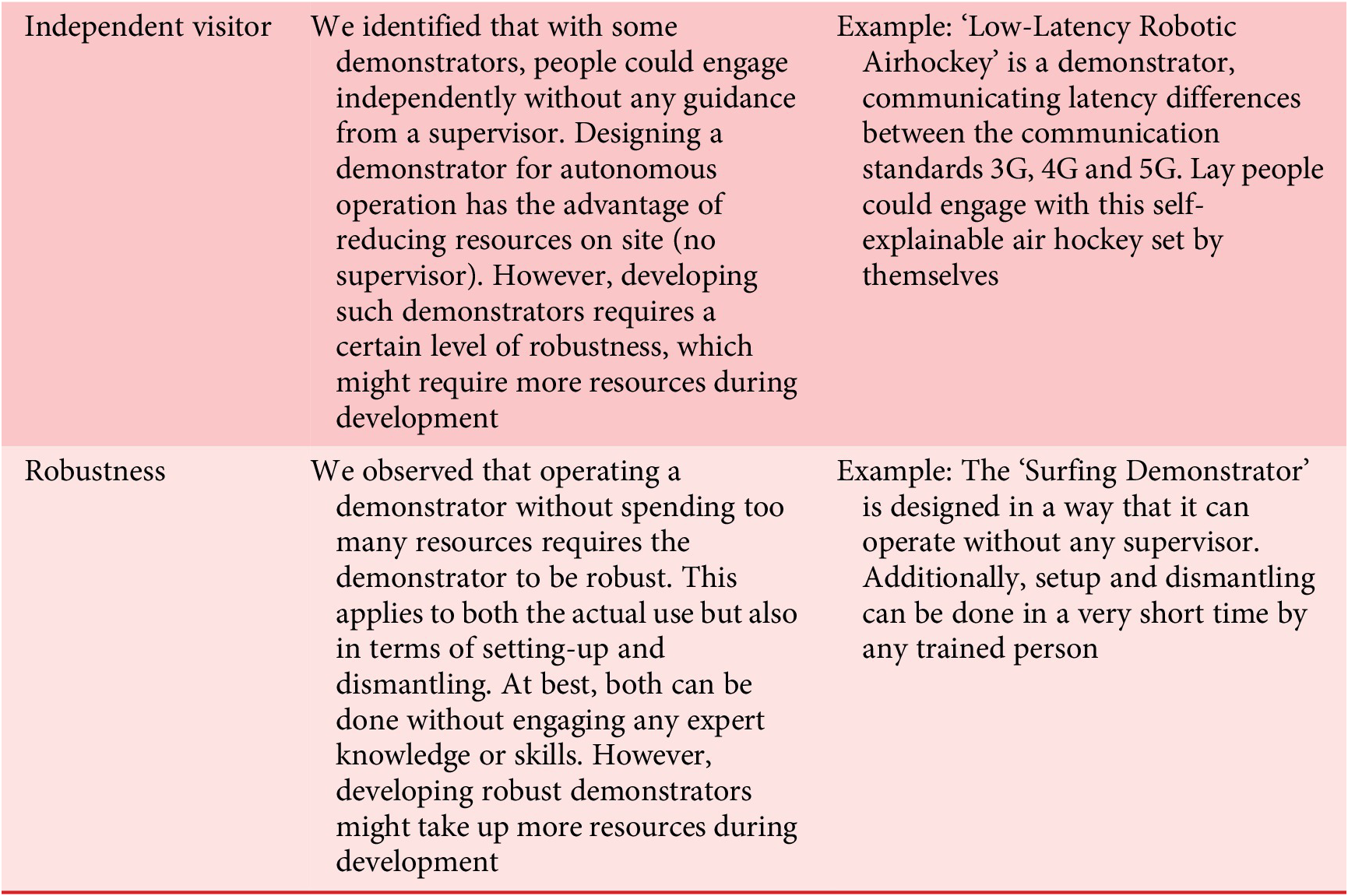
The proposed typology assists in categorising and understanding 13 key design principles, themed in demonstrator-specific goals (see Figure 3). The typology was built from three perspectives: first, in terms of the communication goal (see Table 1), second, in terms of visitor engagement goals (attraction, initial engagement, deep engagement) (see Tables 2–4) and third, in terms of resource-related goals (low effort in development and operation) (see Tables 5 and 6).
Thirteen Design Principles are categorised into goal-related themes, one relating to communication (green), three relating to visitor engagement (yellow) and two relating to resources (blue).

Design principles related to the communication goal of the demonstrator

Design principles related to the goal of attracting visitors
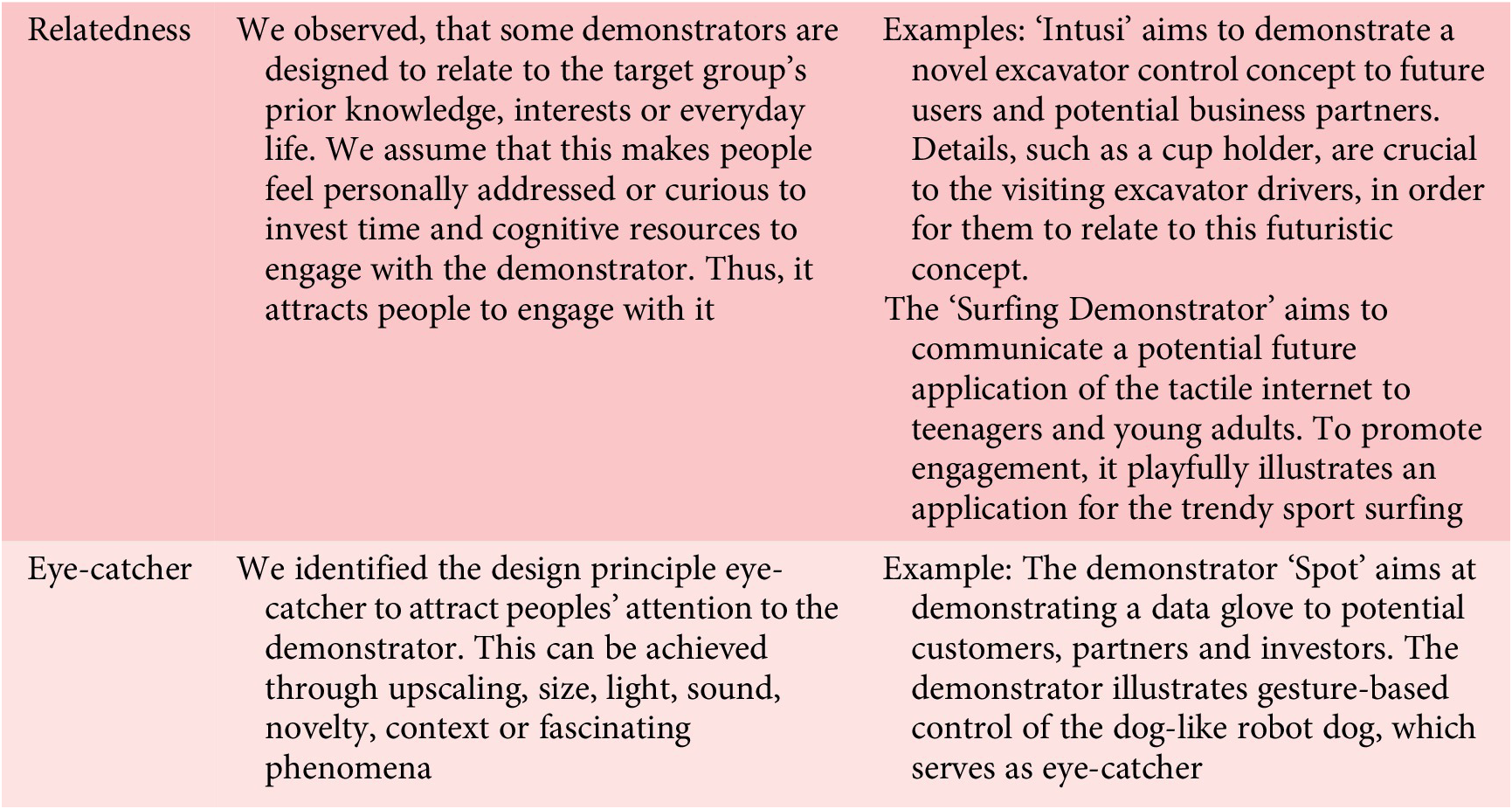
Design principles related to the goal of initially engaging visitors

Design principles related to the goal of deeply engaging visitors

Design principles related to the goal of saving resources during development

Design principles related to the goal of saving resources during operation
4. Discussion
Demonstrators are powerful artefacts for communicating science and technology. However, there is a lack of knowledge about how to efficiently design demonstrators that effectively communicate to stakeholders with a different knowledge base. Identifying design principles of demonstrators will facilitate researchers with important design knowledge in the concept phase of demonstrator development to exploit the demonstrators potential of a communicating artefact. In this study, we qualitatively analysed 28 interactive demonstrator cases and identified 13 key design principles, which contribute to goals relating to communication, visitor engagement and resource efficiency. Those principles have been derived from and are therefore valid for demonstrators from the fields of robotics and Internet of Things. This study confirmed that the demonstrator is an artefact with both prototype and science exhibit characteristics, since we found that most design principles can be supported by – or are related to – literature in the fields of museum and prototype research. We further notice an ambiguity for some principles. Each, immersion and low-barrier, fake and authenticity, have some contradictory aspects. We elaborate on those aspects in the following sections.
4.1. Museum research
Literature in Museum Research supports the principle context, since situating scientific ideas in real-world contexts and showing how science connects to people, society or the environment enables visitors to connect new information to prior knowledge and experiences (Gilbert & Stocklmayer Reference Gilbert and Stocklmayer2001; Allen & Gutwill Reference Allen and Gutwill2004). Regarding principle relatedness, learning research suggests that people need to identify themselves with science topics to learn science effectively (Brickhouse, Lowery & Schultz Reference Brickhouse, Lowery and Schultz2000; Archer et al. Reference Archer, DeWitt, Osborne, Dillon, Willis and Wong2012). Hence effective science exhibits should adapt to the target group’s activities, topics and aesthetics. The literature also supports the eye-catcher principle, providing evidence that large, sound-emitting or moving exhibits attract the attention of visitors to a greater degree (Melton Reference Melton1972; Peart Reference Peart1984; Bitgood, Patterson & Benefield Reference Bitgood, Patterson and Benefield1988) and that technological novelty promotes visitor attention (Sandifer Reference Sandifer2003). However, we believe that this principle bears the risk of visitors perceiving the eye-catcher itself as the main content of the demonstrator even when it is not. The principle low barrier can be confirmed by museum research, since there is evidence that low-pressure settings, the opportunity to observe others and offering playful, clear entry points are conducive for visitors to initially engage with an exhibit (vom Lehn, Heath & Hindmarsh Reference vom Lehn, Heath and Hindmarsh2001; Meisner et al. Reference Meisner, vom Lehn, Heath, Burch, Gammon and Reisman2007). Regarding the principle comparison, literature confirms that to promote prolonged visitor engagement, an exhibit should enable open-ended exploration and foster investigation (Sandifer Reference Sandifer2003; Gutwill & Dancstep (Née Dancu) Reference Gutwill and Dancstep (Née Dancu)2017) in order for visitors to actively construct knowledge by investigating their own questions, in contrast to placing visitors in the role of passive recipients of information (Hein Reference Hein2000; Rennie & Johnston Reference Rennie and Johnston2004).
Regarding the principle immersion, we found three different interpretations of what an immersive exhibit comprises that match our analysis very well: (a) Exhibits that replicate environments and recreate realistic, life-sized settings that place visitors in a certain time, location or situation (immersive context) (Bitgood, Ellingsen & Patterson Reference Bitgood, Ellingsen and Patterson1990; Gilbert Reference Gilbert2002). (b) Exhibits that enable virtual experiences in simulated worlds (Dede et al. Reference Dede, Salzman, Loftin and Ash2000) (virtual or augmented reality) and (c) exhibits that allow ‘whole body’ experiences, where visitors use their body beyond walking or sitting (embodied interactions) (Falk et al. Reference Falk, Scott, Dierking, Rennie and Jones2004). The literature suggests that immersive exhibits attract and engage visitors on a higher level, while they do not necessarily provide better learning experiences (Dancstep et al. Reference Dancstep (Née Dancu), Gutwill and Sindorf2015). This principle would be interesting to explore more deeply in future research.
The principle independent visitor illustrates one main difference between exhibits and demonstrators, since in museum contexts, visitors engage without explainers, while demonstrators are mostly accompanied by explaining scientists. Research on the role of explainers argues that they facilitate the visitor experience while encouraging visitors to engage and to reason about the exhibit (Rodari & Xanthoudaki Reference Rodari and Xanthoudaki2005). However, the quality of facilitation depends heavily on the explainers’ preparation and pedagogical knowledge. We recognise the potential of demonstrators to be conversation openers for people with different knowledge backgrounds but are aware of the resource-intensive job of supervising. We are interested in further exploring the effect of this principle on communication aims.
4.2. Prototype research
Some design principles are especially relevant for application-oriented demonstrators, which already communicate a technology application or its technical/market fidelity. Those demonstrators resemble prototypes of a soon-to-be market-ready product and therefore are closely related to the prototyping literature. The principle try relates to the very basic concept of prototyping, which (next to exploration) serves as a tool for communication and evaluation among different stakeholders (Star Reference Star2010) by creating shared tacit knowledge (Henderson Reference Henderson1991; Rhinow, Köppen & Meinel Reference Rhinow, Köppen, Meinel, Israsena, Tangsantikul and Durling2012). Both the principles context and fake can be applied to make an application-oriented demonstrator appear more like a market-ready product and therefore relates to fidelity discussions around prototypes (Virzi et al. Reference Virzi, Sokolov and Karis1996). High-fidelity products can evoke different reactions (e.g., excitement for product aesthetics) but also expectations (e.g., to functionalities) to a demonstrator. We assume that a product with a high perceived fidelity poses the risk of disappointing visitors, especially experts, after testing. We believe this principle should only be used for certain purposes, such as making future technology tangible for a nonexpert target group. However, we also see ethical concerns, which makes a transparent communication about what has been faked and why crucial.
4.3. Design research
Relating to the principle low barrier, Norman (Reference Norman1998) coined the term affordance, which refers to […] those fundamental properties that determine just how the thing could possibly be used.
It results as a basic requirement in human-centred design to achieve good usability outcomes in human–machine interaction. The principle relatedness can further be promoted by technology acceptance research: The Unified Theory of Acceptance and Use of Technology (UTAUT) model describes ‘habit’ among seven other factors, which influences the acceptance of a technology (Venkatesh, Thong & Xu Reference Venkatesh, Thong and Xu2012). The principle platform refers to modularity as a design concept. It describes the decomposition of a product into components, which facilitates the standardisation of components and increases product variety (Gershenson & Prasad Reference Gershenson and Prasad1997). Modularity further plays an important role in sustainable design from a life cycle perspective (Sonego, Echeveste & Debarba Reference Sonego, Echeveste and Debarba2018). Adapting this principle to demonstrators can result in the benefit of quickly upgrading, adapting or modifying certain elements, which can promote a vast variety of demonstrators.
We assume that some principles strongly depend on the respective target group, which can in general be split into experts and nonexperts. Taking the principle authenticity as an example, we assume that too much unfiltered or raw technology could be overwhelming and discouraging for a nonexpert target group, while too little authenticity could disappoint an expert target group. However, providing authentic insight into the multifaceted research and development behind housings or interfaces might increase the credibility of research projects and justify research or business funds. It also communicates a more realistic picture of scientific processes. The principle fake also strongly depends on the target group and communication aim. Wizard of Oz prototypes allows a communication of functionalities, applications or experiences that have not been developed yet. It might be a valuable approach as a conversation opener at an early development stage, especially with a nonexpert audience. Those two principles are contradictory and it would be interesting to explore this topic further.
4.4. Limitations
However, the results should be considered with care, since the 28 demonstrator design cases have a narrow scope, both locally and thematically. Approximately 72% of demonstrator cases derive from one research institution (TU Dresden). Furthermore, approximately 48% of demonstrator cases derive from one research cluster, based in Dresden. Thematically, the demonstrators are limited to the fields of Internet of Things and Robotics. Hence, the research should be regarded as specific to the local research landscape in Dresden (Germany) and only to the two mentioned thematic areas of technology development. However, this scope allowed a much greater depth of understanding design principles than would have been possible from a broader sample.
4.5. Implications
We suggest the following implications for practice:
-
(i) Including design knowledge into the scientific process can have an impact on the quantity and quality of created artefacts, such as demonstrators with their multitude of purposes. This should be considered already in research proposals to provide resources for such skills.
-
(ii) Scientists should be informed about the role of demonstrators, including possible target groups and design principles for them to consciously plan and create demonstrators for their needs.
-
(iii) Raising awareness for the demonstrator as an important communication tool is crucial also among other stakeholders at scientific institutions, such as decision-makers, communication offices or technology transfer offices.
5. Conclusions
In this article, we present the results of a thematic analysis to identify design principles among 28 demonstrator cases, which we collected through an online survey. The resulting typology consists of 13 design principles, themed in demonstrator-specific goals. The framework gives a comprehensible overview of design principles for technology demonstrators and is able to facilitate research teams with rich design knowledge in the concept phase of demonstrator development. Eventually, the framework supports to exploit the demonstrators full potential of a communicating artefact and to save resources during development and operation. The main insights further indicate that (a) visitor experience and resource efficiency are both important drivers in demonstrator design, (b) the target group (broadly divided into experts and nonexperts) influences the choice and form of design principles and (c) some design principles, such as immersion versus low barrier or fake versus authenticity, are contradictory since they are associated with one goal while degrading another.
The identified design principles provide many opportunities for further research, such as extending the framework to other fields of technology. In the near future, we aim to explore the effect of specific design principles on science communication aspects with nonexperts. This could lead to a more precise and evidence-based knowledge base about the design and experience of demonstrators. To make current and future results even more accessible to demonstrator developers, future work will include the transfer to an open and easily accessible tool.
To conclude, this typology of design principles is an important first step in understanding the conceptual design of scientific demonstrators for communicating technology research and development. More effective communication between different disciplines or nonacademic stakeholders has the potential to facilitate inter- and transdisciplinary cooperation to tackle the challenges of an increasingly complex world and consciously shape the future for the better.
Acknowledgement
This work was funded by the German Research Foundation (DFG, Deutsche Forschungsgemeinschaft) as part of Germany’s Excellence Strategy – EXC 2050/1 – Project ID 390696704 – Cluster of Excellence ‘Centre for Tactile Internet with Human-in-the-Loop’ (CeTI) of Technische Universität Dresden.
A. Appendix
A.1. Online survey
Introduction
We want to investigate the role and characteristics of the demonstrator in technology research and development. For this, we need a large number of case studies of technology demonstrators. It would be very helpful if you enter all demonstrators one after the other that you have (co)developed.
General information about the demonstrator
What is the name of the demonstrator?
Which institution/s does the demonstrator belong to?
What was the approximate effort of developing this demonstrator (in person-months)?
Objectives
What is the primary goal or intention of the demonstrator?
Who is the associated target group?
Where is it used/shown?
What other goal or intention is being pursued with the demonstrator?
Who is the associated target group?
Where is it used/shown?
Design
On what basic concept is the demonstrator (or the interaction with it) based to achieve the goal/s?
What characterises the final demonstrator, and how could/can it be experienced?
Please upload a photo of the demonstrator.
Is more information about the demonstrator available online (e.g., video, website, publication)?
Reflection
To what extent was the goal/s met (or not met) with the demonstrator?
In your view, was the effort involved in developing the demonstrator worthwhile?
What is your assessment based on?
Is there anything else you would like to share with us?
In case we have any questions, feel free to leave us an email address.
A.2. Overview of demonstrators
Tables A1–A4 give an overview of the 28 demonstrator design cases, which have been analysed during the study. The tables comprise of the demonstrator names, originators, objectives, target groups and the identified design principles. The objectives and target groups are direct quotes from the online survey.
Condensed overview of demonstrator design cases, part 1
Condensed overview of demonstrator design cases, part 2

Condensed overview of demonstrator design cases, part 3

Condensed overview of demonstrator design cases, part 4


 Open access

