

Introduction
At various points after 2000 governments in Russia, Poland and Hungary declared ‘demographic crises’ marked by well-below replacement fertility and declining populations. Demographic issues rose to the top of national political agendas. All three governments adopted pro-natalist incentives (baby bonus programmes) and generous family benefits Footnote 1 , policies to which they devoted substantial fiscal resources. While directions of change in these policy areas have been broadly similar across the three cases, the design of policies, especially of the most prominent and expensive ‘flagship’ programmes, have been quite distinct in each case. The purpose of this article is to compare Russian, Polish and Hungarian pro-natalist and family policies that were adopted in response to population decline. Previous studies have found that success in raising fertility rates, the three governments’ major goal in introducing pro-natalist programmes, has been real but temporary in all cases (Frejka and Zakharov, Reference Frejka and Zakharov2013; Suwada, Reference Suwada2019; Szanto, Reference Szanto2021). Less attention has been paid to the comparative effects of these policies on child and family poverty. We find significant and disparate effects on child poverty rates across the cases. And while there has been considerable research on family policies, especially in Poland and Hungary, ours is the first study to add the comparison with similar policies in Russia, and to compare effects of these policies on women’s labour force participation in the three cases.
Baby bonus programmes, parental leaves and pre-school childcare are interrelated components of family policy that may affect fertility trends. However, they provide different incentives for mothers and families. Baby bonus programmes incentivise child-bearing only, and are discursively supported by the neo-familialist ideologies that are dominant across all three regimes. Neo-familialist ideologies emphasise traditional values encouraging women’s roles and responsibilities in the private sphere, particularly in reproductive labour. Parental leave policies have ambiguous effects, on the one hand facilitating mothers’ labour force participation, on the other incentivising their temporary withdrawal from paid work, which may become long-term or curtail career advancement. Increasing supply of institutionalised pre-school childcare both facilitates and incentivises women’s paid work, responding to the reality of mothers’ significant part in labour forces which is – somewhat contradictorily – also recognised in official discourses. Significantly, these policies have different fiscal implications: institutionalised childcare entails long-term public investment, whereas monetary bonuses for childbearing and parental leave benefits are funded temporarily and shift over time. Our article assesses the use and differing effects of these three policies as well as their relation to ideologies across the cases.
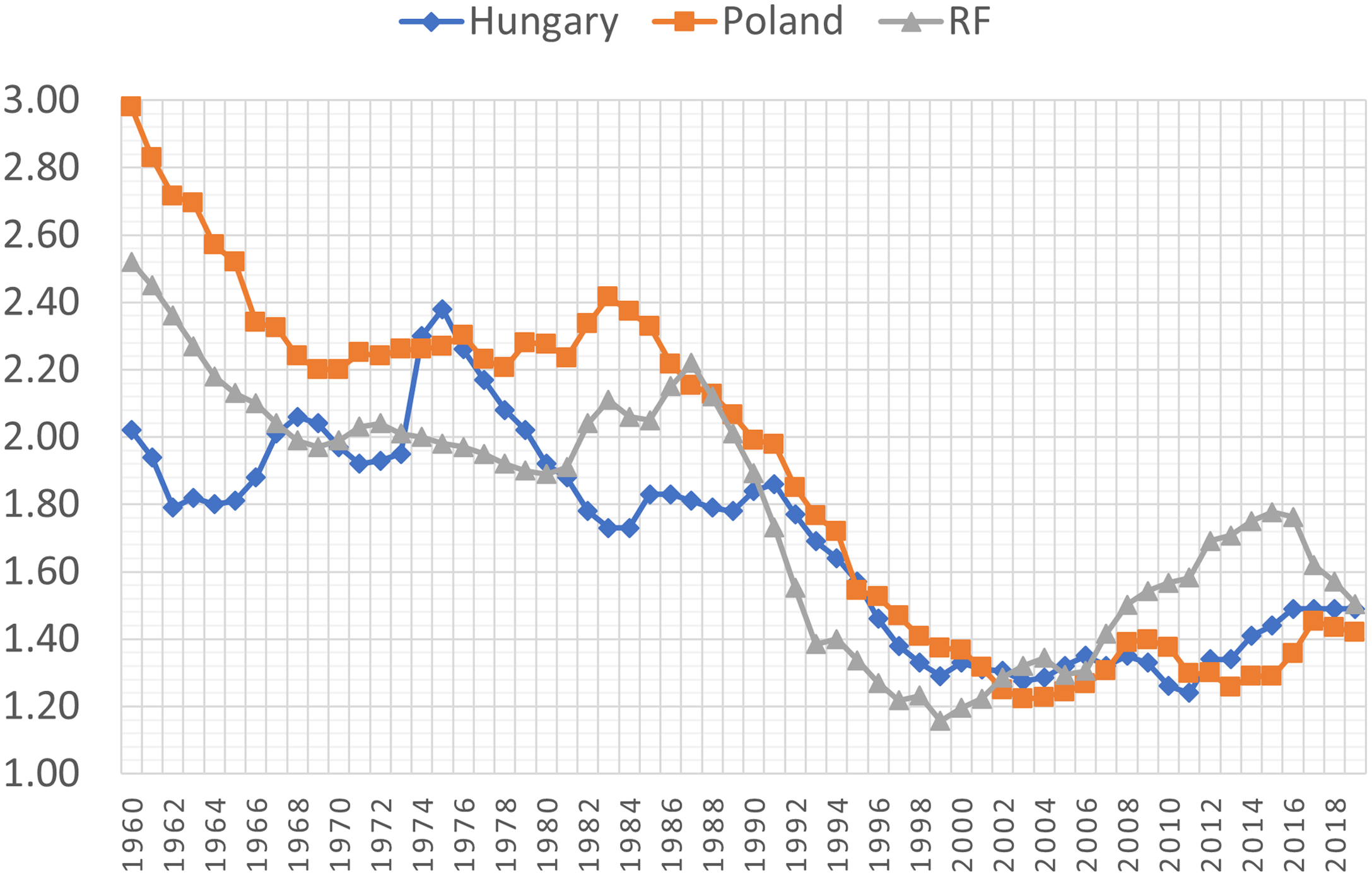
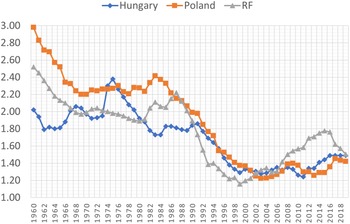
Why compare these three cases? Russia, Poland and Hungary share similar, though not identical, historical legacies of pro-natalist and family policies as well as historically high levels of women’s labour force participation. During the communist period all had ‘dual earner’ – ‘double burden’ systems, also known as ‘working mother’s gender contract’ – in which most women worked full-time while also bearing responsibility for children and home (Ashwin, Reference Ashwin2000; Fodor, Reference Fodor2004; Perkowski, Reference Perkowski2017). From the 1960s, fertility declined in all three cases, to below replacement rate (defined as lower than 2.1 children per woman) in Russia Footnote 2 and Hungary, though not in Poland (see Figure 1). Hungary experienced well-below replacement rates in the 1960s and again in the 1980s. By the early 1990s fertility had fallen below replacement in all three states and ongoing decreases were contributing to demographic decline.
Total fertility rate per woman, Russia, Poland and Hungary, 1960-2019
Source. OECD (2022a).
There have also been similarities in the political realm. Since 2000 the three states have been governed for long periods by parties with nationalist, neo-familialist ideologies – Putin’s United Russia, Hungary’s Fidesz, and Poland’s Law and Justice Party – that have prioritised raising fertility. Each has a ‘flagship’ pro-natalist programme that features large-scale monetary transfers to families – Russia’s ‘Maternity Capital’, Poland’s Family 500+, and Hungary’s earned income tax credits for families with children (Magda et al., Reference Magda, Kielczewska and Brandt2018; Cook and Inglot, Reference Cook, Inglot, Beland, Morgan, Obinger and Pierson2021). In terms of these main ‘input’ factors the three constitute similar cases.
The significant differences in levels of fertility decline during the communist period (see Figure 1) left somewhat different policy legacies in the three cases. Hungary, which had the lowest fertility, developed and maintained strong pro-natalist and family policies from the 1970s and 1980s. Hungary was exceptional among communist states for the extent and generosity of its family benefits (Marx et al., Reference Marx, Salanauskaite and Verbist2013; Inglot, Reference Inglot2020). Poland, which maintained above-replacement fertility through the mid-1980s, introduced maternity and family benefits more gradually. Policies remained fragmented and levels of funding were uneven, increasing and decreasing over time (Szanto, Reference Szanto2021). According to Inglot et al. (Reference Inglot, Szikra and Raț2011: 20), Poland’s communist-era government did not attempt ‘to create any integrated system of childcare policies, falling rapidly behind many other Soviet bloc nations even during the best times of the 1970s.’ In the Russian case, from the early Soviet era support for families included child benefits, maternity leaves, workplace flexibility, fertility promotion and public childcare (Selezneva, Reference Selezneva2016: v). After WWII several additional pro-natalist benefits and family supports were introduced as part of the effort to compensate for the huge loss of life (Hoffman, Reference Hoffman2000). In the early 1980s, as fertility began to decline sharply, new pro-natalist policies were introduced (Malkova, Reference Malkova2017). While the range of benefits during the Soviet decades was broad, they were less generous than in Hungary. In addition, ‘the Soviet family model was distinguished by its insistence that women retain positions in the workforce at the same time that they produced and raised children’ (Hoffman, Reference Hoffman2000: 35).
Several streams of shared discourse have developed around pro-natalist and demographic policies since the 1990s in Russia, Poland and Hungary: (i) a liberal-democratic discourse that includes a gender equality agenda, (ii) a conservative/traditionalistic/patriarchal discourse and (iii) a nationalistic discourse. The conservative discourse opposes abortion, sex education, homosexuality and promotes ‘traditional family values’. Nationalist discourses embrace ‘xenophobic’ agendas, and espouse alarmist views on the ‘dying out’ of the national majority because of threats from migrants and/or ethnic minorities. Both provide strong support for pro-natalism (Sobotka, Reference Sobotka2011: 283-4). Fertility is considered a matter of national security in all three countries. It is also interwoven with religious discourses, especially in Poland. The current anti-gender equality discourses in these states are motivated by conservative populism and constitute a reaction against the EU’s gender mainstreaming policies. Pro-natalist discourses in Poland and Hungary are explicitly Eurosceptic in their opposition to multiculturalism and liberal values as well as gender equality. They embrace a binary role model for women as mother and wife, and men as breadwinner (Kourou, Reference Kourou2020: 4-5). Similar discourses in Russia emphasise moral obligations of citizens, who are supposed to increase fertility rates in order to strengthen ‘family values’ (Leykin, Reference Leykin2011). The ‘traditional values’ concept functions here as ‘symbolic glue’ organising discourse coalitions that draw heavily on Russian Orthodox religious thinking and in some regions on Islamic revival movements (Edenborg, Reference Edenborg2021: 1-3).
The religious, traditional values, nationalistic, and conservative discourses represent social movements and clusters of public concerns. They are interlinked forms of anti-gender mobilisation. To enable communication across ideological differences, their proponents from various religions and intellectual circles, parental organisations, academics and political parties build so-called discourse coalitions, i.e. groups of actors and interests that use common storylines over a certain time period (Hajer, Reference Hajer, van den Brink and Metze2006; Edenborg, Reference Edenborg2021). By centring on such storylines as protecting ‘traditional values’ and saving the children, the governments facilitate the discourse coalition to oppose LGBTQ rights and reduce sexual and reproductive rights. This ‘biopolitical turn’ is part of the authoritarian drift of post-communist political regimes (Makarychev and Medvedev, Reference Makarychev and Medvedev2015).
Analytically, we view pro-natalism as a system of ideologies, institutions, and policies aiming at encouraging childbearing that is advanced in response to concerns of insufficient population size and fears of ethnically different migrants or minorities (Hašková and Dudová, Reference Hašková, Dudová, Haukanes and Pine2021). Change or continuity in reproductive institutions and policies are the results of debates in certain discourses communicated to the public (Fairclough, Reference Fairclough and Fairclough1992; Hašková and Dudová, Reference Hašková, Dudová, Haukanes and Pine2021). Analytical consideration of interrelated discourses, policies, and institutions relies on the concept of the ‘biopolitics of population’ (Foucault, Reference Foucault1980) describing a way to govern citizens by considering them in terms of population. Pro-natalism as an element of biopolitics is a series of interventions and regulatory control measures aiming to normalise, control and regulate individuals in order to ensure the stability and reinforcement of the nation-state. Pro-natalist policies coupled with nationalist discourses aim to support the fertility rate among members of a particular national community, often on the foundation of traditional patriarchal ideology (Yuval-Davis, Reference Yuval-Davis, Wilford and Miller1998). The policies, discursive campaigns, and expert knowledge combined in pro-natalism mostly target female individuals responsible for the reproduction of the national body, thus differentiating women on the basis of their racial, ethnic and sometimes social background.
The following sections of our article compare pro-natalist and family policies across Russia, Poland, and Hungary. Part II focuses on the major or ‘flagship’ pro-natalist programmes that were adopted in each case, assessing their comparative effects on fertility and child poverty. Part III compares effects of selected family policies on work-family reconciliation and women’s labour force participation across the cases. The conclusion summarises comparisons and considers implications.
‘Flagship’ pro-natalist programmes: monetary transfers, fertility, and poverty
All three ‘flagship’ programmes – Russia’s Maternity Capital, Poland’s Family 500+, and Hungary’s earned income tax credit – rely on large explicit or implicit monetary transfers to families that are designed to incentive women to have more children. They were preceded and are accompanied by a range of new or enhanced family benefits, as well as progressive restrictions on abortion rights. Footnote 3 Below we explain the main provisions of each programme, then assess comparatively their effects on fertility and child/family poverty.
Russia’s maternity capital programme
Russia’s government was the first of the three to focus on demographic policy. In 2006 President Putin declared the need to address population decline as ‘the highest national priority,’ Footnote 4 and announced the ‘Maternity Capital’ (MC) programme as part of a package of policies aimed at raising the proportion of families with two or three children (Avdeyeva, Reference Avdeyeva2011; Cook, Reference Cook, Jäppinen, Kulmala and Saarinen2011; Borozdina et al., Reference Borozdina, Rotkirch, Temkina and Zdravomyslova2016). The programme provides a large one-time transfer (certificate) to mothers who give birth to or adopt a second or third child – in certain cases, the benefit may be given to the father or directly to the child. MC was awarded for second or third children between 2007 and 2019, then extended to the first child born or adopted from 2020 until 2026. The programme provides one MC certificate per family that meets the criteria, irrespective of income. The funds are restricted to use for housing, children’s education, contribution to the mother’s pension fund, or rehabilitation services for a child with a disability.
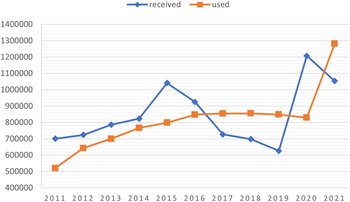
Beginning in 2006 at R250,000 ($9,500), the benefit was raised continuously to R429,400 ($10,000) in 2014, equal to almost five years of minimum living expenses for a child (though it could not be used to meet most living expenses). Despite its costs the federal programme was maintained through the 2008 and 2012 recessions. Beginning in 2011, regional supplements were added for the third child (Kazenin and Kozlov, Reference Kazenin and Kozlov2020). Approximately 700,000 women received certificates annually to 2011 (Elizarov and Levin, Reference Elizarov and Levin2015). The number receiving and using MC from 2011 to 2021, which appears in Figure 2, shows that the recipient pool grew to 1,040,843 in 2015 then dropped down to 626,450 in 2019 and rose again to 1,053,461 in 2021. In the beginning of 2022, the size of the benefit increased in nominal rubles but fell in dollar equivalents, to R524,528 ($6,467).
Number of people receiving and using Maternity Capital in Russia, 2011-2021
Source. Rosstat (2022a).

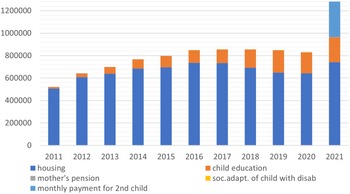
MC can be used only after the third birthday of the child for whose birth it is awarded. It is given not as cash but to rent or buy housing or pay school tuition and fees (the options to invest in mothers’ pensions or pay for services for a child with disabilities are rarely used). Figure 3 shows how parents have used MC. By far the most common use is for housing. A smaller but still significant proportion and growing is spent on the child’s education. In 2021 a new option was introduced to receive a monthly payment for the birth or adoption of a second child, which proved quite popular. It was used by 316,700 persons. Field research (Borozdina et al., Reference Borozdina, Rotkirch, Temkina and Zdravomyslova2016) during the early years of the programme found that many eligible mothers confronted bureaucratic obstacles in accessing the benefit, and that it was more easily accessed by middle-class than poorer families. The process for accessing MC has since been simplified and is not difficult for families of various income and education levels. Figure 2 indicates that rates of use have increased steadily.
Uses of Maternity Capital, 2011-2021
Source. Rosstat (2022a).
Note. Monthly payment for the second child is available only since 2021 after this measure was announced.

Poland’s Family 500+ Child Allowance
Poland’s Family 500+ Child Allowance was initiated much later than Maternity Capital, in 2016, as the flagship social programme of the recently-elected populist Law and Justice government. Significant but less generous pro-natalist measures had been adopted in Poland since 2007 by both Law and Justice and Civic Forum governments, and appeared to produce a relatively small, temporary increase in fertility (Inglot, Reference Inglot2020). Family 500+ provides a monthly cash benefit to all families for each child until the age of eighteen, irrespective of income or number of children. It was initially means-tested for the first child, then made universal in 2019. In 2016 the monthly benefit was 500 Polish zloty per child (120 euros), though the amount has not been adjusted for inflation and its real value has declined. Parents can apply for Family 500+ benefits through a user-friendly online application process. Benefits are distributed at local government offices. The programme’s reach is very broad: by mid-2016, 2.7 million children had benefited (Inglot, Reference Inglot2020). Family 500+ has almost doubled national expenditure on family policy, raising the cost to approximately 3 per cent of GDP, moving Poland from the bottom to near the top of family policy spenders in Europe (Magda et al., Reference Magda, Kielczewska and Brandt2018; Cook and Inglot, Reference Cook, Inglot, Beland, Morgan, Obinger and Pierson2021). It represents a radical policy innovation by the populist Law and Justice party which, while right-wing in identity politics, favours highly re-distributive programmes typically associated with the left in family and social policy. Family 500+ is extremely popular and contributes to the governing party’s continuing success.
Hungary’s earned income family tax credits
The populist Fidesz Party won control of Hungary’s government in 2010 and in 2011-2012 substantially expanded the existing system of earned income tax credits for parents. This programme of expanded tax credits, an implicit subsidy, constitutes the government’s ‘flagship’ policy. It is the most distinctive and expensive benefit in a large package of family policy measures introduced by Fidesz. The benefit is in the form of a monthly allowance for each child that parents can deduct from taxes. In 2018 the annual deduction amounted to 200 euros for one child, 400 euros for two and 660 euros for three or more children (= 31 euros, 63 euros and 104 euros per month respectively.) There is a lifelong exemption from income tax for mothers of four or more children. These amounts can be compared to an average net monthly salary in Hungary of 730 euro in 2018 (Bault, Reference Bault2019). Additional programmes provide subsidies for housing and preferential access to nurseries for large families. The tax credits and other enhancements in family policy consolidated Hungary’s position as the most generous post-communist provider of family support, close to levels of wealthier European states. Fidesz increased spending on all forms of family policy provisions from 960 billion forints (3.5 per cent of GDP) in 2010 to 3,500 billion forints (6.2 per cent of GDP) in 2022 (Hungary Today, 2021). However, the full tax credit is available only to families that earn sufficient income in the formal economy to subtract it from their taxes.
All three governments promoted their pro-natalist policies as antidotes to low fertility. As explained above, however, the programmes were designed differently in terms of breadth of coverage and distributive principles. Their recipient pools are quite distinctive. The next section of the article presents a brief review of the broadly-acknowledged disappointing, though somewhat varied, effects of these programmes in raising fertility, as well as their highly differential effects on child and family poverty.
Effects of pro-natalist programmes on fertility
The literature is divided on the effectiveness of financial incentives in raising fertility (Laroque and Salanié, Reference Laroque and Salanié2008; Cook, Reference Cook, Jäppinen, Kulmala and Saarinen2011: 29-30; Elizarov and Levin, Reference Elizarov and Levin2015). Evidence for all three flagship programmes shows that they produced significant but temporary increases (see Figure 1). In Russia fertility grew significantly during the years after adoption of MC, with the largest increase in the first years, peaking in 2015, but remaining well below replacement levels. From 2016 fertility declined and stagnated. In Poland and Hungary increases were more modest, though as in Russia were most pronounced in the first years of the programmes. In all three cases the effects faded out over time. Higher fertility rates were not sustained even when benefits increased. Some analysts speculate that such newly introduced financial incentives affect mainly timing rather than number of births per women, perhaps due to uncertainty whether the policies will continue. Interviews with recipients of MC, for example, revealed a general distrust towards the programme’s sustainability (Borozdina et al., Reference Borozdina, Rotkirch, Temkina and Zdravomyslova2016: 60).
Effects of pro-natalist programmes on poverty
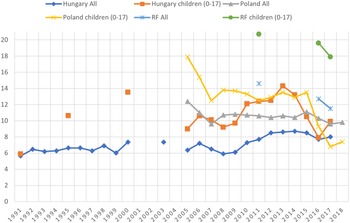
The large financial transfers provided by the three pro-natalist programmes have had dramatically different effects on child poverty in Russia, Poland and Hungary (see Figure 4).
Relative income poverty rate (%) for the total population and for children (0-17 years old)
Source. OECD (2022b).
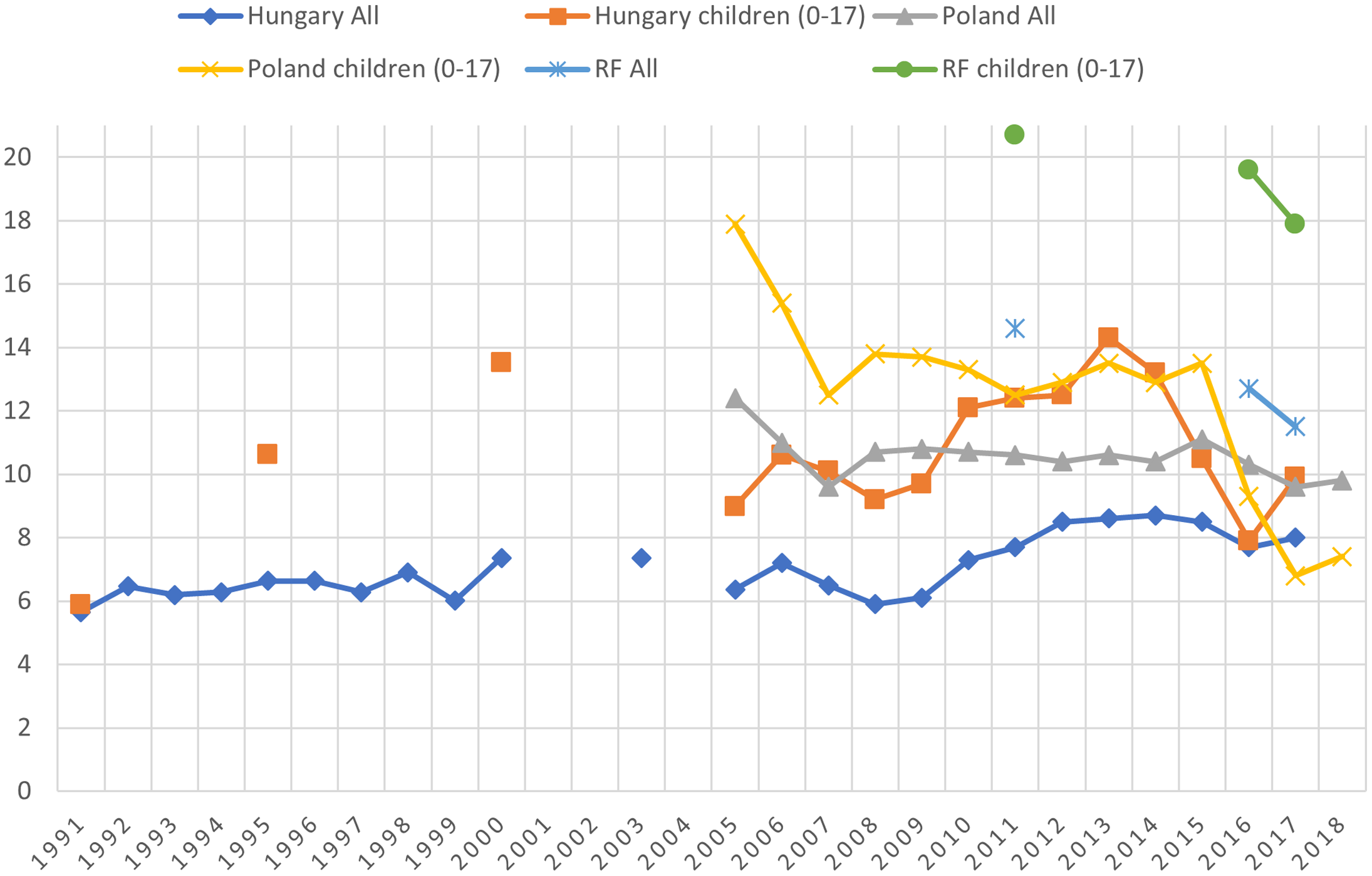
Before the introduction of these programmes child poverty was significantly higher than total population poverty in all three cases. As Figure 4 shows, in Russia child poverty remained much higher than poverty in the total population – almost 20 per cent in 2016 for children versus about 13 per cent for the total population. During the years 2012 to 2018, while the MC programme was in place, both child and total poverty rates dropped about 2 per cent while the disparity remained, showing virtually no effect on relative child poverty. In Poland by contrast, child poverty was significantly higher than total population poverty when Family 500+ began in 2015, close to 14 per cent for children versus 10 per cent total. With the benefit’s introduction child poverty plummeted by 50 per cent within two years, to less than 7 per cent, then increased slightly but remained below the overall poverty level. In Hungary, where the disparity between child and total poverty was similar to Russia’s, child poverty also declined significantly and relatively with the increase of family tax exemptions, to the level of overall poverty by 2016, then began to increase – increases in child poverty in both Poland and Hungary resulted partly from inflation for which programme benefits were not indexed. Footnote 5 In sum, MC had virtually no effect on quite high rates of child poverty or that of children relative to Russia’s population as a whole. Family 500+ had a dramatic effect in lowering absolute and relative child poverty in Poland. Hungary’s tax credits lowered child poverty to the level of total poverty temporarily.
What accounts for these differences? The Russian case is most interesting because of its very small effects. In Russia poverty has long been concentrated in large or multi-child families (see Table 1), though the number of such families has declined throughout the Federation. Maternity Capital benefited only those mothers who had one or two children at the time the programme began in 2007 (until 2020 when first children became eligible), not those who already had three or more. In addition, regional benefits that were added to the programme in 2012 varied according to regional budgets and tended to exclude the poorest regions (Elizarov and Levin, Reference Elizarov and Levin2015). Footnote 6 While other benefit programmes did reach larger families, MC did not, and overall family-friendly policies failed to reduce children’s poverty level in Russia. To observe the situation in more detail, we look at another indicator, the relative risk of poverty for children at age sixteen and below – zero to sixteen is a bit smaller group in comparison with the zero to seventeen from Figure 4. Observations of the indicator from 2000 show the least progress in poverty reduction among children in comparison with other age groups, and significant differences are visible from 2007. Moreover, since 2016 the risk of poverty indicator among children has been growing while other categories demonstrated stability after the 2014-15 shock (Biryukova and Ter-Akopov, Reference Biryukova, Ter-Akopov and Ovcharova2019). In 2018 a means-tested benefit was added to MC, funded by regional budgets. Families with a child born or adopted after January 1, with incomes not exceeding one and a half times the regional subsistence minimum, became eligible for a monthly child allowance.

Class or income category was not an explicit part of the public discourse around MC, but ‘unfortunate’ families that had long been stigmatised were in practice mostly blocked from eligibility. A popular discourse focusing on neblagopoluchnye sem’i (unfortunate families), those whose life conditions were difficult, had been used to stigmatise poor, often multi-child and single-parent (nepolnaia’, i.e. incomplete) families since Soviet times and continued into the 2000s (Iarskaia-Smirnova and Romanov, Reference Iarskaia-Smirnova, Romanov and Salmenniemi2012). The ‘unfortunate family’ discourse connects with the conservative and familialist discourses discussed above, designating those who do not conform to the traditional family model. The category was associated with unfounded claims that such people had babies in order to receive money from the state, but lacked the judgement to spend it wisely, and so served as an implicit justification for the design of MC. While low-income families were not explicitly excluded from the programme, providing the benefit only for second or third children effectively excluded larger poor families that fell into the stigmatised categories. By contrast, the intent to exclude often-poor Roma families from pro-natalist benefits in Hungary on the basis of ethnicity, discussed below, was quite explicit.
Reasons for the exceptional effects of Poland’s Family 500+ Programme in reducing poverty among children are obvious. The benefit is universal, the application process straightforward and benefits easy to collect. Poland’s policies produced the lowest level of child poverty, and the largest gap with total poverty to the benefit of children, in the three cases. Family 500+ represented a radical conceptual innovation in comparison to programmes elsewhere (Inglot, Reference Inglot2020). Along with Poland’s other generous family policies, it was adopted by a nationalist government for an ethnically homogeneous population amidst fears that the nation was literally being depleted by low fertility and large-scale out-migration of young citizens. The comparatively radical redistributive orientation of the populist Law and Justice Party is worth emphasising.
Hungary’s child tax credit is, on the face of it, a non-progressive and status-maintaining programme. It appears designed to benefit mainly traditional middle-class Hungarian families, which earn sufficient income from jobs in the formal labour market to qualify for the full deduction (Fodor, Reference Fodor and Fodor2022a). Felix (Reference Felix, Kovats and Poim2015: 64), who reflects a common view of Hungary’s family policies, argues: ‘According to the rhetoric, the aim of the ruling parties is to provide the opportunity for women to stay at home with their children. However, these policies affect poor and better-off families differently, putting the latter in a more favourable position’. The pro-natalist discourse in Hungary contains a strong ethnic accent, with explicit messages directed toward the Roma Community. It is framed by accusations that ‘shadowy forces are intentionally decimating white Christian populations by encouraging low birth rates and allowing other groups – namely Muslims, migrants, and people of colour – to gain power through immigration and higher birth rates’ (Scigliano, Reference Scigliano2021). Nationalist-populist population discourse is observed in all three countries but attempts to stigmatise poor families gained greatest emphasis in Hungary, targeting the Roma minority as the ‘undeserving poor’ (Raț and Szikra, Reference Raț, Szikra, Eydal and Rostgaard2019: 224).
The data in Figure 4 only partly confirm this picture of a non-progressive benefit. According to the figure, absolute and relative child poverty in Hungary fell after introduction of the tax credits, from 2012 to 2016, almost as steeply as in Poland with the Family 500+ Programme. The effects were slightly more modest, with child poverty falling to the level of general population poverty rather than below as in Poland and beginning to rise more quickly, but the differences are not great. It appears that the tax credit did reach poor multi-child families. Before the programme was introduced, the presence of children increased risk of poverty, especially for families with three or more children and in single-parent families (Czibere and Rácz, Reference Czibere and Rácz2014). The tax exemption for mothers with four or more children also may have reached some poorer families. Still, according to the European Anti-Poverty Network (EAPN, 2020: 5) in 2020, in families with three or more children up to 22 per cent lived in conditions of deprivation, while almost 44 per cent of Roma children experienced severe deprivation. Referring to the period of COVID-19, when child poverty increased globally, the EAPN report (2020: 11) observed critically, ‘Presumably Hungary won’t be able to use its distorted family support scheme to protect those most affected: the children of /the/ precariat and lowest /income/ decile, who already have no access to most forms of the existing family support schemes.’
In the next section we look at family policies in the three cases, focusing on provision of preschool public childcare, length of maternity/parental leaves and employment of mothers with children of various ages.
Family policies: work-family reconciliation and gender equality
Russia, Hungary and Poland all adopted or expanded varying combinations of other family policies, usually including parental leaves with monetary compensation, mothers’ job protections and provision of public pre-school childcare (Robila, Reference Robila2012). These policies are assumed to function as key determinants for levels of women’s participation in the labour force, in turn influencing the extent of gender equality. Depending on their design, such policies may favour either comprehensive or familialist family support models, i.e., either enable mothers’ participation in the labour force (work-family reconciliation) or create and sustain obstacles that tend to keep them at home. Parental leave policies can function as explicit or implicit incentives for women to care for children outside the labour force. An inadequate supply of pre-school childcare may prevent mothers from re-entering the labour force for several years after the birth of a child.
The preference of the EU and most feminist groups is for comprehensive support policies that enable women with children to work without long periods out of the labour force. The underlying logics for this preference are both social and economic: women who work steadily have more mobility opportunities, income, social insurance benefits, independence and capacity to be self-supporting than others. The single wage-earner model leaves families more vulnerable to job loss, illness and disability of the male breadwinner. In broad economic terms, higher rates of labour force participation produce larger tax bases to finance government and social welfare (the Nordic model). For children, attendance at quality pre-school is seen as a means of equalising opportunities across social classes, providing all with early education, competence in the major language(s) of instruction, and other types of enrichment that are less likely to be available in poorer families (Esping-Andersen, Reference Esping-Andersen and Palier2010). In sum, the comprehensive model promotes both gender and social equality. The preferences of the nationalist, neo-familialist leaderships of Russia, Poland and Hungary are for women to focus on home and children, give birth to more children and accept a male breadwinner model supplemented by support from the state.
The extent, design and mix of family policies vary across the three cases, as do judgements about whether specific policies support familialism or comprehensive family models. It would be unwieldy to compare all aspects of the three states’ family policies. Instead we focus on two key programmes that are broadly seen to influence family models and women’s labour force participation: provision of pre-school public childcare services, and parental leave programmes. Accessible and affordable childcare enables mothers with young children to return to the labour force soon after the birth of a child, while lack of such services creates pressure for the family-centred ‘home care’ model (Kingsbury, Reference Kingsbury2015). Effects of parental leave are more complicated. Long parental leaves, which are almost always taken by mothers (participation of fathers remains marginal in these cases despite some efforts to promote it) are seen to incentivise long labour force absences, during which women become disconnected from jobs and/or fall off their career tracks. The birth of a second or third child may extend the leave and thus the period of disconnection. Salary compensation, though it invariably declines over time, makes long leaves more financially feasible, and other family benefits may help to compensate for foregone salary. Below we show for each case, data on provision of pre-school childcare; length of parental leaves; and women’s labour force participation rates by age of youngest child (Raț and Szikra, Reference Raț, Szikra, Eydal and Rostgaard2019; Inglot, Reference Inglot2020; Szanto, Reference Szanto2021).
Pre-school childcare services
Communist systems, which had incomparably high levels of women’s labour force participation, also had extensive networks of state-subsidised pre-school childcare, especially in urban areas. Often childcare was provided by employers on the work premises or by local governments. During the post-communist recessions many of these facilities closed, some were commercialised and demand collapsed as birth rates and thus numbers of young children fell dramatically. When they initiated pro-natalist programmes in the post-communist period all three governments were left with limited networks of pre-school childcare facilities. They began expanding capacity for ages three to five years, and much more gradually nurseries for children zero to three years. Tables 2 and 3 show the percentages of children under three years and three to six years enrolled in childcare in Russia, Poland and Hungary from 2005. Table 2 shows for all three cases that there has been limited progress in increasing facilities for children under age three. In 2005 less than 3 per cent of zero-to-three-year-olds in Poland and less than 7 per cent in Hungary were enrolled in care services, while more than 20 per cent were enrolled in Russia. Poland increased percentages modestly and unevenly, reaching a high of almost 16 per cent in 2015 before falling in the next two years. Hungary, by contrast, nearly tripled its percentage to 20 per cent in 2019. Russia retained its 2005 rates. Percentages of three-to-six-year-olds enrolled in pre-school (Table 3) are much higher and show different patterns. Hungary has very broad coverage, almost 87 per cent in 2005, increased to 92 per cent in 2019. Poland began in 2005 at 38 per cent and increased dramatically to almost 82 per cent in 2019. Russia, from a low of 53 per cent, increased to almost 83 per cent in 2019.
Enrolment rates in early childhood education and care services, 0- to 2-year-olds

Source. OECD (2022a)
Enrolment rates in early childhood education and care services and primary education, 3- to 5-year-olds

Source. OECD (2022a).
Actual levels of employment for mothers with children in these two age groups are shown in Table 4. As the Table indicates, there is little correlation between maternal employment and rates of enrolment in childcare, especially for mothers with very young children. While Hungary has higher levels of childcare coverage for children zero to two years, maternal employment rates were much higher in Poland – 46 per cent versus 12 per cent in Hungary in 2006. By 2019 both had increased coverage, with Hungary continuing to outpace Poland. Yet maternal employment stood at 58 per cent in Poland versus 16 per cent in Hungary. In Russia, maternal employment rates for the mothers of children zero-to-six years old comprised 62 per cent in 2009 and 67 per cent in 2019 (further breakdowns by age are not available for Russia from comparable OECD databases). Rates of mothers’ employment in Poland and Russia remain consistently higher than in Hungary.
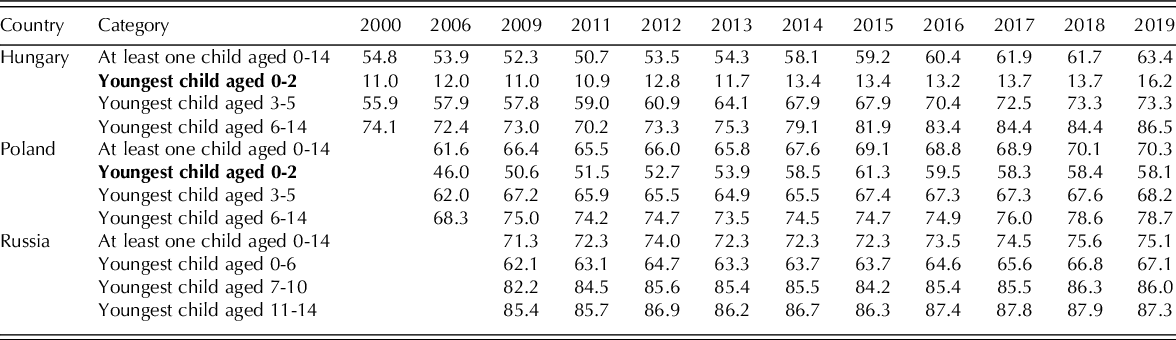
In Russia, the proportion of employed mothers with children seven to ten years old was 82 per cent in 2009 and 86 per cent in 2019. As the child grows older, this share increases: to 85 per cent in 2009 and 87 per cent in 2019 of employed mothers with children eleven to fourteen years old. Table 4 demonstrates small increases in employment over these years, within relatively stable patterns of the very high employment level among mothers (with the exception of the Hungarian case for women with children at the age zero to two years). In sum, though there is a dearth of early childcare in all three cases the percentage of children enrolled appears unrelated to the level of mothers’ employment.
Different mixes of childcare provided by extended families, private nannies and commercial facilities compensate for inadequate public facilities in allowing mothers to work in Poland and Russia. In Poland family members, mainly grandmothers, provide some care, but hiring of private nannies and enrolment in private childcare facilities have come to play a major role (Garcia-Faroldi, Reference Garcia-Faroldi2021). The government provides subsidies for nannies, and Poland has developed a broad informal childcare market. The country ‘stands out for its marketing of care services: 57 per cent of creches in 2013 were private and 78 per cent in 2017’ (Garcia-Faroldi, Reference Garcia-Faroldi2021: 714; See also Szelewa and Polakowsk, Reference Szelewa and Polakowsk2020; Inglot et al., Reference Inglot, Szikra and Raț2022). In Russia extended families play a major role in childcare (Teplova, Reference Teplova2007). A study based on data from the 2004 and 2007 waves of the Generations and Gender Programme survey found that 40 per cent of childcare services were provided informally in households, mainly by grandparents, especially in poorer and rural families (Sukhova, Reference Sukhova2011; Sharin and Kulkova, Reference Sharin and Kulkova2019). MC can be used to cover costs of state or private preschool childcare. In contrast to Poland, however, private childcare covered only 1.4 per cent of children in Russia in 2015 (Kazakova, Reference Kazakova2019). All three governments have introduced various subsidies in an effort to provide care alternatives for the youngest children (Raț and Szikra, Reference Raț, Szikra, Eydal and Rostgaard2019; European Commission, 2020). One could make the case that failure of any of the three governments to provide care for a large majority of children under the age of three constitutes pressure for a ‘home care’ model that would keep many mothers out of the labour force for several years. However, substantial proportions of these mothers in Poland and Russia are employed.
Parental leave
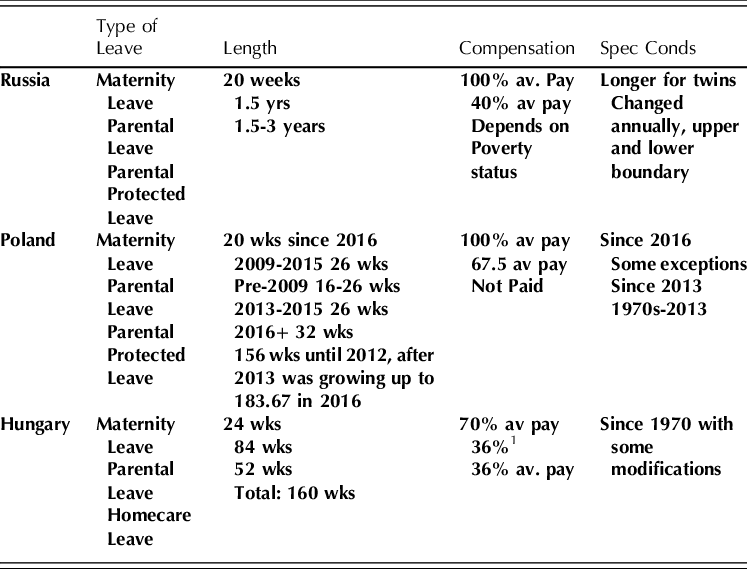
Parental leave programmes are the other type of family policies thought to affect women’s return to the labour force after a child’s birth. Extended parental leave policies are found to incentivise mothers’ prolonged absences from work, and so disadvantage them when most do return to the labour force, leaving them with fewer opportunities, more precarious jobs and fewer possibilities to accumulate social benefits such as pensions (Fodor and Kispeter, Reference Fodor and Kispeter2014; Magda et al., Reference Magda, Kielczewska and Brandt2018). These leave policies are also often unstable. They offer options for length of leave and levels of wage replacement that can be changed quickly by legislation. Table 5 presents a summary of leave programmes in Hungary, Poland and Russia. As the table shows, all three states provide maternal and parental leave with varying levels of compensation that diminish with length of leave. Hungary’s policy is the most generous, providing 160 weeks (three years) of leave with some wage replacement. Russia provides some financial support for up to three years depending on the family’s poverty status. Poland allows an even longer leave, 183+ weeks from 2016, but it is not paid. We conclude that Hungary’s policies provide the strongest incentives for mothers to remain outside the labour force for extended periods, taking account of both length of leave and compensation.
Parental Leave Programs in Russia, Poland and Hungary: Length and Compensation
Source. OECD (2022a).
Note. (1) All figures for compensation referring to Hungary and Poland are valid for 2020.
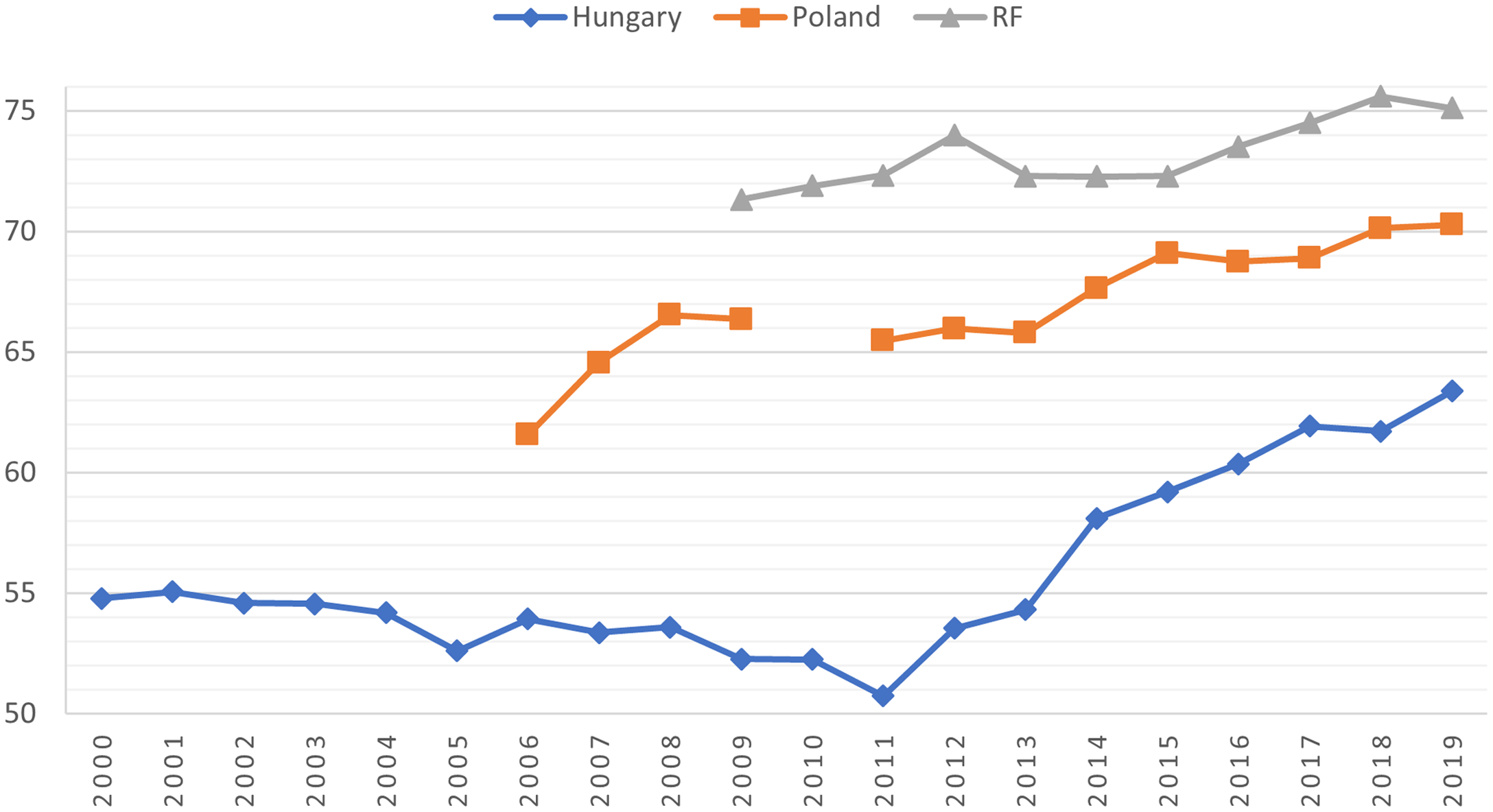
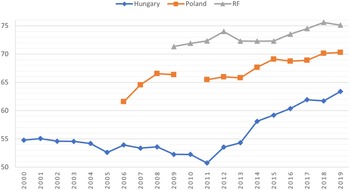
Figure 5 shows the comparison of maternal employment rates by age of youngest child for mothers with at least one child aged zero to fourteen from 2000-2019. Overall, the figure shows increases in employment, though there was a dip in Russia during the recession that began in 2012. There are also persistent differences across the cases. Russia consistently has the highest rates of mothers’ employment, Poland follows about 10 per cent below, while Hungary remains at the bottom, with the largest gap between Poland and Hungary. There has, however, been a relatively sharp increase in Hungary since 2011, when Fidesz introduced its package of family policies along with the earned income tax credits discussed above. Hungary has also introduced programmes to draw mothers back into the labour market, including the programme ‘Reducing the employment gap between men and women.’ Launched within the framework of the European Commission’s Structural Reform Support Programme, it provides technical support for the development of employment opportunities that make it possible to reconcile work and family life, specifically tailored to the needs of mothers raising small children. Outside the framework of the Action Plan, there is another measure that aims to encourage mothers to continue their studies, thereby improving their position on the labour market (European Commission, 2020: 21). These programmes, perhaps in combination with increased incentives for parents to work because of the earned income tax credit, which can substantially increase net income above net salary, may further increase mothers’ employment.
Finally, we should also consider whether the flagship baby bonus programmes contribute to or hinder mothers’ employment. As effects of these programmes on fertility are temporary, modest overall, and likely affect timing more than numbers of births, we should expect impacts on mothers’ employment to be limited. Evidence from Russia indicates that the effect of childbirth on mothers’ employment generally is negative. A recent study by Lebedinski et al. (Reference Lebedinski, Perugini and Vladisavljević2022) found that five years after childbirth, women suffer an earnings penalty, while no effect is observed for men. The mothers’ penalty stems exclusively from lower employment after childbirth; the authors do not find penalties in terms of working hours or hourly wage rates for women who remain in the labour force. The study also finds that parenthood decreases the probability of working in supervisory positions for mothers (Lebedinski et al., Reference Lebedinski, Perugini and Vladisavljević2022). To the extent that the flagship programmes increase numbers of births, or move childbirth to an earlier point in the mother’s work life, available evidence thus suggests that they hinder employment.
Conclusion
Our study has compared pro-natalist and family policies in Russia, Poland and Hungary during the post-communist period. We find that ‘flagship’ pro-natalist programmes in the three cases have had real but limited effects in achieving their major goal, raising fertility. Though lowering family poverty was not an explicit goal, the programmes have had significant and disparate effects on child poverty, halving it in Poland, lowering it in Hungary and barely affecting it in Russia. Both Russia’s and Hungary’s programmes effectively disadvantaged the poorest families, generally large families in Russia and ethnic Roma families in Hungary. In all three cases, pro-natalist and ‘traditional values’ discourses and incentives created justification for what Fodor (Reference Fodor2022b) calls a ‘carefare’ regime that for right-wing populists seems to be ‘a legitimate alternative to the neoliberal paradigm, offering welfare chauvinism and re-traditionalisation as the only feasible solution to the crisis of care’ (Graff and Korolczuk, Reference Graff and Korolczuk2022: 169).
The second focus of our article is on family policies that are thought to affect mothers’ labour force participation, specifically provision of public pre-school childcare and parental childcare leaves. We find no relationship between provision of childcare, either nurseries or kindergartens, and mothers’ employment across the cases. Governments have made limited long-term investments in re-building childcare infrastructure; especially in Poland and Russia, percentages of employed mothers with pre-school children far exceed availability of public facilities. Family and private/commercial care compensate. Maternity leave policies, at least in Hungary, do appear to incentivise substantial breaks in mothers’ labour force participation. Births, and to a greater extent long childcare leaves, disadvantage women in labour forces, contributing to lower wages, less career advancement, and overrepresentation in part-time and informal sector jobs when most eventually return to employment (Fodor and Kispeter, Reference Fodor and Kispeter2014).
In conclusion, we observe that all three governments have concentrated monetary and rhetorical investments in pro-natalism, traditionalism and familialism, imploring women to have more children and to remain at home raising them. These efforts have failed to produce substantial or sustained increases in fertility; demographic decline continues in all three cases.
It remains something of a puzzle why all three governments continued to invest scarce financial resources in these largely failed policies. Governments’ failure to provide adequate childcare, especially for ages 0-3, is consistent with its familialist rhetoric, but has not resulted in most mothers remaining at home. As we have shown, more than 60 per cent of mothers in Hungary and 70-75 per cent in Poland and Russia are employed; including in the latter a majority with children under age two. These governments have also made concessions to the reality, in many cases financial necessity, of mothers’ employment, by subsidising private childcare and adopting other work-family reconciliation measures, but such efforts are subsidiary. The post-communist governments’ traditionalist rhetoric and concentration of expenditures on pro-natalist incentives to encourage births, rather than on preschool childcare institutions that facilitate mothers’ employment, have had quite limited effects in either reversing demographic decline or re-traditionalising contemporary women’s lives. Instead, patterns of small families and high maternal labour force participation, established during the communist period and common to developed economies, have, with some variation, continued into the present.
Acknowledgements
Linda J. Cook and Elena R. Iarskaia-Smirnova gratefully acknowledge support from the Basic Research Program of the National Research University Higher School of Economics.




 Open access

