


Introduction
Establishing site chronology is a fundamental element of archaeological analysis. In historical archaeology, broadly covering post-1500s CE archaeology globally, many studies focus on sites with known occupation dates derived from the documentary record. With sites of unknown chronology, proxy dates are often used, for example from objects such as coins or other inscribed materials that can provide a terminus post quem (date after which, see Deetz Reference Deetz1996: 24). In North America, the development of techniques such as the mean ceramic date (South Reference South1978) provide additional methods for determining an approximate age of historical sites, based on known date ranges for the manufacture of mass-produced ceramic vessels. Dating of sites not associated with specific documentary evidence is crucial, as many are often associated with subaltern groups of interest in archaeologies of colonialism.
Proxy dating using artefacts provides useful estimates but can be subject to a variety of limitations. Time-lag often exists between when objects are introduced to the market and when they reach more remote parts of the capitalist world system, which are among the places where undated sites or features are likely to be encountered (e.g. Allen Reference Allen2008: 133). Further, recovery of materials to generate chronological data usually requires excavation, which is not always possible or desirable in every context. Simultaneously, absolute dating of organic building materials such as timbers from historical sites—especially from the eighteenth century CE onwards, when processes of European colonialism increase exponentially—is limited because the sites are generally too recent for radiocarbon dating to yield precise results, though dendrochronology is possible where timbers preserve (Boswijk et al. Reference Boswijk2014).
In the tropics, an alternative method is ‘U-series’ or uranium-thorium (U-Th) dating, which can be applied to directly date branch corals (Hellstrom & Pickering Reference Hellstrom and Pickering2015). This method has been used in Polynesia to provide dates for the initial discovery of the Tonga archipelago (Burley et al. Reference Burley2012) and the Mangareva Islands (Kirch et al. Reference Kirch2021), Hawaiian sacred sites where branch coral was a common type of offering (Kirch & Sharp Reference Kirch and Sharp2005; Weisler et al. Reference Weisler2006) and coral blocks from marae (temples) in Mo’orea (Sharp et al. Reference Sharp2010). One of the key observations in these studies is the importance of selecting ‘fresh’-looking branch coral samples, or ideally ones with evidence for anthropogenic modification, for example when used as abraders. Dating of branch corals from the past 500 years using the U-Th method can be challenging due to lower levels of 230Th. However, high-precision dating is still feasible if proper protocols are applied (Zhao et al. Reference Zhao2009).
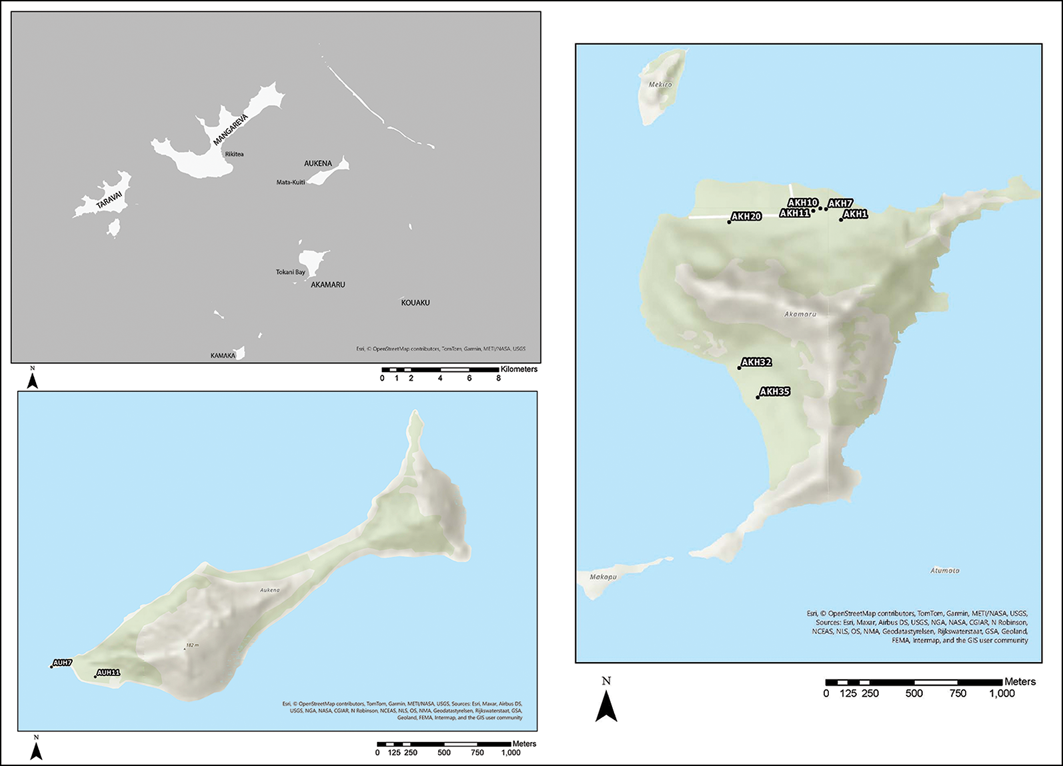
An archaeological survey of nineteenth-century buildings associated with missionary activities in the Mangareva Islands of French Polynesia (Flexner Reference Flexner2024) sampled minimally weathered branch corals from Acropora sp. coral blocks in nine of the ruined buildings in the islands (Figure 1). The samples provide U-Th dates for seven previously undated stone cottages built and inhabited by Polynesian Catholics (’are po’atu in the local Mangarevan language), a coral watch tower and a building with known construction dates (the boys’ school, constructed between 1853 and 1858 CE; Laval Reference Laval1968: CXVIII; Delbos Reference Delbos2011: 246). The results demonstrate a few decades of inbuilt age in some cases, which can be explained by the reuse of older building materials (Emory Reference Emory1939: 8) or the use of coral blocks cut from reef limestones that included already dead corals that are not visibly weathered. Direct dating of building materials alongside branch coral recovered from an excavated context also provides useful information for stratigraphic interpretation.
Map of the Mangareva Islands: top left) island names in capital letters, showing the locations of places mentioned in the text; right and bottom left) locations on the islands of Akamaru and Aukena, respectively, where coral samples were collected (figure by author).

Figure 1 Long description
The map of the Mangareva Islands is divided into three sections. The top left section displays the names of the islands in capital letters, highlighting the locations of places mentioned in the text. The right section focuses on the island of Akamaru, marking specific locations where coral samples were collected, labeled as AKH2, AKH135, AKH120, AKH110, and AKH7. The bottom left section shows the island of Aukena with marked locations for coral sample collection, labeled as AKH4 and AKH5. The map uses a scale in meters and includes a north direction indicator.
Mangareva historical archaeology
The Mangareva Islands are an archipelago of small, ancient extinct volcanic peaks, located within a lagoon surrounded by a fringing reef. The reef includes several long, narrow motu (coral islets), many of which feature beach rock terraces on the surface and corals in the intertidal zone. Evidence of initial discovery by Polynesian navigators is estimated at approximately 850 CE based on direct U-Th dating of a coral abrader. More concrete evidence for human occupation and environmental disturbance appears by 1100 CE (Kirch et al. Reference Kirch2021).
European encounters with the Mangareva Islands began with the British missionary ship Duff in 1797 (Wilson Reference Wilson1799). This was followed several decades later by the arrival of French Catholic missionaries from the Pères des Sacrés Coeurs de Jésus et de Marie in 1834 (Laval Reference Laval1968). Upon establishing a foothold in the islands, the missionaries began a programme of construction, led by a cadre of frères bâtisseurs, lay builder-brothers, who also trained Polynesian converts in European construction techniques (Delbos Reference Delbos2011).
In addition to a massive cathedral in Rikitea, then and now the main village in Mangareva, the missionaries and converts built multiple churches in the neighbouring islands of Aukena, Akamaru and Taravai. Missionary infrastructure included separate boys’ and girls’ schools in Aukena and Mangareva, a dormitory and workshop for frères tisserands (weaver-brothers), a massive blast furnace near the boys’ school, and communal bread ovens throughout the mission villages. The missionaries also built a royal palace for the family of Maputeoa, the ranking chief and regent of the Mangareva Islands, after his conversion to Catholicism in 1836 (Flexner Reference Flexner2024).
This building activity impacted the Polynesian landscape, particularly through the desecration and destruction of once sacred sites called marae. Previous archaeological research interpreted piles of stone used for building materials in the nineteenth century as likely derived partially from blocks once incorporated into marae (Emory Reference Emory1939: 8). In addition to locally sourcing coral building materials from near-shore reefs, the missionary builders and converts cut blocks of beach rock and corals from exposed formations in the motu of Kouaku, approximately 14km to the south-east of Rikitea (Flexner et al. Reference Flexner2025: 33–34).
The most common building type recorded during archaeological survey is the small stone cottage that was the typical dwelling for missionaries and Mangarevans alike, accounting for more than 50 per cent (69/123) of the recorded structures across the four main islands where missionary construction occurred during the nineteenth century. The houses are constructed of rectangular blocks of beach rock or volcanic rock for the corners, window and door apertures, infilled with more uneven coral blocks that comprise the walls. Stone house construction started by the late 1830s, transitioning to wooden houses by the beginning of the 1870s (Laval Reference Laval1968: LXXXI–LXXXIV).
As part of a survey of nineteenth-century constructions in the Mangareva Islands, 1 × 1m test pits were opened in the interior and exterior of 12 houses. The goal was to uncover information about construction techniques, for example how the building foundations were laid, and material culture from the occupation of the dwellings. In addition to missionary houses associated with the early churches in Aukena and Akamaru, excavations sampled undated houses previously occupied by Polynesian families. This selection comprised one house in Aukena, one in Mangareva and eight in Akamaru, including two in Tokani Bay, which was the location of the earliest missionary settlement (a full survey and excavation report, Flexner et al. Reference Flexner2025, is available upon request to the authors).
During the excavations, the presence of unweathered branch corals in several in situ coral limestone blocks was noted (Figure 2), as well as in blocks that were clearly architectural but had fallen from the adjacent ruins. Samples of branch corals were removed using hand tools, being careful not to damage the building fabric more than necessary. Seven houses were dated using the U-Th method, as well as the boys’ school (which had known dates based on missionary documents), the watch tower at Mata-Kuiti point and a branch coral recovered from a pit feature within one of the houses.
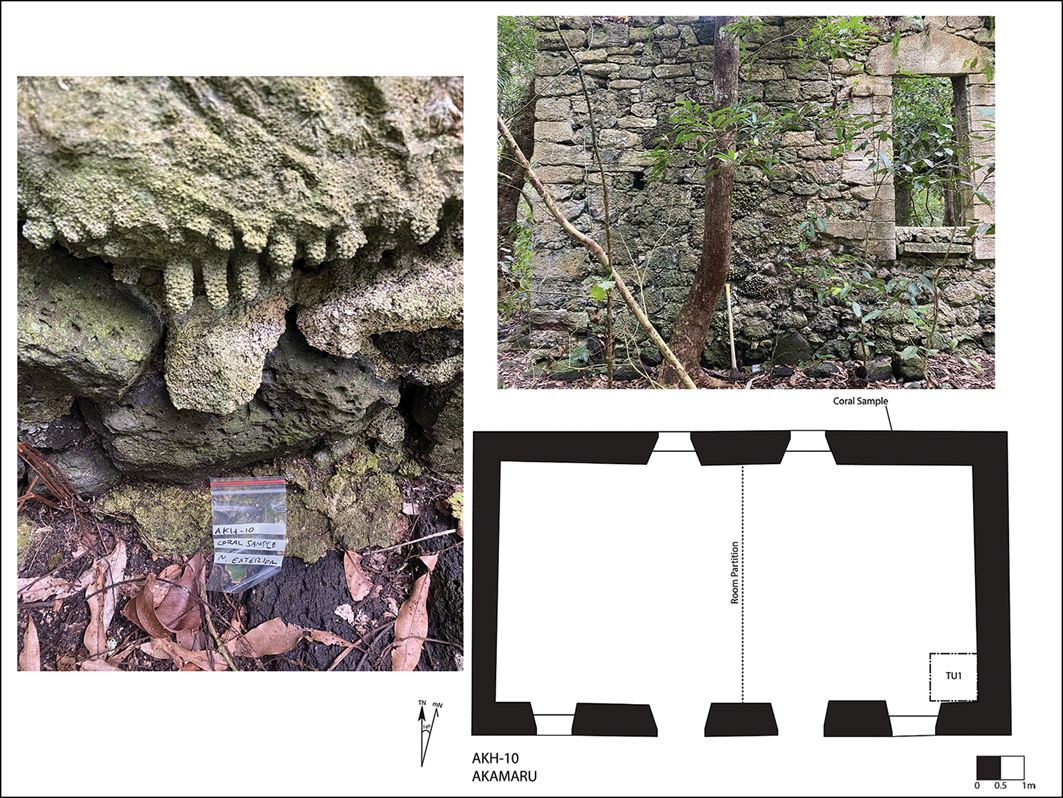
Left) example of unweathered in situ branch corals within a coral limestone block from the north exterior wall of structure AKH-10 on Akamaru Island; top right) the north exterior wall of AKH-10; bottom right) building plan of AKH-10 showing the sampling location. The sample returned a date of 1840±3 CE (figure by author).
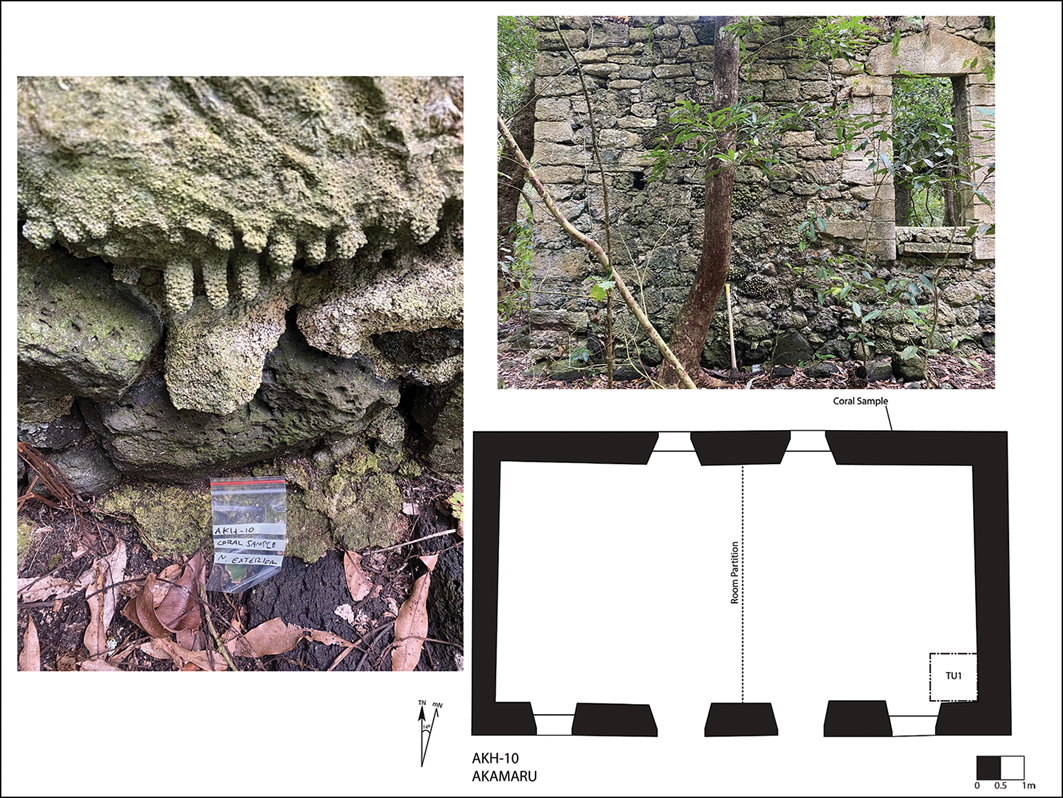
Figure 2 Long description
The image contains three elements: a photo of unweathered in situ branch corals within a coral limestone block from the north exterior wall of structure AKH-10 on Akamaru Island, a photo of the north exterior wall of AKH-10, and a building plan of AKH-10 showing the sampling location. The photo on the left shows a close-up of unweathered branch corals within a coral limestone block, with a labeled sample bag placed nearby. The top right photo displays the north exterior wall of AKH-10, featuring a window and a tree growing against the wall. The bottom right diagram presents a building plan of AKH-10, indicating the sampling location and labeling it as TU1. The sample returned a date of 18403 CE.
U-Th dates from colonial buildings in the Mangareva Islands
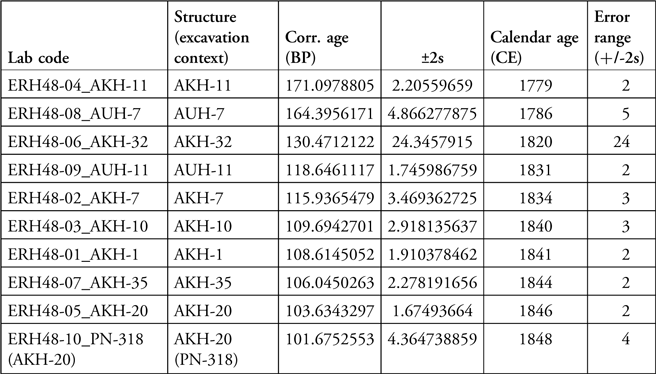
All 10 coral samples used in this study were dated by the University of Queensland Radiogenic Isotope Facility (UQRIF) under ultra-clean conditions using the U-Th method. Complete information on chemistry and standards provided to the author by UQRIF is available in Table S1 in the online supplementary material. The resultant dates, including a conversion to calendar years CE, are presented in Table 1. The boys’ school on Aukena (AUH-11, the Collège d’Anaotiki) acted as a ‘control’ site with a known period of construction. The coral sample from that site was more weathered compared with other samples, as limited branch coral was within reach for sampling, but still returned a reasonably close date of 1831±2 CE. The nearby watch tower AUH-7, which is likely of similar age (see Laval Reference Laval1968: CXXVI), returned a date that was far too early, pre-dating European contact with the Mangareva Islands. This sample was also notably weathered.
U-Th dating results presented in chronological order, adjusted to CE calendar years (‘present’ in BP is 1950 for compatibility with radiocarbon dates).

Table 1 Long description
The table presents U-Th dating results for 10 coral samples, arranged chronologically. It includes columns for lab codes, structure excavation contexts, corrected ages in years before present (BP), error ranges, and calendar ages in common era (CE) years. The samples were dated by the University of Queensland Radiogenic Isotope Facility. Notable entries include AKH-11 with a calendar age of 1779 CE and an error range of 2 years, and AUH-7 with a calendar age of 1786 CE and an error range of 5 years. The boys school on Aukena, AUH-11, acted as a control site with a known construction period, returning a date of 1831 CE. The nearby watch tower, AUH-7, returned an unexpectedly early date, predating European contact with the Mangareva Islands.
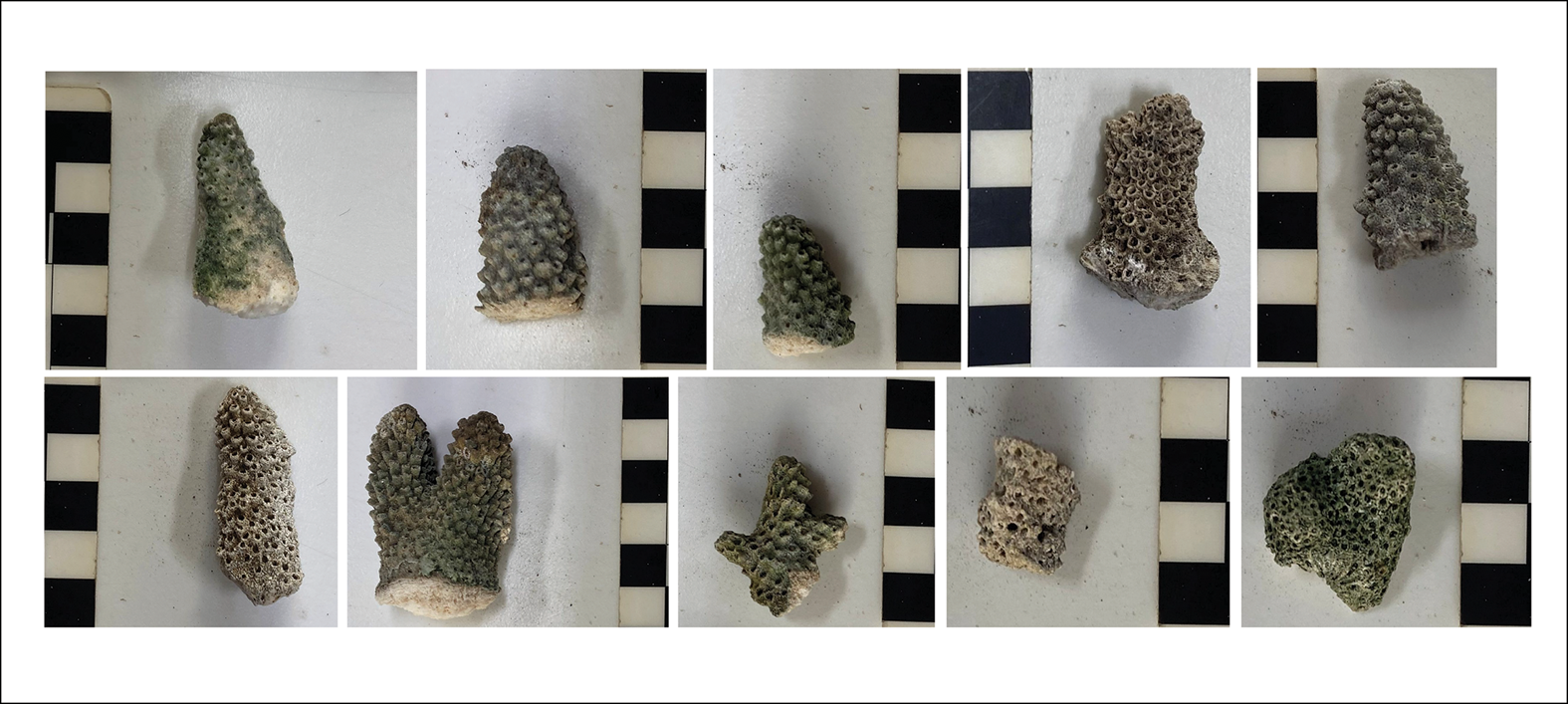
The samples from Akamaru were all visibly less weathered (Figure 3). Even so, one sample returned a pre-contact date (AKH-11). Of the two houses in Tokani Bay, AKH-32 yielded a pre-missionary date of 1820±24 CE, which is also the largest error range among the U-Th dates. This may be due to the introduction of non-radiogenic thorium via terrigenous dirt incorporated into the coral skeleton either during life or postmortem (N. Leonard pers. comm. June 2025). The remaining samples fall within the first decade or so of missionary presence in the islands, from AKH-7 (1834±3) to AKH-35 (1844±2). This latter sample is from the second house in Tokani bay, located approximately 200m from the first; it is possible they were roughly contemporaneous, but that the sample from AKH-32 had more inbuilt age.
The branch coral samples: top row from left) AKH-1, AKH-7, AKH-10, AKH-11, AKH-20; bottom row from left) AKH-20 PN-318, AKH-32, AKH-35, AUH-7, AUH-11 (figure by author, each square in the scale bar is 1cm).
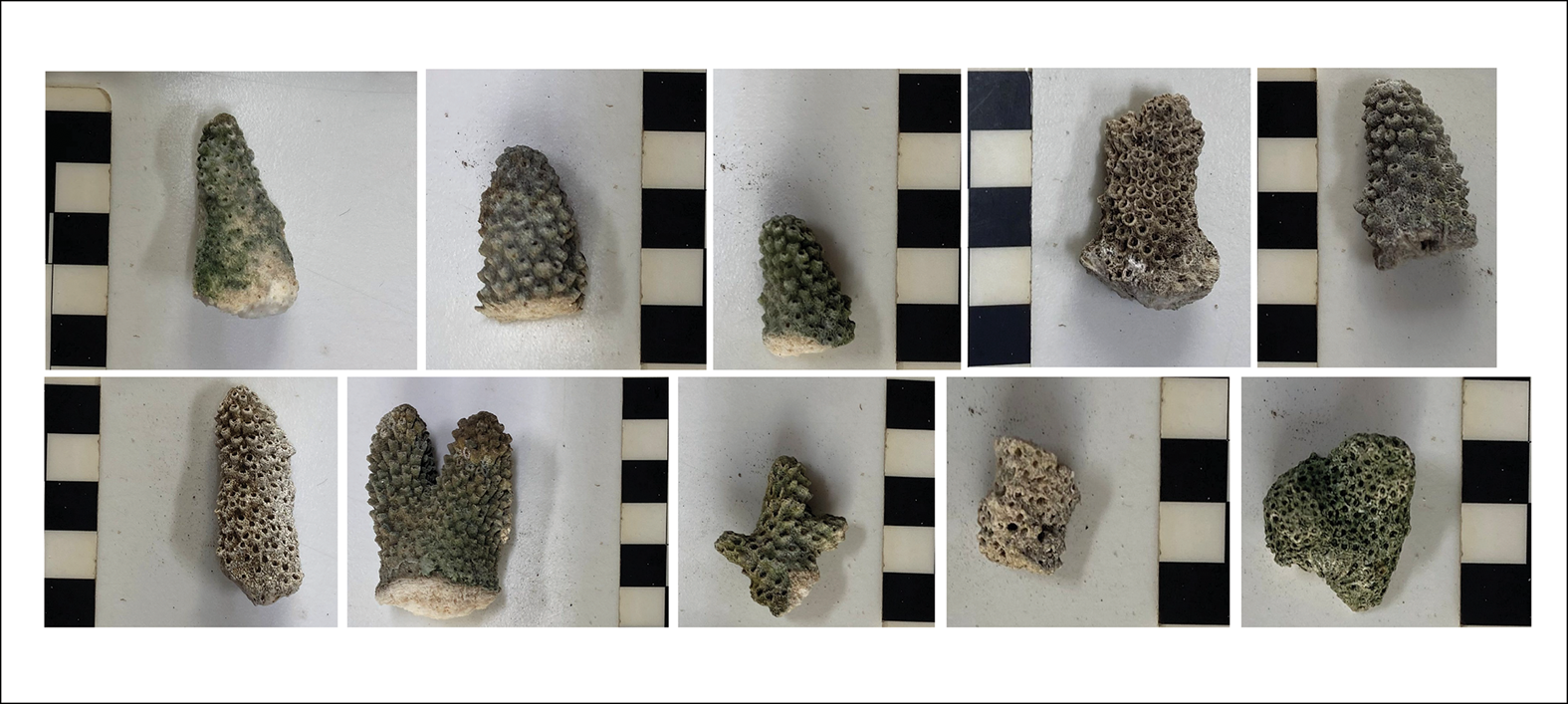
Figure 3 Long description
The image contains ten photos of branch coral samples arranged in two rows. The top row from left to right features samples labeled AKH-1, AKH-7, AKH-10, AKH-11, and AKH-20. The bottom row from left to right displays samples labeled AKH-20 PN-318, AKH-32, AKH-35, AUH-7, and AUH-11. Each sample varies in shape and texture, with some appearing more porous and others more solid. A scale bar with black and white squares is present in each photo, with each square representing one centimeter. The samples are placed against a white background, and the scale bar helps to provide a sense of size and scale for the coral branches.
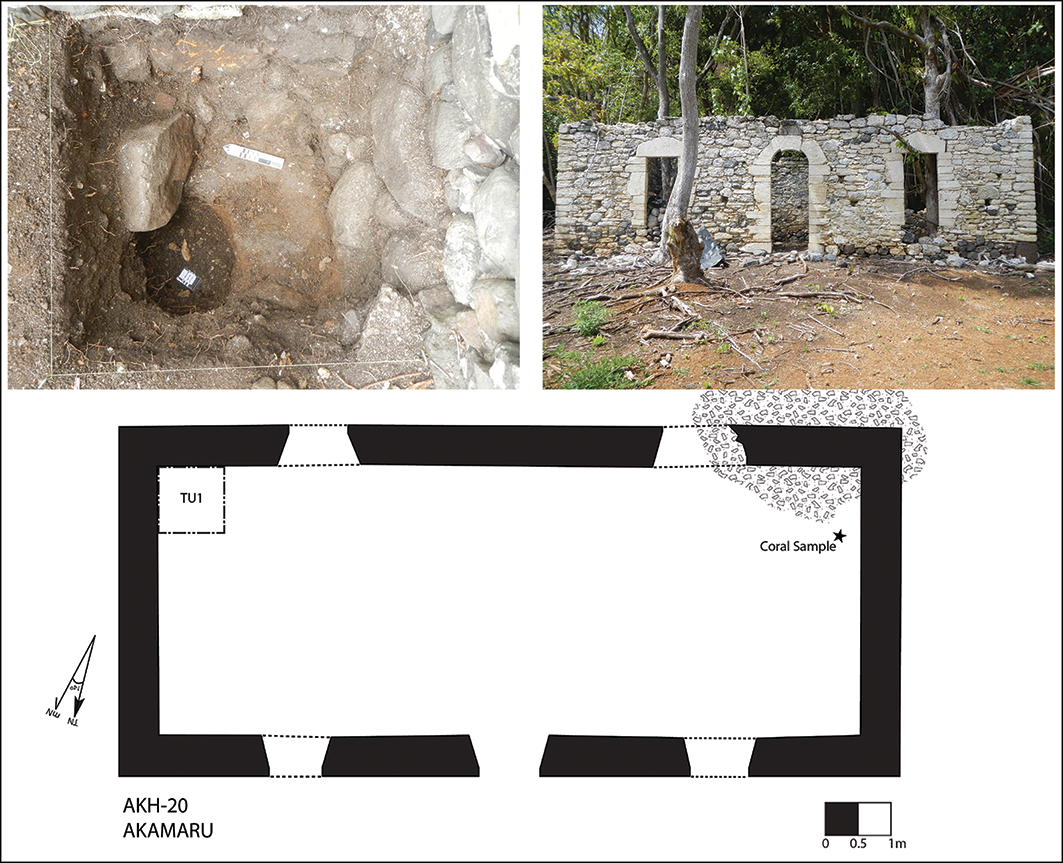
The remaining dates are from a fallen coral block in the south-west corner of the house AKH-20 and a branch coral recovered from an excavated context (PN-318) in a 1 × 1m test pit (AKH-20 TU1) located in the south-west corner of the same house (Figure 4). The fill of PN-318 consisted of an extremely loose brown sediment with a high concentration of relatively large fragments of bone, shell, glass and iron artefacts compared with the other houses excavated in Akamaru. Excavation exposed the southern and eastern limits of the pit feature, which extends beyond the northern and western boundaries of TU1, and removed sediment from approximately 0.50–0.90m below the current ground surface (Flexner et al. Reference Flexner2025: 112–15). While analysis is ongoing, a high proportion of objects relating to food and drink (including alcohol) were noted, as well as construction materials.
Plan of AKH-20 (below), showing location of test pit and coral sample, along with photographs of the building (top right) and pit feature PN-318 (top left) (figure by author).

Figure 4 Long description
The image consists of three elements: a plan of AKH-20, a photograph of a building, and a pit feature. The plan, located at the bottom, shows the layout of AKH-20 with labeled sections including TU1 and the location of a coral sample. The photograph on the top right depicts a stone building with arched windows and a tree growing nearby. The photograph on the top left shows a close-up of a pit feature, labeled PN-318, with visible soil layers and a marked sample area. The images are combined to provide a comprehensive view of the archaeological site and its features.
At the time of excavation, it was hypothesised that the pit might represent the waste from a single feasting event, possibly coinciding with the construction of the house as the pit was sealed by the deposits adjacent to the house foundation. Having a garbage pit inside a tropical household would have been both unsanitary and unpleasant, and therefore unlikely. The two U-Th dates overlap (1846±2 for the coral block and 1848±4 for the sample recovered from PN-318), reinforcing the hypothesis that the walls of the house were constructed shortly after the feast was held. As with other samples there is the possibility of some inbuilt age, but the overlap makes sense if the coral sample from the pit fell off during the trimming of coral blocks ahead of building the house.
Logically, coral blocks cut from the same part of the reef should be more likely to contain branch corals of similar age, however this has not been empirically tested. The objective in this initial run of U-Th dates was simply to test the reliability of the method for dating nineteenth-century buildings, so a single sample from multiple houses was sufficient. The collection of additional samples from the same houses, as well as sampling directly from areas where there is evidence for historical cutting of coral blocks, such as Kouaku, would be beneficial for future studies.
The sample of 10 dates presented here represents a small but significant portion of the 69 stone cottages that exist in varying states of ruination around the islands of Aukena, Akamaru, Taravai and Mangareva. The fact that four of the dates range from a few years to over 50 years prior to missionary arrival in the Mangareva Islands should not be taken as discouragement or a problem with the method. Rather, while the precision of each individual date is high (even in the case of AKH-32, which still has an error margin smaller than most radiocarbon determinations at 95.4% confidence), the accuracy of what is being dated does not necessarily directly correlate with the construction of the building.
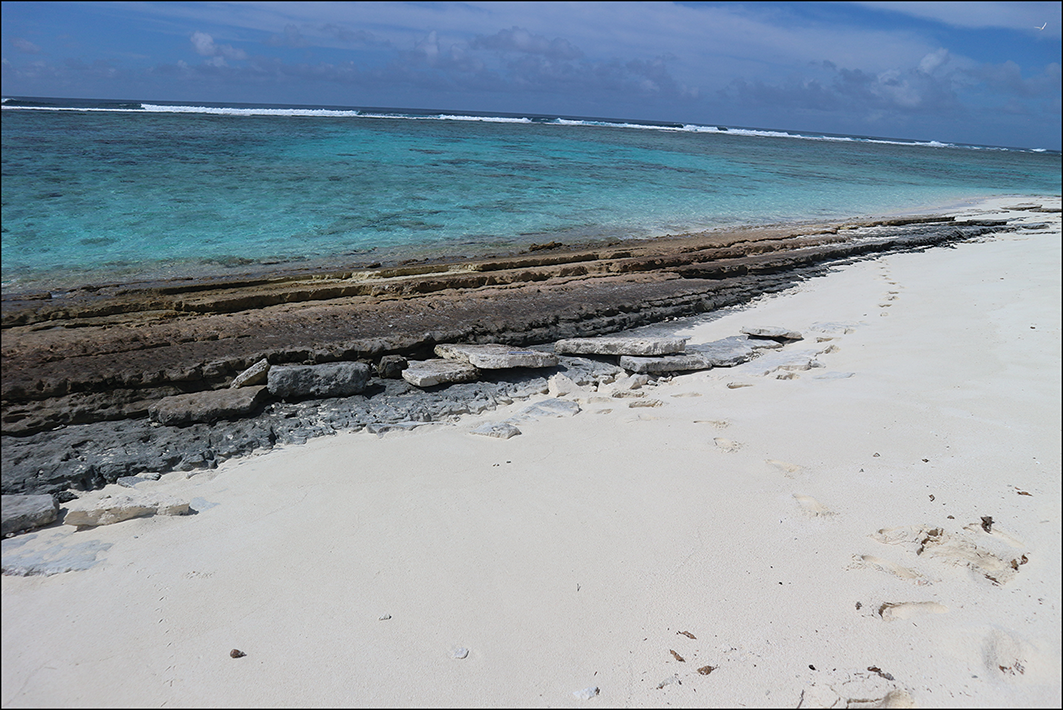
What these dates represent is the death of the corals cut off the reefs of the Mangareva Islands. In some cases, blocks may have been reused from pre-European structures, as suggested by Emory (Reference Emory1939: 8), or may have been cut from locations where the coral was already dead but minimally weathered, such as the near-shore reef limestones alongside beach rock deposits in the motu (Figure 5). Coral exoskeletons can be quite hard. Living seaward corals in the reef would have had less inbuilt age, while less-weathered branch corals with several decades of inbuilt age might still have been present on blocks from the shoreward side. This would be akin to the ‘old wood’ problem in radiocarbon dating (Schiffer Reference Schiffer1986) and time-lag in dendrochronology (Boswijk et al. Reference Boswijk2014).
Photograph of exposed beach rock and near-shore corals in the motu of Kouaku where labourers gathered building materials for the Catholic mission (figure by author).

For buildings of completely unknown age, it might be appropriate to treat U-Th dates as a kind of terminus post quem relative to the actual construction date(s). Reused blocks could have been cut years or decades before missionary arrival. Corals might have died years or decades before a particular block was cut from the reef limestones, and there might be an interval of years again before the block is trimmed and placed in a wall. A similar chronology problem is understood in dating structures using associated artefacts such as coins (Deetz Reference Deetz1996: 24). As always, triangulating chronology from all available information, including artefacts and the documentary record, rather than relying on a single radiometric dating technique, provides the most robust means of building site chronologies in historical archaeology.
Discussion and conclusions
While increasingly used alongside radiocarbon dating in studies of pre-European structures in Oceania (Kirch & Sharp Reference Kirch and Sharp2005; Weisler et al. Reference Weisler2006; Sharp et al. Reference Sharp2010), U-Th dating of branch corals had not previously been applied to colonial-era buildings. This study demonstrates that the use of this method is viable for direct dating of coralline building materials from unweathered or minimally weathered branch corals removed from in situ Acropora sp. blocks, or blocks that have clearly fallen from adjacent building walls. Dating using the U-Th method produces absolute dates without the need for excavation, though it does still require the removal of small fragments of building material and destructive analysis. The results indicate a certain amount of inbuilt age, in a range from years to decades within some of the samples, but nonetheless provide useful estimates for building construction. Some of the results may indicate the reuse of coral blocks from former marae within the Catholic houses, which may have held both practical and symbolic significance for the inhabitants.
The inbuilt age in some of these samples could be taken as a cautionary tale for the use of U-Th dates in pre-European contexts in and beyond Oceania. Even very ‘fresh’-looking corals can be years or decades older than the events they supposedly date (though apparently not centuries or millennia), particularly if materials have been moved around or reused. Yet, an inbuilt age of a few decades would still normally be well within the kinds of error ranges derived from radiocarbon dates (cf. Wilmshurst et al. Reference Wilmshurst2011). In many cases, comparative studies of U-Th and radiocarbon dating are concerned with time depths in which decades-level errors are inconsequential (e.g. Cutler et al. Reference Cutler2004), but for more recent periods smaller timescales can make a big difference for interpreting events. Though beyond the scope of this initial study, one possible question to further interrogate is whether the dating of modified objects such as coral abraders yields more reliable dates than branch corals that appear to have been simply broken off from the reef and deposited elsewhere. Further taphonomic studies in this area could clarify the matter.
This study represents a relatively small sample of dates, even within the Mangareva Islands where dozens of additional buildings could conceivably be sampled for branch corals. Other landscapes in French Polynesia have examples of a similar architecture, which was exported by the missionaries from Mangareva to other archipelagos, such as the Tuamotus (Lagarde et al. Reference Lagarde2020). Comparison of U-Th chronologies between Polynesian archipelagos would be useful, particularly in determining whether or not the apparent ‘old corals’ problem in some of the samples from the Mangareva Islands holds true across the region.
Beyond Polynesia or Oceania, other historic limestone coral structures might be amenable to this method of dating, from the Torres Strait Islands (e.g. Ash et al. Reference Ash2010) to East Africa (Berti Reference Berti2016) to the Caribbean (e.g. Yates Reference Yates2006). Indeed, throughout the archaeology of the tropics, the application of the U-Th method to coral limestone buildings could greatly advance understandings not only of site chronologies, but of construction techniques using this kind of material in different geographic contexts. Critically, better chronology of historical building activities can shed light on the construction projects of people from colonial contexts who do not necessarily appear in the documentary record, one of the most significant contributions that historical archaeology can make to current perceptions of the past.
Acknowledgements
I am grateful to my colleagues Emilie Perez and Moanatea Claret who have been essential to the success of the larger project, of which this article represents a small contribution. I also thank the people of the Mangareva Islands, without whom this work would not have been possible, and the Direction de la Culture et du Patrimoine who provided the administrative support for our research.
Funding statement
This research is funded by an Australian Research Council Future Fellowship (FT210100244).
Data availability statement
Data are available from the author upon reasonable request.
Online supplementary material (OSM)
To view supplementary material for this article, please visit https://doi.org/10.15184/aqy.2026.10325 and select the supplementary materials tab.
Author contributions: using CRediT categories
James Flexner: Conceptualization-Lead, Data curation-Lead, Formal analysis-Lead, Funding acquisition-Lead, Investigation-Lead, Methodology-Lead, Project administration-Lead, Resources-Lead, Software-Lead, Supervision-Lead, Validation-Lead, Visualization-Lead, Writing - original draft-Lead, Writing - review & editing-Lead.


 Open access

