


Introduction
In recent years, there have been important advances in our understanding of the etiopathology and clinical course of multiple sclerosis (MS), a chronic neurological disorder characterized by inflammation, demyelination and neuroaxonal loss. MS is most commonly diagnosed in people aged 20–40 years, although biomarker studies have demonstrated neuroaxonal damage can occur a median of six years prior to clinical onset,Reference Bjornevik, Munger and Cortese1 corresponding to a potentially newly discovered prodromal phase of the disease.Reference Wijnands, Kingwell and Zhu2
The disease course has traditionally been described as a two-stage process: an initial focal inflammatory phase predominating in the relapsing-remitting MS (RRMS) phenotype, followed by a noninflammatory neurodegenerative phase in secondary-progressive MS (SPMS); neurodegeneration predominates from the outset in the primary-progressive (PPMS) phenotype.Reference Leray, Yaouanq and Le Page3 However, it is now apparent that these phenotypes do not adequately depict the complex pathophysiology of MS.Reference Kuhlmann, Moccia and Coetzee4 Focal inflammation and neurodegeneration are not necessarily sequential processes but may co-occur at all stages of disease. Clinical expression is influenced by environmental factors, notably Epstein-Barr virus infection,Reference Bjornevik, Cortese and Healy5 sun exposure/vitamin D,Reference Ascherio, Munger and White6 obesity in adolescenceReference Hedstrom, Lima Bomfim and Barcellos7 and smoking and exposure to secondhand smoke,Reference Hedstrom, Baarnhielm, Olsson and Alfredsson8,Reference Hedstrom, Baarnhielm, Olsson and Alfredsson9 all of which may interact with genetic risk factors.Reference Alfredsson and Olsson10
Neurological deficits in physical and cognitive function may occur with focal inflammatory disease activity (relapses, lesions on MRI) or a more diffuse compartmentalized inflammation in the central nervous system (CNS). Of particular importance is smoldering-associated worsening (SAW) characterized by activation of microglia/macrophages and astrocytes, slow expansion of chronic active lesions and alterations in neuronal metabolism and function (e.g., redistribution of sodium ion channels, calcium ion accumulation, mitochondrial failure).Reference Scalfari, Traboulsee and Oh11
The conventional treatment approach for MS has been to initiate a lower-efficacy disease-modifying therapy (DMT) and reserve higher-efficacy agents for those patients with severe/aggressive disease or an inadequate response to the initial agent. However, it is now recognized that earlier use of higher-efficacy DMTs (HE-DMT) is often needed to slow the process of neuroinflammatory damage and tissue loss in the CNS that begins even before the clinical onset of MS. To address this issue, an expert panel of Canadian MS specialists developed a series of consensus recommendations on the use of HE-DMTs in practice. The goal was to guide clinicians on initiating, maintaining, de-escalating and discontinuing HE-DMTs to improve disease management for persons with MS (pwMS).
Methods
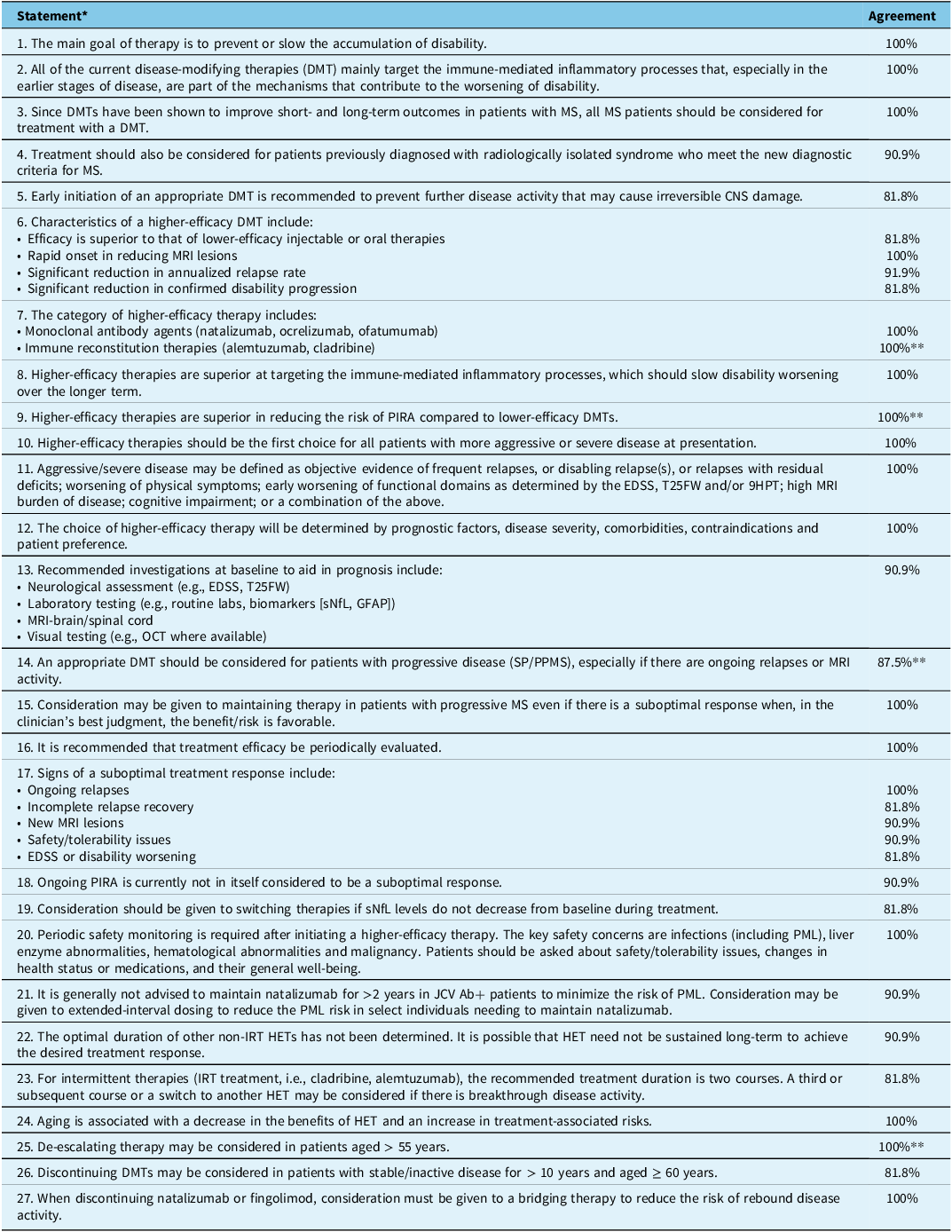
The Canadian expert panel comprised MS experts representing various provinces with different DMT approval processes. The group developed its recommendations using the Delphi method, a structured process of consensus building in which participants vote anonymously on a series of prepared statements. Key issues were identified and preliminary statements were drafted by the project leader (MSF) and submitted to the group for the first round of voting. Participants voted their agreement/disagreement for each statement, and the percentage agreement was calculated. Averaged scores ≥80% were adopted for the consensus statement; scores 70–79% were tabled for further discussion, and scores <70% were rejected. Some statements were revised, and new statements were added prior to a second round of voting. When voting was completed, all participants were invited to attend a conference call in December 2024 to finalize the list of consensus statements. The list of statements is shown in Table 1.
Level of consensus with statements by the Canadian MS expert panel

Table 1 Long description
The table presents the level of consensus with statements by the Canadian multiple sclerosis expert panel. It includes statements about the main goal of therapy, the use of disease-modifying therapies, and the characteristics of higher-efficacy DMTs. The table has twenty-seven rows and two columns. The first column lists the statements, and the second column shows the percentage agreement with each statement. Key trends include high agreement on the importance of early initiation of appropriate DMT and the superiority of higher-efficacy therapies in reducing the risk of PIRA. The table also highlights the need for periodic safety monitoring and the consideration of switching therapies if certain conditions are met.
MS = multiple sclerosis; CNS = central nervous system; PIRA = progression independent of relapse activity; EDSS = Expanded Disability Status Scale; T25FW = Timed 25-Foot Walk; 9HPT = 9-Hole Peg Test; sNfL = serum neurofilament-light chain; GFAP = glial fibrillary acidic protein; OCT = optical coherence tomography; PML = progressive multifocal leukoencephalopathy; JCV = JC virus; IRT = immune reconstitution therapy; HET = higher-efficacy therapy.
*Wording of statements was revised in the final group discussion. Statements that did not receive ≥80% approval were discarded. **Round 2–3 of voting.
Consensus recommendations
Statement 1. The main goal of therapy is to prevent or slow the accumulation of disability
Sustained disability progression independent of relapse activity (PIRA) is a main driver of disability accumulation in DMT-treated pwMS.Reference Lublin, Häring and Ganjgahi12,Reference Kappos, Wolinsky and Giovannoni13 PIRA is generally defined as disability accumulation during a relapse-free period, becomes clinically eloquent within a median of seven years after symptom onset in an estimated 25% of pwRRMS and is prognostic of earlier disability.Reference Tur, Carbonell-Mirabent and Cobo-Calvo14 While it is unclear if PIRA is a marker of progressive biology,Reference Camara and Yong15 slowing the accumulation of disability associated with PIRA and relapse-associated worsening (RAW) is the most important therapeutic goal throughout the treatment course. This accords with the treatment goals previously outlined by the Canadian MS Working Group.Reference Freedman, Devonshire and Duquette16
Statement 2. All of the current disease-modifying therapies (DMT) mainly target the immune-mediated inflammatory processes that, especially in the earlier stages of disease, are part of the mechanisms that contribute to the worsening of disability
The conventional target of treatment has been RAW, with the goal of achieving no evidence of disease activity. While PIRA contributes to disability at all phases and is the principal driver of disability accumulation during the progressive phase, RAW is associated with an increased risk of early disability worsening during the inflammatory phase.Reference Lublin, Häring and Ganjgahi12,Reference Prosperini, Ruggieri, Haggiag, Tortorella, Pozzilli and Gasperini17 Treatment with DMTs to reduce RAW has been shown to delay the time to reach disability milestones in pwMS.Reference Lublin, Häring and Ganjgahi12
Statement 3. Since DMTs have been shown to improve short- and long-term outcomes in patients with MS, all MS patients should be considered for treatment with a DMT
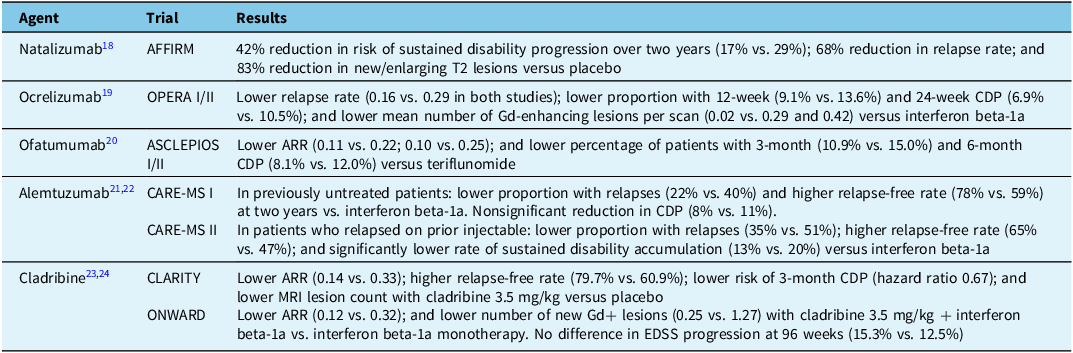
All HE-DMTs have demonstrated significant efficacy versus placebo and/or active controls in reducing disease activity and disability accumulation (Table 2).Reference Polman, O’Connor and Havrdova18–Reference Montalban, Leist and Cohen24 Long-term data from observational and open-label studies suggest improved outcomes with sustained DMT exposure.Reference Cobo-Calvo, Tur and Otero-Romero25–Reference Kalincik, Diouf and Sharmin27
Phase III trial results of higher-efficacy disease-modifying therapies in relapsing multiple sclerosis (RMS)

Table 2 Long description
A table comparing results of phase three trials for higher-efficacy disease-modifying therapies in relapsing multiple sclerosis. The table has five rows and five columns. The columns are labeled Agent, Trial, and Results. The agents listed are Natalizumab, Ocrelizumab, Ofatumumab, Alemtuzumab, and Cladribine. Each row provides specific trial names and results for each agent, including reductions in relapse rates, disability progression, and lesion counts. Notable trends include significant reductions in relapse rates and disability progression across various trials and agents.
Gd = gadolinium; CDP = confirmed disability progression; ARR = annualized relapse rate; EDSS = Expanded Disability Status Scale.
Statement 4. Treatment should also be considered for patients previously diagnosed with radiologically isolated syndrome (RIS) who meet the new diagnostic criteria for MS
In individuals with RIS, one-half will develop MS within 10 years.Reference Lebrun-Frenay, Kantarci and Siva28 The TERIS and ARISE studies have demonstrated that DMTs may prolong the time to a first clinical event in subjects with RIS,Reference Lebrun-Frénay, Siva and Sormani29,Reference Okuda, Kantarci and Lebrun-Frénay30 although routine treatment of this group is controversial. In the most recent iteration of the MS diagnostic criteria, MS may be diagnosed in individuals with RIS if there is dissemination in space and time and/or paraclinical evidence (positive CSF findings, lesions with a central vein sign [CVS]) suggestive of MS.Reference Montalban, Lebrun-Frenay and Oh31 Although efficacy data for HE-DMTs are lacking for this early MS group, treatment would be expected to improve long-term outcomes.
Statement 5. Early initiation of an appropriate DMT is recommended to prevent further disease activity that may cause irreversible CNS damage
All DMTs have demonstrated efficacy in reducing the risk of relapses and MRI lesions in relapsing MS; many have also been shown to slow disability accumulation as measured by the Expanded Disability Status Scale (EDSS). The Canadian treatment optimization recommendations and other international guidelines recommend treatment initiation soon after diagnosis.Reference Freedman, Devonshire and Duquette16 Treatment is optimally initiated within the first 6–12 months after disease onset.Reference Iaffaldano, Lucisano and Butzkueven32 An eight-year follow-up study found that the risk of reaching EDSS 4.0 was significantly higher (hazard ratio 2.64) when treatment was delayed three years compared to treatment initiation within one year of MS onset.Reference Kavaliunas, Manouchehrinia and Stawiarz33
Statement 6. Characteristics of a higher-efficacy DMT include efficacy that is superior to that of lower-efficacy injectable or oral therapies, rapid onset in reducing MRI lesions, significant reduction in the annualized relapse rate and significant reduction in confirmed disability progression
Several phase III trials have demonstrated that HE-DMTs are superior to lower-efficacy active comparators such as interferon beta-1a or teriflunomide in reducing ARR and MRI lesionsReference Hauser, Bar-Or and Comi19–Reference Coles, Twyman and Arnold22,Reference Montalban, Leist and Cohen24 (Table 2). Most studies have also shown that higher-efficacy treatment significantly reduces confirmed disability progression (CDP), defined as a sustained worsening in EDSS score confirmed at three or six months.
Statement 7. The category of higher-efficacy therapy includes the monoclonal antibody (MAb) agents natalizumab, ocrelizumab and ofatumumab and the immune reconstitution therapies (IRT) alemtuzumab (also a MAb) and cladribine
All of the above HE-DMTs have been shown in clinical trials to meet the efficacy criteria outlined in Statement 6. Efficacy may differ among agents in the higher-efficacy category. There was a consensus not to include sphingosine-1-phosphate (S1P) receptor modulators (fingolimod, ozanimod, ponesimod) in the higher-efficacy category since some studies indicate that the efficacy of fingolimod is similar to that of lower-efficacy oral agents.Reference Kalincik, Havrdova and Horakova34
Statement 8. Higher-efficacy therapies are superior at targeting the immune-mediated inflammatory processes, which should slow disability worsening over the longer term
As previously noted, phase III trials have demonstrated that alemtuzumab, ocrelizumab and ofatumumab are superior to lower-efficacy agents in reducing inflammatory disease activity (relapses, MRI lesions).Reference Hauser, Bar-Or and Comi19–Reference Coles, Twyman and Arnold22,Reference Montalban, Leist and Cohen24 A recent network meta-analysis of all DMTs concluded that the most efficacious treatments were alemtuzumab and ofatumumab for ARR and alemtuzumab, ofatumumab and ocrelizumab for six-month CDP.Reference Samjoo, Drudge and Walsh35
Statement 9. Higher-efficacy therapies are superior in reducing the risk of PIRA compared to lower-efficacy DMTs
This statement was somewhat controversial due to limited data. A Swedish Registry analysis reported that HE-DMTs were associated with a significant 21% reduction in PIRA compared to lower-efficacy agents.Reference Spelman, Glaser and Hillert36 The use of HE-DMTs during PIRA reduced the risk of persistent PIRA in an MSBase study; the novel concept of “non-persistent PIRA” suggests that PIRA may be reversible if aggressively treated.Reference Zhu, Zhou and Kalincik37 Additional studies are needed. There was a consensus that at present, there is insufficient evidence to state that HE-DMTs are superior in reducing SAW.
Statement 10. Higher-efficacy therapies should be the first choice for all patients with more aggressive or severe disease at presentation
There is substantial evidence from observational, cohort and population-based studies that initiating treatment with a HE-DMT versus lower-efficacy DMT is associated with improved long-term outcomes.Reference Brown, Coles and Horakova38–Reference Vudumula, Patidar, Gudala, Karpf and Adlard42 Moreover, early use of HE-DMTs has been shown to be superior to escalation from a lower- to higher-efficacy agent.Reference Harding, Williams and Willis43–Reference Iaffaldano, Lucisano and Caputo45 Accordingly, the Canadian MS Working Group and other expert panels have recommended the use of HE-DMTs as the initial therapy in patients with active, aggressive or rapidly-evolving MS at onset to slow disability progression and reduce irreversible neurological damage.Reference Freedman, Devonshire and Duquette16,Reference Filippi, Amato and Centonze46
Statement 11. Aggressive/severe disease may be defined as objective evidence of frequent relapses, or disabling relapse(s), or relapses with residual deficits; worsening of physical symptoms; early worsening of functional domains as determined by the Expanded Disability Status Scale (EDSS), Timed 25-foot Walk (T25FW) and/or 9-Hole Peg Test (9HPT); high MRI burden of disease; cognitive impairment; or a combination of the above
Factors associated with a poor prognosis include greater relapse frequency and severity, incomplete relapse recovery with residual neurological deficits and new MRI lesions.Reference Freedman, Devonshire and Duquette16 A single disabling relapse was considered sufficient evidence of severe disease. A combination of clinical and radiological evidence of physical and cognitive impairment has greater prognostic value than individual measures.Reference Damasceno, Pimentel-Silva, Damasceno and Cendes47
Statement 12. The choice of higher-efficacy therapy will be determined by prognostic factors, disease severity, comorbidities, contraindications and patient preference
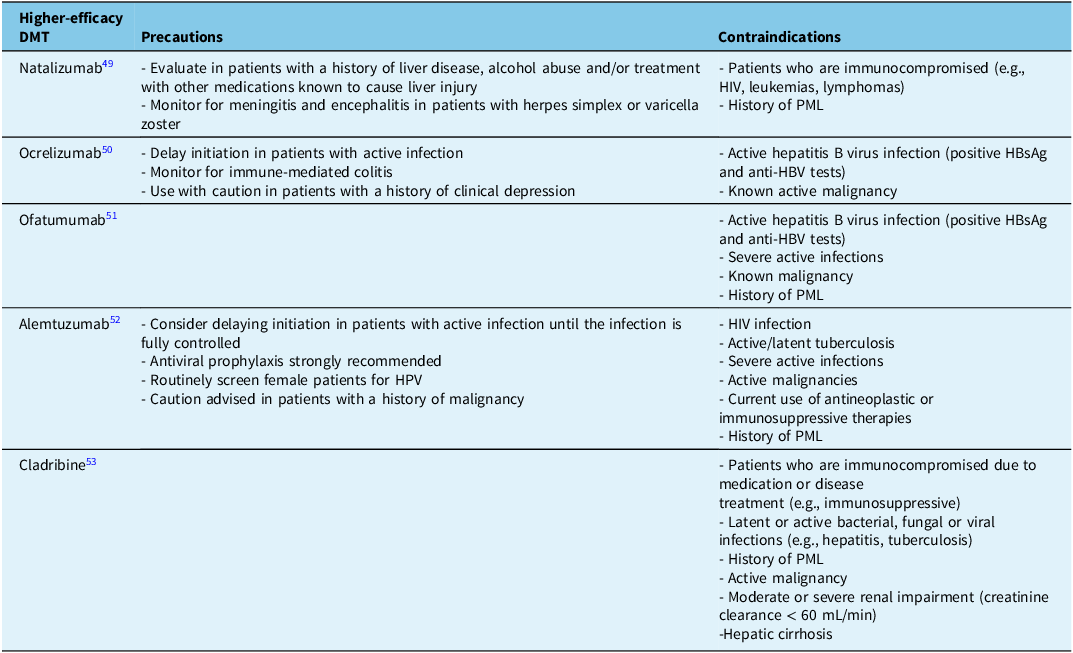
Treatment selection should be individualized and may be guided by disease severity at baseline and clinical/radiological features associated with a poor prognosis, such as frequent/severe relapses, extensive CNS involvement (e.g., multifocal disease, high lesion number/locations, T2 burden of disease), poor relapse recovery and the number/volume of MRI lesions. The presence of comorbidities is also associated with worse MS outcomes.Reference Salter, Lancia, Kowalec, Fitzgerald and Marrie48 During treatment selection, caution is advised when using HE-DMTs in comorbid patients, notably those with acute infections or a history of malignancy (Table 3).49–53 HE-DMTs are generally contraindicated in patients who are immunocompromised due to disease or concomitant medication, chronic infections (e.g., hepatitis B, tuberculosis) or active malignancy. Caution is advised when timing the use of HE-DMTs in women of childbearing age who are planning pregnancy.49–Reference Krajnc, Bsteh, Berger, Mares and Hartung54
Precautions and contraindications for higher-efficacy disease-modifying therapies (DMT) in multiple sclerosis patients

Table 3 Long description
The table compares precautions and contraindications for higher-efficacy disease-modifying therapies (DMT) in multiple sclerosis patients. It includes five rows and three columns. The columns are labeled Higher-efficacy DMT, Precautions, and Contraindications. Each row lists a specific DMT along with its associated precautions and contraindications. For example, Natalizumab requires evaluation in patients with a history of liver disease and monitoring for meningitis and encephalitis in patients with herpes simplex or varicella zoster. It is contraindicated in immunocompromised patients and those with a history of progressive multifocal leukoencephalopathy (PML). Ocrelizumab advises delaying initiation in patients with active infection and monitoring for immune-mediated colitis. It is contraindicated in patients with active hepatitis B virus infection and known active malignancy. Ofatumumab suggests use with caution in patients with a history of clinical depression and is contraindicated in patients with active hepatitis B virus infection, severe active infections, known malignancy, and history of PML. Alemtuzumab recommends considering delaying initiation in patients with active infection until the infection is fully controlled and routinely screening female patients for human papillomavirus (HPV). It is contraindicated in patients with human immunodeficiency virus (HIV) infection, active/latent tuberculosis, severe active infections, active malignancies, current use of antineoplastic or immunosuppressive therapies, and history of PML. Cladribine advises caution in patients who are immunocompromised due to medication or disease treatment and is contraindicated in patients with latent or active bacterial, fungal, or viral infections, history of PML, active malignancy, moderate or severe renal impairment, and hepatic cirrhosis.
HIV = human immunodeficiency virus; PML = progressive multifocal leukoencephalopathy; HPV = human papillomavirus.
Statement 13. Recommended investigations at baseline to aid in prognosis include a neurological assessment (e.g., EDSS, T25FW), laboratory testing (e.g., routine labs, biomarkers [sNfL, GFAP]), MRI-brain/spinal cord and visual testing (e.g., OCT where available)
Clinicians should inquire about the patient’s vaccination status as part of the initial workup and administer live attenuated vaccines prior to initiation of HE-DMTs. Patients should also be screened for certain infections (e.g., hepatitis, tuberculosis, varicella-zoster virus, human immunodeficiency virus) before treatment start in accordance with current American Academy of Neurology guidelines.Reference Farez, Correale and Armstrong55 Patients should be informed that some HE-DMTs may reduce vaccine efficacy (including COVID-19 vaccines).Reference Ciotti, Valtcheva and Cross56
A full clinical and radiological evaluation is required at baseline to aid in prognosis and treatment selection. Frequent/severe relapses, new MRI lesions, extensive CNS involvement and residual impairment are indicative of highly active disease and are prognostic of poorer long-term outcomes.Reference Tomassini, Fanelli, Prosperini, Cerqua, Cavalla and Pozzilli57,Reference Spelman, Meyniel and Rojas58 Demographic factors (e.g., male sex, nonWhite ethnicity, older age at onset) may also contribute to a worse prognosis.Reference Tintore, Rovira and Río59 Higher levels of neurofilament-light chain (NfL), a biomarker of neuroaxonal injury, are prognostic of relapses, new MRI lesions and EDSS scores at five years.Reference Freedman, Gnanapavan and Booth60 A small 20-year cohort study also found that baseline serum NfL (sNfL) and, to a lesser degree, glial fibrillary acidic protein (GFAP) were prognostic of long-term outcomes.Reference Pereiro, Muñoz-Vendrell, Moreno, Bau, Matas and Romero-Pinel61 CSF and/or serum NfL measurements at baseline are recommended.Reference Freedman, Gnanapavan and Booth60 The number and volume of spinal cord lesions are prognostic of future disability.Reference Lauerer, McGinnis and Bussas62 Other imaging findings, such as the presence of paramagnetic rim lesions or cortical lesions, are also prognostic of greater MS severity and disability; patients with >4 PRLs at baseline have a 17-fold higher risk of PIRA.Reference Borrelli, Martire and Stölting63 Visual evoked potentials and optical coherence tomography (OCT) are emerging as important biomarkers of demyelination and neuroaxonal damage.Reference Oertel, Krämer and Motamedi64,Reference Toledo, Sepulcre and Salinas-Alaman65 It should be noted that this list of investigations is not meant to be prescriptive since not all tests are routinely available across Canada and individual centers may have their own protocols.
Statement 14. An appropriate DMT should be considered for patients with progressive disease (SP/PPMS), especially if there are ongoing relapses or MRI activity
To date, only one HE-DMT study of ocrelizumab has demonstrated efficacy in PPMS; a lower-efficacy agent, siponimod, has also shown efficacy in SPMS.Reference Montalban, Hauser and Kappos66,Reference Kappos, Bar-Or and Cree67 Ocrelizumab is approved for use in adult PPMS patients with inflammatory disease activity.50 The group consensus was that patients with progressive MS should have the option of receiving treatment depending on clinical circumstances, potential benefit and personal preference.
Statement 15. Consideration may be given to maintaining therapy in patients with progressive MS even if there is a suboptimal response when, in the clinician’s best judgment, the benefit/risk is favorable
The usual definition of a suboptimal response (i.e., ongoing inflammatory activity, disability worsening on EDSS, T25FW, etc.) may not fully capture the range of beneficial treatment effects in progressive pwMS. One study of ocrelizumab in highly disabled PPMS patients (EDSS 7.0) reported that most patients (66.1%) remained stable and 8.1 % had disability improvement with treatment during the three-year follow-up.Reference Houtchens and Howard68 The relative benefits and risks of treatment will change as the patient ages; the most notable is the increasing risk of infections in older pwMS. It is important for clinicians to reevaluate the benefits and risks of treatment throughout the clinical course.
Statement 16. It is recommended that treatment efficacy be periodically evaluated
There was full consensus on the need to periodically evaluate treatment efficacy. A change in treatment may be required if there is a suboptimal response. The frequency of these evaluations was not specified since it will vary according to the method of assessment, the timing of follow-up visits and the protocols of individual MS centers.
Statement 17. Signs of a suboptimal treatment response include ongoing relapses, incomplete relapse recovery, new MRI lesions, safety/tolerability issues and/or EDSS or disability worsening
Clinical and radiological evidence of disease activity and disability progression are prognostic of worse outcomes, and these same factors indicate an inadequate treatment response. Disability worsening includes physical (e.g., by EDSS or other measure) and/or cognitive impairment (e.g., by Symbol Digit Modalities Test [SDMT]). It is recommended that cognitive function be evaluated periodically since impairment in information processing speed has been shown to be predictive of physical impairment and disability progression.Reference Hechenberger, Helmlinger and Ropele69 There was a consensus that the occurrence of breakthrough symptoms in the absence of clinical or MRI activity was not sufficient evidence of a suboptimal treatment response.
Statement 18. Ongoing PIRA is currently not in itself considered to be a suboptimal response
While there are some data to suggest that HE-DMTs reduce PIRA,Reference Spelman, Glaser and Hillert36,Reference Zhu, Zhou and Kalincik37 the evidence is too preliminary to include PIRA reduction as part of the definition of a treatment response. Additional studies are needed to establish whether DMTs that act primarily to reduce focal inflammation are also effective in targeting noninflammatory progressive biology.
Statement 19. Consideration should be given to switching therapies if sNfL levels do not decrease from baseline during treatment.
Most DMTs have been shown to reduce sNfL. A lower sNfL level six months after initiating a HE-DMT has been shown to be associated with a reduction in T2 lesion number and brain atrophy at two years and less EDSS progression at four years.Reference Kuhle, Kropshofer and Haering70 If sNfL levels do not decrease substantially (≥20%) within six months of starting a DMT, a treatment switch or escalation to a HE-DMT should be considered.Reference Freedman, Gnanapavan and Booth60 sNfL should be evaluated during routine follow-ups (e.g., at 6–12 month intervals) or at the next visit if there is evidence of ongoing disease activity (relapses, new or enlarging MRI lesions, gadolinium-enhancing lesions).Reference Freedman, Gnanapavan and Booth60
Statement 20. Periodic safety monitoring is required after initiating a higher-efficacy therapy. The key safety concerns are infections (including progressive multifocal leukoencephalopathy [PML]), liver enzyme abnormalities, hematological abnormalities and malignancy. Patients should be asked about safety/tolerability issues, changes in health status or medications and their general well-being
Table 3 lists the safety concerns. The main safety issue when employing HE-DMTs is the risk of infections, and patients should be screened for latent or subclinical infections and receive appropriate vaccines prior to treatment initiation (Table 3). Of particular concern during HE-DMT use is progressive multifocal leukoencephalopathy (PML), a potentially fatal infection caused by the JC virus (JCV). PML cases most commonly occur with natalizumab although the incidence is very low. PML cases have been reported with other HE-DMTs but are rare. The estimated PML risk in natalizumab-treated JCV antibody-negative pwMS is 0.07 per 1000 patients; the PML risk in JCV antibody-positive patients is estimated at 1.7% (2.7% with prior immunosuppression).Reference Krajnc, Bsteh, Berger, Mares and Hartung54,Reference Ho, Koendgen, Campbell, Haddock, Richman and Chang71 (See reference [Reference Morrow, Clift and Devonshire72] for Canadian practice guidelines on natalizumab use.)
Neoplasms have been reported with HE-DMTs but are considered uncommon. Close monitoring for adverse effects is required throughout the course of treatment. Clinical guidelines for cancer screening according to age, sex and familial/personal medical history should be closely followed by the patient. Cancer screening may be complicated by the increase in abnormal cervical screening tests that have been reported in treated MS patients.Reference Buzzard, Kalincik and Nguyen73 Clinicians should inquire about changes in health status (e.g., new malignancy) that may require a change in treatment. Patients should be encouraged to report side effects/tolerability issues; these may be managed with dose adjustments or a treatment switch. It should be noted that alemtuzumab is generally reserved as a second-choice HE-DMT due to the risk of autoimmune disorders and rare but severe vascular effects.
Statement 21. It is generally not advised to maintain natalizumab for >2 years in JC virus antibody-positive patients to minimize the risk of PML. Consideration may be given to extended-interval dosing to reduce the PML risk in select individuals needing to maintain natalizumab
As noted above, there is a cumulative risk of PML in JCV antibody-positive patients, notably after two years of continuous drug exposure.Reference Krajnc, Bsteh, Berger, Mares and Hartung54,Reference Ho, Koendgen, Campbell, Haddock, Richman and Chang71 Patients who opt to continue treatment must be fully informed of the potential risks. In the NOVA study, there was no loss of efficacy with extended-interval dosing versus standard dosing (q6weeks vs. q4weeks) with respect to clinical or patient-reported outcomes.Reference Zhovtis Ryerson, Foley and Defer74 While PML cases have been reported during extended-interval dosing, the estimated risk reduction is 88–94% (mean dosing interval 35–43 days).Reference Zhovtis Ryerson, Foley and Chang75
Statement 22. The optimal duration of other non-immune reconstitution therapy (IRT) HE-DMTs has not been determined. It is possible that HE-DMTs need not be sustained long-term to achieve the desired treatment response
There is some evidence to suggest that the benefits from HE-DMTs decrease substantially after age 55 years.Reference Vollmer, Wolf, Sillau, Corboy and Alvarez76 Continuing treatment thereafter may be associated with declining efficacy due to immunosenescence and an increasing risk of treatment-related adverse effects (e.g., infections, malignancies). (See also Statements 24–26.)
Statement 23. For intermittent therapies (IRT treatment, i.e., cladribine, alemtuzumab), the recommended treatment duration is two courses. A third or subsequent course or a switch to another higher-efficacy therapy (HET) may be considered if there is breakthrough disease activity
Immune reconstitution therapies (IRT) are induction agents that are administered intermittently. The dosing for cladribine is 1.75 mg/kg administered over two treatment weeks (weeks 1 and 5) and repeated in year two, followed by two years off treatment.53 Alemtuzumab is infused at a dose of 12 mg/day for five days in year one and 12 mg/day for three days in year two.52 In the CLASSIC-MS extension study, 58% of patients completing a 2-year course of cladribine received no further therapy over the subsequent 10-year period.Reference Giovannoni, Boyko and Correale77 Long-term studies of alemtuzumab have reported that 48–53% of pwMS required no further therapy at eight years.Reference Bass, Arroyo and Boster78 The current recommendation is that additional cladribine courses may be considered for patients with mild to moderate breakthrough disease activity; another HE-DMT may be advised for patients with significant disease activity or progression.Reference Habek, Drulovic and Jakob79
Statement 24. Aging is associated with a decrease in the benefits of HET and an increase in treatment-associated risks
Aging in pwMS is associated with a decrease in inflammatory disease activity (relapses, new MRI lesions).Reference Tremlett, Zhao, Joseph and Devonshire80,Reference Koch, Mostert and Zhang81 This has been attributed to declining immunocompetence (e.g., reduction in the capacity to mount a robust immune response and exert immunosurveillance but a predisposition to auto-immunity), which acts, in conjunction with biological aging, to create a chronic low-grade inflammatory state (“inflamm-aging”)Reference Perdaens and van Pesch82 in the periphery and CNS environment. CNS compartmentalized inflammation, characterized by microglial activation and chronic lesion expansion (smoldering plaques), is associated with an age-related failure of repair mechanisms such as remyelination, contributing to the neurodegenerative state observed in older pwMS. Some studies have reported that with aging, the benefits of HE-DMTs decline while treatment-associated risks increase.Reference Vollmer, Wolf, Sillau, Corboy and Alvarez76,Reference Weideman, Tapia-Maltos, Johnson, Greenwood and Bielekova83 A limitation, however, is a paucity of clinical trial data for patients aged > 55 years. Some key issues that complicate the management of older pwMS are the higher risk of infections resulting from immunosenescence, increasing disability, the high prevalence of comorbidities and polypharmacy. These issues will need to be considered when deciding whether to maintain, de-escalate or discontinue a HE-DMT.
Statement 25. De-escalating therapy may be considered in patients aged > 55 years
This statement was the most contentious during the group discussion. As noted above, there is a less favorable benefit/risk profile of HE-DMTs in older individuals (see Statement 24). A European workshop consensus suggested that de-escalation may be considered in patients aged > 55 years with no clinical or radiological evidence of disease activity for five years.Reference Androdias, Lünemann and Maillart84 The decision to de-escalate to a lower-efficacy DMT should be individualized according to best clinical judgment and patient preference. There are few data on the optimal de-escalation strategy in patients aged > 55 years. Caution is advised when switching from natalizumab to a lower-efficacy agent due to the risk of rebound disease activity (see Statement 27). For pwMS receiving anti-CD20 therapy, extended-interval dosing or a switch to an IRT such as cladribine may be an option.Reference Novak, Bajwa and Østergaard85,Reference Sacco, Disanto and Pravatà86 Additional studies are needed.
Statement 26. Discontinuing DMTs may be considered in patients with stable/inactive disease for >10 years and aged ≥ 60 years
Few trials have examined treatment discontinuation. The phase IV DISCOMS study failed to show that treatment discontinuation was non-inferior to continuation in patients aged > 55 years with no relapses in the preceding five years and no MRI lesions in the preceding three years.Reference Corboy, Fox and Kister87 It is unclear if the results are generalizable to HE-DMT since most pwMS were receiving a lower-efficacy DMT. The DOT-MS trial of discontinuation in patients with no relapses/MRI lesions in the preceding 5 years was terminated after 15 months due to the recurrence of inflammatory disease activity.Reference Coerver, Fung and de Beukelaar88 A meta-analysis of real-world studies found a low relapse risk after discontinuation in pwMS aged ≥ 60 years and with either 10 years of DMT use or 8 years of stable disease.Reference Prosperini, Haggiag, Ruggieri, Tortorella and Gasperini89 Two ongoing trials are investigating discontinuation in SPMS patients aged > 50 years with stable disease for three years (STOP-I-SEP; NCT03653273) and in RRMS patients aged > 55 years with stable disease for five years (Therapy Withdrawal in RMS, TWINS; NCT06663189).
In the absence of more complete data, it may be prudent to consider treatment cessation in patients aged > 60 years with long-standing stable disease depending on clinical circumstances and patient preference. Patients should be closely monitored for signs of worsening disease activity and progression. Moreover, it must be emphasized that discontinuation does not mean a cessation of therapy. PwMS will continue to benefit from symptomatic therapy and rehabilitation to improve their daily performance and quality of life.
Statement 27. When discontinuing natalizumab or fingolimod, consideration must be given to a bridging therapy to reduce the risk of rebound disease activity
Some studies have reported a recurrence of disease activity following discontinuation of natalizumab or fingolimod.Reference Fox, Cree and De Sèze90,Reference Maunula, Atula, Laakso and Tienari91 Bridging to an anti-CD20 agent, cladribine or another DMT may be advisable when stopping these agents.
Conclusion
The consensus statements were developed by an expert panel based on clinical experience and, wherever possible, high-quality scientific data. A limitation is that many issues have not yet been adequately researched. Additional studies are needed to determine the impact of HE-DMTs on the neurodegenerative biology that drives disability progression. The optimal timing and approach to treatment de-escalation and discontinuation also need to be determined. Practice recommendations such as these cannot perforce fully explore complex issues such as the emerging data on the utility of the many biomarkers currently being investigated or the timing and selection of DMT for women contemplating pregnancy. Readers are advised to supplement these recommendations with a review of the literature on these more specialized topics. Despite these shortcomings, it is hoped that these recommendations on the use of HE-DMTs in practice will facilitate treatment decision-making and improve long-term outcomes in pwMS.
Acknowledgments
The authors acknowledge the editorial assistance of Steven Manners of Communications Lansdowne.
Author contributions
All authors contributed to the development of the consensus statements and the drafting and review/approval of the manuscript.
Funding statement
Funding was provided through an unrestricted educational grant from EMD Serono Canada, which supported editorial assistance and the development and implementation of the specific Delphi platform for establishing consensus, collating and presenting the data, organizing the virtual conference, transcribing the results of the discussion, summarizing the consensus statements and reimbursing article processing charges.
Competing interests
Mark S. Freedman has received consulting fees and/or honoraria from Amgen, Astra Zeneca, EMD Inc./EMD Serono/Merck Serono, Find Therapeutics, Hoffmann-La Roche, Novartis, Sandoz, Sanofi Genzyme, Sentrex and Teva Canada Innovation; has participated in advisory boards for Amgen, Astra Zeneca, Autolus, Bayer Healthcare, Celestra Health, EMD Inc./Merck Serono, Find Therapeutics, Hoffmann-La Roche, Neurogenesis, Novartis, Sanofi Genzyme, Sentrex and Setpoint Medical; has participated in a data safety monitoring board for Abata, Celltrion, Hoffmann-La Roche and Moderna; and has participated in speakers’ bureaux for Hoffmann-La Roche, Novartis and EMD Serono.
Fraser Clift has received honoraria from Biogen, EMD Serono, Novartis and Roche and has participated in advisory boards for Novartis and Roche.
Virginia Devonshire has received honoraria from EMD Serono, Novartis and Roche and support for attending meetings from Apotex and has participated in advisory boards for Merck Serono/EMD Serono, Novartis and Biogen.
François Émond has received research grants from Novartis and Sanofi; has received honoraria from Biogen, EMD Serono, Novartis and Bristol Myers Squibb; and has participated in advisory boards for EMD Serono and Novartis.
Catherine Larochelle has received a research grant from Merck KGaA and honoraria from FIND Therapeutics, Novartis, Biogen, Sanofi, Bristol Myers Squibb, Actelion, Roche and EMD and has participated in advisory boards for FIND Therapeutics, Novartis, Biogen, Sanofi, Bristol Myers Squibb, Actelion, Roche and EMD Inc.
Michael C. Levin has received grants from MS Canada, the Canadian Tri Agency, the Saskatchewan Health Research Foundation and Novartis; has received honoraria from Biogen, Novartis and Roche; has received a travel grant from the Americas Committee for Treatment and Research in Multiple Sclerosis (ACTRIMS); holds a provisional patent for a potential therapeutic; is a member of the MS Canada Medical Advisory Committee; and is an author/editor for The Merck Manual.
Heather MacLean has received grants from Roche, Sanofi, Janssen and Immunic Therapeutics and honoraria from Novartis, Roche, and EMD Serono, has participated in advisory boards for EMD Serono and Novartis and has financial or non-financial interests in Celestra Health.
Sarah A. Morrow has received grants from MS Canada, Biogen Idec and Roche Canada; has received consulting fees from Biogen Idec, EMD Serono, Novartis and Roche Canada; and has received honoraria from Biogen Idec, EMD Serono, Novartis and Bristol Myers Squibb/Celgene.
Alexandre Prat has received grants from EMD Serono, Bayer, Merck, Teva, Sanofi Genzyme, Novartis and Biogen and honoraria from EMD Serono, Bayer, Merck, Teva, Sanofi Genzyme, Novartis and Biogen.
Daniel Selchen has nothing to disclose.
Penelope Smyth has received honoraria from EMD Serono, Biogen, Roche and Novartis; has participated in advisory boards for Horizon Therapeutics, EMD Serono, Novartis and Roche; is a member of the Medical Advisory Board for MS Canada; and is current President of the Canadian Network of MS Clinics.
Galina Vorobeychik has received consulting fees from Novartis, EMD Serono and Biogen, has received travel support from EMD Serono and has participated in advisory boards for Novartis, EMD Serono, Biogen, Roche and Sanofi Genzyme.

 Open access

