




Introduction
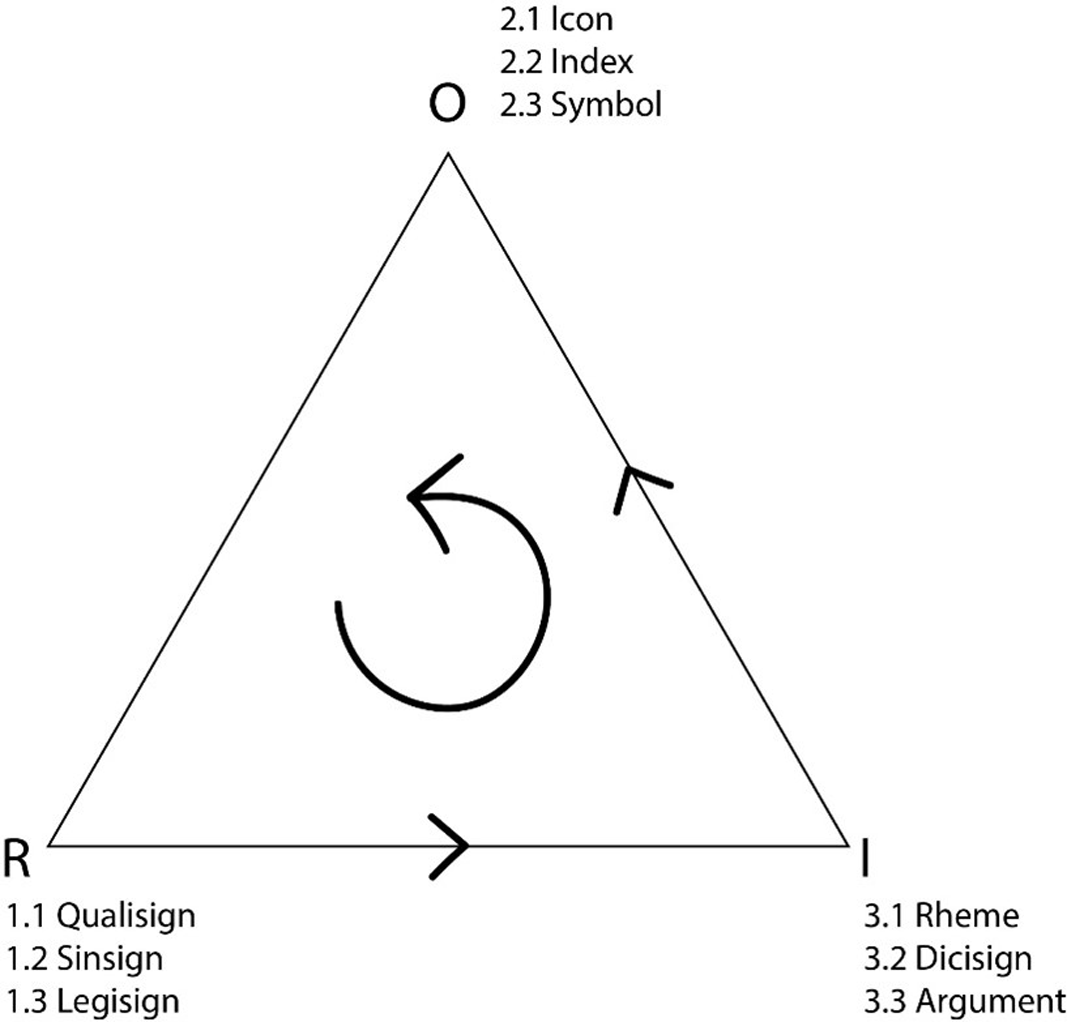
Which of the methodological approaches in Palaeolithic archaeology give the most meaning to a lithic object? What does it mean to give meaning? Can we reach a prehistoric meaning of these objects, so far removed from us in time and space, without fear of committing a counter-meaning? This article proposes to examine the possibility of introducing a full Peircian semiotic reading (Deledalle Reference Deledalle1979; Reference Deledalle1990; Reference Deledalle1993; Peirce Reference Peirce1978), taking a techno-structural approach to lithic objects (Boëda Reference Boëda1992; Reference Boëda1997; Reference Boëda2001; Reference Boëda2013; Dauvois Reference Dauvois1976; Lepot Reference Lepot1993). The Peircian vision, rooted in the pragmatist tradition, is based on the trichotomy of the sign: the subdivision of the sign into first, a representamen (R), what appears to us of the object; second, an object (O), which causes its appearance; and third, a interpretant (I), the possibility that the sign must be interpreted. Each of these three entities is in itself also triadic, resulting in a set of nine sub-signs as we will see later (Fig. 2): qualisign, sinsign, and legisign (first trichotomy); icon, index, and symbol (second trichotomy); and rheme, dicisign, and argument (third trichotomy). This will be explained in more detail later in the paper, but in brief, using the example of the lithic artefact, the representamen can be a qualisign, i.e. I perceive the artefact. It can be a sinsign i.e. I can say that it is made of matter and is part of the physical world. It can be a legisign, i.e. I will select it on the basis of purely visible criteria. The object can be an icon when I perceive it in its materiality. It can be an index when I can notice that certain areas of the material seem to be altered or modified. It can be a symbol when I can fit the lithic artefact into an existing classification or typology. Finally, the interpretant can be a rheme, i.e. I perceive it without being able to interpret it. It can be a dicisigne when I can tell something about the artefact from the indices I have observed. Finally, it can be an argument, i.e. from the information provided by the artefact, I will be able to argue and hypothesize.
The influence of Peircian theory on the conceptualization of French Archaeology is manifested in the work of Jean-Claude Gardin, who developed a logicist approach to archaeological experience (Gardin Reference Gardin1974; Reference Gardin1979; Reference Gardin, Gardin and Peebles1992; Reference Gardin1997). Alain Gallay in particular continues in this perspective by applying a logicist reading to his work on Neolithic societies in Europe and Africa (Gallay Reference Gallay1988; Reference Gallay1989). Although several authors have been interested in the contributions of Charles Sanders Peirce’s theory of signs, too few have attempted to integrate it in the field of prehistoric knapped stone studies. Furthermore, those who have applied Peirce’s semiotic theory have often used only one of the entities of the sign. For example, P.G. Chase (Reference Chase1991) examines the appearance and place of the symbol through three aspects of artefact manufacture in the Lower and Middle Palaeolithic: shaping, the imposition of an arbitrary form and standardization. In his work he takes up the second trichotomy of the Peircian sign, namely ‘icon/index/symbol’. For his part, Iliopoulos (Reference Iliopoulos2016) brings together the ‘pragmatic semiotics’ and the ‘cognitive theory’ of enaction (Varela Reference Varela1988; Reference Varela1989); they refer, for the one, to the determination of the nature of material meaning and, for the other, to an attempt to understand its emergence. The determination of the nature of material meaning is done through the observation of signs and their relations, inscribed in a physical reality, while the understanding of the emergence of material meaning goes through the principle of ‘enaction’, meaning representation as a relational activity between the subject and the object (Havelange et al. Reference Havelange, Lenay and Stewart2002). Iliopoulos raises the question of the material dimensions of meaning and the problems posed by the terms used to describe objects, between perception and meaning. He takes an ontological perspective in an attempt to decipher semiosis as the product of the constitutive relationship between mind and matter. Ontology in this case is seen as an ontology of technique, the technical object is therefore thought of as ‘an exteriorisation of time, a vessel of memory, organized and dynamic’ (Pérez-Balarezo and Boëda Reference Pérez-Balarezo, Boëda and David2019).
Kissel and Fuentes (Reference Kissel and Fuentes2017) position themselves in a comparable trajectory, questioning the importance of symbolic thought in the Pleistocene. They examine the use of the symbol from a Peircian perspective and mainly focus on first trichotomy of the sign – ‘qualisign/sinsign/legisign’ – that of representamen and thus quality. This makes no sense since the Peircian theory exists only through the relations between the three trichotomies of the sign (Peirce, Reference Peirce1978). In this context, the application of the theory of the sign is materialized through three types of prehistoric artefacts: ochre, anthropized shells and engravings. For Kissel and Fuentes, the search for the emergence of meaning in the Pleistocene involves the identification of legisigns that allow the constitution of groups of ideas, concepts and ideals (Kissel and Fuentes Reference Kissel and Fuentes2017). Others such as Barham and Everett (Reference Barham and Daniel2021) have focused on the origin of language in the Lower Palaeolithic. Language defined as a bio-cultural behaviour (Darwin Reference Darwin1871; Deacon Reference Deacon1997; Tomasello Reference Tomasello2005) is studied in this context by combining semiotics as well as language theory (Chomsky Reference Chomsky1956; Everett Reference Everett2017). Through the application of the second trichotomy of the Peircian sign (icon/index/symbol) corresponding to the categories of the object, the authors seek to highlight the genesis of language as early as Homo erectus s.l., in particular by considering the hand axe and cleaver as marker symbols of its appearance (Barham and Everett 2021). In the same vein, the hand axe has been interpreted as evidence of an early language since its manufacture requires an advanced cognitive degree involving the transmission of knowledge and the manipulation of abstract concepts over a vast spatio-temporal period. Thus, Barham and Everett construct their reasoning from the application of a hylemorphic (material/form) scheme modelled on lithic artefacts, to the detriment of the techno-functional criteria that structure them. A hand axe is not only a complex form but the result of an internal functional structuring. Barham and Everett’s conclusions are the result of the application of a morpho-typological (and evolutionary) approach to prehistoric lithic artefacts. The hypothesis of the genesis of language has not yet reached any scientific consensus, ever since it was raised through the radically different ideas of André Leroi-Gourhan and Claude Lévi-Strauss. Leroi-Gourhan associated the technical gesture and the appearance of language in an ethno-prehistorical perspective (Leroi-Gourhan Reference Leroi-Gourhan2013). Lévi-Strauss on the other hand proposed, argued from an anthropo-structural perspective that was based on the adaptation of Saussurean semiology (structure), to define language as a ‘system of signs’ (Lévi-Strauss Reference Lévi-Strauss1962). Decades after this initial debate, the development of research in genetics has contributed to the emergence of new research avenues on the topic. For instance, it is now possible to detect the presence of the FOXP2 gene in prehistoric populations (Krause et al. Reference Krause, Lalueza-Fox and Orlando2007; Trinkaus Reference Trinkaus2007), which, in conjunction with other candidate genes, would be implicated in language-related phenotypes (Fisher Reference Fisher2017) and, in this way, add to our knowledge on the emergence of language and symbolic thought. Parallel to this, growing fossil evidence supports an early evolution of speaking abilities (e.g. DeBoer Reference DeBoer2017).
Many of the above-mentioned studies have in their own way made use of Charles Peirce’s semiotics and the coding of signs according to the 10 phaneroscopic categories and their trichotomous subdivisions (firstness, secondness, and thirdness). Although the application of Peircian semiotics has opened new analytical paths which enable a better understanding of processes of signification, the appearance of language, or the emergence of complex cognitive processes, the ‘sign’ has never been apprehended through its full trichotomous division (representamen, object, interpretant). A complete apprehension is important because only then does it become possible to better define the relations between the different categories of signs and their significance for the analyst.
The aim of this article is to demonstrate the interest in applying Peircian semiotics to the method of techno-structural analysis of prehistoric lithic artefacts. This work is then situated in a reflection on the different kinds of semiotic relations that we might use in our interpretations that other researchers have already begun regarding pottery styles (e.g. Parmentier Reference Parmentier1997), village design, and site location (e.g. Preucel Reference Preucel2006; Preucel and Bauer Reference Preucel and Bauer2001). The objects then will be conceived as signs, which will make it possible to objectify the analysis and to circumvent affective, analytical and interpretative a priori, the so-called ‘the trap of the hylemorphic schema’ (matter/form) as well as analytical errors caused by social habitus. Finally a note must be made that this paper is not written as a classical article (material and method, results, discussion) but rather more as an experimental itinerary of a knowledge process in four parts: (1) a history of the approaches to lithic artefact studies, (2) the pragmatic foundations of the method and the epistemic scope of the proposed application, (3) the semiotic tool or the perception of lithic artefacts in signs, and (4) the contributions and perspectives of Peircian semiotics for the study of technical behaviours over the long time span of prehistory.
Different approaches to the study of lithic artefacts
The historiography of the study of lithic artefacts in this section is novel for its examination of both the different French schools of thought and the developments in English-language scholarship, as well as consideration of other European influences. The reading and analysis of prehistoric lithic artefacts are based on protocols defined by ‘schools of thought’, oscillating between various currents: cultural-historical, processual, post-processual, evolutionary and materialist, inter alia (Audouze and Karlin Reference Audouze and Karlin2017; Hussain Reference Hussain2019; Hussain and Will Reference Hussain and Will2020). These diverse philosophical influences have globally marked scholars in prehistory over the course of an ever-evolving epistemology of prehistory. Initially, the study of knapped stones was strongly influenced by the naturalistic and evolutionary school, popular from the middle of the 19th century. The discoveries of early human remains (such as the Neanderthal in 1856, Cro-Magnon in 1868, the Pithecanthrope of Java in 1891, the Man of La Chapelle-aux-Saints in 1908, and others) coinciding with the publication of Darwin’s 1859 On the origin of species by means of natural selection, or the preservation of favoured races in the struggle for life had a strong impact on the way scholars in prehistory read, classified and interpreted prehistoric material. In the evolutionary perspective, both Lamarckian transformism (Lamarck Reference Lamarck1809) as well as the social Darwinism current that was disseminated, for instance, by Herbert Spencer (Spencer Reference Spencer1876; Reference Spencer1889; Tort Reference Tort1983; Reference Tort1995) became especially influential in the ways prehistoric human productions were apprehended. However, in the very same period, prehistoric artefacts were also still popular in collections for cabinets of curiosity. This specific quest for the object for the object’s sake persisted at least until the appearance of Prehistory as a scientific discipline in the mid-1800s, then very much situated at the crossroads of the natural sciences and the humanities (Hurel Reference Hurel2004; Hurel and Coye Reference Hurel and Coye2011; Laming-Emperaire Reference Laming-Emperaire1964). In terms of interpretation, the evolutionary approach had the effect of ‘naturalizing’ the artefact by classifying it by ‘types’ as if it consisted of inorganic matter that could be placed directly in an evolutionary lineage (Stiegler Reference Stiegler2018). This made it so that many prehistorians became mainly focused on the constitution and recognition of prehistoric ‘cultures’, based on the (nearly) only material remains at their disposal: prehistoric knapped stone industries. The first of the scholars who attempted such classification was Jacques Boucher de Crèvecœur de Perthes (1788–1868) who worked from the beginning of the 19th century on recognizing early hominids and their material productions, mainly during his work in the Somme valley, using archaeo-geological methods (Boucher de Perthes Reference Boucher de Perthes1847). A few years later, Gabriel de Mortillet (1821–98) was the first prehistorian to propose a cultural chronology of prehistory based on archaeological objects in his work Le préhistorique antiquités de l’homme, published in 1883. At the turn of the 20th century, Abbé Henri Breuil (1877–1961) continued his work in this trajectory of a chrono-cultural classification of prehistoric archaeological facts, which he illustrated in the famous ‘Battle of the Aurignacian’ (Breuil Reference Breuil1912). In France, the middle of the 20th century saw the development of a systematization of the analysis and classification of lithic industries. François Bordes (1919–81), Louis Méroc (1904–70) and Georges Laplace (1918–2004) became the leaders of advanced typo-analytical methods that were sometimes very radically applied, such as in Laplace’s Typologie analytique et structurale: base rationnelle d’étude des industries lithiques et osseuses (Laplace Reference Laplace1974) in the ‘Bordes method’ (Bordes Reference Bordes1961). However, parallel to this, another French prehistorian and ethnologist initiated a very different way to look at prehistoric material, boldly named ‘ethnologie préhistorique’ (Leroi-Gourhan Reference Leroi-Gourhan1936). This was André Leroi-Gourhan (1911–86), who conceived the study of archaeological and prehistoric soils as an ethnological investigation rather than a typological one to give a better voice to the material remains. Leroi-Gourhan introduced numerous concepts drawn from the anthropology of Marcel Mauss; for instance, the best known is the ‘chaîne opératoire’, which he applied to the analysis of lithic industries (Leroi-Gourhan Reference Leroi-Gourhan1943; Reference Leroi-Gourhan1945). Following Leroi-Gourhan, Jacques Tixier (1925–2018) and the laboratory ‘Préhistoire et Technologie’ that he founded in 1980, developed a technological analysis of lithic industries, based on stone knapping experiments, dynamic reading and archaeological refitting. These ideas became formalized in the book Préhistoire de la pierre taillée (Inizan et al. Reference Inizan, Reduron, Roche and Tixier1995; Tixier et al. Reference Tixier, Inizian, Roche and Dauvois1980) and introduced important new concepts such as an anthropology of gesture and technical action in prehistory; it aimed both to answer the how and the why of lithic industries. The challenges of, as it became known, the French-style knapped stone technology, combining a dynamic reading of lithic objects and the creation of diacritical diagrams (Dauvois Reference Dauvois1976), were to decipher the modes of production (shaping and flaking). Thus, by mobilizing the concept of the chaîne opératoire, a virtual reconstruction of the stages in the life of the artefact became possible, from the selection phase of the natural matrix all the way to its abandonment (Pesesse Reference Pesesse2019). In the meantime, in English-language 1960s scholarship, the Mesolithic prehistorian Grahame Clark (1907–95) commenced innovative work on the relationship of prehistoric human societies with their environment and was part of the functionalist current in archaeology. In 1969, Clark published a book entitled World Prehistory. A New Outline (republished three times), in which he developed the idea of an ‘evolutionary’ classification of lithic industries according to five successive modes, mode 1 corresponding to chopper tools and flakes and mode 5 to microlithic components of composite artefacts. Following him, David L. Clarke (1937–76) and Lewis Binford (1931–2011) initiated new ways of practising archaeology: the New Archaeology (Binford Reference Binford1962; Clarke Reference Clarke2014). Being critical of the French culturalist work (of both Bordes and Leroi-Gourhan), this movement used actualist models and a hypothetico-deductive (or abductive) and systemic approach, inspired by the work of Norbert Wiener (Reference Wiener1948) and Ludwig Von Bertalanffy (Von Bertalanffy et al. Reference Von Bertalanffy, Chabrol, László and Paulre1973). In the context of the rupture caused by New Archaeology, Harold Dribble (both critical and continuing in the line of the New Archaeology work) developed a new way of establishing a biography of the lithic object by considering modern scholarly biases in the interpretation of lithics (Dibble Reference Dibble1995; Dibble et al. Reference Dibble, Holdaway and Lin2017; Rolland and Dibble Reference Rolland and Dibble1990).
At the crossroads of these two approaches, the 1980s saw the development and application in Spain of the Analytical Logic System (ALS) proposed by Eudald Carbonell (Carbonell et al. Reference Carbonell, Guilbaud and Mora1983). This method of studying lithic industries is positioned as a critique of the ‘traditional empirical systems of classification’ (Bernal and Moncel Reference Bernal and Moncel2004), in particular those of Bordes (Bordes Reference Bordes1961; Reference Bordes1970) and Tixier (Reference Tixier1980), which were developed at the same time. The systemic foundations of this new method, although it is based on an intention to think of lithic material within a technical ‘chaîne opératoire’, are placed within an interpretative framework, exclusively oriented towards the production processes (as was the case for J. Tixier). After the morphotechnical analysis of the artefacts, the ALS returns to the arbitrary classification by mode proposed by G. Clark and falls back into a morpho-typological classification of lithic artefacts. In the end, this method did not have the impact its authors had hoped for, since it never really spread outside the Iberian Peninsula. Unlike New Archaeology (Gallay Reference Gallay1980; Reference Gallay2011; Roux Reference Roux2007; Reference Roux2019), the Analytical Logical System has not been able to take a theoretical and epistemic turn to exist or even be applied in and outside Europe.
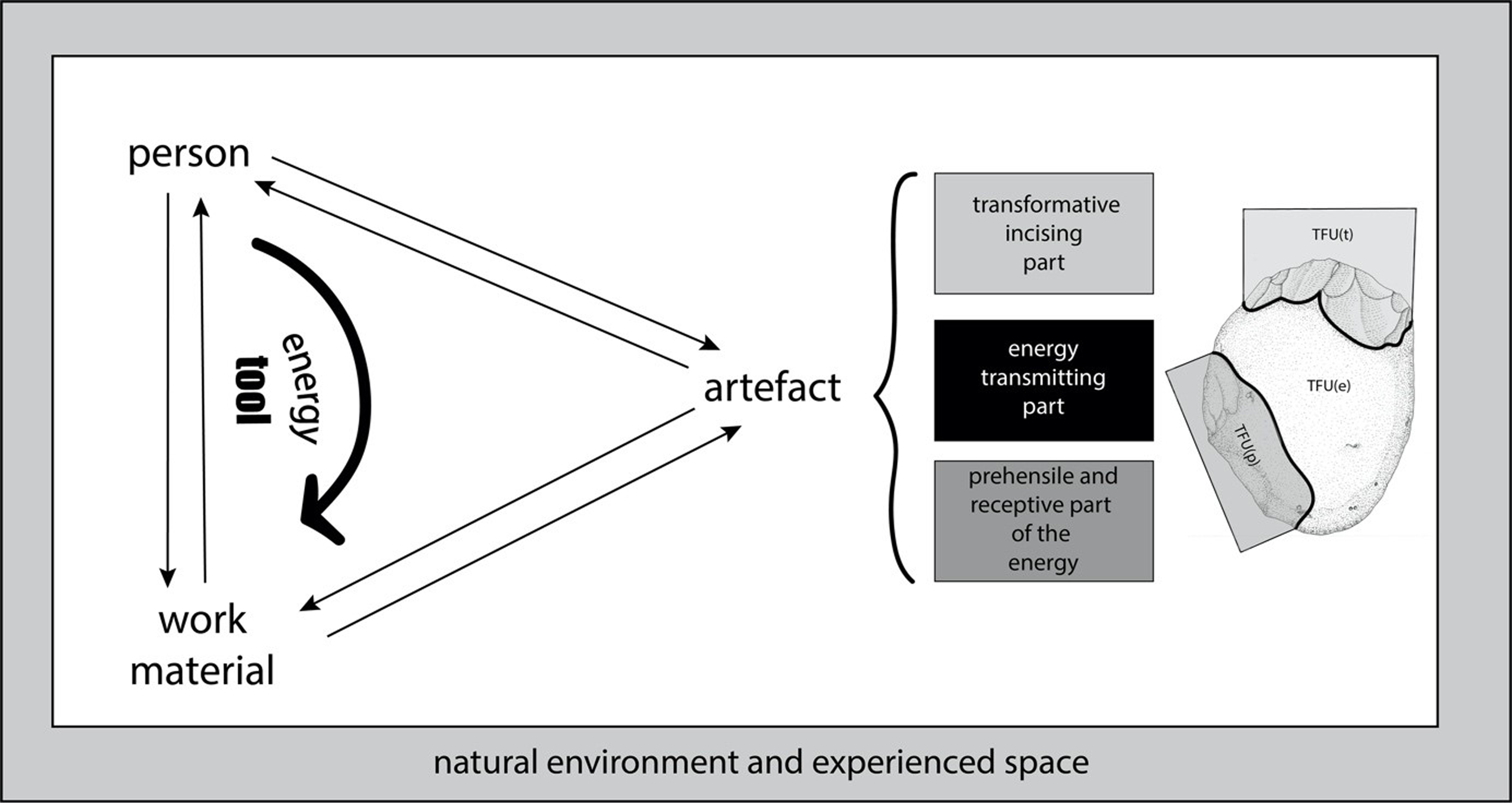
The 1990s in France witnessed another change in how lithic artefacts could be approached; this came through the ergonomic and functional design-theory proposed by Éric Boëda (Reference Boëda1992), which was later further developed into an ‘artisanal’ theory of the prehistoric tool by Michel Lepot (Reference Lepot1993; then associated with the University of Paris-X Nanterre and the Préhistoire et Technologie laboratory). The theory was based on the systemic work of Ludwig Von Bertalanffy (Von Bertalanffy et al. Reference Von Bertalanffy, Chabrol, László and Paulre1973) and the ergonomics-anthropotechnics work of Pierre Rabardel (Reference Rabardel1995). Éric Boëda furthermore integrated a techno-functional and technogenetic approach using concepts derived from the research of the philosopher of technology Gilbert Simondon (1924–89), such as those of ‘individuation’ or ‘concretization of technical objects’ (Simondon Reference Simondon1958; Boëda Reference Boëda1997; Reference Boëda2001; Reference Boëda2013). This brought a new structural way of studying lithics in which the lithic artefact is perceived as a structure carrying three entities or techno-functional units (TFU) that coexist and interact in the general functioning of the technical object: the TFU(t) or transformative (or cutting) part, the TFU(p) or prehensive part and the TFU(e) or energy-receiving part (Fig. 1).
Scheme of the structural decomposition of the tool into techno-functional units (TFU) (inspired by Boëda Reference Boëda2013).
Representation of the Peircian trichotomy sign and sub-signs categories: R, representamen; O, object; and I, interpretant (after Deledalle Reference Deledalle1979).
It is important to understand that, in this model, the energy-transmitting part is rarely individualizable by the analyst because it is totally integrated into the morphostructure of the tool. One of the major contributions of this new way of thinking about lithics is the intervention of philosophical and ergonomic concepts in the service of an objective approach to knapped stone objects. A further complement to this new strain of research has recently been carried out by Hubert Forestier, who attempted a move towards a new possible epistemological trajectory for the understanding of prehistoric objects (Forestier Reference Forestier2020; Reference Forestier and Sidera2022). While placing himself in a methodological continuity, i.e. techno-functional, with ‘l’École nanterienne’, Forestier began a change of horizon by questioning not only the mode of existence but also the value of reality and the conditions of appearance of lithic material, which is then placed in tension between a plane of immanence and transcendence (Forestier, Reference Forestier2020). The prehistoric lithic object is thus perceived as the double manifestation of a materiality preserved from time but also the bearer of signs that are often beyond the analyst’s reach. Against the backdrop of a crisis of objectivity, it is a question both of the stone object and of that which is no longer visible and whose withdrawal would explain both the meaning and the counter-meaning of the archaeological manifestation. Inspired by phenomenology and neo-realism, his epistemological proposal targets the prehistoric artefact as a for-us which is then rethought through and beyond itself towards an Other than oneself or an Other-self in what he henceforth called a philosophical anthropology. Now that we have presented a historiographical and global overview of different approaches to the study of prehistoric lithic artefacts, we will move on to give an introduction of the pragmatic foundations of the semiotic analysis method.
The pragmatic foundations
The method of semiotic analysis commenced with the publication of the logical theory of signs by Charles Sanders Peirce (1839–1914), which finds its sources firmly in the pragmatist tradition. Pragmatism is an American philosophical movement that emerged in the 19th century. It is a ‘theory of truth’ which is also conceived as ‘a theory of science, in the sense that science is synonymous with experimental method and not practical results’ (Deledalle Reference Deledalle1971, 6, our translation). Pragmatism’s founding idea is rooted in Kant’s philosophy and appeared in Peirce’s thought in the early 1870s. Peirce was inspired in particular by Kantian formal logic (the foundation of his metaphysics), the semiotic trichotomy (grammar, logic and rhetoric) and the conception of categories inspired directly from Kant’s transcendentalism (Chauviré Reference Chauviré1995). Nevertheless, Peirce refuted the thing-in-itself or Kantian noumenon in his work, rejecting the dichotomy between the reflective use of a judgment (thinking) and the determining use of a judgment (knowing; Chevalier Reference Chevalier2016).Footnote 1 During the following decade, Peirce published two founding articles of pragmatism entitled ‘The fixation of belief’ and ‘How to make our ideas clear’ which appeared in French in the Revue philosophique in 1878 and 1879, respectively. The maxim of pragmatism appears in this last article: ‘Consider what effects, which might conceivably have practical bearings, we conceive the object of our conception to have. Then, our conception of these effects is the whole of our conception of the object’ (Charles Sanders Peirce Reference Peirce1879, 293). This would be misinterpreted and distorted over time, in the sense that pragmatism has been wrongly used to suggest that truth is only what works in practice, and that it has a narrow focus on immediate practical consequences. However, Peirce argued that pragmatic effects must be those which are conceivable and have practical bearings, including those that are indirect or far-reaching, and can also include aesthetic, moral and intellectual considerations. It is a valuable method of inquiry that emphasizes the importance of considering practical effects in our understanding of the world.
Pragmatism also has William James (1842–1910) and John Dewey (1859–1952) as founders, which is important, as James applies pragmatism’s principle to religion and philosophy (James 1907), while Dewey became very influential in the fields of pedagogy, psychology, sociology, law and politics (Dewey Reference Dewey1938). It is important to disconnect the moral pragmatism of James from the logical pragmatism of Peirce. William James’s work caused quite a misunderstanding of Peirce’s original pragmatism, forcing Peirce to create the term pragmaticism, which reflects the true meaning of the pragmatism maxim. As a theory of truth (Dewey Reference Dewey1938), pragmatism focuses on understanding the processes of establishing a belief, as Peirce states: ‘The essence of belief is the establishment of a habit; and different beliefs are distinguished by the different modes of action to which they give rise’ (Peirce Reference Peirce1878, 5,397–8). However, only the scientific method can establish a de facto scientific belief oriented towards objectivity. We use therefore pragmatism for logical, objective and critical purposes to form an opinion, to think our corpus in action according to appropriate knowledge conditions because ‘…thought is essentially an action…’ (Peirce Reference Peirce1878, 5,397–8). Pragmatism consists of focusing strictly on the context of observation and the study of signs by anticipating the effects of analysis on the construction of techno-structural hypotheses. We therefore aim to make it the backdrop for our semiotic reflection.
The semiotic tool or the apperception of lithic artefacts as signs
The artefact is a sign composed of sub-signs. It is through the observation and the hierarchy of these sub-signs that the analyst will be able to study the archaeological objects from a phenomenological perspective respecting the plans given to his perception. The prehistorian is only a more or less passive observer, and the reproduction of the gestures of the Paleolithic knappers does not mean the artefact has meaning. Devoid of any cultural and functional symbolism, the prehistoric artefact possesses a forgotten and/or lost technical memory which becomes ignored by the analyst (Boëda Reference Boëda2013). However, all thought proceeds through signs (Charles Sanders Peirce Reference Peirce1879). The creation and use of the artefact by the Paleolithic communities induce the production of forms and signs that leave traces on the lithic industry which in fact is perceived as a memory reservoir. It is therefore essential to analyse each artefact within its technical system or within its technical lineage, through an objective and purely pragmatic approach allowing new avenues of interpretation to be opened up. Semiotics are therefore considered as ‘the quasi-necessary or formal doctrine of signs’ (Deledalle Reference Deledalle1979, our translation), and it is based on Kantian phenomenology as a theory of phenomena and not of appearance, since in Kant’s view, the phenomenon is not appearance but ‘what appears’ (Kant Reference Kant2017, our translation). However, to differentiate his theory from the point of view of certain psychologizing aspects in Kant (Tiercelin Reference Tiercelin2013), Peirce named it: ‘phaneroscopy’ or theory of categories understood as ‘a description of what is in the presence of the spirit or in consciousness as it appears in the different genres of consciousness.’ (Peirce Reference Peirce1978, 67, our translation). The creation of the neologism ‘phaneron’ from the Greek word ‘phaneron’ (neutral of ‘phaneros’), meaning ‘what shows itself’, allows one to refer specifically to the appearance of things as they are, rather than being influenced by the subjectivity of the observer (Deledalle Reference Deledalle1990). Semiosis or semiotic inference draws its foundations from mathematical logic by being articulated around a triad that we find at the level of the sign’s constitution as shown in the diagram below (Fig. 2).
The Peircian sign is therefore seen as triadic with: first, a representamen (what appears to us of the object); second, an object (which causes its appearance) and third, a interpretant (the possibility that the sign has to be interpreted). This trichotomy of the sign corresponds to different categories: firstness to feeling, secondness to existence and thirdness to thought. Moreover, each of these categories is also triadic, resulting in a set of nine sub-signs (Fig. 3). The representamen is therefore composed of three sub-signs: first, a qualisign; second, a sinsign; and third, a legisign. The object consists of the icon, the index and the symbol. Finally, the interpretant is composed by the rheme, the dicisign and the argument. These sub-signs are not individuals; they are just constitutive blocks of an individual who would not be individual if these elements did not exist.
Table of the Peircian sign’s trichotomy and the nine types of sub-signs (following Deledalle Reference Deledalle1979).

From these nine types of sub-signs, Peirce conceived 10 phaneroscopic/phenomenological categories (Deledalle Reference Deledalle1979) to understand the phenomenon as a whole. On the basis of this classification, we have chosen to introduce pragmatic semiotics as a methodological tool for the study of prehistoric lithic artefacts. If the sign is in perpetual (living) action, and the non-functioning object corresponds to the rank of thing (static), we must imperatively contextualize semiotics within a techno-structural approach to lithic objects. With this in mind, we will regard knapped stone artefacts according to relevant criteria and characteristics of a morphological, technical, structural and semiotic nature. The objective is to apprehend the technical object as closely as possible to what it is and to what it lets see to build the most objective interpretation possible of techno-structural order. Naturally, to achieve this objective still requires a lot of epistemological, methodological and practical work. However, it seems to us that clarifying and classifying the stages of archaeological reasoning in the description and interpretation of artefacts is the foundation on which we must build our objectivity. In this search for the logicist understanding of knapped stone objects, the following synoptic table (Fig. 4) presents the semio-pragmatic processes at work when the analyst arrives at the level of interpretation. The semiotic and interpretative processes are also placed within a trichotomy, separating the domains of the interpretant, the object and the interpretation (representation, sense and meaning). The meaning corresponds to what Peirce calls the final interpretant.
Synoptic table of the semiotic classification of semantics and semio-pragmatic processes (following Deledalle Reference Deledalle1979).

The scheme below (Fig. 5) serves as a summary of our approach and of the fields in which the object-sign is concretized. As technologists, we place ourselves in ‘fields of sense’ (Gabriel Reference Gabriel2014) specific to our discipline. This concept borrowed from the neo-realism of Markus Gabriel is defined as such: ‘the fields of sense are domains in which something, determined objects, appear in a determined manner, which is completely excluded in the domains of objects and more in ensembles. Furthermore, two fields of senses can relate to identical objects which only manifest themselves differently in the two fields of sense.’ (Gabriel Reference Gabriel2014, 92).
Scheme of a semiotechnological study of the lithic object and expression of the 10 Peircian phaneroscopic categories.

These fields of sense constrain us and position us in a variety of habits that we must strive to break out of, so as not to fall into analytical and interpretative traps. Within the fields of sense of the prehistorian, the analysis of the lithic artefact is part of pragmatic foundations which find a contextualization in the broad lines of the techno-structural approach. This is how it is possible to observe the 10 phaneroscopic categories when studying a knapped stone tool. This categorization by phaneron or phenomenon structures the progress of analysis and places us in a quest for objectivity, in an oscillatory movement between percept and concept. The speed and amplitude of the latter is specific to each prehistorian, and it depends mainly on two factors: the conditions of conservation of the archaeological record and the ‘level’ of technical memory that the object can still represent through its stigmata. The analyst’s personal biases move between these two poles. Recognizing these limits is fundamental to reaching a certain level of objectivity.
Case study
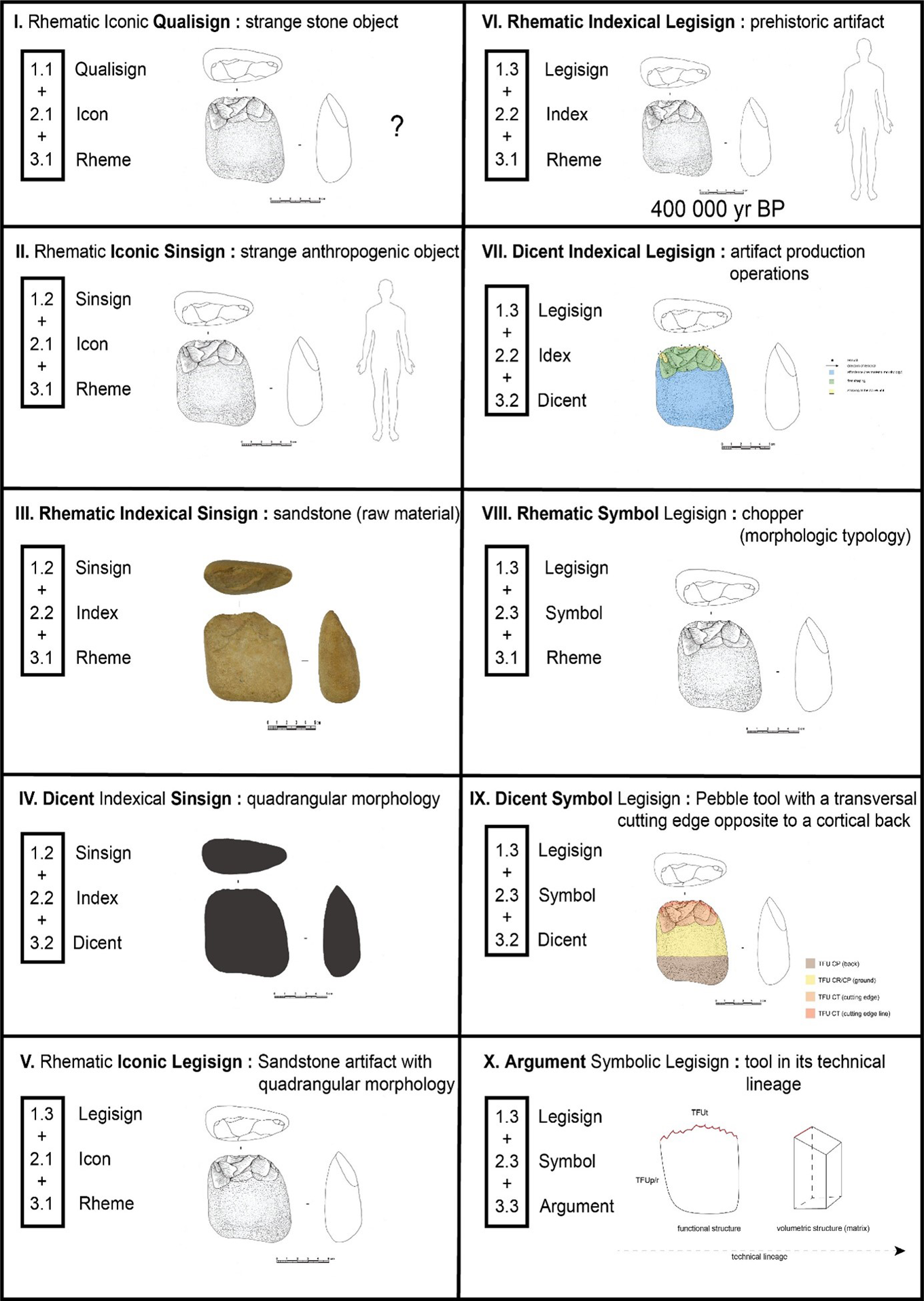
To show the operationality of this approach, we have chosen to study stone objects from different spatio-temporal and cultural contexts, thus allowing us to question the vision that we may have of these objects, some of which are out of our technical memory. Following the semiotic division, we can observe 10 phenomena or classes of signs. As we have seen, ‘every sign is defined by its threefold relationship to the three dimensions of the sign’ (Deledalle, Reference Deledalle1979, 79) which are firstness, secondness and thirdness. From this, the perception and analysis of the prehistoric object can be done according to these 10 classes of signs. The first object we will regard as a case study is a pebble tool (Fig. 6) from layer 5 of the Pointe de Saint-Colomban site (Carnac, France), dated to the Lower Palaeolithic and attributed to the so-called Acheulean lithic technocomplex (Guibert et al. Reference Guibert, Bon and Forestier2022). First of all, the first impression we have of the object is a perception of a strange stone object corresponding to the observation of the rhematic iconic qualisign (1.1 + 2.1 + 3.1). Then, the second phenomenon still gives us a strange object but one which can be attributed to an anthropogenic action thanks to the perception of the rhematic iconic sinsign (1.2 + 2.1 + 3.1). The third class of signs (1.2 + 2.2 + 3.1) informs the raw material. The fourth phenomenon (1.2 + 2.2 + 3.2) is a relation to the sensible which allows us to distinguish precisely the quadrangular morphology of this object. The fifth class of signs is marked by the beginning of the interpretation; it is notably from the rhematic iconic legisign (1.3 + 2.1 + 3.1) that we can discriminate that it is a quadrangular artefact made in sandstone. Following this perceptive and analytical process, the observation of the rhematic indexical legisign (1.3 + 2.2 + 3.1) attributes a typological and cultural status to this object. The following class of signs (1.3 + 2.2 + 3.2) makes it possible to decode the production operations of this artefact resulting from an operational scheme of shaping. The rhematic symbolic legisign (1.3 + 2.3 + 3.1) informs us about the morpho-typological attribution of the object, identified as a chopper. The penultimate phenomenon (1.3 + 2.3 + 3.2) symbolizes the functional potential of the object, which turns out to be a pebble tool with transversal cutting edge opposite to a cortical back. Finally, the argumental symbolic legisign (1.3 + 2.3 + 3.3) constitutes the end of the semiotic unravelling of this object, and allows us to infer the place of this pebble tool in its technical lineage. Clearly, the criteria for identifying the first two classes of signs (the quality and the existence of percept) are less clear than the subsequent phaneroscopic categories which are based on more familiar criteria.
Semiotechnological study of a pebble tool from Pointe de Saint-Colomban (Carnac, Morbihan, France; Guibert et al. Reference Guibert, Bon and Forestier2022).
The second object is a flake tool (Fig. 7) also from the Palaeolithic site of Pointe de Saint-Colomban (Carnac, France); its age is estimated at around 400,000 years B.P. (Monnier and Le Cloirec Reference Monnier and Le Cloirec1979). The first class of signs, which corresponds to the rhematic iconic qualisign (1.1 + 2.1 + 3.1), indicates the presence of a strange stone object. The second phenomenon (1.2 + 2.1 + 3.1) allows us to enter into the materiality of the traces inscribed in the stone, which allow us to discriminate this phenomenon as a strange object created by a human. The third (1.2 + 2.2 + 3.1) and fourth (1.2 + 2.2 + 3.3) classes of signs allow us to go further in the observation since these stages allow us to access the lithological and morphological dimensions of this object made in jasper and presents a quadrangular morphology. The fifth phenomenon or phaneron (1.3 + 2.1 + 3.1) constitutes the initialization of the interpretative process since from it we know that this object is a quadrangular jasper artefact. This interpretative dimension is given by the incorporation of the legisign. From the rhematic indexical legisign (1.3 + 2.2 + 3.1), it is possible to infer that this object is a prehistoric artefact dated to about 400,000 years ago B.P. The observation of the seventh class of signs (1.3 + 2.2 + 3.2) allows us to understand the production operations of this artefact, which is the result of a knapping operation followed by a phase of making the active cutting edge. The rhematic symbolic legisign (1.3 + 2.3 + 3.1) provides morpho-typological information by attributing this artefact to the scraper type. The ninth phenomenon (1.3 + 2.3 + 3.2) allows us to go beyond this typological aspect by understanding the object in its techno-structural dimension. Finally, just as with the example of the pebble artefact, the tool is placed within its technical lineage. This last stage of the semiotechnological protocol has the value of a final argument and therefore a final interpretation. These two examples of study highlight the analytical and interpretative scope of this new approach, by evacuating the possible biases induced by the methodological habitus of a classical technological approach, as, for example, a morpho-productive or morpho-functional a priori attribution of the object.
Semiotechnological study of a flake tool from Pointe de Saint-Colomban (Carnac, Morbihan, France; Guibert et al. Reference Guibert, Bon and Forestier2022).

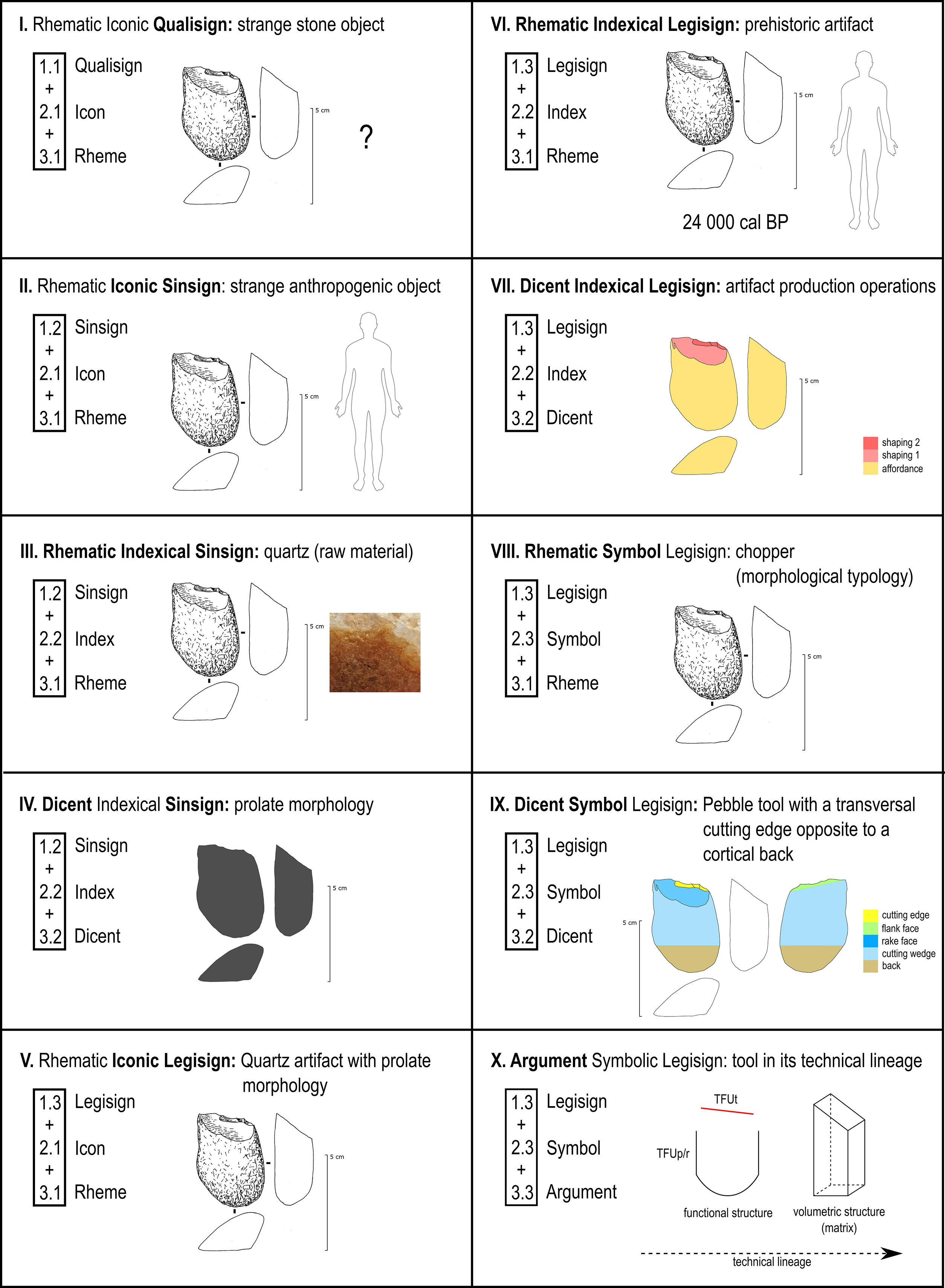
A third example comes from another continent and another archaeological period: Pleistocene South America. As in the first case from Pointe de Saint-Colomban, it is a pebble tool but smaller (Fig. 8). When the analyst first observes this object, they do so in its quality capacity of rhematic iconic qualisign (1.1 + 2.1 + 3.1); that is to say that the object is nothing more than a strange object made of stone. Much more systematic observation and analysis, added to the analyst’s experience with other qualisigns of the same nature, will allow him to recognize a set of stigmas produced by the human being, thus reaching the perception of a rhematic iconic sinsign (1.2 + 2.1 + 3.1). As the analyst deepens their study, they discover that this artefact is something more than an object lost in time and space. The artefact then reveals its mineral composition as rhematic indexical sinsign (1.2 + 2.2 + 3.1) and its prolate morphology as dicent indexical sinsign (1.2 + 2.2 + 3.2), thus offering the necessary inputs for a first definition of its artefactual denotation as rhematic iconic legisign (1.3 + 2.1 + 3.1). But the sign of this artefact does not end in its artefactual definition, since it has a cultural definition as an artefact-sign of the American Upper Pleistocene, that is, a rhematic indexical legisign (1.3 + 2.2 + 3.1) from 24 000 cal B.P. This characteristic is fundamental for the analyst, since the comparison with other artefacts-signs from the same archaeological context (toolkit) will allow them to access other predicates. Thus, the analyst realizes that this object is also a dicent indexical legisign (1.3 + 2.2 + 3.2), as it denotes an organized set of production schemes that partially inform about their typological essence. When the analyst combines contextual analysis with that of the manufacture of the artefact, then the object is revealed as a rhematic symbol (1.3 + 2.3 + 3.1), that is, as a chopper, to use the most popular nomenclature in prehistoric lithic technology. But up to this point, this chopper remains a culturally and productively mediated artefact-sign. When we delve into the analysis of the internal structure of the artefact, we realize that its nature as a sign goes beyond production within a human group since it is its functioning that is revealed as dicent symbol legisign (1.3 + 2.3 + 3.2) – a functioning that requires a transversal cutting edge opposite to a cortical back to fulfil its function or assigned use. But neither its form nor its production nor its belonging to a toolkit nor its operation fully explain this artefact-sign. There is something else in its nature that reveals its quality of argument symbolic legisign (1.3 + 2.3 + 3.3): its belonging to a technical lineage, that is, to say to a technical evolution over a long period of time. Nevertheless, what about objects whose morphology already informs us, directly or indirectly, of a particular function or use, or of a specific chronology? Let’s look at the case of a fishtail projectile point typical of the Pleistocene-Holocene transition in South America (Fig. 9). Unlike the previous cases, the identity of the rhematic iconic qualisign (1.1 + 2.1 + 3.1) is no longer that of a strange object, since the analyst’s first impression is that of a prehistoric point, and therefore there is immediately no doubt about the anthropogenic nature of the object. Therefore, this point is not a rhematic iconic sinsign (1.2 + 2.1 + 3.1). By continuing with the analysis, we perceive that the object is made on silex (rhematic indexical sinsign) and has an oblate morphology (dicent indexical sinsign). The object is also not a rhematic iconic legisign nor a rhematic indexical legisign, since its artefactual and cultural identity are already known from the first class of sign. However, the point is a dicent indexical legisign, a rhematic symbol legisign, a dicent symbol legisign and an argument symbolic legisign because it has an identity of its own manufacture, its typology, its internal functioning and its evolutionary dimension.
Semiotechnological study of a simple bevel tool from the C7γ-a layer of the Vale da Pedra Furada site (Piaui, Northeastern Brazil), dated to around 24,000 cal. B.P. (Boëda, Ramos, et al. Reference Boëda, Ramos and Pérez2021).
Semiotechnological study of a ‘fishtail’ projectile point, recovered from the surface near the Serra da Capivara National Park (Boëda, Flegenheimer, et al. Reference Boëda, Flegenheimer, Viana, Gluchy, Pérez, Ramos and Guidon2021).

We can see that the application of Peirce’s pragmatism to prehistoric lithic technology, through a semiotechnological approach, allows for a more systematic and comprehensive analysis of prehistoric objects. This approach takes into account the emotional perception of the prehistorian, as well as the temporal, cultural and spatial distance between the objects and the observer-analyst. By using a clear and heuristic system, this approach helps to reveal the various characteristics of the objects, such as their artefactual, cultural and evolutionary dimensions, which in turn inform our understanding of the past. This way, the semiotechnological approach provides a valuable tool for the study of prehistoric lithic technology and contributes to our knowledge of human history and evolution.
Contributions and perspectives of Peircian semiotics
The adaptation of the concept of sign to the technological and structural study of lithic objects from prehistoric times brings out new avenues of analysis and interpretation. Semiotics, considered as the logical theory of signs (Deledalle Reference Deledalle1979), allows us to perceive the prehistoric object that has become an artefact-sign as the result of a (underlying) semiotic process integrated to a functional process. By venturing into the analysis of this process, we de facto place ourselves in a mirror semiosis, that is, between two fields of sense, that of prehistoric artisans and that of prehistorian analysts. The mirror is the temporal distance that separates us from this past humanity but that is still there somewhere in a ‘deferred’ way through the object. We are therefore unable to access the original meaning of the knapped stone, which has become a ‘thing-in-itself’ (Kantian sense), unattainable for the prehistorian. Despite this admission, we propose to invest in the other side of the mirror, provoked and nourished by the semiotic processes specific to the analyst. Thus, following Peirce’s writings on perception, we differentiate ‘percept’ from ‘perceptual judgment’ (Peirce Reference Peirce1868). The first is: ‘a unique singular event occurring hic et nunc. It cannot be generalized without losing its essential character.’ (Peirce Reference Peirce1868, 110). The second is already in the semiotic process since it places the representamen (the perceptual image) as a function of representation that we could relate to the Heideggerian Dasein as a being of the technical/semiotic state of being (or existence) questioned. The contribution of this distinction is essential since it allows us to ‘filter’ the objects outside semiosis from those at the core of this semiotic process. From this perspective, the semiotic and pragmatist approach that we are proposing logically matches the work initiated by É. Boëda and concretized by M. Lepot and his artisanal theory of tools, but it adds a significant and conceptual perception of the objects, understood as signs.
Semiotic analysis is not limited to the classification of signs and their components into categories to create a typology of signs. While this approach may be helpful in the short term, it is not an effective way to gain a deeper understanding of the meaning and significance of signs over time. In fact, the Italian semiotician Umberto Eco referred to this as an ‘erroneous project’ in his work (Eco Reference Eco1976). It is important to acknowledge that semiotic analysis involves a more comprehensive approach that considers the context and cultural factors that influence the interpretation and creation of signs. The study of the production of signs can then be perceived as much as a study of the appearing, that is, ‘a way in which the object appears’ (Gabriel Reference Gabriel2014), as the search for a truth or power of signification of the object – in other words, a technical object whose structures refer to a scientific and metaphysical realism and whose analysis has barely begun in prehistory (Forestier Reference Forestier2020).
The introduction of this new way of apprehending lithic productions will allow the specialist to highlight analytical, affective and interpretative a priori by thinking of the object as a sign (object-sign), within a system of signs (the technical system or the technical trajectory). At the intersection of the fields of technology and semiotics, the sign-object is placed as a medium between the technical object and the phenomenal object (Fig. 10). Focused on the study of semiotic processes within technical systems, this approach is heuristic because it addresses the knowledge of the technique and human on a long-term prehistoric time scale. We argue that the prehistorian’s objectivity is transcribed in this way, by making visible the stages of the analytical and interpretative process of the lithic objects, and by being aware of the construction of this ‘personal objectivity’. In conclusion, we propose the introduction of a semiotic approach as both a methodological tool and a foundation for a possible new episteme in Prehistory and Anthropology of technology (David Reference David2019; Forestier Reference Forestier and David2019; Reference Forestier2020). This approach seeks to enhance our understanding of human history and technology in a more realistic and self-aware way, acknowledging the limitations of our knowledge and perspectives. By adopting a semiotic orientation, we are able to analyse and interpret the meaning and significance of material culture, including lithic technology, in a more comprehensive and nuanced way. This approach is not only useful as a methodological tool but also has the potential to contribute to the development of new knowledge and understanding in the fields of prehistoric archaeology.
Scheme of the transition between the technical object understood as a sign-object and as a phenomenal object in perpetual becoming.

Financial support
None.
Conflicts of interests
None


 Open access

