





Introduction
“Talking about sound is one of the hardest things we do,” violin maker and repairer Jess Fox told me. I had just arrived with my violin for a sound adjustment session at her Boston-area workshop. Such sessions are opportunities for violin makers and repairers—also called luthiers—to work with musicians to improve the acoustics and ergonomics of their instruments. Jess sat at her workbench, nestled along one wall of the low-ceilinged, carpeted room. She was renting it on weekends from a guitar maker, whose jewel-toned instruments adorned the walls, contrasting with the tawny fiddles that hung above her bench. Jess began by directing me to stand in the middle of the room and play scales on my violin. Then, we talked about what we each heard, focusing especially on my violin’s timbres or tone qualities. That afternoon with Jess, I was intrigued by how difficult it was to name timbre: was I hearing a metallic sound quality, or maybe a hiss, or else, something rattling on the violin? To make matters more complicated, the timbres Jess and I heard sometimes seemed to differ, perhaps because my violin was perched a few inches under my left ear, while she listened from across the room.
Despite such communicative challenges, we managed to have long conversations about the timbres we heard and the timbres I desired. Jess took our speech into consideration as she tapped away at my violin with tiny tools, altering its acoustics by making tenths-of-a-millimeter adjustments to its wooden and metal components. Then I tested the violin, we talked again about what we heard, and Jess made further adjustments. We repeated this cycle of testing, talking, and adjusting several times. At the end of our hour together, we agreed that the instrument sounded better, at least to our tastes and forms of expertise: its timbres were richer, darker, and less metallic. I paid Jess for her work and left feeling elated, eager to get home to play my violin.
In this article, I analyze the sound adjustment session I participated in with Jess as a case study for an interdisciplinary approach to communication about timbre beyond words, and more broadly, an approach to the relationship between language and sensory experience. Research on timbre across linguistic anthropology, cultural anthropology, and music studies (ethnomusicology, historical musicology, music theory, and sound studies) often implicitly or explicitly foregrounds lexical semantics. Anglophone timbre lexicons among practitioners of Western musics are richly populated with synesthetic or cross-modal adjectival metaphors such as “bright,” “open,” “clean,” and “metallic” (Fritz et al. Reference Fritz, Blackwell, Cross, Woodhouse and Moore2012; Harkness Reference Harkness2013b, Reference Harkness2017). Research that implicitly or explicitly foregrounds these lexicons has aimed to construct scales for describing and prescribing timbre based on pairs of opposite adjectival metaphors (e.g., “dark” and “bright” for violin sound) (Fritz et al. Reference Fritz, Blackwell, Cross, Woodhouse and Moore2012; Wallmark and Kendall Reference Wallmark, Kendall, Dolan and Rehding2018), to draw conclusions about the ontology of timbre as an abstract category based on such adjectival metaphors’ problematic vagueness (Barthes Reference Barthes1978; Dudley Reference Dudley2014; van Elferen Reference van Elferen2021), and to examine how certain qualities cross sensory modalities in specific historical and political-economic contexts (Harkness Reference Harkness2013b, Reference Harkness2017). Indeed, adjectives play crucial roles in communication about timbre and sensory experience more broadly (see Schutte Ke, this issue), including in my sound adjustment session with Jess. In this article, however, I emphasize the ways that successful communication about timbre depends on verbal and nonverbal strategies that extend beyond words. I follow linguistic anthropologists who have long called for ethnographers to move beyond language users’ own “disproportionate focus on discrete words” (Carruthers Reference Carruthers2023, 3) as the “building blocks … of meaning” (Agha Reference Agha2007; Silverstein Reference Silverstein, Basso and Shieffelin1976, Reference Silverstein1981, Reference Silverstein and Lucy1993; Whorf Reference Whorf1956, 107).Footnote 1 To do so, I turn to Charles Goodwin’s concepts of “professional vision” and “situated practice” (C. Goodwin Reference Goodwin1994, Reference Goodwin, Resnick, Saljo, Pontecorvo and Burge1997), and Thomas Porcello’s practice-based approach to audio engineers’ “professional audition” and talk about sound in recording studios (Porcello Reference Porcello2004, 734).Footnote 2
I use Goodwin and Porcello’s approaches to analyze the transcript of an audio recording of my sound adjustment session with Jess, which she generously allowed me to reproduce here. I also draw on 12 consecutive months of multisited ethnographic fieldwork with luthiers that I conducted in 2022 and 2023 in Boston (home to the only full-time violin-making school on the East Coast), in New York City (a center of the international violin market), and in the Northern Italian city of Cremona (a historic center for violin making). I additionally consider articles about sound adjustment practices in lutherie industry publications. It is important to note that in the sound adjustment session with Jess, I was a particularly capable participant observer: I trained as Western classical violinist since the age of six, though I never attended conservatory or performed professionally. That said, I was not yet familiar with luthiers’ sound adjustment practices. The session with Jess was my first time participating in a sound adjustment, and I undertook it early in my fieldwork before conducting many interviews with luthiers or attending violin-making school myself, as I would go on to do.
In this article, I argue for and demonstrate an approach to communication about timbre beyond words by ethnographically attending to the myriad strategies luthiers and musicians use to communicate about timbre in practice. I show that Jess and I were able to communicate successfully about timbre during the sound adjustment session only because we creatively and improvisationally employed synesthetic adjectival metaphors alongside a range of additional communicative strategies, including metonymy, evaluation, association, sound symbolism (Porcello Reference Porcello2004), grading and commensuration (Carruthers Reference Carruthers2017, Kockelman Reference Kockelman2016), multisensory highlighting (C. Goodwin Reference Goodwin1994), Jess’s material alterations to the violin, and my violin performance. This analysis emphasizes that speech about timbre—including synesthetic adjectival metaphors—takes on meaning in specific and emergent social, linguistic, perceptual, material, embodied, and sono-musical contexts, and it underscores the importance of attending to these contexts as they unfold in real-time interactions. This analysis also suggests that timbre specialists, including luthiers and musicians, develop metapragmatic orientations to timbre, or reflexively theorized strategies for communicating about it, which shape how such communication unfolds in practice.
I begin by positioning timbre within linguistic anthropology and music studies, and I explore the ways that both disciplines have tended to implicitly and explicitly foreground the lexical in studies of timbre. I also outline my approach to communication about timbre, which follows Porcello (Reference Porcello2004) in building on Goodwin’s work on “situated practice” (C. Goodwin Reference Goodwin1994, Reference Goodwin, Resnick, Saljo, Pontecorvo and Burge1997). Next, I provide an overview of how luthiers’ sound adjustment work unfolds, both on a technical level and within luthiers’ broader careers in the United States. Then, I use the situated practice approach to analyze my sound adjustment session with Jess. I employ a combination of dialogue transcription and ethnographic description to analyze participants’ speech and actions, drawing loosely on the method developed by Charles Goodwin and Marjorie Harness Goodwin for analyzing a “situated activity system,” or talk and action together in context (C. Goodwin Reference Goodwin1994, Reference Goodwin, Resnick, Saljo, Pontecorvo and Burge1997; M. H. Goodwin Reference Goodwin1990). Throughout, I explore parallels between my talk about timbre with Jess in the sound adjustment session and Porcello’s analyses of recording engineers learning to talk together as part of their work of “crafting” timbre in recording studios (Porcello Reference Porcello2004, 734). In conclusion, I discuss applications of my approach for communication about sensory experience beyond music and sound.
A situated practice approach to communication about timbre in linguistic anthropology and music studies
The study of timbre links language and music—and linguistic anthropology and music studies—through the history of the discipline of psychophysics, and through analogies between timbre and color. Alexandra Hui defines psychophysics as “the study of the relation between physical stimulation and psychical sensation;” psychoacoustics studies this relation with respect to sound and listening (Hui Reference Hui2012, xv).Footnote 3 Psychophysicist Herman von Helmholtz was the first to study the physical acoustics of timbre in the mid-nineteenth century.Footnote 4 He made the important discovery that timbral differences were caused by differences in overtone sequences (the fundamental pitch is the vibrational frequency that listeners most often associate with a sound; additional higher and lower frequencies or overtones are often present, which modulate the sound in small ways) (Dolan Reference Dolan2013; von Helmholtz Reference von Helmholtz1863). Helmholtz referred to timbre as klangfarbe, which his English translator, Alexander Ellis, chose to translate as “tone color” (Dolan Reference Dolan2013, 53; von Helmholtz Reference von Helmholtz1863).
Franz Boas initially wanted to write a PhD with Helmholtz in Berlin, but due to a family illness, completed his physics degree instead in Kiel with Gustav Karsten, who assigned him to write a dissertation on the color of water (Rossi Reference Rossi2019, 135–36). While Boas was studying the way water samples from various bodies of water reflected and refracted light in different ways, he noticed that water color depended on many factors, including the particulate matter suspended in it, the surrounding environment, and, in Michael Rossi’s words, “the perceptual idiosyncrasies of the observer (in this case, Boas)” (Rossi Reference Rossi2019, 136). In other words, Boas observed that color perception is relative.
Later, Boas grounded the concept of cultural relativism in an analogy between the perception of color and the perception of timbre (Boas Reference Boas1889; Rossi Reference Rossi2019, 140). His article “On Alternating Sounds,” published in the second-ever issue of American Anthropologist in 1889, investigates the phenomenon of “sound-blindness,” thought at the time to be an analog of color blindness. To explain the phenomenon, Boas writes, “it was observed that a considerable number of individuals cannot distinguish differences in key and timbre of sounds which are easily discerned by ordinary ears” [italics added] (Boas Reference Boas1889, 47). Based on this observation about timbral listening, Boas argues that current sensory experience is based on prior sensory experience, and that a listener will recognize a sound as distinct and categorizable if it is within their cultural or linguistic experience (50). A sound that is unfamiliar to a listener may appear to shift in identity or alternate. Boas suggests this phenomenon may lead an anthropologist to misunderstand language and other aspects of experience in an unfamiliar culture, because categories for experience are cultural and relative. In this way, the observation that timbre perception is cultural—that is, based on prior experience—motivated foundational anthropological understandings of language, culture, and the senses.
Timbre presents an alluring set of puzzles in Western music and sound practices not unlike the problems Boas encountered while studying the color of water.Footnote 5 In Emily Dolan’s history of the concept of timbre in Western classical music and aesthetic philosophy, she notes that “writing about timbre is difficult” (Dolan Reference Dolan2013, 53). Dolan points out that this is in part because timbre has long “evade[d] precise definition and rigorous analysis” (Dolan Reference Dolan2013, 53). One reason for this is that timbre has no standard of measure. This sets it apart from Western classical music theory’s more familiar sonic parameters—pitch, volume, and duration—which have widely accepted standard units of measure (hertz, decibels, and beats per minute, respectively). Another problem is that timbre seems to include multiple aspects of sound at once: it depends on a sound’s overtones or constituent frequencies, as Helmholtz discovered, and also on the quality of a sound’s attack and decay, or “sonic envelope,” as psychologist James J. Gibson observed (Dolan Reference Dolan2013; Gibson Reference Gibson1966; von Helmholtz Reference von Helmholtz1863). Psychoacoustician W. Dixon Ward famously called timbre a “wastebasket” concept holding every sonic attribute that remains beyond pitch, volume, and duration (Dolan Reference Dolan2013, 54; Ward Reference Ward and Glorig1965).Footnote 6 While timbre—in terms of overtones and sonic envelopes—can be measured with a sound spectrograph, such tools do not necessarily offer information about perception. In ethnomusicologist and psychoacoustician Cornelia Fales’ words, timbre presents a “paradox” because studies show that people tend to perceive sounds with the same wave forms (constituent frequencies and sonic envelopes, as represented on spectrograms) differently in different multisensory contexts, and yet, people use such faulty perceptions to successfully navigate their environments (Fales Reference Fales2003).
While spectrographs are ubiquitous tools for describing and prescribing timbre in some musical settings, such as in recording studios and digital audio applications, they are not commonly used in Western classical music practices involving acoustic instruments such as the violin. Instead, Western classical music practitioners describe and prescribe timbre most obviously through a plethora of synesthetic or cross-modal adjectival metaphors, such as “dark,” “sweet,” “warm,” “metallic,” “open,” and “clean” (Fritz et al. Reference Fritz, Blackwell, Cross, Woodhouse and Moore2012; Harkness Reference Harkness2017). It is perhaps for this reason that these metaphors have been both an explicit and implicit focus of much research on timbre in music studies, as well as linguistic anthropology and sociocultural anthropology.
Music cognition scholars and psychoacousticians have been building a valuable body of research on what they call timbre semantics, which explicitly focuses on timbre metaphors. Such research employs cognitive science experiments to understand how people’s perceptions of timbres relate to the synesthetic adjectival metaphors and other words that people use to describe those timbres (Reymore et al. Reference Reymore, Noble, Saitis, Traube and Wallmark2023; Saitis and Weinzierl Reference Saitis and Weinzierl2019; Wallmark and Kendall Reference Wallmark, Kendall, Dolan and Rehding2018). One representative study by psychoacoustician Claudia Fritz and colleagues considers English-speaking violinists’ self-reported associations with 61 common words for violin timbre, including the synesthetic adjectival metaphors “brilliant,” “cold,” “piercing,” “dull,” “clean,” “hard,” “sweet,” “light,” “rough,” “steely,” “thin,” “clear,” “dark,” “open,” “round,” “smooth,” “closed,” “dead,” “free,” “heavy,” “penetrating,” “rich,” “warm,” and “metallic” (Fritz et al. Reference Fritz, Blackwell, Cross, Woodhouse and Moore2012). Fritz and colleagues show that violinists have relatively consistent positive and negative associations with adjectival metaphors for violin timbre. For example, they find that violinists tend to have positive associations with “brilliant,” “rich,” and “dark,” while they tend to have negative associations with “dead,” “noise,” and “metallic”.Footnote 7 These researchers’ findings may enable them to employ this set of adjectival metaphors in future cognitive science experiments to study violinists’ timbre perception. My hope is that the ethnographic approach I demonstrate in this paper, which contextualizes the use of such lexicons as one strategy among many others that people use to communicate about timbre, might be of use to timbre semantics researchers in future studies of sound and music perception.
Scholars across disciplines have also used synesthetic timbre metaphors to draw conclusions about the ontology of timbre as an abstract sensorial, sonic, and/or musical category. One example is Roland Barthes’s famous complaint about adjectives for timbre in his essay on music criticism, “The Grain of the Voice” (Barthes Reference Barthes1978). Writing of timbre, Barthes asks of music critics: “Are we condemned to the adjective? Are we reduced to the dilemma of either the predicable or the ineffable?” (180). Barthes suggests that rather than trying to come up with better strategies for writing about timbre, music writers should “displace the fringe of contact between music and language” by abandoning timbre and considering a different musical object altogether (181).Footnote 8 Katherine Dudley takes a related approach in the account of instrumental tone (sometimes a synonym for timbre) in her ethnography of guitar makers in North America (Dudley Reference Dudley2014).Footnote 9 Dudley writes that guitar makers “tend to dismiss the subjective aspect of tone as a linguistic problem” because “what sounds delightfully ‘chocolaty’ to one person may be unpleasantly ‘muddy’ to another” (7). This leads Dudley to argue that tone is “the ‘structure of feeling’ that organizes the encounter [between guitar maker and guitarist or listener] and invests it with a force and intensity that is hard to put into words,” such as a listener’s indescribable desire for a handmade guitar (8). For Dudley, this means that tone (or timbre) is best understood as affect (8).Footnote 10 While I agree with Dudley that timbre has much to do with affect, I take a different approach in this paper. I examine luthiers’ many workable solutions to what Dudley calls the “linguistic problem” of communicating about timbre (7), and what Barthes calls “the dilemma of either the predicable or the ineffable” (Reference Barthes1978, 180). From the analytic perspective I demonstrate here, communicating about timbre poses a challenge for luthiers and musicians, but not an insurmountable one. The approach I outline may therefore constitute an alternative starting point for scholarship on the ontology of timbre.
Recent linguistic anthropological studies of communication about timbre, including Nicholas Harkness’s work on vocal qualia, have also tended to at least incidentally foreground synesthetic adjectival metaphors. Harkness and Lily Chumley follow Charles Sanders Peirce (Reference Peirce1868) and Nancy Munn ([Reference Munn1986] Reference Munn1992) to define qualia as “experience[s] of qualities” such as “redness” and “otherness” before they are categorized as such (Chumley and Harkness Reference Chumley and Harkness2013, 4; see also Harkness Reference Harkness2022); in Peircean terms, qualia are “facts of firstness” or sensuous “non-signs” (Harkness Reference Harkness2020; Parmentier Reference Parmentier1994; Peirce Reference Peirce1868). To study qualia enables anthropologists to track “how distinct sensorial and social experiences... are... made qualitatively similar” in particular sociohistorical contexts (Harkness Reference Harkness2013a, 12). One example is Harkness’s analysis of a voice lesson that centers on the qualia of “openness” and the idea of the “open throat,” a standard and socially prominent ideal of operatic vocal timbre and technique (Harkness Reference Harkness2017). In the lesson, the teacher uses a variety of verbal and nonverbal semiotic strategies to turn the idea of the open throat into a practical way for the student to proprioceptively experience the feeling of their own voice and thereby fine-tune their vocal technique (Harkness Reference Harkness2017).Footnote 11 My findings share much with Harkness’s analysis of vocal timbre and technique (Harkness Reference Harkness2013b, Reference Harkness2017). Here, however, I consider an interaction in which the synesthetic adjectival metaphors that the participants use are not especially prominent in their musical cultures and are more improvised than they are standardized or enregistered. I do so to decenter the lexical, emphasizing that musicians and luthiers jointly negotiate the production of timbres in practice by creatively using a wide range of adjectival metaphors in combination with other verbal and nonverbal strategies for communication.
I study musicians’ and luthiers’ workable strategies for communicating about timbre in practice by turning to linguistic anthropology research on talk about color, drawing a throughline from Boas’s analogy between color perception and timbre perception in his argument for cultural relativism (Boas Reference Boas1889). Specifically, I adopt Charles Goodwin’s methods for analyzing “professional vision” and “situated practice” in his ethnography of a group of geochemists who must work out a mutual agreement about what counts as “jet black” to determine if the chemical reaction they are performing in their lab is complete (C. Goodwin Reference Goodwin, Resnick, Saljo, Pontecorvo and Burge1997). Goodwin notes that prominent studies of language about color have focused on langue, including Berlin and Kay’s pathbreaking demonstration that languages add color terms according to universal historical patterns (Berlin and Kay Reference Berlin and Kay1969; C. Goodwin Reference Goodwin, Resnick, Saljo, Pontecorvo and Burge1997, 113; Saussure Reference Saussure, Bally, Sechehaye and Riedlinger1959, 6–15). Ethnography enables Goodwin to focus instead on parole, showing that the geochemists’ verbal and physical interactions with each other and with their lab equipment are what enable them to come to consistent and mutually agreed-upon assessments of “jet black.” Goodwin argues that the geochemists’ evaluations of “jet black” are not universal—they might differ from the judgments of another community of practitioners—but they are not idiosyncratic, either. Rather, “jet black” is a “social fact” within their community of practice for which “competent practitioners … hold each other accountable” (Durkheim Reference Durkheim1984; C. Goodwin Reference Goodwin, Resnick, Saljo, Pontecorvo and Burge1997, 131).
Thomas Porcello uses a similar approach to examine how audio engineers learn to talk about timbre with one another and with musicians in both novice and expert ways in 1990s Texas recording studios. Porcello shows that audio engineers make successful discursive references to timbre in the studio using strategies including metaphor, turn-taking, metonymic reference to musical instruments and technologies, lexical onomatopoeia, associations with songs and music genres, and more (Porcello Reference Porcello1996, Reference Porcello2004). Porcello theorizes these strategies as “dialogic instance(s)” (Porcello Reference Porcello2004, 746) of what Steven Feld calls “interpretive moves” or listeners’ ways of engaging with music as socially meaningful (Feld Reference Feld, Keil and Feld1994, 86–89). Porcello’s methods and conclusions are valuable for contemporary linguistic anthropology and music scholarship on timbre, and I advocate for returning to them, as I do here.
For both Porcello and Goodwin, studying speech in action enables anthropologists to understand how people make judgments about perceptual categories that are “shaped by systematic patterns of situated use” and to account for “the possibility that actors might deploy a range of different kinds of criteria” for categorization (C. Goodwin Reference Goodwin, Resnick, Saljo, Pontecorvo and Burge1997, 114; Porcello Reference Porcello2004). In other words, mutual perceptual assessments about timbre and color are never based solely on the individual words (such as synesthetic timbre metaphors) that people use to name qualities, but always also depend on the ways people use those words in contexts that include extended verbal and nonverbal interactions and practices. In this paper, I follow Goodwin and Porcello to ethnographically analyze the ways that Jess and I—as a luthier and a violinist—communicated about timbre by making socially situated assessments about sound through speech and nonverbal action during a sound adjustment session. The similarities between the perception of timbre and the perception of color suggest that the methods and arguments in this article might apply beyond the study of sound and music, to adjudicating color and other visual qualities in painting, sculpture, lab science, and environmental science (see Schutte Ke, this issue), to pinpointing taste in studies of food, drink, and consumption, to mapping movement in dance (see Gao, this issue) and sport (see Ke-Schutte, this issue), and much more.
Sound adjustment practices among luthiers in the United States
Today, luthiers in the United States typically learn their craft at one of several full-time violin-making schools where they enroll as students for three years or more following high school, shortly after college, or occasionally as older adults.Footnote 12 During school, students learn to craft violins, violas, and cellos by hand from pieces of carefully selected spruce and maple. After graduating, newly minted luthiers often take jobs for several years in workshops run by more experienced colleagues. In such “shops,” new luthiers perform repair and restoration work on existing violins, violas, and cellos, enabling them to build up the hand skills and financial capital to potentially start their own businesses crafting new instruments. It is while performing repair and restoration work that luthiers typically hone their skills in sound adjustment: collaborating with musicians to alter instruments’ acoustics. Some luthiers discover that they prefer restoration to crafting new instruments and choose to specialize in the work. They occasionally become sought-after sound adjusters who work independently or in multi-luthier shops, and whom professional violinists, violists, and cellists travel long distances to consult. Luthiers often encourage professional performers and advanced student musicians to bring in their instruments for adjustments annually or seasonally, knowing that shifts in heat and humidity cause wood to expand and contract in ways that alter sound quality. However, sound adjustments are rarely undertaken for beginner and intermediate students, for whom the subtle acoustic changes that adjustments enable may not be financially or musically worthwhile.
The violin’s assemblage of myriad tiny components each affect sound production and sound quality. During sound adjustment sessions with musicians that last from 15 minutes to an hour, luthiers often focus on the bridge and sound post because these are relatively quick to move, alter, and replace. The bridge is a slender, carved piece of unvarnished wood that supports the metal strings, holding them away from the body of the violin. Vibrations from the strings travel through the bridge and into the instrument’s spruce top. From there, they flow through the sound post to the maple back.
Luthiers sometimes use standard measurements to determine the ideal placement of the bridge and sound post. They also tinker with placement during adjustment sessions to achieve optimal acoustics. During my session with Jess, she tapped on the sound post with a slender metal tool to move it by a fraction of a millimeter, then asked me to test the violin and describe what I heard before making further adjustments. There is no formula: just as each violinist’s body, performance technique, and ear is different, so is each violin, crafted from unique pieces of spruce and maple.
Timbre talk in practice: analysis of a sound adjustment session
In Table 1, I reproduce an early segment of the transcription of the sound adjustment session with luthier Jess Fox in the Boston area in 2022, in which I participated as the violinist.Footnote 13 Jess sat at her workbench, facing me where I stood holding my violin, some 10 feet away.
Sound adjustment segment 1

Table 1 Long description
The table contains the transcript of a conversation between luthier Jess Fox and the author, a violinist, about adjusting the sound of the author’s violin. Jess Fox wants to hear the violin's full range before making changes, so the author tunes the violin and plays a G Major scale. The author describes hearing a metallic sound on the G string, and Jess Fox suggests it might be due to new strings, which often have a slight hiss. The author then describes the metallic sound as a high hiss. Jess Fox tells the author that they will see if the sound disappears after she makes various adjustments to the violin. The dialogue is part of the process of diagnosing and adjusting the violin’s sound quality.
In line 1, Jess verbally framed the interaction we would engage in over the next hour. She described our participant framework, including our roles and the actions we would perform (Goffman Reference Goffman1986). Jess would adjust the violin. We would both test the violin by listening to it, so I would play scales that demonstrated its full range of pitches, as timbre is often specific to pitch. Jess would also lead us through talking about how the instrument sounded to each of us. In line 3, I followed Jess’s instructions and played a three-octave G Major scale. Then, in line 4, I told Jess I heard a “metallic sound” on the G, which is the instrument’s lowest string. In line 5, I played a few more notes on the G, as if to demonstrate or aurally highlight this “metallic” sound.
In line 6, Jess responded to me by indicating that she did not hear sound I had called “metallic,” and that this could have been due to differences in our spatial orientation toward the violin. Like many instruments (and the human voice), a violin sounds different to a performer than to a listener across a room. This is partly because of differences in proximity to the instrument. A violinist who plays Western classical music typically tucks the violin between their chin and left shoulder so that the violin’s strings are parallel to the ground and the scroll points left away from the body. This means a performer hears sound waves that emanate directly from the instrument just a few inches under the ear, as Jess put it. A listener several yards away—“out here,” as Jess said (line 6)—primarily hears sound waves altered by physical features in the environment. Both perceptual experiences matter to music making. What a performer hears may become perceptual feedback that affects the way they play the instrument.Footnote 14 What a listener several yards away hears may be closer to what audience members experience during a performance (not accounting for the architectural differences between performance spaces). This is one reason that sound adjustment often requires collaboration or mutual coordination between two people: one to play the violin and one to listen across a room.
Goodwin addresses a related phenomenon with respect to vision and color in his ethnography of the geochemists who are evaluating whether a chemical reaction in their lab has yet reached the color that they call “jet black” (Goodwin Reference Goodwin, Resnick, Saljo, Pontecorvo and Burge1997). For the geochemists, body positioning is crucial, not only for visual perception but also for communication about visual perception (126). For example, in one instance, a geochemistry student’s speech and gestures direct her professor to look at the chemical reaction from a vantage point similar to her own, enabling the professor to evaluate the student’s visual perception (126). In Goodwin’s terms, talk joins gesture, body positioning, and physical vats of chemicals to turn lab practitioners’ private perceptual experiences of color into public events or social facts “that can be evaluated and confirmed (or denied)” (Durkheim Reference Durkheim1984; C. Goodwin Reference Goodwin, Resnick, Saljo, Pontecorvo and Burge1997, 128). In the conversation about timbre during the adjustment session, Jess’s goal was not necessarily to hear my violin as I heard it or achieve shared aural perspective. Instead, our talk aimed to make our private perceptual experiences of the violin’s sound mutually available despite their proximity-based differences.
In lines 6 and 8, Jess went on to offer two possible interpretations for my adjective “metallic.” In doing so, she implied that the differences in what we reported hearing may have been due not only to differences in proximity but also to differences in our forms of expertise. Jess’s first interpretation was that the sound I called “metallic” was produced by the new strings I had put on my violin a few days before, manufactured under the brand-name Dominant, which, she explained, tend to have specific timbres when they are new. If this was the case, Jess said, the timbre I referred to as “metallic” would also sound like “a little bit of gravel, like AM radio noise type hiss” (line 6).
Jess’s second interpretation was that I was hearing “something actually metallic” rattling on the violin (line 8). Jess’s use of “actually” performed crucial metadiscursive work here (Silverstein Reference Silverstein and Lucy1993). It indicated that in Jess’s second interpretation, “metallic” functioned as a metonym that reduced the sound quality to its source: a metal component of the violin, such as the metal fine tuners, which are tiny screws that enable players to make minute adjustments to the pitches, or tunings, of the strings. At the same time, and by contrast, “actually” indicated that in Jess’s first interpretation, “metallic” functioned as a metaphor that could be glossed as “sounds like metal but not produced by metal.”Footnote 15
Jess’s use of “actually” also metapragmatically directed attention to differences in our expert practices of listening to and talking about timbre. “Actually” implied that as a classically trained violinist, I may have been unaware that “metallic” could have these two possible interpretations—and that in contrast, Jess’s professional expertise as a luthier included her ability to both listen for and talk about such distinctions. Indeed, for Jess, distinguishing between the two interpretations of “metallic” was of paramount importance to the success of the sound adjustment session because this would direct the physical work she undertook as a luthier to improve my violin’s timbre. If Jess’s first interpretation was correct—if “metallic” was a metaphor and the timbre in question was produced by the new strings I had recently put on the violin—then the unwanted timbre would naturally disappear as the strings aged without any physical intervention on her part. If Jess’s second interpretation was correct—if “metallic” was a metonym—then she would need to locate and physically alter the metal components of the violin that were producing the unwanted timbre.
To determine whether I meant “metallic” as a metaphor or a metonym, Jess combined multiple verbal strategies for referring to timbre. In line 6, Jess explained that if the so-called “metallic” timbre was produced by my violin’s new strings, I would be hearing “a little bit of gravel, like AM radio noise type hiss.” This statement concatenates, nests, and laminates five common verbal strategies for referring to timbre that Porcello (Reference Porcello2004) identifies among audio engineers: cross-modal metaphor (“gravel”), association (“like AM radio noise type hiss”), metonymy (“AM radio”), evaluation (“noise”), and sound symbolism (“hiss”) (Porcello Reference Porcello2004).
First, Jess’s term “gravel” employed a common synesthetic or cross-modal metaphor for timbre that maps texture in the realm of the visual and haptic onto the aural. Next, Jess’s phrase “like AM radio noise type hiss” functioned as a form of association. The audio engineers Porcello studies often cite “other musicians, recordings, sounds, time periods and so forth, in a search for a common frame of reference from which to describe the timbres in question” (747). Jess’s association between the so-called “metallic” timbre and the sound of an AM radio worked similarly, turning on the assumption that the radio’s signature crackle would be within our common frame of reference.
This associative phrase breaks down further: “AM radio noise” also functioned here as a metonym, or the reduction of an entity to one of its attributes or parts. Porcello observes that professional audio engineers and the rock musicians they work with frequently use product names as metonymical short-hands for timbre in the recording studio, such as “Telecaster sound” among musicians, which refers to the timbres of the well-known electric guitar model, or “AKG 414” among engineers, which refers to the timbres produced by a particular microphone (Reference Porcello2004, 748). Metonyms that reduce sounds to their sources are also common devices for talking about timbre and other sonic attributes in everyday life. Consider the statements “I hear an ambulance” and “I hear a violin.” Like all metonyms, these reductions are hardly specific, since an ambulance and a violin may each produce a wide range of sound qualities; the same is true of an “actually metallic” object (line 8). Yet, despite the vagueness of timbre metonyms, their commonplace use in everyday speech indicates that they are often quick and successful strategies for referring to sound qualities. Jess’s speech in lines 6 and 8 shows that for luthiers, metonymy can serve both as a shorthand for referring to timbre (as in the phrase “AM radio noise”) and also as a means for describing the physical source of a sound quality that requires adjustment on the luthier’s part (as in the metonymic interpretation of “metallic”).
Jess’s word “noise,” meanwhile, additionally functioned as an aesthetic evaluation. Porcello observes that audio engineers in the recording studio often evaluate sound qualities by characterizing them as good or bad, desirable or undesirable (Reference Porcello2004, 734). In the context of the AM radio and other electromechanical devices for communication such as the telephone, noise often refers to sounds that impede successful communication; in cybernetic terms, noise is the degradation of a signal (Kockelman Reference Kockelman2017, 32–35; Larkin Reference Larkin2008). Musicians, instrument makers, and listeners actively seek out noise as a desirable sound quality in some genres, such as noise music, metal genres, and electronic music (Novak Reference Novak2013; Wallmark Reference Wallmark2022). In Western classical music contexts, noise often refers to unwanted, unintelligible, unorganized, or excessive sound. Jess’s use of “noise” in line 6 drew on these associations to imply that the timbre I might have been hearing was an unwanted quality to be adjusted away.
Finally, Jess’s word “hiss” is an example of lexical onomatopoesis, or words that acoustically resemble their referents, functioning both as Peircean icons and symbols. In this case, the final sibilant sound of “hiss” is itself a hiss. Porcello observes that many cross-modal metaphors for timbre also make use of lexical onomatopoesis, including “hollow,” “ring,” and “muffling” among audio engineers (Reference Porcello2004, 747–48). The engineers he studies also use sung vocables, or non-lexical sound symbolism, to mimic timbres. One of the engineers in Porcello’s ethnography, for example, articulates the vocables “dz” and “hm” in recording studio conversation to mimic “the resonance characteristics of the musical sounds he is discussing” (746). Luthier Guy Rabut describes using a similar strategy to help violinists describe timbre during sound adjustments. “I listen for the type of vowel sound the [violin] string is creating,” he told luthier colleagues in the audience during his presentation at a 2002 industry conference (Rabut and Burgess Reference Rabut and Burgess2002, 73). He continued: “one of the complaints people [musicians] have is, ‘No one can hear me; I’m under water; it’s too soggy.’ That’s the ooh sound” (73).
For Jess, nesting and laminating multiple strategies for talking about sound in line 6 helped her increase the specificity of her timbral reference. She described the so-called “metallic” timbre not only as sounding like “gravel” but also as sounding like an “AM radio,” and more specifically, the radio’s “noise,” and even more specifically, its “hiss.” Concatenating and laminating multiple linguistic devices—metaphor, metonym, association, evaluation, and lexical onomatopoeia—also provided a kind of referential redundancy that helped Jess ensure I would understand the timbre she referred to. If “gravel” did not call to mind the same timbre for each of us, perhaps “AM radio,” “noise,” or “hiss” would. The key point here is that Jess did not use one word or even one strategy alone. Rather, these words, phrases, and devices for referring to timbre became workable in the sound adjustment session when she strung them together within our longer dialogic exchange.
The term that stuck was “hiss.” In line 9, I took my turn in the conversation, responding to Jess by saying, “yeah, it’s kind of like a hiss but like, maybe a high, high hiss, or something?” Porcello shows that turn-taking is crucial in talk about timbre in the recording studios as audio engineers exchange, critique, and build on one another’s discursive references and responses to sound (Porcello Reference Porcello2004). When I took my conversational turn, I used what Paul Kockelman calls “grading” to indicate that the sound I had referred to as “metallic” was commensurate with the sound Jess had referred to as a “hiss” (Kockelman Reference Kockelman2016). Kockelman defines the act of grading as involving the comparison of a figure (an entity being assessed, in this case, a hiss) to a ground (a point of departure, some normative hiss) along a dimension (in terms of a quality, in this case, pitch), in a certain direction (here, increasing) (393). Andrew Carruthers argues that grading establishes relations of “contrastive commonality” (Carruthers Reference Carruthers2017, 147), or “degrees of equivalence between commensurate entities” (126). In other words, grading is a means of commensuration or of establishing dimensions of similarity.Footnote 16 When I told Jess that I heard a “high hiss” (6), the word “high” did the important work of implying that I was attending carefully enough to the “hiss” to be able to grade or evaluate it. My phrase “high hiss” established, through commensuration, our increasingly shared attunement to my violin’s sound.Footnote 17 Jess concluded our verbal turn-taking in line 10 by suggesting that physically adjusting the violin’s components would help us to further pinpoint the so-called “metallic” timbre.
I handed the violin back to Jess, who placed it on the workbench in front of her. She began to adjust it, loosening the violin’s four strings to reduce the tension with which they held in place the bridge, the slender piece of carved wood that holds the violin’s strings away from its body. Jess braced the bridge between her thumbs and forefingers and pushed it carefully to a new spot, no more than a millimeter away from its original position. She retightened the strings and tuned them. Then she handed the violin to me to test. I played another three-octave G Major scale, followed by several arpeggios. We began to talk again about how the violin sounded (see Table 2).
Sound adjustment segment 2

Table 2 Long description
The table contains the transcript of a conversation between luthier Jess Fox and the author, a violinist, about sound adjustments to the author’s violin, focusing on the E and G strings. Initially, both praise the E string's timbre, and Jess explains that the timbre improved due to her adjustment of the violin’s bridge. Both also initially say that the G string seems to be newly free of noise, but when the author tests it, she detects a slight noise when she first pulls the bow across the strings.
In line 11, testing the violin by playing it and listening together to it became a resource for talking about timbre. Specifically, my phrase “how the E is sounding now” functioned as a shifter (Silverstein Reference Silverstein, Basso and Shieffelin1976). Like a pronoun, the phrase carried little denotational content on its own, taking on specific meaning only in relation to the E string sound that Jess and I had most recently heard.Footnote 18 Goodwin describes the visual version of this phenomenon as it unfolds in the geochemistry lab in which he conducted fieldwork (Reference Goodwin, Resnick, Saljo, Pontecorvo and Burge1997). The geochemistry professor’s ability to evaluate his student’s assessment of “jet black” depends on the professor and student looking together at the same vat of chemicals at the same time, whether from the same vantage point or not (C. Goodwin Reference Goodwin, Resnick, Saljo, Pontecorvo and Burge1997, 128). Goodwin calls this “co-participation in the same activity” (128).Footnote 19 During the sound adjustment session I participated in with Jess, co-participation in listening was integral to the way we communicated with one another about timbre.
In line 12, Jess expressed agreement with my assessment that the violin’s sound had improved. She also mapped my statement about change in timbre to the physical change she had made to the position of the violin’s bridge by saying, “the movement of the bridge helped” (line 12). Just as my phrase “how the E is sounding now” (line 11) functioned as a shifter that referred to the sound we had most recently heard, Jess’s phrase “the movement of the bridge” (line 12) functioned as a shifter that referred to the physical change she had most recently made to the violin. Here, then, adjusting and testing the violin—experimenting physically with the placement of its component parts, performing on it, and listening together to its sounds—became crucial strategies for talking about timbre. Once again, the contrast between my focus on timbre preference and Jess’s focus on the placement of the violin’s material parts functioned metapragmatically, emphasizing the differences in our respective forms of expertise as violinist and luthier.
In line 13, I tested the violin again. Then, in line 14, Jess asked if I was still hearing the sound quality or “noise” that I had originally called “metallic.” Her use of “noise” in this instance seemed calibrated to lead me away from “metallic” and the confusion of its multiple metaphorical and metonymical resonances. In line 15, I told Jess that I thought the timbre in question was gone, but then, as if to confirm my assessment, I tested the violin once more in line 17. I amended my assessment in lines 18–20, insisting that I did still hear the timbre, and that it appeared when I began to pull the bow across the strings. I demonstrated by playing a few notes in line 21. Here again, testing the violin and listening to it together became a resource for talking about the instrument’s sound.
Notably, my statement in line 20, “it’s like right when I start the bow,” functions as what Goodwin calls a “highlighting” activity that directs another person’s attention to the sensorially salient portion of a shared experience (C. Goodwin Reference Goodwin1994, Reference Goodwin, Resnick, Saljo, Pontecorvo and Burge1997, 134–35). Goodwin analyzes examples of visual highlighting, or making a figure stand out visually against a ground, such as when the geochemists extract the material that would become “jet black” from the vat of purple chemicals it was sitting in (C. Goodwin Reference Goodwin, Resnick, Saljo, Pontecorvo and Burge1997, 134–35), or when archaeologists “annotate the earth” with trowel lines and colored flags (C. Goodwin Reference Goodwin1994). My statement “it’s like right when I start the bow” was part of a multisensory highlighting practice that temporally, visually, and sonically marked the salient portion of the sound Jess was about to hear when she saw me begin to draw my bow across the violin’s strings. In this brief exchange, then, not only was testing a resource for talking about sound, but also talking about sound became a resource for directing listening during testing. The key point here is that communicating about timbre in the sound adjustment session unfolded both verbally and nonverbally through iterative interactions between activities of talking, physically adjusting the violin, and testing its sound (performing and listening).
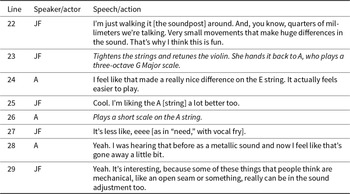
I handed the violin back to Jess and she loosened its strings again, then began to work on adjusting the sound post. She passed thin metal tools through the violin’s sound holes and used them to carefully tap on the spruce cylinder of the sound post, wedged inside the violin. She verbally described what she was doing as she worked (see Table 3).
Sound adjustment segment 3

Table 3 Long description
The table contains the transcript of a conversation between luthier Jess Fox and the author, a violinist, about adjusting the position of the sound post on the author’s violin. Jess Fox makes small changes to the position of the soundpost that significantly affect the instrument's sound. The author notes an improvement in the E string's playability and a reduction in metallic sounds overall. Jess Fox agrees.
In line 22, Jess portrayed adjusting the sound post as experimentation: “walking it around” first to one position and then another inside the violin in between activities of testing. In lines 23 through 27, Jess and I used several of the previously discussed strategies for locating timbre, including grading, sound symbolism, and talk that refers to testing. In lines 28 and 29, we finally seemed to arrive at an agreement about the so-called “metallic” sound quality: In line 28, I told Jess that the sound quality she had just described using the vocable “eeee” was the same quality I had previously described as “metallic,” and in line 29, Jess affirmed my statement by mapping it to a physical alteration she had made to the violin. She told me the timbre was “in the sound adjustment,” meaning that she was able to change it by shifting the position of the sound post and bridge, rather than by altering or fixing another instrumental component, such as a crack or open seam between two pieces of the violin’s wooden body, which is often attended to as part of more extensive lutherie repair work. Here again, talk was interwoven with materiality and performance, and Jess translated, so to speak, between our practices of expertise as violinist and luthier. I conclude my analysis here because I am primarily interested in this article in how we worked together on timbre that I had initially called “metallic.” However, Jess and I continued working together for some 20 more minutes while she altered other instrumental components until we agreed that we were satisfied with all aspects of the violin’s sound.
Conclusion
In this paper, I have drawn on the tools of a philosophically pragmatist linguistic anthropology to study communication about timbre during a sound adjustment session with a luthier in which I was a violinist participant. Given that timbre lacks standards of measure and is notoriously difficult to describe, scholars across anthropology and music studies often implicitly and explicitly focus on lexical semantics of timbre, and especially the synesthetic or cross-modal adjectival metaphors people use to describe the perceptual category in Western music and sound practices. Following Porcello (Reference Porcello2004), I have argued for a different approach here, which I describe as the situated practice or practice-based approach because it calls for listening beyond words to attend to the many additional verbal and nonverbal strategies or practices that people use to communicate successfully about timbre.
The approach I have argued for and demonstrated here opens paths for further research in linguistic anthropology as well as in music studies. Such research could illuminate how timbre communication strategies might unfold differently among different luthier–musician pairs who have different training, taste, or even hearing loss. Further research could also examine how such strategies might differ in relation to other instruments and the voice, in the contexts of different music genres and performance practices, beyond Anglophone contexts, and in sounding and listening practices beyond music. Applications may also include research on music education, including in the development of tools for music educators to teach and communicate with students about timbre.
Finally, the similarities between talk about timbre and talk about color—as demonstrated by anthropologists from Boas (Reference Boas1889) to Goodwin (Reference Goodwin, Resnick, Saljo, Pontecorvo and Burge1997)—suggest that the methods outlined here may be productive for research on perceptual experience in other sensory modalities, including taste, smell, touch, and proprioception. Such methods can contribute to research on food, drink, and consumption, environmental and lab sciences, sports, and the performing and visual arts and crafts. Scaling up, such methods point to valuable directions for linguistic and semiotic anthropology research on the ways in which sensory experience becomes meaningful, or in other words, on the relations between aesthetics and value.
Acknowledgements
For their helpful comments on versions of this article, I thank Andrew Carruthers, Aliyah B.D. Dewar, Steven Feld, Nicholas Harkness, Jay Ke-Schutte, Jairo Moreno, Timothy Rommen, Xiao Schutte Ke, Deborah Thomas, the participants in the January 2026 Northeast Linguistic Anthropology workshop at Boston College, my fellow writing workshop participants in the Departments of Anthropology and Music at the University of Pennsylvania from 2023 to 2025, and the anonymous reviewer for Signs and Society. I am grateful to Emily Dolan for our many conversations about timbre and for inviting me to participate in her Fall 2023 “Timbre” graduate seminar at Brown University, which inspired this writing. I also owe thanks to Steven Black, Candy Goodwin, and Charles Zuckerman for their encouraging feedback on versions of this work delivered as papers at the 2025 meetings of the Society for Linguistic Anthropology and the American Anthropological Association. Finally, I am grateful to the students in my graduate seminar “Music in Contemporary Life” at Boston University’s CFA School of Music in Fall 2025, who engaged enthusiastically with this research and showed me the wide applicability of its methods in music performance and education contexts.
Funding statement
This research was made possible through generous support from the Wenner-Gren Foundation for Anthropological Research (Grant no. 10301), the Penn Center for Experimental Ethnography, the Penn Center for Italian Studies, the Penn Museum, the Penn Sachs Program for Arts Innovation, and a Penn Dissertation Research Award.
Competing interests
The author declares none.



 Open access

