



1. Introduction
DP-internal concord, including noun-adjective agreement (i.e., adjectival concord) in ɸ-features (i.e., number and gender), case, and definiteness, in Arabic, Hebrew and other Semitic languages has attracted the attention of many syntacticians (Fassi Fehri Reference Fassi Fehri1993, Reference Fassi Fehri1999; Siloni Reference Siloni1997; Borer Reference Borer, Johnson and Roberts1999; Kremers Reference Kremers2003; Shlonsky Reference Shlonsky2012; AlQahtani Reference AlQahtani2016; Jarrah et al. Reference Jarrah, Altakhaineh and Al-Rasheedi2020, among many others).Footnote 1 The Standard Arabic (henceforth SA) constructions in (1) are examples of this phenomenon whereby the modifying adjective inflects for the number, gender, case and definiteness of the modified noun.Footnote 2Footnote 3
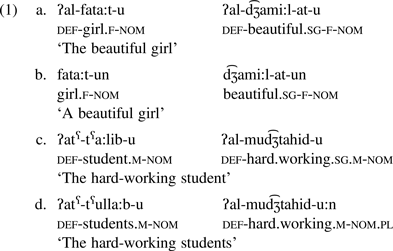
Since interest in agreement relations and their surface manifestations within the nominal domain has arisen, DP-internal concord has posed several problems for theoretical models that have, among other things, attempted to unify it with agreement patterns outside DP under one approach of syntactic dependencies (Danon Reference Danon2008, Reference Danon2011). This research presents evidence that DP-internal concord, with special focus on adjectival concord in SA, requires no specialized mechanisms different from the mechanisms proposed for Agree relations outside DP. This crucially conforms to syntactic accounts that propose that aspects of DP-internal concord follow from the Agree operation (Chomsky Reference Chomsky, Martin, Michaels and Uriagereka2000, Reference Chomsky and Kenstowicz2001) which is typically established between elements outside DPs (e.g., Carstens Reference Carstens2000, Danon Reference Danon2008). This unification of sentential and nominal accounts of agreement phenomena is a step toward a better understanding of Agree dependencies, as research on clausal syntax is no longer impervious to Agree relations within the nominal space (Danon Reference Danon2008, Reference Danon2011).
This article also provides novel evidence that Agree relations inside a DP can be implemented upwards, contra Chomsky's (Reference Chomsky, Martin, Michaels and Uriagereka2000, Reference Chomsky and Kenstowicz2001) proposal which requires a probe to c-command its goal in order to instantiate valuation. Upward probing is nonetheless shown to operate when downward probing is insufficient to value the probe's unvalued feature (uF). This indicates that probing in Arabic is dynamic, as directionality of probing can change from downwards to upwards, depending crucially on whether or not a matching accessible goal is located within the c-command domain of a probe. This line of analysis allows us to construct an argument against Agree proposals that restrict probing to instantiate either upwards (Zeijlstra Reference Zeijlstra2012) or downwards (Chomsky Reference Chomsky, Martin, Michaels and Uriagereka2000, Reference Chomsky and Kenstowicz2001). It also poses a challenge to proposals that view downward probing as dependent on upward probing (Bjorkman and Zeiljstra Reference Bjorkman and Zeijlstra2019). On the other hand, constraining probing dynamics in the way formulated in the current research adds weight to proposals that allow upward probing when downward probing fails to value the probe's uF (e.g., Béjar and Rezac Reference Béjar and Rezac2009, Carstens Reference Carstens2016).
The following discussion is structured as follows. Section 2 introduces the Agree operation (Chomsky Reference Chomsky, Martin, Michaels and Uriagereka2000, Reference Chomsky and Kenstowicz2001) and discusses related debates regarding the directionality of this operation in the grammar. Section 3 provides a description of the key observations that the current work attempts to explain. Sections 4 and 5 demonstrate that the switch from downward probing to upward probing is possible in Arabic grammar. Upward probing, however, is only instantiated when downward probing fails to value the probe's uF. Section 6 presents our conclusions.
2. Theoretical preliminaries
In the Minimalist program (Chomsky Reference Chomsky1995, et seq.), Agree and Move operations are prompted by the presence of unvalued features (henceforth uFs). Chomsky (Reference Chomsky, Martin, Michaels and Uriagereka2000, Reference Chomsky and Kenstowicz2001) proposes that such features are valued through the Agree operation which is established within a local domain that is configurationally specified. Chomsky uses the term ‘probe’ for a feature that initiates a search for what he calls a ‘goal’. The probe carries uF, while the goal bears the matching valued feature. Chomsky also proposes that the goal must be c-commanded by the probe. However, as Svenonius (Reference Svenonius2019) points out, several modifications to Chomsky's (Reference Chomsky, Martin, Michaels and Uriagereka2000, Reference Chomsky and Kenstowicz2001) Agree model of syntactic dependencies have been offered in the related literature. For instance, Zeijlstra (Reference Zeijlstra2012) argues that the goal should c-command the probe. Zeijlstra (Reference Zeijlstra2012) treats all cases of downward probing as instances of movement whereby the probe moves to a position, c-commanding the goal. This treatment by Zeijlstra (Reference Zeijlstra2012) has been modified by Bjorkman and Zeiljstra (Reference Bjorkman and Zeijlstra2019), who propose that downward probing can be prompted; however, this can occur only as a dependent operation on a separate independently established upward probing relation (see, however, Polinsky and Preminger Reference Polinsky and Preminger2019 for a refutation).
On the other hand, there is a different family of analyses which has claimed that upward probing is possible when downward probing does not result in valuing the probe's uF. This essentially indicates that the absence of a match in the c-command domain of an unvalued feature is not fatal to the derivation (see Carstens Reference Carstens2016). Based on the phenomenon of agreement displacement, especially in languages where person-feature hierarchies determine whether verb agreement is to be controlled by the object or the subject, Béjar (Reference Béjar2003); Rezac (Reference Rezac2003, Reference Rezac2004); and Béjar and Rezac (Reference Béjar and Rezac2009) propose the ‘Cyclic Agree’ operation. This operation does not require the Agree operation to exhaust a probe which can enter into several Agree relations. For example, if the object is first or second person, the verb agrees with it (see (2a,b,c)). By contrast, when the object of the verb is third person (which is low on the person hierarchy), and the subject is first or second person, the verb agrees with the subject rather than the object (2d). Examples in (2) are from Basque, a null-subject language (see Béjar and Rezac Reference Béjar and Rezac2009: 37); ‘x’ in the gloss means ‘irrelevant/unclear’.
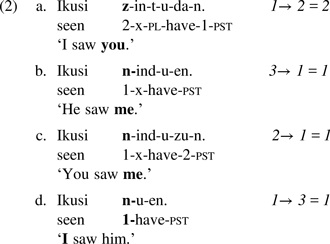
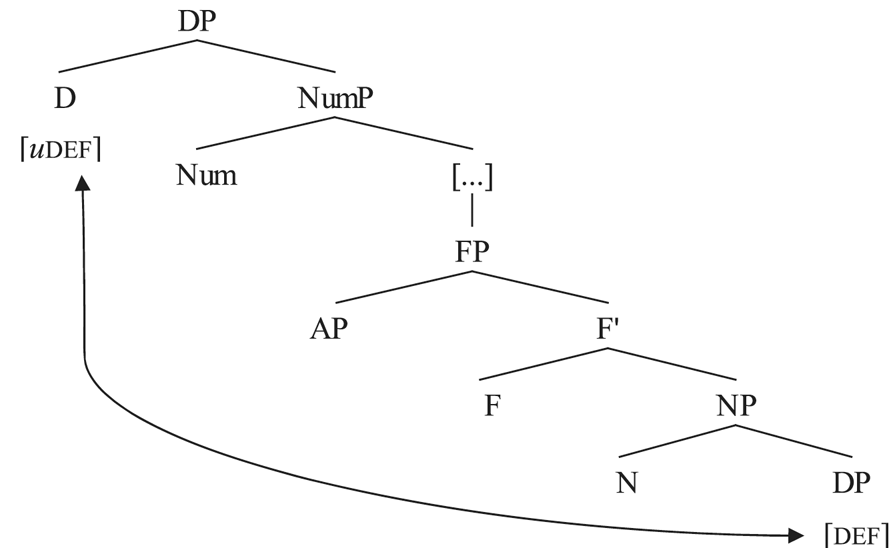
Béjar and Rezac (Reference Béjar and Rezac2009) interpreted the examples in (2) as evidence that when the object fails to control the verb's uF, the verb probes the subject in a second cycle of probing under cyclic expansion, which is schematically shown in Figure 1:
Cyclic expansion (from Béjar and Rezac Reference Béjar and Rezac2009: 94)

The most important point here is that under cyclic expansion, the Agree relation between the probe and its goal can flip, in the sense that the probe can Agree with a c-commanding goal. Carstens (Reference Carstens2016: 36) comments on Béjar and Rezac's (Reference Béjar and Rezac2009) cyclic expansion, mentioning that ‘Basque and other agreement displacement languages thus can be taken as supporting evidence that the positions of would-be probe and goal can be reversed’ (emphasis added). Following the logic of Cyclic Agree, we can propose that v0 in (2d) probes upwards to Agree with the c-commanding (pro-)subject.
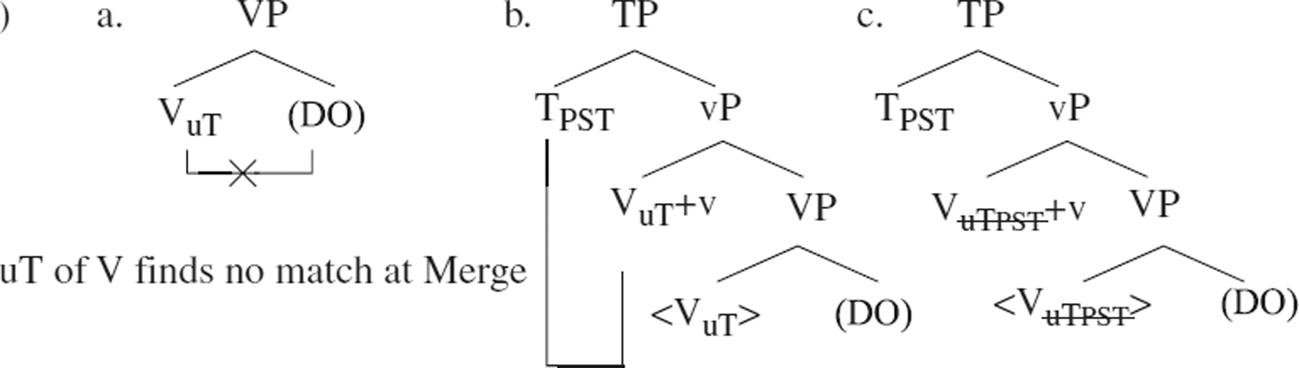
Likewise, Carstens (Reference Carstens2016) offers an account of the Agree operation according to which Agree can be ‘delayed’. Under this account, if a matching feature for uF on X0 is available in the c-command domain of X0 at Merge, valuation of uF takes place, instantiating downward Agree. However, if no matching feature is available for uF on X0 within the c-command domain of X0 at Merge, delayed valuation takes place whereby uF's valuation can be delayed until the merger of extra material above it. Carstens (Reference Carstens2016) argues that when delayed valuation takes place, two directionality-free mechanisms can be used to value X0's uF, as in (3):

For the current article, the mechanism in (3b) is more relevant as it permits the probe to agree with a c-commanding goal. For instance, Carstens (Reference Carstens2016), among other arguments, discusses V0-T0 Agree in English as an example of in-situ delayed valuation. In this regard, she follows earlier work by Pesetsky and Torrego (Reference Pesetsky, Torrego, Karimi, Samiian and Wilkins2007), who consider the tense feature on verbs in English as an instance of an uF which therefore must be valued by the interpretable feature Tense [T] on T0. Carstens proposes that V0 agrees with the c-commanding T0, not because V0 always instantiates upward Agree, but because there exists no valued [T] feature within V0's accessible c-command domain. Accordingly, V0's [uT] obtains delayed valuation for the derivation to converge. Upon the merger of T0, V's uT is valued by c-commanding T0, which is contained in the same transfer domain of V0 (given that V0 always raises to v0 which is moved to the interface levels along with T0; see Chomsky Reference Chomsky, Freidin, Otero and Zubizarreta2008). V0-T0 Agree in English is diagrammed in (4) (Carstens Reference Carstens2016: 37).
(4)

The present article provides novel evidence supporting the view that upward probing can be initiated when downward probing fails to value the probe's uF. Our primary evidence comes from Arabic facts of adjectival concord, which have never been investigated in this respect.
3. Setting the stage
It is a well-known fact that modifying adjectives in Arabic (and Semitic languages in general) agree in number, gender, and definiteness with the noun they modify (see Fassi Fehri Reference Fassi Fehri1999, Shlonsky Reference Shlonsky2004, Ryding Reference Ryding2005). Consider the examples in (5), from Standard Arabic.
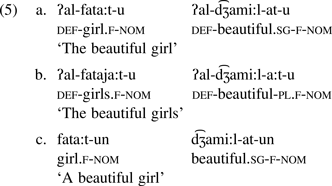
The examples in (5) show that the modifying adjective d͡ʒamiil ‘beautiful’ agrees in number, gender and definiteness with the noun it modifies.Footnote 4
An important question to be resolved is how this adjectival concord is syntactically accounted for. One look at the related literature reveals how hotly debated the answer to this question has been (e.g., Ritter Reference Ritter and Rothstein1991, Siloni Reference Siloni1997, Borer Reference Borer, Johnson and Roberts1999, Fassi Fehri Reference Fassi Fehri1999, Cinque Reference Cinque2005, Bardeas Reference Bardeas2009, Shlonsky Reference Shlonsky2012). While we cannot review all the literature on the syntax of nominal concord, an important proposal regarding the agreement markings on adjectives is that these markings on modifying adjectives are semantically vacuous insofar as they are parasitic on the features of the noun they modify (Siloni Reference Siloni1990, Reference Siloni1997; Borer Reference Borer, Lecarme, Lowenstamm and Shlonsky1996, Reference Borer, Johnson and Roberts1999; Shlonsky Reference Shlonsky2004). In order to account for this fact, we propose that adjectival concord in Arabic is a morphological expression of the Agree operation that is established between the adjective and the noun it modifies. The two enter into an Agree relation whereby the modifying adjective carrying an uF acts as the probe, whereas the noun carrying the matching valued feature acts as the goal. However, for reasons that will become apparent, the actual implementation of this agreement dependency is not straightforward. In fact, a modifying adjective may agree with more than one goal in order to have all of its unvalued content valued. These goals are not necessarily c-commanded by the modifying adjective, nor c-commanding the modifying adjective.
Let us start with the analysis of simple DPs that involve a head noun and one modifying adjective. However, before we turn to the main part of the analysis (i.e., how the Agree relation between the head noun and the modifying adjective is implemented), we need to discuss the locus of the relevant features within the nominal domain, as well as the structural position of modifying adjectives within the nominal domain.
Let us first look at number. Ritter (Reference Ritter and Rothstein1991) argues explicitly that number (singular, dual, and plural) is not an inherent feature of nouns, but is instead a property of Number Phrase (NumP) which is a functional projection that dominates NP (see also Harbour Reference Harbour2011, among others). In minimalist terms, the head of NumP, Num0, can be said to bear the valued [num] feature of the host DP. Following the assumption that the number specification of modifying adjectives in Arabic does not contribute to the interpretation of the accompanying construction, we propose that the modifying adjective within a DP bears an unvalued [num] that is valued by Num0. According to Ritter (Reference Ritter and Rothstein1991) and other researchers (including Valois Reference Valois1991; Cinque Reference Cinque1992, Reference Cinque, Cinque, Koster, Pollock, Rizzi and Zanuttini1995, Reference Cinque2005; Bernstein Reference Bernstein1993; and Shlonsky Reference Shlonsky2004), NumP is projected as an extended projection of the head noun. The DP layer is projected above NumP, as shown in (6).Footnote 5
(6)
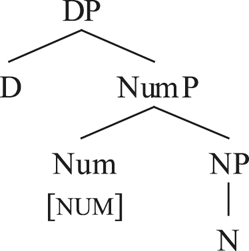
Borer (Reference Borer2005) argues that NumP can be missing from the structure, giving rise to non-quantity interpretation. She proposes that NumP is responsible for the assignment of quantity to a noun or divisions of it such as much salt vs. many books (see also Alexiadou Reference Alexiadou2014).
As for the gender feature of the DP, the situation is quite different. Although few attempts in the related literature specify a unique projection to Gender (e.g., Picallo Reference Picallo1991), the most commonly held view within the Semitic generative practice (and beyond) is that no Gender Phrase is projected within DP. The head N0 bears the gender feature [gend] of the whole DP (see Ritter Reference Ritter and Rothstein1991, Kihm Reference Kihm, Cinque and Kayne2005, Lowenstamm Reference Lowenstamm, Hartmann, Hegedűs and van Riemsdijk2008, Kramer Reference Kramer2015). This amounts to saying that [gend] is specified for each noun as part of its lexical entry, as shown in (7).
(7)
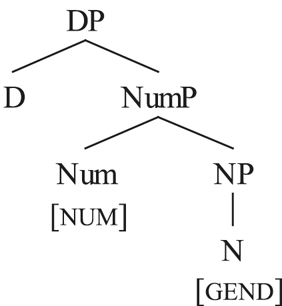
As for the position of Adjective Phrases or APs (headed by the modifying adjectives) within the nominal domain, there is no single agreed-upon view (see Bardeas Reference Bardeas2009). However, one widely held view with respect to the position of nominal modifiers in DPs in Arabic and many other languages, including Germanic and Romance languages, is that they are base-generated in the specifier position of dedicated functional projections (FPs) located between NumP and NP (Crisma Reference Crisma and Zagona1996; Sichel Reference Sichel, Alexiadou, Anagnostopoulou, Barbiers and Gaertner2002; Shlonsky Reference Shlonsky2004; Cinque Reference Cinque2005, Reference Cinque2010). One argument supporting this analysis comes from the fact that adjectives in Arabic observe Mirror Image Ordering, that is, different classes of nominal modifiers appear in the opposite order to the one in which they appear in languages with prenominal adjectives (see Fassi Fehri Reference Fassi Fehri1999, Kremers Reference Kremers2003, Shlonsky Reference Shlonsky2004). For instance, Fassi Fehri (Reference Fassi Fehri1999: 107) mentions the two examples from SA in (5) to show that the ordering of several classes of adjectives in Arabic is the opposite of the order of these adjectives in English.
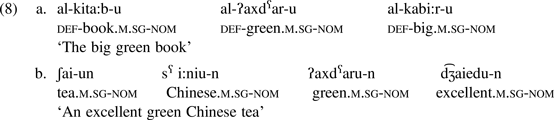
The Arabic adjective denoting size (al-kabi:r ‘big’) follows the adjective denoting colour (al-ʔaxdˤar ‘green’); origin adjectives (sˤ i:niu-n ‘Chinese’) come before colour ones, and colour adjectives come before quality-denoting ones (d͡ʒaiedu-n ‘excellent’). The English translations of the two examples in (8) show that the opposite ordering prevails in English (see Bardeas Reference Bardeas2009: 32).
Shlonsky (Reference Shlonsky2004) argues that the fact that Arabic observes Mirror Image Ordering is evidence against the adjunction analysis of adjectives, given that adjunction does not give rise to Mirror Image Ordering. He also mentions that an adjunction analysis to adjectives within DPs does not account for the fact that the rightmost adjective takes scope over the leftmost adjective. He argues, rather, that the nominal modifiers merge as specifiers of dedicated FPs between NP and NumP (see Cinque Reference Cinque2005, Reference Cinque2010 for a similar analysis). Accordingly, the structure of a DP with a modifying adjective in SA is shown in (9).Footnote 6
(9)
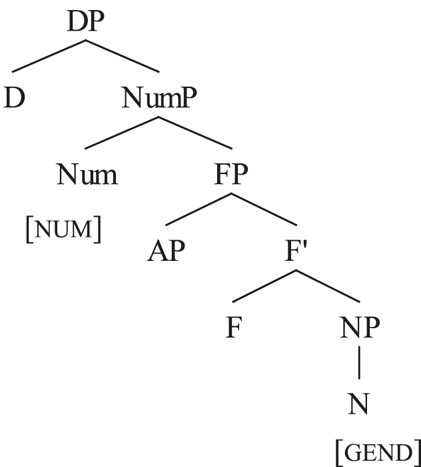
Let us assume for the sake of argument that a modifying adjective (A0) bearing [u gend] and [u num] features probes downwards to value its unvalued features. Assuming the structure in (9), it can be proposed that A0 (the head of AP) finds N0, which acts here as a goal that values A0's [u gend] feature. As for [u num] carried by A0, A0 is forced to wait under the merger of Num0 that bears the matching [i num] feature (recall that NP does not carry a matching [num] feature). This implies that A0 probes upwards in order to value its [u num] feature by Num0. Assuming that the [u gend] and [u num] features on A0 act as separate probes, we propose that the probe in Arabic grammar does not have to c-command its goal (contra Chomsky Reference Chomsky and Kenstowicz2001). In our particular case, A0 (or AP) does not c-command NumP.
The same thing takes place with respect to valuing the [u def] feature on A0. As shown in (10), the definiteness status of the AP should be morphologically equal to that of the head noun (we modify this statement later).
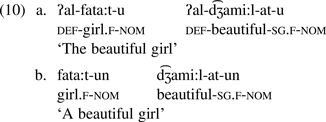
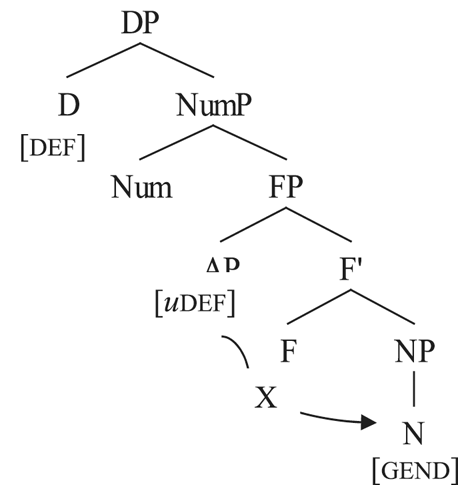
Following Ouhalla (Reference Ouhalla2004), Kramer (Reference Kramer2010) proposes that [def] is carried by D0 in Semitic languages. Assuming this proposal, it can be advanced that A0 enters into an Agree relation with D0, resulting in valuing the [def] feature on A0. Specifically, D0 enters the derivation endowed with an interpretable [-def] or an interpretable [+def] feature. The [-def] feature on D0 gives rise to an indefinite interpretation in which case the DP surfaces without a definite article (or it is attached to a phonetically unpronounced indefinite determiner),Footnote 7 whereas the [+def] feature on D0 is read off in the interface as a definite interpretation; the DP in the latter cases surfaces with the definite article (unless it is inherently definite as the case of proper nouns). Following the assumption that the definiteness article on the modifying adjective d͡ʒami:l ‘beautiful’ does not contribute to the interpretation of the whole DP, it can be advanced that the A0 d͡ʒami:l is endowed with [u def]. The A0 d͡ʒami:l starts searching for a goal carrying a matching [def] feature. Let us propose that A0's probing starts downwards. A0 finds N0 which, however, does not carry a matching [def] feature. Consequently, the A0 d͡ʒami:l shifts its probing domain to a c-commanding material (upon their merger). Upon the merger of D0, the A0 d͡ʒami:l locates D0 and establishes an Agree relation with it. This Agree relation results in the valuation of A's [u def] feature. As a Phonological Form (PF) reflex of this valuation, d͡ʒami:l is prefixed with the definite article when D0 bears [+def] or without a definite article when D0 bears [-def]. This can be schematically shown stepwise in the tree structures in (11).
(11)
a. First Step: A0 probes N0 but no valuation of A's [u def] feature takes place.
b. Second Step: A0 flips its probing domain looking for c-commanding elements with a matching [def] feature.
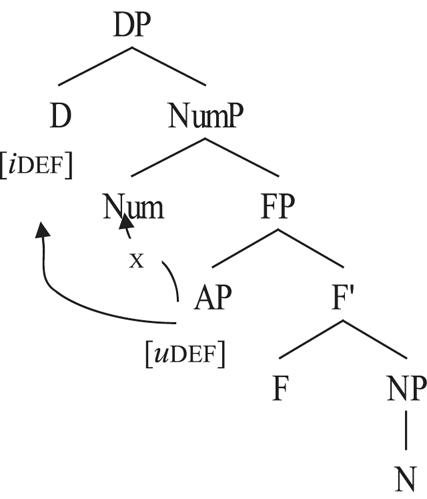
However, although the above discussion shows that probing in Arabic can take place upwards or downwards, A's probing of N0, Num0, and D0 does not in fact determine whether there is a priority for downward probing over upward probing, or vice versa. For instance, it is not clear so far whether A0 probes upwards, first locating Num0, and then shifts downwards, to probe N0 when it does not find a c-commanding goal that can value its [u gend] feature, or vice versa. An anonymous reviewer mentions that Agree in (11) would follow without dynamic search spaces if [u num] only probes up and [u gend] only probes down. However, as we show below, dynamic search space is indeed present in Arabic grammar. Our evidence comes from the fact that modifying adjectives may agree in definiteness with a noun that they do not semantically modify, enforced by the presence of this noun in their c-command domain. We also show that modifying adjectives may agree with a c-commanding element when their search domain does not involve an element with a matching [def] feature. To be precise, a probe may change its search space over the course of the derivation when its feature is not valued by a c-commanded element. Although all instances we provide here show that [u num] probes up and [u gend] probes down, we do not have conclusive evidence that [u num] only probes up and [u gend] only probes down.
In what follows, we attempt to show that downward probing has a priority over upward probing in Arabic. This becomes clear when the valuation of [u def] feature on A0 within construct state nominals (CSNs) is taken into consideration.
4. Probing constraints within construct state nominals
So far, we have claimed that a probe may switch its probing domain (i.e., it probes upward) when there exists no goal that carries a matching valued feature within its c-command domain. Evidence that supports this proposal comes from facts of adjectival concord within the construct state nominal (CSN) in SA. In a CSN, two nouns are juxtaposed to form a genitive relationship, as shown in example (12).

One primary property of CSNs in Arabic is that the head noun (i.e., the noun that appears first) cannot be prefixed with a definite article even if it is understood to be a definite element. In fact, it is the definiteness status of the DP possessor ʔalrad͡ʒuli ‘the man’ (the second part of the CSN in (12)) that specifies the definiteness status of the entire construct. For instance, the entire CSN in (12) is interpreted as a definite element because the DP possessor is definite. If the DP possessor is indefinite, the entire construct is interpreted as an indefinite object, as shown in (13).

All other interpretations, for example, the DP possessor is definite and the possessum (the head noun) is indefinite, are impossible. The two members of a CSN should either both be definite, or both indefinite.
According to Shlonsky (Reference Shlonsky2004), one of the detailed accounts of the derivation of CSN in Semitic languages including Arabic (see also Ritter Reference Ritter and Rothstein1991, Fassi Fehri Reference Fassi Fehri1993, Siloni Reference Siloni1997, Shlonsky Reference Shlonsky1997, Benmamoun Reference Benmamoun2000, and Sichel Reference Sichel, Alexiadou, Anagnostopoulou, Barbiers and Gaertner2002), a CSN like the one in (12) has the following syntactic structure:
(14)
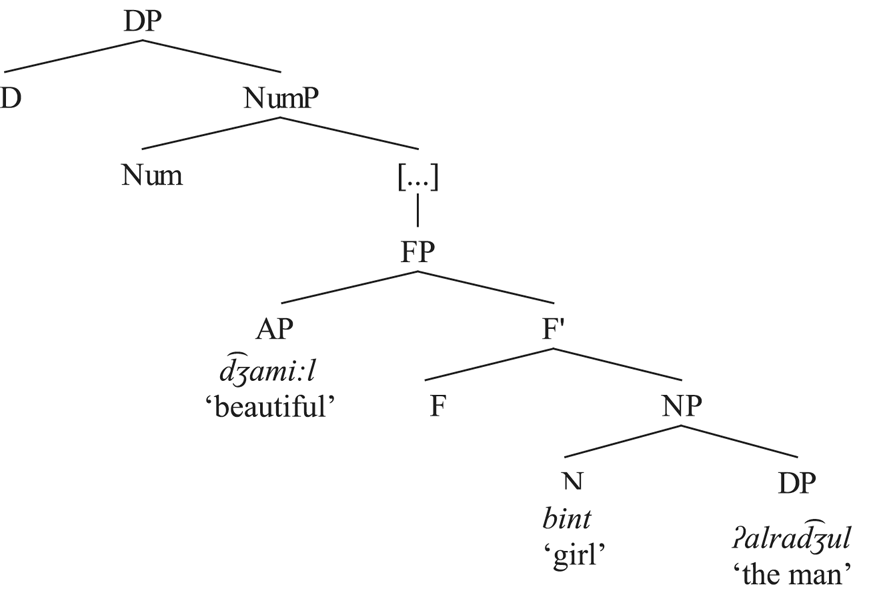
Like cases of simple DPs, nominal modifiers enter the derivation as specifiers of functional phrases (FPs) that project between NP and NumP (see Shlonsky Reference Shlonsky2004).
One important fact shown in (14) is that the DP possessor merges as a complement of N0. Shlonsky (Reference Shlonsky2004: 1503–1505) mentions that in CSNs “a noun or CS-head [the head noun] is left-adjacent to a noun phrase or annex [the DP possessor]”, and that the head noun of CSN is “a genitive Case-assigning head”. The head N0 assigns Genitive Case to the DP possessor, accounting for the fact that the possessor is always assigned genitive Case, as shown in (15).

Shlonsky (Reference Shlonsky2004: 1505) argues that the assignment of the genitive case by N0 to the DP possessor derives the ‘freezing’ effect of construct state nominals; “the fact that the complement of N0 is never moved away from the head N0. The lack of adjectival intervention, that is, the impossibility of positioning an adjective immediately following the head noun, is a direct consequence of this”. For instance, the example in (16) is ungrammatical, since a modifying adjective intervenes between the head noun and the possessor.Footnote 8

Under this view of the derivation of CSNs, there are two possible goals that can value the [u def] of A0 d͡ʒami:l as they bear a [def] feature, namely D0 that heads the whole structure, and the DP possessor ʔalradʒul ‘the man’.Footnote 9 Given the fact that A0 d͡ʒami:l expresses the same definiteness value of the DP possessor on the surface, it can be proposed that A0 d͡ʒami:l enters into an Agree relation with the DP possessor rather than the head D°. However, this line of analysis predicts that the higher D0 can be endowed with an independent [def] feature that is different from that of the DP possessor.
This prediction is not borne out: the definiteness specification of the higher D0 draws on the definiteness content of the DP possessor, an observation that has generated much debate in the literature. One main view in this regard is Borer's (Reference Borer, Booij and Marle1988, Reference Borer, Lecarme, Lowenstamm and Shlonsky1996) proposal that the first member of a CSN is not specified for (in)definiteness, which it acquired through percolation of (in)definiteness feature of the DP possessor after merger that feeds LF. Given that percolation is reinterpreted as an instance of an Agree relation, in the latest minimalist literature, it can be proposed that the tight relationship between the definiteness specification of the higher D0 and the definiteness content of the DP possessor arises because the higher D0 itself enters the derivation with an interpretable but unvalued [def] feature. Pesetsky and Torrego (Reference Pesetsky, Torrego, Karimi, Samiian and Wilkins2007), and several other colleagues, offer evidence in favour of the separation of valuation and interpretability. Under their account, an interpretable feature can be unvalued at first Merge (and a valued feature can be uninterpretable). Based on the fact that the higher D0 is a functional projection that should have some interpretable content (see Chomsky Reference Chomsky1995 for the assumption that functional phrases without interpretable content should be barred from the grammar), we propose that the higher D0 has an interpretable, yet unvalued feature of [def]. Accordingly, D0 must act as a probe, looking for valuing its interpretable content by a matching feature on another head.
On the one hand, if we allow D0 to probe downward, it will find the DP possessor in the complement position of NP, as shown in (17):
(17)
The DP possessor enters into an Agree relation with D0, resulting in the valuation of the interpretable [u def] feature on the latter by the D0 head of the DP possessor. This relation between D0 and the DP possessor accounts for the association of the definiteness specification of the entire DP with that of the DP possessor.
On the other hand, if we allow the higher D0 to probe upwards as in (19), unintended readings arise, as D0 will agree with other elements within the verbal extended projection. For example, under this second option, nothing would prevent D0 from agreeing with the indefinite subject, as in (18), resulting in a wrong interpretation:

(19)

Since the subject and the DP object are included in the same phase (v*P), D0 would agree with the indefinite subject, contrary to fact. Following this line of analysis, we have evidence that uD (unvalued definiteness) in Arabic probes downward, which allows us to predict the right specification of the definiteness value of the higher D0 within a CSN.
As to why the definite article does not surface when D0's uD is valued as definite in CSNs, we refer the reader to Benmamoun and Lorimor's (Reference Benmamoun and Lorimor2006: 1) account according to which the definite article does not surface on the first member of a CSN as an expression of uD's valuation due to “the alternative forms of spelling out features at the PF interface”. Following Benmamoun (Reference Benmamoun2000), Benmamoun and Lorimor (Reference Benmamoun and Lorimor2006: 19) argue that the merger of the members of the CS “allows the last member to spell out the definiteness feature of the first member”, and also mention that the definiteness marker appears on the adjective due to the fact that the latter “has its own definiteness marker because it is not part of the CS complex; it can only have its definiteness feature spelled out by affixation, so the definiteness marker always occurs with adjectives that agree with the CS”.
At this stage, the discussion pertaining to valuation of the modifying adjective's [def] feature is worth clarifying. Two options can be pursued. Firstly, the adjective probes upwards. In such cases, the adjective should wait until the unvalued feature of [def] on D0 is valued. Although this analysis would be conceptually true, since the adjective agrees with what it modifies semantically, it is syntactically less desirable, as it presupposes that uD probes differently when it appears on adjectives. As we have just shown, uD on D0 should start probing downwards, otherwise an ill-formed interpretation is generated. Given the pattern of probing of uD on D0 (see (19)), we assume that uD first initiates downward probing. This implies that A0 d͡ʒami:l in (13) agrees with the DP possessor rather than the higher D0.
In order to account for why A0 agrees with the DP possessor in CSNs but with the higher D0 in simple nouns phrase, we propose that the probing dynamic is constrained in Arabic grammar. Probes in Arabic are not free to search in both directions. uD is first allowed to probe downwards. If the downward space does not have a match, uD can flip its probing upwards, upon the merger of the c-commanding material. We propose the following constraint, which regulates the implementation of probing directionality.Footnote 10
(20) The Probing Dynamics Constraint (PDC):
Upward probing only obtains when downward probing is not sufficient to value the probe's uF.
In CSNs, the modifying adjective agrees in definiteness with the DP possessor which carries a [def] feature and falls within its c-command domain; this is schematically shown in (21).
(21)
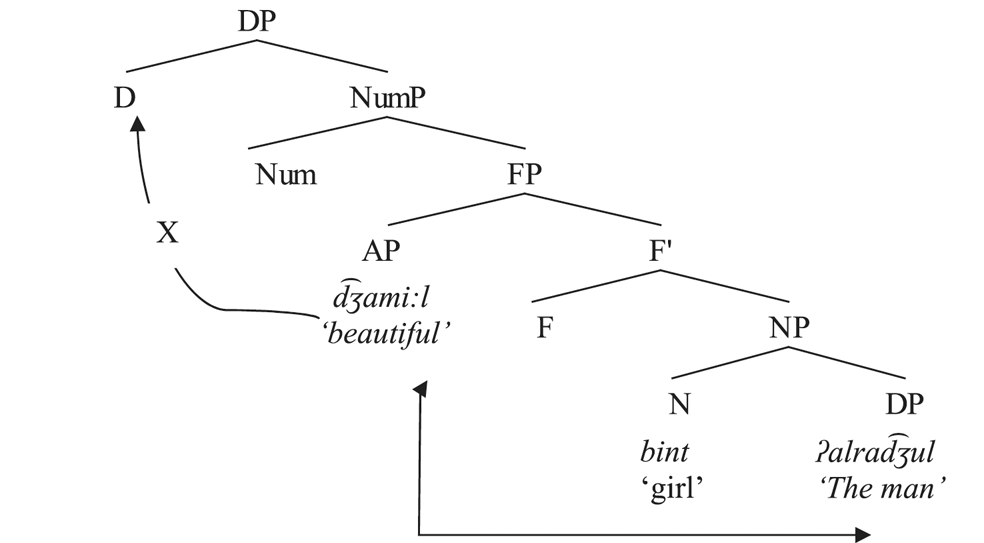
The position of the DP possessor within the c-command domain of AP prevents the latter from agreeing with the head D0 that bears a [def] feature, because of the probing dynamics constraint (PDC). This results in the modifying adjective expressing the definiteness value of the DP possessor even if it does not modify it semantically.
Some may wonder why downward probing is biased over upward probing to operate first in the grammar.Footnote 11 Following proposals by Rezac (Reference Rezac2003) and Béjar and Rezac (Reference Béjar and Rezac2009), it can be assumed that downward bias results from the interaction of Agree and cyclicity of structure building. Once a probe bearing unvalued content is merged into the structure, such content should be valued as soon as possible as a direct effect of the Earliness Principle, which requires a feature to probe as early as possible (see Pesetsky and Torrego Reference Pesetsky, Torrego and Kenstowicz2001). This results in a preference for a first-merged goal which is c-commanded by the probe (and closer to the relevant probe) over other goals that are neither c-commanded by the probe nor closer to it.
One complication arises here: why does the DP possessor not value A0's remaining unvalued features? The DP possessor (carrying a matching [num] feature) does not value the [u num] feature on the modifying adjective, despite that fact that A0's [num] is still unvalued when A0 enters into an Agree relation with the DP possessor (in definiteness). As we have shown above, a modifying adjective within a CSN agrees in number and gender with the noun that it semantically describes rather than with the DP possessor, as shown in (22).

If the modifying adjective agrees with the possessor in number, as in (23), the construction is ungrammatical under the interpretation that the (plural) adjective ‘interesting') describes the story (singular), rather than the boys (plural).

Although the DP possessor falls within the c-command domain of the modifying adjective, the latter agrees in number and gender with the c-commanding NumP and the c-commanded N0, respectively. As for gender, there is no problem, as A0 agrees with N0 which bears a valued [gend] feature, and N0 is the closest c-commanded goal to A0. Regarding number, we propose that A0 does not agree with the DP possessor because this DP is assigned genitive case by N0 in such cases. As we mentioned above, the case of the DP possessor is invariant whereas the case of the whole construction is structural (see, for example, Shlonsky Reference Shlonsky2012). It is widely known that the complements of genitive case-marked elements do not enter into an Agree relation with outside elements; nor can they move (see Shlonsky Reference Shlonsky2004). In other words, the inner structure of elements assigned genitive case is an opaque domain for external probes.Footnote 12 This state of affairs forces A0 to look upwards for other accessible goals, locating Num0 that carries the matching [num] feature.
In the following section, we provide supporting evidence for the fact that AP may agree in one feature with a noun that it does semantically modify. This observation supports our proposal that A0's agreement is subject to Agree operation that takes place in the narrow syntax.
5. Supporting evidence
Our proposal that the [def] feature on a modifying adjective can be valued by an element that is not semantically described by the modifying adjective is supported by the value of agreement inflections appearing on the modifying adjective within a type of constructions discussed in Kremers (Reference Kremers2003). As an illustration, consider the following examples of this construction (from Kremers Reference Kremers2003: 99–100), which we speak of, for ease of reference, as the DP-A-DP construction.Footnote 13
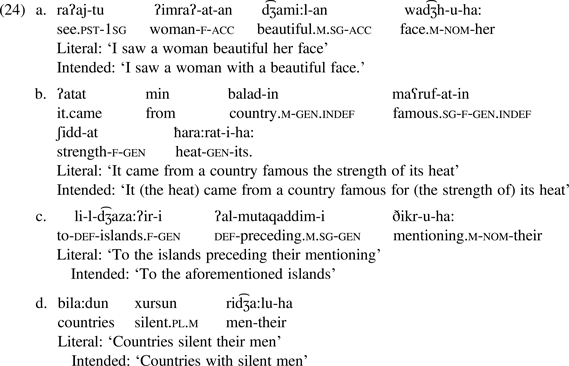
On the one hand, the modifying adjective d͡ʒami:lan ‘beautiful‘ in (24a) agrees in definiteness (and case) with the preceding indefinite DP ʔimraʔatan ‘a woman’ even though it does not semantically describe it. On the other hand, it agrees in number and gender with the following DP wad͡ʒhuhaa ‘her face’ ([sg.m]) that it does describe.Footnote 14 This mixed agreement pattern expressed by the modifying adjective in a DP-A-DP construction is also shown in (24c). The participial adjective mutaqaddimi ‘preceding’ bears the same definiteness specification as the preceding DP ld͡ʒaza:ʔir ‘the islands’ (i.e., both are definite). Nonetheless, the adjective takes its number and gender inflection from the following deverbal DP ðikruhaa ‘its mentioning’ which is [sg.m].
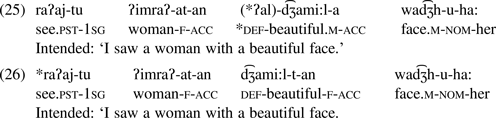
When the modifying adjective agrees in definiteness with the following DP, the resulting construction is ungrammatical, as in (25). Likewise, when the modifying adjective agrees in gender and/or number with the preceding DP, the resulting construction is ungrammatical, as in (26). Accordingly, a modifying adjective in a DP-A-DP construction shows split agreement patterns with two different entities (one of which it does not semantically describe). This essentially supports our proposal that a modifying adjective may agree in one feature with an element that it does not semantically describe.
Kremers (Reference Kremers2003) presents an analysis of a DP-A-DP construction. In the following paragraphs, we present his syntactic account of a DP-A-DP construction, which is shown to fit with our proposal that upward probing only takes place when downward probing is insufficient to value the probe's uF. Indeed, Kremers (Reference Kremers2003) considers the A-DP part of the DP-A-DP construction as two components of one Adjective Phrase. In other words, the expression d͡ʒami:lan wad͡ʒhuha: (lit. beautiful her face) in (24a) is an Adjective Phrase adjoined to the DP that includes the noun ʔimraʔatan ‘a woman’. Following proposals by Abney (Reference Abney1987) and Zwarts (Reference Zwarts1992), Kremers (Reference Kremers2003) treats this Adjective Phrase as a Degree Phrase dominated by an outer D0 layer. His proposal states that the modifying adjective d͡ʒami:l ‘beautiful’ is base-generated as a complement of Poss0 that projects PossP whose specifier is filled with the Deg-internal subject wad͡ʒhuha: ‘her face’.Footnote 15 The modifying adjective d͡ʒami:l then moves to the head of a postulated projection labeled Infl Phrase in order to pick up the agreement features, namely uNumber and uGender, which Infl0 bears. The DP wad͡ʒhuha: ‘her face’, in turn, moves to Spec,Infl Phrase so that it can agree with the modifying adjective, as shown in (27).
(27)
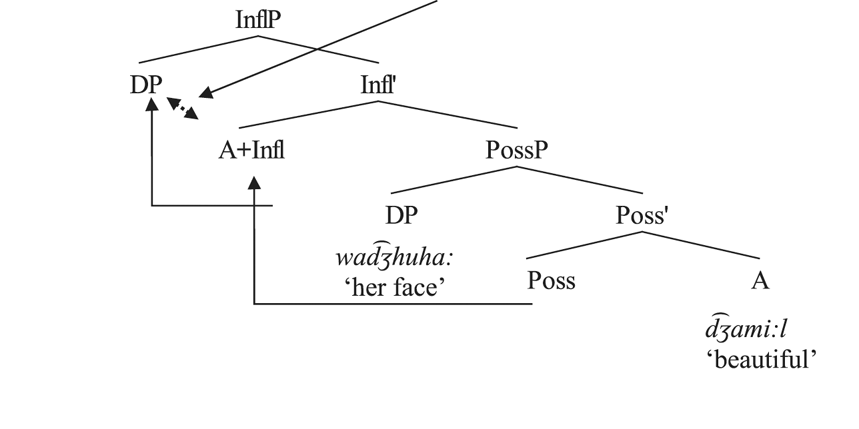
Afterwards, the modifying adjective d͡ʒami:l moves to Deg0 in order to receive its morphological form. The movement of the modifying adjective d͡ʒamiil to Deg0 while the DP-internal subject remains in the Spec position of Infl Phrase results in the modifying adjective appearing before the DegP-internal subject in the linear string (d͡ʒami:l > wad͡ʒhuha:).
Kremers (Reference Kremers2003) proposes that DegP is dominated by a DP layer whose head D0 bears an unvalued [def] feature, as shown in (29). Kremers argues that this D0 cannot agree with the DP-internal subject because DegP is a phase (see Chomsky Reference Chomsky, Martin, Michaels and Uriagereka2000). Because of the Phase Impenetrability Condition in (28), the D0 that dominates DegP is unable to agree with elements which are located within the complement domain of Deg0.
(28) Phase Impenetrability Condition:
In phase α with head H, the domain of H is not accessible to operations outside α; only H and its edge are accessible to such operations.
(29)

Therefore, D0 should wait until DP merges as a modifier with the container DP that includes ʔimraʔatan ‘a woman’. In such cases, D0's [u def] is valued by the higher D0 which bears [def] feature, as shown in (30).
(30)
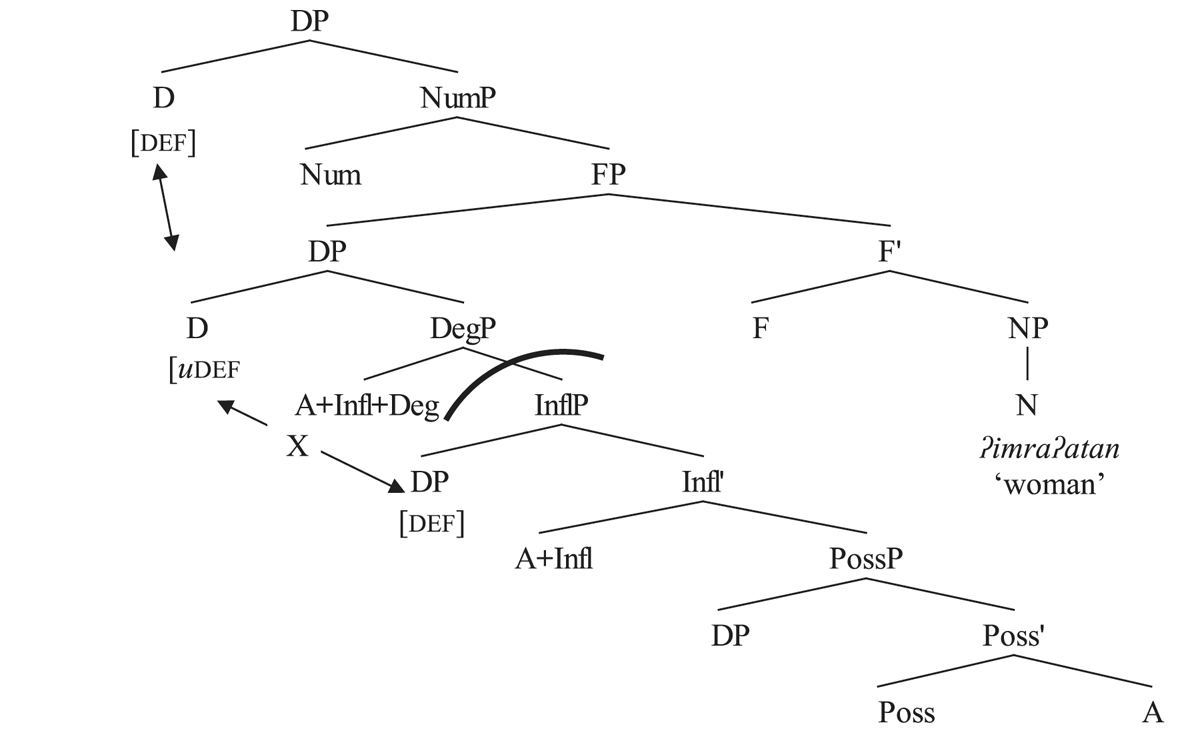
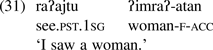
The assumption that DP d͡ʒami:lan wad͡ʒhuha: (lit. ‘beautiful her face’) enters the derivation of the container DP as a modifier is supported by the fact that it can be safely dropped from the construction, as evidenced in (31).
Additionally, DegP d͡ʒamiilan wad͡ʒhuha: can occur with other adjectives that modify the same DP (see 32a–b).
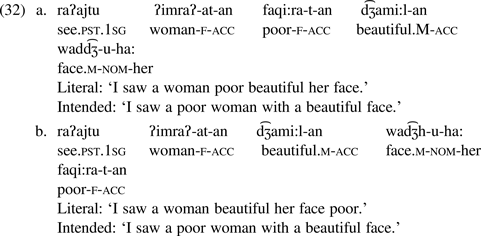
The examples in (32) show that the A-DP string of the DP-A-DP construction acts syntactically as a modifier that is widely assumed to be part of the host DP (Ritter Reference Ritter and Rothstein1991, Siloni Reference Siloni1997).
In so doing, we challenge Bjorkman and Zeijlstra's (Reference Bjorkman and Zeijlstra2019) proposal for a hybrid directionality approach, whereby downward ϕ-agreement is parasitic on pre-existing upward Agree relations between probes and goals. Specifically, they claim that upward ϕ-agreement is independent of such specific requirements of the goal, that is, downward agreement is in all cases an instance of “(possibly incomplete) upwards valuation that is dependent on a separate independently-established UA [upward agree] relation” (p. 528). By contrast, the current article provides evidence that upward Agree is initiated either to complete incomplete downward Agree relations or to establish an Agree relation that a probe could not build with an element that it c-commands (because no element within its c-command search domain bears a feature matching its unvalued feature).
In view of this, the agreement between nominals and adjectival modifiers inside a DP that contains the two is achieved through a particular syntactic configuration that applies before spell-out. In other words, what appears as a nominal concord between a noun and a modifying adjective in SA is an outcome of the Agree relation between the two, established in the narrow syntax. This analysis, particularly with respect to instances of nominal concord inside simple DPs, is at variance with Norris’ (Reference Norris2014) recent account of nominal concord in Estonian. According to Norris, nominal concord that applies within the same extended projection is a morphological operation that takes place in the morphological components of sentence derivation (i.e., after spell-out); hence no specific syntactic configuration is needed for nominal concord to operate in the grammar. A thorough evaluation of Norris's proposal using data from Arabic will be an interesting topic to pursue; we leave it for further research. However, as a preliminary note, we point to some initial evidence challenging Norris’ (Reference Norris2014) analysis, which states that all manifestations of nominal concord within the same extended projections should be viewed as purely morphological: the fact that some patterns of nominal concord in Estonian can be found in agreement patterns in the Arabic sentential domain. Such agreement patterns are widely assumed to follow from the Agree operation. For instance, Norris observes that one difference between nominal concord (as a morphological operation) and subject–-verb agreement (which is a syntactic operation) is that nominal concord appears on specifiers, heads and adjuncts, whereas agreement in subject–verb agreement patterns only appears on heads. Norris (Reference Norris2014: 100) mentions that unlike subject–verb agreement “concord may be seen on heads (e.g., determiners, strong quantifiers), specifiers (e.g., numerals, demonstratives, possessors), and adjuncts (adjectives)”. However, this is not always true in Arabic, where some adverbs are found to agree with the subject of the sentence. A case in point is the adverb waħdah ‘alone’ in SA as the examples in (33) show:
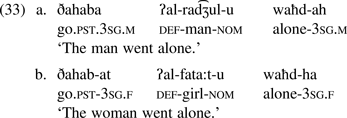
The agreement between the subject and the adverb in (33) can be interpreted as an argument that agreement outside DP is not restricted to heads but can also target adjuncts, as is the case inside DP. Under the Agree-based approach, the adverb waħdah is supposed to carry a set of uɸ-features which are valued by the subject.
Another difference between nominal concord (as a morphological operation) and agreement (as a syntactic operation) is that the latter is dependent on the type of case that the goal bears, whereas nominal concord takes place irrespective of the case value of the elements that show agreement. For example, in Estonian, only nominative arguments can control verb agreement (Norris Reference Norris2014: 101), as shown in (34).
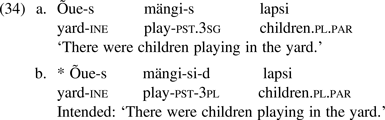
On the one hand, in (34b), the partitive plural lapsi (‘children’) does not give rise to a plural verb; on the other hand, concord is not connected to the assignment of a particular case. Yet, this difference between nominal concord and agreement in Estonian should not be taken as a cross-linguistic argument that concord and agreement patterns outside DPs must be made in two different levels of grammar.Footnote 16 Indeed, complementizer agreement in Jordanian Arabic (which shares similar nominal concord facts with SA) shows that C0 ʔinn can agree with the subject that is assigned (abstract) nominative case or with the object that is assigned (abstract) accusative case, depending on closer c-command. This can be seen in the examples in (35), from Jarrah (Reference Jarrah2020).
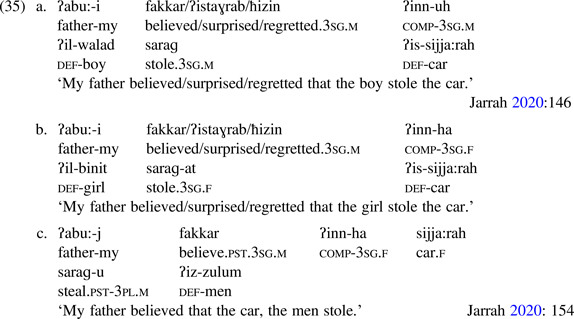
In (35a), ʔinn agrees with the subject ʔilwalad ‘the boy’, as evidenced by the fact that the inflectional suffix that ʔinn bears (i.e., -uh [3sg.m]) is the same Φ-content as the subject. The subject is argued to be assigned Nominative case by T0 while the former is located in Spec,vP. Given the Strong EPP feature on T0, the subject moves to Spec,TP where it enters into an Agree relation with ʔinn (see Jarrah Reference Jarrah2017a,Reference Jarrahb). Sentence (35b) displays the same fact with a feminine subject. On the other hand, in (35c), ʔinn agrees with the fronted object sijjaarah ‘a car’ which is interpreted as a contrastive focus. ʔinn carries an inflectional suffix that covaries in Φ-content with the fronted object (i.e., -ha [3sg.f]) rather than with the subject. The agreement between ʔinn and the closer subject takes place even if the subject appear preverbally, as shown in (36):
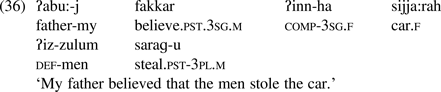
Note the fronted object in (35c) and (36) is widely argued to be base-generated as a complement of V0 (which is an accusative case-assigner in Arabic grammar; Fassi Fehri Reference Fassi Fehri1993, among others). The focused object moves to Spec,Focus Phrase in the left periphery. In such cases, the movement of the object to the left periphery is supported by the fact that the focused object is paired with a gap in its base-position (see Ouhalla Reference Ouhalla, Eid and Ratcliffe1997). Therefore, it can be proposed that C0's agreement in Jordanian grammar takes place regardless of the case value of the elements that agree with it.
Our findings point in a direction that refutes Baker's (Reference Baker2008) own assessment that Arabic sets the second value of his Direction of Agreement Parameter which is proposed to capture how different languages specify their Agree domains (F = Functional head).
(37) The Direction of Agreement Parameter (Baker Reference Baker2008: 215)
(i) F agrees with DP/NP only if DP/NP asymmetrically c-commands F, or
(ii) F agrees with DP/NP only if F c-commands DP/NP, or
(iii) F agrees with DP/NP only if F c-commands DP/NP or vice versa.
The current article shows that probes in Arabic may or may not asymmetrically c-command their goals.
6. Conclusion
The current article has tackled adjectival concord in Standard Arabic. Based on facts from adjectival concord in simple DP and construct state nominals (CSNs), we have shown that upward Agree takes place only when downward Agree is insufficient to value the probe's uF. To account for this state of affairs, we propose a probing dynamics constraint (PDC) stating that upward probing only obtains when downward probing is not sufficient to value the probe's uF. On the one hand, our PDC is in line with proposals that allow upward probing to take place when downward probing fails to value all of the unvalued features of a probe (e.g., Béjar and Rezac's Reference Béjar and Rezac2009 cyclic Agree and Carstens's Reference Carstens2016 delayed valuation). On the other hand, our evidence challenges proposals that do not allow downward probing altogether (Zeijlstra Reference Zeijlstra2012) or view it as parasitic on upward probing (Bjorkman and Zeiljstra Reference Bjorkman and Zeijlstra2019). Additionally, this article provides an empirical argument that DP-internal concord in Arabic applies before the spell-out point.



