

Introduction
In recent years, international organisations have increasingly sought to pluralise the sources, actors, and tenets of expert knowledge in global governance and have often presented this move as a departure from technocracy.Footnote 1 In this paper, we examine a case that is illustrative of this shift: the reconfiguration of disability governance from a domain primarily governed by medical and scientific expertise to one articulated through human rights frameworks. This reorientation is most clearly institutionalised in the Convention on the Rights of Persons with Disabilities (CRPD) and, in particular, in the work of its monitoring body, the Committee on the Rights of Persons with Disabilities (CRPD Committee). Adopted by the United Nations (UN) in December 2006 and ratified by over 190 State Parties, the CRPD has been widely celebrated in scholarly, UN, and civil society narratives as a radical and emancipatory move, frequently described as marking a ‘new era’, a ‘paradigm shift away’ from earlier approaches, or a transition ‘out of darkness into light’, for recognising persons with disabilities as rights holders rather than as medical patients.Footnote 2
In this sense, the CRPD articulated what this Special Issue calls a more explicitly ‘benevolent’ and ‘inclusive’ expert repertoire.Footnote 3 The Committee not only claimed to speak on behalf of those positioned as vulnerable or marginalised,Footnote 4 but also recognised persons with disabilities as experts in their own right.Footnote 5 One key feature was the expansion and diversification of the eighteen independent members of the expert committee responsible for interpreting and monitoring compliance with the CRPD beyond what was then typical for other UN committees at the time. States were required to give due consideration to gender balance, geographic diversity, and the representation of persons with disabilities in the nomination and election of experts. Other human rights treaty bodies have made similar moves to diversify who can make expert contributions. The CEDAW Committee, for example, has recently emphasised the inclusion of indigenous women and girls as ‘agents of change’ and knowledge holdersFootnote 6, pointing to a broader shift towards participatory expertise and the incorporation of lived experience as a legitimate source of expert knowledge in global human rights governance.Footnote 7
As a committee featuring activists and persons with disabilities, the CRPD subverted key elements of the earlier medical model, which framed persons with disabilities in technocratic terms, as objects to be diagnosed, treated, and cured by medical doctors and scientific expertise. It also brought meaningful transformations by recognising lived experience and experiential knowledge as sources of expertise in their own right. This paper, however, takes a different angle by focusing on the underlying elements that endure despite processes of pluralisation and moments portrayed as radical transformation in global sites of expertise.Footnote 8 To do so, we draw attention to what we refer to as epistemic inertia: underlying rationalities and normative views that persist even where formal ruptures are celebrated as emancipatory and where rhetoric, institutional sites, or authorised actors of expertise have changed. Our aim is not to assess the CRPD Committee against the standards of disability advocacy or evaluate its monitoring functions, nor to suggest that change has not been meaningful. Rather, it is to examine how moments of pluralisation can coexist with, and sometimes reproduce, historically dominant ways of knowing that do not fundamentally alter dominant normative views and their associated socio-economic structures.
We centre our analysis on work and employment, a domain in which epistemic inertia is particularly visible. This area has long been central to how both medical and human rights models define the value and social worth of persons with disabilities and remains a key organising focus across both models.Footnote 9 Our main argument is that while the CRPD brought about a reconfiguration of the actors, tenets, and claims of expertise – from doctors to human rights experts, from hospitals to treaties, and from patients to duty bearers – it nonetheless rearticulated a (neo)liberal grammar of productivity, autonomy, and self-reliance already present in the medical paradigm.
In reviewing some of its most recent work, we find that the CRPD Committee continues to reproduce at least three interrelated normative views present in previous international frameworks on disability: first, an understanding of dignity largely tied to ideals of productivity and autonomy; second, a view according to which individuals must ‘adapt’ to existing societal arrangements through merit, instead of those arrangements being transformed; and third, a moralisation of market participation as a privileged horizon to which individuals ought to aspire. As a result, similar to the medical model of disability, although to a lesser degree, the CRPD Committee does not systematically engage with notions of work and employment that go beyond classic neoliberal assumptions, such as those that value (inter)dependence and care, or any other relational logic that challenges market-compatible rationalities and the neoliberal subject as the ‘normal’ human being.
We begin this article by situating our analysis within scholarship on the pluralisation of expertise in human rights institutions, before introducing the heuristic of epistemic inertia to capture how normative assumptions and understandings tied to prevailing socio-economic structures persist across moments of rupture. To provide context for our case study of the CRPD Committee, we outline the main tenets of the medical model of disability and how this model conceives of disability. Furthermore, we examine the pluralising knowledge claims advanced by the human rights paradigm and disability governance movements that underpinned the CRPD. We explain our methodological approach and identify thematic continuities in the most recent CRPD General Comment (No. 8 on work and employment) by comparing it with references to work and employment in earlier major UN disability documents. We find that, in discussing labour, the CRPD Committee reproduces core neoliberal assumptions historically associated with the medical model of disability. Specifically, CRPD General Comment No. 8 continues to valorise autonomy, productivity, and self-reliance while omitting alternative modes of being such as those rooted in care and interdependence. We conclude by reflecting on the broader implications of these findings for understanding the politics of the pluralisation of expertise.
Expertise and the politics of human rights expert bodies
In recent years, scholars in International Relations (IR) and adjacent disciplines have pointed to the politics of knowledge diversification within human rights institutions. This diversification has progressively taken shape through changes in professional backgrounds and trajectories, the recognition of previously marginalised voices, and the consolidation of new forms of expertise.Footnote 10 In this context, Merry and Levitt draw attention to the ‘vernacularisation’ of human rights, showing how technical and universalistic conceptions are translated into local understandings of social justice.Footnote 11 In a similar vein, Hoffmann discusses the emergence of the ‘plural’ human rights professional, a figure whose authority rests not on a single source of expertise but on the ability to mobilise diverse resources and skills across fields.Footnote 12
IR and socio-legal scholarship have examined how such dynamics play out within human rights expert bodies themselves. Studies of treaty body elections highlight that there is no single agreement on what counts as expertise and that these processes are increasingly politicised.Footnote 13 This makes the inclusion of new voices a complex and often contentious process.Footnote 14 A common finding is that diversity in composition does not automatically translate into far-reaching institutional transformation. Reiners and Kahn-Nisser show that even where treaty bodies include members from traditionally marginalised groups, such as women, individuals from the so-called Global South, or those with lived experience, enduring power relations shape whose voices carry influence and what forms of knowledge are taken up.Footnote 15 In a similar vein, feminist legal scholarship has identified tensions in committees’ efforts at gender inclusion and mainstreaming.Footnote 16 Such diversification has been filtered through existing hierarchies and institutional norms that constrain decision-making.Footnote 17
Research on group dynamics and relational agency has further explored how internal interactions give rise to mechanisms that shape the collective agency of expert bodies, thereby limiting the room for manoeuvre available to individual members.Footnote 18 Even in the case of the CRPD Committee, which features the highest number of individual members with an activist background,Footnote 19 institutional dynamics continue to shape and limit the scope of change.Footnote 20 Focusing on the CRPD Committee, Heupel and Joger show how shared narratives about the value of the committee’s mandate, the integrity of its members, the fairness of its procedures, and its association with other legitimate institutions foster common identification among members and enable coordinated decision-making as a group.Footnote 21 After all, like other institutionalised global bodies, human rights treaty bodies operate within frameworks shaped by legal-bureaucratic rationalities, donor expectations, and dominant professional norms.Footnote 22
We draw on these insights but reorient the analysis towards the epistemic level and the substantive content of expertise itself. Rather than focusing on the mechanisms and procedures through which the agency of expert bodies is shaped (the ‘how’), and the extent to which it affects a given outcome, we examine what assumptions, normative frameworks, and political imaginaries persist despite observable changes in human rights expert bodies’ institutional design, procedures, or actor composition.
Epistemic inertia: Continuity, rupture, and the limits of expertise pluralisation
We use the term epistemic inertia as a heuristic for capturing deep-seated continuities in normative views and rationalities that persist even amidst pluralisation manifested through observable shifts in the sites, actors, and rhetoric of expertise. Epistemic inertia orients analysis towards forms of continuity that become visible when claims of novelty, transformation, or rupture are made. As a heuristic, the concept functions as an analytical tool that helps organise observations and guide inquiry without claiming to fully explain the phenomenon itself. We argue that recognising such continuities requires cultivating a particular analytical sensibility that entails, first, stepping back from narratives of change in order to historicise plural expert claims, and second, interrogating the normative content of expert knowledge, that is, the ‘ought to’ of expert claims. This analytical sensibility matters because debates about inclusion and diversification tend to focus on who participates and what appears new, rather than on the kinds of political projects, normative assumptions, or imaginaries of social order that are being reproduced or stabilised in the process. As a result, important continuities at the level of normativity, content, and political imagination can remain obscured, especially when change is only framed and celebrated as emancipatory.
We build on the broader IR literature on expertise and insights from Science and Technology Studies (STS) to articulate the heuristic of epistemic inertia. This body of work has already developed an important vocabulary for capturing how expertise, as a regime of knowledge, stabilises certain understandings. Studies of the politics of expertise have highlighted the durable basis of knowledge through notions such as circularityFootnote 23, methods regimesFootnote 24, or epistemic infrastructures.Footnote 25 Similarly, work in STS has long observed that changes in expert paradigms rarely involve a straightforward break with the past or a replacement of one expert paradigm by another.Footnote 26 They have warned against the ‘tyranny of novelty’, or an overstatement of change that can obscure persistent forms of exclusion and the reproduction of dominant socio-economic orders.Footnote 27 These insights point to the need to remain attentive to the discursive practices, evaluative frameworks, and tacit normative categories that persist and remain entrenched as central benchmarks of what ought to be done. In line with these understandings, we contend that epistemic inertia is most easily captured at the discursive and epistemic level, where it crystallises in authoritative outputs after processes of negotiation, rather than at the level of biographies of individual experts or the institutional design of expert bodies.
We begin with an effort to historicise expert claims. This means situating any expert claim as an authoritative statement made possible in a given political and socio-economic context. In the case of human rights expertise this entails, for instance, situating human rights as a project that took shape in the broader political and intellectual milieu of liberalism. As existing accounts have shown, however, human rights discourse later unfolded alongside the rise of neoliberal political-economic ideas. While scholars caution against reducing this relationship to one of simple complicity, they nonetheless underline the ways in which rights-based projects have often remained compatible with neoliberal political-economic arrangements.Footnote 28 Moyn, for instance, argues that the human rights revolution consolidated minimal floors of protection while leaving deeper questions of inequality unaddressed.Footnote 29 Critical disability scholarship similarly shows that, while human rights discourse has provided important tools for empowerment and participation for disabled people, it has unfolded within a neoliberal environment that constrains collective welfare provision and shifts responsibility away from the state and onto individuals.Footnote 30 Seen from this perspective, these insights suggest that human rights, like other global expert discourses, are always embedded in a context which shapes the kinds of claims that can plausibly be articulated in their name.
A second, closely related analytical move concerns the normative assumptions embedded in expertise. While the first step historicises expert claims by situating them within particular political and socio-economic contexts, this second step interrogates the visions of social life and human conduct that expertise implicitly normalises. In other words, it asks what forms of conduct and value are treated as desirable or self-evident, and what imaginaries of normalcy and deviance those expert claims reproduce. This second-order perspective shifts attention away from evaluating expertise against predefined ends or actor composition and instead prompts us to examine how it actively normalises some visions at the expense of others. In the context of human rights expertise, this means asking questions about prevailing notions of humanness, dignity, and conduct. More broadly, it means examining the ‘ought to’ embedded in human rights expert claims.
In terms of its analytical uptake, our use of epistemic inertia as a heuristic is therefore primarily diagnostic. It does not seek to reconstruct the intentions, beliefs, or strategies of particular actors nor does it point to a specific mechanism of expertise production. Rather than tracing the processes through which continuity is reproduced (i.e. the ‘how’) – a task addressed by several strands of scholarship on expertise – our heuristic seeks to identify and name what persists, particularly in moments that are framed as ruptures. Precisely because it focuses on naming and making visible such continuities, the heuristic can prove particularly useful for comparative research, for scholars seeking to historicise claims of epistemic transformation, and for those interested in the moral economy of knowledge.Footnote 31
We do not see this as precluding the possibility that changes in actor composition may matter for generating meaningful transformations, nor do we assume that the outcome of pluralisation is inevitably inertia. Although examining these dynamics lies beyond the scope of this paper, we acknowledge that alternative conceptions of human rights, such as those articulated in indigenous traditions, offer different normative horizons and that rights activists themselves have long pushed for such transformationsFootnote 32. Rather than adjudicating whether change is possible, our analysis examines how inclusion can coexist with enduring normative orientations within institutionalised sites of expertise.Footnote 33 In this respect, our focus is on global governance expert fora, which, as the Special Issue introduction reminds us, remain largely structured around more familiar (neo)liberal understandings of social and political order.Footnote 34 It is within this tension between continuity and rupture that we situate our analysis, while recognising that alternative political spaces may operate according to different dynamics and logics.
Background: From patients to rights holders
In this section, we briefly outline the main paradigms that have shaped disability governance over time. We first introduce what is known as the medical model of disability, which structured disability governance for much of the twentieth century, and then explain how demands to pluralise expertise and include lived experience to move away from technocracy gained prominence in the lead-up to the CRPD.Footnote 35
The medical model of disability and technocratic expert claims
The medical model of disability gained prominence in the aftermath of the First and Second World Wars, when the return of injured service members posed a moral challenge for governments.Footnote 36 To address the needs of large populations of former soldiers, governments, especially in Europe and North America, developed legislation centred on diagnosis, treatment, and rehabilitation.Footnote 37 The aim was to enable injured veterans to regain their capacities and allow them to return to being independent and self-reliant.Footnote 38
This medical model conceived of disability as impairment, namely a bodily or cognitive anomaly that limits a person’s capacity to function and, as such, must be remediated.Footnote 39 By framing disability, whether acquired or congenital, as a pathological condition requiring correction, it conferred epistemic authority on doctors as the primary experts on disability. Medical professionals were entrusted with the task of curing, rehabilitating, and treating persons with disabilities so that they could achieve autonomy and productivity.Footnote 40 As a result, scientific language became the dominant register through which disability was defined, labelled, and classified.Footnote 41
This often came at the expense of understanding and respecting the lived realities of being disabled, as disabled persons were expected to submit to the treatments of doctors without questioning them.Footnote 42 These dimensions worked in tandem not only to produce knowledge about disability, but also to construct a normative and modernist ideal of what it meant to be a ‘normal’ human being.Footnote 43 To ‘overcome’ a disability was not simply to correct an ‘anomaly’ but also to approximate the normative subject capable of participating in spheres deemed valuable by society, in particular the labour market.Footnote 44 This, in turn, allowed for the perpetuation of ‘the psycho-social imaginary that sustains modernist understandings of what it is to be a subject’.Footnote 45
Although presented as value-neutral, the medical model implicitly stigmatised care and dependency, or what some scholars have called ‘transgressive modes of interconnectedness’.Footnote 46 This is so despite the fact that dependence can also be a meaningful part of identity and social life and call for conceptions of humanness that go beyond the valued attributes of Western subjectivities.Footnote 47 By stigmatising care and dependence, the medical model also overlooked that, for many, the capacity to give and receive care is itself a source of dignity, no less than the capacity for reason.Footnote 48
Disability rights and the CRPD: Rejecting the medical model and pluralising expertise
In the 1970s, disability rights activists began to mount sustained critiques of the medical model. Their central concern was that this approach reduces persons with disabilities to objects of intervention, defined only by deviations from ‘normal’ bodily and intellectual functioning, while positioning medical doctors as experts assigned the task of correcting the ‘defects’ of persons with disabilities – regardless of whether disabled people wanted these interventions or not.Footnote 49 Instead, activists argued, society should make accommodations to improve accessibility for those with disabilities, rather than expecting persons with disabilities to make sufficient individual adaptations to avoid exclusion and discrimination.Footnote 50 They framed access to various basic services and opportunities as a human right, not a privilege limited to those with certain bodily configurations. These ideas slowly gained traction in international debates and eventually culminated in the adoption of the UN CRPD in December 2006.Footnote 51
The convention advanced a model of disability expertise grounded in human rights and emphasised the lived experience of persons with disabilities. Following the slogan ‘Nothing About Us Without Us’, the CRPD emphasises that persons with disabilities must be actively involved in all decisions and policies that affect their lives.Footnote 52 For example, in the nomination and selection of the expert members of the CRPD Committee, the treaty body responsible for monitoring State parties’ compliance with the CRPD, States Parties must ‘closely consult with and actively involve persons with disabilities, including children with disabilities, through their representative organisations’.Footnote 53 Moreover, in electing its members, States Parties are also required to strive for ‘equitable geographical distribution, representation of the different forms of civilization and of the principal legal systems, balanced gender representation, and participation of experts with disabilities’.Footnote 54 As a result, the majority of experts of this treaty body are persons with disabilities as well as experts from a wide range of disciplinary backgrounds.Footnote 55
The Committee’s working methods likewise explicitly require that, in evaluating periodic state reports, the Committee considers information submitted by disabled persons’ organisations and civil society groups from the party state.Footnote 56 Based on all of these perspectives, the CRPD Committee drafts Concluding Observations on periodic state reports. Occasionally, the CRPD treaty body also publishes documents called ‘General Comments’, which provide authoritative guidance on the provisions of the CRPD that require interpretation and clarification. As with the concluding observations, the General Comments are also the result of a participatory process involving input from international organizations, civil society groups, and individuals.
Unlike earlier frameworks, the CRPD redefined persons with disabilities not as passive recipients of medical care but as rights holders, entitled to full participation in society on an equal basis with others, regardless of their treatment or rehabilitation status.Footnote 57 For the first time, the CRPD recognised disability as ‘an evolving concept that results from the interaction between persons with impairments and attitudinal and environmental barriers that hinder their full and effective participation in society on an equal basis with others’.Footnote 58 The CRPD affirms that: ‘Persons with disabilities include those who have long-term physical, mental, intellectual or sensory impairments which in interaction with various barriers may hinder their full and effective participation in society on an equal basis with others’.Footnote 59 Under this framing, disability was no longer treated as a medical condition but as a consequence of the interaction between environments, social relationships, and external situations, which vary across time, cultures, and space.Footnote 60
In this sense, the CRPD Committee has been particularly insistent in portraying itself as a radical departure from the technocratic, medicalised frameworks that have historically governed disability. By identifying the medical model as a cause of exclusion and welcoming the voices of persons with disabilities as experts in their own right, it portrays itself as more transformative and emancipatory than previous disability frameworks at national and international levels.Footnote 61 While there is no question that the CRPD de-pathologised the framing of persons with disabilities and opened space for alternative governance frameworks,Footnote 62 we show how it continues to perpetuate some normative views on disability inherited from earlier frameworks, particularly ideals of autonomy, productivity, and self-reliance. Our aim, therefore, is not to deny the CRPD’s emancipatory potential, but to highlight what may be overlooked when the focus is exclusively on its transformative elements or the inclusion of new voices as sufficient vectors for political change.
Methodology
We employ a case study and qualitative document analysis by comparing UN statements on disability before and after the adoption of the CRPD. We focused on the most recent General Comment released by the CRPD Committee as an example of contemporary CRPD expertise. General Comments are written jointly by the 18 experts of the treaty body to provide authoritative interpretations of the Convention’s articles for states to consider when drafting their periodic reports and implementing policies aimed at complying with the Convention’s prerogatives.Footnote 63 The fact that these General Comments are only intended to provide interpretative guidance on a specific article constitutes an initial straitjacket on the CRPD Committee’s margin of action. More precisely, the role of experts and the meaning of expertise in this context are delimited by the principles and language consecrated in the article under examination, which are themselves the outcome of prior negotiations among the various stakeholders involved in drafting the Convention. At the same time, these formal anchors do not necessarily confine the Committee to a narrow or literal reading of the provision; rather, they allow for interpretive moves that are normatively expansive and, in the process, reconstitute the meaning of the article itself.Footnote 64
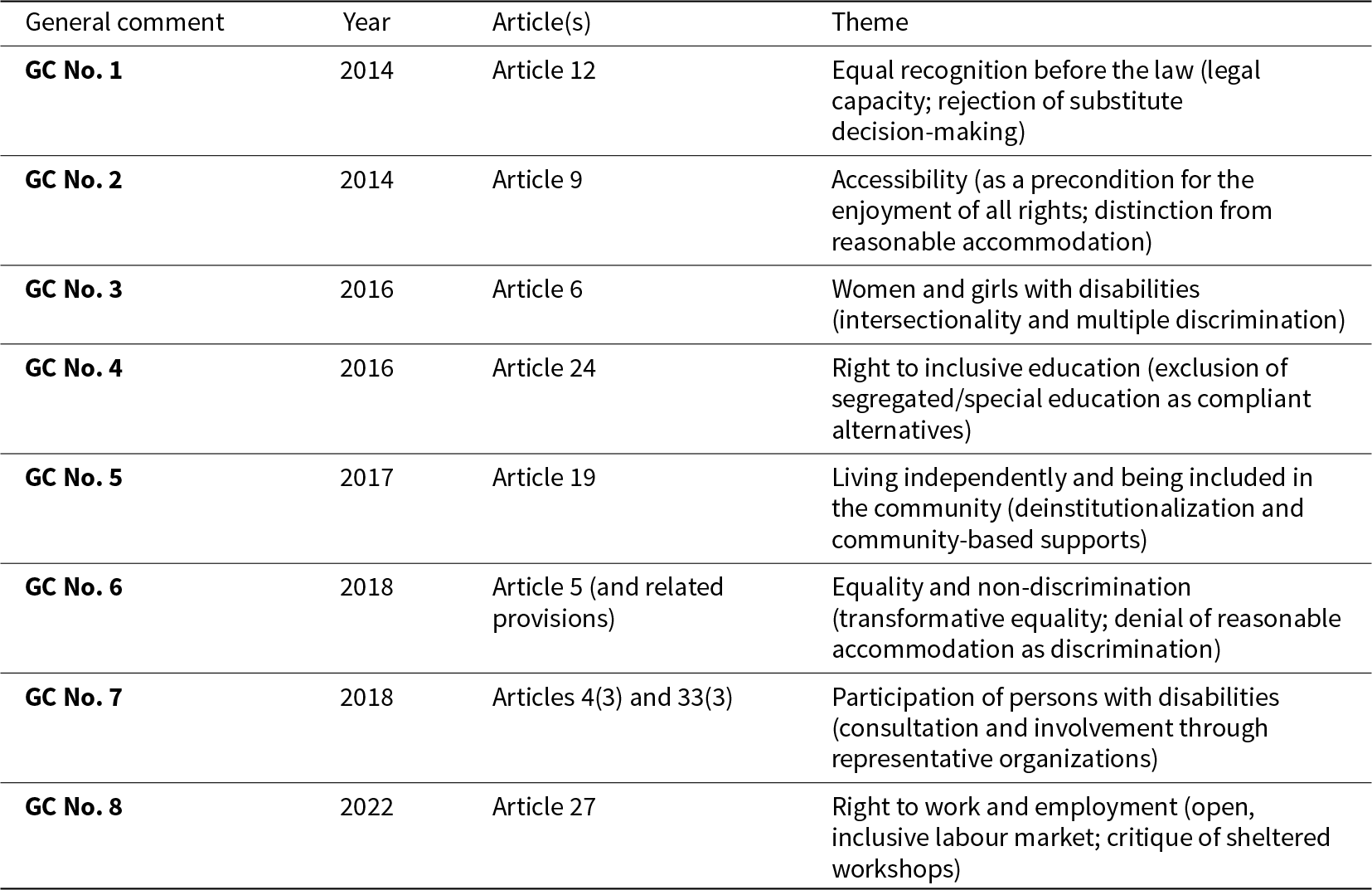
To date, the CRPD Committee has published eight General Comments, each focusing on a specific article of the Convention (see Table 1). The most recent, from September 2022, centres on Article 27 of the CRPD on work and employment, representing the most updated vision of the CRPD Committee. Thus, our analysis will focus on epistemic inertia specifically within the area of work and employment, although we believe they may be present in other thematic areas of the CRPD. While formulating this General Comment, the CRPD Committee considered written recommendations from 88 actors responding to an open call, including states, civil society organisations, and individual activists with disabilities. Furthermore, the CRPD Committee experts held online meetings in March 2021 to discuss the challenges in implementing Article 27, as well as best practices and recommendations on the right to work and employment of persons with disabilities. More than 100 organisations were represented during these sessions.
General comments adopted by the CRPD Committee.
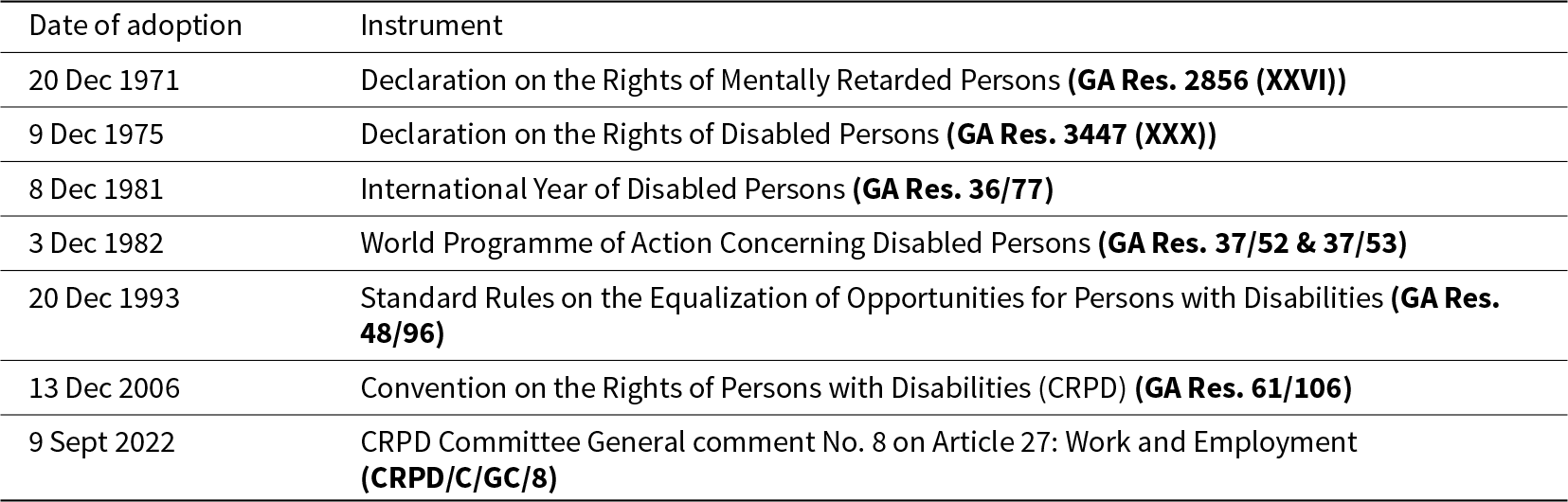
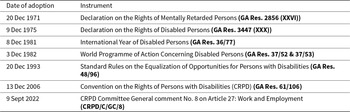
To conduct our analysis, we compare General Comment No. 8 to a corpus of all United Nations primary declarations or treaties related to disability that were published prior to the 2006 CRPD (see Table 2), representing a period when the medical model of disability was still the dominant expert paradigm governing disability at the UN. Because General Comment No. 8 addresses work and employment, we read the earlier documents through the same lens.Footnote 65 Concretely, this involved doing word searches to identify sections related to work, employment, and labour, and then closely reading the relevant passages. This comparative reading allowed us to contrast how these issues are framed across documents and to identify the normative assumptions and forms of knowledge that persist despite the shift in language and institutional context introduced by the CRPD. We treat these discourses not as free-floating macro-structures but as systems connecting ‘sayings to doings’ within specific expert sites, instruments, and practicesFootnote 66.
UN disability conventions, resolutions, and declarations analysed.
Approaches to work in UN resolutions and declarations prior to the CRPD: A baseline for identifying epistemic inertia
Before turning to General Comment No. 8, we reconstruct the baseline assumptions around work and employment embedded in pre-2006 UN disability instruments. We find that before the adoption of the CRPD, UN disability instruments largely articulated a medicalised and market-oriented vision of inclusion: productive employment is treated as one of the primary goals for which persons with disabilities should be ‘cured’, with integration into the labour market to be achieved through the ‘normalisation’ of persons with disabilities.
Early UN instruments largely reflected an understanding of disability as an individual deficit, presenting treatment and rehabilitation as prerequisites for ‘integration into normal life’. This framing not only medicalised disability but also normalised the social systems into which persons with disabilities were expected to integrate.Footnote 67 This logic is clearly reflected in the Declaration on the Rights of Mentally Retarded Persons, adopted in 1971, which stresses ‘the necessity of assisting mentally retarded persons to develop their abilities in various fields of activities and of promoting their integration as far as possible in normal life’.Footnote 68 The declaration uses pejorative language to describe cognitive differences and, in line with the medical model, presents integration as a matter of feasibility and individual capacity. It promotes medical care and physical therapy as means to enable persons with disabilities to reach their ‘maximum potential’, thereby reinforcing the view that inclusion depends on an individual’s ability to adapt, while giving no consideration to societal accommodation or alternative ways of living. Regarding employment and work, the Declaration recognises that persons with cognitive disabilities have ‘a right to perform productive work or to engage in any other meaningful occupation to the fullest possible extent of his capabilities’.Footnote 69 Although this does not suggest that people with cognitive disabilities must work, it does set up maximal productivity and participation in the labour market as a horizon of normality – ultimate goals that persons with disabilities should strive towards. This assumption reappears in subsequent documents in our corpus.
A similar framing appears in the Declaration on the Rights of Disabled Persons, adopted in 1975, which defined a disabled person as ‘any person unable to ensure by himself or herself, wholly or partly, the necessities of a normal individual and/or social life, as a result of deficiency, either congenital or not, in his or her physical or mental capabilities’. Footnote 70 Once again, ‘normal’ is not clearly defined and disability is conceived of as an individual deficit, reproducing neoliberal assumptions of the self-reliant, independent, and productive human subject. This is reinforced when the document asserts: ‘Disabled persons are entitled to the measures designed to enable them to become as self-reliant as possible’.Footnote 71 This orientation is particularly visible when it comes to explicit mentions of work and employment. The Declaration further states: ‘[Disabled persons] have the right, according to their capabilities, to secure and retain employment or to engage in a useful, productive and remunerative occupation’.Footnote 72 This language continues to reinforce a deficit-based conception of disability, depicting persons with disabilities as inherently dependent, and that dependence as inherently undesirable. At the same time, it legitimises conceptions of what constitutes a normal individual and an adequate social life, setting self-reliance and productive work as the ultimate goals of disability interventions. Thus, beyond the medicalised treatment of disability, this declaration enshrines the rights of persons with disabilities under a neoliberal logic that strives to make the individuals with disabilities autonomous, independent, and self-reliant in order to realise their humanity, social value, and self-worth as productive subjects of the neoliberal market.
The following year, in December 1976, the United Nations General Assembly, through Resolution 31/123, proclaimed 1981 as the International Year of Disabled Persons. Among its stated objectives were ‘helping disabled persons in their physical and psychological adjustment to society’ and ‘promoting all national and international efforts to provide disabled persons with proper assistance, training, care and guidance, to make available to them opportunities for suitable work and to ensure their full integration in society’.Footnote 73 As in earlier UN declarations, this resolution makes ‘adjustment to society’ a pursuit towards which states should orient their support when attending to persons with disabilities, while tacitly endorsing existing social structures as needing no adaptation. This means that the underlying goal was not to question or transform the relations and systems of power that produce marginalisation, but rather to make individuals ‘fit’ into them. In doing so, this resolution medicalises and neoliberalises disability, closing off broader questions about the very kind of society that persons with disabilities were being asked to ‘integrate’ into in the first place.
Building on this momentum, in 1982, the General Assembly adopted Resolutions 37/52 and 37/53, which established the World Programme of Action concerning Disabled Persons. These documents emphasised ‘equalisation of opportunities’ but gave minimal attention to the employment of persons with disabilities, with only a single reference regarding the accessibility of employees with disabilities to UN buildings. In these documents, equalisation of opportunities is not clearly defined, but it is set as a core goal that states should strive for.Footnote 74
Later, with the adoption of the Standard Rules on the Equalisation of Opportunities for Persons with Disabilities on December 1993, the UN laid out more clearly what equalisation as a horizon might look like in various aspects of life and what type of measures are required by states to achieve this objective. Under Rule 8 on employment, we start to see precursors of the CRPD’s more rights-based approach, with language foregrounding anti-discrimination, accommodation, and accessibility. Thus, we see a discursive shift, although ‘equalising opportunities’ becomes synonymous with eliminating discriminatory practices rather than altering existing systems and structures. Notably, this document maintains integration into the market and productivity as an important horizon. Across these documents, as an underlying rationality, there is an effort to naturalise an understanding of humanness anchored in autonomy, productivity, economic independence, and finding space in the open labour market, reinforcing a neoliberal doxa.
In this sense, the medical model institutionalised in pre-CRPD UN disability governance was not normatively neutral but already embedded in a neoliberal grammar as it was applied to themes of work and employment. In the next section, we argue that when read against this baseline, the CRPD Committee’s interpretation of work and employment does not constitute a straightforward rupture, even though it has altered which voices can speak authoritatively and who is recognised as an expert. Constant references to ideals of autonomy, self-reliance, productivity, and independence continue to operate as core assumptions even as UN governance shifts towards a human rights and pluralising model of disability expertise.
Epistemic inertia: disability and work in General Comment No. 8 of the CRPD
In a careful reading of General Comment No. 8, we identify three areas where the General Comment reproduces normative views about disability, work, and employment that we found in earlier UN documents that came before the CRPD. First, the General Comment continues to normalise systems that privilege autonomy, self-reliance, and productivity. Second, it frames adaptation and inclusion in society as a matter of merit, with relatively little attention to possible structural changes. Finally, this text still positions the labour market as an arena in which individuals are expected to realise their humanity, social value, and self-worth. We show that only some of these patterns stem directly from the wording of CRPD Article 27, while others suggest a more voluntary, if unconscious, continuation of the neoliberal logics we identified in UN disability frameworks prior to the CRPD.Footnote 75
Human dignity, work, and the persistence of the productive subject
The first dimension of epistemic inertia we identify happens at the level of what counts as a ‘dignified’ human being. Across our pre-CRPD corpus of UN documents, what it means to be human is intrinsically tied to the idea of being an autonomous and productive subject. In those resolutions more strongly grounded in the medical model, dignity was tied to rehabilitation and the capacity to gain independence and functionality through treatment. Productivity was both a marker of recovery and a precondition for social reintegration. Being ‘cured’ was not only a matter of bodily correction but also a moral imperative to (re)claim one’s role as an autonomous and potentially productive member of society and ‘normal life’.
Despite the emancipatory language of General Comment No. 8, the CRPD Committee’s approach to work and employment retains several of the key assumptions underpinning this configuration of the subject. In particular, it perpetuates the idea that autonomy, self-sufficiency, and economic productivity are prerequisites for human dignity. A clear manifestation of this continuity lies in the CRPD Committee’s conflation of productivity and autonomy. General Comment No. 8 opens by asserting that ‘the right to work is a fundamental right, essential for realizing other human rights, and forms an inseparable and inherent part of human dignity’.Footnote 76 This opening statement, which cannot be directly inferred from the text of Article 27, does more than affirm the importance of employment: it discursively constructs work as a condition for full personhood. By framing the right to work as inseparable from human dignity, the Committee reinforces a value system in which productivity is elevated as a central normative pillar, implicitly privileging an autonomous and economically independent subject. In this sense, the Committee’s normatively expansive interpretation accords a particular weight to the right to work.
Although this framing appears empowering, it ultimately relies on a highly individualised and uniform conception of subjectivity tied to (neo)liberal ideals of self-reliance. The invocation of dignity is premised not on relational interdependence or mutual care, but on the capacity to contribute economically. Dependency, vulnerability, and interdependence, all central features of human existence, are either absent or recast as deficits to be overcome, as in the pre-CRPD framework.
Such framing raises critical questions: Why must the realisation of other rights, such as health or education, depend on access to work? This conception not only marginalises the lived realities of many people with and without disabilities who work but remain economically precarious, and it also narrows the definition of ‘work’ to earning an income, which could exclude activities like parenting, caregiving, and volunteer labour. This logic becomes more explicit in the Committee’s claim that: ‘The right to work also contributes to the survival of individuals and to that of their family, and, insofar as work is freely chosen or accepted, to their development and recognition within the community’. This normatively expansive interpretation reinforces the epistemic formation of the dignified human primarily as a productive worker. More specifically, work is not only an individual condition of existence, but the survival of the family also depends on it, which casts employment as an individual and collective goal worthy of human pursuit. In this sentence, the CRPD Committee also suggests that as long as work is freely chosen or accepted, it is morally good, as it contributes to human development and recognition within the community. While this claim may reflect prevailing socio-economic realities and mirrors the obligations enshrined in the CRPD, the Committee’s formulation elevates them into a normative horizon. It reproduces longstanding neoliberal assumptions about autonomy, independence, and human worth as functions of productive labour rather than interrogating them. What we identify as worth analysing is not the descriptive claim that work often enables survival and human rights, but the way this claim legitimises and normalises a neoliberal rationality.
This normative vision is reiterated in the CRPD Committee’s assertion in General Comment No. 8 that: ‘Meaningful work and employment are essential to a person’s economic security, physical and mental health, personal well-being and sense of identity’. In this framing, employment is presented as a condition for survival, mental stability, and self-worth. Here, finding meaning in productivity is a key to becoming a healthy subject. Unlike earlier instruments that explicitly addressed ‘disabled persons’ when reflecting on the right to work, in this statement, the CRPD Committee makes no distinction between persons with and without disabilities. By universalising autonomy and productivity as a fundamental component of human existence, it normalises a particular form of able-bodied, self-governing subjectivity as the standard. Thus, in a way, employment becomes a form of treatment, a remedy for both disabled and non-disabled individuals. Without it, subjects face the risk of deterioration, failure, and, to the extent that it is tied to survival, inter-generational stability, and death.
In short, the pre-CRPD declarations based on the medical model and CRPD General Comment No. 8 based on the human rights model contain a shared premise: that dignity is contingent upon becoming an autonomous, self-reliant, and economically productive subject. In echoing the idea that the problem lies in the individual’s deviation from norms of independence and productivity, the shift towards viewing persons with disabilities as human rights-bearers reaffirms some of the core assumptions of the previous framing of persons with disabilities as patients (only now filtered in non-medical terms).
Merit and equalisation as drivers of inclusion
Another dimension in which epistemic inertia becomes visible lies in the CRPD Committee’s reliance on equalisation and merit as the main pathways to societal inclusion. The underlying idea is that it is individuals who must adapt to existing societal arrangements, rather than the opposite. While framed in the language of rights, this approach echoes the medical model’s logic by seeking inclusion within an existing system rather than transforming its underlying structures. Rather than fundamentally disrupting previous paradigms, the CRPD Committee often reinscribes the norms established by the medical model through a repeated discursive formula: ‘on an equal basis with others’. This formula implicitly affirms the ‘normalcy’ of the systems in which persons with disabilities must find space, without interrogating the exclusions, value hierarchies, or ableist assumptions embedded within the existing structures.
For example, the Committee writes: ‘Persons with disabilities face barriers to gaining access to and exercising their right to work and employment in the open labour market, on an equal basis with others’. It further states: ‘All workers with disabilities have the right, on an equal basis with others, to be considered for promotion through fair, merit-based and transparent processes’.Footnote 77 Although the formula ‘on an equal basis with others’ is explicitly grounded in Article 27 of the CRPD, the CRPD Committee advances a normatively expansive interpretation by attaching this equalising language to specific evaluative criteria that are not articulated in the treaty text, such as merit, fairness, and transparency. In doing so, equality is operationalised as access to pre-existing structures, values, and temporalities of work, closely aligned with earlier constructions of a ‘normal life’ in pre-CRPD disability frameworks. Within this configuration, equality is envisioned as the removal of barriers and the creation of a merit-based system, so as to enable persons with disabilities to participate in existing practices presumed to be naturally functional and productive.
Nowhere is the reproduction of the equalising logic more evident than in the emphasis on merit. The CRPD Committee states: ‘States parties should introduce objective standards for hiring and promoting persons with disabilities on merit and be committed to increasing the number of employees with disabilities.’ Here, merit is referenced as if it were a value-neutral and widely agreed-upon standard, but in practice, how merit is defined is often a topic of intense societal debate. By embracing merit as an ‘objective’ benchmark without clearly defining it, the CRPD Committee leaves unquestioned the way the dominant notions of merit have historically functioned to legitimise exclusion and precarity of marginalised groups.Footnote 78 Additionally, it glosses over the discriminatory criteria that are often used to judge whether one is ‘qualified’ for employment. In practice, this means that individuals with disabilities are expected to demonstrate their worth in terms defined by able-bodied norms of competence, productivity, and efficiency. In this way, through the language of merit and equalisation, the committee obscures the fact that able-bodied norms have long structured dominant definitions of competence, productivity, and worth, normalising (neo)liberal assumptions of competitiveness and capability.
In CRPD General Comment No. 8, equalisation, merit, and access are presented not as ambiguous, contested political choices but as neutral, easily implementable ‘solutions’ to discrimination. This framing echoes and reinforces the logic of previous UN documents on disability, where the task was not to drastically restructure social systems but to ‘treat’ and ‘cure’ individuals for successful integration into the existing system and ‘normal life’. By reproducing a depoliticised path to inclusion through the language of equalisation and merit, this logic therefore ends up reproducing some of the very assumptions that it claims to transcend.
Market participation as a moral horizon
A third and related dimension of epistemic inertia concerns the end goal or telos of efforts to manage disability. In CRPD General Comment 8, market participation emerges as a primary moral horizon that persons with disabilities should strive for. This vision is not radically different from that of previous UN disability framings grounded on the medical model, where the goal of cure or rehabilitation was closely linked to restoring a person’s ability to participate in the open labour market.
While the methods and experts prescribing action may have changed, from doctors to human rights professionals, the underlying expectation remains similar. In the medical model, the patient has to become functional in order to be reintegrated into society through work. In the human rights model, the rights-holder may not need to prove full functionality, but they are still expected to want to participate in the market, even with limitations, and their degree of participation becomes a core metric by which the success of disability policy may be evaluated. In previous decades it was considered important that persons with disabilities become more able to perform paid work to avoid burdening others, whereas General Comment No. 8 assumes that (with adequate accommodations and opportunities) all persons with disabilities intrinsically desire to do paid work. In this new perspective, participation in the labour market remains a central measure of worth, value, and life fulfilment.
Throughout General Comment No. 8, the open labour market is framed as an enriching space of economic and social belonging. The Committee repeatedly urges states to take effective measures to facilitate access by persons with disabilities to ‘open labour markets’ (presumably, as opposed to potentially exploitative sheltered workshop schemes) and to promote the employment of persons with disabilities in both public and private sectors.Footnote 79 It assumes that employment rates, wages, stability, standards in hiring conditions, and accessibility enjoyed by the ‘others’ are a collective horizon that persons with disabilities should also aspire to.
This logic extends through ideals of entrepreneurship and self-employment. General Comment No. 8 asserts: ‘Persons with disabilities have the right to freely choose their work, including whether they wish to be self-employed, start their own business or work in a cooperative.’Footnote 80 It also states: ‘The promotion of opportunities for work that is freely chosen requires accessible information on entrepreneurship, micro, small and medium-sized enterprises, and other forms of business models and economic units, such as cooperatives.’Footnote 81 On the surface, this language appears empowering. Yet it also channels the value of inclusion into market-driven forms of subjectivity, in which participation is secured primarily through becoming an employee, an entrepreneur, or a self-employed individual.
The CRPD seeks to secure the right of persons with disabilities to access the labour force without exclusion, segregation, or confinement to exploitative or narrowly defined forms of work, should they wish to participate. Our observation does not question this commitment. It instead addresses the narrowness of a capitalist framework in which wage labour, entrepreneurship, and self-employment are treated as the primary markers of inclusion, leaving limited space to recognise the value of alternative forms of work, social participation, contribution, and care.
Alternative imaginaries to disability and work
What makes epistemic inertia powerful is not only that it sustains dominant assumptions, but that, in doing so, it renders others less visible, less plausible, or simply unthinkable. In this sense, the emphasis on autonomy, equalisation, and market participation by CRPD Committee experts is telling. These ideals persist not because they are uncontested truths, but because other imaginaries of contribution and social value, normalcy, and worth are sidelined.
These silences are particularly evident in the Committee’s neglect of non-market or individualised forms of contribution, which has direct consequences for how dependency and interdependence are conceptualised. As feminist and disability scholars have long argued, dependency is not an aberration from an idealised norm of autonomy, but a universal condition of human lifeFootnote 82. As Kittay observes:
If we conceive of all persons as moving in and out of relationships of dependence through different life-stages and conditions of health and functionings, the fact that the disabled person requires the assistance of a caregiver is not the exception, the special case. The disabled person occupies what is surely a moment in each of our lives, a possibility that is inherent in being human. From this perspective, we reason that our societies should be structured to accommodate inevitable dependency within a dignified, flourishing life – both for the cared for, and for the carer. Finally, if we see ourselves as always selves-in-relation, we understand that our own sense of well-being is tied to the adequate care and well-being of another.Footnote 83
This means that all persons, at different points in their life cycle, rely on networks of care, support, and assistance. In that sense, Western society’s overemphasis on ideals of ‘autonomy’ and self-sufficiency, impacts support for those in need of care.Footnote 84 Building on this, theorists have further emphasised that caring is not merely a private activity but a central social practice that sustains communities and makes other forms of participation in society possible.Footnote 85 Yet societies often degrade the importance of care in order to uphold the power of those who benefit from existing hierarchies of privilege.Footnote 86 By failing to consider this, the CRPD Committee, much like earlier UN instruments, inadvertently contributes to sustaining the stigma attached to those forms of being that do not conform to (neo)liberal ideals of self-sufficiency, autonomy, and productivity.
What is also absent from CRPD General Comment No. 8 is that persons with disabilities also have a valid right not to be formally employed while retaining their dignity and rights. In this sense, what the recommendations omit is any sustained engagement with alternative economic models, collective forms of labour, or the value of non-market contributions. Alternatives long discussed in critical disability studies – such as universal basic income, cooperative economies, or commons-based participation – are not considered.Footnote 87 Care as a form of labour, for example, could sit alongside the right to work, recognising caregiving as a vital practice that sustains communities.
Expanding the scope of disability rights to include alternative economic imaginaries such as care or cooperative economies would acknowledge collective forms of production and reproduction that are not reducible to the wage relation. Policies such as basic income have also been promoted within disability movements as a way to secure dignity and autonomy without tying survival to the conditionality of labour market participation.Footnote 88 These alternative economic models destabilise the centrality of employment and its conflation with what it means to be a dignified human being, and suggest that a life well-lived does not need to be justified in terms of productivity alone.
A more ‘plural’ approach to human rights expertise and disability would, therefore, redefine what it means to be a human in a way that recognises and protects time, spaces, and an ethics of care that exist outside (neo)liberal relations.Footnote 89 As scholars have argued, such models would not only promote more relational conceptions of the individual, but would also provide the basis of a vision of society that can account for the non-market and non-individualistic dimensions that structure our societies and relationships as human beings. Such a perspective should ensure a fulfilling life both for the carer and the cared for.Footnote 90 After all, it is often through care ‘and care of the highest quality’ that individuals with and without disabilities can be included, loved, and allowed to live joyful and dignified lives.Footnote 91
We contend that these alternative imaginaries do not require the CRPD Committee to disregard the text enshrined in Article 27. For instance, Article 27 guarantees ‘the opportunity to gain a living by work freely chosen or accepted’. This formulation does not define work exclusively as wage labour and leaves open the meaning of ‘gain a living’. Thus, understandings of work among the CRPD Committee experts need not follow a market-conforming and individualised logic, given that nothing in Article 27 directs the interpretation towards independence and self-sufficiency.
In this sense, the rights consecrated in Article 27 could be interpreted in consonance with those in Articles 19 (community living) and 28 (adequate standard of living), which adopt a more relational vision of the subject and emphasise supported participation. These articulations with other articles of the CRPD would also be fundamental to ground alternative imaginaries, such as a basic income. In support of universal basic income, the CRPD Committee could rely on Article 28, which recognises the right of persons with disabilities to an adequate standard of living and social protection. Yet the Committee’s interpretive choices seem to narrow the horizon of what is considered conceivable, legitimate, or rights-bearing within the framework of work and human dignity.
In sum, while the Committee has pluralised its expert repertoire through ‘inclusive’ practices (i.e., by inviting persons with disabilities and civil society organisations into its deliberations) and through a more ‘benevolent’ repertoire of action than that of the medical model, it has not fundamentally pluralised the normative assumptions about what a human being ‘ought to be’ within existing socio-economic structures.Footnote 92 Expertise, in this sense, is pluralised in terms of who may speak, and which claims can circulate, but not in terms of the underlying imaginaries that shape notions of worth and what counts as a dignified human life.
Conclusion
In this paper, we have studied the politics of the pluralisation of expertise through the heuristic of epistemic inertia. As a heuristic, epistemic inertia points to the underlying rationalities and normative views that persist even where the rhetoric, institutional sites, or authorised actors of expertise have changed. This analytical lens, more generally, helps us resist reading claims to rupture in expert configurations as automatic signs of progressive or emancipatory change. Attention to epistemic inertia, we argue, allows us to make visible the contents or the ‘what’ of expertise in order to name the underlying rationalities and normative views that persist amidst change.
The case of disability governance offers a clear illustration of these dynamics. While the human rights paradigm of disability clearly brought about significant transformationsFootnote 93, it continued to frame disability through lenses that were characteristic of the previously dominant medical model: individual autonomy, self-reliance, and economic productivity. This suggests that, even as authority shifted from medical expertise and technocratic dictates to a more eclectic repertoire of knowledge with broader moral appeal, the prevailing understanding of disability remained largely anchored in (neo)liberal ideals of what it means to be a ‘normal’ human. At the same time, dependence and care, or any other relational logic that diverges from the ideal of the self-reliant, market-participating individual, were demoted across both paradigms.
This paper has focused on the CRPD Committee’s General Comment No. 8; however, the dynamics identified here are likely not confined to work and employment, nor to disability governance. Epistemic inertia may be at work across other human rights expert bodies and, more broadly, across contemporary efforts to pluralise the sites, actors, and practices of institutionalised expertise. This makes it all the more important to critically interrogate claims of progressiveness and emancipation made by and about global expert sites, while not losing sight of their potential for building positive alternative futures.
Future research could trace relevant processes in a more granular way, for example, through interviewing committees’ experts, exploring the dynamics of expert nomination, election, and training, or analysing to what extent civil society contributions are integrated into final expert outputs. This perspective could generate more practice-based and relational insights and help clarify the conditions under which the pluralisation of actors, tenets, and discourses may give rise to more transformative epistemic reorientations, particularly within institutional settings such as the UN.
Acknowledgments
We would like to thank Rebecca Nielsen, Annabelle Littoz-Monnet, and Christian Kreuder-Sonnen for reading and commenting on earlier versions of this paper, as well as three anonymous reviewers for their constructive feedback.
Annex 1. Obligations enshrined in Article 27 of the CRPD
The obligations enshrined in Article 27 are:
a. ‘Prohibit discrimination on the basis of disability with regard to all matters concerning all forms of employment, including conditions of recruitment, hiring and employment, continuance of employment, career advancement and safe and healthy working conditions;
b. Protect the rights of persons with disabilities, on an equal basis with others, to just and favourable conditions of work, including equal opportunities and equal remuneration for work of equal value, safe and healthy working conditions, including protection from harassment, and the redress of grievances;
c. Ensure that persons with disabilities are able to exercise their labour and trade union rights on an equal basis with others;
d. Enable persons with disabilities to have effective access to general technical and vocational guidance programmes, placement services and vocational and continuing training;
e. Promote employment opportunities and career advancement for persons with disabilities in the labour market, as well as assistance in finding, obtaining, maintaining and returning to employment;
f. Promote opportunities for self-employment, entrepreneurship, the development of cooperatives and starting one’s own business;
g. Employ persons with disabilities in the public sector;
h. Promote the employment of persons with disabilities in the private sector through appropriate policies and measures, which may include affirmative action programmes, incentives and other measures;
i. Ensure that reasonable accommodation is provided to persons with disabilities in the workplace;
j. Promote the acquisition by persons with disabilities of work experience in the open labour market;
k. Promote vocational and professional rehabilitation, job retention and return-to-work programmes for persons with disabilities.
States Parties shall ensure that persons with disabilities are not held in slavery or in servitude, and are protected, on an equal basis with others, from forced or compulsory labour.’

 Open access

