

Thirty-five years of Native American Graves Protection and Repatriation Act (NAGPRA) implementation have demonstrated a significant need for competent and well-trained NAGPRA practitioners to facilitate the return of ancestors and cultural items to descendant communities.Footnote 1 Anthropology programs continue to lack dedicated NAGPRA compliance training, and NAGPRA continues to be minimally emphasized in programs, particularly at the undergraduate level (LeBlanc and Schreiner Reference LeBlanc and Schreiner2025; Sievert et al. Reference Sievert, Nichols, Pyburn, Thomas, Messenger and Bender2019). A lack of emphasis results from limited funding (Beisaw and Duus Reference Beisaw and Duus2016; Luby and Nelson Reference Luby and Nelson2008; Wheeler et al. Reference Wheeler, Arsenault and Taylor2022:9), continued misunderstandings of NAGPRA among archaeologists and biological anthropologists (Sievert et al. Reference Sievert, Nichols, Pyburn, Thomas, Messenger and Bender2019), and disincentives for faculty to engage with NAGPRA in their research (Nash and Colwell Reference Nash and Colwell2020; Nash and Colwell-Chanthaphonh Reference Nash and Colwell-Chanthaphonh2010). These challenges have contributed to the rarity of extensive NAGPRA training and the limited pool of well-trained professionals who can enact NAGPRA compliance with a solid foundation (LeBlanc and Schreiner Reference LeBlanc and Schreiner2025; Sievert et al. Reference Sievert, Nichols, Pyburn, Thomas, Messenger and Bender2019). The few available programs are commonly extracurricular, cost-prohibitive, and limited by instructor capacity (LeBlanc and Schreiner Reference LeBlanc and Schreiner2025).
Building on general guidelines for incorporating students into the NAGPRA process provided by LeBlanc and Schreiner (Reference LeBlanc and Schreiner2025) and developed in consultation with Tribal partners (e.g., Roberts Thompson et al. Reference Roberts Thompson, Thompson, Garland, Butler, deBeaubien, Panther and Hunt2023), we provide the structure and lessons learned from the NAGPRA education program, known as the NAGPRA learning track, at Arizona State University (ASU). In this article, we discuss the outline of the four-semester program (Figure 1). Each semester builds student knowledge and competency through reading group discussions, intensive training by staff members, and structured hands-on experience, providing students with a comprehensive understanding of repatriation compliance—from initial object inventories to assisting directly with an active NAGPRA project.Footnote 2 We highlight lessons learned by focusing on aspects associated with the administration and pedagogy of the program. Finally, we provide suggestions for starting a NAGPRA learning track at other institutions.
Outline of the four-semester NAGPRA learning track implemented at the Center for Archaeology and Society Repository.

Identifying a Need for NAGPRA Education
NAGPRA was passed to create a legal obligation for anthropologists and museums to repatriate Native American ancestors, funerary objects, sacred items, and objects of cultural patrimony to federally recognized Tribes and Native Hawaiian Organizations. Recent emphasis on NAGPRA implementation is complemented by broader cross-disciplinary shifts in archaeological training toward collaboration with descendant communities, cultural resource management, and more ethically grounded, nonextractive practices (e.g., Kroot et al. Reference Kroot, Peeples, Montero and Vogel-Teeter2025; Potter and Hanson Reference Potter and Hanson2025). NAGPRA training, however, has not received the same attention, creating a persistent obstacle (LeBlanc and Schreiner Reference LeBlanc and Schreiner2025; Sieg and Neller Reference Sieg and Neller2025). In the fall of 2021, we sought NAGPRA readings and training resources to integrate into a long-running museum internship. For years, the Center for Archaeology and Society Repository (CASR) and its predecessor, the Archaeological Research Institute, have integrated student learning into repository operations. In the years leading up to 2021, the collections internship offered by CASR focused solely on hands-on collections management experiences underlaid by on-the-job training. Mid-2021 served as an inflection point, leading to the incorporation of student training into active NAGPRA work at CASR.
For the fall 2021 semester, CASR incorporated a weekly reading group to familiarize students with collections practices commonly learned through experience or in graduate-level classes (Caseldine and Dahlstedt Reference Caseldine and Dahlstedt2025). The initiation of the reading group corresponded with Caseldine and Dahlstedt assuming their current roles and a shift in focus of repository efforts toward repatriation. As highlighted by Reijerkerk and Nyitray (Reference Reijerkerk and Nyitray2023), we found it difficult to find articles and training materials that discussed the steps necessary for repatriation. The few published books and articles we found focused on the administrative history of NAGPRA and the shortcomings of its implementation (e.g., Atalay et al. Reference Atalay, Shannon and Swogger2017; Colwell Reference Colwell2017; Nash and Colwell Reference Nash and Colwell2020; Trope and Echo-Hawk Reference Trope and Echo-Hawk1992). Further, NAGPRA trainings were either introductory or workshops that are often cost-prohibitive for students (LeBlanc and Schreiner Reference LeBlanc and Schreiner2025:452–453), given that training was not discussed in the Act or subsequent Final Rules (Sieg and Neller Reference Sieg and Neller2025:375). Our search for available NAGPRA literature and training resources, and the challenges we experienced trying to hire qualified staff for our NAGPRA team, highlighted the need for formalized NAGPRA training for undergraduate students.
Shortly after redesignating the collections internship as Archaeological Collections Care and NAGPRA, the need for a multi-semester NAGPRA training program was identified. The redesigned internship course provided students with skills and knowledge essential for NAGPRA repatriations, but served as an introduction rather than a comprehensive training experience. We decided to structure the program as a learning track, rather than an undergraduate minor or certificate, because minors and certificates are administratively demanding to implement. Further, establishing a minor or certificate would require student enrollment numbers beyond the capacity of the repository staff. A learning track does not appear on transcripts but can be communicated through a student’s CV, as is done with volunteering or employment. This choice allowed CASR to implement the program quickly and adjust goals and objectives in real time, based on student and staff feedback.
Semester Descriptions
Semester 1
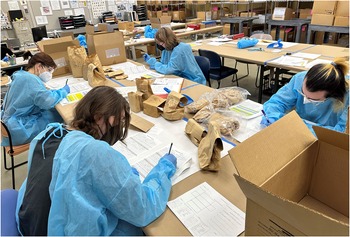
Semester 1 of the NAGPRA learning track, the Introductory NAGPRA Curatorial Internship, consists of two major components: (1) hands-on collections inventory (Figure 2) and (2) a weekly reading group that encourages active NAGPRA and collections care discussions. Many students who enroll in the learning track have some archaeological background from classes, but not all do. A majority of the students who join the program have no hands-on experience with collections and have not completed an archaeological field program. Training and individual instruction are therefore crucial components of student success in the program.
An example of the Semester 1 inventory. As shown, students complete a general box inventory sheet and artifact inventory sheet(s) for each assigned artifact box. Each student is provided with a standardized artifact coding list and reference materials to ensure that the information they record aligns with the Center for Archaeology and Society Repository database standards.

Students receive two weeks of orientation that introduce the importance of NAGPRA and repatriation efforts. Guided by prior and ongoing consultation with active Tribal partners, following best practices highlighted by Garland and colleagues (Reference Garland, Alapisco, Arbolino, Sieg, Covell-Murthy, Edwards and Yann2025) and Roberts Thompson and colleagues (Reference Roberts Thompson, Thompson, Garland, Butler, deBeaubien, Panther and Hunt2023), students learn respectful-behavior protocols, comprising dress code, appropriate language and terminology, and guidance for properly interacting with Native American items. Although we make every effort to minimize student interactions with ancestors and funerary objects, encounters do occur. Students are asked, and encouraged, to talk with the inventory supervisor if they are not comfortable with these brief encounters. Alternative projects are identified to ensure students have a comparable experience with their peers in the first semester.
During the orientation period, students learn to identify and properly document a variety of relevant cultural materials through teaching kits. Further, students receive instruction on identifying potential NAGPRA cultural items to ensure those belongings are identified early in the repatriation process. Students continue to work with the teaching kits and additional resources until they feel confident with the inventory process.
Next, students receive background and contextual information about the project that they are contributing to from a NAGPRA project lead, enabling them to engage more effectively with the inventory process. The intensity of this introduction and training is the core of Semester 1 and lays the foundation for learned skills in later semesters.
The Semester 1 reading group explores a variety of topics to provide students with a holistic picture of collections care and NAGPRA practices. These topics include collections management, archives, collections care and Indigenous representation, curation crisis and decisions, data sovereignty and collections ethics, NAGPRA overview, non-NAGPRA repatriation, and healing through NAGPRA. Students engage with the reading materials outside of class and participate in a variety of creative activities and engaging lessons in class. Further, appropriate discussion of the topics is highly encouraged during inventory activities. Students submit a weekly journal entry prior to each group meeting, which consists of three questions or observations, to help them think more expansively about the readings and discussions.
Semester 2
Semester 2, the Advanced NAGPRA Curatorial Internship, continues the structure of the first semester, including a weekly reading group and hands-on experience, but shifts toward skills instruction and mastery. The second semester focuses on data management, cultural item descriptive cataloging, and archaeological illustration. Students do not interact with funerary items, per consultation with current Tribal partners, but they do assist with the documentation of sacred objects and objects of cultural patrimony. Semester 2 instruction begins with digitizing written inventory forms. This data entry is vital for confirming that Semester 1 students transcribed information written on artifact bags correctly and all cultural items for repatriation have been identified. Students quickly recognize the importance of inventorying and our thorough repatriation process.
Next, students learn to record the color, texture, size, weight, and other diagnostic characteristics of items to aid in their future identification without the aid of a picture, known as cataloging. The in-depth examination of cultural items helps students build object knowledge critical for a career in museum work. Students see themselves contributing to an active NAGPRA project, through documentation requested by Tribal partners, instilling the importance of their work.
Students then learn archaeological illustration, facilitated by one day’s training and a week of practical illustration exercises, complementing their cataloging skills. Students draw non-NAGPRA items to hone their techniques, aided by examples of illustrated items. We have observed students become more skilled at identifying subtle details, such as polishing patterns, use wear, and flake scars. Illustration training requires staff expertise to train students effectively, and not all students continue illustrating beyond the training period. Despite this, students learn that artifact illustration is an important contribution toward repatriation when Tribal partners request a visual representation of an item that cannot be photographed.
The second semester readings and discussion narrow down to repatriation topics. Students discuss the relationship between federal laws and policies and NAGPRA, and the ethics of human osteology teaching collections, an emerging topic of repatriation. The reading group concludes with several weeks of intensive review of the NAGPRA legislation itself, the 1995 regulations, and the 2024 updated regulations, aided by guiding worksheets. Students come away prepared to reference and implement the regulations and understand how NAGPRA has evolved over time.
Semester 3
The third semester of the NAGPRA learning track, NAGPRA Project Lead Shadowing, requires students to act as NAGPRA coordinators and apply the methodologies learned in the first two semesters to prepare a small collection for repatriation. These projects are supervised by the project lead who is heading the overarching project to ensure that a duty of care has been established and sufficient background information is available. Students are not assigned projects with known funerary contexts or any mention of bone, including faunal bone. The semester is divided into five parts.
The first part builds a foundation for archaeological field methods and archives. Students begin with an overview of types of archaeological project, including survey and excavation, as well as different excavation techniques (e.g., trenching, test pits, and grid excavations) and terminology (e.g., middens, units, and features). This archaeological methods and terminology instruction provides them with a foundation to decipher complex proveniences and properly identify NAGPRA items. Next, students work with our archivist to locate, scan, and archive various project documents, including field reports and notes, site cards, specimen logs, and published works. They synthesize these documents into a background report that explains the history of the project and repatriation recommendations.
In the second part, students learn about data validation and integrity from the collections manager and database manager. Students are introduced to how collection records are generated, enter inventory data for their assigned project into a standardized spreadsheet, and validate the accuracy of the recorded information against the scanned archival records. Once validated, students learn how those data are incorporated into our secure database.
The third part instructs students in how to identify cultural items for repatriation. Students work with the assigned project lead to identify cultural items for repatriation. These decisions are based on material type, archaeological context, and Tribal partner guidance, and require students to draw on the archaeological and archival research foundations established during the first part.
In the final part, students collate and synthesize NAGPRA determinations for their assigned project into distinct documents. They produce a CASR NAGPRA Summary Report that aggregates the collection’s history, methods, and NAGPRA determinations for Tribal and federal partners, when applicable. They draft Notices of Inventory Completion and Notices of Intent to Repatriate following national NAGPRA guidelines. Finally, they synthesize and present their NAGPRA determinations to staff, following our presentation template for Tribal consultation.
Semester 4
The NAGPRA learning track culminates with the External Internship. The goal of the fourth semester is to provide students with the opportunity to apply skills learned during the previous three semesters in a nonuniversity setting. External internship placements arose from relationships with federal and nonfederal partners. Particularly enticing for our placement partners was the idea of combining student training with the institution’s internal NAGPRA compliance needs. Our partners understood that the benefit of much-needed help was contingent upon allocating time and effort to supervise and train students to be successful in the placement. Students are not simply volunteering to satisfy an hour’s requirement but are active participants in NAGPRA work who are seeking hands-on experiences to situate themselves for a career in repatriation.
The enthusiasm expressed by our placement partners is derived from the shared concern about the disparity between the general lack of NAGPRA technical knowledge and expertise and the complexity of NAGPRA compliance. We learned that our partners had little to no experience or background to effectively comply with NAGPRA, or had experience but were constrained by other workload obligations. The types of project each partner identified were varied and of high training value. For example, students have helped a national forest reconstruct a history of repatriation since 1990, assisted museum personnel with rehousing NAGPRA cultural items, and helped a semigovernmental utility to initiate repatriation consultation. The external placement opportunities are invaluable experiences, because high contact and quality experiences cannot be replicated in the classroom setting or at CASR (Ruth et al. Reference Ruth, Brewis, Beresford, Smith, Stojanowski, SturtzSreetharan and Wutich2023).
The placement activities differ greatly; however, students witness firsthand the processes necessary for NAGPRA compliance. A particularly enriching aspect of the experience is attending internal NAGPRA meetings at the placement locations. These meetings are critical for student learning, because they witness firsthand the processes and decisions going on behind the scenes that guide repatriation. Additionally, we ask that students attend consultation meetings. Their attendance must be discussed with the relevant Tribal representatives for approval, but, if appropriate, students observe these critical meetings directly. Consultation is among the most important steps of repatriation, so witnessing these meetings before starting a NAGPRA career allows students to learn aspects of meeting protocol from others, rather than on the job.
Students synthesize what they have learned through a program reflection and presentation. They write a 10-page reflection summarizing what they have learned in their external internship, how the previous three semesters contributed to the skills they practiced in the placement, and give suggestions for improving the program. The end-of-program presentation is a valuable opportunity for students to talk about what they did in their placement. Our staff attend these presentations and enjoy learning about each student’s growth. Staff members devote considerable effort to each student’s development, so they are able to see the fruits of that labor.
What We Have Learned
Administration
Integrating the NAGPRA Learning Track in Repository Operations
The success of our NAGPRA learning track results from integrating student education into repository operations. As discussed, the basic structure of the learning track is inventory, advanced documentation, project management, and classroom instruction. In a study of social science experiential learning, Ruth and colleagues (Reference Ruth, Brewis, Beresford, Smith, Stojanowski, SturtzSreetharan and Wutich2023, Reference Ruth, Brewis, Beresford and Stojanowski2025) found that practical skills training in hands-on environments leads to better career preparation than synthetic classroom instruction. Meeting greater demands for creating meaningful and diverse experiences at CASR requires multiple instructors and staff members.
Caseldine leads the Semester 1 and 2 reading groups, supplemented by repository staff and invited external guest speakers. Dahlstedt instructs the project-management-oriented Semester 3 reading group. The inventory supervisor, located in the inventory space and supervising the inventory process, has consistent face time with students as they work. The placement of the inventory supervisor provides a visual encouragement for students to engage, ask questions, or request help, benefiting the students greatly but requires the supervisor’s time and attention to shift away from other vital tasks. Further, the inventory supervisor meets with Semester 1 students to learn about their career goals and to provide guidance. Many students have commented that this is the first time that they have received such impactful and tailored guidance.
The supervision and training of Semester 2 and 3 students require the time and effort of multiple staff members. In the past, project leads were the center of supervision, because those students helped them with various project tasks. Difficulty arose from the project leads’ being located in offices next to the inventory space, a social barrier to many students, and balancing supervision with their workload. Students were required to check in with relevant project leads when they arrived, and the project leads would periodically check in with the students to see how they were doing. Despite these efforts, some students found a decrease in consistent interactions difficult. We therefore learned that all students would benefit from more direct supervision in order to be properly guided. This realization led to the assignment of a dedicated point person to supervise Semester 2 and 3 students. The point person provides technical assistance, coordinates with project leads, and conducts frequent check-ins as students work on tasks, such as cataloging and illustrating. Project leads ensure students are familiar with the overall project scope and goals and archaeological context while providing task assignments.
The internal repatriation workflow is structured to incorporate the pace of student learning. Each semester students require training time before being assigned project tasks. For example, students join Semester 1 with various levels of relevant experience and become proficient at different rates. They are given time with training materials (e.g., artifact material type identification) to demonstrate mastery of the process. The types of task that students perform increase in difficulty each semester, so training time is built into subsequent semesters as students are assigned new tasks based on a general training plan. Adequate student training time is therefore a recurrent time investment each semester.
We have found that the time investment is worthwhile. Students help to move projects along in ways that are beyond the capacity of staff. Particularly, students assist with monotonous but important tasks that are structured as time-limited teaching opportunities, such as data validation and advanced cultural item documentation. Additionally, students have a variety of skills that complement those of the NAGPRA staff. For example, the illustration of NAGPRA items is an important part of our repatriation process, as requested by Tribal partners. Our staff, regardless of their drawing ability and desire, do not have sufficient time to illustrate all designated items. All Semester 2 students learn archaeological cultural item illustration, but some excel, leading us to hire students who demonstrate an aptitude for illustration.
Instructional Planning
Before the start of each semester, repository staff meet to assess the needs of NAGPRA projects and determine where students would fit best to achieve both learning objectives and repatriation milestones. Instructional planning is divided into two stages. The first stage, taking place during the summer between spring and fall semesters, involves extensive planning for the upcoming academic year. The second stage, a shorter break occurring between the end of the fall semester and the beginning of the spring semester, allows for student project task adjustments based on progress made during the fall semester.
The first stage of planning involves identifying projects that students will work on during the academic year. Relevant project leads are assigned responsibilities for mentoring Semester 2 and 3 students and preparing site context summaries. The summaries provide information about the nature of the archaeological work conducted for the given project and the types of provenience information that students should expect to encounter and identify potential NAGPRA contexts that require object inventory by repository staff. Students receive the minimal amount of sensitive information directly relevant to their work, as defined by our duty of care agreements. The contextual information is tailored to each semester. Semester 1 students have increased engagement through learning about the site as they are inventorying items, and it provides an entry point to discuss past archaeological practices. The tasks completed by Semester 2 and 3 students depend on the contextual information for the selection of the items documented (Semester 2) and on determining associations (Semester 3).
Dedicated Supervision
Student supervision has presented a persistent challenge, as noted above. We originally attempted the traditional teaching model of using teaching assistants (TAs) to oversee students. This approach was insufficient, because we were often assigned new TAs each semester, so they were learning our processes alongside the interns. Further, students ask a range of questions, from procedural to archaeological, so the supervisor requires a broad base of knowledge. Specifically, the supervisor needs a diverse archaeological background to provide guidance about contexts, methodology, and artifact identification. Printed resources in the inventory space are necessary to assist the supervisor in guiding student training.
A dedicated staff member to supervise the inventory is critical because they are the first line of consistency and quality assurance (e.g., King and Sweitzer Reference King and Sweitzer2014). Students will record information based on their interpretation of the process and instructions, if unsupervised. Supervisors check inventory sheets regularly to identify issues with student recordings. This provides supervisors with the opportunity to guide students when mistakes occur and fix data errors early. Prior to this change in supervisory structure, we faced a persistent obstacle of catching inaccurate data entries after the semester ended, forcing staff to fix issues without the students present to provide insight into the error.
The inventory supervisor learns the specifics of the inventory process and is able to update the process when issues arise. We scaled up our inventory process based on observations and experience, but updates were piecemeal and distributed among multiple staff. Having a dedicated inventory supervisor allows for a more comprehensive and timely updating of processes. As such, the inventory process is much more efficient and consistent.
Program Size Limits
The increasing staff commitment to meet student needs has led us to limit how many students participate in the program. We have learned that a student-to-staff ratio for Semester 1 should not exceed 10:1. Higher ratios impede the inventory supervisor from adequately attending to student needs and supervision. Until recently, up to four students were permitted to participate in Semester 2. Project leads voiced concerns that four students exceeded their capacity, occasionally 4:1. It was decided to accept no more than two students into Semester 2 per semester. A 2:1 ratio allows project leads to attend to students while balancing their workload. Semester 3 never exceeded a ratio of 2:1, due to attrition through graduation. External placements accepted either one or two Semester 4 students, depending on capacity.
Despite limiting how many students can participate, more than 70 students have participated in at least Semester 1 since 2022 (50 students since redesignating the internship as Archaeological Collections Care and NAGPRA in 2023). Of those, five students have completed all four semesters of the NAGPRA learning track. As exemplified by student-to-staff ratios above, staff participation can be quite intensive. We suggest a ratio of no more than 2:1 for institutions where staff have multiple responsibilities.
Assessing Program Effectiveness
ASU evaluates instruction effectiveness through end-of-semester course evaluations. We have found these highly ineffective for providing substantive student assessments of the learning track. It has been our experience that only some students complete the course evaluations, since they are voluntary, and fewer provide insightful comments. Although students speak highly of the program to academic advisors and recommend the internship to fellow students, it does not lead to completing the course evaluations.
We implemented end-of-semester reflection papers for each learning track semester to provide the missing feedback (e.g., King and Sweitzer Reference King and Sweitzer2014). Although their responses will not be anonymized, we ask students to think deeply about what they have learned and to provide comments on areas for program improvement. The reflections from all four semesters of the program have led to continued improvement—some large, such as swapping the order of the project lead shadowing and the external internship. Recently, we implemented pre- and post-assessment to understand what students are learning (e.g., Ruth et al. Reference Ruth, Brewis, Beresford and Stojanowski2025). Students receive points for the reflection papers and assessments, but they are graded for completion rather than their content. This ensures we receive feedback from each student participating in the program.
Pedagogy
Length of Training Experience
We have learned that a 16-week semester is necessary for students to have a meaningful training experience each semester of the learning track. When we started the learning track, we offered Semester 1 during the summer semester. We were concerned that pausing the inventory over the summer would negatively impact forward progress. ASU offers highly condensed summer semesters of either six or eight weeks. The accelerated nature of that semester required substantial revisions to the existing training and learning experience. The abbreviated semester constraint was a hindrance for two reasons. First, many students are either nonlocal, traveling home during the summer, or have other obligations, so they do not take classes. The few students who signed up for Semester 1 were insufficient to conduct a meaningful reading group.
Second, six or eight weeks is far too short for students to build the necessary foundation for subsequent semesters. We found that 16 weeks is the minimum amount of time for students to cover the necessary reading topics and become proficient at inventory. To adapt to the condensed semester, we retained the journal entry requirement but removed the weekly reading group. The inventory supervisor was then responsible for guiding reading discussions when students conducted the inventory. It became clear that condensing and significantly modifying the semester was not a meaningful learning experience for students.
We reevaluated the necessity of having interns during the summer and concluded that it was actually impeding forward progress. Updates to student training and inventory procedures led to students becoming increasingly efficient. Some students needed more time than others, but the inventory was moving faster than the later stages of the process. To complement the increased efficiency, inventory preparation expanded into a multistage strategic planning process, now initiated during the summer. Boxes are identified, pulled, and staged for the next semester. Inventoried boxes are retained in the temporary inventory collections space until project leads have validated that NAGPRA-relevant items have been removed for further documentation. Without extensive planning, students would sit waiting for their next assigned box, and project leads and other staff would scramble to find suitable tasks.
Pausing the inventory during the summer allows NAGPRA staff to plan a project workflow and to complete post-inventory processes. Further, project leads can advance their background research to identify any contexts that are not easily identifiable based on the information written on artifact bags or boxes to be flagged as potentially NAGPRA and pulled during inventory. The summer pause allows for open tasks to be wrapped up and the next academic year to be planned.
Reading Group
The weekly reading group challenges students to critically assess how practitioners engage in archaeological and museum practices. The reading group is a vital supplement to the hands-on skills students are learning, because it reinforces the practical and conceptual “why” behind assigned tasks. Although specific to collections care and NAGPRA, students learn skills to evaluate systems of professional practice, think critically, and contribute to organizational goals in a positive and informed manner. The reading group therefore prepares students to integrate lifelong learning into their approach, regardless of the career path they choose.
The first semester reading group forms the bedrock of the instructional design. Semester 1 is often the first time that students have taken a course with a seminar format. Unlike discussion boards and one-off group assignments, students learn, and are encouraged to discuss, new and challenging topics in a supportive environment. To support this instructional structure, students submit journal entries consisting of three responses to the readings, as either questions or comments or a combination of both. Additionally, students pair with classmates to discuss the assigned articles, following structured questions. Originally, reading group time was dedicated to student-oriented discussions, but the style was not conducive to all students participating. A shift to a pair-and-share activity model has elicited in-class engagement equivalent to what was seen in student journal entries. We have observed students becoming increasingly prepared for discussion-focused reading group instruction in later semesters.
The reading groups for Semesters 2 and 3 shift the focus from article-based learning to hands-on skills training. The second semester reading group builds on topics discussed during the first semester to help students narrow their focus to NAGPRA. Furthering knowledge gained during the first semester, Semester 2 students explore structures surrounding NAGPRA and the wider implications prompted by repatriation, particularly federal policies and regulations, and human osteology teaching collections. Interwoven with the discussions are project-relevant trainings. These trainings form the building blocks for becoming a well-informed project lead. Earlier in the program’s development, students learned these skills on an ad hoc basis. Feedback received from both students and staff indicated that a more structured plan was needed. Oversight of these students is challenging, because they contribute to many different parts of the repatriation process, so consistent communication with staff involved in training and continual planning is needed.
The third semester turns completely toward one-on-one discussions centered on managing a project. The experiential learning approach of this semester allows students to learn new skills within a structured environment, but sufficient ambiguity remains to make the reading group discussions directly applicable to their work. A feedback loop is therefore established where students talk about topics they will engage with, practice skills learned, ask questions in subsequent reading groups, and refine their practice.
Individualized Instruction and Engagement
The NAGPRA learning track, at its core, is individualized (e.g., King and Sweitzer Reference King and Sweitzer2014). Although the topics and skills students learn are consistent, the varied projects they work on introduce them to a diversity of problems that they will face as NAGPRA practitioners. Students learn from, and work with, professionals in the field with a variety of specialized backgrounds, including collections management, archives, human and faunal osteology, and archaeological illustration. Within the context of active repatriation projects, students learn directly from experts, rather than passively from assigned materials, allowing the content to be adjusted to support and refine student skills (e.g., Ruth et al. Reference Ruth, Brewis, Beresford, Smith, Stojanowski, SturtzSreetharan and Wutich2023, Reference Ruth, Brewis, Beresford and Stojanowski2025).
We have learned that students in the internship and learning track require instructional flexibility to meet their needs, while ensuring relevant supervision to encourage growth and achievement. Direct supervision is a necessary component for promoting flexibility by shaping students’ approaches to meeting course objectives. In our experience, students often do not proactively seek help from staff, so a dedicated supervisor ensures students are checked in with, encourages questions, and identifies needs for alternative or additional instruction.
Suggestions for Starting a NAGPRA Education Program
The formalized NAGPRA educational program developed at ASU has been challenging and rewarding. Although many people helped develop and run the NAGPRA learning track, we believe that the program can be scaled according to needs, staffing, and available resources. The successes and lessons learned through the NAGPRA learning track lead us to suggest four foci critical for building and managing a NAGPRA education program integrated into active repatriation efforts.
First, it is imperative to prepare undergraduate students for careers within and outside of academic settings. NAGPRA education programs must equip students with skills that are transferable to disciplines beyond anthropology and museum studies (e.g., critical reasoning, goal-setting, and professionalism). We recommend that anthropological internship courses prepare students for consultation with descendant communities, collaboration with potential stakeholders, and diverse task management. For NAGPRA specifically, ethics and respect must be at the forefront of student instruction. Core to our approach is students interacting with Tribal representatives at various points along the NAGPRA learning track, especially important for establishing duty of care (e.g., Haas et al. Reference Haas, Morgan, Lofaro, Thomas, O’Donnell, Schreiner and Panther2025), establishing and reinforcing student behavior protocols for repatriation work, and working with and learning from NAGPRA practitioners. The core aspects of our approach equip students with a foundation and framework to be as prepared as possible for their first NAGPRA job, regardless of location.
Second, reading groups should expose students to a diversity of voices, especially Native American writers and scholars, and emphasize building critical thinking skills through synthesizing and interrogating academic literature and federal law. Reading group discussions should encourage students to work collaboratively, learn and explain ethics regarding archaeological and museum practices, and actively devise reasoned solutions and conclusions—skills that will prepare them to be informed citizens and effective collaborators in the workforce (e.g., Ruth et al. Reference Ruth, Brewis, Beresford and Stojanowski2025). Importantly, the reading group materials must introduce archaeological, biological anthropological, bioarchaeological, and museum practices and rationales to effectively reconstruct disturbance contexts and reunite separated ancestors and cultural items. The readings and trainings that the students engage with during the reading groups are indispensable for a meaningful and encompassing NAGPRA educational experience. Of all the suggestions we provide, implementing a weekly reading group, lasting no more than an hour and requiring one staff member, is the easiest to implement, especially for less-resourced institutions. The weekly meeting provides the opportunity to introduce students to new topics and teach needed skills at one time, rather than time-consuming ad hoc instruction.
Third, a NAGPRA education program is not possible without adequate funding to support repatriation efforts. NAGPRA instruction requires a holistic approach to supplement and enhance classroom instruction. Sufficient staffing, from inventory supervisors to project leads, is critical for the kind of formal and rigorous training that practitioners have lamented not receiving. Insufficient funding to support staff salaries impedes students from receiving intensive direct mentorship. As stated, students in the NAGPRA learning track need consistent and knowledgeable supervision at all points during the program. Learning objectives can be achieved with minimal staffing involvement, but student errors will be a constant challenge for staff moving repatriation forward. Staff will have to devote considerable time and effort to fixing student errors, or tasks will have to be repeated by future students. Without adequate funding for staffing, NAGPRA education programs will have to be restricted to no more than one or two students.
Fourth, the pedagogy of the department must align with the goals and objectives of the NAGPRA education program (see Anderson and Atalay Reference Anderson and Atalay2023). It is important for departments to develop a cohesive narrative that is complementary to NAGPRA and repatriation. From our experience, students express confusion when NAGPRA is either not discussed in their other classes or is disparaged as only applicable in the United States. As the expanding body of literature focused on NAGPRA and practitioner personal experiences can attest, NAGPRA is more than a federal process confined to the United States (e.g., McKeown Reference McKeown, Fforde, McKeown and Keeler2020).Footnote 3 Countries and peoples from around the world are increasingly demanding the return of their ancestors and cultural patrimony and respect of their sovereignty (e.g., Batt Reference Batt2021). Viewing the ethics of repatriation as a particularity of the United States and “not applicable to me and my teaching” represents a rebuke of diversity and inclusion efforts advocated by professional organizations, such as the Society for American Archaeology.
Conclusion
Since integrating student training into NAGPRA operations at CASR, we have found it to be both a challenging and rewarding process. As outlined in this article, thorough planning and intensive staff involvement are key to the success of our NAGPRA learning track. Dividing the program into four semesters allows students to develop their repatriation expertise over time, and within the capacity of participating staff members. Students who complete the learning track are highly trained and prepared to enter a career in NAGPRA. For students who choose a different career path, they are equipped with critical thinking and other skills to be successful in the future. We acknowledge that other institutions may not have the capacity to offer a NAGPRA educational program at the scale we discuss here, but aspects we discussed, like the weekly reading group, are worth their commitment, because they introduce students to ideas and skills necessary for repatriation work.
Acknowledgments
The development, implementation, and improvement of the CASR NAGPRA learning track has been a collaborative effort, relying on the support and guidance of many people. Authorship was determined through guidance provided by Equity in Author Order (https://civiclaboratory.nl/2016/05/23/equity-in-author-order/, accessed February 2, 2026). The authors would like to thank the Tribal Historic Preservation Offices of the Gila River Indian Community (GRIC) and the Salt River Pima-Maricopa Indian Community (SRP-MIC) for their review of, and guidance for, student involvement in our NAGPRA repatriation process. We would further like to extend gratitude to SRP-MIC for graciously providing cultural sensitivity training for students and staff twice a year. We thank School of Human Evolution and Social Change directors Ryan Williams and Chris Stojanowski and Center for Archaeology and Society director Matt Peeples for providing administrative and resource support to ensure sufficient staffing for the learning track’s success. We recognize, and express appreciation to, current and former staff and students who contributed to various aspects of our teaching and repatriation process, including Oslynn Benjamin, Emily Brooks, Jade Figueroa, Chandler Lahey, Katie Sargent, Emily Sharp, Jessica Ulmer, and all the interns and student workers who have devoted thousands of hours toward our repatriation goals and whose feedback has improved our approach to student learning. SHESC staff, including student advising, research advancement, business operations, and human resources, have provided critical behind-the-scenes assistance. Departmental staff are rarely recognized for their vital contributions. The learning track would not be administratively or logistically possible without them. Finally, we would like to thank the editor and three anonymous reviewers for their excellent suggestions to improve this article.
Funding Statement
This research received no specific grant funding from any funding agency, commercial, or not-for-profit sectors.
Data Availability Statement
No original data were used.
Competing Interests
The authors declare none.


 Open access

