





Introduction
Young people hold an unenviable and complicated role in the unfolding story of climate change: they have contributed the least to the problem, will bear its consequences throughout their lifetimes, and will face the responsibility of enacting society’s climate responses into the future (IPCC, 2023). Research indicates that young people feel unprepared to manage the instability that climate change portends (Jones & Davison, Reference Jones and Davison2021), and that they experience higher levels of climate anxiety than other age groups (Hogg et al., Reference Hogg, Stanley and O’Brien2024), alongside feelings of powerlessness and despair (Hickman et al., Reference Hickman, Marks, Pihkala, Clayton, Lewandowski, Mayall, Wray, Mellor and van Susteren2021). At the same time, young people have been positioned in public discourse as “heroes” or “saviours” (Jones et al., Reference Jones, Davison and Lucas2023) who will fix the climate problems caused by previous generations. To enable that figuration to materialise, young people would need to be afforded opportunities to develop the knowledge, emotional fortitude and practical skills to adopt leadership roles and act as empowered agents of change.
But are they being afforded opportunities to develop these cognitive, affective and behavioural capabilities? Research reveals how young people have led social movements to drive system change, such as Fridays for Future and School Strike 4 Climate in Australia (Tattersall et al., Reference Tattersall, Hinchliffe and Yajman2022; White et al., Reference White, Ferguson, O’Connor Smith and O’Shea Carre2022). Young people have done this while confronting multiple barriers to activism, including an antagonistic media environment and increasingly restrictive laws related to public protest (Hohenhaus et al., Reference Hohenhaus, Rutherford, Boddy and Borkoles2023). Outside of social movements, however, there is relatively little research on how young people enact agency on climate change in everyday life (Parsons et al., Reference Parsons, Bhor and Crease2023). Given that responding to climate change requires both systemic and behavioural shifts (IPCC, 2023), it is important to understand the spectrum of climate actions that young people might employ in addition to protest. Moreover, it is important that spaces exist in which young people can learn about, and develop skills in, these practices for enacting agency on climate change which may support well-being.
Schools possess key attributes that position them well for this endeavour. In Australia, the national curriculum aims to prepare students “to respond to the challenges that will continue to shape their world,” and encourages students to contribute to their communities through “active citizenship” (ACARA, 2025). Schools are trusted institutions (Biddle, Reference Biddle2023), acting as community hubs with considerable social capital (Verlie et al., Reference Verlie, Clark., Jarrett and Supriyono2021), and offering a supportive setting in which to develop the individual, interpersonal and civic capabilities needed for building agency (Sanson & Masten, Reference Sanson and Masten2024). Further, teachers are among the most trusted professionals in Australia (Ipsos, 2024), and may already possess the status of “trusted and caring messengers” so critical for influential climate engagement (Maibach et al., Reference Maibach, Uppalapati, Orr and Thaker2023, 54). These assets could be leveraged to provide transformative learning experiences for students (Wals, Reference Wals2011), which may yield broader benefits when students feel empowered to educate others in their lives (e.g., Lawson et al., Reference Lawson, Stevenson, Peterson, Carrier, Strnad and Seekamp2019). Yet young Australians have reported their educational experiences to be limited, describing a sense of distress and disempowerment when learning about climate change at school (Jones & Davison, Reference Jones and Davison2021; Mayes et al. Reference Mayes, Villafaña, Chiew, Maiava, Abhayawickrama and Finneran2026; Russell, Reference Russell2024).
Moreover, young people face different constraints than adults to enacting their agency toward climate change. For example, they may need to seek parents’ approval to attend climate-related events. In Australia, people under 18 are ineligible to vote, and this inability to have their views heard can lead to a sense of disempowerment (Arnot et al., Reference Arnot, Thomas, Pitt and Warner2023). This can be exacerbated for those living in regional areas whose communities are physically distant from centres of power (Teo et al., Reference Teo, Gao, Brennan, Fava, Simmons, Baker, Zbukvic, Rickwood, Brown, Smith, Watson, Browne, Cotton, McGorry, Killackey, Freeburn and Filia2024); where social norms may inhibit expression of environmentalist views (Colvin & Przybyszewski, Reference Colvin and Przybyszewski2022; Whitehouse & Evans, Reference Whitehouse and Evans2010); and where relatively little research on youth engagement in climate action has been conducted (Hohenhaus et al., Reference Hohenhaus, Rutherford, Boddy and Borkoles2023). Taken together, these factors complicate young people’s participation in processes of societal change necessitated by a warming planet.
The present study therefore aims to contribute a regional Australian youth perspective on “climate agency.” In this research, climate agency refers to how these young people perceive their own capability to contribute to meaningful action on climate change. Grounded in participants’ experiences of growing up and attending school in regional Australia, the study also illuminates important contextual factors influencing the development and expression of climate agency.
Theoretical framework
Agency
A common understanding of agency, building on the influential work of Bandura (Reference Bandura1997), centres on the notion of being able to steer one’s own life course, by making decisions and acting in line with personal values and goals. In psychological research, agency is commonly operationalised through assessing efficacy beliefs at the individual or group level. For example, studies have assessed people’s beliefs about the extent to which they can make a difference on climate change when acting as an individual (Lawrance et al., Reference Lawrance, Jennings, Kioupi, Thompson, Diffey and Vercammen2022), or as a collective (Hamann & Reese, Reference Hamann and Reese2020). In sociological research, there is a longstanding structure-agency debate (Crossley, Reference Crossley2022), in which agency is examined in relation to social-structural constraints. For example, socio-economic inequalities limit the participation of youth in United Nations climate conferences, constraining their agency to engage in climate politics (Buhre & Josefsson, Reference Buhre and Josefsson2024). This research draws on these literatures to elicit young people’s perspectives on taking meaningful climate action, while also attending to contextual realities.
Of particular relevance to young people is the literature of environment and sustainability education, which has inquired into agency (see Rousell & Cutter-Mackenzie-Knowles, Reference Rousell and Cutter-Mackenzie-Knowles2019). Studies emphasise that education can be an arena where young people move beyond knowing facts about environmental problems to believing they can make a difference through their own agentic capabilities (Trott, Reference Trott2020). These capabilities involve cognitive, affective and behavioural dimensions, and can be developed through enacting sustainable practices (Chawla & Cushing, Reference Chawla and Cushing2007). For example, Trott (Reference Trott2019) found that community-based, youth-led environmental projects – including community gardening, tree planting and policy advocacy – resulted in an enhanced sense of agency among participants. More recently, school-based climate assemblies have been positively regarded by students for building their climate knowledge and collaborative skills, resulting in youth-led climate action plans for their community (Cebrián et al., Reference Cebrián, Boqué, Olano and Prieto2025). Such experiences can instil hope that change is possible and achievable in the “here and now” (Amsler, Reference Amsler2015, 17) – a practice-based hope that can support young people to sustain climate action (Ojala, Reference Ojala2022). Educational contexts are therefore important settings for building agency regarding environmental problems. Recognising this, the present research was conducted in a school to generate nuanced insights into the role that education plays in climate agency for young people.
Social-ecological theoretical perspectives
Social-ecological theoretical frameworks have been valuable for understanding the role of contextual factors in human development. A seminal framework is Ecological Systems Theory (EST), which holds that development is influenced by the nested set of social and environmental systems with which people interact (Bronfenbrenner, Reference Bronfenbrenner1979). These interactions are dynamic and bidirectional, meaning that systemic factors influence individuals, and individuals influence systemic factors to varying degrees. The most proximal system to the individual (“Microsystem”), encompasses family and friends, and is the system in which individuals have most direct influence; the next (“Mesosystem”) includes community and school settings; the next (“Exosystem”) includes wider social influences such as media and government policy, upon which individuals have less influence; the next (“Macrosystem”) encompasses cultural context; and the most distal (“Chronosystem”) represents change experienced over time. Crandon et al. (Reference Crandon, Scott, Charlson and Thomas2022) utilised this framework to review literature pertaining to systemic factors affecting the development of climate anxiety in youth. The authors argued that this systems perspective can advance understanding of the various factors that may protect against, or exacerbate, climate anxiety. In this study, the theoretical framework is adapted to reveal the complex arrangement of factors, including education, that influences climate agency from the perspective of young people.
Situating the case study within the regional Australian context
This case study was conducted in Wagga Wagga, New South Wales (NSW). Located on the Murrumbidgee River in Wiradjuri Country west of Canberra (see Figure 1), it is the largest regional city in the state of NSW. It has a population of 67,609 (ABS, 2021) and covers an area of 4,825 square kilometres (Data NSW, n.d). The area supports a range of agricultural industries including broadacre cropping, livestock farming and horticulture.
Location of Wagga Wagga, NSW.

In Australia, places are designated into one of five categories of remoteness according to their relative geographical access to services. Wagga Wagga (hereafter “Wagga,” as it is known locally) is defined as an “inner regional” location (ABS, 2023), meaning it features the second highest level of accessibility after major cities. Beyond this technical definition lie other dimensions associated with regional localities that are relevant for managing climate change in Australia. For example, scepticism about anthropogenic climate change may be more prominent in local discourse (Miller & MacNeil, Reference Miller and MacNeil2022; Poruschi et al., Reference Poruschi, Scovell, McCrea, Walton and Gardner2024). Regional Australia is also the site of much of the country’s transition to renewable energy, and this buildout can disturb community cohesion and trust (Colvin et al., Reference Colvin, Witt and Lacey2016). Indeed, the placement of electricity transmission infrastructure on agricultural land in Wagga is raising community tensions regarding whether land use ought to change from farming to energy production (Roe, Reference Roe2024).
Such tensions have recently played out on the political stage. The conservative National Party, whose platform prioritises the interests of regional Australia (The Nationals, Reference Nationals2025), has abandoned its commitments to reach net zero emissions (Jotzo, Reference Jotzo2025). The Federal seat of Riverina, in which Wagga is located, is a safe seat for the Nationals (AEC, 2025). Yet the party’s jettisoning of its net zero commitments comes despite support for climate action in the Wagga community. For example, in 2023, the local Council ran a public consultation process for its Net Zero Emission 2050 Roadmap, and found 89% of public submissions endorsed the plan (WWCC 2023). This apparent contradiction between community and political interests illustrates the complex dynamics of responding to climate change in regional Australian communities.
Further complexity arises when considering how climate change intersects with the region’s religious beliefs. Wagga reports relatively high levels of religious affiliation and the predominant faith is Catholic, at 27.1% of the population (ABS, 2021). On one hand, previous Australian research (Morrison et al., Reference Morrison, Duncan and Parton2015) found that people of Catholic faith were less likely to believe that anthropogenic climate change was happening than Buddhists or atheists, agnostics, or those with no religion. On the other hand, the Catholic Church issued the papal encyclical Laudato Si’, which urged humanity to “care for our common home” by addressing environmental problems including climate change (Holy See, Reference See2015).
How might these complicated dynamics influence climate agency for young people in Wagga? This case study was situated at a Laudato Si’ Action School, a Catholic high school pursuing initiatives to increase environmental action aligned with Pope Francis’s encyclical. It provided a unique setting for understanding how a school, guided by national curriculum but situated in the context of regional Australian life, may support students’ climate agency.
Research design and methods
Qualitative methods are valuable in exploring contextual questions and how people make sense of phenomena (Maxwell, Reference Maxwell2013). Accordingly, this case study employed focus group discussions (FGDs), given their facility for generating rich data for analysis while capturing meaning-making in a social group context (Morgan, Reference Morgan2019). Informed by the preceding literature, a set of broad discussion prompts was developed to encompass cognitive, affective and behavioural dimensions that support agency (see Supplementary Materials). For example, “What are the main ways you learn about climate change?” allowed students space to identify a range of systemic factors important to learning, such as information obtained at school or from news media. Discussions, which ranged from 30 minutes to 62 minutes in length (with an average length of 50 minutes), were audio-recorded for subsequent transcription.
Participants
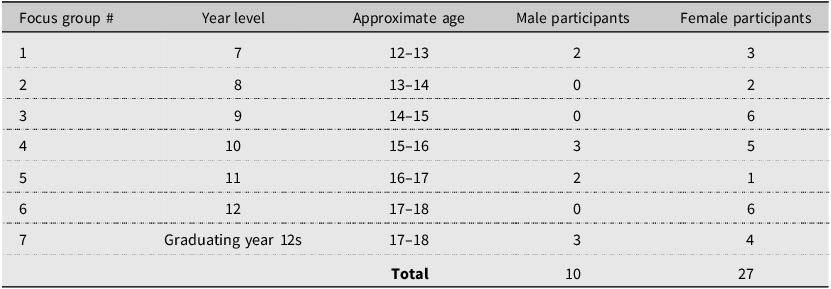
A letter to parents/guardians was provided through the school’s communications app, inviting students to express interest in the study by emailing the coordinating teacher. Interested students received an Information Sheet, a Consent Form and Parent/Guardian Consent Form. Informed consent was obtained from 37 students and parents/guardians. Volunteers from all year levels (7–12) were recruited (see Table 1). Seven FGDs took place between November 2023 and April 2024, and one student participated in an online interview, for logistical reasons. Ethical aspects of the research were approved by the relevant educational authority and the Australian National University Human Research Ethics Committee.
Key participant characteristics

Analysis
The research employed an interpretivist analytical approach, using reflexive thematic analysis (RTA) (Braun & Clarke, Reference Braun and Clarke2020). RTA emphasises the researcher’s subjectivity as integral to analysis; the author of the present study thus recognises her positionality as a parent of two school-aged children as a key motivator of the research. The case study design allowed multiple visits to the school to understand students’ perspectives yielding co-creation of findings. Both deductive (theory-driven) and inductive (data-driven) coding of transcripts was undertaken in NVivo 12 to identify systemic factors featured in participants’ dialogue, and themes capturing significant experiences communicated within and across conversations. The interpretivist approach allowed assignment of factors to systems levels (e.g., Microsystem) according to how participants conveyed their role in influencing these factors, and thus may depart from the delineations in Bronfenbrenner’s original EST (Reference Bronfenbrenner1979). For example, media influences were present across all systems levels due to participants’ engagement with social media posts, which they both consume and produce. This combination of methods enabled the theoretical perspective to be adapted to understand agency, and themes representing cross-cutting insights to be assembled.
Findings
Thematic findings
A confluence of factors representing all systems levels shaped how participants conceived of their climate agency, but most salient were relational and place-based factors residing in the Microsystem, Mesosystem and Exosystem. This section synthesises interrelated elements into key experiential themes important to participants. Where exchanges between students are reported below, note that Participant Identifiers (P1, P2, etc.) are used to differentiate students in that specific exchange only.
Learning experiences matter
Participants reported that learning about climate change – and possibilities for addressing it – involved multiple avenues, including school, various media outlets and conversations with family and/or friends. Among these, school-based education emerged as a critical influence on developing climate agency. Most students characterised learning opportunities at school as limited, reporting that lessons covered climate change superficially (“we only touched on it briefly”). There was a desire for climate change to be introduced earlier, and taught in more depth, to support students to act sustainably:
“I feel like we learn too little too late – it took me until year 10 before we really started to learn about it. I feel like we need to learn all this sooner to have a better understanding, to change our habits.” (Year 11 student).
Students emphasised the importance of learning about how to address climate change to help counter emotional distress, which was raised repeatedly. Feelings of sadness, worry and helplessness were common, related to climate change itself as well as others’ attitudes towards it (“I’m sad because my teacher doesn’t believe in it”). The following excerpt highlights how different educational approaches can affect students’ sense of agency and emotional well-being. Elsewhere in the FGD, Participant 2 had described an in-depth learning experience involving sequential lessons and discussions, including pathways for addressing climate change. Participants 1 and 3 reported a less comprehensive approach mainly centred around climate risks:
P1: “When I was learning about it, it was … shocking, like a big emotional wave.”
P2: “Yeah, it was like a wave at first. But then… once you realise you can do something about it and be part of it, you feel a lot better than if you sit there worrying about it. To go out and do something feels better than sitting at home all day worrying.”
P3: “I feel a bit the same as [P1]. It’s a bit scary, because it’s such a big issue for our time, and you don’t really know how to help towards the issue. You just feel so small in comparison.” (Year 11 FGD)
This exchange is instructive, explicitly connecting the cognitive, affective and behavioural dimensions of learning, and how different approaches can encourage or impede climate agency.
Where students wanted more information than provided in the classroom, some consulted online sources. The experience of independent exploration was mainly viewed negatively, as this excerpt shows:
P1: “I can remember there this was this one lesson… we did a thing on tipping points, and then the bell went, and I was still freaked out. I thought we were all gonna die, and…so I was just watching stuff online, I went into this rabbit-hole, and I was fully convinced the world was gonna end, and there’s nothing we can do about it.”
P2: “Yep. You’ve gotta give teenagers the actual tools to learn about accurate information […] Otherwise you’re leading them down an existential rabbit-hole, and putting so much pressure on 13, 14, 15 year olds because they don’t understand what they’re consuming.” (Graduating year 12 FGD)
The above excerpt highlights two important points. First, sparking awareness of the gravity of climate change, without accompanying discussion of societal responses, can be frightening for students. Second, students’ information-seeking online may compound distress depending on what they encounter, and their ability to ascertain whether sources are authoritative.
An important counterpoint was expressed by several students who had been taught more comprehensively about climate change by educators who were highly knowledgeable and motivated to incorporate it in their teaching. In these cases, teachers engaged students in deeper discussions and provided hands-on activities for learning about environmental problems – for example, conducting a school-wide Waste Audit. Participants saw these as valuable to building foundational skills to tackle environmental problems, which could be extended to climate-specific activities later:
“You have to learn how to do those smaller things before you can get to the bigger things.” (Year 9 student).
A desire to gain practical skills for responding to environmental problems was expressed multiple times by participants, who recognised these as the very capabilities needed for contributing to climate action.
Alone with their concerns
A common theme was the sense of isolation in contemplating climate change and managing associated distress. For example, one Year 7 student worried about the plight of animals (“there will be no wildlife, because there will be no habitats for them”); but when asked who she spoke to about these concerns, she responded “I just deal with it on my own”. This experience was common, with most participants reporting having few – if any – conversations about their worries. They gave various reasons for this, including misgivings about receiving negative social feedback from peers (“there’s a bit of fear about getting judged”), and the potential for conflict:
“It’s kind of a taboo subject, like if you bring it up then it’s also gonna bring up a lot of people getting angry with each other.” (Year 11 student)
Lack of dialogue was central to the common view that “no-one really cares” about climate change. Given that climate conversations and action were mostly absent from their lived experience, many participants concluded that people must not care about the issue. This perception left them feeling demoralised and disempowered, compounding a sense of marginalisation expressed by one Year 9 student as “we don’t have a voice, we don’t get recognised.” This situation appeared to foreclose possibilities for influencing change:
“I feel like no-one really cares, like what impact it’s having […] and no-one’s gonna listen to a young, teenage boy.” (Year 11 student).
However, several students recounted talking to teachers whom they trusted about their feelings, and this was conveyed as validating:
“Mrs [teacher’s name] was the first person to tell me, this stuff is tough to deal with and if you wanna talk about it – it’s OK to talk about it. Everyone else was just saying, good luck.” (Graduating Year 12 student).
The ability to discuss climate change in depth, and the emotions elicited, was invaluable for some students in countering feelings of distress. One student noted solutions-focused discussions at school helped manage his worries, instilling hope for positive change:
“A lot of the stress you get around climate change is the feeling of hopelessness, like there’s not really anything we can do. But after those conversations about solutions, I felt so much better… kind of felt that worry relieved a bit.” (Year 10 student)
These words underscore the importance of dialogue for supporting students with the cognitive and emotional challenges associated with climate change.
Three conceptions of climate action
Participants expressed three main ideas about what climate action looks like: changing individual behaviours; participating in collective protests; and undertaking collaborative environmental activities. While some individual actions were seen as more implementable (e.g., vegetarianism), others were out of reach (e.g., buying an electric vehicle), thus perceptions of agency through individual action were mixed. Moreover, even “feasible” actions raised doubts about whether they would make a difference – an important element of climate agency:
“I went vegetarian, and it makes me feel better, but it also feels kind of pointless because no-one around you is doing it.” (Year 12 student).
In terms of collective action, this was conceived by most as “activism,” entailing activities such as school strikes and non-violent civil disobedience. Many participants expressed barriers to enacting these. For example, one student cited lack of transport between Wagga Wagga and urban school strikes as an impediment; many others expressed aversion to employing activist methods they viewed as ineffective, or socially divisive:
“You see protestors stopping trains and things like that […] it’s kind of a nuisance, and I think it polarises other people.” (Year 10 student).
Those activities were generally viewed as something that happens elsewhere: one Year 10 student described seeing activist signage in Sydney “but you don’t see anything like that here.” An important departure from this conception of collective action as distant, protest-based activism was made by three students who had experienced other kinds of communal environmental activities. These students offered the important insight that working together to tangibly improve an environmental problem was empowering. It was also an opportunity for enjoyment through social connection:
“There were a lot of like-minded people who had the same concerns as me, but we were doing something about it. And, it was just fun in general – being out there with your friends and planting heaps of trees – just to be involved with that community feeling was really good.” (Graduating Year 12 student)
This viewpoint suggests such activities offer higher compatibility with students’ real-life context than protest-based activism. It also identifies social and well-being co-benefits offered by direct, collaborative pro-environmental activities.
A social-ecological systems view of climate agency
The theoretical perspective advocated by Crandon et al. (Reference Crandon, Scott, Charlson and Thomas2022) to encourage a holistic view of climate anxiety, here used to explore climate agency, provides insight regarding the layered social-ecological systems factors most relevant to young people. Multiple, interrelated factors were discussed, with place-based and relational factors being especially salient. The schematic (Figure 2) shows that what students encounter at home, at school and in their community were critical influences, and ones in which they played a more active role. For example, in the Microsystem, views of family and friends were typically known through direct personal interactions. Factors residing in the Macrosystem, however, were experienced indirectly via news/social media platforms. Consequently, factors such as government policy appear more peripheral in how participants perceive their climate agency.
Key social-ecological systems factors relevant to participants’ sense of climate agency. Interplay between systems is represented by dotted lines. Note that the role of social media in shaping perceived climate agency is present across all systems to varying degrees.

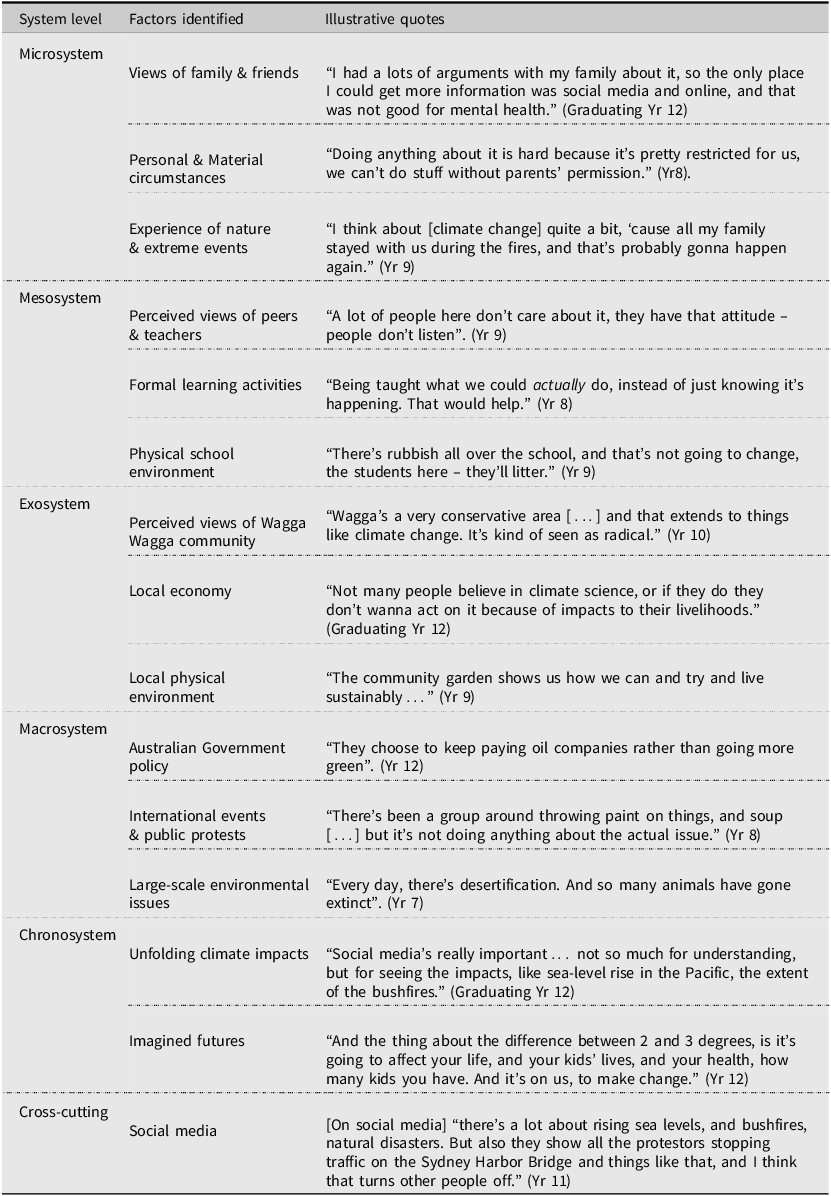
An important element in interpreting these findings is the interplay between various systems levels, depicted by the dotted boundaries between layers in Figure 2. For example, students spoke about interactions between their school (Mesosystem) with the wider Wagga Wagga community (Exosystem), including visiting a community garden to learn about sustainability. Social media cut across all systems, facilitating exchange of information and views about climate change at different scales. Table 2 presents illustrative quotes pertaining to key systems factors identified.
Social-ecological systems factors relevant to developing climate agency

Discussion
For these students, climate agency was contingent on a complex local context in which there were perceived taboos and social risks associated with discussing and acting on climate change. In their nuanced accounts, the students identified that how they learned about climate change, combined with social norms observed in daily life, shaped how they conceived of their own agentic potential and avenues to express it. School was a site of convergence: a focal point where multiple social-ecological systems factors coalesced to influence agency. School was characterised not merely as a critical place to acquire climate information, but as a place of social and emotional learning, and ideally, for action. Accordingly, the Discussion prioritises the educational context, and school-based interventions that could assist development and expression of students’ climate agency.
The students repeatedly appealed for more comprehensive climate education, including opportunities to process associated emotions. Importantly, they sought to learn practical skills for addressing environmental issues. This exemplifies a recognised gap between environmental concern and action capability among students internationally (OECD, 2022). Moreover, the few who had undertaken hands-on activities articulated benefits to their sense of agency and well-being, consistent with existing research (e.g., Trott, Reference Trott2019). Cultivating young people’s competencies to respond to environmental problems at local scales therefore appears critical to fostering a broader sense of climate agency.
Despite the attributes of Australian schools that could be marshalled to cultivate such competencies, (see Introduction), there are significant obstacles to schools capitalising upon them. For example, the Australian Curriculum primarily positions climate change within the “cross-curriculum priority” of Sustainability (ACARA, 2025). This means climate change may be taught, but outside few subjects (e.g., senior-level sciences), is not explicitly required. Individual teachers must therefore decide whether, and to what depth, they cover climate change in their teaching practice. In a crowded curriculum, and particularly for non-science teachers, there is little impetus or support for teaching this challenging topic (Whitehouse & Gough, Reference Whitehouse and Gough2022), despite its relevance across subject areas. Indeed, Freebody et al. (Reference Freebody, Carroll, Clegg, Dovers, McGaw, Tytler and Yates2023) noted that “Schools seem almost perfectly evolved to avoid, let alone prioritise, an educational object that relies entirely on cross-curriculum activity” (36). Further, they note the situation is exacerbated by the dearth of professional development opportunities for educators themselves to learn about climate change and best practices for teaching it. It seems foreseeable, then, that most students in this study did not characterise their educational experiences as strengthening their climate agency. The students’ appraisal supports other Australian research which found climate education to be inadequate and disempowering (Jones & Davison, Reference Jones and Davison2021; Russell, Reference Russell2024). Without policy change to support educators and schools to prioritise climate education, it seems unlikely that Australian students will receive the kind of education they desire, and that many educators want to deliver (Baker et al., Reference Baker, Clayton and Bragg2020; Beasy et al., Reference Beasy, Jones, Kelly, Lucas, Mocatta, Pecl and Yildiz2023).
More broadly, many students perceived that addressing climate change was not valued in their community. This seemed a powerful inhibitor of climate agency. Others’ avoidance of climate conversations discouraged students from instigating discussions, or acting on, an issue they nevertheless understood as urgent. The students’ conclusion that people didn’t care about climate change caused them to hide their own concerns, reinforcing social silence and foreclosing possibilities for action. This aligns with the findings of Geiger and Swim (Reference Geiger and Swim2016), who found that people were less willing to discuss climate change (i.e., self-silenced) when they believed others did not share their concerns. The students’ fear of negative social feedback accords with studies finding young people felt dismissed, belittled or judged for raising climate concerns (Hickman, Reference Hickman2020; Hickman et al., Reference Hickman, Marks, Pihkala, Clayton, Lewandowski, Mayall, Wray, Mellor and van Susteren2021). This may be a key impediment to action, as peers exert significant normative influence on adolescents’ personal environmental behaviours (Collado et al., Reference Collado, Staats and Sancho2019). Educational settings can counter this by affording a space in students’ lives where climate change and options for responding are openly and sensitively discussed (Baker et al., Reference Baker, Clayton and Bragg2020; Verlie et al., Reference Verlie, Clark., Jarrett and Supriyono2021).
Students also offered ideas for actions they considered meaningful, highlighting ways of enacting climate agency beyond individual (understood as consumer) or collective (understood as protest) actions. Their collaborative vision constitutes an action repertoire that is needed for societal transformation, but attracts little research attention (Trott et al., Reference Trott, Gray, Lam, Courtney, Roncker and Even2023) in a scholarship emphasising mass mobilisations and urban contexts (Hohenhaus et al., Reference Hohenhaus, Rutherford, Boddy and Borkoles2023; Neas et al., Reference Neas, Ward and Bowman2022). In practice, too, community-based action-oriented programmes are rarely implemented, despite being recognised as effective in building such skills as youth leadership, problem-solving and community involvement (White et al., Reference White, Ardoin, Eames and Monroe2024). This is unfortunate, given the feelings of camaraderie and enjoyment that students in this study described, in line with previous research (Trott, Reference Trott2019). Indeed, these descriptions may provide support for the posited “virtuous cycle of positive affect” (Brosch, Reference Brosch2021, 18), wherein taking environmental action makes people feel good, which motivates further environmental action due to anticipated positive feelings. Given the emotional toll of climate change for young people (Hogg et al., Reference Hogg, Stanley and O’Brien2024; Mayes et al., Reference Mayes, Villafaña, Chiew, Maiava, Abhayawickrama and Finneran2026; Russell, Reference Russell2024), it would be valuable for schools to provide opportunities which potentially confer well-being benefits. Whether this virtuous cycle is elicited and sustained would also be a valuable area for future research.
Place-based initiatives that enable students to conduct environmental projects, and observe the outcomes of their efforts, therefore seems a promising avenue for fostering climate agency. Such projects would correspond with the cross-curriculum priority of Sustainability, as well as the Civics and Citizenship subject in the Australian Curriculum, which has a focus on agency and contemporary issues (ACARA, 2025). Undertaking such projects could assist in creating social conditions conducive to climate action, by demonstrating that these activities are valued, potentially shifting norms of inaction. Place-based projects which engage across systems levels – e.g., schools (Mesosystem) collaborating with local Councils/community groups (Exosystem) – may also offer the social connection that students described as supporting their agency and well-being.
Limitations
This research responded to calls for youth-centred studies of agency toward climate change that expand upon existing social movement studies (Neas et al., Reference Neas, Ward and Bowman2022) and those situated in urban or metropolitan contexts (Hohenhaus et al., Reference Hohenhaus, Rutherford, Boddy and Borkoles2023), as well as considering how to empower young people learning about climate change (Jones & Davison, Reference Jones and Davison2021). The case study methodology drew value and nuance from focusing on one school context. This allowed experiences that informed conceptions and meaning-making around climate agency to be explored, in the context of these students’ everyday lives in regional Australia. Thus, it does not aim for representativeness, and cannot claim generalisability, as experiences will differ across varying contexts. Further, while the study sought to engage students with different views, participants were potentially the more climate-engaged, climate-concerned students within the school. Lastly, the systems factors presented are not intended as an exhaustive list; rather, they convey the most important in these students’ experiences of developing climate agency. Further research is needed to extend on these findings, and to establish whether these experiences are shared by young people in different locations, within and outside of Australia.
Conclusion
The participants of this study contributed new insights relating to climate change and agency. By offering their ideas on what climate agency means to them, and what helps or hinders its development and expression, they have contributed a distinctive perspective grounded in the experience of growing up in regional Australia. Adapting Bronfenbrenner’s EST generated a contemporary and contextualised view of the real-life situations and influences these young people encountered, and identified educational experiences as critical to climate agency. These students wanted to learn and discuss drivers of climate change, its impacts and what they can do, in the place they live and with people who are important to them. They described the kinds of climate action they wanted to undertake, beyond protest movements and why. However, they also described multiple impediments to action. The perception that “no-one really cares” was pervasive, generating a somewhat vicious cycle of silence about climate change. This led many, including those feeling distressed about climate change, to feel alone with their concerns. They were often uncertain about how to contribute to meaningful climate action.
Yet this study also revealed that much can be done. Those who were afforded opportunities to engage deeply – including dialogue with trusted teachers and hands-on, collaborative activities generating tangible environmental benefits – articulated positive effects to their sense of agency and well-being. There is a need for education policies that help schools to provide these opportunities. At a minimum, the Australian Curriculum should provide a stronger mandate for teaching climate change. This should be complemented by climate-specific professional development programmes for teachers. Young people are legitimate actors in responding to climate change, and receiving a robust climate education should be a foundational element of their civic participation. Creating the conditions which support their well-being, and strengthen climate agency, is vital to all of us in navigating a shared, climate-altered future.
Supplementary material
The supplementary material for this article can be found at https://doi.org/10.1017/aee.2026.10183.
Acknowledgements
Thank you to all the students who participated in this research, for sharing your thoughts and experiences so generously. My sincere thanks also to Catholic Education, Diocese of Wagga Wagga, and the staff at my partner school, for supporting this research program. I am also deeply grateful to A/Prof Rebecca Colvin (ANU) and Mrs Sharon Forwood (ANU) for contributing their expertise to this work, including on conceptual and practical matters; and to Dr Samantha Stanley (UNSW) for her feedback on earlier drafts. This work would not have been possible without you. The supplementary material for this article can be found at https://doi.org/10.1017/aee.2026.10183.
Ethical statement
Ethical aspects of the research were approved by the relevant educational authority and the Australian National University Human Research Ethics Committee (Protocol 2023/253). The datasets generated during and/or analysed during the current study are not publicly available due to ethical obligations to protect the anonymity of participants.
Financial support
This research was supported by an Australian Government Research Training Program Scholarship. The ANU College of Asia and the Pacific provided some funding through the “Asia Pacific Innovation Program (APIP)” which contributed to travel costs.
Author Biography
Tanja Russell is a PhD Candidate in the Crawford School of Public Policy at the Australian National University. Her research focuses on the role of educational experiences in empowering young people to take meaningful climate action. She works at the Institute for Climate, Energy and Disaster Solutions at the Australian National University.




 Open access

