


Introduction
The culture of overtime work has deep labour historical roots in China and remains particularly prevalent in the technology sector, where many organisations expect employees to adhere to the ‘996 work culture’ (Dong et al Reference Dong, Wu, Ni and Lu2021). ‘996 work culture’ refers to a gruelling work schedule from 9 am to 9 pm, six days a week (Chen et al Reference Chen, Masukujjaman, Al Mamun, Gao and Makhbul2023; ChinaBriefing 2025). Prominent companies such as Alibaba, Tencent, and Jingdong have adopted this overwork culture for their organisations. Yet, many high-profile incidents at tech companies have sparked widespread criticism and resistance against the notorious ‘996 work culture’, which has led to an increase in the occurrence of mental and physical problems seen in workers, such as job burnout (Dewi et al Reference Dewi and Susanti2021). According to China’s labour laws, a standard workday is eight hours long, with a maximum of 44 hours a week. Any work beyond that requires extra overtime pay. However, this has not been well enforced, and, despite criticism, the 996 work practice remains commonplace in China’s Digitech and internet sectors (Liu Reference Liu2023). Concerningly, Jack Ma, the co-founder of Alibaba Group and Chinese tech tycoon, controversially described the ‘996 work system’ as a ‘great blessing’ in a public media interview, a comment marked as a tipping point in China’s labour history (Yip Reference Yip2021). Similarly, Richard Liu, the founder of JD.com, likened his relationship with employees working under this system to that of ‘brothers’ (Liu and Chen Reference Liu and Chen2023). These corporate narratives of overwork culture reflect the persistence of exploitative labour practices and contribute to the modern slavery phenomenon in China’s labour history.
China’s labour force is insufficient to cope with contemporary economic development (ChinaBriefing 2025; WorldEconomicForum 2021). Its working-age population is shrinking amid declining birth rates and an aging society, dropping to 857.98 million in 2023, 6.83 million less than in 2022, and down 77.02 million from 2013 (ChinaBriefing 2025). The World Economic Forum has pointed out the Chinese labour force gap, estimating it to be around 11.8 million annually (World Economic Forum 2021). At the same time, societal expectations encourage families to have children. China introduced the universal Two-Child Policy on 1 January 2016, abolishing the One-Child Policy (Huang and Jin Reference Huang and Jin2022; Q Huang et al Reference Huang, Jin and Fan2024). To better address the country’s long-term labour force imbalances, the Three-Child Policy was officially announced on 20 July 2021 (Song and Wang Reference Song and Wang2022). However, workers are reluctant to have more children due to high unemployment rates and inflation (Zhao et al Reference Zhao, Zhang and Tang2024). Less family time due to adherence to the 996 work system escalates this situation.
An important development in China’s work culture over the past few years has been the growing awareness of work-life balance and an increasing backlash against overwork. This trend is especially evident in white-collar professions and China’s internet industry, likely due to the higher visibility of these positions within society (Li Reference Li2023; Liu Reference Liu2023; Zheng and Qiu 2023). Long-hours presenteeism describes circumstances where extended work hours are culturally or structurally enforced as a sign of commitment for employee engagement (Rawat et al Reference Rawat, Lyndon and Darvekar2025) and is particularly prevalent in high-pressure sectors such as China’s tech industry. The existing research has linked this phenomenon to chronic occupational stress, burnout, mental health decline, and fertility postponement (Ahn et al Reference Ahn, Lee, Park, Oh and Lee2021). The 996 work system does not simply mean working overtime or performance issues (Li Reference Li2023; Schuster Reference Schuster2022). A typical feature of the 996 work system is that labourers often work far longer hours in one job without extra pay for those additional hours and are not always compensated in other forms (Yip Reference Yip2021). This differs from the casual work arrangement, in which labourers work their total hours across multiple jobs to increase income. Liu (Reference Liu2023) has pointed out the labour struggles in China’s internet industry and the 996 scheduling. This illustrates the broader challenges of balancing innovation-driven growth organisations with employee well-being, a tension that also underpins debates on worker rights and organisational responsibility. Labourers subjected to the 996 work system often struggle to break free from its exhausting job demands, prompting them to seek alternative ways to improve their family’s financial well-being. As a result, labourers may seek alternative digital finance strategies to improve their economic situation (Lin and Wye Reference Lin and Wye2025). This may involve exploring new financial investment opportunities to increase household income and prepare for future family plans, such as having children. Consequently, many labourers are turning to digital finance as a viable investment avenue in their pursuit of long-term financial security for their families.
Digital finance, driven by private Fintech companies such as Ant Financial and Tencent, is a recent innovation in China. One of the most successful practices is the mobile payment system. Within four years of Alipay and WeChat Pay’s launch in 2013, over 70% of China’s adult population, including 66.5% in rural areas, adopted mobile payment (Jackson and Joep 2017). This rapid adoption was facilitated by widespread smartphone use and fast Fintech development in China. Unlike mobile money systems in other developing economies, such as M-PESA in Kenya and South Africa, which rely on agents for cash-in and cash-out services, China’s mobile payment systems function as e-wallets. They provide a secure and remunerative savings vehicle, enable payments via QR code scanning, and offer real-time, low-cost money transfers within the ecosystem (Wang and Wang Reference Wang and Wang2022). Digital finance has made financial products more accessible by reducing information asymmetry between lenders and borrowers and decreasing transaction costs (Banna and Alam Reference Banna and Alam2021; Li et al Reference Li, Wu and Xiao2020). Digital finance applies technologies such as big data and cloud computing to innovate financial services (Lu et al Reference Lu, Wu, Li and Nguyen2021; Yang et al Reference Yang, Chen, Shi and Wen2017), empowering employees to explore high-risk investments and shifting the decision-making power from financial institutions to households.
Corporate risk-taking has been widely studied (Tang et al Reference Tang, Hou, Goodell and Hu2024; Tian et al Reference Tian, Li and Cheng2022). But household risk-taking has received less attention. This is due to the difficulty in measuring household risk-taking behaviours and the many constraints in household decision-making that remain unexplored by existing theories (Hu et al Reference Hu, Guo, Shang and Zhang2024). Existing studies on 996 work systems and overwork culture predominantly emphasise labourers’ physical and psychological health consequences (Li Reference Li2023; Liu Reference Liu2023; Zheng and Qiu 2023). However, previous studies did not consider the role of those labourers’ families and their households’ financial behaviours. Therefore, relaxing the above-mentioned assumption motivates our inquiry and provokes our research questions:
RQ1. Does digital finance drive household risk-taking in financial investment for overworked labourers?
RQ2.Does the 996 work system and fertility decisions affect the relationship between digital finance and household risk-taking in financial investment for overworked labourers?
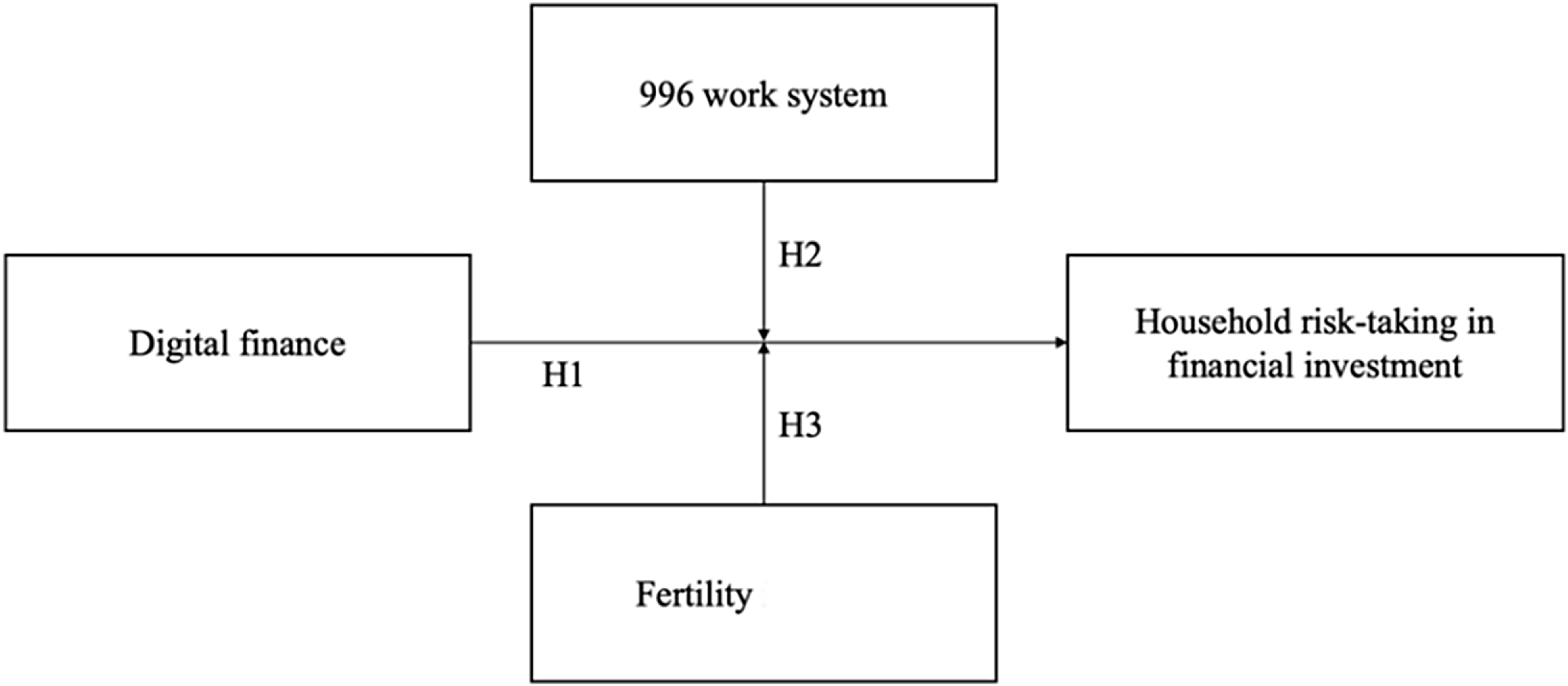
To address these questions and critically examine our research hypotheses, we draw on the theoretical lens of the Theory of Planned Behaviour (TPB) to investigate how digital finance will influence household risk-taking in financial investment for overworked labourers in China. Our study posits that digital finance is likely to promote household risk-taking in financial investment by simplifying the process (Lu et al Reference Lu, Guo and Zhou2021a), enhancing control over investment decisions (Guo et al Reference Guo, Wang and Yuan2021a), and increasing social pressure to adopt these technologies. We also propose that the 996 work system may impact this association. Intense demands and stress associated with the 996 work system deter households from initiating risky investments. However, for those who engage in risky investments, the financial capacity and familiarity with digital finance tools fostered by the 996 work system lead to a higher proportion of their total financial assets being allocated to these investments. We posit that the 996 work system indirectly encourages the use of digital financial tools by severely limiting labourers’ time and flexibility. Labourers turn to app-based platforms for convenience and speed when facing long hours and fast-paced environments. Labourers’ routine reliance, especially in tech-savvy sectors, builds familiarity and trust in digital finance, fostering greater engagement with these finance tools. Moreover, we hypothesise that household fertility tends to weaken the relationship. With fewer children to support, families may secure themselves with more disposable income and a greater capacity to take financial risks.
This study makes three contributions. First, this study extends the TPB to the context of family financial investment and the digital finance sector. Corporate risk-taking has been widely studied, but household risk-taking has received less attention. Second, it extends the TPB to the context of the 996 work system. The results show that the 996 work system has a significant and negative impact on the relationship between digital finance and the presence of risky financial assets, while it has a significant and positive impact on the relationship between digital finance and its proportion of the total financial assets. This expansion enhances our understanding of how 996 labour overwork influences the usage of digital finance and household risk-taking in financial investment, thereby broadening the theoretical framework of the TPB.
The remainder of this paper is structured as follows. Section 2 introduces the TPB and hypotheses. The data source, descriptive analysis, and empirical method are presented in Section 3. The main results, robustness checks, and results discussions are reported in Section 4. Section 5 concludes the paper.
Theory and hypotheses
The theory of planned behaviour
The TPB, developed by Icek Ajzen in 1985, predicts and explains human behaviour based on intentions (Ajzen Reference Ajzen1991). The theory suggests that an individual’s intention to engage in a behaviour is the strongest predictor of whether they will perform it. According to TPB, behaviour is influenced by intentions and perceived behavioural control, which includes factors beyond the individual’s control. Intentions are influenced by attitudes towards the behaviour, subjective norms, and perceived behavioural control (Ajzen Reference Ajzen1991; Reference Ajzen2020; Bosnjak et al Reference Bosnjak, Ajzen and Schmidt2020). Attitude towards behaviour is the degree to which a person evaluates the behaviour positively or negatively (Ajzen Reference Ajzen1991). This refers to the degree to which a person has a favourable or unfavourable view of the behaviour in question. It is influenced by beliefs about the outcomes of the behaviour and the value placed on these outcomes. Some empirical studies measure this by asking respondents about the significance and impact of the behaviour’s consequences (Lee et al Reference Lee, Kang and Kim2021; Park and Blenkinsopp Reference Park and Blenkinsopp2008). Subjective norms are beliefs about whether significant others (e.g. family, friends, colleagues) approve or disapprove of the behaviour. This pertains to the perceived social pressure to perform or not perform the behaviour. Perceived behaviour control refers to the perception of ease or difficulty in performing the behaviour, considering risks and self-efficacy (Ajzen Reference Ajzen1991). In this theoretical vein, behavioural intentions are shaped in part by perceived behavioural control. That is, individuals’ beliefs about how much control they have over performing a behaviour. While structural conditions such as exploitative work environments may objectively limit control, it is the perception of these limitations that influences intention and, subsequently, behaviour (Ajzen Reference Ajzen2002).
When applying TPB to financial investment intention, investors’ attitudes towards investing can be shaped by their beliefs about potential returns and risks (East Reference East1993). For instance, if an individual believes that investing in stocks will yield high returns and financial growth, they are more likely to have a positive attitude towards investing (Rathee and Aggarwal Reference Rathee and Aggarwal2022). Conversely, if they believe that the financial market is too volatile and risky, they might develop a negative attitude. This also reflects an individual’s subjective norms in investment decisions. The influence of family, friends, and financial advisors can play a significant role. If an individual’s social circle views investing positively and encourages them to invest, they may feel social pressure to conform and thus be more likely to invest.
Based on the TPB as a theoretical lens, Warsame and Ireri (Reference Warsame and Ireri2016) applied the TPB to study the usage of Sukuk, an internet financial product, in Qatar, revealing that attitude positively affects the intention to use Sukuk. Akhtar and Das (Reference Akhtar and Das2019) explored investment intentions in India with the TPB. This study indicated that attitude partially mediates the relationship between financial knowledge and investment intention, while financial self-efficacy influences the link between personality traits and investment intention. Subjective norms had a weak positive effect on investment intention. Zhang and Huang (Reference Zhang and Huang2024) employ the TPB, finding that perceived behavioural control significantly shapes investors’ intentions and behaviours toward socially responsible investment.
Using the TPB, we can analyse how digital finance promotes household risk-taking in financial investment by focusing on attitudes, subjective norms, and perceived behavioural control. The combined effect of these will shape the individual’s intention to invest. A positive attitude towards investment, strong social support, and a high level of perceived control will generally lead to a stronger intention to invest. Digital finance improves attitudes towards risk-taking in investments by making the process easier and more appealing (Lu et al Reference Lu, Guo and Zhou2021a). Positive experiences and potential gains encourage households to take more risks. Moreover, as digital finance becomes widespread, social pressure to adopt these technologies and engage in financial investments increases. Seeing others succeed with digital finance fosters a belief that taking financial risks is beneficial and acceptable. In addition, digital finance tools enhance control over investment decisions with features such as real-time tracking and easy access to information (Guo et al Reference Guo, Wang and Yuan2021a). This increases confidence in managing investments and encourages riskier behaviours.
Digital finance and household risk-taking in financial investment
Digital finance, led by companies such as Ant Financial and Tencent, has rapidly advanced in China. Unlike other countries’ systems, China’s mobile payments operate as e-wallets, offering secure savings, QR code payments, and low-cost transfers (Wang and Wang Reference Wang and Wang2022). Digital finance reduces information asymmetry and transaction costs (Banna and Alam Reference Banna and Alam2021; Li et al Reference Li, Wu and Xiao2020), and uses technologies like big data to empower households and shift financial decision-making power (Lu et al Reference Lu, Wu, Li and Nguyen2021; Yang et al Reference Yang, Chen, Shi and Wen2017).
Evidence indicates that financial technology development influences market participants, such as businesses (Wang et al Reference Wang, Jiao, Bu, Wang and Wang2023) and households, by enhancing their ability to manage income shocks. It achieves this through providing better access to financial services by lowering transaction costs and reducing risks (Chen et al Reference Chen, He and Li2024c; Hua and Huang Reference Hua and Huang2020; Jain and Gabor Reference Jain and Gabor2020; Wang et al Reference Wang, Jiao, Bu, Wang and Wang2023; Yang and Zhang Reference Yang and Zhang2022). As a result, households are more capable of investing in productive assets, which boosts their wealth and investments in both human and physical capital (Wang et al Reference Wang, Wang and Zhao2022). This ultimately enhances their resilience to unexpected challenges and stressors (Suri et al Reference Suri, Bharadwaj and Jack2021).
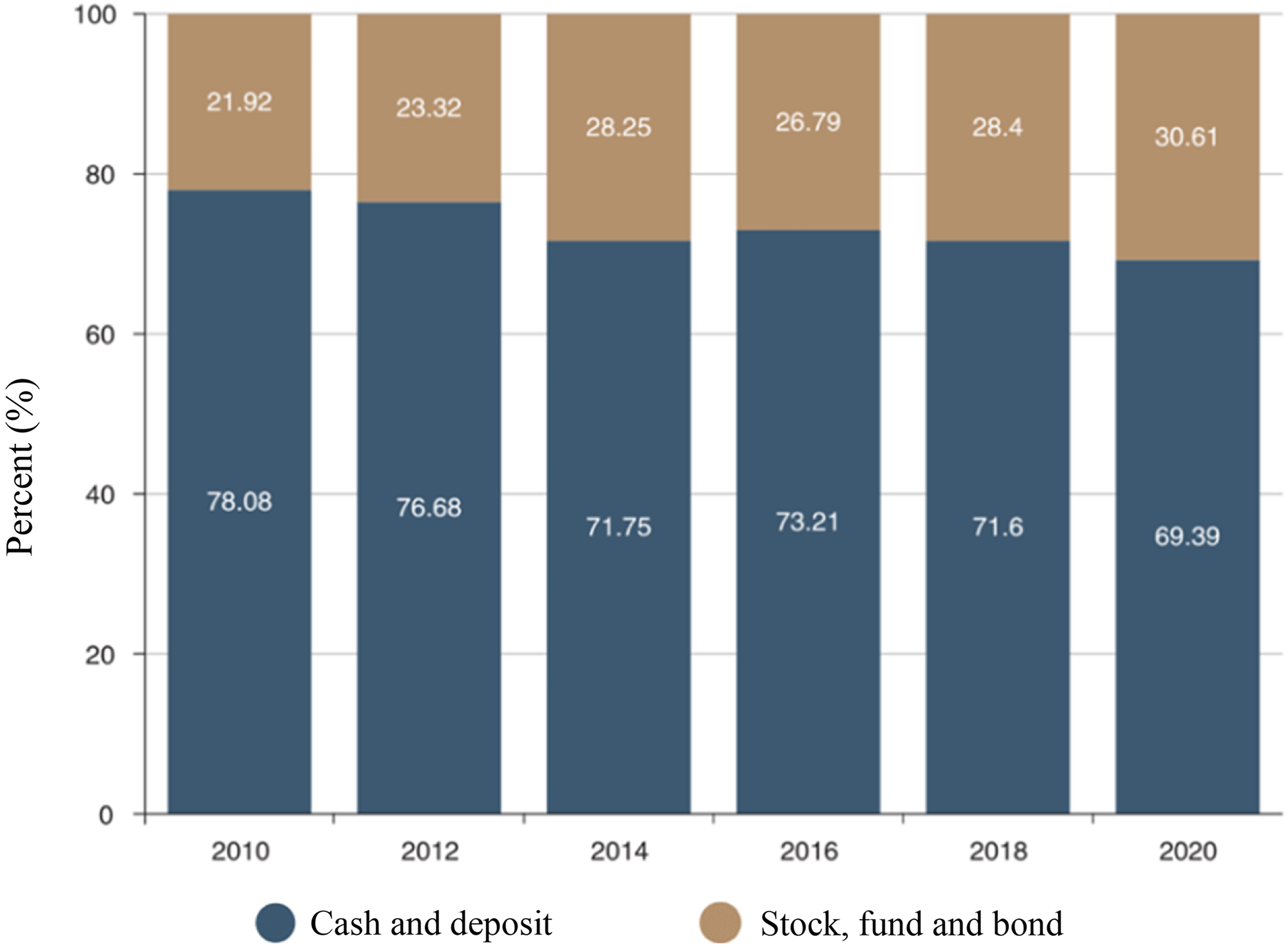
By 2022, China’s asset management business reached RMB 66.74 trillion, with nearly 200,000 products, according to the Asset Management Association of China. The proportion of risky financial holdings in household portfolios rose from 21.92% in 2010 to 30.61% in 2020 and is projected to reach 34.09% for medium- and high-net-worth households by 2025 (Figure 1).
Household financial asset allocation of China.
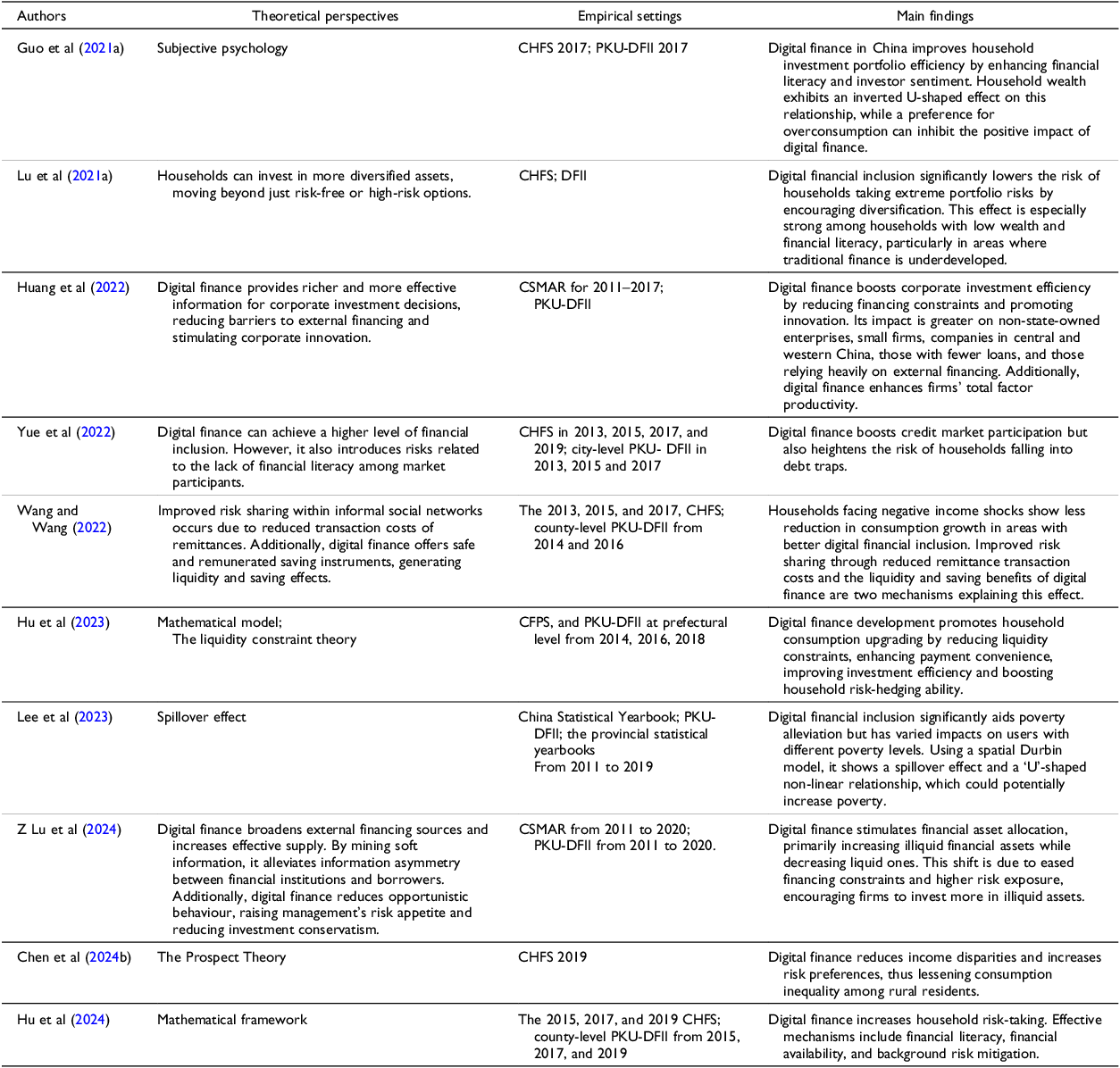
In the empirical analysis, household risk-taking is measured by whether a household possesses any risky financial assets and the proportion of those assets to overall financial assets (Malmendier and Nagel Reference Malmendier and Nagel2011). Studies on household risk-taking include research on risk appetite, risk attitude, and debt risk. Risk appetite is an objective measure compared to the subjective risk attitude, considering the type and level of risk a household is willing to bear. A household’s risk attitude determines the extent of risk it is prepared to take (Shen and Yang Reference Shen and Yang2023). Research on debt risk examines the likelihood of a household falling into a debt trap, with a higher risk-taking attitude indicating a greater likelihood (Yue et al Reference Yue, Korkmaz, Yin and Zhou2022). Campbell (Reference Campbell2006) introduced ‘household finance’, noting that financial investment decisions, including risk-taking, are influenced by family heterogeneity and demographics. Table 1 presents a set of recent studies on digital finance and financial investment.
Studies on digital finance and financial investment
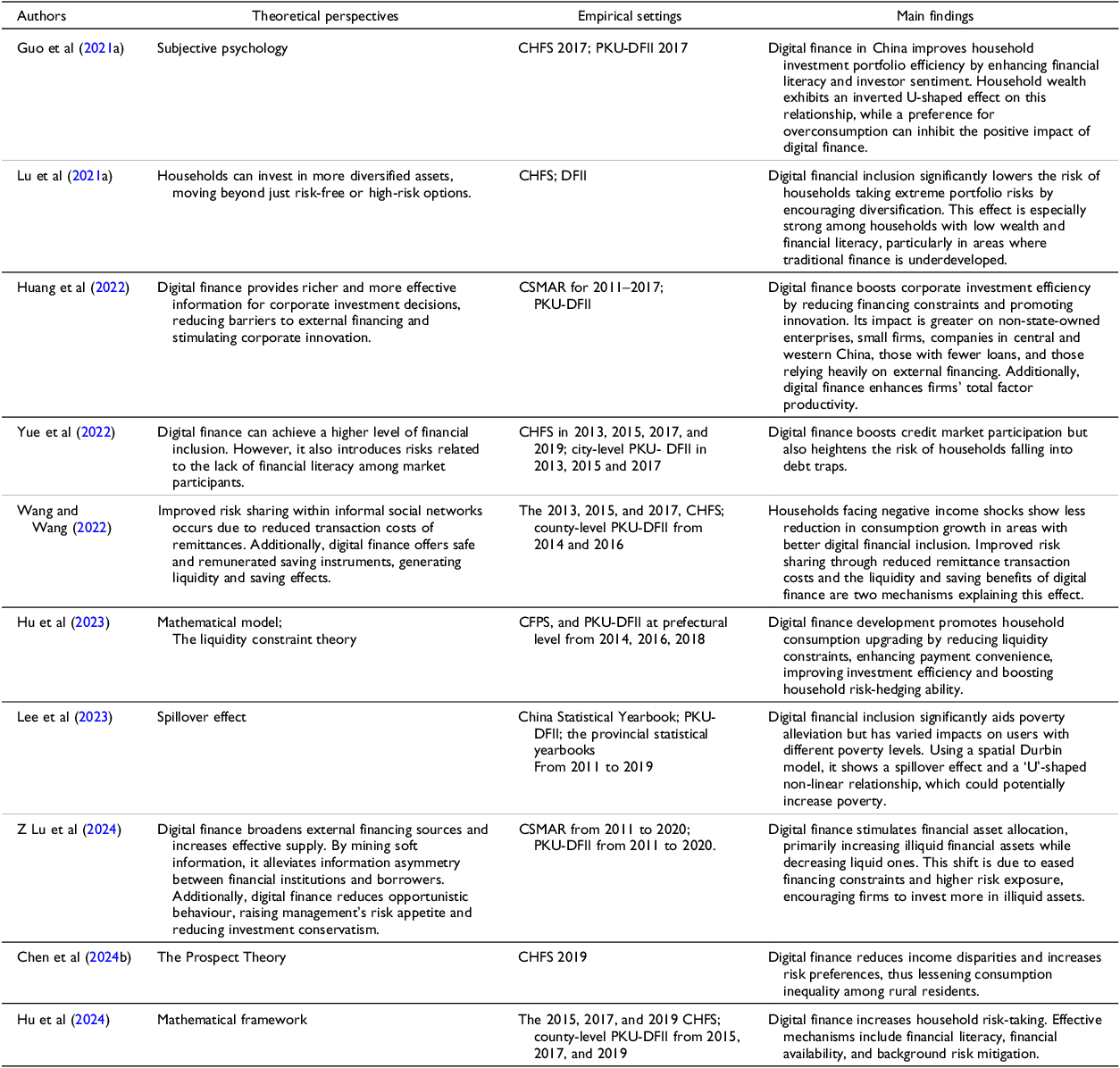
a CSMAR = China stock market and accounting research database. CHFS = China household finance survey. PKU-DFII = digital financial inclusion index by the institute of digital finance of Peking University.
Technological progress has driven the advancement of digital finance, providing new investment opportunities, altering household risk appetite, and changing household risk-taking behaviours (Hu et al Reference Hu, Guo, Shang and Zhang2024). Research shows that the use of digital financial products and services impacts household risk-taking. Most studies suggest that digital finance enhances households’ risk-taking capabilities. Exposure to various financial platforms, such as mobile payments and online shopping, tends to reduce risk aversion and increase risk tolerance (Hong et al Reference Hong, Lu and Pan2020). Households can access credit resources with technical support from banks with efficient information databases, potentially increasing their risk-taking (Björkegren and Grissen Reference Björkegren and Grissen2018). Digital finance encourages more individuals to invest in risky financial assets, leading to a rise in the number of households engaging in such investments (Shen et al Reference Shen, Hu and Zhang2022).
The recent significant rise in household debt has posed a threat to the global economy, drawing attention from policymakers and researchers (Feng et al Reference Feng, Lu, Song and Ma2019). Research has shown that while digital finance broadens credit market participation, easier credit access exposes households to potential debt traps (Yue et al Reference Yue, Korkmaz, Yin and Zhou2022). In particular, people with lower financial literacy who gain access to complex financial products and services are at greater risk (Leong et al Reference Leong, Tan, Xiao, Tan and Sun2017). Therefore, digital finance is more likely to promote household risk-taking in financial investment. Based on this, the following hypothesis is proposed:
Hypothesis 1 There is a positive relationship between digital finance and household risk-taking in financial investment for 996 labourers.
Moderating effects of 996 overwork
The 996 work system, which requires employees to work from 9 am to 9 pm, six days a week, often without overtime pay (Xiao et al Reference Xiao, Silva and Zhang2020), has become prevalent in China’s high-tech industries. 996 overwork is influenced by employees’ beliefs about the outcomes of such a work regime. For instance, employees may perceive long hours as a means to achieve career advancement, financial rewards, or the success of their company. The influence of colleagues, managers, and the broader organisational culture can significantly impact employees’ perceptions of social pressure (Wang Reference Wang2020). If employees perceive that their peers and superiors expect them to work long hours, and if they believe that conforming to these expectations is crucial for job security or career progression, they might feel compelled to adopt the 996 work system.
The 996 work system can decrease the likelihood of households holding risky financial assets. The intense nature of the 996 work system can lead to high levels of stress and fatigue (Chen et al Reference Chen, Masukujjaman, Al Mamun, Gao and Makhbul2023). This might make individuals more risk-averse and reduce their appetite for financial risk-taking. They might prefer safer investment options to avoid additional stress. Furthermore, the long hours associated with the 996 work culture can leave individuals with little time for thorough financial planning and research (Kimura et al Reference Kimura, Bande and Fernández-Ferrín2018). This lack of preparation can result in a more conservative approach to investing. They might feel less confident in making informed, risky investment decisions. Moreover, the demanding work schedule can lead to health issues (Xiao et al Reference Xiao, Silva and Zhang2020). These concerns can increase the need for financial security. Individuals might become more cautious and less inclined to engage in high-risk investments due to potential future medical expenses or the need to support themselves if they cannot work. Accordingly, we propose the following:
Hypothesis 2 The 996 work system weakens the positive relationship between digital finance and household risk-taking investment for 996 labourers.
Moderating effect of fertility intention
Over a household’s lifecycle, changes in family composition (e.g. children growing up and becoming financially independent) can influence risk-taking behaviour. In societies with lower fertility rates, households may have more disposable income and fewer financial obligations related to child-rearing. This can lead to a higher propensity for risk-taking in financial investments. With fewer household members to worry about, labourers might be more willing to invest in stocks, real estate, or other higher-risk assets. In contrast, higher fertility rates often correlate with increased financial responsibilities for more household members (Hosany and Hamilton Reference Hosany and Hamilton2022). Households with more children might prioritise stability and security, leading to a preference for low-risk investments such as bonds, savings accounts, or insurance products. The need to ensure a stable financial future for their children can drive more conservative financial behaviour (Gu and Arends-Kuenning Reference Gu and Arends-Kuenning2022). Financial insecurity and job precarity are increasingly common in China’s urban labour market (Xu et al Reference Xu, Jin, Pun, Guo and Wu2024). These factors have been shown to reduce labourers’ willingness or perceived ability to have children. These factors intersect with cultural expectations around family stability and household financial preparedness, further complicating fertility decisions (Xu et al Reference Xu, Jin, Pun, Guo and Wu2024).
The TPB has seen application in fertility intention. Drawing on the TPB, Chen et al (Reference Chen, Lo, Chen, Chan and Ip2024a) found that, among non-parents, older age and secondary education were linked to lower fertility intention, while being a tenant, having positive attitudes towards marriage and children, and higher family harmony were linked to higher fertility intention. For parents, parenting stress significantly reduces the desire for more children, regardless of finances and family environment. Moridi et al (Reference Moridi, Damghanian and Keshaverz2024) found that the most important factors in a couple’s decision to have children are the intention and a positive attitude towards it.
Changes in fertility can influence household priorities, resource allocation, and risk tolerance in several ways. Households with more children generally need to allocate more resources towards child-rearing expenses such as education, healthcare, and daily living costs (Hosany and Hamilton Reference Hosany and Hamilton2022), which can limit the amount of disposable income available for savings and investment. In addition, families with children often have a longer financial planning horizon, focusing on long-term goals such as funding education and retirement. This extended planning horizon can affect their investment strategies, potentially leading to more conservative choices to ensure stability and security. Moreover, the presence of children can impact a household’s risk tolerance, as parents may become more risk-averse, preferring safer investments to protect their family’s future (Baek and DeVaney Reference Baek and DeVaney2010).
We posit that fertility significantly impacts household risk-taking behaviour in financial investment. Lower fertility intention can lead to increased disposable income and higher risk tolerance, while higher fertility intention often results in more conservative financial behaviour due to greater financial responsibilities. Furthermore, as the number of dependents increases, the time and energy available for investment decreases. This limitation can hinder households from utilising digital finance tools to invest in riskier assets. Therefore, we propose the following hypothesis:
Hypothesis 3 Fertility weakens the positive relationship between digital finance and household risk-taking in financial investment for 996 labourers.
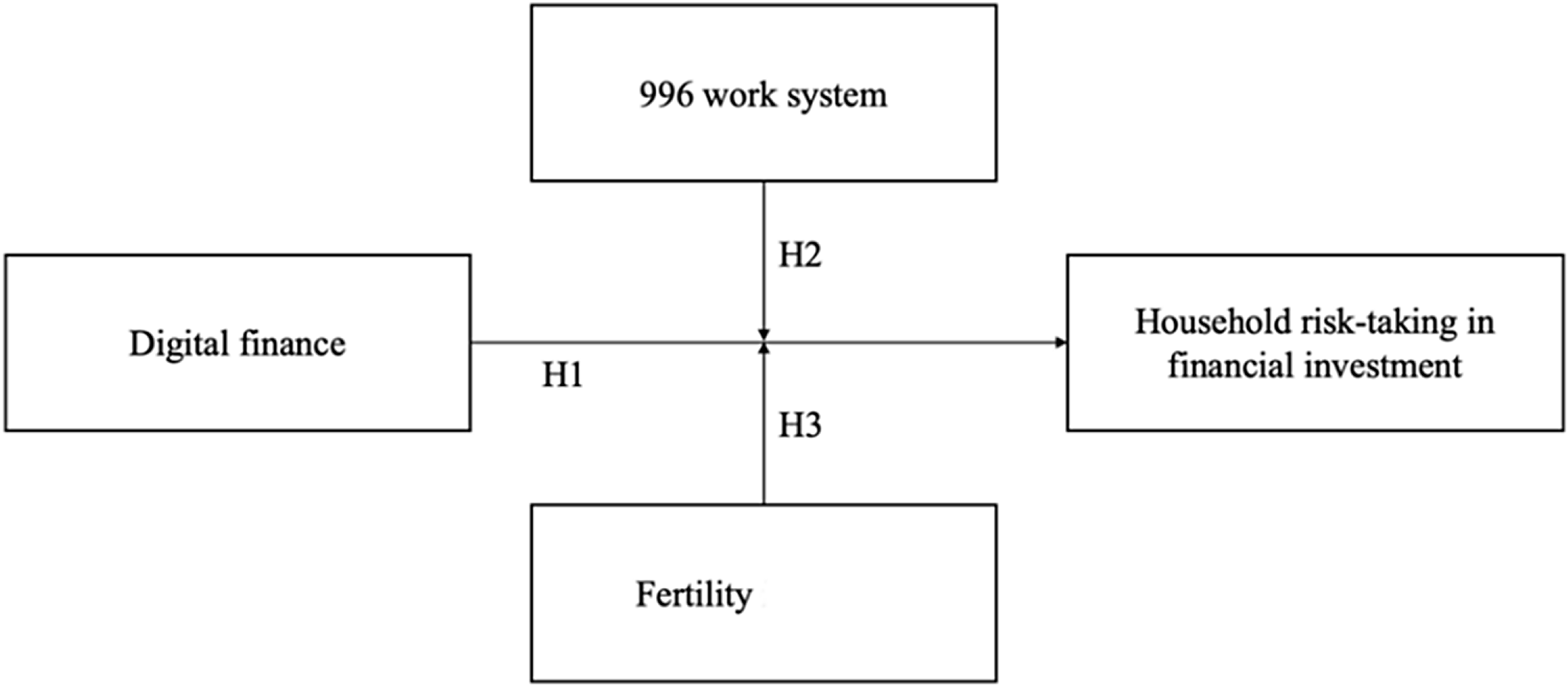
We summarise these theoretical arguments in a conceptual framework in Figure 2.
Conceptual framework (from authors).
Method
Data source and sample
To measure the impact of digital finance on household risk-taking in financial investment, we used secondary data due to the national scope of our research. Collecting primary data from all 31 provinces in China through surveys would be impractical, and our study requires detailed household information, making secondary data more suitable. We obtained data from the China Family Panel Studies (CFPS) and the Digital Financial Inclusion Index (DFII). The CFPS, a biennial longitudinal survey conducted by the China Social Survey Center at Peking University, covers 31 provinces and includes extensive information such as family economic activities, education levels, and health status. The DFII, published by Ant Financial Services Group and Peking University, assesses the progress of digital finance in China. We choose prefectural-level data from 2018 and 2020 in the empirical sections.
The specific processing steps involved four stages. First, we calculated the number of elderly individuals (aged 65 and above) and young individuals (aged 14 and below) in each household and retained the necessary variables from each database. Second, we matched the household head from the family economic database with the corresponding individual database identifier to obtain household head-related variables. Third, we merged the required variables from the family relationship database. Finally, we matched the DFII data with the CFPS data based on the city where the family is located.
Due to missing values in the family data, the final dataset used in our estimations is an unbalanced panel, comprising 7582 household observations for the years 2018 and 2020. We did not impute missing values to avoid distorting the sample. In our sample, the proportion of households with financial assets increased from 4% in 2018 to 7% in 2020. Both the average proportion of financial assets in households and the average total household income rose between 2018 and 2020. The average age of household heads was over 50. On average, household heads had 7 years of education, and about 85% were married.
Dependent variable
According to Hu et al (Reference Hu, Guo, Shang and Zhang2024), risky financial assets include stocks, corporate bonds, financial bonds, funds, financial derivatives, gold, and non-RMB assets. Following Malmendier and Nagel (Reference Malmendier and Nagel2011) and Hong et al (Reference Hong, Lu and Pan2020), we measure household risk-taking using two core dependent variables: the presence of risky financial assets (riskif) and their proportion of the total financial assets (riskratio). To address the potential impact of extreme outliers on riskratio, we winsorised the right tail of riskratio. This method replaces values exceeding the 97.5th percentile with the value corresponding to the 97.5th percentile. riskif is equal to 1 if the household has any financial assets; otherwise, it is 0.
Independent and moderator variables
Digital finance (df) . Digital finance can be defined as a financial system that effectively and comprehensively provides services to all social classes and groups (Guo et al Reference Guo, Wang, Wang, Chen, Li and Wang2021). We use digital finance (df) as the proxy for the core independent variable, measuring the level of digital financial development (Hu et al Reference Hu, Zhai and Zhao2023). This variable is sourced from the Peking University Digital Inclusive Finance Index (2011–2020), released by Peking University’s Digital Finance Research Center. The index encompasses three dimensions of digital financial services: breadth of coverage (Bread), depth of usage (Depth), and degree of digitisation (Dig). In this study, the overall index is primarily used for regression analysis, while the sub-indices of the three dimensions are employed for robustness checks (Shen et al Reference Shen, Qin, Li, Zhang and Zhao2024). Moreover, all indices are logarithmically transformed at the prefectural level to maintain consistent statistical standards (Hu et al Reference Hu, Zhai and Zhao2023).
996 work system (996). The 996 work system is defined as working from 9 am to 9 pm, six days a week, without extra pay for those extra hours (Wang Reference Wang2020). Working more than 9 hours reduces workers’ job satisfaction, and these reductions are even greater among those working more than 12 hours (Zheng et al Reference Zheng, Vatsa, Ma and Zhou2023). Therefore, we utilise a binary variable that indicates whether the household head works more than 72 hours a week in one job. ‘Yes’ is recorded as 1, and ‘No’ is recorded as 0 (Li and Zhang Reference Li and Zhang2024).
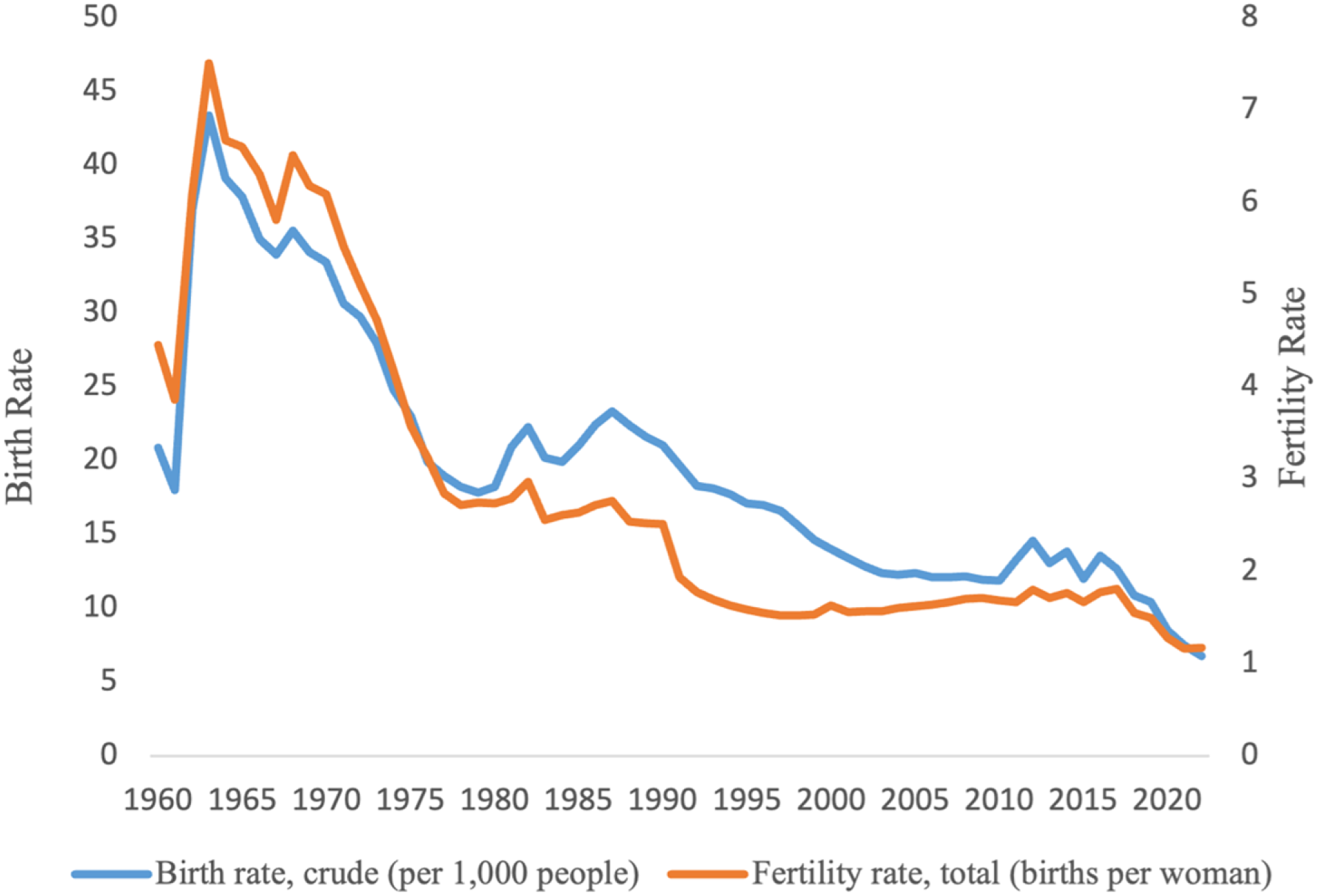
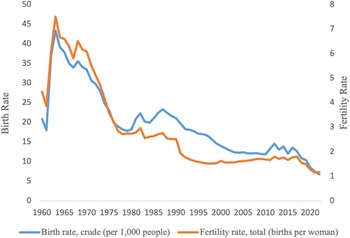
Fertility (birthrate) . The birthrate variable is defined as the total number of births divided by the total population, multiplied by 1000, to obtain the number of births per 1000 people (S Huang et al Reference Huang, Wu and He2024). Generally, the crude birth rate and total fertility rate per woman are two common measures of fertility. We use the birth rate at the provincial level as the proxy because it is more readily available and consistently reported across provinces, ensuring data reliability and comparability. Moreover, China’s crude birth rate and total fertility rate exhibit similar trends (Figure 3).
China’s birth rate and fertility rate from 1960 to 2020.
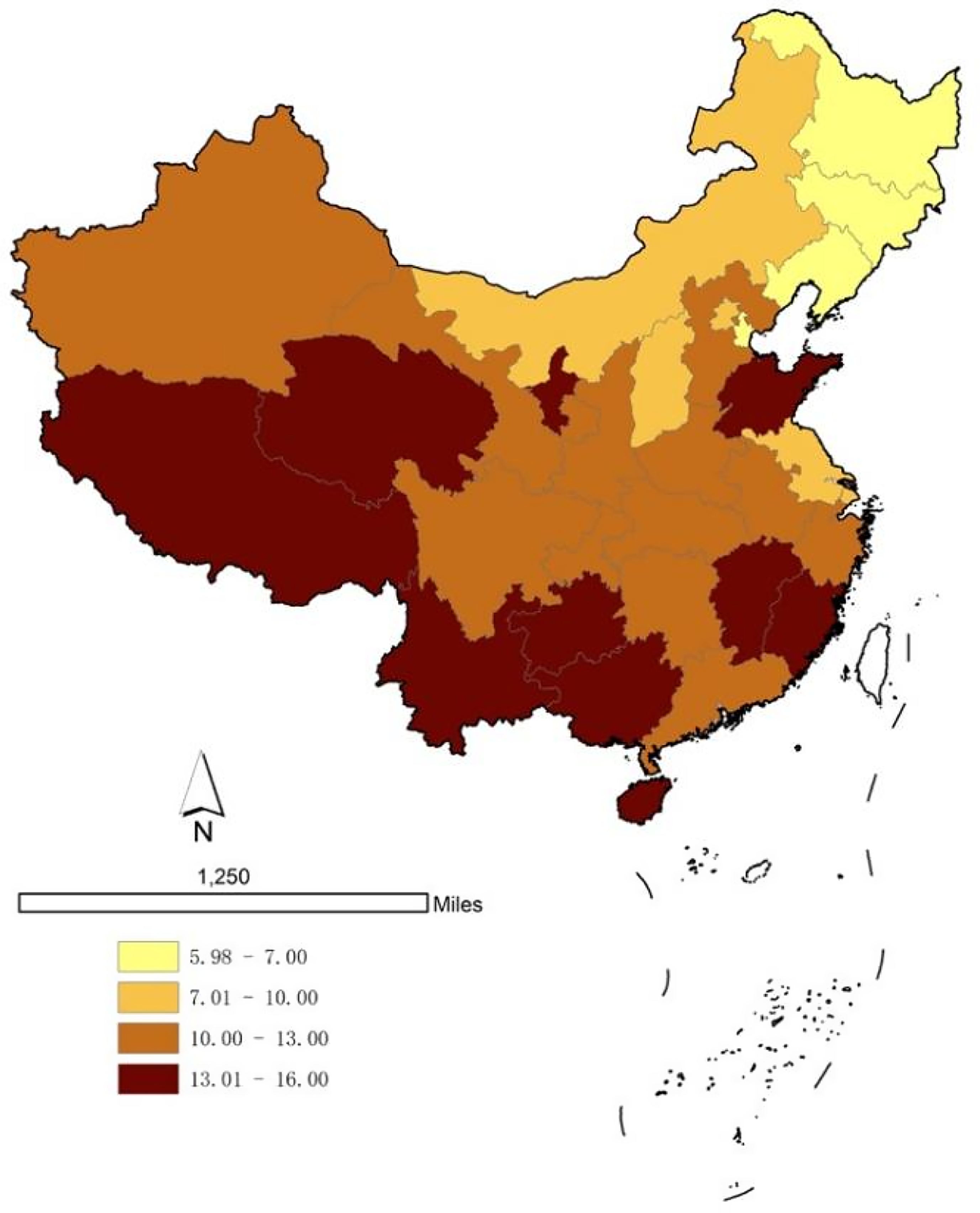
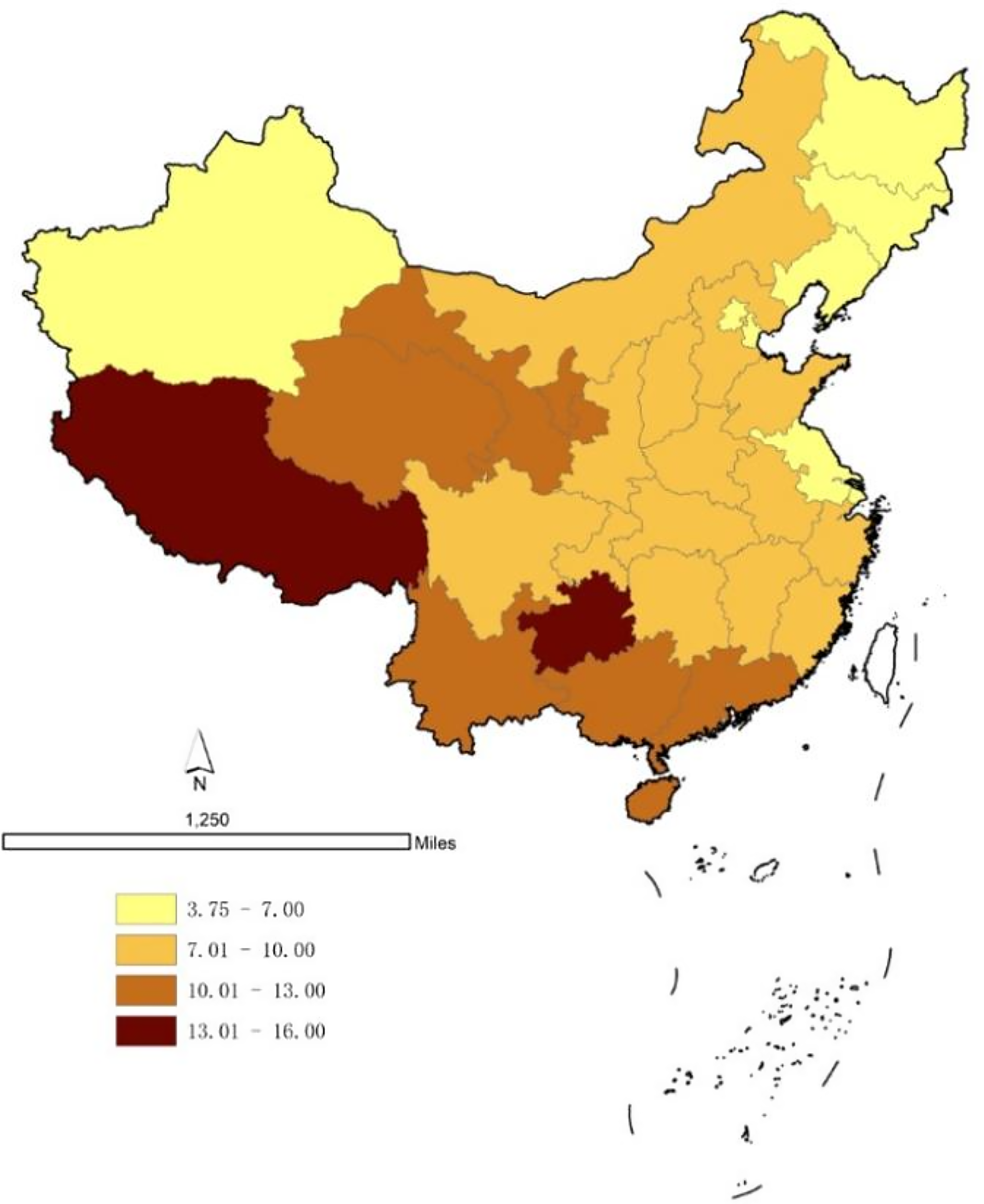
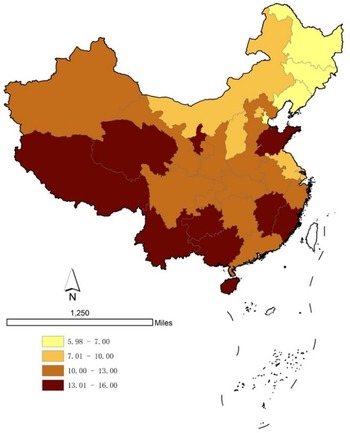
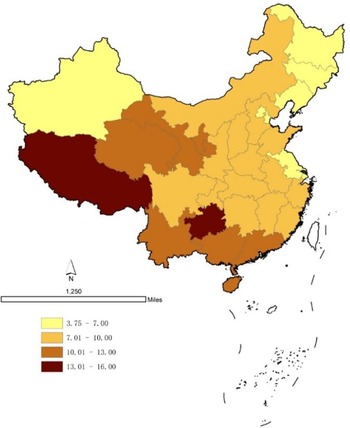
The data for this variable were gathered from the National Bureau of Statistics, which provides comprehensive and standardised demographic statistics for all provinces. Figure 4 and Figure 5 display the birth rate of all provinces in 2018 and 2020. In both years, the birth rate is relatively higher in Guizhou and Xizang. This pattern reflects the close relationship between birth rate and economic levels, with economically poorer areas showing higher birth rates.
Birth rate in 2018.
Birth rate in 2020.
Control variables
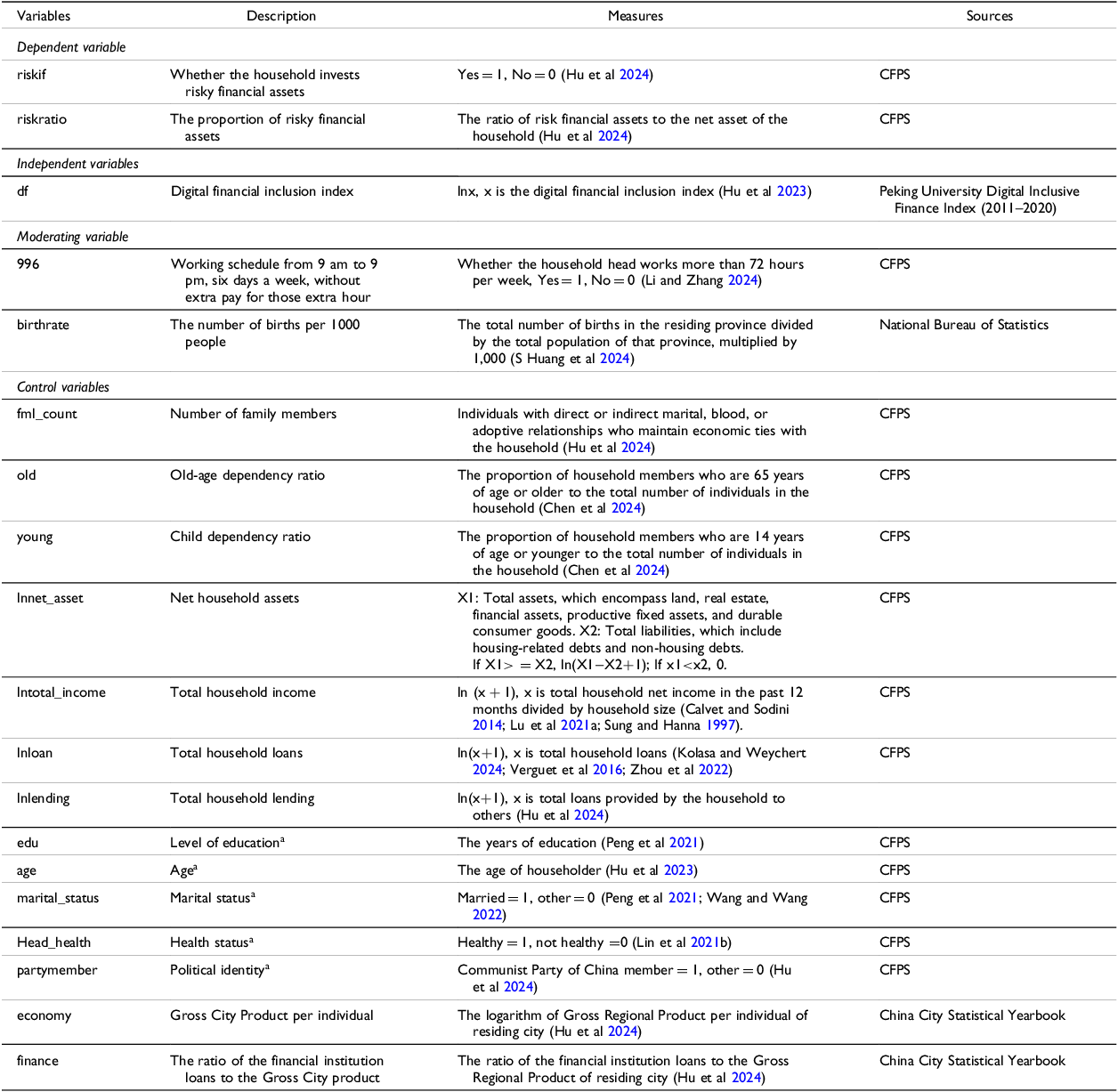
We control for the age of the household head in our analysis. As age increases, individuals tend to become more risk-averse (Karl Reference Karl2016). This trend is driven by the need to save more income for future retirement and medical expenses (Hu et al Reference Hu, Zhai and Zhao2023). Digital financial development enables convenient access to various financial services through the Internet, revolutionising sectors such as lending. This transformation offers new investment opportunities, altering household risk appetite, and influencing household risk-taking (Hu et al Reference Hu, Guo, Shang and Zhang2024). Therefore, we control lending in our analysis. Here, we define lending as the logarithm of the amount of money others owe to the household. We summarise other major variables, measurements, and information sources in Table 2.
Measures and sources of major variables
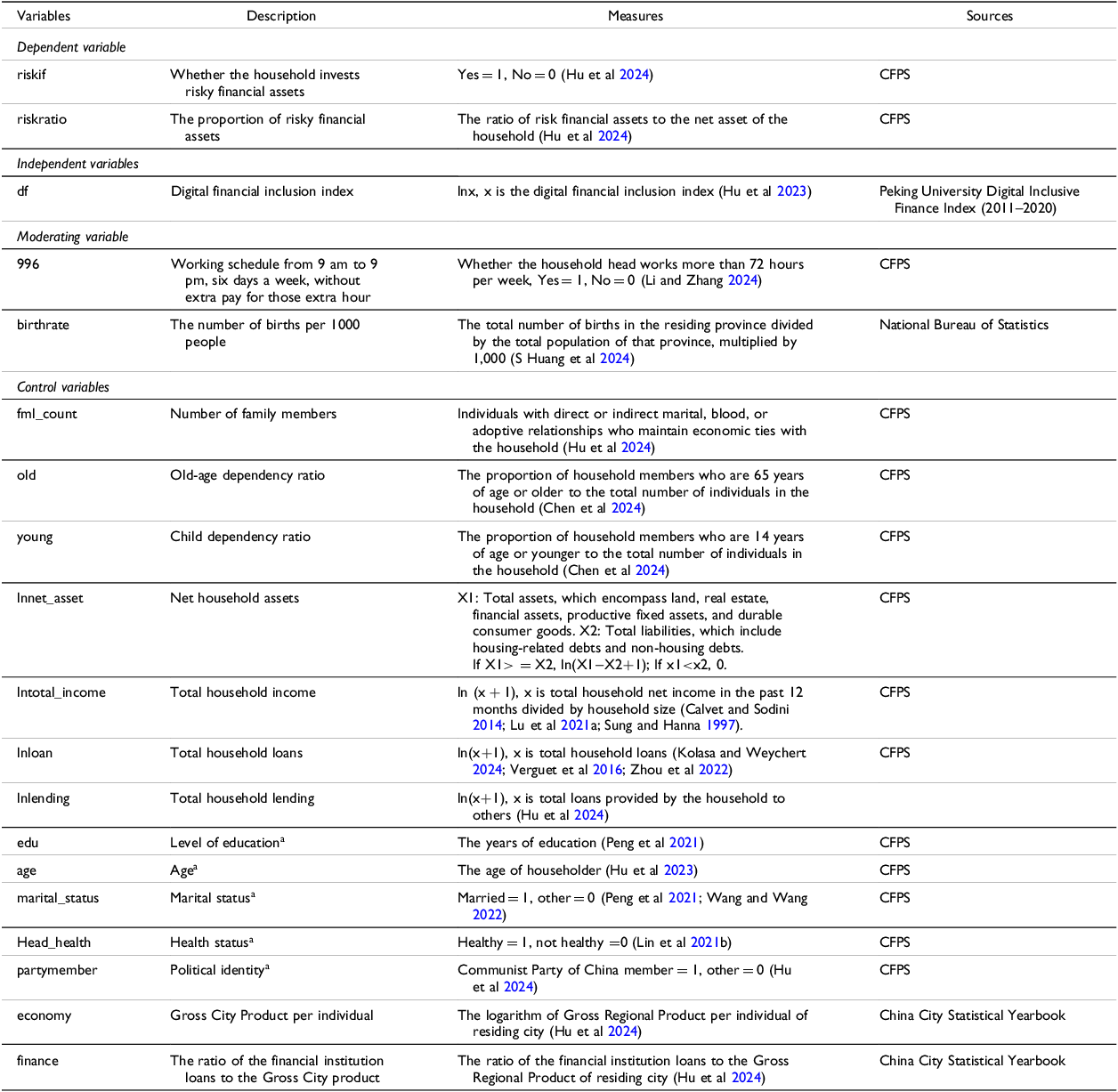
a Note: Suggests that the variable is measured at the household head level.
Analysis
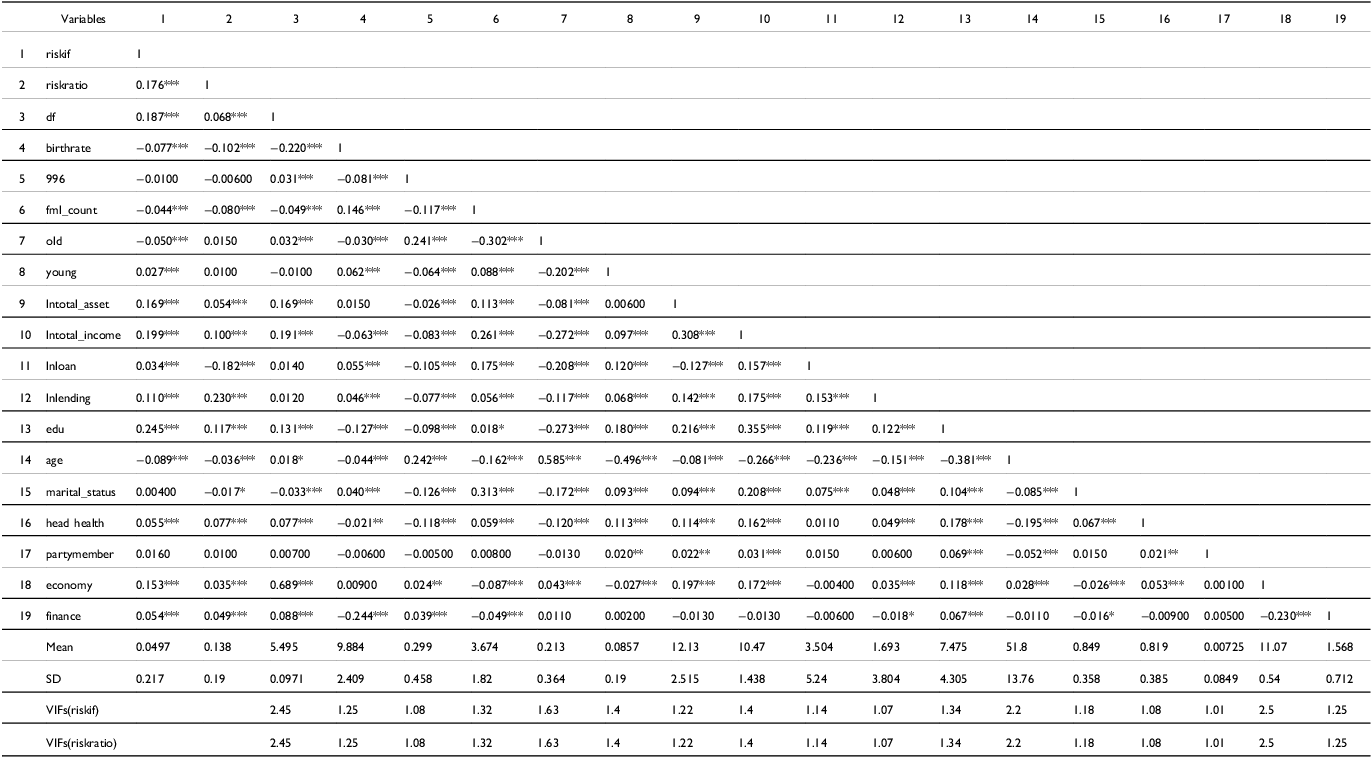
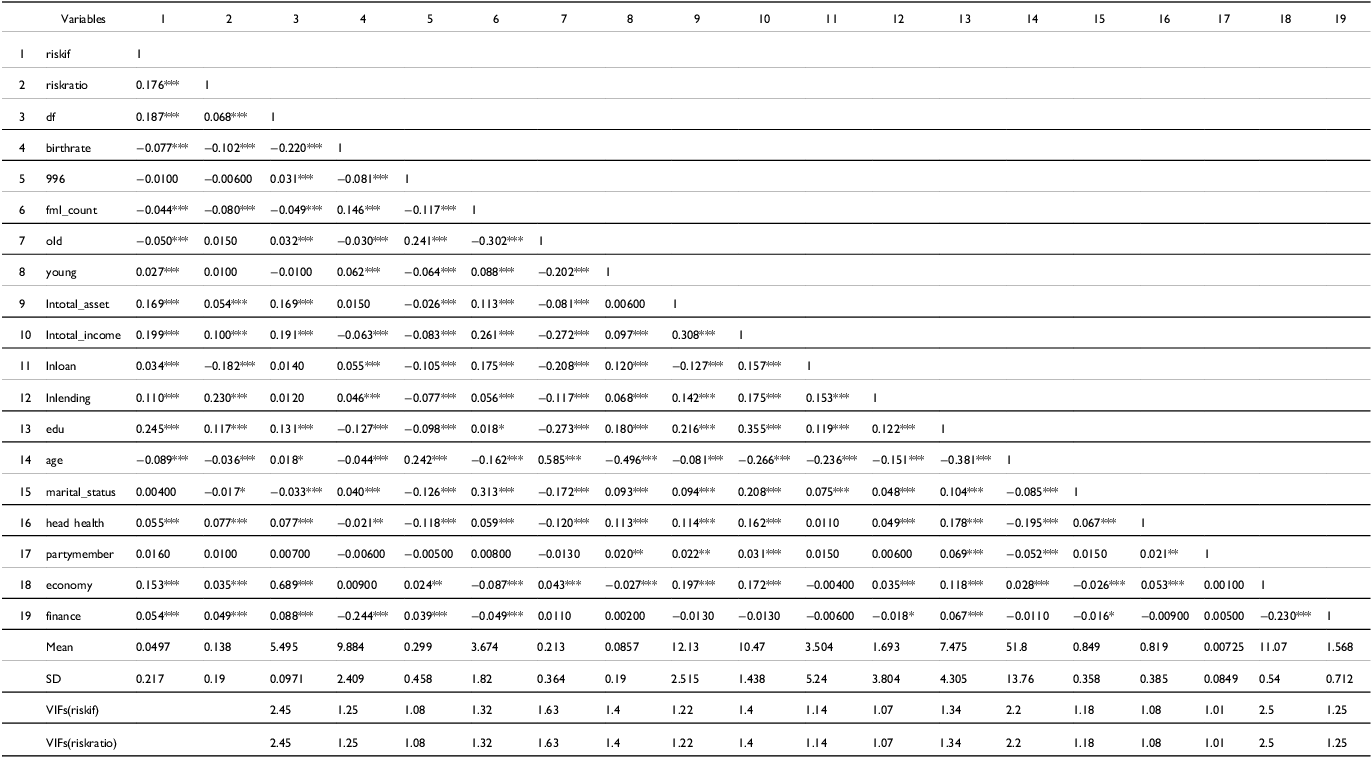
Table 3 presents descriptive statistics and correlations among the main variables. A notable correlation was observed between economy and df (r = 0.69, p < 0.01). The mean VIF value was 1.44, with the maximum VIF value at 2.50, both well below the recommended threshold (Hair Reference Hair2009), indicating no significant multicollinearity concerns (O’brien Reference O’brien2007).
Descriptive statistics and correlation matrix (N = 7,582)
Estimation
To examine the relationship between digital finance and household risk-taking in financial investment, we use a fixed effects panel regression model. It is specified as follows:
 $$Risktakin{g_{it}} = {\beta _0} + {\beta _1}d{f_{it}} + {\beta _2}{X_{it}} + {\beta _3}{Y_{it}} + {\beta _4}{Z_{it}} + {\mu _i} + {\varepsilon _{it}} (1)$$
where i represents the family and t represents the year. $\beta $
is the coefficient, and
$\beta $
is the coefficient, and ${\varepsilon _i}$
. is the error term. df
it
is the digital financial inclusion index of the prefecture where household i resides in year t. We also include a series of control variables that existing literature suggests are correlated with household risk-taking in financial investment. X represents the family characteristics, and Y refers to the individual characteristics of the household head. Z represents the district’s economic and financial conditions.
${\varepsilon _i}$
. is the error term. df
it
is the digital financial inclusion index of the prefecture where household i resides in year t. We also include a series of control variables that existing literature suggests are correlated with household risk-taking in financial investment. X represents the family characteristics, and Y refers to the individual characteristics of the household head. Z represents the district’s economic and financial conditions.
Results
Hypothesis tests
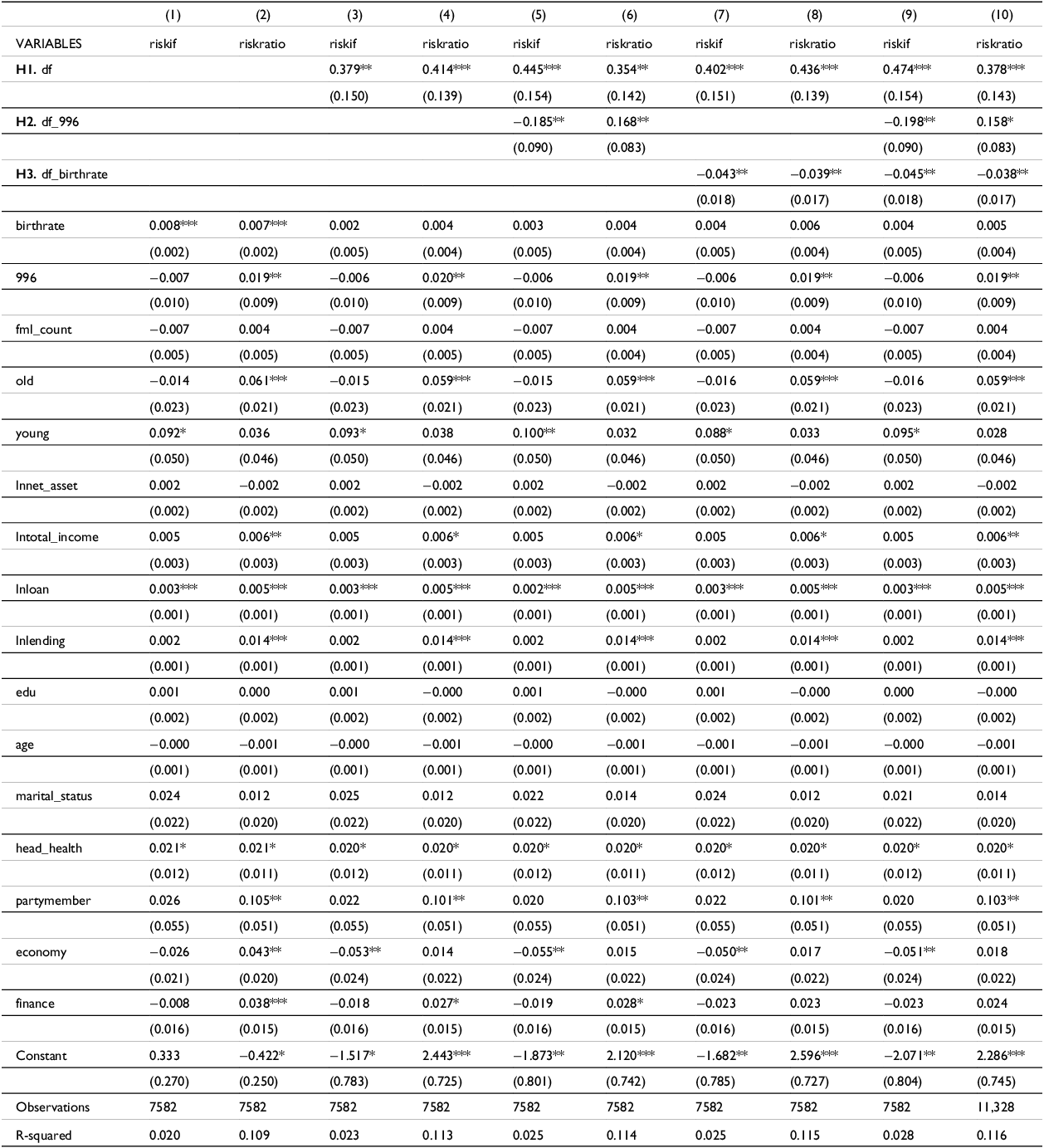
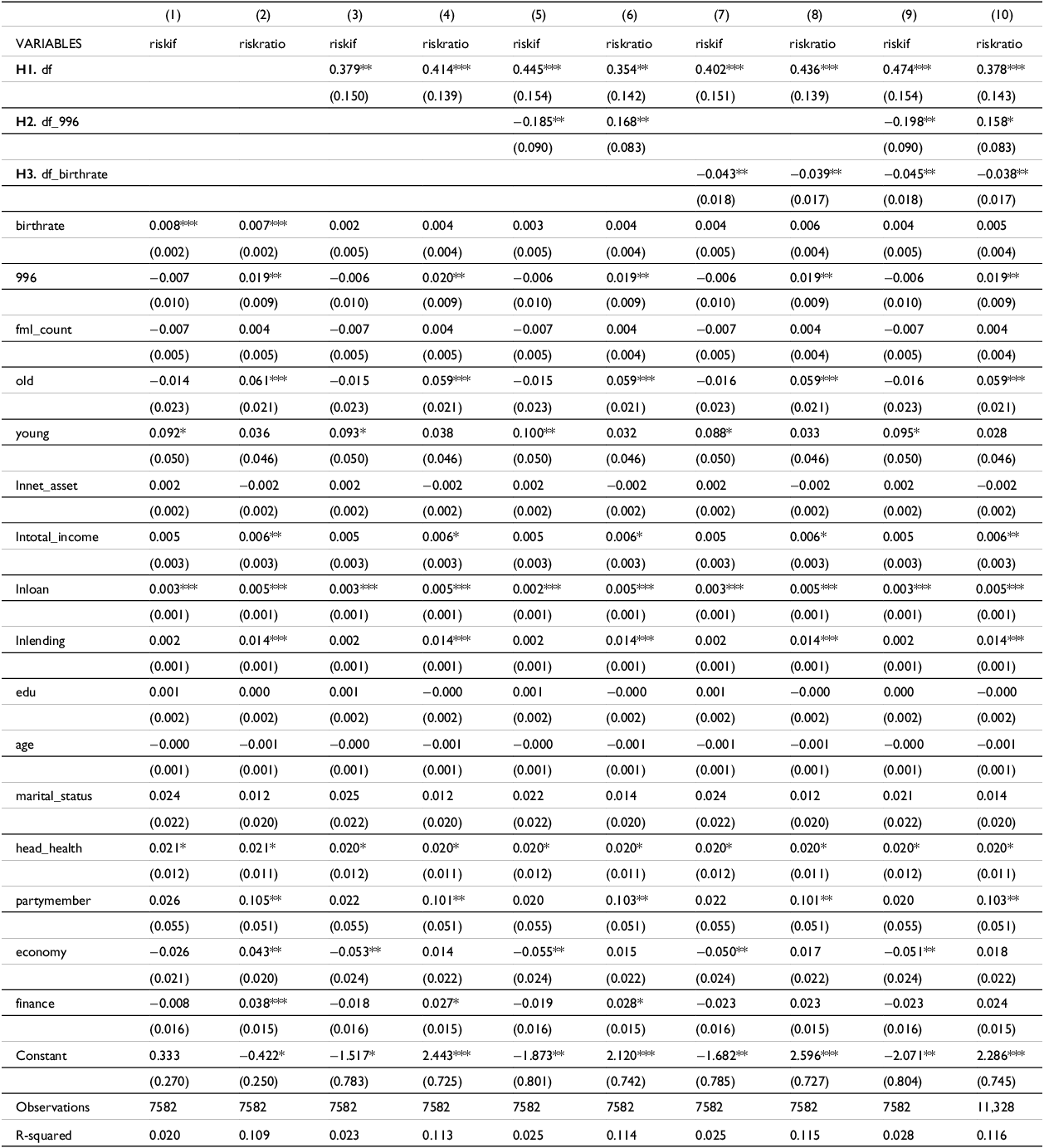
Table 4 presents the results from the fixed effect. In column 1 and column 2, the regression model includes only the control variables. Columns 3–8 include the tests of Hypothesis 1, 2, and 3, respectively. Column 9 and column 10 are the full model including all variables and interaction terms.
The association of digital finance with household risk-taking
Standard errors in parentheses.
*** p < 0.01, ** p < 0.05, * p < 0.1.
Column 3 and column 4 include df to test H1. Specifically, as digital financial inclusion index increases, household risk-taking in financial investment is likely to increase. The coefficient of riskif is 0.379 and significant at the 1% level. Similarly, the coefficient of riskratio is 0.414 and significant at the 1% level. Columns 5–10 provide consistent findings. These results, therefore, lend strong support to H1.
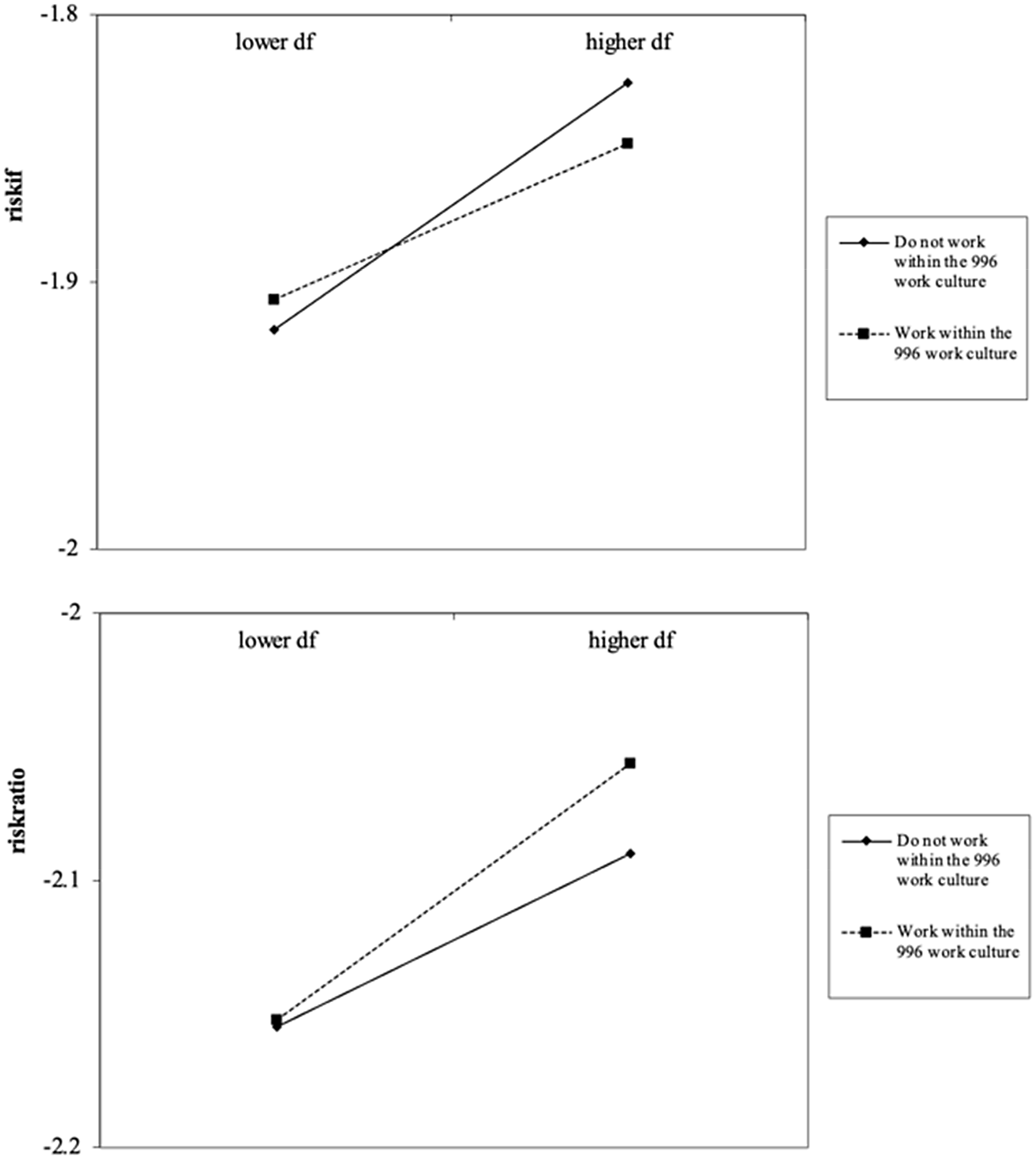
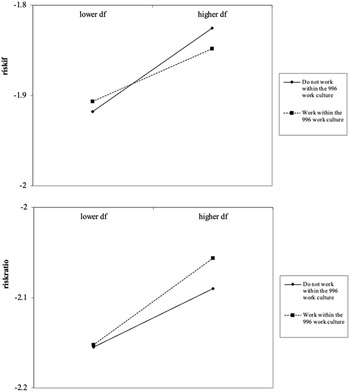
Column 5 and column 6 test H2 by including the interaction term between df and 996. Hypothesis 2 proposes that the 996 work system weakens the positive relationship between digital finance and household risk-taking in financial investment. Column 5 shows a negative and significant coefficient of this variable (β = −0.185, p < 0.05). But column 6 shows a positive and significant coefficient of this variable (β = 0.168, p < 0.05). We also obtained consistent results in columns 9-10.
For those who already engage in risky investments, the increased financial capacity can lead to a greater willingness to invest in riskier financial assets (Lu et al Reference Lu, Guo and Zhou2021a). Employees in the 996 work system are typically in technology-driven industries. According to the 2023 report, technology-driven industries have the highest average annual salaries among urban employees. Thus, employees in these industries have more disposable income to allocate towards investments. Furthermore, they are more likely to be comfortable with digital finance tools, which reduces perceived barriers to using digital finance for investment purposes and promotes risk-taking.
Figure 6 illustrates that for households engaged in the 996 work system, the positive relationship between digital finance and whether the household invests in risky financial assets becomes stronger. As households work within the 996 work system, the positive relationship between digital finance and the proportion of risky financial assets weakens.
The effect of 996 Overwork on the relationship between digital finance and household risk-taking in financial investment.
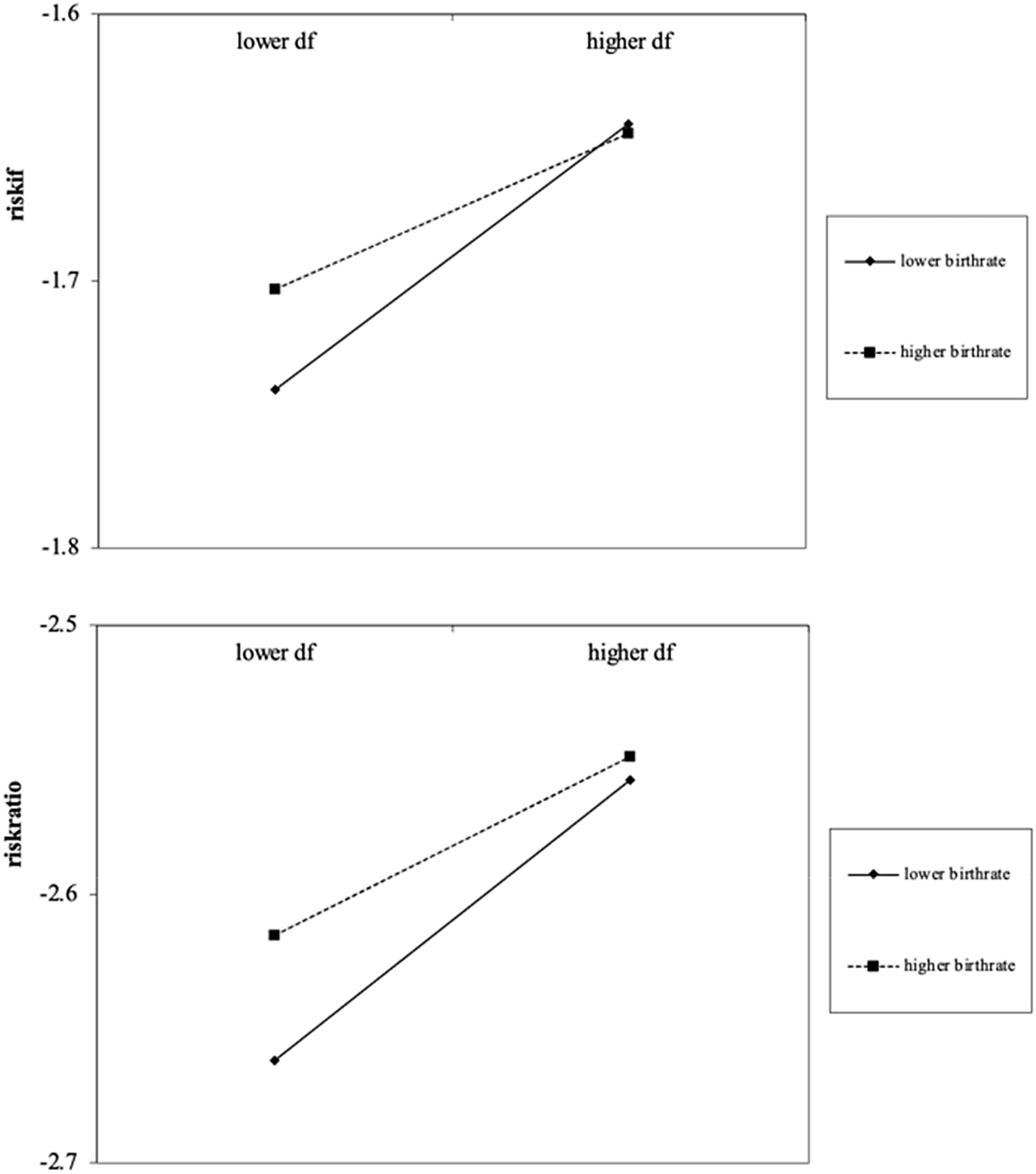
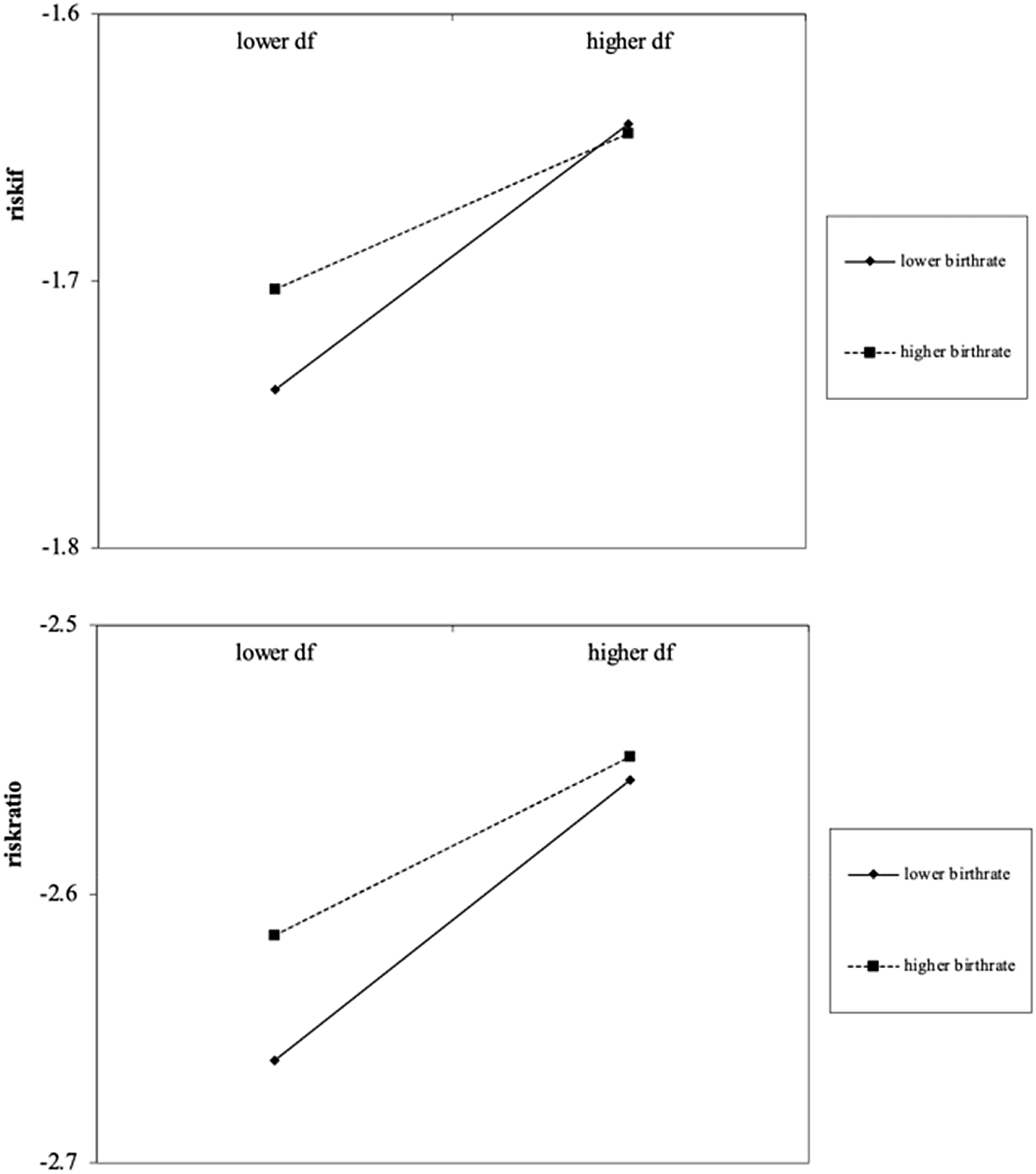
To examine Hypothesis 3, we tested the interaction term of digital finance and birth rate in column 7 and column 8 in Table 4.1. Our findings reveal that the moderating effect of birth rate is negative and marginally significant. As depicted in Figure 7, as the birth rate increases, the positive relationship between digital finance and whether the household invests in risky financial assets weakens. As the birth rate rises, the positive link between digital finance and the proportion of risky financial assets becomes weaker. These results are consistent with those shown in column 9 and column 10, thereby supporting H3.
The effect of birth rate on the relationship between digital finance and household risk-taking in financial investment.
Robustness check
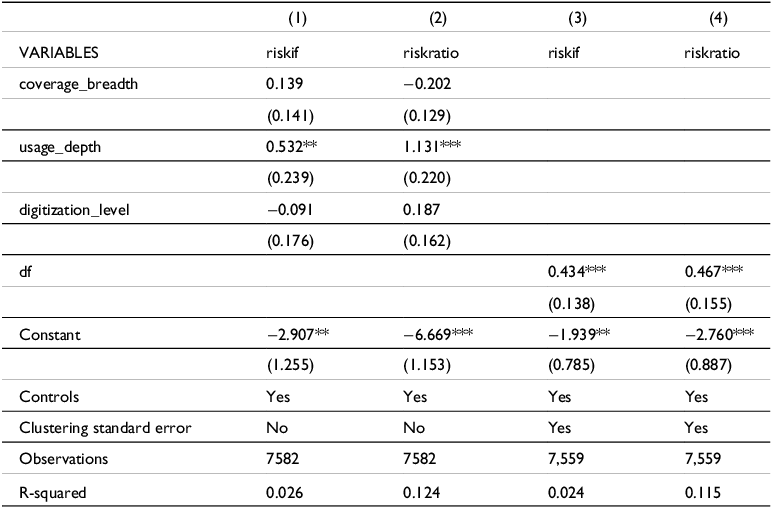
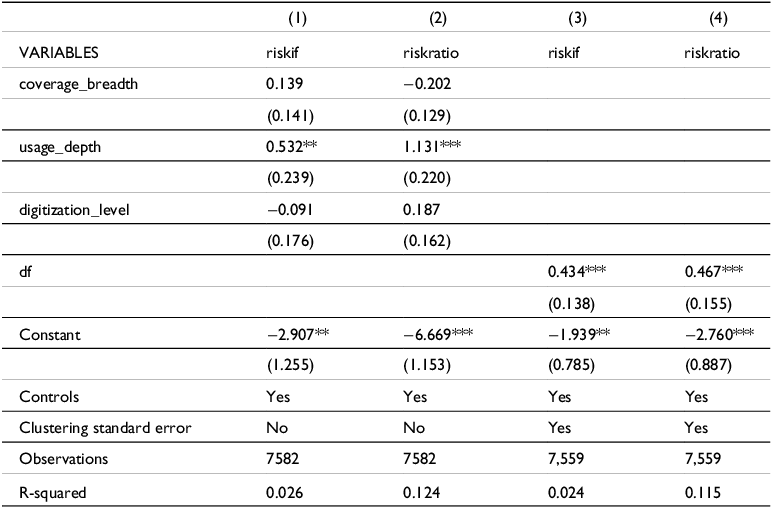
To ensure the reliability of our findings, we performed two sets of additional tests: substituting the core explanatory variable with alternative proxies (Shen et al Reference Shen, Qin, Li, Zhang and Zhao2024), and considering cohort effects (Chen et al Reference Chen, Mao and Huang2024). Table 5 shows the robustness tests in this study.
Robustness testing
Standard errors in parentheses.
*** p < 0.01, ** p < 0.05, * p < 0.1.
First, we introduce three sub-indices of the Digital Inclusive Finance Index as alternative proxies for digital finance. The three sub-indices are the digital financial coverage breadth index (Bread), digital financial usage depth index (Depth), and inclusive finance digitisation level index (Dig) (Guo et al Reference Guo, Wang, Wang, Chen, Li and Wang2021). The results of column 1 and column 2 are presented, indicating that the digital financial usage depth index has a substantial positive impact on household risk-taking in financial investment. Thus, the results further support the robustness of the baseline results.
Furthermore, given that the geographical proximity of groups can lead to similar investment preferences and habits due to cohort effects, these effects at the county level are taken into account. The estimation includes standard errors clustered at the county level to control for these cohort effects, and the results remain robust. Overall, the findings presented in Table 5 exhibit coherence with those outlined in Table 4.
Endogeneity
We identify the omission of key explanatory variables and the presence of reciprocal causality as critical sources of endogeneity. Household risk-taking in financial investment prevailing might potentially arise from latent factors, while omitting them may lead to estimation bias. Moreover, households that engage more in risky financial investments might seek out and adopt digital finance tools to manage and monitor their investments better. In this section, we employ the IV method to mitigate potential endogeneity issues, ensuring the robustness of our findings.
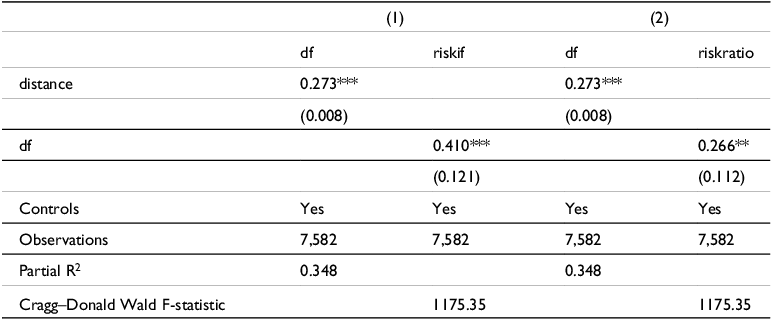
Some scholars use the spherical distance between a household’s region and HangzhouFootnote 1 as an instrumental variable (IV) (Hong et al Reference Hong, Lu and Pan2020; Hu et al Reference Hu, Guo, Shang and Zhang2024). However, the digital financial inclusion variable varies over time, while the selected IV does not, making the standard second-stage estimation invalid. Therefore, following Lu et al (Reference Lu, Guo and Zhou2021a), we use the product of the spherical distance and the mean provincial digital financial development index as a time-varying IV.
Instrumental variables must be exogenous, correlated with the endogenous variables, and uncorrelated with the error term of the explanatory equation. The linkage between digital finance and the digital economy, and the spillover effect from Hangzhou, support this. In addition, the distance between a household’s city and Hangzhou is not inherently linked to household risk-taking.
Table 6 shows the first and second stages of the 2SLS estimation. After using the instrumental variable, digital finance still has a significant positive influence on household risk-taking in financial investment. The Cragg-Donald Wald F-statistic is 1175.35, far exceeding the critical value of 16.38 at the 10% significance level, indicating that distance is a strong instrument for household risk-taking. Thus, distance as an IV meets the exclusion restriction criterion, as supported by both statistical metrics and theoretical rationale.
Endogenous testing
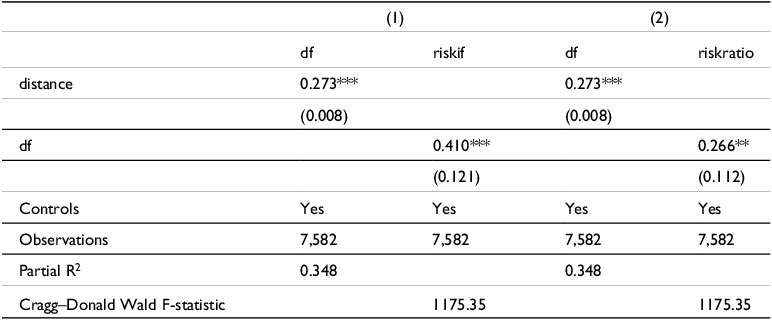
Standard errors in parentheses.
*** p < 0.01, ** p < 0.05, * p <0.1.
Heterogeneity
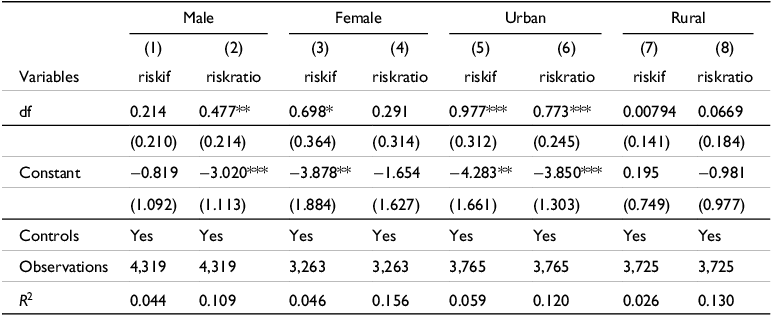
To investigate the potential heterogeneous effects of digital finance on household risk-taking in financial investment across different groups, we categorised the samples based on regional settings and the gender of the householder (Table 7).
Heterogeneous analysis
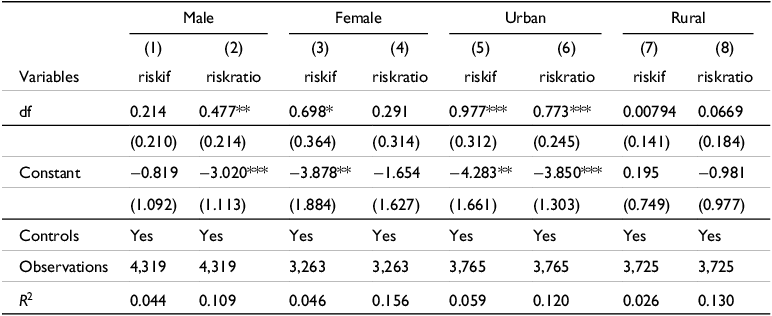
The gender of the head of the household has received considerable attention in research. Women are usually more risk-averse than men, especially when encountering physical threats (Williams and Baláž Reference Williams and Baláž2014). Among samples with female householders, digital finance positively impacts the presence of risky financial assets (b = 0.698, p < 0.10). Among samples with male householders, digital finance positively impacted their proportion of the total financial assets (b = 0.477, p < 0.05).
In China, cities generally have higher levels of economic development than rural areas (Lin et al Reference Lin, Qin, Li and Wu2021b). In urban areas, it was found that digital finance positively and significantly influences household risk-taking in financial investment. However, it did not exhibit significance in rural areas.
Discussion
This study leveraged the TPB to explore how digital finance influences household risk-taking behaviour among overworked labourers, particularly in the context of China’s 996 work culture and shifting fertility intentions. We test hypotheses in the context of Chinese households.
Our findings affirm that digital finance platforms, due to their convenience, accessibility, and automation, positively influence risk-taking behaviours by enhancing perceived behavioural control (Hu et al Reference Hu, Guo, Shang and Zhang2024). Labourers under time constraints, such as those in the 996 system, cannot often seek traditional financial advice or conduct a comprehensive analysis of financial products. Digital tools reduce these frictions, increasing the sense that one can participate in financial markets despite structural constraints (X Lu et al Reference Lu, Zhang, Guo and Yue2024). This echoes existing research that links fintech accessibility to increased financial inclusion and participation (Shen et al Reference Shen, Hu and Zhang2022).
However, our findings further uncover that the 996 work system emerges as a double-edged sword. On the one hand, it negatively moderates the relationship between digital finance and the presence of risky financial assets. This is because the intense 996 work system creates high levels of stress and fatigue (Chen et al Reference Chen, Masukujjaman, Al Mamun, Gao and Makhbul2023). Long working hours can deplete cognitive resources and emotional energy. As a result, individuals may adopt more conservative financial behaviours as a way to minimise perceived risks in other life domains. Overworked individuals often lack the time and mental capacity to explore and evaluate complex investment opportunities. Therefore, they may opt for safer, more familiar financial investment options. Consequently, individuals are more likely to be risk-averse and less likely to initiate risky investments. They prefer safer investment options to avoid additional stress. This aligns with TPB’s emphasis on attitudes: when energy and time are limited, people develop more conservative orientations towards non-essential risk (Lynne et al Reference Lynne, Casey, Hodges and Rahmani1995). Moreover, our findings suggest that overwork can decrease financial decision-making confidence, reducing perceived control even in the presence of digital tools.
On the other hand, for those already invested in risky assets, the 996 context can amplify the intensity of financial engagement. High and stable incomes (often associated with tech jobs under the 996 system) provide the financial means to allocate a larger share of assets to high-risk investments. In these cases, digital literacy and financial autonomy, fostered by both the work environment and digital finance platform use, contribute to restoring a sense of behavioural control (Kumar et al Reference Kumar, Pillai, Kumar and Tabash2023). Increased financial capacity from higher salaries in technology-driven industries, where the 996 work system prevails, boosts willingness to invest in riskier financial assets (Lu et al Reference Lu, Guo and Zhou2021a).
Fertility further weakens the relationship between digital finance and household risk-taking in financial investment. An increased number of children will limit the time and energy available for investing, further hindering the use of digital finance tools for riskier investments. Here, both subjective norms and social norms regarding having children and parenting, and risk-averse attitudes, become more salient. As family obligations grow, especially under rising childcare costs and diminishing state support (Hosany and Hamilton Reference Hosany and Hamilton2022), households tend to adopt more conservative financial behaviours (Baek and DeVaney Reference Baek and DeVaney2010).
These findings also speak to broader scholarship debates in labour relations and the economy. While digital finance is often hailed as a democratising force (Bernards Reference Bernards2023), our results suggest that labour regimes such as the 996 system constrain how this potential is realised. We argue that structural work conditions, not just individual traits, shape who can access financial opportunity and under what circumstances. Thus, digital inclusion without labour protection may reproduce or even deepen financial inequalities.
Theoretical contribution
This study contributes to emerging scholarship on labour relations and economics by showing that financial decision-making is not merely a function of individual rationality, but is deeply embedded in power-laden work structures and family responsibilities. Specifically, we shed light on the lived realities of 996 labourers in China. They are individuals who are often too exhausted and financially burdened to consider childbearing or engage meaningfully in long-term financial planning. The study makes two key contributions: First, we extend the TPB to the context of labour overwork, marking what we believe to be the first empirical application of TPB to the 996 work culture. While prior studies have largely focused on organisational outcomes, particularly highlighting the impact of the 996 overwork culture on unenforced labour rights to impose harsh working conditions (Wang Reference Wang2020), workers’ productivity and innovation (Yang et al Reference Yang, Liu and Deng2021). However, these studies typically limit their scope to workplace dynamics. By contrast, our study broadens this lens to examine how the 996 overwork shapes workers’ family lives, particularly in relation to fertility intentions and household financial behaviours.
Second, our study is a pioneering research to examine 996 overwork and digital finance. By connecting digital financial participation with overwork and fertility constraints, our work introduces a novel framework for understanding how structural labour conditions shape perceived behavioural control, social norms, and attitudes towards financial and family-related risks. This integrative perspective enhances TPB by embedding it within a socio-economic context marked by 996 overwork. Our research offers a more holistic account of decision-making under constrained agency. Family influence plays a crucial role in shaping these investment behaviours (Li et al Reference Li, Wu and Xiao2020). If a family’s social network holds a positive view of investment and encourages participation, labourers may experience social pressure to conform, increasing their likelihood of investing. Conversely, if their social network is risk-averse and discourages digital finance investments, individuals are less likely to engage in such activities (Sikarwar Reference Sikarwar2019). Generally, a positive attitude towards investment, strong social support, and a high level of perceived behavioural control contribute to a stronger intention to invest.
Practical implications
Our research findings provide managerial insights for financial institutions, educators, and policymakers to design interventions and strategies that effectively promote fertility and healthy family household investment behaviours by overworked labourers. For policymakers, our findings highlight the importance of the 996 work system and fertility as significant factors influencing the relationship between digital finance and household risk-taking in financial investment. In this sense, policymakers should consider the impact of fertility on financial behaviour when designing family support programmes. Policies that alleviate financial pressure on families could encourage more balanced risk-taking in investments, contributing to overall economic growth.
We further call financial institutions’ attention to the effect of jobs. This study demonstrates that the 996 work system significantly and negatively impacts the presence of risky assets in households, suggesting that intense demands and stress associated with 996 overwork prevent households from initiating risky investments. Simplifying the investment process and providing tools and resources that facilitate easy access to investment platforms can enhance perceived behavioural control. Online trading platforms, investment apps, and accessible financial advisory services can lower the barriers to investing. Financial advisors need to consider fertility and family composition when advising clients. Tailored investment strategies that account for the number of dependents and future financial needs can help optimise risk-taking behaviour.
Moreover, educators can develop targeted financial literacy programmes that address the specific needs of households in high-pressure overwork environments. Improving financial literacy can positively impact attitudes and perceived behavioural control. Educational programmes can help potential investors understand the risks and benefits of various digital investment options, thereby shaping favourable attitudes and enhancing their confidence in making investment decisions. Financial literacy programmes that address the specific needs of families at different stages of the life cycle can help households make informed investment decisions. Understanding the trade-offs between risk and return, and how these relate to family size and future financial obligations, is crucial.
Limitations and future research directions
Our study concludes with some limitations, suggesting avenues for further research. Given the unique exploratory nature of China’s modern labour, we do not tend to generalise our findings to contextual settings of other countries. More research on overworked labour under the 996 system is needed to better understand the complex dynamics of China’s labour history. Future research should also explore additional potential mediators, such as personal characteristics of labourers or other micro-level factors, to provide a more comprehensive analysis. In addition, our study focuses on the 996 overwork schedule and its impact on workers’ fertility and household finance, which is about their family lives beyond the workplace environment. We call for future research to situate 996 overwork within a wider workplace context and address Occupational Health and Safety measurements, to deepen the understanding of how overwork impacts both public and private domains of life. Our empirical examination of the 996 work system and digital finance is only a part of a more complex picture of China’s urban labour market. Future research is encouraged to integrate employment precarity, labour rights, and pressure of high housing costs in examining fertility patterns for 996 labourers. Last, but not least, we call for future research to conduct a comparative study across different countries and contexts. While digital finance is expanding globally, China’s adoption is faster and more deeply integrated into everyday financial activity for households, due in part to mobile-first infrastructure and platform integration (e.g. Alipay, WeChat Pay). Hence, we call for future research to explain 996 labourers’ digital financial risk-taking behaviours in different countries with slower adoption curves or more traditional financial habits.


 Open access

