


Introduction
Gene-by-environment (GxE) research has traditionally followed the diathesis- or vulnerability–stress model, which posits that individuals carrying genetic-risk variants are more vulnerable to adversity and thus more prone to psychopathology [Reference Monroe and Simons1]. In this framework, adversity is merely a trigger for psychopathology in genetically susceptible individuals. While insightful, the model is incomplete, focusing on negative influences and neglecting positive experiences that foster resilience and well-being [Reference Pluess2]. From an evolutionary viewpoint, it is unlikely that natural selection would favor genes that solely increase vulnerability to disorders [Reference Ellis, Boyce, Belsky, Bakermans-Kranenburg and van Ijzendoorn3]. In contrast, the Differential Susceptibility (DS) model [Reference Ellis, Boyce, Belsky, Bakermans-Kranenburg and van Ijzendoorn3–Reference Belsky and Pluess6] proposes that individuals differ in their sensitivity to both adverse and supportive environments. Thus, some of the same genetic variants and traits increasing vulnerability are presumed to also enhance benefits from positive experiences (“for better and for worse”) [Reference Belsky, Bakermans-Kranenburg and van IJzendoorn4]. A third model within the DS framework, is vantage sensitivity, which proposes that certain genetic variants increase sensitivity to positive experiences without heightening vulnerability to negative ones. This model represents the mirror image of vulnerability–stress, whereas DS provides an overarching framework that integrates elements of both [Reference Bakermans-Kranenburg and van IJzendoorn7, Reference Pluess8].
Unlike disease models such as vulnerability–stress, which categorizes individuals as either vulnerable or resilient depending on adversity exposure, the DS model conceptualizes them as more or less responsive to their environment [Reference Ellis, Boyce, Belsky, Bakermans-Kranenburg and van Ijzendoorn3]. This challenges the prevailing focus on negative exposures in GxE research, which may distort our understanding of environmental impacts on risk and opportunity factors. In fact, the simultaneous consideration of positive and negative exposures may help explain inconsistencies and replication issues in GxE research [Reference Belsky and Domingue9].
The DS model emerged in the field of developmental psychopathology, and its application to adult and “non-affective” samples remains limited. Traditional GxE approaches to psychosis have focused on genetic risk and environmental insults as triggers of neurodevelopmental disruptions [Reference Debbane and Barrantes-Vidal10]. However, several advances call for a broader developmental approach to psychosis that considers, consistent with DS, the interaction between non-specific factors (variability factors) with both risk and opportunity outcome-specific factors – as put forward by Szöke et al. [Reference Szoke, Pignon, Boster, Jamain and Schurhoff11] in the variability and risk model for schizophrenia. Such advances include evidence supporting that: (i) psychosis phenotypic dimensionality aligns with findings of a wide distribution of genetic risk in the population [Reference Smoller, Andreassen, Edenberg, Faraone, Glatt and Kendler12] that is also linked to several psychopathology manifestations [Reference Nivard, Gage, Hottenga, vanBeijsterveldt, Abdellaoui and Bartels13], (ii) adversity is a predictor of psychosis [Reference Zhou, Sommer, Yang, Sikirin, van Os and Bental14] but supportive experiences can serve as protective factors [Reference Yang, Wang, Li, Zhou, Zhou and Sun15], and (iii) both genetic and environmental risk factors for psychosis are also associated with positive outcomes [Reference Szöke, Pignon and Schürhoff16].
Following this rationale, the Barcelona Longitudinal Investigation of Schizotypy Study [Reference Barrantes-Vidal, Torrecilla, Mas-Bermejo, Papiol, Bakermans-Kranenburg and van Ijzendoorn17] (BLISS-1) extended DS research to the psychosis extended phenotype employing Polygenic Scores of Environmental Sensitivity [Reference Keers, Coleman, Lester, Roberts, Breen and Thastum18] (PGS-ES). PGS-ES indexes genetic sensitivity based on a GWAS that used a monozygotic twin design to identify genetic variants associated with intra-pair differences in internalizing (anxiety and depressive) symptoms. Because monozygotic twins share the same genome and largely the same family environment, these intra-pair absolute differences in emotional symptom scores can be attributed to differential responses to nonshared environmental experiences. Findings showed that nonclinical young adults with high PGS-ES had more positive schizotypy, psychotic-like experiences (PLE), depression, and anxiety if exposed to childhood adversity, but fewer symptoms under low adversity. In a larger independent nonclinical sample encompassing both negative and positive early experiences, these findings were replicated and extended to positive outcomes specifically to well-being (BLISS-2) [Reference Barrantes-Vidal, Torrecilla, Lavín, Mas-Bermejo, Papiol and Bakermans-Kranenburg19] Similar effects were observed testing DS to context in daily-life using Experience Sampling Methodology: participants with high PGS-ES reported more paranoia and negative affect (and less positive affect) after exposure to less-positive contexts but showed opposite effects after exposure to positive ones [Reference Barrantes-Vidal, Torrecilla, Mas-Bermejo, Papiol, Bakermans-Kranenburg and Rosa20].
The present study
The present study aimed to extend initial findings supporting DS in relation to the psychosis extended phenotype by testing the interaction between PGS-ES and positive and negative experiences on four major outcome domains: (i) psychotic, (ii) internalizing, (iii) functioning, and (iv) positive mental health in the TwinssCan cohort.
It was expected that PGS-ES would moderate associations of both adverse and positive exposures with all outcomes in a DS pattern. High-sensitivity individuals were expected to show more symptoms, worse adaptation, and less well-being under adversity, and the reverse under positive conditions (“for better and for worse”). Furthermore, it was hypothesized that the positive, not negative, schizotypy dimension would show a DS pattern for PGS-ES given its stronger association with psychosocial factors [Reference Varese, Smeets, Drukker, Lieverse, Lataster and Viechtbauer21] – whereas the negative dimension is characterized by diminished openness to experience.
Methods
Participants
The total sample consisted of 778 twins of which 638 provided genetic data (mean age = 17.36, SD = 3.60; 60.5% female). All participants’ ethnicity was White-Caucasian to ensure genetic homogeneity for PGS calculation. Demographic data were obtained through self-report. This final sample consisted of 204 monozygotic twin individuals and 436 dizygotic twin individuals (320 twin pairs). Data were derived from the first wave of the TwinssCan study, a general population twin cohort recruited from the prospective population-based registry East Flanders Prospective Twin Survey in East Flanders, Belgium. TwinssCan cohort included adolescent and young adult (age range upon enrollment = 15–35 years) twins (n = 796) a, their siblings (n = 43), and parents (n = 363) assessed between April 2010 and April 2014 [Reference Pries, Guloksuz, Menne-Lothmann, Decoster, van Winkel and Collip22]. For the present study, siblings were excluded to maintain twin-sample homogeneity and to enable multilevel modeling that accounts for intra-pair variation. Written informed consent was obtained from all participants. Exclusion criteria were lack of parental or caregiver consent for those under 18 years old and having a pervasive mental disorder. The study was approved by the local ethics committee (Commissie Medische Ethiek van de Universitaire Ziekenhuizen KU Leuven, Nr. B32220107766).
Polygenic scores of environmental sensitivity
Genotypes were generated on two platforms: the Infinium CoreExome-24 and Infinium PsychArray-24 kits. Details about the genotyping, quality control, and imputating procedure can be found in Supplementary Appendix 1. PGS-ES was calculated based on the GWAS for environmental sensitivity [Reference Keers, Coleman, Lester, Roberts, Breen and Thastum18]. We employed the clumping and threshold methods using PRSice2 [Reference Choi and O’Reilly23]. To calculate PGS, the beta-values, effective allele, and P-values were extracted from summary statistics. Insertions and deletions, ambiguous SNPs, SNPs with a MAF < 0.01 and/or imputation quality R2 < 0.9, as well as SNPs located in complex-LD regions and long-range LD regions [Reference Price, Weale and Patterson24] (see Supplementary Table 1) were excluded from TwinssCan dataset. Overlapping SNPs between GWAS summary statistics (training dataset), 1000 genomes (reference), and our TwinssCan dataset (target) were selected. These SNPs were clumped in two rounds using PLINK’s clump function (round 1: --clump-kb 250 --clump-r2 0.5; round 2: --clump-kb 5000 --clump-r2 0.2). The number of alleles for PGS are listed in Supplementary Table 2. PGS were calculated using PRSice2 [Reference Choi and O’Reilly23] at several p-value thresholds but scores with p-value thresholds of p < 0.10 were used as previous evidence showed that threshold of .10 explained more variance [Reference Barrantes-Vidal, Torrecilla, Mas-Bermejo, Papiol, Bakermans-Kranenburg and van Ijzendoorn17, Reference Barrantes-Vidal, Torrecilla, Lavín, Mas-Bermejo, Papiol and Bakermans-Kranenburg19]. More liberal thresholds (e.g., p < .50) were avoided due to greater overlap with population admixture, which increases the risk of spurious associations.
Environmental measures
Childhood adversity was assessed using the Childhood Trauma Questionnaire-Brief (CTQ-B) [Reference Bernstein, Stein, Newcomb, Walker, Pogge and Ahluvalia25], a 28-item self-report measuring sexual, physical, and emotional abuse, as well as physical and emotional neglect before age 18. To capture experiences not covered by the CTQ-B, 13 questions adapted from the Childhood Experience of Care and Abuse interview [Reference Bifulco, Brown and Harris26] were included, addressing adversity in two age periods: 0–11 and 12–17 years. The total sum of endorsed experiences was added to the CTQ score, creating a comprehensive score of childhood adversity.
To assess peer-related adversity, the Retrospective Bullying Questionnaire [Reference Schäfer, Korn, Smith, Hunter, Mora-Merchan and Singer27], a self-report measure of childhood and adolescent bullying, was used. Following prior research [Reference Rauschenberg, van Os, Goedhart, Schieveld and Reininghaus28], we selected two items to assess the frequency and intensity of physical, verbal, and indirect bullying in elementary school, along with five items from Part III capturing additional bullying experiences (e.g., “How many times have you skipped school or tried to avoid going to school by doing something?”). The total score reflected the overall exposure to bullying.
To measure positive childhood experiences, a four-item self-report scale (Cronbach’s α = .79) assessing upbringing (“I had a very pleasant childhood”), parental relationships (“My parents loved each other very much”), received attention (“I received the attention I needed”), and personal privacy (“My privacy was respected”) was used.
Outcome measures
Psychosis-spectrum
The SIS-R is a semi-structured interview assessing 20 schizotypal traits and symptoms and 11 signs [Reference Vollema and Ormel29]. In this study, 11 traits/symptoms and 4 signs were rated. Symptoms, such as magical ideation and referential thinking, were based on verbal responses, whereas signs, like goal-directed thinking and affect flatness, were behaviorally assessed. Positive (referential thinking, suspiciousness, magical ideation, illusions, psychotic symptoms and derealization/depersonalization, hypersensitivity), and negative (social isolation, introversion, restricted affect) symptom sum scores were calculated. Schizotypic signs were analyzed separately, as they capture a mixture of positive, negative, and disorganized schizotypy dimensions (goal-directedness of thinking, loosening of associations, poverty of speech and eccentricity), and (i) it is well-established that combining different dimensions into composite scores reduces predictive power [Reference Barrantes-Vidal, Kwapil, Cheli and Lysaker30], and (ii) we had an a priori hypothesis regarding the relevance of our genetic predictor specifically for positive features [Reference Varese, Smeets, Drukker, Lieverse, Lataster and Viechtbauer21]. Additionally, the Positive subscale of the Community Assessment of Psychic Experiences (CAPE) [Reference Stefanis, Hanssen, Smirnis, Avramopoulos, Evdokimidis and Stefanis31] was used to assess the frequency of positive PLE, providing a self-reported, subjective, evaluation of these experiences that complemented the observer-based SIS-R ratings. The Negative subscale was not included given that prior work in nonclinical samples indicates that it substantially overlaps with the depressive dimension, e.g., [Reference Racioppi, Sheinbaum, Gross, Ballespí, Kwapil and Barrantes-Vidal32], and because our hypothesis was specifically focused on positive psychotic-like phenomenology.
Internalizing symptoms
The Symptom Checklist 90 Revised [Reference Derogatis, Rickels and Rock33] (SCL-90-R) and the depressive subscale of the CAPE [Reference Stefanis, Hanssen, Smirnis, Avramopoulos, Evdokimidis and Stefanis31] were used to assess internalizing symptoms. From the SCL-90-R’s nine dimensions, we included depression, anxiety, phobic anxiety, interpersonal sensitivity, somatization, obsessive-compulsive scales, and seven additional items reflecting affective dysfunction (e.g., restless or disturbed sleep). The SCL hostility subscale was excluded, as it is conceptually more closely related with externalizing behaviors. Given strong correlations (see Supplementary Table 3) among these variables, a composite internalizing symptoms score was created to streamline analysis and minimize multiple testing. See Supplementary Appendix 2 for a detailed description of the process.
Functioning
Functioning was assessed using the Global Assessment of Functioning scale [Reference Pedersen and Karterud34], a standard rating scale that assesses social, occupational, and psychological functioning. Higher scores reflect better functioning.
Positive mental health outcomes
Self-esteem was measured using the Rosenberg Self-Esteem Scale [Reference Franck, De Raedt, Barbez and Rosseel35], and well-being with the Amsterdamse Psychological Well Being scale [Reference Ryff and Keyes36] (AWS), a 54-item self-rating inventory assessing six dimensions: environmental mastery, purpose in life, self-acceptance, autonomy, personal growth, and personal relationships. Due to strong correlations among these variables (see Supplementary Table 5), a composite score was created (see Supplementary Appendix 2 for details).
General coping style was assessed using the Utrecht Coping List [Reference Schreurs, Willige and Van De37], which measures seven coping styles: active tackling, avoidance, comforting thoughts, expressing emotions, palliative reaction, passive reaction, and social support. To achieve a broader characterization of coping strategies and optimize the analyses, we examined its factor structure. This process yielded two distinct factors – Active and Passive Coping – whereas the Social Coping subscale was retained as a separate component. See Supplementary Appendix 2 for details.
Statistical analysis
Given the hierarchical structure of the data, with participants nested within twin pairs, linear mixed models were used to account for within-subject clustering of multiple observations of those who were part of the same twin pair. Analyses were conducted using version 3.6.3 of the LEGIT package in R [Reference Jolicoeur-Martineau, Belsky, Szekely, Widaman, Pluess and Greenwood38], which is specifically designed to examine the fit of GxE interactions. Following Belsky & Widaman [Reference Belsky and Widaman39], we first used a standard regression model to check whether the interaction term yielded significant effects. Specifically, we examined whether the interaction yielded an F > 1, which indicates sufficient variation in the interaction term [Reference Belsky and Widaman39] to proceed to the subsequent competitive–confirmatory model testing [Reference Widaman, Helm, Castro-Schilo, Pluess, Stallings and Belsky40].
The competitive–confirmatory approach works by re-parameterizing the interaction model. That is, it systematically varies the parameters included in the regression equation to compare alternative GxE models. Specifically, this approach contrasts weak and strong versions of the DS, vulnerability–stress, and vantage–sensitivity models and determines which provides the best fit to the data [Reference Widaman, Helm, Castro-Schilo, Pluess, Stallings and Belsky40]. Moreover, LEGIT incorporates a recent improvement as compared to the original re-parametrization approach, by including re-parameterization of models that do not include the GxE term (intercept only, gene only, environment only, and gene and environment only) to examine the fit of these non-GxE models along with the GxE models. The best model fit is evaluated based on the lowest Akaike Information Criterion (AIC) fit index. An interaction is classified as “DS” if this model has a) the lowest AIC, and b) the 95% interval of its estimated crossover point is within observable bounds of the environmental score. However, if any of the four models without the interaction term shows the lowest AIC, the interaction will be considered as showing no evidence of GxE. Importantly, including non-GxE models in the comparison process of re-parametrized models is critical to minimize the rate of false-positive findings to 5% or lower. Furthermore, the accuracy and predictive ability of the competitive–confirmatory model testing with LEGIT as compared to other methods such as the classic Regions of Significance has been documented [Reference Jolicoeur-Martineau, Belsky, Szekely, Widaman, Pluess and Greenwood38].
All analyses included the first two ancestry–informative principal components (PC1 and PC2) as covariates [Reference Lin, Pries, van Os, Jurjen, Rutten and Guloksuz41] in the regression model and were trimmed from the subsequent competitive–confirmatory test phase if they were nonsignificant.
Results
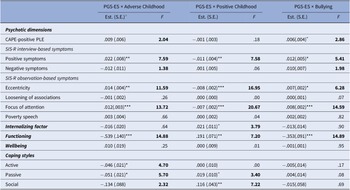
For the psychosis phenotype, only eccentricity was predicted by the interaction between PGS-ES and all environmental variables (adverse, positive, and bullying), with F > 1 (Table 1). Competitive–confirmatory tests revealed that interactions between PGS-ES and adverse and positive experiences fitted a strong DS model (Tables 2 and 3). That is, those with higher PGS-ES showed more eccentricity if exposed to adverse or less positive environments, but decreased eccentricity if exposed to highly positive environments (or low adversity), compared to those with lower PGS-ES (Figure 1A,D). Regarding the interaction with bullying, the competitive–confirmatory test revealed similar AIC indices between a DS and an E only model, indicating inconclusive findings about GxE (Table 4; Figure 1G).
Regression models of Gene–environment interactions between polygenic score of environmental sensitivity and childhood adverse. Positive and bullying experiences

a Adjusted for ancestry PC1 and PC2.
Note: Interactions with F > 1 are bolded. *** p < .05, ** p < .01, + p < .10. PGS-ES: polygenic score of environmental sensitivity; Est: estimate, S.E: standard error.
Competitive–confirmatory tests of re-parametrized regression models of polygenic score of environmental sensitivity (p < .10) × adverse childhood interactions
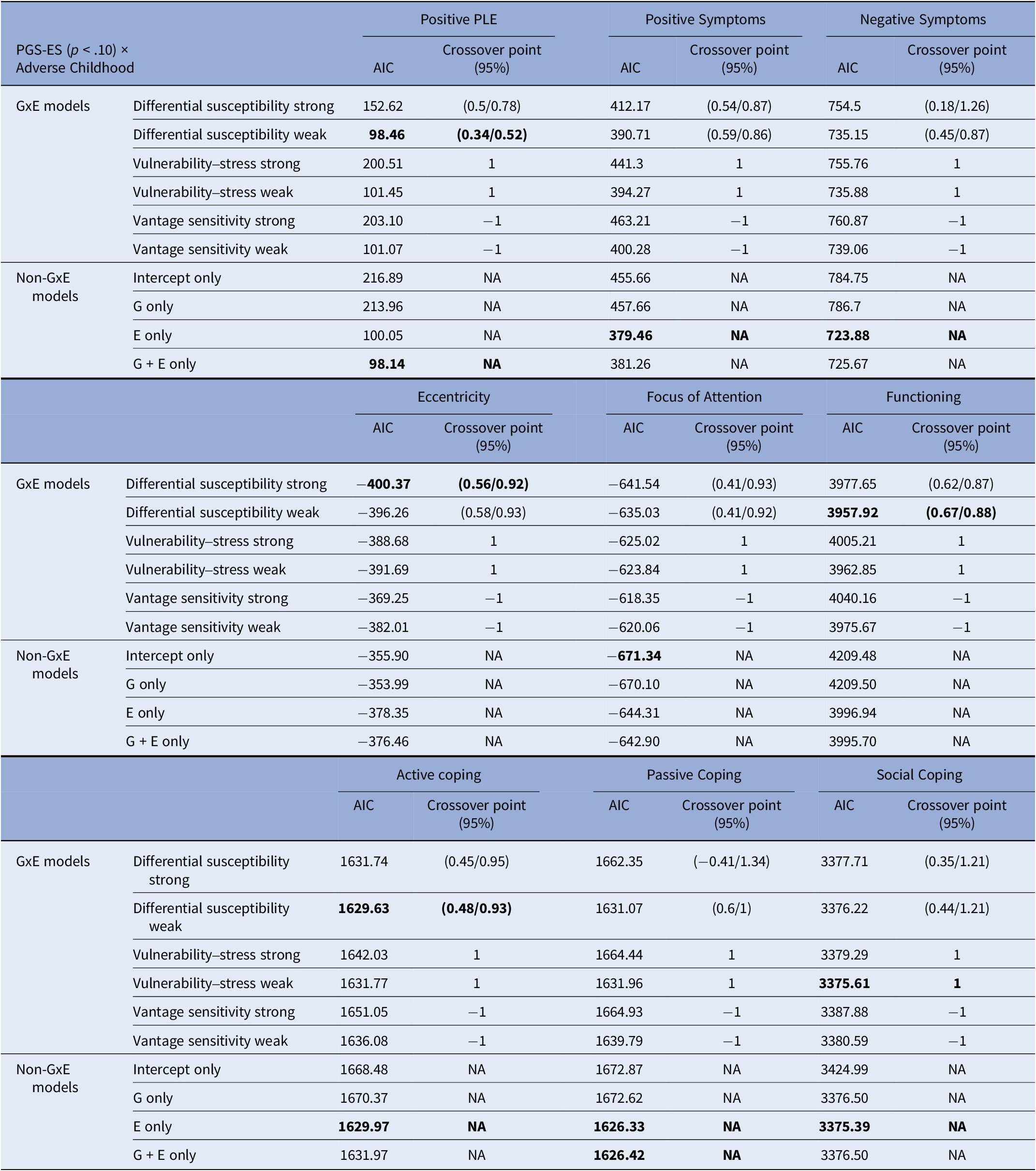
Note: The environmental variable was reversed to go from higher to lower adversity for consistency with the LEGIT package, which assumes that direction, ensuring standard model label interpretations (i.e., diathesis-stress and vantage sensitivity). Models with the lowest AIC are bolded. Following Belsky and Widaman (2018), only effects with F > 1 in the prior analytic step (Table 1) are examined in this step.
Interactions between PGS-ES and childhood experiences fitting a differential susceptibility model.

PGS-ES interacted with adverse childhood on positive PLE (Table 1), although the AIC indices from the competitive–confirmatory testing indicated that the interaction fitted very similarly either a model of G + E only (i.e., both the PGS-ES and the environment show main effects) or a DS model, indicating inconclusive findings about GxE (Table 2).
Functioning emerged as a significant outcome of the interaction between PGS-ES and the three environmental factors (Table 1) consistent with DS (Figure 1B, E, H), indicating that those with high PGS-ES showed decreased functioning when exposed to an adverse or less positive environment but increased functioning when exposed to highly positive environments (or absence of adversity) (Tables 2 and 4). Only the interaction between PGS-ES and positive childhood revealed similar fit for both, a DS and a weak vulnerability–stress model, indicating that the effects could fit both (Table 3).
Competitive–confirmatory tests of re-parametrized regression models of polygenic score of environmental sensitivity (p < .10) × positive childhood interactions

Note: The environmental variable was reversed to go from higher to lower adversity for consistency with the LEGIT package, which assumes that direction, ensuring standard model label interpretations (i.e., diathesis-stress and vantage sensitivity). Models with the lowest AIC are bolded. Following Belsky & Widaman (2018), only effects with F > 1 in the prior analytic step (Table 1) are examined in this step.
Competitive–confirmatory tests of re-parametrized regression models of polygenic score of environmental sensitivity (p < .10) × bullying interactions

Note: The environmental variable was reversed to go from higher to lower adversity for consistency with the LEGIT package, which assumes that direction, ensuring standard model label interpretations (i.e., diathesis-stress and vantage sensitivity). Models with the lowest AIC are bolded. Following Belsky & Widaman (2018), only effects with F > 1 in the prior analytic step (Table 1) are examined in this step.
Regarding coping styles, PGS-ES showed interaction effects (F > 1) with both adverse and positive childhood on passive and social coping. Active coping also showed F > 1 but only for the interaction with adverse childhood (Table 1). From these, the interaction between PGS-ES and adverse childhood on active coping revealed similar fit indices for both, a DS model and an environment only model (Table 2), while the interaction between PGS-ES and positive childhood on social coping style clearly fitted a DS model (Table 3), indicating that high-PGS-ES individuals showed increased social coping when exposed to high levels of positive childhood experiences, but decreased social strategies when exposed to lower positive influences. The other effects on coping styles were not supported by the competitive–confirmatory test as GxE models.
Finally, no significant GxE interactions were found for internalizing symptoms nor wellbeing.
Discussion
Consistent with the DS model, youngsters with high genetic sensitivity to the environment were not only more vulnerable to unfavorable family and school contexts but also more able to benefit from the absence of adversity and presence of positive experiences compared to those with low genetic sensitivity. A conventional GxE analysis under the vulnerability–stress model could only detect increased vulnerability and maladjustment in highly sensitive individuals and thus might miss the full picture: that the same sensitivity also conferred advantages in supportive environments. Notably, all significant GxE interactions displayed a DS pattern, emerging in general functioning and positive schizotypy traits like eccentricity, aligning with earlier DS findings in nonclinical youth [Reference Barrantes-Vidal, Torrecilla, Mas-Bermejo, Papiol, Bakermans-Kranenburg and van Ijzendoorn17, Reference Barrantes-Vidal, Torrecilla, Lavín, Mas-Bermejo, Papiol and Bakermans-Kranenburg19, Reference Barrantes-Vidal, Torrecilla, Mas-Bermejo, Papiol, Bakermans-Kranenburg and Rosa20]. The relevance of genetic sensitivity in moderating the impact of different types of environmental factors on psychological adjustment underscores the need to examine individual differences in the response to environmental exposures. Also, these results highlight the importance of assessing the full spectrum of environmental conditions when examining GxE, as the coexistence (or compensating effects of) protective factors along with adversity might account for part of the heterogeneity of GxE research. This is particularly relevant for youth mental health as stigma and self-stigma can shape trajectories of risk and/or resilience [Reference McGorry, Mei, Dalal, Alvarez-Jimenez, Blakemore and Browne42]. Misinterpreting sensitivity to the environment as indexing only risk might severely jeopardize the potential for developmental enhancement and resilience under supportive conditions.
DS effects were consistently detected across the three environmental factors examined. The childhood adversity index, primarily reflecting intrafamilial experiences, produced slightly more interactions than school bullying, which is meaningful given the role of early-life rearing experiences. However, most of the sample (70%) was aged 15–16, when experiences of bullying are still occurring and, thus, their full impact might not yet be captured in this age range (in fact, only bullying at primary school could be analyzed as most participants had not yet finished secondary school). Also, the positive experiences index was more limited in scope and items, possibly reducing sensitivity to DS effects.
DS effects were consistently found for the interactions between PGS-ES and the three environmental factors on schizotypic eccentricity and functioning, indicating that interviewers perceived adolescents with high genetic sensitivity to the environment who reported high adversity/low protective experiences as more odd and dysfunctional but, also, less eccentric and better adjusted when exposed to low adversity/high protective experiences as compared to adolescents with low genetic sensitivity. These findings mirror earlier DS studies in youth, where effects were found for functioning and positive – but not negative – schizotypy [Reference Barrantes-Vidal, Torrecilla, Mas-Bermejo, Papiol, Bakermans-Kranenburg and van Ijzendoorn17, Reference Barrantes-Vidal, Torrecilla, Lavín, Mas-Bermejo, Papiol and Bakermans-Kranenburg19]. While earlier work reported DS effects for CAPE positive experiences [Reference Barrantes-Vidal, Torrecilla, Mas-Bermejo, Papiol, Bakermans-Kranenburg and van Ijzendoorn17, Reference Barrantes-Vidal, Torrecilla, Lavín, Mas-Bermejo, Papiol and Bakermans-Kranenburg19], this study only found an interaction on CAPE positive experiences that was close to but did not clearly fit DS, suggesting that interviewer ratings of eccentricity might be more precise than self-reports.
An unexpected finding regarding the hypothesized trans-syndromic effect of genetic sensitivity, and contrary to previous studies [Reference Barrantes-Vidal, Torrecilla, Mas-Bermejo, Papiol, Bakermans-Kranenburg and van Ijzendoorn17, Reference Barrantes-Vidal, Torrecilla, Lavín, Mas-Bermejo, Papiol and Bakermans-Kranenburg19, Reference Barrantes-Vidal, Torrecilla, Mas-Bermejo, Papiol, Bakermans-Kranenburg and Rosa20], was the lack of GxE effects for internalizing symptoms. Of note, adolescent twins showed very low endorsement in all anxiety/depression items from the SCL-90-R, probably due to the measure’s emphasis on severe symptomatology (e.g., thinking about death or dying, being afraid to leave the house alone) and clinical well-established manifestations [Reference Derogatis, Rickels and Rock33], which may not be sensitive enough to detect subtle manifestations in nonclinical populations. An additional interpretation could be that the fact that positive schizotypy shows stronger and more consistent DS effects over affective or anxiety manifestations is consistent with a continuum of psychopathology severity [Reference McGorry and van Os43] in which psychotic-like manifestations index greater deviance and, thus, greater genetic sensitivity in combination with greater adversity may contribute to stronger effects for such phenotypes, reinforcing their position on the more severe end of the psychopathology spectrum.
Regarding positive outcomes, no DS interactions were found for wellbeing, possibly because the AWS measure assesses constructs (e.g., autonomy, personal growth, purpose in life) that might be underdeveloped in adolescents. In contrast, significant DS effects were found for the interactions between PGS-ES and adverse childhood on active coping and PGS-ES and positive childhood on social coping, although only the latter clearly fitted DS. High-sensitivity individuals lacking positive rearing may struggle with developing social coping strategies, whereas supportive rearing contexts may promote adaptive coping mechanisms [Reference Masten44].
The fact that DS effects were consistently found in relation to adjustment rather than symptom expression aligns with the developmental phase of the study sample. The sample is mostly composed of adolescents aged 15–17, capturing the intersection of developmental vulnerability and heightened sensitivity to sociocultural influences [Reference Blakemore and Mills45], characterized by highly undifferentiated and comorbid symptomatology [Reference Hartmann, McGorry, Destree, Ammiger, Chanen and Davey46]. This population is central to the emerging youth mental health crisis, driven by profound societal shifts (e.g., intergenerational inequality, financial instability, climate change, impact of unregulated social media) [Reference McGorry, Mei, Dalal, Alvarez-Jimenez, Blakemore and Browne42]. Some limitations should be acknowledged, including the reliance on self-report questionnaires, which may be influenced by recall errors and subjective biases, although recent meta-analytic evidence suggests that such reports are valid and reliable predictors of mental health outcomes [Reference Francis, Tsaligopoulou, Stock, Pingault and Baldwin47], and the limited generalizability of the study to White adolescent populations. Also, future studies could benefit from broadening environmental assessment by incorporating complementary frameworks – ranging from dimensional models that capture specific features of early experiences to more integrative exposome approaches that offer a comprehensive, multifactorial view of environmental influences – as recent work from our group [Reference Barrantes-Vidal, Torrecilla, Lavín, Mas-Bermejo, Papiol and Bakermans-Kranenburg19] shows that distinct early environmental dimensions differentially interact with genetic sensitivity to shape developmental outcomes. Nonetheless, the findings support a paradigm shift in how we conceptualize risk, vulnerability, and their associated stigma. The same plasticity factors that increase vulnerability also enhance responsiveness to protective factors, presenting a crucial opportunity for targeted prevention efforts. Interventions must prioritize resilience-building and adaptive coping strategies, particularly given the potential for iatrogenic harm in interventions targeting adolescents [Reference Foulkes and Stringaris48]. Early interventions that embrace a pluripotent approach – addressing shared risk factors and nonspecific symptoms while promoting resilience – are essential.
To conclude, DS was supported, suggesting that genetic sensitivity to the environment operates “for good and for bad” depending on the quality of environmental factors and extended evidence that this is relevant to the psychosis extended phenotype: high-genetic-susceptibility youngsters that showed greater vulnerability to adversity were the same ones that also displayed a higher capacity to benefit from positive environmental influences. This supports that the long-dominant vulnerability–stress is incomplete and potentially misleading, as it primarily emphasizes vulnerability to negative environments. In contrast, DS offers a broader perspective that contributes to understanding the complexity underlying risk and opportunity factors to mental health. This perspective has the potential to inform evidence-based interventions aimed not only at reducing psychopathology but also at promoting positive mental health, health – an urgent priority in addressing the current youth mental health crisis and, more broadly, in promoting developmental enhancement during this critical life stage.
Supplementary material
The supplementary material for this article can be found at http://doi.org/10.1192/j.eurpsy.2026.10176.
Data availability statement
The pre-existing dataset analyzed for this study is not publicly available, but is available upon request from the TwinssCan project team (info@twinsscan.eu), who are the owners of these data.
Financial support
This work was supported by the Spanish Ministry of Science and Innovation MCIN/AEI/10.13039/501100011033 (PID2023-152345OB-I00) and the Generalitat de Catalunya (2021SGR01010). Dr. Barrantes-Vidal was supported by the ICREA Academia Award of the Generalitat de Catalunya. Valeria Lavín was supported by the Spanish Ministry of Science and Innovation (PRE2021–097443). Dr van Os and Dr Guloksuz are supported by the Ophelia research project, ZonMw grant 636340001. Dr Rutten was funded by a Vidi award (91718336) from the Netherlands Scientific Organization. Angelo Arias-Magnasco, Bochao Danae Lin, Dr. van Os, Dr. Rutten, and Dr. Guloksuz are supported by the YOUTH-GEMs project, funded by the European Union’s Horizon Europe program under the grant agreement number: 101057182. Since its start, the East Flanders Prospective Twin Survey has been partly supported by grants from the Fund of Scientific Research Flanders and Twins, a nonprofit Association for Scientific Research in Multiple Births (Belgium).
Competing interests
All authors declare that they have no conflicts of interest.


 Open access


Comments
No Comments have been published for this article.