





INTRODUCTION
Anaphora resolution consists of resolving references to earlier or later words presented in the discourse. When speakers must resolve anaphoric expressions, they calculate the accessibility of the entities presented in the discourse. An antecedent is considered more or less accessible based on a set of pragmatic, syntactic, and semantic factors (e.g., Arnold, Reference Arnold2010 for a review). For example, order of mention (first-mentioned vs. second-mentioned referent) and if an entity is given or new in the discourse are pragmatic features that can affect individuals’ interpretation of anaphoric expressions (e.g., Ariel, 1990).
Semantic roles (e.g., agent vs. patient) and grammatical roles (e.g., subject vs. object) of the referents are also crucial in calculating accessibility. For instance, subjecthood is known to affect anaphora resolution, and anaphoric expressions are more likely to refer to antecedents in subject position than in other positions.
In English, referents that are more accessible are usually expressed as pronouns in discourse. A large body of psycholinguistic studies has shown that monolingual speakers can be very fast and successful at choosing and comprehending appropriate references in discourse (Arnold, Reference Arnold2010, for a review). For example, when presented with sentence (1), native speakers of English can quickly identify the referent of the pronoun “she” as “Mary” (e.g., Arnold et al., Reference Arnold, Eisenband, Brown-Schmidt and Trueswell2000).
(1) When Mary went with Eric to the grocery store, she bought some apples.
While in sentence (1) the pronoun “she” unambiguously refers to the feminine antecedent, in sentence (2), the pronoun is potentially ambiguous, because both “John” and “Eric” are possible antecedents for “he.”
(2) When John went with Eric to the grocery store, he bought some apples.
Psycholinguistic studies have shown that regardless of the potential ambiguity, English speakers show a clear interpretation preference. When reading a sentence like (2), comprehenders tend to interpret the pronoun as referring to the subject and first-mentioned referent “John.” This bias is also known as the “first-mentioned” bias. Notice that at least two sources of discourse prominence make “John” the more salient noun phrase (NP): first-mention and subjecthood. While previous research has attempted to tease apart the role of first-mention and subjecthood on referent accessibility (e.g., Fukumura & van Gompel, Reference Fukumura and van Gompel2015) it is beyond the scope of the present article to illustrate the relative contribution of these two factors.
Although individual variability among comprehenders exists (e.g., Arnold, Reference Arnold2015), the first-mentioned bias has been confirmed by several studies using different online and off-line techniques (e.g., Arnold, Reference Arnold2010). More recently, it has been shown that the strength of the first-mention bias correlates with comprehenders’ print exposure, demonstrating that pronoun interpretation biases are influenced by language experience even in monolingual individuals (e.g., Arnold et al., Reference Arnold, Strangmann, Hwang, Zerkle and Nappa2018).
Referring expressions differ across languages. For example, in null subject languages null and explicit pronouns can be used, as exemplified in (3) and (4) for Spanish. In null subject languages, native speakers show a preference for interpreting the null pronoun as referring to the subject antecedent (i.e., John in (3)), while explicit pronouns are more likely to refer to a nonsubject antecedent (i.e., the preceding object in (4)). Notice that, while the difference in interpretation of null and overt pronouns may be very strong in some null subject languages (e.g., Italian; Belletti et al., Reference Belletti, Bennati and Sorace2007), Spanish comprehenders’ preferences may be less clear-cut (Chamorro, Reference Chamorro2018; Filiaci et al., Reference Filiaci, Sorace and Carreiras2014).
(3) Cuando John fue a la tienda con Eric, compró unas manzanas.
When John went to the grocery store with Eric, (he) bought some apples.
(4) Cuando John fue a la tienda con Eric, él compró unas manzanas.
When John went to the grocery store with Eric, he bought some apples.
When adult speakers learn a second language (L2) that has a different set of referring expressions and interpretation biases for pronouns than their first language (L1), as in the case of English and Spanish, they may experience difficulty. In the present study, we focus on the acquisition of pronoun comprehension biases in adult learners of English (a nonnull subject language) whose L1 is Spanish (a null-subject language).
Many studies have examined the interpretation of pronouns in various groups of adult learners, demonstrating that even highly proficient L2 speakers can interpret and produce referring expressions differently from native speakers (e.g., Belletti et al., Reference Belletti, Bennati and Sorace2007; Keating et al., Reference Keating, Jegerski and VanPatten2016; Rothman, Reference Rothman2008; Tsimpli et al., Reference Tsimpli, Sorace, Heycock and Filiaci2004).
Previous research has focused mainly on L2 speakers of a null-subject language, such as Italian, Spanish, and Greek, while existing research on learners of a nonnull subject language is more limited (L2 Dutch–L1 Turkish/German: Roberts et al., Reference Roberts, Gullberg and Indefrey2008; L2 German–L1 English: Wilson, Reference Wilson2009; L2 German–L1 Dutch: Ellert, Reference Ellert2013; L2 French–L1 Turkish: Schimke & Colonna, Reference Schimke and Colonna2016; L2 English–L1 Spanish: Contemori & Dussias, Reference Contemori and Dussias2016, Reference Contemori and Dussias2020; Contemori et al., Reference Contemori, Asiri and Perea Irigoyen2019; Contemori, Reference Contemori2019; Contemori & Ivanova, Reference Contemori and Ivanova2021; L2 English–L1 Greek: Cunnings et al., Reference Cunnings, Fotiadou and Tsimpli2017).
For L2 English, previous research using off-line and online sentence comprehension tasks has demonstrated that intermediate and highly proficient learners can use the first-mentioned bias to interpret ambiguous pronouns as native speakers do (Contemori et al., Reference Contemori, Asiri and Perea Irigoyen2019; Contemori & Dussias, Reference Contemori and Dussias2020; Cunnings et al., Reference Cunnings, Fotiadou and Tsimpli2017).
However, not all sentences containing an ambiguous pronoun can be interpreted by L2 English speakers in a nativelike way. For example, Contemori et al. (Reference Contemori, Asiri and Perea Irigoyen2019) tested intermediate proficiency L2 speakers (L1 Spanish) on the off-line interpretation of ambiguous pronouns, including sentences like (5). In (5), two referents are presented in the discourse using a conjoined NP and the pronoun appears in a second sentence where only one of the two NPs is repeated (see also Roberts et al., Reference Roberts, Gullberg and Indefrey2008 for the use of similar materials with L2 Dutch speakers).
(5) Eric and John are in the office. While Eric is working, he is eating a sandwich.
Native speakers interpret the pronoun in (5) as referring to the closest referent (i.e., the local antecedent Eric), which is also the subject of the subordinate clause. This preference is robust regardless of the order of mention of the antecedents. More specifically, if the second mentioned referent in the first sentence John is the NP mentioned in the while-clause, it is also the preferred referent of the ambiguous pronoun (see norming study with native English speakers presented in the “Materials” section). Thus, in this particular type of context, locality rather than first-mention makes a referent the most accessible. In other words, English native speakers find the local antecedent, which is the entity that is rementioned and is the subject of the while-clause preceding the ambiguous pronoun, to be more accessible.
By testing the comprehension of sentences like (5), Contemori et al. (Reference Contemori, Asiri and Perea Irigoyen2019) found that native speakers of English interpreted the pronoun as referring to the local antecedent “Eric” in 87% of the cases, while L2 English speakers chose the local antecedent significantly less (59%). In comparison to previous studies where L2 speakers demonstrated nativelike interpretation of ambiguous pronouns (e.g., Contemori & Dussias, Reference Contemori and Dussias2020; Cunnings et al., Reference Cunnings, Fotiadou and Tsimpli2017), in Contemori et al. (Reference Contemori, Asiri and Perea Irigoyen2019) L2 participants’ performance may have been affected by the complexity of the context presented. Notice that in sentence (5), two referents are presented in the discourse using a conjoined NP. In addition, a second sentence containing the adverb “while” may be interpreted as introducing a contrast between NP1 (John) and NP2 (Eric). These features may have increased L2 participants’ chances of interpreting the pronoun as signaling a topic shift, an interpretation that may be acceptable in participants’ L1.
Previous research has ascribed the optionality observed in different groups of L2 speakers to several possible underlying causes, including (a) the demand for increased cognitive resources when processing structures at the interface between syntax and discourse, (b) cross-linguistic interference, (c) lack of automaticity in L2 speakers’ discourse processing, and (d) lack of exposure to L2 pronoun uses (e.g., Sorace, Reference Sorace2011 for a review). While all these factors are likely to contribute to the (sometimes persistent) optionality observed in some L2 groups, current research has not yet evaluated the relative contribution of these possible sources of difficulty (see Contemori & Ivanova, Reference Contemori and Ivanova2021 for a study on the role of cognitive resources on referential choice). In the present study, we aim to contribute to filling this gap, by investigating the role of exposure on the acquisition of pronoun interpretation biases in the L2 and uncover its impact on L2 referential comprehension.
THE ROLE OF EXPOSURE IN L2 ACQUISITION
Input in language acquisition can be defined as the “positive evidence available to learners … described in terms frequency, consistency, and complexity” (Zyzik, Reference Zyzik2009, p. 42). Models of L2 acquisition adopting different theoretical perspectives recognize the importance of input to promote L2 learning (e.g., Bybee, Reference Bybee, Robinson and Ellis2008; Rankin & Unsworth, Reference Rankin and Unsworth2016). This is true for both those who subscribe to a generative approach to language acquisition, as well as those who take a usage-based or emergentist approach. Within usage-based paradigms, which do not assume any innate domain-specific knowledge of language, the assumption is that all linguistic knowledge originates from the input. Linguistic knowledge is thought to be derived statistically, developing through repeated exposure to patterns. In usage-based frameworks such as connectionism (Gasser, Reference Gasser1990) or the competition model (Bates & MacWhinney, Reference Bates, MacWhinney, MacWhinney and Bates1989; MacWhinney, Reference MacWhinney and de Groot1997), frequency in the input is crucial (Ellis, Reference Ellis, Gass and Mackey2012; Zyzik, Reference Zyzik2009).
Input also plays a role, albeit it a different one, in generative approaches to language acquisition. Within a framework that assumes an innate system that determines and constrains the grammar of all human language, language acquisition occurs as a result of an interchange between this innate knowledge and the language-specific information that can only be acquired from the input. Different roles have been proposed for the input in the acquisition process. Accounts such as the Interface Hypothesis (Sorace, Reference Sorace2011), which attribute nonnativelike acquisition of certain features of language to processing difficulties rather than acquired knowledge, assume that the learners are being provided with the necessary information for acquisition through the input (Rothman & Slabakova, Reference Rothman and Slabakova2018). Generative accounts recognize that no development can occur without exposure to the target language. Furthermore, as Rothman and Slabakova note, “the context under which input is provided is of crucial importance … because context is a partial proxy for quantity and quality of input as well as a delimiter of potential language use” (p. 429).
Whether it is argued that frequency and repetition of forms is what leads to acquisition or that robust and sufficient target language input drives UG-constrained reanalysis, researchers recognize that exposure to the target language is what triggers acquisition. It is clear, however, that the exact mechanisms underlying the extraction of semantic and grammatical information from the input during L2 acquisition is still debated. In the present study, we look at the effect of exposure from the perspective of discourse, investigating how pronoun biases can change as a function of the input presented experimentally.
Previous studies have employed exposure in the form of structural priming with L2 speakers at different levels of proficiency and investigating different syntactic and discourse structures (see Jackson, Reference Jackson2018 for a review). Structural priming in comprehension is the technique where repeated exposure to a particular structure can facilitate the online and off-line comprehension of a following structure of the same type. Effects of comprehension priming can be observed (a) immediately after a prime structure is presented (immediate priming), (b) throughout the course of an experimental session, after repeated presentation of the prime structure (adaptation), (c) right after the exposure session (cumulative priming), and (d) a week or more post-exposure (long-term priming) (Kaan & Chun, Reference Kaan and Chun2018; Pickering & Ferreira, Reference Pickering and Ferreira2008; for a review). Evidence of cumulative and long-term priming has been observed with various populations, leading researchers to hypothesize that priming is a form of implicit learning that can contribute to change comprehenders’ underlying structural representations (e.g., Branigan & Messenger, Reference Branigan and Messenger2016; Chang et al., Reference Chang, Dell and Bock2006). For example, Chang et al. (Reference Chang, Dell and Bock2006) suggest that an error-based learning mechanism allows adjustments of the underlying system. According to this hypothesis, exposure to a less frequent syntactic structure creates immediate reuse of that structure (a priming effect). In addition, a mismatch between a predicted (more common) structure and the (less frequent) encountered structure creates an error, which is used to adjust the probability distribution, determining long-term learning.
Previous L2 priming studies have focused on exposure to different syntactic structures across languages and L2 speakers with different proficiency levels (see Jackson, Reference Jackson2018 for a review). The results suggest that L2 speakers can be sensitive to immediately preceding structures and can adjust their own syntactic comprehension as a consequence of exposure (see Jackson, Reference Jackson2018 for a review). However, research focusing on discourse-level priming in the L2 is more limited (e.g., Contemori, Reference Contemori2019). We describe here the results by Contemori et al. (Reference Contemori, Asiri and Perea Irigoyen2019), which are particularly relevant for the present study.
Contemori et al. (Reference Contemori, Asiri and Perea Irigoyen2019) used priming sentences like (6) in a comprehension study, to change participants’ pronoun interpretation biases in English. The author tested a group of native English speakers and a group of intermediate proficiency L2 speakers (L1 Spanish). In the experimental design, a priming condition was included where a sentence with a potential ambiguous pronoun like (7) was preceded by a sentence like (6).
(6) Emily liked Brian because he was a good person.
(7) Mary met Linda while she was traveling.
The sentence in (6) aimed at priming participants with second antecedent references (he = Brian). The results showed that both L2 and native speakers were sensitive to the prime stimuli and were more likely to interpret an ambiguous pronoun (e.g., “she” in (7)) as referring to the second antecedent (i.e., Linda in (7)) after encountering a prime sentence like (6), than after encountering a nonprime sentence (i.e., an effect of immediate priming). Contemori et al. (Reference Contemori, Asiri and Perea Irigoyen2019) also observed an effect of adaptation in both groups, showing that second antecedent interpretations increased over the course of the experiment as a function of the number of prime sentences encountered. The study by Contemori et al. (Reference Contemori, Asiri and Perea Irigoyen2019) shows that native speakers and L2 learners can change their pronoun interpretation preference as a result of exposure to a different interpretation bias (see also Fernandes et al., Reference Fernandes, Luegi, Soares, Fuente and Hemforth2018 and Kaiser, Reference Kaiser2009 for adaptation to pronoun comprehension biases in the statistical environment in monolingual speakers).
AIMS AND PREDICTIONS
While residual indeterminacy in L2 referential choice is a widely studied phenomenon, we do not know yet which factors underlie the differences between L2 and native speakers. The goal of the present study is to contribute to fill this gap, by focusing on L2 speakers of English (L1 Spanish). Previous research has proposed that among the possible underlying causes of L2 speakers’ difficulty, lack of exposure may be a potential factor (e.g., Contemori, Reference Contemori2019; Contemori et al., Reference Contemori, Asiri and Perea Irigoyen2019; Sorace, Reference Sorace2011). However, none of the existing studies has systematically analyzed the role of language exposure in contexts where pronouns interpretation biases diverge in L2 and native speakers.
By focusing on the role of exposure, the present study aims to test how evidence extracted from the input is used by L2 learners. Here, we employ a similar comprehension task to Contemori et al. (Reference Contemori, Asiri and Perea Irigoyen2019) and expose L2 speakers to nativelike local antecedent interpretations using prime sentences like (8). The prime sentences have a similar structure to that of the discourse contexts tested by Contemori et al. (Reference Contemori, Asiri and Perea Irigoyen2019): Two antecedents are introduced through coordination followed by a sentence with “while” and an ambiguous pronoun. However, the prime sentence is not potentially ambiguous because a gender informative pronoun is included (she = Ashley in (8)). By priming the local-antecedent interpretation with unambiguous sentences, we provide examples of nativelike interpretations and aim at testing how this input is used by L2 speakers to interpret ambiguous pronouns in sentences like (5), repeated here as (9).
(8) Albert and Ashley bought a house in Chicago. While Ashley was decorating the house, she decided to remodel the living room.
(9) Eric and John are in the office. While Eric is working, he is eating a sandwich.
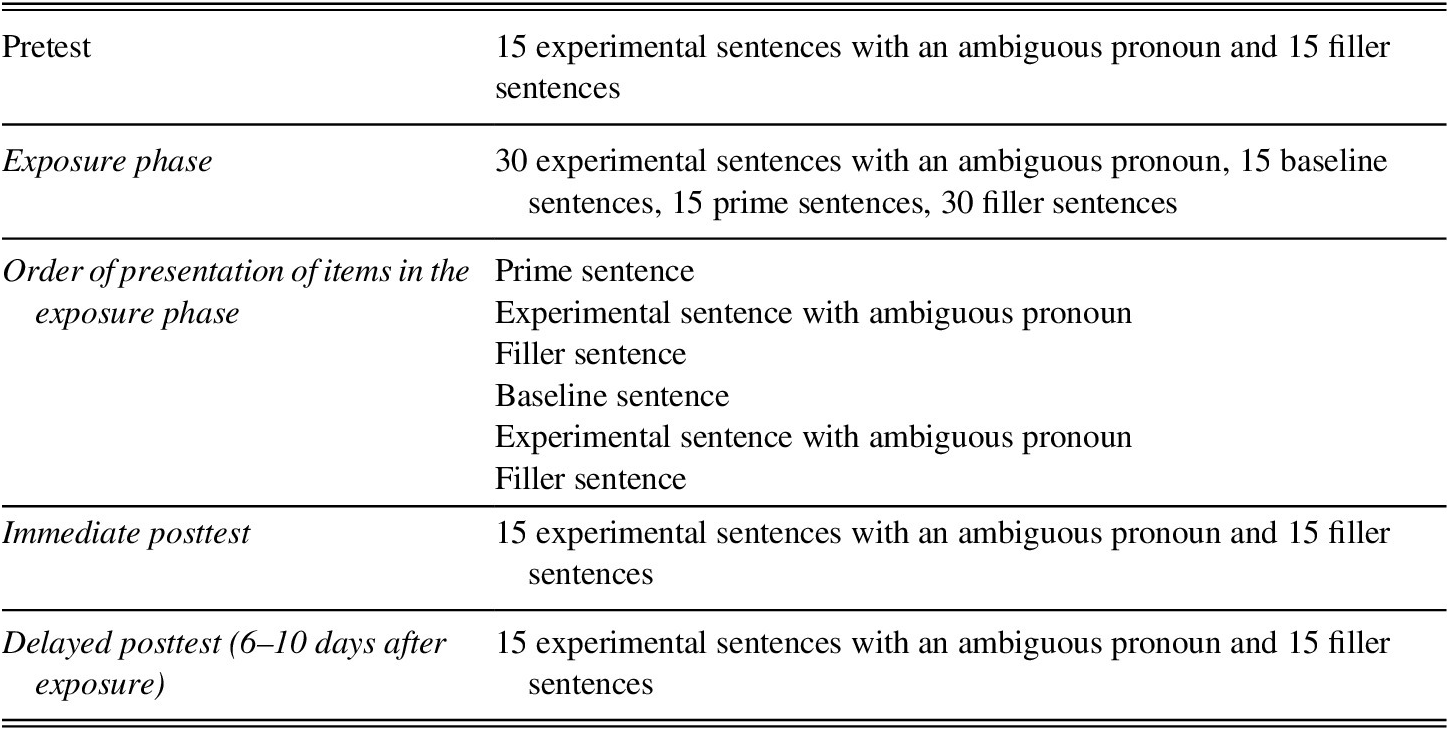
The sentence comprehension test comprises four phases: (a) a pretest assessing the interpretation of ambiguous pronouns in contexts like (9); (b) an exposure phase where participants are exposed to prime sentences like (8) to measure the immediate effect of exposure and the effect of adaptation throughout the exposure session; (c) a posttest measuring the interpretation of ambiguous pronouns in contexts like (9) to evaluate the cumulative effect of priming immediately after the exposure phase; and (d) a delayed posttest where the more long-term effects of priming are tested.
We know from previous studies that speakers can use the information provided in the input to change their first-mention pronoun interpretation preference (Contemori, Reference Contemori2019; Fernandes et al., Reference Fernandes, Luegi, Soares, Fuente and Hemforth2018; Kaiser, Reference Kaiser2009). Thus, we expect that L2 English speakers may benefit from exposure to nativelike pronoun interpretation in contexts where ambiguous pronouns can be challenging to interpret (e.g., (9)). We predict that an effect of priming will emerge following the prime sentences during the exposure phase (i.e., an immediate effect priming), and in the immediate posttest phase (i.e., a cumulative effect priming). In addition, as observed by Contemori et al. (Reference Contemori, Asiri and Perea Irigoyen2019), we expect to observe that ambiguous pronoun interpretation is affected by cumulative experience with the primed structure throughout the task (i.e., an effect of adaptation).
For the delayed posttest, it is unclear if the priming effect can persist 6–10 days after exposure for discourse structures. Notice that while previous research has analyzed effects of adaptation and immediate priming on pronoun interpretation (Contemori, Reference Contemori2019; Fernandes et al., Reference Fernandes, Luegi, Soares, Fuente and Hemforth2018), none of the existing studies has used a delayed posttest (for long-term effects of priming in other populations and different domains: e.g., Branigan & Messenger, Reference Branigan and Messenger2016; Kaschak et al., Reference Kaschak, Kutta and Coyle2015; Kleinschimdt & Jaeger, Reference Kleinschimdt and Jaeger2015). Thus, the present research is the first to address the question of how persistent the priming effect is and how effectively exposure can modify learners’ underlying discourse representations over time.
METHOD
PARTICIPANTS
Thirty-six L2 English speakers whose L1 is Spanish participated in the Exposure Phase (20 females; mean age = 21; SD = 4.6). Participants were recruited in intermediate and advanced English as a Second Language (ESOL) classes at a university and a junior college in El Paso, Texas, a bilingual community at the border between the United States and Mexico. They were included in the sample if they scored 60% or lower on the local antecedent interpretation in the pretest phase. The reason to adopt this selection criteria is that exposure can only be effective if the ambiguous pronoun interpretations are not at ceiling (i.e., different than the nativelike pattern).
Participants’ completed a language history questionnaire (Marian et al., Reference Marian, Blumenfeld and Kaushanskaya2007) and a subset of the Michigan English Language Institute College English Test (MELICET), assessing English proficiency. In the subset of the MELICET, participants are presented with 30 grammar questions and 20 cloze questions from a reading passage. Participants’ language background information and their MELICET scores are shown in Table 1.
Participants’ information based on the language history questionnaire and English proficiency test: Mean (SD)

Thirty L2 English speakers who participated in the Exposure experiment took part in the Delayed Posttest session that took place 6–10 days after exposure.
MATERIALS
A sentence comprehension task was designed in which participants identified the referent of an ambiguous pronoun. Seventy-five experimental sentences were constructed. In the sentences, two equally salient referents (Eric, John) are introduced in a sentence through coordination, as shown in (10). A second sentence introduced by “while” includes the first referent introduced in the preceding sentence, followed by a main clause containing a potentially ambiguous pronoun. The sentences had a similar structure as the experimental sentences in Contemori et al. (Reference Contemori, Asiri and Perea Irigoyen2019).
(10) Eric and John are at the office. While Eric is working, he is eating a sandwich.
Each experimental sentence was followed by a comprehension question where the interpretation of the ambiguous pronoun is tested, as illustrated in (11).
(11) Who is eating a sandwich?
(a) Eric
(b) John
(c) Someone else
After each question, three choices were presented, one corresponding to the local antecedent (Eric), one corresponding to the nonlocal antecedent (John), and one corresponding to an external referent interpretation (someone else). The position of the three referents in the multiple-choice question was counterbalanced across the experiment.
Notice that the external referent (someone else) is a possible interpretation in the Spanish translation of (10). In Spanish, an explicit pronoun can be associated with a referent not mentioned in the previous discourse (e.g., Chamorro, Reference Chamorro2018; Contemori et al., 2017). As an underlying cause for L2 speakers’ difficulty with ambiguous pronouns may be cross-linguistic interference, the external referent option was included although this interpretation is not possible in English.
A norming task was conducted with 40 native English speakers recruited on Amazon Mechanical Turk to ensure that the ambiguous pronoun in the experimental sentences is interpreted toward the local antecedent (e.g., Eric, the NP mentioned in the “while” clause). Only sentences for which native English speakers selected the local antecedent in the majority of the cases were selected for the experimental task (average of local antecedent interpretations = 0.98; SD = 0.02).
In the exposure phase, 30 experimental sentences with an ambiguous pronoun were preceded either by a baseline sentence (12) or a “prime” sentence (13).
(12) At the art show, Daniel purchased a painting from Barbara. Barbara is a very talented painter.
Who is a talented painter?
(13) Albert and Ashley bought a house in Chicago. While Ashley was decorating the house, she decided to remodel the living room.
Who decided to remodel the living room?
The baseline sentence did not include any pronoun and had a similar structure as the fillers. The prime sentences had a similar structure as the experimental sentences, but the two antecedents differed in gender (e.g., Ashley, Albert in (13)) and the pronoun always referred unambiguously to the local antecedent (she = Ashley in (13)). Masculine and feminine pronouns were counterbalanced. In half the prime sentences the local antecedent was the first mentioned referent in the first sentence, and in half the prime sentences it was the second mentioned referent. The counterbalancing of the order of mention was included to make the prime stimuli more varied.
A norming study was conducted with 30 native speakers of English recruited on Amazon Mechanical Turk. The norming aimed at testing the local antecedent preference of native speakers when the local antecedent is the second-mentioned referent of the coordinated subject phrase in the first sentence. In the task, we used the sentences with an ambiguous pronoun selected for the experiment and we included local antecedents that were second-mentioned (e.g., Eric and John are at the office. While John is working, he is eating a sandwich.). The results of the study demonstrated that native speakers prefer the local antecedent interpretation (average of local antecedent interpretations = 0.95; SD = 0.2), even when the referent is second-mentioned (e.g., he = John).
Two versions of the exposure phase were created such that an experimental sentence was associated with one “prime” sentence in one list, and a “baseline” sentence in another list. In addition to the 60 items divided by experimental, prime and baseline, 30 fillers were included in the exposure phase. During the exposure phase, no feedback was given to participants.
The pretest and posttest included 15 experimental sentences and 15 fillers each. An example of a filler is presented in (14).
(14) Simon was writing a letter to Carl when Rhonda walked in the room.
Who walked in the room?
Two lists were constructed in which the experimental sentences either appear as part of the pretest or as part of the posttest.
The pretest, exposure phase and posttest were presented as one experiment, with no interruptions, for a total of 150 sentences. Thus, participants were not aware that the experiment consisted of three separate testing phases.
A total of four lists for the experiment were created. Each list was presented in a pseudorandomized order.
The delayed posttest took place 6–10 days after the exposure and included 15 experimental sentences and 15 fillers, organized in a pseudorandomized list. The order of the items in the delayed posttest was reversed to create a second list. Table 2 summarizes the structure of the task.
Example of the structure of the task
PROCEDURE AND CODING
Half the participants were tested in the classroom and completed a pen-and-pencil version of the sentence comprehension task. Half the participants completed an online version of the comprehension task, designed using Question Pro, due to COVID-19 concerns.
The delayed posttest was completed between 6–10 days after the first session, either as an online survey or in person as a pencil-and-paper task. The modality of administration of the test (in person vs. online) did not influence the results of the study, as shown by separate statistical analyses reported in the “Results” section (notes 1 and 3). Participants were instructed to read the sentences and answer the comprehension question. There was no time limit for participants to complete the comprehension tasks. Additionally, participants completed either a pen-and-pencil copy or an online version of the Language History Questionnaire and MELICET. Participants’ accuracy on filler sentences, baseline sentences, and prime sentences with nonambiguous pronouns was on average 90%, demonstrating good comprehension of the sentence materials.
The dependent variable used in the statistical analyses is antecedent choice, coded 1 if it was a local antecedent choice or 0 otherwise for sentences containing ambiguous pronouns. We conducted two analyses: (a) a comparison of local antecedent interpretations for ambiguous pronouns in experimental sentences preceded by a baseline versus preceded by a prime sentence; and (b) a comparison of local antecedent interpretations for ambiguous pronouns in experimental sentences in the pretest versus immediate posttest and in the pretest versus delayed posttest condition.
For all analyses, we used mixed-effects logistic regression (Jaeger, Reference Jaeger2008) to analyze likelihood of local antecedent interpretations produced by participants with glmer (lme4 library; Bates & Sarkar, Reference Bates and Sarkar2007). A stepwise backward inclusion procedure was used to test both first-level effects and the interactions between the fixed-effect factors.
RESULTS
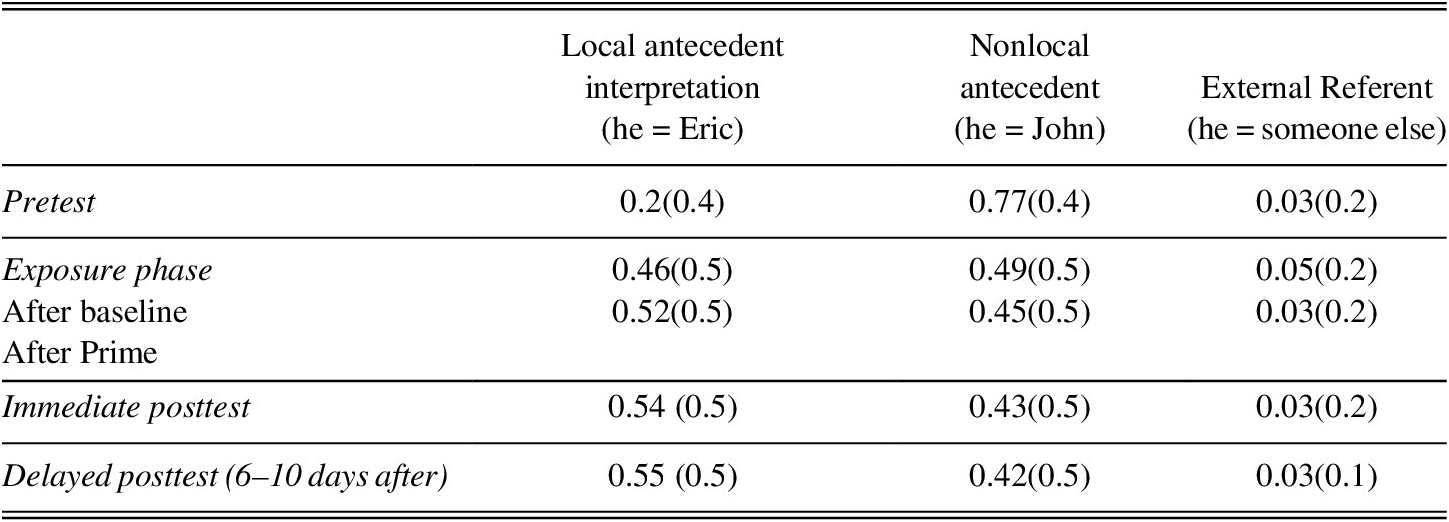
Table 3 illustrates the local (he = Eric), nonlocal (he = John), and external referent (he = someone else) pronoun interpretations for the experimental sentences by condition.
Local (he = Eric), nonlocal (he = John) and external referent (he = someone else) pronoun interpretations for the experimental sentences with ambiguous pronoun: Mean (SD)
BASELINE VERSUS PRIME
In the first analysis, we compare local antecedent interpretations for ambiguous pronouns preceded by a baseline versus preceded by a prime sentence. Two centered factors were included in the model: Exposure Condition (local-antecedent interpretations after baseline vs. after prime) and Order of the Items as a continuous variable. Order of the Items was included to explore potential adaptation as a result of exposure, that is, the amount of local antecedent interpretations may increase as a function of the number of primes encountered in the input, as shown in previous L2 studies using syntactic priming (e.g., Kaan & Chun, Reference Kaan and Chun2017) and discourse priming (Contemori, Reference Contemori2019).
Table 4 shows the results of the full model. The model revealed a main effect of Exposure Condition, indicating that local antecedent preferences were significantly higher immediately after a prime sentence than after a baseline sentence. A main effect of Order of the Items was also significant. Figure 1 shows the main effect of Order of the Items, demonstrating a significant increase in local interpretations over the course of the Exposure phase. The lack of a significant interaction between Condition and Order of the Items suggests that the effect of adaptation is consistent across the two conditions.
Proportion of local antecedent interpretations over the course of the exposure phase.

Full model statistics

Notes: Baseline and Prime are coded as –0.5 and 0.5 for the factor Condition. The maximal random effect structure leading to convergence includes by subject and by item random intercepts and slopes for the effect of Condition.
We conducted a separate statistical analysis, including the MELICET scores as a continuous factor, to test the effects of L2 proficiency on the immediate priming and adaptation. However, the analysis did not show a significant main effect of MELICET nor significant interactions with Priming Condition or Order of Items (all p-values > 0.1).Footnote 1
PRETEST, IMMEDIATE POSTTEST, AND DELAYED POSTTEST
In the second analysis, we used two models to compare local antecedent interpretations for ambiguous pronouns in the pretest versus posttest and delayed posttest condition.
The first model compared the immediate posttest to the pretest baseline. The predictor in this model was Condition1 (immediate posttest was coded as 0.5; pretest was coded as –0.5; delayed posttest was coded as 0).
The second model was identical to the first, except the predictor (Condition 2) compared the delayed posttest to the pretest baseline (delayed posttest was coded as 0.5; pretest was coded as –0.5; immediate posttest was coded as 0). Table 5 illustrates the two models.
Full model statistics

Note: The maximal random effect structure leading to convergence includes by subject and by item random intercepts and by subject and by item random slopes for the effect of Condition.
A main effect of Condition was found in both models, indicating significantly fewer local antecedent interpretations in the pretest compared to the immediate posttest condition, and significantly fewer local interpretations in the pretest compared to the delayed posttest condition.Footnote 2
We conducted a separate statistical analysis, including the MELICET scores as a continuous factor in the two models, to test the effects of L2 proficiency on cumulative and delayed priming. However, the model did not reveal a main effect of MELICET. In addition, we did not find an interaction between Condition 1 and the MELICET scores or an interaction between Condition 2 and the MELICET scores (all p-values > .1).Footnote 3
DISCUSSION
In the present study, we recruited a group of L2 speakers of English (L1 Spanish) that demonstrated nonnativelike interpretations of ambiguous pronouns in specific discourse contexts. In the contexts, two noun phrases are introduced in a declarative sentence through coordination, a subordinate clause is introduced by “while,” preceding a main clause that includes an ambiguous pronoun interpreted as referring to the local antecedent in the “while” clause. We used a sentence comprehension task to test local antecedent interpretations and to expose participants to nativelike interpretations of ambiguous pronouns. We tested the hypothesis that exposure through priming could change participants’ interpretation of ambiguous pronouns to approximate the nativelike pattern.
The study showed two main results: (a) L2 speakers’ local antecedent interpretations are susceptible to immediate, cumulative, and delayed priming effects and (b) L2 speakers’ interpretations adapt over the course of the experiment, as a function of the priming received. We are going to discuss these two points separately.
First, we compared the local antecedent interpretations preceded by a baseline sentence or by a prime sentence. A main effect of Condition demonstrated that participants were more likely to choose the local interpretation for the ambiguous pronoun following a prime sentence than following a baseline sentence, showing immediate priming. Thus, the unambiguous prime sentences in the exposure phase had a positive impact on L2 participants’ interpretation as soon as they were encountered. The results are in line with Contemori (Reference Contemori, Asiri and Perea Irigoyen2019), where a significant effect of exposure was found when priming pronoun interpretations at the discourse level, but in different sentence contexts from those of the present study.
In addition, our study is the first to demonstrate that sustained priming can be observed at the discourse level. The analysis of the results showed a higher number of local antecedent interpretations in the posttest phase compared to the pretest phase, a result that we interpret as a significant effect of cumulative priming. Interestingly, the effect of priming was so persistent that participants produced significantly more local antecedent interpretations also in the delayed posttest (6–10 days after exposure) in comparison to the pretest phase.
Notice that previous studies on L2 syntactic priming have suggested that less proficient L2 speakers may show larger priming effects than more proficient L2 speakers (see Jackson, Reference Jackson2018 for a review). However, in our study we did not find an effect of proficiency, as measured with the MELICET test. Here, we tested a homogenous group of L2 classroom learners and we used only one measure to assess their proficiency. Future studies should use multiple measures to assess L2 speakers’ proficiency and test a larger group of participants with different levels of proficiency.
It remains unclear what the nature of the priming that we observe for pronoun interpretation at the discourse level is (see also Contemori, Reference Contemori2019), and how comparable it is to the syntactic priming effects that have been shown for many syntactic structures, languages and populations (see Pickering & Ferreira, Reference Pickering and Ferreira2008 for a comprehensive review). The results of the present study indicate that priming at the discourse level may be linked to implicit learning although the details of the underlying mechanism remain unclear (see Kaiser, 2009 for a discussion of discourse priming effects).
In addition, our results support a theoretical view where discourse conventions are learned through exposure to language, as demonstrated in a series of studies linking print exposure to the use of the first bias in English native speakers (e.g., Arnold et al., Reference Arnold, Strangmann, Hwang, Zerkle and Nappa2018). Here, we tested a group of adult learners lacking the knowledge of pronoun interpretation preferences in the L2 in specific contexts. The results demonstrate that exposure may lead to implicit learning of the L2 pronoun interpretation preferences.
A second important result in our study is the increase in local antecedent interpretations observed over the course of the exposure phase. This effect is demonstrated by a significant effect of Order of the Items that emerged in the analysis comparing local antecedent interpretations after baseline versus after prime. In line with the results by Contemori et al. (Reference Contemori, Asiri and Perea Irigoyen2019), this effect demonstrates adaptation. Notice that previous research has looked at effects of adaptation in L2 speakers testing various syntactic structures. However, the evidence from previous studies is mixed, and effects of adaptation have not always emerged in the syntactic structures tested at different levels of L2 proficiency (e.g., Hopp, Reference Hopp2015; Jackson & Ruf, Reference Jackson and Ruf2017; Kaan & Chun, Reference Kaan and Chun2017; Kaan et al., Reference Kaan, Futch, Fuertes, Mujcinovic and Fuente2019). Notice that there is still a debate regarding the exact nature of adaptation in native and L2 speakers (e.g., Chang et al., Reference Chang, Dell and Bock2006; Reitter et al., Reference Reitter, Keller and Moore2011), and it is unclear if immediate priming and adaptation may be driven by the same underlying mechanism (e.g., Fine & Jaeger, Reference Fine and Jaeger2013). While our study cannot contribute to the theoretical debate on adaptation, it shows that adaptation at the discourse level can be quite robust with L2 speakers at the intermediate level of proficiency, and replicable across different discourse structures (i.e., simpler sentences in Contemori, Reference Contemori2019; more complex discourse here).
Overall, our study demonstrates that priming pronoun interpretations may be a fruitful technique to expose learners to specific examples of sentences in a vulnerable domain, targeting interpretation preferences that may require a long time to acquire. Our results have implications for teaching because, while the discourse-syntax interface (e.g., interpretation of potentially ambiguous pronouns, use of pronouns in written/oral language) may have a considerable impact on L2 learners’ comprehension and production of language, this topic is not addressed in language classrooms. This can easily be rectified. Current trends in second language teaching advocate supplementing contextualized, natural input with enhancement techniques to ensure that a learner’s attention is brought to the targeted grammatical forms (Izumi & Bigelow, Reference Izumi and Bigelow2000; Doughty, Reference Doughty, Doughty and Long2003; Long, Reference Long2016). One of the most prominent of these techniques is input flooding, in which the input is “saturated with numerous examples of the target structure with the expectation that this artificial increase will aid the learner in noticing and then acquiring the form” (Hernandez, Reference Hernández2011, p. 162). To encouraging nativelike interpretation of ambiguous pronouns, students can be provided with texts with a multitude of sentences containing ambiguous pronouns preceded by sentences with unambiguous pronouns with nativelike interpretations for priming. In this way, the usually ignored discourse-syntax interface can be addressed and the priming benefits found in this study can be utilized and, at the same time, the principles of providing students with contextualized input can be maintained.
FUTURE DIRECTIONS
Our study also leaves some open questions for future research to investigate. A result to be explored further is the amount of local interpretations in L2 speakers after exposure, which in our results amounted to 46%–55% in all phases after the pretest. In comparison, English native speakers who participated in the norming studies chose the local antecedent interpretations for ambiguous pronouns at ceiling (95–98%). While our exposure phase was relatively short, with only 15 prime sentences being presented to participants, we speculate that higher local antecedent preference may be achieved by L2 speakers after multiple priming sessions, and we leave this question open for future studies.
A second question that remains unanswered is how the prime results extend to different bilingual populations and L1–L2 pairs. To our knowledge, L2 English speakers demonstrate limited difficulties in pronoun interpretation that may require time to be acquired successfully (i.e., in specific discourse structures like the ones tested here). Future studies should focus on L2 speakers that reveal persistent optionality in pronoun interpretation even at the highest levels of proficiency (i.e., learners of null subject languages; see Sorace, Reference Sorace2011 for a review), and different bilingual populations that are known to experience difficulties at the syntax-discourse interface (e.g., heritage speakers; Montrul, Reference Montrul2018).
Studying exposure in a controlled environment has the potential to inform theories of second language acquisition on the role of the input. Demonstrating the acquisitional effects of concentrated exposure and priming can lend support to arguments supporting the importance of frequency in the input put forth by supporters of usage-based accounts of SLA. From a generative perspective, such a study provides insight into the means and degree to which concentrated exposure to nativelike interpretations can trigger interlanguage development of language features such as ambiguous pronouns, which are processed at the level of the discourse-syntax interface (Sorace, Reference Sorace2011). It also reinforces the notion behind Rothman and Slabakova’s (Reference Rothman and Slabakova2018) observation regarding the importance of context with respect to exposure to the input. In the present study, quality and quantity of the input are controlled and measured, as is the resulting outcome; the potential for exploring the effects of input through this type of manipulation is substantial.


 Open access

