





Adolescents show dramatic increases in the prevalence of major affective disorders as they mature (Kessler, Avenevoli, & Merikangas, Reference Kessler, Avenevoli and Merikangas2001; Thapar, Collishaw, Pine, & Thapar, Reference Thapar, Collishaw, Pine and Thapar2012), but these increases vary by individuals. One risk factor for major depressive disorders is an individual's belief about whether or not people can change, or implicit theories of personality (Dweck, Chiu, & Hong, Reference Dweck, Chiu and Hong1995; Yeager, Reference Yeager2017; Yeager & Dweck, Reference Yeager and Dweck2012). Adolescents reporting more of an entity theory – the belief that socially relevant personality traits are fixed qualities – tend to report greater depressive symptoms and psychological distress (Schleider, Abel, & Weisz, Reference Schleider, Abel and Weisz2015). Interventions that reduce an entity theory of personality, by teaching the belief that people can change, have decreased maladaptive psychological stress responses and prevented the onset of depressive symptomatology during adolescence (Calvete et al., Reference Calvete, Fernández-Gonzalez, Orue, Echezarraga, Royuela-Colomer, Cortazar and Yeager2019; Miu & Yeager, Reference Miu and Yeager2015; Schleider, Burnette, Widman, Hoyt, & Prinstein, Reference Schleider, Burnette, Widman, Hoyt and Prinstein2019; Yeager et al., Reference Yeager, Johnson, Spitzer, Trzesniewski, Powers and Dweck2014).
The psychological mechanisms underlying the association between implicit theories of personality and internalizing symptoms have yet to be fully documented. Specifically, it is puzzling why a situation-general cognitive belief system (about people's potential for change) can predict affective disorder symptomatology (e.g., elevated depressive symptoms). Here we address this puzzle by drawing on hopelessness theories of depression (Abramson, Metalsky, & Alloy, Reference Abramson, Metalsky and Alloy1989) and the biopsychosocial model of challenge and threat (Blascovich & Mendes, Reference Blascovich, Mendes, Fiske, Gilbert and Lindzey2010; Jamieson, Hangen, Lee, & Yeager, Reference Jamieson, Hangen, Lee and Yeager2018). We tested the mediating role of two candidate psychological processes: fixed trait attributions about the self (e.g., “I am not likable”) and threat appraisals (e.g., “I can't handle my stressors”). Our study grows out of the theory that if adolescents believe that people cannot change, they are more likely to attribute the causes of a negative social event to their fixed, flawed characteristics, which feeds into the appraisal that no amount of coping resources can help them to overcome adversity (Yeager, Reference Yeager2017). Such maladaptive appraisals can accumulate consequences for internalizing symptoms (Jamieson et al., Reference Jamieson, Hangen, Lee and Yeager2018).
In the present research, we first synthesized all of our past studies with diverse and large samples and examined the link between an entity theory and internalizing symptoms (Study 1). This was an important step to take before examining the mechanism because it would answer recent questions about whether the associations between implicit theories and coping styles are replicable (e.g., Burgoyne, Hambrick, & Macnamara, Reference Burgoyne, Hambrick and Macnamara2020). We then examined the psychological processes linking an entity theory and internalizing symptoms using an 8-month longitudinal study that included daily stress diary records over ten days (Study 2).
“People can't change:” An Entity Theory of Personality and Internalizing Symptoms
Cognitive theories of depression posit that maladaptive cognitions, such as dysfunctional attitudes (the cognitive theory of depression; Beck, Reference Beck1987) and negative cognitive styles (the hopelessness theory of depression; Abramson, Metalsky, & Alloy, Reference Abramson, Metalsky and Alloy1989), are risk factors for the etiology of depressive symptoms (see Lakdawalla, Hankin, & Mermelstein, Reference Lakdawalla, Hankin and Mermelstein2007). For example, research has shown that attributing negative life events to global, internal, and uncontrollable causes predisposes individuals to internalizing symptoms (Cole et al., Reference Cole, Ciesla, Dallaire, Jacquez, Pineda, Lagrange and Felton2008; Gibb & Alloy, Reference Gibb and Alloy2006; Hankin, Abramson, & Siler, Reference Hankin, Abramson and Siler2001). This line of research raises the question: what prompts individuals to chronically have maladaptive cognitions when facing negative life events?
Several promising early studies have shown that a situation-general belief system, an entity theory, can predict the development of situation-specific maladaptive cognitions (Yeager, Reference Yeager2017) and subsequent internalizing symptoms (Burnette, Knouse, Vavra, O'Boyle, & Brooks, Reference Burnette, Knouse, Vavra, O'Boyle and Brooks2020; Schleider et al., Reference Schleider, Abel and Weisz2015). Schleider et al. (Reference Schleider, Abel and Weisz2015), for example, showed in a meta-analysis of correlational studies that an entity theory was associated with youth mental health problems (overall r = .25, median study N = 275). Adolescents face many new and potent social challenges (e.g., uncertainty about social status, peer victimization, bullying; Benner, Reference Benner2011; Crosnoe, Reference Crosnoe2011) and social difficulty is one of the major stressors that contribute to the development of depressive symptoms in adolescence (La Greca & Harrison, Reference La Greca and Harrison2005). During this period, viewing social traits and social status as a fixed attribute that will never change likely predisposes adolescents to form negative cognitions when experiencing a challenging social event.
The evidence that an entity theory of personality relates to internalizing psychopathology is not yet conclusive. The previous meta-analysis found only a few studies focusing on implicit theories of personality and mental health (k < 10), and the included studies had modest (N < 350) and homogeneous samples (e.g., recruiting a sample from a single location; Schleider et al., Reference Schleider, Abel and Weisz2015). Showing that a phenomenon is replicable is an important step to take before investigating its mechanisms. Therefore, we first conducted a synthesis of all past datasets that our research group has collected on the topic, regardless of significance level, to estimate the magnitude and significance of the association between an entity theory of personality and internalizing symptoms using large, diverse samples of adolescents.
“I'm not likable:” Fixed Trait Attributions about the Self
Why would a belief about change predict internalizing symptoms? People's attributions – their explanation for what caused a particular event (Weiner, Reference Weiner1985) – is the first mechanism we considered. How people attribute causes of socially adverse situations influences how they regulate their affect (see Barrett, Mesquita, Ochsner, & Gross, Reference Barrett, Mesquita, Ochsner and Gross2007; Gross, Reference Gross2015; Gross & Thompson, Reference Gross, Thompson and Gross2007). In particular, research based on the hopelessness theory of depression (Abramson et al., Reference Abramson, Metalsky and Alloy1989) found that when individuals focused on fixed, personal flaws as the cause of adverse social events, they were more likely to experience negative affective states (Graham & Juvonen, Reference Graham and Juvonen1998; Prinstein, Cheah, & Guyer, Reference Prinstein, Cheah and Guyer2005) and develop depressive symptoms (Cole et al., Reference Cole, Ciesla, Dallaire, Jacquez, Pineda, Lagrange and Felton2008; Gibb & Alloy, Reference Gibb and Alloy2006; Hankin et al., Reference Hankin, Abramson and Siler2001).
Fixed trait attributions are situational judgments that emerge from situation-general belief systems (see Yeager, Reference Yeager2017; also see Dweck, Reference Dweck1975). Consider an adolescent who is socially excluded. If this individual believes that people are either winners or losers and that those labels cannot change, the adolescent may be more likely to focus on fixed traits (e.g., “I'm not likable”) as the causes of their ongoing adversity. In other words, adolescents may be more likely to search for an explanation related to people's fixed traits when they believe that traits are unchangeable (see the path I in Figure 1; Plaks, Reference Plaks2017).
Hypothesized psychological processes underlying the association between an entity theory of personality (i.e., belief that people cannot change) and internalizing symptoms.

The research on aggression provides promising evidence that people with more of an entity theory of personality process information in a way that prioritizes fixed trait attributions. Adolescents who endorsed more of an entity theory of personality tended to attribute an offender's wrongdoing to fixed traits (i.e., the offender is a characterologically “bad person”), express hostile intent, and display aggressive behaviors (e.g., Dodge, Reference Dodge2006; Yeager, Trzesniewski, & Dweck, Reference Yeager, Trzesniewski and Dweck2013, Study 1). Experimental studies found that reducing an entity theory of personality reduced adolescents’ fixed trait attributions regarding an offender (Yeager, Trzesniewski, Tirri, Nokelainen, & Dweck, Reference Yeager, Trzesniewski, Tirri, Nokelainen and Dweck2011) and their aggressive tendencies (Yeager et al., Reference Yeager, Trzesniewski and Dweck2013, Studies 2–3).
Research has yet to test an equivalent model in the etiology of internalizing symptoms. It is plausible that individuals with more of an entity theory of personality attribute a negative social event to a fixed trait of not only others (e.g., “he is a bad person”) but also of themselves (e.g., “I am not likable”; Erdley, Cain, Loomis, & Dumas-Hines, Reference Erdley, Cain, Loomis and Dumas-Hines1997), and thereby experience internalizing symptoms (Cole et al., Reference Cole, Ciesla, Dallaire, Jacquez, Pineda, Lagrange and Felton2008; Dainer-Best, Lee, Shumake, Yeager, & Beevers, Reference Dainer-Best, Lee, Shumake, Yeager and Beevers2018; Prinstein et al., Reference Prinstein, Cheah and Guyer2005; Spence, Sheffield, & Donovan, Reference Spence, Sheffield and Donovan2002). Therefore, we examined whether fixed trait attributions about the self were mediators for the association between an entity theory of personality and internalizing symptoms.
“I can't handle my stressors:” Threat Appraisals
Affective responses to a stressful event vary not only as a function of causal attributions (i.e., “why did it happen?”) but also as a function of resource/demand appraisals (i.e., “can I handle it?”). Causal attributions and resource/demand appraisals are empirically related (Chwalisz, Altmaier, & Russell, Reference Chwalisz, Altmaier and Russell1992), but conceptually distinct; the former is related to causes of an event, and the latter is related to assessments of how individuals respond to the event (Lazarus, Reference Lazarus1991; Terry, Reference Terry1991). Yeager (Reference Yeager2017) argued that an entity theory of personality not only influences causal appraisals of negative social events but also appraisals of situational demands and coping resources (also see Lee, Jamieson, Miu, Josephs, & Yeager, Reference Lee, Jamieson, Miu, Josephs and Yeager2019).
The biopsychosocial model of challenge and threat describes how appraisals of situational demands (e.g., perceptions of uncertainty, danger, and required effort) and of coping resources (e.g., perceptions of familiarity, knowledge, skills, ability, and social support) interact to elicit challenge- or threat-type stress responses in situations that present acute demands and require instrumental responding (Blascovich & Mendes, Reference Blascovich, Mendes, Fiske, Gilbert and Lindzey2010; Jamieson et al., Reference Jamieson, Hangen, Lee and Yeager2018). Individuals experience threat (vs. challenge) when they appraise resources as insufficient (vs. sufficient) to meet demands. Intuitively, if the causes of negative social events are attributed to one's fixed, flawed characteristics, no amount of coping resources would help one overcome social adversity (path II in Figure 1).
Physiologically, any important stressor should be accompanied by sympathetic–adrenal–medullary (SAM) activation. The experience of threat also strongly activates the hypothalamic–pituitary–adrenal (HPA) endocrine axis – the end product of which is the steroid hormone cortisol (e.g., Lee et al., Reference Lee, Jamieson, Miu, Josephs and Yeager2019; Yeager, Lee, & Jamieson, Reference Yeager, Lee and Jamieson2016). Psychologically, threat elicits negative emotions, avoidance motivation, and is associated with cognitive decline and negative health outcomes (e.g., Jefferson et al., Reference Jefferson, Himali, Beiser, Au, Massaro, Seshadri and Manning2010; Matthews, Gump, Block, & Allen, Reference Matthews, Gump, Block and Allen1997). Cognitive appraisals of situational demands exceeding coping resources predispose adolescents to internalizing symptoms (path III in Figure 1; see Grych, Harold, & Miles, Reference Grych, Harold and Miles2003; Shelton & Harold, Reference Shelton and Harold2008).
Few studies have examined appraisal processes in the context of global belief systems (see Lee et al., Reference Lee, Jamieson, Miu, Josephs and Yeager2019; Yeager et al., Reference Yeager, Johnson, Spitzer, Trzesniewski, Powers and Dweck2014, Reference Yeager, Lee and Jamieson2016), and no previous study has tested threat appraisals as a mediator between implicit theories of personality and internalizing symptoms. Such evidence may be sparse in part because it is difficult to study situational appraisals in the real world. Cognitive appraisals of resources and demands are conceptualized as situation specific, and therefore idiosyncratic, which means they can vary considerably across stressors and are notoriously difficult to measure with high fidelity in a field study (Jamieson et al., Reference Jamieson, Hangen, Lee and Yeager2018). For example, an adolescent may view one negative social event (e.g., a quarrel with a sibling) as a manageable challenge, while perceiving another negative social event (e.g., verbal insults from a classmate) as insurmountable. Another adolescent might make a reverse appraisal. Therefore, an assessment of a person's stress responses is more valid if there are repeated measures across different social stressors.
Thus, the present research goes beyond past studies by employing a daily diary design. We expected this design would provide a useful foundation for a new understanding of how adolescents’ day-to-day stress responses and long-term mental health are associated with implicit theories and causal attributions.
The Present Research
The present research addressed two questions. The first question was the extent to which an entity theory of personality would be associated with internalizing symptoms. Testing the generalizability of the association between an entity theory of personality and internalizing symptoms is important because there have only been a few studies on this topic, and the majority of the previous studies have relied on small or modestly sized samples. To answer this question, we quantitatively synthesized multiple datasets we had collected on this topic (total N = 6,910). These data, which represent 25 times the median sample size of the studies included in the previous meta-analysis (median n = 275; Schleider et al., Reference Schleider, Abel and Weisz2015), allowed us to avoid the “file drawer” problem (Rosenthal, Reference Rosenthal1979, p. 638) and to understand the potential heterogeneity across different datasets. This was critical for gauging confidence in the presence of the associations between an entity theory of personality and internalizing symptoms before proceeding to potential mediators.
The second question extends prior research by examining the extent to which trait attributions and threat appraisals mediated the link between an entity theory of personality and internalizing symptoms using a relatively large, 10-day daily diary study. We hypothesized that an entity theory of personality would result in an attributional focus on fixed traits and the appraisal that one did not possess sufficient coping resources to overcome intense social stressors (i.e., a threat appraisal), which, in turn, would lead to internalizing symptoms (Figure 1).
This is an observational study, not an experiment. We can only make the claims that are afforded by correlational data (Imai, Keele, & Tingley, Reference Imai, Keele and Tingley2010). It is nevertheless useful to rely on a longitudinal design to predict later depressive symptoms, which is what we did in Study 2. Also, we used the within-person daily diary analysis to minimize some of the confounding factors that could undermine correlational findings. In the end, these observational data can lay the foundation for future experimental research by demonstrating the expected covariation among variables while considering temporal precedence (see Curtis, Comiskey, & Dempsey, Reference Curtis, Comiskey and Dempsey2016; Thompson, Diamond, McWilliam, Snyder, & Snyder, Reference Thompson, Diamond, McWilliam, Snyder and Snyder2005).
Study 1
Method
Dataset
The data for Study 1 came from two different sources. The first dataset (Study 1a, N = 3,805) was created by compiling data from all prior studies conducted by our research group that assessed implicit theories and internalizing symptoms (see Table 1 for details). We standardized all continuous values to z scores within each dataset so that the scores were comparable across datasets. The aggregated data consist of 3,805 ninth- and tenth-grade students (46% female) from California, Texas, and Finland. The total sample included 38% White, 29% Latinx, 13% Asian, 5% Black/African-American, and 15% other or nondisclosed races/ethnicities.
Sample characteristics and measures (Study 1)

Note: CA = California, USA. TX = Texas. CDI = 26-item version of Children's Depression Inventory (Kovacs, Reference Kovacs1985). CDI:S = 10-item short version of Children's Depression Inventory (CDI:S; Kovacs, Reference Kovacs1992). QID = Quick Inventory of Depressive Symptomatology Self Report (QID-SR; Rush et al., Reference Rush, Trivedi, Ibrahim, Carmody, Arnow, Klein and Thase2003). PSS = Perceived Stress Scale (Cohen et al., Reference Cohen, Kamarck and Mermelstein1983).
All studies measured implicit theories of personality using 3–4 items assessing participants’ implicit theories about social trait (e.g., “Bullies and victims are types of people who really can't be changed,” “Some people are just jerks, and not much can be done to change them.”).
The sample of the second dataset (Study 1b, N = 3,105) came from ninth-grade students who were part of the Texas Longitudinal Study of Adolescent Stress Resilience: Saturated Schools Sample (TLSASR:SSS), a new public-use dataset funded by the NICHD.Footnote 1 We included all participants from the TLSASR:SSS who provided consent and were not randomly assigned to the incremental theory of personality intervention condition.Footnote 2 The sample consisted of 3,105 ninth-grade students from 25 high schools in 16 states in the United States (51% female; Mage = 14.8; SDage = 1.01). The sample included 52% White, 12% Latinx, 9% Black/African-American, 8% Middle Eastern, 7% Asian, 3% Native American, 1% Pacific Islander, and 7% other races/ethnicities; 45% of the participants reported that their mothers completed a 4-year college or advanced degree, and 12% reported that their mothers did not complete high school.
Measures
We provided the information about measures used in Study 1a in Table 1. In the following section, we provided the information about measures used in Study 1b.
Implicit theories of personality
Participants’ entity theories of personality were measured using eight items (for the validity of the measure in adolescent samples see: Lee & Yeager, Reference Lee and Yeager2019; Yeager et al., Reference Yeager, Trzesniewski, Tirri, Nokelainen and Dweck2011; Reference Yeager, Trzesniewski and Dweck2013). These items assessed adolescents’ implicit theories about social traits in the context of peer conflict (e.g., “Bullies and victims are types of people that really can't be changed,” “Some people are just jerks and not much can be done to change them,” “Popular people and unpopular people are types of people that really can't be changed,” “Some people are just not cool, and not much can be done to change that”). All eight items are available in the online supplemental materials. Participants responded to each item based on a 6-point scale, ranging from 1 (strongly disagree) to 6 (strongly agree). Values were coded so that higher scores indicated stronger endorsement of an entity theory of personality. The reliability was α = .83, and no item lowered the overall reliability. Our confirmatory factor analysis also showed that the one-factor structure had adequate model fit, χ2(18) = 54.31, p < .001, comparative fit index (CFI) = .95, root mean square error of approximation (RMSEA) = .05, [90% CI: .04, .08].
Internalizing symptoms
Internalizing symptoms include many different types of symptomatology. Prior research on implicit theories of personality has focused on depressive symptoms (e.g., Miu & Yeager, Reference Miu and Yeager2015) and global psychological distress (e.g., Yeager et al., Reference Yeager, Johnson, Spitzer, Trzesniewski, Powers and Dweck2014). A meta-analysis on the association between implicit theories and mental health also found similar patterns for depressive symptoms and global psychological distress (Schleider et al., Reference Schleider, Abel and Weisz2015). Given that our interest is in internalizing symptoms in general, we included both depressive symptoms and global psychological distress as indicators of a latent construct of internalizing symptoms in our main analysis. In support of the measurement validity, both depressive symptoms and global psychological distress had standardized factor loadings above .60 as indicators of internalizing symptoms (Study 1a: βs = .68~.89; Study 1b: βs = .67~.90).
Participants’ depressive symptoms were measured using the Children's Depression Inventory (CDI; Kovacs, Reference Kovacs1985). One item related to suicidal ideation was removed from the questionnaire, resulting in 26 items. Participants responded to each item regarding their feelings and thoughts in the past two weeks (e.g., “I feel like crying.”) based on a 3-point scale, ranging from 0 (rarely, or once in a while) to 1 (many days) to 2 (every day). Responses were averaged, and higher scores indicated greater severity of depressive symptoms (α = .90). In our sample, approximately 14.61% of the adolescents presented clinically elevated depressive symptoms (sum score > 19).
Global psychological distress was measured using the 10-item Perceived Stress Scale (e.g., “In the last two weeks, how often have you felt nervous and stressed?”; Cohen, Kamarck, & Mermelstein, Reference Cohen, Kamarck and Mermelstein1983). Applying a planned-missing-data design (Little & Rhemtulla, Reference Little and Rhemtulla2013), participants responded to four randomly selected items (e.g., “In the last two weeks, how often have you felt nervous and stressed?) based on a 5-point scale, ranging from 1 (never) to 2 (rarely) to 3 (sometimes) to 4 (quite often) to 5 (all the time). Responses were averaged, and higher scores indicated greater global psychological distress (α = .87).
Data analysis
In both Studies 1a and 1b, we conducted structural equation modeling using Mplus 8 (Muthén & Muthén, Reference Muthén and Muthén2017). Study 1a's model included an observed variable of an entity theory of personality and a latent variable of internalizing symptoms. This model was a fully saturated model (i.e., df = 0). As such, Study 1a's model fit was not evaluated. Study 1b's model included a latent entity theory and latent internalizing symptoms. Thus, the model fit was evaluated based on CFI (values > .95 for adequate fit, Hu & Bentler, Reference Hu and Bentler1999) and RMSEA (values < .06 for adequate fit).
We used robust maximum likelihood estimation (MLR) to account for the nonnormal distribution of depressive symptoms. Missing values were estimated using full information maximum likelihood (FIML) estimation to produce less-biased parameter estimates as compared to listwise deletion or older imputation methods (Peugh & Enders, Reference Peugh and Enders2004). In addition, we used adjusted cluster-robust standard errors (McNeish, Stapleton, & Silverman, Reference McNeish, Stapleton and Silverman2017) to account for the nested data structure (i.e., participants were nested within each study in Study1a and within each school in Study 1b).
Results
Person-level intercorrelations, means, standard deviations, and the number of responses of the key variables are presented in the online supplemental materials. The model showed adequate model fit, Study 1b: χ2(32) = 264.91, p < .001, CFI = .97, RMSEA = .05 [90% CI: .05, .06]. The results of both models confirmed our hypothesis: An entity theory of personality was positively associated with internalizing symptoms (Study 1a: standardized regression coefficient β = .21, unstandardized regression coefficient b = .18 [95% CI: .14, .22], SE = .02, z = 8.26, p < .001; Study 1b: β = .30, b = .10 [95% CI: .08, .12], SE = .01, z = 12.90, p < .001). The heterogeneity indicators suggested little difference across the datasets in Study 1a (depressive symptoms: Q(10) = 18.02, p = .054, I 2 = 46.23%,Footnote 3 τ = .06; psychological distress: Q(8) = 7.44, p = .49; I 2 = 0%, τ = .0003).
In sum, we found that the association between an entity theory of personality and internalizing symptoms was positive and significant, consistent with past findings (Burnette et al., Reference Burnette, Knouse, Vavra, O'Boyle and Brooks2020; Schleider et al., Reference Schleider, Abel and Weisz2015). The results refute the claims that implicit theories are unassociated with coping responses (e.g., Burgoyne et al. 2020) and set the stage for Study 2's investigation of the mechanisms.
Study 2
In Study 2, we used longitudinal data with daily diary reports to answer our primary question: how does an entity theory of personality predispose adolescents to increases in internalizing symptoms?
Method
Dataset
The data come from the Texas Longitudinal Study of Adolescent Stress Resilience: Daily Diary Sample (TLSASR:DDS). Ninth-grade students attending one of five participating schools were recruited from a diverse school district in central Texas. We included all 533 control group participants who did not receive an intervention, who provided their consent to participate in the study, and who answered at least one key measure (50% female; Mage = 14.43; SDage = 0.55). The exact sample size varies from analysis to analysis due to the small differences in the number of missing reports for each variable. There was no overlap in samples of Study 1 and Study 2. The sample consisted of 54% White or European-American, 30% Latinx, 8% Asian, 4% Black or African-American, and 4% other races/ethnicities. Regarding maternal education, 64% of the participants reported that their mothers completed a 4-year college or advanced degrees, whereas 4% of participants reported that their mother did not complete high school.
Procedures
During the 2015–2016 or 2016–2017 school years, in September or October (T1), participants completed an approximately 30-minute survey that assessed individual differences in several psychological variables, including implicit theories of personality, depressive symptoms, and global psychological distress. Several weeks later (average = 6.5 weeks), participants completed a daily survey every weekday for ten days, Monday through Friday (T2). The daily surveys occurred in the school's computer labs, between 10:00 a.m. and 3:00 p.m. Ninety-eight percent of the participants answered at least one daily survey, and the daily survey completion rate was 80%. Finally, at the end of the school year, in April or May (T3), participants completed a follow-up survey which again assessed individuals’ differences in depressive symptoms and global psychological distress.
Measures
Implicit theories of personality (T1)
We used the same eight items (α = .83) utilized in Study 1b to assess adolescents’ beliefs about malleability of social traits (Lee & Yeager, Reference Lee and Yeager2019). The one-factor structure had adequate model fit, χ2(18) = 54.31, p < .001, CFI = .95, RMSEA = .05, [90% CI: .04, .08].
Fixed trait attribution about the self (T1)
Participants’ fixed trait attributions about the self were measured using a hypothetical scenario adapted from previous research (Yeager et al., Reference Yeager, Trzesniewski, Tirri, Nokelainen and Dweck2011; Reference Yeager, Trzesniewski and Dweck2013; also see Graham & Juvonen, Reference Graham and Juvonen1998). Participants read the following scenario: “Pretend that the story below actually happened to you: The other day, a few other students at my school started insulting me and trying to hurt my reputation. They also excluded me and ignored me. Now they're threatening to make fun of me even more. It's making me feel really bad and angry.” Participants were then asked to rate the extent to which they would react to the situation by wondering if they were just not a likable person based on a 5-point scale, ranging from 1 (not at all likely) to 5 (extremely likely).
One potential limitation of single-item measures is reliability. Unreliability could lower statistical power and mask true associations. We addressed this issue by conducting a supplementary analysis of all previously collected data in which we measured implicit theories of personality and fixed trait attributions.Footnote 4 Some of these datasets measured fixed traits attributions with a multi-item scale while other datasets measured them with a single-item scale (for details, please see the online supplemental materials). Looking across eight datasets (N = 4,258), we found that an entity theory of personality positively predicted fixed trait attribution about the self to a similar extent regardless of the number of items and there was no significant heterogeneity in this association across the datasets, τ = .03, I 2 = 28%, Q(7) = 7.47, p = .38. The result suggests that our single-item attribution measure is unlikely to compromise the conclusions presented here. Another potential limitation of single-item measures is validity. Single-item scales can be valid when they have sufficient coverage of the central aspects of a construct (e.g., Bergkvist & Rossiter, Reference Bergkvist and Rossiter2007; Bowling, Reference Bowling2005; Robins, Hendin, & Trzesniewski, Reference Robins, Hendin and Trzesniewski2001; Skoogh et al., Reference Skoogh, Ylitalo, Larsson Omeróv, Hauksdottir, Nyberg and Wilderäng2010). We chose an item that captured critical aspects of internal, stable, and global attributions, which are the cornerstone characteristics of the cognitive vulnerability model suggested by Abramson and colleagues (Abramson et al., Reference Abramson, Metalsky and Alloy1989). The item also focused on the evaluation aspect of fixed trait attribution about the self, which was semantically the most critical aspect of a self-reported measure (Osgood, Suci, & Tannenbaum, Reference Osgood, Suci and Tannenbaum1957). Finally, likability plays a significant role in peer relations among adolescents, and the item covers this contextually relevant psychological process (Kurdek & Lillie, Reference Kurdek and Lillie1985).
Intensity of daily stressors (T2)
We assessed the perceived intensity of daily stressors in socially evaluative situations using a daily diary measure. On each day participants were asked to name up to two negative events that happened within the past 24 hours and rate their intensity on a scale ranging from 1 (not at all negative) to 5 (extremely negative; Lee et al., Reference Lee, Jamieson, Miu, Josephs and Yeager2019; Yeager et al., Reference Yeager, Lee and Jamieson2016). Pairs of trained research assistants who were not aware of the research hypotheses reliably categorized event descriptions into social-evaluative stressors, namely stressors associated with family, peers, boyfriend/girlfriend, social media, classroom/academic, or other interpersonal relationships (e.g., “my friend is still ignoring me,” “I did not feel respected by people around me in one of my classes,” “My art teacher isn't being very nice to my friends and me,” Krippendorff's α = .76; for details see Yeager et al., Reference Yeager, Lee and Jamieson2016, Study 2). The rated intensities of the two social-evaluative stressors were averaged to create a composite score, in line with previous research (Lee et al., Reference Lee, Jamieson, Miu, Josephs and Yeager2019; Yeager et al., Reference Yeager, Lee and Jamieson2016).
Daily threat appraisals (T2)
We assessed participants’ daily appraisals of their stressors using two items (Spearman–Brown coefficient = .73) asking about the perceptions regarding whether they possessed sufficient resources to meet the demands of the negative events they had described (e.g., “I felt like I could handle the negative things that happened to me today,” “The negative things that happened to me will probably never get better”; Lee et al., Reference Lee, Jamieson, Miu, Josephs and Yeager2019). Participants responded to each item based on a 7-point scale, ranging from 1 (strongly disagree) to 7 (strongly agree). Each item was coded so that higher values represent greater feelings of threat (i.e., situational demands exceeding personal resources).
Internalizing symptoms (T1, T3)
Depressive symptoms (αT1 = .89; αT3 = .90) and global psychological distress (αT1 = .90; αT3 = .88) were measured using the same items that were used in Study 1b. Similar to Study 1, depressive symptoms and global psychological distress had standardized factor loadings above .60 as indicators of internalizing symptoms (βs = .71~.97). For supplementary analysis, we used the sum score of 19 as a cutoff score (Kovacs, Reference Kovacs1992) to create dichotomized status of depressive symptom severity (0 = absence of severe depressive symptoms, 1 = presence of severe depressive symptoms). In our sample, 14.64% of the adolescents presented clinically elevated depressive symptoms above the cutoff score.
Data analysis
Replication of Study 1's results
We utilized an identical modeling strategy to Study 1 to examine the association between an entity theory of personality and internalizing symptoms.
Extension of Study 1's results
We estimated a random intercept and random slope multilevel structural equation model to examine the processes underlying the association between an entity theory of personality and internalizing symptoms. We first included the intensity of daily stressors (Level 1) as a predictor for daily threat appraisals. This model would allow us to check the validity of our threat appraisals measure by showing the extent to which threat appraisals were associated with the stressor intensity. We then included an entity theory of personality in the model as a person-level predictor (Level 2) of the within-person random slopes (Level 1) for the association between daily stressor intensity and daily threat appraisals (Figure 2a). This model would tell us the extent to which an entity theory of personality predicted adolescents’ tendency to cope with daily stressors poorly. This modeling strategy was in line with previous research examining implicit theories and daily threat appraisals (Lee et al., Reference Lee, Jamieson, Miu, Josephs and Yeager2019; Yeager et al., Reference Yeager, Lee and Jamieson2016).
Unstandardized coefficients for the moderating role of (a) entity theory (n = 510; 3,197 daily reports) and (b) fixed trait attribution about the self (n = 510, 3,199 daily reports) in the relation between the intensity of daily stressors and daily threat appraisal. The dotted line indicates a statistically not significant path. The exact sample size varies from analysis to analysis due to the small differences in the number of missing reports for each variable. *p < .05, **p < .01, ***p < .001.
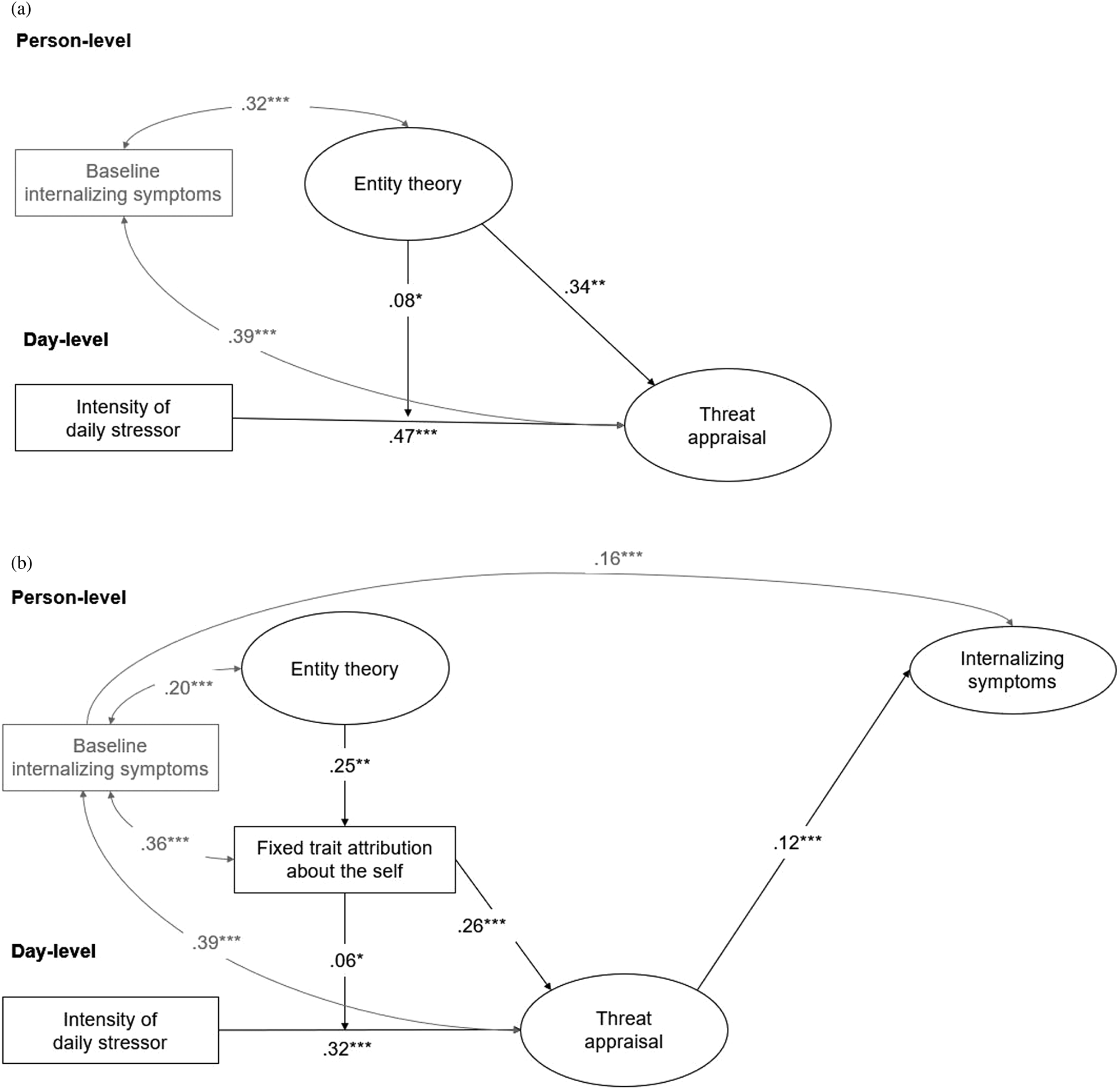
Next, we added fixed trait attributions as a person-level mediator and end-of-year (T3) internalizing symptoms as a person-level outcome to the aforementioned multilevel model. That is, an entity theory of personality was included as a person-level (Level 2) predictor for fixed trait attribution, fixed trait attribution was included as a person-level (Level 2) predictor for the stressor intensity-threat appraisals random slopes (Level 1), threat appraisals were included as a day-level (Level 1) outcome as well as a person-level (Level 2) predictor for internalizing symptoms, and T3 internalizing symptoms were included as a person-level outcome (Level 2). The T1 internalizing symptoms were included as a covariate. This model is graphically depicted in Figure 2b.
We included baseline (T1) internalizing symptoms as a covariate to reduce the effect of confounding variables. We also included dummy-coded variables for the day of the week as covariates (reference day = Monday) to account for different levels of stress on different days of the week (Chow, Ram, Boker, Fujita, & Clore, Reference Chow, Ram, Boker, Fujita and Clore2005). Finally, in light of evidence that stress processes sometimes differ between men and women (e.g., Elliott, Reference Elliott2001; Matud, Reference Matud2004), we also added gender as a person-level (Level 2) covariate and as a moderator in an exploratory analysis.
All analyses were conducted using Mplus 7 (Muthén & Muthén, Reference Muthén and Muthén2017). We used the robust maximum likelihood estimation (MLR) and estimated missing values using the full information maximum likelihood (FIML) estimation (Peugh & Enders, Reference Peugh and Enders2004). Day-level predictors were person-mean centered, whereas person-level predictors were grand-mean centered to separate within-person effects from between-person effects (Enders & Tofighi, Reference Enders and Tofighi2007). We reported only unstandardized coefficients for multilevel analyses because random effects models assume no single variance/covariance matrix for the entire sample, which complicates the presentation of standardized coefficients (Muthén & Muthén, Reference Muthén and Muthén2017). The exact syntax is available in the online supplemental materials .
Results
Replication of Study 1's results
Person-level intercorrelations, means, standard deviations, and the number of responses of the key variables are presented in Table 2. We first replicated the findings of Study 1. The model including an entity theory of personality and internalizing symptoms showed adequate model fit, χ2(32) = 70.22, p < .001, CFI = .96, RMSEA = .05 [90% CI: .03, .06]. Replicating Study 1's finding, an entity theory was positively associated with end-of-year internalizing symptoms (β = .29, b = .08 [95% CI: .05, .12], SE = .02, z = 4.55, p < .001). This finding extends Study 1 by showing the associations between an entity theory and later internalizing symptoms.
Person-level intercorrelations, means, and standard deviations (Study 2)
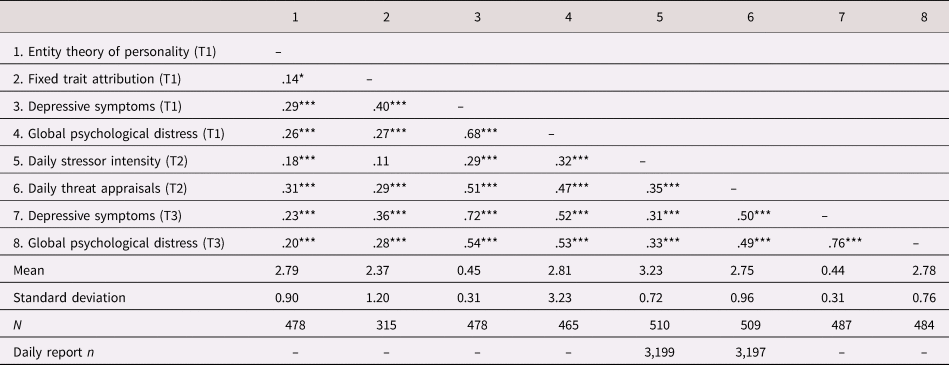
Note: Daily stressor intensity and daily threat appraisals were averaged across ten days. *p < .05. **p < .01. ***p < .001
Next, we conducted the same analysis using clinically elevated depressive symptoms status as the only outcome variable. An entity theory of personality was positively associated with the clinically elevated depressive symptoms status (β = .28, b = .51 [95% CI: .16, .86], SE = .18, z = 2.90, p = .004; Odds ratio = 1.67). That is, adolescents with a relatively strong (+1 standard deviation from the average) entity theory of personality were about 2.5 times more likely to be clinically depressed (34.1% of the participants in our sample) than those with a relatively weak (−1 standard deviation from the average) entity theory of personality (13.9% of the participants in our sample).
Extension of Study 1's results
Intraclass correlations (ICCs = .42~.43) showed that there was sufficient within-person variability (57~58%) in daily threat appraisals to justify day-level analyses. Thus, we proceeded to multilevel analyses (Figure 2a). We first checked the validity of the threat appraisal measure by examining the intercept of within-person random slopes for the association between daily stressor intensity and daily threat appraisals. The intercept of within-person random slopes was b = .47 [95% CI: .41, .54], SE = .03, z = 14.45, p < .001. This result indicates that participants tended to make more threat appraisals on days they experienced more intense negative social events, supporting the validity of our measure.
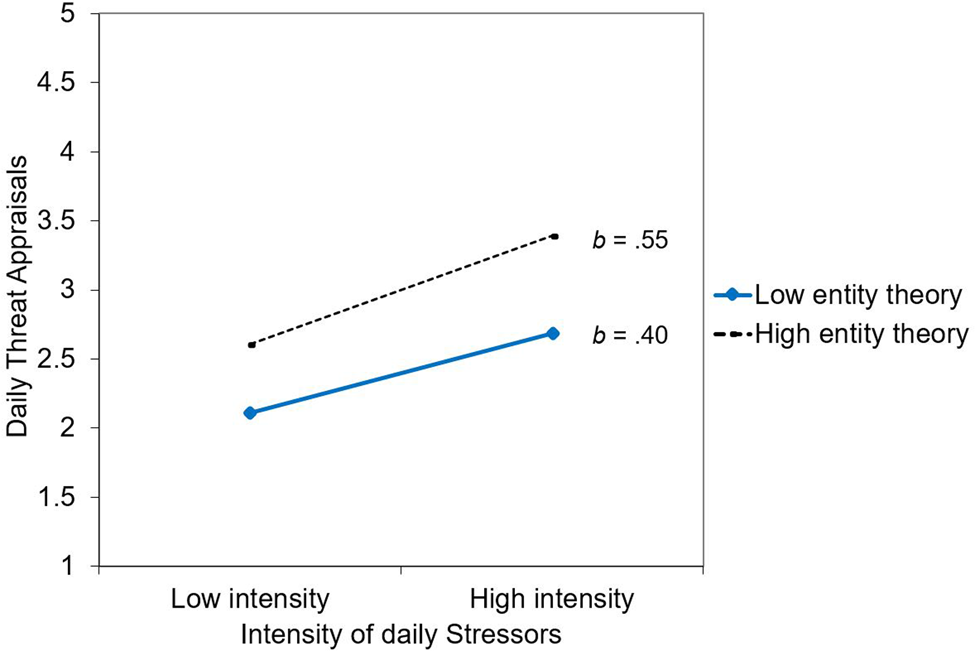
More relevant to our hypothesis, an entity theory of personality positively predicted the within-person random slopes (Figure 2a; b = .08 [95% CI: .02, .15], SE = .03, z = 2.44, p = .02). That is, adolescents who strongly endorsed an entity theory of personality made more threat appraisals when they experienced intense social stressors (see Figure 3). Said differently, an entity theory appeared to magnify the link between a day's stressor intensity and a person's threat-type stress responses. This finding directly confirms the predictions from existing theoretical models (Burnette, O'Boyle, VanEpps, Pollack, & Finkel, Reference Burnette, O'Boyle, VanEpps, Pollack and Finkel2013; Yeager, Reference Yeager2017) but has never been shown before.
The association between intensity of daily stressors and daily threat appraisals by high (+1 standard deviation) and low (−1 standard deviation) entity theory of personality.
We next added a person-level mediator (i.e., fixed trait attributions about the self) and a person-level outcome (i.e., internalizing symptoms) to the model (Figure 2b). In support of our hypothesis, an entity theory was positively associated with fixed trait attributions about the self (Table 3). Next, adolescents’ fixed trait attributions about the self positively predicted the within-person random slopes for the daily stressor intensity–daily threat appraisals association (Table 3). That is, adolescents who made more fixed trait attributions about themselves coped more poorly with daily stressors. Threat appraisals, in turn, positively predicted later internalizing symptoms after controlling for baseline internalizing symptoms (Table 3; the indirect effect of an entity theory of personality on internalizing symptoms: b = .01 [95% CI: .001, .02], SE = .004, z = 1.96, p = .049). This result indicated that adolescents’ situation-general cognitive beliefs (i.e., entity theories of personality) predicted increases in internalizing symptoms via maladaptive situational cognitive styles, namely trait attributions and threat appraisals (Figure 2b).
The path coefficients for the association of entity theory of personality to internalizing symptoms
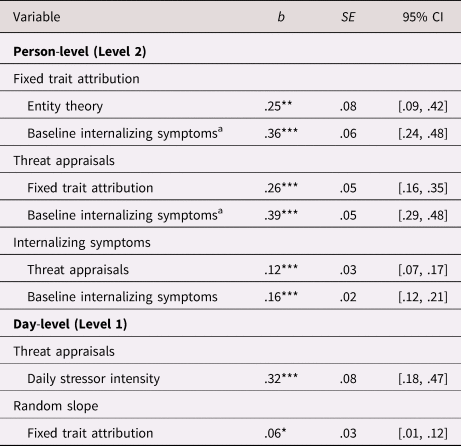
Note: N = 510 (3,199 daily reports). All independent variables are listed with a left indentation under each corresponding dependent variable. Standardized coefficients were not calculated because the random effects model assumes no single variance/covariance matrix for the entire sample. Dummy-coded day variables were included as covariates (Reference day = Monday) to control for the potential day-of-the-week effect (Chow et al., Reference Chow, Ram, Boker, Fujita and Clore2005). acovariance path. * p < .05. ** p < .01. *** p < .001.
Exploratory analyses of gender
After adding gender as a covariate, the results remained consistent (see online supplemental materials). Further, an exploratory multigroup analysis also revealed no significant gender difference in all focal path coefficients (Satorra–Bentler Δχ2(3) = 1.69, p = .64; Satorra & Bentler, Reference Satorra and Bentler2001). Together, we had no reason to suspect that gender moderation or gender confounding influenced our main findings.
Discussion
The National Institutes of Health recently called for mechanism-focused research of behavior change and stress coping (National Institutes of Health, n.d.; see also Summer, Beauchaine, & Nielsen, Reference Summer, Beauchaine and Nielsen2018). Our research directly addresses this call. Our findings provide evidence for the path linking an entity theory of personality to later internalizing symptoms via situation-specific judgments of potential cause and coping resources. These findings offer a basis for understanding how an abstract, cognitive belief about the fixedness of personality predicts internalizing symptoms. Understanding the potential mechanisms is critical not only to advance theoretical knowledge about internalizing symptoms but also to make interventions reliably effective and precisely targeted (Nielsen et al., Reference Nielsen, Riddle, King, Aklin, Chen, Clark and Green2018).
Our findings demonstrate the value of bringing together models of situation-general cognitive beliefs (i.e., implicit theories about personality) with models of situation-specific judgments (i.e., attributions about a specific negative event, appraisals of coping resources) when explaining the onset of depressive symptomology during adolescence. Adolescence is a crucial period for the first onset of major affective disorders (Kessler et al., Reference Kessler, Avenevoli and Merikangas2001; Thapar et al., Reference Thapar, Collishaw, Pine and Thapar2012). Many studies have identified antecedents or risk factors of depressive symptoms, including maladaptive situation-specific cognitions (Beck, Reference Beck1987; Hankin et al., Reference Hankin, Oppenheimer, Jenness, Barrocas, Shapero and Goldband2009; Petersen et al., Reference Petersen, Compas, Brooks-Gunn, Stemmler, Ey and Grant1993; Thapar et al., Reference Thapar, Collishaw, Pine and Thapar2012). Past studies, and the present research, found that one situation-specific cognitive style that predicted internalizing symptoms was a fixed trait attribution about the self – or internal, stable, and global attributions (e.g., Cole et al., Reference Cole, Ciesla, Dallaire, Jacquez, Pineda, Lagrange and Felton2008; Hankin et al., Reference Hankin, Abramson and Siler2001; Spence et al., Reference Spence, Sheffield and Donovan2002). Our studies advance the theories of where these situation-specific cognitive styles come from by highlighting the role of implicit theories of personality as a meaning system (Dweck & Yeager, Reference Dweck and Yeager2019; Hong, Chiu, Dweck, Lin, & Wan, Reference Hong, Chiu, Dweck, Lin and Wan1999; Molden & Dweck, Reference Molden and Dweck2006). This finding extends the extant cognitive models of depression (e.g., Abramson et al., Reference Abramson, Metalsky and Alloy1989; Beck, Reference Beck1987) by incorporating a situation-general cognitive belief, namely an entity theory of personality, as an antecedent of situation-specific causal attributions and threat appraisals.
Our results also contribute to the extended process model of emotion regulation (Gross, Reference Gross2015). The extended process model of emotion regulation posits that the evaluation of a stressor – the judgment that it is “good” or “bad” for me – is central to emotion regulation. When regulating responses to negative social events, an adolescent with an entity theory of personality may perceive a social stressor as “too much to handle” (i.e., threat appraisals) and evaluate the situation as “bad for me.” Alternatively, an adolescent who holds an incremental theory of personality may perceive a social stressor as a hurdle that can be overcome (i.e., challenge appraisals) and evaluate the situation positively. Importantly, this valuation process is dynamic. The way individuals evaluate one situation can influence similar situations in the future. Thus, the adolescent with an entity theory of personality would be expected to appraise future negative social situations as threatening and seek to withdraw from such situations or avoid them. This avoidance behavior could then have the potential to allow stressors to snowball and lead to internalizing psychopathology. An intriguing implication of this process is the possibility of a self-fulfilling prophecy: beliefs about the fixedness of traits may contribute to behaviors that cause one to continue to be socially isolated, via the emotion regulation processes outlined here.
The findings of this current research also provide practical implications for future interventions. Preventative interventions for depressive symptoms may benefit by focusing on teaching adolescents that people can change while simultaneously assisting them in translating these beliefs into adaptive situational cognitions. For example, an intervention program may teach adolescents about how social labels in schools, such as “loser” or “winner,” are not permanent while simultaneously helping adolescents to make adaptive attributions and challenge appraisals about a specific social episode they recently encountered. This combined focus on situation-general and situation-specific cognitions has the potential to boost the effectiveness of psychological interventions for adolescents’ mental health outcomes.
An important limitation of our research is that it was not designed to support causal inferences. The current findings show the presence of hypothesized covariations among the variables while considering temporal precedence. This evidence for the process model can serve as the first step toward supporting a causal process model (Cook & Campbell, Reference Cook and Campbell1979; Kenny, Reference Kenny1979). Furthermore, it is useful to know what predicts internalizing symptoms in the real world because it helps us identify early warning signs (for discussion of the utility of prediction see Shmueli, Reference Shmueli2010). Yet, observational research can rarely eliminate all possible confounding variables, and thus we do not make causal claims here. We encourage future research to test the conclusions of these studies using randomized experiments.
Conclusion
We showed that adolescents tend to be more vulnerable in the face of stressors during the transition to high school when they believe that people, including themselves, cannot change. Further, our research identified two potential mechanisms – trait attributions and threat appraisals – through which a cognitive belief about the malleability of personality was associated with the etiology of internalizing symptoms during adolescence. We hope this research can serve as a starting point for more integrative and experimental research, and possibly identify means for preventing an increase in internalizing symptomatology during any stressful period of life.
Funding Statement
Research reported in this publication was supported by the National Institutes of Health under award number R01HD084772, the Robert Wood Johnson Foundation under grant number 74535, and the John Templeton Foundation under grant number 60636. This research was also supported by grant, P2CHD042849, Population Research Center, awarded to the Population Research Center at The University of Texas at Austin by the Eunice Kennedy Shriver National Institute of Child Health and Human Development and by an Advanced Research Fellowship from the Jacobs Foundation to David Yeager. The content is solely the responsibility of the authors and does not necessarily represent the official views of the National Institutes of Health or other funders.
Conflicts of Interest
None.
Supplementary Material
The supplementary material for this article can be found at https://doi.org/10.1017/S0954579420001832


 Open access

