It has been estimated that there are c. 500 wild tigers Panthera tigris remaining in Peninsular Malaysia (Kawanishi et al., Reference Kawanishi, Siti, Abdul Kadir and Topani2003). Although 45% of Malaysia is still forested (Kawanishi et al., Reference Kawanishi, Siti, Abdul Kadir and Topani2003), the country's apex predator is gravely threatened by habitat loss, forest fragmentation, prey depletion, poaching and retaliatory killing (Locke, Reference Locke1954; Elagupillay, Reference Elagupillay1983; Kawanishi et al., Reference Kawanishi, Siti, Abdul Kadir and Topani2003, Reference Kawanishi, Sunquist, Jasmi, Sahir, Siti Hawa, Elagupillay, Shukor, Norhayati and Shahrul2006). To assess the status of tigers camera-trapping surveys at nine sites were conducted over 1997–1999 (Lynam et al., Reference Lynam, Laidlaw, Wan Shaharuddin, Elagupillay and Bennett2007) but only naive density estimates (0.51–1.95 100 km-2) could be derived because of insufficient data for capture-recapture analysis.
Apart from a study conducted in primary forest in Taman Negara National Park, Peninsular Malaysia, over 1999–2001 (Kawanishi & Sunquist, Reference Kawanishi and Sunquist2004), robust density estimates of tigers are not available for other forest types in Malaysia. There is therefore an urgent need to obtain information on the density of tigers in other forest types to formulate an effective national tiger conservation strategy. To provide such information for a disturbed habitat we adapted the capture-recapture framework (Nichols & Karanth, Reference Nichols, Karanth, Karanth and Nichols2002) to determine the population density of tigers in a selectively logged dipterocarp forest in Peninsular Malaysia.
This study was conducted in Gunung Basor Forest Reserve, in Jeli District, in north-east Peninsular Malaysia in the state of Kelantan. This Reserve is part of a contiguous landscape that falls under a Class 1 Tiger Conservation Landscape (Dinerstein et al., Reference Dinerstein, Loucks, Heydlauff, Wikramanayake, Bryja and Forrest2006). The area is undulating (150–1,840 m) with floristic zones ranging from lowland dipterocarp and hill/upper dipterocarp forest to lower montane forest. The dipterocarp forest of this forest reserve has been selectively logged on several occasions since the 1970s and more recently during 2004–2006.
Following reconnaissance surveys for tiger signs (September–October 2004) a total of 15 camera-trap locations were selected encompassing an area of c. 120 km2. Camera-trapping, with passive infra-red camera-traps (CamTrakker, Georgia, USA), was conducted between October 2004 and July 2005. All camera-traps were operational for 24 hours per day. Each camera-trap location had two camera-traps positioned on opposite sides of a trail to photograph both flanks of any tiger simultaneously (Karanth & Nichols, Reference Karanth and Nichols2002). Camera-trap locations were at elevations of 190–850 m, and distance between locations was 1.8–6.0 km.
Capture-recapture methods (Nichols & Karanth, Reference Nichols, Karanth, Karanth and Nichols2002) were used to estimate total abundance. A closure test was conducted with the software CAPTURE (Otis et al., Reference Otis, Burnham, White and Anderson1978; Rexstad & Burnham, Reference Rexstad and Burnham1991) to investigate whether the closed population assumption was violated. The jackknife estimator (Otis et al., Reference Otis, Burnham, White and Anderson1978) under the heterogeneity model (Mh) was used to estimate population size because it has performed well in other tiger camera-trap studies (Karanth, Reference Karanth1995; Karanth & Nichols, Reference Karanth and Nichols1998; Karanth et al., Reference Karanth, Chundawat, Nichols and Kumar2004).
Trap effort during each trapping session was not equal because of instances of camera-trap malfunction and camera-trap damage by elephants. A sampling occasion was therefore defined according to each monthly trapping period (Karanth, Reference Karanth1995). There was no loss in the detection of tigers by conforming to this definition of sampling occasion. Density estimates were generated by dividing tiger abundance ( , from CAPTURE) by the effectively sampled area,
  (
( ). The effectively sampled area was estimated using the strip width buffer method (Wilson & Anderson, Reference Wilson and Anderson1985; Karanth & Nichols, Reference Karanth and Nichols1998).
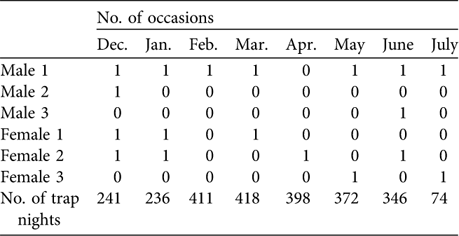
The statistical test for population closure in CAPTURE supported the assumption that the sampled population was closed for the study period (z = -0.629, P = 0.26). The number of individual tigers captured (Mt+ 1) was six (Table 1). Using the Mh jackknife estimator the average capture probability per sampling occasion ( ) was 0.2812 and the corresponding estimate of population size (
 (
( (
( ))) was 8(1.89). Thus, the overall probability of photo-capturing a tiger in the sampled area (
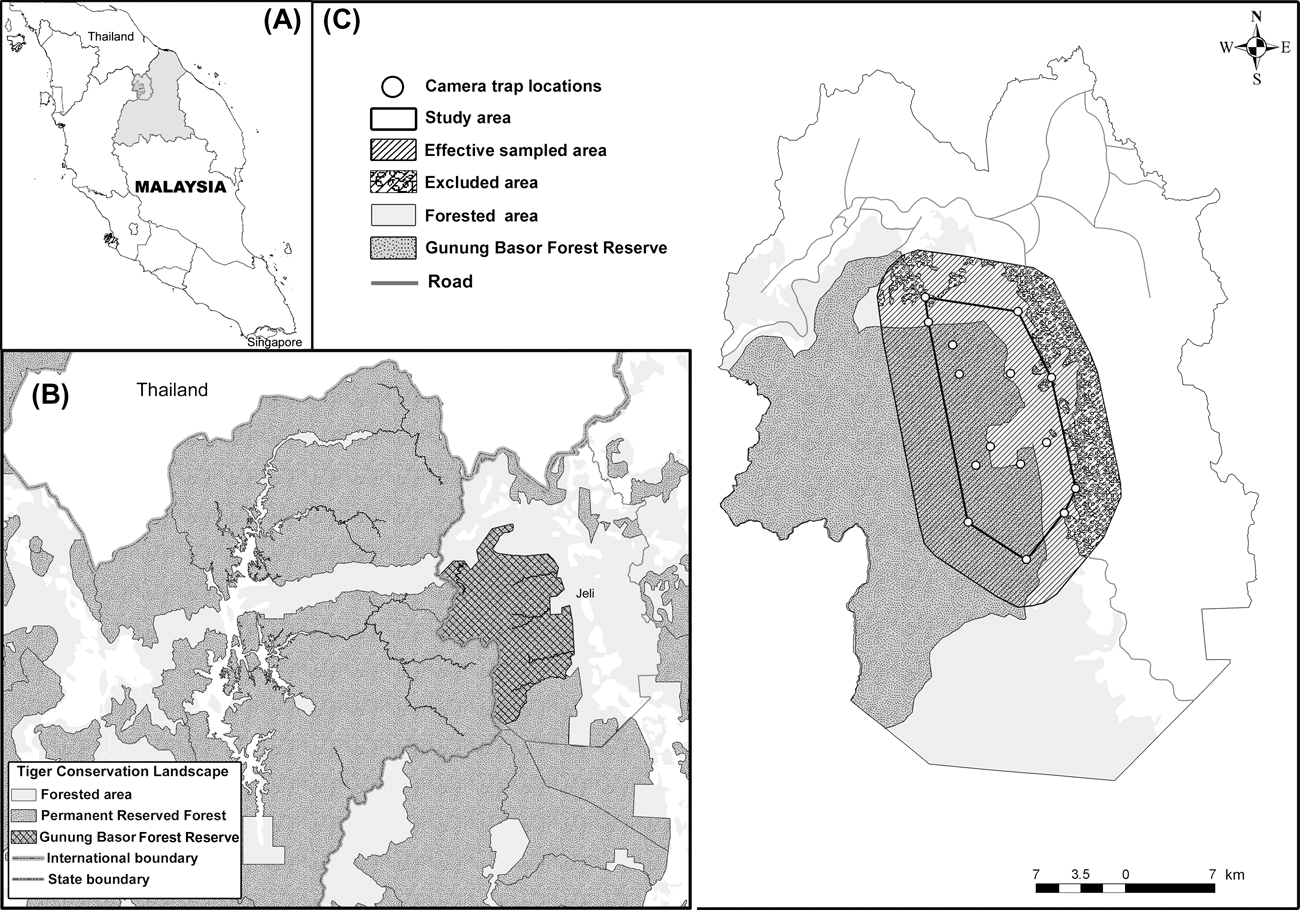
 ) was 0.75. The polygon formed by the outermost camera-traps was 122.9 km2 (Fig. 1) with a buffer width (
 ) of 3.22 km and an estimated effectively sampled area
  (
( ) of 308 km2. The estimated density (
 (
( )) was 2.59 (0.71) adult tigers per 100 km2.
(A) The state of Kelantan in the north-east of Peninsular Malaysia (shaded), with the location of Jeli District indicated in the west of the state, (B) the Tiger Conservation Landscape of Jeli, with Gunung Basor Forest Reserve indicated, and (C) the study area in Gunung Basor Forest Reserve, with the study area, effectively sampled area, and excluded areas (orchards, plantations and human settlements).

Capture histories of the six individual adult tigers camera-trapped from December 2004 to July 2005, and the number of trap nights per month (i.e. the sampling effort).

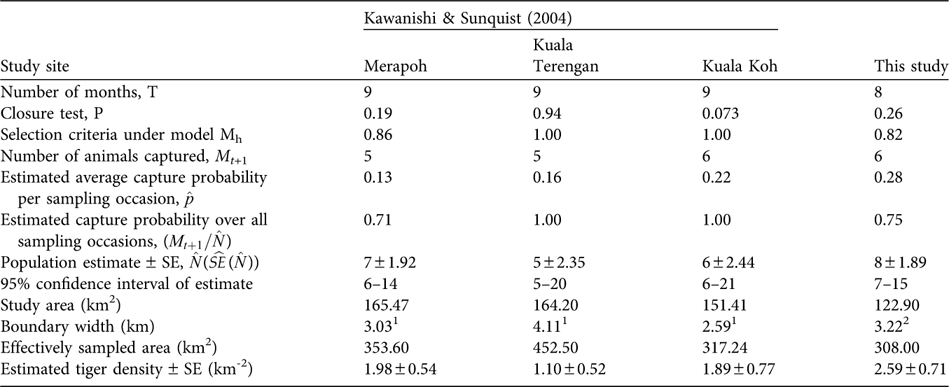
These results show that the selectively logged forests of Gunung Basor Forest Reserve contain a population density of tigers c. 30% higher than the highest estimate derived by Kawanishi & Sunquist (Reference Kawanishi and Sunquist2004) in Taman Negara National Park, a protected primary forest (Table 2). In other protected primary forests in South-east Asia estimated tiger densities are 1–4 per 100 km2 (Indonesia: O'Brien et al., Reference O'Brien, Kinnaird and Wibisono2003; Thailand: Simcharoen et al., Reference Simcharoen, Pattanavibool, Karanth, Nichols and Kumar2007). Although logged forests are disturbed habitats, the response of tigers to the direct and indirect impacts of logging is poorly known. Selective logging may actually improve tiger habitat (Miquelle et al., Reference Miquelle, Smirnov, Merrill, Myslenkov, Quigley, Hornocker, Schleyer, Seidensticker, Christie and Jackson1999) as the disruption of the forest canopy increases sunlight to the forest floor and thus increases browse availability to tiger prey (Davies et al., Reference Davies, Heydon, Leader-Williams, MacKinnon, Newing, Fimbel, Grajal and Robinson2001).
Comparison of capture-recapture statistics used in deriving density estimates in this and Kawanishi & Sunquist's (Reference Kawanishi and Sunquist2004) study in Peninsular Malaysia.

1 Boundary width calculated using the Absolute Maximum Distance Moved method
2 Boundary width calculated using the Mean Maximum Distance Moved method
We did not conduct transect sampling to quantify absolute abundance of prey because this method does not provide sufficient sample sizes to estimate prey abundance (Kawanishi, Reference Kawanishi2002). Nevertheless, relative abundance indices based on photo encounter rates of two prey species (barking deer Muntiacus muntjak and wild boar Sus scrofa) appear to support a predictive model of tiger abundance as a function of prey (Karanth et al., Reference Karanth, Chundawat, Nichols and Kumar2004) as the indices of these two species are at least three and six times higher, respectively, than that of tigers in Gunung Basor Forest Reserve (Darmaraj, Reference Darmaraj2007). Reliance on cattle depredation is unlikely to account for the reserve's high population density of tigers because an average of only eight cases of such predation per year over 1993–2003 was recorded within the entire state of Kelantan (Badrul, Reference Badrul2003).
Our results illustrate the potential of selectively logged forests to accommodate a high population density of tigers. There is a tendency in Malaysia to perceive selectively logged-over forest as having limited conservation and economic value; this fallacy has probably led to the degazetting of forest reserves and subsequent conversion to other land uses (e.g. for plant commodity crops such as oil palm). As tigers have large habitat requirements the effects of such conversion, leading to fragmentation and isolation of forest reserves, will severely affect the long-term viability of tiger populations across the landscape. Our results demonstrate the need for further research on tiger ecology in selectively logged forests to inform decision makers and conservation planners of the conservation value of such habitats. We hope that future research will highlight the role of selectively logged forests for tiger conservation and aid in providing tiger-friendly management guidelines for sustainable forest management in Malaysia.
Acknowledgements
We thank WWF-Netherlands for financial assistance and the Department of Wildlife and National Parks and the Forestry Department of Kelantan for their support. We are also indebted to Kae Kawanishi, Ullas Karanth, WWF-Malaysia colleagues and others for their valuable input.
Biographical sketches
Mark Rayan Darmaraj is a field biologist who has been working for WWF-Malaysia for the past 5 years. He currently designs and conducts wildlife research in several selectively logged forests in Peninsular Malaysia using camera traps. His particular interests are the population ecology of large mammals, especially tigers. Wan Mohamad Shariff, also with WWF-Malaysia, is continuing research on the ecology of tigers using camera traps. His other interests are the ecology of medium to large terrestrial mammals, especially other species of felid.