


1. Introduction
To reduce the negative sustainability consequences associated with products throughout the whole lifecycle and to extend and close resource loops, manufacturers are increasingly required to collaborate beyond the boundaries of their own organizations and value chains. Addressing this challenge is not only a technical or managerial task, but also a design one: it requires reimagining how actors, infrastructures, and systems interact to generate shared value. In this context, the circular economy (CE) is commonly conceptualized as a regenerative system that minimizes resource input and waste by slowing, closing, and narrowing material and energy loops through practices such as reuse, remanufacturing, and recycling (Reference Geissdoerfer, Savaget, Bocken and HultinkGeissdoerfer et al., 2017). A successful transition to a CE will likely depend on the ability of organizations to shift away from maximizing individual benefits towards shared system-level value creation, where new partnerships, actor roles, and forms of collaboration emerge. Recent research points at the need for circular ecosystems, defined as interdependent and non-hierarchical networks of actors who collaborate to co-create value through CE strategies (Reference Aryee, Kanda, Geissdoerfer and KirchherrAryee et al., 2025). However, the formation of such circular ecosystems remains challenging. Many companies are not used to engaging in the forms of partnership required for circularity, which involve shared benefits, mutual data openness, and iterative co-creation rather than purely transactional exchanges. As (Reference Aryee, Kanda, Geissdoerfer and KirchherrAryee et al., 2025) note, “governance in circular ecosystems is shaped by complex dynamics involving power negotiation, conflict resolution, and contested definitions of value and inclusion”, making collaboration both politically and relationally demanding. Existing research has advanced conceptual foundations for circular ecosystems (Reference Aarikka-Stenroos, Ritala and ThomasAarikka-Stenroos et al., 2021; Reference Aryee, Kanda, Geissdoerfer and KirchherrAryee et al., 2025) and provided detailed case studies and prescriptive support (Reference Brown, Von Daniels, Bocken and BalkenendeBrown et al., 2021; Reference Konietzko, Bocken and HultinkKonietzko et al., 2020). While these contributions clarify what forms of collaboration are needed and how they can be facilitated, there is still a limited understanding of the enabling factors (e.g., conditions, capabilities, actions) to foster collaboration in circular ecosystems, and the extent to which those factors are present (or absent) in ongoing European CE projects. Moreover, numerous studies have examined CE barriers (e.g., Reference Kirchherr, Piscicelli, Bour, Kostense-Smit, Muller, Huibrechtse-Truijens and HekkertKirchherr et al., 2018), yet few have focused on barriers related to the formation of circular ecosystems. Accordingly, the purpose of this study is to address this knowledge gap by asking the following research questions: 1) What are the main barriers for developing circular ecosystems? 2) What are the enabling factors for collaboration in circular ecosystems, and how are those factors addressed in European CE-oriented projects?
2. Methods
To address the research questions, the study used a multi-step approach. First, a literature review identified and categorized barriers for developing circular ecosystems, which were clustered using an interpretative framework developed by the authors. Second, insights from this review, combined with prior research on collaborative circular value chains, were used to derive a list of 11 enabling factors for collaboration in circular ecosystems. These enabling factors were then operationalised into a corresponding list of keywords to support data extraction. Third, a qualitative web-based case analysis was conducted through a custom web scraper, which collected data from publicly accessible European CE project repositories to enable an analysis of how the enabling factors are addressed in practice.
2.1. Literature review
A literature review was conducted to identify the main barriers that hinder the implementation of circular ecosystems. This review builds on Reference Dokter, Mallalieu, Hallstedt and IsakssonDokter et al. (2025), who identified nine enabling factors for fostering collaborative circular value chains. While their work primarily examined actions and capabilities that support inter-organisational collaboration, the present study adopts a broader perspective. It focuses on barriers that impede the establishment of circular ecosystems, considering multiple levels and diverse aspects. The keywords used for the literature review included “circular ecosystem’, “circular value chain”, “barrier”, “challenge”, “collaboration”, and “co-creation”. The review focused on open-access journal articles from Scopus and Web of Science. To structure the analysis, we developed an interpretive framework inspired by Reference Kirchherr, Piscicelli, Bour, Kostense-Smit, Muller, Huibrechtse-Truijens and HekkertKirchherr et al. (2018) on barriers to the circular economy, combined with insights from Reference Jones and MetcalfJones (2014) on systemic design for complex social systems. The framework clusters the barriers into four categories: regulatory, technological, organisational, and inter-organisational.
2.2. Web scraping of circular economy-oriented projects
2.2.1. Identification of enabling factors and list of keywords
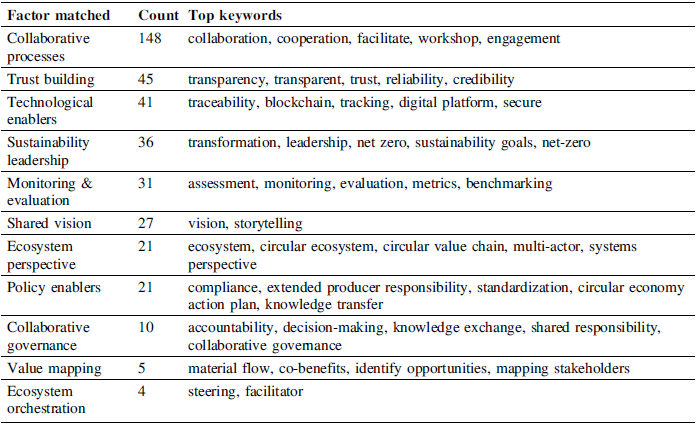
Based on identified barriers, 11 enabling factors supporting collaboration in circular ecosystems were consolidated, expanding the original nine from Reference Dokter, Mallalieu, Hallstedt and IsakssonDokter et al. (2025) to include technological infrastructures (e.g., digital product passports, traceability platforms) and policy frameworks (e.g., regulatory incentives, shared standards). Each factor was linked to keywords drawn from the literature and typical project terminology, resulting in 274 keywords across 11 factors (table 2 lists the 11 factors but the list of keywords is omitted due to article length restrictions). To exemplify the approach, the factor “Trust building’ included keywords such as: “trust”, “trusting”, “trustworthy”, “building trust”, “transparency”, “transparent”, “reliability”, “confidentiality”, “secure data sharing”, “open communication”, “mutual respect”, “credibility”, “relationship building”.
2.2.2. Data collection and analysis
A total of 763 cases were sourced from two public CE project repositories, which provide insights into how projects are represented and communicated by organizations. The first, the knowledge hub powered by Circle Economy which lists case studies filtered under ‘Europe’ and key elements ‘Incorporate digital technology’ and ‘Team up to create joint value’ (n=135). The second, the European Circular Economy Stakeholder Platform, lists ‘Good Practices’ case studies (n=628). A custom web scraper was developed in Python, with programming support by ChatGPT. The scraper used the requests and BeautifulSoup libraries to extract paragraphs from main content, excluding navigation, headers, filters, and other non-relevant sections, incoherent short sentences (<6 words) were filtered out. The scraping was conducted between 3-11-2025 and 7-11-2025, and factors and keywords were matched in 279 unique projects. The output was stored in structured.xlsx files, including project title, source platform, URL, matched factor, matched keyword, extracted text segments, and retrieval date. When a keyword match was detected, the surrounding text (±25 words) was extracted as a contextual segment. Each keyword was registered once per case to ensure that recurring mentions in a single case did not inflate counts. A qualitative content analysis of text segments identified recurring actions, strategies, and approaches in relation to the 11 enabling factors. The full dataset, code, and methodology can be shared for reproducibility on request.
3. Results
This section first presents the results of the literature review on the barriers for developing circular ecosystems. It then outlines the results from the web-based analysis of CE projects based on the eleven enabling factors for collaboration in circular ecosystems, showing keyword frequencies across factors and extracted texts illustrating how challenges, approaches, and actions are described in CE initiatives.
3.1. Barriers for circular ecosystems
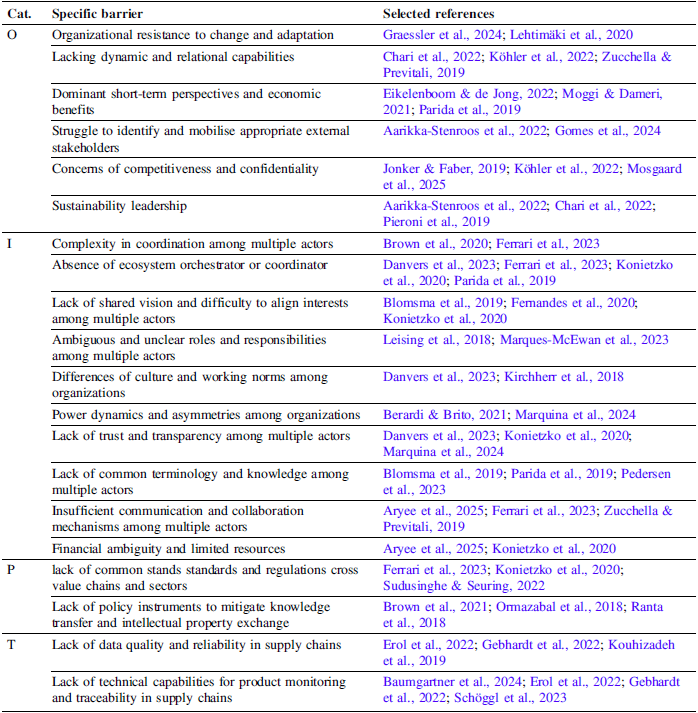
The barriers are organised into four main clusters: policy and regulatory barriers, technological barriers, inter-organisational barriers, and organisational barriers. This categorisation aims to capture the multi-dimensional nature of the challenges. Table 1 provides a comprehensive understanding of these barriers.
Interpretive framework with clustered barriers to circular ecosystem implementation (Cat. = Category, O = Organizational; I = Inter-organizational; P = Policy and regulation; T = Technological); selected references are shown; the full review included additional sources

From an organizational perspective, cultures, beliefs, and silo-thinking can hinder possibilities to collaborate. The resistance to change occurs at individual and organizational levels (Reference Graessler, Guenter, de Jong and HenningGraessler, et al., 2024). The dominant short-term perspectives, performance metrics, and traditional cost-benefit analyses can turn circularity into an add-on rather than a strategic priority, causing conflicts between short-term profitability and long-term ecosystem resilience (Reference Moggi and DameriMoggi and Dameri, 2021; Reference Parida, Burström, Visnjic and WincentParida et al., 2019). Another organizational barrier concerns identifying and mobilizing appropriate external actors and many firms lack strategies or experience in doing so (Reference Aarikka-Stenroos, Chiaroni, Kaipainen and UrbinatiAarikka-Stenroos et al., 2022). Moreover, complex interdependencies within ecosystems (Reference Gomes, Homrich, Facin, Silva, Castillo-Ospina, Trevisan, Ometto, Mascarenhas and CarvalhoGomes et al., 2024), concerns over competitiveness and confidentiality (Reference Mosgaard, Kristensen and BockenMosgaard et al., 2025), and the absence of sustainability leadership (Reference Pieroni, McAloone and PigossoPieroni et al., 2019; Reference Chari, Niedenzu, Despeisse, Machado, Azevedo, Boavida-Dias and JohanssonChari et al., 2022) are discussed as other organizational barriers.
Most barriers are at the inter-organisational level. Inter-organisational collaboration is often challenged by the complexity of coordination among multiple actors (Reference Brown, Bocken and BalkenendeBrown et al., 2020; Reference Ferrari, Jugend, Armellini, Barbalho and CarvalhoFerrari et al., 2023). There is often an absence of a central coordinator or orchestrator that takes responsibility for coordinating and supporting different actors. Without clear governance structures and processes, collaboration remains fragmented and possibilities for shared visions and objectives of the CE are constrained (Reference Blomsma, Pieroni, Kravchenko, Pigosso, Hildenbrand, Kristinsdottir, Kristoffersen, Shabazi, Nielsen, Jönbrink, Li, Wiik and McAlooneBlomsma et al., 2019; Reference Danvers, Robertson and ZutshiDanvers et al., 2023; Reference Fernandes, Pigosso, McAloone and RozenfeldFernandes et al., 2020; Reference Ferrari, Jugend, Armellini, Barbalho and CarvalhoFerrari et al., 2023; Reference Konietzko, Bocken and HultinkKonietzko et al., 2020; Reference Pedersen, Clausen and JørgensenPedersen et al., 2023). Besides, the lack of common terminology and understanding of circular principles hinders effective communication. Cultural and operational differences across organizations makes collaboration difficult (Reference Kirchherr, Piscicelli, Bour, Kostense-Smit, Muller, Huibrechtse-Truijens and HekkertKirchherr et al., 2018). Power asymmetries can create tensions, undermine equitable participation, and disrupt trust and willingness to collaborate (Reference Berardi and BritoBerardi & De Brito, 2021; Reference Marquina, Le Dain, Joly and ZwolinskiMarquina et al., 2024). Finally, insufficient financial support and resources also hinder long-term implementation of circular ecosystems (Reference Aryee, Kanda, Geissdoerfer and KirchherrAryee et al., 2025; Reference Zucchella and PrevitaliZucchella & Previtali, 2019).
The complex relationship between ecosystem actors and inadequate governmental regulation often acts as a significant barrier to the effective implementation of circular economy in the local ecosystem (Reference Ferrari, Jugend, Armellini, Barbalho and CarvalhoFerrari et al., 2023). The absence of clear standards and shared regulatory frameworks limits alignment among stakeholders. Moreover, existing policy support is frequently fragmented, offering few mechanisms to incentivise cross-sectoral collaboration or to ensure consistent and long-term funding (Reference Konietzko, Bocken and HultinkKonietzko et al., 2020; Reference Sudusinghe and SeuringSudusinghe & Seuring, 2022). In particular, the absence of effective policy instruments that facilitate knowledge transfer and manage intellectual property exchange constrains collaboration among actors (Reference Brown, Von Daniels, Bocken and BalkenendeBrown et al., 2021; Reference Ormazabal, Prieto-Sandoval, Puga-Leal and JacaOrmazabal et al., 2018; Reference Ranta, Aarikka-Stenroos, Ritala and MäkinenRanta et al., 2018).
Technological barriers play a crucial role in hindering the implementation of circular ecosystems. Issues related to transparency, traceability, and product tracking across supply chains are particularly significant. The lack of visibility regarding material flows and product life cycles limits the ability of organisations to monitor resource use, evaluate environmental impacts, and recover value from products at the end of their life (Reference Erol, Murat Ar, Peker and SearcyErol et al., 2022). Without reliable systems to support the gathering, aggregation, and exchange of data, stakeholders face difficulties in ensuring accountability and collaboration across the ecosystem (Reference Kouhizadeh, Sarkis and ZhuKouhizadeh et al., 2019; Reference Gebhardt, Kopyto, Birkel and HartmannGebhardt et al., 2022; Reference Schöggl, Stumpf and BaumgartnerSchöggl et al., 2023).
3.2. Results from web-based case analysis
3.2.1. Overview of extracted cases
A total of 763 cases were analysed, with a factor identified in 279 unique projects (37%). Of these, 187 came from the EU’s circular economy stakeholder platform and 92 from the Circle Economy knowledge hub. Cases spanned diverse sectors (e.g., construction, fashion, city planning, manufacturing, food systems) and CE strategies (remanufacturing, sharing systems, industrial symbiosis, product-service systems, take-back programs). There were 389 factor occurrences and 487 distinct keyword occurrences. Each case included an average of 1.39 factors (SD = 0.81) and 1.75 keywords (SD = 1.50).
3.2.2. Frequency of collaboration-enabling factors and keywords
Table 2 summarizes the frequency of collaboration-enabling factors across cases. Collaborative processes occurred most often, followed by Trust building and Technological enablers. The presence of both Collaborative processes and Trust building highlights a focus on reliability and transparency, often elaborated through workshops and other multi-stakeholder engagements. While many project descriptions emphasize collaboration, few detail formal governance structures (e.g., agreements, contracts), explaining the low frequency of collaborative governance. Trust building and technological enablers frequently co-occurred, indicating digital infrastructures support transparency and reliability. Ecosystem perspective and Ecosystem orchestration appeared in under 8% and 2% of cases, showing circularity is mainly framed at the project or organizational level.
Frequencies of 11 enabling factors matched across the studied cases (n=279)

The 487 keyword occurrences were analysed and Figure 1 presents the top 20 keywords. Because the scraping method prevented keyword repetition within a factor occurrence, the keyword frequencies represent single occurrences within distinct projects rather than counting keyword repetition. While references to collaboration and cooperation are expected in CE projects, collaboration appears to require more than relational coordination alone. The prominence of transparency and traceability indicates a focus on shared information infrastructures as foundations for trust and collective action.
Overview of the frequency of the top 20 keyword occurrences across the studied cases

3.2.3. Extracted text segments and illustrative examples
From the 279 analysed cases, a total of 720 text segments were identified that referenced one or more of the nine enabling factors. Each segment captured a project context in which a relevant keyword appeared, revealing a range of actions, approaches, and strategies associated with collaboration in CE projects. Summaries and quotes of recurrent themes associated with each factor are outlined in Table 3.
Summary of text segments extracted across factors alongside selected examples

4. Discussion and final remarks
The initial aim of the study was to identify the main barriers for developing circular ecosystems, highlighting inter-organizational collaboration as a primary barrier. Following, the study identified 11 enabling factors for collaboration in circular ecosystems, which helped to examine how these factors are addressed in European CE-oriented projects. In sustainable design and circular innovation, designers are increasingly required to coordinate multi-actor collaboration and foster relational conditions under which circular solutions can be realised. Understanding factors supporting collaboration in circular ecosystems offers insights for design researchers and practitioners working at the ecosystem level.
Based on four clusters of barriers for circular ecosystems and 11 enabling factors for collaboration, the study systematically analysed 763 project descriptions from 2 publicly available European project repositories through web scraping. Results show that collaborative processes, trust building, and technological enablers are among the most frequent factors, reinforcing relational foundations for circular ecosystems through novel digital technologies. In practice, this is evidenced by the growth of product traceability platforms which can positively impact inter-organizational collaboration and enable confidential and trustworthy environments (Reference Baumgartner, Berger, Schöggl, Lynn, Rosati, Kreps and ConboyBaumgartner et al., 2024; Reference Schöggl, Stumpf and BaumgartnerSchöggl et al., 2023). Analysed cases frequently signalled collaborative intentions but provided limited detail on how collaboration is achieved, and through what governance structures. This is partly a limitation of the method, as project descriptions mainly focused on outcomes over processes. Moreover, projects were often temporary and focused on initiating collaboration rather than managing it over time and sustaining it at larger scales. The term ecosystem often referred to resource flows rather than stakeholder constellations and there were few references to circular ecosystems or ecosystem orchestration, possibly indicating that these terms are still primarily concepts in academic debate (Reference Aarikka-Stenroos, Ritala and ThomasAarikka-Stenroos et al., 2021; Reference Aryee, Kanda, Geissdoerfer and KirchherrAryee et al., 2025).
To date, the potential role of design capabilities and designers in fostering and orchestrating circular ecosystems remains underexplored. Reference Konietzko, Bocken and HultinkKonietzko et al. (2020, Reference Konietzko, Baldassarre, Bocken, Ritala, Ometto, Sarkis and Evans2024) highlighted the necessity of initial alignment through shared visions in circular ecosystems supported by workshops, experimentation, visualization, and prototyping. Reference Aryee, Kanda, Geissdoerfer and KirchherrAryee et al. (2025) emphasised the use of participatory approaches, such as co-design methods and strategies, to promote diverse representation and enhance engagement and shared ownership of circular initiatives. The 3I’s framework (Reference Trevisan, Castro, Gomes and MascarenhasTrevisan et al., 2023) underscores that orchestration relies on innovating in circular product design, integrating diverse actors, and investing in shared infrastructures. The first two challenges resonate directly with strategic design capabilities in managing complexity and enabling co-creation, reinforcing the need for further research on design capabilities as foundational mechanisms for circular ecosystem orchestration. We argue that the notion of circular ecosystems opens up new spaces for design and designers to contribute, for instance through strategic design capabilities such as holistic thinking, empathy, a willingness to experiment, and managing complexity (Reference Boyer, Cook and SteinbergBoyer et al., 2013; Reference Calabretta, Gemser and KarpenCalabretta et al., 2016). These are necessary features to address the inter-organizational barriers and contribute to the formation, governance, and collaborative dimension of circular ecosystems. This study makes a methodological contribution by demonstrating how keyword-based automated web scraping and text analysis can be used to map theoretically grounded factors across a large set of cases from publicly accessible CE repositories. A main limitation is that public project descriptions reflect how organizations present their work, not necessarily how CE projects occurred. Nevertheless, the large dataset reveals insights less apparent in small-sample qualitative studies. Future studies will focus on in-depth qualitative studies of circular ecosystems to examine the presence of identified factors and the dynamics underpinning successful collaboration, as well as the role of design capabilities.
Acknowledgements
Financial support from GENIE – Gender Initiative for Excellence at Chalmers is acknowledged.


 Open access

