





Introduction
Food insecurity in high-income countries has been defined as the condition in which individuals or households do not have reliable access to sufficient, safe, nutritious and culturally acceptable food that can be acquired in socially acceptable ways and with dignity(Reference Gallegos, Booth and Pollard1). In the Australian context, this definition is particularly important because food insecurity often occurs not because food is unavailable within our food system but because households face financial, geographic, social and structural barriers to obtaining adequate food in ways that preserve autonomy and dignity(Reference Gallegos, Booth and Pollard1). Despite the global commitment to Sustainable Development Goal 2 (Zero Hunger), which aims to end hunger, achieve food security, improve nutrition and promote sustainable agriculture by 2030(2), progress has stalled in many settings. Recent international reports indicate that advancement towards this goal remains uneven and insufficient, with hunger and food insecurity persisting above pre-pandemic levels in many regions(Reference Kent, Murray and Penrose3). Indeed, 1 in 8 Australian households reportedly experienced food insecurity in 2023(4), with higher estimates being reported across many communities(Reference Kent, Visentin and Peterson5–Reference Seivwright, Kocar and Visentin7). This stagnation reflects not a lack of food production and agricultural viability but the complex and interconnected nature of food systems, where social, economic, environmental and political pressures interact to undermine equitable access to nutritious food(Reference Pérez-Escamilla8). Framing food and nutrition insecurity as a complex systems issue moves us beyond a narrow focus on food supply and highlights that food insecurity is fundamentally shaped by the systems through which food is produced, distributed, accessed and governed(Reference Charlton, Pickles and Gebremariam9).
In recent years, vulnerabilities in food systems have been intensified by overlapping forms of disruption. Acute shocks, including the COVID-19 pandemic(Reference Jones, Bellamy and Bellotti10), bushfires and major flooding events(Reference Smith, Lawrence and MacMahon11,Reference Smith and Lawrence12) , have exposed weaknesses in food supply chains, retail access and community infrastructure. Highly centralised, just-in-time food supply chains that are increasingly globalised have proven efficient under stable conditions but fragile during prolonged or place-specific shocks, with limited capacity to adapt to rapid changes in demand, labour availability or infrastructure damage(Reference Yang, Tilman and Bellemare13). At the same time, chronic structural pressures such as rising food prices(Reference Lewis, Herron and Chatfield14), housing stress, insecure employment and escalating energy and transport costs have progressively eroded household resilience(Reference Middha and Willand15). For many Australian households, food insecurity is increasingly persistent rather than episodic(Reference Pollard, Booth and Jancey16), reflecting not only immediate crises but the cumulative effects of prolonged economic and social strain. These intersecting disruptions support the notion that food insecurity cannot be understood solely as a matter of food availability or individual choice. Rather, they expose deeper structural weaknesses in contemporary food systems and raise important questions about who is most vulnerable, who has control over food access and how communities respond when formal systems fail, particularly for sectors of the community who experience socio-economic disadvantage, geographic isolation or disrupted mobility.
Existing responses to food and nutrition insecurity during disruption
A broad range of responses to food and nutrition insecurity have emerged across high-income countries during periods of acute and chronic disruption(Reference Yii, Palermo and Kleve17). In Australia, these include emergency food relief services(Reference Lindberg, Whelan and Lawrence18) such as food banks, hampers, meal delivery programmes and vouchers, alongside school-based supports(Reference Spencer, Kent and Williams19), community meal services, mutual aid networks, neighbourhood food sharing(Reference McKay, McKenzie and Lindberg20) and more recently, place-based initiatives such as food hubs(Reference Wingrove, Love and Bolton21), cooperatives(Reference Williams, Pilkington and Parker22), community gardens(Reference Pickles, Charlton and McMahon23) and regional food governance groups(Reference Godrich, Doe and Goodwin24). These responses operate across multiple levels of the food system and serve different functions depending on the nature and duration of disruption. Importantly, these responses operate within food systems already shaped by structural vulnerabilities, including concentrated retail power(Reference Clapp, Vriezen and Laila25), dependence on centralised and just-in-time supply chains(Reference Murphy, Carey and Alexandra26), uneven local food environments(Reference Gebremariam, Kent and Brennan-Horley27) and persistent affordability pressures for low-income households(Reference Dean, Lewis and Walton28). Periods of disruption therefore often expose and intensify pre-existing weaknesses in food systems that undermine food and nutrition security, rather than creating entirely new vulnerabilities.
During acute shocks, such as pandemics, floods, bushfires and sudden economic crises, many of these responses function as buffering mechanisms(Reference Béné29). In this review, buffering refers to short-term shock absorption strategies that protect households and communities from immediate hardship by maintaining food access, reducing hunger and supporting continuity of dietary intake during periods of instability. Such responses are essential in crisis settings, particularly where households experience sudden income loss, transport disruption, mobility restrictions or breakdowns in local supply systems(Reference Kent, Murray and Penrose30). However, while the literature consistently recognises the importance of buffering responses, there is increasing critique that existing approaches are insufficient when relied upon as the primary response to food and nutrition insecurity(Reference Carey and Murphy31). We argue that too much of the current response landscape remains heavily concentrated in downstream and emergency-oriented models that address the immediate consequences of hardship rather than the structural conditions that produce it(Reference Sonnino and Milbourne32). Food insecurity in high-income countries is increasingly understood as a product of broader social, economic and spatial inequities, including poverty, housing stress, rising food costs, transport disadvantage and unequal local food environments. As such, short-term buffering may protect against acute hunger without strengthening longer-term resilience.
Concentrated corporate power across food retail, distribution and supply chains, alongside broader commercial determinants of health, can constrain government willingness to enact upstream policy change(Reference Clapp33). Large supermarket chains, food manufacturers and supply chain actors often exert substantial influence over pricing, product availability, procurement systems and policy agendas, which may privilege market efficiency and profitability over equity, nutrition and community wellbeing(Reference Clapp33). Dominant businesses can shape markets, technologies and governance, undermining people’s agency and limiting democratic participation in food policy(Reference Clapp, Vriezen and Laila25). This concentration of power can limit opportunities for more preventative and rights-based policy responses, including regulation of healthy food affordability, local procurement models and investment in place-based food infrastructure(Reference De Melo, Baker and Machado34).
Important gaps also remain at the level of governance and systems response. Nationally, Australia lacks a comprehensive food or food security policy, a lead agency and a regulatory framework covering food distribution and access, beyond food safety and production(Reference De Melo, Baker and Machado34). Australian food policy is frequently fragmented across sectors including health, agriculture, social welfare, education, planning and emergency management, contributing to policy incoherence and limited accountability for food and nutrition security outcome(Reference Nelson, Lim-Camacho and Robinson35). This fragmentation means that responsibility for food and nutrition security is often dispersed across multiple portfolios without a clear lead agency, reducing the capacity for coordinated, cross-sector responses to acute and chronic disruption. In practice, this can result in reactive and siloed policy approaches, with mostly minor ‘adjustment’ actions and no transformative reforms(Reference De Melo, Baker and Machado34). At the same time, across states and regions, in addition to food policy being horizontally (between sectors) limited, it is also vertically (between levels of government) fragmented, with weak integration into urban planning and disaster governance, limiting resilience and post-disaster learning(Reference Keegan, Reis and Roiko36). As a result, no single level of government is clearly accountable for food and nutrition security outcomes.
The time for action is now. Amid the 2026 fuel crisis and rising cost-of-living pressures, and with the development of a new National Food Security Strategy underway, there is a clear policy window to shift from short-term crisis management towards long-term food systems resilience and equity. Therefore, this review examines how community-led responses to food and nutrition insecurity operate during periods of disruption, with particular attention to the Australian context. Specifically, the review explores how these responses function along a continuum from short-term buffering of hardship to the strengthening of adaptive local food infrastructure and resilience, through to the redistribution of agency and governance power within food systems. In doing so, the review aims to critically examine the extent to which community-led responses move beyond crisis management to contribute to more equitable, resilient and nutrition-sensitive food systems. This review also introduces a new model as a conceptual framework to guide policy and practice.
Conceptual framing: what is disrupted and where responses occur
Six-pillar food and nutrition security framework
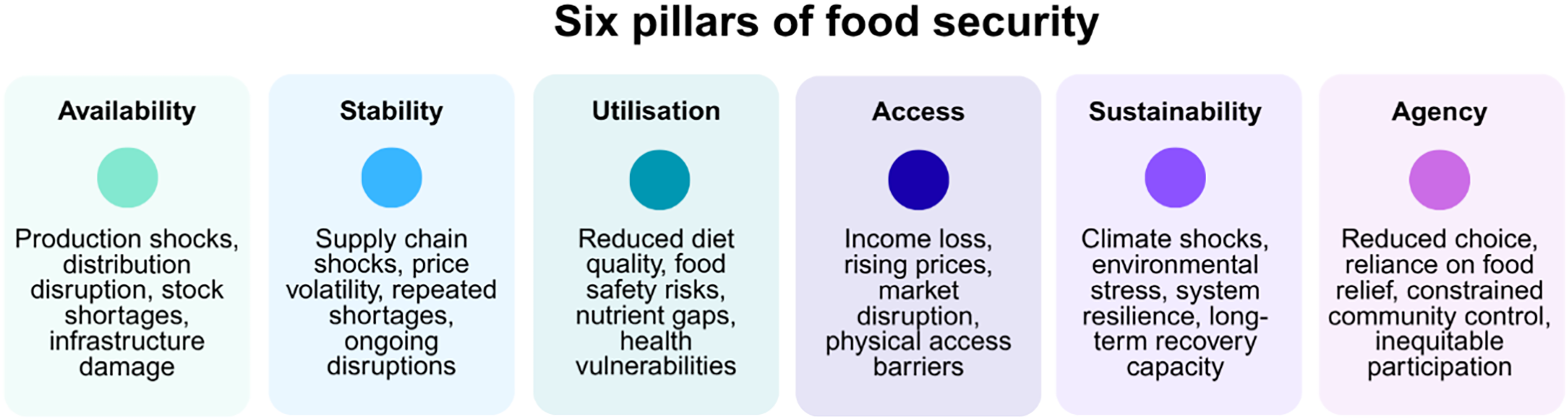
This review is guided by the six-pillar food and nutrition security framework(Reference Clapp, Moseley and Burlingame37), which conceptualises food security as a multidimensional construct comprising availability, access, utilisation, stability, agency and sustainability (Fig. 1). While the first four dimensions have traditionally underpinned food security scholarship(38), more recent work has emphasised the importance of agency and sustainability, particularly in the context of repeated and overlapping disruption. Together, these pillars provide a framework for understanding not only whether food is physically present within the system but also whether individuals and communities are able to access, use and influence food systems in ways that support health, dignity and long-term resilience. During periods of disruption, these dimensions are rarely affected in isolation. Acute shocks such as pandemics, floods, bushfires and economic crises may simultaneously disrupt food availability through supply chain interruptions, constrain access through rising costs and reduced mobility, compromise utilisation through poorer diet quality and reduced dietary diversity and undermine stability through repeated or prolonged uncertainty. Importantly, such disruptions may also erode agency, limiting the ability of households and communities to make meaningful food choices or participate in food-related decision-making. Within this review, agency is positioned as a central pillar, providing an important lens for examining whether community-led responses merely buffer hardship or contribute to strengthening control, dignity and participation within food systems.
The six pillars of food security(Reference Clapp, Moseley and Burlingame37) as a framework for understanding food system disruptions and crises.

How disruption affects food and nutrition security across system levels
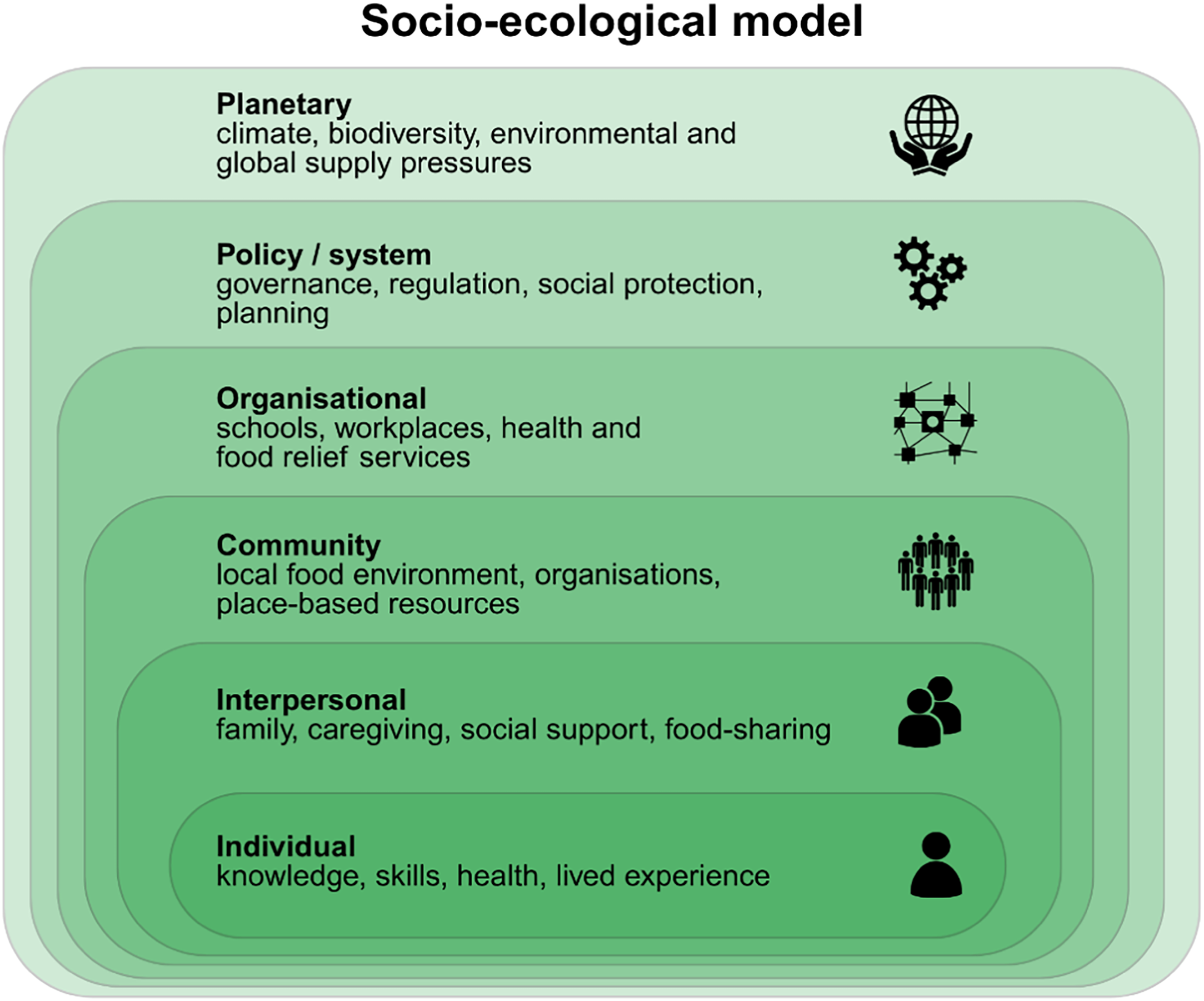
To complement the six-pillar framework, this review applies a socio-ecological model to examine where disruption and responses occur across interconnected levels of the food system(Reference Bronfenbrenner39). This model recognises that food and nutrition security, is shaped by interacting influences at the individual, interpersonal, community, organisational, policy and broader systems levels (Fig. 2).
The socio-ecological model showing inter-related levels of influence on food and nutrition security at the individual, interpersonal, community, organisational, policy/system and planetary levels.

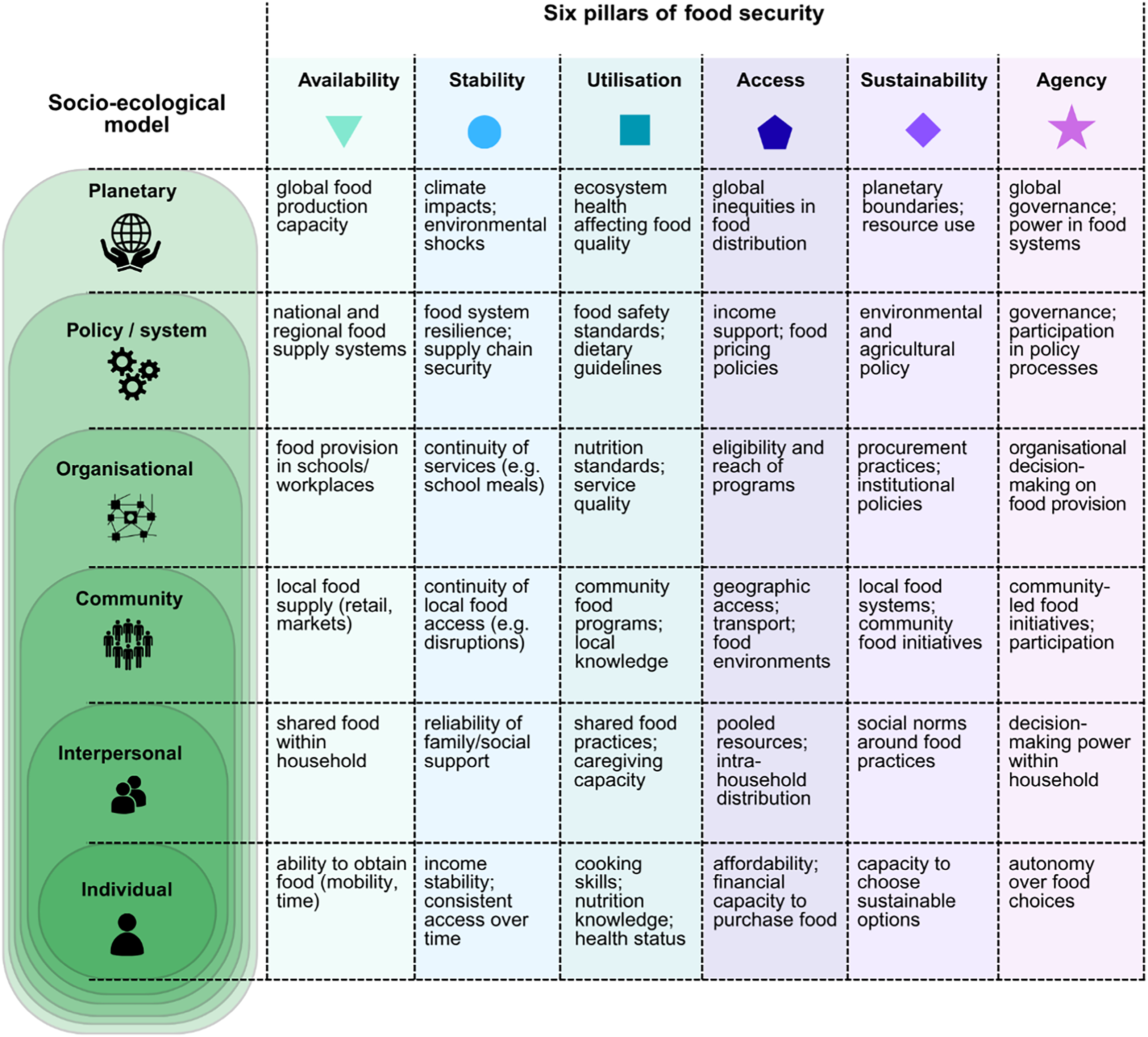
This model highlights two key points. Firstly, that disruptive events such as pandemics, climate-related disasters and economic shocks rarely affect a single level in isolation. Instead, their impacts cascade across levels, influencing household food access and coping strategies, community support systems, institutional food environments and broader governance and policy responses. Secondly, responses to food insecurity are mobilised across these levels, ranging from individual and household coping strategies to community-led initiatives, to organisational and policy-level interventions. Fig. 3 demonstrates how activities that address the six pillars of food security can be mapped across different socio-ecological levels. In this review, the socio-ecological model is used to locate where responses are concentrated and to examine whether they remain focused at downstream levels or extend to community, governance and systems levels where longer-term adaptation and transformation may be possible.
The six pillars of food security across the socio-ecological model, illustrating how determinants of food and nutrition security operate from individual to planetary levels and interact to shape system responses to disruption.

Individual and household food access and utilisation
At the individual and household level, disruption most immediately affects food access(Reference Kent, Murray and Penrose40) and utilisation(Reference Kent, Murray and Penrose30). Access captures whether households are able to obtain food economically and physically, and in crisis settings this is frequently constrained by income loss, unemployment, rising living costs, transport barriers and place-based inequities(41,Reference Guiné42) . In urban and regional Australia, access is further constrained by the uneven distribution of healthy food outlets, meaning that even when food remains available within the broader system, many households are unable to afford sufficient, nutritious and culturally appropriate foods(Reference Gebremariam, Charlton and Visentin43,Reference Gebremariam, Kent and Brennan-Horley44) . For example, Australian evidence during the COVID-19 pandemic demonstrated markedly higher food insecurity among low-income households, renters, those who had experienced income loss, people living with disability, young adults, temporary residents and international students(Reference Kent, Murray and Penrose3). These pressures were compounded by rising food prices, with healthy foods including fruit, vegetables, legumes, grains and lean proteins increasing in price more rapidly than less nutritious options. Between 2019 and 2022, recommended healthy diets rose in cost by approximately 18%, intensifying affordability barriers for households already experiencing socio-economic disadvantage(Reference Lewis, Herron and Chatfield14).
These disruptions have important implications for utilisation at the household level, where households often adopt reactive coping strategies, including skipping meals, reducing food quality, purchasing the cheapest available foods or relying on food relief services with limited choice(Reference Kent, Seivwright and Visentin45). Many households report constrained choice, stigma and reduced dignity during these periods, even where temporary income supports are available(Reference Kent, Murray and Penrose3). This results in reduced dietary diversity, lower fruit and vegetable intake, increased reliance on shelf-stable ultra-processed foods, compromised food safety and reduced capacity to prepare meals(Reference Kent, Murray and Penrose30). Cooking skills, food literacy, storage capacity and the home food environment become increasingly important in shaping how well households are able to convert available food into adequate diets(Reference Ronto, Nanayakkara and Worsley46). These effects may be particularly pronounced among children, older adults and people living with chronic disease, where nutritional compromise can have immediate and cumulative health consequences.
Community and systems disruption
At the community and systems level, food systems disruption frequently affects availability and stability. Availability refers to the physical presence of food within the system, including production, processing, transport, retail distribution and household supply. In crisis contexts, availability may be disrupted by reduced agricultural output, labour shortages, transport breakdowns, infrastructure damage, stock shortages and interruptions to local or global supply chains(Reference Godrich, Lo and Kent47,Reference Godrich, Macau and Kent48) . Recent Australian examples include flood and bushfire impacts and extreme weather events in regional production zones(Reference Smith, Lawrence and MacMahon11,Reference Cuthbertson, Archer and Robertson49) , disruptions to road freight and temporary supermarket shortages during the COVID-19 pandemic(Reference Kent, Gale and Penrose50). These disruptions are often most visible through empty supermarket shelves, reduced product variety, delays in stock replenishment and increased price volatility.
Beyond logistics, disruption also exposes deeper structural weaknesses in local food environments. Communities experiencing socio-economic disadvantage are often characterised by less supportive food environments, including fewer healthy food outlets and greater exposure to takeaway and fast-food options(Reference Gebremariam, Kent and Brennan-Horley27). In regional and remote communities, these inequities may be further compounded by distance, fuel costs, reduced infrastructure and limited alternative supply pathways(Reference Love, Whelan and Bell51). This highlights that systems disruption is not only a question of supply chains but also of place-based inequity and local adaptive capacity.
Agency and power during disruption
Agency is central to this review and reflects the capacity of individuals, households and communities to make meaningful decisions about food and to influence food system governance. This includes autonomy in food choice, culturally appropriate food practices, community control, food sovereignty and participation in local and policy decision-making.
Crises expose unequal power in food governance where agency is often significantly constrained. National responses often privilege large retailers and vertically integrated chains, while community and local actors fill gaps in access(Reference Savary, Akter and Almekinders52). Corporate concentration enables firms to set prices and wages, shape food environments and technologies and influence policy, all of which can narrow people’s real choices and weaken democratic participation in food governance(Reference Clapp, Vriezen and Laila25). At the systems level, disruption may further expose unequal distributions of power. Governance case studies from Melbourne and across Australia have demonstrated that formal food system responses during crises were predominantly shaped by industry and supermarket actors, while civil society organisations and vulnerable groups operated in parallel through informal spaces of self-governance and food relief provision(Reference Carey and Murphy31). In contrast, consumers consistently called for stronger public leadership, clearer contingency planning, stronger regulation of supermarket and supply chain practices and greater support for community-owned and locally governed food initiatives(Reference Kent, Gale and Penrose50).
These findings position agency as both a household and governance issue. During disruption, questions of who holds decision-making power, whose needs are prioritised and who participates in recovery planning become central to understanding food and nutrition security. Importantly, these issues also extend to sustainability. Periods of disruption expose structural features of contemporary food systems that are fundamentally unsustainable, including heavy reliance on long and fragile supply chains, high-carbon transport, just-in-time logistics and environmentally vulnerable production systems(Reference Anderson, Bruil and Chappell53). Strengthening resilience therefore requires not only crisis response but also longer-term structural and policy reform, including diversification and localisation of supply chains, support for place-based food systems and embedding human-right-to-food principles within policy frameworks(Reference Marusak, Sadeghiamirshahidi and Krejci54).
Community-led responses across the socio-ecological model
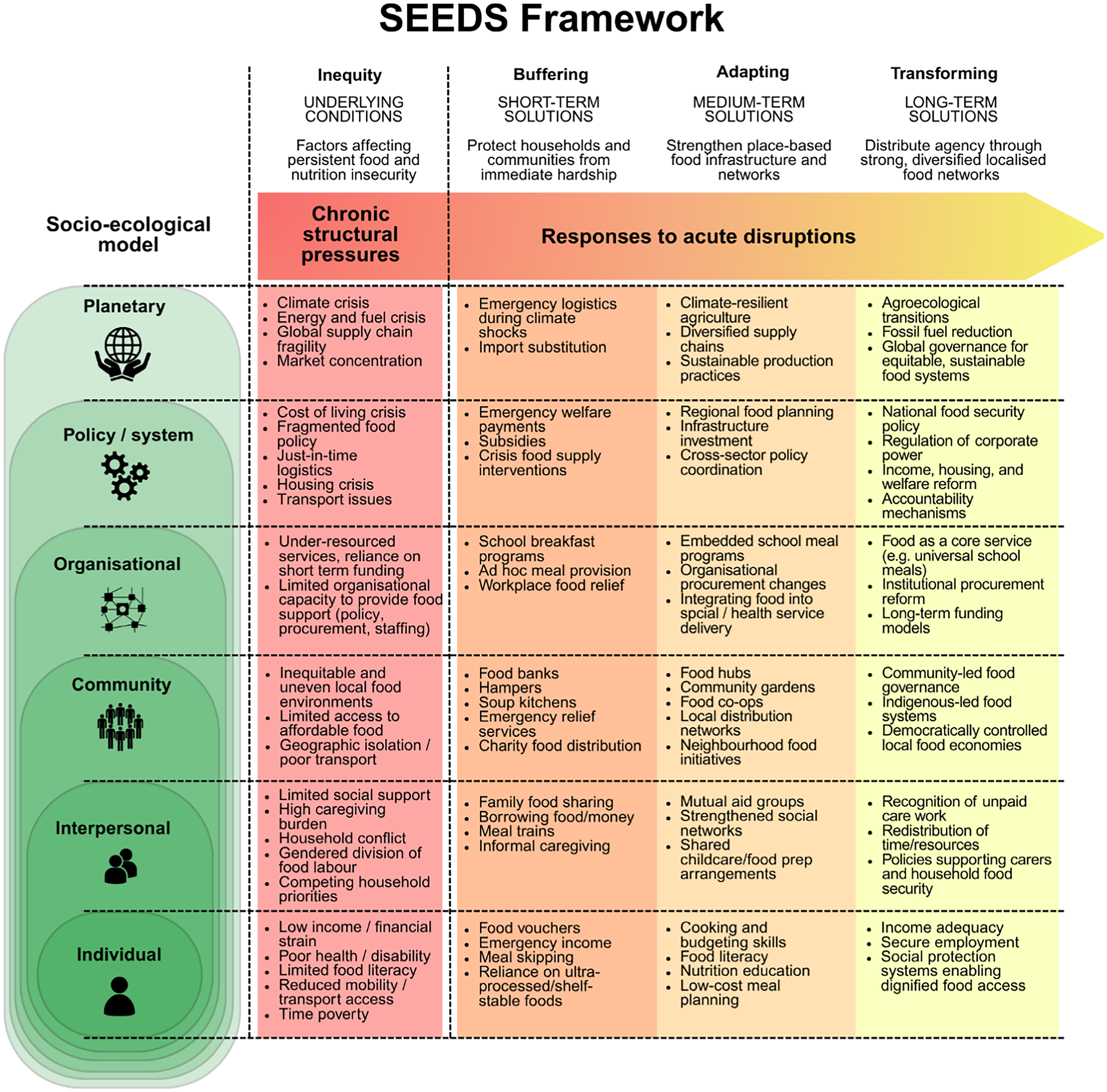
Community-led responses to food and nutrition insecurity operate across multiple levels of the socio-ecological model and serve distinct but interconnected functions during times of disruption (Fig. 4). Rather than conceptualising these initiatives solely by type, this review organises them according to where they primarily operate within the system and the role they play in strengthening food and nutrition security. This framework has been termed the SEEDS (Socio-ecological Enablers of Dietary Security) model. Across various socio-ecological levels, responses range from immediate buffering at the household and interpersonal level, to community and organisational infrastructure that strengthens local adaptive capacity, through to governance and systems responses that we argue have the greatest potential to redistribute agency and transform food system resilience.
The Socio‑Ecological Enablers of Dietary Security (SEEDS) Framework, showing the relationship between levels of the socio-ecological model and acute (buffering), medium-term (adapting) and longer-term (transforming) responses to disruptions.

Household and interpersonal buffering responses
At the individual, household and interpersonal levels, social and community-led responses most commonly function as buffering mechanisms that absorb the immediate impacts of disruption. These responses are particularly important during acute shocks such as pandemics, floods, bushfires, sudden income loss and mobility restrictions, where households may experience immediate barriers to food access, affordability or meal preparation. Reliance on relatives, neighbours and social networks is one of the most frequent coping strategies adopted during crisis(Reference Rut and Davies55). Mutual aid organisations and food‑sharing networks distributed thousands of pounds of food, reduced food waste and built community in US cities such as Chicago and Tompkins County, often via informal, volunteer‑run hubs and cabinets, neighbourhood social networks, local online groups and volunteer-led delivery systems(Reference Gordon56–Reference Lofton, Kersten and Simonovich59). Mobile and meal services (e.g. soup kitchens, mobile kitchens, crowdsourced delivery) maintained access for older adults, disabled people and those unable to travel during lockdowns and weather events(Reference Papadaki, Ali and Cameron60). These responses improve short-term food access and stability, especially for most disadvantaged communities and may reduce stigma relative to formal charity models. Yet, such buffering responses rely heavily on pre-existing social cohesion and reciprocal community-driven relationships. Indeed, while these responses are essential, their primary role remains protective and largely downstream(Reference Béné29), as their focus is on absorbing immediate hardship rather than altering the structural determinants of food insecurity. Without stronger links to broader infrastructure and policy supports, there is a risk that buffering responses become normalised as long-term substitutes for upstream action.
Community and organisational infrastructure
At the community and organisational levels, responses shift from immediate relief towards strengthening adaptive local food infrastructure. In the Australian context, food banks, community agencies, school food programmes and meal services form a growing emergency food relief landscape(Reference Kleve, Greenslade and Farrington61), providing hampers, cooked meals, vouchers and other forms of immediate support. As such, these services act as ‘infrastructures of care’, expanding rapidly during COVID-19 to meet rising demand(Reference Williams, Pilkington and Parker22). Other initiatives aim to contribute in part, to mid-term resilience by reducing reliance on fragile and highly centralised supply chains and by creating place-based systems that support food access before, during and after disruption. Other examples include food cooperatives(Reference Kent, Brooks and Attuquayefio62), community gardens(Reference Huq and Deacon63), local food hubs(Reference Breen, Harris and Chouinard64), crop swaps and urban agriculture(Reference Lal65), school meal pilots(Reference Williams, Spencer and Gallegos66), procurement systems embedded within community organisations and regional producer-distributor networks. Unlike buffering responses, these initiatives begin to operate across multiple pillars of food and nutrition security simultaneously.
At the food security pillar of availability, these responses strengthen local production, aggregation and distribution pathways(Reference McDaniel, Mas and Sussman67). At the pillar of access, they can improve affordability and physical access through shorter supply chains and community-based distribution. For example, food hubs, farmers’ markets and similar models improve access to affordable, nutritious, often local food, especially for low-income groups(Reference Garrity, Guerra and Hart68), and can support healthier diets(Reference Kent, Brooks and Attuquayefio62). Importantly, they also strengthen the utilisation pillar through food literacy, cooking skills and community knowledge exchange, while enhancing agency by increasing participation in how food is sourced, governed and distributed(Reference Papargyropoulou, Bridge and Woodcock69). Community gardens, crop swaps and urban agriculture initiatives also strengthen local adaptive capacity(Reference Pickles, Charlton and McMahon23). Through gardening, micro-agriculture and urban farming communities can build food growing skills, diversify food sources and strengthen local self-reliance and social cohesion(Reference Campbell, Papanek and DeLong70), even when contribution to total food volume is modest(Reference Doustmohammadian, Mohammadi-Nasrabadi and Keshavarz-Mohammadi71).
Regional food hubs and community-based distribution systems are also particularly important examples(Reference Papargyropoulou, Bridge and Woodcock69). The Community Grocer project from Melbourne, Australia is a successful example of this approach (See Box 1). By linking small and medium-scale producers with community, organisations, schools, food relief services and aged care settings, these models strengthen local flexibility and reduce transaction costs during transport disruption, labour shortages or demand volatility. They can also enhance sustainability via reduced waste and packaging(Reference Papargyropoulou, Bridge and Woodcock69). Similarly, cooperative purchasing groups improve affordability by pooling demand and shifting decision-making over pricing and procurement closer to households and communities(Reference Burnett72).
The Community Grocer and the Food Justice Wholesaler: building ‘missing-middle’ infrastructure for equitable and regenerative food systems (adapted from Galvin et al. 2025(Reference Galvin, Rose and Godrich73))
Context and challenge
For more than a decade, the Community Grocer (TCG) has been a cornerstone of Melbourne’s community food system, delivering fresh, affordable and culturally appropriate produce in and around public (social) housing (74) . Through a market-style, community-embedded model, TCG supports food security with dignity, social connection and local economic participation, maintaining prices approximately 35% lower than major supermarkets (Reference Lindberg, McCartan and Stone75).
As climate, cost-of-living and supply chain pressures intensified, TCG confronted a structural challenge confronting many institutions: how to integrate regeneratively produced food into supply chains while maintaining affordability for low-income consumers and fair returns for farmers. This challenge reflects a broader ‘missing middle’ in food systems, namely the lack of aggregation, logistics and procurement infrastructure that connects ethical producers with institutional and community buyers (Reference Levkoe, Hammelman and Craven76–78).
Practice innovation
In 2024, with support from the Lord Mayor’s Charitable Foundation (Reference Lord Mayor’s Charitable79) , TCG undertook an 18-month pilot to re-design its supply chain (80). Key elements included:
-
• Strengthening systems for ordering, pricing, tracking and supplier management;
-
• Partnering with small and medium regenerative growers across metropolitan and peri-urban Melbourne; and
-
• Establishing a central aggregation hub in Alphington with cool-storage facilities for direct producer drop-off.
By the end of the pilot, 20% of TCG’s supply was regeneratively grown, demonstrating that values-based procurement could scale without compromising affordability or producer livelihoods.
From Pilot to Platform: the Food Justice Wholesaler
Building on this proof-of-concept, TCG and partners are now developing the Food Justice Wholesaler. This is a values-driven, public-good intermediary designed to connect regenerative producers with institutional buyers. Core features include:
-
• Dual value-chain coordination, strengthening both farmer supply and institutional demand;
-
• Values-based procurement criteria (local sourcing, fair labour, cultural relevance and health outcomes);
-
• Flexible pricing and subsidy mechanisms combining tiered pricing, philanthropy and institutional cost-sharing;
-
• Shared logistics and cold-chain infrastructure to avoid duplication; and
-
• Collaborative governance, anchored by a backbone organisation to maintain accountability and equity.
Impact and significance
The model demonstrates how blended finance opportunities (philanthropy, institutional budgets and policy incentives) can create durable food-system infrastructure that supports regenerative production, regional livelihoods and dignified access to healthy food (Reference Swensson, Hunter and Schneider81,82) . The Food Justice Wholesaler is now being advanced as a scalable, replicable platform capable of underpinning equitable and resilient urban-regional food supply chains.
Governance and systems responses
It is argued that the most structurally transformative community-led responses operate at the governance and systems level(Reference Bers, Delaney and Eakin83). These responses move beyond immediate food provision and local infrastructure to address how decisions are made, who participates in governance and how food and nutrition security is embedded within regional planning, emergency preparedness and broader policy systems. Examples include regional food action groups(Reference Godrich, Chiera and Doe84), sometimes referred to as taskforces, collective impact groups, local food alliances, place-based governance coalitions, regional food strategies or local government-led food security initiatives (see Box 2). These structures are conceptually distinct from buffering and community infrastructure responses because their primary function is not simply food access but coordination, governance and systems transformation(Reference Guillaumie, Kamgang and Brotherton85). Translocal and regional networks (e.g. Sustainable Food Cities, US Food Policy Networks) link local groups horizontally and vertically, enhancing learning, coordination and transformative capacity across scales(Reference Thow, Ravuvu and Iese86,Reference Santo and Moragues-Faus87) . At this level, responses are most strongly aligned with the pillars of agency, stability and sustainability (Fig. 4). In disaster and disruption settings, regional food governance structures can function as coordinating mechanisms that link local government, emergency management, health services, schools, producers, food relief providers and community organisations to support rapid and context-specific responses. Their role therefore extends beyond crisis coordination to preparedness planning, including mapping local food infrastructure, identifying vulnerable populations, strengthening procurement pathways and embedding food security within disaster resilience strategies.
From crisis response to governance reform: food policy councils and regional food alliances
Context and challenge
Food system shocks, most notably during the COVID-19 pandemic, exposed profound gaps in food governance. While corporate supply chains prioritised continuity, community organisations and local governments were left to coordinate responses to food insecurity, often without formal authority or resources. These conditions highlighted the absence of institutional mechanisms to integrate lived experience, equity and resilience into food system decision-making.
Practice innovation
In response, food policy councils, regional food alliances and cross-sector taskforces emerged as coordination mechanisms bringing together civil society, government, service providers and producers (Reference Godrich, Doe and Goodwin24,Reference Godrich, Chiera and Doe84) . Initially crisis-driven and informal, these bodies facilitated information sharing, identification of at-risk populations, coordination of food distribution and advocacy for policy change. Over time, many evolved into more formalised governance structures influencing procurement, planning and emergency preparedness.
From crisis coordination to governance platforms
Some councils and alliances have transitioned from ad hoc responses to durable platforms for food governance. In metropolitan Melbourne, crisis-era collaboration informed the city of Melbourne’s Food City 2024–34 strategy (88) . Internationally, networks such as the UK’s Sustainable Food Places and the US Food Policy Networks demonstrate how local food councils can be linked across scales to support peer learning, legitimacy and policy diffusion (89) . In regional Australia, emerging food security alliances are similarly integrating food into disaster resilience, wellbeing and regional development frameworks (Reference Carey and Murphy31,90) . The Milan Urban Food Policy Pact provides a prominent example of trans-local food governance operating at scale (91) . Launched in 2015, the Pact now spans over 330 signatory cities across all global regions, representing more than 550 million urban residents. Signatory cities commit to a shared framework of action comprising 37 recommended policy actions across six domains: governance, sustainable diets and nutrition, social and economic equity, food production, food supply and distribution and food waste. A scoping review reported that the most common policy actions undertaken by local governments of signatory cities involved food procurement within public facilities and establishing guidelines for school feeding programmes (Reference Barbour, Lindberg and Woods92) . The Pact functions as a permanent platform for peer learning, policy diffusion and collective advocacy, supported by a formal Secretariat and Steering Committee elected by member cities.
Impact and significance
Food policy councils and alliances function as governance intermediaries, translating community priorities and lived experience into policy agendas. Their impact is strongest where they are formally recognised, resourced and embedded within government while retaining strong civil-society participation. By moving beyond consultation towards shared authority over planning, procurement and policy design, these structures redistribute power, challenge market-dominated food systems and enable more equitable and resilient food futures.
Over the longer-term, regional food taskforces, for example, may work to redistribute decision-making power by embedding local voices within strategic planning processes and strengthening cross-sector coordination between communities, local government, health services, producers, schools and community organisations(Reference Godrich93). Effective arrangements emphasise broad participation, shared or polycentric governance, transparency and explicit attention to power, justice and community agency(Reference Kraak and Niewolny94). In this sense, governance responses are not only mechanisms for service coordination but also infrastructures through which agency can be redistributed, enabling communities to participate in shaping how food systems respond before, during and after disruption. Importantly, governance-level responses operate across the full disaster cycle rather than only during the emergency phase. In preparedness, these structures can support contingency planning for food distribution during supply chain disruption, fuel shortages or infrastructure damage(Reference Moore, Burke and Biehl95). During response phases, food councils may facilitate rapid cross-sector coordination to maintain food access for populations at greatest risk, including low-income households, older adults, children and geographically isolated communities. In recovery phases, they provide a mechanism for translating lessons from crisis response into longer-term systems change, helping ensure that post-disaster responses do not simply reinstate pre-existing inequities but instead strengthen local food environments, procurement systems and community resilience. Although many food councils remain in early stages (‘preparing the ground’ rather than fully delivering sustainability and democracy outcomes), they nevertheless function as important infrastructures for adaptive learning and post-crisis policy change(Reference Santo and Moragues-Faus87,Reference Moragues-Faus and Sonnino96) . This adaptive learning capacity is increasingly important in contemporary food systems that are characterised by recurrent and compounding disruptions.
Local government responses are particularly important because they provide one of the few governance mechanisms capable of integrating food security into planning, transport, procurement, community development and disaster preparedness systems(Reference Carrad, Aguirre-Bielschowsky and Reeve97). However, many local governments continue to face challenges in operationalising food insecurity planning, including fragmented responsibilities across portfolios, limited resourcing, weak vertical integration with state and national policy and the absence of clear accountability structures(Reference Carrad, Aguirre-Bielschowsky and Reeve97). These limitations can constrain the ability of local responses to move beyond reactive relief and embed food and nutrition security as a core element of community resilience planning. Governance responses therefore represent the strongest pathway for longer-term transformation because they influence the structural conditions that shape food and nutrition security over time. Periods of disruption may also create important policy windows in which food insecurity shifts from being viewed as an individual or charitable concern to a recognised systems and infrastructure issue. In this way, community-led governance responses strengthen the capacity of communities not only to respond to immediate shocks but to influence policy, advocate for structural reform and redistribute decision-making power in ways that support equitable recovery and longer-term food system resilience.
From buffering to transformation: when do responses redistribute power?
While community-led responses operate across the socio-ecological model, the critical question is not simply where they sit within the system but whether they alter the underlying distribution of power that shapes food and nutrition security. Many interventions improve food security outcomes without altering underlying power structures(Reference Leeuwis, Boogaard and Atta-Krah98). The evidence reviewed suggests that many responses remain highly effective at buffering immediate hardship yet have limited capacity to shift the structural conditions that produce vulnerability(Reference Doustmohammadian, Mohammadi-Nasrabadi and Keshavarz-Mohammadi71). In this sense, the distinction between buffering and transformation is not defined by the type of response alone but by whether responses change who sets priorities, controls resources and shapes decision-making within food systems. Food relief, mutual aid and even local infrastructure may protect households during disruption but without changes to governance authority, income adequacy, procurement systems and policy accountability, these responses may function primarily as mechanisms of crisis management rather than transformation.
A key tension within the resilience literature is that the language of resilience can sometimes obscure rather than challenge structural inequity(Reference Wood, Queiroz and Deutsch99). Across high-income settings, community capacity and local adaptability are often celebrated as markers of resilience, yet these narratives may inadvertently normalise ‘state withdrawal’ of responsibility(Reference Spencer100) and shift responsibility for food security onto communities themselves. In this framing, resilience risks becoming less about redistributing power and more about expecting already disadvantaged communities to absorb repeated shocks with insufficient support. This is particularly relevant in contexts of rising food prices, fuel instability, housing stress and repeated climate-related disasters, where the structural determinants of food insecurity remain largely unchanged. Community-led responses may therefore simultaneously represent both resistance and accommodation by resisting immediate hardship while accommodating failures in broader welfare, planning and food governance systems(Reference Doustmohammadian, Mohammadi-Nasrabadi and Keshavarz-Mohammadi71). At the same time, concentrated corporate power across food retail, distribution and supply chains may continue to shape pricing, availability and policy agendas, limiting the transformative potential of community-led responses unless broader commercial determinants are also addressed(Reference Knai, Petticrew and Mays101).
Power redistribution begins when communities shift from service users to agenda-setters and decision-makers(Reference Clapp, Moseley and Burlingame37). This often occurs through the gradual institutionalisation of community-led responses, where ad hoc crisis initiatives evolve into enduring governance structures such as taskforces, procurement partnerships, local alliances and formal roles within council and emergency planning systems. A rights-based framing is central to this shift, as it moves responses from charity and goodwill to entitlement, accountability and public obligation(Reference Lindberg, Barbour and Godrich102), thereby challenging corporate and state dominance. Power is most meaningfully redistributed when communities exert real influence over resource allocation, including where food infrastructure is located, which populations are prioritised, how funds are distributed, and the models of access deemed acceptable and culturally appropriate.
The key distinction is whether community participation is substantive rather than merely symbolic(Reference Baker, Lacy-Nichols and Williams103). Transformation therefore depends on communities moving beyond consultation to exercising shared authority over budgets, resilience planning, procurement systems and recovery strategies. Governance structures such as food policy councils, regional taskforces and cross-sector alliances can enable this shift, provided that power-sharing is genuine and inclusive of those with lived experience(Reference Neve, Hawkes and Brock104), which is something that has historically been limited in the Australian context(Reference Venegas Hargous, Kapeke and Backholer105).
Public food procurement provides one of the clearest examples of how community-led and publicly governed responses can redistribute power within food systems(Reference Galvin, Rose and Godrich73). Far from being a purely administrative or compliance function, procurement acts as a powerful structural systems lever because it determines what foods are purchased(Reference Galvin, Rose and Godrich73), which producers and supply chains are supported and what types of diets are normalised across public institutions including schools, hospitals, aged care, childcare, correctional settings and community meal programmes (see Box 3). When communities, local governments and public institutions influence procurement priorities, power shifts from distant commercial actors and lowest-cost contracting models towards more place-based, equity-oriented and nutrition-sensitive food systems. This may include directing public spend towards local producers, embedding culturally appropriate and dignified food choices, strengthening Indigenous procurement pathways and supporting smaller-scale enterprises and intermediaries that are often excluded from dominant supply chains. In this way, procurement not only improves immediate access to nutritious food but also redistributes economic and governance power by shaping who benefits from public investment, whose food practices are legitimised and how resilience is built into regional food systems over time.
Public food procurement as a lever for nutrition security, equity and food system transformation (adapted from Galvin et al., 2026(Reference Galvin, Rose and Godrich73))
Context and challenge
Public institutions in Australia purchase an estimated AU$2.14 billion of food annually across hospitals, aged care, schools, childcare, justice and defence settings. These institutions function as anchor institutions, with stable demand that could support healthier diets, local economies and sustainable production. However, prevailing procurement systems prioritise lowest price and large-scale suppliers, limiting access for small and medium producers, Indigenous enterprises and values-aligned supply chains and constraining progress on nutrition security, equity and sustainability.
Practice innovation
When aligned with nutrition standards, equity objectives and sustainability goals, public food procurement represents a powerful lever for system-wide change, shaping what food is produced, how supply chains function, who benefits economically and which diets are normalised (106) . Internationally, values-based procurement models demonstrate how public purchasing can be re-oriented towards multiple public benefits. The Good Food Purchasing Program (107) in the United States applies explicit criteria across health, local economies, environmental sustainability, workforce wellbeing and animal welfare across more than US$1.1 billion in food contracts. Comparable approaches in Denmark (108) , Scotland (109) , Brazil (110) and Uruguay (111) embed sustainability, nutrition and equity objectives into legislation, standards and compliance frameworks, enabling procurement to directly shape production practices, supply chains and diets. Aligning procurement with dietary guidelines can simultaneously improve nutrition outcomes and reduce environmental impacts. In Copenhagen, integrated strategies combining plant-forward menus, organic sourcing and food waste reduction cut food-related emissions by 38% (112) , while similar approaches in New York City’s public hospital system achieved a 36% reduction (113) and in Sweden, public procurement targets have driven substantial expansion of organic farmland.
From pilots to platforms (enabling systems change)
Case examples illustrate how institutional pilots can trigger wider system change when supported by enabling infrastructure and governance. In Australia, integration of culturally appropriate foods such as ‘bush tucker’ into hospital menus has improved dignity and cultural safety without increasing costs (Reference Galvin, Rose and Godrich73) . Internationally, mandated procurement targets, such as Brazil’s National School Feeding Programme requirement for sourcing from family farmers, have created durable markets that link public nutrition programmes with rural livelihoods (Reference Dillemuth and Hodgson114) . These initiatives are most effective when paired with aggregation infrastructure, pre-processing capacity, digital procurement platforms and workforce capability building.
Impact and significance
Strategic public food procurement can simultaneously strengthen all pillars of food security, particularly diet quality, agency and stability, while buffering economic shocks, supporting regional economies and accelerating dietary transitions consistent with health and climate goals. Aligning public procurement with plant-forward, dietary guideline-consistent menus can simultaneously improve diet quality and reduce environmental impacts. In Copenhagen, integrated strategies combining plant-forward menus, organic sourcing and food waste reduction reduced food-related emissions by 38% (112) . Similar approaches in New York City’s public hospital system achieved a 36% emissions reduction (113) , while in Sweden organic farmland expanded substantially as a result of meeting public procurement targets (115).
Where procurement is embedded within whole-of-government strategies, rather than isolated contracts, it acts as a structural lever for food system transformation. This shifts power towards communities, producers and public value outcomes instead of privileging narrowly market-driven logics.
A further mechanism of transformation is vertical integration across levels of governance, whereby local priorities and lived experience are translated into state and national policy through formal reporting pathways, advocacy coalitions and cross-sector governance structures(Reference Summerhayes and Baker116). Without this upward translation, local gains in agency may remain place-based and fail to influence the broader policy settings that shape food insecurity.
The Federal Government’s development of the Feeding Australia Strategy through the Department of Agriculture, Fisheries and Forestry (DAFF) represents an important policy shift, signalling increased national attention to food systems resilience(117). However, without appropriate representation on the National Food Council, and without genuine co-design approaches, there is a risk that the strategy will remain predominantly framed around agricultural productivity, international trade and supply chain resilience. Such a framing may give insufficient attention to household food and nutrition security, food affordability, agency and equity. A supply chain-dominant perspective risks privileging food production and logistics over lived experiences of access, dignity and participation, particularly for populations experiencing socio-economic disadvantage. Without explicit integration of nutrition security, social policy and community voice, national food strategies may inadvertently reinforce existing power structures rather than redistributing decision-making authority across the food system
Periods of disruption can open important policy windows in which the redistribution of power becomes more politically feasible. Crises expose the fragility and inequities embedded in existing food systems, making structural conditions visible that are often obscured during periods of relative stability(Reference Nemes, Chiffoleau and Zollet118). A key pathway from disruption to transformation is adaptive institutional learning, whereby failures exposed during crises, such as supply chain fragility, geographic barriers to access or inadequate welfare responses, are translated into revised policy frameworks, strengthened local infrastructure and clearer accountability mechanisms.
The central question is whether the disruptions currently being experienced in Australia will lead only to temporary expansions of emergency relief or whether they will catalyse longer-term shifts in governance, accountability and public investment(Reference Smith, Lawrence and MacMahon11,Reference Smith and Lawrence12) . Without sustained funding, supportive governance arrangements and upstream policy action, community-led responses risk becoming long-term substitutes for government action rather than catalysts for systemic transformation.
Implications for public health nutrition and food policy
The findings of this review have important implications for policy, public health nutrition practice and local governance. Strengthening food and nutrition security during periods of disruption requires moving beyond reactive food relief towards coordinated, place-based and governance-informed responses that address structural determinants and strengthen community agency.
At national and state level, policymakers must move beyond charity-centred and emergency-only responses towards comprehensive food and nutrition security policy embedded across social protection, housing, transport, disaster preparedness and climate adaptation. Priority actions include improving income adequacy, strengthening food affordability policy, supporting shorter and more diversified supply chains, embedding right-to-food principles within food and social policy frameworks and investing in regional food infrastructure and public procurement pathways. Importantly, governance structures need to include meaningful public health, civil society and lived experience representation to avoid food policy being dominated by agribusiness and retail interests.
Stronger cross-portfolio coordination across health, agriculture, social services, education, planning and emergency management is required to reduce policy fragmentation and improve accountability. The establishment of a dedicated ministry of food has been increasingly argued as a means of achieving this integration(Reference Patay, Rippin and Ares119). Further, local governments are uniquely positioned to operationalise place-based food system resilience(Reference Carrad, Aguirre-Bielschowsky and Reeve97). Councils can embed food and nutrition security within planning, procurement, transport, disaster preparedness, community development and climate resilience strategies. This includes supporting local food hubs, community gardens, crop swaps, school food programmes and regionally embedded producer networks. Formal mechanisms for community participation in local food governance, such as regional food alliances, taskforces and resilience committees are essential to ensuring responses move beyond short-term buffering towards longer-term systems resilience, particularly in regional and socio-economically disadvantaged communities.
Public health nutrition practitioners have an important role to play in shifting responses to food and nutrition insecurity from downstream food relief towards systems-oriented and equity-focused action. However, nutrition practitioners remain under-represented in nutrition policy advocacy and food systems governance(Reference Cullerton, Donnet and Lee120) and are insufficiently embedded in local food systems(Reference Pickles, Stefoska-Needham and Cullerton121) and civil society organisations(Reference Carrad, Smits and Charlton122), where much of the innovation in food system change is occurring(Reference Rose, Ciesielski and Carrad123). This gap reflects longstanding structural and training limitations identified more than a decade ago, including the marginalisation of advocacy, political engagement and systems thinking within nutrition education and professional practice. As articulated in a 2016 editorial(Reference Charlton124), addressing food and nutrition insecurity under the UN Sustainable Development Goals requires a paradigmatic shift in nutrition practice from a focus on individual behaviour and nutrient intake towards engagement with the structural, economic, environmental and governance determinants of diet quality and health. This expanded mandate positions public health nutrition practitioners not only as technical experts but also as contributors to multisectoral action across food systems, social protection, climate change and human rights(Reference Gallegos and Carrillo-Alvarez125). Looking forward, practitioners should actively contribute to cross-sector partnerships, community co-design processes and regional food governance structures, ensuring that nutrition quality, dignity and equity remain central within food system responses. Their role extends beyond nutrition education to include policy advocacy, evidence generation, systems leadership and translation of lived experience into practical policy and service reform(Reference Gallegos126). Finally, institutional and professional support is essential to embed these expanded roles in practice. This includes recognition of systems and advocacy work within professional standards and accreditation; creation of funded positions for public health nutritionists within civil society organisations, local government and food system governance bodies; and stronger partnerships between universities, professional associations and civil society. Strengthening the capacity of the nutrition workforce to engage with food systems transformation is not an optional extension of practice but a prerequisite for advancing nutrition security, equity and resilience in the face of ongoing social, economic and environmental disruption.
Conclusion
Community-led responses are essential during periods of disruption, but their significance extends well beyond immediate crisis relief. Drawing on the six-domain food and nutrition security framework, this review demonstrates that disruption affects availability, access, utilisation, stability, agency and sustainability simultaneously, with impacts cascading across multiple levels of the socio-ecological model from households and interpersonal networks through to community infrastructure, governance and broader systems settings. In response, community-led initiatives operate along a continuum from short-term buffering of hardship, to building adaptive local resilience, through to the redistribution of agency and governance power. Their transformative potential depends on whether they remain reactive coping mechanisms focused primarily on access and short-term stability or become embedded within broader systems and policy reform that strengthen agency, sustainability and community participation across ecological levels. Ultimately, strengthening food and nutrition security in high-income countries requires moving beyond charity-centred responses towards governance models that centre dignity, participation, structural equity and long-term food system resilience.
Author contributions
Conceptualisation: KC, KK, Literature review: KC, KK. Drafting and writing: KC, KK, SP. Creation of Figures: SP.
Financial support
Karen Charlton is supported by an Australian Research Council Future Fellowship #FT220100178
Competing interests
No authors have any conflicts of interest.
Use of Artificial Intelligence
The authors declare that artificial intelligence (AI) tools, Microsoft 365 Copilot (GPT-5–based conversational model), were used solely to assist with language editing and grammar correction. All intellectual contributions, including study design, data analysis, interpretation and conclusions, were performed by the authors. The authors take full responsibility for the content of the manuscript.

 Open access

