

INTRODUCTION
There is little left of Poland's once large, vibrant, and diverse Jewish communities, which prior to World War II represented approximately 10 percent of its population. While Poland then had the largest Jewish population in Europe (about 3.5 million), only between seven thousand and forty thousand Jews live in that country now, numbers varying depending on sources, the criteria used to determine Jewishness, and the year the data was collected.Footnote 2 Yet there are currently nearly forty festivals of Jewish culture held in almost as many Polish cities and towns, most of them initiated in the 1990s and 2000s. The dramatic growth in size and popularity of Kraków's Festival of Jewish Culture is telling: founded in 1988 as a modest, two-day local affair consisting primarily of films and lectures with limited public appeal, it is now a major national and international festival; under the patronage of the president of the Republic of Poland it lasts eleven days and is attended by some thirty thousand people from Poland and abroad (Kraków Festival of Jewish Culture [FKŻK] Annual Reports 1991–2013). Its final open-air concert, “Shalom on Szeroka Street,” is free to the public and televised nationwide. The festival's popularity is indexical of non-Jewish Poles’ growing interest in Jews and all things Jewish in Poland, but that interest is observable all year long, in the commercial success of klezmer music (Waligórska Reference Waligórska2013), the proliferation of Judaica bookstores and Jewish-style restaurants, the opening of new museums, memorials, and memory spaces,Footnote 3 a growing engagement of artists and public intellectuals with Poland's Jewish past and Polish-Jewish relations more broadly, and the emergence of Jewish studies programs at multiple universities (Wodziński Reference Wodziński2011). The last indicator of this cultural phenomenon, about which there are no official statistics, is a modest but rising number of conversions to Judaism. These converts are often people who discover Jewish roots and feel compelled to “return to the source” (Reszke Reference Reszke2013), but sometimes they are Poles without Jewish ancestry who are nevertheless called or seduced by the appeal of Judaism (personal interviews with Rabbis Schudrich, Pash, Herberger, Horovitz, and Segal in 2012 and 2013; personal interviews with converts, Mar. 2011, Mar. 2013).Footnote 4
To be sure, these different processes are facilitated by the specific historic juncture brought about by the fall of communism. While the Shoah qua Shoah was rarely discussed under communism and one's Jewishness was seldom publicly embraced, after 1989 it became possible to examine the past. Many Poles discovered Jewish origins and those who already knew could openly talk about them.Footnote 5 The opening of the Eastern Bloc made foreign institutional support and funding for the renewal of Jewish communal life available and the development of heritage and Holocaust tourism facilitated the gentrification of formerly neglected Jewish neighborhoods and sites (Kugelmass and Orla-Bukowska Reference Kugelmass and Orla-Bukowska1998; Jochnowitz Reference Jochnowitz1998; Murzyn Reference Murzyn2006; Gruber Reference Gruber2002; Lehrer Reference Lehrer2013).Footnote 6 This is especially true for Kraków, which is only an hour away from Auschwitz and which has greatly benefited, and profits, from the post-Schindler's List tourism boom. These parallel processes brought non-Jewish Poles in contact with a different narrative of World War II than the one they had been socialized in during communism, namely that Poles were the main victims of the war. In 2000, with historian Jan Gross’ publication of Neighbors, a short book that recounts in painful details how ethnic Poles tormented and murdered their Jewish neighbors in the small town of Jedwabne in July 1941, they experienced another shockwave by discovering their own role in the Holocaust. This led to significant soul-searching and a process of national demystification that is still on-going (Gross Reference Gross2000; Gross and Grudzińska-Gross Reference Gross and Grudzińska-Gross2011; Machcewicz and Persak Reference Machcewicz and Persak2002; Polonsky Reference Polonsky2009; Forecki Reference Forecki2010; Grabowski Reference Grabowski2013; Zubrzycki Reference Zubrzycki2006; Reference Zubrzycki, Vatan and Silberman2013).
National Identity's Symbolic Boundaries
While this complex set of historical, political, economic, and cultural forces was crucial to the twin rebirth of Jewish communal life and non-Jewish Poles’ interest in all things Jewish, in this article I concentrate on the latter aspect of what is indiscriminately called the “Jewish Revival.” I do not claim, of course, that the “revival” has been the work of non-Jewish Poles alone: Polish Jews are obviously key actors in the revitalization of different forms of Judaism and the solidification and expansion of Jewish communal life. Non-Polish Jews also play an important role in that process, through various forms of philanthropic and missionary work.Footnote 7 My focus here, however, is primarily on non-Jewish Poles’ rediscovery of Poland's Jewish past and discovery of multiple facets of Jewish history and contemporary culture. This focus is justified by two motivations: empirically, non-Jewish Poles’ interest in things Jewish is more puzzling than Jews’ interest, and theoretically, it helps us get closer to the main sociological question that guides this essay, namely, whether and how symbolic boundaries can be redefined in an ethnically and denominationally homogeneous society.
I argue that non-Jewish Poles’ “resurrection of the Jew” through memory work, social activism, and cultural practices cannot be reduced to the commodification of Jewish culture, nor does it merely mark the antisemitic folklorization of Jews and things Jewish—an aspect that Erica Lehrer has convincingly drawn out in her work (Reference Lehrer2003; Reference Lehrer2013). Neither should it be read as solely Poles’ outlet for the working through of cultural trauma or their collective expression and expiation of guilt. No doubt a bit of each of these fuels the multi-pronged phenomenon, but it is also part of a broader and long-standing effort by both Jewish and non-Jewish cultural elites, social activists, ordinary citizens, and some state agencies to soften, stretch, and reshape the symbolic boundaries of Polishness that the Right has sought to harden and shrink using a conservative, nationalist version of Catholicism as its primary tool. The “Jewish turn” is a means to symbolically reclaim the pluralistic society that was eradicated during World War II, the memory of which the socialist state materially erased and ideologically suppressed in its effort to legitimize and naturalize the new borders and new demographic makeup of the postwar nation-state.Footnote 8
Polish “philosemitism”Footnote 9 is partly an attempt to build and promote a plural society in (and against) an ethnically and religiously homogenous nation-state. This is an argument I and others have made elsewhere (e.g., Zubrzycki Reference Zubrzycki, Bender and Klassen2010; Reference Zubrzycki, Vatan and Silberman2013; Meng Reference Meng2012; Lehrer Reference Lehrer2013). Although the diversity that characterized Poland for most of its history is unlikely to return, civic and cosmopolitan nationalists see the recognition of that legacy as a tool not only to build an open society, but also to mark Poland as a polity that meets the standards of an internationally normative model of nationhood that values and encourages pluralism and multiculturalism.Footnote 10
I thus have two principal objectives in this article: the first is empirical—to make sense of non-Jewish Poles’ interest in all things Jewish without reproducing a simplistic dichotomy between anti- and philosemitism; the second is theoretical—to show the role of cultural forms and practices in shaping the contours of national identity. Poland is an auspicious place to study these questions because over 95 percent of its population is ethnically Polish and nominally Catholic. Over 93 percent of Polish citizens declare a belief in God (Centrum Badania Opinii Społecznej [CBOS] 2013), and 70 percent participate in religious services at least once a month (CBOS 2009; 2013). Such a demographic context and religious landscape are unusual, and revealing for the study of the inner workings of symbolic boundary-making and the role played by cultural work in that process.
The rich and varied literature on symbolic boundaries in the social sciences is beyond the scope of this article to review. I shall merely stress here that most of it concerns the creation, maintenance, and transgression of boundaries between groups. In studies of ethnicity and nationalism, the classic work is that of Frederick Barth, who opened that field of research half a century ago by showing that ethnic identity is a feature of social organization and not of “culture.” By shifting the attention away from a substantive notion of difference and toward the social organization of difference, Barth was introducing the concept of boundaries between ethnic groups. This reframing proved a formidably fruitful lead that spanned several decades and crossed disciplines and empirical objects. Through their careful review of works in various disciplines and subfields, Lamont and Molnar (Reference Lamont and Molnar2002) identified four properties of boundaries based on ethnicity, class, gender, or race: permeability, salience, durability, and visibility, providing researchers additional analytical tools to analyze boundaries between various social groups. It was, however, the flipside of boundary-making that animated Brubaker et al. in their study of ethnicity in the Romanian city of Cluj (Reference Brubaker, Feischmidt, Fox and Grancea2006). Instead of taking for granted that ethnonationality does matter, they studied when, why, and how it did and did not. They were interested more specifically in the ways in which, and instances when, symbolic boundaries between ethnic groups became apparent and salient and how fluid and context-dependent those boundaries were.
Those contributions were crucial, yet that scholarship focuses on cases where difference, however arbitrarily defined, exists. The question therefore remains: how is boundary work done in a society where ethnonationality is the key collective marker of group identity and where the overwhelming majority of people belong to the same ethnonational group? Instead of focusing on properties of boundaries, or on how symbolic boundaries are created, maintained, or transgressed between ethnic and national groups, I will illuminate the process through which boundaries are redefined within one ethnonational community. I investigate the internal process through which individuals or social groups are considered to “truly” belong, or not, to the national community, and the symbolic violence involved in that process (Bourdieu Reference Bourdieu1991).
Methods and Data
To explain the contemporary enthusiasm for things Jewish and to see whether and how it is related to symbolic boundary (re)making, this study adopts macro, meso, and micro perspectives. I analyze Jewish-centered initiatives sponsored by state institutions, NGOs and bottom-up civic projects, and everyday individual practices (Fox and Miller-Idriss Reference Fox and Miller-Idriss2008). I have used archival and ethnographic methods to collect data that allow me to interpret different meanings that Jewishness has for the diverse actors and organizations engaged in the revival, both Jewish and non-Jewish, secular and religious.
The study builds on over forty months of fieldwork in Poland spanning the last two decades, during which I observed and documented changing Polish-Jewish relations and the rising interest of non-Jewish Poles in Jewish culture. Specifically for this project, I have conducted twenty-two weeks of fieldwork in Kraków and Warsaw since 2010: I was a participant observer in 2010 and 2014 at the Festival of Jewish Culture, which organizes a series of workshops, courses, and tours aimed at educating Jewish and non-Jewish Polish participants about Poland's Jewish past and present. I attended more than twenty workshops on topics as diverse as “Jewish cuisine,” “Jewish dancing,” “Jewish paper-cutting,” “Hasidic singing,” and “genealogy.” I enrolled in daily Hebrew and Yiddish language classes offered through the festival, attended dozens of lectures, and embarked on multiple iterations of walking tours of “Jewish Kraków” to learn how Jewishness is presented and taught to non-Jewish Poles who constitute the majority of those attending the events. While the festival is sometimes portrayed in the West as a kitsch “Disneyland,” and Kazimierz as a Potemkin village in which Poles “play Indian,”Footnote 11 these characterizations overlook the fact that the festival not only allows non-Jewish Poles to learn about Jewish culture, but that it also offers a safe, neutral, and non-intimidating space in which Poles who are rediscovering their Jewishness can acquaint themselves with some of its cultural forms. It also provides the occasion for Jews from across Poland to gather for symposia, book releases, and reunions, or to celebrate life-events. This annual event is therefore a significant space where Jewishness is performed at several levels and an important one for academic inquiry. My encounters and conversations during the festival with Polish and non-Polish participants (both Jewish and non-Jewish), Jewish community members and activists, tour guides, as well Jewish and non-Jewish volunteers provided me with significant insight into the varied meanings these practices have for ordinary, private citizens.
I have also attended numerous communal events in the Kraków and Warsaw Jewish communities, such as Sabbath dinners, anniversaries and other life event celebrations (weddings, bat mitzvahs), and religious holidays (Purim, Yom Kippur, Passover). My participation in mundane, everyday work at Kraków's Jewish Community Center (JCC), which opened in 2008, was also significant, as was my attendance at special events for Catholics and Protestants who were eager to learn about Judaism and Jewish culture, such as Christian Passover Seders.
Moreover, I conducted over sixty in-depth, open-ended interviews with key actors and representatives of institutions involved in major Jewish-related initiatives and activities. Interviewees included rabbis, cultural entrepreneurs, communal leaders, museologists, artists, and public intellectuals, as well as participants in communal and cultural events. About half of my formal interviewees are non-Jewish volunteers at Jewish institutions, non-Jewish members of an Israeli dance group, Christian evangelicals observing Jewish holidays, and non-Jewish Poles who are in the process of converting to Judaism or who recently discovered they have some Jewish ancestry and are recovering a Jewish identity through an active schedule of classes and practices.
Finally, I have collected materials documenting the emergence and transformation of various Jewish-centered initiatives and state-sponsored institutions such as festivals, museums, and university programs; memorials and significant artistic creations and projects; and the openings of commercial enterprises such as restaurants, cafes, and bookshops, with special attention to the reactions to these in the press. This simultaneous attention to micro, meso, and macro aspects of the revival provides me with a view both from above (from the production-side of the revival of Jewish culture in Poland) and from “below” (from its consumption and re-creation by participants). Most importantly, this approach has allowed me to develop an interpretation of Jewishness's varied meanings that is firmly grounded in empirical data about lived reality: by getting close to the actors actually engaging in Jewish-centered practices, paying close attention to the local contexts in which those practices and projects arise, and seeing how they are interpreted and appropriated by ordinary people reacting to them, I can paint a more nuanced picture of the phenomenal interest in all things Jewish in contemporary Poland.
SYMBOLIC BOUNDARIES IN A “MONOCULTURAL” SOCIETY
One of the key questions that animates public debates in Poland and intrigues social scientists alike is what pluralism and secularism can mean in a “monocultural” society like Poland (see Waligórska Reference Waligórska and Sapper2008; Zubrzycki Reference Zubrzycki, Bender and Klassen2010). To understand the challenges this situation poses, we must first take into account the processes through which Poland's current demographic makeup was achieved and naturalized.
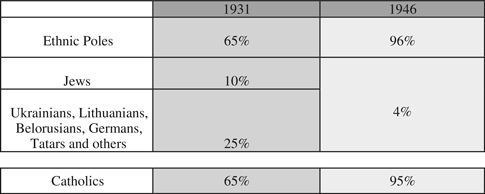
For most of its history, Poland was significantly diverse, populated by people belonging to different ethnic, linguistic, and religious communities. With the advent of World War II and the Holocaust, and with the postwar redrawing of Poland's borders, pogroms, state-sponsored ethnic cleansing, and antisemitic purges, this picture changed dramatically: while ethnic Poles on the eve of the war constituted approximately 65 percent of the Second Republic's population, by the late 1940s they accounted for about 95 percent of the People's Republic. The religious makeup of the population within the new borders changed in a similar manner (Table 1).
Ethnic and Religious Composition in the Second Republic of Poland and the Popular Republic of Poland. Data Sources: Michowicz Reference Michowicz and Tomicki1988; Tomaszewski Reference Tomaszewski, Teich and Porter1993; and Casanova Reference Casanova1994.

The current ethnic and religious “homogeneity” is therefore the byproduct of relatively recent, and very violent, historical events and political processes. Yet it was successfully naturalized in the postwar period by both the state and the Catholic Church. In other words, institutions built or boosted their legitimacy by emphasizing this new ethnonational and denominational homogeneity and suppressing even the memory of diversity. Combined, these processes further tightened the association between Polishness and Catholicism (Zubrzycki Reference Zubrzycki2006: 60–76; Porter-Szűcs Reference Porter-Szűcs2012).
If ideological pluralism was a “politically sensitive” issue under state socialism, systemic transformations after 1989 have not made it less so. In post-socialist and then post-EU Poland, the mere idea of pluralism has been vigorously contested. Intellectuals and politicians on the left and the center, as well as liberal Catholics, typically stress the nation's ideological heterogeneity and argue that in a plural society religion (and Catholicism more specifically) is only one among many competing or overlapping value systems. They therefore demand and defend the confessional neutrality of the state in order to protect the rights of minorities, atheists, or non-practicing Catholics, and to ensure citizens’ equality de jure and de facto. The Catholic Right and the official hierarchy of the Catholic Church, on the other hand, emphasize the “objective” homogeneity of Poland's population, wielding Poland's demographic statistics (“96 percent ethnically Polish, 95 percent Catholic, and 95 percent believers”) to bolster claims of monolithic unity and to legally enforce a narrow vision of Poland. Such statistics were used to support and justify the inclusion of an invocatio Dei in the 1997 Constitution (Zubrzycki Reference Zubrzycki2001) and are often invoked to defend the state's policing of social movements that deviate from an imagined national norm. For example, such statistics were thrown around when gay pride parades were banned in Warsaw in the name of “public morality.” At the occasion of Corpus Christi in 2013, the Archbishop of Kraków, Cardinal Stanisław Dziwisz, gave a new twist to that argument by recognizing that “there exists a plurality of opinions in Poland, [and that] in a democratic society the majority rules.” “But,” he added, “truth is not determined through voting,” which is why “even the parliament cannot create a moral order other than the one deeply inscribed in the heart of man, in his conscience.”Footnote 12 Religious discourse since 1989, then, has been used primarily to constrain individual rights and to shrink the boundaries of Polishness by symbolically excluding those considered “morally unworthy” for full membership—“Jews,” secularists, “bad Catholics,” masons (all code names for Jews), and, increasingly, feminists and sexual minorities.Footnote 13
“Magical Antisemitism”: Idioms of Nationhood and Logics of Exclusion
This form of symbolic exclusion points to an interesting paradox. As we know from a rich literature on nationalism (e.g., Brubaker Reference Brubaker1992; Schnapper Reference Schnapper1994; Yack Reference Yack1996; Nielsen Reference Nielsen1999; Zubrzycki Reference Zubrzycki2001), ideological forms of exclusion are typical of places where the nation is understood in civic terms, and where therefore one's national identity, at least ideally, is determined by his or her adherence to the principles of the social contract, whatever its terms may be. But it ill befits a place where the nation is primarily understood in ethnic terms, following the German, romantic model of nationhood.Footnote 14 In line with this conception, national identity can neither be chosen nor escaped; it is transmitted through birth, “flowing through one's veins,” constitutive of an imagined primordial self.
How is it possible, given this latter, dominant understanding of national identity, to exclude ethnic nationals from the nation? How can the conservative Catholic Right insist on the blood-based character of Polishness while simultaneously symbolically excluding some ethnic members on the basis of their beliefs, political opinions, or sexual orientation? How is the tension between these two modes of social closure—one based on blood and culture, the other on ideological orientations and political bonds—reconciled? In The Crosses of Auschwitz (Reference Zubrzycki2006) I showed how “ideological deviance” from the ethno-Catholic definition of Polishness is ethnicized such that individuals and groups that are not defending the prominent place of Catholicism and its symbols in the public sphere, and are advocating instead a civic-secular Poland, are turned into “Jews.” This logic and the multiple examples of its application in the public sphere, in both verbal and non-verbal discourse, provide rich exemplars of a phenomenon analyzed long ago by Jean-Paul Sartre (Reference Sartre1986 [1946]), who famously claimed that “If the Jew did not exist, the anti-Semite would invent him,” or more recently by Enzo Traverso (Reference Traverso1997), who explained how one can be Jewish merely by virtue of the Other's gaze. Polish public intellectual Adam Michnik refers to this specific form of antisemitism as “magical antisemitism”: “The logic of normal […] antisemitism is the following: ‘Adam Michnik is a Jew, therefore he is a hooligan, a thief, a traitor, a bandit etc.’ Magical antisemitism however works this way: ‘Adam Michnik is a thief, therefore he is most probably a Jew’ (Reference Michnik and Oppenheim1999: 73).”
But why Jews instead of Ukrainians or Germans, also significant Others in the Polish social imagination? A simple answer to this complex question might be that Communism, Western-style capitalism, and cosmopolitanism are all specifically associated with Jewishness, and that Jewishness is an ethno-religious category that many Poles on the Right perceive as the polar opposite of the Polak-katolik (Krzemiński Reference Krzemiński1996; Reference Krzemiński and Kania2001). As Jewishness becomes a symbol standing for a liberal, plural, civic, and secular Poland, Poland is said by the conservative Catholic Right to be ruled by “Jews”—by symbolic Jews—who must be neutralized. Poland is thus host to the apparently curious phenomenon of antisemitism in a country with very few Jews.
Figure 1 captures key components of that type and form of antisemitism. Posted on the Internet, the photo collage is entitled “A very virtual Poland,” and depicts former President Aleksander Kwaśniewski (1995–2005) with his mouth taped shut with a photograph of Joseph Stalin. Kwaśniewski, it is implied, is a communist mouthpiece. In the background are a flag of the European Union, which Poland joined in 2004 under Kwaśniewski's leadership, and a Star of David that Jews were forced to wear during World War II. Here, the visual claim is not only that Kwaśniewski is a communist and a Jew—replicating the longstanding trope of żydokomuna, recently analyzed by Paweł Śpiewak (Reference Śpiewak2012)—but that the European Union, too, is a communist/Zionist plot to take over Poland, implied in the juxtaposition of both yellow stars. Finally, on the top right corner, is the insignia of the Soviet NKVD, predecessor of the KGB.
From http://bardzo-wirtualna-polska.abceblog.com/ (accessed 4 June 2013).
From http://bardzo-wirtualna-polska.abceblog.com/wp-content/uploads/sites/10/2013/08/zydzi-w-polsce.jpg (accessed 4 June 2013).
The second figure does not associate symbols of cosmopolitanism, communism, and Judaism to a political formation, but instead visually transforms political elites of various formations, from left to right, into ultra-orthodox Jews.Footnote 15 The claim here is that Poland is ruled by Jews, a claim made clear in the caption “List of jews in enslaved Poland.”Footnote 16 That process of turning opponents into “Jews” is so prevalent that some liberal Catholic Bishops are often accused of being Jewish. Even John Paul II, recently canonized, is not immune to this magical antisemitism (see figure 3).
Antisemitic graffiti on a mural of Pope John Paul II, in Kraków, summer 2013. It accuses the Pope of being an actor and a fraud, a Jew. (“Z kurwy żyd” is literally “Jew of a bitch” instead of the usual “son of a bitch”) because of his ecumenism and rapprochement with “our older brothers in faith.”). Photograph by Marcin Karkosza, used with his permission and that of Gazeta Krakowska.
SOFTENING SYMBOLIC BOUNDARIES
The very process of ethnicization of deviation from the ethno-Catholic model of Polishness is also at the source of philosemitism. For if ethno-religious nationalists contend that “Jews” are contaminating the nation with their civic ideals, building a pernicious post-national, cosmopolitan world, and must therefore be politically marginalized, “Jews” must for the same reason be resurrected and Jewishness promoted according to proponents of a civic and secular vision of the polity. Precisely because Jewishness carries specific significations and symbolic capital that other minorities in Poland (such as Ukrainians, Silesians, or the Vietnamese) do not possess, it is primarily through Jews and Jewishness that a modern multicultural Poland is articulated. Hence liberal, leftist youth wear T-shirts and brandish posters in protests against clerical nationalists, subversively claiming that they are “Jews,” mocking conspiracy theories of the Right. “I'm a Jew” T-shirts were part of a campaign by the Foundation for Freedom that consisted in “spreading […] slogans signaling the existence of some taboo topics […] and discriminated social groups in Poland,” including atheists and homosexuals,Footnote 17 while a hip clothing label in Warsaw launched a new “Jewish” line called “Oy.” Initially targeted at young Jews, Risk Oy produces relatively pricey T-shirts and hoodies with slogans such as “Thanks to my Mom,” adorned with a variety of Star of David designs and Hebrew inscriptions. The owner of the brand told the Times of Israel, “What we really want […] is to rebrand Jewish identity. We want to show the modern, positive aspects of it. What we are doing is showing that being Jewish is cool and sexy.”Footnote 18 According to Kraków's JCC director Jonathan Ornstein, there might be no need to “rebrand” Jewish identity, since he has been insisting for years now that “It's hip to be Jewish in today's Poland” (personal communications, Mar. Reference Ornstein2011, Mar. 2012, and Mar. 2013). Several non-Jewish volunteers at the JCC and non-Jewish members of a Kraków-based Israeli dance troupe made similar observations, commenting on the fact that “Jewishness is fashionable,” one even adding, “…just like in Warsaw it's fashionable to have a gay friend” (interviews, Mar. 2012).
The important question here is why Jewishness (and gayness) is “fashionable” for some non-Jewish Poles. What does it signify for them? The president of the Joint Distribution Committee (JDC) in Warsaw, Karina Sokołowska, specified in the Times of Israel article on Risk's Oy clothing line, “In general, Jews in Poland are looking for ways to express being Jewish, [but the clothing line] is an attractive item for Poland's many philo-Semites” (my emphasis). One such non-Jew quoted in the story, a forty-year-old lawyer living in Warsaw, explained, “Wearing [Risk Oy] is like taking part in a public discussion about Jews in Poland—that Jews live here and that Jews can live here.” This is an important comment: that public discussion about Jews in Poland is actually one about the very identity of Poland and a critique of the still dominant vision of the nation as ethnically Polish and (nominally) Catholic.
Poking Holes in the Catholic Fortress
Poland is for all because … no one has the monopoly over her.
———Pidżama Porno, punk rock bandFootnote 19It is in the broader context of struggles to define Poland that many non-Jewish Poles’ participation in and support for the revival of Jewish culture and communities takes on its full significance. My interviews with key cultural entrepreneurs and numerous non-Jewish activists suggest that their promotion of Jewish culture is part of a broader attempt to expand what it means to be Polish, to counter the Catholic Right's monopoly over the definition of Polishness (Zubrzycki Reference Zubrzycki, Vatan and Silberman2013) and to build and promote a plural and secular society in a nation-state with an ethnically and religiously homogenous population. What is intriguing for my purpose here, though, is that many of the same people who argue for a secular society in Poland do not object to the public display of Jewish religious symbols and often even support it. Aneta, a long-time JCC volunteer who is expressly anti-clerical and declares herself an atheist, explained to me during a Shabbat dinner: “I think it's great to see all of that [Jewish religious activity]. I'm not religious but I think it's good to see that there's something else than what we already know, and frankly speaking, we're sick of … processions, pilgrimages here and there, crosses everywhere.…”
Evangelical Christians repeatedly emphasized in our conversations that it was important for them to discover Judaism for theological reasons—“to go back to the source” and “get to know Jesus as a Jew”—but also to support the revival of Jewish communities to build a counterweight to what they see as the all-too-heavy presence of Catholicism in Poland.Footnote 20 Moreover, most practicing Catholics among the JCC volunteers and members of the Israeli dance group I interviewed associated themselves with Catholic movements related to what is called in Poland “open Catholicism,” known for being more “intellectual” than ritualistic, close to the liberal Catholic weekly Tygodnik Powszechny, and for actively preaching John Paul II's call for ecumenism and respect for “our older brothers in faith.”Footnote 21 This is why the Pope's message and image are often used to counter antisemitism, and also likely one of the reasons why a mural dedicated to his memory in Kraków was vandalized with antisemitic graffiti, in itself a powerful example of magical antisemitism (figures 3 and 4).Footnote 22
On this mural, painted on the occasion of the 2014 Life Festival in Oświęcim (where Auschwitz-Birkenau is located), John Paul II proclaims that “anti-Semitism is a sin against God and humanity.” Photograph by Ted Pearce, Oświęcim, 2014. Used with his permission.
Some also articulate their support for the revival of Jewish culture partly in opposition to the conservative, reactionary Catholicism of Radio Maryja.Footnote 23 When, at one point in my conversation with another JCC volunteer, Natalia, I mention that the controversial, right-wing Radio Maryja is organizing an anti-government protest in the following days, the middle-aged, well-traveled, polyglot responds: “Argh, I forgot that they still exist.… [But] let's leave these marginals in the margins! Radio Maryja, it's a bunch of old ladies—hopefully they don't have too many young followers. There is a chance, with Jewishness being fashionable, that it means that the young generation is more open [and] that there will be more openness in the future.”
Whether Natalia is right about generational change or not, what is significant for our purpose is that the hegemony of Catholicism and the Catholic Church is not combatted via the promotion of other religious communities such as Protestants, Russian Orthodox, Muslims, or Jehovah's Witnesses, who, while small, do exist in Poland, but rather through Judaism and Jewishness more specifically.
STRETCHING SYMBOLIC BOUNDARIES
Because in the eyes of ethno-Catholic nationalists only “objective facts” like ethnicity and religious affiliation matter, and since ethnonationality is the dominant, if not hegemonic mode of thinking the nation in Poland, many activists and state agencies create visible, countable, “objective” counterweights. They do so in two main ways: by supporting the institutional growth of Jewish communities and thereby introducing Jewish symbols into the public sphere, and by promoting knowledge about Poland's Jewish past and present through a multitude of cultural events.
Materializing Difference
As the earlier quote from self-defined atheist Aneta suggests, the presence of Jewish religious life de facto weakens the hegemony of Catholicism, in a way analogous to the way the cross in the public sphere in communist Poland weakened the party-state's claim of monolithic unity. But while the cross in Poland has come to signify a specific vision of the nation and the polity that has become increasingly contested over the past twenty years (Zubrzycki Reference Zubrzycki2006; Reference Zubrzycki, Bender and Klassen2010), the menorah and the star of David have no such acquired “baggage” for left-leaning Poles who support a civic and secular vision of the nation. Since the mid-2000s, a giant Hanukiah has been lit in Warsaw on the first night of Hanukkah by Chabad Rabbis, accompanied by city and state officials, and the Chief Rabbi of Poland, Michael Schudrich, lights a Hanukiah at the presidential palace. Both events are photographed and publicized. Such practices cannot be cynically seen as mere electoral strategies by non-Jewish politicians, since the “Jewish vote” is of little significance given the small number of Jews in Poland. But they are certainly addressed as much to international audiences as to national constituencies. The Polish state has been keenly aware of the need to rebrand Poland abroad and there can be little doubt that its support of Jewish-related initiatives is part of that process.Footnote 24 Jewish markers, be they religious or secular, serve to visibly create diversity, thereby somewhat diluting Catholicism's dominance. The mechanism at work here differs from the use of readily available “visible” markers to create boundaries and delimit groups: the goal is rather to stretch existing boundaries by making ideological difference visible, “materialized,” and thereby undermining claims of Catholic uniformity. Art and memory projects are an important site for the process of expanding symbolic boundaries.
Social Activism and Memory Work
Fantasies of the past determined by needs of the present have a direct impact on realities of the future.
———Svetlana Boym, The Future of Nostalgia, xviThe first project I will consider is the much discussed and debated 2007 film Nightmares, made by Israeli visual artist Yael Bartana in collaboration with Sławomir Sierakowski, public intellectual, founder and editor-in-chief of the leftist journal Krytyka polityczna. Nightmares showcases Sierakowski as a political leader standing in the middle of an empty Warsaw stadium overrun by weeds,Footnote 25 shouting a forceful monologue he wrote himself and which, he told me, he “truly, genuinely meant”:
Jews! Compatriots! People! […]
You think the old lady who still sleeps under Rivka's quilt doesn't want to see you? That she has forgotten about you? You're wrong. She dreams about you every night … and trembles with fear. Since the night you were gone and her mother reached for your quilt, she's had nightmares.Footnote 26 Only you can chase them away. Let the three million Jews that have been missing from Poland return, stand by her bed, and finally chase away the demons. Come back to Poland, to your country!
He goes on to claim, “This is a call not to the dead but to the living”:
When you disappeared, we were happy. We said “At last we are home by ourselves. Polish Poles in Poland, no one to bother us.” And because we were still unhappy, once in a while we managed to find some Jew to kick out from our country. Even when it was clear that there weren't any of you here, there still were some people who managed to kick you out. And what? Today, it is with boredom that we watch our faces, all similar to each other,… and today we know that we can't live on our own, that we need others, and there aren't others that are closer to us than you. Come live here! We're different but the same! Let's live together! (2013).
Reconnecting with Poland's Jewish past and recognizing the problematic attitude of Poles toward Jews during World War II and its aftermath may be a way to exorcise old demons, but inviting Jews to come back also serves to break the monotony created by an ethnically homogeneous society. While Sierakowski is speaking the words, “it is with boredom that we watch our faces, all similar to each other,” Bartana's camera glances over the similar faces of blond scouts who an instant before were busily stenciling on the stadium green, “3,000,000 Jews can change the life of 40,000,000 Poles.” Bartana plays with the aesthetics of propaganda films of the 1930s. Nightmares is closest to Leni Riefenstahl's work, especially as Bartana's camera lingers on blond children to comment on the ethnically “pure” Poland that Hitler and Stalin ultimately created. Note also that Sierakowski's dream—to have Jews “return” to Poland to free Poles of their nightmares (war traumas and postwar apocalyptic, mono-ethnic reality)—is actually the Right's nightmare.
The film is a commentary on the nostalgia-infused utopian pluralistic Poland desired by a new Left, while at the same time it knowingly participates in that very political fantasy. The project evolved organically through the close intellectual relationships and friendships developed between Bartana, Sierakowski, and members of Krytyka polityczna (interviews with Sierakowski [Reference Sierakowski2012] and Bartana [Reference Bartana2013]). What would happen if three million Jews actually “returned” to Poland? While the first film is about Poland's rapport with Jews, the second and third explore the meaning of Poland for Israel, the implications that a return to Poland by Israelis would have for Palestinians, and the new world that could emerge from that. From a local-national story centered around Polish nightmares and dreams, the complete trilogy (entitled And Europe Will Be Stunned) addresses issues of memory, displacement, and human rights.Footnote 27
Over the years, Bartana and Sierakowski founded a “real” (i.e., non-cinematographic) “Jewish Renaissance Movement in Poland,” replete with a manifesto, congresses, delegates, and supporters advocating for the return of Jews to Poland and human rights more broadly. This further blurred the line between art and politics, fiction and reality. The important point for my argument is that building a plural, multicultural Poland in the present is achieved not through the small but existing and visible groups like the Vietnamese, who constitute the largest ethnic minority in Warsaw, or through Silesians, the largest ethnonational minority in Poland, but through Jews—“real, living ones” whom Sierakowski invites to return to Poland, or long-gone ones, like Rivka, who are now missed and remembered. In the trilogy, it is the return of Jews to Poland that renders other minorities visible and relevant. In that discourse, a multicultural Poland is created by, and made possible thanks to, Jews.
Longing and Phantom Limb Pain
The “missing” and “missed” Jew is at the center of another memory project initiated by performer Rafał Betlejewski. His project, called “I miss you, Jew,” endeavors to recover the “true” Poland that has been lost with the disappearance of Jews from the national landscape. In a series of graffiti works and happenings throughout Poland, Betlejewski writes, with the active participation of local populations, “I miss you, Jew. I miss you in Poland, in all these little villages and big cities. You left a [void] there. Both in space and my heart. I just wanted you to know that. Polak” (http://www.tesknie.com/index.php?id=50). The graffiti was often painted in spaces formerly occupied by Jewish individuals, families, or communities to memorialize their lives. Groups of memory activists pose, for example, in Poznań's former synagogue, “repurposed” as a swimming pool by the Nazis in 1940 (figure 5); by a store; in a train station; in the woods. Betlejewski would also photograph himself and others in various sites next to an empty chair, signifying the missing—and missed—Jew, and post the pictures on a dedicated website/memory book. At the bottom of the main webpage, in Polish, is a banner stating, “For Poles, the synonym for the word zagłada [genocide] should be the word ‘loss’” (http://www.tesknie.com/index.php?id=32).
“I miss you, Jew” happening in the Poznań New Synagogue, built in 1907 and repurposed as a swimming pool for Wehrmacht soldiers by the Nazis in 1940. Recently it was converted into a gallery space, and plans to establish a Center for Judaism and Dialogue are under discussion. Source: © Rafał Betlejewski, used with permission of the artist.
Combatting antisemitism by purging the word “Jew” of its negative connotations in Polish is just one of this project's aims;Footnote 28 it also works to reclaim the memory of a part of Poland and Polish national identity that is experienced much like a phantom limb pain.Footnote 29 That is, the tragic “disappearance” of Jews and Jewish culture from Poland is presented (and increasingly experienced) in many Polish milieu as a tragic loss for Polish culture, and it is in that name that it must be rescued, saved, revived.
The website also provided a venue where Poles could post remembrances—their own, their parents’, or their grandparents’—of specific Jewish individuals or vanished Jewish communities. Here are two evocative examples of the sort of testimonies that appear there:
I miss you, Jew! I live in western Wielkopolska. Today I'm twenty-one years old and I deeply regret that I was not given the opportunity to know the entire history of my town. In the very center of Wolsztyn stood a beautiful synagogue, just by the square. Today there is no trace of it. I want to retell the history that my great-grandfather told my grandmother, and which she then told me. During the war my family had a big farm. The entire day was spent working in the field, especially during the summer time. That field was next to a forest. One day, some Jew who was hiding in the woods came to ask my great-grandfather (…) for food. They agreed. I remember how my grandma described the fear, even if this was a village…. They left food in the woods, between trees, and that Jew, I don't know his name or age, took the food and hid himself underground. This didn't last too long, probably a few months. One day the food was left untouched. Same thing the following morning. I don't know what happened to that Jew but I hope that he survived! Jew, I miss you! I would very much like some day to talk with him, ask how he managed, help him find his roots. I very much regret that there are no Jews left in Wolsztyn. It is a huge loss. I'm also sorry that in 2009 someone burned the synagogue. We still don't know who did it. I only hope that someday I'll see a smiling Jew who will be walking the streets of my town and be part of it, like it used to be (Aleksander, at http://www.tesknie.com/index.php?id=1416).
So little and yet so much was left after them. The history of Łęczna Jews is just as incredible as it is forgotten. But I remember. And I long (Bajka, at http://www.tesknie.com/index.php?id=1408).
The second example is a brief yet eloquent commentary on history, memory, and longing, but without details or story. The first testimony, on the other hand, relates a specific incident lived by the author's grandparents, part of familial memory (and perhaps mythology). It is an earnest narrative with typical details and holes, and the author's hopeful but naïve idea of what a Poland with Jews was and would be like. Svetlana Boym defines nostalgia “as a longing for a home that no longer exists or has never existed” (Reference Boym2001: xiii). It is that home that many Poles are looking for. But nostalgia is also “a romance with one's own fantasy” (ibid.), which Aleksander's testimony exemplifies: “his” memory ends matter-of-factly with a passing comment on a recently torched synagogue, but without any critical reflection on what the relationship could be between the past event he recalls, his own nostalgia, and the antisemitism that endures. Jewish absence facilitates the nightmares of the Right and their negative stereotypes of Jews, but also the dreams of the Left. The Jewish body is an empty container, filled with Polish aversions, fears, desires, and aspirations.
RESHAPING SYMBOLIC BOUNDARIES
Poland is for all because … it has always been for all. For centuries, Poland prospered because of its multi-ethnic and multi-religious population. It culturally and spiritually enriched Poland in the past and we can only pray that it will continue to do so in the future.
———Michael Schudrich, Chief Rabbi of PolandFootnote 30The multiple festivals of Jewish culture in the four corners of Poland seek to educate Poles (and tourists) about the culture of Jews who once lived in Poland and contributed to Polish culture. The claim is not merely about mutual influence: rather, Jewish culture is constitutive of Polish culture. Polish culture, these activists claim, is not only about Catholic practices and folklore. It is about broad universalist values that have shaped a long tradition of “religious tolerance” and “civic openness” that led to the flourishing of Jewish religious and communal life, prosperous Jewish towns and peaceful shtetls, and Polish culture. As Janusz Makuch, the co-founder and director of Kraków's Festival of Jewish Culture, told me in one of our conversations:
Whether people know it or not, it is a fact that Jews, for many, many centuries,… made tremendous contributions to Polish culture. So when we're talking about Polish culture, we're equally taking about Jewish culture. Without the contribution of Jews, true Polish culture couldn't exist. Forget it! Literature, architecture, sculptures, historians, intellectuals, music, economics, politics, food. So everything was intertwined and still is, thank God. What I'm trying to do … is to help Poles realize what is theirs (1 Mar. 2012, original conversation in English).
The recognition of the Jewish past and the presence of cultural markers in contemporary Poland therefore allow public figures, teachers, and activists to plausibly argue for a civic definition of Polishness. Because in the postwar period the communist regime coopted (and corrupted) civic discourse, that vision of the national community is often perceived as “foreign.” Today's civic nationalists must work harder to create a plausible and desirable civic project. To render that vision of the nation legitimate and “truly Polish,” they reach into the distant past and re-narrativize Polish history to emphasize ethnic and religious diversity, political openness and tolerance, and political freedom. They point to the large number of Jews who settled in Poland as evidence of the historical roots of a Polish civic nation. Poland's historical religious tolerance also allows them to articulate a discourse that sets Poland apart from other European nations. As I heard so many times in various venues, “When Jews were being kicked out from Southern and Western Europe, King Kazimierz the Great was welcoming them in Poland.” That narrative of Polish exceptionalism is significant, and I will return to some of its implications, but here I want to emphasize the link that cultural entrepreneurs, public intellectuals, artists, and ordinary citizens make between Jews and Poland's Europeanness. For Mirka, a woman in her early twenties who had been volunteering at the JCC for two years when I met her, the presence of Jews in Poland would allow Poles to feel more at ease in the new Europe: “I'm totally for Jews living here, as it was before, as it was before the war. Then it would be more comfortable for us in Europe because we'd be more open, more understanding toward differences in general.” At one point in Bartana's Nightmares, Sierakowski implores Jews to return so that “we shall finally be European.”
The promotion of Jewishness in festivals, memory projects, and many other institutional projects are also thought to be bringing Poland back to her “true essence.” In the words of Makuch, “Kraków was always a multicultural place, where cultural pluralism was often very obvious. However this national monotheism, religious monotheism, that was created after the Second World War is scorching me, hurting me. I really don't like this—so let's go back here to what is the basis of our spirituality, actually, since Jews were Polish citizens” (interview, 19 Mar. 2011). That discourse has been perfectly integrated by various groups involved in the Jewish revival. Ania, a woman in her late twenties who dances in the Israeli dance group as a hobby and is a practicing Catholic, explained to me that she wants to learn about Jews and Jewish culture to better know herself as a Pole:
Well, basically, there has been a Jewish presence in our country (u nas) for eight hundred years, on our lands, here in Poland, so there is this influence that we don't remember anymore because there are almost no Jews left in Poland. There are very few. [But it's important to know that culture] so that we can better know ourselves. Our identity, who we are, what we have— … we owe [it] not only to ourselves, but also to other communities who lived here. And Jews lived here in great numbers. So we owe them for their contributions in the academic and scientific sphere where there were a lot of Jews, and in the administration here in Kraków. There were Jewish mayors, many well-known lawyers at Jagiellonian University, many architects, in music too. So they contributed a lot. In literature too! They were a big influence. Not long ago I was talking with friends about hospitality, how Poland and Poles are known for their hospitality (kind of), but that hospitality actually comes from Jewish culture!”
In this discourse and related practices, modernity, Europeanness, and multiculturalism, as well as cultural forms and national traits, are achieved through and thanks to Jews.
In another key passage of his speech in Bartana's Nightmares, Sierakowski deplores that with “one color, one cannot see.” To properly see, one needs more colors, and for many Poles Jews bring that metaphorical color. The posters advertising Kraków's Festival of Jewish Culture in the past two decades provide a rich visual demonstration (figure 6). The use of color is certainly meant to connote the life and vibrant culture of Jews rather than the greyness and stark black and white photographs associated with the Holocaust (exemplified in Schindler's List). However the consistent use of rainbow colors is also meant to convey the diversity that Jews represent and bring to Poland (interview with Janusz Makuch, 1 Mar. Reference Makuch2012). That visual scheme has been extended and used by multiple organizations fighting antisemitism and promoting Jewish culture and multiculturalism. Jews, whether in the past or the present, “real” or “symbolic,” allow Poles to build a multicolored, pluralist Poland against the mono-ethnic white and red, and the black shirts of neo-fascist groups.
Posters from Kraków's Festival of Jewish Culture, 1994, 2002, 2003, 2004, 2006, and 2009. Source: © Jewish Culture Festival Society, jewishfestival.pl.
“Our Jews”: Otherness and Indigeneity
There aren't Others that are closer to us than you.…
We're different but the same! Let's live together!”
———Sierakowski, NightmaresThis still begs the question: why do those who wish to build pluralism focus on Jews instead of Silesians or Vietnamese? One explanation that I have already provided is that Jewishness carries a specific signification and symbolic capital: modernity, cosmopolitanism, urbanity. Another is that Jews are basically absent from the Polish landscape and are therefore both non-threatening and available to be filled with one's fantasies: nightmares or dreams depending on one's political orientation. Yet another reason is that Jewishness, unlike Ukrainian-ness, Silesian-ness, or Vietnamese-ness, is at once exotic and somewhat “indigenous.” It is different enough, yet as Kasia told me in a conversation in 2012, it “was nourished from the Polish soil and grew on these lands.” Ola, a Lutheran from Silesia who majored in Judaic studies and art history and is now a museum educator in a Catholic institution, explained: “On one hand, [Jewish culture] is, let's say, ‘oriental.’ But on the other hand, because it developed in Poland, in spite of everything it's somehow very much tied with Poland, yes? It's kind of an exotic element in our environment. It's not something like … Swahili somewhere far off in Africa, but [rather] something that is different from Polish culture yet at the same time related to it, inseparable even.” It is that duality—exoticism and familiarity—that according to another JCC volunteer makes Jewishness so appealing for non-Jewish Poles: “We could talk about [Jewish culture] as a foreign culture, different from Polish culture if we wanted … to separate, but we are still aware that we're talking about a culture that was here for centuries. But it's still something exotic, right? And yet, totally close to us. So it's easy to become interested in [Jews and Jewish culture] and become fascinated. It becomes fashionable.”
Jewishness is thus both “Other” and “Ours,” an observation made spontaneously by countless other interviewees. As another young woman who volunteers at the JCC told me, “Jewish culture is ‘exotica’ right here at home.” It is the ideal indigenous Other. In that discourse, to revive Jewish culture allows Poles to become “authentically” multicultural. It allows the recovery of a truer national self and the reshaping of symbolic boundaries of the nation through the Other. This is an Other whose extermination was grossly silenced for half a century, leaving a mnemonic void that a new generation of Poles is eager to uncover and discover to become more authentically Polish. Embracing pluralism and Jewishness is not only part of branding Poland as modern and European; it is also giving Poland back her “true” shape.
CONCLUSION
The extermination of Jews and destruction of Jewish culture in Poland is presented, and increasingly experienced, in liberal intellectual, artistic, and ecumenical milieu as a tragic loss for Polish culture and identity, and this is why it must be rescued, saved, or even resurrected. Poland, individuals in those groups argue, is not homogeneous. But instead of emphasizing the ideological heterogeneity of its current population as a legitimate form of diversity, they emphasize its (ethno)cultural heterogeneity, the result of an ethnically and religiously diverse past. By creating “objective,” tangible, visible, countable—and growing—Jewish Others, a new generation of social actors and cultural agents implicitly and often explicitly contest the claim of the nation's ethnic and religious homogeneity. Symbolic boundaries in contemporary Poland are thus being redefined by overlapping discursive and performative practices: they are softened by poking holes in the ethno-Catholic fortress, stretched through memory work, and reshaped by discursively naturalizing and “indigenizing” Jewishness as “Polish.”
This is not to say that Catholicism's hegemonic place in Poland is only or even primarily contested and countered via the support of Judaism and Jewish culture. It is also operated via movements of religious exit (such as apostasies), formal demands for a stricter separation of church and state, and support of the rights of various alternative groups, primarily sexual minorities and feminists who, significantly enough, also support the revival of Jewish communal life since they understand their minority status and struggle as being shared by Jews. Nor am I denying that the “revival” is also about other important projects and processes, for it obviously is. What I have argued in this article is that there exists an elective affinity between non-Jewish Poles’ support of, and participation in, the revival of Jewish culture and preservation of Jewish memory and their desire to build a Poland that is different from the one forcefully promoted by the Catholic Church and the Right. Resurrecting Jewish culture and actively supporting Jewish communities’ revival of Judaism gives concrete shape to seemingly amorphous ideological pluralism in order to trump the “hard” demographic “facts” of Poland's ethno-religious homogeneity,Footnote 31 and as a way to neutralize Catholicism as a religious tradition with political traction.
These discursive and performative strategies do not whitewash history to erase traces of antisemitism. For many of my interviewees, “revelations” of violent crimes committed against Jews by ethnic Poles (e.g., Gross Reference Gross2000; Reference Gross2006; Gross and Grudzińska-Gross Reference Gross and Grudzińska-Gross2011) sparked their initial interest in Jewish history and culture. Likewise for consciousness-raising efforts such as Betlejewski's “I miss you, Jew” project. He explained to me in 2011 that learning about the 1941 murders of Jews in Jedwabne was a “life-changing event” for him as a person and as a Pole. Nor are these discursive and performative strategies purely instrumental: I am not asserting that the people involved are not genuinely interested in Jewish culture or Judaism, or that they do not care about the memory of those murdered in the Holocaust. But in their artistic creations, beliefs, discourses, and actions, and alongside and through their cultural investments in Judaism, they weave their individual identities and private life-projects into a vision of Poland that is severed from that presented by Polonia semper fidelis.
By showing the varied processes through which ethnic, religious, and ideological identifications are constructed in everyday life in the present, managed through discursive recourse to the past, expanded through institutional affiliations, and legitimated by government programs and agencies, this case study makes the following contributions to the literature on nationalism and cultural sociology more broadly:
First, it shows us how a symbolic category—here Jewishness—can serve as a foil to construct not only an exclusive ethnic nation, but also to build an inclusive, civic, and secular nation. I have shown that in Poland the national self is being built not only against the Other (the Jew), but also through that indigenous Other in opposition to an alleged primordial “self”—the ethno-Catholic Pole. This is more than the simplistic story of philosemitism opposing antisemitism—or “anti-antisemitism.” Rather, Polish philosemitism is part of a larger process of redefining national identity. Jewish culture is but one thread woven into the dense tapestry of the civic national counter-narrative, yet it is an especially important motif given both the long history of Jews on Polish lands and the trauma of their eradication from the national landscape. It is also important because it helps the state to rebrand Poland on the international scene, a motivation that cannot be ignored.
The Polish case shows just how complex the process of national redefinition can be, since in order to expand the definition of Polishness, difference must be introduced and legitimated. And that difference implies the maintenance of symbolic boundaries. As Eviatar Zerubavel has powerfully shown, “In order to focus on anything, we must perceive some discontinuity between that which we attend and that which we ignore.… It is boundaries … that allow us—visually as well as mentally—to grasp any entity at all” (Reference Zerubavel1991: 118–19). While it is by including Jews in the national narrative and conception of a new national self that the symbolic boundaries of Polish national identity are stretched and reshaped, it is so precisely because Jews are “different,” “Other.” The inclusion of Jews within the symbolic perimeter of the nation in order to redefine Polishness does not, and cannot, de-Otherize the Jew. The Jew must irremediably remain Other. The study thus highlights the tension that is intrinsic to expanding the symbolic boundaries of the nation through the Other, because that Other, whether real or symbolic, remains malleable at the hands of those who control the category. The symbolic power exerted to “articulate the principles of vision and division” for a particular group, to quote Bourdieu (Reference Bourdieu1991), is thus still “violent” even when it is used in progressive projects meant to expand the symbolic boundaries of the group.
Secondly, this study shows how what Brubaker (Reference Brubaker1992) has called “idioms of nationhood”—cultural schemes or ways of conceiving one's nation—shape not only formal rules of membership (i.e., citizenship), but also the logic of symbolic membership. That the nation is generally imagined in ethnic terms in Poland (and in the region more broadly) explains why certain members are symbolically excluded from the national community for their political ideas or values by being “ethnicized,” by being turned into ethnonational Others. It also explains why proponents of a civic vision of the nation cannot rely on its abstract principles to sell that project and must resort to recreating Jewish culture as “real,” as a visible counterweight to the ethno-religious national community. Paradoxically, then, ethnicity remains the prism through which social actors attempt to transcend ethnonationalism. My point is that one has to pay attention to dominant idioms of nationhood to understand not only formal political modes of inclusion or exclusion via citizenship, but also the logic of symbolic inclusion and exclusion in nationalist discourse and practices.
That observation also helps us to understand other cases. Consider France, the archetype of civic nationhood, where inclusion into the national community is premised not on blood but upon one's adherence to the social contract. How can the French Right legitimately exclude threatening ethnic and racial others? It does so by ideologizing them, by turning Arabs and Africans into dangerous Muslims who threaten the Republic by infringing upon secularism, a sacred tenet of the social contract.
Third, this work contributes to the scholarship on nationalism and everyday life which has shown that the construction of national identity is a process that operates not only at the level of elite discourse and institutional (re)arrangements, through official policies or state-sponsored institutions such as museums, educational programs, or NGO outreach actions, but also through memory work, cultural initiatives, and everyday practices undertaken by multiple actors in a variety of venues (Billig Reference Billig1995; Brubaker et al. Reference Brubaker, Feischmidt, Fox and Grancea2006; Fox and Miller-Idriss Reference Fox and Miller-Idriss2008). What I have shown here is that these practices do not serve to reproduce an existing national identity but to de- and re-construct identity along new lines. Polishness is being challenged and redefined by activists and artists as well as by ordinary people in their mundane activities. Multiple forms of memory work such as graffiti art, walking tours of formerly Jewish spaces, commemorative marches, or the cleaning and restoration of cemeteries all serve to undermine the political claim and the dominant view that Poland is essentially, primordially ethno-Catholic. Ordinary Poles become involved in the revival and assimilate Jewishness, to the extent that it becomes “Polish,” through embodied and repeated actions—by learning how to “cook Jewish” or how to serve and consume Jewish foods during a festival, at a café all year round, or at a Sabbath dinner at the JCC; by singing and dancing; by learning Jewish paper-cutting techniques; or by donating their time and energy to Jewish individuals and organizations.
Finally, this study contributes to the literature on symbolic boundaries by showing the intricate processes through which the line separating the national self from the Other is negotiated and redrawn on the ground. I have identified three main, diachronic, and overlapping processes at play in the redefinition of national identity: softening, stretching, and reshaping. I showed that in order to expand the notion of what a given national identity “is,” dominant visions must be undermined. In the Polish case, that softening process is primarily achieved discursively, through critiques of the Catholic Church. Symbolic boundaries are stretched by making the contemporary Jewish presence visible and by materializing traces of the Jewish past. The stretched boundaries of Polishness are reshaped and legitimated by Poles participating in cultural work that indigenizes the Jew and Jewish culture, thereby naturalizing an alternative model to the dominant one that links Polishness to Catholicism. In that narrative, it is the pluralistic Poland that is the “true” Poland, while postwar Poland is a casualty of the Nazis and Communists, taken hostage by the Catholic Church.